
 Ask ChatGPT


 The High Performance Podcast
17 Feb 2025 · 55m
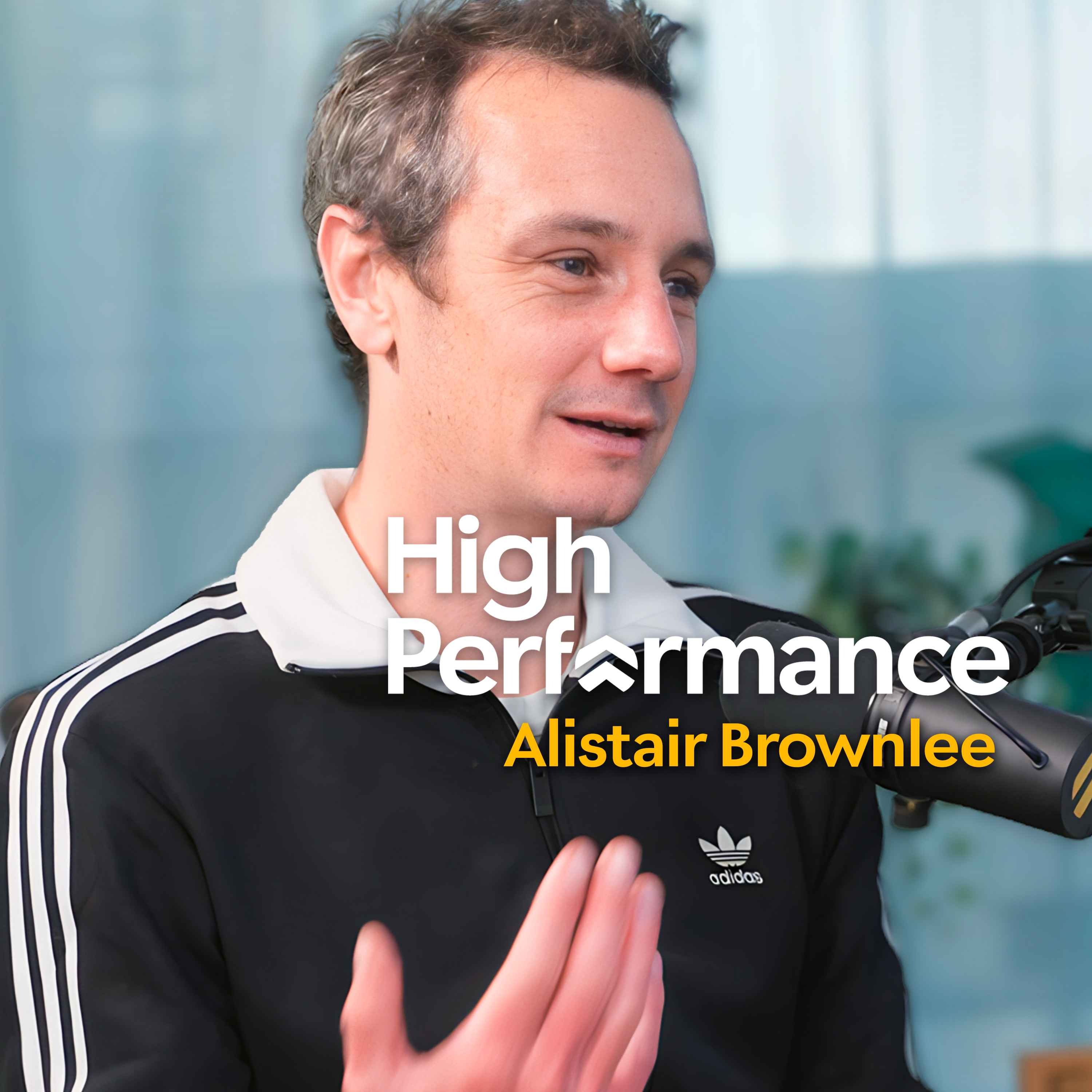
In this episode of The High Performance Podcast, hosts Jake Humphrey and Damian Hughes engage with two-time Olympic gold medalist Alistair Brownlee. Brownlee reflects on his illustrious career in triathlon, including his decision to retire, the mental and physical challenges of elite sport, and the importance of hard work and belief.
Written by AI. May contain mistakes.

Get the gist, explore an idea or ask about something said.
 Claude
On The High Performance Podcast, what are the key points of this episode?
Searching your listeningAutomatic transcript. May contain errors.
0:28Watch it early on the High Performance App. and in sport. In fact, sport does require that at the top level. It requires you to be incredibly selfish, but sometimes you do just need to help your brother out. That's the voice of two-time Olympic gold medalist Alistair Brownlee, who wasn't just the best in the world at triathlon. He redefined the sport. Listen to Alistair describe just why he hates talking about that famous clip of him carrying his brother over the line. How he'd use different types of motivation to help him get to the top and then stay there. And how he redefined his relationship with pain.
1:05Alistair didn't just win, he dominated. Let's understand how, as we welcome Alistair Brownlee to High Performance.
1:18Alistair, welcome to High Performance. It's great to be here. Thank you for having me. Well, I want to start with a quote from your brilliant book, Relentless. I'm petrified by what awaits, not by potential failure, but just by retirement. You've just recently announced your retirement. So how are you feeling? Well, yeah, I wrote that, I think four or five years ago now. And yeah, fast forward those years, and I decided to retire from sport, officially retired two months ago. At the moment, I feel really, really good about it, to be honest. Sport has been my life. I've been a professional athlete for 18 years.
1:56I'm 36 now. So it's half my life. I was taking sports seriously before then. So on one hand, it is an enormous shock. You know, imagine a life where pretty well, the vast majority of days, 75 % of those days, I've got up to go swimming in the morning. The other days I've got up to do something else, literally thousands of times. And all of a sudden, that's not there. So on one hand, you know, that structure, routine, regiment the goals the the processes are not there but on the other hand um the opportunities that's opened up the time the opportunity to do sport for enjoyment and different challenges the opportunity to um use that focus and energy to do other things and it's all amazing well we're going to come on and talk about that focus and energy that you had but i'm interested in when did you know it was time to step away from elite sport i don't think there was a definitive moment I think, you know, I can make anecdotes up about definitive moments, but I think over the period of the last couple of years, it came on me slowly, that brilliant quote of going bankrupt slowly and then all at once.
3:04But yeah, it came on me slowly. I think at the beginning of last year now, 2024, I was probably 50-50, and then I just got more sure, I think, throughout the year. And I just knew it was time. It's funny, isn't it, sometimes? I'm a very analytical kind of objective person and decision maker. That's the processes I go through. But I just felt it was a very instinctive decision and it was the right thing at the right time. One of those anecdotes that I like to tell that kind of isn't true but has an element of truth to it is through the work with the International Olympic Commission, I was in Paris at the Olympic Games and I stood on the pontoon next to all the competitors who were about to start and dive into the river.
3:48And I was stood there before the horn goes off, which is the most nerve-wracking part, I think, of any sporting competition just before you start. And I thought, you know, thank goodness I'm here, stood here, spectating. And I definitely thought, yeah, I think that's quite telling because I wouldn't have thought that 10 years ago. There's that quote though, isn't there, that athletes die twice, one when you retire and then when you die for real. So how have you gone about making that transition from being Alistair Brownlee the triathlete that you're so synonymous with to being Alistair Brownlee the man?
4:19I think two things for me my identity was never completely tied to being a triathlete but I think I always actively tried to have lots of other things going on whether that's work with the foundation you know writing a book things in business things in sports administration I actively sought out kind of opportunities and other areas of interest and then on a similar vein I've been preparing for retirement for probably you know the last five or so years and you know not necessarily actively thinking I'm going to retire on this date I want to have this opportunity lined up but I've been very much knowing I'm going to retire at some point in this time frame I'm the kind of person that needs something to do you know I've got this pathological fear of kind of having nothing to do and you know getting out of bed and by 11 o 'clock you think, oh, I don't know what to do with the rest of the day, you know, head down the pub.
5:13I need kind of structure and I need things that keep me interested and engaged. So I've been able to kind of plan and engage in some of those things, experience those things, kind of play at things in some ways to work out what I enjoy and what inspires me. See, I'm really interested by that bit of having like an eclectic mix of different interests. So because like there's a common narrative in lots of elite sport that your focus needs to be singular, you need to be dead-eyed on what your targets are, and yet you're advocating having a range of different interests. What did that do for you? Yeah, I think having a range of interests is really important.
5:52I think from a sporting point of view, being able to have a kind of, A, being able to step off the sporting field and have other focuses, I think is really important. So you're not tied to your sporting identity. We all know a lot about that. the impact that has when you're injured or ill and the psychological issues you can have but also be i think to give you um perspective and of course that doesn't mean that you can't be hyper focused when the time comes i mean for me that really is the essence of performing high performance in sport um you know what mental state do i need to be uh when it in when it really matters and yeah that's in competition sometimes in training um and then outside of that you know what can you do to increase the focus in that moment and give you perspective and give you other interests and help you recover and all those things.
6:44So can we talk a little bit about your background then because you're synonymous as well as synonymous with being the triathlete, synonymous with being from Yorkshire as well. It's almost like your background and your performance is stitched into the environment. Would you tell us a bit about it? Yeah I had a very I guess kind of normal background in lots of ways a very amazing kind of stable family life I'm one of three brothers my mum and dad and the three of us lived in in Leeds or just kind of on the edges of Leeds in Yorkshire mum and dad were were very active my mum had been a swimmer in her past and my dad had been a had been a runner and I think they just encouraged us I think firstly to try all sports which I think is fundamentally so important for young people you know try get exposure to everything you don't know what might inspire you and that's very much our philosophy with the foundation um expose as many people to activities you can but also just a love of the outdoors and being active you know my memories is uh every every single weekend being dragged out sometimes before I learned to enjoy it dragged out to walk this walk over the moors here or walk up this hill or cycle here, possibly more than the sport, actually.
8:02That love of being outside and activity was really crucial. Growing up, I, yeah, very much my parents and focus was academic and not so much sport. I loved my sport. I was doing swimming, cycling, running, triathlon by the time I was in my teens, starting to train quite hard. Wasn't particularly good at it to start with but slowly got better through my teenage years and trained a lot with my younger brother Johnny who was following a very similar path and he was most of the time the perfect training partner and we got it amazingly sometimes we didn't and that was it really I lived a very kind of I think simple life of going to school working really hard yeah that's probably another thing I would say that, you know, my, the philosophy of my mom and dad was kind of, it doesn't really matter what you do, you know, just do it to the best of your ability.
9:02Be good at what you do. Work hard at it. Focus. A very kind of meritocratic, hardworking, kind of good Northern outlook, I guess.
9:23Go to Upwork.com today and start hiring proven freelance talent fast. No bulky overhead. No rigid long-term contracts. Just the right expert right when you need them. Work smarter and faster with Upwork. Go to Upwork.com now and find your freelance expert. That's U-P-W-O-R-K.com. Post a job for free and get started today. If you're a custodial supervisor at a local high school, you know that cleanliness is key. and that the best place to get cleaning supplies is from Grainger. Grainger helps you stay fully stocked on the products you trust, from paper towels and disinfectants to floor scrubbers.
10:01Plus, you can rely on Grainger for easy reordering so you never run out of what you need. Call 1-800-GRAINGER, click grainger.com, or just stop by. Grainger, for the ones who get it done.
10:18This episode is brought to you by Opera Air. the first browser with mindfulness at its core. Now, most of us spend hours every day online, but how often do we pause to take care of ourselves whilst we're doing it? And that's where Opera Air comes in. It's a lightweight, fast, secure browser built not just for productivity, but for your well-being. With Opera Air, mindfulness is built right in. You'll find free breathing exercises, guided meditations, and soundscapes with ambient sounds, lo-fi music, and binaural beats, all designed to help you focus, relax and even spark creativity while you browse.
10:55Let's talk about the hard work stuff because some of the stories about your childhood that you choosing to forgo getting on the school bus. Tell us a little bit around some of those examples of what hard work looked like. At the time I definitely didn't see training as hard work, although maybe I'm looking at it through rose-tinted glasses, but I worked out relatively early on that endurance sport is basically a capacity game. The more of it you can do, the more load you put through your body, the bigger response over a period of time. And so I was actively trying to work out how I could fit the most training in a day.
11:34And I've always been really into efficiency and making the best use of time. And I was thinking, oh, I'm sat on a school bus for 40 minutes a day or whatever it is. I could be using that time to commute. So anyway, it took a bit of time, I think, to convince my mum that it was okay. And I think the first few times, my dad actually cycled almost all the way with me and then all the way back to make sure it was okay. But yeah, it's one of those fascinating things in life, you know, by the school that my parents sent me for zero sporting reasons at all, completely for academic reasons. turned out that firstly I could cycle mostly there up a really nice traffic-free canal towpath every morning.
12:19And secondly, had a teacher there who took people out running every lunchtime. And those were two massive factors in my sporting development. And you talk in your book around a concept called the Kohler effect that you've just articulated there. Would you tell us a bit more around what you understand that to be? The essence of the Kohler effect is that you're a kind of product of the people you surround yourself with on many different fronts one of the great questions i think in in where sporting success comes in people is how much down is uh down to pure chance um you know you you come across great people uh who support you on that journey and uh you know that's that's luck or you you choose people i was very fortunate from a young age to be surrounded by all kinds of amazing people.
13:09And I think I got a lot of motivation and my inspiration from people who were, you know, who were close to me. It could have been someone who was a bit older than me at the swimming club who I respected or a coach, a teacher that took me out running every lunchtime, you know, incredible kind of dedication to the cause. I met two fantastic coaches when I was about a 14-year-old in Malcolm Brown and Jack Maitland. I had a great bunch of friends who also cycled and ran and would go out and explore on the weekends. So through a bit of luck, through maybe a very little bit of planning, I did kind of surround myself, I think, in an environment that was just very conducive for training a lot.
13:53You've spoken about different drives and you're renowned as being one of the hardest working athletes, someone that seems to have that constant unerring drive to improve and to get better. What was it that drove you? I don't think you can ever answer this question completely kind of analytically. I think ultimately it's lots of things at different times. I think in some ways I was just driven because I just was. I had some kind of innate drive and whether that is really innate or kind of a nature nurture or whether it came from my parents telling me, you know, it doesn't matter what you do, just do it well.
14:32But on an individual session, One of the things I really learned from writing the book was, I think the people who are very successful over long periods of time in all kinds of disciplines, you know, I spoke to Ronnie O'Sullivan, Snuka, AP McCoy as a jockey and loads of other people, is they work out what they need to motivate them in that particular setting to do what they need to do on that day. And that could be many different motivations, even in the same session. So, you know, for me, sometimes I would go swimming in the morning it'd be part of my life so the alarm goes I'm getting up and you motivate yourself to get out of bed to get a cup of tea and then you motivate yourself to get in the car and then you motivate yourself to get out the car and on the pool because you're going to interact with your friends so you know there's a social motivation there and then you motivate yourself to get in the pool and you know in the space of that 30 40 minutes there could be 10 different forms of motivation and then finally you're racing up and down you know racing Johnny in the lane next to me and that's a competitive motivation and that was my way of getting me from if you're sat in bed thinking should I go swimming or not this morning or should I go I'm going to be racing up and down the lane as hard as I possibly can in in 40 minutes time you're just never going to get out of bed so yeah you have to break it down and and find what motivates you for those particular moments.
15:55So let's fast forward a little bit then through your school career because you start off you finding the different motivations you start to progress and get better and at the same time you find yourself being offered a place to study medicine at Cambridge University it's the enviable position for so many students you chose to walk away from it tell us about that it was obviously a very hard decision um I loved uh academics and I loved studying. I really enjoyed studying sciences at school and my mum and dad encouraged that and at the same time I was encouraged to I guess research and read about the science that interested me which was you know the human body and exercise science and so that you know that was a real passion of mine.
16:45I applied to study medicine and had a place to study medicine at Cambridge and And it was a really difficult decision because at the very same time, all of a sudden, my sporting career had taken off. I'd kind of gone from the year before, I think I was 40th or 50th in the junior world champs to that year I won the junior world champs. And I think that was weeks before I was going to start going to university. And all of a sudden, yeah, I mean, I could have sponsors. I could actually make a living out of triathlon, which I didn't know was possible really before that. the Olympics this is the end of 2006 so the Olympics are less than two years away and we know that the Olympics are going to be in London in six years time so it was a tough decision and my dad ultimately said you've got this amazing opportunity you should at least go and try it and he definitely thought if I got there that would be it I would commit but at the same time it was absolutely the right thing to do because I know I did go and try it it was a fantastic opportunity I would have loved to carry on I kind of always had in the back of my mind I'd probably go back and study medicine at some point but it also made me really sure that triathlon was absolutely the thing that I wanted to do and when I made the decision to focus on my sport I was making a really positive proactive decision that I could be doing something else amazing and I better make the most of the opportunity to do sport.
18:13So what advice would you give to anyone that might be in a position where they've got two choices and wondering what path to tread down? I think firstly, it's a very difficult position to be in. So don't be afraid to struggle with that situation, especially where it is one of those life kind of determining things potentially. Yeah, however you look at it, that definitely was. So yeah, don't be afraid to struggle. I think don't be afraid to try and make it as analytical as you can. Write pros and cons. But ultimately it has to be an intuitive decision. There isn't going to be a way to objectively decide.
18:59I always found that by going out running and thinking about it in a kind of clear headspace environment, you just think everything becomes much clearer. and yeah for me that was just a very instinctual decision and I made it and thankfully looking back it turned out it was a good one but it could have very could have not been. So you did make the decision you did commit and go all in what was it that you think gave you your edge as a competitor? I was absolutely determined to be the very best I could be so I think from a physical point of view I worked out early a way of training that suited me and I constantly innovated to try and add a bit more training here do something slightly different try if something worked out or not to really optimize what I was doing and I think psychologically I think from maybe innately or maybe from my upbringing I was just in a good position to A, enjoy the training, be motivated to do the training enjoy competition as well and not get overwhelmed by that Can we talk a little bit about the overlap between the physical and the mental because you're an athlete renowned for burying yourself and your definition of burying yourself is where you train until your muscles burn your eyes bulge and your eardrums are fit to burst tell us about going into that place of such pain pain is associated with endurance sport isn't it and there's very different amounts of pain you know i didn't do super short things but you can put yourself through horrendous pain for a minute for me at the end of a triathlon or if you're doing some short reps in swimming or on the running track or you also can be doing an Ironman distance triathlon and your legs really hurt and you've got 20, 25k left to run and you know you're going to be doing it for the next hour or hour and a half and so that kind of long chronic pain is different and yeah they're very very different things and I think people are probably optimized for different types of discomfort maybe.
21:21Yeah, I think you do have to get some kind of satisfaction from it. I remember very clearly being injured and not being able to train hard in the first session back after a few weeks when I could really push and getting to the end of a few reps where I've really pushed and you're in that pain just feeling immense satisfaction from pushing myself that hard. So I think there must be something kind of psychologically in there where I enjoyed that and either did or learned to have satisfaction from pushing myself, as crazy as that sounds. But I think you should also say that in endurance training, for endurance sport, the vast majority of the training you're doing isn't to that level of intensity.
22:03The vast majority. In a week where I was in big weeks, could have been doing 20 sessions and 35 hours plus up to 40 hours of training, the amount of time you're in that kind of discomfort could be less than an hour so even even less sometimes so yeah the very extreme discomfort doesn't happen very often and it shouldn't actually because you know one of my other big kind of I think tenets of training for endurance is all about sustainability repeatability over a long period of time so you know whatever you do you you can't only do it once you have to can I do this session in this week for the next six months because that's that's how you get better there's that famous incident in the 2010 world triathlon series where you push yourself beyond the physical pain barrier where eventually your body just pulled the pin on you tell us about that experience yeah i um and i was running down uh through hyde park along the serpentine this morning actually and kind of remembering about that and other things.
23:12And yeah, I remember I was having a really bad day and I was just, since being young, I had done this thing where in really difficult situations where you're pushing yourself as high as you can, I would only focus on a point on the back of someone's shoulder if you're running behind them or a part of the bike if you're cycling behind them. And I would just completely focus on that point and take away everything else and nothing else in the world matters in that moment the only thing matters is that point doesn't get any further away from me i remember running and running and just feeling bad from the first bit of the run and you just get to the next corner get to the next corner and um yeah i remember within the last few hundred meters of that race and i was just focusing on this point just get there and then you can get around this corner and you can sprint and you'll be at the finish.
24:06Hopefully you'll sprint around the guy who you're with and I can win the race. I saw the flags for the finish line and the last thing I remember is thinking, they look quite a long way away. And my mind goes blank and I then wake up in a hospital bed covered in ice and wires coming out of me. And I'd gone unconscious from pushing myself so hard and effectively overheating. So you can push yourself that far. I don't advocate doing it. And you're pushing yourself at that point. You're going through a lot of warning signs. Like what? Well, just feeling really bad for a long period of time, obviously starting to feel hot.
24:46Probably things like you're starting to get really bad stomach pain. Yeah, just like legs, muscles, your lungs hurting like nothing you've experienced. Over a long, you know, not over one minute, but over kind of 10, 15 minutes. It's really, really pushing. And your core body temperature can get really, I think I was over 41 degrees, which is like a crazy high core body temperature. And then it's a very dangerous situation. Fortunately, I had amazing care at the time and I was cared for immediately by doctors and cooled down. But if you don't cool down fast, it's really dangerous because your core body temperature goes high, your body shuts out its peripheral circulation and actually your skin starts feeling cold and that's when you know you're in a lot of trouble and that's because your peripheral circulation is shut down and so at that point your periphery of your body, your skin and subcutaneous tissue is insulating your core and you can just heat up and heat up so you need to cool people down quickly or it can get very bad.
25:53So we often hear that the advice for all of us when we stretch our comfort zone is to be comfortable with the discomfort what have you learned then between that distinction of being comfortable with the discomfort and actually pushing too far to that point of danger i know lots of endurance athletes who have been to that point and everyone has a common issue afterwards where they feel they're not sure where that line is anymore between what's kind of safe pushing yourself if there is such a word but there is you know pushing yourself as hard as you can and and then and going too far um everyone seems to happily find that line relatively quickly afterwards to be honest and for me yeah it was the same I was physically unwell actually for probably a few weeks after that and my body couldn't push like I'd like it to be able to but um yeah I had no problem again pushing myself and I've actually never done it since so um yeah I think you also probably need quite a lot of uh external as well as internal factors to push yourself that far.
26:57You probably need the right kind of weather conditions, warm, but in my experience, not too warm. So you don't start factoring in the warmth, potentially some GI problems. So you're not absorbing fluid like you'd normally. And I think you need to be exceptionally psychologically motivated. So, you know, there's no way on this planet I could do that in a training session or in a scientific lab you need to be so motivated by by the race around you so where would you draw the line at this win at all cost mentality then that we often assume that elite sport demands of us well the the win at all cost mentality is um is good i think until it puts from a personal point of view we're not talking kind of a wider societal point of view is until it puts you in in physical danger and I think obviously that is the that is the line I mean that's the question in sport not only is it the line in competition because of course if you if you conk out before the line you're not going to win so there's a pragmatical approach there I wouldn't even well unless it was maybe the Olympic Games I also wouldn't want to cross the line and end up in intensive care anyway maybe I probably would for the Olympic Games but apart from that if that you know if that was the fostering choice between uh yeah between those two things no for most races i wouldn't um and in training as well you know you training is about um doing things consistently over a long period of time uh and so by definition you want to stay on the right side of the line of breaking yourself your coach malcolm brown is an interesting character in your book there's lots of sort of little aphemisms that he tells you around one of them is pressure is a privilege how did that affect you when you were sort of in these races where you where the pressure's acute you know the competition's high how did you sort of process that yeah the pressure uh is a privileged thing is something that i i think i talked about with malcolm when i was very young um and it's stuck with me ever since uh triathlon isn't a major sport it's a relatively niche sport and then all of a sudden around the Olympic Games, especially going into London, there is relatively feels like tons of pressure.
29:17You know, you go from no one knowing you all, mostly what triathlon is, to people asking you how the race is going and when you're going to win the Olympics, when you go and buy a pint of milk in the local shop. So there is a big change there. And I went from a relatively kind of unknown junior to winning the World Series and being the best athlete in the world. And the one that everyone watched in a couple of years so it was quite a quite a steep learning curve and change in that time so yeah at some point Malcolm told me yeah it's different now you know people are gonna focus on you and and look at you to win that's a different and sometimes more difficult situation to be in than the one where you just turn up and no one expects anything of you but it's also a privileged situation to be in because to be in that situation it means something it means that you deserve to be there and I just always saw it in that light instead.
30:11So in practical terms for anyone watching this then Alistair how did you learn to embrace it rather than fear it than the pressure? Well a very tangible anecdotal example you know I like to use the pressure for the London Olympics was enormous relatively for me and I remember going down to the start of the race, feeling under enormous pressure, and then going out on the course to ride my bike, check out the lap and check everything was working. And there was so many people there. And I just, my first thought was, well, this is, you know, this is nerve wracking. So many people just there expecting me to win this race.
30:54And then I just had this amazing a switch flipped and I just realized, wow, you know, all these people or the vast majority of them holding the Union Jacks, I'm not sure about the other, the blokes with the Spanish flags, but the vast majority of them are here to support me and see me do well. And although that's a very external kind of exogenous thing, you know, internally, I just rationalized it and said, you know, what is pressure? I mean, it is this external thing. I'm just rationalizing it as a a positive rather than a negative. And I know that's kind of the oldest trick in psychology of your thoughts are and your beliefs are what you make them to an extent.
31:35But it's a very easy thing to say, isn't it? And a difficult thing to do. And yeah, in that moment, that's how I rationalize it. And I guess a million other examples like that, I'd feel that conversations put pressure on me. I'd say, oh, it's either nice or maybe it gives me motivation or something else. And I think that's very much how I looked at it on a case-by-case kind of basis. And what about the other line that Malcolm used to use to you that you can believe you can win the Olympics? But only by a stride, yeah. So, yeah, that was a great line. I was still young. I think London had just won the bid to hold the Olympic Games.
32:21So it's 2005, get the timeline right. and I'm 17 and at that point I yeah I thought it's really cool that London's would won the bid to hold the Olympics here but I've got no chance of being there and so it's irrelevant to me I'm going to go and watch and the Olympic Games are going to be in my home country even at that point I think London felt a long way away so it was hardly my home country you know what Malcolm was saying was you have to believe you can you can be there and winning the olympics but only by a stride so it's going to be a lot of hard work a lot of dedication um a lot of determination and a bit of luck so break that down for us because lots of people talk about you need to have belief how do we go about acquiring belief belief is very much a double a edged sword um you need the right amount of belief uh in my experience in the right ways and not too much.
33:21It's actually easier to define what too much is than the right amount. And you define too much of aiming to achieve something that is absolutely physically impossible. And that's bad because probably you know it's impossible. So you can kind of believe that on a superficial level. But when your convictions really push comes to shove, when you're doing that metaphorical training session in the snow early in the morning and you need to draw on that as a sense of motivation. If you kind of, in a deeper sense, know it's not possible, it probably doesn't exist, so it's not going to happen. And then, of course, if you start getting to those goals, those lines in the sand and the achievement that you believe you can achieve doesn't happen, there's an enormous negative psychological effect on that.
34:14So, yeah, it needs to be relevant. standard kind of goal setting. So how do you kind of set those goals, align them with your dreams to have belief in the right way? And I'm not sure I entirely have an answer for that. And the truth is there's probably hundreds, if not thousands of young people out there that believe they could win Olympic golds or win the Premier League or whatever it might be. And it doesn't happen for them. but I think it could have been very possible it just didn't work out and hopefully that kind of level of belief provided a really deep source of motivation to get them a long way on that path anyway and I think that's the key thing and I'm actually not sure always how important belief is as I said before it's one source of motivation I think to draw on when you later kind of in my career talking to people from reading the book, you know, people's most sources of motivation can be incredibly diverse.
35:25It can be belief and goal setting and achievement driven, whether that's achievement driven, financial or kind of social status driven. It can be, you know, really superficial in my, you know, in a certain context of I'm doing this just to earn well or, you know, gain something. It can be more deep set, just a desire to do well or to prove something to people around you. It can be belief and goal driven. I actually don't think it really matters where people draw their motivation from. I think the important thing is they just know how to motivate themselves at the right time. So in all of those years if to use that example of um between a kind of maybe when the first sparks of i believe i can be at those olympic games and win you know the i bet the number of times i actually needed to draw upon that for a real motivation is quite low most of it was kind of lifestyle i'd be motivated by social factors motivated by competitive factors racing johnny next to me and maybe only on the very, you know, cold, dark days where I needed to get out and do a particular session.
36:37It's like, I'm doing this because I believe this is what I need to do to win the Olympic Games. If you're still overpaying for wireless, it's time to say yes to saying no. At Mint Mobile, their favourite word is no. No contracts, no monthly bills, no overages, no hidden fees, no BS. I made the switch because I was tired of those ridiculous bills and sneaky charges from my old provider. With Mint, I'm paying$15 a month and getting the same high-speed data, unlimited talk and text, and the coverage on the nation's largest 5G network. Honestly, the quality is just as good, if not better than what I had before.
37:13And the best part? You don't need a new phone. You can keep your current one, bring your number, and all your contacts. I use Mint Mobile, and you should too. Ready to say yes to saying no? Make the switch at mintmobile.com slash HPP. That's mintmobile.com slash HPP. Upfront payment of$45 required, equivalent to$15 a month. Limited time new customer offer for first three months only. Speeds may slow up a 35 gig on unlimited plan. Taxes and fees extra. See Mint Mobile for details.
38:00the right expert right when you need them. Work smarter and faster with Upwork. Go to Upwork.com now and find your freelance expert. That's U-P-W-O-R-K dot com. Post a job for free and get started today. If you're a maintenance supervisor at a manufacturing facility and your machinery isn't working right, Grainger knows you need to understand what's wrong as soon as possible. So when a conveyor motor falters, Grainger offers diagnostic tools like calibration kits and multimeters to help you identify and fix the problem. With Grainger, you can be confident you have everything you need to keep your facility running smoothly.
38:36Call 1-800-GRAINGER, clickgrainger.com or just stop by. Grainger, for the ones who get it done.
38:49So tell us a little bit about your relationship with your brother then, because obviously he's not only a training partner, but he is a sibling as well. Tell us about that relationship. So, yeah, Johnny and me have been competitive since we, it's possible to be competitive, I think, as brothers that are two years apart. I don't know when that first happened, but I was probably five and he was three and we were playing, I don't know, football or something else in the garden and falling out about it. Yeah, we were competitive about everything. Yeah, whether that was sports in the garden. My mum likes to say we were competitive about stacking a dishwasher.
39:30I don't know if that's true or a story. We would go on holiday and fall out over playing crazy golf and throw golf clubs at each other's head and everything and never finish the game of Monopoly. All those things. But by our kind of late or mid-teens, we'd both really channeled everything into being the best triathletes we could. And we would be really competitive. We'd go out training together and just start racing. over time it wasn't like we sat down and had a specific strategy about it we realised that we were massive assets to each other to be able to train with each other and push each other on across three sports and we realised we couldn't do that every session that we were doing like I said you could do a maximum of 20 sessions in a week tons, 35 plus hours of training you can't race all of those hours the philosophy is you do as much as you can as easy as you can to drive the physiological adaptations you want but when you do do hard focus things you go at a high intensity and at that point you could race and be competitive so we kind of had these rules that yeah you only raced when it mattered and in training and that was yeah that was to both of our benefits and i've heard you talk about the incident ones where you're racing with johnny and he sort of gives you a tell would you explain that incident we were always winding each other up in in some shape or form um and you know you'd like do a training session and try and pretend that that one was super easy even though you were trying to keel over after after the session and um yeah when it when it came to racing i mean i was always pretty confident that i had the upper hand um but yeah johnny likes to use this particular example of me being kind of cutthroat and ruthless and it was actually at the olympic games in in rio we were in first and second place in the race absolutely perfect scenario with five kilometers to go of the run and he's running behind me and he says to me slow down relax and he says he's like thinking about our health and making it to the finish line um uh in the in the hot conditions anyway i heard this and i was like straight away this means i'm going too hard sped up and uh dropped him and went on to win the olympic games and how did he respond to that afterwards it's given him a good story um But yeah, I think he still thinks that was some kind of mistake, to be honest.
42:16So can I ask you then, because that edge of ruthlessness that you demonstrated there in that Rio Olympic final is one thing. And then there's the incident that I think you're going to be synonymous with for the rest of your life, which I'd like to show you if you don't mind. I'd like you to talk us through what was going on in this particular incident. So yeah, this is an incident in Mexico. It's actually a few weeks after the Rio Olympic Games, and the kind of context is Johnny is going to be world champion. He's leading the race, and I'm running behind in second, third place with this South African guy who ends up winning.
42:51I run around the last corner and see Johnny at this point who's just kind of collapsed against a volunteer, and my first thoughts are, oh, no. I kind of know he's overheated. What an idiot. Like, why has he messed this up? and then within literally a split second I decide to grab him and start running towards the finishing line and then a few hundred metres later I think oh this is further than I thought we've got quite a long way to go here and so I'm still dragging him and I realised he can still get maybe the points he needs as long as we don't get caught and he gets across the finish line before me so I decide to push him across the finish line poor Johnny collapses over the finish line and needs medical attention and at this point he's whisked off to the emergency medical room to get cooled down and get treated.
43:44But it was really bad. It was very kind of unwell for quite a long period afterwards. Now, it might be a trick of my imagination on this, but when you push him over that line, I'm sure I see a shake of the head from you. Yeah, well, I don't know what's that about. One of the things with explaining, and loads of people have obviously asked me why, you know, why I did it, what was going through my mind in that moment, what was the decision-making process. In truth, it's the end of, you know, I've just raced for nearly two hours in the hot sunshine and, you know, I'm hot absolutely the end of my physical ability.
44:22And if anyone's tried to do math sums while you're pushing yourself hard, I mean, try it next time. You just don't have the capacity to do it. It's really interesting. and you've got a second as I came around the corner to decide what to do and just decide to grab him yeah I can't really say exactly what was going through my mind at that moment I just did but yeah I remember thinking later on it's a couple of minutes of running I think as we're running towards the finish line thinking yeah firstly what an idiot you know he should have just paced this a little bit better he was definitely going to win secondly how far is the next person behind us because we can still get to the finish line before we get caught here and I need to get Johnny there first.
45:05So when you look back on it now like how do you reflect on that incident now? In lots of ways for a long time afterwards both of us really struggled with the fact that that was the thing that people knew us for sure and you know we're just at the Olympic Games or a few months before we'd come first and second in the Olympic Games which for us is actually way more remarkable for two brothers to come first and second in an individual event you know um i actually don't know the stats on that but i think it's hardly ever happened in individual events so we're like and obviously we're very performance driven and that was the absolute pinnacle of performance in our sport and then all of a sudden you're way better known for failing dramatically in another race a few weeks later because it was a failure that the goal was to win the race there, Johnny to win the world title and it didn't happen so it took us a while to kind of get our heads around that and then yeah I think we realised that it struck a chord with people differently who wouldn't normally be into triathlon that they were it showed them how tough it was how on the edge professional sports people can be for things going wrong as we've talked about and I think what I like to take from it is that yeah you can be um you can be the most ruthless person in sport in fact sport does require that at the top level it requires you to be incredibly selfish and incredibly ruthless but that doesn't mean you need to be that person all the time and um sometimes things are more important than that and sometimes just instinctively without being thinking about it you do just need to help your brother out yeah i love that so can we reflect on your career now then because like you say it's been incredible the you and Johnny finishing one and two, but winning double Olympic gold and world championships and all the other incredible achievements.
46:59There's a quote from you that said, back in 2021, I had at the Tokyo Games that I've got to make the most of it while I can. Do you feel you did make the most of it? That is the question, isn't it? Out of all the questions you could ask me about my career in sport, that is the one, because ultimately that's all you can do. your delta set of cards, how do you maximize your hand? As cliche as that sounds. Yeah, I think ultimately I do. I'm very proud of what I achieved, very happy with it, got immense satisfaction from what I did, from being probably 15, 16, 17, 18-year-olds who didn't believe, firstly, that you could have a career as a professional athlete.
47:46Secondly, didn't believe I'd go to the Olympic Games. and thirdly never dreamed I could win the Olympic Games twice. Yeah, from that respect, yeah. For sure, I would have liked to have achieved more, won more races who in life wouldn't like to have been more successful. But that is life, isn't it? Finding satisfaction in what we do have and knowing that you did your best. I also think quite often the other way of asking that question is someone asks, if you look back now, would you have changed anything? And my answer to that is a definite no because I don't know how that would have affected anything along the way and I would have not swapped winning anything else or hundreds of more races for winning the Olympics twice.
48:36So maybe that's a different way to answer it. That's a lovely way to answer it. So when you lay your head on the pillow at night and you sort of play the highlights reel of your career, Where does your brain take you to? Do you know what? I think quite often I actually, I probably never think about crossing the finish line, standing on the podiums, or very rarely. I actually think, and this sounds like something that someone would just say, but it's actually true. I remember really hard training days where I've got immense satisfaction from being out for long training days in the cold weather or having a great ride or run with a bunch of my friends and training partners where we knew we were doing something good or being away on camp and putting days and days of tough training together with no distractions and with a great bunch of people.
49:35And yeah, some of the times when two kind of types of moments stick out. One is, like I said, getting a satisfaction from a particular session and knowing, yep, everything's working. Everything's working exactly as it should be. That's rare in triathlon, where you know that you're swimming, cycling and running. Everything's progressing nicely in tandem. But also ideas and innovations that I came up with. When I remember times where I thought, actually, I can do this differently. I can look at this differently. I can add a bit more training there. Yeah, well, at the simplest level, just discovering actually, you know, this is my training.
50:15I say at the simplest level in terms of innovation, it sounds very simple. But if you believe, you know, the body is as simple as you put load through it and it responds to that and gets faster, fitter, stronger, you want to maximize your load. And so thinking, well, how can I maximize your load in this week? It's kind of a logistical problem when you think of it like that. can I add a bit more here or a bit more there, can I swap things around so I do a longer session here and a longer session there. They're actually, for me, they were the most significant innovations beyond things that sound a bit more fancy.
50:55But there's a theme throughout your whole career that I think makes you exceptional, which is somebody that was really responsible for your training load. You were responsible for walking away from Cambridge University. you were responsible for choosing to cycle to school rather than get the bus that that theme of responsibility runs all the way through your whole career yeah I think self-responsibility is really important in in sport in my experience not everyone approaches it in my way you know some people like to hand over that responsibility to someone they absolutely trust 100 % and that's fair enough.
51:31For me, that responsibility always was on my shoulder. And there's many ways to think and discuss about why that was, you know, was it because, yeah, there's some kind of control element there or whether it is, it's kind of an ego thing of you believe you're the best person to make that decision. I think for me, it was mostly pragmatical. I knew that it was my body we're talking about. I knew it was my career. I knew that no one was as passionate about me and my performance as me. And I think that's the thing in sport. You know, it's not only your career, it's your hopes, it's your dreams, it's your passion, it's your hobby, it's your social life, it's your health and well-being, it's all those things.
52:15And because of that, I believed I was best placed to make those decisions that affected that. And it was an immediate feedback. so if something went well in a race or badly immediately i would think um you know why was that can i do something better now go away and get the best possible advice i could get on that issue whether it's a training thing or a medical thing or a physiological kind of scientific thing but um ultimately then i would make the decision with the best advice i possibly could implement it and carry on going through that process of iteration so now you are at this crux point where you're making a transition away from being a triathlete out of all the qualities the skills and methods that you used as an athlete to get to the top which of those are you going to take with you into this next stage that you think will be important i'm not entirely sure yet um because we'll uh i'll see exactly um what the next chapter of my life looks like but i think a few the really kind of key high level things is I think having a focus and a passion is is really important um for me having that north star to drive you on is crucial um I think if you if you start from that position uh that fact of self-responsibility I think is really important um I think achievement comes from um from the belief that um your best place to to do that and make those decisions but also you know there isn't a clock on something that achievement is if it takes 24 hours in a day to do it you know that's the the work and effort you have to put in but most importantly finding really enjoying what I do I think I think that's absolutely crucial that that real deep sense of enjoyment but finding satisfaction in the process of doing it yeah I worked out very early in a sporting career that winning the race and standing on the podium was nowhere near the you didn't get the the joy and happiness and satisfaction from that that all the training deserves you know you have to find that everyday satisfaction.
54:31Brilliant well thank you for coming and sharing some of these lessons from an incredible career Alistair, it's been a real privilege. Can we go to some quickfire questions? Let's do it.
54:45What are the three non-negotiables that you and everyone around you was expected to buy into? Dedication, fun, and what would be the third? Yeah, innovation. What advice would you give to a young Alistair just starting out? Yeah, I'd just say believe in yourself, and take time to enjoy it along the way. What's your biggest strength and your greatest weakness? I think my biggest strength is my determination and willpower, and my biggest weakness is my determination and willpower. So what would you say is the best piece of advice you've ever received and why? Yes, well, two bits. I'd say my dad's advice to follow your dreams was the best equally with Malcolm's advice to say believe you can win the Olympics but only by stride We've got an app with high performance our listeners have got the capacity to be able to identify daily habits that they do to help them move towards their own version of high performance What habit do you have that has helped you on your own journey?
56:01I don't know if it counts as a habit, but I think routine is absolutely everything. So I guess the habit would be how well do I stick to my predetermined routine? And for me, that takes away a lot of the need for use of willpower to do hard things. You know, if you're sat at home and you need to go to the gym and you've come home from work and it's six o 'clock and I need to think like this now and I'm retired. and you think, oh, should I go to them, should I not? That takes so much willpower to get you up off the sofa to the gym, etc., etc. Just don't give yourself the option. And that's how I functioned mostly.
56:43It's this morning, I get up, I'm going swimming, it's just what I do. And so form those habits and the routine and stick to it. So what would you do for that? Would you lay out your kit the night before and things like that to be able to allow you just to roll into that autopilot? Well, I think that's part of it. I think having a predetermined routine is the first step. And then the second step for me, I saw it as removing all the barriers possible that could be in the way to stop me doing what I needed to do. So yeah, the example of is exactly that. Make sure your kit's ready to go so you can just grab the bag and get out the door.
57:21make sure for me I had a working bike and warm and dry kit, trainers, helmets everything ready to go next to the door so I could put it on and go out make sure I had a bike on the turbo trainer in case I was using that ready to go so I didn't need to spend 15-20 minutes fiddling with it, making sure everything worked before I got on there are all barriers to stopping me doing what I need to do and take as many of those out as you possibly can brilliant and the final question then alistair is what's your one golden rule to live a high performance life have a fixed routine that's sustainable and most importantly you get a lot of satisfaction in that's amazing thank you for coming and sharing the lessons from a lifetime at the edge thanks very much thank you thank you for listening to this week's episode and a special thank you to alistair Remember, you can get in touch with us via our brand new Instagram broadcast channel and get the chance to have your question featured on the show I look forward to seeing you next time
58:49If you're a maintenance supervisor at a manufacturing facility and your machinery isn't working right, Grainger knows you need to understand what's wrong as soon as possible. So when a conveyor motor falters, Grainger offers diagnostic tools like calibration kits and multimeters to help you identify and fix the problem. With Grainger, you can be confident you have everything you need to keep your facility running smoothly. Call 1-800-GRAINGER, click Grainger.com, or just stop by. Granger, for the ones who get it done.
59:45and events. Swipe, tap, ticket, go. Game time. At Capella University, learning online doesn't mean learning alone. You'll get support from people who care about your success. Like your enrollment specialist who gets to know you and the goals you'd like to achieve. You'll also get a designated academic coach who's with you throughout your entire program. Plus, career coaches are available to help you navigate your professional goals. A different future is closer than you think with Capella University. Learn more at capella.edu.
Alistair Brownlee is a two-time Olympic gold medalist and one of the most respected triathletes in the world. Known for his relentless work ethic and exceptional performances, Alistair’s journey in sport is rooted in his upbringing in Yorkshire, where hard work and determination were key values that pushed him to the top of elite competition.
In this episode, Damian speaks with Alistair about his decision to step away from elite sport and what led to that moment. He reflects on his early years, the influence of his environment, and the relentless training that shaped his career.
Alistair also shares insights into the mental and physical challenges athletes face, including a painful moment during the 2010 World Triathlon Series. He dives into the overlap between physical endurance and mental resilience, offering advice to those facing tough decisions about their future.
This episode explores hard work, belief, and the crossroads of life, offering valuable lessons from one of the best athletes.
🚨 Partners
XTB 👉 Download the XTB app today and start making your money work for you at: https://hppod.co/xtbhp
Payhawk 👉 See our sponsor, Payhawk in action here: https://hppod.co/Payhawk
FORA 👉 Claim a free day pass at any Fora workspace and find the perfect home for your business here: https://hppod.co/FORAHP
HP Foundation 👉Do you want to kick-start an evolution that will change the lives of millions of children? Find out more about the High Performance Foundation: https://hppod.co/foundation
HP Corporate Events 👉Click here to book High Performance Events: https://hppod.co/corporate-events
Explore offers and discounts through our other partners:
https://hppod.co/partners
Hosted on Acast. See acast.com/privacy for more information.


