
 Ask ChatGPT


 The High Performance Podcast
22 Jul 2026 · 36m · 15 chapters
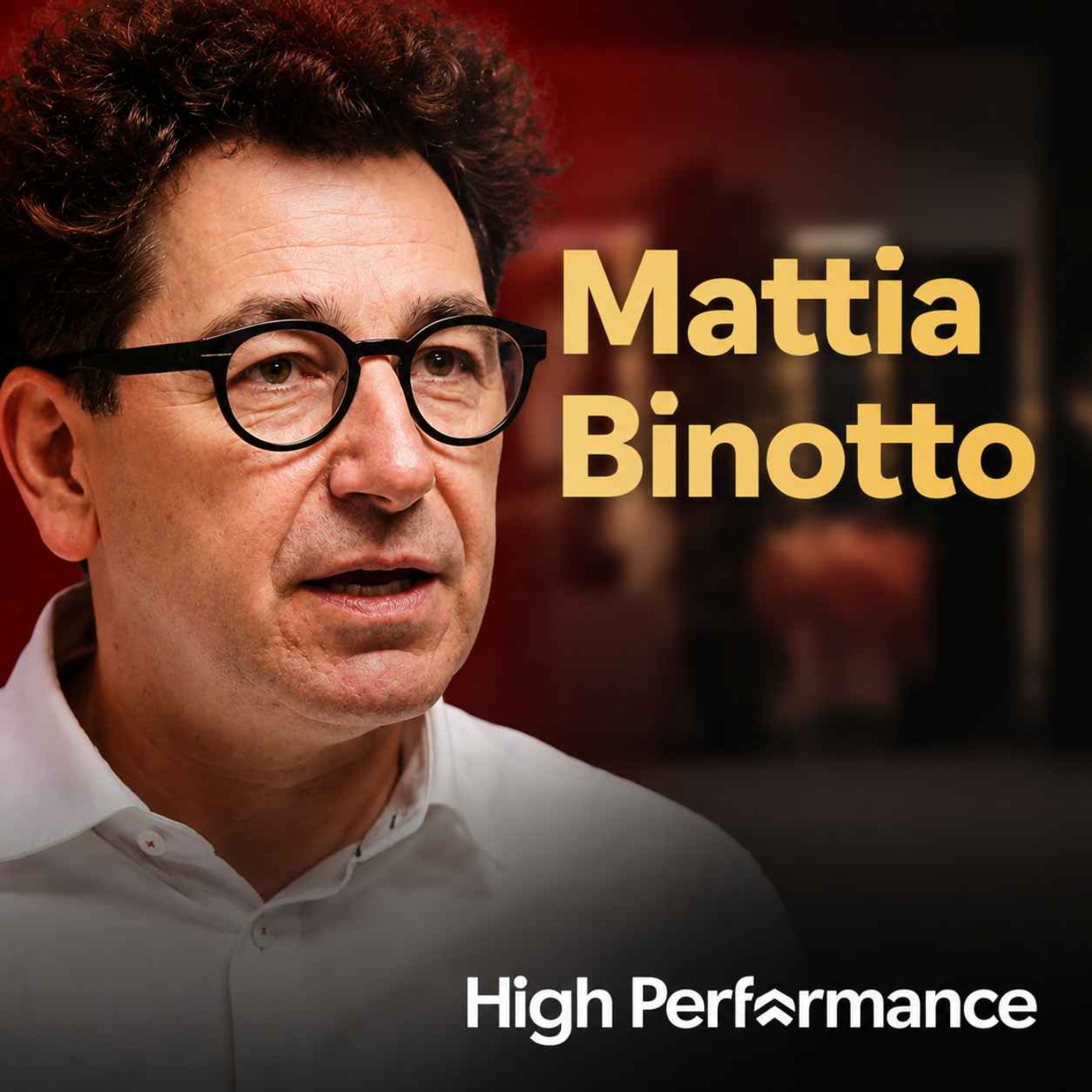
Mattia Binotto discusses building Audi’s new Formula One project from the Sauber base, focusing on culture/behaviors, long-term planning to a 2030 world championship, and managing money under F1’s cost cap (with Revolut Business as a finance partner).
Mattia Binotto is Audi Revolut F1 Team boss; he previously worked with top F1 leaders including Ross Brawn, Jean Todt, and Michael Schumacher, and later with drivers Sebastian Vettel and Fernando Alonso. He also references experiences at Ferrari and Sauber.
Culture is defined by measurable behaviors (ownership, communication, feedback, continuous improvement), not rules. Changing an existing team requires “unlearning” old habits. Audi’s transformation is a multi-pillar business effort (infrastructure, process, culture, team, skills) with 70+ projects and a 2030 target.
Schumacher’s “protect the team” leadership; Kimi Raikkonen’s direct, honest feedback; Alonso’s hunger after missing the title; Nico’s first podium at Silverstone; Gabriele’s F3 and F2 titles and long-term fit for Audi.
Written by AI. May contain mistakes.
Mattia discusses his transition from Ferrari to building the Audi F1 team.
“that that would have been, again, my job in the future, waiting for great opportunities, and even trying something different.”
Mattia elaborates on the significance of establishing a strong team culture.
“So it was not somehow running a team which was already successful.”
Discussion on how to define and measure effective team behaviors.
“I think this is very interesting because I spoke with a senior Formula One CEO, shall we say, not long ago and I asked them the question about culture.”
Mattia shares insights and lessons learned from working with F1 legends.
“So it's a clear set of views that you can see, measure, discuss, even feedback, assessments to the employees from the bosses.”
Exploring Michael Schumacher's approach to leadership and team dynamics.
“Can I talk about your life leading up to this point that I think would have taught you so many things about what leadership looks like, what standards look like?”
Learn about Schumacher's impactful leadership style and team dynamics.
“and he was there to say, okay, no problem.”
Discover key lessons learned from F1 champions Kimi and Fernando.
“jacket to cover you and it doesn't matter him so it was really there to to to demanding on one side because high demanding, but very, let me say, very, he was a team player, but the leader of the team.”
Explore leadership styles learned from legendary figures in F1.
“still willing to prove how much he's capable.”
Understand the challenges of transforming Sauber into a winning culture.
“And often, I have to say myself, difficult moments, I'm always thinking what Russ would have been doing in such a situation or what Jean would have been doing in such a situation.”
Learn about Audi's strategy to cultivate young talent in F1.
“So we've got a proper graduate programs implemented.”
Discuss the impact of Nico's podium finish on his and the team's morale.
“Every brand seems to want to be in Formula One at the moment.”
Learn about the significance of Nico's first podium for the team and the journey to improvement.
“the podium that was the very first podium for him after so many races.”
Discover Binotto's insights on Gabriele's potential and his attitude towards racing.
“And I think celebrating in our hospitality.”
Explore the team's objectives and Binotto's plan for winning the championship by 2030.
“Is he too hard on himself when he makes a mistake?”
Understand the extensive transformation plans in place to boost team performance.
“Because as we said before, it was a sauber team with very little resources being a small private team.”

Get the gist, explore an idea or ask about something said.
 Claude
On The High Performance Podcast, what are the key points of this episode?
Searching your listeningAutomatic transcript. May contain errors.
0:03Mattia, welcome to High Performance. This is a conversation for anyone that at any point in their life has tried to be ambitious and build something that is going to surprise those people around them. So I want to talk about what it takes to build something to the scale that you're trying to build the Audi Revolut Formula One team. Can we start the moment you walked in the door? First, it takes time. It takes long. But as you said, let's start from the very beginning. First, I stopped myself working in Ferrari and for many months without a job. simply watching F1 on TV, even trying to understand if still I was so passionate that that would have been, again, my job in the future, waiting for great opportunities, and even trying something different.
0:58Just, let's see, let's see, to try something different that maybe I can be a passionate of. But as a matter of fact, I couldn't resist to F1. And that's my life since the very beginning. F1 is my blood. And somehow you become addicted to it because you are so passionate that you are addicted. So I knew very soon that F1, I should have come back. But only if a great opportunity would have been there. So it's obvious that somehow some opportunity came. But the one of Audi has been the one that really for me was a no-brainer. because of Audi, because what it represents as a brand, because of the project, which still I believe is the most today, the most ambitious and incredible in F1, starting from scratch with such a big brand where you can create somehow an important legacy.
1:54That's no doubt the most fascinating, I would say, today in F1, and not only in F1, the entire motorsports. So it was a no-brainer. So once we had the contacts, we discussed, it took us two days to the side. And really, it has been really a shake hands move on. Contractive details were only details. I love building whatever it is. I need to build something. And for me, somehow building a team was somehow what was the most interesting and important. So it was not somehow running a team which was already successful. Now it's starting from, not from scratch, from an existing small private team and to turn into a successful big team in the future.
2:46So for you personally, what does building something do for you that just being successful doesn't do? Building is about giving people an opportunity. building is about creating a team at the end, it's creating a family again a place where people may enjoy and may succeed together, it's not individual success, I'm not interested in individual success and I think what's great with F1 at the end is a team effort and it's a big team it's a lot of people it's 1500 people total But somehow creating that culture, that mindset, enjoying together the success, it's somehow what's motivating me. And if I asked you to describe the culture or the culture that you would dream to have one day, how would you describe that culture?
3:49I think first, what is culture? Yeah. It's very difficult to define what is a culture because people may say culture is mindset. culture may be a mentality a winning mentality but then you need to translate that into facts tangible, even measurables I would say and the way we define ourselves the culture is through behaviors so the behaviors is what you can measure and you can somehow, it's tangible and at the end the culture is the way that the people are behaving such that you are moving in the right direction and then you are achieving your objective so it's not only about let's say it's a winning mentality because then you need to translate into it and for us the behaviors which count the most ownership communication and feedback it's very basic but at the end it's continuous improvement it's something that you can, as I said It's simple, basic behaviors.
4:58But once you establish them and the entire team, the entire people, the way they interact are behaving in such a way, you can make sure that you are moving in the right direction. You know, high performers are usually the ones who are willing to change the way things have always been done. They move faster. They think bigger. They try and remove friction wherever they can. And that's exactly why high performance is partnering with Revolut Business. Because if you are running a growing business just like me, and you're dealing with overseas supplies, international payments, travel, multiple currencies, I know they can slow you down when you need momentum.
5:32And Revolut Business multi-currency accounts can actually help you operate globally with less friction, letting you hold, exchange and manage over 25 currencies all in one account. So whether you're, I don't know, paying suppliers abroad, managing international spending, or perhaps traveling between markets, you get more clarity, more flexibility, and more control. This is built for ambitious businesses that think beyond borders. And you know right now, and listen to this, high performance listeners can get a£200 welcome bonus. I mean, how amazing is that? By just signing up through the link in the description and adding money to your account by September 30th, 2026.
6:10Subscription fees and T's and C's apply. I think this is very interesting because I spoke with a senior Formula One CEO, shall we say, not long ago and I asked them the question about culture. And they said, oh, well, our culture is people following the rules. And we had to have a conversation and we both, or I managed to get him to a point where he understood that rules don't create a culture, rules enforce a culture, right? So this idea of behaviors I think is very interesting because my version of hard work might be different to yours. Peter over there's version of commitment might be different to Will's version of commitment.
6:49So how do you get people to understand what your set of behaviors are and what they look like? So first, back to the culture and the definition, because I think you need to explain to the team. First, you need a clear objective. Yeah. And then you need to measure what's missing to achieve the objective. What's the gap? And often when you ask to your team, what's the gap, what do we need to achieve the objective? The immediate answer will be we need more money, we need more investment, more tools, more infrastructure, more space, more people. But then the culture is one of the pillars, the behaviors.
7:28So you can have all the resources you need. You can have all the people, a number of people you need, all the skills, but if the team do not behave properly, you will be unsuccessful. So the behaviors are one of the most important pillars for an F1 team to become successful. The way we're explaining it as well to the team is we take the image of an iceberg and the part which is below the sea level is the smallest part of the iceberg, but the one which is visible. And that's the strategy, the plans, the objective visible to everyone. But at the end, the iceberg will move for the quantity of the mass which is below the sea level because that's what makes the iceberg moving.
8:17And that's about habits, fears, the way that the people are behaving. And if you are not addressing those behaviors, the iceberg may not move in the right direction compared to the objective. So you need to act on those behaviors, being aware of fears, habits, past culture. As for us in the team, It was a team from Sauber, so completely different objectives, ambitions, targets, certainly with a specific culture. Now it's changing a lot. We are hiring people, multicultural because as well, multinationality in the team, different ages. So you need to act on the behaviors to make sure that the iceberg is moving on the right directions.
9:01And the set of behaviors, as I said, when it's about ownership, it's about accountability. feeling responsible and you can measure it, how the people feel responsible towards actions. And that can be the same with communication and feedback, clarity on priorities, the way you feedback in meetings. So it's a clear set of views that you can see, measure, discuss, even feedback, assessments to the employees from the bosses. Are you behaving properly as described, as indicated? But creating that culture takes time. That's the point. It takes time to identify the behaviors which are required. It takes time to explain it to all employees, what's about, the importance of it, making sure that the leadership are role models, otherwise it will never be somehow implemented.
9:56and then it's through insisting on it by creating specific opportunities workshops that long term you will see that those behaviors will be implemented one of the really fascinating things that you have to manage as well as managing drivers and managing your people and managing your travel and managing your own workload is managing money because there's a cost cap in a formula one And I'm interested in your partnership with Revolut Business and how important they are to helping you guide your team to really understand the importance of looking after those finances. No doubt very important. Revolut in finance got an experience which is incredible.
10:40And for us, it's the exchanges we are having with them. They are supporting us. We may have questions and you will have immediate feedback. But as well in all our financial transactions, they need to be efficient, even in the supply chain. It's a global supply chain. You've got suppliers around the world. You need to be fast. You need to be lean. And the revolution for us is important, I would say even essential, because it makes it happening and happening properly. And you know that it's a no-brainer, no? It's like one problem less. And so it's, again, partnerships are important. Partnering with the revolution is a game-changing for us.
11:29Can I talk about your life leading up to this point that I think would have taught you so many things about what leadership looks like, what standards look like? I mean, you worked with Ross Braun and Jean Tarr and Michael Schumacher, Sebastian Vettel, Fernando Alonso. Can we go through some of those fascinating people that you spent your early F1 career with and find the biggest lessons from those people? And I guess, can we start with Michael Schumacher? Is that a good place to begin? The best leader maybe I've met. Often I describe him not as the best driver, but the best leader. First, I have to say I've been very lucky, right?
12:03I've been working with a lot of so fantastic leaders. And at the time of Michael, Jean-Todd, Ross Brown, Dominica Ali was there, Montezemore. So I think for a young graduate as I was, so much to learn. And so much for me has been in an incredible school. Andrea Stella was as young as I was in the team. So a lot of us had the luxury, I would say, to be part of that team because of the leaders we had at the time. And so much to learn. So Michael was an incredible driver, no doubt. Fast, immediately fast. A single lap and he was already at the limit of the car. But he was an incredible leader as well.
12:46And when I'm saying he was an incredible leader, he was so demanding. He was so, but being always a role model. He was always there to push the team, but to push himself. and somehow to encourage the team and to protect the team. So as much as he was demanding, he was there as well to protect whenever a mistake was happening. So many mistakes have happened that he never mentioned a single word on the radio, in front of a camera or an interview, and protecting always the team. And everyone was so, at the end, so motivated working with him because everybody knew that they could act in an environment where ambition was very high, yes, but where mistakes were possible.
13:48and I think that was somehow his strengths and we all were, honestly, we were pushing so much for him because whatever happened and he was there to say, okay, no problem. Yeah. Try to do better next time and next time we'll win together and it was motivating. It was really motivating yourself. And I think you can often judge people like Michael Schumacher, not with the way they talk to a Ross Brawn or a Jean Todd or their fellow driver, the way they talk to someone like you who comes in at the very bottom of the Formula One ladder. What was he like with you in those early days? At the bottom, he knew everyone.
14:30He knew exactly what was the necessity of everyone. He was taking care of each single person around him in the necessities. And it was not only when he was simply winning that then it's easy, you know, you're winning we are all together you're celebrating it was in the most difficult moment and if you had any problem he was next to you to help you and he was even coming spontaneously to ask if anything was required any help really yeah if you it was cold he brought you his own jacket to cover you and it doesn't matter him so it was really there to to to demanding on one side because high demanding, but very, let me say, very, he was a team player, but the leader of the team.
15:22A few other Formula One world champions that you were lucky to share the team with. I mean, Kimi Raikkonen is also an equally fascinating character, but in a very different way to Michael Schumacher. What's the biggest thing that you think you learned from Kimi? Kimi is an incredible person because at the end, as you said, very different character. very silent maybe, but once he's in confidence, never stop talking. So at the end, with him, you need to be straight and forward and honest. And I think acting in an honest, transparent manner is what you will learn with him. Direct, honest, proper feedback, loyal.
16:05And then again, when on track, in the cockpit, visor down he was so fast and talented that it was so nice to work with him because once on track once whatever you couldn't do yourself the plus he would add it himself and then Fernando comes in another world champion and I'll never forget his face at the end of the season when he couldn't believe he hadn't won the world title and I think the whole world wanted him to be a world champion in a Ferrari I wonder what you learned from him in the face of not quite getting what he wanted necessarily or giving the Tifosi what he knew they wanted? Very smart person.
16:49Hungry. Yeah. Really hungry. And you can see him today as well still being there, fighting for whatever he can, still willing to prove how much he's capable. I think being hungry is somehow what again you may learn from Fernando because it's once he's on track everyone is a competitor yeah and it's and then it's about really reaching always the maximum doesn't matter what I enjoy the time as much as you said And now that race in Abu Dhabi was for us so difficult. So difficult still today. Really? Yeah, still today if you think back. Because that has changed, I think, I would say even the life for many of us.
17:48That's been the case of Fernando himself. And the rest of the time moving in on other teams. Stefano Domenico. So it has changed a lot. Just as well for Stefano in principle not winning that championship. So the other thing is still hurting. And those leaders that you had there outside the car, from Stefano, Luca, Ross, I wonder, Jean, I wonder which of them, which of the leadership style of those people you've taken the most from into your work now with Audi? I think at the end it's a mix. Is it? Yeah, it's difficult to say it's from one specifically. So what have you taken from here? From Jean, hard worker.
18:36Yeah. He was hard working and going in all the details of the company. No stones unturned. Very good. And I think that's certainly from Jean. From Michael, as I said, protecting the team in difficult moments. Ross, one of the best leaders I've seen always his capacity to come to a decision by convincing everyone of the decisions it was really a participative leadership so you come to the conclusion with proper reasoning where everyone would be convinced from it very diplomatic but such a strong leadership that everybody would believe in what he would say so it's no discussion it's Luca Montezemolo high motivation, motivating people the capacity of boosting and giving energy to an entire team so I think all of them Stefano very balanced always very balanced and I think that as well in difficult moments to stay balanced is important.
20:00So I think there is always a lot to learn from everyone and then you create your own personality. Your own and then obviously to be as good as great as they have been. That's the challenge. Yeah. Because they have been successful. They have proved that they have been the best at the time. But it's inspiring at the end. So you are inspired by them. And often, I have to say myself, difficult moments, I'm always thinking what Russ would have been doing in such a situation or what Jean would have been doing in such a situation. I think it's helpful the way to approach maybe the facts or the difficulties.
20:48And the reason why I think that's so fascinating for your leadership style now at Audi is that as much as you know that it's the most exciting project on the grid, I actually think it's also the most difficult. Because if you build a new team like Cadillac, you can build it from zero and you are responsible for creating it. If you go into Red Bull or Mercedes, you go into a already created winning culture. You're in this really interesting place where you've gone into a team that already existed in Sauber, but a team that were like just fighting to get enough money to go racing and they were just getting on the grid was the achievement for them.
21:25And then you come in and go four years and we're the world champions. So there are some people who are new and fresh and they're inspired by your message. There are other people who have been on the journey with Sauber and they have to actually unlearn a lot of their behaviors before they can learn the direction you're going. You said as much it's challenging, it's difficult. As a matter of fact, it's challenging because it's difficult. But you're right. I think sometimes it's better starting from scratch than the situation we have at Audi at the moment because to turn Sauber into a winning mentality, it's not easy because once a person got his own culture, his own habits or behaviors to change them, we know it's not easy.
22:12And as you said, if I look at our team today, it's not anymore Sauber. A lot of people from Sauber have left. some have remained new people are joining good specialists or leaders from the other teams a lot of young people we are investing along on youth even last year 60 young graduates joining the team from different areas of the world so even different let me say nationalities languages and we are investing a lot on those young people because we believe that that will be our future. Young and diversity. So we've got a proper graduate programs implemented. We've got in Zurich one of the best universities in the world, but it's not the only one where we are somehow attracting young people.
23:07We've got an engineering academy in place. Again, try to select the best engineers in the world that may become the leaders in the future. So we implemented the Engineering Academy last year. It was six students participating, but they have been recruited out of more than 4 ,000 applications. So once we published it in two weeks, we had more than 4 ,000 applications. And that's for us what's fascinating me. I believe that our future will be a winning future because or thanks to those young people we are hiring today. That will be the base of our, the foundations, our team in the future. And that's all the investment, no?
23:50Maybe you need to wait two, three years to see the return on the investment. So we know that with the young people, high energy, a lot, very smart, aware of the latest technologies, but they need to learn the specifics of F1, no? And that may take two, three years. That's why, again, 2030 has an objective. So it's not only about infrastructure that we need to build or technology or tools, but because we are investing on our young team today. And if you would come to Hynville and visit our company, and maybe even going to the canteen and you look around, it's incredible to see how young is the team.
24:26It's funny you say that. Last week I came to Hynville, spoke to Alan, walked around, had a coffee, went up on the roof terrace upstairs, very nice new building. And you're right. I mean, I know I'm getting older, right? Yeah. but everyone was younger than me. And I looked around and I thought, this is really exciting that these young people are here. Because I think, you know, everyone wants to work in Formula One at the moment, but actually, you know, we're having this conversation thanks to Revolut Business. Every brand seems to want to be in Formula One at the moment. And that's actually a great place for you to be because you can look at everyone that's interested and go, right, who really speaks our language?
25:03Who really can come on the journey with us? How can we create a deep partnership with a brand? I'm interested what you think a great modern Formula One partnership, like the one that you've got with Revolut, what does that look like in 2026? At first, it's not sponsorship, it's partnership. So it's a matter of, and when it's partnership, again, it's bringing value to the project from different angles. It's not only commercial, it's different experience. It's with Revolut as example, the ways that they are recruiting we compared because for us recruitment was an important lever for our future as we said we are hiring a lot of young people and to compare their approach hunting, recruiting was a factor which is nothing to do with finance nothing to do with the banking but how different companies, different corporates somehow behaves and develop.
26:07So it's comparing experience at the end. And as I said, diversity is so important today in F1. I think the product is so complex. The company is so complex. It's growing in all the directions. And in the past in F1, a single person, a technical director could design the car. It's not possible anymore. Now you need many people interacting together. So it brings different ideas, different experience. And we need to be open to those ideas and integrate them into one single product at the end. So the various experience are bringing all those values. And again, in the partnerships, it can be a technical partnership, it can be a different type of partnerships.
26:51But the experience of each single, let me say, partners brings value to our team. And I think back to Silverstone last year with Nico getting his first ever podium. and I know that often when a moment like that happens the driver gets the credit for finally achieving that but actually it's the movement of the entire team and you were involved, although the team wasn't out at that point you were involved with the team at that point I'm really interested in just talking briefly about your two drivers one young guy looking to make his mark in the sport and another guy who a year ago at the British Grand Prix finally made the mark that he wanted in the sport Did you notice a difference with Nico in the days after his podium or not?
27:33I think he was relieved. Yeah. It was so important for him. The joy he was expressing on the podium, after the podium, celebrating with the team was incredible. No, it was... I didn't realize it myself that he was missing the podium. Did you not? No. So it's not something I had in mind, like we have somehow sooner to have that podium for Nico. I only realized once he was on the podium that was the very first podium for him after so many races. And for me it was somehow incredible because he was such a great driver, fast, consistent. So I was expecting that maybe he had already different podiums.
28:16So I was not aware of it. But I was so happy for him, really for him and the team because at I remember when I joined, it was summer 2024. Zero points in the classifications, last and second last. The car was pretty slow. No plan of developments for 25 because everything was somehow focusing on 26. And instead with the team, we said, come on, we need to improve. We need to train our muscles because it's 2030. It cannot be 26-hour challenge. 20-30 and we need to develop the team and we need to have proper plans and we need to improve ourselves only by continuous improvement that we can become better and we set some plans already developing in 24 and we scored points by the end of the seasons and finally in 25 fighting for points at each single race and with that podium in in Silverson I think that for the entire team back at Hinnville it has been an incredible achievement even a relief for the team even more for Nico.
29:20And for Nico, it was pure joy. You could see it. And I think celebrating in our hospitality. But it was the entire paddock at the end, celebrating for him. But it has been great moments. And what can we say about Gabriele? Because I think the way Formula 1 judges young drivers has changed now. We expect them to come in and be fast. I think Max Verstappen changed the rules, really, for rookie drivers. he moved the benchmark forwards. How much do you believe that Gabriele can be a real force in Formula 1? As first, I think that all the rookies to the NF1 are great drivers. And they're proving to be great drivers.
29:59I think that Gabi has maybe the most potential of them. I'm convinced of that. What have you seen that makes you believe that? So he won the F3, he won the F2. One year after the other, not many drivers have been capable in one road to win the F3 and the F2. So when we hired him, for me the speed in itself was a given, because if you win the F3 and the F2, somehow you're a fast driver. So I was not judging the speed at the time, I was not judging his, again, his attitude, his behaviors. And what impressed me was he was first hungry to become champion one day. Second, again, for him, building something special.
30:44And I think he has accepted our project knowing that it's a long-term project because he's willing to create that legacy as well together with us. Humble, hard worker. He's got all the right attitudes. Is he too hard on himself when he makes a mistake? He's hard on himself, but it's good that I think he's hard at the moment than it's down to us to help him to balance the situations. but it's and I think it's not easy for him to as well to embrace our project because he can see how the drivers as a rookie as him maybe on which he was competing at the time of history on F2 maybe today winning in F1 as Kimi but because Kimi is certainly a car that somehow can give him the opportunity to fight for a win and for Gabi it's difficult because he knows that maybe he can be as fast as Kimi, but he cannot prove it.
31:43So because he has an Audi at the moment and he may be scoring two points in Australia, that's it. But he knows as well that what he can create with us will be something more important. So on one side, it can be frustrating. On the other side, he's got a big project ahead and he's got a team that is fully supporting him because we see him working. We see him racing. We have all the telemetry data. We know how strong he is and how fast he is. And I think he knows that, we all know that he will become champion one day. It's only a matter of patience now. And you've spoken publicly about 2030 being the year that Audi wins the world title.
32:31How often do you need to remind the team of that? Or is it so ingrained in the minds of your staff that you don't need to mention it? Two dates in print. I was at the very start. It's something on which we set very, very soon as an objective and a target. Myself, as I said, I joined, I think, August 24. We were September 24 in Monza with the CEO of Audi, Gernot Lerner, and together in a media briefing, we declared 2030. But the 2030 was not, by chances, was not simply a number, just move distance, the objective. It was really the conclusion of having assessed the current team was required to become champion, how long it will take.
33:20And we had, let me say, a proper discussion, a clear discussion. And that was so important to set it very soon to establish the right challenge internally, as well in terms of internal pressure, in terms of ambitions and how long it will take and give visibility on plans. Because as we said before, it was a sauber team with very little resources being a small private team. And they look at you, okay, we've got an objective, you've got the plans, and then you need to give them tangible facts that you are moving in the right direction with the plans, which is what we did. But the teams have known very soon the 2030, and we have declared it in many occasions
34:05with the entire team, which I would say it has been immediately embraced. And the people, all the employees know it's 2030 and they know the plan, which is even more important. The plan is, when we defined the plan, it was more than 70 projects overall to the employees with proper milestones for each single project. But it's a true business transformation. And it's on five different pillars. Infrastructures, process, culture, team, and skills. So it's, and for all of them, you've got dedicated single projects. So it's a big transformation. It's a big effort from the team. which makes me as well somehow very confident because in difficult weekends in the last races, we have been through difficult moments.
35:03Went back at Inville, really what, yes, we may be frustrated for the single races, but I have no doubt, no doubt that there is not a single team in F1 which is doing as much as we are doing in Inville at the moment. And that's behind the scenes, no one sees it. but the efforts that the team is making and putting in transforming that team with all through those projects, plus developing the care, plus improving yourselves, it's pretty impressive. A powerful way to end. I love the fact Revolut Business have organized this conversation for us. I think you're lucky to have them as a partner. I think they're lucky to have you as partners.
35:40And I'm rooting for you, and I can't wait to see the celebrations in 2030.
Mattia Binotto has spent almost three decades at the heart of Formula One, helping shape Ferrari before taking on his biggest challenge yet as CEO and Team Principal of the Audi Revolut F1 Team.
In partnership with Revolut Business, Mattia joins Jake ahead of Silverstone, to share what it really takes to build a winning team. He explains how you create a winning culture from the ground up, why great leadership starts with trust, and the lessons he learned from working alongside icons like Michael Schumacher and Jean Todt.
Mattia also shares how partnering with Revolut helps the team move faster globally, and why he believes young talent and long-term thinking are the foundations of sustained success. This is a conversation about leadership, culture, and building an organisation that's designed to win.
Revolut Business High-performing businesses need powerful financial tools. Get a £200 welcome bonus with Revolut Business when you sign up at revolutbusiness.onelink.me/jLOt/mattiabinottoyt and add money to your account by 30/09/2026. Fees, promotion terms and T&Cs apply.
Hosted on Acast. See acast.com/privacy for more information.


