
 Ask ChatGPT


 The High Performance Podcast
5 Aug 2024 · 44m
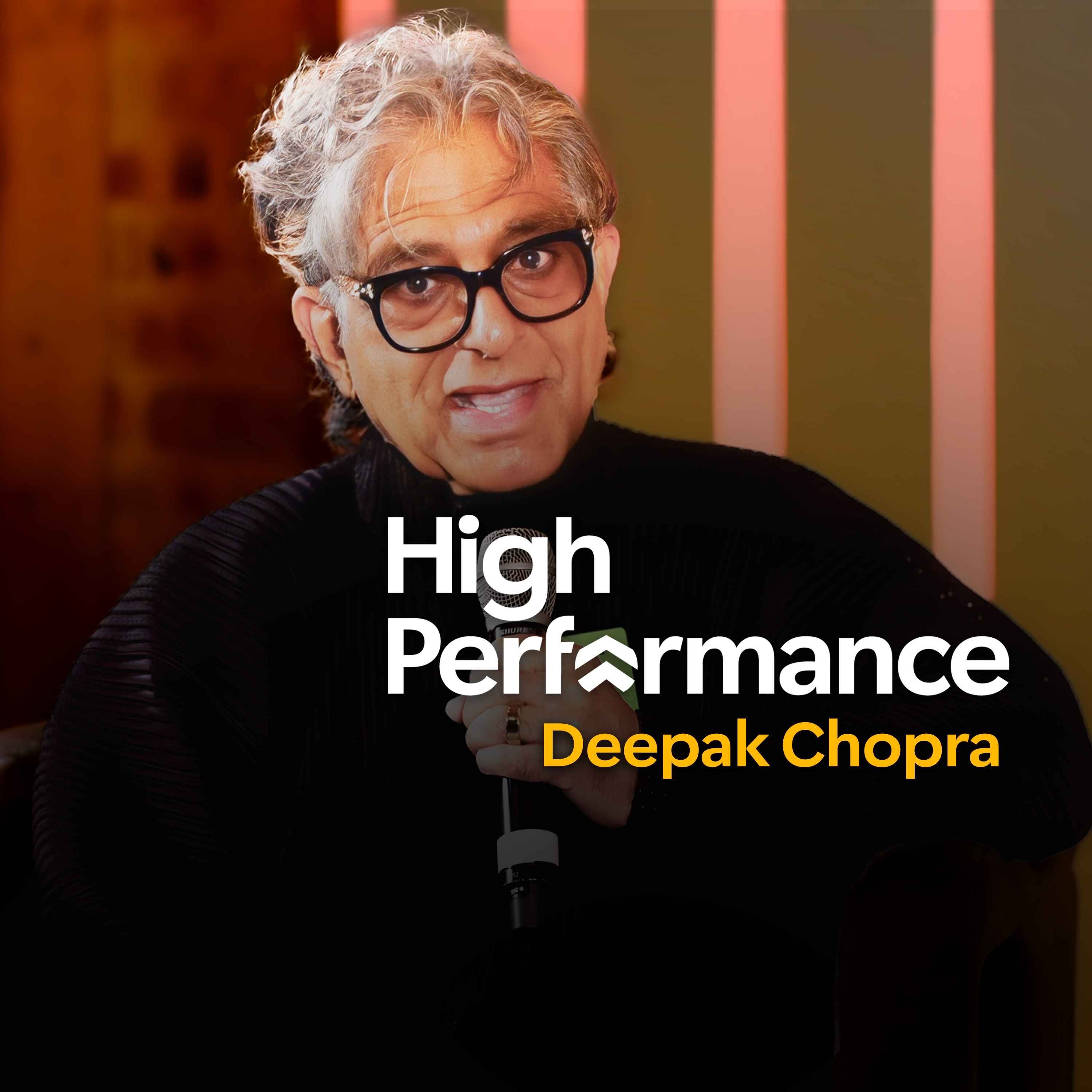
In this enlightening episode of the High Performance Podcast, hosts Jake Humphrey and Damian Hughes converse with renowned author and spiritual leader Deepak Chopra. The discussion explores fundamental concepts of happiness, high performance, and the integration of technology in enhancing human experience.
Written by AI. May contain mistakes.

Get the gist, explore an idea or ask about something said.
 Claude
On The High Performance Podcast, what are the key points of this episode?
Searching your listeningAutomatic transcript. May contain errors.
0:28Watch it early on the High Performance App. a material level, but recognize that you will never be fulfilled with anything that's material. You start with do less and accomplish more, but the ultimate goal is do nothing and accomplish everything. That is author, thinker, guru, Deepak Chopra. And this is High Performance, the show that unlocks the minds of the most fascinating people on the planet. I'm Jake Humphrey, and alongside our expert, Damian Hughes, we learn from the stories, struggles and successes of our guests, allowing us all to find our own version of high performance. And today we do that with a man who's a world-renowned pioneer of integrative medicine and personal transformation.
1:11Deepak believes that great things await you and he wants to offer you a pathway to get there. We spoke with him in front of a live audience at Founders Forum. It was an awesome chat. It comes next.
1:26Deepak welcome to high performance what do you believe high performance is high performance is a state of flow where there's no resistance no defensiveness no anticipation no regret no seeking it's just presence and in that presence there's flow that's high performance Are you there? Always. How? Let's try something. Are you looking forward to this conversation? A little more enthusiasm? Okay, let me ask you the same question, but don't answer it. Until I raise my hand, okay? Are you looking forward to this conversation?
2:21so that space between your thoughts if you make that your reference point you'll be in flow because that's where your spirit is that's where your consciousness that's presence in spiritual traditions it's called the soul so your body is changing all the time you had a different body when you were a baby different mind different when you were a teenager. Now it's different all the way to dusty death. But that presence is timeless. It even transcends birth and death. So if you don't think of yourself as a person, but as the presence in which the person is a process, because there is no such thing as a person in the deep reality, the person is not a noun, it's a verb, it's an activity, in consciousness.
3:16So if you move your internal reference point from your mind to the source of all experience, which is the source of all sensations, perceptions, images, feelings, and thoughts, there's only stillness. So if you talk to even high-performance athletes, when they're in their peak flow moment, there is no time, they cannot hear sound, and without anticipation, they're at the right place at the right time, synchronistically speaking. That's peak performance, but what we're talking about is peak living, which is how do you stay there all the time? You shift your awareness from what you're perceiving to that which is perceiving.
4:03So right now as you're listening to me you can try something else shift your attention to your own presence that which is listening you feel presence that's you it's not your mind it's not your body it's not even the experience of the world it's where everything happens and that place is not in time it's timeless so could you tell us how we can induce that state of flow then more frequently in our lives? Well, there are many practices, meditation, mindful awareness of your body, mindful awareness of your breath, and then if you go deeper, mindful awareness of what's happening inside your body, which is called interoceptive awareness, mindful awareness of the web of relationship, mindful awareness of the universe, and ultimately, awareness of awareness.
4:59So it's a journey, but what I shared with you is instant. Even as you're looking at me, and you can get into the habit of doing this, stop every once in a while and ask yourself, am I aware? Just ask yourself that one question, am I aware? And then you can say, what am I aware of? Well, I'm aware of this, this thing that we call Deepak. I'm aware of Damien and Jake. I'm aware of all these people. I'm aware of what I have to do afterwards. So when you look at awareness as your reference point, it's not just this, it's everything. So, you know, to think I'm this skin-encapsulated ego dragging a flesh of bones and flesh is the hypnosis of social conditioning and religious conditioning and scientific conditioning.
5:50Our true self is not conditioned. It's infinite, irreducible, fundamental, without form, and inconceivable, imperceivable, and yet without it, there's no experience. We've done almost 300 episodes of high performance. You're the first person to ever sit in the chair and tell us that actually doing less gets us closer to high performance. Ultimately doing nothing and achieving everything. So you start with do less and accomplish more. But the ultimate goal is do nothing and accomplish everything. Right now, if I asked you, what is regulating your blood pressure? What are you doing to regulate your blood pressure?
6:34What are you doing to regulate your immune system? What are you doing to regulate your hormones? What are you doing to regulate your body temperature? What do you do when you speak? how do you orchestrate syntax grammar all without thinking right so how does a human body think thoughts play appear and now kill germs remove toxins make a baby all at the same time that's high performance it is hey sorry to jump into this chat but i just wanted to take a moment to tell you about some of the fantastic partners we're working with but do stick around though to find out what our guest was talking about when they said this.
7:15We can use AI to create a critical mass for a more peaceful, just, sustainable, healthier and joyful world, including climate change, including what we call conflict resolution, including resurrection of species, microbiome. It's unimaginable.
7:34The market's uncertain. Revenue's tied and hiring on hold. That's why results-driven and companies are using Upwork to keep work moving. Go to Upwork.com today and start hiring proven freelance talent fast. No bulky overhead. No rigid long-term contracts. Just the right expert right when you need them. Work smarter and faster with Upwork. Go to Upwork.com now and find your freelance expert. That's U-P-W-O-R-K.com. Post a job for free and get started today. Fall is all about cozy comforts, and with Herobred, you can enjoy all your favorites and still hit your health goals. From breakfast bagels and meal-prepped enchiladas to mouth-watering burgers and cheesy noodles.
8:16You won't believe Hero Bread's options have 0-5 grams net carbs and are high fiber from the taste and texture. And right now, Hero Bread is offering 10 % off your order. Go to Hero.co and use code FALL25 at checkout. That's FALL25 at H-E-R-O dot C-O. All figures are per serving of Hero Bread. Contains 2-18 grams of fat per serving. See the product nutrition panels on Hero.co for more information. This episode is brought to you by Opera Air, the first browser with mindfulness at its core. Now, most of us spend hours every day online, but how often do we pause to take care of ourselves whilst we're doing it?
8:48And that's where Opera Air comes in. It's a lightweight, fast, secure browser built not just for productivity, but for your wellbeing. With Opera Air, mindfulness is built right in. You'll find free breathing exercises, guided meditations, and soundscapes with ambient sounds, lo-fi music, and binaural beats, all designed to help you focus, relax, and even spark creativity while you browse.
9:15How have we ended up in a position where, as human beings, we think that doing more and achieving more and pushing further and fighting harder and scrapping for the next win is the thing that gets us closer to high performance? Well, according to deep historians, up until 40 ,000, give or take a few thousand years, but only 40 ,000 years ago, there were eight different types of human species. So we are Homo sapiens. It's a name we gave ourselves. It says we are the wise ones. We were humbled enough to describe ourselves that way. But then we gave names to other species. until then, and this is usually referred to as the cognitive revolution, like other animals, we had very basic language.
10:05All animals, even insects, have language. Elephants have language. But the language is mostly for three things. Eating, so food calls, reproduction, sex calls, mating calls, and danger calls. Then we, this special species, created the language for stories, and the most prevalent stories then and now are gossip. And when we read news or watch movies, that's what we're looking for, gossip. Who's sleeping with whom, who can be trusted, etc., etc. But that ability to make a story created ability to make models of reality, models of reality, like, for example, money. Money is something we created. Latitude, longitude, something we created.
10:58Nation states, we created. So we assumed an identity which actually took us away from the flow state. You know, watch animals, go to the Serengeti, and you'll see that zebras and giraffes and antelopes and tigers, they have no stress. only in the moment of a food call or a sex call, then they have momentary activity, which we could call sympathetic overdrive, which we call stress. So if you kick a dog, for example, the dog will be offended. And if you meet that dog five years later, the dog will attack you because it remembers. But the dog won't ruminate for five years how to get even. Okay. So the dog is in flow, except when it's mating, eating, or looking for food, or avoiding danger.
11:59There's no stress. Zebras don't get stressed. Only humans get stressed. So this has been going on for 40 ,000 years with hunter-gatherers and then with the age of agriculture, age of industry got worse. And now because we've all sacrificed ourselves for our selfies, it's the worst. So it would seem then that a common ending for most of the stories we tell ourselves is happiness, is almost the consequence of going on a journey, telling ourselves a story. why do you think that is a dangerous place for many entrepreneurs to almost defer happiness well i meet entrepreneurs all the time and they're telling me about their last exit and how great it was and now they're stressed about their next exit they have never thought about their final exit which is called death so once you become aware of your mortality, it's a magical experience.
12:59Every moment becomes precious. Now, in the light of death, you don't want to waste any time. You want to have joy. So the only measure of success should be joy. So my mantra, if you will, is, am I having fun? Am I joyful right now? Yes. Am I hanging out with people who are joyful or want to be joyful? Yes. Are we going to create joy for others? Yes, I hope. If that is the mantra, then I'm in. Otherwise, I don't bother. And actually, if you make joy the reason for success, then you will make other people joyful and you will try to make other people successful. The best way to be successful is to make somebody else successful.
13:50the best way to be happy is to make somebody else happy. Now having said that, there's something called the happiness equation which has been worked out by social scientists. So here it is, H is equal to S plus C plus V. So H stands for happiness, is equal to S. S is something called set point in the brain. 50 % of our daily happiness experience comes from set point in the brain. So happy people, even if they see an adversity, they look for an opportunity. Oh, there's COVID, let's create Zoom. There's COVID, let's do messenger RNA research. Let's create a vaccine. You see, there are lots of tech technologies, including AI, took a boom during COVID.
14:45Because there's some people looking at that as an opportunity. That's 50 % of our happiness experience. You reframe adversity as a challenge, then you reframe challenge as an opportunity. So that's the first component of happiness, 50%. Plus C. C is conditions of living, and that's money. There are two categories of people who are stressed about money, the extremely rich and the extremely poor. The extremely poor can think of nothing else, but the extremely rich can also not think of anything else. They confuse their self-worth with their net worth. Why? Why? Because of the hypnosis of our social conditioning these days.
15:32If you win the lottery, for example, the data shows that you'll be ecstatic in the beginning. You're making $20 ,000 a year or$50 ,000 or$100 ,000. Suddenly, you know, have$50 million. You'll be ecstatic. In six months, you'll plateau. In one year, you'll get back to your set point. In five years, you're stressed because you're thinking of, you know, what's the next break and how much more can I make? Looking at the stock market, parking your money in the Bahamas, avoiding taxes, all of that. So money adds 10 % to your happiness experience. We need money, obviously. Okay. But it's about 10 to 12%.
16:16The remaining 40 % is called what are the choices you're making every day? There are two kinds of choices we make every day. One is for personal pleasure. So alcohol, entertainment, movies, food, restaurants, shopping. By the way, shopping is the number one reason that people use to get happy. Shopping, number one preoccupation of our civilization. And then there's other things, food, sex, etc. Do these choices make us happy? Yes, they make us happy, but provisionally for a few days. then you have to repeat the experience to be happy again. And of course, if you have an addictive personality, then you can't get enough of what you don't want anymore.
17:02Anyway, personal pleasure gives you happiness short-term. Long-term happiness comes from something called fulfillment, which means do you have meaning and purpose in your life? And most importantly, can you make other people happy? And you don't have to buy them anything. attention, deep listening, affection, deep caring, appreciation, noticing how unique they are. You know, every person here is an uninterrupted history of the entire universe. Think about that. Well, your body came from the crucible of burning stars. 50 % of the atoms in the body came from the Milky Way galaxy. The remaining 50 % came from anywhere, two trillion galaxies right now is the estimate.
17:48The 50 % of the items are from this galaxy, 50 % of the items are from other galaxies sucked into our galaxy by a phenomenon called gravitational wind. So all that started about 400 ,000 years after the Big Bang. And then there was cosmic evolution, then there was planet Earth, the solar system, and then there's biological evolution, mutations, natural selection, all the way from microbes, chemolitho-ortotrophic, hyperthermophiles, which were the primitive organisms on the rims of volcanoes, which are your ancestors, all the way through photosynthesis to plants, to animals. And now we have this species, which is 99 % the same as a primate, as a chimpanzee.
18:39And yet, we have learned to navigate the stars. This is every single human being is uninterrupted chain of being since the beginning of creation. And why is that an important thing for us to understand? Because everyone's so unique. It's absolutely wondrous that we exist. You know, there's a poem from Rabindranath Tagore, the great Indian poet. He said, that I exist is a perpetual surprise. And if you're not surprised by your existence, then your humanity is incomplete. If you're surprised, look at a baby. Before they've seen anything, they're looking around. It's like, wow, what is this? Have you forgotten that?
19:27Where's that wonder? Where's that curiosity? where's that surprise where's that feeling like bewilderment you know you should be shocked that you exist you know if you're not bewildered by your existence where's the creativity just looking for the next exit so can i go back to the formula that you offered us deepak that that first one about the set point given that it makes what 50 of our happiness how do we start to increase our set point? Well, first of all, the set point, unfortunately, is determined by you, by your childhood and your upbringing. So if your parents or your siblings or your immediate environment, caretakers, were complaining, condemning, criticizing, and playing the victim, then you will have that set point for unhappiness.
20:21On the other hand, if your parents gave you all the attention, affection, appreciation took you for what you were as you were, not trying to change you. You're so unique that I don't want to change you at all. And if your parents were looking for opportunities, you'll get to an amazingly mature emotionally and spiritually developed person. If you don't get that, you might freeze at the age of eight years, which in the U.S. anyway, it qualifies you for running for office. You can run for president. But that's how the set point is determined. The way you change the set point is first you become aware of it, right?
21:06Then you say, you know, if you look at a situation, you say, this is terrible. You say, why do I think it's terrible? Am I 100 % sure it's true? what if it wasn't true what's the opposite what's the opportunity here so that there's a bit of reflective inquiry and now that's been taken to a new level it's called cognitive awareness-based cognitive thinking and also techniques like mindfulness and meditation help let's talk then about some techniques and some habits. You know, we often say on our show that you can't stumble into high performance. And I think that you can't stumble into the awareness that you have for the way that you live.
21:52So are there daily practices that you go through to remind yourself of all the things that you've mentioned so far? Me personally, for me, it's automatic. And I don't get sucked into drama because the world is full of drama. And it doesn't matter, you know, if you're an activist, morally outraged, even moral outrage is rage. It doesn't bring on creativity. It's nice to be morally outraged, but remember, it's rage. And the worst use of imagination is rage or stress, because with rage comes stress. The best use of imagination is creativity. So, you know, And we're here with Founders Forum. It's all about creativity.
22:42What is the dynamics of creativity is you have to go beyond the drama. You have to know what you want, number one. So there's intention, there's information gathering about what you want to create, there's information analysis, there's incubation, and there's spontaneous insight, which leads to inspiration. Inspiration leads to implementation, implementation leads to incarnation. It's a death and a resurrection. Creativity is new meaning, new story, new relationships, or new interpretation of relationships, and new context. The old context, the old set of thinking, the old story has to die. And that's fundamental creativity.
23:33Now, we have innovation, which is not fundamental, basically. It's just the iPhone 14 instead of iPhone 13. That's not creativity. or you add an extra camera or something like that, you know. But fundamental creativity is a new story. It's a disruptive, I mean, we talk these days about disruptive technologies, right? So these disruptive technologies that emerge are very creative, right? Now we're seeing the most disruptive technology of all time, which is artificial intelligence, large language models. It's so disruptive that it will create a whole new era of technologies and innovations, and it will also get rid of jobs that used to occupy us that were mundane and banal and give us even more room for creativity.
24:27um i i'm right now in the process of writing a book about ai and how you can make it your best friend how you can use it as a health coach how you can use it as a research assistant and finally how can you replace all the gurus in the world because it has access to the knowledge of all the spiritual and philosophical traditions of the world so are you optimistic then about ai I'm realistic. Like any technology, you can use it for diabolical purposes. AI can be weaponized, just like anything. Nuclear energy can be weaponized. The internet has been weaponized for hacking, etc. So, you know, technology is neutral.
25:12How we use it depends on us. So we created the technology and now we feel victimized by it, which is a paradox. We are victimized by our own creation. It's like, you know, your servant has now become your ruler. And it shouldn't be like that. It should be, we created a technology. I feel that used rightly, and I've had conversations with Sam Alton, the CEO of OpenAI, and he agrees with me that we can use AI to create a critical mass for a more peaceful, just, sustainable, healthier, and joyful world, including climate change, including what we call conflict resolution, including resurrection of species, microboem.
25:56It's unimaginable. There's no human being who has access to biological language, mathematical language, the language of physics, the language of literature, the language of philosophy, and the language of theology. No human being. And there is so much negativity around AI. Every headline seems to be a negative one. From all the things that you... Those are the people with the bad set point. Exactly. Trying to ruin our set point. Of all the things that you've read and the conversations you've had with Sam and other people, what is it that you've heard that has filled you with optimism or the thing that you're most excited about when it comes to the future of AI?
26:33I've been with a lot of people discussing AI and the fact that it could be weaponized. And I have been on panels where we've discussed how AI can be used to prevent the weaponization of AI, and that's possible. We just have to have the collective will. So I feel very optimistic about AI as a leap for humanity, which is unimaginable, from human to metahuman. I literally believe that, that this is a leap in are evolution. Now, you know, when I talk about evolution, I'm talking about evolution in consciousness. But now we know that evolution in consciousness can lead to evolution in biology. We know something that's called epigenetics.
27:26So when you change your ways of thinking, feeling, believing, behaving, then your genes turn on switches that follow your beliefs and your intentions. And genes then change the neural landscape of the brain. It's called neuroplasticity. So I feel we can use technology to change the activity of our genes and also ultimately change the landscape of our brains, which is the right way to do it. Instead of all this, I'm going to download my brain, that's not going to happen because your brain doesn't produce consciousness. That's another big mistake that materialist science is making. How do atoms, molecules, force fields, electrical impulses produce this experience?
28:20You know, that's called the hard problem of consciousness. So if you really understand consciousness, then you can use technology to extend the range of our experiences. Right now, we have five senses that work within a very narrow bandwidth of the electromagnetic spectrum. So between 300 nanometers and 800 nanometers of the electrospectrum gives you access to this. Now a snake navigates through infrared. Can we wear infrared glasses? Sure we can. Birds navigate through ultraviolet. Can we create technologies that we can navigate through ultraviolet? Sure we can. That telescope out there, the James Webb telescope, which is giving all this information, all it's looking at is radio waves and microwaves and cosmic waves, and then converting it into pictures that we can see.
29:16This was what happened, and this is so many galaxies, etc., etc. So, with the new technologies, we will be able to enhance our sensory experiences. that means expand our range of awareness of the cosmos know what's happening inside our bodies know how to regulate that through feedback mechanisms right now i'm wearing four sensors and comparing them with each other i have another sensor here that's looking at my blood sugar But the next step is, how do I create the technology to automate my well-being in the direction of homeostasis? The blood sugar goes up or down, what should be the next thing happening, etc., etc.
30:04It's unimaginable, beyond imagine. And imagination is a never-ending horizon. I just want to dive into this conversation with Deepak very quickly to tell you about some of the awesome partners that we're working with here at High Performance. But first, make sure you stick around for the rest of our conversation with Deepak and find out what he was talking about when he said this. I'm not a human being. I'm a non-local being having human experience, local experience. If you're still overpaying for wireless, it's time to say yes to saying no. At Mint Mobile, their favourite word is no. No contracts, no monthly bills, no overages, no hidden fees, no BS.
30:47I made the switch because I was tired of those ridiculous bills and sneaky charges from my old provider. With Mint, I'm paying$15 a month and getting the same high-speed data, unlimited talk and text, and coverage on the nation's largest 5G network. Honestly, the quality is just as good, if not better than what I had before. And the best part? You don't need a new phone. You can keep your current one, bring your number, and all your contacts. I use Mint Mobile, and you should too. Ready to say yes to saying no? Make the switch at mintmobile.com slash HPP. That's mintmobile.com slash HPP. Upfront payment of$45 required, equivalent to$15 a month.
31:24Limited time new customer offer for first three months only. Speeds may slow up a 35 gig on unlimited plan. Taxes and fees extra. See Mint Mobile for details.
31:44Proven freelance talent fast. No bulky overhead. No rigid long-term contracts. Just the right expert right when you need them. Work smarter and faster with Upwork. Go to Upwork.com now and find your freelance expert. That's U-P-W-O-R-K.com. Post a job for free and get started today. Come to DSW for the shoes. Stay for the fun. Because let's be honest, if shoe shopping isn't fun, are you even doing it right? So go ahead. Try something new. Try something different. Good different. Try something that feels like you, you know, the real you, and then definitely brag about it later. Because at DSW, you've got unlimited freedom to play with sneakers, boots and everything in between for every style, mood and occasion.
32:27You'll definitely find shoes that get you at prices that get your budget. DSW. Let us surprise you.
32:39and that leads me to that phrase that you use that ai creates space for creativity to blossom as the author of nearly 100 books what what tips or habits do you regularly indulge in to to create creativity for yourself i you know i've gotten into the habit of asking questions of myself, and I ask them before I meditate, but I also ask them before I sleep. And then in the morning, I have some insights, and then I go to some of the AI networks, and I say, you know, I had this idea, what do you think? Other people have thought about it. And sure enough, you know, it's very interesting. There's no idea that you have that somebody else hasn't thought about.
33:26Yeah, it's quite, in the beginning, very disconcerting. But then you say, well, these people have had these ideas. Now, how can I build upon this? So I have a habit of asking questions all the time. What are the questions? Well, the most basic fundamental questions of our existence are, who am I? What do I want? What's my purpose? What am I grateful for? So who are you? You're not your body because if you say I'm your body, I'm my body, then which one? You were a fertilized egg and a zygote and a baby and a toddler. There's no such thing as a body. The body is an amalgam of sensory perceptions that are changing over a lifetime according to a storyline.
34:11So you're not your body. You're not your mind because you say I have a mind. Which one? Today's mind, last Wednesday's mind, teenage mind, baby mind. What mind are you talking about? So you're not your body, you're not your mind, you're not your emotions, you're not your story. You're the source of all that. You're fundamentally a creative consciousness. That is the fundamental reality. And that creative consciousness is entangled with other creative consciousnesses. Because even when we do disruptive, create disruptive technologies, we still stand on the shoulders of people. Isaac Newton lived in the 17th century, but without his math, Newtonian physics, we wouldn't have gone to the moon.
34:59right so that's five almost 500 years ago we're still standing on the shoulders of giants like that now we have access to their minds to their thoughts to their to their writings and then you have the technology revolution which is so recent and the quantum revolution which is 100 years old and relativity which is also about 100 years old and now with large language models you will see revolutions and adventures that humans can take that even Homer never dreamed of. Can we run through the three other questions you ask yourself? And I'd like to know your answer to them. So the second question you ask?
35:42What do I want? What do I want? To know myself, period. Because I'm not a human being. I'm a non-local being having a human experience, local experience. And I know that now through years, 45 years of reflective inquiry. What is my purpose? Well, on a material scale, I would love to harness the collective creativity, imagination of the world for a more peaceful, just sustainable, healthier, and joyful world. We have technology to reverse climate change. I can go through them. We have technology to resurrect even extinct species. We have technology to create healthy food. We have technology for conflict resolution.
36:41We have technology 95 % of disease-related gene mutations are modifiable epigenetically. For those gene mutations that At Predict Disease, we're going to have gene editing. So we have technology to prevent and cure disease. All we need right now is an ecosystem where there's shared vision, where there's maximum diversity of talent and opinion and education and race and gender. Maximum diversity, shared vision, complementing each other's strengths, and creating an ecosystem where we share our vision and support each other. a spiritual and emotional bond. So if we have those three, four, five things, shared vision, maximum diversity, complementing strengths, and emotional and spiritual bonds, which we can create through technology these days, we can solve any problem.
37:44And the final question? What am I grateful for? That I exist. I didn't ask for it. just picking up on that it was the second question that i've heard you speak about about about what do you want you've also spoken about is there a limit to what you want would you explain why that's an important follow-up question there is no limit to what you want from a material level you know you buy an automobile then you want a ferrari then you want a boat then you want a yacht then you want a jet plane, then you want to go to space. There's no limit to that, and that's okay. But recognize that you will never be fulfilled with anything that's material.
38:31The only thing that will fulfill you is harnessing the most fundamental aspect of your being, which is creativity. Let's delve a bit deep on this. But of course, you know, there are other things that if we focus on them, empathy, which is feeling what others feel, compassion, the desire to alleviate suffering, joy, and what I think could be called love in action, because love without action is meaningless and action without love is irrelevant. But when you act with love, you can heal the world. and this conversation has been so full of wisdom so full of great advice so full of optimism yet you've also said that depression is the number one pandemic impacting society today yes yeah every 40 seconds somebody is dying from suicide in our world and suicide is now the second most common cause of death amongst teens and the first common cause of death amongst teens is drugs and and accidents, which is, of course, linked to depression also.
39:43So we will say that depression is definitely the number one pandemic of our time. And the reason it is, is it's recycled trauma. You know, the memory of trauma is anger. The desire to get even is hostility. Blaming yourself is guilt and shame. And then the depletion of energy that happens as a result of all of that is depression. That's the pathogenesis of depression. It's recycled trauma, and we haven't learned our lesson. We're doing it in Gaza. We're doing it in Ukraine. We're doing it in India and Pakistan. We just haven't learned it since medieval times. We have medieval behaviors and modern technologies, capacities.
40:30That's a very dangerous combination. The same technologies that you have could be used to heal ourselves and we're not doing it. We, our foundation, by the way, has a program called neveralone.love. You can check it, neveralone.love. And that is a program to bring together people who are feeling depressed and supporting each other through those four A's, attention, affection, appreciation, and creating ecosystems online and offline. and we even used a chatbot and we had about 20 million text messages and 6 ,000 suicide ideations that our emotional chatbot intervened in because the teens were more comfortable talking to a machine than to a human being.
41:18This is the state of our society. They don't trust therapists. They don't trust human beings, Gen Z and these kids. They don't trust anyone, but they trust a machine And the machine is actually much more empathetic because it checks on them. What did you sleep well last night? Did your boyfriend call you back? Or what did you have for dinner, etc.? So, you know, you can, that's another gift of technology. And in this program, we also have at the back end, of course, therapists in case somebody is really in a dangerous situation. So what do you tell us, Andipak? How do we combat suffering most effectively?
41:57Well, there's this kind of suffering that we're talking about. But there's existential suffering. You have all the money in the world. You have all the success in the world. You have best health in the world. You have best relationships. But you're still going to get old. And you're still going to have infirmity and still going to die. So, you know, at some point, if you're a spiritual person or a conscious being, you have what is called the dark night of the soul. You know, is there all there is? And that has a whole different way to handle. And there's no mental solution for that. There's only spiritual solutions.
42:38You have to get in touch with that part of yourself, which is not subject to either birth or death. And in spiritual traditions, we call it consciousness, but awareness, fundamental awareness. That in which the body and the mind and the emotions and the personality recycle and evolve. A very fundamental state of being, which is before any social constructs, is what you see in a baby. There's a saying in India, every child that is born is proof that God has not yet given up on human beings. So if you return to the state of innocence, you'll be happy. Very good. We're almost out of time. And we always end our conversations with some quickfire questions on the show.
43:25The first one is, we often talk about non-negotiable behaviors, things that people really should work into their daily lives. If I was to ask you the three most important non-negotiable behaviors in your life, what would they be? Violence. Why?
43:44Because it's a non-starter. So no violence? Yeah. Physical, verbal, sexual, whatever. with no words respecting others values see in all conflicts the basic fact is lack of respect if i steal your money you might forgive me but if i insult you you'll not forgive me it's good respect and the three i think two is enough so what would you say is your biggest strength and your greatest weakness my strength is i trust my inner being my weakness was maybe i'm still struggling with it maybe not i will not immune to criticism yet i'm getting there and how have you got there because i remember you know when you first started writing books I've read articles that you you suffered horrendous criticism and abuse and questions from you know very learned people how did you learn to deal with those criticisms I used to get offended enraged and defensive and then I realized that that was going to result in being offended for the rest of my life and that wasn't a useful way to be creative if you're offended for the rest of your life.
45:09So I slowly got, and then I even reframed that. I said, my worst critics could be my best friends because they're giving me feedback and maybe there's some things they're saying that I should learn from. And I did. If you could go back to one moment of your life, what would it be and why? I had just intubated a patient at a Harvard hospital as a resident, what a pacemaker saved his life. And then I walked outside the hospital and smoked a cigarette. And I felt so disgusted by myself that I threw the cigarette and I stopped all my indulgences at that moment that were not serving me. That was about 50 years ago.
46:02That's why you look 21. I'm 77 going on 78. Chronologically, not biologically. That is worth a round of applause. And the final question after this fascinating conversation, the thing that you would like to leave ringing in people's ears, I guess the message that you feel is most important at the moment, your one golden rule for people to live a high-performance life. My time almost banal. Take it easy. that's it there's nothing to be serious about seriousness is a sign of self-importance and self-importance is feeling sorry for yourself so lightness of being that's the phrase what a great conversation Deepak thank you very much for joining us on high performance ladies and gentlemen Deepak Chopra
47:02And that's it. Thanks so much for joining us. Please hit the follow button. It helps us so much to keep growing our platform and impacting more lives in a positive way. And you can also watch these conversations on YouTube, as well as listen where you get your podcasts. And if you enjoyed this, check out our brilliant conversation with Alain de Botton, who also joined us on High Performance, another impressive thinker. Thanks so much for listening, and we'll see you soon.
47:58We'll see you next time. Herobred's options have 0-5 grams net carbs and are high fiber from the taste and texture. And right now, Herobred is offering 10 % off your order. Go to Hero.co and use code FALL25 at checkout. That's FALL25 at H-E-R-O dot C-O. All feakers are per serving of Herobred. Contains 2-18 grams of fat per serving. See the product nutrition panels on Hero.co for more information. Your sausage McMuffin with egg didn't change. Your receipt did. The Sausage McMuffin with Egg Extra Value meal includes a hash brown and a small coffee for just$5. $10, only at McDonald's for a limited time.
48:33Prices and participation may vary. At Capella University, learning online doesn't mean learning alone. You'll get support from people who care about your success, like your enrollment specialist who gets to know you and the goals you'd like to achieve. You'll also get a designated academic coach who's with you throughout your entire program. Plus, career coaches are available to help you navigate your professional goals. A different future is closer than you think with Capella University. Learn more at capella.edu.
Renowned author and spiritual leader, Deepak Chopra joins Jake and Damian at the Founders Forum event to explore how we can enhance our lives and find greater fulfilment.
Known for his work on medicine and mindfulness, Deepak explains how these practices can help us enter a state of flow, where we are fully immersed and engaged in our activities. He emphasises the paradox of doing less to achieve more, highlighting how many bodily functions occur effortlessly, suggesting that high performance can be achieved with less conscious effort.
While acknowledging the potential risks of AI, he sees it as a tool for positive change, enhancing creativity and addressing global issues. Deepak also shares his perspective on happiness, arguing that success should be measured by joy rather than achievements.
Throughout this episode, Deepak offers insights into living a more conscious and joyful life, advocating for a balanced approach to technology and a deeper understanding of our inner selves.
🚨 Partners
Huel 👉 Claim your FREE t-shirt HERE: my.huel.com/hpblack
Discover all 154 health benefits at uk.huel.com/benefits
Heights 👉 https://hppod.co/heights
Explore offers and discounts through our other partners:
Hosted on Acast. See acast.com/privacy for more information.


