
 Ask ChatGPT


 The High Performance Podcast
17 Aug 2026 · 1h · 17 chapters
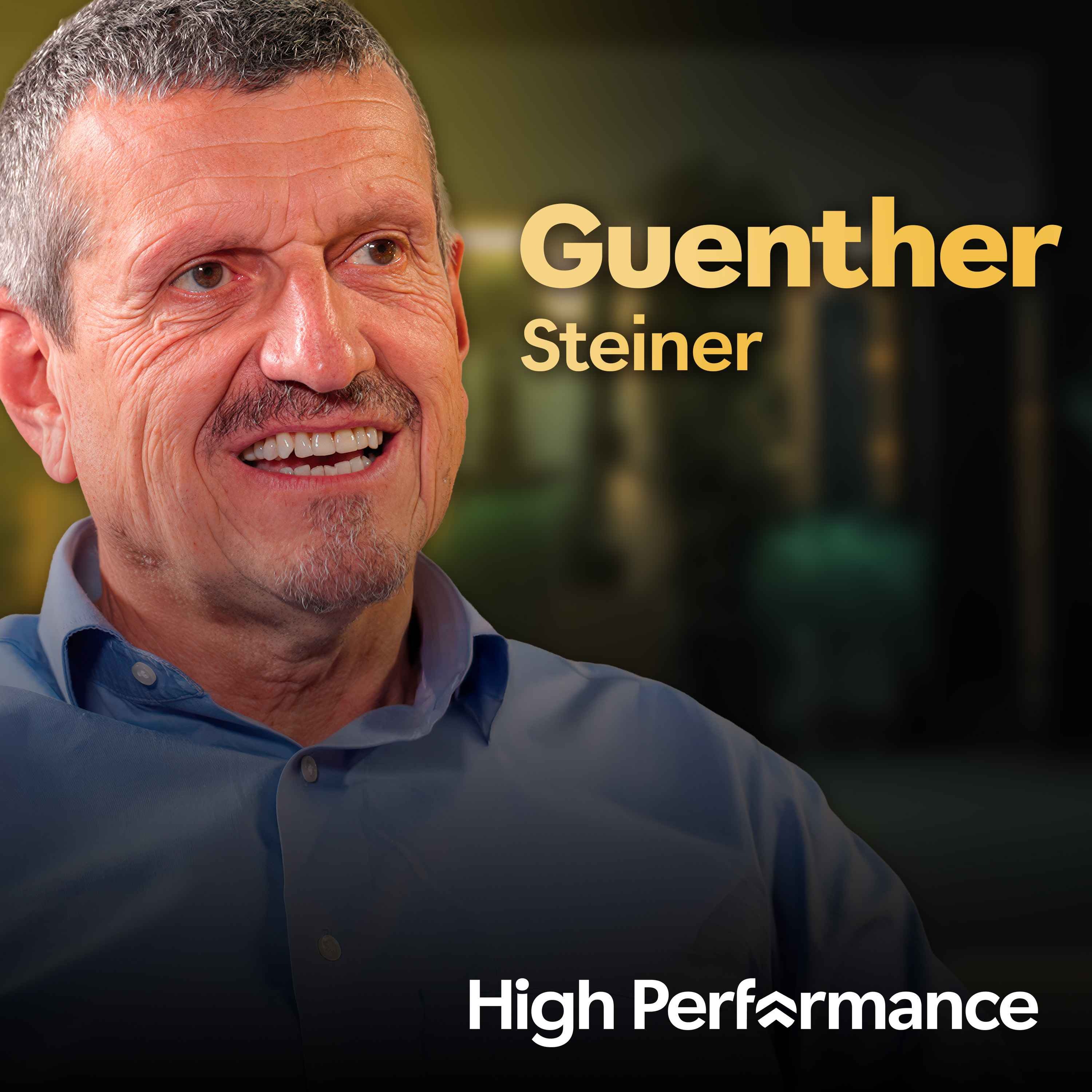
Guenther Steiner (former Haas F1 team boss) explains his Haas exit as a relief, why Gene Haas took the decision away, how budget-cap era changes drove disagreements, and how he processes pressure and conflict. He also discusses his leadership style, culture-building, and early Haas underdog strategy (using loopholes, buying certain parts, and partnering with manufacturers). He then describes what happened immediately after being fired and how it led to MotoGP and TV work.
None. The episode is a solo interview with Guenther Steiner (host asks questions; no other named guest appears in the transcript).
Steiner says he stayed “two years too long,” didn’t regret the firing, and felt frustration peaked in 2022–2023 when he saw the podium path but couldn’t convince ownership. He claims Drive to Survive amplified a caricature but doesn’t regret it. He says he’s direct, avoids back-channel politics, and apologizes when he overreacts.
Phone call from Gene Haas in a supermarket deli counter; Haas’s 2024 car improvement after Simone Resta left with him; steering rack efficiency example (buying for ~$100k vs developing for ~$3m); Charlie Whiting allowing loophole use for “own car” rules; stewards incident where a team manager told him to stop insulting people.
Written by AI. May contain mistakes.
“The decision to leave Haas was taken away from you.”
Learn how transparent communication fosters a positive team culture.
“And then what about managing upwards end?”
The lead-in to the sponsorship message.
“Mint took what's wrong with wireless and made it right.”
Discussing how to handle criticism and explain innovative approaches in F1.
“Why are you doing it differently than anybody else?”
Understanding the culture and relationships that fueled Haas's success.
“not even 250, did I know everybody by name?”
Exploring the struggles of securing funding for team success in F1.
“You know, and then you see immediately if people, first of all, understand what you're saying, because some people, it's not like, that's weird.”
Reflecting on the portrayal of character in media versus true personality.
“So you described that you had this growing sense of frustration.”
Discussing the experience of working under pressure and maintaining relationships.
“But do you feel it did affect people's perception of you?”
Learn how Gunter manages pressure and the importance of apologies in leadership.
“and every normal human being knows that, you know.”
Gunter shares personal stories about apologizing in high-stress situations.
“No, I normally, I think it was more to an individual.”
Explore Gunter's unexpected transition to television after leaving Haas.
“And this guy in life has got a very important position, you know, a very important job to do where he sees all kinds of people, you know.”
Gunter discusses his wife's reaction to his busy lifestyle after a promised slow down.
“they were like, hey Gunter, we want you in Bahrain for the beginning of the season.”
Learn about Gunter's approach to changing team cultures in a new environment.
“When I think people, when I or we or somebody is not treated right, I stand up for it, you know, and sometimes just tone it down a notch, you know.”
Gunter explains how to instill a culture focused on continuous improvement.
“And what I always try to say, guys and girls, this is not for my personal advantage.”
Learn about the importance of instilling a culture of excellence in racing teams and the challenges involved.
“Everything is an evolution of things, you know, to get better.”
Learn about the importance of instilling a culture of excellence in racing teams and the challenges involved.
“that's proven to help you live up to five years longer by nudging you towards healthier lifestyle choices.”
Explore reflections on Gunter Steiner's approach to leadership and personal growth.
“So thank you for giving up your time rather than sitting in a hotel room doing nothing.”

Get the gist, explore an idea or ask about something said.
 Claude
On The High Performance Podcast, what are the key points of this episode?
Searching your listeningAutomatic transcript. May contain errors.
0:03Jake Humphrey: You can have an opinion about me. I do not care. The decision to leave Haas was taken away from you. My vision was different than the owners. Do you feel that you stayed too long with Haas? Yes. I think I stayed two years too long. The Drive to Survive series almost created what I would see as a bit of a caricature of you. I don't regret it. I'm perfectly fine with what it is because I know who I am. But do you feel it did affect people's perception of you? How do you perceive me? When you are doing something seven, eight, nine years to get always to get a point in F1, will I ever reach the podium with what I've got?
0:39No. Did the call from Jean come as a surprise?
0:47Jake Humphrey: Well, Gunther, it's brilliant to have you back again in the high-performance chair. You're a guy that's been making decisions for a long time and yet the decision to leave Haas was taken away from you. Would you tell us about that? It was taken away, but I was pretty happy that it was taken away. You know, sometimes you want to make a decision, but then you don't. And then when it comes to it, I was very happy when it happened, you know, because I didn't agree with where the team was going. My vision was different than the owners, you know. And obviously he owns the team, so he can do whatever he wants, you know.
1:20I mean, he has fully right to do that. He doesn't have to ask me. And I'm a big believer in one door closes, two opens, you know. And obviously, in the moment, too many doors open for me because I'm too busy.
1:32Jake Humphrey: Well, we'll talk about some of those doors that open for you in terms of your move into MotoGP in a while. But would you take us to the moment when you received the phone call? Yeah, it was in a supermarket, you know, and I answered. And there was a discussion, oh, this year was bad. And I said, yeah, but we have been working on next year because obviously sometimes you have to know when you cannot recover something. And who was on the other end of the phone? Gene Haas. Yeah, Gene was on the other end of the phone. And I think to also say this was 23. Obviously, 23, the car was not good. I mean, we had problems, but we sorted the problems because you saw what the car did in 24.
2:15The car was one of the better cars Haas ever had. and that had nothing to do with the people which came in afterwards. You know, that was clearly done 23 when Simone Rester was there and Simone left as well. I mean, Simone was a technical director at the time and he left with me at the end of that year and he's now at Mercedes, deputy technical director, and they are doing pretty well. So, and, you know, that car was a good base to go forward, but for me, it was okay. I mean, you know, it's like I was there long enough, you know. For me, it's not like hanging on to something. I won't have the possibility to achieve something.
2:49And it is not possible.
2:50Jake Humphrey: And can you remember what was the food aisle you were in when you received the call? I was at the deli counter, you know, picking up my ham for the night, you know, or salami, you know. And, okay, my wife was with me. And, you know, we were there. And it was quite funny, you know. He says, I'm not with us anymore. I said, how do you mean? You know, in the supermarket, you know, on the cell phone. Okay. And it's okay. We went and went home and had dinner. And, you know, I slept perfectly. And I was even happier the next morning when I got up. Because, again, for me, a new world opened, you know.
3:28Yeah. And I just wanted to move on in life, you know.
3:32Jake Humphrey: And I know you've spoken about that ability to process a situation and move on quickly. But did the call from Gene come as a surprise? No. No. No, because the relationship wasn't good for a while, you know. It was not what it was in the beginning because I didn't agree with the vision of the team, you know. And I know myself well enough. If I don't agree with something, I'm not very collaborative, you know. And I tried to fix it and I had ideas how to fix it, all that. But it was not welcome to have ideas. It was more like, you know, this is what we need to do. And my opinion was how you want to do it is not working.
4:11You know, it will not work for the future because the sport had changed. With the budget cap coming, the sport had changed, you know, and you need to adapt to changes. Because when we came in, we could do things differently, but the sport changed. These teams, they got very, in the moment for a team to get the best out of the budget cap money is to be efficient in production. I mean, it's clearly you can see. And if you have not your own production, you cannot be efficient, you know. But to have your own production, you need to invest money, obviously, because, I mean, and all that, I had a plan to do that, but he didn't want to do that.
4:51And again, he's fully right. It's in his rights to do it because he owns the team, not me. I cannot say he did it wrong or right. That is his decision, you know? Yeah.
5:00Jake Humphrey: But did you try to put up an argument when that phone call comes? No, no. He's telling you. No, no, no. So I was like, as I said, I was pretty, I was okay with it. There was no argument at all. Right. I didn't want to argue because I was happy to move on. I'm interested in the relationship between you and Gene, because we also, on Drive to Survive, often that you would have to make the phone calls to him after a race weekend. Tell us a little bit about how that started and the moment up to that phone call. Where Gene has, you need to have him here on your podcast to ask him how he sees what he wanted to do because I still haven't understood, you know, because being in a sport, for me, being somewhere competitive, I want to be a winner.
5:46That is what I aim for. Only one can achieve it. I'm fully aware of that one, you know, but you make the maximum effort not just to be a participant. But it's the same in life. You don't want to be just a participant. You want to be part of life, you know. You want to enjoy yourself. But no, in the beginning, I mean, there was a clear plan. it is difficult to get into F1, as we now can see with Cadillac. It's not easy. We had actually success pretty early. We then had a few bad years as well, you know, 2019. But that's normal in a sport, you know. You cannot have always good years. And you're competing with the best of the best, you know.
6:21It's like so. And at some stage, I don't know, maybe he lost interest in the sport or maybe he thought it should be done different. And, you know, it's just the relationship deteriorated, I would say, you know, over time. But that happens sometimes in life, you know, and I'm not upset about it. I'm actually pretty happy to have done what I've done, you know, starting off on F1 team from nowhere, finding the money to do it because, and then being able to do it, you know, it's something I'm actually thankful that I found Gene Haas, which put the money in, you know, and I could do what I wanted to do, you know, which is pretty cool.
6:56And then when it ends, I mean, you just need to move on. I mean, I don't think, I haven't thought about for a long time until you started to ask me again because I moved on in life, you know.
7:05Jake Humphrey: When you said the relationship started to deteriorate, what were some of the signs that that was the case with you and Gene? In the beginning, we agreed on most of the things. And after, you know, I think it started to deteriorate after 2020, after the crisis of COVID, you know, when the team struggled and all that stuff, you know, to get up back on their feet, you know. So I think it just started to, talking less. I mean, there was nothing bad in it, you know. It's like there was not a sign that we, I mean, you know, we had disagreements all the time as well, but we always found a way out of it like you do in a relationship.
7:40But after a while, there was just less and very little talking.
7:45Jake Humphrey: But when you had those disagreements, how did you learn to disagree agreeably? In the end, you need to be also respectful of this guy owns everything. He puts the money in. And, you know, there's a saying, who pays decides. and you have to agree with that one and then you cannot do anything but I can decide for myself for my career as well you know and that was as I said that in the end what it was which made me happy about it that I left I think that sort of highlights how exposing your role was as the head of a team like that that you're under acute pressure you're expected to give responses in the moment when results and you're getting phone calls from America that asking to justify a result Who helped you in those moments?
8:32Jake Humphrey: Did you have a coach or who was a mentor that helped you navigate that position? No, I didn't have anybody.
8:42It's one of those things. I can deal with these things pretty good myself. I mean, maybe not me. Maybe I need a coach, what you're saying, because you're looking at me like, you better get yourself a coach here, man. you know I'm not dropping
8:59Jake Humphrey: a big hint there no you're just saying nothing you're just no but I am interested that there are moments where you've flown off the handle and you've said something and you can go back and apologise yeah but that is an example though of where it often feels exposed and the ability to just have somebody to say to you Gunter maybe you want to do this differently like who no no no there was people around which were allowed to say that for example a team manager you know as I said before at some stage she took me aside and said kunter i think i better go alone to the stewards because you're not helping the case here but by insulting everybody you know and shouting at them you know so uh and i said i think you're right let's try that one you go on yourself on your own we'll be right back after a quick word from our partners do you keep hearing podcast ads like this one for example but always wonder how you actually get involved with them for your own brand or organization?
9:56Well, it's easier than you think. We're Acast, and we give you the platform to do it all yourself. Browse thousands of popular podcasts, choose the shows that match your perfect audience, set your budget, and launch. And if you want a hand, our podcast specialists are there to help you launch with confidence. This is podcast advertising without barriers. Get started at acast.com slash advertise.
10:26Jake Humphrey: So can you give us an example then of somebody that did give you feedback that made you stop and reflect and change your behavior? Feedback I got a lot. It didn't stop me, you know. No, I got a lot of feedback, but again, it wasn't as bad as you think it is, you know, Because you just saw these moments. So you think it was, this was a continuous thing. No, it wasn't a continuous thing. It's just something. But while we were speaking, I was thinking of, you know, sometimes you see coaches or managers, what they're called, you know, going off with the referee on TV, you know. And I think it's a very similar situation when you're unhappy, you say something, but it doesn't make them bad people, you know, or incompetent people, you know.
11:13I mean, Mourinho, he's known to have an opinion about decisions of the referee. Sure. You know, he's one of the best, if not the best, you know. So I would say this is just like if you're passionate about something, you know, this happens, you know. You don't, in my opinion, you don't have to be always perfect for everybody. And I'm all right not being perfect. As I said, you can have an opinion about me. I do not care. In a good way, I do not care. Like, I have an opinion about you, you know, but it's like, it is not a bad one, by the way. Thank you. Good job.
11:49Jake Humphrey: But the reason I'm just pursuing this line, Gunter, is not because I see it as good or bad. I'm interested in the fact that emotion is very natural, especially in the sport that you're under. but you seem to have married the ability to harness that emotion to then be able to be logical and it's just the process of how you can then bury those emotions to then be creative to be innovative to keep bringing people with you i was just interested in in your thinking of how you went about doing that how you created the space there's two there is i think there is two people in here, you know, when I go racing, but it's just in you, you know.
12:31I don't have to put an effort into this, neither in one or the other. For me, it's like, you know, you need to be rational in life. And I think I'm pretty rational, you know. I'm very direct. I know that. But I have no problem with that. I cannot be any different because I don't want to be any different, to be honest. I could try to be different, but I don't want to. It works for me because I'm honest about things, you know. And, you know, I can hold also a corporate line, but in the end, if that is getting against my principles, I don't hold it, a corporate line. Because I think, you know, I'm here not for myself, but you have to represent something honest, you know.
13:12And if it is not what I want to do or what I think is the right thing, I speak up, you know. I have no problem with, you know, some people hide behind a finger. Try to do that. You will always be seen, you know. So it's one of those things I'm just like, and some people don't appreciate when you are straightforward. People like more that you tell them what they want to hear and then you do something different. I think that's wrong because that is not how you make progress, you know, by just being devious and working behind the back of other people. I don't need to do that. I don't want to do that.
13:45And I will never do that.
13:46Jake Humphrey: so how would you go about then getting your leadership team to understand this idea of we're going to give each other direct feedback we're not going to speak behind each other's back how would you go about creating that team ethos of people that could support you in creating that culture by being like this that's the only way you can do it you know I mean you cannot go to a seminar and you know all these things we need bonding sessions and all that stuff you didn't do any of that no I didn't do them for my bonding session is to be in a meeting room with other people and be honest, you know, that is the best way to do it.
14:22Jake Humphrey: Brilliant. And then what about managing upwards end? Like in those early days with Gene and his team, would you do the same in those meetings? Absolutely. I mean, you just tell them what it is. And I mean, you know, after a race, I always called him up, Gene has, and told him what happened. So at least he hears this from me. and I never told him lies or anything because it's no point. Because it is what it is. Because as soon as you have got a situation which doesn't work and you try to find an excuse for it, guess what? You will not sort the situation because you think it was okay to do like this.
14:57That is not how you make progress.
14:59Jake Humphrey: So, you know, it's often said the important thing is not how you enter the room, it's the impression you leave when you've left it. When you think of your time at Haas in Formula One, What are the relationships that you still maintain? I mean, most of the people have got a very good relationship. I wouldn't say not with Gene Haas, but... Right. But what about... It is not bad. We have no relationship. That's it. And I'm fine with that. You know, I'm fine. You know, it's not a bad relationship. You know, we sorted our stuff out and that's it. I move on. He can move on. I'm pretty happy to move on without him.
15:35And he's pretty happy without me.
15:37Jake Humphrey: I can imagine though, like when we did speak last time, that you were so synonymous with Haas, that there was so much of your identity and you've given so much of your life to it. Did you find it difficult to leave? No. No, absolutely not. No, it was not difficult because I always am a believer in the future. I've worked with people for 10 years, but the relationships are still there. These people are not upset with me because I didn't do anything wrong. You know, I actually tried to do things different, you know, better or worse, we will never know because I couldn't do it my way. But in the moment, I don't think it got a lot better because the team is at the same place where they were before.
16:14Jake Humphrey: And I'm taken with the idea, though, that you do something because you're passionate about it and you love it. When you look back on that period now, when did you start falling out of love with it? End of 22, 23, because I could see where the other teams are going, what we need to do, you know. I could see to be successful what needs to be done, you know, and I couldn't get that across. Again, it's my fault not getting it across, maybe, you know, but I try to tell, you know, this is what we need to do to be successful in the future. Because for me also, and this is people maybe when you're not working in F1, people sometimes don't understand.
16:50When you're, you know, when you're doing something seven, eight, nine years to get always to get a point in F1. Yeah. You know, I've done that. I want a podium. You know, if I don't have the opportunity to go for something better, I mean, I don't want to fight every year for the same thing like the team is doing in the moment. You know, they fight for the same thing to get a point. Yeah, I've tried to get points since 10 years to finish 7th, 8th, 6th, 9th, 10th. You know, it's like you need to put yourself in a place to say, I want to reach the podium. You know, that is, if you're ambitious in life, that is what you want to do.
17:28Will I ever reach the podium with what I've got? No. And if you don't believe anymore in it and you're not happy just to get a point on the weekend, then you need to change. And that's what I said, for me, it was good to change.
17:41Jake Humphrey: So when you reflect on you then, when you felt that you stopped believing or you stopped sharing the ambition, what was the difference in you as a leader? I always try to do my job correctly. You know, I wouldn't do less or worse. But you just start to think, what is next? You know, what is next? You spend more time on that one than you should. You know, what is next for you? Because you're not happy in the position you are in. But as a leader, I don't think I changed. Because I feel responsible for the people and for whatever I do, you know. And again, you can see we worked hard, Simone and me, for 24 to have a good car again.
18:21and the car was as good as it can get. It's not a good car, you know, because it never won a race or was on the podium, but it was a decent car, you know, but as good as it can get.
18:31Jake Humphrey: But what was the hidden cost for you, though, of still trying to drive with the same energy and the same passion as previously whilst feeling that you were competing in an unfair battle? Frustration sometimes, not a continuous frustration. It's just like when you have one of these days and you know you're nowhere and you're treading water, basically. It comes in as frustration in you. And therefore, as I said, when it finished, it was happiness. You know, when you get now the full picture, you can say, how can you be happy if you lose a job in F1? Because it's frustration. And get rid of frustration.
19:08Now the frustration is gone. Now I need to do something different. And it comes pretty easy to me to do something different.
19:14Jake Humphrey: Do you feel that you stayed too long with us? Yeah. I think I stayed two years too long. Two years? Two years too long, yeah. What do you think you should have done differently at that stage? What I could have done, should have done better or differently is maybe convincing the ownership to do or to sell them my vision. Or not to sell them, to explain them my vision better so they would do it. But I don't know if I would ever achieve that, you know. That is one of the things. But that is what I should have done, you know. To go there where it should go. But I didn't achieve that. So I think what I should have done, just say, hey, it's not working.
19:49I'm leaving now. But in the end, I don't regret it not to have left two years before. I'm pretty fine with it. You know, reflecting is like, yeah, if you give me now with hindsight, that's what I say. But at the time, it wasn't this bad because otherwise I would have done it.
20:06Jake Humphrey: Yeah, of course. But a lot of our listeners are in their own situation of having to persuade other people to understand their agenda. So would you tell us about how you went about trying to persuade the leadership of Haas in your vision? It's just like explaining what other people are doing, what it takes to be successful. But obviously, again, maybe I wasn't good enough in doing it or it wasn't understood. I will never know that, you know. maybe it was understood and again the leadership didn't want to do it and they're full in their right not to do it they don't have to listen to me because i don't own it because what i own i do what i want as well you know i'm pretty clear with that one but did you ever get pushed back or did like was it a debate or you were just presenting and and you were getting no response exactly it was just like no so can we talk about those early days at has because i think that when you say like the achievement of getting into formula one is significant in its own right but that kind of underdog mentality that you fostered seemed to be your greatest advantage in the early years yeah and and i was left completely on my own there doing it you know uh and and that's the thing because if i i think i'm pretty good in having a vision of doing something you know again i don't want to pat myself on my shoulder, you know, but in the end, I started a few things also for other people and I'm pretty good in doing it.
21:35And it's normal when then everything is set up, people then start to get, okay, that was easy to do. It wasn't actually easy. We got there, you know, but for me, the challenge, every challenge is an opportunity. That's what I always see in challenges, you know, and if you have got a white sheet of paper and you see how other people are doing it, and I respect the other people like how they're doing it. So I'm not more intelligent than them. So I have to do it a different way and you need to find ways to do it differently, you know, because if you just do more of the same, how I always think, how should I have success?
22:09Because this is intelligent. People like setting up a Formula One team, you know, when we started, there were a lot of, there were the small teams were around Cater and Marussia. This was good people, you know, there was no idiots, you know, but they didn't succeed because you fight against the big boys like Ferrari, Mercedes, McLaren, Red Bull, you know, they're at a different scale. So you need to find an angle to get there, but differently, not just more of the same.
22:36Jake Humphrey: So give us some examples then of how you decided to fight them differently. You know, by joining up with one of the manufacturers, because in the end, they know what they are doing. You need to read the regulation and get rid of your ego, because a lot of it is ego. I want to do everything myself and show the big ones how it is done. No, no. I use the big one to make me better. You know, it's like, and obviously they know about it, but in the end, you need to give them back as well something. You know, you give them information because if you have got somebody there, even if he's big, they say, these little guys, they're actually not stupid.
23:12You know, maybe we can learn a little bit of it. We help them out. We make a little bit of money because we pay the stuff we get, you know, and it helps both ways because relationships never can go only one way you know so so a business or life relationships they they cannot you cannot always just demand you need to give as well you know and and and I think that that's what it was you know I knew uh I knew the rules pretty well in formula one but you can and cannot do you you speak with the people which then have to say yes or no their authorities and they say yeah you can do this and always in the beginning it's like why would you do that because I think it's a good way to do it.
23:48And in the beginning, nobody believed what we were doing could be successful.
23:52Jake Humphrey: So give us an example of something that you went to the authorities that the rest of the industry would have gone, why are you doing that? You know, I went there, it's very simple. In F1, the rules say you need to make your own car. Define a car for me. What is included? Oh, it's all written here. Oh, you need to develop your own dynamics fine and you need to make your own chassis and the rest of the car it's not written you can buy it okay can i buy this you know and and at the time charlie whiting was still alive you know he was a good friend and charlie said yeah you can do that why not it's the rules are like this obviously behind us they didn't change everything you still can buy parts but behind us they closed a lot of loopholes we used every loophole available you know to do this because as I said we were not more we were not smarter and we didn't have more money actually we had less money than everybody else you know but if you think about it that's a way to do it and it gives you also some uh feel of uh confidence that when you get to the racetrack you will be half successful because if you do everything yourself it's just difficult you know because it's so sophisticated formula one and first of all you compete with the best of the best and you don't have time like when you do most of the other sports not all of them like in football you come third league second league and then you come to the premier league now in formula one you cannot do f3 f2 and then f1 it's a different sport you go in straight from the side with the best of the best so you have to it's better to align with the best of the best and obviously the first year you're conscious you will be be behind of them i mean that is normal but at least you will not embarrass anybody doing it.
25:31Jake Humphrey: There's a couple of things in the answer that I just want to unpick. One is the curiosity and that creativity that you obviously have. But you also said something a little bit earlier about you have to get rid of the ego to bring that humility. How do you do that? I think that's me. I mean, the curiosity and always trying to find a way. I love that, you know, the vision of doing something. I love that vision, you know. It's coming up, going back to start an F1 team. When I told So I didn't speak with a lot of people because less is more, you know, because as soon as you try to tell everybody what you want to do, then everybody gets an opinion and then it kills it, you know.
26:10You work with it. But when the first people were like, what are you talking about? How can you start an affronting from nothing? You know, I did it on my own. I didn't have a lawyer. I wrote up a business plan, went around to see a lot of rich people, you know, see if they were interested in, you know. I said, that will never work. It worked, you know. and the ego. I mean, if it is for the benefit of the cause, get rid of your ego. It's no point to have an ego, you know.
26:38Jake Humphrey: So tell us a little bit then about those visits where you're going around to these rich investors because I can imagine there's a fair amount of ego there and you're trying to sell them in this blank sheet of paper. I always say I don't try to sell. I try to explain them a project and you cannot sell a project like this. You need that they want to do it, you know, because as soon as you sell it, you are responsible for it, you know, the outcome. And the outcome, when you start, at the time when you started an F1 team, you didn't, I mean, at the time, we didn't know that F1 teams will be worth billions of dollars.
27:12At the time, they were worth as much as somebody wanted to pay for it, you know? And one team was sold for one pound, you know? So, Marusha, so it was not a sell. It was somebody, you know, if you want to do an F1 team, if this is what you want to do, there is a plan and this will work. That is what I told them. I never tried to sell them on it, you know, and I never was persistent. I presented my plan. If they said thanks and no thanks, I said thank you for the time to listen to me. But every time I did something, I spoke with someone, I learned to make the project better. So I used it to my advantage to speak with – because this is, again, wealthy people but also smart people, you know.
27:53So every time they ask you questions, it's like I better get an answer for this one because the next person will ask me that one. as well. We'll be right back after a quick word from our partners. What if the real question isn't where you're going, but the adventures you experience along the way? It's time to set your sights higher on peaks still to be climbed, rivers still to be crossed and greater dreams to pursue. It's time to embrace the impossible with Defender. A family of vehicles built around capability, durability, tested on some of the most difficult terrain. Defender defines tough luxury.
28:23And I should know I've driven one for the past three years. I have the Defender 130, but from the compact confidence of the Defender 90 to the versatility of the 110 through to mind the Defender 130 with seating for up to eight, there's endless potential. You feel in the details as well, the rugged body design, the robust materials, all working together so you can head out with confidence. And inside, ClearSight technology helps you see the world around you in a new way, while the PV Pro keeps your navigation routes and playlists flowing seamlessly as you go. And with up to 89 cubic feet of cargo space, there's room for everything you need on your journey.
28:56Explore the full Defender lineup at LandRoverUSA.com.
29:26You're saving money. Mint took what's wrong with wireless and made it right. High-speed data, unlimited talk and text, all on the nation's largest 5G network. You can bring your own phone. You can keep your number. You can pick a 3-, 6-, or 12-month plan and say goodbye to that big monthly bill. To get your new wireless plan for just$15 a month, go to mintmobile.com slash HPP. That's mintmobile.com slash HPP. Cut your wireless bill to$15 a month at mintmobile.com slash HPP. And that's it. There's no catch. Up front payment of$45 for three months,$90 for six months or$180 for 12 months plan required,$15 per month equivalent, taxes and fees extra, initial plan term only, greater than 50 gig may slow when network is busy, includes up to 20 gig hotspot, capable device required, availability, speed and coverage varies.
30:10See mintmobile.com. You know how much prep goes into every guest we bring onto this show? Well, lately, we've been doing a lot of that prep with Claude. Its deep research pulls proper analytics across dozens of sources with citations that we can actually trust, not just skim over. So last week, it actually connected two big things that we'd never spotted on our own. And that ended up being one of, I think, the biggest moments in one of our most recent episodes. And what I love about it as a host is that Claude doesn't think for me, it thinks with me. Claude is the AI for minds that don't stop at good enough.
30:41It's the collaborator that actually understands your entire workflow and thinks with you. Whether you're debugging code at midnight or strategizing your next business move, Claude extends your thinking to tackle the problems that matter. For problems worth solving, get started with Claude at claude.ai slash performance. That's claude.ai slash performance. And check out Claude Pro, which includes access to all the features mentioned in today's episode. Claude.ai slash performance.
31:07Jake Humphrey: So what were some of the criticisms that you were receiving that you took on board and found a way round or an answer? Why are you doing it differently than anybody else? Why? Because people, they see five people do it this way. You come with something different. Explain me why that will work. And then you need to give them answers to that one. And you need to explain it properly. And why you buy the parts? Why is that better? Pretty easy. You know, first, they don't understand it. But then, you know, a steering rack, what a steering rack is on. It's the mechanical bit which gets the, in F1, a very sophisticated part.
31:41You know, all the teams have got this part in. if you develop it yourself, you have got two or three designers working on it for six to eight months, you know, spending maybe$3 million to develop this part. Once you have got that part, guess what? It's not better than the other teams have got it, but you spend a lot of money. And I said, I buy this part for$100 ,000. So that is where I find my efficiency, you know, and you have to explain efficiency. And this is the little things you learn, that you can give them practical examples what you're doing.
32:13Jake Humphrey: So in those early years then, you find yourself that you've scrapped and you've managed to bring people along with you so you get yourself in the paddock. How would you have described the culture then in those early years of Haas when you were overseeing it? I think the culture was that because we were the smallest team, we had only, in the beginning, we didn't even have 200 people, but they were all people which understood what we were doing because some people you interview and you tell them what you're doing I said, I don't want to be here. I want to be in a big team, you know, where I've got, I'm a number, I do my eight-hour job, and then I go home.
32:46At last, it was a mission for all the people. I mean, and there was a lot of good people. And again, I think I was pretty lucky to get this kind of people because they all were working very hard to achieve it. I mean, I always say I didn't achieve anything. The people achieved it, what was achieved there, you know. You know, obviously, I was the leader. I came up with the idea, but without these people. And as I said, I would say 90 % of the people, or 95 % of the people, I've got still a good relationship. And they still, when they see me, they said, when are you starting something up again? Because I want to be part of it, you know?
33:20Jake Humphrey: And why do you think that they would be keen to be part of anything that you were involved in? Because I'm very direct. They saw that it worked, you know, and we enjoyed ourselves. You know, it was good. We had good time. You know, it was hard times, but they were good. You had satisfaction and everybody got recognized that they did a good job. You know, it wasn't just a big corporate, which the whole thing had success. No, the individuals had success and they loved that, you know. That was people which loved to be on a mission. So how would you go about letting everybody know that they were part of it?
33:53Jake Humphrey: And the reason I ask that is I'm thinking of when we spoke to James Vowles and he was keen to put everybody's name on the cone of the car so everybody felt that their name was being carried on the racetrack. How would you go about getting that sense of brotherhood? Just knowing the people. I think that does a lot more than putting their name on the car. That's my opinion. I mean, in the end, you know, when we were 250 people, not even 250, did I know everybody by name? Maybe not. You know, I'm honest about that. But it's just a connection with the people. That's what makes them involved, you know, and they have responsibility, you know.
34:35They need to do something and what they want to do and realize you don't have to tell them. If something did something successful, you don't have to tell them you did it. They recognize it, you know, themselves. It's a very weird, it's a culture.
34:51Jake Humphrey: Yeah, so tell us other ways, though, because like building those relationships and knowing the 200 people when you first arrive in Formula One. Sounds like that was a competitive advantage for you. How would you go about building those relationships? It's just like working with the people. I mean, we didn't have to have, you know, like big team building efforts because it was everybody bought into this thing, call it. You know, we want to establish an F1 team. It's, you know, and I just realized now with Tech3, we bought the team. It's a lot smaller than them. When you buy something and you don't start from zero with the people, it's much more difficult to get these relationships.
35:36But when you start with these people, when you employ them, because I interviewed all of them myself in the beginning. You know, I mean, we had nobody. I mean, I started on my own. I mean, I started on my own and then I got a lady involved in HR just to document everything. But I had a guy called Nigel involved in it, which worked. I know him since the Jaguar days and all of my projects. He's a financial guy because that's very important to me. But we just interview people, him and me in the beginning.
36:15than one and to bounce ideas off. And you just establish relationships by doing this. If you employ the people yourself, there is a relationship. You cannot avoid that. Obviously, when you move into a team, it's much more difficult.
36:29Jake Humphrey: But what was the criteria then when you're interviewing somebody to come with you? What are you looking for? What are the characteristics? The characteristics was like, are you buying into the project? You know, and the project was, I told them, this is not, we are not Ferrari or we are not Red Bull. You know, we are a lot smaller. We do things different. Do you like that or not? You know, and then you see immediately if people, first of all, understand what you're saying, because some people, it's not like, that's weird. How do you do things? Why do you do them like the other ones? Because we cannot.
37:01We need to do them different. You know, we need to work with other people, with another team. And some people get it and say, yeah, that's actually not a bad idea. You know, let's do it this way. And that's where you see if you want the people. and we had some people which couldn't stand the pressure of doing it like we did that they were used just to be you know a number in a team which it's fine as well there is no criticism we are all
37:22Jake Humphrey: different you know so can you give us an example then of somebody that you recruited that ended up really surprising you in a positive way i think most of the people surprised me because most of the people which came actually stayed on there was very few levers some of them couldn't stand the pressure, but it was very few. And I must say also, when we explained them what we are doing, you know, you could see immediately if they wanted to be there or not. It is not this difficult. We make it sound a lot more difficult than it is, you know. It is actually, if you are pretty, if you are very clear what you expect from people, you get a very clear answer, you know, and that's the important thing.
38:03So, and as I say, you know, we could over-dramatize how difficult everything was. it wasn't this difficult, you know. There was a will to do it, and you needed to see if the will was on the other side as well.
38:15Jake Humphrey: As you sort of get into the world of Formula One, a maturity happens to the team. You go from being just happy to be there to what you described as. Now we want to not just be happy picking up a point every now and again. We want to be on podiums. What was the change in the culture that sort of precipitated that? I think it was not the change in the culture All these people wanted more. They always wanted, I mean, you didn't, the culture was there. What was there, I couldn't give them what needed to be done. And the people didn't need to tell me. I knew myself what needed to be done, but it wasn't possible to do.
38:52That's a short form of it. It just was not possible because, you know, obviously to do these things, you need money. So you described that you had this growing sense of frustration.
39:05Jake Humphrey: the money wasn't there to be able to achieve the objectives you wanted how did that manifest itself in your team that same sense of frustration some people left some were very unhappy you know and obviously some people maybe thought it is down to me which it wasn't because I saw it coming before they you know but they couldn't know that and you don't speak about this you know you cannot make and you cannot put the blame on something uh which in the end it i'm not saying it's wrong you know everybody makes this decision and we go back to who pays the sides you know yeah so uh and and you don't try to uh to to blame somebody uh the only one you can blame is yourself that you cannot come up with the goods that they can be successful or that like you want to be can you tell us then a little bit about your character because the drive to survive series almost created what i would see as a bit of a caricature of you in terms of they would get you ranting and raving and responding to pressured moments how much do you regret that sort of portrayal I don't regret it because I know who I am you know it's pretty simple to say you know you're always perceived that some somebody from you know like like a sports documentary or whatever it is you know people which know me they know exactly why I am like this because I'm, and it's real, you know, that wasn't played.
40:36It's real because I'm passionate about the sport and what I'm doing. But on a normal day, I'm the most relaxed person you can find, you know, the most reasonable. Because otherwise I wouldn't have done what I've done, you know, because you cannot live like this, you know. And I haven't seen Drive to Survive, you know, so I don't know. But obviously I was there when they filmed it and I can imagine what they filmed, you know. So it's one of these things and they got the best out of it. But in the end, I don't regret it. I'm perfectly fine with what it is because I know who I am. You know, I don't need a TV series to make me or to act like this.
41:14No, this is who I am. If I'm passionate because we had a bad result and somebody else was involved in having that bad result, I tell them what I think.
41:24Jake Humphrey: But do you feel it did affect people's perception of you? even though you haven't seen it, you must have a sense of how people came to perceive you that didn't know you. How you perceive me? Well, in the way that you've described it. So I haven't seen you doing that rant or raving. That calmness, that ability to build a relationship is the evidence that I've seen in the two meetings that we've had. But I'm interested that people that would be coming into your world that have only ever seen that public perception. Yeah, but I think when the people meet me, it's a different story. I mean, you know, people is well aware that this is a sports documentary and this is not, you know, I mean, you couldn't be always like, I couldn't be always as intense, enormous life like during a race or after a race in the worst moments or best moments, whatever you want to call them, you know, you cannot be like this.
42:25and every normal human being knows that, you know. If people think that I'm always like this, whoa, I mean, my life would be pretty short, I guess.
42:34Jake Humphrey: But it was an interesting way of seeing you how you operated under pressure. This was the pressure in a race. You know, you're always under pressure. But then again, that goes away. And people which work with me, they know after an hour, I'm all right again, you know. It comes down, you know. And that is when you work with people. This is, I mean, you could use that against me or for me and you're free to do whatever you want to do. Or everybody's free to do with that what they saw, what they want to do. But I mean, and I have no problem with that because everybody, you know, I always say, don't judge me.
43:07But again, you can have your own opinion because I've got my opinion, you know.
43:11Jake Humphrey: Yeah, of course. But can we talk about pressure moments? Because in MotoGP, you're still going to experience those moments of acute pressure. How have you learned to effectively be able to handle those moments so you can still do your job to the best? I think these moments when you behave like, or when you act like this, not acting as acting, but when you behave like this, it's a better word. I don't think they're bad as long as the rest. I mean, these are a small amount of what you're doing, you know. Maybe this is the amount you see on TV, you saw on TV, But if you see me on a normal workday at the racetrack, you know, you don't see eight hours of this because it's not sustainable.
43:54But people which work with me are fully aware of this. So sometimes you have to say your opinion, you know. And when you're challenged, sometimes you need to be pretty clear what you want from people and whatnot, you know, or if somebody did wrong. Obviously, you're always, and I'm a big believer in that, you know, if I did something wrong or overdid it, which happens, you know, in the emotion of a sport. You know, I'm never worried or afraid to go back and apologize for it, you know, for my behavior. I mean, I'm not like this. I said, hey, maybe I shouldn't have reacted like this. But a lot of people work with me and they knew that.
44:30And half an hour they came back and laughed about it, you know, because you need to get to know a person before you build your complete opinion about what you saw on TV.
44:42Jake Humphrey: that reminds me like we interviewed a fascinating man called uh steve hansen who was the head coach of the new zealand rugby union team who spoke about one of the most powerful acts he that he found as a leader was to apologize at certain moments for the way he'd behaved under pressure or um or or in moments where he'd let himself down can you give us an example where you did go back to the team and apologize? No, I normally, I think it was more to an individual. You know, if you say something, I mean, I don't remember one case, but there is enough places, you know, like, for example, after a race, we got called to the stewards or something and the team then told me, Gunter, you're not allowed to go to the stewards anymore because you pissed them off, basically, you know.
45:34but I still have I mean I think one of the head stewards I met him two three weeks ago at a MotoGP race and he actually said to me we miss you in the stewards room because at least he gave us some action you know you said what you want to say but this is a guy which I mean if I think now this is a professional which in real life has got a very important job to do I don't want because otherwise it's easy to find out who it is and I don't want to put names yeah yeah so but i i said things to him you shouldn't be saying to people but i i was not worried to call him up the next day and say hey i i think i overdid it a little bit so i apologize you know i didn't and the guy came to me laughing about that three weeks ago you know that that is that that should show uh you know and and that these people they saw that i was doing it not because i hated them or it got personal because i was so frustrated with what happened that i I just needed somebody to run off with.
46:35And this guy in life has got a very important position, you know, a very important job to do where he sees all kinds of people, you know. So it was very weird. And he came to me and he actually walked over and said, good to see you here because I miss you in the steward's room, you know. And not saying that how I behave is right, but somehow he know that I didn't mean bad, you know, because I always was good enough to go back to him and say, hey. you know maybe I shouldn't have called you the name I called you because it's not appropriate to call a steward what I called you and you know it wasn't a nice word what I called him
47:13Jake Humphrey: well if I take you back to that phone call in the supermarket deli counter so what happened in that period if I said I just don't want to do anything I want to come down you know I want to just enjoy life because it's quite stressful so this happened two days later people started to call me to do things and I was like, I didn't expect it, you know, and I didn't look for it because I was looking to do less, you know, actually, because, you know, I still own my composite company. So it was not like the short term was not a problem, you know, so I didn't. So I was like, and I said, when they, and I emailed people back saying, guys, I'm not saying yes or no what you're suggesting, but I need a little bit of time at least to think about it, what I want to do because I was not prepared immediately to do something again.
48:02But then after a week, you know, and I honestly said, I said to the people, just give me a little bit of time. You know, I want to see where I want to go my next step. But then it comes after a week. Okay, this would be pretty cool to do, you know, to do TV. I never did TV. You know, they said, okay, let's speak about. And I made a TV contract within five days, you know, for German TV, for RTL, you know. they were like, hey Gunter, we want you in Bahrain for the beginning of the season. Like, all right then, you know, let's do it. You know, and then it just started. And then I think we can move into MotoGP.
48:39I mean, I never had the plan to buy a MotoGP team. So because I had a little bit less to do, I like MotoGP always, but never had time to go there. So I think it was March in 24, I went to the race in Austin, you know, because it was close by in the States. I said, fly there, you know, got there. And on the way back in the airplane, it was like, it would be pretty cool to have a MotoGP team because this is a sport which is growing, you know. There is potential there, you know. So I started to, again, to speak with people, how about getting a new license? And I was told, you don't get a new license, you need to buy a team.
49:15And I was like, okay, if I need to buy a new team, I need some money. And I didn't have enough, I need to find investors. So, but I started to work. But it's not like I go about it like eight hours a day I work on this. No. Okay, let's try this. And I knew enough people, phoned up a little bit of people, met with a few people, and this is how it happens. But it's just like I get an idea, and then, as I said before, you start to draw the picture, and once the picture is ready, you go and do it.
49:43Jake Humphrey: And what did your wife say, though? So you've made that promise of I'm going to slow down and take some time, and then the phone calls and the emails start coming in. What was her reaction? I'm an idiot. To say it bluntly, I said, why you do this? You worked so hard the last years. And again, she still says it. Why you do all these things you do? Because I cannot sit still. It's difficult for me to do nothing. It's very difficult. And it's like, yes, I cannot say it's not work, but I want to do it. I don't have to do it. That is maybe the nice thing. you know for example i don't need to be on this podcast but it's it's it's a pleasure to be here you know it's like it's something you do and uh you know if if it's something nice if somebody wants to know your story and how you do things it's nothing but you know i don't have to do it i could sit in the hotel now in london doing nothing sure but i rather sit here with you and we're grateful that you have done so thank you for that first of all but but what answer do you give to your wife when she says you're an idiot why are you doing this i i don't argue with her i just take i'm an idiot and i keep on doing what i'm doing you know exactly yeah and let her believe i'm an idiot you know so but but she knows me i mean we are married 30 years you know she not more than 30 years actually uh she knows uh who i am and and she knows that when i'm sitting at home doing nothing i'm not a happy camper you know so uh she is rather doing me something than sitting at home being a pain you know where and and does she ever give you any sort of advice or challenge you in a professional capacity she tries to but uh i i think she has given up you know uh i i'm i'm advice resistant you know so no no no but but as normally if if if there is something
51:41where I, for example, react. I'm very reactive to things. When I think people, when I or we or somebody is not treated right, I stand up for it, you know, and sometimes just tone it down a notch, you know. It's not every battle is yours, you know. Just get over it, you know. Like, you know, like in public transport or something, you know, people push it along. I mean, I need to tell my thing, you know. And I tell people, hey, why you don't wait in the line, you know? Like everybody else, things like this. I always, you know, that's in me. I cannot help myself.
52:16Jake Humphrey: I mean, that's an interesting example. Where does that sense of fairness or that rallying against injustice come from? Because I think people shouldn't take advantage of other people. I mean, I stay in the line, so you have to stay in the line. I mean, it's like, why do you think you can do things you shouldn't be doing? I think I'm very much for a civilized society, you know? Yeah, yeah. And smartasses don't work for me. See, but that's interesting, isn't it? Because, again, we're drawing a very loose parallel here, but you go in Formula One with Haas, and you are being the guys that are disrupting, the guys that are trying to push in, the guys that are trying to, like, find the loophole.
53:00But all within regulations. All within, you know, if, I mean, it's, yeah, it's all within how it should be, you know. You need to be smart, but not devious. You know, that's something different, you know.
53:13Jake Humphrey: I like that. I like that distinction. So tell me about, you're going in with Tech3 now. How are you being smart, but not devious then? How am I being smart? I try to get smart there. I'm not there yet. I'm still learning, you know. It's one of these things, I think I said it before. For me, it's much more difficult to get in something which is not more difficult, different. It's not difficult. It's different to go in there and in something set up because it is a good setup. You know, I just need to get used to the culture. And if I want to change something, I need to change a culture. Changing cultures is very difficult because it was developed over a long period of time.
53:52That's what it's called culture, you know. And to change this, you cannot change it from one day to the other. and you need to bring people along, explain them what you want to do, what we have to do, not only what we want to do, you know, to make it better for everyone. And what I always try to say, guys and girls, this is not for my personal advantage. This is for the advantage of all of us if we do better, if we do more, if we do it smarter, maybe find different ways to do it, not being stuck in a rut basically, you know? But I'm still working on it. And again, as I said, it's a very good sport.
54:26you know and i'm not smarter than them i have a lot more experience in other industries you know i need now to get the experience in here and merge the two things together and hopefully
54:39Jake Humphrey: something good comes out so when you first go into a new team or like a new sport in many ways that you don't have that depth of history in what are the first things that you do to assess what their strengths already are and then where you feel you can make a difference? I think you observe, you speak with people, you talk with people, you know, and it doesn't need to be always in a, you know, an environment where you really drill deep. It's just like you go around, observe, and, you know, when you do motorsport a long time like me, a lot of things you have seen before, you know, not everything because I'm not Mr.
55:19Perfect, you know, but you've seen a lot of things and you see things, okay, this we could be doing different. I don't want to say better because, you know, better is different opinions about better, you know, between people always, you know, so we could do this different, but you need to bring the people along that they believe in it. And I want that the people tell me what we need to do to get better. That's not always being me telling them, hey, do this. I just need to give them, as I did that ask, guys, you're responsible for it. You know, if you do your job, you know, we will be a good team.
55:51They need to come to me. That's what I try to do, that they say, hey, if we do this different, we need money, whatever we need, you know, to do things different. Can we do it? Because nothing is perfect. Everything is an evolution of things, you know, to get better. Everything, you know. So I just try to install that culture of let's try always to be the best in all what you do, you know. and I've said it's easy said, not so easy done.
56:19Jake Humphrey: So how long in your experience does it take before that mentality starts to become embedded? I think it will take a year, you know. It will take at least a year and then it's not 100 % because you cannot go from zero to 100. It's an evolution and there is things which already get better, you know, or different, you know, not better because better again is you can judge what is better and what not, But it's just like to install this culture of let's always try to achieve the maximum. If there was one thing you could take from your Haas experience into Tech 3, what would that be? I mean, if you could change it, I would like to start with a complete new team.
56:58Right. You know, but in the end with Tech 3, we got the good team. You know, it would be easy if I would say, so why you don't change everything and start from new? Because it's a good team, you know. and then again it's like what is easier to start a new team because that will take time or try to change a little bit the culture in there you know so I think that is the better way to change the culture because I think Interweb on Chiral the owner of the team he had it a long time very smart guy you know and he did a good job I mean this guy is going racing I mean I'm just like alright they don't need me you know to go racing if I'm not there they're actually better off to be honest because one guy less standing in the way, you know, just one body less around because they know to do that properly, you know, and good, they are one of the best in the paddock, you know, so we got very lucky with that one.
57:49But then to expand, you know, all the commercial stuff like this, that was never there. But in general, MotoGP was not at the level like Formula One is, and that is what we have to install.
57:59Jake Humphrey: If there was one thing that you would want to leave as a legacy when your time is up at Tech 3, like we've spoken about how you reflect on, Haas, how do you want this team to describe you? That it was a team which was very good and at the end, it was fantastic. If there was a final message then that you would speak to, if you could speak to Gunter from 10 years ago? Maybe be a little bit more chilled about things, but he wouldn't listen. Gunter wouldn't listen, so there's no point to tell him, you know? Because he cannot be. It gets in me. It's like, and I try to do that many times to tell myself, you know, but when it gets to it, when we need to get going, we need to get going.
58:45Jake Humphrey: So Gunther, it's time for our quickfire questions, which are brought to you by our partner Vitality, the life and health insurer that's proven to help you live up to five years longer by nudging you towards healthier lifestyle choices. So let's find out which ones matter most to you. What are your three non-negotiable behaviours? My directness, I'm polite, and I'm fair. What's the greatest piece of advice you've ever received and why? Believe in yourself. Because if you believe in yourself, you can do a lot of things in life. If you don't believe in yourself, you don't achieve anything. Who gave you that?
59:23I think that came over time. I mean, I just accumulated from successful people. They all believe in themselves.
59:30Jake Humphrey: What's your greatest strength? Persistence. And your biggest weakness? I'm stubborn sometimes. what advice would you give to a teenage gunter just starting out on this journey let's go and do it what's one goal that you'd like to achieve that you haven't quite said out loud yet i haven't won a world championship what role does health play in your success everything i mean it's the most important thing because without health you cannot do anything and i mean i i try to look after as much as i can you know with eating healthy uh moving making some exercise you know but I'm fully aware that health is the most important thing to live a good and successful life.
1:00:14Brilliant.
1:00:15Jake Humphrey: What's one habit that you've adopted in your life that changed everything for you? I like to walk in the morning to get my mind up. Like this morning, I walked for an hour in Hyde Park, you know. Right. Yeah, I get up at 6.30 and I go for a long walk just to then I can figure out today what I need to do. And you don't listen to anything? No, no, no, it's just me. It's just me. This morning I was with my wife because she's here. But I mean, if I would be alone, I would do the same thing. And finally, what's your one golden rule for living a high performance life? Whatever you do, you need to like or like to do it or want to do it.
1:00:51Otherwise, you cannot be successful.
1:00:53Jake Humphrey: Find out more about living longer with Vitality at vitality.co.uk. Gunther, I've loved listening to this chat. So thank you for giving up your time rather than sitting in a hotel room doing nothing. But it's exciting to watch you take this next stage of your journey with Tech3. So thank you for coming along and sharing some of those insights today. Thanks for having me. Well, this is a bit where I would normally turn to Jake and we do have reflections. So I'll do it on my own. And I found that a fascinating conversation with Gunter. I think what stood out for me was a couple of things. Psychologists often talk about entry and exit points of any relationship.
1:01:35Jake Humphrey: How we arrive, but equally how we leave, is significant in being able to do that effectively. And I think what Gunter was especially skilled at doing was having exit points, being able to move from Haas and have that confidence that two doors were going to open for him. And I think there's something quite elegant about the way that he's managed to do that. So he's left with no recriminations or bitterness or any kind of resentment to the place that he's left behind. The thing that did stand out for me, though, was the paradox that Gunter often encapsulated, this willingness to be humble and take advice off other people, but then the resistance to advice when it went against his own instincts.
1:02:19Jake Humphrey: I think there's something quite interesting there that we can all reflect on ourselves about. Who do we take our advice from? And are we really willing to change our behavior? on the back of it. I found it a real difference in meeting Gunter from the last time we met him four years ago. I felt when we spoke to him there, he was in the midst of the drive to survive caricature of the guy that was constantly ranting and raving and effing and blinding. Whereas this was a more reflective, calmer character. And I think that captured who he said that he is most of the time. I felt we saw the real him on this occasion.
1:02:56Jake Humphrey: And I hope you found it a fascinating insight into a complex, charismatic, and an incredibly successful character from the world of Formula One. It's been a real pleasure to sit down with Gunter today. And you could go back and listen to the interview that Jake did with his successor at Haas, Ayu Komatsu. And if you're interested in the lessons that we've gleaned from some of the Formula One principles, you can also go and explore our interviews with Toto Wolff, Christian Horner, and Zac Brown, just to name a few. But as ever, thank you for joining us here as being part of our high-performance community.
1:03:33Jake Humphrey: We look forward to seeing you next time.
1:03:45Here's a tip for you. There's a podcast out there with fans waiting to be your next customer. They tune in every week, they trust the host, and that host wants to talk about brands like yours in their own words to their audience. The problem is, you just haven't been introduced yet. We're Acast, where that introduction happens. As the world's largest podcast marketplace, we let you browse shows, see who's listening, and book host-read sponsorships or run your own ads all from one platform. Transparent pricing, real-time data, complete control. Start advertising on podcasts by visiting acast.com slash advertise.
Guenther Steiner is one of Formula 1’s most recognisable team bosses, building Haas from nothing and becoming known for his straight-talking approach to leadership. He joins us to reflect on ambition, pressure, and knowing when it’s time to walk away.
Guenther opens up about his final years at Haas, admitting he stayed around two years too long, and how he knew the belief was gone when he could no longer see a path to a podium. He also reveals the moment he discovered he’d been sacked, and why it brought an unexpected sense of relief.
He shares the thinking that built Haas and how he’s applying the same principles to his new chapter in MotoGP with Tech3. This is a candid conversation about ambition, identity, and knowing when to let go.
Revolut Business 👉 High-performing businesses need powerful financial tools. Get a £200 welcome bonus with Revolut Business when you sign up at https://revolutbusiness.onelink.me/jLOt/hp-ep9-aud and add money to your account by 30/09/2026. Fees, promotion terms and T&Cs apply.
AG1 👉 head to http://drinkag1.com/highperformance and get a free Morning Person Hat to help start your AG1 daily habit - plus a free D3 and K2, and five travel packs
Go Henry 👉 Grow their skills and their money at gohenry.com/highperformance with £5 FREE to get started!
Eight Sleep 👉If you want to discover deeper sleep. Use code HPP to get £360 off your Pod 5 Ultra here: https://highpfrmc.com/eightsleep_au
Vitality 👉 We've partnered with Vitality because our philosophies align perfectly: healthy habits build high performance and can lead to a healthier, longer life. Find out more about health and life insurance with Vitality: https://highpfrmc.com/vitality-hpp-au
Hosted on Acast. See acast.com/privacy for more information.


