
 Ask ChatGPT


 The High Performance Podcast
12 Oct 2026 · 58m · 21 chapters
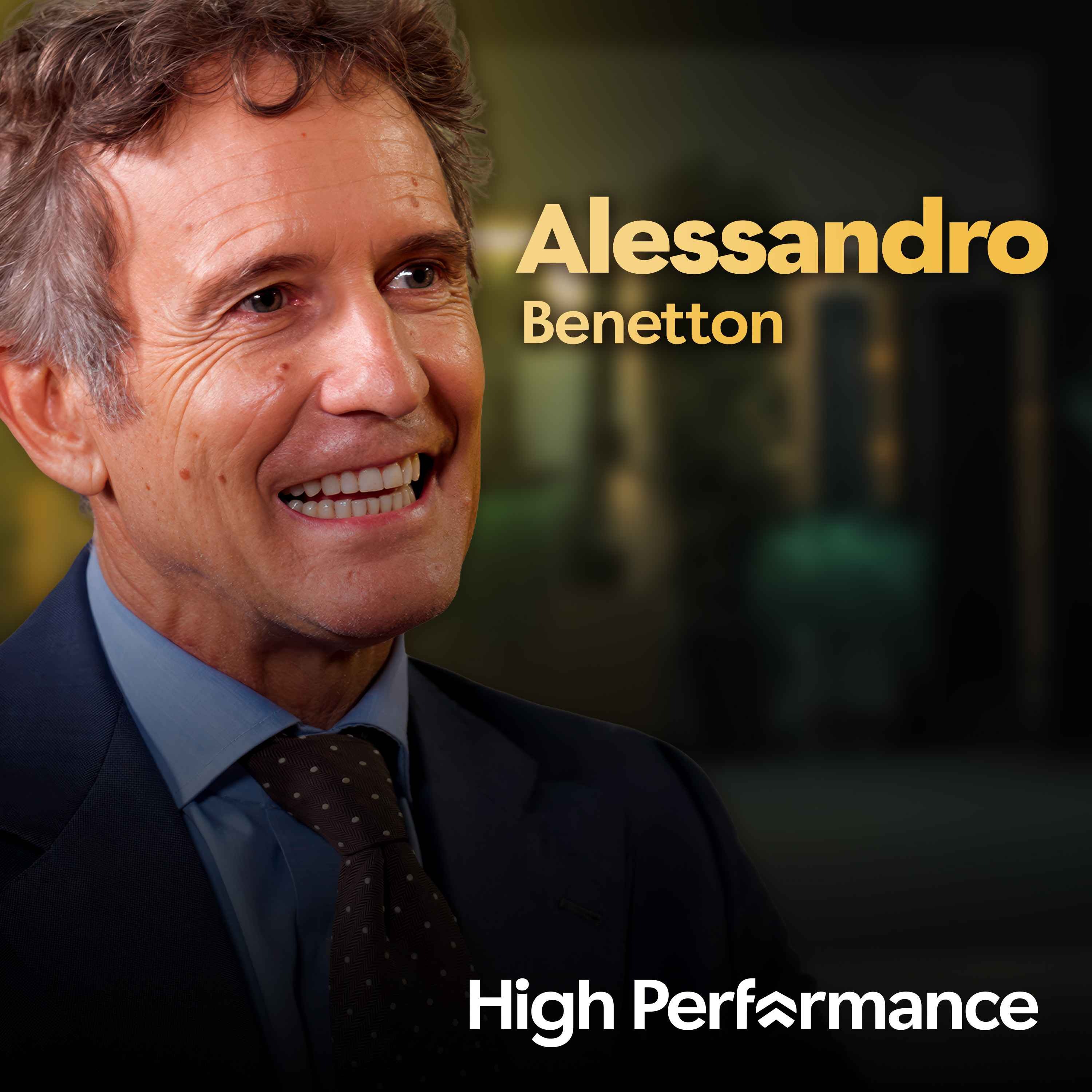
Alessandro Benetton explains how Benetton—initially mocked as a clothing brand—built a Formula One championship team by spotting and signing a young Michael Schumacher, leading through the 1994 Imola tragedy, and navigating reputation and FIA controversy (including launch control allegations).
Alessandro Benetton is chairman/leader of the Benetton F1 effort after joining the family business in his early 20s. He describes his 1988 entry via Treviso and his leadership role during the Schumacher era. The episode also references Flavio Briatore, Eddie Jordan, and Michael Schumacher’s background as a young driver.
Schumacher’s defining traits were not intimidation, discipline, and a relentless demand for “more horsepower” and investment. Benetton’s strategy was global brand visibility on a limited budget, with reputation as the “unit of measurement.” During Imola, Benetton says leadership centered on the human impact and keeping the system together. On 1994 launch-control scrutiny, Benetton says he publicly defended the team while privately urging it not to create doubts.
Schumacher’s debut qualifying seventh (1991) and Benetton’s rapid pursuit; Schumacher’s humor and team morale (e.g., interacting with a cook, returning a fallen part to mechanics); Imola’s Saturday atmosphere and Ayrton Senna’s death not communicated until after the race; Schumacher’s Japan title-clinching moment and Damon Hill pressure; Schumacher’s later move to Ferrari driven by belief in success and a major financial package.
Written by AI. May contain mistakes.
Discussion on the early interactions with Michael Schumacher and the vision for Benetton.
“I want to start with one week in 1991 when an almost unknown 22-year-old called Michael Schumacher arrives in Formula One, qualifies seventh on his debut.”
Alessandro shares how he became involved in the Formula One team at a young age.
“I think that if we want to give a little bit of background to that, we need to go back to the fact that I was in my 20s.”
Exploration of what made Alessandro want to sign Schumacher and his early impressions.
“that actually there was a tag outside of a room and that says Alessandro Benetton, chairman.”
Details on how Benetton approached Schumacher and the competition for his signing.
“He got into the car, no experience, and he gets into the car and he has another driver of the team who's very fast on the laps as De Cesare is, and he's so much faster, the first lap.”
Alessandro discusses the dynamics between Benetton and Flavio Briatore during the negotiations.
“I think that Eddie has good reason to claim that he was the one who discovered him.”
Alessandro recounts his first meeting with Schumacher and his observations on his character.
“So he's kind of saying to you, make sure everyone backs me on this.”
Discussion about Schumacher's drive and focus on becoming the best.
“How did you see those manifesting in his behaviors?”
Learn about Michael Schumacher's early demands and leadership style.
“I think the Michael Schumacher that won multiple world titles with Ferrari, he did have standards and he did demand things and he did deliver and he was consistent.”
Discover how Schumacher balanced competitiveness with team spirit and humor.
“I think the other thing that people don't speak about often enough with Michael Schumacher is his sense of humor.”
Understand the emotional impact of the 1994 Imola weekend on the team.
“carried that team through the Imola weekend?”
Explore how leadership was handled during the mourning period after Ayrton's death.
“And because you were at home, you probably had more information than they had at the circuit.”
Learn about the dynamics between team management and Schumacher during their title run.
“And after that moment of shock, the season carries on as it always does in Formula One.”
Learn how managing relationships and expectations shaped team dynamics.
“that I don't think anybody ever recorded that.”
Discover how sponsorship choices and public perception impacted team success.
“I have such mixed feelings in the moment and mixed sensations that I would be lying if I told you that I had everything clear in my mind.”
Learn about the intense dynamics of racing in the championship and the pressures faced by teams during critical moments.
“You know, we're winning the championship, having much less horsepower than our competitors.”
Explore the aftermath of the championship race, the team's doubts, and their ultimate victory in Formula One.
“In the immediate aftermath, as you were still celebrating and spraying champagne and partying, was there any talk within the team of the controversy of that race?”
Discuss the changes in Formula One, including recent developments and modern influences.
“But I think it's amazing what has happened.”
Explore how recent changes have revitalized Formula One and the role Benetton played.
“Today, it is much more moderate in the pit lane, still big in the circuit and it's huge outside.”
Explore how recent changes have revitalized Formula One and the role Benetton played.
“What's the one habit in your life that is vital for your health?”
Discover Alessandro Benetton's experiences and insights from his career in F1.
“at vitality.co.uk, the life and health insurer that uses a behavior change program to incentivize healthy lifestyle choices.”
Reflect on key takeaways from discussions about Michael Schumacher's impact.
“But Alessandro had this really difficult period where publicly he's backing his team and privately, as he told us, he goes to them and says, why are you doing this to the Benetton name?”

Get the gist, explore an idea or ask about something said.
 Claude
On The High Performance Podcast, what are the key points of this episode?
Searching your listeningAutomatic transcript. May contain errors.
0:03So when did you first become aware of Michael Schumacher? He was doing the best and he was telling you, I expect you to do the best. What are we doing here? It's not supposed to be a place where people get killed. Sometimes if you want to find your own space, you have somehow to rewrite the rules.
0:26Alessandro, welcome to High Performance. I want to start with one week in 1991 when an almost unknown 22-year-old called Michael Schumacher arrives in Formula One, qualifies seventh on his debut. And within days, Benetton, the team that you are running, are trying to sign him. And then just four years later, you're already the world champions. So I want to understand in this conversation what you saw in Michael Schumacher that made you want to sign him, who he really was away from the cameras, how you led that team through the trauma of Imola, but also how a clothing company who were laughed at by some people in the paddock ended up beating the giants of Formula One.
1:10Does that sound interesting? Absolutely. Great. And brings back great memories. I think that if we want to give a little bit of background to that, we need to go back to the fact that I was in my 20s. I was at Goldman Sachs here in London, as a matter of fact. My father comes to London. He gets into my office at Goldman and says, listen, you know, we bought a Formula One team. Your uncle is quite worried about how much it's costing us, this thing. and I think that you should take a look at the numbers. You're good at numbers. You are a Goldman Sachs. And in reality, you know, I was, yes, the first Italian ever a Goldman Sachs, but I was mostly preparing coffee for superiors, making photocopies.
1:57So, I mean, but I understood about numbers. So I said, well, are you sure you want me to do that? He says, yes, yes. During your spare time, just get involved with that. So first weekend, take the train, go to Whitney where we had this so-called factory, which in reality was not something much bigger than, you know, like a little shops, a repair shops for cars. It was something very, very, very small. So I get into the office and I find out that actually there was a tag outside of a room and that says Alessandro Benetton, chairman. So that's how I discovered it. You're how old? I was 24. So, and I felt really bad for two reasons.
2:45First of all, because obviously I was not prepared for that. And second, because that was exactly the opposite of what was looking for at that point of my life, which was to establish my own path. And that was such a shortcut that did not make me comfortable with. So what to do, what not to do. That was my father's style. You know, it just would throw you in the water and see what happens. And the things were not going very well. So that was 1988. So we get to 1991. Like you said, you know, I had done some experience by then. And one of the main ingredients that we were discovering, which I think is the highlight of that cycle of experience, was that we had to move.
3:33We had to change. We are continuously looking for new gimmicks and trials in order to escape this position of just being the underdogs and being the people, like you said, people would laugh at because no background, no experience coming from clothing. You know, what would you know about engineering and an engineer and so forth? And so that was a very important element that expressed very well how courageous we were and how we would look outside of a box. So being aggressive in getting a new driver that was just at the beginning and just had done very little was one sign of that context on which we were moving.
4:24So when did you first become aware of a driver called Michael Schumacher? I think Michael discovered himself. He got into the car, no experience, and he gets into the car and he has another driver of the team who's very fast on the laps as De Cesare is, and he's so much faster, the first lap. So, I mean, you look at that and you know that the guy has something, you know. Now, if you ask me if there was another element which was perhaps more like personal, it was his personality. It was very clear to me from day one that he was not intimidated. He was not intimidated by the circuit. He was not intimidated about the fact that he was very young.
5:08He was not intimidated by the fact that he had no experience. And he was not intimidated by other champions. that was another important element that was very clear in my eyes that would potentially make a big champion As I mentioned before we started recording I was telling you my background and I worked in Formula 1 from 2009 till 2013 and the person I worked with who was the expert alongside me was Eddie Jordan Of course And obviously Michael was in the Jordan car and it was funny whenever I spoke to Eddie he used to growl at me and say don't ask me about Michael Schumacher. They took him from me.
5:48And this is such a fascinating part of the story because Michael drives in the Jordan. Obviously, we both know Eddie, a businessman, loves a deal. He probably thought, this is my new driver. And then suddenly Benison swooped in. I'd love to sort of break down what happened here. Who was the first person to reach out to Willie Weber and Michael Schumacher and say, let's have a conversation? I think that Eddie has good reason to claim that he was the one who discovered him. You know, that's why, you know, we could have a big debate about who did it. Was it Briatore? Was it Eddie? Was it... But it probably is Michael.
6:28Was it Tom Walkinshaw claimed that he was, that he's Bernie Ecclestone. I mean, it could be many of us. And Eddie for sure should be in the top of the list of people who can claim because he was the one who brought him into Formula One. And I think that basically Bernie Eccleston knew that there was not a definite contract. It was just something temporary for Spa. I think that Bernie wanted to make sure that that was an opportunity to keep the interest of Formula One alive. He thought that Michael plus the emerging team, which was Benetton, that was still lacking that pit in order to become truly competitive could be the new story and raise the level of attention of Formula One much more than Eddie.
7:19So Flavio led the conversations to try and get Michael to join. Yes, indeed. But you would have been speaking to Flavio during that time. Of course, I was in touch with him. Actually, it was quite funny because at that time I was in Boston, And I had watched the trials, the Saturday time-lapse, and I called Flavio and I said, did you look at this guy? I mean, this guy is seven. First time he gets into a Formula One and we are at Spa. How is that possible? And he says, I think, Flavio, we should really look into this guy because it's clear that there is a talent. And the answer was, I'm already working on that, you know.
8:07And I said, well, are you sure? I said, yes, be prepared. It's going to be confusing. There's going to be tension. Is that what Flavio said? And that's what he told me. Right. And he said, and so you will need to do some work with Treviso. Treviso is our headquarter of the Benetton family. And he knew that the family would have reacted a little bit like, oh, are we sure that that's the right way to behave? You know, is it polite to do something like that? So he was like kind of preparing me to prepare everybody else. That's really interesting, though, because you've got the sort of the traditional Benetton business in Treviso and you do things the right way.
8:51And then you've got Flavio, who's a competitor and a sportsman who is maybe a little more aggressive. So he's kind of saying to you, make sure everyone backs me on this. Make sure that... That's correct. But at the same time, I knew there was an angle that could be very well presented within the headquarter. At the end of the day, I always knew that in the back of the mind of my father, there was always a tendency, a trend to follow and try to do the unexpected, try to explore new ways of doing things. So I knew that we could also claim that sometimes if you want to find your own space, you have somehow to rewrite the rules.
9:45Because if you just follow the rules, you have to follow the line. And if you follow the line, there's somebody who's before you. Do you remember the first time that you met him and sat down for a conversation? Oh, yes, I did. It was the following Grand Prix. I went there, I talked to him and I saw he was very mature, very self-confident, very determined, very clear in what he wanted to achieve. and at the same time he was carrying the enthusiasm that a young driver, a young sportsman carries with himself which is like you could perceive that he really loved what he was doing. He loved driving.
10:32He loved being fast. And I think anybody who would meet him at that point in time could recognize that he was strong in both aspects. How did you see those steps to become the best of the best? How did you see those manifesting in his behaviors? Programming and, as I said, making sure, you know, there's certain people that you meet, that you can already feel that they could change with success. They could change if things went in a given manner. He never gave me that impression. I mean, you could tell that he was those type of person that was so focused on what he was doing that most likely he would have not been distracted by any lateral forces that would have come in case of success.
11:31He would have not been distracted by money. He would have not been distracted by media attention. He had that sort of personality. uh what uh how would he give that impression why somebody in front of him would feel that way i i guess uh it was very focused you know you would ask him you know what are your priorities i said it was said i need more horsepower uh we need more investment uh in the in the wind tunnel we need to make sure that we get the best tires we need to make sure that we have the right engineers because we need to improve on the mechanics and so forth and you know I never saw that as a limitation as a man, as an individual I just saw somebody who wanted to reach an objective We'll be right back after a quick word from our partners
12:36This message is brought to you by Apple Card. Ah, fall. That cozy season where we swap the swimwear for sweaters and sunnies for scarves. But before the Halloween decorations are put away or Thanksgiving table has been set, there's already holly jolly music playing in the grocery store, reminding you that the year is coming to a close. Time to kick end of year into high gear. When you use Apple Card with Apple Pay, you earn 2 % daily cash back on all purchases, including food, decorations, gifts, and more. Get a head start on your end of year purchases. Apply for your Apple Card in the Wallet app on your iPhone today and start using it right away with Apple Pay.
13:09Subject to credit approval, Apple Card is issued by Goldman Sachs Bank, USA, Salt Lake City Branch, terms and more at applecard.com. Still waiting in line? Again? That's time you'll never get back. Save time and money with Stamps.com. Over 4 million businesses have skipped the line with Stamps.com. Join them to save up to 90 % off carrier rates from your computer or phone right now. Print postage for certified mail, registered mail, and packages in seconds. Then schedule a pickup right from your home or office. For a limited time, go to stamps.com and use code podcast for a free welcome gift. Taxes and fees apply.
13:47What if the real question isn't where you're going, but the adventures you experience along the way? It's time to set your sights higher. On peaks still to be climbed, rivers still to be crossed, and greater dreams to pursue. It's time to embrace the impossible with Defender. A family of vehicles built around capability, durability, tested on some of the most difficult terrain, Defender defines tough luxury. And I should know, I've driven one for the past three years. I have the Defender 130, but from the compact confidence of the Defender 90 to the versatility of the 110, through to mine, the Defender 130, with seating for up to eight, there's endless potential.
14:21You feel it in the details as well, the rugged body design, the robust materials, all working together so you can head out with confidence. And inside, ClearSight technology helps you see the world around you in a new way, while the PVPro keeps your navigation routes and playlists flowing seamlessly as you go. And with up to 89 cubic feet of cargo space, there's room for everything you need on your journey. Explore the full Defender lineup at LandRoverUSA.com. And Michael was incredibly young at this point. I think the Michael Schumacher that won multiple world titles with Ferrari, he did have standards and he did demand things and he did deliver and he was consistent.
14:56but he was also a much older, more experienced driver at that point. I think it's really interesting that Michael is so young, yet he's still saying to you, I need this, I need this. You're describing someone who is almost much older than his years. I tell you one episode, which is something that I haven't mentioned many times, somehow as a personal angle. But I think explain a little bit about who Michael is. So I'm the teen owner, theoretically, I'm the chairman, and I go to the Grand Prix. You know, at that time I had a girlfriend, and my girlfriend was actually, would speak German, so they would interact.
15:38And he had been dating his future wife, Corinne, I don't think for very long. But I could tell you that he took the thing very seriously. So at a certain point, I was in a different situation. So I presented, I mean, I get into the next Grand Prix and I go with another girl. And I could tell immediately that Michael did not like that. And we had no confidence. We were not friends. I mean, and he made sure that I would know that he was not agreeing with my choice. But it was not in an arrogant manner. It was not in an impolite manner. It was just a way of telling me, well, you shouldn't do that, you know.
16:33And did he do that? And yeah, he gave me, yeah, that's how he behaved. But that tells you, if you want to read it in a different manner, that he was very determined. And for him, order, discipline and being consistent with your choices was a way of life. It was something that meant a lot to him. I think the other thing that people don't speak about often enough with Michael Schumacher is his sense of humor. Because you can't just be a robotic performer all the time. What was he like with the Benetton team, with the mechanics, with the engineers, with the catering stuff? It was good. I mean, he knew, especially when things were going well, that he should keep the team spirit high and alive.
17:24So he would have a very friendly relationship with a cook. He would have a right level of attentions on people when he wanted to give that sort of added value contribute. to the team. At the same times, you know, I remember once that that was, you know, the car broke down and one piece fell out from the car. And he stepped out, he brought up the piece, and he went to the mechanics and he gave it to Hans, who was responsible for that, and tap him on the shoulder, you know, pat him in the shoulder. Just like saying, hey, you know, that was your responsibility. make sure that that doesn't happen again.
18:17And maybe he would do something like that. But his major contribution was the cross-pollination that he was bringing into the team by doing this sort of actions, you know, making sure that everybody was responsible. He was doing the best. And he was telling you, I expect you to do the best. Setting the standard. He was setting the standard. Michael then drove for you for a couple of years. and then 1994 is the year that you win the title. The greatest season of Benetton's life because you won the world title with Michael that year, but also the hardest because of Imola. Can we talk a bit about how you as a leader carried that team through the Imola weekend?
19:01Because such a difficult mix of emotions because you won the Grand Prix, but you lost two great friends. I still feel you know I get goosebumps you know when I think that weekend because everything that should not happen did happen in a weekend so my memories goes back at least my most emotional part of my those two days the facts are well known terrible accident to Barrichello and two people lost their lives, you know, and if you ask me, it was the Saturday and I was in Imola and the atmosphere was terrible, Ratzenberger, you know, and we all know, but, you know, we justified, you know, we said, okay, maybe it was a minor team, something broke down, the driver was an excellent driver but still not enough experience that's how you know and so we pack it and we put it back and we said okay tomorrow is another day and it's one of those days and we already paid the price for what can go wrong you know it's like when you hear about dramatic events you know on planes and you say okay now quote unquote we're going to be safe for a while because statistically that has gone And again, yeah.
20:36So that was the spirit. So I went back, actually, I'm watching the Grand Prix on TV. I would do that quite often, actually, because for me, the moment was really to understand the spirit on the Saturdays and the Fridays. And then the racer would watch it because you understand better if you want. Where were you watching it? So I was watching it at my home in Trevis. Right. With a few friends. And so that I had the great honor of having met a few times, even years before Ayrton. And he was really a special guy. But in my mind, and I still feel guilty for that, I had in mind one guy that sometimes was a little bit exaggerating in my view.
21:25You know, he was very vocal and that was because he was very sensitive, a very sensitive, special soul and person. But I had that in my mind. So when I saw the accident, for a moment, I thought that it was just like, okay, he's in the car, he's waiting. He want to make sure that everybody knows there has been an incredible crash because I just couldn't get in my mind that something bad had happened. And to a certain extent, I still feel guilty for having thought that way. And I'm confessing it today and still painful because in reality, Ayrton was the type of guy that he had in the car the Austrian flag for Rassenberger.
22:16That was him. So he was not the champion. He was not just the very special driver, the talented guy, but he was also that human being, you know, and that's why he was a very special individual. So victory means, I'm not going to say nothing because every victory means something, but I still got the trophy at home and when I look at it, I can tell you, you know, what pops up in my mind is not that we won, but it is what happened and how I felt that day. And because you were at home, you probably had more information than they had at the circuit. So did you know that Ayrton had passed away during the Grand Prix?
23:05No, nobody knew. That was not communicated. And I understand that the reason why that happened is because they wanted to finish the race. in order to have an ordered movement of people, you know, all the fans that were really thousands and thousands. And plus there was some technical people, which is very sad if you think about it today, that they do not want the judges and, you know, the bureaucracy get involved during the race because it would have been a complication for everybody. So after the race, as the rest of the world found out that Ayrton had died, you did too. And suddenly you go from being a team chairman in his mid to late 20s, leading a team to try and find success, to leading a team through a period of mourning.
24:04How did you approach your leadership in that moment with your drivers and with your team personnel? I think that during this continuity and during changing times, my philosophy, and I guess I tested that in that moment, but it is true more than ever today, is to put the human aspect at the center. So the feeling of people. And you can tell that people were not happy. And they were sad and they were questioning. Everybody was questioning. You know, what are we doing here? I mean, it's supposed to be a sport. It's not supposed to be a place where people get killed, you know. And so at that moment, you have to make sure that, you know, that sentiment develops into something that people can accept.
25:04And for me, talking to the team and talking to Michael was more like understanding that for Michael was a big shock because like, hey, you know, he was not a secondary driver. It was the driver. So if it can happen to him, if it can happen to him, it can happen to me as well. And I think that it took him a little bit. And then, of course, you know, the nature of the driver is that, you know, you're getting into the car and he forgets about it. But it took some time for everybody. And my role was keeping the system together when there was such a continuous instability that was brought in by these choices, aggressive choices and non-classical choices that Flavio and the engineers were making at the time.
26:03I wonder whether you would have felt that in the days after Imola, when you're trying to find the right words, you're trying to calm the drivers, you're trying to help the team understand what's happened and move them forwards. You were, you know, you were fighting for the world championship. Yeah. No, I guess the imposter syndrome was something that I felt when I read that name tag. That was the moment in which I felt, should I really be here? Or it's just a sort of nepotism. Because as I said, I was looking for the opposite. It was not that I didn't like it or like it. I was looking in my life deliberately for something opposite.
26:44And I found the recipe that instead, you know, being conscious of this fact should push me to give the best of myself. And this type of pressure that I was giving to myself, I think, turned out to be very useful during moments like the one that you have just defined, which is like, you know, what should we do now? And I saw a role for myself in this, you know, keeping the team together during an important transition and a moment of shock. And after that moment of shock, the season carries on as it always does in Formula One. And it looks increasingly likely that Michael Schumacher is going to be the 1994 Formula One world champion.
27:36I'm really interested in your relationship at this point with Flavio Briatore because he's a very forthright man with very strong views and a very unique management style. So as you approached winning the world title with Michael, what was your relationship like with Flavio in that time? Michael was a very straightforward guy. So let me tell you about an episode that I don't think anybody ever recorded that. So we have sports team interviews, basketball, volleyball, rugby. And we invite Michael for a basketball game. And Michael comes and says, I'm going to come, but I want to come privately. You know, I don't want to come because I don't want to talk to the press.
28:31And he was already competitive. He already had some, it was clear that he was already in the position of winning Grand Prix. And Flavio didn't tell him that there was supposed to be a little meeting with the press before the basketball game. And eventually that did happen. I participated and I led the works. and representation and then discussion with the press. And clearly Michael was unhappy about that. And Flavio, you know, got him, you know, a certain point into an angle and said, listen, Michael, you know, these people are the owner of a team, you know, and if they need that, you should do it.
29:26and there was a little bit of tension among the two and the answer to your question the reason why I'm telling you about this episode is because there was a good balance with Flavio because usually in many circumstances you know you have to play the good cup and the bad cup and Flavio would not be scared to be the bad cop when it was necessary. And I always had appreciated this aspect. Was he sometimes going overboard and exaggerating? For sure, that's his style. But that's also, we need to recognize the style that was allowing us to explore new frontiers. Sometimes he went too far, yes, and sometimes I had to tell him, you know, come back a little bit.
30:27You know, that's not the time. That's a little bit too much. And he would respect that. That's why I think we can definitely say that has been a fruitful relationship. And how did you know when Flavio had gone too far? Because actually Flavio's flamboyant approach to management is probably one of the reasons you signed Michael, one of the reasons why you were a world champion. So you need some of that, but you also have to have the Benetton standard. So how did you get the balance right? Let me put it this way. Why did Benetton get into Formula One? Benetton did not get into Formula One because we wanted to become engineers.
31:07We did not get into Formula One because we wanted to run a technical business. We got into Formula One because we wanted to have a global exposure for our brand with a limited budget because we had a business model that could expand everywhere in the world. But we did not have the money to do that. We did not have the financial resources. So the only way out was to get into a sport that would have an international exposure with a limited... So the risk was taken for technical reasons. So the final objective was the visibility, which eventually turned out to be extremely successful, into something that would expose us to the worldwide market.
32:03And so the limit was when an action would interfere with that objective. Bad reputation, not positive reputation in a market that would potentially affect negatively the brand. So that was my unit of measurement with Flavio. You know, if something could be not good for reputation of a brand in a given market, that's when I would define step back. And in the early 90s, what was the budget of a Formula One team like Benetton then? When I got involved, but it was too expensive and we were owning the team, we're talking about two million pounds. Per season? Per season. Feels like nothing now. Absolutely.
32:54And we're talking about 1987. And as the money continued to be spent and the budgets obviously go up a little, how much pressure was there on you from above to deliver not just for the Benetton name, but also to deliver success on track? Like, did Benetton want to win or did Benetton just want people to see the name of the business? The pressure more than financial, because when you win, you know, you get the financial results. You win the races, you get exposure, sponsor will come to you. the pressure that I had to manage was more on the reputation than anything else. And that would turn out to be a constant in my life if I look at my career today and what has happened.
33:46And the pressure was coming from the fact that, A, I had to convince the family, and I wasn't sure about this myself, that we could accept a tobacco company. as a main sponsor. Because there was a dogmatic view, because of what our brand was representing, that was not good. And of course it's not because it was banning, it was normal practice, but those companies were the ones with big budget. And we could not find sponsors that would give you the same amount of money if they were not coming from an industry. At the same time, I was perfectly conscious of the fact that was borderline. If I wanted to have as a priority the positioning of a brand, of the name of the family.
34:39So managing that was pressure. And then when we were questioned as being correct in the interpretation of the regulation and when we were accused of being cheaters, managing that moment was another delicate moment. That's when I felt pressure. So if you ask me when I felt pressure, it was getting tobacco as a sponsor and managing the team spirit because I had two choices. I could say, okay, step back, guys. You should have not put myself and the family name in this situation where people are accusing us of not being good guys. Or I could say, I trust you guys. I think you're a good team. I'm going to defend you.
35:40And I opted for the second option. Let's talk about that then, because it was in the season when Michael won the world title in 1994 and the governing body found launch control aids in your car in a time where electronic driver aids were banned. For someone who's so careful about the name Benetton and who has pressure from above to defend and protect that name, can you take me to the moment that you first realized that there was an investigation and that something wasn't quite right and how you felt?
36:18I have such mixed feelings in the moment and mixed sensations that I would be lying if I told you that I had everything clear in my mind. But I had certain elements that I did have clear. The first element was that Michael had been doing so much training in being fast at the start. And just if you want to recall one episode that demonstrated that, he had that in his DNA. Just if you think about how was the start of his first Grand Prix ever, he burned the clutch because he was like to the limit. He knew that he was very much focused. So the fact that somebody would doubt and would speculate that we were not being concrete, we were not being fair and we were not being correct because he was so fast, there was a reasonable doubt that I had in my mind that he was just very good.
37:31Yeah. So can somebody, the question was, can somebody be so good that you can imagine that since he's so good, he's cheating or he's using a trick? Yeah, I thought that that was a possibility. was this a possibility that Flyer and the team they were so eager to be competitive and they wanted to really win the races that would push it so much to the limit yeah that was a possibility but at the same time they knew how careful I was in managing the reputation of the company and the brand name I also knew that was the possibility that we were starting to disturb the system because what was the selling point of Formula One?
38:27Technology, advancement, you know, giving continuously the perception to the viewers, to the fan, that we were talking about the most advanced engineering, Engineering, you know, the tip of the iceberg up there. So it was natural that people would ask and question that by saying, hey, look at these guys. They're doing sweaters. How can they win a championship in so few years? So maybe you have been fooling us, telling us that you need to be so technical and such a high level of engineering sophistication that it's not possible. You know, there must be something else. So there was an inner force that was against Benetton being competitive.
39:19So I blended these three factors together and I came to the conclusion that my best option was to defend the work of the people that were behind the Benetton project. And so publicly you defended Benetton, which is the right thing. You carry the surname in your name. But behind the scenes, you must have been angry. I mean, you must have said to the guys in the team. Right. Yeah. Come on. But you know the way we operate. Yes, indeed. Yes, indeed. Absolutely. I have had reaction and I think you are very well spotted. You know, that's my reaction. And I think that was my true reaction. I felt it.
39:58You know, it was not a fake. I was not just defending an image on an external appearance. I went, I met the people. I said, and I cautiously stay myself in between. And I never said, I doubt you. And I never said, I want to know if it's true or it's not true. My position was like, you guys shouldn't put me in this position. So make sure that it doesn't happen again. I don't want to be put in the position in which people have doubts about what we're doing. And what was your emotion when the FIA cleared Benetton? Of course, big relief and satisfaction. I was proud of myself for having taken a stand behind the team and thankful to the people.
40:56And what was Michael like in this time? Because Michael never liked anyone questioning his integrity, did he? No, no, no. Michael was among us the one that always said, I'm very relaxed about this. It's going to come out. The truth is going to come out. And we're okay. We're clean. Well, let's move forward then to the end of the 1994 season. And it's an amazing story to think that you came into the sport and everyone laughed because you were a sweater manufacturer, not a traditional Formula One team. You then signed this amazing guy. 94 is tragic, but it's also a season where, you know, your credibility is called into question.
41:39And then finally, Michael Schumacher is the Formula 1 world champion. What are your memories of the day that he became world champion driving a Benetton? That was a long day. It was a long day because the old season, that was like three quarters of a season. I cannot recall exactly when, but, you know, I said, oh, maybe we're going to win the championship. And we have to be realistic. You know, we're winning the championship, having much less horsepower than our competitors. And unfortunately, being cynical, we have to admit that that has happened because Ayrton is not here with us anymore. Because I thought, generally thought that it would have been a different story.
42:27and because the electronic route that Williams has taken probably has been longer for them than expected. So we are in three quarters of the season says, okay, you know, we really got a shot of doing it. And then, you know, we got disqualified and then we get the black flag. So it's going to happen. We get into the last race, which is very exciting. And I'm there, I'm in Japan, and the race is going that it looks like we're going to pull it out. You know, we're going to win. And then a certain moment, Michael makes some mistakes. He goes out of the track and he really gets close. And Damon is getting closer and closer.
43:21and then there is the accident where you know debate is still open whether it was done purposely or not purposely do you still debate it?
43:34Michael told me I promise you I didn't do it on purpose I think that many people think that he has done it on purpose And I think in reality, the way I'm putting it in the archive, the story, is that a driver in a certain moment, in my experience, like I would do as a businessman, just take an action. and the definition of how much that action is consciousness, is instinct, and why you're doing it, and what you're considering, is a line that cannot be 100 % divided. So if the question is, was Michael a guy who would like to win cheating? The answer is no, he was not that type of guy. Did he do it consciously or unconsciously, instinctively or whatever in that moment?
44:40That is a possibility. That's how I have memorized that moment. And what about when you realized that you were going to be world champions with Michael? What was that moment like? I went and I... Where were you? Don't tell me you were in Treviso. Absolutely not. I was in the pit lane, I was like in the garage with the people, the whole team, and it's like there was big screaming. And, you know, I hugged, I think one of the first person that hugged and, you know, kissed each other, it was Corinne. Corinne, Michael's wife. And it was like the level of enthusiasm. And it's like amazing how at the same time, those are the moments in which you feel full of joy and empty of energy because, you know, it's been so intense.
45:44And what was your first conversation with Michael when he climbed out the car? We hug each other and from what I recall, he says, Michael, you made it. And he said, no, no, we made it. And at that moment, I really appreciated this fact that he felt proud of having done a journey together. We'll be right back after a quick word from our partners. When we were kids, summer meant freedom. No homework, no teachers, no school. and as adults, summer still means freedom thanks to Mint Mobile's summer sale. Right now, all of Mint's plans are$15 a month, even unlimited. So free yourself from big wireless and their gimmicks and gotchas and switch to Mint for high-speed data and coverage on the T-Mobile 5G network.
46:32And if you speak to anyone who's switched to Mint, they will tell you the ease of doing so, the quality of the service, the savings that they make. It's all well, well worth it. And here's what wins a lot of people over. Mint took what's wrong with wireless and made it right. premium wireless for 15 bucks a month. Every plan also comes with high-speed data and unlimited talk and text on the nation's largest 5G network. You can even bring your current phone and your number, choose a three-, six-, or 12-month plan and say goodbye to your monthly bill. It's genuinely that easy. Sign up online and get three months of premium wireless for 15 bucks a month.
47:06To get your new wireless plan for just 15 bucks a month, go to mintmobile.com slash HPP. That's mintmobile.com slash HPP. Cut your wireless bill to 15 bucks a month at mintmobile.com slash HPP. There's no catch. Upfront payment of$45 for three months,$90 for six months, or$180 for 12 months. Plan required. 15 bucks per month equivalent. Taxes and fees extra. Initial plan term only. Greater than 50 gig may slow when network is busy. Includes up to 20 gig hotspot. Capable device required. Availability, speed, and coverage varies. See mintmobile.com. This message is brought to you by Apple Card. Ah, fall.
47:43That cozy season where we swap the swimwear for sweaters and sunnies for scarves. But before the Halloween decorations are put away or Thanksgiving table has been set, there's already holly jolly music playing in the grocery store, reminding you that the year is coming to a close. Time to kick end of year into high gear. When you use Apple Card with Apple Pay, you earn 2 % daily cash back on all purchases, including food, decorations, gifts, and more. Get a head start on your end of year purchases. Apply for your Apple Card in the wallet app on your iPhone today and start using it right away with Apple Pay.
48:11Subject to credit approval, Apple Card is issued by Goldman Sachs Bank, USA, Salt Lake City Branch, terms and more at AppleCard.com. Still waiting in line? Again? That's time you'll never get back. Save time and money with Stamps.com. Over 4 million businesses have skipped the line with Stamps.com. Join them to save up to 90 % off carrier rates from your computer or phone right now. Print postage for certified mail, registered mail, and packages in seconds. Then schedule a pickup right from your home or office. For a limited time, go to stamps.com and use code podcast for a free welcome gift. Taxes and fees apply.
48:51In the immediate aftermath, as you were still celebrating and spraying champagne and partying, was there any talk within the team of the controversy of that race? Or had you just let that go and focused on defending? No, I think there was a moment in which we were doubtful when the accident happened. and so when Michael won the race there was still a little bit of atmosphere of not going to say skepticism but you know people were nervous because they said oh you know what is the jury is going to decide and then you know the jury had no doubt and I think I can remember who came to us and I think it did happen before the end of the race and so So that moment, we were just counting the laps before the end of the race.
49:41And then one year later, you win the 1995 driver's title. But crucially, and the public love the driver's world championship, but within the sport, it's all about the constructor's title and you won it that year as well. How did that feel when you thought about the people that doubted Benetton and criticized Benetton and were looking for ways to disqualify you and cause you problems, that you'd finally won everything you can win, the drivers and the constructors. That was a fundamental stepping stone in codifying that cycle of the experience in Formula One, which will turn out to be extremely relevant into the bigger business of the family.
50:28because that origin, which was like create visibility for the store, expansions for the store's expansion of Benetton, had in reality turned out to be something even more valuable, which was the credibility that the family could be successful in other businesses. And that was an incredible breakthrough. and it was an incredible added value element in allowing and creating the credibility for the family to expand into other sectors. So this equation was like, oh, these guys are not just good at sweaters. They can compete in one of the most sophisticated industry. So that means that they are allowed and they are interesting partner in too many other sectors.
51:25This equation was not thought of beforehand. This type of, quote-unquote, fringe benefit had not been taken into consideration, but it was a key element in the development of a business in the future. So getting back to your answer on how important it was to confirm ourselves in 1995 was fundamental because that was, you know, closing definitely the experience as an experience that would give us that extra credibility to different sectors. And we were clean. There was no doubt about it. I also think you changed Formula One because when Red Bull arrived and did exactly what you did, started off by sponsoring a team and then bought their own team, nobody questioned it.
52:20Everyone understood the business model at that time. And they lauded Dietrich Matterschitz as an amazing businessman. But it was your family that started this idea that if you want to promote your business, you can take a Formula One team. it's an amazing story and before we move on to our quickfire questions to finish with such as the world of sport one minute you're winning the world title with michael schumacher and the next thing he leaves and goes to ferrari can we finish off by you explaining to us how that happens and the conversation you have with michael where he says i'm now leaving and i'm joining ferrari yeah well michael was very straightforward and he said listen you know he came to me i came to Flavio, I can't recall that, and say, listen, you know, Michael, always remember that Michael would never do something that he was not convinced could bring him to success.
53:16But at the same time, and of course, he had so different background because I was coming from a privileged situation. But as I said, I was always trying to put myself in a less privileged situation. So I could understand, I could perceive this. You know, he went through the time in which, you know, he had no money for the tires. He had no money for go-carts. He had no money for a new engine. So the economical aspect was relevant to him. and I would never say that he would have done anything like that for money because that was not Michael but I think at that moment the combination of the fact that he was that he thought he could make it and the financial package was so huge and I think that in the back of the mind he knew that he had the personality to lure, to attract some of the key people of our team, which is something that happened, you know, because Ross Brown went there, Pat Simmons went there, you know, everybody went there.
54:26Did you try and fight any of this? Did you fight to keep Michael or fight to keep Ross? Well, of course we tried, but we had no budget in order to do it. And plus, you know, at that time, Renault was still not so focused in Formula One. Renault was like, okay, we're making the engine, but we don't make too many engines. Remember that time, you know, they were like supplying just two teams. So I think Michael made the right decision. And now Flavio is back. And now Flavio is back and with the same old approach. And I talked to him, I see him once in a while. Actually, I've seen recently. I said, Flavio, you are the only one who could convince a French team owned by Renault to buy Mercedes, a German engine.
55:18You know, and it's just amazing. And the fact that once again, you know, it's a recycle of ideas. You mentioned Red Bull and I would add the Gucci in Formula One as well. All these years later. Before we finish, what do you think of modern Formula One with more races, more sponsors, more fans, drive to survive, influences? I mean, it's a very different sport now, isn't it? It is. But I think it's amazing what has happened. You know, back then, Formula One was very big at the circuit, was very big in the pit lane and big outside. Today, it is much more moderate in the pit lane, still big in the circuit and it's huge outside.
56:12And I think all these actions of making the races more appealing, keeping the level of the audience very high has been, you know, we have to admit a tremendous job that has been done over the past few years. And congratulations for your part in the Formula One story, both you and Benetton. It's amazing. No one has done anything like it before or since. And you can always remember that. So we're going to finish with some quickfire questions. These are sponsored by our partner Vitality, the life and health insurer that's proven to help people live up to five years longer through rewarding healthy living.
56:48So let me start there. What's the one habit in your life that is vital for your health? Sleeping. Very good. What are your three non-negotiable behaviors? Being coherent, which is a word that I do not particularly like, but it's fundamental with my values. I think being gentle, always thinking that the person that you have in front should need more comprehension from you. Try not to lose the privilege of living a life in which I can explore new things. Lovely. What's your biggest strength? being intense in what I do, being curious and trying always to be right in terms of timing. What's your greatest weakness?
57:46I think I've learned. Let me put it this way. I think I've learned that sometimes being correct on timing and being faster requires also to be faster in deciding to be slow. Over the years, I think I have learned that patience has a value. And the fact that when I got divorced eight, nine years ago, three kids decided to live with me and I had to bring them up by myself has given me the privilege of improving that because at the end of the day when you're talking about strength and weaknesses is usually that your weaknesses are your strength that you by mistake take too much over the limit very good i like that a lot what's one change you've made in your life to maximize your impact i think there are three time three cycles in life i think for me the first cycle
59:08was the cycle of my guts when i said i i want to be independent i want to go to the states i want to do the things that I did. Then there is a second cycle. There has been a second cycle for me, which is the cycle of the brain. When I said, okay, that's my business, it's private equity, I want to grow it, I'm going to look at the numbers. And today is the cycle of the heart where you can put the first two together and live happily. Beautiful. And the final question, how would you describe high performance? High performance is to do the right things at the right moment, the things that make you happy, considering that sometimes you have to respect that not everything that you want happen when you want it and still enjoying it.
1:00:20And doing all of this, maximizing your well-being. Very good. You can find out more about living longer with Vitality at vitality.co.uk, the life and health insurer that uses a behavior change program to incentivize healthy lifestyle choices. Alessandro, I can't thank you enough. What an amazing story, an incredible life both in and outside of Formula One. And I'm so pleased that that young man who was desperate to go and forward his own path just took the challenge of Formula One because it's an amazing story and what a privilege to have been at the center of it. So thank you very much for sharing that with us thank you thank you it's been my privilege loved it so there you go Alessandro Benetton the man who led that Benetton Formula One team in a time where they discovered Michael Schumacher he won his first two Formula One world titles and they became the Constructed World Champions before Michael waltzes off to Ferrari and he does it all with Flavio Briatore as the team boss who's now back in Formula One looking after Alpine and you can follow the lineage all the way from the Benetton team all the way down to Alpine it's amazing really I'm always super impressed when someone comes on the podcast and talks not in their native language and still is as eloquent and as considered and thoughtful as Alessandro was and I think the big takeaway for me from that conversation and we've heard this from Rob Smedley and other people who spent time with Michael Schumacher is that Michael was this perfect mix of someone who could have fun and enjoy his life, but he was so, so driven to be successful.
1:01:54And wasn't it interesting when we were talking about the controversy over the electronic aids on the Benetton car, which eventually the FIA decided that they hadn't used, therefore they couldn't be, well, they couldn't prove they'd used them, therefore they couldn't punish them. But Alessandro had this really difficult period where publicly he's backing his team and privately, as he told us, he goes to them and says, why are you doing this to the Benetton name? because when a business gets involved in F1 purely for a branding exercise, you can't afford controversy. It just doesn't work. Yet Michael and Flavio and Ross Braun, well, they just want to push the envelope as much as possible to try and win a world title.
1:02:33A fascinating conversation. Don't forget there's so many more Formula One archived conversations which you can check out. Please send this on to someone who maybe doesn't quite fully understand what Michael Schumacher or what Benetton bought to Formula One. You can check out the new Benetton film. which is available right now. And I can't thank Alessandro enough. Thank you for watching. Stay humble, curious, and empathetic. And we'll see you next time.
1:03:06This message is brought to you by Apple Card. Ah, fall. That cozy season where we swap the swimwear for sweaters and sunnies for scarves. But before the Halloween decorations are put away or Thanksgiving table's been set, there's already holly jolly music playing in the grocery store, reminding you that the year is coming to a close. Time to kick end of year into high gear. When you use Apple Card with Apple Pay, you earn 2 % daily cash back on all purchases, including food, decorations, gifts, and more. Get a head start on your end of year purchases. Apply for your Apple Card in the wallet app on your iPhone today and start using it right away with Apple Pay.
1:03:39Subject to credit approval, Apple Card is issued by Goldman Sachs Bank, USA, Salt Lake City Branch, terms and more at applecard.com. Hey, I'm running out to drop off a stack of letters and packages. Need anything shipped while I'm gone? Save the gas. Stamps.com lets you print postage and schedule pickups right from your desk. Sync your contacts into the address book, get detailed accounting insights, and get notified the moment your certified mail is delivered. All from my desk? All from your desk. Join the 4 million businesses using Stamps.com right now with code podcast and get your free welcome gift.
1:04:11Stamps.com code podcast. Taxes and fees apply. Thank you.
Alessandro Benetton knows what it means to challenge an established order. When the Benetton family entered Formula 1 from the world of fashion, the paddock laughed. But rather than trying to fit in, they rewrote the rules, and went on to win world championships.
Alessandro joins us to reflect on the decisions that changed everything, from recognising Michael Schumacher’s extraordinary talent before the rest of the sport caught on to standing by his team when allegations of cheating threatened the family’s reputation. He shares why backing your instincts, challenging convention and trusting the people around you can matter most when the pressure is on.
This is an insight into the advantage of being an outsider, the courage to make unconventional decisions, and why sometimes the best way to get ahead is to stop following the crowd.
Alessandro Benetton Bio:
Alessandro Benetton is Chairman of Edizione and Mundys, and the founder of 21 Invest. He began his career in Formula 1, taking over the Benetton team at just 24 and becoming the youngest chairman in F1 history. Under his leadership, the team won two drivers’ championships with Michael Schumacher and the 1995 constructors’ title.
AG1 👉 Grab the Autumn Wellness bundle at http://drinkag1.com/highperformance - Get a free welcome kit and shaker, a month's supply of Omega 3 capsules, a bottle of Vitamin D3K2 and five travel packs, plus an extra £10 off
XTB 👉 To find out more and make your money work, use code HPP at: https://highpfrmc.com/XTB_HPP_AU
Vitality 👉 We've partnered with Vitality because our philosophies align perfectly: healthy habits build high performance and can lead to a healthier, longer life. Find out more about health and life insurance with Vitality: https://highpfrmc.com/vitality-hpp-au
Hosted on Acast. See acast.com/privacy for more information.


