
 Ask ChatGPT


 The High Performance Podcast
25 Jul 2024 · 1h 11m
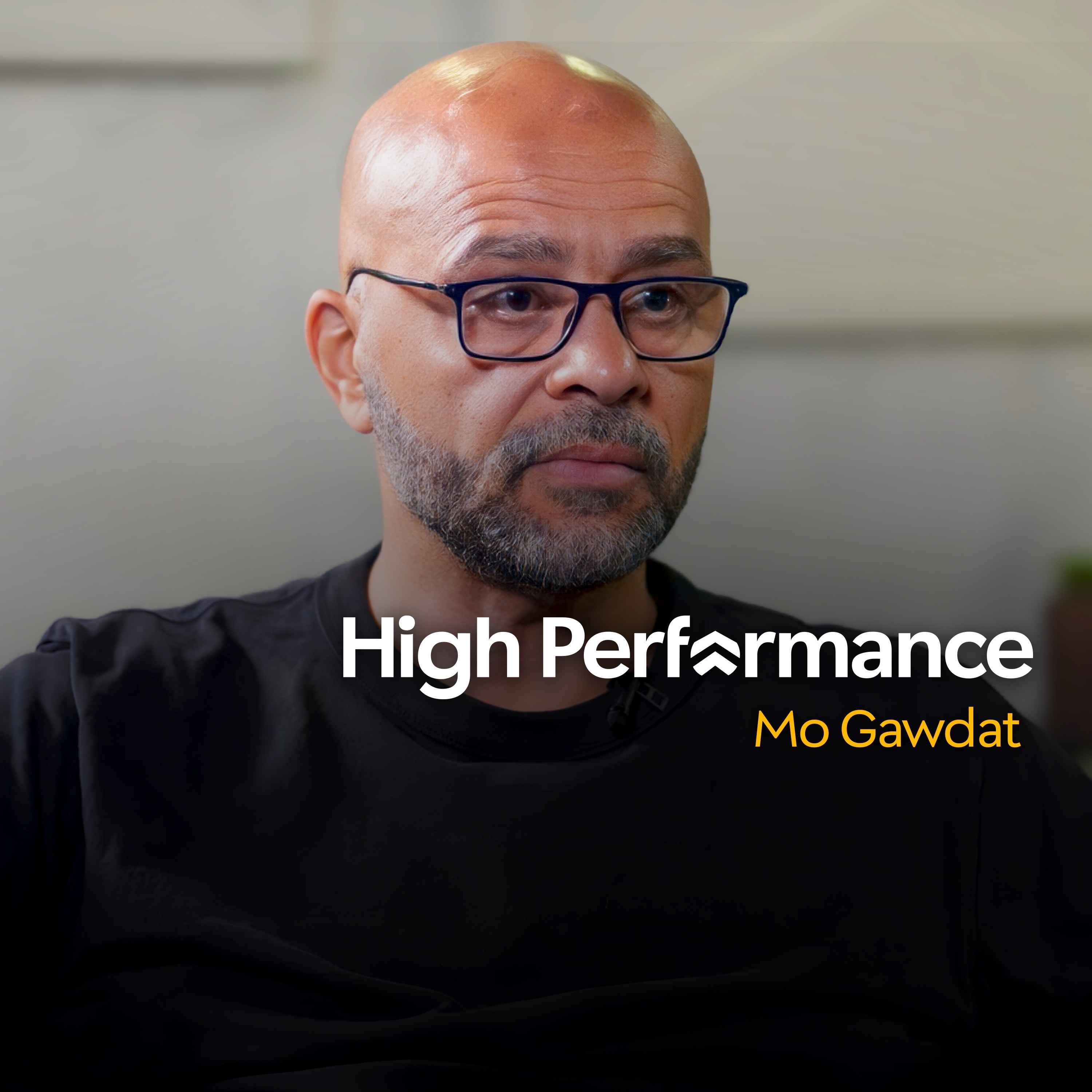
Hosts: Jake Humphrey and Damian Hughes
Mo Gawdat, former Chief Business Officer for Google X, tech entrepreneur, and author.
In this episode, Mo Gawdat returns to discuss innovation, the elusive concept that drives progress in various domains. He shares insights on how to foster a culture of innovation, the distinctions between creativity and innovation, and how AI is poised to shape our future as innovators.
Written by AI. May contain mistakes.

Get the gist, explore an idea or ask about something said.
 Claude
On The High Performance Podcast, what are the key points of this episode?
Searching your listeningAutomatic transcript. May contain errors.
0:00Watch it early on the High Performance App. Available now Roman Kemp, the broadcaster opens up a powerful conversation on success and mental health. Hey guys, welcome to the High Performance Podcast and our Experts in the Field miniseries, which is made in partnership with Salesforce. Across this miniseries, you're going to hear how Salesforce are changing the game with products like the AI-powered platform, Einstein One. It's an innovation that's only made possible thanks to their unwavering commitment to core values, such as trust, customer success, equality, sustainability, and of course, innovation, which is what we're excited to discuss today.
0:47Today, we've got a truly special guest joining us. He's a former chief business officer at Google, a serial entrepreneur, and the author of one of my favorite recent books, Solve for Happy. He's none other than the incredible Mo Gowdat. Mo's career is a testament to the power of innovation. I'm going to explore in more detail what innovation means and how we can all live far better with Mo today.
1:18Mo, thank you for joining us today. Now, I know we always start with the question, what is high performance to you? But as you're a returning guest, Let me read your answer from two years ago. High performance to you was the most efficient way to achieve what you're supposed to achieve. What you set out to achieve, what you define success as. Yes. Now I add with joy. So it's quite interesting. With my last book, I worked very closely with Alice Law, you know, Alice, my co-author. And she was the one that pushed me, sort of, you know, initiated the idea of writing Unstressable. And I have to say, you know, I've achieved so much.
1:57So much. And interestingly, never really stopped to celebrate and enjoy it. And in the process, you and I both know, right, you're working through an interesting project. And some of us have that future centricity. It's like, how is it going to look like? How am I going to measure success? How quickly, efficiently I can get there? And you just don't enjoy it. You just run through it. And you sort of tell people that you're enjoying it. but true joy is to actually allow yourself to savour every experience. And so the idea of achieving what you set out to achieve in the most efficient way, while you're unstressable, I think would be my current definition.
2:39Fantastic. So why do you think that we do get on that hedonic treadmill of not stopping to appreciate and enjoy what we've achieved? I think it's because the goalposts constantly change. So somehow we have a tendency to dismiss the present and sort of discount the future. When you look at your own life or at technology or at, you know, achievements and so on, you don't realize. I mean, look at this beautiful setup that you now have, right? And I'm almost guessing, you know, probably would be accurate to say that when you come here every morning now, it's just, you know, workplace. place. The awe of it goes away, right?
3:24And somehow we dismiss what has happened and how far we've come. We don't stop to celebrate what we've achieved. And we always give ourselves something that corresponds to our current capability that you would have never assigned yourself as a target had you been 18, for example, right? And because of that, you know, treadmill, if you want, You end up in a place where nothing is ever fully savored, right? And nothing is ever considered success because there is always another definition of success. Well, if we can pick up on that thing then of moving in a direction rather than worrying about the long term.
4:09I'm interested in your definition of the word innovation. What do you consider it to be? I got that question quite interestingly when I started to talk about AI. Because people, in the early years, you know, I started to warn against AI in 2018. Not the existential fears, but in the way humans are using AI or are likely to use AI. And, you know, every time I spoke about it, people were like, oh, come on, Mo. You know, believe it or not, 2018, not too far ago. But we didn't know that this was going to happen, the language models that we have today and all of the video tools and so on. But at the time, people would say, but come on, human intelligence is different.
4:54We are genuinely innovative and AI will never be innovative. And I was like, what do you mean? Like the definition of innovation is I'm going to present you with a problem. I'm going to ask you to define every possible solution to the problem. discard the ones that have been tried before, and come up with a new one. The subset in algebra of the new ones, okay, are the innovative solutions. The ones that have been tried before, they're not innovative. They could work, by the way, but they're not innovative. And that's it. It's a solution to a problem, given the amount of data and information and knowledge that you have now, that has not been attempted before.
5:32That's it. So what's the difference between innovation and creativity, would you say? Creativity is to come up with something from scratch. So to create, to create. So, you know, interestingly, though most people would think that the iPod was a creation, it wasn't. There were many little players that were not the same quality, that used, you know, maybe small memory cards or whatever. They weren't small at the time. And you could keep 30 songs on them. I had products from Microsoft, the iPack, for example, at the time. You could play media on that, right? But the idea that you create something that does it so well as the iPod, that's innovation.
6:23But creating 3D printing, for example, from scratch, that's creativity. Creativity in that case would be to simply find something that's completely, never existed before. Innovation is to find a variant of an approach to a solution that's never been used before. Okay, so let's delve into your career then. Are there any moments of innovation that come to mind? Oh, quite a few. I've been so fortunate. You know, I've been thinking about that the other day. Mainly because I sat next to absolute freaking geniuses. Like it really throughout my career, I have always been presented with someone that saw the world very differently.
7:15And you know when you sort of like want to arrive and go like, now I'm the boss, I know everything. And then you just, every time someone shows up in my career and shows me something different, right? And I have to say my work at Google X was quite a bit of that because when I joined X, X was not short of creativity, if you want. We had brilliant engineers, brilliant people who were given resources that are almost infinite for the average engineer. and we're told you can work on anything. So basically, we had a policy at the time that basically said if it doesn't contradict the laws of physics, we're going to give it a shot.
8:12And believe it or not, that was not producing much at all. Because then if you're into creativity for creativity or into innovation for the sake of it, you're not really into following through okay and then the moonshot factory was basically the idea that some ideas will either fail right they may not contradict the laws of physics but they may prove too early for the technological advancement we have or too expensive to create or whatever or maybe they don't have a market but then that others that will actually prove that doable and that we will double down on those and take them forward you know one of my favorite examples was to take a patent from Xerox at the time.
8:56You know, if you understand chemistry, basically, you know, water is H2O and carbon dioxide is CO2, right? If you take the O's and the C's and the H's and reorganize them, you can basically make kerosene, right? Which is very, very straightforward when you really think about it. And the patent was to take seawater, suppress the CO2, basically break it into C and O2 and break the water that came into the seawater into H and O2 and then basically get the C and H together and you would literally open a water tap at the end of it and get kerosene. So you take seawater from one side, kerosene from the other side and it freaking worked.
9:42It really worked. And that's the interesting thing. The interesting thing is then you go like, how many of those have we discovered by science that the capitalist or the political or the societal systems did not approve of the problem with this? Of course, it was very expensive to run unless you found infinite renewable energy. And basically to build those plants and then transport the kerosene wasn't very efficient. So you had to really create them where you needed to. But those kinds of innovations, you know, the idea that today you can literally almost for$25 ,000 buy a printer where you can print DNA.
10:28You can, you know, use CRISPR and, you know, synthetic biology technologies to print a biological design, right? These are things that we've never thought about before, okay? But that now pop up. And as I said earlier, then you discount them. You go like, oh yeah, I know CRISPR. I've studied that. It's interesting. But let's look at the next thing. So having been around these geniuses of innovation, what were the kind of characteristics that you saw that were commonly evident? I found that the most powerful characteristic, if you want, was a sense of unreasonable passion about a very tiny sliver of something.
11:23So Sam, I always give the example of Sam. So Samantha was someone who did, you know, her field of studies was an analysis of the stresses on stitches. Okay. Which is like, why would anyone study that? Right. And then when we were doing Project Loon, Loon was that high altitude balloons that basically, you know, we used weather balloons to try and give internet to the world. And the trick was, you know, at the early beginnings of Loon, the balloons lasted like four days, five days. And then typical of high altitude balloons, they would burst, lose the helium, and then the balloon would land. Of course, that would be okay if you're launching 50 balloons a year.
12:12We needed to launch hundreds of thousands of them, which basically is an environmental nightmare. And so, you know, we needed the balloon to last longer. We were aiming for 100 days, 200 days, and so on. And Sam simply was hired because we wanted to know the stitches, the gluing of the, you know, and she walks in and she basically goes like, oh my God, like I can do this. I have Google's resources. And she builds those very sophisticated tables with lights and, you know, stress analysis. And she would not go home. Like literally, and she had, you know, her wonderful son, Kermit, And basically, and she would literally, I would like be 9 p.m.
12:56at work and go, Sam, please go home. And she goes like, no, no, but this is so exciting, right? And that was the whole thing that, you know, most highly innovative people find one sliver of something and they are so passionate about it, okay? And if you can get them together, because nobody can invent alone anymore. If you can get them together to work together, right, then you've created a very innovative place, right? You know, most people would say Steve Jobs invented the iPhone. No, Steve Jobs didn't. He had a very, very, you know, capable team of designers and tech designers and so on and so forth.
13:36And he was the sort of the orchestrator, the final cut, you know, director, if you want. But the innovation was happening by the team, right? and, you know, with directions from him and so on. That's the game that, you know, some of them were very much into aesthetics and others were very much into battery life and others were very much, and so on. And that's the game, you know, you get someone who's just crazy about one tiny little sliver of what you want to do. But then tell us about the conditions then that you spoke about, you have to get them to work together. You said previously that innovation is a team sport.
14:13It really is now. And I'm interested in what are the environmental factors then to get that team to be able to innovate successfully together? There are multiple ways to do it. One, of course, is aligned mission or purpose, right? So if they're all aligned to one direction and they believe in it more than you, you're in a good place, right? Or as much as you. The other is to not let them overlap and compete at all, okay? Which is a trick that I think a lot of people miss out. When you have two people or two teams with similar skills and you get them to compete, which is a very ugly management technique, basically, you are, by definition, losing cycles, redundant cycles in politics, right?
15:01What you want is to align everyone within a domain or a discipline within that domain or discipline, okay? So you don't want two teams to analyze stresses on the seams of the balloon. You want one team to analyze that. And you want that team to not overlap with the team that is doing the small sell that is in any way. So basically, they're completely, they're not enemies in any way. So there are no politics cycles that are wasting anyone's time. That's one side. The other side is innovation is very messy. Right. And the trick is if you hire an innovative person, by definition, there is a point in the process where they no longer fit for the project.
15:52This is why a lot of founders of startups somewhere in the middle would get a board of directors saying we're going to hire a CEO. Right. Or a COO. Why? Because the skills that you need to be a founder of a startup are not the skills that you need to run a growing business. And so the game is, how do you make everyone feel safe that they can take you as far as they can and then go back and do what they like? And I think that's, to me, that idea of you're fit to the innovation cycle. Believe it or not, it's a very big hindrance to innovation. It's that idea of if you're a little ahead of the cycle, so you're an ops person, for example, that wants everything to be organized when the season of the startup or the project is, let's try a few things and break a few things, you're going to hinder progress, right?
16:51If you're the actual startup founder that wants to try a few things and break a few things, but now we're growing and customers are relying on us, you're going to hinder progress. And that sort of handover is really, really keen to me. Well, I mean, I wanted to go through a McKinsey list of some of the biggest obstacles in organizations that often hinder innovation, and you've touched on some of them. But what I'd like, Mo, is if you'd almost give us some tips on how, if anyone was listening to this conversation, that might be at a different place in the organization. But what can they do to almost facilitate innovation?
17:30So the first one on the list was a culture of fear, of making mistakes and getting it wrong. How would you address that? We used to literally reward failure. So we used to have a, you know, Google had this weekly, we called it TGIF, at X we had bi-weekly. And basically the teams that would give up on an idea and say, we're not going to do this anymore, we would give them a bonus and celebrate them in that Friday meeting. And basically with no fear that they'll find another idea, right? They may, you know, sort of double up with another team for a month or two until the next idea comes up and all ideas were open, right?
18:11And so people didn't think that they were, you know, that they were going to lose something if they said this is not working anymore. And, you know, I used to give a presentation that was called Innovation's Rules. And the first one, the first rule on the list is that you cannot encourage innovation. You can only block it. Right. And, you know, basically, if you look at any child, Children will take a few pebbles and a plate and just create some toy for themselves and imagine that they're in imaginary worlds and driving cars around and doing things, right? We're born that way. We're born innovative.
18:50But then you sit them in school and say, hey, by the way, if your answer is different than the answer of the teacher, right, you're going to be losing grades and daddy's going to give you a hard time. So what do they do? Very clever. Very quickly. they learn to just do what they're told, right? Very few of us actually resist to the point where they go like, no, but that's not, you know, that's not true. Like I remember one of my best friends, still today, actually, we know each other 40 some years now. We were in math class in geometry, before trigonometry. And, you know, in geometry, the teacher says, if two lines are parallel, if two lines are not parallel, they will meet at a point, even if that point is very far for you to see.
19:43So, you know, they may appear parallel, but eventually they'll meet. And so he stands up and he goes like, Miss, but what are those? Okay. And those are not lines in a plane. They're, you know, in 3D. And her answer is, those don't exist. Okay. And I remember him vividly in the recess afterwards, like completely puzzled, saying, how can they not exist? They're right here, right? And that's the point. The teacher is sort of in her mind saying, you're going to learn that in sixth grade. Don't bother me now, right? But she doesn't say that. She says, sit down, those don't exist. And now he's struggling within himself to tell himself, should I break the rules or not, right?
20:30If you want a team to be innovative, you have to tell them that the cost of quick failure is not that high. The cost of doubling down on something that's failing is high. So if I give you a project and it's a$40 ,000 project and you fail, I don't care. In the scale of Google, it's nothing. But if you tell me that this project is going to work and then turn it from$40 ,000 to$400 ,000 to$4 million to$40 million to$400 million and then fail, that cost is really high. So the idea is when on the project timeline is the failure. And let's encourage early failures so that you don't double down on something that's going to make us all lose.
21:21Well, that then leads us beautifully to the second one on the list, which is short-term thinking is often a huge barrier to innovation. Not at all. No, I disagree. I think there is no long term in our world anymore. So you have to understand what most people don't understand is the speed of the cycle. So, you know, any company today that's doing a five years plan, I have no idea what they're doing, honestly. right because our world in five years is unrecognizable as compared to our world today take geopolitical economic uh you know technological whether that's artificial intelligence or you know synthetic biology you know global climate change there is so much changing right and and you'd be really i mean you definitely need a five-year plan for your cash cow for your core business But if you want a five-year plan for innovation, good luck, right?
22:21The game is, so you're driven and most big innovators are not driven by business plan. So one of the things that really made a big difference to, you know, in most of the software cultures that I built in my life or worked in in my life, is that the cost of developing software is actually cheaper than the cost of management reviewing the business plan. right so so you have to imagine that it's actually such a waste if we got the top management together for you know six weeks in a row once a week for two hours you know and the teams that are preparing the presentations and oh that's crap right the easier way is to say come to the investment committee tell us your idea if your idea is less than say fifty thousand dollars and two engineers engineers, go build it.
23:16We'll agree a few parameters of success. If you succeed, come back and ask for the big money. And what is a couple of engineers for four weeks and$50 ,000? For most companies, it's nothing. And that, by the way, is only for software business or tech businesses. Any company today, financial investment or real estate or whatever, there There are so many artificial intelligence tools that are coming out that you do not want to spend time analyzing if you're going to spend, you know, a few thousand dollars buying this or not. You want a tiny team on the side that basically goes out there and tries it in a small subset of the company without risking your cash cow and simply telling them, hey, you know, if that works, if that works, come back to us and let's make the big decisions.
24:12Well, the next one on the list is about the lack of resources, time or capacity in an organization. And I'm interested in those rules that you had. So it might be, you know, if it costs less than 50 ,000, the resources of two engineers. What are the kind of ideal rules? Can I, do you want me to be diplomatic or honest? Honest. Yeah, 80 % of your people are wasting your time. That's the truth. I mean, Elon Musk with X is a very interesting example of that, right? But in most of the organizations that I worked on, you have two teams. You have what I call the bureaucrats. These are wonderfully important people to keep the cash cow running, the core business.
25:00Yeah. Right? If you get the bureaucrats into innovation meetings, their entire conversation is going to be about, but this is not going to work. Yeah. Right? Why? Because every morning they wake up and their bread and butter is here. It's in keeping the status quo and erecting fences and guardrails. Yeah. Right? You don't want those in the meeting at all. Right? What you want in the meeting is the wild, uninhibited, uninhibited, I don't know the English word, right? The ones that don't want to follow the rules. Right? And you give them one rule. And the one rule is don't harm the core business and stay within those resources.
25:39Okay, then let them go. If they come to you and say, look, so the way I always presented my innovation plans to the company. So I was the emerging markets VP. And emerging markets, even though we had like the next 5 billion users of Google, were not going to be a billion dollars business anytime the next couple of years when I started. And at the time, Google was making billions everywhere. And so if I went and said, I want to do business differently, I would piss off my managers because they don't want to put effort in this. It's too small. So I basically told them, look, you can either give me a budget and not worry about it.
26:26I'll deliver my results at the end of the year. Or let's agree a process. And the process is this. I'm going to come to you and say, I have a project that has this end impact. okay 500 million dollars in three years time but i'm and to get to the 500 million dollars we're going to have to invest 50 right but i'm not going to talk about this i just want to talk about 50 000 impact if you give me five right on a tiny little a b test or pilot right but i don't want to come back to you if i do this i don't want to come back to you and ask for 500 right so you give me five, I give you 50. You give me 5 ,000, I'll give you, you know, 500 ,000, right?
27:11I don't want to come back and keep asking, right? So let's agree a few parameters. I will run this project and only on the big investment milestones I'll come ask for approval. But between now and that time, I need you to approve$150 ,000 investment. I'll use them as$550 ,000 and then$100 ,000. yeah okay that's 155 right but but basically i don't want to waste your time on this and here are the parameters if the 5 000 pilot succeeds it will have met this and this okay the 50 000 pilot if it succeeded will have met this this this and that criteria and i will just tell you so that you celebrate and you know what most of my leaders were like yeah that's amazing and and the game was I was honest enough when the$5 ,000 pilot failed to go and say, by the way, the$5 ,000 pilot failed, here is your$150 remaining back.
28:10Okay? And by doing that, you're asking yourself to be separated from the core business enough to be crazy. Right? But also keeping the core business in mind so that in the long term, you're going to be blending back into the core business with innovative ideas that not only serves your business, but the business at large. Yeah, okay. Hey, everyone. First of all, thank you so much for watching this episode. I want to just take a really quick moment to talk about Salesforce, who've made these cool episodes possible. If you're looking to bring innovation and trust to your entire organization, then Salesforce is the platform for you.
28:47They help teams work smarter and faster, connecting companies with customers in a whole new way. With their product, Einstein One, the AI platform introduced by Salesforce, you can combine various AI-powered tools and features under one umbrella to help businesses automate tasks, to gain insights, and to enhance customer interactions, helping to create more personalized experiences for you and for your clients. You see, Salesforce understands how crucial personalized customer experiences are to any business, which is why they're innovating with tools such as Einstein One to help your business realize its potential and implement processes that will result in better relationships with your consumers.
29:30Salesforce absolutely knows the importance of innovation. It's one of their core values, and it's why they set us up with Mo as part of this episode, who, of course, is a leader in innovation. As mentioned, Salesforce are pioneering the use of trusted AI to unlock your data and take your business to the next level, helping you maximize your team's potential and guarantee customer success with AI tools that genuinely increase productivity and help your business achieve growth. They can help you to innovate. I know from my high performance work and my other business ventures that innovation is the one thing that can set you apart from the crowd.
30:06So maybe you should really think about it. Anyway, let's get back to our conversation with Mo. that brings me then on to the next one on the list which is a lack of urgency is again another another big reason why people often don't innovate yeah innovation is a very rapid cycle very very rapid cycle so you know in my work for example so i write obsessively i wrote probably seven times as much as i published right because and writing is a form of innovation. It's a form of creativity, if you want. Because simply, for innovative people, it's a passion of the must. And that's the truth. We want to keep going back to the most novel, new idea.
30:58And if I'm working on a project for a while, and it's not novel anymore, I want to go back to that idea. So there are two tricks that you have to do there. One is make the cycle very quick. So when we used to do the all ideas are addressed, we used to have multiple stages. And one of the stages would be simply, as I said, a couple of engineers, a few, you know, and we would want a prototype out of that. Okay. Sorry, a proof of concept out of that. A proof of concept is not something that is working, but it shows you that this is possibly going to work. And I remember vividly, if you remember, do you remember Google Glass?
31:36Yeah, yeah. Yeah. So Google Glass was that incredibly sleek. For a technology geek like me, it was so sleek. The optics were incredible. The processor, the battery size, the weight, all of these were massive engineering problems, right? But the first proof of concept was six kilograms. The engineer came in with a desktop computer and a projector, like an overhead projector on top of his head, overhead. Very interesting. And basically, that was to prove that the optics will work. It's not a prototype. So that's one stage. Then if you get to that, you've proved that the concept is possible. The next investment cycle is to get to a prototype.
32:21Then the next investment cycle is to get to a market fit assessment and so on and so forth. And it's that quick. But then if you want to come back to me with a proof of concept, that's not going to be a six weeks thing. some of the proof of concepts, believe it or not, I asked them to come back in four hours. Okay? Four hours, right? You know, the meeting was at noon. I said, before we go, I'd like to see the numbers on that. Right? And it is very, very possible to do a lot of proof of concepts. So one of them, for example, again, Project Loon, was that one way to ensure that the balloons last longer is redundancy, right?
33:03Which basically means that instead of one big balloon that contains the helium, you have balloons within balloons within balloons within balloons. So if a balloon pops, the helium is contained within another balloon. And you don't need a prototype for that, right? The idea was presented. I said, okay, go do the mathematics. How thick is the film? Okay, how much of it do we need? You can calculate the spherical size, you know, and what's the weight of the film versus the weight of the helium. Will this thing fly? Right? Not very complicated. It took two and a half hours and the project was scratched.
33:39Simple. Right? And that's the idea. The idea is every idea is a good idea until you say, prove it. Yeah. Which brings us on, you mentioned the prolific nature of your writing, which brings us to your new book, Unstressable. Yeah, I love that book. Yeah, it is. It's fantastic. And there's, I think, lots of insights in that that relate to this theme of innovation as well. 100%. I mean, most of my books, I attempt to explain a very soft concept in a very highly engineered way. So Unstressable is me and Alice, right? Which I think truly is a yin and yang approach to stress. So Alice is very spiritual, very feminine, very soft in her approach, very self-compassionate, if you want.
34:35I'm a freaking geek, right? I want to understand everything as a logistical process that follows an algorithm and is repeated frequently. And the mix of that was so eye-opening for both of us, actually. So we start the book with the idea that stress is algorithmic, right? that basically if you compare stress in humans to stress in objects in physics, right? An object is not stressed because of the external load on it. It's stressed because of the load divided by the square area of the object. Okay. Right? And so we as humans, we get challenges from outside us. We also get challenges from inside us, by the way, which we discuss heavily and unstressable.
35:18But that this is, those challenges, you know, interestingly, the things that freaked me out in my 20s i managed to deal with in my 30s dealt with it with ease in my 40s and in my 50s i laugh about them right i laugh about them not because they're easier but because i've created the resources right i've grown grown my my square area if you want of resources you know knowledge skills contacts and so on so give us an example now of one of those things that would have stressed you in year 20s? As I mentioned, you know, when 2008 economic crisis happened, it was at the time, I think, so let me put it in context.
36:04When I started at Google, I reported to Nikesh Arora, who was an incredible boss, very tough, but he taught me so much. and he was the chief business officer of Google. And Nikesh, in the introductory meeting, when I come into the meeting room, he basically said, this is Mo. He brings the average age of the company up. And that was it. He didn't say much more. I was like, okay, good intro though. I mean, because that says a lot. At the time, Google was 27 years, I think, the average age. And it was Alan Eustace and me and, you know, Eric Schmidt and Jonathan Rosenberg and maybe 200 people across the company.
36:52I was 40 at the time. And when you really think about it, there is incredible value to bringing the average age of the company up. And the thing is, when the 2008 crisis hit, okay, I can tell you Google freaked out. Everyone was like, if you're 27, this is your first economic crisis. Eric and myself were like, what's up? Cyclical. Happens before. Happened before, will happen again. And every crisis comes with opportunities. So the stress itself, the load that's applied on all of us is the same. but then the way we respond to them because of our square area basically, resources, skills differs.
37:40And that's the premise of unstressable. The premise of unstressable is that it's not the events of your life that stress you, it's the way you deal with them that does. Okay. And from that, once you frame that clearly in your mind, we just poured on the topic. honestly so Alice from her side and myself from the other side where basically we started to realize all of the human behaviors that lead you to be stressed in situations right when you don't need to be stressed more interestingly all the human behaviors that generate stress from within you not from outside you yeah that are not needed at all so you know our model is called a ton of stress t-o-n-n so tell us about the acronym then yeah so ton is trauma obsessions noise and nuisances.
38:30So you have to imagine that on one axis, it's internal or external stresses. So stresses that come from outside you, external or from within you, internal. And on the other axis, it is micro or macro. Like massive size stressors or small stressors. Okay. So macro external is trauma. Trauma is you lose a loved one, you're in an accident, you lose your job, you know, you go through a divorce, whatever, you know, some difficult breakup and so on. These are events that happen from outside you. And they're so large in magnitude that they break you instantly. So when you really think about it, it's like the time when you apply so much pressure to an object that basically the cross section cannot carry it anymore.
39:16So it breaks. Yeah.
39:20Interestingly, 91 % of us will face a PTSD-inducing traumatic event at least once in their life. PTSD, this is the ultimate level of trauma, right? 93 % will recover in three months. 96.7 % will recover in six months, okay? Which is quite interesting. And by the way, the majority of those who recover will actually enjoy post-traumatic growth. So it's quite interesting. You go through trauma. You think that your world has ended. You come out of it within three to six months, most of us, right? Stronger and happier than you were before. It's not trauma that's the issue. The issue is we break down under three conditions.
40:07One of them is trauma. The other is burnout. And the third is what I call the anticipation of a future threat. Right. So burnout is the aggregation of the O and N. OK, the obsession and the obsession, noise and nuisances. Right. Obsessions are are big scripts that you live by. I'm not good enough. You know, nobody likes bold people. I'm going to spend the rest of my life alone, whatever. OK. And you take that one script and you repeat it in your mind over and over and over and over. that it becomes the size of a trauma, not hitting you in one Sunday afternoon, but hitting you over four months of obsession.
40:50Noise are the little niggles, right? You're walking out of your apartment and you look at it and you go like, that little belly, right? Just something to annoy you. And those, interestingly, come in the hundreds a day. Hundreds. By the way, it doesn't matter if you're a housewife or a CEO. It's quite interesting. The nature of them change. But we're so good at them because they mimic the behaviors of our caretakers when we were children. It's almost always believed that we can only be the best we can if we keep telling ourselves that we're shitty. Which is so wrong. As a matter of fact, the whole idea is, can you be better because you're amazing?
41:43It's not, I'm shitty, so I need to be better. It's, I'm amazing and I can be better. Brilliant. Yeah, yeah. Right? And then the third is the nuisances. And these are in the thousands. Alice wrote this beautiful few pages on it. She calls it the morning of nuisances, right? which basically measures in a very accurate way the number of stressors that hits you before you even leave home. Right. Okay, from your loud alarm to, you know, if you have kids, the kids are not ready and the socks are not dry and the tweets that you see or the comment that you see on social media or the message that you have, a million of those.
42:27You add them up with the noise, with the obsessions. And what happens is you don't break because a traumatic event exceeded your square area. You break because you have a million little stressors that you can limit. You can so easily limit. You can so easily, before you end this podcast, you can so easily switch your alarm in the morning to a nice soothing sound. or learn to sleep nine hours before when you want to wake up so that you never actually hit the alarm in the first place. And when the aggregate of all of those put together breaks you, burnout is not an event. It's just that's one last straw.
43:19It's like you've been aggregating all of those and then you come to me and say, hey Mo, by the way, you seem to have a bit of a flu today. And I go like, come on, you know, not even you. And, you know, you break. You fight with your partner, you fight with your colleagues, you leave work, whatever that is. It wasn't that comment, it was the aggregation, right? I mean, this stuff is so perfectly aligned to this theme of innovation as well, isn't it? 100%. When you think about the trauma, the obsession, the nuisances and the noise that can get in the way of an organization and a team looking to innovate.
43:52Right. And you just touched on the first of what you talk about, the remedies for it, how we can use this, which is the three L's. So recognizing it and learning to limit it is the first one. It is the first one and the easiest one and the one you should blame yourself for not doing because it is so easy. If you just sit on Saturday and write down a list of all of the things that stressed your last week and limiting them, or you get together with your leadership team and say, what's stressing the organization? And whatever you can limit, limit. The problem is we go to HR and we say, hey, by the way, the team is stressed, give them a Christmas party, which stresses everyone more.
44:34The trick is, again, a very interesting example from my Google years was, when we had our offices in Silicon Valley and in San Francisco and in many other places around the Bay Area, but basically the people in San Francisco would have to commute to the office. And, you know, any company would say, okay, we're going to give you a car allowance so you can buy a car. Google said, no, we're going to create buses that are extremely comfortable, that have meeting areas in them, that have extremely fast Wi-Fi, that have a nice little coffee place on the side, right? And you can actually, you know, basically count your day as started from the minute you're on the bus, right?
45:15So people basically would leave their homes in San Francisco at 7.30 a.m. 7.32 when the bus is there, he's already started working. He can VC with his team. Some of his team are in the same room. Meetings are happening. He's answering his email or she's answering her email. And basically, we would remove, limit the reason for the stress. And that's the opposite of, okay, here is something I hope you forget about was stressing you. That's not the way to do it. the way to do it is to limit, to remove one by one. We say that, I was saying that when things are not adding up, start taking away. And I love that idea in the book of limiting, which then, again, keeping it in the theme of innovation, which is then about learning.
46:00Yeah, so limit, learn and listen, right? So tell us about that. Learning is the whole, it's quite interesting when you really think about it because somehow I think the biggest innovation killer is when you stop learning. It's quite interesting because when you're learning, you're learning something that already has been written or studied or analyzed, right? But, you know, how can that produce something that hasn't been studied or learned or analyzed, right? It's because of the idea of novel combinations, right? So when I learn about geopolitics and economics, right, I can understand my world differently than if I'm just focused on geopolitics and or economics, right?
46:45If I learn those in the sphere of climate, okay, then I can, you know, I can suddenly say, oh, hold on. So the US dollar is moving this way because of geopolitics that way, but also because the cost of climate change are going to be this. And the more you know, the more you create novel combinations, if you want, for innovation. But the more you know and stress, okay, the more you recognize different pathways around what used to sort of freeze you. So the typical response to stress is fight or flight or freeze. Cortisol is just doing that to you. Basically, even though there is no tiger out there, it's always fight or flight or freeze.
47:33Freezing is probably the biggest problem we have in the modern world because as you freeze, the stress is still there and you freeze for weeks feeling stressed. And that's the game. The game is, can you learn the skills? Can you learn, for example, about the time of stress? Can you learn the modalities, the listen bit of limit, learn, and listen? That stress is not one entity within you. It's four different modalities that behave very differently within your mind, your heart, your body, and your spirit. And all of every bit of the learning creates a bit of skill that basically gives you more square area.
48:19more resources that you can rely on whether that's as an individual by the way or as an organization so can you tell us some of those organizational skills to avoid the typical freeze flight fight responses that can kill innovation I will say I mean there are quite a few but I'll probably start with three I think the top one in my mind is a belief system that stress is good for you okay Okay, and this is so frequently repeated in Harvard Business Review and in, you know, MBAs and so on. Stress is not good for you at all. Okay, stress is good for squeezing 5 % more out of a factory worker on a production line.
49:07Right. Okay, if what you want is innovation, if what you want is flow, if what you want is customer relationship, if what you want is teamwork, okay? All of those things are not done well under stress at all, okay? So when you think in your mind that it's good that you stress your team to get 5 % more, that's a very bad idea, okay? What you want is to ask for 5 % more in exchange for, and if you achieve that, I'm not going to stress you, okay? And the game is so interesting. When you have that deal with your teams, basically allowing their productivity to be in their hands, while you're basically exchanging that for giving them a lovely, enjoyable working environment, they'll overachieve your 5%.
49:59That's number one. But number two is they'll be nicer to their colleagues. They will be more focused on work. They'll be more loving to their customers. So customers will love them back. Orders will be bigger. And you're not going to have attrition. They're not going to have to pay for their burnout and so on and so forth. So the number one issue, honestly, is the leader's belief that stress is a skill. Like I need to stress them to get to squeeze that 5 % more. Stupid. Number two in my mind is that idea that stress is unavoidable. It is true that some stressors are unavoidable, but that you don't need to remove all stressors to have an unstressed life right the issue is you know if you have 200 stressors and those are about to get you into burnout or into breakdown okay by removing 20 life is okay right so just remove any 20 it really is not an you know it's not impossible for an organization to do that yeah that's number two number three which i think is a little more difficult is that when we are in at work for some reason we lose our humanity we just start to repeat three letter acronyms and we become very uh mechanical in a way right and believe it or not as humans we only feel safe when we're in connection to other humans The human race did not advance so far because we're smart or because we're hardworking.
51:36It's because we know how to work together, right? There is a tribe. If you were the smartest person on earth, if you were Einstein alone, okay, you would be eaten in three weeks at best, right? So the game is we are hardwired to feel that connection is a safe environment. And somehow at work, especially in the West, so I worked everywhere in the world. and in emerging markets in the East, it's very different. There is a very deep human connection in the office. We actually are friends. We actually care about each other. By the way, this is also in the Mediterranean and Spain or Italy and so on.
52:13You actually know the name of the wife of your colleague and his children. And you may have actually, you know, had a coffee with them that didn't talk about work. And I'm not asking the UK or the US or whatever to go that far. right that's too much heaven forbid right but at least be human at least be human in little assumptions that you know legal is not trying to make your life difficult they're just trying to protect the company that sales are not careless they're just simply trying to maximize the revenue right and and just by having a bit of compassion to the other guy you suddenly create an environment where you say, I understand where you're coming from.
52:54You genuinely say that, not in a figure of speech type thing. You genuinely say, hold on, you must be human too. You may have problems at home today. You have been stuck in the commute like I have, and you may have a constipation or whatever today. You're human, okay? And so accordingly, if I treat you as a human, you will likely treat me back as a human. Yeah, yeah. And believe it or not, okay? So in my last years as a VP, regional VP, or chief business officer, I learned very quickly, which I think was the biggest skill that I've ever been taught, by one of my clients. He walked into my office and I said, hey, do you want to go for a walk and maybe we have a coffee?
53:43And he said, yeah, sure, I have nothing else today. It was like freaking 2 p.m. Okay. And I said, what do you mean? And he was running a massive, he was the CEO of a massive organization. I said, what do you mean you have nothing else today? And he said, look, I work four hours a day. And the days I work more than four hours, something is wrong. I said, what do you mean? And he said, people like to put a half an hour meeting in my calendar. Okay. If it's half an hour, it's not deep enough to warrant my attention. It's for one of my team. Okay. I said, so what do you do with the other four hours?
54:20And he said, well, I walk with people that are interesting while I have coffee, or I walk in the corridors and meet my teams and show them that I care. And that's how I run my multi-billion dollar organization. Very different than the mentality of, and if you do this, we're going to squeeze 5 % more. You know why? Because there are true leaders and there are managers. And sadly, you cannot learn through leadership from a book. Managers learn the methods that they can turn the gears a little. Remember that Charlie Chaplin movie? So turn the gear a little so that the production line moves a tiny bit quicker.
55:04That's a manager. That's managing from top, pushing people. Leaders don't do that. Leaders go, by the definition of the word, leaders are leading. They are in the front. They're passionate about something, right? They make their passion very clear. And they make it clear to their team that they'll give their lives for that passion to happen. Okay? But at the same time, they make it clear to the teams that if I understood, say, Poland, for example, better than my country manager in Poland, that would be stupid. Yeah, yeah. Like, where did I get that arrogance from? Okay. Well, if I understood Eastern Europe better than my regional director in Eastern Europe, or regional VP in Eastern Europe, where did you get that arrogance from?
55:50Arrogance from, right? The truth is, you don't. The truth is you're just stressing them to feel that you're the boss. Okay. And you can, by the way, tell them, hey, it's 14 million this week. If you don't deliver, I'll stress you. And that's it. So when it comes to innovation, I'm interested in how AI can be a force for good. Oh, a force for good or a force for innovation? How much time do we have? Look, there are a couple of views of this. Always when you think about artificial intelligence, you have to think short term and long term. Short term, the definition of AI, one of the definitions that I try to make clear in my mind is that we've commoditized intelligence, right?
56:38We've found a way to create a plug in the world where I can plug in and get 40 IQ points more, okay? Today, let's say. In a couple of years' time, I'll plug in and get maybe 500 IQ points more. In the short term, that will allow those of us who were struggling with our brain capacity to solve mega problems, mega problems. Like, you see, the thing is, so I love physics and I had the honor and pleasure of spending time with some of the top physicists that ever lived. And I can tell you openly, I have no idea what they're talking about. Like, it's so complex for my little brain. More interestingly, they have no idea what the other specialized physicist is talking about.
57:25That's why we get together for very long times and hours and everyone explains his stuff because we're so highly specialized. But if you can have one machine combine all of this and spit out the result when you ask the question, that can solve a lot of things. We can literally harness energy out of thin air. We can literally create an iPhone on a tree, literally with nanophysics. okay it is it's unbelievable what we can do we can cure every disease we can reverse climate change we can do anything right of course the question is will we do anything there and that's the problem the problem is in that phase what i ask people to do is if you're not using ai today there are three skills that you have to invest in the minute we finish this conversation one is you have to learn all the tools that are related to your area of specialization.
58:28How do I do that, Mo? You go to an AI tool and you say, I work in FMCG. I do this in that part of the world. What are the top 10 tools I need to learn, right? Nobody's ever taken a course in PowerPoint, let's say. You learn it by playing around. That's the same when you learn with AI. That's one. The second is what I call the skill of parsing out the truth. Most people don't understand this. Until 2023, where language models became quite the trend, when you went to Google and asked a question, Google gave you a million websites back and told you, you find out what your version of the truth is.
59:11That's no longer the case. Today, you go to a language model and you ask a question and it very confidently spits out an answer that sometimes is wrong. and sometimes it's averaged and sometimes it's not nuanced at all. It doesn't include all of the angles, right? Okay. And that is not the truth. Now, more and more, those answers will be fake videos, you know, deep fakes, face filters, so many things that are totally not true. Yeah. And so the second most important skill is how can you innovate if you don't know what's true and what is not? How can you design your future? if you don't understand the reality of the geopolitics that are happening today, which I will tell you openly, I spend three hours a day listening to every opinion in every language I can find, because now you can translate, okay, to try and find the truth.
1:00:06And the truth is a lot more elusive than you think it is, okay? And when you really, really think about it, I always give people that example. I say, World War II history is written in English by the Americans. If I had an AI that actually looked at every language, what the Japanese wrote, what the Germans wrote, what the Russians wrote, what the Italians wrote, what the British wrote in English, and put that together, I can guarantee you it will be a different picture of the truth. It will not be the truth still, but it will be a different picture. Now, the biggest skill today in my mind is how do you get to that?
1:00:44How do you find that truth? And the third, of course, is a question of ethics, question of how can I use AI in a way that is human, that continues to be connected to humanity, that keeps humanity's best interest in mind. And I always tell people, if you're using an AI tool in a way that you don't want your daughter exposed to, don't do that. Now, this is the mid-term innovation. The long-term innovation, I don't want to upset anyone, but we are about to stop innovating. Humanity. This is it. This is the end of human innovation. Why? Because the innovator is always the smartest person in the room.
1:01:28The smartest person in the room is about to be a machine. Right. So they know how to write code. They know how to run machinery. They know how to write. Very soon, they'll have enough access to be the one that innovates. And the image of that world is something that I don't know, and I don't know anyone that can predict. But you have to imagine that within five to ten years' time, 99 % of human innovation may not need a human. By next year, 2024, 2025, 25, my expectation is that there will be an AI agent, okay, that you go to and say, hey, I have a thousand pounds. I want you to invest it and get me a thousand four hundred at the end of the year.
1:02:17By the way, I also have my brand as Moga Oded, four times bestseller. I have my podcast. I have my followers. I have this. I have that. And the machine will literally go out, okay, look at what's trending on the internet. Give me three topics and say, which should I write about? And I'll say, write about love and romance and the machine will go and write a book about love and romance, give it to me to review while it creates a logo and a barcode and whatever and then put it on Amazon and use Google to promote it and eventually give me$1 ,400 back at the end of the year. It's very possible through agents to be able to do that.
1:02:55Now, in the past we used to think of those small businesses as innovation. No longer. and I think people are somehow missing the magnitude of the tidal wave tidal wave by the way that we can ride and it doesn't have to crush us but people are thinking of this as just another wave of innovation another iPhone it's not we're inventing intelligence that changes everything so how optimistic are you? I am So it depends on your time frame. Okay. In the long term, you know, when I wrote Scary Smart, my AI book, basically, I said that there is a force inevitable at the end of the book. At the beginning of the book, I spoke about the inevitability of AI happening and that it will be smarter than us and that some challenges will happen on the way.
1:03:47Yeah. Right. At the end of the book, I spoke about the force inevitable, which is that eventually we will create a utopia. Right. And I am absolutely certain that eventually imagine a world where energy is free, where production is almost for free. The challenge with that world is that our current value set does not enable it. Our current value set is all about scarcity and competition and profits and capitalism and so on. But humanity will get to a point where we will have to reinvent our social systems, reset them in ways that will enable that world. Between now and then, here's the challenge.
1:04:31I told you, give me 40 IQ points more and I'll probably be able to harness energy out of thin air. No, maybe 400. It doesn't matter. 400. Okay. And I would love to. and humanity at large, by the way, because at 400 IQ points more, my intelligence from any other person's intelligence is not even relevant, okay? At 400 IQ points more, if we choose to harness energy out of thin air and end climate change issues, or at least suspend it for now, we will be able to, but will we choose? Will we choose to do that? Unfortunately not. My belief is that the value system of humanity today will be to make more profits.
1:05:19And as we make more profits, my feeling is that we may actually go through a bit of a very interesting struggle that forces the reset. That struggle will lead to concentration of power, will lead to redefinition of what reality is, will lead to a redefinition of freedom, believe it or not. Some of the most innovative people I ever met never innovated for where the ball is. You always innovate for where the ball is going to be. And it's actually really difficult to predict where the ball is going to be in the next three to four years. But at the heart of it is about that final point you've made earlier about the relationships, just our sense of humanness.
1:06:02It's all about connection. I think the biggest innovation in the next few years is when the machines automate a lot of the tasks, how do you and I get closer? because you don't need me to, believe it or not, next year, actually now if you want to, it wouldn't have been perfect, but now you could speak to my avatar and it would have given similar answers, right? But there is this, you know, we're friends from last time, we know each other, there is a warmth between us, there is a human connection. This, I believe, is going to be the differentiator, okay? When everyone has access to a call center software that basically answers everyone, okay?
1:06:46All of them are going to, all of the call center agents are going to sound like Scarlett Johansson and, you know, from her. And, you know, we all want to speak to Scarlett Johansson. There's no differentiation there, right? So the differentiation will be in those few companies that will actually keep a call center agent, okay? Enable them with massive tools to make all of the annoying tasks done by the machine. But then when you call, they say oh hi last time when we spoke this happened there is a true human connection I think this truly in my mind is where we need to innovate we need to innovate even within the machines in emotional intelligence in paradoxical intelligence in consciousness in connection, in compassion these are all forms of intelligence that are not the innovation that we're building today Which is a brilliant place to finish an intriguing and fascinating and beguiling conversation, Mo.
1:07:47Tiny bit scary. Yeah.
1:07:54Damien. Jake. Great conversation with Mo, and I guess it was really a conversation about innovation, right? And I suppose I'm just left wondering which area of innovation is going to be the thing that really moves the dial for everyone across the world. Yeah, well, I loved it, and I came away from it feeling really optimistic about how AI is going to help us innovate faster and on a far bigger scale than what we've ever known previously, whether that's climate change, whether it's our reliant on fossil fuels, whether it's about dealing with some major illnesses. I think what Mo was saying is none of us is going to be smarter than all of us and AI is going to enhance it.
1:08:29I think where it's going to be important is that we have to come together with this idea of a collective will to want to use AI to innovate for good rather than allow it to be used just for individual purposes or to make a smaller group more powerful. You know, for a long time there was a conversation about the fact that AI is wholly dangerous and a massive risk to mankind. And now the more that we actually see AI bringing the impact to us, the more we have conversations like the one you just had with Mo, So the more we see how, exactly as you say, it can be used for good, the more excited, I guess, I'm getting about actually what the future looks like with AI.
1:09:13Well, the example that echoes that, Jake, is when he spoke about, say, call centres, Mo was suggesting that in the next five years, we're going to be able to innovate in, like, telesales centres where the bulk of the work of processing the data is going to be taken over by AI. But where companies that can distinguish themselves are still keeping humans to be able to build relationships, to be curious, empathetic and kind to other people on the end of a phone. And that's where the combination, if we use it correctly, of AI and our very human nature, that will allow innovation to really do all the good things that it promises.
1:09:53And that is actually the interesting part, isn't it? Because AI will be available in a pretty similar way to everyone. what will make the difference is how we innovate around it. I think it almost allows individuals to shine even more, actually. Yeah, exactly. But I think that's what innovation has always depended on. It's not necessarily coming up with the new tools. It's how we as humans choose to use those tools. And that's why I think the conversation was so upbeat and positive in its nature with Mo. Great. Well, thanks a lot, mate. Thanks, mate. I loved it. And thanks to you as well for listening to these mini-series made possible by Salesforce, the number one AI CRM, combining unified data and trusted AI in one platform that empowers users to deliver more impactful customer experiences in sales, marketing, commerce, and more with personalized AI.
1:10:43Thanks for listening and watching.
1:11:01you
This episode is part of our ‘Experts In Their Field’ mini-series, presented by Salesforce.
In this episode, we welcome Mo Gawdat, former Chief Business Officer for Google X, tech entrepreneur, and author of the best-selling books "Solve for Happy" and "Scary Smart” back to High Performance.
Mo sits down with Damian to discuss innovation, a topic he is deeply passionate about and a leading voice in. Together, they explore how we innovate, how we can define a concept as elusive as innovation, and the common obstacles that hinder productivity and creativity.
Mo shares his insights on the ever-changing goalposts that make us dismiss the present and forget how far we’ve come. He delves into the difference between creativity and innovation, explaining how creating something entirely new differs from improving existing ideas.
Mo also emphasises the importance of a collaborative environment and aligned mission to foster innovation. He shares tips on overcoming the fear of failure, managing organisational resources, and addressing the lack of urgency that often stifles innovation.
This episode was made possible by Salesforce, who value innovation as one of their core-values. With their AI platform Einstein 1, you can combine various AI-powered tools and features under one umbrella to help businesses automate tasks, gain insights, and enhance customer interactions.
Hosted on Acast. See acast.com/privacy for more information.


