
 Ask ChatGPT


 The High Performance Podcast
4 Jun 2025 · 35m
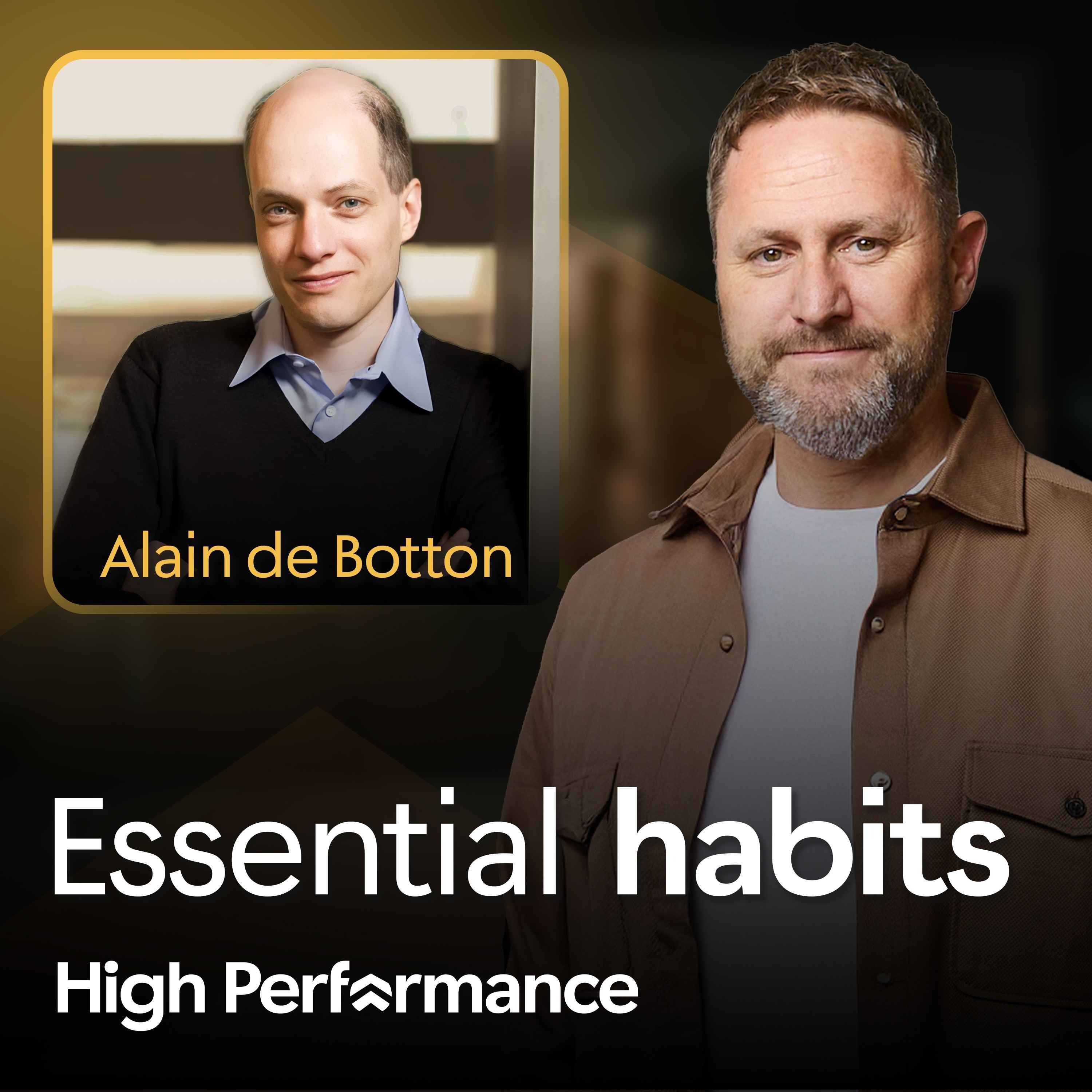
In this episode of The High Performance Podcast, hosts Jake Humphrey and Damian Hughes engage with philosopher Alain de Botton. The focus is on the essential habit of asking better questions to foster deeper trust and connection in relationships—both personal and professional. The discussion centers around the uncomfortable yet transformative question, "How have I annoyed you?"
Written by AI. May contain mistakes.

Get the gist, explore an idea or ask about something said.
 Claude
On The High Performance Podcast, what are the key points of this episode?
Searching your listeningAutomatic transcript. May contain errors.
0:28Watch it early on the High Performance App. Right when you need them. Work smarter and faster with Upwork. Go to Upwork.com now and find your freelance expert. That's U-P-W-O-R-K dot com. Post a job for free and get started today. At Capella University, learning online doesn't mean learning alone. You'll get support from people who care about your success. Like your enrollment specialist who gets to know you and the goals you'd like to achieve. You'll also get a designated academic coach who's with you throughout your entire program. Plus, career coaches are available to help you navigate your professional goals.
1:05A different future is closer than you think with Capella University. Learn more at capella.edu. This episode is brought to you by Opera Air, the first browser with mindfulness at its core. Now, most of us spend hours every day online, but how often do we pause to take care of ourselves whilst we're doing it? And that's where Opera Air comes in. It's a lightweight, fast, secure browser built not just for productivity, but for your well-being. With Opera Air, mindfulness is built right in. You'll find free breathing exercises, guided meditations, and soundscapes with ambient sounds, lo-fi music, and binaural beats, all designed to help you focus, relax, and even spark creativity while you browse.
1:49A really useful question to ask on a date. You know, you go out on a date with your partner and you say, this could sound a bit odd, how have I annoyed you? Welcome to the Essential Habits of High Performance. This is where we explore the habits, the ideas and the teachable moments that help extraordinary people thrive and help you do exactly the same. I'm your host, Damien Hughes, and I've worked as a visiting professor of organisational behaviour. I've been a trusted advisor to dozens of elite leaders looking to create high-performing cultures. I've immersed myself in this world for the last 25 years, because above all, I'm someone who loves exploring how high-performance works and how we can take the lessons from our guests and apply them into our own world.
2:36Today, we're going to dive into a habit that may surprise you. It's not a productivity hack. It's not a morning routine. It's a question. And not just any question, but it's one posed to us by the philosopher Alain de Botton. One that can transform your relationships, your emotional intelligence, and even your leadership. The question, which you heard at the top of the show, is this. A really useful question to ask on a date. You know, you go out on a date with your partner and you say, it could sound a bit odd, how have I annoyed you? Yeah, you heard that right. it might sound like an argument waiting to happen.
3:16But as you'll hear today, this question, and others like it, hold the power to deepen our connections and to build stronger, more resilient relationships, both personally and professionally. So let's explore how a philosopher's gentle provocations, a little bit of vulnerability, and a sprinkling of research-backed curiosity can change how we relate to each other. And how high performance isn't always about going faster. But often, it's about going deeper and asking better questions. Before we dive any further into today's conversation, let's talk for a moment about Alain de Botton and why his voice matters in the conversation about high performance.
4:02Alain is a modern-day philosopher who's made it his life's mission to take deep, ancient ideas and translate them into something we can use on a random Tuesday afternoon. He co-founded The School of Life, which has helped millions of people around the world learn to navigate relationships, work and emotional challenges with more wisdom and clarity. But what makes Alain so unique is not just his intellect, it's his empathy as well. He asks the questions most of us are too busy or too afraid to ask. More importantly, he teaches us how to ask them well, without ego, without fear, and with a spirit of curiosity.
4:48At a time when so much of high performance is measured in hustle and output, Alain reminds us of something essential, that emotional depth, thoughtful questions, and meaningful connections aren't just soft skills, they're power skills. So if you care about becoming not just a better performer, but a better teammate, a better partner, or a better leader, then Alan's insights are worth your time. Because when we deepen our emotional intelligence, we tend to elevate everything else we touch. Now you might be listening to this thinking, why on earth would we want to ask our partners or our teammates or our mates the question of, how have I annoyed you recently?
5:32Like, why? why would I want to poke the bear? It's because, he says, our relationships thrive, not when we avoid friction, but when we learn how to surface it kindly and listen without defensiveness. And to be able to listen to the answer without going, that's not true, that's not true, but you've annoyed me. You know, not to do any of that, simply to listen. And, you know, therapists are good at teaching us this, to reflect back. So someone goes, you know, I'm annoyed because every time I mention a friend, you somehow find something wrong with a friend. And rather than going, that's not true.
6:08I really like all your friends to go. Okay. So I'm hearing that you don't think I give your social choices enough approval. And the person goes, wow, I've actually been heard. I've actually been understood. Brilliant. You just rephrase what they've told you without butting in and saying, you know, I'm a good person. You allow yourself to tolerate the notion that you've made a mistake. It sounds simple, but being truly heard, truly seen, is actually surprisingly rare, but it's incredibly powerful. Another interesting question Alan offers us is this. You know, another useful exercise is to say, for each person to say, what is it about my background that's made something difficult for me?
6:53Now imagine hearing that from a colleague and a partner. suddenly the heat of a moment cools down you've been invited into somebody's story you know what's made it difficult for me that you know the duvet cover is never properly on the bed what's made it difficult for me that that you know you come home late and you know and i get angry you know to try and explain because so often we're not very generous in our explanations both to ourselves and to the other person about why difficult behaviors occurred but there's almost always a poignant backstory but we were unable to deliver it properly to the other person because we're so on edge and we're so angry behind every reaction there's always a reason behind every argument there's always a backstory and when we take the time to hear it we start to humanize each other this is what alan calls a gift so to be able to give that backstory is another gift both to ourselves and the other person.
7:51And, you know, at the end of the day, the more backstories are shared in a calm way, the more everybody emerges as worthy of love. Of course they do. Of course they do. It's the lack of a backstory that always brings out, you know, anger and cruelty. The gift of calm explanation, of saying, here's why that hit me so hard. In high-performing teams, this matters more than you might think. We often focus on goals, deliverables, KPIs, but the real engine of team performance is trust. Psychological safety, the ability to bring our whole selves and to be met with curiosity rather than judgment. Alain offers a piercing metaphor.
8:37We really value that people don't have car crashes and that's why there's an enormous industry around trying to prevent car crashes. we don't have such precautionary views around you know relationships we just don't so i i think that you know looked at slightly cynically we don't care enough and because we don't care enough we we don't put enough effort in so there are some people your listeners you know others who do care very much and they'll be starting to invest in maybe we don't know how amazing our relationships could be as well let that sink in we invest time and money into road safety health and safety, even cyber security.
9:12But when it comes to our most vital human connections, whether that's at home or at work, we often leave things to chance. And that's why this essential habit matters. Not just for romantic relationships, although that does help, but also for friendships, for teams and our communities at large. So why does this work? because of three pillars that strong relationships are built on. Interest, understanding and rapport. Let's rewind to a fascinating experiment that proves just how powerful a question can be. Back in 1997, psychologists Arthur Aron and Elaine Spaulding, who, fun fact, had met and fallen in love themselves while studying human relationships, ran a study that had become legendary in the world of psychology.
10:06Now, just listen to what they did. They brought pairs of strangers, complete strangers, into a lab at the State University of New York at Stony Brook. They had no history, no context, just two people sitting across from each other. And then they gave them a structured set of 36 questions. Now, these weren't interrogation style questions or surface level small talk They were intentionally designed to build intimacy gradually The first ones were light, even a little bit playful in tone If you could have dinner with anyone in the world, living or dead, who would it be? Then, they gently began to ramp it up What's your most treasured memory?
10:55When did you last cry in front of another person? And then finally, they ended with this instruction. To look into each other's eyes without speaking for four minutes. Just four minutes. Now you may be wondering what happened. People who walked in as total strangers left that room feeling deeply connected. Not just plight or friendly, but deeply bonded. Brilliantly, one pair that met in these circumstances even ended up getting married. But here's the kicker. The real power wasn't in their specific answers. It was in the process. This is what psychologists call mutual self-disclosure. The act of gradually revealing meaningful information about yourself in a reciprocal way.
11:50You go a little bit deeper, I'll go a little bit deeper. And over time, trust is built, vulnerability is rewarded, and that's when emotional intimacy begins to form. Arthur Aron later explained it in this way. He said, One key pattern associated with the development of a close relationship is sustained, escalating, reciprocal, personalistic self-disclosure. Translation Sharing personal stories In a thoughtful back and forth rhythm Is what makes people feel close And this is exactly what Alain de Botton is getting at with his question How have I annoyed you recently? It's not just about airing grievances But instead it's about building a relationship that can handle the truth Now that can grow through vulnerability That knows how to listen without breaking Imagine if our teams at work or our friendships or even our families started to make space for this kind of structured curiosity.
12:58Imagine how much conflict would be prevented if we could build that closeness before the tension. And that's why Alain's work and this research matters. Because at the heart of every high-performing team or relationship, it isn't just about skill. It's trust. and trust begins with a question. And Alan's questions cut to the heart of this. It opens the door for honesty, for empathy and for healing small hurts before they begin to grow. What interests me is why we don't ask these questions more often. Well, there's three very good reasons. The first one is a fear of conflict. We worry that if we bring up potential tensions it'll explode into full-blown arguments.
13:48According to a 2017 study by the Harvard Negotiation Project, 69 % of employees avoid difficult conversations at work, especially when emotions are involved. In close relationships, we often tread lightly to keep the peace, even if it means ignoring growing frustration. But here's the interesting twist. Avoiding conflict doesn't eliminate it. it just buries it until it resurfaces bigger and more damaging later on. The second reason we avoid it is often for ego protection. Let's face it, nobody loves being told that they've done something wrong. Our egos are hardwired to defend us. Neuroscience backs this up.
14:32In one study from UCLA, it found that when people experience criticism the brain reacts similarly to physical pain, lights up the same regions. We instinctively push back, we deny or we deflect. But when we choose to invite feedback, like Alan suggests, we're flipping that script. We're turning criticism into a potential moment of connection. The third reason is sometimes we just lack role models. We don't normally see these conversations happening around us, so we assume that they're not normal. Think about it. How often have you ever seen someone at work calmly ask, Have I upset you lately? Or witness two mates talking openly about the little hurts before they become big resentments.
15:21I bet it's rare. According to research from the brilliant Brené Brown, we're more likely to mirror the emotional communication that we've seen growing up or in our own environment. And for many of us, that doesn't include being vulnerable. But here's the good news. These skills can be learned. One of my academic heroes is Dr John Gottman. He's one of the world's leading relationship researchers. He found that couples who handle conflict with gentle curiosity rather than stinging criticism are 80 % more likely to stay together long term. Just think about that, that's huge. And not just for couples.
16:03That same principle of gentle, curious questions applies to teams, friendships and leadership. We don't need to have the perfect words. We just need a willingness to ask and then the courage to listen. So next time you can feel tension building up, consider it as an opportunity, not a threat. It's a chance to step into discomfort and come out of it stronger, together and healthier with our relationships Alan helps us work through that fear He reminds us that once we've done it once, that is shared of vulnerability and survived It gets easier, it becomes almost like a shared language So what is the essential habit in today's episode?
16:50Well it's this ask better questions and then really listen. Now that might sound simple maybe even obvious to you but in a world where we're moving at high speed where distractions are constant and conversations often skim the surface this is a deeply radical act. We're used to asking questions that maintain the status quo. How was your day? Did you finish that thing you were working on? Is everything all right? Now these are fine, but they rarely invite anything new. They're like well-worn paths that were brought down a thousand times. There's no surprises, no discoveries to be found. But what if we took a different approach?
17:34One inspired by Alan de Botton's philosophy and grounded in the psychological research we've just explored. What if, instead of autopilot questions, we start asking ones that create space for real insight, real connection and real growth. Here's three simple powerful questions that you can try asking this week. One, is this something I've done lately that you think I could improve? Now this one takes a little bit of courage but it shows that you're not just willing to perform well you're willing to learn and grow. You're opening the door to feedback before it becomes a frustration for other people.
18:14A second question could be, what's something that's been hard for you this week? Now this one says, I can see your life outside of our interaction and I care about the full picture. It invites the other person to meet you with honesty without feeling pressure. A third suggested question might be, what's a little thing that's made a big difference for you recently? Now I love this one because it brings in gratitude, insight and learning. It uncovers the small wins and the unnoticed bright spots that can often go uncelebrated. But, and this part is just as important, when someone answers you, don't fix, don't defend and don't try and one-up them.
19:01Just reflect it back. You might say things like, that sounds like it really weighed heavy on you. or I didn't realise that I'd had such an impact, thank you for telling me. That's it, just be the mirror that says, I hear you. Because sometimes the most healing thing we can offer another person isn't our advice or our action, it's simply our presence. And when you do that consistently, something subtle but powerful begins to shift. Trust deepens, misunderstandings shrink and you become someone others feel safe around. Not just light, but safe. And that, well that's a superpower in life, in leadership and in love.
19:48We often think high performance is about speed, power or output but Alain de Botton reminds us that high performance is also about connection, understanding and emotional fluency. Sometimes the most courageous thing you can do is to ask someone how you've annoyed them and then stay quiet long enough to truly hear the answer. After the break, I'm going to share other moments from Alan that left a lasting impression on me and I'll explain why they could resonate with you as well. As ever, Will, our brilliant producer on High Performance, who's been here from the very beginning, is going to come and join me to explore why this episode continues to have an impact.
20:32If you're still overpaying for wireless, it's time to say yes to saying no. At Mint Mobile, their favourite word is no. No contracts, no monthly bills, no overages, no hidden fees, no BS. I made the switch because I was tired of those ridiculous bills and sneaky charges from my old provider. With Mint, I'm paying$15 a month and getting the same high-speed data, unlimited talk and text, and coverage on the nation's largest 5G network. Honestly, the quality is just as good, if not better, than what I had before. And the best part? You don't need a new phone. You can keep your current one, bring your number, and all your contacts.
21:07I use Mint Mobile, and you should too. Ready to say yes to saying no? Make the switch at mintmobile.com slash HPP. That's mintmobile.com slash HPP. Upfront payment of$45 required. Equivalent of$15 a month. Limited time new customer offer for first three months only. Speeds may slow up a 35 gig on unlimited plan. Taxes and fees extra. See Mint Mobile for details. The market's uncertain. Revenue's tied and hiring on hold. That's why results-driven companies are using Upwork to keep work moving. Go to Upwork.com today and start hiring proven freelance talent fast. No bulky overhead. No rigid long-term contracts.
21:47Just the right expert right when you need them. Work smarter and faster with Upwork. Go to Upwork.com now and find your freelance expert. That's U-P-W-O-R-K.com. Post a job for free and get started today. Ah, DSW, birthplace of the humble brag. Here, the shoes are so good, no one would ever know how little you paid if you didn't go telling everyone that is. And with never-ending options for every style, mood, and occasion, all at really great prices, we'll definitely give you something to brag about. So go ahead, stock up on fresh sneakers from your favorite brands. Or try those boots you always secretly knew you could pull off.
22:24Find the shoes that get you at prices that get your budget at DSW stores or DSW.com.
22:35I loved going back and hearing that episode again. Did you? Why? It just reminds you of how, actually, how much wisdom and stuff there was there that I just completely forgotten. I think it's one of those podcasts, and we've had a few, where you actually have had to go back and listen to it a few times. Yeah. Because it's just condensed with so much knowledge and stuff, and your brain just forgets it. Yeah. Yeah, well, that's true of pretty much everyone, isn't it? It's almost like brimming. There's almost too much in there. And that's why I think trying to curate it in a series like Essential Habits is just a really helpful way for people to go, well, I can take that one idea, then it's easy, simple, and actually it's really rewarding to implement it.
23:18Yeah, did it have an effect on you, this one? Did it make you consider anything, change anything, or analyse anything? Definitely. I think the bit around asking better questions is something that when I used to pick the kids up from school when they were young enough and you had to meet them at school gates and you get into that dance don't you every day you say how was your day at school and they go alright yeah and then you say what did you do and they go nothing and then you follow up and you go what did you have for your dinner don't remember yeah and you do that a day after day every day and what they're actually doing when Alan was telling me I was thinking my kids are giving me feedback they're going dad your questions are boring yeah they're useless like we're not interested in engaging with you so then asking them different questions like what's the daftest thing anyone's done today or what's the thing that made you laugh the loudest or what was the kindest thing that a classmate did i found out so much more it's so true i asked those same questions to my kids when i'm walking back from school yeah what's the what's the funniest thing that happened to you today or and you always get a much better response which will then lead to like oh yeah and actually we did this this and this it's just a gateway into it well on the basis of arthur and elaine aarons is 36 questions i thought we were just going to stare each other for four minutes no not quite i wouldn't subject you to that mate i i've got three of these best 36 questions and i want i want your answer to it if you could wake up tomorrow having gained any one quality or ability, what would it be?
24:53Oh, wow. I probably would say to be an even greater listener. I think, but that is something, funnily enough, that probably have learned a lot by doing like these podcasts and by literally, and listening to podcasts such as Alan's is just actually not always feeling like you're the loudest, need to be the loudest in the room, but just to sit and listen more and only kind of speak when you kind of need to. Yeah. What would you say if I asked you the same question? What would I say? I think it would be the ability to care less. I think often, like we're going to listen to a clip in a bit where Alan talks around how anxiety can show up and what it really means.
25:37I think sometimes anxiety shows up in my life and it's because I care whether it's about what somebody thinks or criticism you're going to receive. so I think it would be to care less about the opinions of people that don't matter. Yeah, that's a good one. Yeah, question two. What do you value most in a friendship, Will? Trust, I think. Trust and presence, probably. Yeah. I think maybe it's changed slightly as I've gotten a bit older. I think there are certain people that, and funnily enough, maybe we've even gone on a journey together because we've now known each other for five years and we've gotten to know each other, you know, more and more and more as the days and the months and the years have rolled on and we're still kind of learning about each other and about each other's backstories, which then feeds into even how we do this and the podcasts that we make.
26:27But yeah, I think that trust and that ability just to be able to tell people anything and then they're going to receive that and listen and not judge you or anything. Yeah, I like that. Mine's loyalty. Mine's loyalty. Somebody that will sort of like defend you even when you're not there. You know, I remember saying this to Jake once that we were in a call with a publisher and I found out later that Jake had stuck up for me and I wasn't there. And I had to phone him up immediately afterwards and just say, thank you. Because that's a characteristic that I really value. So I like that. And then the third one.
27:09Yeah, you can use this at home. if you were going to become a close friend with your partner please share what would be important for them to know I think she already knows this but as much as I want to be as much as I want to be a night owl and have deep conversations at 10 o 'clock I really don't I'm a morning person I've only realised that later in my life I always thought I was a night person I really am not so you know when someone and we have conversations that it's like I really need to talk to you and I look at my watch and go it's 11.30 I really I can't it's like yeah figuring out when to have the best time to have a conversation yeah God I like that my one is that I'm an ambivert so you know people talk about whether you're an introvert or an extrovert there's a third option which is an ambivert where you can go out and you can be sociable and things like that.
28:13But I'm right on the cusp. I can only do it for a certain amount of time and then I have to retreat into my shell. Ambivert. I've not heard that before. Yeah, it's a phrase. I think it was, I first read about it in Daniel Pink's work where he talks about being somewhere on that scale where you get your energy. And I think once I've become comfortable with that, I definitely want to share that. I like that, mate. What's the first clip from Alain you want to play, mate? There's a clip that really resonated with me, Will. It relates to the fact that we're capable of listening at around 600 words a minute, and yet even the fastest talker only speaks around 150 words a minute.
28:51So you can listen four times faster than anyone can ever speak. And Alan talks around why we need to become better listeners. What really resonated here is the final line in this clip. We're so bad at hearing feedback and we're so bad at giving feedback. Normally, this happens at 12 o 'clock in the kitchen when the dishes need to be done and people are a bit tetchy. And they throw vicious words at one another because they're frustrated. And then those vicious words give birth to other vicious words. And you get into these terrible cycles. Often, you'll get couples who are trying to teach each other really important lessons, but they're not speaking them properly and they're not listening to them properly.
29:31So, major opportunities to grow are missed and our pride gets in the way. So tell us how we do give a missing feedback better. I think one of the things we do is to accept that it is entirely legitimate to see relationships as arenas in which we learn about ourselves and deliver knowledge to the other person about who they are. But we have to do it very, very carefully. But there's nothing illegitimate about that. Because I think the notion of, you know, I had to break up with my partner because they didn't accept me for who I am. And normally people will clap at this point and go, brilliant, you got out of a terrible relationship.
30:10I'm not discounting that. That could be a difficult relationship. But it could also be that the non-acceptance captures something important that needs to be listened to. To be endorsed for everything one is isn't love. I mean, that's, I don't know, a kind of euphoric demand for approval that breaks all respectable boundaries. But it also means we're rigid. Accept me for who I am. That's right. It means I'm not going to change for anybody. How unsafe and toxic is that? Absolutely. So two people need to accept that they are flawed. I mean, you know, the ability to go through life, and we're big on this at the School of Life, to actually say, I'm a flawed human being.
30:50I'm a flawed human being. How liberated is that? Yeah. You know, when he was saying, I was like, to be endorsed for everything isn't love. There are lessons in that that definitely I've learned and really resonate as you get further along in your life and makes you reflect back potentially on, you know, relationships you've had in the past. Yeah, definitely. The next clip I think is really worthy of tuning in and leaning a little bit closer to Pick Up Alain's message here. It's about celebrating the power of average. I think the ability to tolerate one's own averageness in many fields is the beginning of a certain sort of wisdom.
31:33And the insistence always on specialness is a kind of malignant situation. You know, the notion, for example, that if you've done well as a parent, your child should have no interest in being famous. Nowadays, a lot of people want to be famous. You know, it's a very common aspiration. That's a sign that something is failing us in our understanding of an ordinary existence. Go on, say more about that. I believe that an exaggerated desire for fame, for distinction, is often trying to compensate for a feeling of invisibility. And the more invisible someone feels, the more they feel that they must be up on a stage of some sort or another in a spotlight.
32:25And, you know, scratch below the desire for fame. What is it for? What's it really about? And here I'm really talking about desire for fame rather than desire for distinction on the basis of something you're doing. It's really the desire that other people admire you. Strangers, the people who don't know you think well of you. It often hides a sad story of some form of invisibility or injury. and I think that you know the more we create a society in which you know you don't really exist until you've achieved distinction it becomes a kind of arms race well then you have to achieve distinction because there is then no way of getting that distinction you know of course what's the first question everybody gets asked in the modern world what do you do for a living and we work of course we work for money but we also work in order to have an answer to that question which will deliver us that other thing we so want which is a sense of being seen and of being respected this was definitely a clip i had completely forgotten about like we spoke about earlier oh it's brilliant because how often do we get caught up even here on the podcast where we talk about growing our reach or worrying about uh the social impacts of the work that we put out there and sometimes i think that it is about wanting to be seen and to be heard which we all do but actually not at the expense of just being authentic and genuine and acting with integrity and we don't need everybody to see that it really really struck a chord with me yeah and i think the idea that it's okay to be average as well yeah it's like actually you know there's a desire that that's a failure or you've got to be up here and you've got to be famous and you've got to be so otherwise you're nothing and we're actually average is fine average is okay most of us are fairly average at everything when we spoke to mark manson the author of the subtle art of not giving an f you know he spoke around actually embracing averageness jamila jamil spoke about she'd never met a happy billionaire you know because often it's a search for validation for something that's severely lacking in your life and i think when we focus on the inner game of wanting to be surrounded about people that love us, that see us, that care for us and know us for who we truly are.
34:45That is high performance. What's the final clip make from Alan? The final clip is something that I think everybody can benefit from. It's having an emotional literacy. The ability to explain how we feel to other people because that allows us then to lean in and explore those feelings even when they're uncomfortable in order to understand them in more detail. Many of us get upset very often by people close to us, by little things that they do. And that hurt and anger can accumulate. And if we don't have a safe way to discuss it, to discharge it, what can happen is that we go numb. We maybe get weighed down by a diffuse but unanalyzable sense of despair.
35:32Or we flinch when they come close to us. We don't want them near us. The real reason is that there's something we need to get off our chest. But because we're a little bit too rigidly keen on thinking of ourselves as good people, who are just very loving and kind and upbeat, we don't allow ourselves to go to some of these darker places. And then the problems start to accumulate. So I sometimes think of taking an emotion like anxiety. I think anxiety is often a worry that doesn't know itself. Now, why doesn't it know itself? Often because the anxiety is contrary to something that we want to believe to be true about ourselves.
36:08So we don't want to feel alarmed about something because it has no place in our sort of image of ourselves or of the world. Similarly, depression is often a sadness that we have no space for within our conception of what's normal for us. So let's imagine, I don't know, someone left us five years ago. Well, we're a normal person. Why would we still be upset about that? That's not possible. Actually, the mind is a strange and complex organ. Maybe we are. So allowing room for some of these more unusual ways in which our minds work can actually leave us feeling lighter in ourselves. So just to go a bit deeper on that, are you saying that someone with anxiety, part of the anxiety is caused by fighting the feeling?
36:55100%. I mean, this is, you know, we are, the old expression, our own worst enemies in that we're fighting civil wars. You know, that other useful expression, being at peace with oneself. You know, we may be at war with others, with life, with situations, but so long as we're not at war with ourselves, that's already a big burden of us. And often we are fighting these wars. I mean, take somebody who feels that, I don't know, they need to adhere to a certain religious code. But another level, there's something in that code that's brushing up against something pretty substantial in their nature. Constant.
37:32There will be a constant, unhelpful war. So, yes, I think a lot of feelings that cause us most trouble are those where there is a kind of a refusal to accept that we might be a certain thing or a certain way. If you've found today's episode meaningful, please share it with a friend or a teammate. And if you try one of the questions, drop us a line, we'd love to hear how it goes. Until next time, stay curious, stay kind, and keep practicing the essential habits of high performance.
38:45We'll see you next time. at hero.co. All figures are per serving of Hero Bread. Contains 2 to 18 grams of fat per serving. See the product nutrition panels on hero.co for more information. At Capella University, learning online doesn't mean learning alone. You'll get support from people who care about your success, like your enrollment specialist who gets to know you and the goals you'd like to achieve. You'll also get a designated academic coach who's with you throughout your entire program. Plus, career coaches are available to help you navigate your professional goals. A different future is closer than you think with Capella University.
39:22Learn more at capella.edu. Dr. India Woods here. As a veterinarian, I demand a lot of my scrubs on the job. That's why I show up in FIGS. FIGS are made for the sometimes crazy situations I find myself in. It doesn't matter if I have to squat, sit, bend, or even chase after one of my patients. FIGS moves with me and keeps me comfortable in the highest pressure situations. FIGS gives me one less thing to worry about. Get 15 % off your first order by visiting wearfigs.com and use code FIGSRX at checkout. That's wearfigs.com, code FIGSRX.
This new Essential Habits series breaks down the key habits behind high performance, one episode at a time. This week’s habit is deceptively simple: asking better questions.
Philosopher Alain de Botton joins us to explore how a single, uncomfortable question, “How have I annoyed you?” can deepen trust, defuse tension, and create stronger connections in every part of life.
Whether it’s at home, at work, or with close friends, we often avoid the conversations that would help us grow. Alain shows us a different way, one built on emotional generosity, honest listening, and the courage to be vulnerable.
In this episode, we explore:
Here is a list of studies referenced in the episode:
Listen to the full episode with Alain De Botton here: https://pod.fo/e/1f5db0
Hosted on Acast. See acast.com/privacy for more information.


