
 Ask ChatGPT


 The High Performance Podcast
6 Aug 2025 · 29m
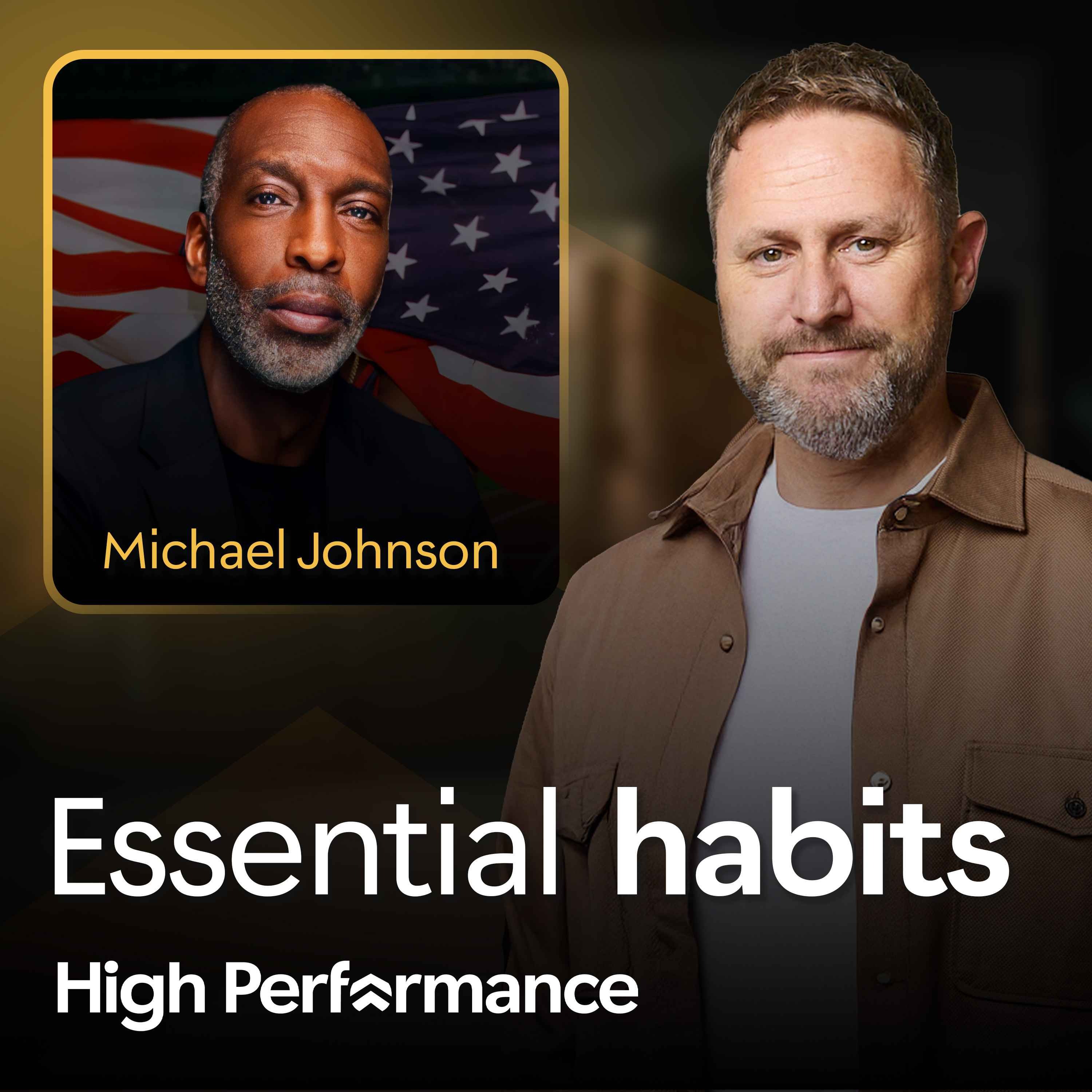
Hosts: Jake Humphrey and Damian Hughes
Michael Johnson - 4x Olympic Champion
In this compelling episode, Olympic champion Michael Johnson shares profound insights on the critical role of brutal self-honesty in achieving high performance. He asserts that "success doesn’t care what you believe you deserve," emphasizing that results come from hard work, not mere belief.
Written by AI. May contain mistakes.

Get the gist, explore an idea or ask about something said.
 Claude
On The High Performance Podcast, what are the key points of this episode?
Searching your listeningAutomatic transcript. May contain errors.
0:28Watch it early on the High Performance App. Right when you need them. Work smarter and faster with Upwork. Go to Upwork.com now and find your freelance expert. That's U-P-W-O-R-K dot com. Post a job for free and get started today. Morning people wake up for peace and quiet. McDonald's breakfast people, we wake up for the sweet rush of getting that warm, delicious breakfast right before it ends. with McValue at McDonald's get any size pumpkin spice iced coffee for just 99 cents until 11am and try our pumpkin and cream pie they're spiced and priced so very nice price and participation may vary cannot be combined with any other offer
1:14this episode is brought to you by Opera Air the first browser with mindfulness at its core now most of us spend hours every day online but how often do we pause wants to take care of ourselves whilst we're doing it. And that's where Opera Air comes in. It's a lightweight, fast, secure browser built not just for productivity, but for your well-being. With Opera Air, mindfulness is built right in. You'll find free breathing exercises, guided meditations, and soundscapes with ambient sounds, lo-fi music, and binaural beats, all designed to help you focus, relax, and even spark creativity while you browse.
1:52I realized that, yeah, I have been trying very hard to avoid the thing that I don't like. Trying to make this, you know, sort of excuse and trying really hard to become the first world-class sprinter ever to do so without weight. I committed to it and ended that year the first person ever in the world to be ranked number one in the world in the 200 and 400 meters. Welcome to the Essential Habits of High Performance, where we explore the daily practices, mindsets and teachable moments that shape extraordinary lives and leaders. Today's habit is about brutal honesty. Michael Johnson didn't just win four Olympic gold medals.
2:33He dominated his sport through sustained excellence, consistency and rigorous self-discipline. but one of his biggest breakthroughs came when he learned to stop lying to himself. In this episode, we look at what happens when you face your blind spots, you confront your weak points, and you build the habit of being brutally realistic. Because the thing you want most, it might just be hiding behind the thing you're avoiding. Hey, I'm Damien Hughes. I've worked as a visiting professor of organisational behaviour, and I've served as a trusted advisor to elite performers across sport, business and the arts.
3:10For much of the last 25 years though, I've immersed myself in one question. How does high performance actually work? And how can we take the lessons from our guests and apply them into our own world? Michael Johnson's one of the most dominant athletes in Olympic history. But this story isn't just about his medals, it's about his mindset. In college, Michael was supremely talented, but constant injuries were holding him back. One day, his coach issued him with a simple challenge. Michael, let's think about anything that we haven't been doing that maybe we can start doing. Michael knew the answer instantly.
3:51He was skipping strength training because he didn't enjoy it, and he was trying to succeed without it. I have been trying very hard to avoid the thing that I don't like, because I'd rather just do the thing I do like and trying to make this, you know, sort of excuse and trying really hard to, you know, become the first world-class sprinter ever to do so without weights. He changed course, committed to the thing he'd been avoiding. That season, he stayed injury-free and he became the first man ever ranked world number one in both the 200 and 400 metres. The fundamentals matter. It takes what it takes.
4:28There's, you know, this illusion of, you know, There's choices when you want to be world-class. There are very few choices that you can make. You have to just do what you got to do. I love that phrase. And it became a personal mantra to Michael. It's not motivational, but it's factual. You don't succeed by skipping steps. Now, this isn't glamorous. It's not new, but it is essential. And once Michael committed, the results came quickly. He stayed healthy, he trained harder, and he raced faster than ever. The following year, he set world records, and more importantly, he stopped guessing what success might take.
5:07He knew. But Michael didn't stop this habit at training. He used it whenever he faced disappointment. When he lost races he expected to win, when his body failed him, even when he had a stroke in 2018 and he had to learn how to walk again. His instinct was the same. Don't sugarcoat it, don't lie to yourself. but instead ask the hard questions and then take responsibility for the answers that come. Success doesn't really care about what you believe you deserve. Michael often asked himself, even during his peak years, why me? He knew there were other talented runners who dreamed of the Olympics but didn't make it.
5:50So what made him different? I got more speed in my little finger than most people have in their whole body. And I was just born that way. Yeah, this is important. Talent does matter. But what separated him were the decisions he was making, the daily choices, the way he was refusing to negotiate with effort. I wanted it too bad. There was never a reason I missed a training session. Even when the task was tough and uncomfortable, even when no one was watching him, his high standards never wavered. And he understood that mindset shapes outcomes. As he put it, You're going up against something, whether it's other people or whether it's just a process or a system or process of improving yourself.
6:36That's always an uphill battle. And you don't just get there based on what you deserve. You get there based on what you do. After retiring, he built a business, a brand, and a lifestyle that reflected those very same values that he demonstrated on the track. Consistency, clarity, and a relentless truth telling. Whether he's now mentoring young athletes or challenging public opinions in his TV punditry role, he remains focused on the facts and not on the feelings. This stuff isn't just about physical training. It's about developing a mindset where you stop hiding from the truth and negotiating with the goal that you're chasing.
7:15You do what it takes. And that's today's essential habit that we're going to explore. The courage to confront your own blind spots and then the discipline to do what it takes to address them. Why does this habit matter? Because the gap between where you are and where you want to be is often filled with lots of things you don't want to do. The uncomfortable reps, the awkward conversations, the routines that don't feel particularly exciting, but you know they work. Michael Johnson's habit of brutal honesty is backed by decades of research in psychology, leadership and behavioural science. And it's one of the clearest predictors of long-term success, not just in sport, but in every field.
8:03Let's break it down. The first thing that this honesty does is it boosts regulation and performance. When Michael Johnson was looking at himself in the mirror and admitting, I'm avoiding the weight, it wasn't comfortable, but it was necessary and it was searingly honest. that level of self-awareness is powerful stuff in one 2016 study by joanne hudson and david day in the journal of sport and exercise psychology they found that elite athletes who scored high in self-regulation that means they could accurately assess their own weaknesses tended to be more consistent less prone to injury and they bounced back quicker from setbacks these athletes weren't just training hard they were training with intention because they knew where they were falling short.
8:51It's the same in business. The same principle holds true. Research conducted by the organizational psychologist Dr. Tasha Urich, and it was published in the Harvard Business Review, shows that self-awareness in leaders leads to better decision making, stronger relationships, and higher performing teams. But here's the interesting catch. 95 % of people rate themselves as highly self-aware, and yet it's estimated only between 10-15 % of us actually are. Michael Johnson didn't assume he was doing everything right, but he was willing to ask himself the hard questions and then act on the answers. The second benefit of this brutal honesty is that avoiding limits our growth.
9:37In a 2012 paper published in Emotion by Gal Sherps and his colleagues, They demonstrated that people who routinely avoid discomfort reduce their long-term resilience. Every time that you avoid or shirk a challenge, your tolerance for facing adversity shrinks. You feel less capable, so you tend to avoid doing more. Over time, the gap between you and your goals just grows wider and wider and wider. Michael could have kept dodging strength training. He could have clung to the story that he was different or he didn't need it. but that mindset would have cost him his health and his gold medals. The third reason why this habit matters is that a growth mindset makes feedback useful.
10:22One of the most quoted bits of research on the podcast has been the pioneering studies conducted by Stanford psychologist Carol Dweck on mindset and how it's reshaped our understanding of performance. Her studies, which include the brilliant book Mindset, The New Psychology of Success, show that elite performers don't fear criticism. Instead, they invite it, because they know feedback isn't a threat, but it's a shortcut to growth. Dweck's studies have found that people with a growth mindset are more likely to seek out honest feedback, persist when they're faced with setbacks, and they choose challenging tasks that stretch their ability.
11:02This mirrors Michael's own turning point. When his coach was questioning his injuries, he didn't get defensive. he got curious instead. He stopped saying this is just who I am and he started asking well what's the gap between where I am and where I actually could be and that shift from protecting your ego to protecting your progress instead is what separates champions from contenders. The fourth reason why this habit matters is that when we confront the uncomfortable it creates clarity. In one 2019 study conducted by two psychologists at the University of Sheffield, they explored what happens when we avoid difficult or ambiguous tasks.
11:43Their findings? Well, they're like a warning light for every ambitious person who's ever procrastinated, because here's what they discovered. When people avoid the hard stuff, even small tasks, they experience higher levels of anxiety, more burnout and more chronic stress. That avoidance doesn't give you relief, it gives you a mental itch that you can't quite scratch. It lingers, it nags and it drains your energy without doing any work. But here's the hopeful part. The study also found that people who did take action, even when it was imperfect, felt more focused, motivated and satisfied with the progress.
12:20Not because the task got any easier, it was simply because they stopped negotiating with it. They shifted from emotional avoidance to what the researchers called adaptive engagement. in other words they didn't wait to feel brave they didn't wait to feel confident they just got going and started with it and every step they took they started to take back control that boils down to michael's entire philosophy which is simply do what needs to be done not what feels good not what looks good but do what works and that's why his mantra is so powerful of it takes what it takes because that removes emotion it kills excuses and brings everything into focus.
13:03When you consider adopting this mindset you'll stop debating whether the work is fun or whether it's fair and you'll start asking is this going to move me forward and with that clarity that freedom from negotiating with yourself comes a competitive advantage. The fifth reason why this habit is critical is that discipline isn't a trait, it's a practice. In one 2020 study conducted by Angela Duckworth and her colleagues and published in Personality and Individual Differences, she challenged the myth that self-control is innate. She discovered that disciplined individuals didn't rely on willpower alone, but instead they created systems and routines that made the right actions easier to follow.
13:47Doing this reduced distractions, planned ahead for obstacles and created automatic habits that supported their goals. Same again with Michael, he didn't always want to lift weights but he built a training structure where it became non-negotiable. He didn't wait to feel motivated, he just removed the option to skip it from himself. And here's the deeper point behind this, discipline doesn't mean pushing harder but it does mean designing your life so that you're doing the right thing and it almost becomes automatic. Michael trained when others were resting. He showed up when others were flinching.
14:22And that's not down to luck or talent, but it was down to structure. So why is this essential? Partly because the stories we tell ourselves matter. If you believe that success should feel good, you'll quit the moment that it doesn't. If you believe that progress comes from talent alone, well, you'll never outwork someone like Michael. this habit forces you to rewrite that own internal story and instead trade wishful thinking for doing the honest work michael's mindset is a template be honest with yourself find out what you avoided and then get on and do it anyway the reward isn't just achievement but it is knowing that you didn't cheat the process that you earned every single bit of it and that's why this habit of brutal honesty and doing what it takes isn't just useful.
15:13It's a non-negotiable for anyone who wants to perform at their best. So here's your challenge this week. Step one, ask yourself, what am I avoiding? Now be specific with this. Is it a daily habit? Is it a difficult conversation you know you need to have? Is it paying attention to a piece of feedback that you've been ignoring? Write it down, say it out loud and acknowledge it to yourself. The second step, now ask, what's the cost of avoiding it? What opportunities is it stopping you from taking? What growth is it holding back? Or what version of you is on the other side of actually doing it? And step three, get on with it and do it.
15:53Take one small action today, not next week, not when it feels a bit easier. Do it today. The habit isn't just about effort, but it's about accurate effort. Putting energy into doing the right thing, especially. when it's a hard thing. As Michael said, success doesn't care what you believe you deserve, so give it what it needs and show up and do what it takes. Now I'm going to be joined by our brilliant producer Will, who's been with us here on the podcast since the very start, and we're going to have a listen to Michael talking about how terrifying it was when he suffered a stroke and the gruelling nature of the recovery, what he learned from the biggest disappointment of his life.
16:33And who would win if he was taking on Usain Bolt and they were both in their prime?
16:41If you're still overpaying for wireless, it's time to say yes to saying no. At Mint Mobile, their favourite word is no. No contracts, no monthly bills, no overages, no hidden fees, no BS. I made the switch because I was tired of those ridiculous bills and sneaky charges from my old provider. With Mint, I'm paying$15 a month and getting the same high-speed data, unlimited talk and text, and the coverage on the nation's largest 5G network. Honestly, the quality is just as good, if not better than what I had before. And the best part, you don't need a new phone. You can keep your current one, bring your number, and all your contacts.
17:16I use Mint Mobile, and you should too. Ready to say yes to saying no? Make the switch at mintmobile.com slash HPP. That's mintmobile.com slash HPP. Upfront payment of$45 required, equivalent to$15 a month. Limited time new customer offer for first three months only. Speeds may slow up a 35 gig on unlimited plan. Taxes and fees extra. See Mint Mobile for details. The market's uncertain. Revenue's tied and hiring on hold. That's why results-driven companies are using Upwork to keep work moving. Go to upwork.com today and start hiring proven freelance talent fast. No bulky overhead. No rigid long-term contracts.
17:56Just the right expert right when you need them. Work smarter and faster with Upwork. Go to Upwork.com now and find your freelance expert. That's U-P-W-O-R-K.com. Post a job for free and get started today. Hey, I'm Dr. Z and I'm a neurosurgeon. So that means long hours, early rounds, late nights, and everything in between. And through it all, I wear figs. They're comfortable when it counts and functional when I need them the most. So where do you wear your figs? On shift, on call, on the couch in the break room listening to this podcast, wherever it is, they fit right in. And now listeners of this podcast can get 15 % off their first order.
18:33Just head to wearfigs.com and use code FIGSRX at checkout. That's wearfigs.com, code FIGSRX.
18:45A global icon, Michael Johnson. and you could feel that when he came in the studio a man who's just so self-assured by his talent and what he can do and uh if you listen to the whole podcast i mean that just rings through the whole thing uh you weren't here on this day were you no and i was gutted one of my favorite books is uh slaying the dragon by michael johnson where he's uh talks about his career and there's so many little nuggets in it that i knew it was going to be a cracker and it didn't disappoint yeah there's a couple of lines that really stick out i remember when we're making the trailer for the podcast and the first line was just that delivery i've got my speed in my finger than most people have in their whole body and it was just he just had these killer lines of just like i just knew what i could do i just knew how great i was but also the second one being like that why would I ever miss a training session?
19:48Like it was the most ridiculous question that Jake had asked. Yeah. Like he said, why would I miss a training session? Well, I think that goes into the first clip that I want to share that when I've gone back and listened to this again, because it's easy to think of this guy as like some superhuman that was running two and 400 meters and, you know, the gold spikes that he had at the Olympic Games and the Atlanta Games in his hometown where he was tearing it up. And yet it was his illness that made him human. And what I love about it was the fact that you can take away lessons from the apex of the top of the Olympic mountain that he was at and apply them for when he was at his most vulnerable.
20:31That has probably been the most unbelievable, unexpected experience of my life. When I had my stroke, I didn't feel any major discomfort. I didn't feel any pain. I just had this strange sensation where I was struggling to move my fingers. I was struggling to coordinate my left leg. And this was right after I finished a workout in my gym. I know my body, and this is not right. Out of an abundance of caution, we decided to go to the emergency room, fully expecting that it's going to be nothing. and it's just getting progressively worse. And so like an hour later after these, they're checking me out, running some tests and it's just getting worse and worse and worse and worse and worse and worse.
21:25Now I can't move my fingers at all. My left leg, I can't stand on it. I can't walk and I can't move my arm. It's shocking. I'm shocked. I'm like, what is going on? The left side of my body is literally being paralyzed I was just, and it's just, I'm scared to death. My wife is there with me and we are just like, what is happening? So of course my immediate question then is, will I make, you know, how long will it take me to recover? And that was, so it never affected any of the right side of my body, never affected my speech, never affected my face or anything. It was just my left arm and leg. I could have very well just tried to sleep it off and I probably wouldn't be here today.
22:10And then recovery. You know, recovery is hard. Yeah, many people give up because the recovery is really hard. A lot of days you don't see any improvement. For me, I was very fortunate having been an Olympic athlete. You know, my daily routine was, you know, tiny little, mostly unrecognizable gains on a daily basis. Some days when you're training at such a high level, you'll have a really hard training session and you'll feel like, I didn't get any better today. I just wasted all of that time. But you know, as an athlete that I did get better. how scary that must have been and you know he's built his whole life around this physical ability being able to do these things and all of a sudden it's just taken away how do you think he you know would then start to rebuild that kind of identity that he had well that's a really good question will but i think as well as the physical fear that he must have had for what was happening it must have been the mental pain of like you say his whole identity is built on being this superhuman athlete and now that he's incapacitated and having to learn to walk again it must have been rebuilding the identity and what's interesting is how he called on the lessons from his previous career the idea of the small incremental steps the patience not to rush it but just to do one thing after the other and know that eventually the cumulative effect will start to add up and he'll start to be human again it's a really good example for any of us that high performance doesn't come in great leaps it often comes in small often insignificant steps that eventually add up to a whole so from there I'd like to actually go to the story that he told when he was at his peak when he was dealing with the huge disappointment of he'd gone on this career trajectory that had just been like a straight line he'd left college he'd become a professional and he then dominated the track for the next two years and then he suffered food poisoning that meant he wasn't able to perform at his very best the essential habit we've been speaking about is brutal honesty this is a great example of where that brutal honesty was never more invaluable to him so first it was that's biggest disappointment of my career full stop i had gotten food poisoning so i was world champion ranked number one in the world for two years, undefeated, and, you know, huge favorite to win the 200 meters at the Olympics.
24:45And a month or so, six weeks or so before, I had just missed that on the world record, just barely missed it at our Olympic trials. So I was in the best shape of my life. And when I got to food poisoning, it was about a week or so before I was competing. Had we done any training that was sort of a strenuous type of training, I would have known that, yeah, there's something going on. I've lost a lot of strength. By the time my first race at the Olympics came on, I was over the food poisoning. Felt fine. Usually in a first round, I can just sort of, I'm going to run the first 100 meters of that 200 meters, and then I'm just going to, I'm going to have a huge gap.
25:28and then I'm just going to, because it's the first round and most of the athletes there, they're not going to be in the final. But I find myself just in an absolute battle of a race in the first round. This has never happened to me before. Like, what is going on? I feel like I'm running in someone else's body. I'm extremely weak and it takes everything. I win that race, but just barely. And it took everything in me. And I knew immediately something's wrong. And it got worse in the next round. And then I ultimately didn't make the final. So very disappointing, embarrassing, you know, one of the biggest favorites, you know, in front of the entire world.
26:03Now I'm out. And that's all everybody's talking about. What happened? What's going on with Michael? And I knew of athletes who were world record holders, world champions that had the butt, never won an Olympic gold medal. And I never wanted to be that. There were some moments where I started to question myself, question my talent. this was my third year as a professional for that three years and up to that point my whole reputation was i just win everything and i went big and i'm unbeatable that was my reputation so now that i'm no longer the champion i'm no longer the best i'm no longer this unbeatable and then what am i the aura has gone yeah i've always been a realist like brutally real with myself.
26:53And I was just at home by myself one day and I was thinking about, okay, well, next year, next season, you know, what's that going to look like? World championships coming up and, you know, full season next year, what's that going to look like? And the reality, you know, as I started thinking about what's that going to look like is I'm going to be racing against all of those guys that won the medals. These are the same guys I've been racing against for the last two years. every time I race them, I beat them, except this one time because I had food poisoning. The reality is if I can avoid getting food poisoning next year when I race against these guys, I'm going to most likely do the same thing that I was doing for the last three years.
27:38And sometimes we, you know, the wins seem bigger than they are, the losses and the setbacks seem bigger than they are. And just sort of being grounded in that reality absolutely helps. And And it certainly helped me in that moment to sort of put things in real perspective. But it helped to also allow myself to go through that period of being really disappointed and sad and scared and angry and all of those things to then get to the point where, all right, you know, let's get on with it. What's interesting there is there's a few tips that any of us can take from this. The first one is that he allows himself time to wallow in what must feel like a grief period to him.
28:16So he allows that to happen, but not for too long. He's putting it in some kind of perspective to go, this was just one race over the last three years. And over the next three years, I'm going to go back to doing what I've done again. And our ability to zoom out at these moments and try and put what might seem catastrophic incidents into a wider perspective can often help us get over them so much faster. Do you remember having Chris Hoy on the podcast in the first season? One of the first interviews we ever did. Do you remember the Father Christmas Syndrome? Now, if you're listening with kids in the car to this, maybe just turn it off at this moment in time, but he talks about that idea that for years you believe that Father Christmas is true and you structure your whole life around it.
28:59So when you eventually find out that it's not, everything appears different. So if you construct a narrative around yourself that you're unbeatable, you can't be beaten, that you're supremely fantastic, the moment you get beat that whole facade unravels and many people struggle to come back from it yeah and what michael just had that ability just to think rationally look back at the evidence all the training he'd done all the races he'd won and he's going to be racing the same people and he knows that actually like you said it's just one race i think the last clip we should talk about because we've actually interviewed both of these people is when he's when we put to him who would win in a race, prime Michael Johnson versus prime Usain Bolt?
29:48Look, if you asked any athlete at that level, they only have one answer. It's going to be themselves. You asked Usain, I've asked Usain that question. And his answer was predictably him. And my answer is predictably me. The good thing for me and for him is that we don't actually have to ever do that.
30:12Why would you win? Just, you know, look, I did not go into any race, and I had some major competitors during my time, 200 meters and 400 meters, and sometimes I went into one of those races at a disadvantage because I was just coming out of the other one. And I just always, I didn't get into any races. I didn't think I could win. I think, you know, I could rise to whatever occasion. And, you know, Usain's an amazing athlete. And he would have had an advantage around me a little bit out of the blocks. But, you know, when he's slowing down at the end, he's not the most efficient at the end of the race.
30:47I'm extraordinarily efficient. I would have beaten him on speed, endurance, ability to hold my speed and my ability to be more efficient. And I'm just going to stick to that to the day I go to my grave. That's brilliant. Although inevitable is his answer. I think the last point I'd make on this is that there's three mindsets you can go into any competition or any endeavour. You hope to win, you expect to win, or you expect to lose. Now, no athlete at their game expects to lose, but equally no athlete hopes to win because hope isn't a strategy. They go in with that sense of expectation of knowing exactly why.
31:25And what I love about Michael there, and it circles all the way back to the habit that we started this episode with, it's the brutal honesty he's telling you exactly where he would beat Usain Bolt not at the start I want to beat him at the end I'm extraordinarily efficient if you'd asked me before who would win I would have been Team Usain but listening to him talk and give his reasonings it put a little doubt in my mind well you say that but when we met Usain in Florida last year and we asked him that same question he was just languidly confident he was like no chance so whatever happens we've got two big confident egos colliding there on the track it'll be fascinating to observe it and I hope you've found this episode equally fascinating as well if you know anybody that you feel would benefit from a little bit of brutal honesty in their own lives why not pass this episode on and suggest that they give it a listen and if you want to share some honest feedback with us about how you're using these essential habits feel free to drop us a line and let us know we'd love to hear from you but thanks for trusting us with your time i'm damien hughes i'll see you soon
32:57introducing new sylvania led ultra fog and power sport lights this powerful upgrade delivers cool white clarity and crisp visibility on the road ahead so you can reignite the love for your car with lights that make it feel like day one. And built with a compact design for a DIY install, these fog lights are backed by over 100 years of lighting expertise to bring you LED ultra night vision and help you see better at night. It's time to fall for your car all over again. Sylvania, light that lasts. Morning people wake up for peace and quiet. McDonald's breakfast people, we wake up for the sweet rush of getting that warm, delicious breakfast right before it ends.
33:38with McValue at McDonald's get any size pumpkin spice iced coffee for just 99 cents until 11am and try our pumpkin and cream pie they're spiced and priced so very nice price and participation may vary cannot be combined with any other offer Pacifico is a Mexican lager brewed to be discovered it's like fresh tracks on a powder day like that uncharted trail a stone's throw away like the perfect wave on a sunny day. Pacifico. Find your own way. 21 Plus. Drink responsibly. Imported by Crown Imports Chicago, Illinois.
There’s a moment in this conversation with 4x Olympic Champion Michael Johnson that stopped me in my tracks. He said, “Success doesn’t care what you believe you deserve.”
That line sums up what this episode is really about, the difference between wishing for results and doing the work required to earn them.
Michael didn’t become one of the most dominant athletes in history by chasing comfort. He became great by facing the hard truth. By asking himself the questions most of us avoid. And then doing something about it.
In this episode, I unpack the habits Michael used throughout his life, from championship seasons to career-ending injuries to the day he was told he might never walk properly again. It’s about discipline, honesty, and doing what it takes, not what feels easy.
We explore:
This episode is a reminder that high performance doesn’t come from believing you’re ready. It comes from acting like it, even when no one’s watching.
Here is more information on the studies referenced:
Listen to the full episode with Michael Johnson: https://pod.fo/e/254ca8
Hosted on Acast. See acast.com/privacy for more information.


