
 Ask ChatGPT



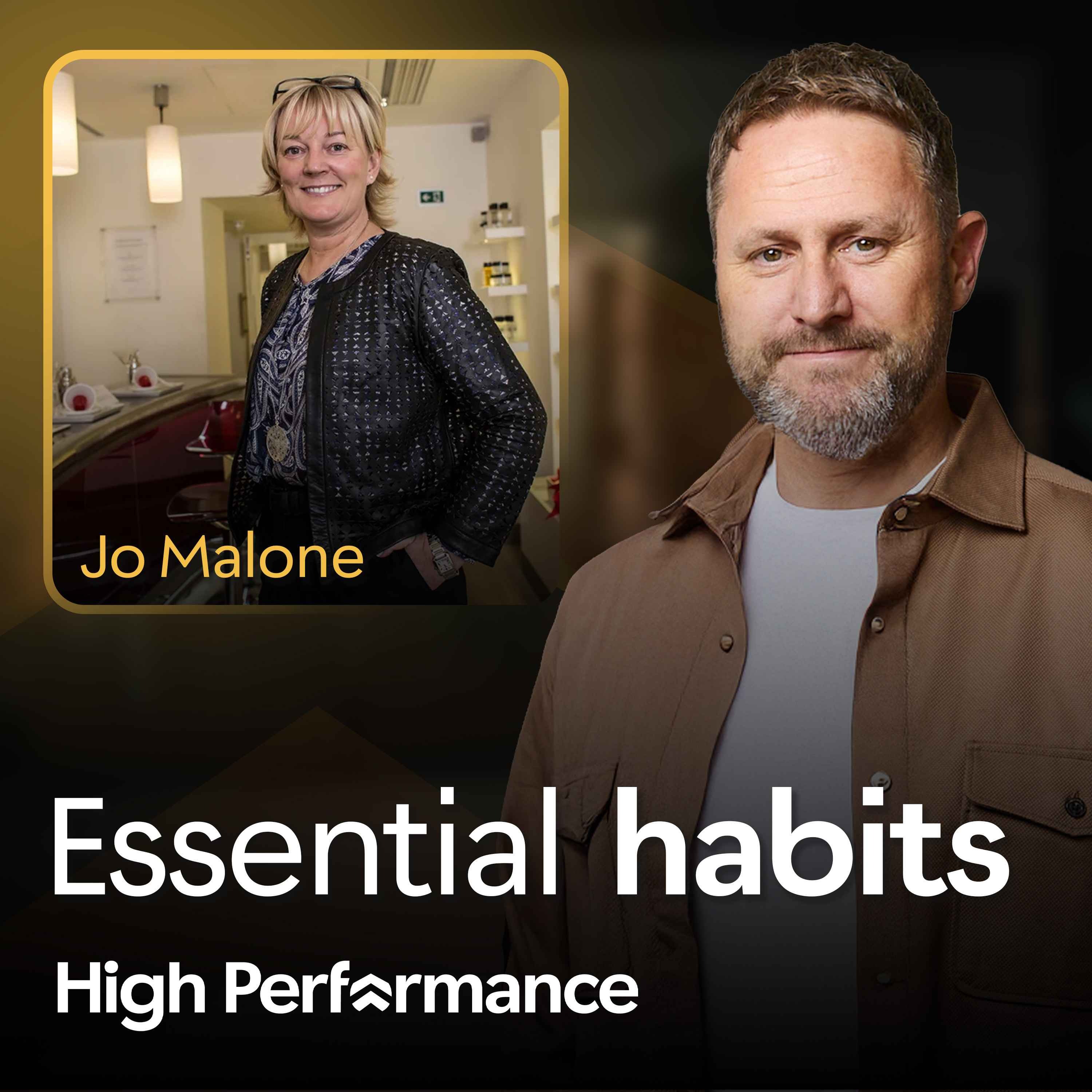
In this episode of The High Performance Podcast, host Damian Hughes converses with Jo Malone, a renowned entrepreneur, discussing resilience, the importance of pausing, and the power of selective memory. The episode serves as the first installment in a new series titled Essential Habits, where high performers share their valuable insights.
Written by AI. May contain mistakes.

Get the gist, explore an idea or ask about something said.
 Claude
On The High Performance Podcast, what are the key points of this episode?
Searching your listeningAutomatic transcript. May contain errors.
0:28Watch it early on the High Performance App. or colors. No chopping, no cleanup, no guilt. Keep the flavor. Ditch the subscription. Get 20 % off your first two orders with code APRON20. Terms and conditions apply. Visit blueapron.com slash terms for more. The market's uncertain. Revenue's tight and hiring on hold. That's why results-driven companies are using Upwork to keep work moving. Go to upwork.com today and start hiring proven freelance talent fast. No bulky overhead. No rigid long-term contracts. Just the right expert right when you need them. Work smarter and faster with Upwork. Go to Upwork.com now and find your freelance expert.
1:07That's U-P-W-O-R-K.com. Post a job for free and get started today.
1:15This episode is brought to you by Opera Air, the first browser with mindfulness at its core. Now, most of us spend hours every day online, but how often do we pause to take care of ourselves whilst we're doing it. And that's where Opera Air comes in. It's a lightweight, fast, secure browser built not just for productivity, but for your wellbeing. With Opera Air, mindfulness is built right in. You'll find free breathing exercises, guided meditations and soundscapes with ambient sounds, lo-fi music and binaural beats, all designed to help you focus, relax and even spark creativity while you browse.
1:49It's like sand. You know, when we go through situations in our life When you pick up wet sand and you hold it in your hand, and then as life goes on, it starts to dry out, and then you open your hand and it's gone. And I think wisdom can sometimes be like that. Welcome to the essential habits of high performance. Have you ever had a moment where everything just paused? A moment so intense, so real, that it cuts through all the noise and makes you see life a little more clearly? Maybe it was a phone call in the middle of the night, or maybe it was hearing the words you never expected to hear, or maybe it was standing at the edge of something new, something terrifying but full of possibility.
2:36We don't get many of these moments, but when we do, they do leave a mark. The more important question though is, do we remember them? That's precisely what today's episode is all about Which we'll explore by looking at the wisdom shared with us by someone Whose name that you've probably heard Not just because of her iconic perfumes But because of her truly remarkable life Jo Malone You've seen the name on counters around the world But the story behind that name is full of grit, heartbreak, comebacks and wisdom I'm Damien Hughes, co-host of the High Performance Podcast In my career I've worked as a visiting professor of organisational behaviour I've been a trusted advisor to dozens of elite leaders looking to create high performing cultures I've also written 12 books which have been translated into over 10 different languages around the world Above all I'm someone who loves exploring how high performance works and how we can take the lessons and apply them into our own world These new weekly episodes are all about essential habits and teachable moments you can implement into your own life Plus, in the second half of this episode, I'll bring you more wisdom from Jo and we'll dig into the lessons behind her words you definitely shouldn't forget In the show notes, you'll also find links to all the latest studies and research I reference Jo's background is fascinating She's grown up on the council estate in Bexley Heath where her father had been a bit of a gambler and had left the family bankrupt at one stage.
4:15Her mother had suffered with diabetes and at the age of 13, Jo had started to have to become a carer for her and at the age of 15, she'd left school as an undiagnosed dyslexic in order to be able to care for her mum. Now, what that meant is she had to go and get a job working in a local beautician's for a lady called Madame Lubati where she worked in the evenings and at weekends. And it was there that she developed this amazing ability to detect smells and combine ingredients to create these beautiful fragrances. And that was the first step on her own journey to creating the business empire of Jo Malone London.
4:58So now we're going to listen to Jo in more detail and we're going to explore the essential habit that she shared with us. built my life and I didn't allow other people's opinions of me to form my dreams and my aspirations. So I remember the night I was diagnosed with cancer and within 48 hours, I was given months to live. And I remember coming home and I was 38 years old. I had a little boy who was running around. I had a gorgeous husband that I adored and I just, I felt broken by that. You know, you know having your your life just snatched away in a second let's just pause for a moment and think about how that would feel for any of us i mean it sounds horrendous enough as joe describes it there but just imagine that you put years of effort into creating the life of your dreams you've met your husband you've had your son and you've built this relationship both as a mother and as a partner you've got business that's going really well and then you sit opposite a doctor who tells you that actually you've not got that long left to live.
6:04I remember when we spoke to the brain surgeon Dr Mahul Jandil about this very point who said delivering this news is probably the hardest skill for any doctor but I don't think sometimes we stop and necessarily reflect about what it's like to be on the receiving end of that. Jo explained exactly what it's like. I remember sitting quietly on my own about an hour later once the tears had stopped and I remember that that resilience that fight that Joe fight that that I know so well sitting there and saying why why are you going to listen to somebody telling you how long you've got to live you've never taken anyone's advice in your life.
6:42Now this is brilliant at a moment of high emotional intensity as this Joe's able to recount in vivid detail exactly what happened during this moment. The tears have stopped and then we can hear that inner voice of the young girl from Bexley Heath that has defied the odds, that's built her business empire and always decided to go her own path rather than the one that most of her peers and contemporaries do. Now it starts to emerge again after the shock of this diagnosis and we can hear the resilience coming out of it. The idea of sitting there and reminding herself that you've never listened to what other people have told you.
7:21So why are you going to start now? You've always done what you felt. Where's that fight now? And I felt myself filling with a sense of I'm going to do everything I can to survive. When you talk about performance, high performance, it's that survival instinct in me. Now, it's this next line that I particularly love. Let's just go back and listen to it again. Where's that fight now? And I felt myself filling with a sense of, I'm going to do everything I can to survive. So this survival instinct that Joe talks about is something that we all have within us. It's something that if you go back to the teachings of Dr.
8:02Viktor Frankl and his book, Man's Search for Meaning, where he reflects on his experiences in the Holocaust. He describes that the last thing you can take away from anybody is their attitude, their willingness to want to survive, to thrive and do the best that they can in often some horrendous circumstances. Now Jo here is giving us a really good indication of how she's starting to control this narrative, to find hope and start to look for opportunities and some way in which she can recover from this terminal diagnosis. Now the real point that I want to get to is going to follow in a moment but once she's decided that she's not just going to accept life on the terms that she's been given.
8:45It's what she chooses to do next with it that is significant. You know, facing cancer, I saw what I really wanted in life and I saw, and I actually, when it was all over and I got through the other end, I had a good old spring clean of my life as well. I love the idea of us having a spring clean of our life because we don't always need a crisis moment like Joe was facing here for us to be able to put our foot on the ball or just pause for a moment and stop and think about what am I accepting rather than choosing to have in my life? Is it, as in Joe's case, tolerating people that are coming in and dragging down the mood?
9:26Or is it our ability to surround ourselves with people that light us up, that encourage us and lift us? Having this ability to choose and decide what we want in our life and live it on our terms is a really important decision that we all have to make. We don't need to have a crisis moment for us to do that and yet how often do we have the thought that it's something we want to do and never actually do something about? Maybe you've seen it with somebody that has driven recklessly for years and they have a bad car crash and then decide they're suddenly going to become a more considerate driver on the road.
10:05Or somebody who's prioritised making money for years, who has a health incident and then decides that actually spending time with their family is the most important thing. It can often be frustrating that we need to get put on the floor before we realise that we can change things whenever we want. We're in charge and we have the pen to write the script for this. Now the reason I tell you this is because this is an important insight that Joe gleaned. But the key bit that I want to give you to take away, the essential habit, is keeping hold of the most important thoughts and actually putting them into practice.
10:44Fortunately for us, Joe offered the fantastic analogy that you heard at the top of the show. It's like sand. You know, when we go through situations in our life and we, when you pick up wet sand and you hold it in your hand and then as life goes on, it starts to dry out and then you open your hand and it's gone. And I think wisdom can sometimes be like that. That's the very point that we've been exploring. That is the mic drop moment, if you like. Because this is the bit that I want to explore in more detail with you. How wisdom can sometimes be exactly like that? It's like the sand that just passes through your hands where we often end up forgetting it at a later stage.
11:25Your brain is a powerful organ, but it doesn't remember everything. That's not a fault, that's a design. There are a few reasons why our selective memory is actually crucial to our healthy brain function. One of them is that your memory is energetically expensive. The brain uses about 20 % of the body's energy, even though it only accounts for about 2 % of your body weight. So remembering everything would require an enormous amount of energy to be expended and the storage capacity to be expanded to which the brain has evolved in order to avoid that. Instead, the brain prioritises efficiency over total recall.
12:10Second reason is that forgetting is actually an adaptive feature. According to the psychologist Dr Blake Richards of the University of Toronto, forgetting is not a failure of memory but a function of memory. In 2017, Dr Richards co-authored a paper in Neuron magazine Suggesting that forgetting helps the brain generalise past events In order to make better decisions in new situations that we face If you remembered every detail, you'd simply be overwhelmed by a huge amount of irrelevant information The third reason is, the brain has got almost like a filtering system That we know as the hippocampus This is the part of the brain that decides which information should be stored away as a long-term memory So things like novelty, emotion and relevance to our survival are all key filters According to research, only 1 % of the sensory information that we ever receive Actually makes it into the hippocampus region that protects our long-term memory And the fourth reason is the decay theory One classic explanation for forgetting is that memories fade over time if they're not accessed or reinforced There's a famous 1885 experiment by Herman Ebbinghaus Who found that we forget 50 % of new information within an hour of receiving it We forget 70 % within 24 hours and 90 % within a week unless the information is meaningfully reinforced The fifth reason why our brain forgets so easily is the attention and cognitive load required the average person has around 6 000 faults per day this is according to a 2020 study conducted by queen's university in canada we can only deeply process a small number of them so multitasking reduces our encoding efficiency so research says that when we switch between tasks that reduces our productivity by as much as 40 and it lowers our ability to retain information now there are a number of problems which result from this.
14:13It may be minor incidents such as forgetting where you left the car keys or your glasses, but there can be serious consequences. In the law, eyewitness misidentification is a significant contributor to wrongful convictions in the United States. According to the Innocence Project, approximately 69 % of DNA exoneration cases have involved eyewitness misidentification, making it the leading contributory factor in these wrongful convictions. Experts estimate that approximately 5 ,000 to 10 ,000 felony convictions in the United States each year are also wrongful, with research suggesting that about three quarters of these wrongful convictions involve eyewitness misidentification.
15:01Let's explore then how our brains decide what to remember and how we can leverage this understanding to enhance our memory. Our brains are inundated with information daily, yet only select pieces are stored for the long term. Research led by Professor Charon Ranganath at the University of California has shed light on this process. In the paper that has the not-so-catchy title of Post-Learning Hippocampal Dynamics promote preferential retention of rewarding events, they did a scan of the brains of volunteers as they answered a number of simple yes and no questions about a series of objects. So what they were asked is, say for example they'd be shown a tin of beans and said, is this tin of beans heavier than a basketball?
15:46And you had to answer yes or no. Then they'd have a look at something like a dumbbell. Is this heavier than a basketball? Yes or no? When each of these items were put up, there was also a value added to the card that it was shown on so it would tell you how much it might be worth it might be£1 or it might be worth£10 if you got the right answer but at the end of the test they were told how much money they'd won by giving the right answer on each occasion now once it was completed the volunteers brains were then scanned while they rested and they were given a surprise memory test what they found is that it was the items that had the highest value with the ones that people were able to retain and remember and what's interesting is that when the researchers looked at the brain scans of the volunteers when they weren't doing anything like a memory test they found that their brain was still replaying the items that had the highest reward they were able to determine this from an identifiable pattern of activity in the hippocampus now this suggests that our brains prioritize memories associated with high reward and then it reinforces them through replaying them even while we're resting.
16:54This mechanism aids us in future decision making by emphasizing the experiences that yield positive outcomes. So to consciously improve our memory retention the neurologist Dr Andrew Budson and the neuroscientist Dr Elizabeth Kensinger proposed the FOUR method outlined in their brilliant book Why We Forget and How to Remember Better. The acronym of F is for a focus where they They ask you to concentrate solely on the information you wish to remember. Eliminate any distractions. O stands for organize, where you structure the information logically, grouping related items together. U is about understanding.
17:38Ensure you comprehend the material fully. Seek clarification if you need. And then R is about relate. connect new information to something familiar, such as associating a name with an own song or an event. By applying these four steps, we can enhance our ability to encode and retrieve important information. I'd encourage you to consider applying the four method in your own daily life. For instance, next time you meet someone new, think of it like this, focus on their name as they introduce themselves, really listen. then organise the name by associating it with their profession or a distinctive feature understand the pronunciation ask again and ask questions if you're unclear and finally relate the name to somebody that you already know or a famous public figure this deliberate approach can significantly improve your ability to recall names and it also strengthens social connections Now interestingly, as I said earlier, forgetting isn't a flaw, but it's a feature of our cognitive system It allows us to discard irrelevant information, making room for more pertinent data This selective memory process is essential for our decision making and adapting to new environments Drs Budson and Kensinger highlight that forgetting helps prevent information overload enabling us to focus on what's truly important So the takeaway is that Jo Malone is one of the most successful names in global luxury.
19:13She's a self-made entrepreneur, a creative genius and someone whose name is literally synonymous with scent. But her story isn't about building a fragrance empire, it's about grit, survival and the lessons which life teaches us when we least expect it. Most importantly, Jo teaches us about exploring the power of those big life moments. How do we hold on to them? What can they teach us? And how do we stop those defining lessons from slipping through our fingers like sand once the world moves on? Whether you're all facing a challenge, chasing a dream or simply trying to remember who you are, Joe's story offers us all a powerful reminder that wisdom often arrives in the darkest places.
19:57And if we're paying attention, it can light the way forward. So maybe today, take five minutes to sit with a moment that changed you What did it teach you? And how will you remember it tomorrow? What hit me, re-listening to Jo's episode Was just how much is packed into her story Real, grounded lessons worth holding on to After the break, I'll highlight the moments that stuck with me And why they might stick with you too Will, our brilliant producer since day one on High Performance, is joining me to unpack why this one still resonates.
21:01I'm paying$15 a month and getting the same high-speed data, unlimited talk and text, and the coverage on the nation's largest 5G network. Honestly, the quality is just as good, if not better than what I had before. And the best part, you don't need a new phone. You can keep your current one, bring your number, and all your contacts. I use Mint Mobile, and you should too. Ready to say yes to saying no? Make the switch at mintmobile.com slash HPP. That's mintmobile.com slash HPP. Upfront payment of$45 required. required, equivalent to$15 a month. Limited time new customer offer for first three months only.
21:34Speeds may slow up a 35 gig on unlimited plan. Taxes and fees extra. See Mint Mobile for details. The market's uncertain. Revenue's tied and hiring on hold. That's why results-driven companies are using Upwork to keep work moving. Go to Upwork.com today and start hiring proven freelance talent fast. No bulky overhead. No rigid long-term contracts. Just the right expert, right when you need them. Work smarter and faster with Upwork. Go to Upwork.com now and find your freelance expert. That's U-P-W-O-R-K dot com. Post a job for free and get started today. At Capella University, learning online doesn't mean learning alone.
22:16You'll get support from people who care about your success. Like your enrollment specialist, who gets to know you and the goals you'd like to achieve. You'll also get a designated academic coach who's with you throughout your entire program. Plus, career coaches are available to help you navigate your professional goals. A different future is closer than you think with Capella University. Learn more at capella.edu.
22:44How are you guys? Oh my goodness, whole team. So do you remember where you were when we recorded this? yeah well we did this in lockdown so uh jake was in norwich i was back in manchester and joe dialed in from london so uh yeah it seems a long time ago but yeah it was in the deep dark days of lockdown yeah and she asked us to turn the camera off didn't she well this is the interesting thing because most of the interviews that we do and people listening might have watched some of the episodes on youtube so you can see that most of them are done face to face or if they're not due to geographical reasons we'll do it on zoom but the point is you can still see the face you can still see their eyes you can still read the body language but this is where it surprised us because joe came on and said would we mind if we did it with the cameras turned off i think she'd either had a bad night's sleep or she was feeling a little bit self-conscious but whatever her reason was she felt that she could give the best version of herself yeah and at this point i remember when you have guests who do that you're almost quite alarmed at first you're thinking oh how's this going to go is this going to be good what's the reason they want to do that but you're right it forces you to really plug into one sense and not the multiple senses that you would have when someone would be there well bingo that's exactly it that there's nothing to look at so then you've really got to tune into what they're saying and then not only are you listening to the words you're listening to like the tonality of it you're listening to the cadence of it i mean it's sometimes referred to as the words the music and the dance but what you're forced to do is listen to the dance to listen to the rhythm of what's being said and really pay attention and i thought i felt personally it really heightened the experience of remembering just how good she was yeah there weren't there haven't been many guests in the history of us doing a podcast where it's happened but i do remember walking up and down the garden as well like vividly now you say it where you were kind of hanging on words and she was saying so many things and i just almost remember stopping and just like really pressing the earbud to my ear to listen to her well it's almost like you know sometimes when you when there's like a pregnant pause in a conversation where somebody might just be gathering their thoughts and i think the danger is sometimes at those moments we rush to fill the gap whereas because we couldn't see what joe was doing you almost let that that pause hang for a bit longer and then inevitably she would fill it and she'd come back and either offer a more clarification or she'd expand or dive a little bit deeper to illustrate what she meant but what kept coming that back was something that was richer and deeper and more profound it's why i'm so excited to share this as the first of our service and do you remember after the record it's one of uh she sent everybody in the team a candle and not just to to you guys but every single person who was involved in that cool production that journey for her she had a personalized note from her yeah and she sent a candle to our house i'll never forget that yeah yeah she was the definition of class yeah of a class act you know and something like a gift like that to all of us recognizing that we'd all played our part in it to me made her one of the most iconic guests that we've had on this podcast series and you picked out um some of your favorite bits from the episode avenue where would you like to start so one of the topics we spoke to joe about was resilience she told us that she'd had to be the adult of the family at age 10, being responsible for what was in the fridge or going out to work, even though she was too young by most accounts to do that.
26:36We were interested in whether those hard times are necessary to build resilience. I think as a child, I didn't choose, you know, to be in that position. I didn't choose to have to think about, you know, where the next meal was coming from, from the age of eight years old. I mean, that wasn't, but I think, I don't think it matters where you come from in life. you can always make the very best of something and and I think my parents actually did teach me that you know whoever you are whatever you have you know make the very best give your very best to that and it it's it's an attitude of mind I think a lot but that resilience doesn't always come from standing you know front line in a war it it often comes from that day-to-day pursuit every single day and not that not not quit attitude and I think that's where my um because bad things happen to good people.
27:27It's a reality. And I think it's a mindset. I think it's how you look at resilience. It's how you look at fights. And that sense of, I mean, for me, resilience means don't quit. Resilience is, sometimes we move forward in situations and we walk towards our goal. And sometimes you just have to hold your ground. Resilience isn't always about moving forward and being successful. And I think when I look back at my life, I wouldn't change a thing. Isn't that weird? I really wouldn't change a thing because I think I am the person I am today because of all those steps. I might change some of the things I've said to people because I'm quite impulsive, but I wouldn't change my life in it, not even the cancer chapter.
28:09And I know that sounds a very strange thing to say, but I learned so much about myself. I learned about life I learned about love and I learned about the things I didn't want in my life. We also spoke to her about lessons that she'd learned as an 11 year old adolescent girl that she was still applying both at 38 when she was diagnosed with cancer and at 58 when she was talking to us and reflecting on such an incredible life well lived. You know what I always think every single day of my life I get up with enthusiasm and I give everything to that day that I possibly can. And I go to bed at night slightly exhausted, but proud.
28:49And I think I've lived my life like that all the way through. And I always believed that there is something else out there every single day. And I never felt that I was unworthy, even though I had no education, I hadn't finished school. I didn't have all I didn't have didn't come from a wealthy background um you know all of those things but I still didn't let that define and dissolve my dreams I'm and I'm a dreamer I am I think that's part of what what makes me who I am I dream big and the bigger you dream the more chances you have of attaining that so where does that come from then Jo because like you say there'll be people listening to this that maybe grew up in similar circumstances that uh that don't dream so big so what advice would you give for anyone about that capacity to do that well what i would say is it's your responsibility it's no one else's responsibility to fulfill your dreams but yourself and at the moment we're living in we're living in really um life world-changing times where and I think taking that responsibility upon yourself and saying if I want to make this happen I've got to make that that happen with me and I've never felt in my life that it was someone else's responsibility and I never want someone else to think they can take my dreams and make them their own either do you know what I mean I think everybody is responsible for their own and accountable for who they are and what they do.
30:24I remember this wonderful woman who helped change my life called Anna Albright. And she was a cognitive therapist. And at the time, I was really struggling with my mental health. I mean, that's creativity, negative and positive often goes hand in hand. And I remember her saying to me, and I said, why do I react in this certain way to a situation? And she said, it's the little girl in you. It's the little girl that knew that it was all up to her to make it happen. And I remember going away and thinking about that. And I didn't look at that with sadness. I looked at that situation with such, that little girl that lived on that council estate and she had to put all the little pieces, no matter what the pieces were, she had to put them together and make something.
31:13That's what caused me to be who I am today. So all the things that happen to us in life are often those little pieces that are really important. And what it does is it says that nothing is wasted. And I started to really rethink things in a different fashion. And I think that was a really big breakthrough for me as a person, looking at some of the things that happened to us. They often take us into a different perspective. And again, going back to sort of, you know, hate and bitterness and all the things that, that started to push all of that away for me. and I started to see a much more positive approach to things, much more wholeness.
31:55Does that make sense? Oh, it makes perfect sense. I think there's a really interesting phrase that I sometimes use where I say that you can often see the ghost of people's childhoods rattling around their adult bodies. Oh, I love that. That's so true. Yeah, and so I'm interested in terms of what elements of your childhood then would we still see today? if we'd have seen like the little girl from Bexley Heath and seen you today, what are the links that we'd see? Oh, do you know, I've got tears in my eyes thinking about that. What an amazing question. I don't look at them as ghosts, but I look at them as, I feel, it's so funny, my mum and my dad and my sister have all passed away.
32:38But I felt the presence, not in a weird way, but I felt the energy of my dad in the last year, actually. He was a big loner. He was a brilliant artist. But what is still within me is the little girl that did the markets. Absolutely, I still feel I love a market anyway. I love the whole thing about shopkeepers and all of that. So I think there's still that kid there. I still to this day look to see that there's four meals in our fridge. so in case anything happened I can at least get us through four or five days I still have that mentality I have um and not wasting things you know I hate waste I hate uh although I don't have to worry about an electric bill or a gas bill or anything like that anymore I still have that real sense that waste is is so wrong in any form so that's that's the little girl in me I was never frightened about my lack of education everyone else was but I wasn't and I think there's still that within me and I'm never frightened of putting my hand up and saying what does that mean I don't understand that what can you explain that to me and people find that really strange that I would show that vulnerability but actually I we're all here to learn aren't we we're all here to and if I don't understand how something works and I don't understand a word or just put my hand up and I think the the little girl in me is that's how I learn I would ask loads and loads and loads and loads of questions and I would question then the answer I think that is still in me as well it's a lovely question thank you and this final clip I want to share with you is almost a challenge to that common narrative that we assume that entrepreneurs like Jo build a business look to sell it for fortunes and then go off into the sunset to live a life happy ever after She challenges that idea and talks to us about the power of having a sense of purpose.
34:45We sold our business. So both Gary and I are business partners, husband and wife, best friends, business partners. And I think that when we sold our business, we had this wonderful little gem of a British business. But she was growing. Jo Malone London, Cream and Black Box, was growing so rapidly. And we were just running out of money. It was, we owned 100 % equity of that company and we were running out of it. So every time you went into a new territory. So I think Gary and I both knew that we either had to borrow money, we had to partner with somebody or we had to be, we needed deep pockets.
35:25We needed people that understood distribution and we needed someone that loved the industry. and when Estee Lauder you know came into our lives um on that at that moment and it took a good took a good 18 months of courting backwards and forwards and meetings but when they actually made the offer it was and I don't regret that decision I don't regret selling to them at all in any way shape or form and you know for the first couple of years it was a dream come true we were two kids who had had nothing, sleeping on a piece of blue foam from home base as our bed. And suddenly there we were probably secure for the rest of our lives.
36:09But halfway into that kind of first five years, that's when I was diagnosed with cancer. And I took a year out and I fought it. And when I came back, my mindset was in, I was standing in a very, very different position. I had no sense of smell because of the chemo. And I thought that was never going to come back. I was wrong, very, very wrong there. I'd lost my confidence. Of course I had, you know, half my body was missing. My hair was gone. I was in a very different place and I'd lost who Joe was. I was wrong there. Joe was still there. And I just didn't feel, I didn't feel we were part of something anymore.
36:54and I probably was right there. That's a, you know, that's a sort of, um, honesty. I think, you know, understandably the business had moved on. So when I made that call to leave it and walk away, I made it with a very logical head and, um, but I knew that my life was, I could feel my life changing, but I remember that last day and that's what you're referring to. When I turned the key, I asked to be the last person to turn the key in the door and I put the bottles on the shelf for the last time. And it suddenly occurred to me that I'd sold a business. I was leaving a business. But in fact, that business was my best friend.
37:36And it was the thing that brought me alive. Creating fragrance was the thing. And it suddenly all dawned on me. And that's the bit that I regretted. Oh, my God, what am I going to do tomorrow? And for a bit, you know what? I wonder why you didn't see that sooner though, Jo. Because we're people, you know, this whole thing. Just because you're successful, it doesn't make every decision you make the right one. We make mistakes. That's what being human beings is all about. It's what you do with those mistakes. It's what you do without regret and those mistakes. That's what causes us to grow. Why hadn't it dawned on me before?
38:12Do you know what? I can't answer that. I don't know. I really don't know. But the minute I walked down that street, oh boy, that's when it hit me. That regrets, that spiraling, what am I going to do tomorrow? What am I going to do for the rest of my life? And we had a five-year lockout, rightly so. We'd been paid a lot of money. And for the first couple of months, we traveled. We did some amazing things. But I could be sitting in the most beautiful place on the face of this earth and I could feel this heaviness of sadness. I just couldn't get out of it. And I kept wanting to dream. I would capture my thoughts and my dreams and say to myself, Joe, they're not yours anymore.
38:59You have to let them go. And I just couldn't let go of that entrepreneurial. Do you know what? I don't think I've ever done an interview like this, by the way, where I had spoken in such depth about my emotions of what I felt. Wow, what a line. Like I hope you feel, it was a real privilege to be a witness to listening to the incredible wisdom, the depth of humanity, and just the kindness and generosity of her spirit to share some of the lessons that she'd learned in her own incredible life. If you've enjoyed this episode, please share it with someone you know. Remember to hit the follow button and join us next week where we're going to explore another essential habit of high performance.
39:44An idea that you can take away and apply in your own life to enable you to live a life of high performance, however you choose to define it.
40:24We'll be right back. night vision can help you see better at night. It's time to fall for your car all over again. Sylvania, life that lasts. There's nothing like being in the stands cheering on your favorite team. GameTime is your hack to unlocking amazing tickets in just a few taps. Plus, their GameTime guarantee means you can trust you'll get 100 % authentic tickets at the best price. Fees are always included, so what you see is what you pay. Get the best deals on sports tickets. Download the GameTime app and create an account to start searching for tickets to upcoming games and events. Swipe, tap, ticket, go.
41:01GameTime. At Capella University, learning online doesn't mean learning alone. You'll get support from people who care about your success. Like your enrollment specialist, who gets to know you and the goals you'd like to achieve. You'll also get a designated academic coach who's with you throughout your entire program. Plus, career coaches are available to help you navigate your professional goals. A different future is closer than you think with Capella University. Learn more at capella.edu.
Essential Habits is a new weekly series from High Performance. Hosted by Damian Hughes, each episode breaks down powerful habits from world-class performers and thinkers - so you can apply them in your own life.
Here’s Damian’s take on the first episode, featuring Jo Malone:
"Sometimes life moves so fast we forget we even can stop. That’s something Jo reminded me of in this episode, the quiet power of pausing and taking stock before charging ahead.
Jo’s story is a masterclass in resilience and reinvention. With around 6,000 thoughts flying through our minds each day, many of them negative, it’s not just about thinking less, but choosing what’s worth holding on to. Together, we explore how stopping to organise our thoughts and truly understand our story can turn moments of crisis into turning points.
I also unpack a fascinating piece of neuroscience, a study with a less-than-glamorous title, but a powerful message, showing how our brains naturally prioritise rewarding memories. If you’ve ever wanted to hold on to what matters and let the rest slip away… this one’s for you."
Here is a list of studies referenced in the episode:
Hosted on Acast. See acast.com/privacy for more information.


