
 Ask ChatGPT


 The High Performance Podcast
21 May 2025 · 38m
Written by AI. May contain mistakes.

Get the gist, explore an idea or ask about something said.
 Claude
On The High Performance Podcast, what are the key points of this episode?
Searching your listeningAutomatic transcript. May contain errors.
0:00Watch it early on the High Performance App. Available now, Roman Kemp, the broadcaster, opens up a powerful conversation on success and mental health.
0:31the right buyers with LinkedIn ads. Spend$250 on your first campaign and get a free$250 credit for the next one. Get started at linkedin.com slash campaign. Terms and conditions apply. I'm no tech genius, but I knew if I wanted my business to crush it, I needed a website now. Thankfully, Bluehost made it easy. I customized, optimized, and monetized everything exactly how I wanted with AI. In minutes, my site was up. I couldn't believe it. The search engine tools even helped me get more site visitors. Whatever your passion project is, you can set it up with Bluehost. With their 30-day money-back guarantee, what have you got to lose?
1:08Head to bluehost.com to start now. This episode is brought to you by Opera Air, the first browser with mindfulness at its core. Now, most of us spend hours every day online, but how often do we pause to take care of ourselves whilst we're doing it? And that's where Opera Air comes in. It's a lightweight, fast, secure browser built not just for productivity, but for your well-being. With Opera Air, mindfulness is built right in. You'll find free breathing exercises, guided meditations, and soundscapes with ambient sounds, lo-fi music, and binaural beats, all designed to help you focus, relax, and even spark creativity while you browse.
1:47At first, I didn't say anything to my mates, because obviously I've got to walk off the estate with a backpack on. Where are you going? I'm just going to my mates. That lasted a little while. What mate? you've never spoke about this mate before no I go to like a dance school what you do dance? no I don't do dance I go there there's like street dancing and then it became you know what I don't care I go there and I do like ballet Welcome back to the Essential Habits of High Performance where we explore the small everyday actions that help high performers thrive why they matter and how you can apply them in your own life to live and work a little better I'm Damien Hughes For the last five years, I've co-hosted the High Performance Podcast with Jay Comfrey, and it's become a real passion of mine.
2:32Above all, I love exploring what high performance really means, and how we can translate it into our own lives. These new weekly episodes are all about the essential habits and teachable moments you can adopt on your own journey towards high performance. And this is a podcast of two halves. In the first, we'll be exploring an essential habit from the first ever guest on High Performance. Then, in the second, we'll take a look at some of the other lessons he shared with us. In the show notes, you'll also find links to all the latest studies and research which I reference. Today, we're talking about something deceptively simple, but hugely powerful.
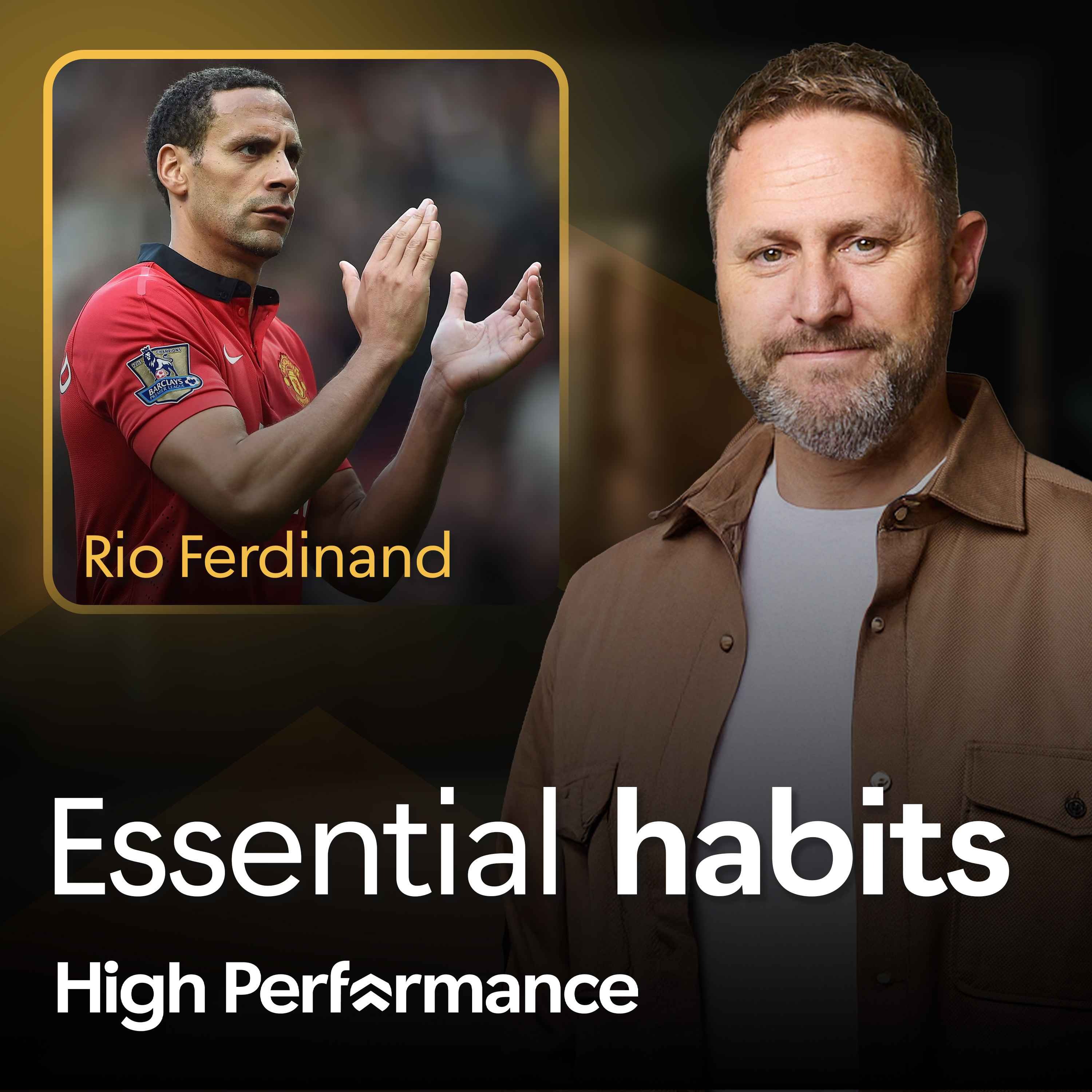
3:17Labels. That is, the labels that other people give us. and the labels that we give ourselves. These are like mental shortcuts, but what makes life easier for the brain often becomes a roadblock for our growth. And I want to start with a story that shows exactly what I mean. It's from someone who's worn many labels and refused to let any of them define him. Rio Ferdinand is known for many things. England football captain, Premier League legend, television pundit, entrepreneur, restauranteur. But when we sat down for our very first high-performance episode, what struck me wasn't Rio's impressive CV.
4:03It was the mindset behind it. He explained how he'd refused to allow himself to ever be boxed in. He refused to let anyone else decide who he was allowed to become. And that mindset, well, it started early. At first, I didn't say anything to my mates. Where are you going? Because obviously I've got to walk off the estate with a backpack on. Where are you going? I'm just going to my mates. That lasted a little while. What mate? You've never spoke about this mate before. No, I go to like a dance school. What, you do dance? No, I don't do dance. I go there, there's like street dancing. And then it became, you know what, I don't care.
4:36I go there and I do like ballet. Ballet in South London in the 1980s as a teenage boy. As you can imagine, it raised eyebrows. But what's impressive is how Rio didn't back down. I was confident enough of my place within my group of friends that that ain't going to affect my relationship with anyone. That moment, owning a part of himself that didn't quite fit the stereotype, would shape the rest of his life. Indeed, Rio didn't just experience labelling from peers or from the public. He also experienced it when he reached the very summit of his career. I remember Alex Ferguson and David Gill saying to me, well, disgrace, what are you doing?
5:17You're a football player, blah, blah. Well, if you're going to be here to hold my hand when I retire and give me a job, guaranteed, well, I won't do all this, but I know you won't. So I need to set myself up doing stuff where I'll be busy, etc., to be able to do stuff in my later life. Now, that defiance where we stood up to Sir Alex Ferguson and David Gill was more than just confidence. To me, it was a refusal to be boxed in. Now, there's a particular moment in our conversation with Rio that's stuck with me ever since. It's not a flashy statement. It's not even a story about winning a trophy or a moment of glory out on the football pitch.
5:53It's one that's about fear. Yeah, a fear of not being regarded as a good pundit. By the time my time's up on this planet, I've got a fear that people are going to go, he was just a footballer. I want to be known for something else. Just think about that. This is one of the most decorated footballers of his generation. This is a bloke who's played for England, He's captained Manchester United. He's won Premier League titles. He's won the Champions League. And yet, he feared being labelled just a footballer. But instead of shrinking from that fear, Rio used it. He used that fear to become fuel. I'm not going to be a good footballer.
6:32I don't want to be a good footballer. I've got to be a good footballer. What's next? I want to be a top footballer. I want to be elite. I want to be considered one of the best in Europe, one of the best in the world. It pushed him not only to reach the highest levels of the game, but also to imagine life beyond it. To create something more. Now this is the heart of what choosing your own label really looks like. It's not about denying who you are. Rio never stopped being a footballer. But it's about refusing to let that one word contain your entire identity. In that dressing room. I need you to miss me if I'm not playing.
7:06I want my teammates to go, flipping hell, Rio's top player, you know. That's not ego. That's intention speaking. It's a commitment to being excellent at what you do, but not being defined by it. Too often, especially in elite environments, people can get trapped by success. They get handed a label, star striker, CEO, founder, teacher, and then it becomes like a cage, a comfort zone, almost a finish line. But what's impressive about Rio is how he chose to flip the script. footballer yeah but also broadcaster entrepreneur restaurateur father creator he didn't wait for permission to evolve into these roles he didn't ask anyone to relabel him he simply did it himself and that's the invitation that this episode is offering to you don't let the world tell you who you are but instead choose your own label and once you've worn that one for a while give yourself permission to change it again.
8:15You don't just have one identity. Think of it like chapters. And the most powerful chapters are the ones that you write yourself. Let's just take a moment to talk about why labels matter so much. There are powerful psychological reasons why we tend to use them. The first one is it's almost a mental shortcut. Your brain is wired for efficiency. It labels things and people to avoid having to process every detail from scratch. When we say things like, she's the leader, he's a bit of a joker, they're just athletes. The problem is, these shortcuts can then become cages. They flatten people into caricatures.
8:59They limit what we see and what we believe is really possible. Another reason why we use labels is it gives us a sense of control. It makes life feel a little bit more predictable. If I can name you, I feel like I can understand you. But what that does is create a false sense of safety. The third common reason why we often use these labels is it gives us a social identity. We label ourselves to give ourselves a sense of belonging. Oh, I'm the shy one. I'm not really a numbers person. But once we internalize that label, we often stop growing beyond it. Now these ideas aren't just theoretical. There are decades of research that back it up.
9:45Let me share three fascinating studies with you to show you the power of how labels work. The first example is one of the most striking pieces of research about how labels shape perception. and it comes from a 1983 study by the psychologists John Darley and Paget Gross. It's known as the Stereotype and Social Class Study and what it uncovered is both simple and disturbing. Here's what they did. They introduced a group of participants to a young girl named Hannah. Two groups of people were then shown the exact same girl, same clothes, same behaviour, but there was a subtle twist. Each group saw her in a different context.
10:33One group saw a video of Hannah playing in what appeared to be a wealthy middle-class neighbourhood. There were big houses, clean streets, well-maintained gardens. The other group saw her in a more run-down working-class area where there was peeling paint, litter and broken fencing in the background. Then, both groups watched the same footage of Hannah taking a test at school Her performance was deliberately ambiguous She got some answers right and some wrong But just enough to leave it open to interpretation Now comes the fascinating part When the participants were asked to judge Hannah's academic ability The group who'd seen her in their more affluent setting described her as intelligent, capable and predicted she was likely to do well in school.
11:24But the group who'd seen her in the poorer environment, they saw the same test, the same girl, but they interpreted her performance as average at best. Some even predicted that she was likely to struggle academically. Now remember, this was the same child doing the same test, but a different label led to a different outcome. So what does that tell us? Well, once a label like middle class or working class is in place, it doesn't just shape how we describe someone. It warps how we see them. Even objective behavior gets filtered through our unconscious expectations. Now, this is the invisible power of labels.
12:05They don't just reflect perception. They help create it. And if we're not aware of that, well, we end up limiting others and ourselves. sometimes without even realising that we're doing it. Now the second piece of research I'd like to share with you is one of the most famous and eye-opening experiments in psychology and it's one that shows just how powerful labels can be especially when they're tied to expectation. In 1968 researchers Robert Rosenthal and Lenora Jacobson conducted a study in an American elementary school that would become known as the Pygmalion effect. Here's what they did. At the start of the school year, they gave all the students an IQ test.
12:50But the twist? They told the teachers that a few students who'd been randomly selected with no actual difference in ability were on the verge of a big intellectual breakthrough. They called them bloomers. Now, these students weren't any smarter than their peers. They weren't selected based on the test results. The only difference was the label that the teachers believed about them, that they had rich potential By the end of the school year, something remarkable happened The so-called bloomers showed significantly higher gains in IQ scores compared to the other students Why? Well simply because the expectation had shaped the interaction Teachers, without realising it, tended to give those kids more encouragement, more attention, more challenging material and more belief That invisible change in behaviour transformed into real, tangible performance gains The label of high potential became a self-fulfilling prophecy Now I use this as an important reminder of the importance of the stories that we tell about people especially the young and especially ourselves.
14:08It doesn't just describe what's there, it builds what's possible. So look out for the next time you hear someone called gifted or troubled. Remember, those words aren't simply descriptions, they're instructions, they're expectations, they're seeds of what might possibly grow. The third study that I'd like to share with you reveals just how quietly and powerfully labels can shape our decisions, even when we think that we're being objective. This one comes from Dr Luke Birmingham, a psychiatrist who wanted to understand how unconscious bias influences professional judgment. Over 450 psychiatrists were given a case file describing a young man who had assaulted a train conductor.
14:56Same background, same behaviour, same language in the file. The only difference was his name. Half the psychiatrists had seen the name Matthew. The other half saw Wayne. Now here's where it gets really interesting. Matthew was overwhelmingly described as troubled, in need of help and possibly suffering from a mental health condition. But the language the psychiatrists used was softer, more sympathetic. but Wayne he was twice as likely to be labeled aggressive more likely to be seen as a drug user and more likely to be diagnosed with a personality disorder now let me remind you this was the same story with a different name and it led to a different judgment so why does this matter Well once again it shows how automatic and invisible our labelling habits can be Even highly trained professionals aren't immune from this A simple name can activate a whole chain of assumptions About class, race, worth and about danger And that chain reaction can lead to radically different outcomes Now this is why we need to check ourselves Because if our snap labels can change something as serious as a diagnosis this.
16:19Imagine what they can do in everyday conversations, hiring decisions, team dynamics and relationships. It's not just the name on the file, it's a story that we unconsciously attach to it. And the real challenge? Learning to separate the person from the prejudice which we've unknowingly inherited. So today's essential habit is remembering that labels are shortcuts for the brain but are also roadblocks for the soul. They may help us make quick decisions, they may help us tidy up the world around us and they may help reduce mental effort but they also limit us. They trap us in fixed roles, they narrow down our potential and they shape how others see us before we've even spoken.
17:06So here's the challenge for this week, A small exercise with the potential for a big shift. Step one, write down one label that you've accepted. It could be a name someone gave you. Lazy, anxious, too sensitive, not leadership material. Or it could be one that you've given yourself. Just a teacher, just a parent, just an intern. We all carry them quietly and often unquestioned. step two ask yourself this simple question does this label help me grow or does it hold me back does it expand your vision of yourself or does it shrink it does it give you permission or does it keep you playing small and now the most important part step three write a new one not based on what you've been not even based on what you've done but based on who you're becoming For example, not just a teacher but a guide for the next generation.
18:11Not just a parent but a leader at home. Not just an intern but a future founder in training. You don't need permission to rewrite your label. You just sometimes need a bit of time and courage. The courage to imagine a future version of yourself and then act like it already exists. Because here's the truth. you can be more than one thing you already are you can be strong and soft confident and curious experienced and still a learner you can be both in process and in power the scientist alan turing once said sometimes it's a people no one can imagine anything of who do the things that no one can imagine so don't wait for someone else to name your potential write it yourself and then live like it's already true.
19:04Up next, I'm joined by our brilliant producer, Will, who's been with us ever since the very start of High Performance. We're going to share with you why we chose Rio for this Essential Habits series, what we remember from the day when we recorded with him and why this story still resonates with us.
19:25If you're still overpaying for wireless, it's time to say yes to saying no. At Mint Mobile, their favorite word is no. No contracts, no monthly bills, no overages, no hidden fees, no BS. I made the switch because I was tired of those ridiculous bills and sneaky charges from my old provider. With Mint, I'm paying$15 a month and getting the same high-speed data, unlimited talk and text, and coverage on the nation's largest 5G network. Honestly, the quality is just as good, if not better, than what I had before. And the best part? You don't need a new phone. You can keep your current one, bring your number, and all your contacts.
20:00I use Mint Mobile, and you should too. Ready to say yes to saying no? Make the switch at mintmobile.com slash HPP. That's mintmobile.com slash HPP. Upfront payment of$45 required, equivalent to$15 a month. Limited time new customer offer for first three months only. Speeds may slow up a 35 gig on unlimited plan. Taxes and fees extra. See Mint Mobile for details. The market's uncertain. revenues tied and hiring on hold that's why results driven companies are using upwork to keep work moving go to upwork.com today and start hiring proven freelance talent fast no bulky overhead no rigid long-term contracts just the right expert right when you need them work smarter and faster with upwork go to upwork.com now and find your freelance expert that's upwork.com Post a job for free and get started today.
20:54I'm no tech genius, but I knew if I wanted my business to crush it, I needed a website now. Thankfully, Bluehost made it easy. I customized, optimized, and monetized everything exactly how I wanted with AI. In minutes, my site was up. I couldn't believe it. The search engine tools even helped me get more site visitors. Whatever your passion project is, you can set it up with Bluehost. With their 30-day money-back guarantee, what have you got to lose? Head to Bluehost.com to start now.
21:26So this was episode one. It was, yeah. So it was January 2020. So COVID was just a word that we'd heard in the wind. It wasn't, its impact wasn't being felt at this stage. Yeah, and we'd only met each other a handful of times before this. Because it wasn't, this was the, wasn't the first episode we recorded, recorded but it was the first episode we put out why do you think it was the first one that we chose to put out well that's right yeah so we'd already recorded ben ainslie we'd done ant middleton tom daly uh and then we'd had a break for christmas and we were still sort of thinking is this something in this wasn't we and then when we sat down with rio i think one his name and his profile was a good reason to put it out first but secondly i'd never heard him talk about some of the things that he shared with us and you remember where we were we uh we went to his restaurant in manchester didn't we and uh i mean from a producer point of view from a production point of view possibly the worst place we could have ever recorded a podcast when i listened to it back but uh it was nice to be in his own environment yeah absolutely so it was a restaurant that he that he'd founded with a business partner called Rosso in Manchester.
22:42Now, I should emphasize it was too posh that I'd ever been in there previously. So going into that restaurant was nice, partly because, like you say, he was in his own environment there. He was in his own domain. And if you remember, he turned up and we had lunch with him before we sat down and recorded. And I think even that conversation over a bit of lunch just relaxed him into what we were trying to do. We could build a little bit of trust. They could look into our eyes and see that there was no gotcha moments coming. It was a genuine desire and a curiosity to understand how we'd got where we had.
23:18Yeah, and definitely a lesson on that time before you record to have a moment to sell with each other. And I think that's something that we definitely kept on. And then you could tell then early on the ambition of the person, the ambition of the man who didn't want to just, you know, he wanted to own restaurants. he wanted to be a good pundit he was starting up a youtube channel at the time he was someone who was discussing a lot of the things that you know already spoken about in this podcast yeah even even things like what he'd gone through in his personal life you know he'd lost his first wife and he was uh he was just on the cusp of his new relationship that with his with what is now his second wife but you know this was a man that was sort of having to reinvent himself in lots of different ways through tragedy through grief through circumstances and yet what really struck me about him was how open and curious he was you know like Jake was the host of what was then BT Sport and Rio was a pundit and he was asking about what they were planning to do that evening in a match you know he was curious to speak to you and to myself around the podcast and what we were planning to do with it you know he was he was asking as many questions as he was giving answers himself yeah and it was a good feed as well i remember that uh what was what's the first clip that you want to talk about that stuck with you from our conversation with him jake asked him a really good question which is one that i imagine many elite performers have had which is do you feel you were the most talented person as a child growing up and his answer to that was consistent with again so many of our high performers they weren't necessarily the most talented at a young age but they felt there was something different that they'd learned that enabled them to go and grow especially when times got tougher and circumstances got more demanding there's loads of players i could name we've got more ability than i had probably but they didn't have the work ethic or the the mental capacity to take loads of stuff on board what comes with it the pressure expectations dealing with all that how can you learn though to to take the pressure that's all I sort of wonder whether that is an innate thing.
25:28I don't know whether there's some sort of research done into this, but it feels to me like if you're 15 or 16, that is really young still. Some 15, 16-year-olds can take pressure, criticism, scrutiny. Others just simply can't. And I don't know whether you can equip them for that. Do you know, sorry, you give us a scientific answer after, but me and my mates have got a little chat group, a WhatsApp group, and who I grew up in my estate with. And one of the common themes all the time is like, the kids haven't got like the harsh reality banter that we used to have as a kid. So everyone got theirs.
26:06Everyone got grilled. Everyone got put down on the floor. And it was merciless. And that kind of, without that, I don't know if I could have taken the media attention as well as I have, or the negativity that comes from certain quarters in the media or on the terraces, etc. So how do you reflect on that now, hearing it back? Well, we've both got kids that sort of like competing in sport. And I think there's that really fine line that he talks about there, which is not destroying them and not heaping too much pressure on them, but sometimes being able to give them feedback that says this is what you can do better.
26:43This is how you can improve. And I think that's the message that I took away from what Rio was talking about there. Sometimes we talk about this idea of helicopter parenting, of trying to solve all the problems for young people, whereas sometimes letting kids work it out for themselves, get feedback from each other, and learning can happen so much faster if we can get out of the way. And then a lot of what we spoke about was that time when he went to United and then the expectation of playing under Sir Alex Ferguson and the culture, that environment brought, which a lot of our guests on High Performance have talked about, but this was obviously the first guest who really gave an insight into what it was really like.
27:25Well, as a United fan, to me it was a real privilege to get that insight into the inner sanctum. I've heard it spoken by other coaches at Manchester United before where they say that your brain can only focus on one of three outcomes. You can either expect to lose, you can hope to win, or you expect to win. And you can only focus on one of them. So which one you choose to focus on determines how you behave, your mentality and how you show up. And I think in this clip I want to share, Rio really goes into some detail about how it was a culture that just expected to win and how he had to adapt and assimilate to that is really quite interesting.
28:05So that image that we would all have externally of, oh, you go in and Sir Alex Ferguson lays down the law. It was the players letting the other players know. He'd laid the law down years ago. and then all of a sudden the machine then works itself and he allowed what was great about Alex Ferguson is he allowed the leaders in the change room to run that change room I could probably count on one hand how many times he come into our change room the training ground we're there every day never comes in there you run it and who were the leaders when you went in? when I first went there yeah Keeney obviously was the captain Gary was Neville was more like a he was he was more like the voice the voice of reason all the captain's jobs that you need to do like the paperwork and the busy stuff that he done Giggs in his own way, quiet but there was a ridiculous success that you just demanded respect How would you now describe the expectations?
29:04You go in there on day one what is expected at that period what was expected of a Manchester United player at that time? To expect to win Games or titles? titles trophies you you you take a trophy a season minimum and was that the same at Leeds no Leeds was trying to catch man United trying if we can get in the Champions League it's unbelievable achievement right and lesser and staying up at West Ham so I'd gone through that gradual process of different expectations and demands so but once I got to United it was more just like listen the expectations when we was there was just you got to win a trophy this finishing as a Champions League position is foreign to me.
29:45I don't know that. I don't understand that. We're there to win trophies and that's it. You're judged on what you win. And your standards every day of training. And like, you wouldn't accept people just tossing it off in training. What would happen if someone did? I'd be screaming and shouting. I'd call you out. I'd embarrass you. Whether it's through humour or straight, what are you doing? Fix up. And losing a game in training because you're messing about. Are you mad? No, you're not going to ruin my day. Would you call people out when you were at Leeds or West Ham? Or was that something you learned to do at United?
30:18So then people say you're born leaders. Yeah. I don't necessarily agree with that. I wasn't a great communicator, a talker. I was with someone the other day and they said like, all you used to do is shout. I used to do my head in. I used to think, what are you shouting for? They used to say, because you just shout so much. But I only started shouting and talking, pulling people about in a game or in training when I fully understood my role on the pitch, where I'm meant to be. And then I could start understanding and thinking about other people's roles to be able to have the confidence to shout at them where you're meant to be.
30:51Get here, five, get back. Push up, left, right. I was like, I was so like, I was vocal. I was always shouting in training. I was always the loudest. And same in training. I would, bad loser, scream and shout. If we lost and I thought it was someone's fault they would be told straight, I'd be screaming. in you came in though as a as a record transfer fee right yeah were they keen to let you know that despite the fact that you were the record signing they were the ones that were the winners and you were coming into their environment were they keen to bring you down a peg come in come into it really and that's what make it that's what gave me until you didn't deliver and then but a steely welcome it wasn't open arms ah all song and dance and flowers and it was come and join this and I had the feeling that they believed I could make I could make it better as well because obviously they had David Beckham, Scolese, Barty, the Nevels, all the England boys there who I played with of England anyway so then they knew if I was good or bad for the team so and I believe that they'd maybe told when people have asked is he good enough yes he is and I felt that so that gave me confidence.
31:56So how did you prepare for that then so and again I love that image of you kicking a ball around open those guys in Packham would invite you to join in with them. Same in training. Same, just on a different stage. Yeah. Like, my first training session was probably the most nervous I've ever been playing football because these guys are waiting to see what does£30 million look like? What did it look like? It looked like shit at the time because I was so nervous but I gradually improved and again, my first season at Man United, we won the league but I didn't feel like I was an integral vital member of that team they wouldn't have missed me if I didn't play I felt and I didn't feel like I even warranted the medal in a mad way I took it almost reluctantly this ain't enough I need them to be thinking about me like they think about X, Y and Z over there we know we can't deal without rooting this team I want to be like that I need to be like that when did that change then?
32:51because if you sign for Manchester United you have a legend walking around Bobby Charlton, someone like that at what point and it's hard to ever think you're level with him that's the pressure at what point did you think yeah do you know what I can hold my head up high now in the company of Bobby Charlton until we won the Champions League yeah I felt kind of in awe not in awe was the wrong word but I felt a little bit like I'm not at that level yet I can't I can't look at Robbo I can't look at Sir Bobby Charlton and go how you doing without real like I'm like you man like I don't know you're held in higher esteem or you're a better player than me but I've done something that I'm etching myself in the history of this club from my little bit of my percentage that I've put in yeah and what was really interesting about that clip was kind of how it ended and how he didn't feel like he was at a level yet until he had achieved something wasn't it yeah I love that line that he said at the end about you know I'm putting my little bit of percentage into this club that seeing yourself as just like one tile in an overall mosaic on the wall of the club's history is something that shows how humble it was.
34:05And again, that's not necessarily a label that often gets attached to Rio, but I think a club like Manchester United humbles you, you know, where you look back at the rich tapestry of people that have done incredible things and understanding that you want to be just one of those people. It's a sign of a really healthy culture that was certainly there at the time. at the times i was already hearing people go oh they're not very good now and things like that but i think what we've seen over the last few years has been this sort of cultural vandalism i call it where people are being highly rewarded for not putting in a percentage that would get them on the wall we might have more answers on the culture of manchester united in their peak years than any other subject we've ever talked about on high performance.
34:59Yeah, I mean, as I say, being a fan sort of attracts me to the conversation of it. But I think what's really interesting is this idea of they would practice for being behind in the closing minutes or Fergie time was not an accident, it was a design. You talk about the high standards, the cultural architects. Rio's just explained there, Alex Ferguson laid the law down and then recruited people that these standards were almost exced into their character, that they weren't willing to compromise on it. We've just been so lucky to see the ingredients of what creates a winning culture. And again, this conversation with Rio is incredibly rich for anyone that wants to go back and explore it.
35:43Yeah, and what's the last clip you want to pick out? Well, the last clip ties into this wider conversation about labels. so it's Rio explaining how the end of his Manchester United career came around. It's a little bit brutal, but it's worth listening to. Towards the end of your career, you can either go out like Eric Cantona, where you go out at the top and everyone wants more from you, or you can go out like Muhammad Ali, where everyone feels a bit of pity when you're fighting Trevor Burbick in a car park. As a guy that did seem to be aware, I often find it quite strange that your career ended with a bit of a fizzle down by leaving United in ignominious circumstances after that day in Southampton and then going to QPR just seemed a bit of a strange move.
36:29I think that the circumstances, there was a backstory obviously with my personal life that remaining busy and in work was important. Right. But the way my career ended at Manchester United, it was almost like the book wasn't closed. I've not even said like bye to the fans. there's not been a parting of the ways between us you normally get an idea if you're going to get a new deal or not either one way or the other before the last day of the season listen when someone comes to you the CEO Ed Woodward would come to you normally and go we're not giving you a deal or we know you're not going to sign so look for pastures new at the end of the season I didn't get either of them last day of the season we played Southampton game finishes come in a change room and the directors and stuff always come into the change room, home and away, and just shake the players' hands.
37:21So while we chart on, Edward would come in, and then he just stood next to me, Edward would, or sat next to me at that point after the game, my boots all still on, et cetera, and just said, listen, we're not going to renew your deal. Thanks for your services at the club. You're free to go and just speak to other clubs and what you want to do. And I was like, wow, is that the way it's going to end? Why? Why like that? For someone that had done as much as you? That was what I thought. Surely you could have given me a heads up before and so I could have actually had a little bit of a goodbye to the fans.
37:53I did it at a later date, yeah. But at the moment, I was just numb. I just sat there like, whoa. Actually, I thought, because it got so late in the season, it was the last day of the season, I thought, well, they're probably going to be in probably a role for me here somewhere, doing something, whether playing or coaching, playing or whatever, or giving an option to do something because they surely would have told me before this day. but it never happened and I just felt that I deserved to be able to say bye to the fans to people at the club the dinner ladies cafe on reception but I just wasn't afforded that kind of the time to do that and I was bitter for a little wife I'm honest It's a strange way you know we've just sat here and spoken for half an hour about elite environments and bringing people in the culture of winning and that's what really made me start thinking like this isn't this place isn't being run properly this isn't the best team in the land in Europe, in the world that I consider should be doing things.
38:47And then after that, I'm seeing the way that people like other players who've done 10 or plus more years at clubs leave their club. And I'm thinking, wow, I didn't get this. This is mad. Do you think it was a sad ending for him that he didn't get that? Or is that just the brutality of what elite sport is? It's a really interesting question, Will. I think it is a really sad ending because I think the way that Jürgen Klopp had that great line when he said, it's not how you arrive, it's how you'd leave that really matters and i think in this case for somebody that had given their all and created so much success there to be almost shown the exit ignominiously rather than heralded for what they'd done is a really sad way that because survivorship bias says there's plenty of people in that dressing room that would see if somebody as successful as real could be treated like that how am i likely to be treated and that in turn creates uncertainty ambiguity ambiguity and fear that doesn't lend itself to high performance so i think in rio's case the fact that he was so willing to try on different labels allowed him to walk away from it and still be successful in other areas of his life but in terms of treating people with dignity and respect i think the example he offers is a good example of how not to do it thanks mate you're good at this i love it i really love as i said at the start of this going back into the archive and like i'm always sat there with my notebook scribbling ideas and i think the story of rio and the labels is really powerful but as we've just explored in the second half there's so much more in there if people want to go and take it away and apply it think about how they could use it in their own team or whether they can use it in their own family or in other aspects of their lives i think the premise of the podcast when we first started it was we want to give you the lived experiences of the planet's highest performers that you can use yourself so thanks for joining me on it well my pleasure if you've enjoyed this episode please share it with someone you know remember to hit the follow button and join us next week where we're going to explore another essential habit of high performance.
41:00An idea that you can take away and apply in your own life to enable you to live a life of high performance, however you choose to define it.
41:29cheesy noodles. You won't believe Herobred's options have 0 to 5 grams net carbs and are high fiber from the taste and texture. And right now, Herobred is offering 10 % off your order. Go to Herobred.co and use code FALL25 at checkout. That's FALL25 at H-E-R-O dot C-O. All figures are per serving of Herobred. Contains 2 to 18 grams of fat per serving. See the product nutrition panels on Herobred.co for more information. What does it mean to move at the speed of AI? It means thinking big and moving fast. It means running like a 10-person team, even if it's just you. With Wix, it's possible. Create a website that's as unique as your business.
42:05Launch a new campaign or test new ways to make more money without slowing down. Think it, build it, scale it, all with AI on Wix. At Capella University, learning online doesn't mean learning alone. You'll get support from people who care about your success. like your enrollment specialist who gets to know you and the goals you'd like to achieve. You'll also get a designated academic coach who's with you throughout your entire program. Plus, career coaches are available to help you navigate your professional goals. A different future is closer than you think with Capella University. Learn more at capella.edu.
There’s a certain kind of strength that comes from knowing who you are, even when the world tries to tell you otherwise. That’s what stood out in my conversation with Rio Ferdinand. Not just the success, but the mindset behind it: the habit of refusing to be reduced to a single story.
Rio’s journey is a lesson in identity, drive, and turning fear into fuel. With all the labels the world tries to throw at us, it’s not just about ignoring them, it’s about choosing your own. From the football pitch to the ballet studio, Rio shows us what it means to challenge assumptions and walk your own path, even when it’s uncomfortable.
In this episode, I also dig into a powerful psychological study that reveals how quickly our judgments are shaped by context, how one label can change everything we think we see. It’s a sobering insight into how easily we box others in… and how often we do it to ourselves.
If you’ve ever questioned the limits placed on you, or wanted to rewrite the script entirely, there’s something in this one for you.
Here is a list of studies referenced in the episode:
Listen to the full episode with Rio Ferdinand here: https://pod.fo/e/15914
Hosted on Acast. See acast.com/privacy for more information.


