
 Ask ChatGPT



In this episode, hosts Jake Humphrey and Damian Hughes engage with Laila Ali, the daughter of legendary boxer Muhammad Ali. Laila shares insights into her father's unique approach to leadership and the practice of making everyone feel seen, particularly highlighting the importance of caring for those who often go unnoticed.
Written by AI. May contain mistakes.

Get the gist, explore an idea or ask about something said.
 Claude
On The High Performance Podcast, what are the key points of this episode?
Searching your listeningAutomatic transcript. May contain errors.
0:28Watch it early on the High Performance App. You can be confident you have everything you need to keep your facility running smoothly. Call 1-800-GRAINGER, click grainger.com, or just stop by. Grainger, for the ones who get it done. The market's uncertain, revenues tied, and hiring on hold. That's why results-driven companies are using Upwork to keep work moving. Go to upwork.com today and start hiring proven freelance talent fast. No bulky overhead. No rigid long-term contracts. Just the right expert, right when you need them. Work smarter and faster with Upwork. Go to Upwork.com now and find your freelance expert.
1:07That's U-P-W-O-R-K.com. Post a job for free and get started today.
1:15This episode is brought to you by Opera Air, the first browser with mindfulness at its core. Now, most of us spend hours every day online, but how often do we pause to take care of ourselves whilst we're doing it? And that's where Opera Air comes in. It's a lightweight, fast, secure browser built not just for productivity, but for your well-being. With Opera Air, mindfulness is built right in. You'll find free breathing exercises, guided meditations, and soundscapes with ambient sounds, lo-fi music, and banyural beats, all designed to help you focus, relax, and even spark creativity while you browse.
1:52There's the public Muhammad Ali, and then there's dad. But I remember my father getting in the car with us when we leave and he'd say, you know why I do that? You know why I take time to look people in their eye because it makes them feel special. They're just so happy to see me. He would paint that picture for us. So why do we have to stay for two hours? Because if there's a line, think about that last person that gets cut off. Welcome to the Essential Habits of High Performance. I'm Damien Hughes, and I've worked as a visiting professor of organisational behaviour. I've been a trusted advisor to dozens of elite leaders looking to create high-performing cultures.
2:34I've immersed myself in this world for the last 25 years, because above all, I'm someone who loves exploring how high-performance works and how we can take the lessons from our guests and apply them into our own world. Let me ask you something. When you walk into a room or sit down at a table or join a queue, do you ever notice who's last? Most people don't. We're wired to spot the loudest, the fastest, the ones at the front. But leadership, real leadership here, often shows up at the back of the line. In today's Essential Habit, we're going to talk about the importance of creating a culture of inclusivity.
3:16taught to us through the legacy of Muhammad Ali, one of the most iconic athletes in history, and shared with us by someone who knew him best, his daughter, Leila. We're going to explore the habit that makes people feel seen, why social connection is a competitive advantage, and how you can lead not just with strength, but with compassion. As ever, in the show notes, she'll find links to all the latest studies and research which I reference. Now you might know Leila Ali as an undefeated world boxing champion. She retired with a perfect record of 24 wins, no losses, featuring 21 knockouts. She was an incredible athlete in her own right.
4:05But she was also the daughter of Muhammad Ali. Now growing up as a child of a global icon can't be an easy thing. Her dad was known for his sharp wit, his lightning-fast fists and his even faster tongue. He was adored, he was feared, he was criticised, he was celebrated, often all at once. But the version of Muhammad Ali that Layla grew up with wasn't just the greatest. He was a dad. He was a man with stories, with quirks and with his values. He was someone who taught not with lectures, but through his presence. And as she told us, that presence just happened to be magnetic. My father did a lot of his teaching by example.
4:51Just by watching him, I learned so much. And he was very consistent. So meaning that obviously my father, wherever we went, there was always a crowd. And he loved attention. And he always said, bring it on. You know, he wanted to be noticed. He wanted to entertain. He wanted to sign autographs. He wanted to pick up babies and kiss them and shake hands and take photos for hours. And as a child, that wasn't always fun. You want to just go get something to eat at the local diner. You don't want to be stuck there for three hours. Oh, God, the same thing every time. But I remember my father getting in the car with us when we leave, and he'd say, you know why I do that?
5:31You know why I take time to look people in their eye because it makes them feel special. They're just so happy to see me. He would paint that picture for us. So he, you know, why do we have to stay for two hours? Because if there's a line, think about that last person that gets cut off. Sorry, I got to go. He never wanted to cut it off. And we're like, okay, but we can't just stay here forever. What about us? You know? So, but he cared about people so much. And he always let us know that he actually was being intentional, you know, about giving back. My dad would literally sit there at his desk and sign pamphlets with his autograph, because at the worst case scenario, here is an autograph.
6:11Now, this story of Layla's reminds me of one of my favourite Muhammad Ali stories, and it relates to an event that took place in June 1975, when Ali was stood before a packed hall at Harvard University. He'd been invited to speak to the students, many of whom idolised him not just for his boxing, but for the courage he'd shown outside of the ring. He was a heavyweight not just in the sport, but in spirit as well. The Vietnam War was still fresh, civil right tensions were high and Ali had refused to be drafted to go and fight. He'd risked everything. So as he stood up before those students, a voice from the crowd called out to him, Give us a poem, Mohammed!
6:55Ali paused. He grinned and then, with perfect comic timing that you can view on YouTube, and delivered with absolute clarity, he said, Me. We. That was it. The room erupted with laughter, applause and a little bit of awe, I imagine. Harvard professor and poet Gary Jamboy, who was there at the time, later declared that Ali had delivered the shortest poem ever written. That title had once been claimed by Strickland Gilliland's Fleas, which goes, incidentally, Adam, Adam. But Ali's line had something different. It was something bigger than that. It wasn't just clever, it was profound. In two words, he'd captured one of life's most essential truths, that we're nothing alone, that greatness is not about ourselves, it's about our service.
7:52The real power comes not from the me, but from what we can build together. Now in later years Ali expanded on that particular moment He'd explained that his journey from ego to empathy From self to thinking about society Was what had truly made him great He didn't talk about the belts He didn't talk about the famous knockouts But the people he'd lifted up along the way One quote attributed to him is that he said We all need to belong among people who lift us up My success wasn't just about what I could do it was about who I did it for. And that's the core of me, we. It's a pivot from isolation to connection, from the spotlight to the shared light, from taking glory to sharing it.
8:41And that's why this moment endures, not just in literary circles, but in classrooms and leadership seminars and even out there on social media. Because in a world that often worships individualism, Ali reminded us of something eternal, that we're all stronger together. Layla Ali followed her dad into the ring, but not with his blessing. So when my dad came in town and asked me about it, I said, yeah, it's true. Yeah, what you heard is true. I've been training and he was like, and he got really serious. And he had his Parkinson's, so his hands shaking and you could tell he's getting upset, you know, and we're sitting here just like this.
9:21And he says, well, do you know how hard it's going to be? Do you realize how much pressure is going to be on you? And I say, yeah, I thought about this, and I'm going to do it. But of course, it's like you're telling your kid something, you think they just don't get it. I'm telling him, he's like, she has no idea what I'm talking about. And he paints the picture in a ring with all these lights shining down on you and a crowd around you chanting, and you're getting in the ring. Do you realize how much pressure will be on you? I'm like, yeah, I do. And then he says, well, what's going to happen if you get knocked down?
9:52I was like, then I'm going to get back up. Just like you did. And he just really gets really frustrated because he's indirectly trying to talk me out of it. His reverse psychology, bringing up all the negative things wasn't working. So he finally just said, it's not for you. It's not for women. I don't want you to do it. I'm not, I'm against it. And I just say, oh, dad, I respect how you feel, but I've already made my decision. I'm going to do it regardless. So you're either going to be there or you're not. Either way, I'm going to do it. So that's how we left it. Imagine hearing that line from your dad.
10:26It's not for women. I don't want you to do it. Just think about that for a second. The greatest boxer of all time. Your dad telling you not to step into the sport that had shaped him, that had given him his voice, his power and his purpose. And yet she went and did it anyway. And what's interesting is she trained in secret at first, quietly building her skills, her stamina and her confidence levels. Not because she wanted to defy him, but because she needed to find out for herself who she was, what she was made of. She wasn't entering the ring to mimic her dad. She entered it to claim something of her own.
11:06And once she did, once the fight started coming thick and fast and she kept winning equally impressively, there was no denying her. She went undefeated as a professional boxer. Remember what I said at the start? She had 24 wins with no losses and 21 of them coming via knockout. She became a four-time world champion across multiple weight classes. She wasn't just known as Ali's daughter. She was Leila Ali, a force in her own right. Now, eventually, her dad saw it. He saw the fire, he saw the discipline, and he saw her brilliance. let's listen in to the moment when layla heard the five words every child wants to hear from their parents okay so my dad i told you that he said don't box it's not for you he did come back to me and apologized and said i want to talk to you i was like oh god now what we're going to talk about this time and how many fights in was this oh man i i had won a world title at least one by then so yeah so so i was a world champion and he says you know i was wrong you can fight and women can fight and I'm proud of you.
12:15And he started crying and I started crying. My dad cried all the time. I'm sure you probably heard, so that wasn't a big deal. But he was so emotional and we both got emotional because I had told myself, I don't care what he thinks. You know, I'm going to do this without him. Forget him, forget him. But I cared. Yeah. That's my dad. And he's the greatest of all time. Of course, I want his respect. I want his respect and I want him to tell me, yeah, you can box, you can fight, girl. And I'm proud of you. So for him to say, you move around like me, you move like me, you jab like me, you know, we're like crying and, you know, he's got his Parkinson's and he's shaking and he couldn't deny, you know, what he sees.
12:53Obviously, I'm not the level of my dad, right? But we're built the same and our style was similar because of our build, right? Long arms, long legs, speed, power, agility, all these different things. So then that's when he said, you know, you got to jab. Every fighter has their thing, right, that they always say. And he says, you got to jab, you got to hit the heavy bag as if a fly is on it. And you're trying to hit it before. Brilliant. Yeah, because if you think about that's the kind of speed, because when you get that visual, no, that's not fast enough. That's not fast enough to hit a fly. You know what I mean?
13:31And you got to snap it. You got to snap it. You can fight, girl. I'm proud of you. That moment wasn't about boxing It was about belonging It was about inclusivity It was about being seen Not for who he hoped she would be But for who she truly was It reflected a deeper evolution in him Remember, it was Muhammad Ali who once said The man who views the world at 50 the same as he did at 20 Has wasted 30 years of his life He grew He let go of the belief that boxing was only for men He saw his daughter not as someone following in his footsteps But as someone blazing her own trail That's the essence of generational growth Not just passing down values But also being humble enough to want to learn from the next generation too Layla earned every title in the ring But to me the real victory Was that she changed the mind of the man Who'd once changed the world Now, let me ask you something.
14:36Have you ever walked past someone who clearly looked like they needed a helping hand, but you didn't stop? Not because you didn't care, but because you didn't even see them. There's a painful truth at the heart of that experience, that most of us don't ignore people at the back of the line out of malice. We often ignore them because we're overwhelmed, we're distracted, or we're just not tuned in to the moment. so why don't we become better at creating a culture of inclusivity because it's often the invisible people who pay the price that's why Ali's words hit so hard think about the last person that gets cut off the one who waited in line the one who showed up but got left out maybe the mark of real greatness is not how many people you impress at the front of the line but how many people you remember at the back.
15:26And it's not just social kindness. It's a neurological truth. Studies show that when we're excluded, it activates the same parts of the brain as when we suffer physical pain. And the reverse is true too. When we feel included, seen and valued, it boosts oxytocin, trust and motivation. So when we can pause and look someone in the eye and ask them how they're doing or simply just wait for that last person in the queue. We're not just making someone's day, we're rewiring their brain and maybe ours too. That hunger to be seen, to be long, to be included is not just emotional, it's biological. So let's start with a bit of an uncomfortable truth here.
16:14Most of us are not unkind people, we're often just unaware. air. So why do we miss the person at the back, the quiet voice, the one not getting past the ball? Well there's four reasons, backed by psychology and neuroscience, that are worth just exploring. The first one is that cognitive load often reduces our empathy levels. When our brains are overloaded, whether that's multitasking or feeling stressed or we're simply just fixated on achieving a goal, we naturally narrow our field of attention. There's a famous study done by the psychologists Darley and Batson in 1973 where even seminary students these are people studying to become priests literally stepped over a person slumped in a doorway while they were rushing to give a talk about compassion.
17:08The biggest factor on whether they did choose to ignore that person in need was whether they were in a hurry which shows us that the more pressure or busyness we feel the less likely we are to notice someone in need even if we do truly care. The second reason is that in-group bias can blind us. What that means is that our brains are wired to favour those who seem most like us the same group, the same background or the same set of behaviours. Research in social psychology shows that we're quicker to empathise with people who appear to be in-group members. Conversely, those who don't fit, they might be people that are new or quiet or just a little bit different, can become psychologically invisible to us.
17:57In one 2006 study looking at brain scans, it was observed that we actually have less empathetic neural activity when we observe pain in people of other social groups. So without intention, we literally feel less for those that we consider outside of our circle. The third reason why we can often neglect to create a culture of inclusivity is the spotlight effect makes us egocentric. We tend to overestimate how much attention others are paying to us, and we underestimate the impact of our own attention. This spotlight effect means that we assume others feel seen just because they're present. But we all know that's not the case.
18:43Presence doesn't equal connection. It's easy to miss the lasting line because we're too caught up in our own mental spotlight. The final reason is the bystander effect. We assume someone else will notice. In group settings, people are less likely to help someone in need because they assume that someone else will do it. This classic finding in social psychology explains how diffusion of responsibility makes each of us less attentive and often less accountable. In crowds, caring becomes diluted unless we're the person that chooses to step forward. So it's not cruelty or coldness that keeps us from noticing the lasting line.
19:29It's either mental overload, unconscious bias, self-focus or group diffusion that counts. But the moment we become aware of these defaults, that's the moment we can start doing something different. As Muhammad Ali said, just take a moment to think about that last person that gets cut off. This mindset is powerful, not just socially, but neurologically. When we feel seen, our brain shifts, our oxytocin increases, threat decreases, and our engagement rises. So let's just press pause for a moment and ask ourselves, why does creating a culture of inclusivity matter so much? Well it turns out it's not just a nice to have, it's not a soft skill.
20:20Belonging is wired into us, biologically, neurologically, and it's fundamental to how we function as humans. Let me take you to the University of California in Los Angeles. A social neuroscientist named Naomi Eisenberger ran a brilliant but simple experiment that changed how we understand social connection She created a game called Cyberball Now the rules of this were dead simple Three people toss a ball back and forth on a computer screen But the catch is, two of those people aren't real They're computer generated avatars It's the third person that is a real participant Now at first the game seems fine, everyone gets a touch of the ball and everyone feels part of the group.
21:08But then, slowly, the two avatars stop passing the ball to the real person. They pass it between each other, ignoring the real person completely. Like a digital snub. Now you might be listening to this thinking, come on, it's just a game. But here's where it gets really fascinating. When they scanned the participants' brains while this was happening, the part of the brain that lit up was the anterior cingulate cortex. That's the same region that processes physical pain. So in other words, being excluded socially lights up the same part of the brain as being physically hurt. Being left out feels to the brain like you've been punched by Muhammad Ali.
21:55It's like touching something hot. It's like an injury. Now here's something that blew my mind. In another study, researchers found that the pain of social rejection can be relieved with Tylenol, the same painkiller used for physical injuries. That's literally how real it is. So the next time that you see someone being excluded, remember, that's not just discomfort they're feeling, that's pain. It's invisible, but it's real. And that is why belonging matters. That's why leaders who create inclusive cultures outperform those who don't That's why people with strong social bonds recover faster from setbacks Because the brain literally registers connection as safety There's more though In one meta-analysis of over 140 studies that was conducted by Julianne Holt-Lunstad She found that strong social connections improve your odds of survival by about 50 % That's a stronger predictor than simply quitting smoking or beating obesity.
23:03Why? Because humans have evolved to surviving groups. Belonging isn't a luxury, it's actually a survival strategy. So what does all this mean for the essential habits of high performance? It means that your culture isn't just a vibe, it's a competitive edge. Teams that feel like they belong are proven that they communicate better, They take more creative risks. They bounce back faster from failure. It's not soft. It's actually a performance multiplier. So when Ali told Layla, think about that last person in line, he wasn't just being kind, he was being brilliant. Because when everyone feels seen, everyone fights harder.
23:47For each other, for the mission they're on, and for the win. Now, Ali knew what it was like to throw punches, but he also knew what it felt like to be left out. As a black Muslim man in 1960s America, he lived exclusion and he was teaching his daughter and us a different kind of power. The power of inclusion. Layla remembered those long hours after her father's speeches or fights when fans were crowding him. He was offering handshakes, photos, babies being lifted into his arms. Now, she hated the waiting. She just wanted to get home. But it was one day when she asked him, why do we have to stay so long?
24:30That he turned to her and reminded her that if there's a line, you think about that last person who gets cut off. And that's the lesson. You don't walk away when someone's still waiting to feel seen. You look after that last person in line. I always hope that my children will watch me and see how you treat people. They're those that can't do anything for you. And I think that's how all people should be. I don't think that just celebrities or athletes or entertainers should be that way. I think that's how we all should be. We should all be kind people. Now let's tie all this up and put it into something practical.
25:04We talk a lot about performance in terms of what we do. Skills, goals, outputs. But how we make people feel is just as important. Social awareness, being tuned in to who feels excluded, who might be hurting, who's hanging back is one of the most underrated habits of high performers. Here are three ways that maybe you can consider building it into your day. These tiny shifts build cultures of connectivity and connectivity fuels performance. The first idea is see the invisible. Make it your mission today to notice the person who usually fades into the background. It might be an intern, it might be a newcomer, a quiet colleague or even literally the last person in line in the canteen.
25:53Make eye contact. Go and use the name and ask how they do it. Because the first step in belonging is being seen. Belonging starts when someone feels that they matter. Second idea is, share your struggles and not just your wins. We often think connection comes from being impressive. but real belonging comes from being authentic. Let people in. Be human. Say to them, I don't know or I've been there too. When leaders show a bit of vulnerability, it opens the doors for others to feel safe enough to show up fully. You don't build trust with perfection. You build it with truth. The final idea is build a culture of we and not me.
26:40This goes straight back to Ali's two-word poem. Every decision you make, whether it's in a meeting, in a classroom or in your family, ask, does this lift others or just myself? Champion ideas that aren't yours. Celebrate other people's successes. Be generous with the spotlight. High performance isn't just about being the best in the room. It's actually about making the room better. Because when people feel like they belong, they don't just perform better, they become better. Whether that's being more confident, more creative, or simply more courageous. And it all starts with the smallest of our essential habits.
27:23Creating a culture of inclusivity. Layla told us that lovely line that my father taught by example. He showed me that kindness isn't a weakness, it's strength under control. That's a different kind of fight, not the one in the ring that we're remembering for, but the one for humanity, the one that says no one gets left behind in my culture. Muhammad Ali and his daughter may be two of the greatest boxers of all time, but their real legacy is in those words, me, we. So here's my question for you this week. When was the last time you looked after the last person in your metaphorical line? Maybe it's a quiet colleague, the friend who never replies but you know he's always reading your messages Or the person who never quite makes the invite list How could you show up for them this week?
28:19Because high performance isn't just about what you achieve It's about who you lift up along the way After the break I'm going to explore some other moments from the conversation with Leila that left a lasting impression on me. Will, our producer on High Performance, is going to come and join me to explore why this episode lands with the power of a Muhammad Ali right-hander.
28:45If you're still overpaying for wireless, it's time to say yes to saying no. At Mint Mobile, their favourite word is no. No contracts, no monthly bills, no overages, no hidden fees, no BS. I made the switch because I was tired of those ridiculous bills and sneaky charges from my old provider. With Mint, I'm paying$15 a month and getting the same high-speed data, unlimited talk and text, and the coverage on the nation's largest 5G network. Honestly, the quality is just as good, if not better, than what I had before. And the best part? You don't need a new phone. You can keep your current one, bring your number, and all your contacts.
29:20I use Mint Mobile, and you should too. Ready to say yes to saying no? Make the switch at mintmobile.com slash HPP. That's mintmobile.com slash HPP. Upfront payment of$45 required, equivalent to$15 a month. Limited time new customer offer for first three months only. Speeds may slow up a 35 gig on unlimited plan. Taxes and fees extra. See Mint Mobile for details. If you're a custodial supervisor at a local high school, you know that cleanliness is key and that the best place to get cleaning supplies is from Grainger. Grainger helps you stay fully stocked on the products you trust, from paper towels and disinfectants to floor scrubbers.
29:59Plus, you can rely on Grainger for easy reordering, so you never run out of what you need. Call 1-800-GRAINGER, click grainger.com, or just stop by. Grainger, for the ones who get it done. The market's uncertain. Revenue's tight, and hiring on hold. That's why results-driven companies are using Upwork to keep work moving. Go to Upwork.com today and start hiring proven freelance talent fast. No bulky overhead. No rigid long-term contracts. Just the right expert right when you need them. Work smarter and faster with Upwork. Go to Upwork.com now and find your freelance expert. That's U-P-W-O-R-K dot com.
30:41Post a job for free and get started today.
30:48now boxing conversations really resonate with you don't they mate they light me up i love them i love them i i grew up in a boxing gym so my dad was a celebrated boxing coach in manchester so as far back as i can remember i've been around fighters i've been about guys that are training going after olympic medals british commonwealth european and world titles so muhammad ali is just the reference point for anybody that loves the sport yeah and you've been really modest about this i the more i've got to know you when we first met i remember you referencing your dad being a boxing trainer and having this impact and then the more i spoke to you and the more i looked into it how influential he was and then the fights that you've been around the fighters that your dad trained we're talking like world champions from the past it's like you know who's who my first ever job was I used to carry the spit bucket for my dad when he'd be sort of going to the big fights and I'd sort of go along and go and get ice and go and make sure that he had all the stuff he needed and then my first paid job was being a ring card boy at the G-Rex Centre in Manchester of having to get in in between fights and sort of go around and say oh the next round is round four so I always think that being in that dressing room is like being in the gallows I can imagine before somebody gets called and you know that's where fights are often won and lost and nobody ever sees it and that's where my real interest in high performance came from being around that so I remember reading a book in 1990 that came out so I think I was about 14 or 15 and it had such an impact on me it was by Thomas Hauser it was the first authorized biography of Muhammad Ali called The Life and Times of Muhammad Ali it's one of the greatest biographies you will ever read in your life I'd urge everybody go and get a copy of it because what basically happens is Ali says to Thomas Hauser I've spoke to everybody and I've given them permission to speak to you candidly they don't have to say they like me they just have to tell you how they received me so this book sort of like you get like a 3D look so when he fights Joe Frazier he goes and interviews Joe Frazier he interviews the referee in the ring he goes and interviews the cornerman and then he interviews Ali so you get the most comprehensive story of this guy's life.
33:08I remember reading it just thinking, this is incredible. I felt like I was there. So I've written a couple of boxing biographies myself, like me and my dad did them. And that was the standard that I always aspired to. And I found out just how hard it is to do something as well as that. So when Layla agreed to come and talk to us, I was like a kid on Christmas Eve thinking, like, I can't believe I'm going to get a chance to speak to her about some of the seminal lessons, not only of her career, which is incredible, but about what her dad had taught her well away from the spotlight of the ring. Yeah, I remember.
33:43I remember how excited you were and I remember your face when we first started talking about it and the book you just referenced. I mean, that was, do you remember, that was actually probably the first iteration of what this idea is now about you doing this. We were really, we wanted to do something where you would really go into, at first we were going to talk about like a book review, remember? and we sat down and we were going well actually I'll pull out the books that I love from the shelf and this was said the first book I'm going to talk about is the book I've read more than any other book in the world and this was the book that you pulled out and then you were diving into what are the lessons in this book that could apply to everybody and that's kind of the first iteration of where we are now with these essential habits.
34:24Well I actually quoted to you at the time There's a story that I spoke to Leila around, and that almost is the theme of the first half of what we've spoke about today, where there's a story, I remember reading it at 14, thinking, wow, was that he goes to a women's prison in New York, Muhammad Ali. And whoever tells the story, I think it's like one of the wardens that's working there, says how he goes and picks out this woman that they describe in the book quite cruelly as being profoundly ugly. And Muhammad Ali goes straight to her and hugs her and gives her a kiss. And afterwards he's asked, why did you do that?
35:01And he went, because nobody will do that. And I want her to know that she's just as important as anybody else. I remember at 14 thinking, what an amazing bloke that he's spotting this. So when Layla told us that story about him being in the line and making sure that I don't leave till everybody gets seen and gets my attention, that to me is why I wanted to share this is an essential habit because we can all get better at doing precisely that. What's the first clip you want to talk about, Damo? Well, the first clip is Leila's response to my question. What's the best piece of advice you've ever received and why?
35:37I remember my dad telling me and us when we were younger, never step on anybody to get ahead. Never step on others to get ahead. And I didn't know what it meant back then. But that's something that I wouldn't necessarily say. I probably have gotten better advice, but that stuck with me because, again, it just goes back to, you know, not trying to dim someone else's light to make yours shine brighter, to help someone along. You know, just this whole concept of helping others, being a good person, all that is instilled in me so deeply. I mean how lovely is that that it just encapsulates what this whole episode has been about actually you don't need to turn down somebody else's light to make your own burn brighter you know lift a hand lift people up rather than look to push them down just really powerful and what I always find listening to Leila like how what it must be like to live under the shadow of your dad who's not only the greatest sports person of all time but one of the biggest icons in the history of the world and how you can carve your own lane in that.
36:52It must be really hard. Yeah, well, Leila's old mum as well was like a celebrated model called Veronica Porsche. So she was somebody that on the surface might appear to live in this sort of gilded cage of, you know, having an iconic dad and a beautiful, successful mother in her own right. But she did tell us about how her life wasn't without struggle. to find her own identity, to be able to forge her own path. And that lends itself to our next clip where she talks about how she was a pioneer in a new sport, but her name meant that everybody wanted her scalp. So how she always had to turn up and be at her best.
37:34Like I said, I had the confidence is amazing. The mindset, because in my situation, being Muhammad Ali's daughter going into boxing, with all the criticism that was against me. It was more criticism than positivity. What was that? Oh, absolutely. When I was fighting, absolutely, 100%. Now, I can sit here and have these interviews and people respect. But back then, it was just kind of like, they didn't respect women's boxing. It wasn't in the Olympics yet. It still isn't huge, but I'm saying it wasn't even where it is now. It was a new sport. People just weren't comfortable with it. Yeah. They didn't believe that I would just want to be a boxer.
38:17But you could be an actress. But you could be this. You could be that. It's like, why do you want to box? Most people that are boxers, because they can't do anything else. So they came from a bad neighborhood. That's what they thought. Yeah. So I didn't fit the bill for them. The girls that were boxing that had been boxing for so many years and weren't getting attention had animosity towards me. They fought me 10 times harder. So like if you're just thudding along, working a day job as a waitress and having some fights and you're trying to make ends meet, you're going to get really inspired if someone tells you, beat Leila Ali and you're going to become a millionaire, whether it's true or not.
38:50They had extra oomph. Everybody fought me harder. So I always had to come with my A game, even though I didn't. Even if I was 60%, a lot of the times I would still be able to win. And what's the last clip you want to share, Damo? The last clip is how Layla describes her moral compass and how she set it. There's a brilliant line in there at the end. I'd encourage everyone, just sit up and pay attention to it. I won't let who my dad was define me. I won't let what I've been through in the past define me. Like, we have to all decide what is going to define our life. What is our own legacy going to be?
39:30And even if you don't know, it's like you wake up every day and you do the right thing. You do what you know is right. Like when we learned, maybe everyone didn't learn this. My dad used to tell us, God is always watching you. Even when you think no one else is around. A lot of people do things when they think no one's watching. Yep. But if you think, okay, that's how I grew up thinking. Like there's never a time to do the wrong thing. There never is. Never. So, you know, it's like I don't really have to worry about heaven or hell or right or wrong. I'm going to do the right thing because it's the right thing to do.
40:06That's how I live my life. That's how I teach my children. I mean, imagine how much of a better world we would live in if everybody would just do the right thing. There's never a right time to do the wrong thing. What a great line. But there's always time to do the right thing. So if you know somebody that might benefit from listening to this episode, pass it on. Or if you know someone that could maybe do with hearing some of the lessons from Leila and Muhammad Ali, why don't you share it with them? Not because they'll repay you, not because it looks good, but do it because it's the right thing to do.
40:41Thanks for listening. I'll see you next time on The Essential Habits of High Performance.
40:52If you're a custodial supervisor at a local high school, you know that cleanliness is key and that the best place to get cleaning supplies is from Grainger. Grainger helps you stay fully stocked on the products you trust, from paper towels and disinfectants to floor scrubbers. Plus, you can rely on Grainger for easy reordering so you never run out of what you need. Call 1-800-GRAINGER, click grainger.com, or just stop by. Grainger, for the ones who get it done. Fall is all about cozy comforts, and with Hero Bread, you can enjoy all your favorites and still hit your health goals. From breakfast bagels and meal prepped enchiladas to mouth-watering burgers and cheesy noodles.
41:33You won't believe Hero Bread's options have 0-5 grams net carbs and are high fiber from the taste and texture. And right now, Hero Bread is offering 10 % off your order. Go to Hero.co and use code FALL25 at checkout. That's FALL25 at H-E-R-O dot C-O. All figures are per serving of Hero Bread. Contains 2-18 grams of fat per serving. See the product nutrition panels on Hero.co for more information. For a limited time at McDonald's, Get a Big Mac extra value meal for$8. That means two all-beef patties, special sauce, lettuce, cheese, pickles, onions on a sesame seed bun, and medium fries, and a drink.
42:05We may need to change that jingle. Prices and participation may vary.
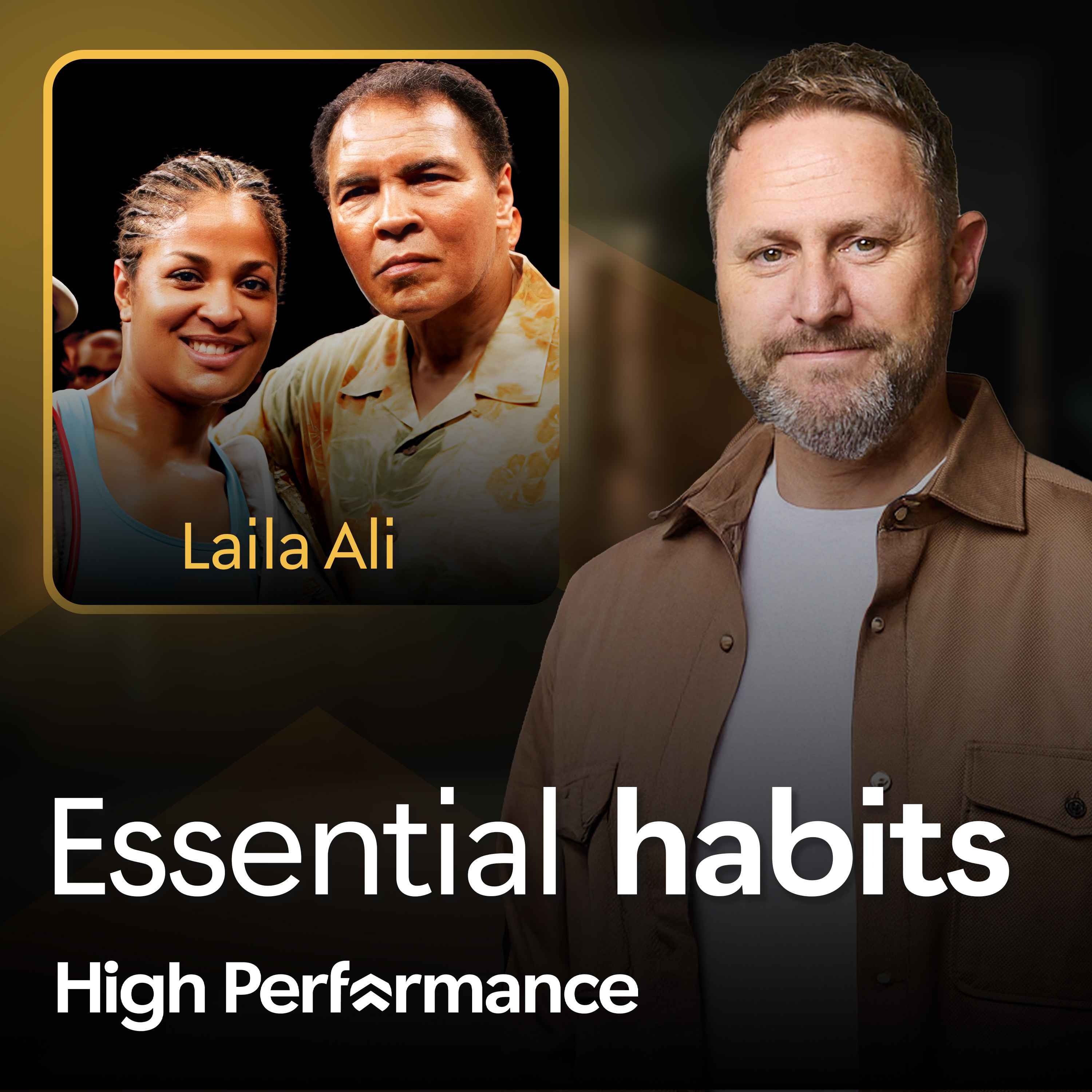
Undefeated boxing champion and entrepreneur Laila Ali takes us ringside, then into the heart of what it means to belong.
In this episode of Essential Habits, we uncover the deceptively simple practice her father, Muhammad Ali, modeled again and again: looking after the person no one else notices.
Through Laila’s stories, from waiting in queues of adoring fans to earning her father’s reluctant blessing to box, we learn how true leadership is less about spotlight and more about presence. By tuning into the quiet moments and the people at the back of the line, we tap into a habit that transforms culture, boosts trust, and fuels high performance.
In this episode, we explore:
- Why 'the last person in line' matters more than the loudest voice
- The neurobiology of inclusion and how exclusion literally hurts
- Three simple shifts to build social awareness every day
- How Laila earned her father’s respect and claimed her own greatness
- What high-performing teams gain when everyone feels seen
Whether you lead a team, a family, or just want to notice people more fully, this episode shows why the smallest acts of attention can have the biggest impact.
Listen to the full episode with Laila Ali: https://pod.fo/e/265de7
Here is a link to more information on the studies referenced:
1. The Good Samaritan Study (Darley & Batson, 1973)
2. Ingroup Bias and Empathy (fMRI Study, 2006)
3. The Spotlight Effect (Gilovich, Medvec, & Savitsky, 2000)
4. The Bystander Effect (Darley & Latané, 1968)
Hosted on Acast. See acast.com/privacy for more information.


