
 Ask ChatGPT


 The High Performance Podcast
7 Sep 2026 · 1h 8m · 27 chapters
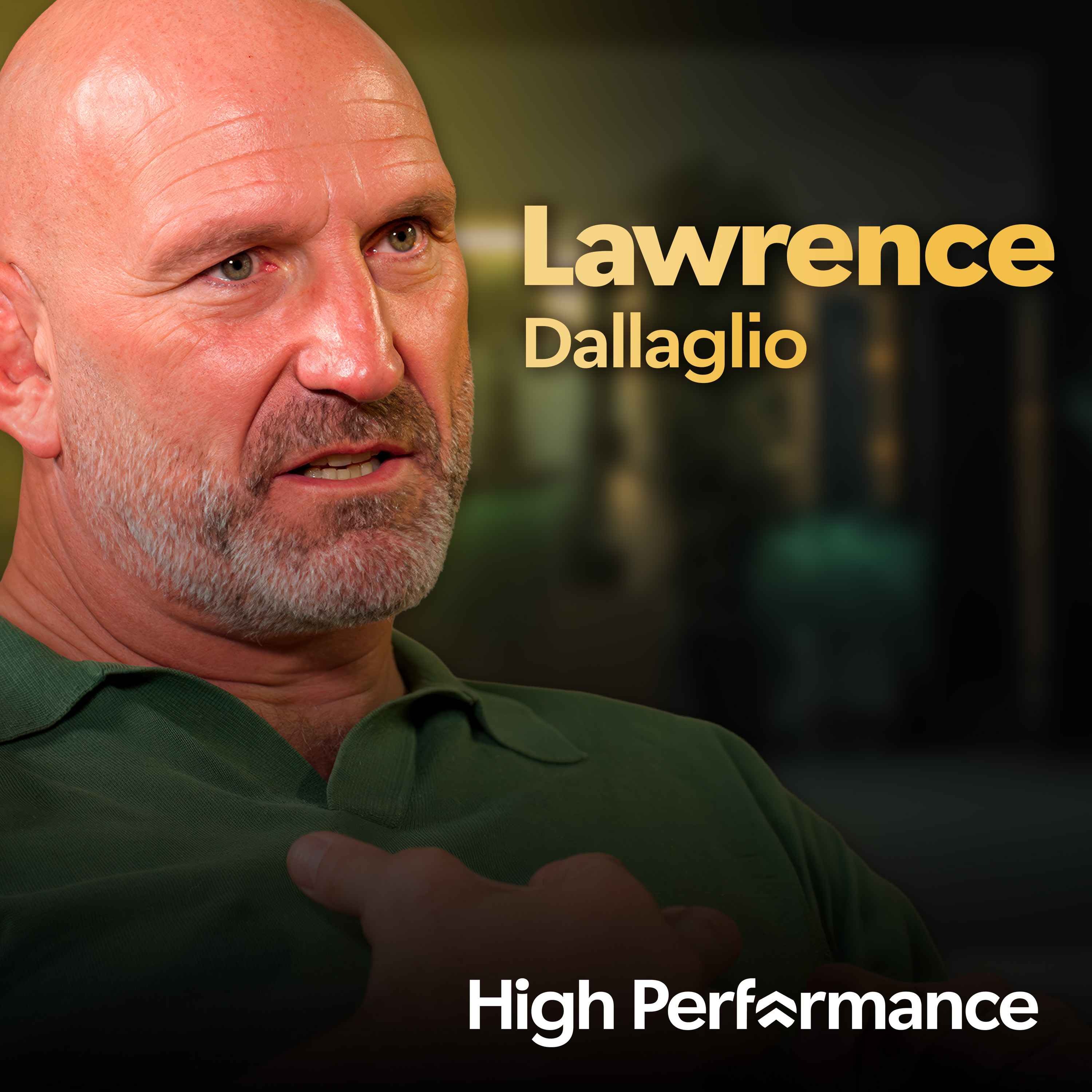
Lawrence Dallaglio (England rugby World Cup winner) discusses how his life “fell apart” after age 50, linking high-performance lessons from rugby to grief, divorce, bankruptcy, overwhelm, and rebuilding self-belief. He argues that success isn’t a straight line, that responsibility starts with the self, and that high performers must sometimes put themselves first and admit they can’t carry everything alone.
Lawrence Dallaglio is a former England captain and World Cup winner. He played for Wasps, became Wasps captain at 22, and later worked in media (BT from 2013). He also appears in a Prime TV show called Live Italian. (Host: Jake Stouck, co-founder/CEO of Serval, interviews him on the High Performance podcast.)
“Two things you can’t measure are what’s in your heart and what’s in your head.” “Honest players look in the mirror.” If you’re not winning 75% you’re in the wrong job—but happiness matters too. Leadership means taking people somewhere they can’t reach alone, while leaders must also look after themselves. Acceptance and therapy helped him move forward.
Sister’s death at 16 (age 19); divorce leading to bankruptcy; father’s death at 91; joining Wasps for community after trauma; World Cup 2003; emotional intelligence (“EG”) and “emotional hook” for teams.
Written by AI. May contain mistakes.
Learn how joining a rugby club helped Lawrence find a sense of belonging.
“I joined a rugby club because I needed a family.”
Lawrence shares his life's journey, including grief, loss, and personal responsibility.
“In many ways, people might view it differently, but my life story is no different to a lot of other people's.”
Explore how Lawrence coped with adversity and the importance of self-reflection.
“The honest player looks in the mirror, you've heard it many times, and asks, well, what could I have done better?”
Lawrence discusses his experiences with bankruptcy and lessons learned about relationships.
“And haven't I, you know, haven't things worked out against me?”
Lawrence discusses his transformation from despair to optimism and resilience.
“And in my opinion, chicken shouldn't be complicated.”
Lawrence discusses his transformation from despair to optimism and resilience.
“That's S-E-R-V-A-L dot com slash tickets.”
Lawrence discusses his childhood trauma and its impact on his life.
“And maybe I believed my own caricature, really.”
Lawrence shares how he turned to rugby for community and purpose amidst grief.
“But equally, that also drove me to do what I did.”
The importance of emotional resilience in high-performance sports is highlighted.
“But no, what I'm saying is that I wasn't going to be brought or taken away from Wasp because I was offered more money.”
Lawrence emphasizes the role of vulnerability and connection in team success.
“And men are quite interesting souls because we don't like to share our vulnerabilities very much, to be honest with you.”
Lawrence reflects on his transition from rugby to life and the challenges faced.
“By the time I was still playing professional rugby, I won the World Cup in 2003.”
Lawrence discusses the impact of losing his parents and personal growth after loss.
“And look, my mother Eileen was a huge influence on my life, maybe too much of an influence in the sense that, you know, she died in 2008, the year that I retired, actually.”
The challenges of modern parenting and family relationships are explored.
“Maybe it's just because, you know, Italian, although I'm English, half English, half Italian, whatever, I don't know which way you look at it, really, but I'm actually half Italian.”
Lawrence discusses the impact of caring for his parents with dementia, exploring themes of guilt and unconditional love.
“You need to just, you know, the Italians, you know, they stop for coffee, they stop for lunch, they stop for a little pizzolino in the afternoon, which is, you know, like a siesta.”
A deep dive into dealing with personal struggles, therapy, and the pressures of high-performance expectations.
“And in my opinion, chicken shouldn't be complicated.”
Lawrence shares insights on leadership, the importance of supporting others, and the evolution of high-performance sports.
“I know this sounds dramatic and I've said it on many a podcast, but it's true, right?”
Learn how Clive Woodward pioneered new strategies to elevate English rugby.
“But when it came to becoming the best in the world, we weren't able to get there.”
Explore the critical mindset lessons for high-performance teams from military experiences.
“Rugby is not – no one loses their life when you play rugby, but you have to approach it in the same way.”
Understand the importance of acknowledging emotions in high-performance environments.
“You said, you need a big game this weekend because you've had a couple where you haven't been playing so well.”
Assess how personal grief can affect a player's performance and team dynamics.
“you've got to be physically in the right shape, in the right frame.”
Delve into the relationship between faith, community, and high-performance culture.
“and beating the Irish if Marrow had had that conversation?”
Discussing the importance of faith and belonging in life transitions.
“and that's just, you know, that's just my way of, you know, I'm very, very much about the head and the heart because that's what drove my career from the start.”
Lawrence reflects on personal struggles and the journey to self-rediscovery.
“And then my fear, I guess, was that I might meet a more broken Laurence Delaglio today who's been through so much, more than most people could cope with, and would be like, I don't know what the future is.”
Discussing the impact of Lawrence's charity work and helping troubled youth.
“There's lots of things I do differently, but if you lose your money in life, you've lost nothing.”
Lawrence shares insights on success, teamwork, and personal growth.
“that's proven to help you live up to five years longer by nudging you towards healthier lifestyle choices.”
Lawrence shares insights about his personal challenges and feelings of burden.
“But when it comes to talking about yourself, that's not something I've been necessarily that good at.”
Discussion on the powerful themes from Lawrence's life experiences and their impact.
“And that moment was so moving when Lawrence said, you know, I had that flash where I realised that I've lost all my family and that loneliness that he felt.”

Get the gist, explore an idea or ask about something said.
 Claude
On The High Performance Podcast, what are the key points of this episode?
Searching your listeningAutomatic transcript. May contain errors.
0:03I joined a rugby club because I needed a family. I needed someone just to put their arms around me and hold me. Nelson Mandela says, What has the power to change the world? He wasn't wrong. It changed my world in a way that I would never have imagined. Two things you can't measure are what's in your heart and what's in your head. Black and white for me, winning and losing, there's no in-between. So I used to have this 75-25 rule. If you're not winning 75 % of the time, then you're in the wrong job. In recent years, you have faced grief, loss, financial pressures, huge personal change. What this last 24 months taught me is sometimes you need to put yourself first, Lawrence.
0:45Well, Lawrence, welcome to High Performance. I was thinking of the best way to introduce this conversation, and I came down on the side of you are a man who knows how it feels to look indestructible, right? World Cup winner, England captain, a man who built a career on belief, on leadership, on finding an emotional edge, on dealing with life when pressure was the greatest. But actually, I then was thinking life in so many ways doesn't care what you've won. In recent years, you have faced grief, loss, financial pressures, huge personal change. And I thought instead of sitting here and having a conversation with you about rugby, we should have a conversation framed by rugby.
1:23But really, I'd like it to be a conversation about what happens when even the strong person is the one that is struggling, how all of us deal with overwhelm, how we can rebuild self-belief when it's a challenge for us, whether sometimes the bravest thing that even the highest of high performers can do is just to admit, like, I can't carry all of this on my own. Does that sound okay? Yes, that's fine. In many ways, people might view it differently, but my life story is no different to a lot of other people's. It's full of ups and downs. Success is not an upward trajectory that just continues to rise and rise like some sort of comet.
2:04It's, you know, there's going to be some changes in direction. And I've got to be honest with you, you know, I had, well, after a traumatic and seismic start with, you know, losing my sister, obviously quite early on in the life story at the age of 16, she was 19. You know, that wasn't in the plan. But then after that, life has been, you know, yeah, of course, careers full of highs, lows, injuries, all sorts of personal battles, et cetera, et cetera. But I've had a pretty good run up to the age of about 50. And then don't mention the F word. And then, you know, things have obviously in the last couple of years unraveled a little bit.
2:46And you've got to take some responsibility for that. And I think part of me, you know, maybe it's in the DNA, maybe it's just something that you develop through playing sport. but the responsibility of the direction that life takes starts and ends with you. I always remember the conversation about honesty. The honest player looks in the mirror, you've heard it many times, and asks, well, what could I have done better? And whenever I've faced adversity or problems or setbacks or difficulties, whether they're personal, professional, mixture of both, I think the first place to look is at yourself.
3:32And naturally, in the last couple of years, I've got divorced. As a result of getting divorced, I was made bankrupt, so I had some financial problems. And I probably was guilty of withdrawing back into my little shell and going a little bit into hibernation because naturally, I'm quite a sort of extrovert, confident, bubbly individual, annoyingly confident sometimes. And I have to rein that in a little bit because, you know, I appreciate other people don't share that enthusiasm for life all the time. But, and silence can often lead to belief when, you know, when you don't say very much. But I think, you know, for someone who says a lot all the time, it was probably no bad thing for me to just take what's happened on the chin a little bit and sit back and reflect.
4:20And as I said to you before, from my own experiences, the first place to start is with yourself. And of course, there's ultimately things that I could have done better. I mean, that's just a natural kind of sportsman's way of trying to solve problems. What could I have done better? You know, let's not blame everyone else. Let's start with yourself first. And then naturally, there's other people that come into the equation. And inevitably, what I didn't expect was so much of a period of such self-pity. I've been a little bit guilty of being a bit sort of, isn't life really unkind? And haven't I, you know, haven't things worked out against me?
4:57Isn't it, is it all me or is it just bad timing? You know, I lost my father last year at the age of 91 as well. So definitely things have, a bit like London buses have come definitely two or three at a time. But it's okay. I mean, I turned 54 last week on St. Lawrence's Day. That's why I was called Lawrence, obviously. I didn't find that out until I was about 15. he got roasted on a gridiron. It didn't work out so well for him, but I guess he was a saint, so it works out okay. So I'm now entering, as people call it, the second half of your life, you know, really. I mean, everyone gets a bit depressed when they hit 50, but not really.
5:31I don't feel depressed in any way whatsoever. I feel blessed. You know, I've made lots of mistakes throughout my career. You know, I'd love to meet someone who hasn't made mistakes, both in their personal life or professionally or both. I think if you don't make mistakes you're doing something wrong a little bit really maybe I've been a bit of a risk taker in the past but you know I've definitely had my battles individually but I definitely feel rejuvenated and sort of you know come through the other side much stronger because you know resilience is something that you kind of learn as a sports person but this has been a deeper journey for me over the last sort of, you know, 24 months.
6:17But I'm very excited about the future. As I said, I've got a lot to look forward to. I've got a wonderful family, lots of opportunities. And I think when things really, when the ship really hits the fan, I think you really know who your friends are and you really find out a lot about yourself, hopefully. I'm still working on that. I'm a work in progress on myself because rightly or wrongly, I've never really focused on myself for great periods of time during my career because it's easier to run away from that part of it and just try to help others. And I'm very empathetic, very good at helping others, very good at putting other people first.
6:59And I think what this last 24 months, 36 months or even longer has taught me is sometimes you need to put yourself first, Lawrence. You really do. I'm very good at giving to other people, whether it's my energy, whether it's my time whether it's my money whether it's whatever it might be i'm a giver you know even though people don't necessarily perceive it that way um and that comes at a cost and i think i've learned that i need to be a bit more selfish quite hard to say no sometimes to people um and i don't want to stop that i don't want to stop being empathetic and and kind and considerate and i don't certainly want to go in the other direction and become this cynical kind of, you know, life's treated me really badly and I'm a bit more cynical because I've never been like that.
7:46Even with my early times with the press when I, you know, felt foul of the news of the world, you know, I could have easily been cynical and never done another press interview ever again, but that wouldn't have got me really very far, would it? So, yeah, so it's been an interesting journey, but I'm excited by the future. You know, the financial thing is nearly behind me and I'm sure there'll come a time when And I can talk even more candidly about that and, you know, kind of maybe reveal the murky world of insolvency and bankruptcy and how that operates because it's quite interesting. No, I didn't know about that and, you know, I didn't know how that worked.
8:28But it's been a learning curve. You know, it really has. And I mean that in the nicest possible way. I've learned a lot about myself. I've learned a lot about other people. naturally when you experience highs and lows in the public eye to a degree I mean I'm you know I am in the public eye whether I like it or not you know it's often talked about and reported and discussed in a way that's so far from the truth but you just got to suck it up and you're really and and when people talk about you the people that are friends of yours when they talk about you and this isn't any kind of deep therapy stuff this is just fact when people talk about you and they don't tell you, they're not your friends really, are they?
9:08They're just people that you've met along the way. And I think I've learned that. I value a lot of people as what I consider to be friends. But then, you know, when things are really difficult, they just talk about you. They say, oh, you know, you're really difficult to approach. I say, well, no, I'm not. I've got a phone number. You know, or they message you because they don't want to hear your voice or something. I don't know what it is. I've sort of tried to be a little bit more empathetic than that. If someone's really in trouble, if someone loses someone, you know, you can be one of a thousand people that send them a message or you can actually pick up the phone, you know, a bit old school, old fashioned way and go, you know, it'd be nice to hear your voice because, you know, I think sometimes we use technology as an excuse to not maybe talk to people in the way that we should.
9:54and I've been guilty of it in the past and I think it's about reconnecting. So I'm quite pleased in some ways that I've had a few problems over the last few years because it's allowed me to declutter my life, really. I don't wish to continue relationships with people that don't show the same level of trust back and I just think you get to a certain stage in your life you know i've got beautiful children um you know the the the anxieties of of parenthood are different now um but things are hopefully about decluttering you know i've spent my whole life um charging around you know in you know trying to conquer the world in a manner of speaking and i i feel a bit i just need to not calm down in terms of my ambition but just just declutter things, you know.
10:53We'll be right back after a quick word from our partners.
11:01For curb appeal that lasts, shop Labor Day Extra Big Deals at Lowe's. For a limited time, get 50 % off all Holland pavers. Plus, save$110 on the Ego Power Plus 56-volt 2.5-amp-hour blower-trimmer combo kit. Now just$249. Labor Day deals are on now at Lowe's. In-store and online. Valid through 9-7. While supplies last. Selection varies by location. Holland Papers offer excludes Alaska and Hawaii. Hi, this is Monica Reinagle of Nutrition Diva. Today's show is sponsored by Nature Raised Farms. Grocery shopping can be a little overwhelming, especially if you're reading labels. And in my opinion, chicken shouldn't be complicated.
11:44Which is why I appreciate Nature Raised Farms. It's chicken that's just chicken. and their lightly breaded chicken nuggets are free from gluten, dairy, and soy. Look for nature-raised farms on your next grocery trip and feel more confident about your choices. I'm Jake Stouck, co-founder and CEO of Serval. We built Serval to automate the IT work that slows companies down. Onboarding, password resets, access to applications, my laptop stopped working. While employees wait for help, their real work is put on hold. IT desperately wants to automate this work. And that's why they need Serval. You just tell Serval what you want to automate in plain English and it's built.
12:25No drag and drop workflows, no expensive consultants. Employees get unblocked and IT teams go from drowning in tickets to building what actually matters. With Serval, IT becomes the AI engine powering the entire company. This is a new way to run IT. We guarantee you'll automate 50 % of all tickets and we'll prove it to you in a free four-week pilot. Go to serval.com slash tickets. That's S-E-R-V-A-L dot com slash tickets.
13:04So how did you get from the man who was locking himself away from the world, getting eaten up by self-pity, to the person that sits here now and says, I'm actually glad I went through this process. I feel optimistic about the future. I'm kind of ready to go again. Was it all internal? Did you have therapy? What's been the process? Because yes, your story is different because of your public persona, but there'll be so many people listening to this at various ages who can relate to the loss of a parent, who can understand overwhelm, who've got financial challenges, who feel they're in this place where they're too young to stop, but they're so old that they're starting to feel a bit tired of life.
13:44And I just think if we can have a conversation to work out how you got to this place, to help them get to a similar place. Not an easy answer. But I mean, I think, you know, I spent my whole life being really, really strong, you know, unshakable belief, like you said. And maybe I believed my own caricature, really. I don't know. You know, sometimes I would dismiss things as, you know, that they haven't actually impacted me and never really dealt with them because you've just got to continue, you know, you almost brush them off as insignificant. Would that include the loss of your sister? Yeah, all sorts of things.
14:22I mean, loss of my sister, I think I never really necessarily, listen, childhood trauma, you can argue two ways. You can argue, well, you know, had I spent a bit more time in therapy at the age of 16, I might have understood it a bit more and understood and moved on and processed it. So you went to therapy at that point? Yeah, a little bit, but I mean, it's offered to you. It was not, you know, it's not the widespread kind of, you know, treatment that maybe you'd receive now. But it was, you know, a very public disaster. You know, things happened, you know, it ripped our family apart in many ways.
14:54So, yeah, childhood trauma, you know, maybe there's still some hidden scars there. But equally, that also drove me to do what I did. You know, I didn't play rugby because I like rugby. I mean, as much as people don't really understand that. I mean if I could choose a sport it wouldn't have been rugby you know getting your face smashed in every single week is overrated trust me and also it wasn't a job in those days so you know I know we're moving into a different conversation but it but it's relevant because I didn't take up rugby because I really enjoyed rugby I took up rugby because I was heading in the wrong direction I was very angry young man questioning the the reason for why life was even you know worth living etc in the sense that you know my sister had worked so so hard to achieve what she achieved and then suddenly life's taken away um without any explanation whatsoever my mum was sort of forced into this fight for justice um campaigning tirelessly and eventually successfully but it just shows how the british you know political and legal system can can conspire against you unless you you know she did a hillsborough and took it all the way to a public inquiry eventually my father had a heart attack and was really struggling.
16:08And I was, you know, definitely on a bit of a spiral. So I joined a rugby club because I needed a family. I needed a community. I needed a sense of, I needed someone just to put their arms around me and hold me really. And that's, you know, I know that sounds quite dramatic, but that's the reason I joined a rugby club. Not because I ever thought, oh, I'm going to make a career out of playing rugby. The game wasn't even professional in 19, my sister died in 89. I joined WOS in 1990. Um, and that's exactly what I got. And rugby became a, uh, no one asked any questions about my past, about my sister, about anything.
16:44Um, you know, in many ways, whilst it's regarded as a white middle-class independent school sport, it's actually very, um, it's very different rugby. It celebrates difference and, you know, It doesn't matter what size, shape, what color of your skin is. There's no rules in rugby in that sense. So wasps became my family, really, and my mum started to come and watch me, and my dad started to come and watch me, and it brought us back together. So, yeah, in many ways, obviously, I would never have wanted what happened to my sister to have ever happened, but it definitely shaped my life in a very different direction because I used that childhood trauma, if you like.
17:25so I didn't play I played with purpose every time I played I wanted to honour the memory of my sister so that became something much more powerful than picking up a paycheck at the end of the week almost the grief was the fuel of course yeah yeah yeah and so in many ways to the people that to my team to my tribe to my kind of team you know what's became my life you know I didn't leave there you know I was given a few opportunities to go and play elsewhere for you know financial gain but money was never my motivation, which is probably why I ended up in the situation I did. But no, what I'm saying is that I wasn't going to be brought or taken away from Wasp because I was offered more money.
18:06Maybe nowadays it would be different because the salaries are, you know, I was the highest paid player in the country for about five or six years. But then I played for England quite early on in the piece. So international rugby became a real burning passion. And I was, you know, driven by pride, by passion, not by anything else. And so in many ways that made me quite, you know, I came to be the captain of the team quite early on in my career at the age of 22. I was made captain of Wasps. There were many people in the changing room, dressing room that were a lot older than me. but in many ways I was quite open really because I would share my kind of my thoughts and my feelings with other people.
18:50I find sport and high performance sport fascinating because we've now moved into this world of kind of science and data and we're obsessed with measuring everything in life. No one is allowed to make any decisions anymore unless they've got the science behind it or they've almost become afraid to make decisions without the evidence to support it and in many ways in the early days of rugby I got that because we had a lot of catching up to do you know with the rest of the world with in terms of data and science but actually you know and in sport we measure everything you know how fast can someone run how much can they lift um you know how you know every single how long have you slept you know what's your hydration levels like whatever it might be but the two things you can't measure are what's in you in your heart and what's in your head up here and and actually believe it or not when you go out into the battlefield or you go out onto the rugby field the two most important things are your heart have you got the ticker have you got the courage to to actually do what you said you were going to do and then your head and how you connect the two things together is probably equally important so in many ways my story was actually quite genuine because the heart and the head were driven by purpose, by unity.
20:10And men are quite interesting souls because we don't like to share our vulnerabilities very much, to be honest with you. And I think when you have a group of men in a dressing room and you're about to play against a group of men in another dressing room and you know in your head that the team in the other dressing room actually are better than you, really, on paper, you know, in every sense there might be the all blacks in particular of south africa you think well if i you know lined up the two teams probably there's probably more of them that would get into a combined team than us so they're actually on paper better but that doesn't mean they're going to win and i think how you connect the head and the heart are really kind of quite important things in terms of how you you move move that forward and then i almost liken it to be if you're a if you're delivering a sermon in a church, you know, and you've got a, you know, you've got parishioners that come in, you've got a community that come in and rely on you, really, and you deliver a story, you deliver something that they can relate to, and it connects you, connects them, connects them to God, you know, that's quite powerful.
21:15If you deliver the same story every week, you know, eventually people can get quite tired of that, aren't they? So it's about renewing your story. You know, success is about, you know, connecting men in a world. in certainly the success that we were trying to drive was about connecting people in a certain way and sometimes it's about opening yourself up and i was very much quite an open book in that regard so you would talk about your trauma and i'd talk about my own my own vulnerabilities if it was if you know because i knew that i'm not it's not unique to me what the feelings i'm experiencing some of the others are experiencing as well in different ways so maybe it's the emotion i call it the eg the emotional intelligence you have to have with with with certain people in teams and and yeah I just think maybe reflecting back I could have transitioned whilst I looked like the perfect model professional who transitioned from rugby professional rugby to life after professional rugby in in the best possible way because I had lots of different options I was working with you in the media with BT from 2013 onwards etc if I look backwards and say what could I have done better I think understand I wish I could have had time to reflect on what happened as a process of playing professional rugby and this is not because it would have allowed me to make better informed decisions about what I really want to do with all due respect I had my first child at 24 I had three children under the age of five.
22:53By the time I was still playing professional rugby, I won the World Cup in 2003. And, you know, my son was two, my daughters were four and six. So right in the eye of trying to be, you know, parent and professional. I then played rugby for another five years. I didn't retire until 2008. I had three kids at private school. I had huge outgoings. um yeah and so i wasn't i and and you know to a degree that's all my responsibility but i didn't even have time to stop and think i just i had to take the first few opportunities that came my way um and then they became so it i allowed the those to sort of influence my decision making rather than actually if i had my time again i'd love to just just taking a step back and reprocessed really because, you know, parenting, a bit like life, is about trust and consistency.
23:51You need to, you know, and stability, really. And whilst it looked like things were quite stable post-career, you know, they maybe weren't, on reflection, quite as stable as they needed to be. So actually, in a strange way, as much as nobody wants to go through the financial challenges, the personal challenges, the loss of a parent, the continuing, you know, processing of the grief of losing a sister at a young age, as much as nobody wants those things, actually what all of those things, that storm that came your way in the last sort of 18 months actually forced you to do was to finally have that reflection that maybe you needed to do after rugby.
24:32100%. And look, my mother Eileen was a huge influence on my life, maybe too much of an influence in the sense that, you know, she died in 2008, the year that I retired, actually. She hung on literally in the last couple of years, bless her, you know, to, and I think she died Christmas after I retired in May 2008. And she was such a life force. Anyone, I mean, I still get stopped in the street now from people that don't want to talk to me at rugby. They just go, I met your mum, you know, it's like, and isn't that beautiful when you hear things like that? And everywhere you go, it's, you know, she's very much part of that.
25:03But in many ways, when she passed, it also made, it also made me look at my relationship with my father in a different way, you know. And obviously, you know, traditionally fathers in, you know, born in the 30s, you know, grown up in the 50s. And, you know, they just did what they had to do, which was go to money. And, you know, they didn't have to come to parent-teacher meetings or they didn't have to watch their son play rugby on a Sunday or Saturday. You know, that wasn't part of the, you know, the training regime. Whereas, you know, you and I know modern-day parenting is a very different thing these days.
25:38So, you know, losing my father as well at the age of 91, I think, was almost the final piece in the jigsaw because it came at a time when I was still having difficulties financially. I was still reeling from, you know, from a lot of other things. And when you lose the second of your two parents, it does feel for a second like the floor beneath you kind of, you know, just completely falls. Is that right? Well, I think so, you know, because, I don't know, I just felt, for a moment, I just felt very alone, because you've got no sister, no mum, no dad, and, yeah, but obviously, you know, I've re -stabilised and put that into perspective, really.
26:22Maybe it's just because, you know, Italian, although I'm English, half English, half Italian, whatever, I don't know which way you look at it, really, but I'm actually half Italian. I mean, we're very much about family, and we always have been, even though we're quite a small family of four. You know, I've got about 44 extended cousins and et cetera. So Irish mother, you know, Italian father, which probably makes me a dangerous Englishman, in fact. But I think when you lose your immediate family, yeah, of course, it just makes you reflect a little bit. I think when you're young, you think of losing a parent as a real tragedy, and then you think, well, if I'm in my 50s, I'll be able to cope fine.
26:58But I think the reality is so different to that. Yeah, it is. And look, he lived an incredible life, age 91. You know, I mean, Italians somehow have got this, Italian men particularly have got this ability to, you know, they're the longest living Europeans of any nation. I'm not sure what they do with their wives or their women, but the men seem to go on for a long time. Maybe it's diet, maybe it's, it's quite interesting actually. I did a TV show many years ago called Live Italian, which was on Prime and it paired me with another Italian guy who was an ex-rubby player, Mark Castro Giovanni. Really lovely character.
27:32You know, he's just been on Italy's Got Talent. And the premise of the show was that, Lawrence, you live in London, you live life at 100 miles an hour, you know, you need to come back to your Italian roots and just need to slow down. And in many ways it's actually right, you know, because what Italian people do is they find moments in their day and in their life just to, you know, slow down. And that's no bad thing. I've all struggled with that, whether it's meditation, whether it's whatever it might be. You need to just, you know, the Italians, you know, they stop for coffee, they stop for lunch, they stop for a little pizzolino in the afternoon, which is, you know, like a siesta.
28:10It's my favourite Italian word. It's a small sleep. It's a little nap, which obviously when you get past 50, Jake, you realise that. Oh, I love a daytime nap, don't worry. But I think you were given that opportunity for a pizzolino every day with your dad because you, you know, your dad very sadly had dementia. You nursed him really towards the end and stayed with him. so that opportunity to slow down although it was in many ways forced upon you that was probably the most important thing yeah it was it was although there's a still an enormous sense of guilt because um i don't know i was the i'm the only sibling in the family so and we don't have an extended family that all live close by like you know sorry you know can you go and visit dad because i'm you because I'm working this weekend or anything like that.
28:55So I wrestled with a tremendous amount of guilt when I wasn't with him. But then obviously when I was with him, it was difficult as anyone who's been with a parent who's suffering from dementia because you think to yourself, well, I'm feeling guilty because actually there's not much of a conversation going on here. But maybe it doesn't matter about the conversation. Maybe just being there is enough, just the sight, because we don't know what's going on, you know, necessarily there. But I don't know, it's tough. I mean, my mum died of cancer in the last two years where I thought were really, really, really tough.
29:32And then my dad died of dementia, and I'm not sure whether they're any better that way either. So, you know, I mean, all I know is that both of them in different ways. I was very fortunate and blessed. Growing up, I got, you know, two things really given to me by them, unconditional love. And when I say unconditional love, that is a very easy thing to say. It's not an easy thing to give as a parent, you know, complete and unconditional love to the point when the police used to knock on the door, my mum would say, not my Lawrence, you must have the wrong house. That's unconditional love. But also a belief system that anything and everything is possible.
30:09And despite all of the trauma that we had losing our sister and my sister and, you know, their daughter, there was still this unshakable belief that you could do. So I look back with so much pride and joy with my parents now and think, you know, what would they do? Because that's exactly where you are in this space now. And were you able, even though your dad had dementia, in those last few months able to sort of say to him the things you wanted to say and have the conversations? Yeah, I'd had them previously. I wish I'd had more of them, if I'm totally honest with you. I wish, you know, I'd been able to ask some of the questions that I possibly hadn't asked.
30:53But then, you know, getting a word in edgeways with my mum was quite difficult. You know, she was very, very consuming in that sense. Yeah, so I don't feel any regret in that regard at all. You know, I feel very blessed with the parents that I, you know, that I had, to be honest with you. We'll be right back after a quick word from our partners. What if the real question isn't where you're going, but the adventures you experience along the way? It's time to set your sights higher. On peaks still to be climbed, rivers still to be crossed, and greater dreams to pursue. It's time to embrace the impossible with Defender.
31:32A family of vehicles built around capability, durability, tested on some of the most difficult terrain, Defender defines tough luxury. And I should know, I've driven one for the past three years. I have the Defender 130, but from the compact confidence of the Defender 90 to the versatility of the 110 through to mine, the Defender 130 with seating for up to eight, there's endless potential. You feel in the details as well, the rugged body design, the robust materials, all working together so you can head out with confidence. And inside, ClearSight technology helps you see the world around you in a new way, while the PV Pro keeps your navigation routes and playlists flowing seamlessly as you go.
32:09And with up to 89 cubic feet of cargo space, there's room for everything you need on your journey. Explore the full Defender lineup at Land RoverUSA.com.
32:43Valid through 916, while supplies last. Selection varies by location. See Lowe's.com for more details. Hi, this is Monica Reinagle of Nutrition Diva. Today's show is sponsored by Nature Raised Farms. Grocery shopping can be a little overwhelming, especially if you're reading labels. And in my opinion, chicken shouldn't be complicated. Which is why I appreciate Nature Raised Farms. It's chicken that's just chicken. And their lightly breaded chicken nuggets are free from gluten, dairy, and soy. Look for Nature Raised Farms on your next grocery trip and feel more confident about your choices.
33:43on you right and it uh it's it's not until i sort of realized i took a step back and realized that you're going through a lot man going through a lot you're dealing you know and i was maybe i'd like chatting with a few friends who said to me whoa that is a lot to deal with you know you've got divorced you know you've had some financial pressures massively financial pressures your dad's dying and he's died um you know so that's a lot to deal with maybe and maybe maybe there was a um uh i'd sort of turn a blind eye to it because that's what i've always done you know i've always not not worried about it's not really not really it's not really affecting me is it you know i don't know it's all maybe sport and certainly the world i've operated in has always taught me to not really worry too much about that.
34:39I've just moved forward. Maybe you were almost too good at being tough. Yeah, I think so. Well, I mean, you know, I think a lot of people have come back to me and said, that is a serious amount to deal with for any human being, you know, anyone, no matter who you are. And maybe I just didn't take that on board. And, you know, yeah, I've, first of all is acceptance, you know, and just go, you know, acceptance. And I'm not going to be able to solve this on my own. You know, I need some help here to traverse back to a path that I think I need to get to. And for someone who spent his whole life helping other people, it's quite difficult to, you know, to admit that you need some help yourself.
35:24And the hardest person to admit it to is yourself. And did you seek therapy? Yeah, of course, of course. But, you know, before I sought therapy, I saw every other way of blocking out. Right. I mean, feeling emotion is not something you do in high-performance sport. Well, you do. Of course you feel emotion. That's wrong because you feel the emotions of your teammates, of yourself. But black and white for me, winning and losing, there's no in-between. So don't get me wrong. If I lost, I detested losing. I hated it, and it took over my life. So, but I think first thing you do is you're able to block out some of, you know, oh, we've lost.
36:09Well, yeah, I was angry for about three or four days. I can deal with that now and then forget about it. I've taken all the lessons I need to learn from it. Let's just throw that game away and move on. But I became very obsessed with winning because I realized that there was, as professional rugby became more and more part of my life, it comes with enormous sacrifices, any job does, you know. and everyone around you, your family, your friends, have to kind of almost sacrifice their friendship, their family life to allow you to do what you do. It's a very, very selfish career, and I don't think people often look at it that way.
36:47You know, Dad, can we go out tonight? Oh, no, Dad's got a big game tomorrow. You know, Dad, can we go out tomorrow? No, Dad's got a scan tonight. You know, I mean, so everything revolves around you, and so all of your immediate family, friends, you know, have to sacrifice themselves to allow you to do what you do. They go through your highs and lows. You know, if you get picked, they're happy. If you get dropped, you know, they have to experience the anguish of the – and it's not like, you know, every quarter you have a review. It's every week. It's every day you get reviewed. You know, you get filmed training every single day.
37:24You know, you get picked whether you're in – you know, if you're presenting a show, it's not like you've got this contract for three years. You've got a three-year contract, but it might drop you from the show, right? You're not presenting this week. Someone else is. You know, it's a really – it's a very volatile – you know, you have to go through winning, which is great. You know, it looks good when you pick up the trophy. But, you know, when you get injured and you're out for nine months and there's – you know, you've got an ACL reconstruction and, you know, there's so much that goes on. So, therefore, my point being, what is the point of it all?
37:54Well, if you're not winning, then why are you doing it? because everyone else has to give up an awful lot to allow you to do that. So I used to have this 75-25 rule, which I'm not sure whether everyone shares, but if you're not winning 75 % of the time, then you're in the wrong job. You know, go and get another job because if I'd stayed on my course as a surveyor, I don't know, maybe I wouldn't have ended up as a surveyor, I don't know, but if I wasn't doing 75 % of the deals that I had in front of me, I'd be a bit concerned, you know? I still think, though, that as a high performer, there's something that we don't talk about often enough which is you can still be winning 75 % of the time but if winning 75 % of the time doesn't bring you happiness then you ask the question all over again is this worth doing?
38:38Because I've sat here, Lawrence, with over 400 people the highest of the high performers and almost to a man and a woman they say there's no incredible joy when you scale the top of the mountain. Yeah, I mean I think first of all losing is okay as well by the way. I think you have to lose a little bit to really have the spark. I mean, you talk to Tony McCoy, and he's been champion jockey however many years and rode thousands and thousands of winners, but no one talks to him about the ones he lost. You know, that wonderful speech that Roger Federer delivers about he actually only won whatever, 54 % of all the points, because you don't remember the ones he lost.
39:15But yeah, so I totally agree. I just think, you know, I don't want to, it's such a, you know, Clive used to coin this phrase, great teams are made up of great individuals. And he's right, you know, part of high performance is about getting yourself individually in the right state. But there's so much that you have to give to each other that if you're not with like-minded people, then, you know, why am I sacrificing everything and you're not doing your job, you know? And what answer did you find there? Because that actually is something that I must get five or six DMs a week from people saying, I listen to your podcast, I love your podcast, I'm ambitious, I'm creative, I'm driven, I want to do great things.
39:58The people around me aren't the same. My parents don't believe in me, my siblings aren't interested, my colleagues are lazy, my boss is not on the same wavelength. What answer did you find that maybe could help people there? There are certain things that, you know, there's passengers that you need to lose along the way. You know, they get off the bus. Because if the destination is a particular destination, you have to recognise that you can't get there by carrying people that aren't on the same trajectory. There are those that need your encouragement or your help to get there because not everyone is, you know, leadership is part of that.
40:33You know, I mean, if I asked you to define leadership, how would you define it?
40:41Displaying people will believe what you do rather than the things you say. So if you break it down, it's the lead ship, right? It's the one at the front of the armada. that's making the decision. I mean, that's apparently what it comes from originally, the word. I spent seven years talking about it and never considered where the word might even come from. The lead ship. The lead ship. Yeah, well, it makes perfect sense. But actually, for me, leadership is about taking people to a place that they couldn't ordinarily get to themselves. And how do you do that? Because not everyone is there to lead.
41:12Some people don't think that they can get to where we're all trying to get to. So leadership, so the point being, going back to your original question, is that some people just need a little bit of help along the way. But that shouldn't be at the cost of helping yourself as well. The leaders, you know, got to look after themselves as well. Which sounds like... But yeah, look, I mean, all I'd say is, I know this sounds dramatic and I've said it on many a podcast, but it's true, right? If we were, you know, I've spent a lot of time looking and working and listening to high-performance teams, you know, and there is no greater high performance than special forces or marines, et cetera.
41:49Clive took us down to, you know, Clive was a real pioneer. He was a disruptor. He was, you know, he realized that English sports and particular English rugby had become very successful to a point. But when it came to becoming the best in the world, we weren't able to get there. So he said, you know, if we keep doing what we're doing, we're going to continue to be successful and we'll win grand slams and we'll become champions of this half of the world. But if anyone's ever seen the World Cup, there's only three names on it and none of them are from this part of the world. They're from the other side of the world.
42:25So he became obsessed with that bit. And therefore, in order to – what we used to do as a nation, and maybe we still do in certain sports, is we look at what the best in the world are doing and we copy what they do. So by the time we've copied it, they've already moved on two or three years. So he said, right, we're not going to do that anymore. We're going to become pioneers. is we're going to change the way, you know, we're going to chart our own course and they're going to copy us. And everyone's mad. I mean, you know, what are you on about? But actually, that's exactly what he did. And rugby had become, had been professional for a while.
43:02New Zealand, South Africa, Australia were a little bit further ahead than all of us. England had got to a wonderful place with the guys like Will Carling and that era with Jeff Cook and they won grand slams. But every time they played New Zealand, in South Africa, Australia, they'd lose quite comfortably. So we needed to change that. And so Clive turned it on its head. You know, he spent the first couple of years trying to argue with everyone and, you know, political infighting, et cetera. Then he realized, actually, I can't control any of that. I've just got to focus on what I'm good at. He went to America, he came back.
43:34You know, he said he realized he was underpaid as a coach, which was a good start. And then he went to watch college football. He watched Denver. And he said, right, they've got a kicking coach. They've got an attack coach. they've got a defence coach. Rugby never had any of that. He was the first person to introduce that. And everyone ridiculed him in the media. Everyone said he was mad. We brought in Dave Orwell as a full-time kicking coach. We brought in all these things. And lo and behold, you know, a year later, New Zealand went, that's quite good, actually. We might start doing that. He then went to Nike and said, right, I've got this guy, Jason Robinson.
44:04He's really good. But he keeps getting scragged. You know, he can run quicker sideways than most people can forwards. Design us a shirt that's going to win us the World Cup. And they went, well, we've just given you£95 million. and he went, no, no, no, I need a shirt. So England, not New Zealand, England were the first ever team to wear the tight-fitting shirts. And that, again, was a little bit of a pioneering exercise. So I think sometimes to be successful, you can't be afraid to pioneer and be bold and brave. And that's exactly why we became successful. But going back to my example that I use quite a lot, it's very dramatic.
44:38Rugby is not – no one loses their life when you play rugby, but you have to approach it in the same way. and I think I learned this from our time with, and I'd like to think a lot of my peers and colleagues learned it as well when we were with the Special Forces. You know, some of the lessons that they learned, if you do not do your job, right, my mate won't get back on the helicopter, right? So one of us has to go back to his parents and tell him, I'm sorry, I turned up late. I wasn't there to do my job. Therefore, your son is not coming home, and that's probably our fault. You know what I mean?
45:11So that is ultimately, you know, that can happen out in the battlefield, right? If you don't do your job, you don't get back on there. Not everyone gets back on the helicopter. There's no guarantees even if you do your job, everyone's going to get back. But you can certainly change the odds. Now, in sport, if you don't do your job, you know, no one dies, thankfully. But we don't win, you know, it takes time, you know. So in the same way as there's no room for error in that kind of scenario, if you're building a high-performance team, yeah, of course you're allowed to make the odd mistake. And I've made plenty, trust me.
45:51But, you know, you can't be carrying people that repeatedly don't do their job. So it becomes quite a – it's not a bullying environment or a selfish environment. It's just a self-policing environment where you say, look, if you don't do your job, mate, I'm going to get hurt. we're not going to win. And ultimately, that's going to affect us all. And that kind of mindset needs to be, you know, and we would have a culture where it would be open. We'd talk about it. You said, you need a big game this weekend because you've had a couple where you haven't been playing so well. So that's okay because we're going to help you to get there, but you are in the last chance to live.
46:26And I just wonder whether there is that degree of jeopardy that exists in when I see some of the sporting teams that I watch now. I don't know. maybe I would be like that if it was just a paycheck at the end of each week you know and it was a paycheck that I really needed maybe losing's losing's okay losing was not okay for me I I'm it used to ruin my entire week um and you know you certainly know the weeks and maybe you know maybe that in in a way affected my behaviors it's because I was quite brutal you know I was I was compassionate I had empathy well I was just you know would you like to explain what you were doing on Saturday because it doesn't look like you were doing your job you know we didn't have HR and you would say that well we don't have HR in sport high performance elite sport it's not there is HR it's called human remains
47:19you know you don't you don't have HR right it's not about you know we're not about we don't talk about each other outside of those four walls, that's not what high performance people do but within the four walls it might be you know, you might pick on someone that you know can maybe handle it some of your more experienced players coaches and leaders tend to pick on them because if you make an example of them, then everyone else follows because, you know, and they're old enough and brave enough to, well that's the excuse I use whenever I used to get picked on maybe Clive's just picking on me because he knows I can take it but what I'm saying is it's a brutal environment.
47:57But there's a trust and a togetherness that, you know, this is just called honest feedback. It's not about what we're trying to do is become better. Now, if we have to deliver that in a very honest way, in a very sort of alpha male way, because men just, you know, explain to the group what you were doing because it doesn't look like you were doing your job. I know you were meant to do your job and you promised us before kickoff that that's exactly what you were going to do. And there was lots of shouting and screaming in the dressing room before the game, but it didn't look like you did your job to me.
48:26So maybe you could sit the next couple of weeks out for a while. That's quite brutal. Don't think about it, doing your job. That's what high-performance teams is all about. It's about not doing simple things over and over again successfully and not making too many mistakes, really. I also love the concept of the emotional hook. Would you explain that for people? Because many, many people listening to this podcast are not in elite sport, but they're in leadership positions or they're in environments where the small elements that made a difference in your world can make a difference in theirs. Yeah, I think you need to.
49:02I mean, people often use these phrases like what you see is what you get. What goes out in the field is the player but it's actually the person. Well, I would defy anyone to try and be something that they're not. So I think there's a science behind preparing sports teams and preparing certain individuals and, you know, you've got to be physically in the right shape, in the right frame. You know, you've got to be able to do your job. But I think the mental side of sport is so underestimated. The mental side of high performance is so underestimated. I think you as a leader and you as a group need to have that, what I call EG, that emotional intelligence to understand everything that's going on in someone's life.
49:48Because you're absolutely right. What you get on the field is what's happening off the field and will be a projection of either positively or negatively. And if that's going to affect you, then if someone's having family problems at home, if someone's experiencing external trauma that they're bringing to work, they might be hiding it well, but then ultimately you can't hide it because when you go out in the field, it's there. So I think it's being able to admit your own vulnerabilities collectively to the group. we don't sit there and hold hands and have a massive therapy session at the beginning, but you need to acknowledge what's going on, you know, in people's lives.
50:26You know, if someone's father is not very well and they're, you know, they've been given six months to live, they can't just block that out of their, you know. So when they come to work, you know, it doesn't need to be said all the time because people acknowledge it, but you need to acknowledge it. So I'll give you an example. this is a recently Mario Toji one of the one of the best most decorated players in English rugby I think he's an amazing player you know probably one of the best we've ever had he's won everything in the game he loses his mother just before the Autumn International Series yeah right that's a huge huge event you know in anyone's life to lose your mother the rock from which you've everything has come Steve Borthy makes him captain does he make him go and discuss his vulnerabilities with the rest of his teammates.
51:16I'm not so sure. What happens? What transpires? This is no criticism of anyone there, but you've got to recognise that, you know,
51:31Itoji missed most of the build-up in terms of the training for the Six Nations because he was away with his mother's funeral, quite understandably. He then comes back. He's put on the bench for the first game against Wales. And his headspace is all over the shop. He's England captain, but yet he's not starting the game, which in itself is odd. He comes off the bench and gets yellow carded within 30 seconds. England beat Wales. It's not a big problem, but in hindsight, it wasn't necessarily the all-singing, all-dancing performance it should have been. he then doesn't play very well for the next two games we lose by a record score to Scotland we lose by a record score to Ireland we then lose to Italy now I'm not suggesting that I think you have to understand what goes out on the rugby field we're not machines people so in hindsight you go two things and I'm not criticising the coach here but I'm just saying that rugby's not science.
52:36There has to be an emotional side to it as well. And successful teams is about emotion as well as science. So you go, look, you just lost your mum. I mean, you know, if I take my, you know, when I lost my mother, I was in bits for months. It takes you a long time to sort that out. Are you okay? No, I'm not okay. Right, okay. Do you want to play? Yeah, I really want to play because playing for England and being captain of England will help me to drive my grief and my loss and fuel it in the right way. Okay, well, we can have a conversation about that, but you need to go and discuss your vulnerabilities with your teammates because they need to know that.
53:15And that didn't happen? That didn't happen. Well, it's pretty obvious it didn't happen because not only did they... I mean, you don't lose by record score. If anything, had that happened, I mean, I might be living in cloud cuckoo land, but I think we'd have beaten Scotland by record score and I think we'd have beaten 100 for the first time in six years because you are showing your vulnerability as the leader of that team. And I'm not blaming him in any way whatsoever, and I'm not blaming the coach. I'm just saying that these are the parameters. Or you just say, look, I need a sabbatical. I need six months off.
53:47And Jamie George, you're the captain. But to do this halfway house and not... So all I'm saying is the power of emotion in sport is so important and so underestimated. And why would it, do you think, have led to a record win over Scotland and beating the Irish if Marrow had had that conversation? Because he's such an iconic player that everyone would have felt his loss in exactly the same way in the dressing room. And they'd have said, how can we help this guy to deal with the anguish that he's dealing with? Well, if we don't know the anguish, then we can't help him, can we? But if we do, if he shares the pain with us to a degree, you don't have to go into detail, then we are going to double up our efforts and the combination of all of that becomes so powerful, it doesn't matter who you're playing against next door, they've got no chance.
54:35And maybe I'm selfishly using, you know, loss and grief as a way of fueling emotion, but anything goes, right? I don't like the opposite of that, which is to not use it and lose by a record score three games running. you know i think we can you you can harness the power of of of uh of emotion and use it in the right well i think it can also help the person who's suffering with the grief huge huge huge but also it's i mean it's almost an acknowledgement if i was if i was the vice captain i'd say look you know but it has to be acknowledged is my point you have to share you know and you know when i had a team to share my own vulnerabilities with trust me i i would or i might pick on you and you know because i know that there's something going on in your world that might resonate with the rest of the group and I wouldn't say pick on you, but I might use your story as a parable for, for, for all of us.
55:30You know what I mean? Um, you know, I've done it many times. And now whether it's, whether it's responsibly, whether that's responsible behavior or not, I don't know. I mean, you know, what does a, what does a, what does a, you know, a monsignor or a priest do every, every week? They try, they try and pick a theme, you know, that, that, that, that helps them to, you know, to deliver something that might resonate with people. I mean, the best theme is to touch people's hearts in a way that's so powerful that it's, you know, and that's just, you know, that's just my way of, you know, I'm very, very much about the head and the heart because that's what drove my career from the start.
56:11That's what, you know. And do you have a faith? Yeah, well, I'm Catholic, but I mean, I've broken a lot of the Catholic sort of virtues. I had three children out of wedlock, so that didn't work terribly well, did it really? But yeah, we all have faith. It's whether we practice it openly or not. We all believe in something. We all pray to a degree, whether it's closing your eyes and going, I hope I pass this or I hope my daughter does this. Do you know what I mean? So in a sense, but what is religion? Religion is being part of a team, right? It's being part of a tribe. It's being part of a community.
56:48there are less and less communities um all i know is that you've got to hold on you know post rugby career you know and it's a bit like being in the forces as well you have a you have a team that you're part of and then you're kind of cut free and you're no longer part of that team and the loss isn't the winning and losing or the or the changing room it's just being part of belongings to something yes and you know that's what religion is it's belonging to a to a to a common belief set of beliefs you know some people don't even believe necessarily in what those common beliefs are but they just they just need to be part of a tribe and I think if you look at psychology over many many years and and you know humans just want to be part of a tribe that's what a family is it's a very small tribe some people have bigger tribes and then you become part of a team you become part of a workforce you become you know some people like small teams some people want to be part of something much bigger.
57:42So, yeah, I think, you know, reshaping my career, for those people who know me really well, I really enjoy being part of a team. Well, I wonder then what you think the future looks like for you because I tell you one of my concerns when I knew we were talking today is I remember the Lawrence fresh out of the game, you know, three or four years retired, barrelling around at BT Sport, larger than life, we did a lot of parties together, a lot of events, lots of shaking hands. And then my fear, I guess, was that I might meet a more broken Laurence Delaglio today who's been through so much, more than most people could cope with, and would be like, I don't know what the future is.
58:25And actually, I'm so pleased that you sit here and say, I feel reborn in so many ways. I'm ready for the next chapter. What do you want that next chapter to look like? I think it's very interesting, actually. I mean, I'm certainly not broken. I felt like it, you know, I've done a lot of self-pity and that doesn't really get me very far. I'm not really, I've never been very good at that. But I've had to address it and, you know, and I've had a lot of... But you have, just to be really clear, you have, like, you have processed all of this stuff. Yeah, yeah. This isn't you just going, like, I've put it in a cupboard, I'm ready to go, what's next?
59:00No, no, no, no, no, no, no, no, no. I used to have this view and it's still very much similar. people say well you know what winning the most important thing about winning in my opinion is believing you can win yeah right i always think that so much more can be affected before a ball's even been kicked now some people might go well that's nonsense lawrence i said no i don't believe it is i think the way that you carry yourself like i go into a week in you know in my old role as a leader of a you know high performance team like england or was and we've got a really big game on Saturday, but it's Monday of the week before.
59:37And, you know, body language is everything, right? If you're part of my team and you're a bit nervous because we're playing the All Blacks or South Africa the weekend, right? If I walk in all like we've lost the game already, then that's not going to help, is it? So I think that there's a process that one goes through and belief is such an important part of it. And Monday, it's okay to have self-doubt. I've got self-doubt. you know everyone's got self-doubt but you need to evolve from monday to saturday where you on monday you're thinking how we're going to win this game but but you go through this process which you learn how to do by saturday you're thinking there's no way we're going to lose this game you know what i mean not overconfidence but you're just in the right place and i think what happened to me over the last two or three years much of it my own doing that's the first thing you have to acknowledge you know i could have done things a lot better might not have got divorced you know I could have been one of those people that just parks all the real feelings and just carries on and you know lives a lie I don't know maybe maybe I could have carried on doing that so there's lots of different things that you could do differently but there's no doubt that the the I was sometimes overconfident over maybe too much belief and so what this what hopefully the last couple of years has done is just allowed me to realign and have a bit more perspective on, you know, that that was a life that I used to lead a little while ago.
1:01:04I need to be a bit more considered now in some of the things that I'm doing. And also, I know it sounds awful, but a bit more selfish, really. I've been really, I've spent a lot of time, whilst I have been quite selfish at moments in my career, I've also rolled over and had my tummy tickled on several occasions as well and, you know, just done so much for other people, which is good it's noble I've got a charity you know I mean there's me with financial difficulties I've got a million and a half pounds in the bank as a charity because I'm because I give so much of my time for other people to help other people and I still firmly believe in that and I feel I'm going to not change that but I think all I've done over the last you know after the self pity phase and after the you know lets everyone feel sorry for Lawrence phase or Lawrence feel sorry for himself phase actually I've now moved on to you know with the right help to now feeling that I just need to, the only person that's going to fix this is me, really.
1:02:05There's lots of things I do differently, but if you lose your money in life, you've lost nothing. If you lose your health, you've lost something. If you lose your word, you've lost everything. And so, you know, I've got so much still left to give and left to offer, so much energy so much passion so much determination and you know and just point it in the right direction i know you're flexible about what that direction is and you will kind of allow life to guide you yeah a little bit of both i mean i think you've got to you know the charity is something i'm very passionate about and i'm going to continue that's phoenix sport no that's the rugby works but we're i partnered with phoenix so phoenix foundation are a bit like you know when nelson mandela said sport has the ability to change the world he wasn't wrong yeah it changed my world in a way that I would never have imagined.
1:02:53And it continues to change other people's worlds. When I retired from rugby, I set up a charity which originally was Delalio Foundation, and then people kept writing to me asking me for money. So I realised I'm not actually a foundation. But I am an educational charity that goes in and works with kids that need it the most, kids who are expelled from school. They're not born bad. They're just born in very difficult circumstances. and they just need a bit of support. 99 % of the kids in, well, 66 % of every person who's expelled from school ends up in prison. So 66 % of the prison system have been expelled permanently from school, okay?
1:03:36There are 240 kids expelled every week at the moment in the United Kingdom. 240 between the age of 14 and 18. That number has doubled since the pandemic from 120 to 240. That is a worrying, so 240 a week are expelled and currently 66 % end up in prison so charity rugby works I work in pupil referral units and AP schools all around the country and we take them on a journey because life is a journey changing behaviors it's not impossible but it's not it doesn't just come with a magic wand it requires multi-year cross-party funding and you know it takes about three years if someone is born into chaos the first year you spend just trying to convince them that you can look me in the eye okay because they're like any children they've had no one in their life that they can trust yeah they haven't had parents like you or like me they've got no one they can trust so the first year is about building trust and building self-esteem and confidence the second year is then about changing aspirations so rugby is the start get them involved in playing rugby could be football could be boxing could be anything okay then you get them into the once you've got their trust you get them into the classroom and then you start to give them employability opportunities now the charity that i started many years ago we have an 89 conversion rate so the currently you hear this neat number that's being banded around the country that's that means not in education or training we have a million 16 plus young people in this country who are nice yeah now what this program does it starts with 14 year olds takes them on a journey which currently is ending up in prison but if they go through this program and there are similar programs like it they end up in 89 so nearly nine out of ten of them end up in full-time employment educational training so you can change people's behaviors so partnering with the phoenix foundation because they um are moving into the uk they do some great work all over the all over the world um um you know born out of Poland but you know giving money to wonderful causes you know they've seen what Rugby Works does and said right we want to power you in Liverpool so we are now expanding the program in in in the northwest of England so that's something that I'm continually keen to support and will continue to support because my name is above the door and you've got a charity gala coming up I believe we have well it's Phoenix Foundation so incredible foundation that partner with charities like myself uh rugby works um we are working together in liverpool and uh in november um they had their first gala dinner uh last year in zurich very funny actually i turned up there was only 12 sports people there or 12 12 or 15 i think um and i i remember walking in i was really proud i was representing the phoenix foundation and i went into my table of guests i said look they've got usain bolt as their table host i said they've got Anthony Joshua you've got me you're going to have the best night trust me and we did so this year is the second year of the Phoenix Foundation gala evening in London um it's at the beautiful Peninsula Hotel I think it's Friday the 20 20th of November is that correct and uh yeah it's it brings to life it you know the Brownlee brothers um myself you know the Phoenix Foundation partnering with charities like Rugby Works, like the Brownlees, and making a difference for young kids in the UK.
1:07:03Love that. We're going to finish with some quickfire questions, if you wouldn't mind. And these are brought to you by our partner Vitality, the life and health insurer that's proven to help you live up to five years longer by nudging you towards healthier lifestyle choices. Wonderful. I can believe that though. I can as well. I like the adverts. They're good. Okay, so three non-negotiable behaviours. Eat well, look after yourself, and be kind. One habit that changed everything for you? Exercise, really. The greatest advice you've ever been given? Just believe in yourself, really. Believe in yourself.
1:07:38Unconditional love and believe in yourself. Your biggest strength? Belief. Your greatest weakness? I talk too much. One change you've made to maximise your impact in life and work? Honestly starts at home, really. I mean, just, I think looking in is probably the most important thing, the biggest change I've made. And finally, for people that have listened to this fascinating hour-plus conversation where we've covered so many valuable and important topics, what would you like to leave them thinking about when it comes to finding their own version of what high performance looks like? Just think, don't forget, you know, success is all relative to what you set out to achieve.
1:08:24you know some people set out to achieve something and what they eventually achieve is beyond all of their imagination or expectations but it's what you set out to achieve anything you you've got to set the you've got to set the bar somewhere so you've got to set it there and then once you're close to once you're close to achieving it there then you maybe you've got to set it a little bit higher but um you know that that for me is you know anything and everything is possible um you And as I keep saying, it's very difficult to do on your own. And leading people and being part of a high-performance team is about taking people to a place that they couldn't ordinarily get to themselves.
1:09:05And I think in order for you to get to where you want to get to, you've got to take a lot of other people with you. And sometimes, you know, they can't get there themselves. They need you. So you've got to build it. And of course, you can find out more about Vitality at vitality.co.uk, the life and health insurer that uses a behavior change program to incentivize healthy lifestyle choices. And they're a pioneer in prevention, as well as a top health and life insurance cover provider. Well, look, thank you so much. We have a lot of people listening to this podcast who are men not dissimilar in age to us, who are in sniper rally in all kinds of different ways, sensing overwhelm on every level.
1:09:45And I think to hear what you've just said there, to have shared so much with us, for people that just spend all their time telling the world they're fine and underneath they're fighting for their own lives. I think this is a really powerful conversation. Yeah, thank you. Thanks for allowing me the platform to share it. I feel like I haven't necessarily always been in the right place to be able to do that. But look, I'm a good talker. But when it comes to talking about yourself, that's not something I've been necessarily that good at. And, you know, I'm really, I feel, I feel unburdened a little bit, more unburdened and you know a problem shared is a problem halved isn't it really so uh yeah but we also have to have perspective on our problems i don't you know i'm healthy and fit yeah you know i've got to go and work on raising the bank balance a bit but that's you know that's not that's not something i worry about because if you get it right thing good things happen to you thank you so much thank you lovely seeing you cheers boss and you wasn't that one of the most remarkable conversations on this podcast we've done well over 400 episodes and i've never i don't think spoken to someone who is so um so clear about the fact that they know that they're responsible for some of the things that have happened in their life but at the same time they have gone through some deeply deeply tough things that are absolutely not their own doing you know the loss of a sister at a really young age which completely changes the trajectory of someone's life or sitting with his dad as his dad was passing away just recently, the loss of his mum.
1:11:17And that moment was so moving when Lawrence said, you know, I had that flash where I realised that I've lost all my family and that loneliness that he felt. And it's a great reminder that we're always so quick to judge people from the outside, to decide whether they are failures or successes, whether they're good or whether they're bad, whether it's their fault or not their fault. The reality of life is that all of us are just trying to do the same thing cope with the cards that were dealt and try and come out of this journey of life the best way possible i hope that it was an interesting and fascinating conversation for you as well i hope there was real value and learning in there for you you can check out the high performance archives for so many incredible conversations with people from the world of rugby but you won't find many that are more moving open and honest than that one i wish lawrence all the success in the world with his charity endeavors and um if you found the conversation worthy of your time, please like, subscribe, hit the follow button, share it with someone that you might find it interesting.
1:12:14And I'll see you next time for another episode of High Performance. But for now, stay humble, curious, and empathetic. See you soon.
1:12:31Hey, it's Paige from Giggly Squad. You know when you finally get started on a project around the house and then five minutes in you realize you're missing one thing somehow it's always that one thing that sends you back to the store that's why i love this from lowe's if you're a my lowe's rewards or my lowe's pro rewards member you get free same day delivery honestly lowe's will make the run for you making it that much easier to get what you need just place your order and lowe's handles the rest it seriously makes life so much easier especially when you've already got a million things going on.
1:13:03Members get more at Lowe's. $25 minimum and loyalty membership required. Order eligible items by 2 p.m. subject to weight and size restrictions and availability. Terms at lowes.com slash shipping terms. Hello, I'm Monica Reinagle, host of the Nutrition Diva podcast. Summer is here and with it, the hot and sticky weather. A morning working in the garden or maybe on the golf course can leave you more depleted than you realize. And plain water isn't always the most efficient way to restore the balance. That's where Liquid IV comes in. Its science-backed formula is clinically proven to hydrate faster than water alone.
1:13:41Whether you're exercising, playing outside, or simply surviving a summer heat wave, it's an easy way to stay hydrated. Shop now at liquidiv.com. Liquid IV, hydration that goes wherever life takes you. I'm Jake Stouck, co-founder and CEO of Serval. We built Serval to automate the IT work that slows companies down. Onboarding, password resets, access to applications, my laptop stopped working. While employees wait for help, their real work is put on hold. IT desperately wants to automate this work, and that's why they need Serval. You just tell Serval what you want to automate in plain English, and it's built.
1:14:18No drag-and-drop workflows, no expensive consultants. Employees get unblocked, and IT teams go from drowning in tickets to building what actually matters. With Serval, IT becomes the AI engine powering the entire company. This is a new way to run IT. We guarantee you'll automate 50 % of all tickets and we'll prove it to you in a free four-week pilot. Go to serval.com slash tickets. That's S-E-R-V-A-L dot com slash tickets.
England Rugby World Cup winner Lawrence Dallaglio built his career on an extraordinary ability to create belief under pressure. But behind that drive was a deeply personal source of motivation: the loss of his sister Francesca when he was just 16.
Lawrence opens up about turning grief into fuel, finding the family he needed through rugby, and why the mental and emotional side of performance is so often underestimated. He also reveals how great leaders build belief before the biggest moments and find what truly motivates the people around them.
This conversation is a candid exploration of loss, belonging, and the emotions that can shape our drive to succeed.
The 2026 Pho3nix Sport with Purpose Charity Gala takes place at The Peninsula London on 20 November, raising funds to create healthier, happier futures for children through sport.
Attend the Gala, support the auction or donate at pho3nixcharitygala.com.
AG1 👉Head to http://drinkag1.com/highperformance to save £20 on your first month, plus a free welcome kit, Vitamin D3 + K2 and five travel packs
Vitality 👉 We've partnered with Vitality because our philosophies align perfectly: healthy habits build high performance and can lead to a healthier, longer life. Find out more about health and life insurance with Vitality: https://highpfrmc.com/vitality-hpp-au
Hosted on Acast. See acast.com/privacy for more information.


