
 Ask ChatGPT


 The High Performance Podcast
19 Dec 2024 · 1h 2m
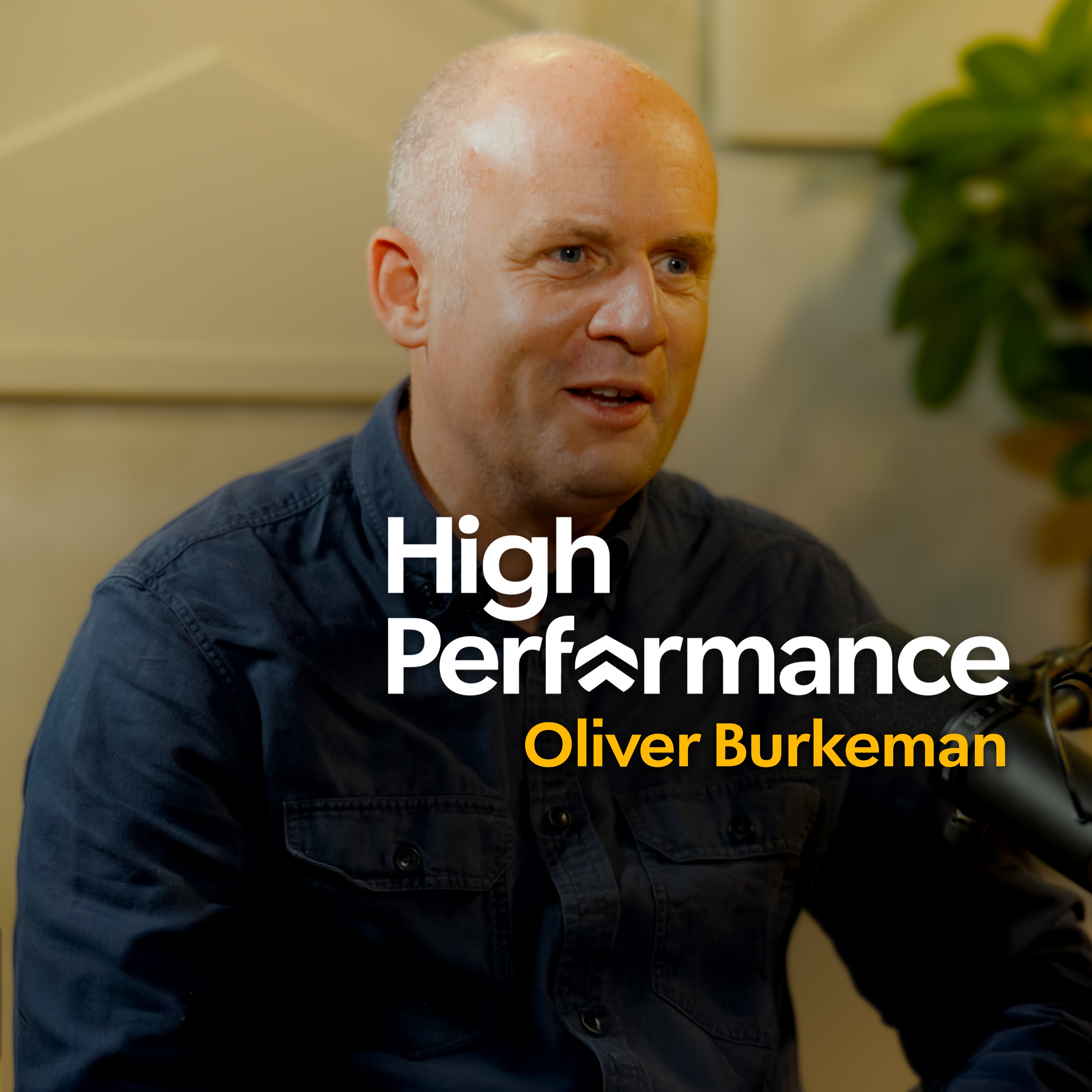
Hosts: Jake Humphrey and Damian Hughes
Oliver Burkeman, Author and Productivity Expert
In this episode, Oliver Burkeman, a renowned author known for his insights into the psychology of productivity, discusses the modern obsession with productivity and its detrimental effects on our well-being. He explores how society's relentless focus on being busy and efficient often leads to burnout and a sense of unfulfillment. Burkeman encourages a shift from productivity as a primary goal to finding joy and meaning in everyday experiences.
Written by AI. May contain mistakes.

Get the gist, explore an idea or ask about something said.
 Claude
On The High Performance Podcast, what are the key points of this episode?
Searching your listeningAutomatic transcript. May contain errors.
0:00Watch it early on the High Performance App. Available now, Roman Kemp, the broadcaster, opens up a powerful conversation on success and mental health. Chasing dreams of super productivity is sort of chasing immortality. Getting on top of everything, especially in the modern world, is a mirage. If you're ever going to make meaning and do cool stuff and build things and create and all the rest of it, it's going to have to be right here in the middle of the chaos. In that acceptance of how actually you're powerless in a certain way, powerless to just like completely change your personality, you get a lot more power because then you're free to just like act here and now.
0:39That's the voice of best-selling author and journalist Oliver Berkman who joins us today on High Performance. I'm Jay Comfrey and I'm quite simply fascinated by the stories of the world's most high-performing people. And I'm Damien Hughes. I'm lucky enough to work with people to help them understand how they create environments that get the best out of themselves and others. This includes working with professional sports teams like the England football team and with a range of leading businesses. Now Oliver is the author of one of my favourite books, 4 ,000 Weeks, as well as The Antidote and more recently, his Meditations for Mortals.
1:13A book actually which I bought my wife Harriet for Christmas. Yeah, well she really wants to read a bit more in the new year and that book's so sort of user-friendly. It's 30 chapters over 30 days. You just have to set aside 10 minutes a day and it's packed with value. and talking of value, this episode is full of it. You're about to hear Oliver's views on why so many of us feel overwhelmed, why we've elevated the idea of being busy as something to aspire to and why we need to embrace imperfection. Learning not just to live in the moment, but enjoying living in the moment. Crucially, Oliver shares practical techniques for anyone to apply and he has this brilliant notion of being an insecure overachiever, which you're about to hear him talk about as we welcome Oliver Bergman to High Performance.
2:03Well, Oliver, welcome to High Performance. It's so good to be here. How have we all ended up feeling so busy, so out of control, and so overwhelmed? I think there are all these different reasons that flow into each other, right? There's kind of historical reasons, economic culture that we live in, some of the religious traditions that inform our culture but a big part of it now really is just that feeling that there's like an infinite amount of stuff that you need to get your arms around in order to stay afloat or in order to pursue the goals or the objectives that matter to you. Infinite amount of stuff to read, to learn how to do it, infinite number of emails to send or answer, all the rest of it.
2:48And so we get on this treadmill where we're trying to get more and more efficient at getting through these supplies of inputs. But that's not going to work because that's not how, you know, because that's not how infinity works, right? You can't get your arms around it. And so we end up in this situation of trying to pack more and more and more in and never get the reward of feeling like we're getting through enough of it to sort of relax for a moment or gather our energies. And so it just sort of perpetuates and gets worse and worse and worse. And yeah, and then busyness becomes like a status symbol.
3:18It becomes, it would have been insane to people in the pre-industrial era to learn that when you rose up through an organization or your business took off or something in the modern world, you get busier as a result. Like surely the whole point of higher status was to be able to spend your days banqueting and hunting stag and things like that. Whereas now it's like, yeah, busyness shows that you're doing well, which is strange. You're so right. I mean, if you think about it, every time you go to a dinner party, a drinks party, an event, and you say to people, how's things? What's the answer? almost every time.
3:55Exhausted. Beasy. Full on. Oh, I can hardly catch my breath. Yeah. So when did we as a culture start to idealize this concept that productivity is something that we should put on a pedestal? I think it happened at different stages. One of the big ones a long time ago now, the process of like industrialization. There was a big shift when people started to think about time as a resource, I think. Prior to that, people did piecework, right? You did a thing, you made something, you sold it. It wasn't like you weren't selling your time. Then as we started thinking about shift work and how to get the most out of a person's time, there's this natural pressure to kind of eke as much value as you can out of somebody working for you in your factory, say.
4:40And then it becomes like personalized in the sort of white-collar work and then knowledge work, digital work that we have now. It's like a very personal thing. Like I have to try to maximize my own value to myself by squeezing, squeezing, squeezing more value out of every given hour. And so, yeah, you naturally get to this place where the sheer fact of doing a lot of things seems to be meaningful in itself, where it seems to me obviously isn't, right? It depends on the things you're doing. You could well be taking actions that were sort of directly detrimental to a company or a life. Sometimes not doing things is the right stance, but we really just have this kind of like doing at all costs and then maybe we'll get to the place of total optimization, perfect control, and after that it'll be plain sailing, but it's always in the future.
5:28But you use quite a compelling metaphor where you say in our heads we think of ourselves as super yachts and yet you encourage us to think more like kayaks in a whitewater rapid somewhere. And yet when I read that, it feels quite scary to let go of this idea of managing our productivity through time and our busyness. How do you advocate we go about doing that? There are all sorts of kind of specific methods, and I really hope we'll get to them. I think the big picture idea here is that for a lot of us, maybe most of us today, we spend our lives in this state of like struggling towards this time when we're going to be in control, we're going to be on top of everything, we're going to have like nailed it all down.
6:12But it's always in the future, right? That moment when you feel like, okay, now I have financial security, now I have the productivity system that allows me to easily process anything that's thrown at me. Like, it's always either a few months away or a couple of years away or the next productivity system away or something. And so we're sort of scrambling towards this place where we feel like then we would feel in control. And the thing about kayaks and super yachts is like, what I want to say is really just being human, being a finite human means being in a little kayak on a river, doing what you can.
6:49You don't know what's happening next. It's all a bit risky. All you can do is respond to things that happen in the moment. You can steer. You can have an objective in mind, a destination. But you can't sort of just sit back and find the system that's going to do it all for you, which is the analogy of the super yacht, you know, sort of sitting in this silent, serene, air-conditioned bridge and just pressing some buttons and leaning back. So I want to advocate in everything I'm doing against this idea of postponing real life to the point when you've really figured it all out and saying what we really have to do is learn to take imperfect but real action here and now without feeling completely ready, without feeling on top of everything because getting on top of everything, especially in the modern world, is a mirage.
7:39It's not the right goal to have. And let's just be really clear. that this is a genuine problem. You know, we're not sitting here talking about something that doesn't exist. Like, actually, how big is the problem? I mean, you've been compelled to write books about this kind of stuff. Back in the day when I was working as a daily newspaper journalist and on deadline after deadline, I didn't realize that it was kind of everybody who has this feeling of being on the back foot, permanently trying to catch up, get to this point. I certainly felt it, but I thought maybe it was just me and in a few more years, I'd figure out how to, you know, be as competent as everybody else, which is imposter syndrome, right?
8:16Another manifestation of this whole thing. One of my favorite studies in the whole of social psychology says that we probably don't know the full extent of the busyness epidemic because the very busiest people are too busy to take part in surveys about how busy they are. So, you know, I think it is absolutely epidemic. And even when it's not busyness, right? Even if you think that's not my problem, I don't have too much to do, and there are people, there's still something. There's still some, I haven't quite figured out how to do life yet, and maybe in the next book that I pick up in an airport or the next course I take or something, I'll finally get to that.
8:58And it holds us back. Yeah, we put off life until we get to that thing.
9:27Upwork.com W-O-R-K dot com. Post a job for free and get started today. Ah, DSW. Birthplace of the humble brag. Here, the shoes are so good, no one would ever know how little you paid. If you didn't go telling everyone that is. And with never-ending options for every style, mood, and occasion, all at really great prices, we'll definitely give you something to brag about. So go ahead, stock up on fresh sneakers from your favorite brands. Or try those boots you always secretly knew you could pull off. Find the shoes that get you at prices that get your budget at DSW stores or DSW.com.
10:10This episode is brought to you by Opera Air, the first browser with mindfulness at its core. Now, most of us spend hours every day online, but how often do we pause to take care of ourselves whilst we're doing it? And that's where Opera Air comes in. It's a lightweight, fast, secure browser built not just for productivity, but for your well-being. With Opera Air, mindfulness is built right in. You'll find free breathing exercises, guided meditations, and soundscapes with ambient sounds, lo-fi music, and binaural beats, all designed to help you focus, relax, and even spark creativity while you browse.
10:47So what's the first step that we should all be taking? Let's say someone listens to this conversation, they get this far, and they hear you say, we're putting off life. We're delaying actually living. what's the first thing that you'd like people to understand to move forwards from this point i think the perspective shift where it begins and all the sort of techniques and habits and everything follow on for me anyway from that from that kind of perspective shift is just to get a little bit more comfortable with seeing like how it really is how there is just always going to be too much to do for a human being you're never going to feel almost by definition you're never going to feel ready to enter the next life stage or launch the next innovative venture in your life, right?
11:33Because it's new by definition. You're never going to be able to feel confident about the future. This is a big one, right? People want to say, well, let's just wait for this period of unsettling stuff to get in my life or in the news, whatever. Let's just wait for that to get out of the way and then I'll get down to it. Seeing that you're not going to get there either and that if you're ever going to make meaning and do cool stuff and build things and create and all the rest of it it's going to have to be right here in the middle of the chaos and the not exactly knowing what you're doing and the probably having too many emails waiting for your answers so it's a really it's a skill of being willing to do things however imperfectly however briefly and stumblingly, but to actually do them instead of create all these amazing fantasies about how we're going to do them brilliantly later.
12:27And I guess that's the philosophy that I think of as imperfectionism. Yeah. And why don't we get there then? Why isn't there a day where suddenly the inbox is empty and the challenges are not there and we can just find it? Because I'm busy telling myself at the moment that next year is going to be the year that I stop the constant chase and I try and find some time for the joy. Right. And you can, right? Just not by doing more. Right, exactly. The only way to get there is to do more, and then more comes. So it's like the only way to rest is to rest less, which just doesn't make any sense. It's directly opposed.
13:04I think the reason that... I mean, you can get there in isolated domains, right? So if all you really want to do in your life is be on top of your email, you can do it. But it will come at a cost of something that actually you care about more. yeah any of us could be completely on top of one of these streams if we just fixated on it i think the reason we never get to the kind of security we're seeking that sense of like okay now i am in the driver's seat of of life i mean not to get too um deep deep or depressing too early but it's basically because that's not what finite mortal humans get to do right that urge for security is really an urge to like be immortal not to have to die not to be limited in all the ways we are just non-negotiably limited so it's an escapism right it's saying like it's sort of dreaming of this thing that might happen uh in the future as a sort of an excuse for not quite having to show up fully for life in the in the present right with all its unpredictabilities and vulnerabilities and And all the things that are difficult about being in relationships or being a parent or anything, it's like it's saying, well, no, no, no, this isn't real.
14:14It's going to be problem-free in a little while. So I'll really dive in properly then. And so there's that kind of desire for, yeah, some system, some philosophy, some morning routine, you know, that you could sort of plug into your brain. And once it was installed, it would all just, you wouldn't have to worry about anything else. and I just don't think that's what it means to be human. One of the ways I've put it in my writing is it's very easy to fall into this notion that the time is going to come in the eventually in your life when you don't have problems and you can just get on with life because all the problems are out of the way and actually like life in a meaningful and not even depressing sense life is problems.
14:56Life is getting really good at grappling with each new problem that comes your way and even choosing certain problems that you want to have because of what they lead to. In the new book I've written, I tell this story that Sam Harris, the podcaster and author, told about being at coffee, I think it was, with a friend and kind of he's like moaning on about all the problems that he's facing in his work and his life at the moment. And she interrupts him and says, hold on, are you still under the impression that one day you're going to get to the stage of your life where you don't have any problems and he sort of realizes with a start that yeah unconsciously he had been doing this obviously it makes no sense intellectually we all know that like there's going to be stuff and on some level the more you go through life the more problems you can expect right because you get older but but but we do a lot of us have this notion that there must be this this problem free time coming and yet firstly there's just no reason to believe it would ever happen.
15:56But secondly, you wouldn't want it to happen. Because if you think about what a problem is, in the broadest sense, it's just like something in the world that demands that you address yourself to it. And that is, I think, what gives meaning to our lives. If you really had the kind of total control over life that we think we want, that led to there being no problems, every single day was completely predictable. Every single person you met, you understood fully. every single football game you watched, you knew the outcome. Like, all this would be no fun in life. There would be none of what one scholar I quote calls resonance.
16:33You know, the thing that really makes life feel worth living actually depends on not having solved all our problems and not being in total control of it all. You know why I like this conversation? Because it's so real. Like, it would be much easier for you to sit here and just tell us that one day our problems will melt away and then we'll all be living a life of joy or maybe telling us you just need to do less things. That's not actually realistic for people. I think for you to sit there and say, do you know what? You're always going to have stuff. You're always going to feel a sense of overwhelm or a sense that there's lots of things to be done.
17:07But living your life among that is the magic here. Yeah, no, I love that way of putting it. And there's a psychotherapist who I've quoted a bit called Bruce Tift who somewhere, I don't know where, I don't recall where, but it says like, imagine thinking about the thing that bothers you the most about yourself right so your problem with procrastination or your short temper or the thing you really wish you could get rid of and just kind of imagine knowing that some version of that anxiety whatever it might be some version of that was going to be with you for the rest of your life you're never going to get completely uh shot of it and as he says and as i've found like many people find that incredibly liberating because it's not depressing at all it's like okay this is just part of who i am and now instead of postponing all the good stuff until i've fixed that i can just do the good stuff now and i can launch the projects and commit to the relationships and have the experiences now without waiting for that in that acceptance of how actually you're powerless in a certain way powerless to just like completely change your personality you get a lot more power because then you're free to just like act here and now.
18:18Can I just pick up on one point there? Let's imagine someone's listening to this, right? Two or three kids, busy job, lots going on. And they're going, hold on, Oliver's saying to me, I need to do more right now. Like I need to still chase what I love among the madness. I don't know when. I'm getting up so early. I'm getting the kids to school. I'm getting home late. So what's your advice to those people? How do they still find life among the madness? Yes. It's a really good point. I think there's a sort of a perspective shift and then there's a specific technique. And the perspective shift is to say, well, in a sense, all our time is already 100 % full, right?
18:55Because there's more things that we could usefully do with our time than we'll ever have the time to do. All you're doing in every moment is making a choice between the thing you do and all the things you choose not to do. And if you are at a stage in your life or a situation in your life where running the family is a huge proportion of what you do, that can be the source of meaning once you see that you are in some sense choosing that. I know it doesn't always feel like a choice, but everything is a trade-off in that respect. So the first thing to see, I think, is that if you are going to make more time for working on your screenplay that you want to write or your art career that you'd like to develop or your songs you want to write, whatever, something is going to have to give because that is just what it is to be a finite human and there may be seasons of life where nothing can give and if that's the case then at least don't beat yourself up about it because like that is just what it is to be human on the other hand if there is anything that can give you know if actually your family would be fine if you took yourself away for half an hour a day if actually your boss would be fine if you were a little bit slower but still reliable at responding to emails so that you could make a little time for something it is on you to make that choice and to own that trade-off as it were and to accept the negative consequence because there will always be one in order to get the the other thing there's a creativity coach uh i love called jessica abel who who has this idea of paying yourself first with time what she means by that and obviously it's an idea borrowed from personal financial advice and stuff but is not to fall into this trap of waiting for the point in the future when you'll have all this other stuff out of the way and these amazing vistas of spare time and focus will magically emerge and then you can write the novel write songs develop the skill you want to learn whatever instead you just you do just literally have to like claim it up front so you do just have to say where in my life today is that or this week is there half an hour an hour where I can just do this, make sort of a bridgehead into this activity.
21:03Not like knowing that there will be people waiting for me and somebody's probably going to get impatient with me and I might get like judgment from people for doing it. But like that's just the trade-off I'm going to have to make if I'm going to do this with my life. That's brilliant. Because you write powerfully about the opportunity cost. And I think that, again, it's almost like a hidden skill of not recognizing that everything we do, there is a cost. Yeah. versus the benefit of it. Would you speak a little bit more around that? Because I found it's a really helpful concept. It's so interesting to me because it feels like a downer.
21:38And then actually when you really think about it, it's incredibly liberating. I mean, I feel like I say that about a lot of what I argue. That's why you argue it, because you believe it, which is great. It's better than being paid for something you don't believe in. Absolutely. Your passion is clear. No, completely. there's a quote in the new book from Sheldon Kopp who was a great psychotherapist who died a couple of decades ago and he says you're free to do whatever you like you need only face the consequences and this is a kind of an amazing mantra I think for many people because I think we either think that we can't make certain choices in life to leave certain jobs, leave relationships we either think we just can't or we want some way of doing this that will have no consequences, negative consequences at all.
22:29So it's like you either want to escape from negative consequences or you're just like, this is the way it's got to be. I hate it, but we've got to carry on this way. And he's pointing out like, no, you can do pretty much whatever you want. It's just that there will be negative consequences and you have to take responsibility for those. So if you leave a certain professional situation, there might be financial insecurity. If you leave a certain relationship, there might be like agony and anguish caused for you and other people. But in certain contexts, that might be the right trade-off to make.
23:03And in other contexts, it won't be, right? In other contexts, you might say, oh, actually, that urge to travel the world, it's not worth it to me, given what I'd be giving up for it. It sounded nice, but actually, I'd rather stay and commit to the situation that I'm in. It could go either way. but because you see that there's always this trade-off I mean the way I like to think about it is we're sort of looking for ways to be free from finite reality but this is a way to be free in finite reality because you say well okay it's just a question of which negative consequences I want to own as the price for doing the things that matter the most to me but when you talk about it I'm often reminded of people I know that you see them acting in certain ways like for example they might spoil their kids materially and often the consequence or the opportunity cost is you're going to create spoiled kids but it's that lack of willingness that I see to lean into the discomfort of you were uncomfortable that you didn't have a lot when you were growing up so you're trying to overcompensate with your own kids yeah and I think what I take from your writing Oliver is that your willingness to lean into uncomfortable truths or to get comfortable being uncomfortable like that like we were talking off air earlier about that great example when you went on the tube and adopted the albert ellis oh goodness exercise it's traumatizing just to talk about sure but i was hoping you would because i think your ability to lean into discomfort is something that we can all learn from sure i'll happily talk about that uh nightmare on the central line um i should say as a preface like you're right but obviously this is like me all these books are like me leading myself into discomfort right it's exactly the stuff that i struggle with that ends up in these in these books because that's why i feel motivated to write them i think that's probably true of anyone writing kind of advice type books so it's always worth bearing in mind this was a thing that i did when i was reporting my book the antidote which subtitle which is happiness for people who can't stand positive thinking so it's all about like approaches to happiness that don't involve just really trying to force yourself to feel great all the time and one of them is an exercise adapted loosely from stoic philosophy by albert ellis the great and completely eccentric uh psychotherapist um who he actually proposed that you do this on the new york city subway i was in london so i did on the central line but the instructions are simple you just take a ride on public transport and just as you come into each station you just speak out loud the name of the station in the train car, the carriage so that everyone can hear you I'm cringing sitting thinking about doing it I've said this in public events and stuff and everyone is just like and me too, right?
25:59everyone is just like oh my god, it would be so embarrassing to do it and it's really interesting to think about why it should be so embarrassing, right? Because you are not picking a fight with anybody. You are not trying to convert anybody to your religion or political cause. You're not revealing secrets about yourself. If anything, you're being kind of helpful, right? Because you're telling them the name of the station. But this is the beauty, though, because most people, like Jake then, you cringe. Yeah. And we back off from the discomfort, whereas you lean into this. I mean, I did. I spent a lot of time backing off from it as well, even during that experiment, I can tell you.
26:38But when you do it, of course you know what happens when you do it, right? Which is that a couple of people briefly look at you like you're not all there, and then they go back to reading their... Well, then it felt like it was a while ago now, but now it would just be phones, right? Only smartphones. And people are wrapped up in their own troubles, and they're not really thinking about you at all. And also, the thing that I think Ellis thought was so important about this is even if it's bad, even if it's unpleasant and you think at the end of it like, I don't want to do that again in a hurry, which certainly was my attitude at the end of this experiment, it's not the end of the world, right?
27:19The sort of emotional, the anxiety that we have when we think in advance about doing all sorts of things, it's sort of a little bit like the world being completely destroyed in a nuclear war or something, right? I mean, that's the level of arousal and negativity that grips you, which is completely absurd from when you then test the thing. The point is just to sort of pressure test your beliefs by bringing them into contact with reality and to see that most of the worst consequences that we go around fearing are just much more handleable handleable than we think there would be. And at least for a while after that experiment, I don't want to say it persisted forever, you know, there was a sense of like, oh, I could sort of do anything now, right?
28:08You know, I mean, not literally, but if that's not an issue, then how many other sort of weird people-pleasing or shrinking violet tendencies that I've had can just be sort of let go of? So yeah, I don't know. We need a new epidemic of people doing that on the central line. Maybe. Or maybe not. Maybe it's kind of... This idea of leaning into discomfort is a powerful one. And the fact is you've written a book called 4 ,000 Weeks, which is really doing that for people. The discomfort there is you don't have that much time. Can we talk about why we need to develop an intimacy with our mortality before we can get to a place where we really understand life?
28:51Obviously, that book title is very broadly speaking, the average lifespan in the developed world. I rounded it down for a nice title number. Obviously, it's got to have, couldn't make it the specific number. And it is shocking at first. I was certainly shocked when I first made that calculation. But what I'm trying to do in that book is not say, time is short, therefore you've got to like stress out about trying to cram every second of your life with the most exciting, most impressive accomplishments you possibly can. Because that is not a nice way to live. that's actually living from deficit, isn't it?
29:28That's sort of saying like, unless I have the most amazing life that anyone's ever lived, I'll have fallen short. What I really want to say, again, at first sounds depressing, but I promise you it isn't, is actually life is so short. The time we get is so little that there's no possibility of doing more than tasting a few things from the kind of banquet of things life has to offer. And that is why you can let go of that kind of self-berating, endless struggle to cram stuff in and instead pour your time and attention and energy into the few things that you've decided really matter for you in this season of your life.
30:10And it's very focused on productivity of a meaningful kind, right? Because it's like letting go of trying to get everything in order so that you can do everything. and it's really just plunging in to the handful of things. I think there's this really, I mean, I've mentioned this a little bit already, but there's this really dangerous tendency to sort of postpone full engagement with life and a strong understanding of just how finite and mortal we are can really work as a good antidote to that because it's like at some point if you're going to do the things you know you want to do in your life, like you're going to have to do them in a present moment.
30:51there's a great great quote from john maynard kane's the economist about how the purposive man he puts it he meant like you know people who are really focused on being productive for productivity sake or whatever doesn't really love his cat but only his cat's kittens nor in truth the kittens but only the kittens kittens and so on forward forever to the end of catdom so it's just this lovely idea that like you never really get to be fully here in life because it's all about getting to the point where you can get your arms around everything. And the understanding that time will eventually run out and you actually don't know when and that's going to be is really powerful as an antidote to that tendency.
31:29Which is one of the reasons why I have tattooed on my inside wrist, which I had done in this studio, actually. You had a tattoo done here. Yeah, I had a tattoo done here. Yeah, Memento Mori. Right. Which kind of translates as remember you're dying, like we're all mortal. Are we running away from the fact that life is finite, do you think? on the whole. Yeah, I think what we do, I love the tattoo, by the way, I'd be interested to know whether it, does it sort of fade into the background or does it still work? Does it work as a reminder? It works as a reminder because I talk about it. Right. And it's there and it catches you sometimes.
32:05But I love telling people that I've got it because I'm very much in the camp that people are not living a life understanding that we're all dying. the Daily Mail is the worst for always having stories about people finding out that they've got some terminal diagnosis at a young age and the reason why they put those stories out there I guess is because they know people click on it because we're fascinated with what must that feel like to be told at a young age you're dying well I can give both of you a terminal diagnosis right now and you can give one to me and everyone else in this room like I'm afraid to say that you know when you see someone say I couldn't believe it when the doctor said it was terminal well I can go to the doctor now and ask him my terminal And the answer is yes, right?
32:46Yeah. So it's about the power of getting to this place, I don't think can be underestimated. Right, right, right. And without undermining the genuine pain and tragedy of people dying young, like if you think about the human lifespan against the historical, like the eons of cosmic time, the difference between living to 90 and living to 30 starts to shrink massively, right? It's like, yeah, we're all very close to that moment, even if we live as long as we might. I read a great quote once that said, we all get a lifetime. And I love that feeling that we, you know, it's different for other people, but we all get a lifetime.
33:22Yeah, yeah, no, exactly. And it's wild to think about it too much. And I do think that we invest a lot of energy in sort of not feeling that. And it's not even mainly necessarily about like the end. It's not necessarily that we spend a lot of time denying death. It's more just all the ways we spend denying all the ways in which we're just limited human animals, right? So even like very simple, like as we've been talking about, right? Chasing dreams of super productivity is sort of chasing immortality because it's like getting to the point where you could be like a god or the god of your inbox at any rate.
34:02Even sort of compulsive worry and things that are not fun to engage in and people wish they could be free of, they have this kind of gesture in them don't they to sort of control the future and know that everything is going to be okay in the long run when of course as you say you know nothing is going to be okay in the long run depending on how you uh depending on where you place the end of the long run yeah but i read um an interview with the radio dj i think he's called chris o 'connell who bought a watch that is actually a memento mori watch that sort of takes your predicted lifespan and then counting down.
34:37And he describes how it almost became crushingly depressing. Yeah. So how do we avoid allowing ourselves to be crushed by that knowledge and liberated? This is interesting. Yeah, I'm not a big fan of any of these ways of, despite the title of 4 ,000 weeks, I'm not actually a big fan of any of these ways of kind of visualizing what you expect your lifespan to be and then showing that you're sort of crossing it off, crossing it off. I think that absolutely either becomes incredibly depressing or it becomes that kind of high stress, like, well, I better organize, like, I better learn base jumping or something because, like, otherwise, what will I have done with my time on the planet?
35:18So I think it's more about, it's kind of a subtle point. I don't know if I'll even, if I even know how to express it, but there's some kind of embrace of finitude where you almost forget about these kind of time spans. it's because you're letting yourself fall more fully into like this moment here and people who have had terminal diagnoses and certain spiritual teachers who are just very good at this kind of thing without that have managed to express this idea about how like actually in this present moment though it's all the time in the world right like it's like you can have a full experience of being with somebody you love or doing some creative work that makes you feel alive like that it can be completely done in you know a microsecond and so in a way i'm not about like hearing the countdown of an actuarial clock in your head apart from anything else like you know a grand piano could fall out of the upper story of the next building you walk out of right it's like it's not it's not how it works but because like the goal here i think is to be more and more fully immersed in like in in this moment rather than um more and more aware of how many future ones you might have left well it was in your writing that i came across a word i'd never heard before but uh really intrigued me italic because the idea that we do things almost without the purpose of having a goal at the end of it you talk about going for a walk and walking in a big circle is an italic right activity you're not walking from one destination to another you're just walking in a big circle.
36:58And yet so often in life, we're told that we need to have goals, we need to be striving for the next thing. And yet you advocate powerfully. Sometimes acting without purpose is just as important. Yeah, so this idea of etiolic activities, I mean, the word comes from the philosopher Kieran Setia, who sort of makes the point, and I think this is really powerful, right, that it's great to have goals and it's great to be focused on achieving those goals, but there is a risk of sort of over-investing in them to the extent that it removes meaning from the present because every minute, every hour exists only for the purpose of reaching this future place.
37:37And the idea of an etylic activity is just something that at least partially you do for its own sake. You're not looking to the point where you've done enough of it or you've done all the things you need to get to the next thing. And yeah, hiking is a sort of obvious example, right? because the most efficient and effective way to get from where you start a hike to where you get to the end if it's a loop is just not to go on the hike in the first place. But that misses the whole point for people who enjoy doing that. And there are side benefits, you know, it's good for your cardiovascular health and everything.
38:10But that is, again, is not usually why people are doing it. They're doing it because they love doing it. and yeah I write in 4 ,000 weeks about how it's kind of become really cringe to sort of celebrate the idea of hobbies there's something about a hobby that kind of implies you haven't got enough to do in your life if you've got time for a hobby like what are you doing we use Rod Stewart's story this is so great it's become a bit more well known so it might not be a big surprise but yeah so Rod Stewart has an absolutely massive model train set network layout that when he was maybe even still today but when he was touring in the US very regularly he would like book an extra hotel room so that he could so that his train layout could have this and could have a room to itself and yeah he's given interviews to a railway modeler magazine on a regular basis they get these great scoops because he's the one they'll talk to and I think what I really liked about that example is just that it's so sort of off brand right it's not it doesn't It doesn't appear to be an instrumental purpose.
39:18There's no commercial benefit to Rod Stewart for doing this. And so you really get a little sense, like he must just actually really love tinkering with his model train set based on a historical mixture of Chicago and New York, which I think is what it is, right? It's got all the grimy streets and he adds the grime with a paintbrush and all the rest of it. Now, these days people are very big on side hustles because a side hustle is a hobby that has got an instrumental goal, which is you're going to make money out of it. Either you do now or you will do one day. It's quite sort of subversive or countercultural in a way to suggest that people should make at least some time in their week for collecting some kind of thing or painting in a way that they don't ever expect to commercialize or in my case, like playing really bad piano rock with headphones on so I don't disturb the rest of my family with how bad I am at it.
40:13But like, it's actually quite good for it to do something you're bad at, right? Because then there's no danger of thinking, can I turn this into a business? Because I promise you, I will never be able to turn my piano into a business. Even the phrase a meaningless hobby, though, is wrong, isn't it? The whole point is that this isn't meaningless. Explain to us why it's so important. Well, because it's meaningful for itself, right? You're just not going to do it unless there's something in the activity that is worth it. In any work life, there's at least some of it. that you're doing because it supports all the other things.
40:42And like, fair enough. Hopefully, the core thing that you're doing is something that is meaningful for you in itself. But a hobby is just, it's so sort of direct. It's just like, yeah, I'm just doing this because this is a way of spending a bit of my finite life that makes me feel alive. And what's so interesting about that is like, yeah, we think of it as sort of wasting time because it's not leading to some big outcome. but how wild that like we should have adopted a definition of wasting time that includes things that are like actually using your time on the planet in a way that feels wonderful to you it's like it's like you're only using time well if you're using it for some other time so when in your writing in your work then would you mind telling us about how we can try and find things where it ignites our passion rather than we do it for our profit or our one of the things that i think is surprisingly frequently true is that people have quite a good intuitive sense of of what they want to be doing and we sort of the problem is very often that we put all this stuff like like a fog that sort of gets in the way of seeing that so you tell yourself that you can only relax into doing that once you've achieved a certain level of career advancement or financial security but actually if someone could just like put that aside for a minute you think what did you enjoy doing as a kid that's an incredibly powerful guide to this not always you know uh not necessarily literally the things but like there are certain kinds of activities that you did when you had that kind of freedom to do whatever you whatever you wanted.
42:30I think there is a lot of benefit in looking back at the kind of stories that you like telling over drinks, over coffee, right? The things that the experiences that you like relating the places you went and the things you did, they're often not the ones that you'd necessarily expect, right? Sometimes people don't really want to talk about their great career accomplishments or something. They want to talk about some live show they went to or some particular kind of field of study they got into and have been like really geeking out on. And so I think it's possible to like see those things. It's also really important to cultivate a very sort of experimental attitude and be like, I don't have to stick with this, right?
43:12I'll do this for half an hour. I'm not going to spend hundreds and hundreds of pounds on the gear for this thing and then feel bad that I only wanted to do it one day. I'm just going to, you know, go and do the thing once and that is part of this sort of kayak imperfectionist outlook right not feeling that if you embark on something it's got to be as part of some big personality transformation where you're going to become the kind of person who does that thing all the time but just being willing to like take one class in that thing or whatever it might be and and maybe that's all they'll ever do great you spent half an hour of your life doing something intriguing If you're still overpaying for wireless, it's time to say yes to saying no.
43:52At Mint Mobile, their favourite word is no. No contracts, no monthly bills, no overages, no hidden fees, no BS. I made the switch because I was tired of those ridiculous bills and sneaky charges from my old provider. With Mint, I'm paying$15 a month and getting the same high-speed data, unlimited talk and text, and coverage on the nation's largest 5G network. Look, honestly, the quality is just as good, if not better than what I had before. And the best part, you don't need a new phone. You can keep your current one, bring your number and all your contacts. I use Mint Mobile and you should too.
44:25Ready to say yes to saying no? Make the switch at mintmobile.com slash HPP. That's mintmobile.com slash HPP. Upfront payment of$45 required. Equivalent of$15 a month. Limited time new customer offer for first three months only. Speeds may slow up a 35 gig on unlimited plan. Taxes and fees extra. or see Mint Mobile for details. You open the fridge, there's nothing there. So what's it going to be? Greasy pizza? Sad drive-thru burgers? Dish by Blue Apron is for nights like that. These are the pre-made meals of your dreams. At least 20 grams of protein, no artificial flavors or colors, no chopping, no cleanup, no guilt.
45:07Keep the flavor. Ditch the subscription. Get 20 % off your first two orders with code APRON20. Terms and conditions apply. Visit blueapron.com slash terms for more. The market's uncertain. Revenue's tied and hiring on hold. That's why results-driven companies are using Upwork to keep work moving. Go to upwork.com today and start hiring proven freelance talent fast. No bulky overhead. No rigid long-term contracts. Just the right expert right when you need them. Work smarter and faster with Upwork. Go to upwork.com now and find your freelance expert. That's U-P-W-O-R-K dot com. Post a job for free and get started today.
45:52I feel we set out that there's a real problem and the way that we can change people's mindsets around understanding that life will not go on forever. Are there any other tools or techniques that you'd really hate to leave this conversation without sharing about how we can help people get to this point in their lives? I'll definitely share a few. I think any approach to sort of organizing your day, organizing your tasks and the rest of it that takes account of being finite is really powerful. So one that I've written about, I call fixed volume, taking a fixed volume approach to productivity with lots of credit due to Cal Newport and his ideas about fixed schedule productivity.
46:33We could really get into the weeds and say why I have a very slightly different focus. But the basic point here is just to say, you know, people's professional situations differ. Not everyone has the same freedom over their time. But to the extent that you have this autonomy, can you like isolate a period of time in the day that you're going to dedicate to things like email and admin, put a boundary around it, and just like do it for that time and then practice as a skill stopping and moving on to the next thing when it's up instead of what we usually do, right, which is tell ourselves somehow I've got to get to the end of all of this stuff today.
47:10And when that stuff is actually in infinite supply, that's bad news. It's not going to happen. I think that if you do any kind of knowledge work, creative work, work that involves thinking, there's a lot of evidence for trying to ring fence sort of just about three or four hours for that most days. There's a section in the new book about doing things daily-ish, having a sort of an approach that is forgiving when things don't work out, but still you're trying to do pretty much more days than not. And that sort of three or four hour idea, like a lot of people have that degree of control over their lives.
47:45But if they try to control the whole day, it's just a nightmare because life and family and colleagues and everything just like constantly interrupted. And then it's more aggravating than it needs to be. So I think trying to isolate that kind of period in the day for in-depth focused work is very useful. So it's really anything like that, that brings you back into an understanding and an awareness of the fact that time is finite. You've got to make some choices about what to do and what not to do. One more idea that I find is really great when you're sort of stuck in a rut and can't find the motivation is to keep a done list, to just like alongside your whole task management, whatever it is, to-do lists, or even if you don't keep them, just a list of the things that you accomplish through the day as you accomplish them.
48:30Sounds kind of silly, sounds like it shouldn't have much of a role to play, but it really focuses your attention on like the more you're thinking okay i'm now going to do something and i'm going to be moving that onto my done list it actually really sharpens your skills of making the right judgment about what to do next and why you're doing that thing and and uh yeah it's um it's bizarrely powerful you write in the antidote about becoming a dad and the experience of sitting on a park bench in Brooklyn, where you were living at the time, and contemplating the enormity of becoming a father. What are the lessons that you'd want to pass on to your son from your experiences and your writings?
49:15Ha, that's a great question. I mean, one of the things that I try to focus on is this idea that comes most commonly, I think, associated with Carl Jung, that one of the best things that we can do as parents is like get our own inner lives in order rather than try to sort of spend too much time crafting ideal humans. He has this great line, the heaviest burden the child must bear is the unlived life of the parent. So it's like, don't be in denial about your own finitude. Don't be in denial about your own passions. Don't put off all the things that you love, especially don't put them off because you think being a good parent means just constant self-denial.
49:59Because then you're modeling... The first image in my head is like parents on touchlines at football games. Right, no, exactly. Because, yeah, and don't sort of model for your kids that life is all about only denying yourself and grinding for future times that never arise. I think what I would really like, to be completely honest for my son, based on my own sort of journey to this point in my thinking on all this stuff, is for him to really feel in a deep way that his kind of adequacy, his okayness, his being loved was not in any way dependent on how much productivity or whatever he... I'd like him to scale those heights, but I'd like him to scale those heights because he wanted to, not because he was trying to make himself feel minimally acceptable, which I think is a trap that a lot of us psychologists call insecure overachievers, a phrase that resonates with a lot of people I find.
50:56Go on, say more about that. I think that's what we're doing. So I think this notion of being an insecure overachiever is just the idea of like, yeah, you do a whole bunch of cool stuff in your life, you're driven, maybe your friends celebrate how impressive your accomplishments are, but somewhere deep inside, you're doing it to sort of make yourself feel minimally okay, like you've met a basic level of, you've justified your existence on the planet or something. I think it's widespread, it's not something to beat yourself up about if that's who you are certainly who i've been but you know the aspiration and probably nobody can convey this perfectly to their kids either but like the aspiration is that you overachieve because it's just fun to do that with your life and it's an expression of your feeling good about yourself rather than a kind of desperate quest to get to the point where you can feel good about yourself really good before we move to our quick fire questions in your new book meditation for mortals there are 28 brilliant sort of short chapters i'd like to know which one was the most impactful for you and why can i have two answers i mean briefly the one at the very beginning called it's worse than you think is is where i kind of set out why it's so liberating to see that actually getting your arms around everything getting everything done getting perfectly optimized is not really difficult it's actually completely impossible and it's such a powerful shift from really difficult to completely impossible and it's very relaxing and also sort of empowering.
52:24On specifics I think the chapter on how scary it can be to allow the possibility that things might be easy and that tasks and challenges that you're facing might be easier than you're expecting them to be has been a big lesson for me to learn. It's almost like if I'm doing something important where the stakes are quite high I just assume that it's going to be grueling. And I'm encouraged in this, by the way, by quite a lot of YouTube personal development content that's around the place. The idea that it's almost muscular sometimes, right? It's like I can feel myself tensing. And I'm not talking about boxing matches, right?
52:58I'm talking about doing things on computer keyboards usually. And so it's quite sort of subversive for a lot of us to ask, what if we allowed the possibility that this was going to be easier than we thought. And the funny thing is then, even when it is a difficult challenge, going into it in that spirit of ease makes it go better even then. Ready for some quickfire questions? No, but I probably never will be, right? Well, let's see.
53:28What are the three non-negotiable behaviours that you think carry the most value in your life and would carry the most value in the lines of our audience? Almost every day for years now, I've done some version of morning pages, right? Of just writing free form, whatever's on my mind into a notebook. Sometimes it's challenging to get up earlier than the rest of my house in order to do it. But that is, I find something incredibly powerful because it really sort of puts things into perspective, right? You just see them on the page. You don't need to find answers to your problems. You just need to see that they are like tractable and manageable.
54:04So that's one. I think spending, it's a bit of a cliche, but spending time in like big natural landscapes on a fairly regular basis does wonders for my nervous system. And I think makes me, this is not really for me to say you should get my wife on, but I think it makes me a lot easier to get along with. You know, that's sort of, there's something about almost just being reminded of your tininess in those kinds of contexts that is very, very powerful. It puts things deeply into perspective. and sort of makes you realize that most of the things that you were catastrophizing about don't really deserve to be catastrophized about.
54:45And then I would say probably thirdly, and this has been a real training from parenthood, is sort of leaning into discomfort of a specific kind, which is the discomfort of kind of impatience, the discomfort of wanting things to move faster, being willing to just sort of adopt an attitude of curiosity when you're with a small kid to be sort of like, well, what should we do? Letting them lead you instead of trying to impose, like, okay, we're going to do this, this, this, then we've got to get out of the house by this time. Sometimes we do have to get out of the house by that time, but you know what I mean.
55:20In 4 ,000 weeks, I write about doing this exercise that I was recommended where you go and look at a single painting in a museum for three hours, a whole separate story about cultivating patience, but being able to feel that kind of antsiness and not respond to it by either, you know, reaching for my phone or trying to boss everyone else about or something, but just sort of feel it is a game changer. Great. Can I just jump in? It's not quick fire. Sorry. It's against the rules now. Quick fire is quick fire. Quick fire is quick fire. The audience are like, here come quick fire questions. You can edit this.
55:56You're now non-quick firing. Sorry, but when you mentioned the painting exercise and then it reminded me of the exercise you did, I wouldn't mind if you'd share it when you went on that silent retreat. And it was the bit that resonated was when you got really pissed off with someone who's breathing. Yeah, that was a meditation retreat that it was only like a week and I wrote about it in the Antidote. But I seem to always put myself into these situations where like, not really doing much, but it's in a situation where that is the hard part, right? So certainly looking at one painting for three hours is an endurance test.
56:32but yeah so this is a meditation retreat in Massachusetts where you know you spend sort of whatever it is 11 hours a day with breaks with food they weren't they weren't mean to you in silent meditation on a cushion and yeah really what the first thing that that level of silence in the environment and in your behavior does for you is make you aware of how little silence and peace there is in inside you and how your brain sort of looks around almost for things to get aggravated about because there's something more comfortable and familiar about just being aggravated and yeah just they talk about this a well known phenomenon where minor behaviours of somebody else in the room like the sort of slightly this way in which this guy was sort of I thought breathing in a slightly affected way and it's just like what even is that breathing in an effect he's just breathing right but like and you've got nothing else going on and you just sort of your mind sort of clenches around this thing until So you're sort of entertaining all sorts of murderous fantasies.
57:30And then eventually, a little bit, hopefully, on a retreat like that, you'll start to see, oh, the problem here is this structural urge to do this. It's not a guy breathing weirdly. It's like I'm just looking for things to be dissatisfied about, and I could just unclench that a little bit and just sort of be with everything that is here. Amazing. Very good. what advice would you give a young oliver sincerely and honestly I would tell my younger self to chill out and that I would want to say you know this sounds like very bad advice to give to a young person doesn't it like just don't try but it's like I think I wish I had understood sooner that so many of the things that I thought the stakes were kind of implicitly life or death about were not some things are in life but but very many things aren't i'm pretty sure i would have got just as good you know exam results at university if i hadn't approached it uh in a way that was sort of destined to squeeze every bit of interest and enjoyment out of the process and turn it into a kind of anxious uh quest for um yeah some sort of inner feeling of adequacy so yeah something like that like yeah relax a little bit unclench based on uh the conversation we've had what does high performance mean to you i think it's got to mean showing up for life in a really sort of in the most sort of full-throated and wholehearted way that is on the cards for you right so it's like it is developing skills and getting better at things and doing things that are impressive to other people but above all it is just like and it's very hard to put into words really it is being able to say that you really were here like in a very emphatic way that you lived through the time that you got on the planet in a really kind of full full-throated and wholehearted way i think that's what it would have to mean ultimately for me love that what's your biggest strength and your greatest weakness you're always you're supposed to say greatest weakness is being a perfectionist because it's secretly a good thing yeah yeah yeah actually i think actually i want to say that one of my biggest weaknesses has been perfectionism and i don't mean it in that way like i think it's just bad and i'm glad that i'm uh that i'm leaving it behind to a great extent i do think that that that sort of feeling that i need to control really myself i'm not much of a controller of other people but i'm historically a very sort of like i've got to pack everything in i've got to reach all the you know so i think that is a a weakness that um makes life no fun for me but also makes life no fun for people around you right because they know that what you're doing is just trying to force reality into a certain direction so you feel okay the strength question is is a is a hard one to answer you know something that i do think i i have i'm not maybe it hasn't been on on display in this conversation or maybe it has i don't know but i do think there's a there's a there's a really important role for having a sense of humor about everything that we're talking about here this is actually not just a sort of icing on the cake thing like there is something deeply funny and absurd about the human situation and it is really really powerful thing to hold on to right i think it's it's incredibly important not to become totally grim faced about the quest for achievement or accomplishment or anything and to appreciate that what we're doing here is finite animals who are capable of conceiving of infinite things is on some level completely ridiculous very good and the final question what you'd like to leave ringing in the eyes and ears of our audience your one golden rule if you like for everyone to find a high performance life i think what i would want to say is and i don't mean this in a stressful way i mean it in a liberating way but anyway like this is it like this time right here this is your life and I hope that you have many many many more this is it going on for many many years from now but meanwhile if you're going to do things that matter if you're going to do things that make you happy if you're going to do things that make you feel alive it kind of has to be now
1:02:02Damien, Jake so much to take away from that conversation with Oliver I know you've been very keen to have him on the show for a long time and you love his book and his teachings, his way of thinking. I mean, this idea of developing an intimacy with our mortality, I almost think of all the things we've discussed in 300 plus episodes of this show over five years, for me anyway, it's probably the single most important lesson that people can take away from our conversations that we can give everyone a terminal diagnosis this very moment and therefore you can't change the way you live when you actually do get one.
1:02:34you need to have that mindset right now and it's the most positive way to live well that's what your tattoo says memento mori yeah well that's a great reminder and that's very much what Oliver talks about I'm really wary of confirmation bias here because I really enjoyed his books and his teachings that I was looking forward to it but what he offered was even better than just reading his work I think just the practical nature of it I think the thing that I've taken away from it is that term he used a few times of italic, sometimes do things just for the pleasure of it. So it was inspired by Oliver earlier this year that I signed up for a painting skills course.
1:03:15How's that going? Walls or pictures? Pictures, but it was just a short course. But it made me realise how relatively rarely I do anything just for the pleasure of it. You know, often I love reading, but I'll have to be reading for a guest or for something we can talk about are, you know, sometimes you like listening to podcasts, but we're often doing it to prepare for the next one. So there's always a purpose behind it. Whereas just to go and practice doing something without there being a purpose, not to show the pictures, but just to take that Buddhist teaching of just be here now was inspired by Oliver.
1:03:51And I think that's what it's given me a perfect reminder of. Nice. And it's all the rage now, you know? What? Non-artists becoming artists. Billy Connolly, Johnny Depp, Boy George. They've all had a go. Yeah, I won't be showcasing what I did. But again, that's the point that, like Matt Fraser, the CrossFit champion said, you don't have to be good at something to enjoy it. And I think it's a reminder sometimes of just, you know, just allow yourself to immerse in an activity just for the simple sake of being where your feet are and enjoying it. It also plays into what you said about pay yourself first.
1:04:25Yeah. And that's really what you've done. You've decided three or four weeks in advance on going to this painting course on this day at this time. You've paid yourself. then whatever else happens that week something that you've done for yourself happens and I think it's massively valuable and we're losing the art of doing things just for the sake of doing them yeah absolutely and Oliver's given us a great reminder of our time is finite so we might as well enjoy the journey while we're here in which case let's go to the pub nice and that's it for today's episode of the show if you enjoyed listening to myself and Damien talking to Oliver please feel free to leave us a review wherever you're listening to this podcast it's so helpful for us it makes a massive difference you can also download the high performance app so you can watch as well as listen to these conversations and we just want to say that we really appreciate having you as part of our community and over the next few months our ambition is to offer you even more value from high performance so we'll see you again soon for another episode
1:05:31Thank you.
Oliver Burkeman is a renowned author and expert on the psychology of productivity. He is best known for his work exploring how modern life’s obsession with productivity often leaves us overwhelmed and unfulfilled.
In this episode, Oliver dives deep into the dangers of idolising productivity, discussing how society's relentless focus on getting more done can actually be ruining our lives. He explains how we’ve come to put productivity on a pedestal and the ways this mindset leads to burnout and dissatisfaction.
Oliver also shares practical insights with Jake and Damian on how to create healthy habits and get things done more meaningfully. He offers advice for parents and others juggling multiple roles on how to find moments of joy in everyday life instead of chasing after unattainable, Instagram-perfect moments.
This episode explores how we can shift our focus from profit-driven pursuits to activities that ignite our passion, encouraging us to embrace the journey itself rather than fixating solely on the outcome, as we navigate the complexities of modern life.
In his BBC Maestro course Time Management, Oliver Burkeman will teach you how to reframe your approach to time and embrace your human limitations.
https://www.bbcmaestro.com/courses/oliver-burkeman/time-management/
🚨 Partners
Huel 👉 Get an exclusive 15% by using code: HP at: https://hppod.co/HP
Payhawk 👉 See our sponsor, Payhawk in action here: https://hppod.co/Payhawk
FORA 👉 Claim a free day pass at any Fora workspace and find the perfect home for your business here: https://hppod.co/FORAHP
HP Foundation 👉Do you want to kick-start an evolution that will change the lives of millions of children? Find out more about the High Performance Foundation: https://hppod.co/foundation
HP Corporate Events 👉Click here to book High Performance Events: https://hppod.co/corporate-events
Explore offers and discounts through our other partners:
https://hppod.co/partners
Hosted on Acast. See acast.com/privacy for more information.


