
 Ask ChatGPT


 The High Performance Podcast
21 Apr 2025 · 1h 2m
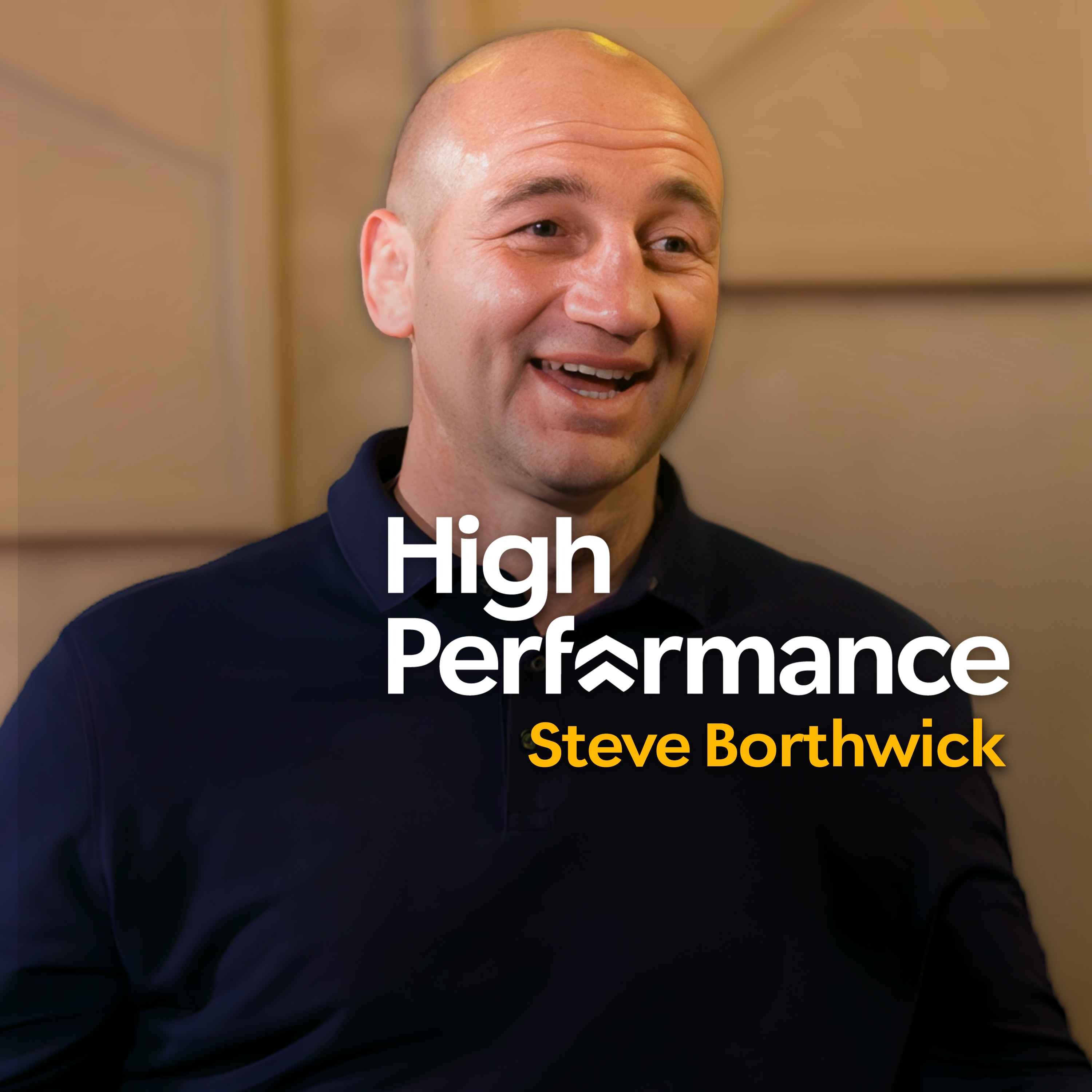
Hosts: Jake Humphrey and Damian Hughes
Steve Borthwick - Head Coach of England’s National Rugby Team
Insights into coaching philosophy, leadership under pressure, and the non-visible aspects of high-performance sports.
Written by AI. May contain mistakes.

Get the gist, explore an idea or ask about something said.
 Claude
On The High Performance Podcast, what are the key points of this episode?
Searching your listeningAutomatic transcript. May contain errors.
0:28Watch it early on the High Performance app. and they're sweating and they've bloodied, they have got to still go out and think clearly at the same point. Now, that's not normal. That's the voice of Steve Borthwick, the man currently steering the ship of English rugby as their head coach. So Damien, you flew solo on this one. How was it? I really enjoyed it. I know Steve a little bit. I've been lucky enough to work with him in the past, so I know he's an incredibly decent, thoughtful and reflective coach. and I think we saw some of the best characteristics of him here, Jake. He spoke to us around how he's gone about trying to reduce the heaviness of the weight of the England jersey for his players.
1:06He reveals a really fascinating insight into a meeting that the England players had in Verona before the 2023 World Cup. And as a former captain of England as well, he talks around how he came to the decision to remove the captaincy from Jamie George and instead build a trusted circle of people around him. This sounds like a fascinating look into the mind of the man charged with leading England rugby into a new era, of course with the ambition always to deliver the Rugby World Cup. As we welcome to High Performance, Steve Borthwick.
1:43Steve, welcome again to High Performance. Well, it's great to be here. Thank you for inviting me on for a second time. I asked you when we, on your first visit to High Performance, would you be happy for your boys to be coached by you? It's an interesting question. That first time I was on High Performance, we were talking about this earlier, the first time I was on High Performance is, I was at Leicester at the time, and I was told I've got a Zoom call with sponsors, and because it was sponsors, Gallagher who sponsored the league and um so i'm repairing for this you know just the zoom call and the the leicester bondi is the guy who ran the comms for the team at that point in time and he said you got the call with the sponsors and 10 minutes time and he and he calls and says you're doing the high performance podcast and said no no i'm chatting to the sponsors that's what you're doing and he he um so he uh he tricked me into doing it and delighted I did it and I remember talking about my boys a bit on that my boys and now they're a bit older and I watch them at sports events I watch them playing rugby I watch them doing judo whatever it might be what do I want from the coaches around them what do I want care love support people who feel absolutely invested in it and want to help them.
3:13And that doesn't mean making it easy. Sometimes that means you've got to, we talked earlier about the coach, you're behind and you're pushing. Sometimes you have to be there. And sometimes you've got to be demanding and you've got to be pulling. But to understand where you've got to be is you've got to care. We'll talk about that time when I came into Leicester. I was privileged enough to see you address the players. and one of the things that I took away from observing you was your ability as a storyteller. Now, on that day, I don't know if you've recounted the story that you spoke about Beth, your wife had been a triathlete and you spoke about the elastic band and the cycle of the guy in front and never letting that elastic band get too tight.
3:58Now, I don't understand rugby at the technical level you do, but I could sit there and I got the metaphor, I got the message you were conveying and you did it both skillfully and succinctly. So tell us a story for England fans of where are we on this journey with you? We're in this new cycle. I think the first time I'd met you, we were in, it was in Manchester. That's right. At the UK Sport Conference. And I remember you talking about places in the car park and name tags on. And we had two specific car parking places. And one of the things I'm going to tell you straight away, as soon as you came in, they aren't reserved for specific people.
4:41I didn't have a car park in place. It was for, I think it was the person who hit the hardest and the person who ran the hardest. That's the hardest. I think it was the first thing as you came in. I was like, I'm going to tell him this before he looks away. I've got car park places there. And that story, I'm pleased that you remembered it. That notebook I talked about, Lessons, on page 1, point 1 of that notebook, about responsibility of coaches, make the complex simple. And those guys have grown on this grass with 80-odd thousand people screaming and they've got this intensity and their heart rates are going through the roof and they're sweating and they've blooded and they have got to still go out and think clearly at the same point.
5:31Now, what we're asking people to do, that's not normal whatever normal is that's not normal and so for my job what can I do for them is give them a clear message a simple message something to anchor to something to resonate with so where's this England team on its journey I think go back to the moment I'll go back when I was a player, and I think I've talked to you about this before, when I was in the change rooms after Saracens won their first premiership. And I remember 12 months earlier, we'd lost. And the pain I felt 12 months earlier. And now I'm sat in the change rooms and watching that moment where everyone is jumping around and screaming and the champagne's out.
6:26I remember taking a few moments and thinking about where we were 12 months ago as well. And understanding that 12 months ago, I sat there and we've gone, we are, we got almost to the top of the mountain. Almost. And then we went crashing down to the bottom. That's where it felt like. And then this group of players started putting one foot in front of the other again. Let's climb back up. Let's see if we can get to the top of the mountain. So where's the team? The team's trying to climb a mountain right now. The team's trying to be the best in the world. And there's a lot of other teams trying to be there as well.
6:58and where I think we've made a load of progress. And the way I read it described is the people go up the mountain in stages and they get acclimatized going up there. Now, we as a team keep climbing up from one base camp to the next camp to the next camp and ensuring we keep looking at the next, you know, putting our foot in front of the next foot in front of the other. I'm very clear where we're going, very clear on what it's going to take to get there. What we're going to do is keep focusing on that next step. And that's what I challenge the players with. What we can do is take care of what we do today.
7:37I don't look back too often, even having conversations like this. It's not something I don't... We take the lessons you review, debrief thoroughly, but then move on fast. And it's always been my way. And sometimes in international coaching where effectively the Six Nations finished just a couple of weeks ago and there's a little bit of a gap to our next game and then i'm looking ahead and i can't wait for those games to come so i'm always looking ahead at what the next challenge is and what we need to do that's what i'm energized by the market's uncertain revenues tied and hiring on hold that's why results driven companies are using upwork to keep work moving go to upwork.com today and start hiring proven freelance talent fast.
8:27No bulky overhead. No rigid long-term contracts. Just the right expert right when you need them. Work smarter and faster with Upwork. Go to Upwork.com now and find your freelance expert. That's U-P-W-O-R-K.com. Post a job for free and get started today. Fall is all about cozy comforts, but when you're prioritizing your health, it's easy to feel like you're missing out. With Hero Bread, you can enjoy all your fall favorites because they're made with Hero Bread sliced bread loaves, tortillas, bagels, dinner rolls, and more. Try their all-new Hero Noodles with 12 grams of protein and just 80 calories.
9:05So skip replacing every carb with cauliflower and indulge in your breakfast, lunch, and dinnertime favorites while still hitting your goals. From breakfast bagels and meal-prepped enchiladas to mouth-watering burgers, and cheesy noodles. You won't believe Hero Bread's options have 0-5 gram snack carbs and are high fiber from the taste and texture. They've even got small batch drops of indulgent favorites like the popular Hero croissant. And right now, Hero Bread is offering 10 % off your order. Go to Hero.co and use code FALL25 at checkout. That's FALL25 at H-E-R-O dot C-O. All figures are per serving of Hero Bread.
9:40Contains 2-18 grams of fat per serving. See the product nutrition panels on Hero.co for more information. This episode is brought to you by Opera Air, the first browser with mindfulness at its core. Now, most of us spend hours every day online, but how often do we pause to take care of ourselves whilst we're doing it? And that's where Opera Air comes in. It's a lightweight, fast, secure browser built not just for productivity, but for your well-being. With Opera Air, mindfulness is built right in. You'll find free breathing exercises, guided meditations, and soundscapes with ambient sounds, lo-fi music and binaural beats, all designed to help you focus, relax and even spark creativity while you browse.
10:24And what do you think is the next challenge for you? Well, I think this team's capable of being an absolutely outstanding team. Now, the World Cup, as we sit here in 2025, the World Cup's just over two years away. And sometimes you You look at that and you think that's a long time. Now they come, the World Cup, every cycle I've been involved in, it comes around super fast. It's on you before you know it. And between now and then, we're not going to waste a minute in terms of, because we want to be in a position to win that World Cup. We're very clear about that. And I think this team can do it.
11:01And what we're going to do is make sure we maximize every minute between now and then. We've got a great summer ahead. the Lions are going to go off to Australia I'm hoping we have as many players on that plane as possible hopefully that's a really successful tour for them we then we've got a game at Allianz Stadium Twickenham against France 15 and then we're off to Argentina for two tests and then up to America to play the USA Eagles now there if we get as many players on that Lions plane as I want it means there's an opportunity for more players in an England shirt this summer to them to get experience, them to step forward, them to carry on the development of the team.
11:43That's exciting. So talking about the mindset then, Steve, what are the kind of characteristics you look for then in an England player? When we talk about it, and again, you have principles of play. There's all sorts of principles by which you are as a team. Now, I think fundamentally, any time you go onto the grass, you have to be so incredibly tough to beat. you have to always be hard to beat in any game you go into so the characteristics there the amount of fight the bravery the physical courage that the players have to do those tough things secondly as part of it as well so what's tough to beat is you've got to play brave with the ball you've got to play and I think this is where the England team is going to go is being able to move the ball being courageous with the ball when in the past you'd think do I throw that pass and hesitate, think, do I throw that pass?
12:39Even trying to take that moment away from players, actually instinctively throw that pass, play brave, play courageous. So what I want is players who are in the fight, who are tough to beat. Just will never stay on the ground. They just keep getting back up and players willing to go and put their skills onto the pitch. How do you create a culture then where those characteristics can show themselves? It's a really good question. and I think that for me as a coach is being conscious of what I want to encourage and I'm very conscious and I have some people around that give me some pretty clear feedback about what behaviours I'm encouraging, what behaviours I'm discouraging, even some of those non-verbal things that you can give off.
13:27If I want the players to play this way, I've got to be constantly encouraging it and this is, as we grow as a team, And as much as the players are learning about how we're playing, the players are learning about each other. I'm learning about the players. They're learning about me. And this is a journey where we all make mistakes. And I've been very clear with the players. And there's no problem if we make a mistake, we hand up and say, okay, make a mistake. I'll learn from it. I won't repeat that mistake. So me is understanding more about the players, understanding what they need from me. And the support and encouragement I need to give them to go on that pitch and play the way we want to.
14:04So can you give us some specific examples then of like the non-verbal signals that you give them that again encourages and nurtures this bravery? Well, I think when you are, when you're, as a coach, you want to give a message. And for me, that message might be really crystal clear. How, what's the message is heard and what the players, yeah. now there was games in the Six Nations there was a game during the middle of the Six Nations where we talked about how we wanted to play and but we didn't execute that on the grass now me that was a big reflection on my coaching of the week how I could have ensured the players were better prepared for that nobody nobody ever goes on to the grass and tries to make a mistake I just don't believe it and you hear it and I'm a football fan and you listen to the radio and you listen to and nobody ever goes on there you know no footballer I hear a lot go make them say they don't want it and I know that and me as a coach how you respond to those how you respond to those little mistakes and I dare say um you have that moment where you give off sometimes with you when something goes against you and you give off that little bit you whether there's the the the cringe the frown wherever it might be.
15:31Nobody intends to make that mistake. So I've got to be as supportive as I possibly can be, as clear as I possibly can be, and understanding that once the players go on there, we have a plan, the players are going to adapt to it. And they're the ones who have the information, more information than I have on the grass. They're the ones who feel it. So how I back them is key. You mentioned Leicester, and I wanted to jump in there because there are parallels of you taking on the England job, as I see, you take over a sleeping giant, one with a huge fan base, some relatively rich resources. It's your first head coach's job and you end up within a year becoming crowned premiership champions.
16:13I'm interested in that journey, from the very start of it to where we know it finished. What was the most effective method that you did to turn around performance there? in any venture, any project, there are lots of people involved. Everybody's had some involvement within it. And I was head coach, but I never stepped on the grass and played. And I wasn't in the stands, like the supporters, I had cheer in the morning. And so you went into this club that through a lot of hard work of a lot of people had this incredible rich history and amazing supporter base, had this group of young players coming through, that come through the academy, already so I came when I arrived really fortunate this group of young players was coming through and a group of senior players that experienced a lot of success and had now been through a bit of pain and were desperate for that success so I was fortunate to have this mix and then recruited managed to recruit some players to come in and really enhance that environment so it came together at that point all with the leadership of the club which was really strong leadership the custodians of the club that helped the club through a tough time through COVID every sports club so I think you always have these multiple stakeholders and I remember sitting with some of those senior players and talking about the fact that they were yearning some of them towards the end of their careers and yearning to get back to Twickenham and lift a trophy again I could sense it off them and we put it out in the open we talked about it and how i wanted to try and help them do that they're the ones who are going to do it and at the same point this group of young players coming through that were just desperate to be bad desperate to improve and i was really fortunate with those guys and um they drove the club from the bomb the effectively the senior players were pushing it and pulling it from the top.
18:26And my job at different times was to just direct, nudge, get behind it, where it might be, and produce a team that was tactically smart and was very, very fit. And whilst I admire your self-effacing nature to give credit to so many other people, you were the difference in many ways because they had all that rich history, they had those experienced players beforehand. and then you came in and turned around performances. So I'm interested in that first meeting you had with them. One of the first meetings we had as a team was at Welford Road Stadium and in the stand. And we put it there deliberately because I think that's a special place for rugby.
19:17I played against them there many, many times and didn't win very many of those games. and I think it's always important to understand what the DNA of a club is. And for me, it was a big learning experience because I'd played against Leicester a lot, but I'd not been at Leicester before. And trying to understand that, and you can only understand that by trying to get to the heart of it and chatting to people and understanding how they feel about it and how they see it. and that was one of the very, very first meetings that we said. And to be clear here is, I know you said earlier that within a year we won, it was a little bit longer than that because there were some tough times.
20:02We talked about bumps in the road. There were some tough results and I think everybody thinks progress is linear. Everybody expects it to be just this one smooth, you start at point A and you finish at point B and it's a straight line between. and there is all kinds of ups and downs in between that. And everyone can just, I think how you handle those ups and those downs, that's one of the things I think for me as a coach, I'd say that's probably one of my strengths is how to handle those periods. So describe then, how do you? Last week I was, the week after Six Nations and I was at home and one of my boys loves playing tennis.
20:47I'm taking him to play. He was playing tennis against a tennis class and I'm watching him and he's hitting the ball over the net, hitting it back and seeing this ball go backwards, forwards. And where my mind actually got to as I was watching him was the world we're in is one where you have this opinion where somebody's saying you're all positive things about you, all, you know, lots of praise in you. And then it gets hit across the other net and then you've got other people saying all kinds of crap about you and all kinds of negativity. And it goes back and then there's praise. And I think one of the things we've got this part, I remember sitting there thinking about it is you can live your life going bang, bang.
21:34And if you're listening to everybody, listening to everybody and you're giving validation to whichever point of view you listen to last. And then you can start getting manipulated. You start getting swayed one way or the other. I'd say one of my strengths is that I'm pretty clear, very clear about the direction we're going and very clear about where the end point is. And navigating along that way, I will stay true to get us getting better. I will continue to try and get better as a coach. I'm not going to get swayed by the praise. I'm not going to get swayed by the criticism. I don't listen to it.
22:14My belief is very strong in the path we're on. So those ups and downs, you have all the bumps in the road. I'm very clear about it. Let's get better this week, today, this session, now. Let's get better. And that's the challenge I always put to the players. So who do you listen to then? I think there's a, you have a core group of people that you trust and are willing always to give you the information, their viewpoint really straight. And you have to have very strong relationships for that. there's Leicester the guy I was shared my office with the general manager now he was a guy I coached with in Japan and the Japan team he'd been a head coach he'd been an assistant coach and he he'd seen a lot of things and in that office he could absolutely give it to me straight about where where I thought he thought I was going wrong what if I was doing well and what I needed to adjust and we could have some pretty tough conversations there and always been really clear that because we trusted each other so much that 30, we could have the hardest conversation, the most forthright conversation.
23:4430 seconds after it finished, we're on brilliant terms. Nothing's changed. Nothing in our relationship changed. If anything, we just keep getting stronger and stronger and I've got a group of people that are like that that I can talk to and give me very honest view. Because when you're the head coach, some people choose to tell you what you want to hear, what they think you want to hear. That's not what I need to hear. So how do you nurture that? That's a difficult question. I've been fortunate along the journey to meet some really good people. And I think you're really authentic people. and I think those guys are invaluable in your life.
24:27Absolutely invaluable. And if you find people like that, make sure they understand how important they are to you. Make sure they're valued and you thank them. And that's always something I've tried to do. And can you, without breaching confidences, Can you give us an example of a piece of feedback that you've received from one of this trusted circle that did address a blind spot that you might have had? Did an exercise. One of the people I refer to showed me, sent me a framework of thinking and where we spend our time, where our tendencies are. And we did it in the coach's room. He was there and he thought it was a quadrant.
25:22And we got up and we stood. He explained it. We got up and stood where we believed our tendencies were in that one. And at that point in time, I was able to ask the coaches. I went and stood where I felt my tendencies were. And what was your tendency? Oh, the framework. If I tried to explain it, I'll get it wrong for everybody listening. but we all have certain beliefs, things we favor. And so I was able to, I divided the room up and said, go and stand where you think you are and let's self-check each other. Do you think that? And I asked the coaches at that point in time, all right, this is where I believe I am.
25:58And I think everyone pretty much agreed that. I said, right, tell me which players do you think I really resonate with? So I stood in this area of the room and I said, which players do you think I really resonate with? And the coaches gave me a few players that really resonate with which players do you think I don't and I think that's the same for everybody none of us are a chameleon that can be different to everybody so what areas of my coaching if I keep emphasising
26:36some players it's really encouraging and some players it's really discouraging how do I reach out more to them and having that kind of discussion is then straight away leave with two or three action points of how I'm going to improve my coaching to increase my influence around the squad the same for the coaches and I don't think that's good or bad it's just fact none of us can have equal impact on absolutely everybody in a room but being conscious of those blind spots turn them not blind anymore if you like and that's where somebody very trusted was able to point out some areas to me in my coaching love that so would it have been like i've seen it used with like different colors where some people like um facts and figures some people like the warm and the empathy some people like just a directive style is that the kind of really really similar to that and we've all got our certain favorite areas and we also know that under the highest pressure where do you then revert to because we can all have great intentions and be really good but then when the pressure really comes on what do you do and then understanding of that yeah and that's that's a growth for for everybody i've come across in in professional sport is how do you keep dealing with those those areas so that that'd be one example of of how somebody's pointed out some areas and then how I go and see coaches or professionals that are stronger in those other areas where I'm potentially have some blind spots, how I have some areas that aren't strong.
28:13That's what professional development's about. Find out which you need to improve and being really purposeful about going and improving them. Okay, so has that influenced your recruitment of your own assistant coaches? Because at Leicester you made some interesting appointments bringing Kevin Sinfield in from Director of Rugby in Leeds Rhinos and Richard Wigglesworth came in with you initially as a player before joining the coaching staff was part of your decision making for that around this the way that they view the way that they're able to engage with players that maybe you couldn't reach I think there's always going to be conscious of that definitely regarding that the recruitment and the coaches there.
28:55I think there's good fortune as well when people are available and meeting people and the good fortune of Kev deciding he wanted to have a change in his career and ultimately change codes from league to union. And somebody like Kev is just incredible. I don't think I've seen anybody as good as him with one-on-ones, with the care for players, with the connection they can build with players. And you could be having the toughest conversation of a review and the player leaving the room just being incredibly grateful to Kev for having gone through that toughest type of conversation. Kev, unbelievable at delivering that.
29:50And to be, I know he was such a successful captain, so long. It must have been wonderful being a player with him as captain. Wiggy, so brilliant tactically, so competitive, so much fire in him. And that, if you talk about that coaching team at Leicester, then you've got people who are Leicester through and through, the likes of Brett Deacon, Matt Smith, they were born and bred Leicester Tigers, and just understand the DNA of the club how important that is for somebody who's outside the club those people have been brought through and influenced by so many different people out of the club and then a coach who's at England now is Tom Harrison a coach who has just gone his career in a different way never played at the very highest of levels I met him on an AstroTurf pitch at Nottingham University on a Thursday night where a friend of mine had asked me to go and help out at an under-16s academy session, and I happened to meet Tom there.
30:59And I knew Tom's dad, but I hadn't met Tom. And from there, it ended up being a phone call. And many years later, I end up at Leicester, and he's academy coach, and then he works from an academy coach to first-team coach, and now he's with the England team. So fortunate on that journey and a great blend of personalities. so tell me about what they bring for you because you're in that really fascinating position having been an assistant yourself so what makes a great assistant coach so firstly an absolutely essentially the quality you are as a coach you've got to improve players that's that has it should be I don't want to take that for granted so that's fundamental to a great assistant coach whilst there are all kinds of facets to it I think you kind of sum the ability to be supportive of that and challenging of the head coach ultimately when someone accepts to be head coach you accept accountability for everything that's just the fact of being a head coach you are accountable and therefore when you make a decision and it's you are the one, everything you are responsible for.
32:19So the assistant coach that in that room will challenge, in the room will question, in that room will scrutinise, put forward their view. And as soon as they step out of that room, there is not one shade of doubt. We are all on this journey 100 % backing behind what that head coach has decided. and then incredible energy behind it. That would be one fundamental around an assistant coach. I think then what always challenges is consistency. Consistency of each day. We talked about the ups and downs. We talked about those bumps in the road. Consistently bringing enormous energy and enthusiasm because the team will be a reflection of the coaching staff.
33:08It'll be without question, the team will reflect them. what you generate what you bring the team is going to reflect So who was the best head coaches that you served under then that taught you some of these principles of being able to accept feedback but then you go and present that United front I think that clearly I think you'd anticipate the person I'd talk about would be Eddie Jones who I think is a phenomenal coach and the the desire to get better the desire to to question the desire to, and he's actually the first person who described to me about the chronic unease you have. And I remember him describing it to me, the chronic unease you have as a coach that you're always striving for more.
33:54It never settled. So, and I remember thinking of it late in that Wales game. And I remember thinking how much proud of the team's performance, proud of the team's effort, and delighted for them that they got the rewards. The chronic unease, that you have that immediately, how do we improve? What's the next step? Where do we go next as a team? That's something that I feel constantly inside. And Eddie was the first person who framed it for me. And you feel it as a coach all the time. Is it more acute as a coach than an assistant?
34:30Without a shadow of a doubt. When you're head coach, you are accountable for everything. That's the reality. and by accepting the position of head coach, you accept that responsibility. So that chronic ease, you've got chronic unease, you feel it, definitely. So you win the premiership with Leicester and then England come knocking. How hard was it to say yes to that job? So that point in time, I'm coaching the biggest rugby club in England. Brilliant club. and with that enormous support and a fantastic player group. And we are now nine or ten months before a World Cup and the team had suffered some poor losses at that point and I'm asked to come in and there's players there that I've never coached before.
35:32I don't know at all. Some I'd not met before. at that point I wasn't able to have for various reasons the full coaching team in place yet that only came only three months before the World Cup and I got to find out about players super fast so you're weighing these things up and you go this is a challenge I remember chatting to my wife and I'm going to jump at this it's coaching England it's my country it's I think, can have a positive effect. Yeah, it's going to be tough. And in the short term, we've got a big task to get ready for this World Cup. But jump to the chance. How exciting is it? Position millions of people would want to be in.
36:23Want to coach the England rugby team? Be just amazing. So, yeah, then jump right into it. Was there any doubt? you know I think there's clearly a conversation I have my wife about the effect it has on family and that's that I think it's right to have that conversation and make sure everybody is on board and Beth's fully on board with it and so we we went and jumped at the opportunity and then got stuck into it when you come into this job then you've got the short-term incentive of you going to a World Cup in France that's imminent. How do you do this sort of cultural review of deciding what am I going to keep and what am I going to discard?
37:12I had a meeting. We went on a camp in Verona prior to the World Cup and I got a group of players together. Myself and Wiggy got a group of players together in a cafe and these players several of whom it was their last World Cup last chance at winning a World Cup players who played a lot of times for England and I said to them I promised them that we would do absolutely everything we could to help this team I remember being sat in this cafe in the middle of this beautiful town in Italy and I said to them this is your team and I've always it's the way I've always been it's a players game it always will be the coach has got a role to play let's not overstate the role of the coach.
38:02It's a players game. I remember talking to them about them owning the team, them taking the team forward. It had been their team and their environment and their culture there. And I can try and shape it. When I support them, they've got to lead this. And I thought through the World Cup into the 23 World Cup, the players did that real well, led by Owen, but supported by this fantastic group of senior players. They created the environment. They created the culture. They decided what they wanted. And I think that's absolutely the best way. How did you go about selecting those players to sit in that cafe and have a conversation with?
38:41I think it's pretty clear. Whilst I'm not going to say who was in that room, I think you'd probably pick the same players. And as it was, they then developed that group. They then carried that conversation on. they invited other people to be part of that group they added to it they had whilst I was no longer in the room because they they handled it and Owen led it they had those conversations that needed to be had and I think that was really important for ultimately we fell short we thought we could win the World Cup and we we fell that final that one of those late kicks in the semi-final fell short of being in the In the final, the team did a good job in a short space of time and I think the players deserve enormous credit for the way they took on their environment, took on their culture.
39:38If you're still overpaying for wireless, it's time to say yes to saying no. At Mint Mobile, their favourite word is no. No contracts, no monthly bills, no overages, no hidden fees, no BS. I made the switch because I was tired of those ridiculous bills and sneaky charges from my old provider. With Mint, I'm paying$15 a month and getting the same high-speed data, unlimited talk and text, and the coverage on the nation's largest 5G network. Honestly, the quality is just as good, if not better than what I had before. And the best part? You don't need a new phone. You can keep your current one, bring your number, and all your contacts.
40:13I use Mint Mobile, and you should too. Ready to say yes to saying no? Make the switch at mintmobile.com slash HPP. That's mintmobile.com slash HPP. Upfront payment of$45 required, equivalent to$15 a month. Limited time new customer offer for first three months only. Speeds may slow up a 35 gig on unlimited plan. Taxes and fees extra. See Mint Mobile for details. The market's uncertain. Revenue's tied and hiring on hold. That's why results-driven companies are using Upwork to keep work moving. Go to upwork.com today and start hiring proven freelance talent fast. No bulky overhead. No rigid long-term contracts.
40:53Just the right expert, right when you need them. Work smarter and faster with Upwork. Go to Upwork.com now and find your freelance expert. That's U-P-W-O-R-K.com. Post a job for free and get started today. Come to DSW for the shoes, stay for the fun. Because let's be honest, if shoe shopping isn't fun, are you even doing it right? So go ahead, try something new. Try something different. Good different. Try something that feels like you, you know, the real you, and then definitely brag about it later. Because at DSW, you've got unlimited freedom to play. With sneakers, boots, and everything in between for every style, mood, and occasion, you'll definitely find shoes that get you at prices that get your budget.
41:34DSW, let us surprise you.
41:42A couple of questions spring to mind for this end. You said that this is a player's game. what difference do you think a head coach has then if you had to allocate a percentage term for that's a very very tough question and I think we all have a tendency to potentially overstate our own importance I think that's generally human nature is to overstate their own importance I think everyone's got an important role to play now when I was at university I did a dissertation. I went and interviewed coaches. By this point, this is late in my career, and I was heading towards coaching. And then I did another course when I was early in my coaching career.
42:30And again, I went and interviewed loads of coaches, and I spent hours talking to them. And there was phrases that were used to me. One coach talked about being a guardian of the culture. and you've got that responsibility to always be watchful of it. And the way the coaches describe their role, and the vision that came in my head was the role of the coach changes. It always changes. Every day it's different. It's multiple times a day. Sometimes you are, metaphorically speaking, you are at the front leading the charge. Sometimes you're at the behind pushing and pushing and pushing. and then sometimes you're alongside, and using one of those friends of mine that uses an analogy with me, he said, you've got them going down the corridor, you've got to keep the doors, they could be going off down little corridors, you've got to keep slamming those doors to keep them on the path where you've got to be.
43:33I think the role of the head coach changes all the time, and you're in one of those positions, you're either on the side, closing doors to keep them on the same path, pushing them in front. the skill I think is recognizing where you need to be at any one point in time and if I shared one coach I had early in my career and I'll always remember him saying it to me he said he reckons he'll have done his job well enough when he doesn't need to be there and I thought that's a pretty good way of putting it he's actually trying to make a group that is so self-reliant and so driven, know what they're after, that he doesn't actually have to be there.
44:19So when you sat in that cafe in Verona, listening to this conversation, which role did you see yourself adopting? I think ultimately by the fact I brought the group together, myself and Wiggy, you're affected out the front and you're bringing this group together and you're giving them the intent, the purpose, why we're doing it, essentially challenging them with some facts challenging them, with some, this is where we're at, this is what we need to do. And then gradually getting out of the way and letting these senior players, letting Owen, Courtney, Ellis, Joe Martin, all these guys, just legends of English rugby, let them run with it.
45:02But as a man that values trust so highly in terms of your coaching group, how did you learn just to trust them and get out of the way and allow them to lead. You were going to say earlier about the players making mistakes and backing them to learn and be better from it. And I talked about, as a parent, kids are going to make mistakes and you might not want them to, but can you just keep encouraging and doing things that they want to do and sometimes it works out and sometimes it doesn't. Same thing applies for a coach. Certainly applies that you have really good intent. I don't believe any coach aims to make a mistake.
45:47I don't believe any player aims to make a mistake. And trying to then, with that intent, recognize the moment where you need to be at any one point in time and then reflecting. And I'd say that's, you talk about strengths, I reflect and I'll be, I try and capture the lessons each day. how do I make sure I'm a better coach for these players the next day? So take us then to your reflections of that semi-final against South Africa. I listened to somebody yesterday, and they were talking about the analogy of driving a car. You're glancing the rear view mirror, you're glancing the side mirrors, because you know that there's lessons from past experience.
46:36You've got to understand where things are around you. but the vast majority of time you're looking where you're going and it's an interesting question because you spend that much time focused through the windscreen at the direction you want to go in so if I look back there what's the main reflections nobody gave the England team a chance nobody gave that group players nobody externally I think gave that team a chance they wrote them off and I think it's very dangerous to start writing off an England team and especially a group of players that good and that determined that we didn't quite do it but they I hope for any player involved in that and any England supporters at that game would be proud of their England team that day You've described Owen Farrell in low in terms there as a leader of that group who took the reins and sort of led by example.
47:40So when he came to you after that World Cup and announced that he was going to step away, what was that conversation like? Well, there's no doubt I would have loved Owen Farrell to continue playing for England. That's a decision he and his family and people close to him decided to make and I then back his decision. Whilst I think rugby's important, I also put it in context, some things are more important than rugby. And so Owen had made a decision and then decided to go and play overseas and experience something else in his career and I had to think there would be not an English fan that would be grudjoing that after everything he has done for English rugby he's a guy I mean through his last six nations he we're exchanging messages and Whatsapps and he's he's watching every game of England and I know he's he's one of England's biggest supporters no doubt about that so yeah I don't think whilst disappointing because I wanted him to continue playing for England and I'll always be supportive of what the players decide and again the narrative that took hold around him in particular was pretty toxic and negative which is part of what his own stated reasons of stepping away for him and his family's welfare was to the watching fan what have we lost by him stepping away I think that whenever everybody, all of us, anybody who's been able to wear the English at any point in time, we always know it's temporary.
49:36We always know that somebody else is going to wear it at some point in time. And it's up to the next people to come and take it forward and add to it. Every player, that's something different. Their character, their personality. Now, Owen's character, brilliant rugby player. and it's easy to go to his character and he's a competitor but let's not mistake this guy is a brilliant rugby player and all that is underpinned by somebody who's fiercely competitive driven determined then the other players bring some similar traits different traits as well different skill sets and that's the richness when you're a coach you're dealing with his richness and I go back to what I talked about earlier which players are you which quadrant do you stand in which side of the room do you stand in how do you coach a certain player because everybody's going to be coached slightly different so tell us about the qualities though that we feel that left the room when Owen did Owen's brilliant player brilliant absolutely outstanding captain and somebody who cares so much and I see that in him everybody could see in him that sheer competitiveness you have I think that's everybody can see right down to his very core how much he cares about the team he plays and the teammates how hard he works a guy who put his body on the line every week and a guy who had that ability it was incredible the ability he had to play as fiercely physical as he did and incredibly skillfully defensively brought that physicality, the skill he brings with his passing and distribution game and then has the calmness and coolness to then be that one person kicking a goal just that one with 80 or thousand people staring at him as well as captain in the team that's quite an incredible mix to be able to bring.
51:54Yeah, and I think he's a man that will be appreciated in his absence rather than at the time he was divided in his presence. Well, I'm a huge fan of him as a rugby player. I had the fortune at the end of my career and early in his career was to play in the same team as him and feel that intensity that as an 18-year-old he would bring onto the training field. this is when I was in my early 30s he's 18 years old I'd been an England player for a number of years captain the team for a couple of years and been playing in the Premiership A a long time and then on that pitch he on the training field the the match field he 18 years old would not hesitate in telling me exactly where I needed to do better to help the team win.
52:54And going back to that conversation about those people, you trust those people that you can have those forthright conversations with, just honest conversations. And 30 seconds later, you'd be absolutely just crack on. He could do that at 18 years old. That's pretty phenomenal. Can we talk then about the captain you chose to replace Owen with? You appointed Jamie George as captain and then within a year you decided to replace him. Now as somebody that had been a captain yourself of England, how did you go about making that decision and then delivering that bad news? Decisions like that, there's always multiple elements into it and I reckon anybody who has to make those big decisions, you think deeply about it and you consider all the different elements.
53:47there's people you trust you're having consultation test my thinking and that would be something I would do a lot is just people testing my thinking but ultimately the decision comes down to you as I talked about as head coach you're a counsellor those things are never easy I mean I was England captain for a period and I received that call from Jono that you know you're not in the squad anymore you know so going from captain to not in the squad anymore. How was that delivered to you? Jono rang me. I think I've talked about this before when he called me. I was actually, we just got married, my wife and I.
54:29And so we were away, we were overseas and he called us. And is it good, is it news you want to hear? Is that? Absolutely not. But he made a decision and I'm sure he put due thought into that decision. And would I rather he called me wherever I was in the world and tell me up front yes how far into your honeymoon was and the conversation there with Jamie clearly not easy I think the world of Jamie I think he's been and continues to be a brilliant player for England rugby and he's a guy again that late in my career and early in his career we played alongside each other in the same team and he I think what he deserves just incredible credit for is the way he played in his last Six Nations where I thought he was injured for the first test of the Six Nations and then played in the next four and I thought he was brilliant I thought he was genuinely brilliant and whilst now Vice Captain he continued not Captain he continued to bring just incredible leadership and influence on those around him.
55:47Now, if that was how, again, I go back to the ups and downs you have, and every one of us has, how you handle them and how you deal with that. Look at the way Jamie George handled that and the way he went about it. I think just incredible. And that shows so much about him as a person. So how do you deliver bad news in a graceful way? one of the hardest elements of my job is selection. And so this is one area of selection. You talk about the captain, the vice captain, selection of the team. And because the reality is, I think I'm very privileged to work with a fantastic group of young men and I want every one of them to play.
56:35I'd want to pick every one of them. And ultimately you can't. now so what I'm trying to do is be as honest as I can be I think that players see through it if you're not they want to know whether they're picked not picked and sometimes they like the answer sometimes they don't like the answer people want to know and I think trying to deliver news like that as honestly as upfront as you can be as humanely and ultimately the way I would like to be treated myself. So tell us about your subsequent decision then to appoint Maro Atoji as captain. What were the qualities that attracted you to putting him in that position?
57:21I finally got over him as a 17-year-old embarrassing me on the training field at Saracens. I'm a 34-year-old or wherever I was and this 17-year-old who's incredibly athletic and just stealing kick-offs and line-outs and I'm thinking, I think I better retire because I can't keep up with that. So I think I finally got over that a few years later. He, I think we're blessed that we have a number of great options. Like Ellis Genge is another person, I think you know, I think the world of Ellis and he was a captain I selected at Leicester and led so brilliantly. and Maro is I think what's correct to Maro is I think his game's improved because he's challenged himself and we have the conversation what's the kind of example he's setting as captain, what kind of example do you want to set as captain and he's going and he's trying to get better each and every day, he's a guy I think he's added different elements to his game and physically he's improved and what's Maro I think Imaro is a deep thinker who is very considered and then goes out and plays the game at a ferocious intensity.
58:44And I think that's a great balance. So TS-PDS, the shit that people don't see, that was an acronym that was there at Savasen's when you played. Tell us about the shit that people don't see now as England head coach. People in the game against France at Twickenham at Allianz Stadium in the second game of the Six Nations. And France are just such a top-quality side. And they tested us and they broke us and they got through. And a lot of we've spoken about balls going to ground close to our goal and chances they missed. And what I kept seeing that day is how hard the team was running to force another pass, to get in the passing lane and make it a harder pass to just say, this is not over.
59:40We are going to keep going and we are going to keep coming. And I remember being sat in the stand that day and clearly, I wanted to win the game. Seeing the team grow that day and seeing the team evolve into one where they keep running, they keep chasing. So against Scotland, I said earlier about those tight losses that you turn, if you keep progressing, turn into tight wins. The way the players, Tommy Freeman against Scotland, and Scotland broke us on one of the last plays and scored. The way Tommy Freeman chased him to score in the far corner as far from the post as possible and then how hard the guys chase for pressure on that conversion.
1:00:30And stuff like that, that is super, super important. Those are the moments that don't make any highlights real. They don't. They just don't. But those are the moments that make a team. What a brilliant ending. It's a brilliant conversation. Can we go on to some quickfire questions, Dave? Yeah, okay, go on.
1:00:56what are the three non-negotiable behaviors that you and everyone around you is expected to buy into work hard is like fundamental working hard in itself is is reasonably easy to do because i know it seems counterintuitive so um work hard and secondly um be really specific and thoughtful about what work you're doing. So it's purposeful, determined work and strive to be better. I really don't mind mistakes. I honestly don't mind mistakes. I make them hundreds every day. Try not to repeat them. That's striving to be better. What advice would you give to a teenage Steve growing up in Cumbria, just starting out on this journey, be more accepting of yourself and I see this a lot, acceptance maybe forgiving I see people that are often too hard on themselves to tell themselves be forgiving, be accepting that we're fallible and we'll try and be better the next day.
1:02:05Are you at that place now? I think we I think again coming back to that self-understanding and that's a constant journey I don't think that's something that you just reach I think it changes all the time and it changes in the context you're in so that's what I'm constantly striving to do if you could go back to one moment in your life what would it be and why I come back to that that analogy that I heard yesterday about the drive in the car constantly on the window screen in front of you there's no doubt my tendency is to I'd like to change things at times I'd like to do things different but you can't so be more accepting be more forgiving it's done with concentrate on the light that's in front and work for that that's what I try and do so it's generally would he asks would I go and change things the mistakes you make have you had a time machine yes and no yes because you don't want to make them but no because it makes you where you are it puts you where you are now this is this is the place you're meant to be And the final question, Steve, is what's your one golden rule for living a high-performance life?
1:03:20I don't know if I live a high-performance life. I think we're all striving to keep dealing with those stresses, anxieties, because it's easy to live an easy life. It's easy to kick back if you live an intentful life. wanting to achieve things that you deem special. Now, what I want to do is I want this England rugby team to be an incredibly successful team. I want it to win the World Cup in 27 because I want it to have an effect upon those young rugby players in this country to inspire that next generation so that English rugby is at the forefront. That's what I want to do. Everybody's got different intent in their life.
1:04:07And while some are involved in rugby, some are writing books, some are in other things. but the dealing with those bits where there's a stress and anxiety and nervousness, a doubt about what you can achieve and then being willing to go and do it anyway. Being willing to go and step into that unknown sometimes and risk it failing, risk it not going right. Risk that pain but being willing to do it anyway. And I'm going to cheat. I'm going to ask one last question. What would you want your epitaph as an England manager to read one people write it anyway and I said I don't you know that game of tennis I talked about earlier I don't listen to it so I don't so people write it anyway and what they just write is entirely up to them and the second thing I go is it's a players game and so if my job is to try and help players and my job is to try and help the team go forward so that's what I want to do if that's what somebody writes afterwards so that's up to them to write but that's what I'm intent on going and doing we live in a world now where it gets written anyway and I say that that's the way communication is well thank you for coming and sharing those thoughts and your wisdom and these really incredible experiences that you've been through Steve no problem thank you for inviting me on here well thank you so much for your time Steve if you loved that conversation check out the podcast we've recorded with the likes of Eddie Jones, Steve Hansen, Clive Woodward, Dan Carter, Johnny Wilkinson, Maro Otoji.
1:05:46The list goes on. There's so many of them. And don't forget to follow and subscribe to High Performance wherever you're listening to stay bang up to date with the latest episodes. And you can hear the episodes before anyone else on the High Performance app. Thanks for listening.
1:06:11Thank you.
1:06:40career coaches are available to help you navigate your professional goals. A different future is closer than you think with Capella University. Learn more at capella.edu.
Steve Borthwick is the head coach of England’s national rugby team and a former international player known for his no-nonsense approach and deep tactical understanding of the game.
In this episode, Steve discusses the philosophy behind his coaching style, focusing on the responsibility coaches have to make the game simple for players. He highlights how the journey to the top, much like climbing a mountain, is a gradual process, with each stage offering new lessons.
He also reflects on the essential qualities needed for success, such as bravery, physical courage, and the willingness to fight for every opportunity. The episode touches on how resilience, physical courage, and trust are all non-negotiables, and how great coaching is about simplifying the chaos and letting players shine.
🚨 Partners
Heights 👉 Get 20% off your subscription by using Code: HP20 here: https://hppod.co/20heights
HP Foundation 👉Do you want to kick-start an evolution that will change the lives of millions of children? Find out more about the High Performance Foundation: https://hppod.co/foundation
HP Corporate Events 👉Click here to book High Performance Events: https://hppod.co/corporate-events
Explore offers and discounts through our other partners:
https://hppod.co/partners
Hosted on Acast. See acast.com/privacy for more information.


