
 Ask ChatGPT


 The High Performance Podcast
18 Jun 2025 · 35m
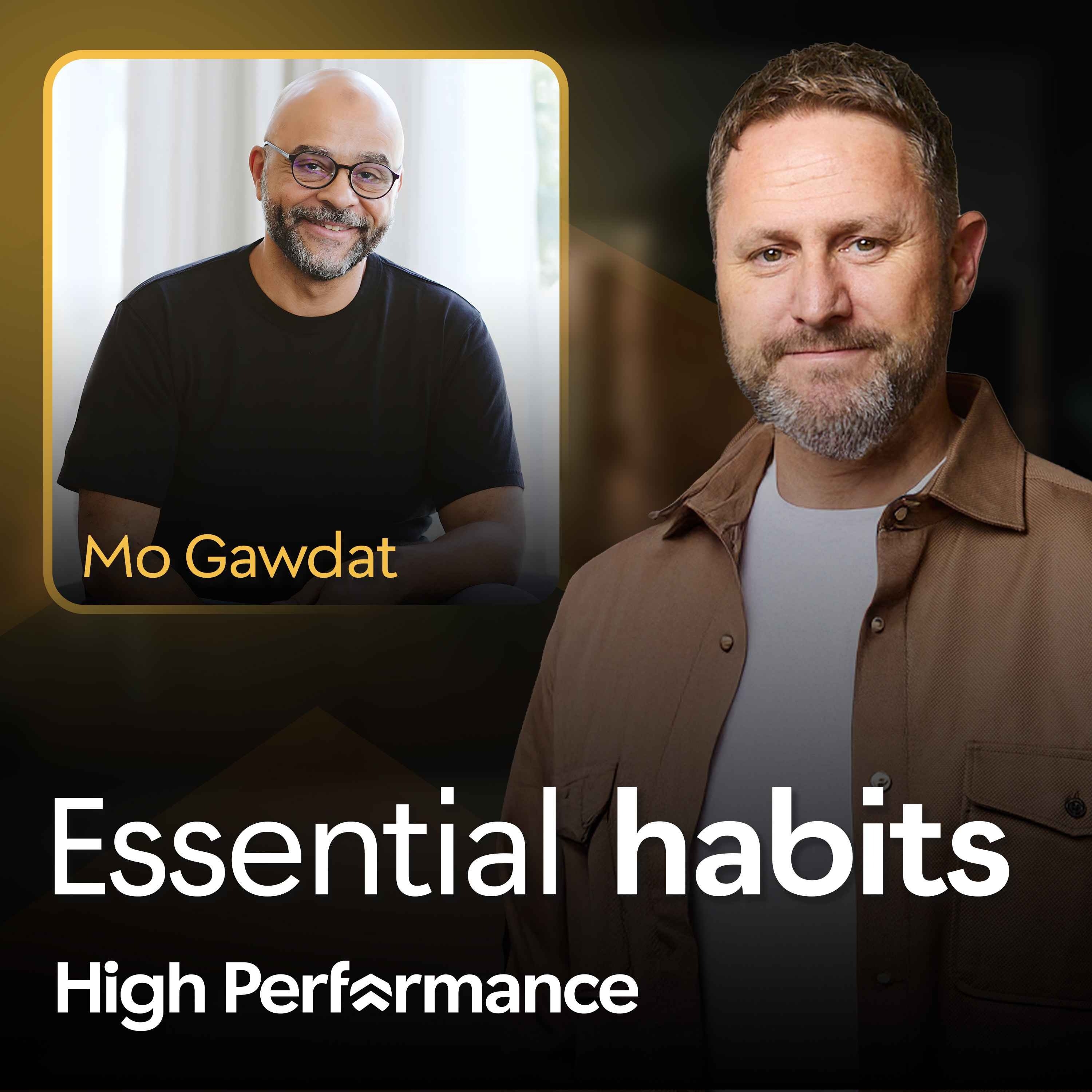
In this episode, hosts Jake Humphrey and Damian Hughes interview Mo Gawdat, former chief business officer at Google X, who shares his profound insights on navigating grief, emotional resilience, and the transformative power of a simple 90-second rule for emotional regulation. The discussion is rooted in Mo’s personal tragedy—the loss of his son, Ali—and his journey of finding happiness after heartbreak.
Written by AI. May contain mistakes.

Get the gist, explore an idea or ask about something said.
 Claude
On The High Performance Podcast, what are the key points of this episode?
Searching your listeningAutomatic transcript. May contain errors.
0:28Watch it early on the High Performance App.
0:42I'm no tech genius, but I knew if I wanted my business to crush it, I needed a website now. Thankfully, Bluehost made it easy. I customized, optimized, and monetized everything exactly how I wanted with AI. In minutes, my site was up. I couldn't believe it. The search engine tools even helped me get more site visitors. Whatever your passion project is, you can set it up with Bluehost. With their 30-day money-back guarantee, what have you got to lose? Head to bluehost.com to start now. This episode is brought to you by Opera Air, the first browser with mindfulness at its core. Now, most of us spend hours every day online, but how often do we pause to take care of ourselves whilst we're doing it?
1:24And that's where Opera Air comes in. It's a lightweight, fast, secure browser built not just for productivity, but for your well-being. With Opera Air, mindfulness is built right in. You'll find free breathing exercises, guided meditations, and soundscapes with ambient sounds, lo-fi music, and binaural beats, all designed to help you focus, relax, and even spark creativity while you browse.
1:50So say an event makes you angry. to the second that you're filled with stress hormones, to the second that you took an action and you didn't, but those hormones were flushed out of your body, is 90 seconds. That's it. You cannot be angry for more than 90 seconds. Welcome to the Essential Habits of High Performance, the show that unpacks the small habits that power big results and the thinking that separates the good from the great. I'm Damien Hughes. I've hosted the High Performance Podcast for over five years now. I've worked as a visiting professor of organizational behavior and I've been lucky enough to work with elite coaches from a wide range of different industries and sports, helping them understand how they can create high performance cultures.
2:42Most importantly, I love understanding the science and the psychology behind high performance and how we can all use it to our own advantage. In today's episode we're going to look at the 90 second rule. So this was shared with us by Mo Gowdar who describes how after losing his son Ali to a preventable medical error he set out to engineer happiness not by avoiding pain but by learning to understand it. He discovered the 90 second rule the idea that emotions pass through the body in just 90 seconds, what happens after that is a choice. Through logic, purpose and radical acceptance, Mo showed us how even in tragedy we can all find a path to joy.
3:26In the show notes you'll find links to the studies and research which I reference. Mo Gouda isn't your average happiness guru. He's a former chief business officer at Google X, a place where moonshot ideas like self-driving cars are born. But it wasn't his career in tech that changed his life. No, it was the day he lost his 21-year-old son, Ali, during what should have been a routine surgery. Ali was my son, but was also my teacher. He was also my coach. He was also my best friend. And he was truly one of a kind. I mean, I feel that his loss is a loss to the world, not just for me. But then he left our world because of a preventable surgical mistake that was fixable.
4:24But they did five of them in a row and they fixed three of them wrong. And so in four hours, my wonderful, handsome, wise son left our world. It was a tragedy made worse by how preventable it actually was. And it changed everything. For Mo, it was a kind of pain that shatters your world. But instead of being consumed by grief, he asked himself a different question. Can happiness be engineered? He turned his analytical mind towards one mission, to solve for happy. The result? A powerful algorithm for emotional resilience Built not on wishful thinking, but learning to reframe suffering Not by ignoring the pain, but by understanding it Mo described a pivotal moment One that ancient philosophers would have no doubt recognised as the battle between emotion and reason It was, as Plato put it, like a rational charioteer trying to tame a wild horse.
5:32Mo faced the grief, but he also made a choice. You can take this through logic, and you can take this through emotions. You can take it literally to hit the ground, either way. Or you can take it to try and make things better. Instead of spiralling into despair, he chose to take the logical route, to take action. He reported the case, he comforted his family, and he began the impossible work of healing. And then, something remarkable happened. Four days after the funeral, Mo's daughter shared the dream that Ali had two weeks before he died. four days after he left us, his sister Aya, he really was very, very close to Aya.
6:19And he really took care of her almost as the masculine figure, if you want. And so he spoke to her. She lived in Montreal. He lived in Boston. And he spoke to her every single day, at least for an hour, which is very unlike, you know, a teenage. He was 21 at the time. she was still in her teens. And she came to me and said, around two weeks ago, he had a dream and he dreamt that he was everywhere and part of everyone. Which, yes, just kills my heart every time. I remember it because some people say that this is the description of death. Actually, in my work in Solve for Happy, I describe death as a way to disconnect from space-time.
7:05if you want. And that basically allows you to be everywhere all the time. As a former tech exec, Mo didn't hear poetry. He heard a target, a mission, a quota. The minute I heard this, as a business executive, all that happened in my head was I heard a quota, a target. Okay, my master, my son, my best friend and my coach is giving me a target. He's saying, make me everywhere and part of everyone. And I just heard myself saying, okay, Habibi, consider it done. That became the driving force behind his best-selling book, Solve for Happy. And it underpinned the philosophy that he shares today. A path through grief into purpose, through logic and out the other side into joy.
7:57In the search for how to navigate suffering, one insight stood out for Mo. It was a rule taught by the neuroscientist, Dr. Jill Bolt-Taylor, a neuroanatomist who had a severe stroke. Her brilliant book, My Stroke of Insight, A Brain Scientist's Personal Journey, and the 2008 TED Talk she delivered, My Stroke of Insight, is well worth a watch. Anyway, let's hear what Jill Bolt-Taylor told Mo. She basically studied our behavior when we are negative. And she says, from the second you are triggered on the negative side, so say an event makes you angry, to the second that you're filled with stress hormones, to the second that you took an action and those, or you didn't, but those hormones were flushed out of your body, is 90 seconds.
8:51That's it. You cannot be angry for more than 90 seconds. Wow, okay. But then what happens is you run the thought in your head again and you renew your 90 seconds. And then you run it again unconsciously and you renew your 90 seconds. While in reality, what you get after those 90 seconds is a buffer where you can stop and say, I lost my phone. You get a mix, a cocktail of weird emotions. One is, how stupid am I? You know, I hate those guys that took it. You know, what will I do with the photos? I wish I had, you can have a cocktail of those emotions. And if you actually observe, you get those emotions and then there is that tiny buffer, right?
9:40And that tiny buffer allows you to go and say, now what am I going to do? I mean, okay, I mean, I can be angry at the world or I can go buy another phone or I can go, you know, cancel my SIM or I can, you know, go to my computer and block the phone, right? And once you get into that buffer, suddenly you move in the right direction. It's called the 90-second rule. Now here's the science of what actually happens during that 90-second period. In the first 30 seconds, your body releases adrenaline and norepinephrine, which heighten your alertness and your stress response. In the next 30 seconds cortisol gets released and that ramps up your body's fight or flight response and it helps you to focus on your immediate survival.
10:33In the final 30 seconds these hormones naturally begin to break down and leave your system and your body starts returning to its baseline. After 90 seconds the emotional storm has passed and your body has returned to a state of equilibrium. That's it. One and a half minutes. After that, the chemical storm's gone. So why don't we? Well, first of all, we replay the story. As soon as we feel anger, fear or sadness, our brains start spinning a narrative. They've just disrespected me. This always happens to me. I can't believe they said that. That story keeps the emotional loop alive. So instead of observing the feeling, we fuel it and 90 seconds turns into 90 minutes or even longer.
11:22The second reason that we don't allow this 90 seconds to pass is that we don't often recognise it's a choice. Many people don't realise there's a biological limit to that first emotional wave. We assume that once anger hits us, we're stuck with it until the external situation changes. But, as Jill Bolt Taylor teaches Mo and us, the initial reaction is chemical and short-lived. What happens next is entirely up to us. Most of us simply haven't been taught that we can step back and choose how we respond. The third reason we don't is that we're often addicted to reactivity. Now this one's a bit more subtle.
12:01Emotional intensity, especially anger, can actually feel energising. It makes us feel alive or righteous or even powerful. Over time we can become habitually reactive, subconsciously seeking the drama of emotion over the calm of regulation. Waiting 90 seconds requires a degree of mindfulness. And let's be honest, that's harder to do than snapping back at somebody. Think of it like this, right? We call these chemicals names like anger, sadness, frustration. They enter us like a wave and you can't stop them, but you can learn to ride them much better. And if you wait just 90 seconds, that wave eventually washes out.
12:45From there, well you can choose what happens next. So how do we take control after those 90 seconds have passed? Well Mo describes how he created a mental flow chart to guide his thinking. one that any of us can use when life goes off script by asking ourselves three simple questions i basically put that buffer in a flow chart and it's a very very simple way for me because i always say if i were to teach the world happiness i'm not qualified i try my best but i'm not like the big you know teachers i need to be the olympic champion of the sport i need to be someone that lives what I preach, right?
13:26And so I basically measure how quickly I bounce back to happiness from unhappiness. We all feel unhappy every now and then because events miss our expectations. It's a survival mechanism, right? But how quickly can you take an event that missed your expectations and then bounce back to, I can deal with this, right? For me on average, and I'm not bragging, this is actual statistics, it's seven seconds, right? Seven seconds, other than a few times a year where it might be an hour or a day, but regularly the little things that upset us all the time, they last seven seconds. Okay? And seven seconds because I go through a flowchart.
14:03And the flowchart is very straightforward. Is it true? Can I do something about it? Can I accept it and do something despite its presence? Right? And it's really not that intelligent when you think back about it. So go for it. Is it true? Is it true? 90 % of the things that make us unhappy are not even true. Like your boyfriend or girlfriend says something hurtful on Friday, your brain is telling you he or she doesn't love you anymore. Okay, that's not true. That's your brain's, you know, magical work on making a scenario that can win the Oscar, right? The truth is he or she said something hurtful.
14:40That's it. That's the truth, right? You want to get to the point of they don't love me anymore. There is a lot more analysis that needs to be done around that, okay? And most of the time, if you actually just ask the question, is it true? Most of the time, you know, you find that it isn't. So you go to the second. If it is not true, drop it. If it is true, you go to the second. And the second is very straightforward. You know, can I do something about it? Can I do something about it? It's the answer to high performance all the time. It's the right way to handle a problem. So can I do something about it is simply do it.
15:17If there is something you can do about it, do it. Don't sit in the corner and cry like a baby. It's not going to fix anything. You're not six-year-old anymore, right? So if there is something you can do about it, do it. The Jedi Master level of happiness, however, is if there isn't something you can do about it. Losing Ali, okay, you can't do anything about it. He's gone. There's nothing you can do to bring him back. And that is what I call, this is basically what I call committed acceptance. Committed acceptance is to say, not the best scenario life. I would have preferred if you'd had taken us in another scenario, but I have to acknowledge that this has happened.
15:53And so if it has happened, can I accept it, accept it as a reality, the new baseline of my life and do something despite its presence to make my life better or the life of others better? Do I want to sit in a corner and hit my head against the wall because Ali left? Yes, I do. But how, what difference will that make to life? What makes a difference to life is I sit down in a corner, write what he taught me about happiness, share it with the world. So he's remembered and the world is a little happier. So that, you know, when I wrote that flow chart, it's part of my next book, That Little Voice in Your Head, I basically realized that our brains are constantly hurting us, okay?
16:36They're constantly incessantly thinking about the wrong things. And that what you want, there is nothing wrong with thoughts. What you want is to think the right thoughts. And the right thoughts are useful thoughts or joyful thoughts. Okay? The way to find your useful thoughts is to go through the flowchart. Analyze it if it's true. Can I do something about it? Or can I accept it and make the world better despite its present? Now think about how you can regularly ask yourself three questions. One, is it true? Two, can I do something about it? Three, can I accept it? and do something despite its presence.
17:14Now, according to Mo, 90 % of the thoughts that make us unhappy aren't even true. So if it's not true, we can let it go. If it is true, you can take action. And if you can't take action, well, then we have to accept it and move forward anyway. This isn't just self-help. It's actually a survival guide. It's what Mo calls a Jedi level of happiness. the jada master level of happiness however is if there is isn't something you can do about it losing ali okay you can't do anything about it he's gone it's nothing nothing you can do to bring him back and and that is what i this is you know basically what i call committed acceptance committed acceptance is to say not the best scenario life i would have preferred if you had taken us in another scenario but i have to acknowledge that this has happened and so if it has happened can i accept it accept it as a reality the new baseline of my life and do something despite its presence to make my life better or the life of others better you might not like the reality but if you commit to making life better despite it you honor your pain and your potential now let's take a moment to translate mo's insight into something practical our essential habit something you can use the next time life catches you off guard.
18:36So here's the moment when you feel yourself being triggered. Pause. Get into the habit of pausing. Watch the second hand of a clock if you like. Breathe but wait 90 seconds. Viktor Frankl, a Holocaust survivor and a renowned psychiatrist wrote in his amazing book Man's Search for Meaning. between stimulus and response there is a space and in that space is our power to choose our response in our response lies our growth and our freedom you are not your reaction you are the space between stimulus and response and in that space is where your power lies not just to respond but to choose the direction of your response so get into the habit that next time somebody cuts you up in traffic, the next time your teammate drops a ball, the next time life doesn't go according to plan.
19:33Don't let the emotion hijack you. Instead, remember the rule, we're going to ride the wave, we're going to feel it, we're going to watch it and we're going to let it pass. Once it has done, we can ask ourselves, is it true? Can I do something about this? Or can I accept it and move forward despite its presence? Those questions are the levers that move you from reaction to intention, from suffering to clarity, or in Mo's case, from grief to growth. Because what Mo teaches us is this. Happiness isn't luck. It's not even emotion. It's a habit. And it's a habit that begins in just 90 seconds. Now, I'm going to be joined by our brilliant producer, Will, who's been with us here on the podcast since the very beginning.
20:23We're going to have a listen to some of the other great lessons which Mo shared with us.
20:31If you're still overpaying for wireless, it's time to say yes to saying no. At Mint Mobile, their favourite word is no. No contracts, no monthly bills, no overages, no hidden fees, no BS. I made the switch because I was tired of those ridiculous bills and sneaky charges from my old provider. With Mint, I'm paying$15 a month and getting the same high-speed data, unlimited talk and text and coverage on the nation's largest 5G network. Honestly, the quality is just as good, if not better than what I had before. And the best part, you don't need a new phone. You can keep your current one, bring your number and all your contacts.
21:06I use Mint Mobile and you should too. Ready to say yes to saying no? Make the switch at mintmobile.com slash HPP. That's mintmobile.com slash HPP. Upfront payment of$45 required, equivalent to$15 a month. Limited time new customer offer for first three months only. Speeds may slow up a 35 gig on unlimited plan. Taxes and fees extra. See Mint Mobile for details.
21:51Go to Upwork.com now and find your freelance expert. That's U-P-W-O-R-K.com. Post a job for free and get started today. I'm no tech genius, but I knew if I wanted my business to crush it, I needed a website now. Thankfully, Bluehost made it easy. I customized, optimized, and monetized everything exactly how I wanted with AI. In minutes, my site was up. I couldn't believe it. The search engine tools even helped me get more site visitors. Whatever your passion project is, you can set it up with Bluehost. With their 30-day money-back guarantee, what have you got to lose? Head to bluehost.com to start now.
22:33This was one of those episodes, I think, where you just forget how much great stuff there is in it, how much wisdom, how much value. When you listen to it again, it just all comes flooding back. some of the stuff that we're now listening to we've just sat and gone we forgot that do you remember that and it's such innate wisdom that it feels so familiar but actually it's also incredibly fresh all of those little things that's why i love this series is that we can remind people of all this other like uh gold that was in there well the very first episode we did will was with um joe malone where she spoke about wisdom going through your hands like grains of sand and i think this is a great reason why joe opened the series but now we're starting to delve into the insights of so many incredible guests and mo is just one of them yeah i remember shooting with him on the days we're on location weren't we we were filming it over there the the near the gherkin that's right and we were looking over like the city and then uh and the but mo came in We were in a small little room together and we did a few podcasts that day.
23:43And I knew of him. I didn't know loads about him, but his story of the life he lived and then the loss of his son was really emotional. Well, it resonated with me a little bit deeper because I was quite deep into the grief process of losing my dad around that time. Yeah. and I hadn't really articulated it to the team that well. And then listening to Mo talk about the loss of his son, Ali, sort of really opened up my emotions to be able to start to process it and understand it at a deeper level and be able to share that with people rather than just sort of trying to paint a smile on and crack on with life.
24:32it asks questions of am I doing things the the right way am I living up to the values I want to you know want to live up to and actually when I was listening to some of the clips I was thinking that even when I came to work on this podcast I was working in a in a job where I was happy like I was working with people that I liked and I was working at a company that was doing well but it was just i don't know whether it was that's like the time of year of the time the age you're at the point in your life you're at but it was missing this just why the purpose of it like this is great i'm not unhappy seemingly doing okay but is what i'm producing and making and putting out there is it valuable do you think for you that was some of it with having kids you You know, like your kids are still at a young age, especially when you joined the podcast.
25:31Do you think it was more becoming a parent had an impact on that decision? Massively. Massively. Because? I think you're aware that when you're older and you stop working as much and your kids grow up and they start having conversations with their friends around what does your dad do or what does your mum do, what are they going to say? Right. And it's like, what are... are you going to be proud of what they're going to say to everybody else that then mirrors down all their generations? And that sounds quite deep, but it is a little bit like, yeah, he did this thing and it turned into this and it was listened to by or watched by a few amount of people and did okay.
26:13I think you just want to be kind of proud of that. Yeah, of course. Well, that goes back to the legacy and the sense of purpose, don't you? You want to know that what you do matters. Yeah. And it does matter well. Thanks, David. What clip should we start with, Mike? There's one bit where he talks about the idea of stop chasing and start living. I think it comes really powerfully from him. He's scaled what lots of people looking from the outside on would go, oh, I want that and then I'll be happy. I want the big salary. I want the posh house. I want the fancy cars. He's had all of that. and he's got some important views from the top of that mountain to share with us.
26:55I'm chasing nothing at all. I'm performing really well at the tasks that come at hand. Yeah. But I'm chasing nothing at all. There is such an interesting side and it's not just because of losing Ali. Of course, losing a loved one puts things in perspective, right? Losing a child is probably the hardest experience ever And also I think it puts everything in perspective more than anything I could think of. But that's not the issue. The issue is that I've been so successful. There was a point, and I am ashamed to say it, I swear I'm not bragging. There was a point where I had 16 cars in my garage, right?
27:36And, you know, you can only drive one. I lived in a nine bedroom place with, you know, a mega garden and a massive swimming pool. you can only sleep in one bed. And somehow, you know, when you go along, you know, along the Maslow's hierarchy of needs, you realize that what makes you happy becomes less and less of an ingredient for your happiness, the more you've experienced it. You know, interestingly, most of what we were told makes us happy. I differentiate heavily between happiness, which is serotonin in your blood, you know, calm and peaceful contentment when you're okay with life as it is, and excitement and elation and fun and pleasure and all of those other replacements that are dopamine in your blood.
28:28Dopamine basically is a reward, jolt of reward in your blood. Basically, your body saying, oh my God, that feels amazing. I want more of it. Now, Now, when you differentiate between the two, you see that dopamine is addictive. So the more of it you have in your life, the more you downregulate for it. You don't feel it anymore. And so, yeah, you get the first car and you think that you're the king of the world. And yeah, the second car is not really that big of a deal. And the third is like a disappointment. And the fourth is like, what am I doing with my life? But then you continue, right? We're all deluded in that way.
29:09And I think what happens in reality after, maybe not just because of the loss of Ali, but perhaps because of age and because, I don't know what to tell you, Jake, I have seen everything. I've seen everything. I've seen every pleasure, every joy, every pain, every suffering, every test. I've seen so much. It's weird. And so after a while, you somehow look at all of it and you go like, yeah. so you know do i want one more of these i mean should i spend a minute of my life chasing one more of these and and the funny thing is when you stop chasing everything falls in place yeah uh actually listen did you like that i like that i do and uh it's easy to get sucked into that though easy to get sucked into that way of life and you do sometimes have to like, you know, I live in a part of the Northwest, close to Damo, where there are people on one side of the town who have the houses and the wealth and the cars and then people on the other side that don't.
30:16It's very easy if your circle starts to include those people to get sucked into, do I need that? Do I need that? Do I need a bigger garden? Do I need a better car? But you don't. And when you're trying to set those values for your kids and everything, and for them to go, it's something that I literally have to ask myself and check myself on quite a lot. So should we listen to another one? Yeah. What are you thinking? Well, again, it fits this whole idea of, like, don't try and boil the ocean, just focus on your little small world, innit? But Mo's Reminder came from an unusually young but incredibly wise source.
30:57So I'm in that TED Talk mentality. You know, most of my life, I'm like, okay, we're going to do something amazing. And that's going to change the world. And it's going to be worthy of 18 minutes on stage. And then, you know, we'll set the next thing. And he comes and sits next to me and says, Papa, I have to tell you something. He was 16, I think, at the time. Papa, I have to tell you something, but it's going to upset you. I was like, I learned, I swear to you, this boy was so wise. When he said, I want to tell you something, I listened. Okay. So I said, no, no, Habibi, tell me what you have in mind.
31:29He said, but you're going to be upset. No, just please tell me. And he said, Papa, you're never going to fix the world. I was like, why, Ali? Why don't you have that spark? Why are you not dreaming of the TED Talk, sort of, in my head? And he said, Papa, the world will always have people that are suffering. The truth is you're never going to fix it. You're never going to fix it. You may impact it a little bit. If you learn to first fix your little world, damn you, Ali. That was totally the opposite of what I did in my life. He basically said, look, if you fix your little world, life will trust you enough to make your little world a little bigger.
32:15If you fix that, it will be a little bigger and a little bigger. So if you really want to change the world, you fix yourself. and if you fix yourself, we will trust you, diplomatically saying, we don't yet, okay? And then you'll change us, me, my sister and my mother. And then if you do that well, then maybe your department at work and then maybe your company and then maybe your country, right? As long as you keep doing it right. And he directed me to a documentary on Netflix, Gyro something, the sushi maker. Basically, when you're a sushi chef, First, they start you off fanning the rice. For years and years, you fan the rice, okay?
32:58Until you really fan the rice really well, then they'll have you wash the dishes or something else. And then they'll have you wrap the first one. Years and years later, when you consistently did the right thing, you become the master chef, right? And that's the game. The game of life is we want those shortcuts. But those shortcuts for so many of us that got them, end up with a disaster because you positioned yourself in a place that was bigger than where you are i found that quite moving you know i think it's knowing that his son isn't around and you know god how much what wisdom a little person can have you know it sounded like an incredible uh an incredible human being um but yeah how often can we overlook the inner world around us trying to chase bigger things and change everything the fact that he's open to listening to his 16 year old son challenge him you know when he says the idea of that when he said listen i switched on and paid attention to it and i think it takes real humility uh on most part to be open and vulnerable to uh to his to his son yeah i think there was another guest we had who said you know if you're lucky you'll get to affect you know you should affect you affect the people around you you know your closest family your friends then some people might start to you know affect than their town, their village.
34:23And then as you get, some other people might then start to affect their region or their country. And then other people might get to affect the whole world. If you're a true high performer or you have that ability. But most of us only kind of really concentrate on affecting the immediate people around us. It's not saying don't have ambition, but don't lose sight of what's important in your inner circle around you. and be where your feet are you know it was rung and chatters you the first interview we did with him was like smile at the person that makes your cup of coffee in the morning say good morning to the bus driver that's what we mean when we talk about your world don't think that I'll do it when I've got a status or a platform or a voice that's a number of followers that are listening to me do it wherever you are be where your feet are and that's why Mo's wisdom there really resonated with me yeah and that kind of leads us on maybe to the last clip we're going to talk about and the final lesson we'll take from Mo's episode.
35:22Yeah, I love this one because, you know, we sort of conditioned from sort of reality TV now that everyone goes on a journey. And Mo actually says that a journey is a path that you've been on before, you know the route. He's got a different definition for it. We're all on a quest. Look under your feet, not at the target. That's the way you don't know, not to miss a block. So the idea is I know on my next startup that if I did the right things, the startup will shine. Right. But if I start my next business focusing on the startup shining, I don't get all of the blocks ticked on the way. Right. What I need to do is I need to say this is where we're heading and these are the blocks I need to step on.
36:11At least that's how I see it now. I will look at those blocks and do them to the best of my abilities until they're as perfect as they can be. And I will stop every day and reflect if those next three blocks are still my next three blocks. By the way, most of us don't realize this. Most of us don't realize that life is a quest. It's not a journey. Okay. The difference between a journey and a quest is a journey is a trip that you've done before. Okay. You know the path. I'm going to go here and then I'm going to turn left and then I'm going to, right? Most of our life is a quest. We've not done that before, right?
36:48You take a couple of steps and it's almost a quest in deep fog, right? You take a couple of steps forward and then you stop and you reflect and you say, is this really still the right direction? Or maybe should I go left a little bit? And then you take one step to the left and stop and assess and say, should I continue? That's how life is when it comes to our relationships. First you fall in love with someone and then you go like, hold on, hold on, that's not the right thing. And then you go a little bit to the right and say, no, I want a taller one. And then, oh, no, no, hold on, taller is like a little too much for me.
37:21I need one that is smarter. And you just keep going through that quest until eventually you say, aha, now I know, right? Now I found out how to tread that journey. and then you go fall in love with the right person that fits you and then go along that journey, ticking those boxes one by one and then end up in the right place, right? And applies to everything, to your business, to your finances, to your happiness. Well, that brings us to the end of our quest today to try and explore about the 90-second rule, how we can control our emotions, which was the first part of this conversation. But hopefully you've enjoyed listening to some of the other truth bombs that Mo was dropping liberally in that first interview we did with him.
38:08And if you want to explore it, I'd encourage you to go back and listen to the whole interview in full. But more importantly, if you've enjoyed this episode or any of the ones from the series, why not share it with somebody that you love or you care about that maybe you feel it can resonate or help them live a life of high performance, however they choose to define it. So thanks for your time. Thanks for coming with us on our own quest. And we'll look forward to catching up with you again soon.
39:01Good times, hard times, and of course, family. Always family. So pull up a chair and join us at Fremont Avenue, a world premiere play only at Arena Stage. Performances start October 8th. Tickets at arenastage.org. At Capella University, learning online doesn't mean learning alone. You'll get support from people who care about your success, like your enrollment specialist who gets to know you and the goals you'd like to achieve. You'll also get a designated academic coach who's with you throughout your entire program. Plus, career coaches are available to help you navigate your professional goals.
39:39A different future is closer than you think with Capella University. Learn more at capella.edu. Hey, I'm Dr. Z and I'm a neurosurgeon. So that means long hours, early rounds, late nights, and everything in between. And through it all, I wear figs. They're comfortable when it counts and functional when I need them the most. So where do you wear your figs? On shift, on call, on the couch in the break room listening to this podcast? Wherever it is, they fit right in. And now listeners of this podcast can get 15 % off their first order. Just head to wearfigs.com and use code FIGSRX at checkout. That's wearfigs.com, code FIGSRX.
Mo lost his son, Ali, in a tragic and avoidable surgery. It’s the kind of grief that could break anyone. But instead of shutting down, he turned toward the pain, with honesty, logic, and a question that changed everything: Can we train ourselves to be happy, even after heartbreak?
One insight stood out: the 90-second rule. According to Mo (and backed by neuroscience), our emotions only physically last 90 seconds. What happens after that? That’s on us.
In this episode, we explore how to ride that first emotional wave, how to challenge the stories our brain creates, and how three simple questions can help us shift from reaction to intention.
This isn’t about pretending everything’s okay. It’s about learning how to respond when it isn’t.
If you’ve ever felt hijacked by your emotions, or just wanted a way to move through them with more clarity, this one’s worth your time.
Listen to the full episode with Mo Gawdat: https://pod.fo/e/140b32
Here is more information on the studies referenced:
1. 90 Second Emotion Rule (Dr. Jill Bolte Taylor, 2006), My Stroke of Insight: A Brain Scientist's Personal Journey
2. Space Between Stimulus and Response (Viktor Frankl, 1946), Man’s Search for Meaning
Hosted on Acast. See acast.com/privacy for more information.


