
 Ask ChatGPT


 The High Performance Podcast
5 Nov 2025 · 47m
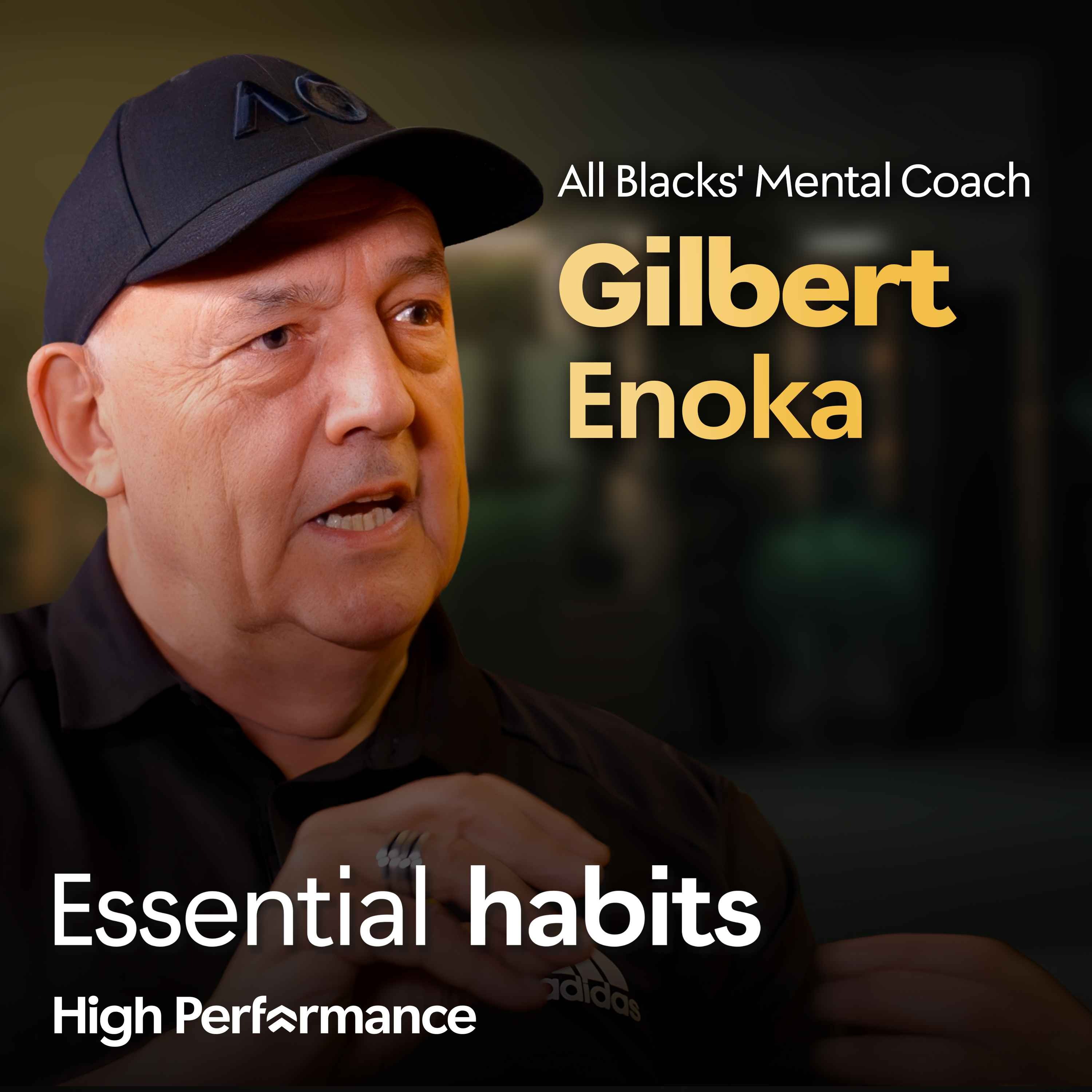
In this episode, Gilbert Enoka shares his personal journey and insights on high performance, character development, and emotional intelligence, which have contributed to the success of the All Blacks rugby team.
Written by AI. May contain mistakes.

Get the gist, explore an idea or ask about something said.
 Claude
On The High Performance Podcast, what are the key points of this episode?
Searching your listeningAutomatic transcript. May contain errors.
0:02Welcome to the Essential Habits of High Performance, where we explore the mindsets and daily practices that help us all lead better lives. Today, I'm excited to announce that we're joined by Gilbert Inoka. Gilbert's widely regarded as one of the most impactful figures in modern day sport. As the mental skills coach for the New Zealand All Blacks, Gilbert helped transform one of the most successful teams in history into a dynasty, winning back-to-back Rugby World Cubs. What's most powerful about Gilbert's work isn't the trophies themselves, It's in the small counterintuitive daily habits that allow that level of consistent performance to manifest.
0:45Habits that focus on emotional control, humility and deep self-awareness. And here's the thing, these aren't just lessons for elite athletes. They are profound strategies that you can apply to your own life. Whether you're leading a team, navigating a high-pressure career or simply just trying to be more consistent in whatever you do. It's a real privilege to welcome Gilbert Anoka to the Essential Habits of High Performance. Well, Gilbert, thank you for joining us today, mate. It's a real honour to have you here. My privilege. Thank you, Damien, for having me. Well, your journey's taken you from teaching to advising the most elite sports teams in the world, and most famously amongst those teams is the New Zealand All Blacks.
1:31You've said that in high performance, the biggest opponent isn't the other team, it's yourself. So I'm interested if you'd tell us, Gilbert, how did those early experiences shape your focus on this inner game? Hugely. You know, sometimes in life you have no choice but to go through things. And my childhood was challenging. Spent 12 years in an orphanage. Was in a place where I didn't have any connection or any belonging and the insecurities that are attached to that sort of existence are huge. and so I met a lot of challenges around what I had to do to keep myself sane and keep myself whole, survived through it rather than thrived and by the time I got a chance to look back, I got some understanding around the fact that in the end I couldn't control my circumstances, that the things that were happening to me and around me were out of my control and that it was the choices I had to make rather than the chances I was given that could make a difference.
2:38So I kind of began to look in the mirror rather than through the window and blaming people and started to look at the changes that would enable me to own my situation and own my future were forged in my own attitude, you know, that I'd never rise above the opinion I'd have of myself, that the choices I'm making are more important than the chances I get. And so I began to live those and they gained strength as I moved through my life. One of my favourite phrases is the ghost of our childhoods that still rattle around our adult body. What are the ghosts from your upbringing that you're still wrestling with?
3:18All of them. You know, you don't go through a childhood like mine without having scars. You know, I kind of look at the photo and I don't have, it's interesting, I don't have many photos of my childhood, very, very few. But the ones you do see of myself and the people around, you see an emptiness inside the individuals that you see in the photos. So, you know, when the human being doesn't have love and doesn't have nourished love, you know, it implodes a little bit from the inside out. And so the ghosts for me are continual. It's a constant battle from within for me. Has been all my life. As I've got older, I've got better at recognising the triggers.
3:59so I can catch them when they're a spark before they become a flame. And I guess that's been the most helpful thing to me. But still there, I think will always be there. I have no bitterness because of it, and so I've worked hard at strategies that enable me to keep myself moving through those situations. And if you don't mind, what are some of those triggers? Oh, the triggers, it's funny, like any senses, I'll see people who are being dealt with in a certain way where they've not been valued or they are feeling lonely in their own way, and that can trigger a sense. There's smells, certain smells that you have just trigger memories.
4:46Where we lived was in a big orphanage, and we basically, it was a big, it was like the good life, you know, everything. You planted your own food, you did all the workings, you stacked firewood, 30-odd truckloads every year. So you did all the work yourself. So lots of triggers come from the smells that you actually get. And it's more what I see other people going through that triggers different things for me now. Well, I can imagine that some of those experiences help shape you to become the mental skills coach in environments where people are operating under pressure, where you become quite astute at observing behaviours, observing people's emotions in real time.
5:29Absolutely, Damien. When you're deprived of the emotional nourishment I was, you become super sensitive to when it's not existing in other people. So I taught at a high school called Hillmorton High School in Christchurch. Low decile, tough kids. A large number of the kids didn't want to go to school when they schooled, when they went to school didn't want to go to class and when they went to class they didn't want to learn. And so I cut my teeth in that environment because I had experienced a lot of those, that neglect and that emotional turmoil was challenging and so I became super sensitive to that.
6:08In the All Blacks I'd always go on the bus 15 minutes before any of the players got on the bus before training, before games. I'd go to meetings for 15 minutes before anyone would go to a meeting. Why? Because I wanted to see what that person was like when they walked through the door. So is Damien the same as he was yesterday? Am I picking up any cues that are different about the way he is? And then, you know, once you get really skilled at that, I could mobilize a leader, could mobilize a coach, or could do something myself to help the individual because when you can meet an unexpressed need in someone else, it's a game changer.
6:51And if you can become an emotional detective, set up structures where it'll allow you to pick that information up, you become powerful with the people that you live with and lead with. But tell us about being that emotional detective then. What were the kind of clues that you were looking for? Body language, sometimes people, you know, just the way they hold themselves, the voice that they were using, Someone who's normally quiet's more vocal. Someone that's more vocal's more quiet. How they're connecting with the people around them. They're all cues that give information about where that person is today.
7:28And that's the key. You've got general impressions, but if I don't meet you at where you're at today, then I can't move you. In an environment like sport where it's volatile and the world's coming at you hard and fast, If you don't go through the right door, you can really be a problem in trying to get the movement you want and the individuals you work with. And you said about meeting unmet needs. What are the most important of those needs that everybody has? Connection, inclusion. I talk a lot about belonging. And a lot of people talk about the differences that exist in teams. We can't get on because we're all different.
8:12You know, I work with Chelsea and, you know, you go in the changing room and there's 13 different languages spoken. But difference is never the problem. The lack of connection is. And so if we don't work hard at setting up structures that enable people to connect with each other, then we don't actually create an environment that's strong enough to hold the tension that exists in sport and in environments and conversations that are tough. So give us an example then of a moment, a connection, of how do you foster that? So every time I see you for the first day, I shake your hand and look you in the eye.
8:49Right. And if you've got 30 people in your team, that every day, the first time they meet somebody, they walk up to them and they say good morning or hello. You only have to do it for the first time. You're automatically making all these connections as opposed to 30-odd people drifting into a room, sitting down, being alone, without having that connection. I have a concept called plus one. So to be a professional athlete, if it requires you to do 10 things in your day, you've got to do one more. Who do you think that's for? The teammate. That's right, someone else. And so if everyone's doing what they need to do to be right, but one more, then you're feeding this connection which becomes so much more difficult to break when you get inside the tension that sport creates.
9:36And so they're never big things, Damien. They're never, you know, they're just small acts. It's like putting drips into a bucket that fills in a way that becomes really, really strong. And I always say the athletes are the bricks and the connection is the mortar between it. And you've got to really work hard at getting that mortar strong. your name has been mentioned several times on the high performance podcast by people that have been fortunate enough to work with you Gilbert most notably Dan Carter spoke glowingly on the two occasions where we've spent time with him it brings us to the first habit though that Dan told us that you were central to which was he described the All Blacks as being the best team in the world when it didn't count and he said that whenever they came under pressure those connections those moments of belonging seem to be remarkably fragile.
10:32And the example he offered was in 2007 in the World Cup quarterfinal against France. He then explained how you were central of introducing the MAD group, the mental advisory department. Great name, right? Is that right? Yeah. Where he spoke to us around the red and blue head thinking. Yeah. Would you tell us a little bit about that? Yeah, look, redhead and bluehead thinking is topical and it's a wonderful description of the way in which the mind works, the brain works. What I believe is that you can only win when your mind is stronger than your emotion. That's a fact. Yeah. Can you stop your emotions?
11:11No. And the way our brain reacts is that those survival instincts and the way our brain reacts is what we call the red system. It happens without us thinking. I quite often ask people, what comes first, your thoughts or your feelings? They go, hmm. I said, oh, well, next time you're out on the road and the car pulls out in front of you, ask yourself the question. And then after that, then when the blue brain kicks in, that's sort of managing your response. So you've got a survival instinct, which is the red system, and then you've got a thinking decision-making system, which is your blue system.
11:47And so what we want to be able to do is we want to be able to use the blue system to manage and keep that red system in control. And we do need a bit of that because that's where your fire comes from. So you don't want to quell it totally. Too much blue means you overthink, you get stuck in your own thought processes and you can't get out of your head. Too much fire, too much red means that all your energy and effort's all over the place and you get reckless, you're late tackle, your decision-making becomes tunnelled and you don't pick up the information to act. But in its essence, if you understand that the only win when your mind's stronger than your emotions and so that if your mind then becomes a skill set that you've got to develop.
12:35It's interesting, Damien, you talk about 207 because we wanted to avoid pressure and it was embarrassing really. And to be honest, I was the problem. Because that was my domain and the thought that pervaded the time was that let's go to France and what we don't want is we want to avoid pressure. We don't want it. Let's stay out of where all the people are staying in our own little place and avoid all the combustion. And then when the waves of pressure hit us like they did, we crumbled like a deck of cards. And then I looked at myself and said, well, you're the problem. So I had to upskill myself in areas in and around how to deal with pressure.
13:19And now fast forward, we've learned that pressure isn't the enemy. It's the arena. You know, as the book says, pressure is your lifestyle. When you're playing in the sport that we're operating in or any sport, you get inside that bubble. You're not trying to rise above it. You just get inside that bubble and you say, all right, this is the discomfort that's associated with pressure. Beautiful. This is what I've prepared for. And then I developed skills, both red skills, blue skills, to enable myself to navigate my way around it. So will you tell us some of these skills then? Because I think our listeners are intrigued.
13:57Like we know from the feedback we get from them that this is the kind of stuff that they want to adopt in their own lives. There's two parts to it. One is an understanding. Yeah. And one is a skill set. So the understanding is around the fact that something like you can, And you can only succeed if your mind is stronger than your emotions. Another understanding links into to be a high performer, to nail high performance, you don't have to be special. You don't have to be gifted. You've just got to be ready. You've got to be prepared. So you asked me the question, what are some things you need to do?
14:31So people get under pressure, and I hear a lot of people say in those situations, they'll sit down and say, just focus on your next task. Just focus on your next task. I hear it a lot that people say. But if your emotions are up in the air like that and you focus on your next task and you haven't steadied your emotions, then it's a problem. So there's a step before that. And so the skill, how do I steady my mind? So if we think steady the mind before I focus on the next task, that can involve breathing for some people. It can involve getting the attention out of your head. Like if I said to you, push your big toe against the floor now and then on your right foot, then left foot, then right foot, then left foot.
15:17And where's your attention? On your big toe. On your big toe. So you've got it out of your head. So have tools that can get your attention and can steady your mind. Think of the moment. Shrink the moment. So don't make the moment. Don't take on the mountain. Just move the next rock. And so it might be, I'm in the middle of the game. The pressure's really hitting me. Yep, Gilbert. Yep, I understand that. I'm steadying the mind. Now I want to shrink the moment. The first two steps, get off the ground quickly. First two words I want to say to the teammate I see. So I shrink the moment, and by doing that, the next minute I'm into the next moment.
15:55And then if you win that moment, and then win the next moment, moment upon moment, that's how momentum's created. And so they become tools that you can practice. Sounds simple, eh? Oh, it really is. But I was unfair then by mentioning 2007, because that was a dark time. Can you tell us when this work that you did on helping them prepare to cope and deal with pressure manifested itself in a way that you're proudest of? After 2007, it was horrific, to be fair. Our country wasn't ready for the All Blacks failing, you know. And one of the things I'm really proudest of is the way in which the country embraced the fact that, you know, we're playing a sport.
16:39You know, no one's dying and, you know, it's a sport that people are playing and they're giving it their best. And so we developed and the bravest decision was made when the late Jock Hobbs, who was chairman, reappointed Graeme Henry as coach. And so we'd gone through a history of start here, go to a World Cup, we fail, sack the coach, go back here. This coach comes to World Cup, fail, go back here. This coach goes to World Cup, fails and go backs here. So in 2007, we get there and somebody said, what if we start here? These guys aren't bad coaches. And they can learn from this. And that's exactly what we did.
17:21With trepidation, there was pride, but then we could look back and begin to move forward. And that really only got manifested when we won by 1.87 against France in 2011. and the small margins, you know, like if we lost 8-7 and, you know, I fast forward to 2023, like, sorry, 8-7 in 2011 when we won the World Cup. When we finished the next day, we had a parade of 200 ,000 Kiwis around the streets. Fast forward to 2023 where we lost to South Africa, 11-12, one point, and we got back to the airport. There wasn't one person waiting at the airport, the small margins. But proudest in 11 because of the scars of 07 and to a certain degree, you know, we had dampened them.
18:14We didn't ever remove them. That 2011 World Cup was played in your backyard as well. So the pressure was acute. You know, you had a lot of injuries as well as the weight of expectation. Was there a certain moment where you saw an athlete that you'd worked with really embrace pressure rather than allow it to envelop them? Yeah, look, I think there's no better example than our skipper, Richie McCaw, you know, who we talk about in the book the growth of the goat because he went through the furnace. Boy, that 207 burned a young captain. And then he decided that, you know, what am I going to do to enable myself to lead the team at the next World Cup?
18:55Well, I'm going to do anything. And for the first time, he began to embrace, you know, of working on himself and especially the mind, you know. And as with most things with pressure, you know, where we had tried to avoid it in 07, we wanted to embrace it. We wanted to lean into it. And we wanted to say, you know, boy, what if we fail? What if we win? He used to verbalise that. He'd stand up in front of the guys and say, you know, most people out there saying, what if we lose? And we feel the tension and the weight of that burden. but if you reframe that and say, what if we win? And even just saying that, what it does to you, to the human spirit and lifts it, and we get to do this, how lucky are we?
19:42And so the whole reframing around that pressure and then putting the work in because I kind of like the phrase, it's easy to sweat. And a lot of people think they only work when they sweat, do intervals, do weights, do aerobics. but when do you sit down and say, the plan I'm working on is not working. What am I going to do now? And you take yourself to that uncomfortable space and you begin to work in that space, not comfortable. Don't spend long periods in it, but you've got to go to those dark places. And that's what we did. And we went to that, but as a reframing of the situation and led by the captain.
20:26and he went through, I know, from that final. Every situation as a captain, he said, if this happens, what am I going to say to the boys? How am I going to stand? What's my posture? What's my body language? Wow. And practiced it. Didn't just… With you? On his own. Right. He'd talk about it, but he would then spend time on his own and he would talk about it and at times verbalise it. Too many people try to work through adversity when adversity hits. Yeah. But if you can, you know, later on we introduce the notion of what we call squeeze drills. Go on, let's explain them. So, do you play rugby yourself at all, Damien?
21:06No, no. But if you did, you'd make a very, very good player, by the way. Oh, well, thank you very much. Let's say you were a halfback. Yeah. And you were feeding the ball from the base of the scrum out to Dan Carter in the first five or something like that. So most people when they were training would do 10 repetitions where the ball's there, pass, ball's there, pass. But in a game, you've got somebody who's trying to slap the ball out of your hand, is in your face, is calling you names. And so a squeeze drill is where we squeeze the context and put pressure on you and you have to execute the skill amidst that arena of pressure.
21:42And so athletes, you talk about habits. Don't ever have a training session where you don't actually incorporate some degree of squeeze in your drills because in a game you're going to get your fair share. And so we began to introduce that component into our training. So you never get perfect in a game. Yep. All you've got to do is get the outcome you want. And so if you think about what am I going to say when the pressure's on, how am I going to hold my body when I can put the pressure on, How am I going to execute my skills when I get the pressure on? And then I practice that deliberately. And then you prime the mind for those moments when they occur.
22:25And I see no difference to a person in the workforce who, in the next week, what are the situations that could occur that could really activate my redhead in a way that the emotion rules me? Right. When that happens, where do I want my attention to be? I practice it. Yep. And so that when it arrives, instead of being an 8, 9 out of 10 in terms of anxiety, I might be a 4 or 5 and I can manage it. And that's mental practice.
22:57Through exploring the best habits from high performance, Jake and I are proud to announce our latest book, Micro Habits. Micro Habits have three qualities. They have to be small enough to start now, simple enough to do without overthinking it and quick enough to fit into your life. In Micro Habits, we share the tried and tested habits adopted by many of the most inspirational guests we've had on the show over the years, from Gordon Ramsey to Keely Hodgkinson, Lando Norris to Emily Maitlis. We're happy to let you know that you can get a 25 % discount code during the pre-order phase, before the full release of the book on the 1st of January, 2026.
23:37Check the show notes to find out more and pre-order your copy of Micro Habits today. Which leads us neatly then on to the other habit that I wanted to explore with you, which is your idea that you don't work with sports people, you work with people that just happen to play sport. And you talk about this idea that better people make better competitors, better players, better athletes. Would you expand on that philosophy? Yeah, look, we had a horrible period in the Allback history around 2004 where we had a real challenge with the culture within the group. We had a booze culture. We had a culture of me.
24:20You had people who were injured wanting to not declare it just so they wouldn't give up their jersey. You had bullying inside the group. And so we had a huge problem. And at times in any team's journey, I quite often like to ask the question, does this need evolution? or revolution. And at that period of time, it needed revolution. So we changed the whole model of leadership away from a hierarchical model, head coach, captain, and players. We shifted it to a shared leadership model. So you have the head coach over here and a group of leaders, and together they ran the team. That's what we instigated at the end of 2004.
25:03Now, as all things were up for grabs, there were no sacred cows, the leadership was. and so was how do we develop people. And so we started looking at the nature of the people we had and we said, we've got some real dickheads. And that's where the dickheads policy came. But at the essence of it was we'd never seen anybody perform consistently that had a poor character. And so what we learned as time went on is that to become unstoppable, your two things are important. One is your character and one is your mindset. And, you know, you think in your own life of the people that have been important to you, characters front and centre.
25:45They know who they are, they can be who they are, and they stay who they are. You know, the know me, be me, stay me. And then all of a sudden this become their character. And so we started, rather than stressing working on what you needed to do to be a great All Black, the emphasis went on to who you need to be. Nowadays, I encourage people to work more on their to-be list than their to-do list. You know, sit in the shower before you go out in the day. Pick one thing that you want to really emphasize, a habit today about who you want to be. Just write it in the fog of the shower door. Today, I want to be more patient.
26:30I want to show more gratitude. You might want to be that all the time, but today you emphasise that, and so that becomes a habit. And then the great Sir Brian Lahore, he was the man that coined the phrase better people make better all blacks. And so we basically said that we believe that the jersey and the legacy demands the current custodians, which was us, to really, really work on the character of the individuals. And we just knew that any victory without character was hollow. And so we helped the individuals grow and develop their own character. And we wanted to produce good fathers, good brothers, good parents, good mates.
27:12And rugby was a part of who they are, but not all of who they were. And were there any particular characteristics then that you felt distinguished a great All Black as well as being a great person? Yeah, I think every, well, the first quality of all the leaders is you have to be the best player in your position on the field, full stop, to do that. The second one was, I've never met a great All Black that never puts the team second. They always put the team ahead of themselves. Okay. And that is a given. Quite often when we had dilemmas of behaviour and dilemmas of choices, we'd often just ask the question either ourselves or get the individual to ask what's best for the team.
28:01And when you ask that question every day and you know the answer, then that becomes powerful. And every great all-black that I know has always put the team first and they've always given their best when they needed to give their best. And as we know, you don't have to be at your best all day every day, but you've got to be at your best when your best is needed. And the great all-blacks do that. and they'll never do that consistently unless they have a well-fabrigated character. I think one of the most abused terms that comes out of your work at the All Blacks is the no dickheads policy. I think people use it liberally or we don't have dickheads in our place or I've heard it used in so many different contexts.
28:45How did you end up being able to drive that no dickheads policy so that everybody understood it? It's a good point you make because people bandied around flippantly. The way to measure it a little bit is the whole concept of one size fits one. So you can't have a no-dickheads policy, which is a carpet or a blanket, you know, a policy for everyone and everything. When I started, I used to think you had to develop everybody. So, you know, the role of my role with developing leaders and high performers is to improve everyone. But I learnt you don't. Some people are best just to play. and then you get your leaders and you develop them really, really strongly.
29:28And then once you're in a team like ours and you have a policy like the no dickheads, the leaders drive it. I sit on the bus and I'm watching somebody come in and I've depicted a behaviour that's different in them, which pricks my senses up a little bit. I'll go down to the back seat to one of the guys in the back seat and say, I think one of you guys need to take him aside because it's starting to get a little bit too big for his boots. and occasionally I'd go and talk to a coach and just sort of say, I think you need to catch up with such and such. And they'd go, why is that? And I'd explain why.
30:02And so in all these ways, we're trying to put the ambulance at the top of the cliff rather than the bottom. But there are inevitably some people that you've just got to push the eject button and send them on their way. And I want to talk about what I think is probably the most cited piece of work that you were involved in, sweeping the sheds. Would you explain what that means to us and the impacts of it? Well, you know, it's not only a metaphor, but it's an act of humility, really. You know, we have an unwritten rule that, and to this day, even though I'm not in the environment anymore, I'll still live my life by it, is that I'll always want to leave the environment I'm in better than when I arrived.
30:50So, you know, the most common expression you hear inside an all-black environment when they walk into the sheds or walking out of it after a game is leave it better than it was when we arrived. You know, the TV cameras now pick up everything that's happening in the shed and, you know, see people sweeping it. I preferred it when there were no cameras in there because, you know, that's when it's done genuinely and humility. This is a book barren, mate. I remember having a disagreement with a friend of mine once when the England rugby team posted a photo on social media to show the humility of their players that had tidied the dressing room up.
31:29And I was like, well, surely that defeats the purpose. The humility is you do it without expectation of anybody praising it. Absolutely. And, you know, you don't heighten it. You know, those sort of things are good for the doer, the observer and the receiver, the people whose place it is. but the moment you have to blurt it out and tell people, then you're doing it for the wrong motive. Yeah, so tell me about how it was introduced as a motive and why it's important. It's funny because the person that actually introduced that was Steve Hansen. Right. Right back because, and that was right back in an early day before he actually entered into the All Black Arena.
32:11Right. And, you know, you've met Steve and you've had him on it and he's a big man but a warm and generous heart, beautiful heart, and he feels people really well. It's a great quality in him. And he always looked at what we can do to pay respect to the environment and the people we work with. And it was just a conversation we had around everything's been left in a mess and we need to do something to buck the ideas up of everybody. So that was one of the behaviours that was incorporated into a wider set of just giving more respect to where we're at, what we're doing and whose place we're in. And out of that bore a ritual.
32:59You know, and rituals are changing the way in which you want to turn up. And the moment you do that, then all of a sudden, you know, it affects other things. Rubbish is put away and the physical act of doing it is done as well. What do you think most people misunderstand or get wrong about the culture with the All Blacks? That they're super special men, that they're beyond ordinary in terms of what they actually do. I've always felt the All Blacks have been extraordinary at doing the ordinary. It's a cliche, I know, but they don't win games by pulling a rabbit out of the hat. you know they understand that in a game that not all moments of time are equal some are critical and that in those moments when the game's on the line and this moment is real important that they want to be the one in that moment executing that skill and that the skill they execute is never a flamboyant it's just a basic skill executed brilliantly and that's what makes those players great So how do you keep it fresh then?
34:11Because what you're describing there, I like the idea of this focus on the brilliant basics, just be brilliant at doing the basics well. How do you stop people looking for gimmicks, looking for shortcuts, looking for the silver bullet? One of the things we found inside the environment is that when we won and when things are going well, people added things in. Let's do this. Let's do a little bit more motivation. Let's do a little bit more skill work. This meeting goes five or ten minutes longer than what it did. When we lost, what do you think happened? When a team loses, what did we do? It would be double down on that, yeah.
34:53Yeah, so we took things away. Yeah, yeah, yeah. And so it absolutely doubled down and we sort of said, jeepers, why did we do that and why did we take it? So we became very, very skilled at removing things and making the main thing the main thing, as we've mentioned earlier. And then that become part and parcel of who we were and what we needed to do to maintain the consistency of what we wanted. If we can get into some of the details now in terms of just some of the players that you've been lucky enough to work with. Like when I read your book, the amount of players that speak so glowingly about the impact with you.
35:30Dan Carter told us that when he first came into the All Black dressing room that people would regard coming to see you. They'd say, there's something wrong with you if you went to see Gilbert. By the time he'd left, there'd be something wrong if they weren't going to see you. Who are the most impressive players that you've seen come from whatever their starting position was to make such an impact, to improve? Isn't it good to hear that people say that they've embraced the mental part of things? We know that no one's immune to pressure. No one, even the superstars. So once you understand that, then if you neglect the focus and development of the mental area, then you're falling short of what it needs to be a professional.
36:13People you think who will stand up under pressure often don't, and people who you think won't often do. So there's no blanket rule that you can predict. What I'm after in all the athletes I work with is reliability under pressure. That's all I want. If we channeled it down to my main thing, it's reliability under pressure. I hate unpredictability under pressure. And so all the work we did was around achieving that. Out and out best player I've ever worked with as an athlete in my life is Dan Carter. Out and out best captain I've ever experienced in my life has been Richie McCaw. Out and out best human being from a team culture humility person, Kevin Mialamu.
37:00You know, just a wonderful human being. The loudest voice is not always the one that you think's got work. I did a lot of work with people where some of the best work's been done in a queue, lining up for food, having a pint over the bar in an aftermatch. You know, it's part of that looking and searching. and when do I say what I'm going to say and then working out when's the best moment to do it. That's the art of it all. When you can nail that and, you know, sometimes you don't get it right and all of a sudden I can move you in a way that helps your performance, then you're more likely to come back and say, I want more of that.
37:43Yep. And so I kind of love that and I'd spend a lot of my time, most of my time thinking about where's the door and when will it be open? And so, you know, sometimes your impatience to win is the reason you lose. Sometimes your impatience to win is the reason to lose. So sometimes I know I want to help you, but if I go in too fast and too quickly, I'll lose you. Yeah. But boy, I've had some, the privilege of working with some wonderful people, you know, Wayne Smith, the professor, Steve Hansen, you know, the wisdom, Graham Henry, you know, just the magnificent man that he, all terrific. Ian Foster, you know, probably the toughest of them all, really, given what he had to go through.
38:28You know, I kind of like reciting the story about Fozzie. During COVID and that, we had a lot of adversity. You know, it was huge. And everyone talks about being resilient and needing these things. And so we talked about three different types of athletes. Three different types of people. One is a fragile person's like a candle that has a flame and a puff of wind comes along and hits the candle and extinguishes it. Yep. Very fragile. Then you have a torch which has a reservoir of fuel. Puff of wind comes along and it dampens the flame, but when the puff of wind goes away, it restores itself to its normal sight.
39:12That's a resilient person. And we say, well, you know, is there anything beyond resilience? And when we look at the bushfire, so what happens to a bushfire? So when a puff of wind comes along to a bushfire, what happens? It gets stronger. And it actually gets more fierce. And so when we're going through all the difficult times in South Africa, when Ian Foster was under the pump, every morning in South Africa when I came down for breakfast, I'd say, good morning, bushfire, how are you? And he'd chuckle away. So, you know, with every blow, you get stronger. and you know in that notion it became a reframing that that helps you manage your way through adversity and that leads me then to you because you're like you to me are the bushfire in that environment so I've existed for 23 years and gone through such cycles of coaches and World Cup pressures and the successes and failures you obviously continue to burn brightly and make a difference.
40:10Where did you get your energy from? Well, I had huge imposter syndrome at the start, you know, because you can imagine someone with my background all of a sudden standing in front of the world's most successful international sporting team, I said, go figure. You know, so I faked it for a long time. But I had a thirst for connecting with people and improving people. And, you know, that started very, very early to do that. And And not only did we, we had a lot of challenges, so my area got rubbished. You'll read in the book that Wayne Smith had to take me on as a masseur originally because the powers that be said if you needed someone in sports psychology, there's something wrong with you.
40:57And so that's another story. So where did I get my energy? I learned very early on to surround myself with people that believed in me. I remove negative people if I'm with somebody and they're negative I say well if you can't be positive at least be quiet and so you learn to take control of those environments and surround yourself with people that are good for you I had a constant thirst to improve so I was always looking for new ways to do things I learnt that rugby is what I do, it's not who I am and once I removed that identity, that was groundbreaking for me, you know, because it didn't mean my identity was fixed on purely whether we won or lost as the All Blacks.
41:45Yep. And so I could say, no, no, do your best, give it all you've got, and on a given day it's going to be enough, on another day it's not. And that's the reality of sport. Yep. Some days it is, some days it isn't. And so, and having a very understanding wife who can read you better than a book has been very, very helpful, and my children too. So having that support crew around to help navigate has enabled me to be more of a bushfire through those moments than a candle. And talking about your wife and children, I'm interested in what's the hidden cost of a life in pursuing high performance like you've done?
42:28I think, you know, there is a cost because, you know, of your way a lot. I'm very fortunate with my wife and for all our lives together, I've always been travelling. Like I was playing volleyball when I met her, so I was lucky enough to go on to represent my country. So I had lots of tours doing that. And then I got involved in rugby really early and in cricket, I had eight years touring with the Black Camp. So our life's always been one where I have been on the road. We have rituals. I ring her every day, no matter where I am in the world, normally at the same time. It was kind of, I had our book launch just recently in Christchurch, which was cool, and my two kids MC'd it.
43:15And it was just simply beautiful. And we had a Q &A at the end, and one of the people, questions they got asked were to the children, to Ben and Jessica. And they said, what have you learned most from your father? And I thought, oh, hell, why is it going to come out here? And so, you know, there's times where I felt I had been away a lot. And Jess said, one of the things she said was, it's been awesome watching somebody work so passionately in something that they're so passionate about. And it was a lovely thing to say. You know, and Ben, you know, he said, oh, I should have gone first. But he just sort of said the commitment.
43:56But, I mean, there is a cost. But, I mean, it didn't mean I loved them less. and I always talk to them every day that we were there and we've got a relationship that's strong and solid and they're my reason. And the three of them, Michelle and the two kids, have in their own way have helped nourish a whole generation or two of sports men and women because of the way in which they've nourished me and provided that support for me and I'm indebted to them for everything. Thank you for sharing that, Gilbert. I appreciate that. And that leads me then to my final question of this fascinating conversation.
44:37When we talk about legacy, what do you want your legacy to be? One of the things that we look at when we get involved with the All Blacks and people say, well, what are you trying to do? You'll see in the book we created, we built this little cube. I think you talked about that. And this cube was sort of something we'd use each day just to connect us to the reason we were doing things and had our drive. And on the bottom of every image was a little wee three letters, E, T, J. And that was short for Enhance the Jersey. And so I always looked at myself in the mirror every week and always look in the mirror and just sort of saying, well, what have I done to enhance the jersey this week?
45:27And if the team wasn't successful, I'd always take it personally and say what else could I have done to help the team to be successful? But my legacy, I think, and I hope, is that my contribution has enhanced the jersey, that I've left a trail of example for those that follow, both players and staff, about what's required to contribute to this most wonderful, privileged legacy that we all get to be part of. And that, you know, that people can sit and they can nod and say, yep, he's enhanced the legacy. And we are so proud that he was contributed to the journey. Well, you've definitely enhanced your legacy here today.
46:14So thank you for being so generous and kind and sharing with your incredible experiences. Thank you, Damien. and appreciate the opportunity to reflect and the spaces and places that you've taken to me have brought back some wonderful memories. So thanks very much. Thanks, Gil. Thank you for listening to the Essential Habits of High Performance. What Gilbert has shown us is that championship performance isn't built on grand strategies. It's built on our daily character. Keeping your head blue to perform under pressure. Sweeping the sheds is a way of reminding you to stay humble. These are lessons that we can all apply whatever field we're working in.
46:55Until next time, choose your habits carefully. Because as we've just heard, they're what shape who you eventually become.
Pre-order our brand new book Micro-Habits and use code MICROHABITS26 for 25% off before the launch on 1st January. https://hppod.co/472Og7q
In this profound conversation, Gilbert Enoka, the legendary mental skills coach behind the New Zealand All Blacks' success, shares the deeply personal journey that shaped his approach to high performance and the habits he’s famous for.
Gilbert opens up about the ‘ghosts’ from his past that still influence his work, explaining how early deprivation made him acutely sensitive to others' emotional states. This gift allowed him to become an emotional detective, observing subtle cues in athletes before training and meetings to meet unexpressed needs, a skill he calls game-changing.
The discussion explores pivotal concepts that transformed the All Blacks, including:
Gilbert shares intimate stories about working with legends like Dan Carter and Richie McCaw. This conversation offers rare insight into the human side of elite performance, reminding us that the greatest competitor we face isn't external—it's ourselves.
Hosted on Acast. See acast.com/privacy for more information.


