
 Ask ChatGPT


 The High Performance Podcast
26 Nov 2025 · 36m
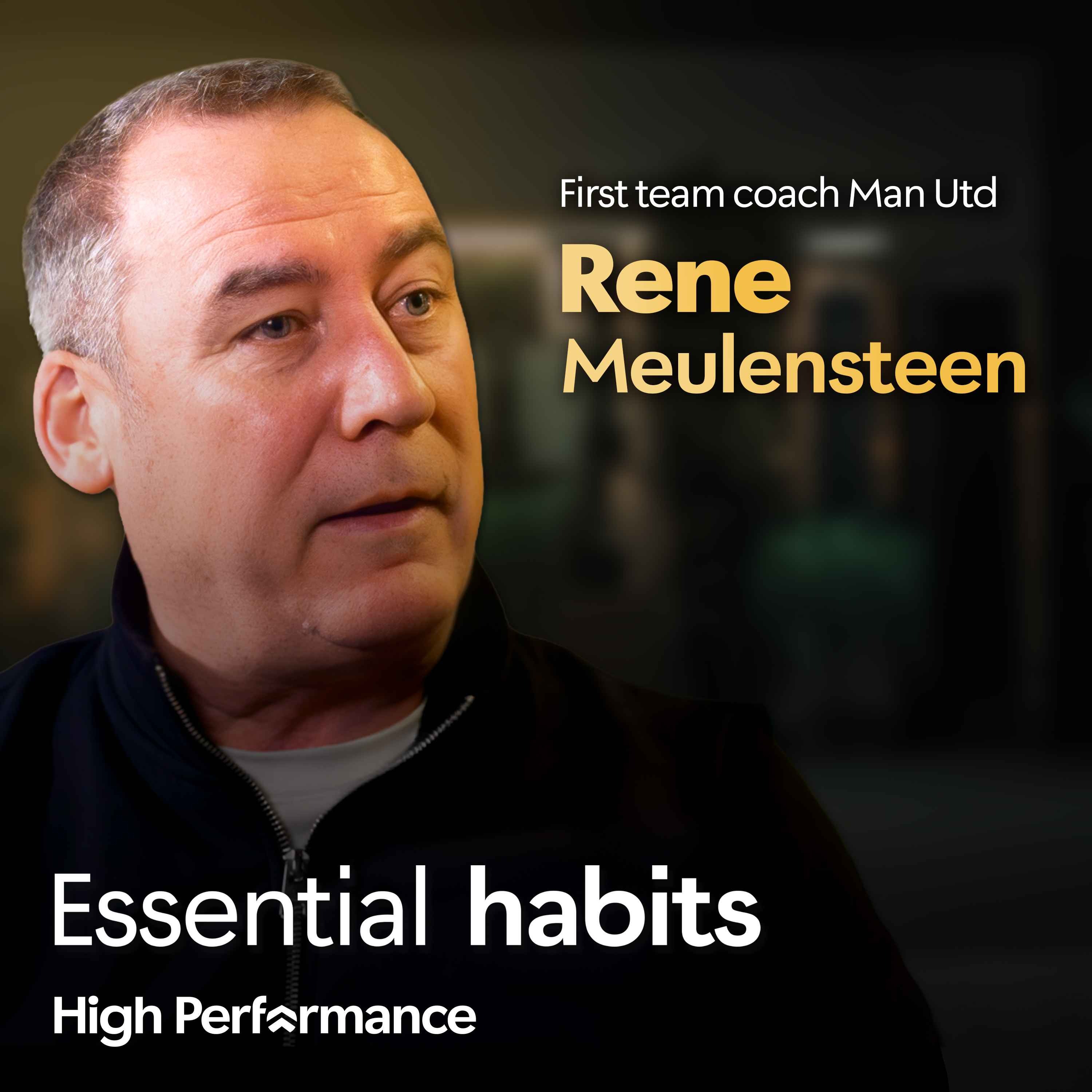
The Training That Changed Cristiano Ronaldo’s Game | Rene Meulensteen
In this episode, hosts Jake Humphrey and Damian Hughes engage in a captivating discussion with Rene Meulensteen, former first-team coach at Manchester United. The conversation focuses on the crucial role that language plays in coaching and performance, particularly in the context of developing Cristiano Ronaldo's goal-scoring prowess during his time at Manchester United.
Written by AI. May contain mistakes.

Get the gist, explore an idea or ask about something said.
 Claude
On The High Performance Podcast, what are the key points of this episode?
Searching your listeningAutomatic transcript. May contain errors.
0:00Unlock it early on the High Performance app. Gareth Southgate, England's former manager who opens up about life leading his country.
0:11The biggest time that I spent with Cristiano was when he got suspended. I said, you want to be the best player in the world. I says, am I wrong? He says, no, you're right. So you know where you are, you know where you want to go. What do we need to do to bring you closer to what you want to achieve? Welcome to the Essential Habits of High Performance, the podcast where we explore the small things that make a big difference. Now today I want to start with something very simple, a single word, change. It sounds harmless enough, doesn't it? But as we're going to hear, that word can shut someone down before they even have the chance to grow.
0:49When René Mullenstein reflects on his years coaching at Manchester United under Sir Alex Ferguson, he doesn't talk about tactics or formation, he talks about the power of words. And he insists that the language you use with people can be the difference between unlocking their potential and shutting it down too early. Hey, I'm Damien Hughes, and I've spent the last 25 years of my life doing a number of roles, including being a visiting professor of organisation behaviour, a trusted advisor to many leaders within the world of sport, business and the arts, and the last six years as a co-host of the High Performance Podcast.
1:28But above all though, my passion is about looking to help create, shape and curate high-performing cultures. I love exploring how high performance can work and, more importantly, how every one of us listening can take the lessons from our guests and apply them into our own world.
1:47René Muehlenstein spent over a decade at Manchester United, working alongside Sir Alex Ferguson during the club's most dominant era. He was Ferguson's first team coach and eventually went on to become assistant manager But his real genius was in the details Those tiny adjustments that turned good players into great ones He worked with some of the biggest names in world football history Cristiano Ronaldo, Wayne Rooney, Ryan Giggs, Paul Scholes, to name just a few But what's striking is that none of them would describe René as a typical coach They'd describe him as someone who understood how people learn, not just what they need to learn.
2:29And that understanding started with something deceptively simple, the words he chose. Because as René explains, one word can make all the difference between a player shutting down or a player opening up. First of all, I never used the word change. So I was working to Jago or working with Owen Hargreaves or Wes Brown or anybody. I would never say, Wes, we need to change this in your game. Because the first reaction from Wes would be, whoa, whoa, whoa, whoa, what am I doing wrong? Instead, Rene took a different tack. He reframed growth as an addition. Now, I've looked at your game. I've looked at the sort of kind of one-for-ones you're getting into.
3:12If we can add this to your game, you're going to be more a complete player, therefore be capable in solving those situations better which is better for the team. So add is more. Just think about that. Add is more. Change is threat. One word closes people down and the other one opens them up. Nowhere was this more vivid than in Rene's work with Cristiano Ronaldo. Now at the time, Ronaldo was dazzling the Premier League with his stepovers and his spectacular long-range strikes. But he wasn't yet to blossom into the ruthless goal-scoring machine who'd go on to dominate world football. I first wanted to bring him from an awareness point to an understanding point, you know, in terms of, do you know actually where you are?
3:58You know what I mean? Conversations like, and I basically told him, I said to him, I says, at one point, I think that I know exactly what you want. And he looked at me like, how can you know? I mean, we never had a... He says, yeah, I know. And he said, what is it? I said, you want to be the best player in the world. not once not twice but many many times to come says am I wrong he says no you're right he says right he says my question to you is will you be the best player in the world tomorrow no probably not next week no next month no end of the season probably not okay so you know where you are you know where you want to go so now what we need what do we need to do to bring you closer to what you want to achieve One of their first conversations was about numbers.
4:47Ronaldo had scored 23 goals the previous season and Rene asked for a target. Ronaldo responded with 30. But Rene pushed a bit further, 40. That was nearly double Ronaldo protested, but Rene had a plan. He showed him a three-minute video of Manchester United's greatest strikers, clip after clip of goals. Then I took him inside and I showed him a video of United's top strikers, including York, Cole, Sheringham, Solskjaer, and this story. Three minute video. Goals after goal. Bang, bang, bang, bang, bang. I said, what did you see? Oh, a lot of goals. Beautiful goals. A lot of goals. He said, yeah, but what did you see?
5:28Yeah, goals. He said, no, no, no, no, no. You're going to watch it again and then tell me what you see. And we looked at it again and I said, what did you see? And I said, I know what you mean. He says, most goals are scored from in the box. Most goals are scored one and two touches And there's a variety of goals Tappings, shots, headers and all that It says correct And then the penny dropped Most goals were scored in the box Many of them weren't spectacular They were scruffy, opportunistic, headers, rebounds Here's what René told him The problem is that you want to score The winning goal all the time And the most beautiful goal What you need to go, you need to become a goal scorer Score as many goals as you can, and those two goals will be in it anyway.
6:12That's what we're going to work on. From there, Rene built training sessions where he mapped out the penalty area into zones, showing Ronaldo where most of the goals were scored, how the defenders protected those spaces, and how goalkeepers shifted their position. They rehearsed scenario after scenario. One-touch finishes, two-touch volleys, headers. But crucially, Rene gave him a metaphor which he never forgot. you have to imagine that you're carrying an imaginary rucksack on your back. So every goal you score, every time you hit the net, even if it's a ball, after training you just kick it in a goal.
6:49There's a click. It clicks. It clicks. And that clicker never stops. It just keeps going. And then that goal scoring becomes such a normal thing for you. The results speak for themselves. Cristiano Ronaldo went from a player who could score goals to a player who was obsessed with scoring them in every possible way, from every possible angle, with every possible body part. And it all began by understanding the power of the language we use. So why are we learning this? Well, at first glance, it might seem trivial. Why does it matter whether René said change or add? But psychology tells us that words are never neutral.
7:33They frame the reality that we face. They signal a threat or safety. They open people up or they shut people down. Let me take you back to the 1970s when two psychologists, Elizabeth Loftus and John Palmer, were working at the University of California, Irving. Loftus was already becoming one of the world's leading experts on memory. She was fascinated by how fragile our recollections are and how easily they can be influenced. Palmer, her colleague, was equally interested in how perceptions shape behaviour. Together they designed an experiment that has since become one of the most famous studies in psychology.
8:16They gathered groups of students and showed them short films of car accidents. Some of the clips were dramatic, it was like cars colliding head on, tyres screeching, metal twisting. where others were more routine it might be like a gentle bump at a junction a minor shunt but afterwards the researchers asked a really simple question how fast were the cars going when they each other now here's a twist that blank space that you just heard me use there was filled with different verbs for different groups so for example one group the term was how fast were the cars going when they smashed into each other?
8:58For another, it was how fast were the cars going when they collided with each other? For another, it was how fast were the cars going when they bumped into each other? And for another one, it was using the verb hit. But for the last group, it was framed as how fast were the cars going when they contacted each other? All the films were identical. The only that changed was that single verb in the question but the answers varied wildly. Students who'd heard smashed estimated much higher speeds than those who heard contacted. Language had stretched their perception of the very same event and then came the second part of the study the part that shocked even Loftus and Palmer.
9:43A week later they called the students back and this time they asked them did you see any broken glass? Now the truth was dead simple. There'd been no broken glass in any of the films, none at all. But here's the astonishing finding. Those who'd had originally heard the word smashed were far more likely to remember glass shattered across the road. That single word had not only influenced their speed estimates but it had literally altered their memory. Now this was a breakthrough. When it was published in 1974, Loftus and Palmer's study transformed our understanding of how memory and perception works.
10:22And it showed that memory isn't like a video camera faithfully recording what's happened, but it's more like a storyteller, one that can be bent and reshaped by the language that we hear afterwards. Now this has huge implications. Their work has gone on to influence everything from the way police are trained to courtroom procedures. Today, for example, detectives are taught to avoid leading questions because the phrasing can plant false memories in a witness. For example, asking somebody, did you see the man with the red hat? It's dangerous because if no red hat existed, the witness may later swear that they saw one.
11:01Instead, police are trained to use neutral phrasing such as, what did you see? Sports psychology is drawn on this research too. coaches are now far more deliberate about how they phrase feedback so telling an athlete don't miss this shot actually makes the brain focus on missing whereas saying hit the target focuses attention on the positive outcome so it's the same feedback but it has a completely different effect so when Rene Muellenstein said to Ronaldo let's add this to your game rather than you need to change. He wasn't just being polite. He was framing reality in a way that opened Ronaldo up instead of shutting him down.
11:42And that's why Rene's choice matters so much. Change implies fault. Ad implies growth. The words didn't just describe reality. They created it. Now let's circle this back, right? When Rene told the player we need to change this, the implicit message was, what you're doing is wrong and that triggers defensiveness insecurity and resistance but when he says can we add this idea to your game the message is all about growth possibility and potential it sparks curiosity and motivation in the learner so it's the same request but it gathers and elicits a very different response and it's all because of the power of language now this goes far beyond football and we can all apply it in our own subtle ways.
12:30Do you tell an employee for example that they need to fix their performance or that you want to build on their strengths? Do you tell your child that they got an answer wrong or that they're on the right track but they could refine it? Do you frame an idea at work as a change program which might trigger anxiety about what we're losing or an improvement program which sparks curiosity about what we have to gain? Research on this framing effect shows us that humans are loss averse. We fear loss more than we value the equivalent gain and that's why change can feel threatening. It suggests that we're going to lose something.
13:07When we talk about adding things it feels like we're gaining something and that as I said earlier suggests that growth is possible. So what can we learn from René Muellenstein's story? Well I think there's three essential habits that show how great performers are really conscious when it comes to minding their language. The first habit is frame growth as addition and not correction. So when you give feedback, build on what's right instead of fixing what's wrong. The second essential habit, let's start using words that lower fret and raise possibility. Psychologists call this the threat versus the challenge response.
13:46Where fret shuts down, challenge opens up. So even small phrasing shifts matters. don't mess this up creates a pressure show what you can do creates an energy the third habit is let's remember that our words shape memory that loftus and palmer study i've cited earlier proved that one word can rewrite how people remember events and the same happens in our own lives you messed up that meeting sticks as a failure that meeting showed that you had potential sticks as growth. So your challenge this week is to choose one conversation, whether that's at work, at home, or even with yourself, and add something to your language.
14:30So we start by replacing the word change with add. We swap threat words for possibility words, and we end with a phrase that builds a positive memory and not shows the seeds of fear. Because great performance doesn't start with tactics but it starts with words. Now I'm going to be joined by our producer Will and we're going to have a listen to some of the other brilliant insights which Rene shared with us. These include Sir Alex Ferguson's flip chart philosophy, how often the infamous hairdryer came out and how the tennis legend Roger Federer subtly influenced Manchester United's tactics.
15:11We've just announced the latest book from High Performance, Microhabits which studied the tiny changes that supercharge High Performance Before the book's full release in January we've got a really special opportunity for our listeners to win a behind-the-scenes experience here at High Performance on an upcoming record day All you've got to do is submit your proof of pre-order purchase of Microhabits and submit it via the link in the description If you do that, you'll also get an extra 20 % off the price of the book too. Try it. We hope to see you joining us here in the studio soon.
15:49Rene, what a brilliant interview this was, wasn't it? It was a really enjoyable interview. One that always, I think, piques your attention. And actually, I think I always say that when we have anyone associated with Man United, so forgive me. Not that I'm a cliche, but yeah, no. As a Manchester United fan, I was excited by it because I remember him coming into the club in the early 2000s when, again, it was quite an innovative idea from Ferguson, I think, which was about start developing skills. He felt that young players were almost like too robotic. They were drilled in terms of fitness, size, speed, and he wanted those that could do that little bit of magic.
16:26So the story is that Ferguson phoned up Dave Mackay, the old Tottenham and Scotland legend who was teaching out in the Middle East, who knew Rene and Dave McKay said to Ferguson this guy's brilliant at skill development and stuff and so on that recommendation they brought him into the club and he started working with the junior ages so he had a stellar reputation within the world of Manchester United so to get to meet him and talk to him about his journey was incredible the key part of what the habit was about wasn't it, that development of the skills with Ronaldo which was the key kind of big takeaway but there was so much other stuff in that and I look I look at it from you know football fan but I obviously live in the North West now and I you know as you know have been invaded in my household by Manchester United fans very good raising the kids well not intentionally and I'm surrounded by them in my day to day life obviously where I live as well is very football focused and Rene lives where I live so you went to meet him didn't you I went to meet him in Costa Coffee there are other coffee shops but we went and had, he had, he ordered a cappuccino, same as me.
17:41We sat upstairs and then we, I like to get a feel of how people, what they'll be like right on the podcast. Are they engaging? Will they tell good stories? He ticks every one of these boxes. I am not lying here when like, he tells stories of how like, Paul Scholes passed the ball over and this is how it got trapped out. He's standing up in Costa. He's literally playing this out in front of everybody sat up there being like, so I like to show them the skill before they do it. And he's playing it out in front of everybody and imagining a ball coming over and chesting it and talking about tactics.
18:17And I was like, well, this guy's made for podcasting in the sense that he was so animated, visual, great storyteller. And I'm in that comes from having a career in punditry as well. So I was brought in on that and it was a fascinating interview. And there's a load of insights that stuck out, wasn't there? A load of insights, especially into Fergie. Well, this is the gold dust stuff, isn't it? Because I think Ferguson these days is almost like, he's on the verge of being Disney-fied. Yeah. Do you know what I mean? I think he's got to that stage of life where, and the nostalgia's kicked in, and everyone's like, everything he did was amazing.
18:56You know, everything he touched turned to gold, and it didn't. Everything's a tactical genius move that was so thought out. yeah and I actually think that does him a disservice he made mistakes, he failed he sort of got things wrong on frequent occasions but it was the way that he learned that I think makes him so incredible not the stuff of just thinking that he was infallible but I always think the hallmark of a great leader is can you communicate what you stand for in a simple sentence, I sometimes talk about the t-shirt rule that you can only get one message across on the front of a t-shirt So what's your one message you want?
19:35Now, if you apply the same logic to Ferguson, it's almost like the flip chart rule. Can you write on a flip chart, one page of a flip chart, what you want your whole identity as a team to look like? And when Rene explained that he sat in Ferguson's office when he was appointed as assistant manager and got to see Ferguson's vision on that one page of a flip chart, But to me, it was like being invited into the football in Holy of Holies. Wow, let's have a listen. So I had this flip chart and he's written things down defensively. From a defensive point of view, he said, I want us to be able to press high, aggressively, talking about the cues.
20:16Sometimes we need to defend from a block. Sometimes we have to, you know, defend really deep to making sure that we don't concede too many crosses or shots at goal. But with the aim really to regain the ball and counter-attack. In possession, which is important, is where we want to take the initiative of the game. You know, all the big teams, the most important word in possession is rhythm. All great teams have players, midfielders, you know, all the players that can create rhythm. You know, building up rhythm is slightly different when you get into a, you know, a highly condensed area where we want to be able to switch the rhythm into one touch pass and then movement.
20:50Yeah. And then I come to the golden rules that he said when possession is that I want all the players to think forward, look forward, play forward. So before you even get the ball, the first solution is forward. With the aim to break lines, to play around them or play through them. That's what we want. And the next golden rule is if centre-backs, midfielders or anybody plays around the midfield line have got time in the ball, face forward, I want forward runs. On the opposite side of the midline. So we always used to sort of build up on the right-hand side. So the solutions were on the other side of the midline was on the left-hand side.
21:26That sort of thing. So those were all golden rules. and then the last flip chart was all about attack and he said when I see Manchester United attack I want to see his attack with pace power penetration and unpredictability and I want you to instill all those things in that team every single day that was my whole navigation system and then the best thing what I found after that is he picked a marker and he put a line underneath that and he said if that doesn't work we gamble. And I absolutely love that. And that was a lot of times when we got into the last 10 minutes of the game. I love that story.
22:07But I love the last line. Brilliant, isn't it? Yeah. We gamble. Because that leads us into, he spoke to us around that idea of Fergie time. Yeah. Fergie time is a well-renowned term. Even people, you know, the younger generation following football now all reference Fergie time. Yeah, yeah. Yeah, him stood on the touchline banging his watch, suggesting that the game couldn't finish until United had won. Like, it's almost part of the mythology. Now, Ferguson wrote in his last autobiography that he never really had much of a clue how much time was left, but it was the psychological ploy of the opposition seeing him stood there and believing that, oh, we're going to keep playing until we lose, that might have given him that edge.
22:52But what I found interesting with Rene's point was that that wasn't an accident either, it was a design. So not the standing on the touchline banging his watch, but the training for how are we going to respond when we're 1-0 down and there's two minutes left. And that was done in training sessions. They would structure their plays and their drills to work out how do we keep our composure, but how do we keep gambling? How do we keep taking that risk to do it? Peter Schmeichel calls it cold red. So in his book, he talks about the cold red moments when you throw everything at it. all the game plan goes out the window and we just gamble and we take ultimate risks.
23:31Yeah, but it's like gambling with preparation. It's like, you know, it's not just like I don't know what we're doing. It's like headless chickens running around. This is prepared gambling and a permission to take risks. 100%. Success isn't an accident, it's a design. And we need to understand that why did Manchester United get this reputation of scoring late winners that famous ferguson quote of we never get beat we occasionally run out of time but we never get beat why how did that happen and then when you can hear the coaches telling you because we trained for it we understood that we might be getting beats we need to know how do we respond at those moments yeah that to me is something that any of us can adopt in our own lives how are we going to handle those moments where a setback occurs how are we going to handle the difficult times.
24:24Otherwise, it's just a dream. Yeah, and we, you know, I think it came up a little bit in the Rene chat as well was, you know, it was the penalty process as well. They're not, you know, and we talked a lot about that with, you know, Gareth Southgate, didn't we? It's like these are pressure moments that you can prepare for. Like again, if we think about the Gareth Southgate conversation, that when he spoke about that European Championships against Italy, then he told us the stats, didn't he? Raheem Sterling scores 33 % of penalties he takes. Marcus Rashford scores 82%. So who are you going to go with?
24:57Yeah. On the balance of odds, you choose Marcus Rashford. Now, unfortunately, this was in the 18 % of misses. But you touched on a really important point there about failure, because failure is almost baked into the process, as the brilliant Greg Hoffman told us once on the podcast, that failure is the price of ambition. And what I think is interesting is, again, almost like challenging maybe some preconceptions that Ferguson was constantly ranting and raving and he was shouting and screaming. What's interesting is that he never shouted or screamed when failure happened, as long as he knew people had given their all, had followed the process that he was asking them to do.
25:39Let's listen to René's answer when he spoke about how many times he genuinely saw the hairdryer come out. in the six years that I've been at Manchester United with him and in the rest of the room I might maybe once or twice that I felt he raised his voice in another way than he normally would but in that case he didn't he sort of basically settled everybody down and said calm down I think we're playing great 2-0 down boss yeah but of course we can talk about the goals I don't want to talk about that it's just listen we're going to throw something at them they can't deal with we made a few changes we brought Carlos Tevez on hunting them down and all this and that I think we made another one I can't remember but the biggest thing was this he said listen I know we're going to score but when we score one we're going to score three now just think about that mentally what it does to the players and on the pitch so when they scored one goal they didn't settle down oh no no we have scored another two that was just a masterstroke for me and we ended up winning that game 5-2 5-2 there was no There was no...
26:45Nobody that went on that pitch worried about we were 2-0 down. We're going to score three goals. And probably more, but we're going to score three goals. Just brilliant. So the hair-dry treatment, more of a myth than a reality. Yeah, but I've reflected on this quite a lot. And I think it's because what generates a headline? Ferguson kicking a boot and shouting and screaming and tearing strips off somebody. Or Ferguson going in and being really calm and reasoned and putting an arm around the shoulder of somebody that needs it and giving words of encouragement. The drama wins every time. So I think it almost takes on a mythology of its own and the danger is that people look at that and think, that's the way to get results, shouting at people, creating a culture of fear, when the reality is that you'd either have to believe that Ferguson was subverting millions of years of evolutionary psychology to get sustained results, or you'd have to believe, but it's not true.
27:41and the people on the inside will tell you, well, it wasn't true. That wasn't the culture that he was sort of curating at the club. Yeah, and that clip, obviously it's an isolated incident, but that psychology of prediction, specific prediction of what will happen and the language he uses, which then actually plays out on the pitch. Well, again, go back into the archive. Do you remember when Ole Gunnar Solskjaer told us on the podcast that in that 11 days of May in 1999... Yes, I do remember this, yeah. When they won the league at Tottenham, they beat Tottenham to win the league, then they won the FA Cup against Newcastle, then they famously beat Bayern Munich in the Champions League final.
28:24And at the first of those games at halftime, they were getting beat to Tottenham, and Ole said that Ferguson came in and went, lads, if you don't score a goal with 20 minutes left, I want to put Ole on and he's going to come on and score. Now, he didn't put him on, but Solskjaer said he almost like sowed the seed that it was almost inevitable whenever I put him on the field he's going to come on and score a goal so that was the seed that blossomed in the Nou Camp 11 days later that when he threw him on in the Champions League final Solskjaer came on with a sense of inevitability that the manager says that whenever I enter the field with 20 minutes to go I always score a goal and that ability to sort of create that cognitive dissonance if you like so here's reality but here's what here's what the alternative could look like is powerful there's a famous example in that final in 99 when he at half time if you look at it that there's about seven players all independently have like verified the half time speech so they come in they're getting beat and Ferguson sort of channels a a speech that one of his old players Steve Archibald had said to him in the week prior to the final where he'd said the worst feeling in the world is you walk past the European Cup at the end of the game and you're not allowed to touch it because you haven't won it.
29:44You can't touch it. And when he came in at half-time in the Champions League final, that was what he told them. He said, lads, in the second half, I want you to go and leave nothing out there because I don't want you walking past that trophy and you're never, ever going to be able to touch it. And some of you, you will never touch it in your career. And they're like, Michael, Andy Cole, Dwight York. Look, the amount of players that have said, that had quite a galvanising effect on them, being willing to gamble and go for it. An amazing ability to how you respond in crisis moments, how you say the language you use and what he said at the moment is almost like that's such a skill.
30:28Well, that leads us nicely then to the last clip, that ability to deal with those crisis points. let's listen to how René described Roger Federer and his influence on the Manchester United mentality so United was in a season where they came back from Barcelona and they Ronaldo missed the penalty they drew 0-0 in the semi-final of the Champions League exactly so they went straight to Portsmouth in the league and they lost so when they came back to Carindra because I didn't travel with the team at the time I stayed behind and worked with players so I still remember all coming in and the players and they're all a little bit like disappointed, deluded and the manager comes up to me and, you know, and he said, you know, I should have won in Barcelona.
31:15So they had the game against West Ham, Barcelona return and then Wigan in front of them and I said to the manager, he said, you like tennis? He said, yeah, I love tennis. I said, who's your favourite player? I said, it's Federer. He says, great, I've got a great story for you because I love Federer and he says, Federer was playing in it in an ATP tournament and he's won the first set comfortably no problem won the second one comfortably lost the third lost the fourth set 7-6 in the tie break he's now playing the fifth set it's 5-4 to Federer it is 40-30 to Federer this is the Federer moment and this is where you are with May and I he says what do you mean he says everything that got Federer to that point all those sets he played whether it was two sets or three or four doesn't matter if he wins that point he wins the game he wins the set he wins the match and he wins the tournament that's the federal environment so you need to be able to reset so where you are now is with Man United you drew 0-0 against Barcelona you lost the penalty you lost against Portsmouth but look at your position if you beat West Ham on Sunday yeah next week against Wigan you win you win the league if you beat Barcelona on Wednesday you go to the Champions League final.
32:33So you are just in a Federer moment to reset. Whatever happens before, you're still in the same position. Though you loved this, didn't you, Will? I did love this. I mean, I'm a huge tennis fan. I'm a massive Roger Federer fan. But I love the idea of that power of reframing, saying that you're looking at the same situation but in a different perspective. It was the willingness to look outside of their world at other leading sporting heroes and how you can apply that same kind of mentality. There's echoes there with other sort of sporting dynasties. Do you remember Dan Carter telling us that when they won the World Cup in 2011, that they sat down as a team in New Zealand and said, let's look outside of the world of rugby and see who dominates.
33:17And they looked at like the Chicago Bulls and the Michael Jordan. They looked at Manchester United. They looked at Tiger Woods. And they didn't say we want to be back-to-back champions. They said we want to be the most dominant team on earth. and they were measuring themselves, not against other rugby teams or other teams in history, but other teams from other sports and industries. And I think sometimes just that ability to reframe by looking outside your world can be really powerful and it can be galvanising. And that's why I think the Federer example obviously had such resonance with Ferguson, but also with the players as well.
33:52I remember reading, remember how Conor Ireland on, the Irish tennis player, and he wrote a book called... The racket. The racket. He was at Wimbledon and he was playing a key match which would take him on to a centre court to play against Federer. He's like 5-2 up in the last set. Tennis has that, is a sport which isn't a flow sport like football, but has those abilities where you have to stop, think, reset. So hence, you lose a few, one game turns into two, two turns into three, turns into four, and you're just snowballing and mentally you've gone. And I think what Rene says about Federer and what Ferguson tried to took on it, it's like you've got to not allow the past game or result or the past three games to affect what you do right now.
34:41And if anyone's listening to that, I mean, it's a brilliant articulation of it, Will. Go back and listen to the episode we did looking at Dan Byrne, talking about the contrast between the first League Cup final that he played in when they got beat 2-0 to Manchester United and then the second one when they went and beat Liverpool 2-1. Because it's a great example of Federer moment thinking, as Rene describes it, playing the game, not the occasion. Don't worry about what the consequences of it is. Just stick to the moment of knowing what you're good at, focus on being in the moment, being where your feet are, and just execute the process.
35:19It's a really good example of it. Again, sometimes you think, are we emphasising this point too much? but you hear it so often from those that scale the heights are the ones that seem to be able to capture that Federer mentality. This whole conversation with René has just been so rich, but let's go back to the point of the episode. It's all about the choice of our language. When he worked with Cristiano Ronaldo, he didn't start with drills. He started with the quality of his words because he knew that it's language that sets the frame in which learning can happen. and when you get the frame wrong, even the best drills or the best tactics don't stick.
35:59But if you get it right, that's where you can unlock motivation, resilience and incredible growth. It seems then that in football, like in life in general, language isn't just decoration, it can be direction. And the essential habit of high performance is this, mind your language. Listen, I'm Damien Hughes and as ever, thanks for joining us, thank you for listening. and I look forward to catching up with you soon.
Win a behind-the-scenes experience at a High Performance record day! Pre-order our brand new book Micro-Habits and use code MICROHABITS26 for 25% off before the launch on 1st January to be in with a chance of winning: https://hppod.co/HPComp
What if one word could unlock potential, or shut it down completely?
When Rene Meulensteen coached Cristiano Ronaldo at Manchester United, he didn't start with tactics. He started with language. The words he chose made the difference between a player who could score goals and one obsessed with scoring them.
In this episode, Damian explores the essential habit that separates good coaching from greatness: mind your language. Discover why Rene never said "change", only "add." Learn how Sir Alex Ferguson's flip chart philosophy shaped United's dominance. And find out how a Roger Federer moment transformed their Champions League campaign.
Featuring insights from psychology (the famous Loftus & Palmer study on how words reshape memory), plus behind-the-scenes stories from United's golden era, this episode reveals how elite performers use language to frame reality, lower threat, and spark possibility.
Together we explore:
René reminds us that high performance isn’t just built on drills and repetitions, it’s built on the words that shape how people feel, learn, and grow.
If you’ve ever wanted to give better feedback, build trust faster, or help someone reach a level they didn’t know they had in them, this conversation with René is worth your time.
Listen to the full episode with René Meulensteen: https://pod.fo/e/2bd0c6
Hosted on Acast. See acast.com/privacy for more information.


