
 Ask ChatGPT


 The High Performance Podcast
22 Oct 2025 · 48m
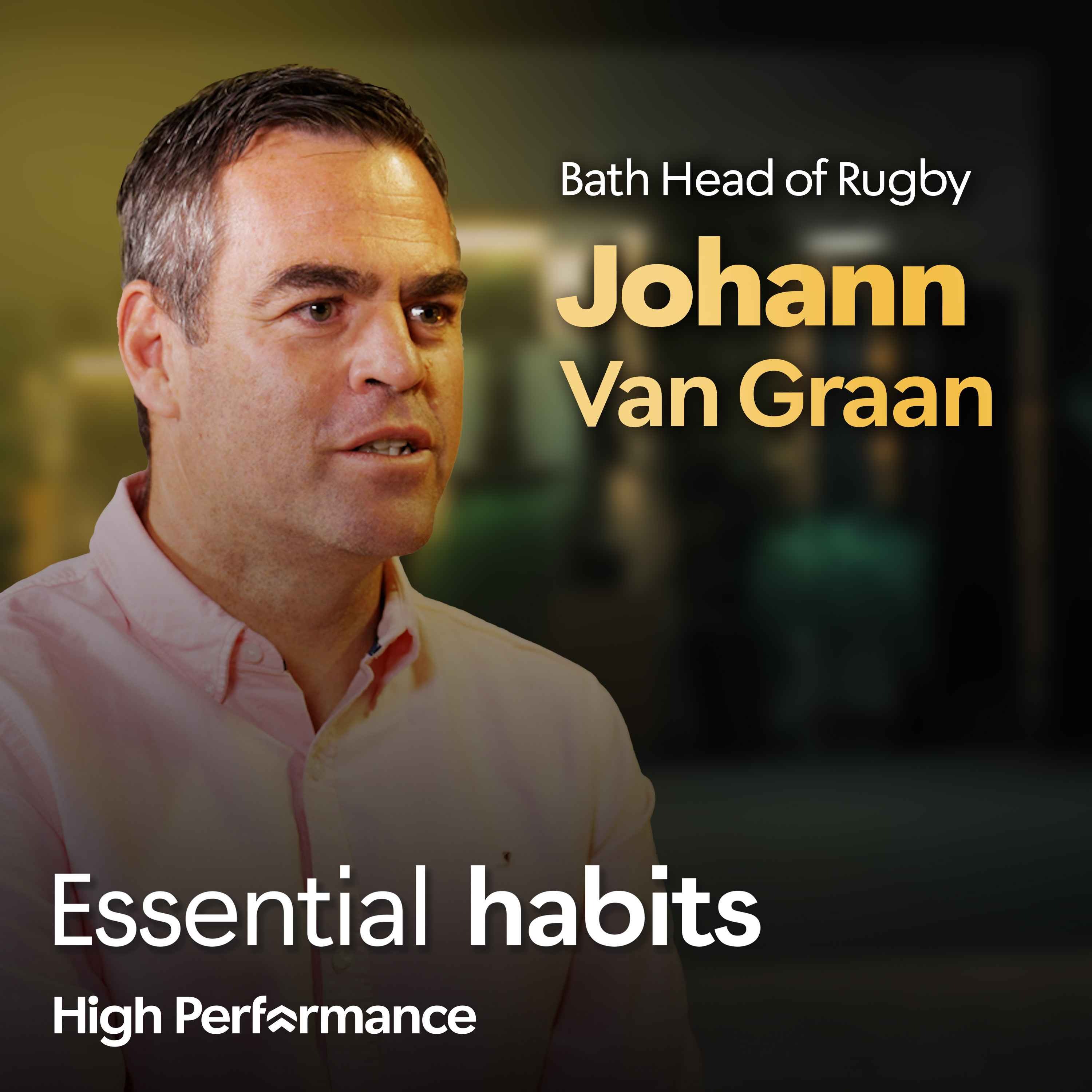
The World-Class Coach Leading with Humility, Trust and Belief | Johann van Graan
In this episode of The High Performance Podcast, hosts Jake Humphrey and Damian Hughes engage in a profound conversation with Johann van Graan, the head coach of Bath Rugby. Johann shares his insights on leadership, personal development, and the essential habits that have guided his successful coaching career. Known for his roles with the Springboks and Munster, Johann provides a masterclass in purpose-driven leadership, emphasizing humility, trust, and a commitment to continuous improvement.
Written by AI. May contain mistakes.

Get the gist, explore an idea or ask about something said.
 Claude
On The High Performance Podcast, what are the key points of this episode?
Searching your listeningAutomatic transcript. May contain errors.
0:00Unlock your next dose of inspiration early on the High Performance App. Available now is our latest episode with Motorsport Trailblazer and Managing Director of F1 Academy, Susie Wolfe.
0:33No weird leftovers, just delicious, easy to make meals. Get 20 % off your first two orders with code APRON20. Terms and conditions apply. Visit blueapron.com slash terms for more. I don't know about you, but as I get older, I start to think more and more about the long game. You know, I'm going to be 47 very soon. And I love the fact that I can show up well today. But actually, I really want to start thinking about things that will leave me in a good place tomorrow, next year, even decades from now. And that's why longevity is so important for me. And one small change I'd love you to consider is MiterPure gummies.
1:07You know, these are the first longevity gummies, and they're powered by something cool called Urolithin A. Now, unlike most supplements, these work at the deepest level with your cells. And when your cells are stronger, everything you do from training to focus just feels easier. And as always, I ask about the science behind these things. Well, MiterPure has been shown to boost energy and even increase muscle strength by up to 12 % in just 16 weeks. They're vegan, gluten-free, clean label certified. They taste great. So if you care about staying strong, energized, and ready for whatever comes your way, think about them.
1:39My friends at Timeline are giving you a high-performance listener, 20 % off. Just go to timeline.com slash highperformance. That's timeline.com slash highperformance. And think about your longevity. This episode is brought to you by Opera Air, the first browser with mindfulness at its core. Now, most of us spend hours every day online, But how often do we pause to take care of ourselves whilst we're doing it? And that's where Opera Air comes in. It's a lightweight, fast, secure browser built not just for productivity, but for your well-being. With Opera Air, mindfulness is built right in. You'll find free breathing exercises, guided meditations, and soundscapes with ambient sounds, lo-fi music, and binaural beats, all designed to help you focus, relax, and even spark creativity while you browse.
2:29Welcome to the Essential Habits of High Performance. Today's episode is something really special, because this time we're not just focusing on one habit. What we're going to do instead is take a deep dive into a series of essential habits, as practiced by Johan van Graam. Now if you know Johan, you'll know that he's one of the world's most respected coaches in rugby. He's been part of the set-up at the Springboks, the Bulls in South Africa, through to Munster, and he's now setting about transforming Bath Rugby. So he's the head coach that ended a 29-year trophy drought. But what stood out to me in this fascinating, engaging and beguiling conversation was the clarity and consistency of how Johan lives his life.
3:13If you've ever seen Johan, you'll have noticed that he carries with him a notebook everywhere he goes. What he explains to us is what he writes in it, and more importantly, how it helps him. You'll hear him talk about the habit of how he begins every morning with a moment of stillness. And then finally, how he strives to do the things that others aren't willing to do. He'll discuss how he stays calm in chaos, surrounds himself with truth-tellers, not time-tellers, and how he puts other people first, at home and at work. Above all, though, you're going to hear someone who doesn't just talk about values.
3:50You're going to hear somebody that actually lives them daily, quietly, and with a huge amount of impact. I've thoroughly enjoyed this conversation, and I'm confident you will too. Let's welcome Johan van Graan to The Essential Habits of High Performance.
4:11So, Johan, welcome to The Essential Habits of High Performance. I'm so excited to have you here. The very start of your career, I know that you've coached at World Copes with the Springboks Monster and now to some success at Bath. But I'm interested about the 16-year-old version of the year that started out with the Bulls. Yeah, I am very lucky to have a referee my whole life since I can remember. I can remember 1986, the Springbok versus the Cavaliers when I was six years old and was a Bull boy and literally had a dad as a rugby CEO. so I was around rugby that I can remember. But I think the real bit around analysis and thinking about the game a bit more deeply came into the 1995 Rugby World Cup, which was the first in South Africa.
4:57And I remember after that, so we had a VHS recording machine. And then I actually bought myself one more with my pocket money and I had two. And I started to cut certain bits from games and I put it together. And then fast forward to 1999, I caught up with Heineken Mayer. And he at that stage was the Springbok forward coach. And I came across a very good rappy of mine in John McFarland, who was the technical advisor at the time for the Springboks. And then they came to the Bulls where I was a junior at. And I grew up next to the field at the Bulls. And then as a junior player there, I started to get into analysis a bit more.
5:41and I started to help on Sundays and look at the opposition for the senior team. And those were the early days of analysis and it was very uncommon in rugby. You know, rugby only turned professional in 1996. And that's really how I found my way into coaching was through analysis and the technical ability to look through the game. But I think it just started with, I love rugby. I absolutely love rugby. What did you learn in those early days that you can recognise as a hobby? you're still using today now that you've had coached? Two things that Haneke said in our very first meeting that I remember, like it was yesterday, he said, because you are young as a coach, and I started coaching when I was 21.
6:28This conversation was when I was 23, and I started as a young analyst and started doing some bits of coaching as the Bulls. Knowledge, you've got to make sure that you've got the knowledge to convince players. And the second bit is in whatever team you are in for the rest of your life, make sure that you become unmissable and make sure you do the things that others aren't prepared to do. And I think those two things from a starting point of view, my first full-time professional job, I can remember that until today. So the knowledge bit around the game and then make yourself unmissable and then the love for rugby and the passion I have for the game.
7:11I think if I combine those things, it was certainly a good start. So how would you define a rest of all? There's always more to do. I think life, rugby, sport, business is ever evolving. And I think always look for the opportunity, look for the small margin. A coach I've learned a lot from, he said, always trust your eyes. And I've learned to trust my eyes in terms of when I see something that potentially we haven't touched on as a team or as a group, always go through the right process and identifying, well, have we missed something? Is there something we could do better? I think from a starting point, maybe I just grab those opportunities.
7:48It's like, well, we don't have anybody else to do. Well, I'll do it. And I'll fast forward to my time at the Bulls in 2008. I was the attack coach. I was the forwards coach. And I oversaw the whole technical department, which was too much to do if I look back at it now. oh I did it and it was never an issue for me and I'd say you know try and find those bits that that others aren't prepared to do that will make a difference because we can spend our time on on many things that doesn't make a difference find the things that does make a difference what would you say are the things that make a difference well for me personally is I've got to find out who I am first what's my why and what makes me tick because as soon as I I've discovered that and I've become comfortable with that then I can make a difference and I believe we are all on this earth to make a difference ultimately we all want to belong to we never want to be told to do things we want to belong to something and I've been very fortunate at the Bulls at the Springboks at Manchester and I above to belong to something that's much bigger than I.
9:01And that's why I love rugby and I love team sports. And in my view, rugby is the ultimate team game. And I think that's better about making a difference, specifically to players, because this game is about players and about their performance and trying to make them better and realize their dreams, because the world currently tells us that it's all about alike. It's all about how many views we can get or how many people say things. It's actually about who makes a difference because we've got one life and I'm very lucky as a coach to have the ability to influence that and hopefully make a difference to players.
9:43And that's quite a grand statement though, this idea of finding a why. At what age did you start thinking around that question? very clear picture in my mind a close friend called Jan Stang we had this bible study group when I was around 19 years old and he asked us as a group in the following weeks to come and tell us who you are and I remember at the time when I started to think about it I had no idea who I am and it took me a few years to figure out who I am what's important in life to me what dreams do I have what do I want to achieve understand that life might end today what are the most important things to keep you busy with and it's in my office it's in my book it's ingrained in my head as to the why I do what I do and I've become very comfortable with that and that's why specifically in coaching whether I coach Bath or I coach my two boys and it'll go on the grass outside our house.
10:51I absolutely love what I do. Yeah, I've become comfortable with who I am. What would you articulate as your why then, if you had to encapsulate it in a sentence or two? Man of God, family man. That will mean many different things to many different people. For me, know where you are going. understand for me that my wife is everything to me my three little kids we are so blessed to have them and for me family is everything if I look at it a bit wider you can't choose your parents your brothers, your sisters your wider family but those are the people that you have for your whole life and those are the people that stand with you in good at a bad time so family is incredibly important to me and I think we are lucky in sport that there's a wider family, whether it's the coaching staff or the support staff or the wider club or the supporters, the playing group, it's a wider family.
11:54As I said before, make a difference. For me, life is about making a difference. Spend your time wisely. Spend your time on the right things. Spend time with people that want the same as you. I think that's a very important bit that I've learned and become comfortable with is I want to be around people that want the same things in life as I do. From a sporting point of view, something with vision. Heineken made a coach that I've learned so much from the saying, always dream big dreams because big dreams makes a man's blood stir. And I found that dreaming big dreams gives you energy. And in sport, I've been so lucky and privileged to be part of teams that have done the unthinkable, to do things that wasn't possible, but we as a group did it.
12:46I think what does world-class look like? I remember September 2011, I walked into the Patriots in Foxborough. The day that I walked in there, I wrote in my book, Life-Changing Day. That was one of the first environments I saw as being absolutely world class. And to put into context, South African, probably South African, but at the southern tip of Southern Africa, we're pretty secluded from an African point of view and a world point of view. So the more I started to see the world outside of a rugby environment, it was great to go to Australia, New Zealand, Argentina. But then the more I came into the Northern Hemisphere, when I visited Japan, the States, the European countries, I learned so much.
13:33I've learned so much from others. and then winning, ultimately we want to win. But the winning I want to clarify, I think winning is a process. It's a journey. It's not the actual result. And one point is the biggest and smallest margin in sports. You lose by a point, everything is wrong in the eyes of the world. You win by a point and everything is right. So I've become comfortable with vision world class in winning in the context of the bigger picture. So let's unpack some of what you've just shared with us here, because there's a number of habits that you've spoken about there that have led you to deliver world-class consistent performances.
14:15And the first one is the notebook. You said that when you walked into the Patriots in September 2011, you wrote down in your notebook, this is what world-class looks like. I always see you with that notebook. Tell us a little bit about the habit you're into of making notes and carrying that notebook around. Well, it actually started with my dad. He still does it today. He's got these big black books and he's got hundreds of them in his study. And I always saw him writing and I never really understood why until I asked him. And it's like we as humans only remember the things that we want to remember.
14:52We tend to forget the things that we want to forget. But what I've learned from a personal point of view is when you put something in your own writing, it's kind of, it's in ink. it's written down it's literally it's there I felt that that's given me a lot of energy in my life a lot of reflection time a play that I've coached Jan van Felzer before the 2015 World Cup said to me coach why don't you write down a memory of the World Cup coming up because he knew I was writing things day to day I said no I never want to write a book he said just try it so what I did before that World Cup, 100 days before the World Cup, I started to write more intensely.
15:39And then didn't read one media page, didn't listen to anything in the outside world, just spent time in this book and spent time in the World Cup. And I remember we landed back in South Africa on the 3rd of November, which was many days later. And then I actually read through it a year or two ago. Amazing, amazing what you've forgotten. and amazing the wisdom that it might be wisdom that I learned out of that tournament. And it's a very good guideline for me because it's mine. It's personal. But yeah, I've learned to take it everywhere with me. And we've got two ears and one mouth as human beings and listen and learn from others much more than you speak.
16:24And I've got this habit of trying to learn something from everybody. a lot of times you learn what not to do but I've learned so much and look the day that I stop learning is the day that I must do something different because in the world that I live in it's ever evolving and there's so many amazing people to learn things from. So how often do you scribble notes? Literally an hour every meeting you know if you just stay if I take you through the example of yesterday. Yesterday it was a coaches meeting. I had the opportunity to speak to the rest of the business in a meeting called the Scrum. I had some one-on-ones.
17:13We had a team preview. We had a defense meeting and attack meeting. I had two phone calls yesterday afternoon and then one or two bits that I learned again yesterday. Literally every day sometimes more than others. and I find myself a lot of time when I run or walk or talk in the morning, straight when I get back, I'm into the book because some of the ideas that I've had, some of the learnings that I've had, selection is very important to me. I take my time in the mornings and when I get back, it's like, yeah, go write down what you reflected and then make my decisions out of that time. So, yeah, look, it's something that's pretty special to me.
17:57It's something that I do. But yeah, it comes from my dad. Is there certain questions you ask yourself that prompt the notes? Many times I ask myself, why did you make this decision? So I won't go into the specific player, but there was one specific game that I can remember that I didn't pick a specific player. and something didn't sit right with me around the decision that I made. But it's a decision that I've owned and I've learned from it. And the conclusion to the decision after reflection was I dropped the player for the right reason at the wrong time. And I've learned that timing is so important in life and you've got to be convinced yourself when you make big decisions.
18:47and the reason I use selection is because you literally make decisions on players' careers, whether it's on games or whether it's on contracting similar to coaches and staff. I think that reflection out of that is pretty important to hopefully get better. That's an example of something that I've learned. When it comes to the decisions that you have to make for these big games, do you tend to write more intensely there? I'd say various. Sometimes I'm very clear. Sometimes you are in a situation that you've got such a clear picture. And sometimes I've got a lot of gray. And I operate very well when I know exactly where I'm going.
19:33So reflection time is important to me. Early mornings is important to me because that's the quietest time of the day. You've just slept. You've woken up. Your mind is clear. It's not filled with anything else. and that's the time that I spend them. And then ultimately then I go and write off of this and then I start my day. So sometimes it's very clear and sometimes I've got the delayed decision until I'm very clear. And then one of my mentors taught me the principle about being decisive. Hindsight is such a wonderful thing. You've got to make a decision at a specific time and once I've made a decision, I'm comfortable with it.
20:15I'll recognise when I've got it wrong because you get it wrong a lot of times and going back to the wire then become comfortable that you won't get everything right. If you surround yourself with the right people, you create an environment with purpose and people know why we do what we do in this clarity. That's a good place to be. I love that. And I was intrigued if you could go back to your reflections of the 2015 World Cup when you started writing. And you said you went back a couple of years ago when you were surprised just how rich it was. How regularly do you go back to read your notes? So I started writing way before 2015.
20:58The 2015 World Cup was just an example of literally every day, putting every thought onto paper. I go back many times. So my books are stacked in my office and at home. So this is the ninth year that I've been fortunate enough to coach overseas. So all the Munster books are at home and they are dated. And I may immediately, you know, year two, book five, if I've got to go back to something and then all the bath books are in the office. So I go back for many different reasons. Sometimes it's about opposition. So let's just use an example of Harlequins. I always go back to when we played them last.
21:42I remember when I see something or something goes in my mind to a specific game, I will just go back to the date and go back to reflection. One-on-one time is very important to me with players or staff. You need to understand what other people's needs are and ultimately want to make them better. So that's pretty key for me. The one that's amazing is if you write down the meetings because a lot of people say things and they don't remember that they said those things. So I'm very curious once something is said and agreed, that is agreed. So from a meeting perspective, I go back many times and then certain learnings or certain things that trigger my mind.
22:27I might listen to a podcast or watch a movie and then something triggers my mind about something that has happened and I know where to go back to. And I've got another book where I write down the quotes, big moments. And this comes from a friend of mine called Johnny van Devent, that he's a good friend that I've met when I was 13 years old. He's currently staying in the Mubi. And we used to recognize quotes. And that's when I came, when I saw the quote that you guys have on the wall to kind of do the best with what you have. And it's when I see something, I try and write it down. and it's things that make me tickle, but it influences me.
23:11So yeah, the writing of the book is pretty cool. I love it.
23:18Through exploring the best habits from high performance, Jake and I are proud to announce our latest book, Micro Habits. Micro Habits have three qualities. They have to be small enough to start now, simple enough to do without overthinking it and quick enough to fit into your life. in micro habits we share the tried and tested habits adopted by many of the most inspirational guests we've had on the show over the years from gordon ramsey to keely hodgkinson lando norris to emily matliss we're happy to let you know that you can get a 25 discount code during the pre-order phase before the full release of the book on the 1st of january 2026 check the show notes to find out more and pre-order your copy of micro habits today would you sort of take us into the pages and give us one example where you scribbled something down that has led to some degree of success for you i'll share one one personal bit i do a theme of every single book that i write and this is book two of the season and the specific theme of this one is family and friends and you know from a personal point of view I had a fantastic time at home in the off season and because we've been away from home for quite a long time you realize again the value of family and good friends and the theme of this specific book is to pick times in the week to reconnect with family and friends because in a world that we put a message in whatsapp it's so easy to just whatsapp or kind of send a voice note but the value of talking to somebody and obviously i can't see somebody eye to eye but doing a natural video message to somebody is much more important to me to just writing a message so the feminine fringe bit is certainly something on my heart, don't it?
25:24That takes us to another habit that stands out for me when I look at your career, which is the role of balance. You know, when you've spoken about faith, family and friends, important pillars of your life, rugby is an intense sport that demands are not. Will you tell us a little bit about how you've managed to retain that level of balance? What a great word. One of the key things I look in with people that I want to work with, players that they could use the word balance, and I've got a very simplistic view of it. Rugby is what we do, it's not who we are. And I'm always looking for who's the person, because let's just use a player coming to our club.
26:12It's much more important to me that we look after his partner, his family, look after what happens after rugby to make sure that an off day is an off day, that you can actually spend time on other things than rugby because rugby can end instantly, whether it's for a coach or a player. And we've got to make sure that it doesn't consume us so much that we forget who we actually are. and the next bit about balance is we've got one life to live and I think it's a big red flag for all of us in sport because it's so intense. You look at younger players, specifically very good young players. We spoke about one or two examples earlier.
26:58You go from zero to zero pretty quickly but all of those things aren't real. I specifically believe the youth are the future of the world and we've got to look after them and I try and have people around me that look after them as good as they can whether it be Rory Murray our head of medical AX Martin our head of physical performance or say the general head of recruitment nutrition or Rob Burgess our head of recruitment or saying later my head of operations why I name these people is definitely look after the people that's at our club. And ultimately, it's what do we speak about in life? We speak about the things that we've done.
27:38We speak about the crack golf shot that we've had or the time that we spent with our kids. The people that have made an impression with me and rugby, we don't speak about specific games. We speak about the memories out of the games. And I think sports, but moments in time. We've had some incredible moments in time. But we won't remember the games. We'll remember the memories. And that's why balance is so important to me, because we want to spend time with each other. And I think something that I've seen in life is we all live life. Like there's no end to it. But it might end pretty quickly. And going back to the balance, but when my grandpa passed away in 2014, on the toilet door, there's the saying, enjoy every day of your life because it's later than you think and going back to the balance bit I keep reminding myself and it's a consistent work for me is to make sure that I've got balance in my life to actually know what's the most important thing and one thing that I've done is I've got six different mentors and six and they are in all different parts of life it's not only in sports and what I've done is I've given them the power of opportunity.
29:02If I ask them a question, please tell me the truth because I believe it's very important to keep your circle small. But once people's in your circle, I want people to tell me the truth and I'll give an example. Franz Ludeke is a gentleman who's made such a big difference in my life and a few times I've asked him a question, is come back with the answer that I didn't like. And we as humans like to go to people and give us the answer that we like. But every time I listened, then the next day I went back and said, you were absolutely right. And I think it's important to surround yourself with people in a small circle that will tell you the truth.
29:45Can you give us an example of what, Franz? So I'll do it. Yeah, I've got a very clear example. So when I had the opportunity to present for the Munster job back in 2017, because France has played such a big part of my life, I actually flew to Tokyo. So I did some spot clutching at East Club Kubota Spears, and I asked Coach, I need some help with this. So I did my presentation, flew across, and was having the two first night, very excited in his flat in Tokyo. and I presented to him and he calls me Jokey. He said, ah, Jokey, you're not going to get that girl. And what he means by that is this isn't you.
30:31You won't get this job because what you've put in here is what you think that people want to see. You didn't put down what is you. So 24 hours later, I was back. and he said, no, now we'll get it. Now you'll get it. And that's a great example of somebody close to me telling the exact same truth. And for me, not setting myself in this context as to what other people think it should be, but being yourself. And I think that coming back to being yourself, it doesn't help specifically in sport that you're trying to be somebody different. You've got to be yourself. So, yeah, France has been a great example of somebody that have told me the truth.
31:21We say you have six mentors. What are the areas of your life that you've recruited these mentors for? Some are coaches. One very good friend. Two people in business, very different parts of business. One person that's been a pastor and a young student. Massive influence in my life since I was 10 years old because in the world that we live in, I think you can get sidetracked by so many things. It's staying true to your true north. And I've learned as a human being is there's so many people that see the world so differently. And I've become comfortable that everybody can see the world in their own way.
32:03And you can be the best of friends with people that see the world in a different way, as long as you stay true to who you are. So it's been a good process. and it's one that's added so much value in my life and I'll always be so thankful to all of these people. And it sounds like that seminal moment at 19 when you were in your Bible class and you asked the question, who are you? And it took you a while to come back with it. Do you help your young people that you coach to find an answer to that question? Yeah, so I don't know if you can call it my coaching philosophy, but it took me some time to figure this out, but it's very clear in my head now.
32:49People always tell you life changes when you get kids, and for the better, for Melissa and I, because of the journey that we went through, and as I said before, we were so blessed to have them. So I try and coach players the way that I hope coaches, one day coaches my two boys and my little girl. and I don't think you as a coach can go wrong then because you always want the best for your kids. You will always have their back. It doesn't matter what mistakes they make. That's a sign of growth. You want them to make mistakes to get better. I certainly tried to create an environment where it was at the Bulls, where I was part of an amazing team as an assistant coach, at the Springboks as an assistant coach.
33:38very different when you're a head coach at both Munster and at Bath. I hope that I've created an environment where between four walls, when you're one-on-one, I've given people the space to tell me exactly what they want to tell me and given me the opportunity to respond to that. And for me, that word trust is once you've shaken somebody's hand and looked them in the eye, that's a sign that there's a two-way commitment. And that has certainly worked for me. I know that'll be very different for others, but I can only be true to myself. But I believe if I can try and look after players the way that I hope coaches look after my two boys and the goal, I think we'll be in a better place.
34:21You did say when you came into Bath that you felt there was demons there that made it to be exercised. What were those demons and how did you go about exercising them? I knew it was a mountain. I didn't know it was Everest. the surprising thing from the very first day was the quality of the people it was amazing people what they needed were to be given a vision to be given a dream but then the most important bit is how do we get there uh the very first thing was connection firstly with each other connection back to the club, to the supporters. Clarity, how do we want to play? And I've only picked one thing, tough to beat.
35:08Because in this game that we play, it's a physical game. You can speak about the game a lot, but once you're between those four white lines, it's me versus you. Commitment, and how do you see commitment? You see it in actions. So we started with literally day one, and I always reference back to day one, July the 11th, 2022. And I remember on the training pitch was the way that the players spoke to each other. And it's something that I didn't think of before that time, but communication. We as human beings are sometimes terrible in how we communicate. We sometimes communicate much more with our body language than with our actual words.
35:50So creating an environment where we can actually speak to each other in a calm and a composed way. and then also the ability to listen to others. And if you ask me one word, I'd say alignment. In alignment with myself and the staff, between the owner, the CEO and the board, about the wild club, the staff to the players, the players to the culture, the culture to what's needed on pitch, then actually our training. And if you think about sports in a very simplistic way, we spend so much time on the game day, the 18 minutes that we play, but we train four times a week. So for me, it was important that we spend just as much time on our training as the actual performance on a Saturday or a Friday or a Sunday.
36:34Make sure people are happy. I think that's the thing that gets missed. And not happy necessarily just only doing fun things. People must live their dreams. You as a player have got one career, and the time that you are at our club, whether it be one year or ten years, make sure that they've got a great time. and then the end result should be the winning. But as I said before, you can do everything right and lose in the last second. And there's a picture in my office about a game, Munster versus Toulouse, the last European game that I was involved in as a Munster coach. And we drew the game in the Aviva 24.
37:18all. After extra time, it was 24 all and we lost in a kick out. It was the first kick out as far as I'm aware for 13 years and it all came down to one kick. And that's a reminder of me to, it's reminded me every single day, one point, one moment, one action. That's the biggest and smallest margin. So always look at the bigger picture, but that one bit if I take you back to the start about seeing that one thing might be the difference between winning and losing and that one thing, the process that's not right. And ultimately, the process has got equal performance. And I can only speak so highly of everybody at the club.
38:03They've understood this and they've lived this and ultimately it's been the players. They are the ones that have been driving this. They are the ones that went to get better. They've tasted it. I said in the final that we lost at Twickenham against Northampton we've tasted it now, we want more and now that we've won it you want it even more and came back to that, the Patriots and Swin' Eleven, I believe in any organisation that you walk into you can taste greatness straight away I felt it in so many places, you can just walk in and taste greatness, you feel it it's all around you and some places you walk into and it's like, this is not what I expected.
38:45And as long as we can keep chasing the taste of greatness and keep trying to get better, that might mean we win another trophy. That might mean we fight together with nine other teams to achieve something. It's about that feeling of, no, we want to get better. There's three things there that have jumped out in that fascinating insight you've just given as your hand. The first one is that you have a picture up in your office where you come out on the losing side in that game against Toulouse. That's not what I would have expected. I would have thought a coach like yourself would have had pictures of success, moments of triumph.
39:26So why is that important? I'd say there's many different pictures. but for me that's important because I've had just as many lows as I've had highs I'll give you a few examples 2004 part of an amazing Bulls team that wins his third Cody Cup in a row amazing at a full loftus the very next year we lead 25 points to 12 with 12 minutes remaining we get a yellow card we lose 29-25 I remember that moment so clearly. We've been 11 out of 11, winning all 10 league games, plus the semi-final, and we lost the final. Fast forward to 2007 Super Rugby final against the Sharks in Dirland. We conceded a try two minutes before the end.
40:22We are six points down with conversion to come from Fernstein, the Sharks. He misses. we win in injury time Rana Banner scores Derecho Hot Kixit we win 20 points to 90 by one point fast forward to the World Cup semi-final in 2015 Springboks versus the All Blacks currently the Springboks are by far the best team in World Rappare by winning the last two World Cups and All Blacks outside at the time were absolutely phenomenal Jerome Kaino scores in the corner Brian Urbana charges Dan Carter down. Then if he sees Brian Urbana charge too early, Dan Carter takes the kick again. He kicks it. Backing of the game, we lose by two points, 20 points to 18, one moment.
41:13European quarterfinal 2018, Thurman Park, down by six points. Andrew Conway scores an absolutely magnificent try. If you ever go and look at it on YouTube, he catches the ball, literally is foot next to the touchline, scores one of the great European tries. Ian Keatley converts. We win by one point. The previous season, two years ago, we end on 62 points in the premiership. But Northampton go for us the number one seed, gets the home change from a two-clean because of one win. And the reason I keep going back to this is the margins. are so small. So how I see life is you've got to take a step back and look at the bigger journey, the bigger process, but also appreciate that every single day, you and I have got 24 hours.
42:08Every team, every human being have got 24 hours. It's who uses it the best. And in my view, most of the time, it comes down to one point. Springbok's previous World Cup beat the French by one point in the quarterfinal. English by one point in the semi-final the All Blacks by one point in the final there's so many margins in sport that's been one of my key learnings it's you've got to make sure you learn out of the losses as much as your wins which then brings me to another question that jumped out from when you described day one July the 11th 1222 coming into Bath and you said I realised we needed to communicate and to listen better and they sound like obvious skills but what might seem common sense isn't always common practice.
42:56How did you teach them to do both of those things? I'll give one example. So there was this one particular game, I won't go into the game of the individuals, but there was this one particular game where I put GoPro cameras on some of our water carriers because I wanted to see what happens on the inside on the pitch. and what I did is I took that information and I took my learnings out of it first and then we did it for another week and then I called all of those players in, the leadership group, the guys that speak and then I just played it back to them and just sat back and said, what are you hearing?
43:41What do you see? And it was amazing to see what learnings they took out of it and how we as a group understand that language is very powerful, that we as human beings can speak for so long, but sometimes it just needs one word. And one specific person that I've added so much to me and to Bath before at Munster at Springbok is Peter Krier, currently working with McLaren. He comes in every now and then, and he helps us in the way that we operate in terms of how do we speak to each other. Because to your point, he's got the exact same saying that common sense aren't that common anymore. And going back to the guiding people, sometimes we are very close and yet very far and sometimes it only takes one action to put us on the right path.
44:37And again, the staff and the players, they're the ones that have been driving this. I was just driving it in terms of aligning the ship and pointing it in the same direction but yeah the GoPros in terms of how we spoke to each other under pressure was a good example. What about you in the coaching box? Have you had a similar experience of somebody looking at your communication style to your coaches and pass it on? Yeah so two examples of that a very good friend of mine Fruhida Piri, we stayed together. I've learned so much from the game from him. In my view, he's one of the best players that have ever played the game.
45:20He had this amazing ability to play well in the big games, be the man of a match in finals. He brought under my attention this word composure. If I had to say Fruhida Piri equals composure, That's the thing I took from him, from a coaching point of view, specifically under pressure. And for me, again, that's different for all different coaches. For me, I'll use the example if the player's on the pitch and I'm in the coach's box and I throw my book, what message am I giving to them? We're the team that we believe we're calm and composed. So that's the first bit. David Mousifordo, who's the performance director at the IDFU, I learned so much from him and he taught me so much.
46:10And he appointed some people that had specific coach development. And this one gentleman came to me and said, would you mind being videoed for the whole week? I said, yes, I'm uncomfortable with that, but I'll give it a go. And there was this one specific game we were playing in Cork. So I didn't know where this camera was, but for the whole of the 18 minutes, he had a camera on me and he could listen to what I said. and then he came back and said go and watch yourself for 80 minutes and i learned so much about just watching me it was so uncomfortable but that has taught me a lot so what was the biggest learning you took from that are you really composed does your body language tell the rest of the group that you are are you saying emotional things are you saying relevant things are you making the right calls?
47:02Are you making the right substitutions? How are you speaking to your fellow coaches next to you? Can you remain calm under consistent pressure? So yeah, look, that's an evolving process. I was going to say that I've cracked this, but for me, there's certain things that work for me. And as I said, certain coaches believe in the total opposite to what I believe in. And as I said before, I'm very comfortable with that, but yeah, I've learned a lot in terms of composure and the pressure. This has been an utterly absorbing conversation, so thank you for giving it to us. Before we wrap up, I'm interested in just exploring if there was one habit that you think transfers, not just from the world of rugby, but to life in general that you would want to pass on to listeners.
47:47What would you say is your essential habit of high performance? Quote by Pecorrella, this beast called football will eat you alive if you're not always always always always yourself so always be yourself be comfortable with who you are and back yourself because nobody else will so I'd say always be yourself this takes you back to that 19 year old boy I'll answer it answer that question yeah it's it's been an amazing journey and look I'm humbled to have a conversation like this because for me, I'm just the normal kid there from up-east to school that I'm from that loves rugby. And I've been so fortunate to get opportunities in life and never in my wildest dreams would you have said that I've been part of an amazing Bulls team, coached my country, coached Munster, and then come to Bath, a club founded in 1865 and won three trophies in nine weeks.
48:52It's impossible. But I was part of some amazing teams. And I think the most important bit, it's never about the individuals, it's always about the team and the people within the team. And no, thank you very much. I've really enjoyed it. Mate, the fact that you do this in your second language and you're educating us has been a real privilege. So thank you so much. Thanks so much.
49:17That was Johan van Graan. And I hope you found that as refreshing and as insightful as we did. This is a man who's been inside some of the greatest dressing rooms in world sport, but who always comes back to the same three things, humility, consistency and connection. So what was the habit that stuck out for you? For me, it was the thinking ink, writing things down and living it every day. Whether you're leading a team or you're trying to just stay grounded yourself, there's a real power in having your values clear and then making sure that your actions match them. Thank you again to Johan for this rare and incredibly special look inside the mind of a top-level head coach.
50:00But most of all, thank you to you for listening to the essential habits of high performance. I look forward to catching up with you again soon.
50:17Have you met All Modern? All Modern brings you the best of modern furniture and decor all in one place. Save up to 70 % during their big sale of the year. Update your space with modern dining tables, chairs, and more. All on sale at All Modern, a Wayfair specialty brand. Plus, get fast and free delivery. That's modern made simple. Shop the big sale of the year October 26th through 29th online at allmodern.com.
Pre-order our brand new book Micro-Habits and use code MICROHABITS26 for 25% off before the launch on 1st January. https://hppod.co/472Og7q
Step inside the mind of one of rugby's most respected figures, Bath Head of Rugby Johann van Graan. In this special deep dive into his Essential Habits, Johann reveals the unique system he uses to stay grounded, lead with clarity, and achieve world-class results, from the Springboks and Munster to transforming Bath Rugby.
This episode is a masterclass in purpose-driven leadership, where Johann shares:
Before every game, Johann takes time to replay his week, not tactics or strategy, but interactions. He asks himself: Did I listen enough? Did I lift someone today? Did I stay true to my values? It’s a simple practice, but one that shapes everything about how he leads.
This is a rare and special look inside the mind of a top-level head coach.
Hosted on Acast. See acast.com/privacy for more information.


