
 Ask ChatGPT


 The High Performance Podcast
9 Dec 2024 · 54m
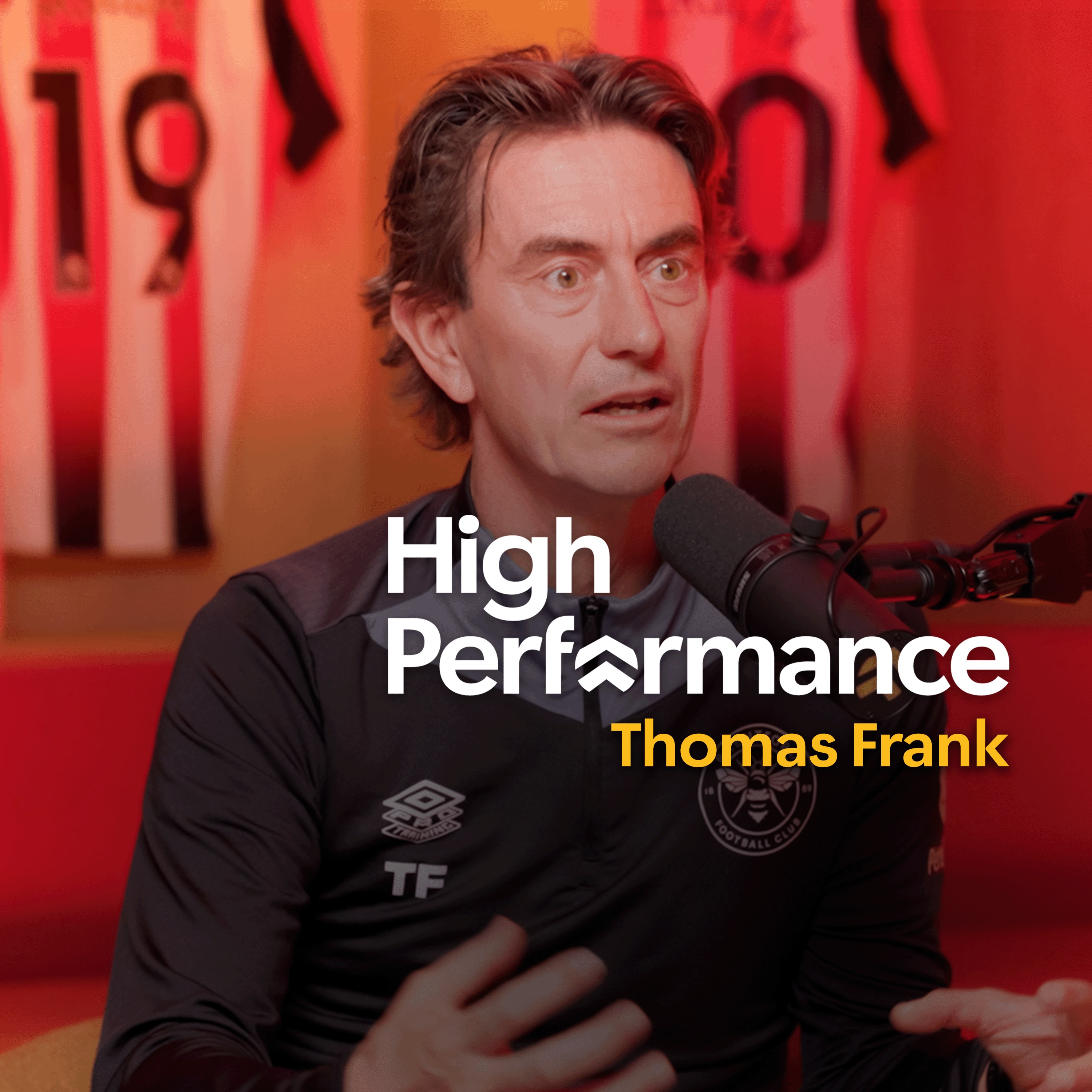
In this episode of The High Performance Podcast, hosts Jake Humphrey and Damian Hughes converse with Thomas Frank, the head coach of Brentford FC. Frank discusses his innovative leadership style and the cultural foundations that have propelled Brentford’s remarkable journey in the Premier League. He emphasizes the significance of people and culture over data in achieving high performance in football and beyond.
Written by AI. May contain mistakes.

Get the gist, explore an idea or ask about something said.
 Claude
On The High Performance Podcast, what are the key points of this episode?
Searching your listeningAutomatic transcript. May contain errors.
0:28Watch it early on the High Performance App. because if you don't take the step, there's no chance you're going to fulfill your dreams or your ambitions. That's the voice of Brentford manager Thomas Frank, who joins us on today's High Performance, the podcast where we explore the experiences, the challenges and the mindsets behind some of the most incredible people in the world. Remarkably, Thomas is the second longest serving manager in the Premier League and although his playing career was unremarkable, his achievements with Brentford have been quite the opposite. He took them to promotion from the Championship in the summer of 2021, with his trademark being the high-energy, fearless approach that the B's embody.
1:08Myself and Damien loved being welcomed into the home dressing room at Brentford to sit down with Thomas and find out how he's done it, Damien. And as you're going to hear, Thomas was keen to talk about what people have got wrong about Brentford. We were also really surprised by some of his revelations that he shared about how the club is run. Thomas reveals which players he trusts to enforce his standards when his back is turned. And he also explains why you don't have to have been a horse to be a jockey. As someone who's worked in the England football camp, it was a real treat for me to be able to pick the brains of one of the most considered and intelligent managers in the game today.
1:44And more importantly, to see how he's managed to achieve such an impressive record. I've spent a long time working in football with managers, with players, with pundits, and I loved this conversation. You're going to hear Thomas open up on the other Premier League managers he confides in and crucially, what his future might look like. As we welcome Thomas Frank to High Performance.
2:11So many people look at Brentford from the outside and seem to have an opinion about how you've done what you've done and how you've had the success you've had. What are we not seeing that you see that you think has really made the difference here? There's a few narratives about Brentford. most of them are positive. And there's a lot about the numbers games and all the marginal gains, which is also part of it. But I think a really secret sauce or what you call it, is the people in the club. And we know it's people that create the culture and the culture eat a strategy for breakfast. So culture beats everything.
2:49And that culture we have built together over years is, in my opinion, Quite incredible. We have a lot of good people, staff, directors, players that are working together in the same direction. I don't think I'm okay. I'm okay, good at something. But I think what I'm best at is to have good people around me. Then I learn. I think I'm okay, good at learning. So I'm reading and speaking to people and all that. So from the All Blacks, I stole that one line and no dickheads. and that's definitely a big thing for me because it completely fitted with my way of seeing culture or top performance culture.
3:31So I'll go that far and say we have no dickheads. And to be fair, I think it's also very rare we find people like that. I think general people, the core in people are good. If not, then you are close to be a psychopath, sorry to say. They are good. So if you find them and you reach them and you get to know them, most people are good. And if they come into an environment that is good, a lot of people are going to be swayed to that culture. And that culture is built on what I would call the path to success. So we call it like passion, attitude, togetherness, hard work. And we all know we need passion to achieve our goals or to maximize performances or maximize whatever we want to do or have in life.
4:19Attitude is another one line I've stolen. I think it's brilliant. It's confident but humble. So you need to be confident. If you don't believe in yourself, it's impossible to achieve anything. But on the flip side, if you're not humble, you forget that you need to put the hard work in, which is the H, of course, in the end. And you can only do it together with people. Because if you want to go quick, go alone. If you want to go far, go together. So I think that path to success is a big thing of why we're good. And I think I would say that we have a nice performance culture. So of course, when people come into the club, it's very open, which I'm very pleased with.
4:58So they feel it straight away that, you know, smiling faces, everyone says hello. We have an open canteen where everyone is eating together. If people want to come in, I always open the training ground. Of course, there's a little bit of limitation, but no secrets. people can come into meetings you know all that but when we cross the white line of course we compete and of course the players think that we are the referee is shit or the coach is a bad decision whatever it is and there's brutal tackles but when they walk off the pitch you know there's that fantastic bond between the players and everyone so I like that phrase a nice performance environment and a lot of other things yeah love it So a journey starts with the first step.
5:43So how do you go about creating this nice performance culture? The foundation in any culture, we need to work hard. So if they don't work hard, then I do this. The way I treat my players or our players, the way we treat each other, is a little bit the same like I treat my children in terms of how you raise them. So of course there need to be demands, consequence and love. so there need to be demands in terms of the hard work and if they don't work hard enough there will be a consequence ultimately they will not play and they would like to play and then of course they need to have a lot of love or belief or caring and all that so you need to have that foundation of hard work and put everything into it I guess it's how you are as a person I think I'm privileged I'm a positive open guy and then we have other good people around me that is also calm and the way of course we have demands and all that, but I think we do it in a, I don't know if it's the right way, but in a direct, but calm way.
6:46And people love to put managers and football clubs in a certain category, right? And I think the thing people talk about often with Brentford is data, because it's kind of the story of Brentford. I wonder though, whether actually you agree with that, because I think every football club now is using so much data. I'd be amazed if there are clubs not using a similar level of data to Brentford, maybe some even more, you know? Yes, we use data and we are good at using it, but everyone is using it today. And I think also it's important to use it in terms of especially, I think especially in the beginning was because how we recruited players.
7:21But everyone used that today. Still needs to use it in the right way to help us. But this is a high performance podcast. And yes, data is important. But I think all the indicators of high performance is something about culture, people, togetherness, teamwork, and the person in the middle. And I think actually that's the secret sauce we have. I think we put the person in the middle and we try to develop people as people or persons and players or staff members, depending on how we do it. And I think that's the key thing.
8:06The market's uncertain. Revenue's tied and hiring on hold. That's why results-driven companies are using Upwork to keep work moving. Go to Upwork.com today and start hiring proven freelance talent fast. No bulky overhead. No rigid long-term contracts. Just the right expert right when you need them. Work smarter and faster with Upwork. Go to Upwork.com now and find your freelance expert. That's U-P-W-O-R-K.com. Post a job for free and get started today. When it comes to what your family eats and drinks, you know your choices matter. You're the expert because you know what fits your life. And getting it right starts with good information.
8:49That's why America's beverage companies are sharing more information about our ingredients at GoodToKnowFacts.org. No spin, no judgments, just the facts straight from the experts for more than 140 beverage ingredients. Visit goodtoknowfacts.org
9:09This episode is brought to you by Opera Air, the first browser with mindfulness at its core. Now, most of us spend hours every day online, but how often do we pause to take care of ourselves whilst we're doing it? And that's where Opera Air comes in. It's a lightweight, fast, secure browser built not just for productivity, but for your well-being. With Opera Air, mindfulness is built right in. You'll find free breathing exercises, guided meditations, and soundscapes with ambient sounds, lo-fi music, and binaural beats, all designed to help you focus, relax, and even spark creativity while you browse.
9:47So to be crude then, what would you allocate if you had to proportion how much of it, of your success, is down to the people and the culture, and how much of it is down to the data and the analytics? 95 % people in culture. The myth that Brentford is built on data has just been busted. Maybe, yeah. I actually think that a big element of your secret sauce is down to two things, just from this conversation and things I've read. Innovation and bravery. Because I think you can't be an innovator unless you're brave, right? I agree. And I look at the things that you do and the way you do it. And a really good example this season is the sort of the blitzkrieg on other teams within the first minute of the game.
10:29And, you know, three successive games scoring in the first minute and another game having to wait until the second minute to get your first goal. I'd love to know the story behind how something like that happens because everyone in life is looking for innovation, right? But it's having the path, it's having the system here so that it goes from an idea to being effective on the football field. So would you mind telling us the story of how that all came about? The Brentford story is, remarkable in many, many ways. And we're very proud of it. And I'm very privileged and humbled to be in the middle of it with a lot of good people around me.
11:08But how can we make it a sustainable success story so we can sit here in five years' time and still thinking, how can you keep going? Because that's a real challenge. Already now we've been, in my opinion, unbelievably successful. But how can we keep going? That's the big thing for me when I'm working every single day. How can we keep developing and keep being an asset to the Premier League? Because for us, it's never been about surviving or staying. We also think that is not innovative. That is definitely not brave. And it's not optimistic. I've talked about before. So it's always been about that.
11:46An asset or developing, adding layers in the Premier League. And I think that's key because it's such a brutal league. it's so so difficult to compete here we had a good squad compared to us because we've done some fantastic businesses in terms of players then we need to keep being innovative we keep change things and I'm a little bit even though I have been a success I'm saying when are we an established Premier League team I don't know they say we are right now maybe but I don't want to say it because I'm afraid that we are leaning back and think oh that's it easy and then we just know it'll go one way and there's so many stories about teams that got up done fantastic and then got relegated like Burnley is a club I admire a lot and we looked their way Bournemouth the same I know they're back but they had to go down Southampton now Leicester there's probably Stoke there's a lot of clubs that you know how can we keep staying there that's the biggest challenge going forward and we need to be innovative A little example of that is the kickoffs.
12:56We try to find areas where we can find the smallest gain and see if we can win something. And it's something we've been working on before. And of course, give credit to Keith Andrews, his ideas. But I think two things. One, clear strategy for what to do it. We train it and the mentality to try, which is linked with the style of play. so when we get up there it's not to okay now we just keep it 20 times 20 passes try to score no no when we're up there we try to relatively quick if we can create a breakthrough in these cases cross has been the most obvious weapon we've used and then scored so there's a lot of things that's been linked there I think it's the biggest thing I think actually is the belief because I think to say to your players we're going to try and score in the first minute I think 99 % of footballers will go that's not how the game works but you're approaching the first minute like a lot of teams would approach the final minute if they were a goal down.
13:55And if you're going to do that to score a goal, why not do it in minute one, right? I agree. I think belief is everything. Linked again to this optimistic approach. We need to believe that we can score on minute one. We need to believe that we could do well in the first season of Premier League. We need to believe that we can go to the Etihad and beat City. Like really believe. And of course, because they on paper are better than us, most of the time we lose. that's just part of it but if we don't if we lose the belief you can never win that's for sure so I go into every game but if we win like literally away there's not once a set we play for a point not once we go with that to win away to City when we beat them 2-1 up there and you need to do a little bit motivational speech which I'm a little bit I'm believing in because you say it every week and I get tired of listening to myself.
14:50So anyway, I don't know how much they take in. Last meeting, before the game, I said to the players, of course, we're going here to try to win. It's against the best team in the world. The best players, De Bruyne, Gundogan, Foden, Grealish that time, Roderick, all of them. And there was a little bit in doubt of Holand for that game. And I really, really hope Holand plays. Because when we beat them, I want to beat them with all the best players. And you said this to the players? Yeah, I said that to the players. So of course, is a part of that motivation and belief. And of course, we were privileged and got things with us that day and won the game.
15:27That reminds us of when James Milner told us about the Barcelona game where Liverpool came back from 3-0 down. And he found what was really helpful was Klopp didn't shy away from the problem. He addressed the fact that nobody believes we can do this. These are some of the greatest players on the planet. And then once he'd almost outlined the obstacle. He gave them the belief to understand they could overcome it. So how important is it, you know, when you're trying to win their hearts as well as their minds for them to believe that you can go on? How do you deliver a great team talk that balances realism with the optimism that you can be victorious?
16:08I think, of course, there needs to be a part of a realism in it. I think I actually almost need to overdo it a little bit, if I'm honest, because if you're too realistic about us going to the Etihad, you think, we can't win here. It's one in 20 times you can win here. And why should it be today? So I think you need to really believe that the next time is always that time that you will beat them. And if you've done it, you need to believe that you can do it again. You need to believe it. Also, because I think one thing is 100 % sure, every footballer or every head chef every top podcast host are just human beings have good days and bad days and in the middle of a game in the middle of the night you're going to have a down in your belief or physical capacity or whatever it is and the footballers they know that even if they play against the best team in the world with the best manager and they're in the best shape they know they're also human beings so there will be spells in that game where they will can't perform or where they lose a little bit of belief or most likely they just dip a little bit in focus because they're playing against the team that they need to beat or should easily beat and stuff like that so I think that's a big thing you can play on as well So how do you decide what to say to the players to get them to be what they need to be at the right time so we're sitting in your dressing room and up on the wall it says brave and aggressive so what was the What game was that up for?
17:45Bournemouth? Was that? I think, yeah. Bournemouth, yeah. They are very competitive. So it's just ingrained in them. Since they were a kid, they wanted to compete and wanted to win. And they found out if you play football, you need to have a kind of aggression in the 50-50 duels, in the duels. And no one has really achieved anything if they are not aggressive unless you are the best possible footballer in the world. And there's only a few of them, even them are quite aggressive. And brave is a little bit linked to the confidence of being confident. If you're not brave, it's, you know, it's difficult to achieve things.
18:25I think you need to be brave. Then there's some that are super confident and super brave. So, yeah, it's that balance. And if you're brave, you're playing forward, you're turning forward, you want the ball in football terms or you want to press high in those situations. and you're willing to take risk. And I always say, if you don't take risk, you also take risk. So you need to take a certain amount of risk if you want to achieve anything. Zero risk is the same as you will decline and you will go backwards. I love that because I think some people think by taking no risk, they live a risk-free life.
19:01But of course, that's not the case. No, no, you need to. It depends on what you want to achieve. Some, of course, it's different with people. but I think you need to, if you don't put yourself out there, how do you get anything? It's the same in life. If you're going out and you want to meet a girl, you need to take a move. It's very rarely that you can sit in the corner and they're coming to you. At least I had to take a move. You need to do something in life. So one of the comments you made earlier, Thomas, was around doing this through people. One of the things that often intrigues us when we look at culture is a phrase from the Norwegian psychologist, Willy Raylio, that spoke about having cultural architects.
19:42You need the leaders without necessarily those titles of leadership that role model the behaviors and the standards that you want. How do you go about identifying and then empowering your cultural architects to set the standards here? I think a couple of things. I think in general, I trust people. The first thing when I meet a person, I trust him or her until I don't trust them anymore, of course. but that's very rare that's going to happen because normally people just want to, how can I say, do their best and they want trust and if they feel the trust, they do a little bit more. And I see the best in people as my first instinct.
20:23Of course, I can also see there's flaws. We all have that. I think that trust is big to the players and my staff because it's not only the players, it's also some of the staff that need to come with this open, minded approach, demands, all that. And they need to, I can't be around 30 players and 50 staff members. So I need others that is also building this culture. And I agree with the cultural architects are very important. I'm privileged, I think is one of the reasons why we also are good. We have some good characters, some good actually cultural architects in the squad. And quite a few actually.
21:04and I think that's the reason why we work hard and we are constantly competing in the best league and it's about humans because money has an impact and of course we don't, we have maybe the third lowest budget in the Premier League so we can't buy all the best players so we need to buy good people, hardworking people of course talented people, of course very talented but if you have the hardworking and the good people and they're working in the same direction and they want to do a little bit more than the others and we have hopefully also a good plan, then we can overachieve and beat the rest.
21:38And I also say to my players that me, my coaching staff and the rest, we can push the culture to, or the high performance culture, if you could talk about this, to 85, 90%. I think I can put the framework, the context, all the nice buzzwords, and I can, you're not running, you're not all that. but the last 10%, the most crucial 10 % is like you are beating your running times, okay? And I guess you're both good runners, so you're probably running around 4.30 a K or 4.15, okay? And if you want to go down to four minutes per K, the last 15 seconds, or just like five seconds, it's unbelievable hard to get.
22:20That demands so hard work. I try to compare that to the last 10 % is in within the group. So I'm saying to the players, the last 10 % is in the dressing room. It's on you guys. I can't do that. So can you give us an example then of how you see that demonstrated by your players? Yeah, but then because I say to them, and of course, and I speak to the five, six, seven, eight players, I think got more in them. Like today, I said to Matthijs Jensen, he was driving a little bit the small position drill. And I said, after the drill, I said, keep doing that. You're doing it for a while. It's you who's driving that drill.
22:58So he's doing that on the pitch. Of course, I see that. Or I'm saying to my captain or my captain's group that, you know, is in the dressing room. You guys need to boost the rest in terms of what kind of standards we will have. Or I got an eye because I know that maybe three or four players are dropping or maybe there's something with them that's not working. What is it? So I ask my players to find out. We're not talking about going out. You can just see they're not happy. Is that a family? what is it can you get around them because they have a naturally they have a better connection with them same nationality so that's how I try to use the players and at what point would you step in there let's say that your captains group comes to you and says this player has an issue with this do you then decide there's a moment where hearing from the manager is what matters yes and maybe also I step in before that and then after I ask the captains group to help it can be both scenarios It can be that they maybe can't reach them or they think it's a problem you need to deal with, Thomas, or it's a personal thing, so probably you need to have a chat with him.
24:09Yeah, I think that's those situations. So we've got all the shirts around us here. Would you mind just picking out maybe three or four of the names on the back of these shirts and giving us a line or two on what that person brings to Brentford that makes them a cultural architect? Of course, the natural one is the captain, Christian Nergard. I think he is a very natural leader. I don't think we have many of them in football in general or don't have enough. He is the classic. He's working hard. No problem to say to the young kid, now you need to step up or to Brian Ombuemo, the top dog, now you need to work harder or it's a bad pass or whatever.
24:54So it's the same, treat everyone the same. and then I think he got good emotional intelligence about how to interact with the different players. I think he's one that gives a lot. I think Jorn Wisser is a player that is, of course, very good for us, but he's a player that you can just see he gets around the other players. So he was running... So he's taking care of Yarmuluk, who's a young Ukrainian boy. with all he's dealing with his parents and everyone in Ukraine. So they have created a relationship and he's talking to him and he's speaking to him, he's taking care of him. And Wyss is also the player that is, for example, in games or training, is also pushing and getting the team in the right direction.
25:43I would say Vitaly Janold is also a player that is around a lot of players in the squad, high standards for training also emotional intelligence to push everyone and I think the last one I can mention a lot a lot more, the last one I think actually mentioned Benmi very experienced player that even that he's not playing as much as he wants to now, he's giving a lot to the group of course I speak to him and talk with him about that it's important, the conversation he has with the younger players or with the group means a lot. So for example, we trained defensive set pieces before Everton in the weekend and Ben was on the Everton team if you can say it like that.
26:33And then he was speaking to King-Lewis Potter that was going to mark Tarkovsky which is one of the best headers in the league and twice the size of him. How he should mark him. No, you need to go around this way and you need to use your arms like this and you need to take a step before him and stuff like that. So things is invaluable. It's such a big thing helping to perform, but also for the culture. Brilliant. And you mentioned the no dickheads policy. What is a dickhead? A dickhead is, what do you say? It's difficult to explain. But definitely a person that don't care about his teammates or staff members.
27:16that I think is not respectful in general to everyone higher and low, treat people the same way. I think that's the most difficult thing for me if I see especially people that got more money, status, everything, and they treat people lower than themselves in a different way. I can't stand it. Yeah, that's very, very difficult for me and I don't care who it is. I'll just instantly, okay, lost him because I think that's very important you do that in life. What was interesting there was when you talk about someone that throws their weight around and their status and you say, boom, gone. There were people watching this that operate in environments where they are the leader and there are dickheads that have somehow made it into the culture.
27:59What advice have you got for them on how you can deal with that? I think the easy ones, get rid of them. That's difficult. But I'm also a big believer that you need to give people chances to improve and get better. And you only get the chance to improve and get better if someone tries to help you. And that's of course give them guidelines of this behavior. It's not good. The way people see you is maybe arrogant or you lose them during the way. All that. Give them examples of how they act. And then I think it's important that you act yourself in a good way. You need to lead by example, of course, the classic one.
28:46But you definitely need to approach them. I think that's the biggest thing and give them a chance to change it. And if they can, of course, they need to leave. I'd like to talk about other managers that you share the Premier League with. I'm interested in the biggest lessons that you've learned from other coaches that you've spent time around. I think there's three areas where they need to score high or any head coach or any head coach in the world that needs to be top. They need to have three areas. in my opinion where I need to score high but I think number one no priorities ranking number one they need to be very good in the specific area they are either coaching or leading or whatever so in my opinion in my case football so we need to be good in terms of you can see in the team clear identity you can train it you need to train it yourself coach it in my opinion develop it analyze it, constantly improve it.
29:45So all the tactical bits, how can you train that and get a clear, clear identity into your team? Two, leadership. And leadership is, of course, many things. It's communication. It's the strategy, it's the plan. It's how you communicate. It's how you lead other players or people. And then man management. The one-to-one, mainly with players, but these days also staff. and then there is too many people with too many egos or too big of egos. But anyway, so these three areas, you need to score high in all three, in my opinion, if you want to be top. And I was thinking, actually, maybe you need to have one more because you need to keep developing, being curious to go to the next level.
30:31For a lot of football managers, I mostly looked at because they don't know exactly their leadership and the way they communicate their football. So that's the football. And then there's other leaders where I've been in the past, it was very interesting in them coaching, but you know, not the coaching technique of answering or asking questions. I used a lot in the past to do that. Very interesting. Found out it's very good, but it doesn't work too much in football. Yeah, in some meetings, but there's also the including thing. What I'm left thinking is, who in the game, and does this happen even, do you pick up the phone to and say I've got a bit of an issue here or when you have a glass of wine after a match with a manager what sort of things do you discuss and I'm interested in who you feel you really learned something from that made a difference for you and what it was I meet with a few Premier League managers sometimes where we discuss everything in a closed room and everything is said there is of course kept there sharing stories and experiences and yeah challenging Even without betraying their confidences and sharing what you discussed with current Premier League managers, is there a power for you in being able to talk about your challenges and your issues and the problems and the sort of landscape of the game?
31:48Definitely, because when we sit there, we are completely naked in a way. We can sit there, we can share all our thoughts, our struggle. We all struggled at one point in a job or in a spell in the season or had issues. It was difficult. So, of course, it's classic. There's a lot, you know, how did you deal with players? How did you deal with the big egos? How did you deal with if you didn't win five games a game in a row? When you went into that club, what was your learning? So all those stories are we sharing. Do you mind telling us who? Because we've had a few, I guess, on high performance. Yeah, we have met a few times with Roy Hodgson, very good, David Moyes, Sean Dice, Graham Potter, Gareth Southgate, of course.
32:39So, yeah, it's very good. And there's a number of those other managers that you've met with that come from a similar background to you in terms of not necessarily having a high-level football playing career. one of our favorite quotes is the Arrigo Saki one that you don't have to have been a horse to be a jockey have you ever discussed that idea of how you can command respect in a football environment having never been a footballer has that come up in these meetings? No actually but I think it's natural in the beginning of my career it was something I was I was thinking about I think it has changed more these days I think it's it still means something if you are a former player and played at the highest level.
33:26You have a natural respect when you step in because you got a name and, you know, oh, he was a good player, you know, just natural, instant, there's just respect. But if they found out that they, you know, whatever, I'm not saying they can't, but the leadership or the coaching or whatever it is, it's not to a good level, then that will die after weeks, a month. And they got something I know will have, I've never been out there but on a very very low level playing the highest level game if they're very good at communicating that and use the experience there's something they'll gain from that of course I just knew that I had to upskill myself in other areas so others must judge that of course but of course being able to coach on the pitch is something I've done 10 ,000 of hours of analyzing game I've seen I don't know how many games, so I hope those two areas are okay.
34:25And then I think the leadership and the man management, it's something we all learn. Either you are, I don't know, say naturally talented, because I don't think maybe we all have a potential, but maybe you have a good personality that makes it a little bit easier. But if you don't learn, and we make so many mistakes along the way and learn from them and get better, then it doesn't matter. so in the beginning of course it was a little bit a thought from me but now of course I don't it's not a problem of course I'm doing very well here in Brentford and everyone knows me and I'm king of the castle and blah blah blah of course I'm not but you know what I mean I'm top of everything but if I walk into a new club I need to perform and prove myself again but I will never think I was not a player now I need to no no I just need to know to go in and trust myself.
35:19I know what I've done is good and hopefully I can do it again. What advice could you pass on to anybody about being willing to stand out and put themselves out there? Definitely, if you want to achieve anything, have any ambitions, you need to be brave enough to stand out there and be either criticized or the fear of failure. Don't fear those things because if you don't take the step, there's no chance you're going to fulfill your dreams or your ambitions. So I think it's very important to trust yourself throughout. Also in the bad days and with the setbacks. How much impact do you think a manager can have in a very short half-time in a game?
36:07I mean, I've looked at a few of your games this season. I thought the most fun one from our perspective was your game against Dipswitch, which was just like sort of a crazy game of football. In those games where you're really up against it at halftime, how do you think you can make a real difference to the second half? I think you can, but it's not like, at least I'm not good enough to do that. Maybe the others are, I don't know. I don't think there is a formula that you can go in there and then you can completely change the team every single halftime. But there is times where you can either do good stops and that's a feeling you can't say okay this game no that's a feeling from your experience what you see the motivational or the little go you need to have of them so I would say there's some half times I was thinking okay there I made the difference but there is a lot where I hopefully did my job but it made a big difference would you give us an example of when you feel like you really did make a difference I think there was Tottenham away in our second season of the Premier League.
37:15There was a clear one where I remember we were 1-0 down. And I was angry and irritated because I felt that we didn't perform to the level or we didn't, like, believed or we didn't have the physical presence or went into the 50-50s. because normally I'm calm, composed, analytic, and try to have that bit. And it's difficult for me to just, okay, now I need to pull that hairdryer, classic Ferguson, which I'm not that good at. But I know I have enough temper that if they hit me on the wrong day, I will snap. And I think that was either the wrong day or the good day because I just felt it. So I didn't speak to the coach, it just went straight into the players.
38:09And, you know, in terms of one more, there's a few things. I said, okay, this needs to be better. I can't remember to press or build up, you know, sharp, but the most important is that I can't replicate it, but, you know, I need to win 50-50, so I need to press. And then, you know, a few players, if you, I think that was Vitaly actually, want to show that you should play there. and now you need to step up and win more 50-50s. And if you, then not all 10, but one or two or three that I know hopefully can take it. If you're still overpaying for wireless, it's time to say yes to saying no. At Mint Mobile, their favorite word is no.
38:49No contracts, no monthly bills, no overages, no hidden fees, no BS. I made the switch because I was tired of those ridiculous bills and sneaky charges from my old provider. With Mint, I'm paying$15 a month and getting the same high-speed data, unlimited talk and text, and coverage on the nation's largest 5G network. Honestly, the quality is just as good, if not better, than what I had before. And the best part? You don't need a new phone. You can keep your current one, bring your number, and all your contacts. I use Mint Mobile, and you should too. Ready to say yes to saying no? Make the switch at mintmobile.com slash HPP.
39:25That's mintmobile.com slash HPP. Upfront payment of$45 required, equivalent to$15 a month. Limited time new customer offer for first three months only. Speeds may slow up a 35 gig on unlimited plan. Taxes and fees extra. See Mint Mobile for details.
39:58the right expert right when you need them. Work smarter and faster with Upwork. Go to Upwork.com now and find your freelance expert. That's U-P-W-O-R-K dot com. Post a job for free and get started today. At Capella University, learning online doesn't mean learning alone. You'll get support from people who care about your success, like your enrollment specialist who gets to know you and the goals you'd like to achieve. You'll also get a designated academic coach who's with you throughout your entire program. Plus, career coaches are available to help you navigate your professional goals. A different future is closer than you think with Capella University.
40:39Learn more at capella.edu.
40:47I dropped a line to one of your coaches to inquire about your leadership style and one of the responses I got back was that you're very good at using logic and strategy and rarely, if ever, let emotion affect your decision-making. Is that conscious? Yeah. Yeah, I think so. I am a very logical person and I also think I'm very calm. I also do my very best to control my temper because I don't think it's beneficial. I really believe that, I really, really believe that, of course, you can perform on fear or pressure or what you hold. You need, no, mainly fear. Of course you can, but I don't think it's sustainable at all.
41:39So I believe in confidence, believe, clear messages, calm. I massively believe in that. But as I, coming back to the kids, raising kids, you know, So demands, consequence and love. And I think that's the big thing. So how do you control your temper then? What are the strategies? Since I was young, I think I guess I've been relatively aware of I don't think it helps. And also if I lose it, always after I'm thinking, what are you doing? And I don't think it really helps. Now, because I know in this world, you also need to show a little bit of, you need to have some personality and presence which I don't and again that's maybe part of you need to have some sort of presence when you're standing in front of players whatever media you need to have something over you so when I lose it very few times not lose it but you know really I think that's important I think it's important to show it so I'm not I think it's more good because in general I think again others must adjust that I think I'm a quite a good guy so I think it's good to just show that side of me a few times.
42:51I also think when you don't shout a lot, when you do shout, people listen, right? Look, we're all adults here and we all know how football works. And we all know that either a team has already come wanting to hire Thomas Frank and take him from Brentford, or one day a team will want to come and hire you and take you from Brentford. And before we started recording, you know, we discussed that you were listening to the Graham Potter episode, and it's a very similar career trajectory. You know, it's been a stable, constant improvement. and then he makes the decision to make a big leap and take the job at Chelsea and everything changes.
43:24One day you will be in that position if you haven't been already. What are the questions that you would ask before joining a new club to make sure that you can replicate your success here? Because we got the impression talking to Graham that that was the big learning for him. I think a couple of things. One, again I said a million times, I'm very, very, very happy here. If I ever should go to another club, I think it's difficult sometimes to be in position to ask the right questions. You definitely need to do diligence yourself. And isn't it Ferguson who's saying, he said that, reminded me this morning when I was running, when one of you said that, that you need to pick your chairman.
44:10that can be difficult because it's not that often that you got the possibility to choose between three clubs there's maybe two or three managers in the world that can do that so more normal managers that Kramer and I if that club comes that we think is interesting enough then it's maybe not an option for us to choose the chairman if we want that challenge if we want that challenge but I think this is a general thing I'll say now it's not for me I think for any football head coach or manager of course the ownership slash chairman is important I think the club you're going into can you instant improve in is there low hanging fruits or is it is it difficult to raise the bar and is the finances finances good and four can you get the players in and out you want to.
45:08I think that's the key. And again, you know, talking as adults, understanding the way the world works, you know, this isn't you saying you want to leave Brentford, let's be very clear about that. But you've had this amazing career of teaching and then going all the way through the youth setup in Denmark and then coming over here, being an assistant, becoming the manager. I've loved, you know, this insight into the culture you've built and your constant quest for information. You know, you're exploring all the time. Is there a part of you that would love to test yourself at the very highest level in the Champions League?
45:40I think there's a part of me that that one day maybe maybe I need to try something different. Is that a bigger club, Champions League, different challenge? I don't know. The flip side of me thinking because I think I'm a little bit different. I don't know. Of course, I don't know all my colleagues, their family life and social life. But I'm a very social person and I love that part of life as well. Being together with friends and family and being able to travel and all that. And I'm working very hard at Brentford. I'm in a club where everything is working. Everything being part of building is, you know, all the processes.
46:27And then we know last year we... I'm not saying we were fighting relegation. It was not going completely the way we thought so. Okay, then it's a little bit tougher. but there's a lot of things in this club where it's easier than you're going into another club where there's just you need to build the culture you need to build everything you need to all that so that's probably the two questions I need to ask myself and plus Brentford maybe there is extra layers I don't know who knows what will happen in the future when we can do even more I think that's probably the two questions I'm asking myself so now I'm just thinking what is it I want in life is that constant chasing which I already do a little bit with my ambition to do better and better and better.
47:09That's, yeah. So if I'd have asked you that 10 years ago, do you think the answer would have been different? Yeah. What would you have said then? I need a big club, I need to push myself. Yeah, but the thing is, I always just thought about the next step. I never, 10 years ago, I was at Brunbou. I thought at that stage, just ask me there. I always just think, okay, I need to get this right because I was there three years and we did fine, but there was a lot of things we need to do. but yeah definitely now I'm thinking it's fantastic privilege to be in football but it's also a hamster wheel and we've spoken to so many high performers who are not happy I think if you can be a high performer and be happy that is rare air at that point it doesn't happen often no I'm quite happy we're about to move on to our quick fire questions to wrap up this interview one thing that I've been thinking about sitting here listening is that you seem so comfortable in your own skin.
48:03I wonder whether you've kind of, you've actually reached that moment in your life where you know you're never going to know everything, but you also know that the stuff you do know is pretty valuable. And you've seen enough and heard enough of good and bad things to realize that there's actually, there's more to life than football. And I just get the sense that you seem comfortable, really comfortable. Thank you. I think I am. I think, I think, I think I've been working. No, I know I've probably been working 60, 70 hours since I was 20 years old. Not with the ambition to be a Premier League head coach one day.
48:39That's a little bit of coincidence. Hopefully hard work, hopefully some skillfuls, hopefully good people help me along the way. And, you know, just small aims, goals, and now I'm privileged to sit here. But I always tried to get the balance okay right with family and friends. and I always knew that that was probably more important to me. And of course, there's stages in your career. Of course, when I was in Brunby, I walked out myself after three years. I probably knew that it was probably not that good to be sacked after two years. Of course, here, I didn't want to be sacked. But now, no matter where I go in the future, if I stay in Brentford, I'll never be afraid of getting sacked.
49:20Never, never, ever, ever. And I could just go home to be a teacher in Denmark. I know I will miss the football a bit. Don't get me wrong. I will still, my ego will be hurt and all that. But the biggest thing in life, no, it's much more important. Family and friends. Love that. Ready for some quick fire questions? Yes.
49:42The first one is the three non-negotiable behaviors that you think are most important for you and the people around you. Hard work, respect, be on time. Very good. What advice would you give to a teenage Thomas just starting? Even that is uncomfortable. Still that belief. I think everything will be fine. It's funny because when I try to look back at my life, I'm thinking, it seems like just one thing took the other. Of course, there was a lot of setbacks. Definitely believe in yourself. and I am an optimistic guy and maybe used it even more when I was younger. And of course, through hard work, there will come opportunities.
50:33What does high performance look like to you? High performance is for me the ability to perform at a high level over long, long periods of spells. I don't know, years, more than, you know, 10 years, more than that. And performance there is, high performance is that you are
51:04probably not only achieving because in football, you know, for example, some teams, CT have done fantastic, but there are also some teams that haven't won enough because it was inside the post, outside the post. So it's that consistent performance over time, of course. But where you are, how can you say, performing to a higher level than you thought was possible, either as a person or a team. And if you want to have that opportunity to perform over time, high perform over time, you need attitude where you're confident but humble. You need to be confident and believe in yourself and your ideas and your dream and all that.
51:45but humble enough to do the hard work and to have the discipline to do the hard work. What's your biggest strength and your greatest weakness? I think my biggest strength is I am positive, energetic, open. That's also the weakness because it's often that the strength is the weakness. So I don't know if you can be too optimistic, but I think because I believe so much in the guys and the team, so we go to Anfield, I believe we can win there, and I get so, not frustrated, but down if we lose, even that I know the chances for losing is big. So that's a downside to it. And me having energy, also another thing being a strength is that I want to do everything, which is good.
52:42Because that gives me ability or determination to achieve something. I've also learned that I can't do everything all the time. I need breaks. I need to rest with everything. What's the hidden cost of your journey to high performance? I think what they don't see for me, I think it's in that journey, there's a lot of things you need to say no to. So that's, you know, family birthdays, kids' birthdays, seeing friends, going out, holidays, all that. I think that's the biggest cost, I would say. And then in football, I think it's brutal because there is 10 % joy and 90 % suffering. so I think that must be the hidden cost as well.
53:38The final question for people who are listening to this and people often listen to this as listeners like you are, they're on their own journey, they're in search for high performance. What would you say to them is a golden rule for living a high performance life? Your final message, I guess, to people who've listened to this conversation. They don't just say that attitude where you're confident but humble because if you're confident, that's where you believe in yourself and you need to believe in yourself. If you don't believe in yourself, you can achieve nothing, nothing, nothing. And it doesn't matter what people say to you, keep believing in yourself.
54:11Of course, learn and learn from your mistakes and don't make lots of mistakes, but not the same twice and all that. I think so confident and then humble enough to put that hard work in because it's relentless out there, but also quite fun. Brilliant. Thomas, thank you so much.
54:33Damien. Jake. A rare, measured, considered, honest insight into the mindset and the life of being a Premier League football manager. Well, what privilege access that we've just been given. It's been utterly humbling for us to be trusted enough by a Premier League manager to come and open and share so candidly. I do think it helped, you know, that when he sat down, the first thing he says is, I've listened to 10 or 15 of your interviews. I think that kind of set the tone for the fact that this was an interview about high performance. But I think what really came through to me is that we've caught him at the right time in his life as well.
55:10Like if we'd have spoke to him 10 years ago, it would have been all about a crazy ambition to be the most successful manager in the world. Yeah, he's arrived at a place where it works for him so much. He's so comfortable here. I think that he's realizing the value in actually being at a football club that is as good for you as you are good for it. And that is so rare in the game. And we've seen so many examples of people that give that up to chase glory or something else and they soon realized it was the wrong move. We've got a measured Thomas Frank. Yeah, true. I mean, I think that formula that I'm going to steal shamelessly about his idea of set demands, be clear about the consequences, but then shape it with love.
55:49Give people lots of love and affection for what they need. I think he's a man there that sets high standards and has high demands of himself, understands the consequences of maybe getting high on your own supply or trying to run too far, too far. but then actually has that love for other people and for himself and his family and his way of life. I think we've met a man that seems to have worked out where his sweet spot is. It's a great lesson for anyone in exploring, in working hard, but I think more than that, being optimistic. You know, when Thomas says, before every game I believe we can win, including away at Manchester City, there's no part of me that doubts that he's telling the truth.
56:25And I think that that is a reminder how powerful a mindset of optimism is for people, whether they're a football manager or not. Yeah, but then that also leads into, I thought his answer to the question of what proportion of your success is data and how much of it is culture. 95 % of this is about people. You know, data doesn't understand optimism. Data doesn't understand relationships. Data doesn't measure that willingness to work hard. It can give us indicators, but it can't deliver that for us. And this is a man that seems to use data in a really intelligent way to enhance the relationships and the culture that is built here.
57:03I loved it. Absolutely eye-opening. And I hope that anyone, whether you work in football, sport, or just life itself, can take something really useful away from that, what we've just heard. Thanks, mate. Thank you, mate. That's it, the end of today's episode. If you want to see what it looked like inside the Brentford dressing room, where we spoke to Thomas, the best place to watch our conversation is on the High Performance app, where there is so much more that you can access. It really is the best place to enjoy high performance. Thanks so much for joining us, and we'll see you again soon.
57:59At Capella University, learning online doesn't mean learning alone. You'll get support from people who care about your success, like your enrollment specialist who gets to know you and the goals you'd like to achieve. You'll also get a designated academic coach who's with you throughout your entire program. Plus, career coaches are available to help you navigate your professional goals. A different future is closer than you think with Capella University. Learn more at capella.edu. Are you ready to get spicy? These Doritos Golden Sriracha aren't that spicy. Sriracha sounds pretty spicy to me. Um, a little spicy, but also tangy and sweet.
58:46Maybe it's time to turn up the heat. Or turn it down. It's time for something that's not too spicy. Try Doritos Golden Sriracha. Spicy. but not too spicy. Hey, I'm Dr. Z and I'm a neurosurgeon. So that means long hours, early rounds, late nights, and everything in between. And through it all, I wear figs. They're comfortable when it counts and functional when I need them the most. So where do you wear your figs? On shift, on call, on the couch in the break room listening to this podcast? Wherever it is, they fit right in. And now listeners of this podcast can get 15 % off their first order. Just head to wearfigs.com and use code FIGSRX at checkout.
59:26That's wherefigs.com, code FIGSRX.
Thomas Frank is the brilliant mind behind Brentford's remarkable journey in the Premier League. Known for his innovative thinking and people-first leadership, Thomas has taken the club from strength to strength, earning respect as one of football's most exciting managers.
In this episode, Jake and Damian dive into Thomas’s unique approach to leadership and culture-building. He reveals the unseen factors behind Brentford’s success, from empowering cultural architects within the team to creating an environment of belief and optimism that fuels high performance.
Thomas also opens up about the role of data in his coaching strategy, explaining how it shapes decisions and impacts the club’s growth. He shares lessons learned from other Premier League coaches and reflects on the pivotal moments where his influence truly changed the course for Brentford.
This episode offers an exclusive insight into the mindset and strategies driving success both on and off the pitch, exploring Thomas' views on leadership, innovation, and cultivating a winning culture in one of the world's most competitive leagues.
🚨 Partners
Huel 👉 Get an exclusive 15% by using code: HP at: https://hppod.co/HP
Heights 👉 Get 20% off your subscription by using Code: HP20 here: https://hppod.co/Heights
Payhawk 👉 See our sponsor, Payhawk in action here: https://hppod.co/Payhawk
FORA 👉 Claim a free day pass at any Fora workspace and find the perfect home for your business here: https://hppod.co/FORAHP
HP Foundation 👉Do you want to kick-start an evolution that will change the lives of millions of children? Find out more about the High Performance Foundation: https://hppod.co/foundation
HP Corporate Events 👉Click here to book High Performance Events: https://hppod.co/corporate-events
Explore offers and discounts through our other partners:
Hosted on Acast. See acast.com/privacy for more information.


