
 Ask ChatGPT


 The High Performance Podcast
27 Aug 2025 · 26m
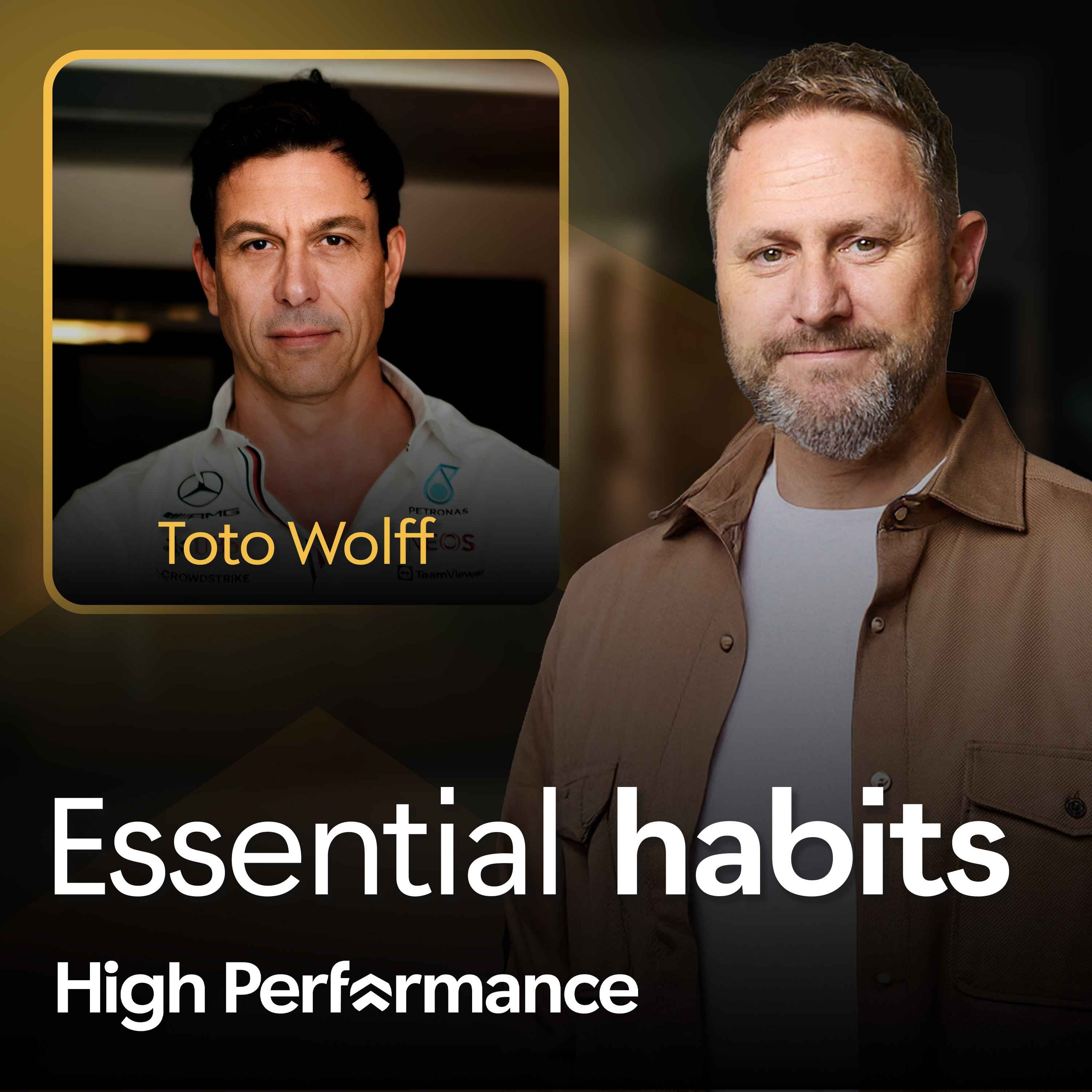
In this episode, hosts Jake Humphrey and Damian Hughes are joined by Toto Wolff, Team Principal and CEO of the Mercedes-AMG Petronas Formula One Team, to discuss his leadership principles and the habits that have driven the team's unprecedented success in Formula 1 (F1). The conversation focuses on how to maintain clarity and purpose under extreme pressure, the importance of reflection in decision-making, and the impact of values over circumstances.
Written by AI. May contain mistakes.

Get the gist, explore an idea or ask about something said.
 Claude
On The High Performance Podcast, what are the key points of this episode?
Searching your listeningAutomatic transcript. May contain errors.
0:00Watch it early on the High Performance App. Available now, Roman Kemp, the broadcaster, opens up a powerful conversation on success and mental health.
0:31smarter and faster with Upwork. Go to Upwork.com now and find your freelance expert. That's U-P-W-O-R-K.com. Post a job for free and get started today. I'm no tech genius, but I knew if I wanted my business to crush it, I needed a website now. Thankfully, Bluehost made it easy. I customized, optimized, and monetized everything exactly how I wanted with AI. In minutes, my site was up. I couldn't believe it. The search engine tools even helped me get more site visitors. Whatever your passion project is, you can set it up with Bluehost. With their 30-day money-back guarantee, what have you got to lose?
1:08Head to bluehost.com to start now. This episode is brought to you by Opera Air, the first browser with mindfulness at its core. Now, most of us spend hours every day online, but how often do we pause to take care of ourselves whilst we're doing it? And that's where Opera Air comes in. It's a lightweight, fast, secure browser built not just for productivity, but for your well-being. With Opera Air, mindfulness is built right in. You'll find free breathing exercises, guided meditations and soundscapes with ambient sounds, lo-fi music and binaural beats. All designed to help you focus, relax and even spark creativity while you browse.
1:50And now you may say, how do dry coffee cups or an old Daily Mail impact on the performance of a Formula 1 team? It shows an attitude. It shows attention to detail. Welcome to the Essential Habits of High Performance, where we explore the daily practices, the mindsets and the teachable moments that shape extraordinary lives and leaders. Today's habit is all about closing the gap between what we say and what we do. When Toto Wolff walked into Mercedes Formula One for the first time, he didn't look at the car, he looked at the coffee cups. He saw a team that claimed they were excellent, but they seemed to tolerate mediocrity.
2:35In this episode, we're going to explore what happens when our environments betray our values and how high performance close that gap, not with slogans, but with essential habits. Because culture isn't what you say, it's what you permit. Hey, I'm Damien Hughes. I've worked as a visiting professor of organisational behaviour and I've served as a trusted advisor to elite performers across sport, business and the arts. For the last 25 years, I've asked one question more than any other. How does high performance actually work? And more importantly, how can we all apply those lessons in our own lives?
3:16Total Wolf isn't just a team principal. He's the architect of one of the most dominant areas in Formula One history. His success isn't just about strategy. It's all about standards. I mean, the first day I walked in, I arrived in reception and I sat down in reception and it didn't look like a Formula One team. There was an old Daily Mail on the table from the previous week and coffee cups that we had to try coffee. And I couldn't believe that this was the Mercedes Formula One team. And now you may say, how do dry coffee cups or an old Daily Mail impact on the performance of a Formula One team?
3:56It shows an attitude. It shows attention to detail. That's what Toto noticed the day that he sat in reception. A team that intended to win, but whose behaviour told a very different story. He put it beautifully, as you've just heard. You may say how to dry coffee cups are an old Daily Mail impacts on performance, but it shows an attitude. It shows an attention to detail. This isn't just about being tidy. It's about what leaders sometimes call cultural drag. The small behaviours that slowly pull performance in the wrong direction. Now Toto saw this instantly. He saw a disconnect between the values of excellence and the day-to-day signals that shouted mediocrity.
4:44So what did he do? He walked his why. What is the differentiator? the differentiator is all those values that lead also to the to the camaraderie that we have within the team that we are empowering that we blame the problem that we communicate around hierarchies in terms of quickly solving the problem Mercedes board that gives us unconditional support and no politics politics you can do outside to make the to make things go towards your direction No allowance for politics inside the team. No place for dickheads. The all blacks mentality. That mindset didn't just turn the team around. It built a dynasty.
5:29We have this concept of the day we fail is the day that our competitors will regret. Because you rarely come away from a race saying, why the hell did we win? But when you lose, you go away and say, why the heck did we lose? What went wrong? And you analyze in much more depth. and what I tried to put in many years ago was that the leaders need to be able to come out with what they did wrong and only then the organisation will learn that it's actually true that we are never blaming the person but the process where we need to optimise. This is a conversation that can be summed up as it's about alignment aligning your habits with your values aligning your culture with your vision and then walking your why between both.
6:19We've all felt it, that inner flicker of resolve, the moment where we swear, this year's going to be different. We go and buy the trainers, we download the new ARP and we clear the cupboards out. We write down our resolution in our journal or we whisper it under our breath on a quiet morning run. And for the next few days, maybe even a week, we keep that promise to ourselves until life starts to get a bit noisier. The mornings get colder, the inbox starts getting more packed, our sofa suddenly feels a lot warmer and comfier, and suddenly that bold commitment that we made with a full heart, it just starts to drift a bit.
6:58If I'm describing you there, be reassured you're not alone. One study found that 77 % of people stick to their New Year's resolution in the first week. By six months, that figure's dropped to 40 % who are still holding on. By the end of the year, well only 19 % see this through. It's a familiar heartbreak, the gap between what we mean to do and what we actually do. Psychologists call it the value-action gap. Some also refer to it as the say-do gap. But whatever name you give it, the pattern's clear. We're often not short of our intention, but we are short on following through. In 2002, a psychologist called Pascal Sheeran set out to understand that very question.
7:48He reviewed over 300 studies on human behaviour. His aim was to measure how powerful our intentions really are. And what he found was sobering. The average link between what we intend to do and then what we actually do is just 28%. That's it. Not 80%, not 50%, but barely a third. In other words, we're living most of our lives inside a gap between what we believe about ourselves and what our behaviour says about us. The largest group in Sheeran's studies weren't people who didn't care. It was people who genuinely meant to act, but didn't. Just stop and let that thought land for a moment. It's not laziness or a lack of desire that prevents us.
8:39It's often our intention alone isn't enough. Sheeran went even deeper. He found that even the strongest intentions, say someone deciding that they're going to start running or they're going to cut back on the amount of alcohol they drink, would often get washed away in the chaos of their everyday lives. When stress, emotion, temptation or just a certain environment starts to collude, all of it conspires in the moment to overrule what we planned with the best of intentions. Because as Sheeran reminded us, we don't act on intentions in a vacuum. We act within systems, habits, social pressures, and if those aren't aligned with what we say we want, well that's where the drift happens.
9:24So why does it happen though? If we're motivated, committed and even passionate, why do our behaviours still betray us? Well the answer lies in the invisible architecture of our decision making. Our actions are not simply the result of willpower or desire, they're often shaped by our systems, our surroundings and subtle signals. Retail psychologists understand this better than anyone. You might have every intention of walking past the chocolate bar but when it's placed at eye level, bathed in soft lighting, marked as limited edition and it's paired with a discounted price, well your intention doesn't really stand much of a chance.
10:05Because our environment speaks louder than our goals. Because what we see, what we hear and what we feel in the moment could often override even our deepest convictions. This isn't about you being weak, it's all about how you're wired. High performers, well they don't just set better goals, they also focus on building better environments to support them. And that's exactly what Toto Wolff understood when he sat in that reception area at Mercedes. He wasn't just seeing empty coffee cups, he was seeing a system that was subtly undermining his own ambition. And he knew that if you want world-class outcomes, you need world-class habits to match them.
10:47There's a beautiful phrase that the Harvard psychologist Susan David uses. Once you hear it, it'll stay with you as long as it has for me. She calls it walking your why. It's not about mission statements pinned to office walls or lofty intentions that you scribble in a journal. It's about something far simpler, but far more powerful. It's all about aligning what you believe with how you behave. and not just doing that occasionally but doing that consistently in the micro moments where nobody else is watching. In her best-selling book Emotional Agility Susan David explains that we often trip not because we lack values it's because we don't know how to live them.
11:32She writes this line Rather than abstract values, think of values as qualities of action so you can move in the direction of your values or you can move away from them. Now that line for me made everything much clearer. So for example, if you say that you value health, do you choose that chocolate muffin? Or do you choose the piece of fruit in the bowl? If you say that you value courage, do you speak up in the meeting? Or do you stay silent? If you say, I value fairness, do you give feedback that your colleague actually needs? Or do you avoid the discomfort and tell yourself that you're being kind by doing that?
12:12the point she's making is that values aren't beliefs they're verbs they're what we do especially when it's hard david's research shows that people who connect their daily behaviors to their deepest values are far more likely to follow through on difficult goals and they're more resilient when things go wrong she describes them as a compass not a map because the terrain of life is unpredictable, but a compass that points you north and reminds you what direction to take when the fog descends. In the high performance world, that compass can be the difference between drift and discipline, between panic and poise, between saying, I want to lead my team with integrity, and then actually doing it when you're put under acute pressure.
12:58Now, Total Wolf seems to understand this. He didn't tell his drivers that they needed to be professional. He showed them what professionalism looked like. He didn't just tell them that they needed to demonstrate respect, loyalty and attention to detail. He made them observable, livable and non-negotiable. Because the best leaders are not preaching values, they're practicing them and they're doing so in public and that way they can expect others to do the same. So here's the challenge for you this week. Look at one area of your life and ask yourself, where am I saying one thing but maybe doing another?
13:36And then, once you've identified that, choose one small action that brings those two things back into line. So how do we take your good intentions and turn them into consistent action? How do we bridge the gap between who we want to be and what we actually do? So here's four quick tips that you could consider adopting to close that gap. First of all, tie your actions to your values. Don't just say, I'm going to eat better. Say, because I value vitality in my life, I'm going to prepare my meals on a Sunday night. Susan David says that values are qualities of action, remember. So the more you move in the direction of your values, the more momentum you build.
14:20Another idea, maybe consider designing your environment to make good decisions easier. We've seen that willpower is important, but we've also seen how fragile it is. So instead of relying on self-discipline, design your surroundings. If you want to write more, put your notebook on your pillow so you can't go to bed without seeing it. You want to stop doom scrolling at night? Well, delete the app at six o 'clock or charge your phone outside your bedroom. You want to cut down on sugar? Put the biscuits on the top shelf, not at the front of the shelf. James Clear once said to us on the podcast that Environment is the invisible hand that shapes human behaviour So don't leave it to chance Curate your space to reflect your standards Another idea comes from the brilliant psychologist Peter Golwitzer Who pioneered a simple but powerful idea It's like this If I feel tired after work I'm going to go for a 10 minute walk before dinner If I'm tempted to doom scroll I'm going to set a 5 minute timer instead If I get nervous before I've got to do a presentation, I'm going to take 30 seconds to breathe and remind myself that I chose to be here.
15:29Goldwits have found that people who use what he called if-then implementation intentions were up to two to three times more likely to follow through on their goals because they weren't hoping, they were preparing. And in that preparation, that's where trust in yourself begins to build. the fourth idea on walking your why is to make your values public if you want to take your commitment seriously start saying it out loud tell other people your partner your team people that you trust what you stand for and then ask them to hold you to it because when you make your values visible your behavior then becomes accountable so total wolf didn't keep his standards to himself.
16:13He made them the heartbeat of the team. When he walked into rooms that didn't reflect his values, he said something and he did something. Any of us can do that too. Because ultimately the intention-behaviour gap isn't just a psychological concept, it's a leadership test. It's about showing yourself and the people around you that your word means something. that's how change begins not in big giant leaps but in constant consistent signals in closing the gap one essential habit at a time i'm now going to be joined by our brilliant producer will we're going to go deeper on total's leadership lessons including the non-negotiable behavior that sent a shiver down my spine how you address selfish behaviors when you see them being demonstrated by others.
17:03And finally, how he tapped into the wisdom of Pep Guardiola.
17:11If you're still overpaying for wireless, it's time to say yes to saying no. At Mint Mobile, their favourite word is no. No contracts, no monthly bills, no overages, no hidden fees, no BS. I made the switch because I was tired of those ridiculous bills and sneaky charges from my old provider. With Mint, I'm paying$15 a month and getting the same high-speed data, unlimited talk and text, and coverage on the nation's largest 5G network. Honestly, the quality is just as good, if not better than what I had before. And the best part, you don't need a new phone. You can keep your current one, bring your number, and all your contacts.
17:46I use Mint Mobile, and you should too. Ready to say yes to saying no? Make the switch at mintmobile.com slash HPP. That's mintmobile.com slash HPP. Upfront payment of$45 required, equivalent to$15 a month. Limited time new customer offer for first three months only. Speeds may slow up a 35 gig on unlimited plan. Taxes and fees extra. See Mint Mobile for details.
18:26the right expert right when you need them. Work smarter and faster with Upwork. Go to Upwork.com now and find your freelance expert. That's U-P-W-O-R-K.com. Post a job for free and get started today. I'm no tech genius, but I knew if I wanted my business to crush it, I needed a website now. Thankfully, Bluehost made it easy. I customized, optimized, and monetized everything exactly how I wanted with AI. In minutes, my site was up. I couldn't believe it. The search engine tools even helped me get more site visitors. Whatever your passion project is, you can set it up with Bluehost. With their 30-day money-back guarantee, what have you got to lose?
19:05Head to bluehost.com to start now.
19:13How you doing, Damo? Yeah, good. Well, thanks for joining us. This was a really interesting recall because it was COVID times, and we were super excited about getting Toto on. he was at the height of his powers at Mercedes they were winning everything but because it was COVID this was one of the most challenging records we have do you remember? Yeah, an absolutely brilliant bloke I was so excited first time when we got him on do you remember when he dialed in he was in Qatar wasn't he during testing and he had people sort of shuffling around like setting the whole thing up and while we were waiting for him on Zoom Yeah, he was on Zoom we had a camera crew there we had an audio person there and we finished the recording and i remember they sent uh they were going to send the footage back but it got lost in transit on its way to the next race and it would never to appear uh so hence why you have this fairly like patchy audio uh recording which was slightly painful to listen to for me i know i know will but sometimes we've got to just accept that these sort of pearls of wisdom, you know, it doesn't matter how you get them.
20:22People can take them and use them. Yeah, and what amazing pearls of wisdom they were. He has this such authoritative, powerful voice, almost like this kind of Bond villain-esque type feeling about him. And when he delivers something, he just delivers it with such kind of purpose and clarity. And he has this accent which makes it really kind of hit home. So what's the first clip you want to listen to, Damo? I think that just explaining a little bit about some of those technical difficulties and doing it on Zoom and things like that, I mean that the first clip I want to share makes it even more powerful because even when we heard it, we were all a bit like, oh, wow.
21:01When he spoke about his non-negotiable behavior that he's just not prepared to compromise on. Let's listen to him and then we'll have a chat about it afterwards. Number one, never, ever lie. because I will lose all respect. Number two, don't bullshit me because I will find out. Yeah, that was the line, don't bullshit me, that really kind of left the kind of chill when we listened to it and just really demonstrated the brutal nature of Toto. Yeah, but I actually think that when I first heard it, it was like, you hear lots of teams talk about, failure is good and failure is part of the process but the bit that often gets misunderstood is the bit that precedes it you need a culture where people can fail and not worried about being dragged over the coals or made to look silly or maybe even jobs being threatened so I think his point of just be honest with me if you're honest with me even if it's a failure I can live with that but what I'm not going to have is people sort of bullshitting me or telling me what they think I want to hear rather than what I need to hear.
22:11It's psychological safety in action. And I think the fact that he's role modeling that so powerfully is what is a testimony to why he's been such a brilliant, successful leader. Yeah, definitely. He came in and had such a massive cultural shift within the team and delivered things with such brutal honesty, didn't he? That's so important. I use his wisdom like with my kids where I say to them, don't lie to me because I can't help you if we're working on imperfect information whatever it is if whatever a problem don't worry about my reaction just come and tell me what the problem is in truthful terms and that way we can work with it and that applies as much in family life and in the home as it does in sort of the highest level of uh of these sports you know and I I love the fact that that was the thing that he that he was prepared to nail his colors to the mast and the Rocky was prepared to die on.
23:07Should we listen to another clip? Go on. Is there a clip you want to share? Yeah, let's have a listen to how we dealt with the clash between two of the biggest drivers he had, Lewis Hamilton and Nico Rosberg. It was very difficult because I came into the team as a newcomer in Formula One. And Nico and Lewis have been in the sport for much longer. But still, I was able to create an environment where they had to respect the team. Sometimes with an iron fist. or Iron Grip. And they understood that they couldn't let us down. They couldn't let Mercedes down. When the events of 2014, where I felt there was some selfish behavior, I said, the next time you come close to the other car, your teammate, you think about the Mercedes brand.
23:55You think about single individuals in the team. You think about Dieter Cetze, the CEO of Mercedes. then it probably that's going to change the way you act you're not going to put your teammate into the wall and i always made clear that if this were to happen regularly and i would see a pattern then i have no i have no fear in making somebody miss races see that to me is a really good example of that jim collins the management writer talks about if you can't change the people change the people and I think what I love about that there is he's giving them the opportunity to do something different but he's making it clear that if you don't want to do that that's fine but you won't continue to be here and you know it's all very well talking about the coffee cups in the reception area people might hear that and think that's about punching down on the people that don't really have much impact but when you know that he's also confronting some of the biggest egos some of the biggest names some of the people that are at the tip of the arrow as james vowels described the drivers it shows you that the culture and the values and the behaviors that he's trying to inculcate apply to everybody that's the bit that i thought was uh was worth taking away from that clip yeah toe is a guy who clearly like lives by his values doesn't he yeah exactly he is literally walking his why he's not making he's not making sort of easy choices where he can sort of make it without any real consequence you know he's putting his own job his own reputation on the line by doing that yeah there's another lovely clip though that i think is worth um listening to was when in the second interview we did with him where he talks a little bit about how even at the elite level with guys like total wolf that people look up to They have mentors, they have peers, they have other people that they can call on for advice.
25:53And when he talks about his relationship with Pep Guardiola, taking lessons from the world of elite football and applying it into his own, that to me is sort of gold dust. I think if someone decides to go, then you need to let them go. Yeah. I had a chat with Pep Guardiola a long time ago and he's a friend. I said, what do you do if this and that player leaves? and he said, what do you mean I do? I said, well, do you try to convince them to stay? No. Somebody thinks he can play elsewhere better or earns more than that. You just got to let them go. And it is something that I embrace in the same way here.
26:30Somebody wants to go, then let's make it as good as possible for each of the parties. Yeah, so to put into context, these are two separate interviews we did with Toto. One of the guests that we've done a couple of times on the show, there aren't many of them, but the first time we speak to him, Mercedes are at their height, at their powers. They're winning everything. Lewis is a world champion, multiple world champion. And then we go and speak to Toho years later at Mercedes HQ. But, you know, Red Bull are dominant. They're winning everything. And Lewis has left. Lewis has gone to Ferrari. And that's the biggest story at the time.
27:04So we speak to him about how the team is changing and how he's managing this shift in the team when their star driver is gone. Well, as we're talking to it now, Will, I'm sort of scribbling down ideas for another episode of Essential Habits that we can go and explore. To me, when I listen to it, it's something called different levels of commitment. So it's by a guy called John Mayer. Like a singer? Yeah, no, not that one. But so he talks about some people when they do a job, they do it through what he calls continuance commitment. And that's you do it because you think, oh, well, what would I do instead?
27:43and you think about the loss that you would gain from walking away from the job. Some people do a job for normative commitment that go, I've been doing it for years, it's what I know, I'll get on with the people here. So you do it just to maintain what you already have. But the third type of commitment is effective commitment. You do it because it just aligns with your values. You do it because it really matters to you and you do it because you realise that you want to be in the environment that stretches you as well as possible. now what the b-search indicates is it's that third type of commitment effective commitment that we all need to be aiming for if we want to thrive in whatever we do and that to me is that great example that guardiola says if don't keep somebody there because that way they're there under either continuous or normative reasons for doing it i think there's a lesson for that for any of us whether we want to apply it both individually or we're looking around in our professional lives and thinking about what what level of commitment are we bringing to any task or challenge that we're facing yeah what what a classic episode both of them i thoroughly recommend people go back uh watch or listen to both the episodes with toto because you know stands out as like one of the best episodes we've done well that brings us to the end of today's episode so thank you for listening to the essential habits of high performance if today's episode has resonated with you, share it with somebody you know who's also looking to walk their why.
29:12And if you haven't already, why not consider subscribing wherever you get your podcasts from. I'm Damien Hughes and I'll see you next time. Until then, good luck walking your why.
In high-performance sport, pressure is constant. In Formula 1, it’s relentless.
Toto Wolff, Team Principal and CEO of the Mercedes-AMG Petronas Formula One Team, has led his team to record-breaking success. But what stands out most isn’t the trophies, it’s the clarity that drives him.
In this episode, I share the lesson I’ve taken from Toto’s approach to leadership: walk in line with your why. When the world moves fast, when the noise is deafening, it’s easy to be pulled in every direction. Toto shows that knowing your purpose, and staying true to it, is what keeps you steady.
We explore:
Whether you’re leading a team, building a business, or simply trying to stay focused in a chaotic world, this is a powerful reminder that the pace doesn’t matter if you know exactly where you’re going.
Here is more information on the studies referenced:
Listen to the full episode with Toto Wolff: https://pod.fo/e/28074d
Hosted on Acast. See acast.com/privacy for more information.


