
 Ask ChatGPT


 The High Performance Podcast
27 May 2026 · 36m · 17 chapters
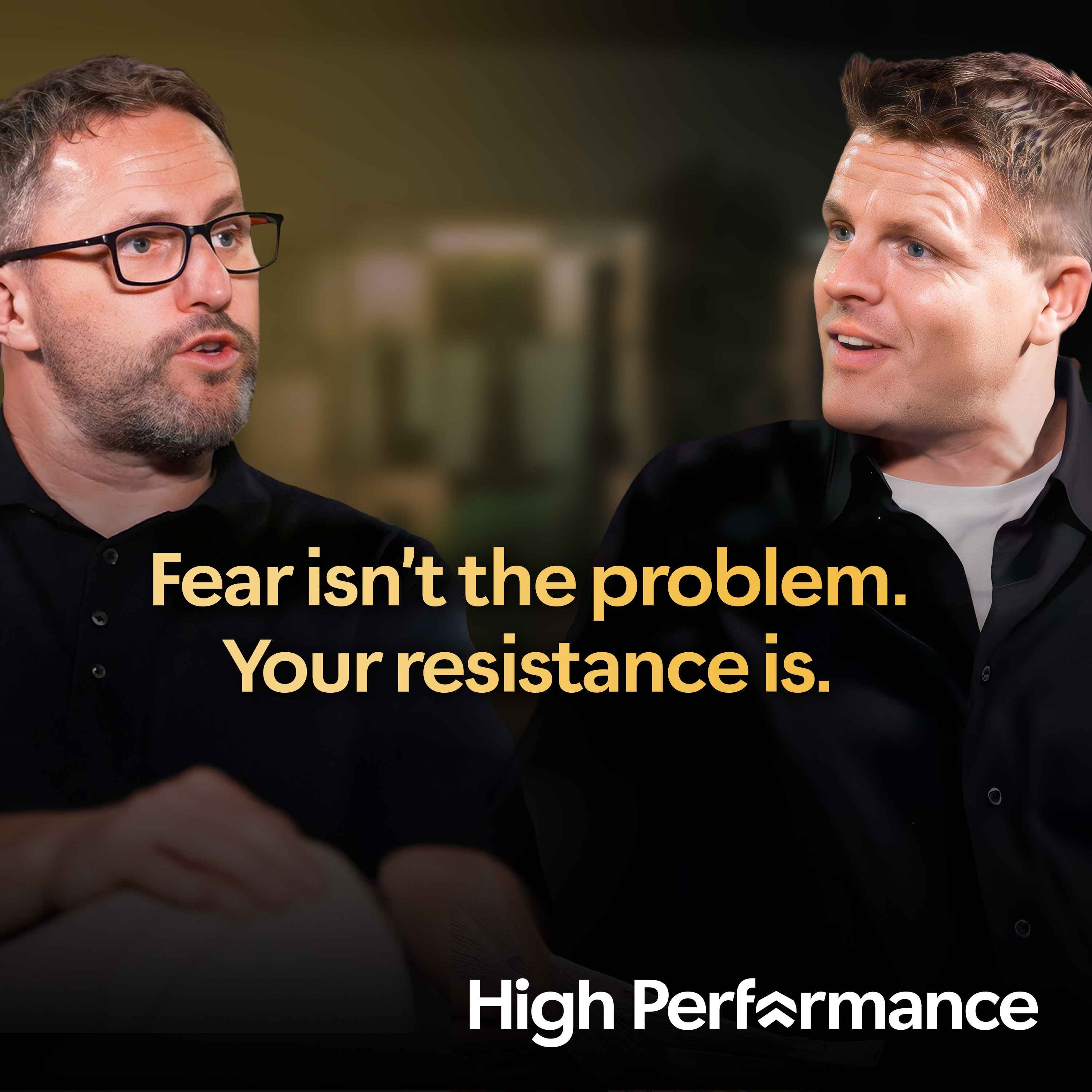
Fear and self-doubt as normal signals; the “cave you fear to enter holds a treasure” idea—fear often appears before major success, and the goal is to process it, name it, and act anyway.
Fear is unavoidable; elite performers still feel it. Overthinking can be productive. Naming emotions turns them from a handbrake into a throttle. Resistance increases pain; acceptance reduces it.
Cup final anxiety (3-1 up to 4-3 down, then recovery); Jamila’s micro-habit to stop saying “I’m busy”; Rosberg’s shaking accelerator foot; Scott questioning “can I still score?”; Robin reframing bullying/missed chances; advice to “surrender” rather than fight fear.
Written by AI. May contain mistakes.
Hosts discuss their personal experiences and manifestations of fear.
“I mean, why am I so excited about kids' football?”
Exploration of how fear influences performance, especially in children.
“So when you speak to Seb and maybe he's feeling nervous before a cup final or like the anxiety spiking, what do you say to him?”
Hosts reflect on the inevitability of suffering related to fear during critical moments.
“And I actually thought growing up that successful people, high-achieving people just didn't feel fear.”
Discussion on embracing fear as a source of motivation for success.
“So you're right, every high performer we've met, whether it's been, as we're going to hear later on, clips from Phil Heath, the Mr.”
Hosts share insights on how successful individuals often face fear before achievements.
“We're going to talk about Scott McTominay, the Italian footballer of the year, about how he had it for 21 years at Manchester United.”
Jamila Jamil shares her experiences with fear in decision-making and productivity.
“So, and just luckily, I got through this sequence of corners with a bouncing foot.”
Discussion on how to redefine busyness and prioritize mental well-being.
“There she is, Jamila Jamil on High Performance.”
Learn about the importance of setting boundaries and the reactions to honesty.
Explore the notion of imposter syndrome and its positive aspects.
Discuss how overthinking can be an asset rather than a liability.
“So, so many people that listen to this show will reach out to us and ask about imposter syndrome.”
Hear insights from elite performers on how fear drives them.
“And that self-doubt is what drives you and pushes you to do more.”
Learn the importance of identifying and articulating emotions like fear.
“And then your ability to be able to articulate those emotions and then go, so what do I do about it?”
Understand how our response to fear can shape our experience.
“And then she said, okay, but you have to find a way to make that less because then it becomes more enjoyable, everything.”
Explore the relationship between fear, pain, and acceptance in personal growth.
Discussing Ronda Rousey's impact and the vulnerability behind her persona.
“I'm also a woman who's worked in a lot of male-dominated industries and you have served as an inspiration.”
Sharing insights and missed questions from past podcast interviews.
“and I felt like she let her guard down and she really showed us that she wasn't just a badass.”
Examining the pressures and expectations of high-performance individuals.

Get the gist, explore an idea or ask about something said.
 Claude
On The High Performance Podcast, what are the key points of this episode?
Searching your listeningAutomatic transcript. May contain errors.
0:01Hi there, welcome along to another episode of High Performance with myself Jake Humphrey and me Damian Hughes with a very simple question today. What are you actually afraid of? How present is fear in your daily life do you think Damian?
0:18Jake Humphrey: It shows up as anxiety, I feel it in my stomach, I recognise when I feel nervous or when fear shows up, it's in my stomach is where it registers. first so um i think fear for me uh shows up um i only have fear over two things finances and health like because i think i can pretty much cope with everything else right i think i feel the pressure from building businesses i think people often think oh if you've built a business that's you know like one of my businesses has 300 staff oh that must be lovely no it's not because one bad month or a few bad weeks and you have got such huge outgoings that you feel the pressure every day and i think health is like the thing that you can't control especially when you've got children and you're married like you just you're not worried about yourself so much it's everyone else's health all the time and i'm i also know that i'm a catastrophizer um which i think is one of the reasons why i've had the career in the life that i've had because i fear the worst all the time therefore i run towards it and think i better do something about it so it's kind of an energy source for me in a strange way and the reason why i wanted to talk to you about fear was because i was on stage doing a presentation a few days ago to a business and i was talking about how like life was pretty run of the mill if not the even worse than that a bit crap when i was a teenager yeah by the way sorry about my voice my son had a cup final this weekend and i was i cheered and screamed so loudly how did they get on they did win with a last minute or a late penalty and the video of me going, ah, like that.
1:54I mean, why am I so excited about kids' football? How did that compare to... Talking about fear. So how did that compare to, like, Norwich getting a promotion? A million times. A million times more excited than Norwich getting promoted or even hosting a Champions League final. Like, nothing comes close to watching your kids play sport. But actually, it's relevant to fear because also, like, when it starts to go wrong, nothing feels worse. and they were 3-1 up and 4-3 down after a tricky few minutes and then eventually they won. So I was kind of pleased in the end.
2:27Jake Humphrey: Well, let me ask you then. So we're going to talk about fair in more detail. So when you speak to Seb and maybe he's feeling nervous before a cup final or like the anxiety spiking, what do you say to him? It's so interesting because this was the first time we'd ever had a conversation where I explained him on the way to the final. bearing in mind he's only 10 so it's always all been about enjoy it have fun relax but i knew that he was nervous ahead of this one because when you're in a final you you want to win it right you feel so close to winning it and what i actually explained to him on the way there i said you do know that you're gonna have to suffer today he said how do you mean i said there will i promise you seb there will be a moment in this game where you feel like you're not going to win and all of those thoughts about your mum and dad and your sister and your coach and your teammates and what people at school are going to say all of those things will start coming in your head and actually that's a really interesting moment for you to remember that it's just it's just fun it's just a game of football but i promise you and we'll talk about it afterwards you will suffer there will be a hard moment in this game and actually to be three one up and four three down having conceded three goals without reply he did suffer like and i could see actually the way that he and all of his teammates were playing at that moment, they were suffering.
3:46Luckily, Seb actually scored to make it 4-all. And at that moment, obviously, the psychology means that they are there than the ones with freedom. And the team that were winning and are now drawing are the ones that have the fear. And the reason why this is so relevant is because, as I say, I was doing a talk the other day and someone asked me, how did you go from failing your A-levels, being fired from McDonald's, never really succeeding at anything, to suddenly ending up on the telly and all that? And I was bought a book. My voice is so bad. I was bought a book called Feel the Fear and Do It Anyway by a lady called Susan Jeffers.
4:19And the whole premise of the book was you will always feel fear. The secret to life is to do it anyway. And I actually thought growing up that successful people, high-achieving people just didn't feel fear. So it was easy for them to be successful. But actually, if you and I look back now at the hundreds of conversations we've had on this show, there is no one we've spoken to who hasn't felt fear often just before their greatest triumph
4:47Jake Humphrey: absolutely yeah i mean it's that there's that great quote from the sort of godfather sociology joseph campbell who says the cave you fear to enter holds a treasure you seek say it one more time say it one more time the cave you fear to enter holds a treasure you seek because the point making is that the thing that fear is on the success is on the other side of fear and so most of us when we feel fear it means that we're close to something important it might be a difficult conversation we need to have that we need to recalibrate the relationship it might be making a decision to start a new business that means that we're fearful of the insecurity that might follow but that's the cave that we have to enter that's the fear we have to confront to be able to get to the other side of it, the treasure that we seek.
5:40Jake Humphrey: So you're right, every high performer we've met, whether it's been, as we're going to hear later on, clips from Phil Heath, the Mr. Olympia seven times. We're going to talk to Jamila Jamil about it. We're going to talk about Scott McTominay, the Italian footballer of the year, about how he had it for 21 years at Manchester United. There's so many examples that we could draw on of people that have had to go into the cave that they fear to get the treasure that they seek at the other side of it. And actually the next episode that we release on high performance is Nico Rosberg, the 2016 Formula One world champion.
6:14When we went and interviewed him in Monaco, we spoke for almost two hours. What percent of that conversation do you think was about him overcoming fear?
6:23Jake Humphrey: Well, 80 % of it. I think so. 80 % easily when he talks about being chased down by Lewis Hamilton in 2016 when he's going after it, when he enters the pit lane for the very first time and Michael Schumacher, he describes him as a god. He stood next to him and thinking, how could I compete with that? It's so rich. Should we listen to some of it? Yeah, here is a very short clip of Nico Rosberg, which you can hear very soon here on High Performance. So I was so scared of losing my dream and of messing up and crashing that my foot started shaking, but so violently that it wasn't like a little vibration.
7:03It was a bouncing, which I'll never have again in my life. Your accelerator foot. The accelerator foot. So I'll never have, because the accelerator, you have to, you're kind of, you know, you're being precise with it. So when you try and be precise with your hands, you also see a shake coming. So I'm trying to be precise. But it was shaking so violently. I'll never again have that in my whole life. Yep. No way. Then I couldn't accelerate properly anymore because the foot was bouncing. And so then it obviously is a mental spiral because then your head says, okay, my foot is bouncing so much that I can't drive anymore.
7:37So then the foot just bounces double as much. So, and just luckily, I got through this sequence of corners with a bouncing foot. Verstappen still staying behind me somehow. And then I got to the straight. The next part was a straight. And so I could push the whole leg through. So normally you accelerate with your foot. And here I used my whole leg to push it through into the throttle pedal. And somehow it then did full throttle. Like a reset moment. Driving down the straight like that. And that was enough that by the time I got to the next corner, my foot slightly calmed again, which then your head says, okay, maybe it's not as bad as it looked.
8:18And so I just managed to somehow get my foot into a state where I could drive the car again. Such a cool conversation. And honestly, it was such a rich episode. You can hear the full chat on our next episode of High Performance. Nico Rosberg, hit subscribe now, and you'll be the first to get the conversation. Let's go into one of the clips then from our previous episode of High Performance. I thought maybe we could start with Jamila Jamil, because I think one thing that's really interesting from this clip is that she spoke about how her decision-making was controlled by fear. How often do you see this in the elite settings that you work in?
8:53Jake Humphrey: Oh, all the time. I see it in business. If we use that as a sort of an arena where I see it often showing up, you know, people talking about themselves being busy, people being productive, people constantly on the go, always having to make decisions, always being active. And it's something that I've reflected on myself. At the start of the year, we were talking about micro habits and I wanted to introduce a micro habit in my life, which was that I found myself often from a place of fear when people say, how are you doing? I'd go, oh, I'm busy. Yeah. And what is the fear? The fear of being irrelevant, the fear of not being useful, the fear of not being able to provide for my family.
9:35So let me get this straight then. Is the fear that you always say yes to everything so therefore you actually are busy or is it that you say you're busy even when you're not so that people think that you're relevant?
9:44Jake Humphrey: No, it's the first one. So it's the idea of saying yes to everything because it comes from that place of fear, of insecurity or sometimes not being able to provide or like I say sometimes not worried about being relevant or being useful. So saying yes to everything has led to me being busy and then I found myself catching myself telling people, I'm really busy. And I realised that I was wearing it almost as a badge of honour. I'm busy, look how useful I am, look that I'm doing what I should be doing. And I realised that it actually wasn't a good thing. I realised that I was diminishing myself while I was trying to blow my own tyres up.
10:20So I made a promise.
10:22Jake Humphrey: my micro habit was to stop telling people I'm busy and start saying I'm productive or I'm working on things that I'm enjoying or and say no yes yeah yeah very much and getting into the habit of just going no I don't want to be busy doing it I want to enjoy doing it or I don't feel that I can do that in a stress-free way that it would diminish from me so trying to get into that habit is is almost inspired by this conversation that we had with Jamila Jamil we've heard it from Jamila we've heard it from Vicky Patterson a couple of years before of always feeling that you've got to be on the go you've got to be busy you've got to be constantly present and that takes its toll let's have a listen to Jamila explain it my idea of success being very much so what I do not just for others but especially for the people that I love how much I'm able to show up for them how much I'm able to appreciate this life and this planet and how well I use my time and that does not involve working an 80 hour week anymore and it's a huge position of privilege from which I can say that because there are some people who are like a single mother of five or something who have to but I do think that it's just become a generally hyper normalized thing that just a hustle hustle hustle acquire acquire acquire sleep when you're dead rest when you're retired and I think post pandemic a lot of us had a wake-up call where we were like hang on a second what the fuck are we doing why why are we waiting why are we postponing pleasure why are we postponing love and community and friendship and connection uh for all this shit and so I don't mean that to sound as judgmental as it just did it just it's more a judgment of myself of why I spent 15 years never taking a week off, never really spending meaningful time with my friends, having them go through huge moments in life that I wasn't there to witness, just to impress a bunch of strangers.
12:20So cool. There she is, Jamila Jamil on High Performance. That was episode 244, which is almost 50 % ago on High Performance. We're now sort of almost double that number of episodes. And of course, if you enjoy any of the clips from these guests, then you can get the link in the description and you can listen to the full conversations.
12:38Jake Humphrey: Can I advise anyone to go and listen to that and stick with it in the end, because she still gives us what I would still regard as the best answer to the question of what is your weakness? Yes, let's not ruin it for people that haven't heard it, but it was, we were open-mouthed, weren't we? I think this is really interesting, this idea of never taking a break and sort of not resting and not relaxing. And I think often it's so hard for people, and there'll be people listening to this now who are like, yeah but that's me but i don't know what to do about it so let's talk then you've shared that you've made a conscious decision to say you're less busy i think what i did was try and reframe what being busy actually looks like because i think there's being busy and then as you said there's being productive there's being useful there's being of value and actually i think that that great phrase if everything's a priority then nothing's a priority is never truer than when are overly busy but it's so hard to say no to people so what i've actually decided to do in the last six months is be really honest about my own capacity levels because what i used to say to people is things are busy at the moment but i'll come back to you in six months or i'll let you know when things quieten down and it feels like you're fobbing people off yeah whereas actually vulnerability is so important so if someone now messages me to do something and i am like overly busy already i just i just reply or i voice note them or i email them and i just say look nothing would make me happy then to say yes but to say yes to you is letting you down because i won't deliver but also letting me down because it will overly stress me but also letting down all the other people i'm already doing things with and i just simply don't have the capacity and i know that the first thing that will fall is my own well-being and the second thing that will fall is the relationship with my wife and my kids and i do have to protect that stuff really so i'm just gonna have to say no but i really do appreciate you what's been the reactions to sharing every single time people have said thank you so much for being so honest i totally get it in fact i feel the same but i had to ask and i think often we think that people are gonna um think less of us or it's gonna be a real issue for them that we said no 99 of the time they've probably asked three or four people the same question yeah and they're waiting to see who comes back and says yes and i think you know you don't have to give them such a complex response like no is a one word sentence right but equally i do think that personal relationships are important and at some time you may well be able to help or you may well require a bit of help or advice from them so i think just shutting people off with no thanks it's not for me is a very different message to course i'm like i'd love to help you i love helping people but i'm just not currently able to do it and i think that's absolutely fine that's brilliant i love that because that's a really elegant way in there of an honest way an authentic way but i like the idea of it gives you a plausible explanation of it that most people can empathize with can i also talk um about what i think is a really good fear.
15:47The fear of not being good enough. So, so many people that listen to this show will reach out to us and ask about imposter syndrome. And I think we both now have the same opinion that A, it isn't a syndrome, B, it isn't a negative. It is a great thing because it sharpens you at the time that you need it. If you're sensing that you've got imposter syndrome, it means that you care about the thing that you have imposter syndrome about. But I've also increasingly had people reach out to me saying, oh, I'm an overthinker. I'm an overthinker it wears me out I think too much about stuff I dwell on things I reflect on things and again I really want people to understand and we'll play a couple clips here about a couple of overthinkers a couple of people that struggle with self-doubt the reason why I think it's so important is that people think that being an overthinker is an issue but look at how often you've come up with the right answer would you have come up with the right answer if you weren't an overthinker being an overthinker is simply getting your thoughts in order yeah and i think we we we give it a negative connotation when we should give it a positive connotation like if you say i think deeply about stuff people go oh that's cool wow yeah if you say i dwell on stuff a lot people go oh you need to stop doing that you don't need to stop doing that because they're the same thing yeah and i think often and we'll hear from a couple of the guests i let you pick which clip you want to play first often the elite performers that we speak to on high performance are elite performers precisely because that voice that doubt that fear that
17:17Jake Humphrey: overthinking is present and it never goes away yeah i like that i've recently chatted with steve peters at an event who was talking about imposter syndrome and he was like that's your brain doing its job perfectly well it's what it should be doing because it's saying you mean there's something important to you and you're questioning whether i have the ability to meet it and if I don't what do I need to do to be able to address that challenge so yeah I think it's a great idea should we listen to um one of my favorite footballers of the last few years that we've certainly sat down and spoke to Scott McTominay because we met him when he was still at Manchester United and he was still meeting the challenges there but then he faced the fear of leaving his comfort zone going out to Italy and has thrived in a new league here he is everyone has it it's just how you control that and how you manage that in terms of your craft doesn't matter what you do if you work wherever or if you're in a different sort of sort of job or you're an athlete everyone has that time where they think i might not have been as professional as i could have been there and we've got a game coming up can i still do it can that and that keeps going around in your head thinking can i keep performing at the level that i'm going and that is ultimately what fuels me the self-doubt does it yeah because you always think every season you come back, am I the same athlete?
18:35Can I still score? Can I still potentially make an assist? Or can we still win trophies? And that self-doubt is what drives you and pushes you to do more. So how often are you questioning yourself, your ability, your talent, your approach? A lot. More than what people would think. They'll see some footballers going through an amazing time in their career where they're winning trophies, scoring loads of goals and stuff like that. They'll still have self-doubt in their brain thinking, next game can I do it? I've scored a goal against Wolves, can I score the next goal? That was my first goal in the Premier League and then I was like, yeah, I'm delighted, but can I get another?
19:12And that self-doubt comes in and then you start thinking, no, no, if you do everything properly and take it step by step, yeah, of course I can. So good that. And I think Scott would agree with us, even after the success he's had in Italy, that voice is still there. What about next season? What about the World Cup?
19:30Jake Humphrey: Yeah. You know, can I really keep this level up? I think it's so valuable. Can I play a clip as well from Phil Heath? Oh, God. So he is multi-times Mr. Olympia. I mean, you know what? It was one of the most kind of spiritual and deeper conversations we had. Do you remember him talking about going past the graveyards and the cemeteries and how that kind of kept him grounded? And he had those emerald green eyes, didn't he, that really sort of like drew you in? And unbelievable muscles. Yeah, that bit, yeah. I mean, what a body. um phil heath uh have a listen to this this is also a cracking cracking clip from high performance what do you believe high performance is oh man a relentless pursuit you know giving yourself permission to be the your most optimal self but doing it while being your most vulnerable self because it requires all of that you know being in the darkness you know but recognizing the light within to navigate through that darkness and that's where you meet performance at its highest level so really what we're saying to people is whether you're listening to what you think i think scott thinks or phil thinks life is not about avoiding the negative thought it's about processing it understanding that it has an important job to do and that without it what's the alternative just not thinking deeply about things and diving headfirst into bad decisions all the time yeah exactly it's about recognizing that it's a signal isn't it that's telling you this is important to me there's that that there's something significant that i need to address here and having the willingness not to think that the courage is the absence of fear it's the willingness to go and be comfortable with those moments of discomfort would you talk to us a bit about the psychology here of naming your discomfort or talking openly about it in a group yeah so if you think about like these emotions remember simon cynic when he spoke to us about we often don't have a language for our emotions so do you remember when he's when he did that um experiment with you about the best friend test and he was getting you to talk about what would your best friend say what is it that's significant and he said that you have to keep going back and asking the question well what is it that I do for you what is it that my presence why are you my friend I'm willing to do that because he says we don't have a language so we'll first of all go oh I like you or you make me laugh and then eventually you get into those deeper emotive answers where you go I just feel better being in your company you make me feel more optimistic about the world and he said but our emotions often don't have a language attached to it so we we feel them before we can articulate them so the idea of being able to take them and name them and label them gets it out of our head and allows us to be able to explore it and address it so again another great example is we referenced steve peters and he gave that example of if you give somebody two bowls they can juggle it give them three they'll start to struggle anything over four most people will start to drop it yeah and he talks about our emotions are like those balls that they're in our head and they're constantly there uh bouncing around so our ability to get them out on the page or articulate them to somebody else allows us to then be able to then bring our logical brain to it and go so what do i plan to do with this how do i plan to address it so emotion of so fear is our emotion showing up and if we can give it a label and often think about it in more subtle ways do you remember katherine ryan we sort of bouncing around episodes here but katherine ryan used the example of she said um if she saw michael mcintyre with a saturday night show she used to say i'm jealous why has he got a show and i've not and then she realized she wasn't jealous she was envious and she was envious because she felt she could have a Saturday night show so when she had that ability to articulate that emotion she was able to come up with a plan to phone her agent and say how do I get to have a primetime show on a Saturday evening so our ability to take these emotions like fear give them more helpful titles allows us then to be able to plan how do we how can we diminish it how can we minimize it how can we address it it's so good because then it goes from being a handbrake to a throttle absolutely yeah definitely you know we've said it before that if we that if we don't address these emotions like when your neighbor gave you that book right think about the emotions that you were suffering oh think about the emotions that you were feeling at that time yeah you know it might have been insecurity it might have been this desire to have a better future but not knowing how to do it, it might have been feeling that I don't quite belong in the groups that you've been.
24:32Jake Humphrey: And then your ability to be able to articulate those emotions and then go, so what do I do about it? It means that you put your hand up when they asked for volunteers at Rapture to go on the TV thing. It gave you the ability to go, I want to go to London and throw my lot in. Because you'd been able to articulate these emotions. So good. Can I play one final clip? Go on, who is it? Robin van Persie have you heard of him? Oh yeah Oh yeah I think so He's doing I've been following how he's doing as a head coach at the moment at Rotterdam He's had another good season Yeah Well I think it's because he's an emotionally intelligent guy and this is what he said to us when we were talking about the importance of doing exactly what you've just said of naming your emotion naming your fear sharing it Let's listen to him If the opponent was like stepping on my toes and sort of trying to bully me, I was going really hard.
25:28And I was going against it. But in the end, after a couple of, after a period, I started to think about that. And then it made sense to me. I was like, okay, the reaction I have, I shouldn't have that reaction. I shouldn't go against it. I should stand above it. So that is like a process of a couple of years. Because if I go against it, then it's such a struggle. I was just like mentally, physically, I was drained after every match for quite a long time, from the age of 23 till 26, roughly there. I was just knackered after every game.
26:05Jake Humphrey: Was there a particular light bulb moment when something came on and you thought, I need to be doing something differently here? Or was it just a gradual process? Yeah, I was talking to my wife actually about it. I was telling her that it cost me so much energy every game. And then she said, okay, but you have to find a way to make that less because then it becomes more enjoyable, everything. And I said, yeah, but how? And then we spoke about that. And then I realized that I was like constantly fighting, you know. And then she made one comment like, yeah, but you have to choose your battle. I was like, yeah, you know, I don't want to fight these small battles.
26:46I'm going to go for bigger ones, you know. so then I said okay what if I and as well I was if I missed a chance for example that's a process as well I was very emotional after I missed a chance I was like constantly ah no and showing the world how disappointed I was and then at one point I was like yeah but that's weakness somewhere you know then because then the opponent sees that I'm disappointed and that I'm not happy with myself so I slowly start to change that and I was like okay you know if I don't show my weakness then they don't have like if I don't react on the bullying if I don't react if I miss a chance then I become stronger and better and once I started to do that I talked with Arsene Wenger about this as well and then everything became lighter you know it was so heavy it was for all those years it was heavy but i was making it heavy yeah it just i just needed a couple of years to realize that so that that line at the end there from from robin it was heavy but i was making it heavy i think it's a really important place to bring this conversation about fear to a close that the fear itself is not heavy the fear itself is not painful the fear itself is not bringing agony to our world it's our response to it do you remember what johanna conter said i think it's again a really good bit of advice for people listening to this to try and let go of of the
28:16Jake Humphrey: thing that's actually causing the pain here for them yeah do you remember that again she sort of cited juan cotto the spanish psychologist that worked with her on this didn't he that was like struggle will always happen it's and how you resist it depends on how much pain you feel so again it goes back to the cave analogy not going into the cave and spending so much time being fearful of what's in the cave and justifying why you're not going to go in there means that it becomes more and more painful it grows bigger and bigger as robin run first he said it gets heavier and heavier because we frighten ourselves by what we don't know being willing to step into that discomfort of going and seeing what is it that frightens me is where the power really lies we get beyond it that's where the treasure is so if our resistance to the fear is a zero then the fear carries zero yeah the pain that you should feel is zero because you anticipated it and we can move on from it so much faster so johanna's example was when she hits that beautiful backhand shot on it hits a net and bounces back down on your side that's always going to feel frustrating but if you can then go just laugh about it it's just a game i can move on from it and I'll be ready for the next shot we don't fear feeling inadequate then we just prepare ourselves to let's be better next time I think it's really good I remember when I was struggling you know mentally in my 20s and I went to see someone and the first thing that they said was her name was Ruth she said the first bit of advice for you stop trying to fight it and accept the feeling accept that you don't feel good and watch what happens lifted not all not completely not instantly but it lifted and i think it's because my resistance had dropped from a 10 to a three or a four it was still there and eventually i got it to a zero and eventually it went away well that's like the from from what i understand that's the genesis of all sort of like when you go to addiction therapy whether it's alcoholics anonymous or any of those other billion uh organizations that help people the first thing is surrender to it don't keep fighting it don't keep resisting it but surrender to it and when you surrender then you can find better ways of of responding so cool a couple of questions from the audience Sally Dillon on the Ronda Rousey by the way well done Ronda back in the ring a couple weeks ago I'd like to get paid 2 million dollars for 15 seconds work is that what she got?
30:44Jake Humphrey: yeah oh goodness Ronda you're such an inspiration I'm sorry you've been affected by so many trolls who are keyboard warriors you can hear her talk about that on our episode with her we'll stick it in the show notes she says well I'm a fan and not a fighter. I'm also a woman who's worked in a lot of male-dominated industries and you have served as an inspiration. And I use the, what would Ronda Rousey do in my head? And the answer was always, work hard, do the right thing and be a badass. Wishing you so much goodness in the future. Jumbo, you know what I enjoyed about Ronda as well as the interviewers?
31:17Jake Humphrey: Jumbo, when we met her in Hollywood and we went and she had a mom and a sister there and we all went for a drink on the rooftop balcony afterwards. and I felt like she let her guard down and she really showed us that she wasn't just a badass. That was like her professional persona. Was that when she bought all of her family and friends and they sat upstairs for about seven hours? That's right. And then when they left, the bill came over to us. That bit was badass, yeah. I was like, oh, thanks a lot, Rhonda. Maybe some of that two million quid could be passed back to us for the afternoon, getting drunk in a...
31:48But seeing her with a mum and her sisters was the bit that I thought.
31:51Jake Humphrey: You saw who she was. She was a really, really special person. Absolutely. A. Swanee sent me a message saying, why didn't you ask the question to David Coulthard that lots of people want the answer to? And that's when he let Mika win the last race and the following first race. Why? I've always felt that's why he wasn't world champion. Senna, Michael only let their partner win after they were champions. They also used them to be champions by holding up traffic. It's a good point, a miss from me, but also what you need to understand a swanny is that that was the same day we filmed carlos signs carlos signs camera crew that he was providing they were his buddies were like nine hours late we were just standing waiting for this carlos arrived before them they arrived had to set up all their stuff so we literally got like half an hour david coolside before i had to race to get a flight back to the uk do you think we'll be able to get david back on again then at some point i mean he has his own podcast now so he's probably moved beyond us but you never know okay we've got history so i'd like to think so we'll make a note of that yes uh damien has your fear lifted i've enjoyed talking about it it's great isn't it yeah have you yeah look mate the more we talk about these things the more we give other people the right to talk about these things and when you do that it helps i really enjoyed the conversation me too thank you very much for listening to this one and if you want to check out the show notes you can see all of the episodes from high performance and if there's someone in your life struggling with fear please send this to them i think it'll be really valuable for them um please hit subscribe if this has been valuable for you and don't forget up next niko rosberg joins us on high performance here's another quick clip from niko we'll leave you with this one let's go to the moment then that you crossed the line in abidabi and then you do know you are the world champion yeah then all those fears and all those doubts you can finally put to bed is that the reality of what happened in your head crossing the line first of all there was just relief there was no joy there was no uh no happiness or anything it was just oh my god relief did you expect that or did it feel different to how you thought it would feel relief and and and me saying that's it i'm done i've done it how quickly did you decide on the line on the line no yeah i'm done yeah um this was this was when you're watching at home or you're watching the television, it looks like the easiest thing in the world to drive that little race car, drive it in circles from time to time, win the race.
34:25But when you're in it and you're in that life, it's like super, super hard. It's very intense, this thing. Which all, I think, everybody who's in a high-performance job will know this feeling. But it gets exacerbated even more when you're in the public eye and there's hundreds of millions of people following you live, you're measured by tenths of a second, everything is on a knife's edge because driving these race cars is so incredibly hard. Now, some people listening might say, oh, yada, yada, yada, you're earning the top guys now 50 million a year, just shut up and drive. But you, as a human, you're in your little bubble and everybody has their own struggles then.
35:14And even though you're earning 50 million a year or the best are now, then the struggles are still real in that moment. Even a Lewis Hamilton, earning tons of money at Ferrari. If you ask him about last year, how horrible was it? From a scale from one to 10, he'll give you a 10.
35:41Thank you.
Fear doesn't disappear when you become successful. It just changes shape.
In this episode, Jake and Damian go into the archive to ask a question most of us avoid: what are you actually afraid of — and what's it costing you?
They're joined by clips from some of High Performance's most memorable conversations: Phil Heath on navigating darkness to find your highest level, Scott McTominay on the self-doubt that never left him through 21 years at Manchester United, Jameela Jamil on 15 years of saying yes to everything and no to herself, and Robin Van Persie on the moment he realised he was the one making it heavy.
Plus: why imposter syndrome isn't a syndrome, the difference between overthinking and thinking deeply, and what actually happens when you stop fighting a feeling and just name it.
Listen to the full conversations:
Jameela Jamil https://pod.fo/e/225b9e
Scott McTominay https://pod.fo/e/2154f0
Phil Heath https://pod.fo/e/2313e6
Robin Van Persie https://pod.fo/e/18789
Ronda Rousey https://pod.fo/e/23ec96
Next week on High Performance: Nico Rosberg — Formula 1 World Champion. Hit subscribe so you don't miss it.
Hosted on Acast. See acast.com/privacy for more information.


