
 Ask ChatGPT


 The High Performance Podcast
8 Apr 2026 · 31m · 11 chapters
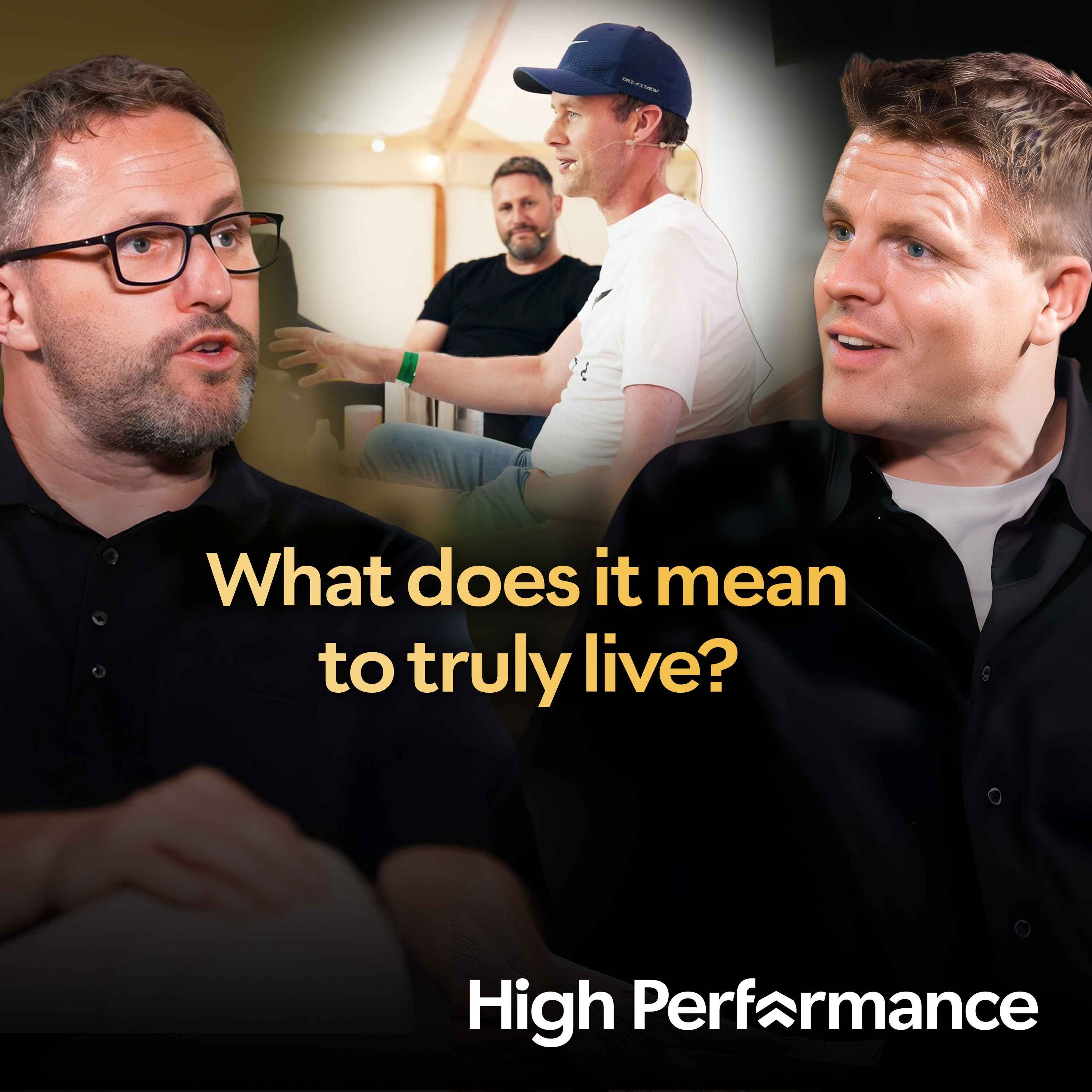
Olympian David Smith reflects on living while facing terminal cancer, including a sudden collapse to quadriplegia, and the mindset shift he calls “dance with the music” (embracing the journey, love, stillness, and present-moment awareness).
don’t wait for bad news to start living; life’s purpose is compassion/curiosity/courage and being where your feet are; ego dies when identity is stripped by illness; palliative care can still produce meaning and action; phone-down connection is essential.
at Happy Place Festival (Tatton Park) he spoke to 300+ people about putting phones down; a hospital voice note describes brain metastasis, double brain surgery, spinal tumor regrowth, and becoming fully quadriplegic in hours; he finished a book from hospital; an Italian waiter story shows compassion and curiosity when both were dealing with tumors; he later reports cancer shrinking by 8mm.
David Smith (Scottish Olympian/athlete; terminal cancer survivor; author). Interviewers/hosts: Jake and Damien (High Performance podcast).
Written by AI. May contain mistakes.
The hosts recount their first meeting with David Smith and his profound message.
“And we thought it'd be great to do a live interview in front of an audience.”
A voice note from David Smith shares his journey and perspective on life.
“heard there from Damien and I've really enjoyed following him on social media for the last few years since we met.”
The hosts reflect on David's message about the importance of living fully.
“And David, I know that you wanted us to have this conversation on the show and I'm so pleased that we are.”
Explore the insights and reflections of those nearing the end of life and the lessons they impart.
“Like I remember reading that book from Bronnie Ware called Lessons from the Dying.”
A personal story illustrating the importance of empathy and connection in daily interactions.
“I mean, should we play people the story that you told us about the Italian waiter?”
Discuss the transformative power of books like 'Man's Search for Meaning' and personal reflections on their impact.
“And he stopped in all of the rush and all of the noise.”
Learn about David's recent health updates and his uplifting perspective on life amidst struggles.
“I mean, I don't want to say too much about it.”
David reflects on how life-threatening experiences led him to redefine his identity and values.
“that he shared with us on that beautiful afternoon in Tatton Park.”
Discover how David and others find purpose through adversity and the importance of gratitude.
Discover how facing mortality has transformed the speaker's appreciation for life and relationships.
“And I think that's the thing with humans.”
Learn about the importance of creating memories and savoring moments with loved ones.
“I have a beautiful 18 year old bottle of Glenfiddich in my house in Scotland.”

Get the gist, explore an idea or ask about something said.
 Claude
On The High Performance Podcast, what are the key points of this episode?
Searching your listeningAutomatic transcript. May contain errors.
0:00Hey sweetie, your mother showed me this Carvana thing for selling the car. I'm gonna give it a try. Wish me luck. Me again. I put in the license plate. It gave me an offer. Unbelievable. Okay, I accepted the offer. They're picking it up Tuesday from the driveway. I haven't even left my chair. It's done. The car is gone. I'm holding a check. Anyway, Carvana, give it a whirl. Love ya. So good, you'll want to leave a voicemail about it. Sell your car today on Carvana. Pickup fees may apply.
0:34hey Damien how's it going hey I'm good Jake you great thank you and obviously this is um this is a very different conversation to one that we would normally have on our performance because we want to talk about someone who had a profound impact on us um someone who since we spoke to him a couple of years ago has left us thinking about him often keeping in touch with him um and that man is david smith i think before we hear from david i think it'd be great if you could tell us the story of how we first met one of the most incredible guests we've ever had on
1:05Jake Humphrey: the show yeah you're right i think no adjective we could use to describe him quite captures just how special david is we so back in 2024 me and you were invited to be part of firm cotton's Happy Place Festival up in Tatton Park, just outside of Manchester. And we thought it'd be great to do a live interview in front of an audience. And when we were sort of thinking about who would invite to capture the messages, we were put onto David through his friend James Burr, who suggested that David's message would be one that would be incredibly profound. he'd been given a terminal diagnosis for the cancer that he was suffering from and he explained that he wanted to come and share some of the lessons on how to live better whilst he was facing his own death sentence and he sat in front of an audience that day, you'll remember Jake and he held over 300 people spellbound we were sat in that tent and his message is about put your phone down connect with people, learn to smell the roses, still lives with me today.
2:20Jake Humphrey: I brought my son George to the event with us and George still speaks about the impact of chatting with David afterwards, where he was kind, he was interested, he was curious about my son's life and he was passing on lessons to him. It's a living, walking, talking embodiment of somebody that's out there who's making a difference so I'm delighted that we just get a chance to talk about him specifically on this episode and share some of his incredible lessons. So David is a very special guy as you heard there from Damien and I've really enjoyed following him on social media for the last few years since we met.
2:59This is a guy who is at the hospital in London having scans and the following week is learning to ski. This is a guy who gets the news that he didn't want that maybe there's a growth or he's waiting for some news from the doctors and he takes himself to Jamaica. This is a guy who refuses to stop living. This is a guy who before long is going to be a dad. This is a guy who has so much that we can learn from. And David's about to tell you that in the last little while he had some, well, he had a terrible moment. He had some really bad news and things have been a struggle for him since then. But in some ways I feel bad even saying things have been a struggle because I know things are hard for this guy.
3:42But as you're about to hear, he's a guy who continues to dance. So I messaged David and I said, look, what's going on? Is there anything that we can do? And his reply was incredible. He said he still feels he has a lot that he wants to tell the world. And I said, well, please tell us. so despite being unable to move he managed to get his phone and record this for us now the audio isn't incredible but he is a guy who's in hospital having treatment and the fact that he's taken time out to share these things with you this is not stuff for you to um just dismiss this is something that i really would love you to listen to carefully and reflect on so here is a voice note from david smith hi mate i'm just going to see if this works if not I will try when my wife is in tomorrow to sort of improvise.
4:36So it's been a pretty crazy few months. Three months ago, the tumor metastasized in my brain and I needed double brain surgery. Then in the last three months, that little stubborn spinal tumor started to pop up some nodules again. And then two weeks ago, I was back in the gym boxing, playing golf and trying to make a difference in the world around me. and at 2.50 I got a little bit of a pain in the back of my neck. By 2.55 I started to lose all function in my body. I had enough strength in my finger to call my wife so she could get home in time as I thought I was about to die. By 3.00pm I was a complete quadriplegic.
5:22Thankfully Angela made it home. We got an ambulance and I was rushed into hospital. and moved into palliative care. With those words, the mean average is four months. Now, I'm not buying that. And I'm going to show up, fight it as hard as I can to the very, very last breath. Becoming a full quadriplegic has certainly been a very big challenge. I'm not going to lie. I don't see myself as this super strong person or anything else. I'm just a normal guy from a small village. Scotland with a zest for life and my only intention every day is to try and make people smile and when I think about that it makes me think a lot I have a beautiful view over London right now in my ward which I feel extremely lucky to have I also say the prayer in my bed on that dreadful Wednesday afternoon as I feel became a full quadriplegic because I fully believed that that was going to be the last seconds on this planet and i wasn't going to get to say goodbye to my loved ones and friends so i believe i've been given a gift and however long that gift is now yes i'm going to dance with the music and that made me think a lot about life it made me think that how we talked about the journey to the destination and how that is our great allure to the ego that i will be happy when I get to the destination.
6:53I will be happy when I get there. I will be happy when I achieve this. Where actually, you then miss the journey because you're so focused on the destination. And then that led me to think, well, what if we just changed the narrative and said that life is a dance with the music. And if you go to an opera or a music concert, you don't go to get to the end. You go to the beat with the beat of the music, to dance with the music, to laugh, to smile. and then I started to realize that life is all about love, friends, relationships, experiences and the material stuff and the noise, does it really matter?
7:33Do we sweat the small stuff too much? And then I started to think a lot about stillness and at the moment I'm completely still because I can't move anybody apart. So I get to watch the sunrise over the morning city of London, which I can tell you now is so beautiful. The orange reflection in the skyscrapers, the sun hitting the buildings, and I just beef. And I just spend all day watching every cloud change to the grey clouds merging off the buildings, and I feel incredibly lucky that I get that experience. It's such a beautiful dance with the music. So when it comes to the dance with the music.
8:16My music is not over yet. I feel like my song is still playing extremely loud and I'm still dancing. Even though I can't move, I can still have a massive change on the world around me. And as I move into this transition, I don't like to see it as death. I like to see it as a transition. How can I help people when I'm no longer physically here in the specimen body? but I've finished a book from my hospital bed that will hopefully help guide others in the future if they're facing similar challenges but ultimately, however long I have left lived I want to make people smile I want to make people see the joy even in the toughest situations I'm thinking about the toughest situations why should we wait in the toughest situations to try and make some form of change or joy there is beauty all around us if we just slow down and just be and just tune into our senses and as spring is arriving now people are sending me videos of animals from the park and flowers and i'm ever so grateful to see that and live those moments each morning or each evening and talking about the evening when the lights of london come alive i'm looking at saint paul's in the shard.
9:38I just think how lucky I have been to have lived so many beautiful experiences and in my hope that I have helped people change their lives for the better. I'm truly grateful for both you and Damien and the team at High Performance and to provide this opportunity to be I hope I'm still alive to possibly hear it. But I put all my faith in your moral fibre that together, hopefully this can shape a better future, not just for cancer patients, but for everyone living on this incredibly beautiful planet that we have. And so remember, approach every day with compassion, curiosity and courage. And ultimately, be where your feet are.
10:37You know, the biggest thing that lands with me, the amazing David Smith and a voice note that he sent us. And David, I know that you wanted us to have this conversation on the show and I'm so pleased that we are. And brother, I'm so excited that you remain with us to be able to dance with life. And I think, Damien, this idea of dancing with life is so fascinating because in so many ways what David's doing is a dance. He's having to dance around the fact that one week it's good news and then it's bad news and then it's uncertain news. and you can get so caught up and so twisted up with that stuff it can restrict you, it can hold you back.
11:11But he continues to dance and I think that is such an important concept that we all have to understand a bit more deeply, don't you think?
11:19Jake Humphrey: Absolutely. I think the grace that David's shown in the face of such traumatic news is incredible. Just following on from the voice note that we've just listened to, I'd sent David a message when I first heard that things had taken a turn for the worse and this is what I just want to read what he said to me and I'll explain why it's significant afterwards but he said cheers mate it's nice to hear from you it's been a crazy few weeks one second you walk in the next second you're a full quadriplegic told that you've got four months left to live this is a bit that stuck with me he said that's okay I'm very much ready to transition I've had a beautiful life I've had some wonderful friendships I've been in love, I've travelled the world and I've hopefully helped change other people's lives Palliative care is definitely an interesting place with some beautiful conversations I'm not going to give up, I'm going to fight because that's what I know but I'm also very calm and accepting of this beautiful transition in the circle of life I mean, I'm choking up even as I read out that message from him because there's a couple of things that he told us at the Happy Place Festival that is still living today, even under the most extreme circumstances, the beautiful conversations, you know, that can only happen when you put your phone down.
12:44Jake Humphrey: That can only happen when you're willing to make the space. That can only happen when you listen, when you're curious, when you ask questions. And it sort of made me stop about the busyness of life and start making that bit of time to catch up with people that really matter to me, to go beyond the how are you. no no how are you really that kind of stuff is david's legacy to me and you know hopefully anybody listening to this might just be inspired to just have their own moment of putting the phone down and connecting with the people that really do count the most in their lives there's also a line from from david one of the most remarkable things that has ever been said probably on our show that you know that line of sport gave him the body to deal with cancer cancer taught him how to live and so often Damien it is it's that news that people get that real that teaches them how they have to live and I think one of the saddest things is that and David isn't this guy but some people are waiting for these moments to then finally decide that they're going to live to finally move forwards with their life to finally sense freedom and I guess the message here is don't wait for that moment that moment of bad news to finally start to live yeah 100 % Yeah, but like, there's a part of me thinks we know this stuff.
14:00Jake Humphrey: Like I remember reading that book from Bronnie Ware called Lessons from the Dying. She was a palliative care nurse in Australia that wrote a book about the things that people told her on the deathbed and it's all about, I wish I'd have had the courage to live the life that I wanted to, I wish I'd have made more time to spend with people that we know. It's all stuff that when you hear it, you go, yeah, I know that, I know that, I should do it. but then we forget it. It's like sand through our hands that sort of runs through and then you forget it and the business of life and getting on with stuff then means that you relegate the stuff that's most important to the stuff that's most urgent.
14:41Jake Humphrey: I think if there's a call to arms for this, it's about for, we're not saying anything revolutionary, we're saying what essentially is common sense, what most of us know. but I think there's a challenge for us all to say how how does our life reflect that you know it's the old Jim Collins a management writer he talks about the wallet and the diary test how does the the places you spend your money and the time and the places you spend your time match up to your priorities and the values of what's most important to you and if there's one piece of advice i'm not big one for dispensing advice but if there's one piece of wisdom i'd like to share from david's experiences and the wisdom he's sharing with us is that question about are you are you prioritizing your time and your money into the places that matter most to you what about the fact as well damien that this is a guy who's in a hospital bed it's a guy who's struggling it's a guy who's fighting for his life but it's also a guy who's written a book and finish the book whilst in hospital, whilst paralysed, as a quadriplegic.
15:49I mean, what this tells us about purpose blows my mind, quite frankly.
15:55Jake Humphrey: Yeah, definitely. It reminded me when I knew he was writing a book. There's a great book that came out in the late 1990s called The Diving Bell and the Butterfly by a guy called Jean-Dominique Borby who had locked-in syndrome. and he wrote a book just using the blink of his eye to indicate what letter it was. And again, I'd urge anybody, if you need a reminder about the fragility of life and how fleeting it is, get that book and read it. This is a man that just writes his reflections on the life that he'd once taken for granted, about the meals that he recounts, that he wishes he could have now, the simple pleasures he got from playing with his children.
16:40Jake Humphrey: I can't wait to read David's book because I think it'll have a similar impact in terms of what the Jean-Dominique Barbie book did on me. And those three values that he has, compassion, curiosity and courage, that daily mantra of be where your feet are. I mean, should we play people the story that you told us about the Italian waiter? Yeah, go on. Life happens and we all become humans and that space between stimulus and response sometimes goes. and I turned up to a restaurant in London and I wanted to sit outside, but the waiter didn't want to put me outside. He wanted to put me inside. So my best self didn't show up.
17:15The younger athlete showed up. No, I want to sit outside. And we had this bit of an argument. So I sat down, eventually get in my way and sat outside. And I thought, that's not who you are. That's upon reflection. I did a mental journal in my mind. I thought that's not the human I want to be. It's not who I hold myself accountable to the values I live. So when he came back to the table, I said, look, I'm very sorry for not being nice. I don't think that's who I want to be. And he said, look, don't worry about it. My brother just got diagnosed with a brain tumor. I was probably short with you. And I was like, oh, I have a tumor too.
17:50And the two of us started crying and he was Italian. So we were hugging each other and it all got quite emotional. And I had a great meal. He looked after me, but a year later I went back to the same restaurant And he was very rude to me. And this is life happening. And I said, how's your brother? And he stopped in all of the rush and all of the noise. And he looked up and he went, oh, David, I have your seat for you. Clear the restaurant, bring him in. And for me, it was a great example of compassion, of being curious as well. We're all going through stuff. And I think it's easy to jump in the car in the morning, go to work and get road rage and cut up people.
18:29and life happens right and i think you know so many people it's a little bit cliche but we are all dealing with stuff i think if one in two people are impacted with cancer so it's inevitable you're going to come across somebody in your working day that is dealing with something something pretty big and that i think for me that was compassion and awareness and curiosity such an amazing story and tells us so much about him but those three values of being kind being
18:56Jake Humphrey: curious and being compassionate i know i know he won't mind me saying it but our brilliant producer will um has printed them off after meeting with david and has got them up on the wall of his office because they really resonated with him as i'm sure they will do for anybody that hears david's incredible story i mean there are lots of books that we'd love people to read man's search for meaning by victor frankel david cited this is one of the two most important books he's ever read um I mean, I don't want to say too much about it. All I want to tell people is it's the most important thing that you will ever read in your life.
19:33And if David feels that, I certainly feel that as well. What would you like to add?
19:38Jake Humphrey: Well, I've already quoted to, hey, Jake, Bronnie Ware's book, Lessons from the Dying, and Jean-Dominique Barbies, The Diving Bell and the Butterfly. Well, I'm now going to finish this episode with a message that I actually got just a few days ago from David. I'll just read it out to you. Hey, Jake, I just want to let you know I got the news yesterday to tell me that my cancer has shrunk by 8mm after radiotherapy and only four weeks post-radio. It was a pretty overwhelming day, but it means I'm not about to go anywhere in the next four months, which is what I originally thought, as we're now pushing up the drugs, and this thing has a high chance of shrinking more.
20:18I know I just need to get into rehabilitation, and get these arms and legs moving, wishing you and the family a great day ahead. I mean, Damien, the fact that he comes with good news, wow. The fact he then follows up with optimism is incredible. But the thing that really sums up this guy, that at the very end there, he spends a few sentences wishing me and my family well. I mean, I don't believe I've ever met a more incredible man than David Smith in my life.
20:45Jake Humphrey: No, these giants walk amongst us, and I think it's a real privilege that when you get a chance to meet, to talk to them and to learn from them, we've got to appreciate it. Anything else you'd like to say, Damien? Well, I mean, we've covered some of the incredible life lessons that David taught us while facing death, but let's listen to some of the other pearls of wisdom that he shared with us on that beautiful afternoon in Tatton Park. When I first went into hospital, I was a 100-kilo roer, and after three weeks, I woke up at 65 kilos. after suffering a stroke and having my first tumor removed and that was the first time I guess that my ego died I wasn't worried how big my arms were I wasn't worried about the six-pack that you've longed for for so many years it really put into perspective just how beautiful this gift is of life and how important it is but also how we get so hung up on things that really don't matter and I know it's easy to say and cliche to say but it really is when it's all said and done and you're lying in an ICU or in the highlight of your day as a bed bath after you've pooed yourself it really puts so much into perspective and I think at that point I detached from the physical being and tried to transcend into more of a spiritual mindful place.
22:09Jake Humphrey: So just go back to that phrase that you use there that was the day the ego died would you explore that a little bit more for us tell us what that means and on what it did mean in that next stage for you yeah i think we get a lot of our sense of self and how we perceive other people perceive us and i think at that point i purely identified with what an athlete was and in the olympic motto it's sit just at his 40s so faster higher stronger so i had to be this six foot four powerful athlete and then all of a sudden you're lying in a hospital bed you can't sit up you're relying on people to feed you wash you dress you and at that point i just i detached completely from the ego so all of a sudden it wasn't about how other people perceive me it wasn't that i sort of thought i was never going to be good enough until i won a world title or or i went to an olympic game so all of a sudden it was like well actually it's okay just being me it's actually okay leaning into the struggle crying being upset it's the i often like my emotions to the scottish weather there's a bundle them within a minute i go from ecstatically high to depressed the joyful happy but i think when when i lay in that hospital bed and i looked around the ward everyone fighting for their lives and and just trying to take that other breath i was like wow i've chased this this existential this this thing this medal or this sort of being of to try and maybe go back to my village and everyone goes wow you're the gold medalist and it really didn't matter uh because in in a hospital room where everyone's fighting for their for their life it's you realize that actually just waiting up in the morning and breathing is is one of the best gifts that will ever be given i think the one thing i always say to myself when it got hard is i always ask myself why i started and i was always very clear on my why i've done a lot of work with psychologists and studied psychology and I realized if I had was very clear in my personal philosophy very clear on my purpose for each day my purpose is a son a brother an athlete husband whatever that may be very clear on my purpose and also always reminded myself why why did you start so what was your answer to that question why so when I went through surgery one and two why I started is because I wanted to be a world champion and I wanted to be the best in the world at what i did if you ask me that now it's it's a completely different answer it's more about trying to make people see how important life is i we come into this world on an inhale and we leave on an exhale to very very powerful defining breaths but every breath we take is defining i often challenge people to say did you wake up this morning put your feet on the floor and say that you were grateful for your feet were you grateful for the legs that took you here today and i know we're tuning into our breath but on an average day how aware are we of these breaths that we take and just how amazing they are how special they are and now when i feel like i want to give up i say to myself well david you you have a purpose of understanding what it's like to be on the edge of mortality and face your death but you also know the real beauty in humanity the real beauty in the world and I sort of feel that if I can share that then people might not have to go through what I've gone through to have the death of the ego and to wake up just to how amazing life can be.
25:36So on those difficult days when you wake up in the morning and the first thought is why has this happened to me? I used to compete for my country as an elite athlete. What are the tools that you employ in those moments? So I think for me it was it was dialing down on my values so again I believe we can train three things in life. We can train our body, which most of us do. We train our craft, which may be our sport, our job, our work. And then it's our mind. And I don't think we're often given the toolkit to work with the mind. We're given this sort of hardware and software that is the mind and the brain.
26:09And we're sent off into the world with everything that's been inputted by our parents for the first seven years and then our teachers. And that's usually, well, you're not good enough. You're never going to get there. I guess in many ways, that's why I I go back to the karate days and the dojos that I fought in. And if I was punched and knocked out, it was like I had to get back up and go again. And so I think for me on the bad days, again, I connect to how fortunate and lucky I am to be alive. I also try to observe my thoughts and feelings and emotions as a watcher with no judgment. So I try to watch them and accept them.
26:45Okay, well, it's okay to feel shit. That's okay. I struggled a lot with survivor's guilt to start with because I was going to a spinal rehab center where people were quadriplegic and I felt why am I feeling bad that he's worse off than me and that really tortured me for years and then eventually a therapist said to me look it's relative to you of course he's going to have a bad day but also you're also going through some shit it's also okay to feel bad and I think accepting those emotions was a big part and then for me it's having a list of things knowing my values what i really value in life being in nature being on my bike being with friends now if i i liken them to the legs of a chair and they hold me up and if you take them away the chair falls down when all three of them go i won't sit here and lie to you um there's days where i don't even leave my bed i'm banging my head on a wall i'm crying i'm just like i know what i've had enough suffering now i'm i'm ready to shut my eyes and never open them again and then somewhere through all of that my phone maybe goes and someone sends me a message to say hey you know thinking of you or you know never give up you inspire me or or i just look out and see a simple bird land on a tree and go wow life life is so beautiful and there's people who it's taken too early and they don't have the choice when i started radiotherapy in 2019 a lot of the people i started that journey with are no longer alive and i thought wow i I actually owe it to them to get myself out of this bed and to get living.
28:19And I think back to the David in the hospital when he's lying in ICU in pain with tubes coming out of him and think, wow, that David would have given anything to go out and write in the rain or just to sit and have a coffee and read a book. And I think that's the thing with humans. Sometimes we always want more. And I think for me, it's brought everyone so much closer. And I think that it's given me such a great appreciation of time that when I'm with you, I'm with you. So when I'm with you, I'm not on a phone. And this is, I think, what my loved ones have taken from this is that, you know, when we're together, I'm with you.
28:56I'm listening to you. I'm hearing you. I'm not just sitting, listening to reply or looking at my phone and doing a thousand things. And I think if you leave with anything today, leave with that. You know, we're addicted in the dopamine rush to our devices. when you're with your friends and loved ones you know really like be with them put put this stuff away and and i think that's probably if i can leave anything with my family that's been the biggest lesson from all of this so it's it's been hard for them and i think it always will be because my tumor is never well i say never going to go away it's it's something i live with for for every every living breath i take so it's something that i have to navigate with with my loved ones and to be honest with you i could probably just start crying now it's like i don't want to i don't want to die and um and it's it's yeah it's scary and uh to deal with it and know that it's going to happen again there has to be a level of acceptance of mortality within it all and just to make peace with that uh i've not i'm the only scotsman that doesn't drink alcohol but I have a beautiful 18 year old bottle of Glenfiddich in my house in Scotland.
30:05And I'm actually en route to get that bottle of whiskey now to go and sit with my friends. Because I realize that in many ways it's a gift because sometimes we don't really get to sit and be with our friends and maybe say goodbyes and stuff. And for this, I'm going to go and knock on some doors and sit and open this bottle of whiskey and sit and just share some stories. because I realise at the end all we have is memories and memories are made from experiences and we don't really have experiences if we don't learn to savour the moment. And savour the moment for me is about being where your feet are and being in the present moment.
30:42Well, if you've never heard the full episode where we speak to David Smith, please go to episode 215. It will change the way you see things. Damien, thank you so much. And for you at home, please hit subscribe. Check out our episodes on YouTube as well as wherever you listen to your podcasts. And we'll see you again soon. Take care.
In 2024, Jake and Damian met the remarkable Olympian David Smith MBE at Fearne Cotton's Happy Place Festival and held an audience of 300 people spellbound. David had a terminal cancer diagnosis — and a message about how to live that neither of them has forgotten since.
This week, they share a voice note David recorded from his hospital bed after becoming a full quadriplegic with recent news he has just months left to live, where he speaks about dancing with life, finding beauty in stillness, and why the journey — not the destination — is everything.
Jake and Damian reflect on David's three guiding values of compassion, curiosity and courage and why so many of us wait for the worst news of our lives before we start truly living.
If you've never heard the full episode with David Smith, it's Episode 215 — and this conversation is the perfect place to start.
Find David on Instagram: https://www.instagram.com/davidsmithmbe/
Hosted on Acast. See acast.com/privacy for more information.


