
 Ask ChatGPT


 The High Performance Podcast
16 Sep 2026 · 30m · 13 chapters
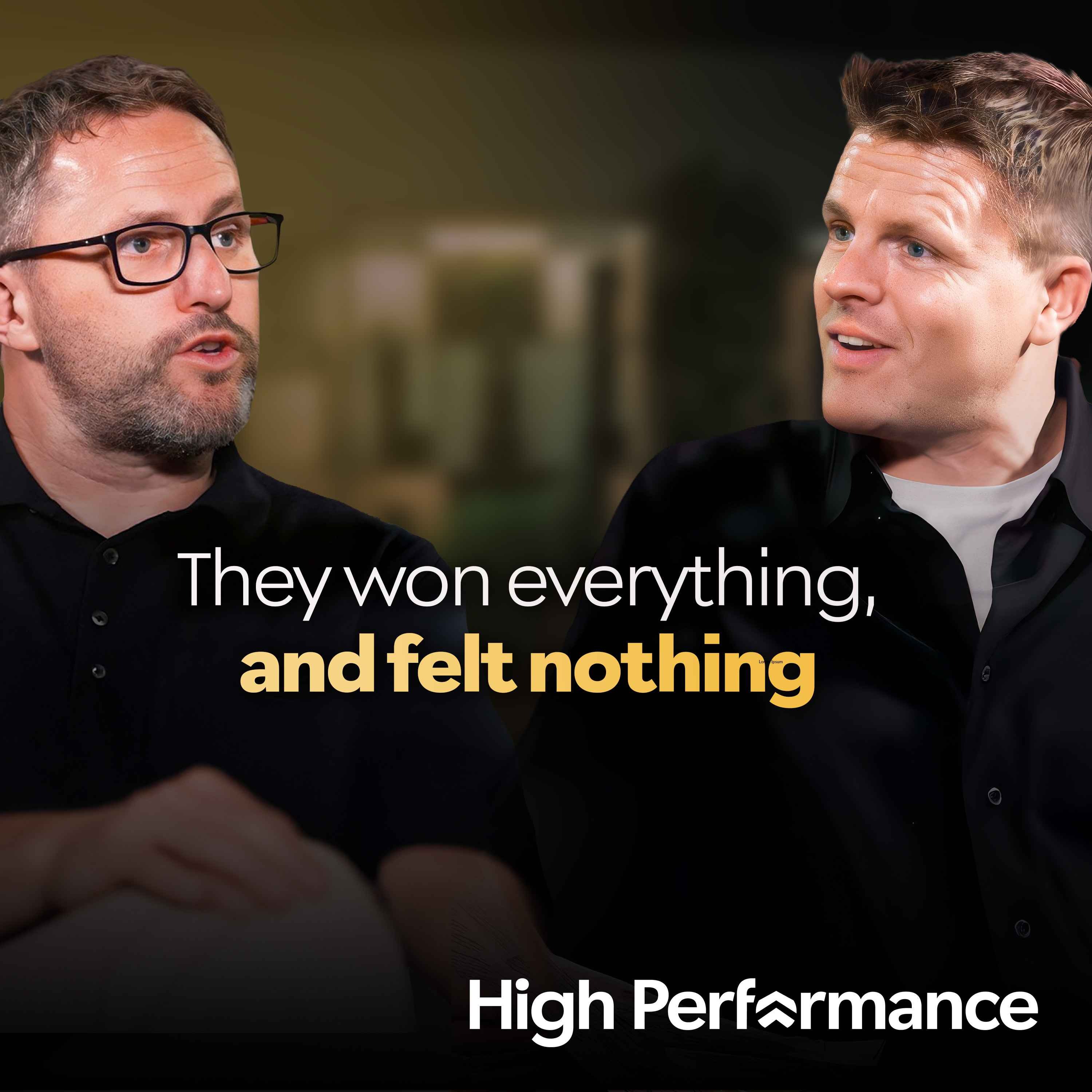
Why high performers often feel relief or dissatisfaction after winning, linked to the hedonic treadmill and the “arrival fallacy,” and how to balance ambition with contentment, flow, and joy.
Rio Ferdinand (footballer; Champions League winner); Jill Scott (former England Lioness; footballer); Stephen Hendry (snooker champion); Dan Carter (All Blacks rugby); Ryan Yates (Nottingham Forest captain); Ali Abdaal (productivity educator); plus mentions of Mark Cavendish (cyclist), Johnny Wilkinson (rugby), and others.
Victory can feel like “I got what I wanted” rather than happiness; relentless pursuit can delay joy; striving can become a habit of stress; enjoyment can be intentionally practiced (playfulness, stepping back).
Ferdinand immediately planning next signings; Ferguson telling coaches to put medals away and win again; Wilkinson saying suffering habits don’t create lasting joy; Carter’s notebook ending with “enjoy”; Yates noticing a family member’s contentment; Abdaal advising less seriousness and “fast-forward” life check.
Written by AI. May contain mistakes.
Explore why high performers often feel they should have enjoyed their successes more.
“When you're running a growing business, the right systems can unlock your full sales potential and make fulfilling every order effortless.”
Explore why high performers often feel they should have enjoyed their successes more.
“And we want to start today with a question.”
Discuss the concept of the hedonic treadmill and its impact on happiness.
“Because those things still do matter, yet still balance that with a life that offers you contentment, flow, clarity, and joy.”
Listen to Rio Ferdinand's insights on achievement and the lack of celebration.
“We're going to hear from Dan Carter, Ryan Yates, the Nottingham Forest captain, Ali Abdel, the productivity expert, lots of different people.”
Examine the pressure high performers feel and the quest for continual improvement.
“So we're going to start with a clip from Rio Ferdinand.”
Explore the struggle high performers face between seeking improvement and enjoying their achievements.
“show and he immediately stopped the producer from talking about anything positive and said, all I want to hear about is the negative stuff because the negative stuff is where we can improve.”
Examine perspectives on success, enjoyment, and motivation from various sports figures.
“What if the real question isn't where you're going, but the adventures you experience along the way?”
Discover why high performers often wish they had enjoyed their journeys more.
“And pretty much every member of the England squad chose an amateur team they'd played for.”
Listen to Ryan Yates' insights on finding happiness beyond achievements.
“Who's also spent his entire life wanting to be a professional footballer and then suddenly had this dawning realisation that another member of his family might actually have it right and maybe he's got it wrong.”
Learn Ali Abdaal's perspective on maintaining joy and reducing stress in work.
“He's a man who has built an entire platform on productivity.”
Explore the trade-offs of ambition and success as discussed by the hosts.
“doing the things you're doing right now, would you be happy?”
Emphasize the importance of being present and grateful in daily life.
“A bunch of previous guests from High Performance with so many lessons for us.”
Emphasize the importance of being present and grateful in daily life.
“Program subject to terms and conditions.”

Get the gist, explore an idea or ask about something said.
 Claude
On The High Performance Podcast, what are the key points of this episode?
Searching your listeningAutomatic transcript. May contain errors.
0:00When you're running a growing business, the right systems can unlock your full sales potential and make fulfilling every order effortless. Switch to ShipStation before peak season so you're prepped and ready before the rush hits. ShipStation connects Shopify, Amazon, TikTok Shop, and over 200 more marketplaces with one platform that does it all. You can manage orders, sync inventory, track returns, all automatically. Everything your operation needs, all in one place. Upgrade your shipping operations to stress-proof your biggest sales days and capture every bit of potential revenue. Go to ShipStation.com and use code AUDIO and get 30 days free.
0:32today's episode is brought to you by olympic hospitality the olympic games are coming to los angeles in 2028 this is a once in a generation event that you will not want to miss and it's more than a ticket it's a story you share with your family and friends and the ultimate way to get closer to the action is with an olympic hospitality package ticket inclusive packages offer a range of prime seating and lounge access options venue-dependent priority entry, food and beverage selections from LA's diverse dining scene, and elevated service and continuous support, making your day at the Olympic Games one to remember for a lifetime.
1:08Get ahead of the curve with an LA28 hospitality package. Discover more at hospitality.la28.org forward slash high performance. Support for today's episode comes from Square. You probably know Square as the thing you tap your card on at your favourite cafe, restaurant, salon or local shop. And I love visiting my favourite cafe in Norwich that uses Square. And you know those places where everything just works, like checkouts fast, you get your receipts straight away, sometimes you can even earn loyalty points while you're there. As a customer, it just feels seamless. And obviously, I love the coffee as well.
1:41But for the person running that business, Square is so much more than a way to get paid. Square brings the tools you need to run and grow your business together in one system, from payments and appointments to staff, inventory, sales, and customer relationships. Whether you're starting something new or looking for a better way to run the business you already have, Square gives you the tools to take payments, manage your day-to-day, and keep growing. And right now, you can get up to$200 off Square hardware at square.com slash go slash HPP. That's S-Q-U-A-R-E dot com slash G-O slash H-P-P. Run your business your way with Square.
2:18Get started today.
2:23Hi there, welcome back to the show. You're listening to High Performance with myself, Jake Humphrey. And me, Damien Hughes. Mate, we've been doing this for well over seven years. You know, I keep seeing photos pop up. And I'm like, in fact, the other day, my kids looked at one. And Seb went, who's that with Damien? I'm like, that's your dad, a lot younger. How dare you? Obviously, you look the same.
2:45Jake Humphrey: No, I wish. Yeah. I was actually doing something last night. We were looking at like photos of the kids when they were babies. And, you know, like my son just turned 17. But you would have started this when he was nine or 10. Yeah, yeah. It's weird, isn't it? Because I was thinking we've done this nearly eight years. We started when I was 40. I'm now 48. I've hosted High Performance for 20 % of my life. Ridiculous. Anyway, we're loving it. We continue to love it. We love your support. Please, if you can like, share, subscribe to the episodes. Almost everyone that enjoys our shows isn't a subscriber, and it would make such a massive difference to us if the hundreds of thousands of people every week that enjoy high performance just hit the subscribe button.
3:25It means we can continue to grow the show. We can attract even more incredible guests, and we can continue to bring you episodes like this, which we know are really valuable. And today we're talking about enjoyments. The question we're asking is, why do high performers almost always wish they'd enjoyed it a little bit more? And we want to start today with a question. The question is, and this is really for you at home, for you as well, Damien, what do you actually feel when you win? If I asked you the question, what do you feel when you win? And you were to give me a very brief answer, what would it be?
3:55Jake Humphrey: Often relief. Really? Yeah, because it's often that sense that you've sort of allowed yourself to go to the place of victory in your mind and then you imagine what it would be like if that wasn't there. So to reach it then doesn't necessarily bring happiness. It's more as a relief, I got what I wanted. What about you? What do you think? I think I just wonder whether I should have set the benchmark a bit higher. Right. The benchmark for victory. You know, because we don't operate in, I don't know, the world of sport, for example. So a win for us is an audience number or a partnership fee or getting asked to stand up on a stage and do a talk.
4:36And every time one of those things happens, of course they're all individually wins, but I then find myself thinking, well, maybe we should have been on a bigger stage. Maybe we should have had a different partner. Maybe we should have had higher numbers. It's the age-old thing, right? For those of you that don't know the story, Sir Edmund Hillary, the great explorer, was reported to have come back to the UK after conquering the world's highest mountain at the time no one had ever been higher and the reporter said to him what did you think when you got to the top and he apparently said well I looked to my left and I saw a higher mountain and this is so relevant for for you for our audience for the people that we have on the show and that question what do you actually feel when you win is a vital question when it comes to high performance because we all know that we're living in an era where there's a lot of grind slop right this constant conversation about optimizing yourself.
5:26We live in a culture that is impressing on us all the time that we have to optimize our lives in every single way. However, what we like to ask on this show is, well, what are we optimizing our lives for? You know, what is the point in reaching the top of our own proverbial mountain if reaching it actually changes nothing? So that question that we're asking today, how can you get the balance right? How can we still be high performers? How can we still find an edge? How can we still achieve our dreams? Because those things still do matter, yet still balance that with a life that offers you contentment, flow, clarity, and joy.
5:59And why are we asking this question? Well, as we just said at the start of the show, we've been doing this for seven years. We've interviewed well over 400 incredible people on this program. And actually, the answer, I don't think, is what you would expect when we ask them about their moments of great achievement. And there is a genuine gap between the things that people are achieving and the joy that they're feeling. it's one of the most important things and i'm not sure we've ever attacked this directly or spoken about this directly it's just a feeling we've both had for ages that there are a lot of people making a lot of effort yeah to feel no different at all when they achieve the thing
6:34Jake Humphrey: they set out to achieve yeah you're right jake it's been it's a term that's been around since 1971 it was christened by a couple of psychologists called brickman and campbell and we're all familiar with it the hedonic treadmill yeah and we often see some of these performers that we interview and you go why are they still doing it why are they still putting themselves back in the arena when they've achieved everything they wanted their reputation their financial security their their you know everything that they could achieve they've already done it and yet they still put themselves in there often it's this idea of the hedonic treadmill that when we're on it we always want more and we can look at people through the lens of our podcast and go well i wouldn't do that but the reality is we're all on it in some way if you ever sort of desired an item of clothing that you thought my life would be better if i could just afford that and then you get it and then how quickly does it take you to then suddenly become used to it or if you ever wanted a new car you get it and then you very quickly stop cleaning it or you stop taking it in the in the same sort of care and and precision that you had when you first bought it or you get to a new house and it's the same thing it very quickly start looking at well i could get a bigger house or i could get something else the hedonic treadmill can take us all on its pathway at any time for anything so one of the things that we want to explore in this episode is how do we get off it how do we recognize that we're on it and then how do we occasionally get off it to remember why we're doing it and what we're going to gain out of it along the way we're going to hear from some interesting people as well um and a nice variety reo ferdinand we're going to hear from Jill Scott, the former Lioness, Stephen Hendry.
8:17We're going to hear from Dan Carter, Ryan Yates, the Nottingham Forest captain, Ali Abdel, the productivity expert, lots of different people. But I'd like to start the conversation with Rio Ferdinand, if you wouldn't mind. So he won the Champions League in Moscow. Within 15 minutes of the final whistle, he was busy asking the CEO of Manchester United, who are we signing next season? Now, at the time, obviously, he thought nothing of it. But then looking back and when he sat and spoke with us, he describes it as being machine-like. You know, this is a guy that never stopped to celebrate. And actually, when we spoke with him on our very first episode, would you believe, of the High Performance podcast, he tells us that no one in the dressing room ever celebrated.
8:56In fact, there was the story of one new signing arriving, celebrating a win. That player got pinned up against the wall and told, there's only two things we celebrate at this club, titles and trophies. We don't celebrate individual wins. But even those titles and trophies, as he's about to explain to us, were very quickly followed by those players and their elite mentality, moving them on to their next thing. So we're going to start with a clip from Rio Ferdinand. And he's talking about whether he's actually ever spent any time thinking about the success in his career. I've never sat and dwelled on stuff that I've won in that moment.
9:31I think I was always fearful of doing that because I thought if I do that, my eye's been taken off what's coming down the road. we won the Champions League and the Premier League that year in Moscow arrived back into Manchester if there was 50 fans there waiting for us to welcome us home I would be lying and then we said the manager said right guys well done I'll see you for pre-season and I was sitting there thinking at the time I was fine because that was just that was it but after I look back now and think we didn't even really celebrate after things we won it was very like machine like very clinical but again when you sit there and wait out if we'd gone the other way and become like these other people would we have sustained the success that we kind of went on to achieve
10:20Jake Humphrey: I mean that's such a powerful example that Rio talks about but we heard it echoed more recently when we sat down with Steve McLaren the assistant manager for Manchester United for a long period of that time when do you remember Jake when he told us about he'd sort of joined Manchester United in the February they won the treble in the May and he said he'd been living in a hotel room, he'd been working till two o 'clock in the morning designing plans and then he was in that sort of really tested environment and he was mentally and physically worn out and as he was going to his car to take a week's holiday, Sir Alex Ferguson said to him, where are you going?
10:53Jake Humphrey: And he's like, I'm on holiday. He's like, no, no, you're in tomorrow morning. And he came in and Ferguson passed the cardboard box around all the coaches and said, put your medals in there, we need to go and win it again next year. and i think our society celebrates that relentlessness that idea of that's incredible that hunger which is super unhealthy well i think it can be yeah and but i think it's tied into a psychological concept called the arrival fallacy that you believe that once you arrive somewhere then you'll be happier then you'll be able to relax then you'll be able to uh enjoy the uh like the fruit of your labors whereas the reality is that never happens that hedonic treadmill just keeps moving the targets a little bit further just delaying your happiness a bit longer so i think again to be able to recognize that we're on it and to understand sometimes that that relentlessness that pace doesn't have to be sustained constantly have you i mean have you ever experienced anything like that yeah i think i've experienced it in a sort of number of different ways i think the first thing I would say is that now when I look back and I think about my TV career starting in local television getting a job on children's BBC straight into Formula One and then being poached by BT Sports to go and host their football coverage you know Champions League finals FA Cup finals big Premier League matches I now look back and think wow those were all really cool moments but actually when you're in the moment each of those things as much as it brings you a mark of validation it also brings an additional bit of pressure so i think that i would allow myself a moment to think this is incredible in fact i remember driving home when i lived in richmond i was driving over uh q bridge and i remember getting a phone call from a guy called dave gordon who worked at the bbc saying we'd like you to be part of the presenting team for the 2012 olympics right and that is like a core memory of mine i remember hanging up the phone and i was like fist pumping in the car.
12:50I couldn't believe it. But then the very next day or the next week, what they call the Bible arrived at my house, which is about 400 pages long. And it's been put together by the sub editors, about seven or eight sub editors at the BBC. It's all the information about all the sports and all the athletes at the Olympics. And you have to know that stuff when you're live on air. So you suddenly have to be an expert in fencing and dressage and rowing because you're live on the BBC and they might just say at the drop of a hat, you know, Max Whitlock's available for an interview and you're going live in 30 seconds.
13:21You can't say, well, who's Max Whitlock? You need to know he's a gymnast. You need to know he's amazing on the pommel horse. You need to know how he did at the Europeans and blah, blah, blah. So you have to have all of that information available. So suddenly the achievement becomes, well, I better not mess this up.
13:37Jake Humphrey: Yeah. Right. Rather than the joyful moment. And I think, I think for me anyway, I think I probably relate to a lot of other people when I say that that kind of takes away from the happiness being long term. Only now I can reflect on that. But I remember when I did my first Formula One race and David Coulthard was our pundit and we did our debrief the day after the qualifying show and he immediately stopped the producer from talking about anything positive and said, all I want to hear about is the negative stuff because the negative stuff is where we can improve. You know, you and I were asked by the British military to go and talk to some members of the special forces.
14:16And when we asked them, you know, how can we be of service to you? They said, well, can you help us see that we actually do do great things? Because when we come back from a mission or from performing a task, all we ask ourselves is how could we have done this better? And I think this is probably a recurring theme for so many people. You know, the minute something good happens, you're trying to find the ability to execute at a high level. The minute that you do achieve something, because of the way the human brain works, particularly with high performers they're immediately asking themselves well could i've done it better yeah so where can we find this kind of like rare gap for allowing ourselves to have that moment of clarity and joy contentment and sort of realizing how well we are doing well it's a brilliant question and i think rather than rushing to an answer why don't we listen to
15:06Jake Humphrey: the words of wisdom from johnny wilkinson because when we sat down with him he's somebody that has lived in that what he described as a room it was a room that he sort of formed when he was five or six years of age believing that he had to be perfect in order to deal with the chronic discomfort he had of dying that fear of dying and let's listen to how he broke out of that room but it took him 30 years to do so so i just created an idea as most people do that that state is revealed or earned through great suffering and sacrifice and experienced otherwise since that by suffering and stressing and fighting you somehow end up in a joyful flowing state whereas my understanding my own experience of it tended to be that by spending my time suffering stressing and sacrificing what i did was create stronger habits of suffering stressing and sacrificing it's a bit like the whole kind of you know when i grow up when i get my car when I get my promotion when I get my family when I get my big house when I get to retirement that's when my joy is going to hit me when I've got enough money but then even when you've got the boat in the in the yeah in the in the sunny port you're still suffering and stressing for the next thing and whole rugby career was like I'm going to suffer through this because I'm going to leave the greatest mark it's like what happens to just flourishing enjoying and loving life I think it's important for people to hear that to hear him say that focusing on suffering and stress and anxiety and hard work doesn't relieve any of those things it just brings you more of those things yeah and i still think there are so many people that feel if they just stress themselves out for another couple of years if they just push themselves to the limit for another six months then they'll have the freedom that that never comes can i bring us to another sports star mark cavendish the former cyclist who is now retired i mean we spoke to him about how often he gives himself credit gives himself praise and here's the conversation have a listened to it.
17:09Like, how long, for example, did you sit at home and pat yourself on the back for the tour you had? Not at all. Not at all. Really, yeah. Like, really. Like, it's nice to... I haven't... Have you ever done it in your whole career?
17:26Jake Humphrey: Nah, not really, you know. Like, I always set another target. I think it was never like... Of course, I was happy with what I'd done, but I never, ever kind of looked back over my shoulder and gone, oh, that was good. Like, I always had to set something else to do. But if you don't stop and enjoy it, what's the point?
17:54Don't know any different, mate. I don't know any...
17:57Jake Humphrey: It's just what I do, it's who I am. There's some really good examples of people that have almost given themselves permission. And I think I like it because it challenges this modern-day narrative that everything has to be performative. There has to be that struggle, that grind, that constant sacrifice to be able to get there. You know, and they're people that did get to the top of their respective mountains and realised that they could have still got there by putting a smile on their face. True, but they only realised it in retirement. Yes. Like they never allowed themselves to get to that place of freedom whilst in the trenches.
18:34Do you know what I mean? I think that's important to remember. Yeah, but then, you know, I look at, like,
18:40Jake Humphrey: the people like Amy Hunt, you know, the sprinter that's just won four medals in the European Championships and sort of come to national awareness. She's done it with having a smile on her face and having a bit of fun. And I think sometimes we often overlook these people and it's easy to divide them as not being serious or not taking it seriously. Think of Usain Bolt giving the fist bump to the kids that were binging out or collecting his tracksuit when he was there and things like that. He had freedom in the moment, didn't he? Yeah, definitely. So I think there is a counter-narrative of believing that this performative mask that we often wear of thinking it has to be serious and we have to look like this is a sacrifice or struggle isn't necessarily an accurate one.
19:28We'll be right back after a quick word from our partners. You know, there's always one problem in the business that I tend to get stuck on. So recently I had a project that I would normally break into 10 separate jobs. It was all about coming up with new ideas to inject life into high performance, which is a podcast that's been going for seven years, right? So I think about that a lot. And I worked through the entire process with Claude as my thinking partner. And it didn't do it for me. It pushed me to think harder myself and then to just find a better answer. The cool thing was I felt like I was still coming up with my own creativity, but I was just being challenged constantly by the questions that Claude was asking me.
20:07Claude is the AI for problem solvers. It's the collaborator that understands your entire workflow and thinks with you. It doesn't think for you. So whether you're debugging code at midnight, you're building a financial model, or like I was just strategizing the next move for your business, Claude extends your thinking to tackle the problems that really matter. And it now goes deeper than a quick search with proper research across dozens of sources, citations as well so hours of digging happens in minutes for problems worth solving get started with claude at claude.ai performance that's claude.ai performance and check out claude pro which includes access to all the features mentioned in today's episode claude.ai performance when we were kids summer meant freedom didn't it and as adults it still does thanks to mint mobile's summer sale right now every mint plan is 15 a month even unlimited so free yourself from big wireless and switch to Mint for high-speed data on the T-Mobile 5G network.
21:05Honestly, when you switch to Mint, the service is brilliant. It's such an easy thing to do and the savings are real. Mint just took what's wrong with wireless and made it right. Premium wireless for 15 bucks a month with high-speed data and unlimited talk and text on the nation's largest 5G network. You can also bring your own phone and your own number, pick a three, six or 12-month plan and say goodbye to your monthly bill. It is that simple. To get your plan for just 15 bucks a month, go to mintmobile.com slash HPP. That's mintmobile.com slash HPP. Cut your wireless bill to 15 bucks a month at mintmobile.com slash HPP.
21:42There is simply no catch. Upfront payment of$45 for three months,$90 for six months or$180 for 12 months plan required. $15 per month equivalent taxes and fees extra. Initial plan term only greater than 50 gig may slow when network is busy. includes up to 20 gig hotspot, capable device required, availability, speed and coverage varies. See mintmobile.com. What if the real question isn't where you're going, but the adventures you experience along the way? It's time to set your sights higher. On peaks still to be climbed, rivers still to be crossed and greater dreams to pursue. It's time to embrace the impossible with Defender.
22:14A family of vehicles built around capability, durability, tested on some of the most difficult terrain, Defender defines tough luxury. And I should know I've driven one for the past three years. I have the Defender 130, but from the compact confidence of the Defender 90 to the versatility of the 110 through to mine, the Defender 130 with seating for up to eight, there's endless potential. You feel in the details as well, the rugged body design, the robust materials, all working together so you can head out with confidence. And inside, ClearSight technology helps you see the world around you in a new way, while the PV Pro keeps your navigation routes and playlists flowing seamlessly as you go.
22:51And with up to 89 cubic feet of cargo space, there's room for everything you need on your journey. Explore the full defender lineup at Land RoverUSA.com.
23:00Jake Humphrey: But I'd like to then counter my own argument by sharing a clip from the interview that we did with Stephen Hendry. Because when you spoke earlier about that day we spent with the Special Forces, I remember speaking to a couple of other guys there and their favourite interview that we'd done was with Stephen Hendry. Because of his uncompromising belief that what he did was necessary and he wouldn't go back and do anything different. Let's listen to him explain exactly what he means. Picking up that trophy at the end of the event, that's your job. That was my job. It was almost like people always say to me there was no emotion, there was no crying or real smiles.
23:44Because to me it was the climax of all the work I'd put in and it was my job to go there and win. and sometimes after I won on a Sunday night I'd be back practicing the Monday for the next one because I had that greed which I think individual sportsmen if they're going to be serial winners have to have they can never be satisfied and I was never satisfied. See that clip is almost the most important clip in this conversation because we're not trying to tell people that you have to find flow in the moment. We're not sitting here saying that you have to enjoy every minute of your life otherwise it's a wasted life.
24:20we're providing counter arguments here and i really the message for you at home is you can you can take the lessons that you want from this it might be that you want to be like johnny wilkinson and realize that struggle leads to more struggle maybe you love the argument that stephen henry's given us there which is that actually that's how i'm wired like i needed the success i needed the victory and i needed the challenge all the time and actually i think it's important for us to say that that's okay as well i don't think we're sitting here saying that if you don't have pure enjoyment every single day of your life it's a wasted life for some people the success the victory the trophies the numbers that is enough and that's also okay yeah definitely
24:59Jake Humphrey: and it's what and well it leads us into understanding the work of the two psychologists we've cited so often on this podcast edward dc and richard ryan that in the 70s in rochester university in new york went and explored the whole idea of of motivation long-lasting motivation and they called it self-determination theory and self-determination theory has got three component parts one the sense of autonomy i'm choosing to do this i have some degree of control over it competence that i'm good at doing this and i can get better and a relatedness of feeling that it fits within a wider context of your life and with the people that matter to you and if you can get those three parts of it right and that's what stephen henry told us that his moments of flow always happiness came at the snooker table because he had autonomy relatedness and competence for what he was doing that's also a way of giving you that long lasting long burning fuel of um of motivation to keep going so again if we're going to sort of throw in other examples of people that have showed us about how you can reach the top of whatever mountain you aspire to and find different ways of doing it jill scott's a great example of it you know like we spoke to jill didn't we a A couple of weeks after she'd come back from winning I'm a Celebrity in the Australian jungle.
26:15Jake Humphrey: And Jill was brilliant at telling us about how the lessons she'd learned about finding moments of happiness and inspiration in her football career had helped her in her life away from the game. Never thought about winning. And I was a bit like that with football as well. Obviously, I wanted to win at all costs, but it was never the forefront of my mind. I think as my career went on, I totally understood process and what I needed to get there. And I always say to people, like for me, I'm like, be the best version of yourself every single day. So try and make good decisions, be a good person. And I remember having a manager and they always said, if you can look yourself in the mirror at the end of the day and say, I've just done everything I can today to be a little bit better, then be proud of that.
27:03Absolutely. It's very important. I'm going to play another clip really quickly. This is Dan Carter. The legendary All Black talking to us about a note in his notebook have a listen in the morning of the game i'd always just put three things okay something like um you know work rate um accelerate um accuracy and then enjoy you know i'd always i'd always finish with enjoy or keep smiling or in the game in the heat of the moment it's not always enjoyable because you're under pressure but it just takes you back to it is just a sport see I think that's important you've got Jill Scott there talking about joy and happiness in our moments and also the fact that Dan Carter despite the fact that I look at him as a really sort of quite a rigid sportsman in many ways you know he noted down everything he broke his day down into small chunks and made sure that every minute of every day was optimised kind of arguably pretty unhealthy but the most important note that I think he ever wrote in his book was that one before the 2015 World Cup to enjoy it and I do think there is a real sadness if we eventually get to the end of our days and we look back and go oh man you know I really did a lot I really achieved it but I didn't enjoy it in the moment yeah I remember when
28:25Jake Humphrey: we're talking to Dan um it reminded me of a story I'd heard Stuart Lancaster talk about when he was the head coach of the England Rugby Union team where he asked the playing group there to describe the team they'd enjoyed being part of the most and explain the reasons why. And pretty much every member of the England squad chose an amateur team they'd played for. And when they explored it, there was two things that came out of it. I was playing with my mates and I was playing just for the enjoyment. It wasn't about winning. It was about the enjoyment. So funny because at that time, all they would have wanted is to be an international level rugby player and escape where they were.
29:04And now the one thing they want when they're the international rugby player is to go back to where they were. And actually, let me play a quick clip from the Nottingham Forest captain, Ryan Yates. Oh, great. Who's also spent his entire life wanting to be a professional footballer and then suddenly had this dawning realisation that another member of his family might actually have it right and maybe he's got it wrong. My cousin, my oldest cousin, Aaron, he's the most laid-back guy you'll ever meet. he's like an anomaly in the family we just went on holiday and he's out fishing and he just is totally different but he's so chilled out he's like i'm like aaron like do you not want to go and achieve and he's like no and he's totally happy with that so i think that's so cool he's like a premier league football player and he's like man my family member who just goes fishing and is happy and content with life and in flow and happiness maybe i'm missing something that they've got and i think it's a really good question for all of us to ask ourselves you know do we need more all the time is because what is the point in being a high performer and scaling these mountains and reaching these big moments if there is no joy happiness at the end of it you know who is the high performer the person that hasn't achieved on paper the things that someone else has but they're really happy or is the high performer the person that's achieved great things and never allowed themselves a moment of joy.
30:20Shall I play one last clip? Yeah, of course. This is Ali Abdaal. He's a man who has built an entire platform on productivity. He speaks to millions of people every single year. And he's got some really good advice for everyone about just taking a step back. Have a listen. I need to take a step back and think, okay, maybe I'm stuck in this job for now, but what can I do right now to at least try and enjoy the process? And I think this is something that anyone can apply. How can I approach this with a little bit more playfulness? How can I approach this with a little less seriousness? How can I just dial down the importance that I put on my work?
30:56You know, we all think our jobs are incredibly important, but actually this feeling of importance and this feeling of seriousness leads us to feel stressed and feel like everything we're doing has such high stakes. And you know, most jobs, the stakes are not actually that high. Even in surgery, in brain surgery and heart surgery, the way they approach it is by having music in the background by having a bit of a laugh, a bit of a joke, because even surgeons that are dealing with life and death recognize that if you take it a little less seriously, you actually perform better. So I think that's one of the most important clips, actually, from the entire conversation we've had Ali Abdaal there saying, if you had to fast forward through your entire life doing the things you're doing right now, would you be happy?
31:37And I think it's something that we have to ask ourselves, because so often achieving great things seems like the attractive thing because the whole world is constantly telling us we spoke about this idea of grind slop at the beginning the whole world every time you go on instagram it's full of people telling us the importance of achieving great things i love what ali abdahl is saying there you know if your whole life was filled with that stuff how would your
31:58Jake Humphrey: life feel and it's an important question let me just read to you i'd saved this uh i found this clip a few weeks ago from james clare and uh james said this he said if you want the bigger house you've got to be willing to give up the house you already love. If you want a bigger career, you've got to give up some of the time that you already love. If you want more, be very careful you don't trade away the things that already make you happy. Right. So it's basically saying you might see the value of the big win, but there's a cost for giving up what you already have. Yeah, exactly. And I think that, well, I've heard you tell that lovely story about the Mexican fishermen, haven't you?
32:33Jake Humphrey: That idea of the guy that enjoys fishing, hanging out with his mates. but has to give it all up to achieve great things so that at the end he can just give up the great things to become a fisherman again yeah yeah I think sometimes we taking a moment to look where our feet are look what we have to be grateful for looking at the people in our lives that that we're glad are with us taking a moment to appreciate that can often be a way of just slowing the hedonic treadmill down and giving us a chance to appreciate what we've got where we are and who we're with that's a great way I think to end this conversation just to be appreciative of other things that we've got.
33:08So there you go. A bunch of previous guests from High Performance with so many lessons for us. Rio Ferdinand back at the planning table 15 minutes after winning the Champions League. Stephen Hendry back at the practice table the morning after winning the World Cup. Jill Scott somehow managing to enjoy the journey as much as the destination. Dan Carter and Ryan Yates kind of starting to notice that maybe there's another way to fulfilment. Ali Abdaal asking, would you fast forward through all of this? And finally that brilliant quote from James Clear. asking us all to remember that achieving great things also has a cost to it as well.
33:41I think it's a really cool conversation. I've got a couple of little comments from some of our audience. Let's bring you those. On the Rio Ferdinand conversation, rpitpanda390 said, I come from a totally different field, science and medicine, but it's incredible how transferable some of the insights discussed here are to almost any field. The same underlying principles drive success in disparate fields. I also remember watching the Robin Van Persie interview in the segment where he talked about giving back. I think that's exactly what this channel is doing, producing high-quality content and making sure that you give back.
34:15Kudos on practicing what you preach and keeping up the good work. And finally, on the Johnny Wilkinson conversation, Deb Shenley said, Ideas I picked up from this gentle sage. What a nice way to describe Johnny Wilkinson, a gentle sage. Prepare to let the old identity die, to live with full presence in every moment, but to defend this rigid idea of perfection. The past has not defined you. I think they're very cool comments and thank you so much for reaching out to us. Please make sure that you keep on doing exactly that. You can like, you can subscribe, you can share the show with people. I'm going to finish this though with a question, not as an attack on ambition, but as an invitation.
34:53Right now you're in the middle of your own life. Are you actually in it?
34:58Jake Humphrey: Well, I mean, that's brilliant, Jake. It reminds me of Bronnie Ware's book, The Regrets of the Dying. And nobody said they wish they'd worked harder, they wish they'd won more, they wish they'd sort of sacrificed more of the time that really mattered. And I think it points to this whole idea of just being present, whatever we're doing, and what we're in. And this doesn't negate the idea that winning matters. We're not suggesting that that should be deleted or distorted in any other way. but it says that you can win and still have fun at the same time. You can win and still appreciate where you are.
35:33Jake Humphrey: And I don't think we've met anybody that says that winning was more important than the whole process of the climb to get there. Absolutely. There you go. It's available to you right now. So thank you very much for listening to this conversation. I hope it's given you food for thought. Remain humble, curious and empathetic, and we'll see you again next time for another episode of High Performance.
36:26We'll be right back. is by location. Program subject to terms and conditions. Cilos.com slash terms for details. Subject to change. When you're running a growing business, the right systems can unlock your full sales potential and make fulfilling every order effortless. Switch to ShipStation before peak season so you're prepped and ready before the rush hits. ShipStation connects Shopify, Amazon, TikTok Shop, and over 200 more marketplaces with one platform that does it all. You can manage orders, sync inventory, track returns, all automatically. Everything your operation needs, all in one place.
36:54Upgrade your shipping operations to stress-proof your biggest sales days and and capture every bit of potential revenue. Go to ShipStation.com and use code AUDIO and get 30 days free. At QVC, shopping is more than just checking out. It's discovering something new every day. Start with today's special value. Then explore exciting finds across the brands and categories you love. From beauty and fashion to home, culinary, and outdoor living. Shop now at QVC.com.
What do you actually feel when you win? Jake and Damian explore one of the strangest patterns they've noticed across more than 400 High Performance conversations: so many people reach the top of their mountain, only to wish they'd enjoyed the climb a little more.
Damian unpacks the hedonic treadmill and arrival fallacy, and asks what we're actually optimising our lives for when every achievement simply moves the goalposts. Because if the next win is always more important than the one you've just achieved, when do you ever get to enjoy where you are?
Along the way you'll hear Rio Ferdinand on winning the Champions League and immediately asking who Manchester United were signing next; Jonny Wilkinson on discovering that years of suffering had only created stronger habits of suffering; Stephen Hendry on being back at the practice table the morning after winning; Jill Scott on putting the process ahead of the result; Dan Carter on the one word he wrote in his notebook before a World Cup final: "enjoy"; Ryan Yates on his laid-back cousin who has no desire to achieve more; and Ali Abdaal on the question we should all ask ourselves: would you fast-forward through your life?
Winning matters. But so does being there for it.
AG1 👉Head to http://drinkag1.com/highperformance to save £20 on your first month, plus a free welcome kit, Vitamin D3 + K2 and five travel packs
Vitality 👉 We've partnered with Vitality because our philosophies align perfectly: healthy habits build high performance and can lead to a healthier, longer life. Find out more about health and life insurance with Vitality: https://highpfrmc.com/vitality-hpp-au
Hosted on Acast. See acast.com/privacy for more information.


