
 Ask ChatGPT


- Podcasts
- The Modern People Leader: Forward-Thinking HR
- 331 - Designing the org of the future: Alexis Fink (Advisor at OpenAI & Workvivo)
The Modern People Leader: Forward-Thinking HR18 Sep 2026 · 1h 3m · 24 chapters
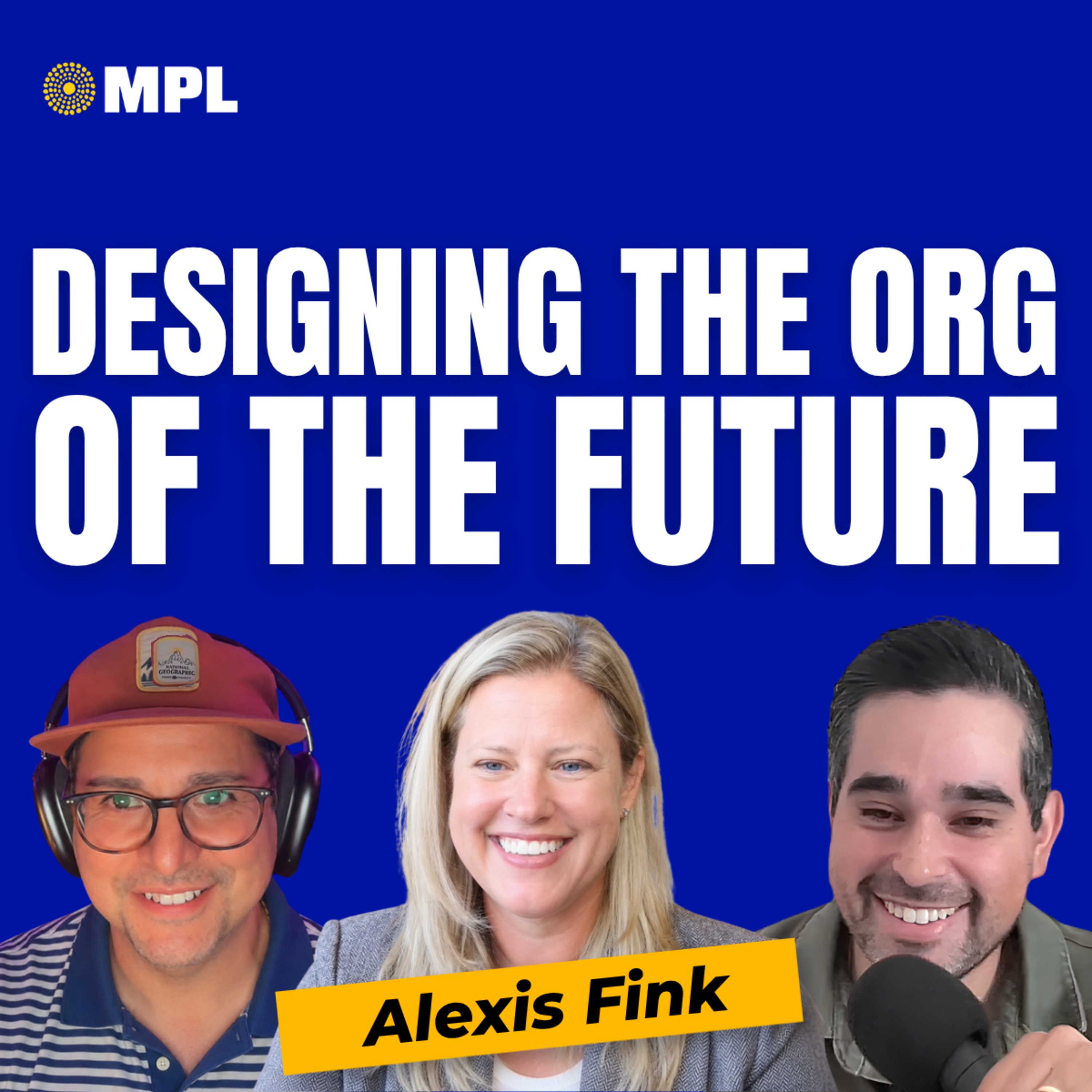
331 - Designing the org of the future: Alexis Fink (Advisor at OpenAI & Workvivo)
In short
How org design should evolve for AI/robotics—shifting from “org charts” (who reports to whom) to “org models” (how work gets done, decision rights, and roles of machinery vs people). Also covers reframing cost-cutting conversations toward revenue, and the need to break out of “learned helplessness” from legacy systems and vendor constraints.
Guest
Alexis Fink, advisor at OpenAI and Workvivo (Workvivo owned by Zoom). Background: PhD in industrial-organizational psychology; previously worked at Meta; dissertation funded by NASA; has studied/observed work across sectors (factories, hospitals, boardrooms, fighter pilots). Runs the People Analytics Board for the Institute for Corporate Productivity; active with PSYOP and USC’s Center for Effective Organizations; does product strategy and writing.
Key claims
AI/robotics won’t just change tasks; it will create new industries and roles. Org design questions should center on work organization, safety/security/reliability, and competitive advantage. Influence should “pull” via gravitational force. Budgeting is often stovepiped across HR/IT/robotics, causing sub-optimization.
Notable examples
IKEA used automation to reduce customer service reps by ~5,800 and redeployed them as interior designers via video calls, generating over $1B in first-year revenue. Microsoft culture transformation: VP gatekeeping, aspiring management program, and filtering manager hiring for cultural collaboration; later reinforced by Satya’s “learn-it-all” culture.
Written by AI. May contain mistakes.
Chapters
0:00
The Role of Influence in Org Design
Learn about the importance of influence and gravitational pull in organizational design.
“And none of those org charts showed those robots as part of the org chart, right?”
1:17
Good News Stories
Hosts share personal good news stories to connect and engage.
“I believe it was Zach Paris that told us we needed to have you on the show.”
2:38
Alexis Fink's Career Journey
Alexis shares her fascinating career journey and experiences leading to her current advisory role.
“yeah i built my own crm our own crm in the first two weeks of my job and so what i had experience in the hr Hourspace is transferable.”
6:05
Advisory Work Insights
Gain insights into the nature of advisory work with companies like OpenAI and WorkVivo.
“I think the root of it is that I am endlessly curious about how to make things better and how different groups of people solve the same universal problems.”
11:02
Transitioning to Advisory Work
Discover the challenges and considerations of moving into advisory roles.
“And I'll also share for the folks who may be kind of in a similar position, as I made the transition into my post-corporate season, as I'm calling it, I really had three key criteria in mind.”
13:15
Building Professional Relationships
Understand the importance of networking and relationships in career development.
“I don't have to write performance reviews.”
14:00
Building Community Trust Through Mentoring
Discover how long-term investments in community can create valuable opportunities.
“I think the answer you're looking for is some kind of marketing activity that I undertook.”
15:34
The Evolution of Work and AI's Role
Learn about the historical shifts in work and how AI will influence future roles.
“And when you think about what it looks like to be a company or an organization that's still around in 20, 30, 40 years, that's going to look much different than the companies of today.”
19:46
Rethinking Organizational Design
Explore the modern approach to organizational design beyond traditional structures.
“And we're starting to see these same patterns happen in AI where what's theoretically possible, what's possible in a lab breaks when you get it into the real world.”
22:58
Innovative Approaches in Organizational Structures
Understand different organizational strategies being utilized to adapt to new technologies.
“And thank you for being a little spicier in your response because usually in this conversation I get it's, oh, well, our AI employees don't belong on the org chart or our AI employees absolutely belong on the org chart.”
Show all 24 chapters
28:00
The Triple Win in Employee Engagement
Explore how freeing up capacity can enhance job satisfaction and revenue.
“They were able to not only retain those employees, but give them work that was sort of more inherently creative and gratifying and had more human connection, which many of us desire.”
29:10
Ikea Experience: A Case Study in Customer Service
Learn how personalized service can transform customer experiences.
“And so childhood trauma aside, like the most recent Ikea trip was the best.”
31:10
The Importance of Organizational Rubrics
Understand the role of structured frameworks in organizational success.
“My former consultant is like, oh, shit, she said the R word.”
33:45
Reframing Conversations Around Cost and Revenue
Learn strategies to shift focus from cost-cutting to revenue generation.
“Every organization and every situation is going to be different.”
35:58
Budgetary Constraints in Organizational Decision Making
Explore the impact of budget control on organizational efficiency.
“nerds, absolutely would never have thought of three years ago or five years ago.”
40:00
Transformative Lessons from Major Corporations
Gain insights from past corporate transformations and their relevance today.
“I only control the, you know, the contingent worker contract.”
42:01
Transformations in Organizations
Learn about key elements from past organizational transformations and their relevance today.
“And so, you know, I've got to imagine that you work through some major kind of transformations like at those organizations.”
48:08
The Role of Compliance in HR
Understand the importance of legal compliance in HR processes and the pitfalls of gut-based decision-making.
“Okay, so it sounds like those are all things that are tried and true and will carry over to the culture changes that companies are going through today.”
49:43
Evolving Change Management Practices
Discuss the evolution of change management and the need for adaptability in today's organizations.
“And the way I learned to do change management, you had a beginning and a middle and an end.”
53:23
Influence vs. Convincing
Explore the nuanced differences between influencing and convincing stakeholders in complex organizations.
“I feel like it's never been more important for leaders to be good storytellers in the, there's a lot of data.”
56:01
Influencing Through Gravitational Pull
Learn how to influence others by creating a gravitational pull instead of convincing them.
“I'm going to work with somebody who does have more overlapping interest.”
57:32
Storytelling in Conversations
Understand the importance of storytelling and listening in building relationships.
“A lot of what you said definitely resonates.”
59:31
Rapid Fire Questions with Alexis
Discover valuable insights from Alexis through rapid fire career advice questions.
“out of here at a reasonable time and we're ready 58 minutes in.”
1:01:54
Final Thoughts and Recommendations
Hear parting thoughts on courage and curiosity, plus guest recommendations for the show.
“what's one word or a few that's coming to mind as we wrap this up and go first Alexis?”

Ask about this episode
Get the gist, explore an idea or ask about something said.
 Claude
On The Modern People Leader: Forward-Thinking HR, what are the key points of this episode?
Searching your listeningTranscript
Automatic transcript. May contain errors.
0:00Alexis Fink: And none of those org charts showed those robots as part of the org chart, right? It was a part of how work got done. It was a tool. It was absolutely essential. In some cases, it was doing 90 % of the work, but it wasn't really on the org chart. And so I think the org chart is the wrong question. The org design, the org model, how work gets done is a better question. And it starts to push you to philosophy. There's an awful lot of influence that's about, you know, okay, what are the terms of the market? What is the, what actually is this whole segment? What does it look like? What's inside it?
0:34Alexis Fink: That is a huge form of influence. And that's not about convincing. That is about creating something that has a gravitational pull. And so at the end of it, when I think about influencing, I'm really thinking about creating gravitational force. Instead of trying to push, which is the way I think of convincing, I want to try and pull, which is the way I generally try to think about influencing. You're listening to the Modern People Leader Podcast, where we go behind the scenes with today's top HR leaders and work experts. We talk to them about how they've gotten to where they're at, what they do every day, and what they see coming next for the future of work.
1:11Hope you enjoy.
1:17Alexis, happy Friday. Happy Friday. I believe it was Zach Paris that told us we needed to have you on the show. and I feel like it's like a Zach Paris week for me. I got an email from him earlier this week. I'm meeting it with him later today. We're talking to you, his former colleague. Y 'all worked together at Meta, is that right?
1:39Alexis Fink: We did and he is an absolute delight. He was such a wonderful colleague and partner for my people analytics role there when he was in the role supporting the CHRO. It was just fantastic to get to play with his strategic acumen and also his unbounded curiosity. He is so smart. He blew our minds maybe like two or three months ago when he joined us in the pod. So shout out, shout out Zach. Hopefully you're listening to this. We start every episode the exact same way. And that's what something we call good news stories. So we all go around, share something could be personal, could be work related, whatever's coming to mind for you on this beautiful Friday morning.
2:18Alexis Fink: Oh, and the way you're saying that, it seems like I'm starting. So for me, the happiest thing is my youngest child is in is just kicked off his doctoral career he is uh in graduate school and thriving and it's wonderful and it's just filling my mom a heart with joy yeah i
2:42built my own crm our own crm in the first two weeks of my job and so what i had experience in the hr Hourspace is transferable. Vibe coding is very transferable. And my belief that CRMs are cooked and that, you know, built for purpose tools are the future. Like, I don't have like, we still don't have the answers to these things. But I will say based on my last week, I think I spent Wednesday, Thursday, Friday of last week over like, you know, vibe coding here and there. and then like presented that to our boss, my boss, our CEO. And I started the swing of like prospecting. And my good news is like, I think day one, I got like 10 touches.
3:37I was still ironing out the kinks. Yesterday, I got 30 touches. Today, my goal is to double that. And it works beautifully. It's like, I hate as a salesperson, like the worst thing for me is the knowing the admin that's going to be involved with launching a campaign and tracking the campaign and updating the campaign and not forgetting to turn people off, like all these things. And, uh, and so knowing that I have something that is like humming built for like what we're doing is, uh, that's my good news today. Not related, sorry to what we're talking about, but there you go. Steven, you're to give me the demo.
4:15I, I've also built out a CRM for MPL this week and it's by no means perfect. And so I would love to, I would love to see what you've built and I'm sure I could take like some screenshots or make some mental notes and improve ours as well. And I think this is how it's going to, the fire is going to just start burning. It's like, Hey, can you show me what, what were the three prompts or five prompts you use for that. So glad to. My good news is that my wife and I have got a little date night planned tomorrow. It's undecided what we're going to do. There's a plan and then there's a backup plan. So the plan is to go see Olivia Dean, who is in Austin this weekend, I think tonight and tomorrow, but tickets are outrageous.
5:06So our plan is to wait until the last minute and see if we can get one. If that falls through, we're going to go have a nice dinner at this place called ATX Cocina, this Mexican restaurant downtown. It's good atmosphere, good food. And so yeah, I've had a busy few weeks and a lot of travel between me and my wife and And both of us and busy with work. And so I'm ready for a little date night. We've got a babysitter. So it's a good time. And so Alexis, tell us the story. So you've done a lot of amazing things. You've worked at Meta. You've worked at, I mean, I had the whole list in front of me. There's a lot of big names on there.
5:52And now you're doing advisory work. And you work with companies like OpenAI and WorkVivo. So give us the story and how that all led to what you're doing today.
6:03Alexis Fink: Wow, that's a giant question. I think the root of it is that I am endlessly curious about how to make things better and how different groups of people solve the same universal problems. I had the good fortune to be an expatriate kid in middle school, basically, which sort of opened my eyes to the fact that there are lots and lots of ways of being. and initially thought maybe I wanted to be a therapist and then realized that I didn't want to spend all my time with people who were sad and also that working one-on-one was really slow. And so to use modern tech industry language, I thought I could scale that by finding the place where people spend most of their time, which is work.
6:48Alexis Fink: Most of your waking hours are spent at work and the place that is probably the most crucial to societal functioning in terms of economic development and the fact that a great deal of people's well-being comes from their ability to do work, sense of meaning, et cetera. So that felt like the most interesting, most important place I could spend my time. I went and got a doctorate in industrial organizational psychology. I got to do things like play. My dissertation was funded by NASA, which makes me sound much smarter than I probably am. And then I got to spend time in factories in rural places. I got to spend time I'm in board meetings for some of the biggest companies in the world.
7:26Alexis Fink: I've just gotten to play from almost any imaginable sector, chemical plants and hospital systems. And again, incredible technology and fighter pilots, just such fun places to play with. And over and over and over again, the same kind of themes come up about how you do good science and good work and discover patterns, but also what good work looks like and what dignity looks like and what challenge looks like and the role that we can play in architecting systems to make, to elevate organizations and the people in them. How's that for abstract? Yeah, no, that like, it's just so such a, our job is so fascinating.
8:12We, we, we meet with a lot of great people, a lot of great thought leaders, like it's a who's who. And we had Dean Carter, formerly of Patagonia, like we recorded with him just a couple of days ago, and it was someone else. And, you know, this, the curiosity, it seems to be a common denominator between, you know, some of the greats that we have spoken to this, like insatiable curiosity of, you know, So it's fill in the blank. And for, you know, it's slightly different for all of us, but I definitely share your passion. So much so that like I founded an engagement survey company. I made the crazy decision to try to launch a startup.
8:57And so love everything you've done. And, you know, I feel like I've followed you for a really long time. So feeling honored that you're joining us today. And so before we go, you know, some of the questions, it's the same format we use, you know, for every episode. But we also we obviously have to kind of dial it in for the nature of the guests and what they do. And so since you're not currently in the seat doing the work, I thought it would be a cool. Usually we ask about the company you're working for. Walk us through the problems, the work, the individuals that you kind of interact with in the advisory that you do.
9:35And like what give us like a backseat, a behind the scenes view into like, what does that mean to be an advisor for OpenAI or WorkVivo? People leaders want to hire the best talent, regardless of citizenship or where that person is from. But when you're hiring across the globe, finding the right person is only half the battle. It's everything that comes after that can get really complicated. Can we hire this person? Which visa path makes the most sense? How long is this going to take? And who's going to be chasing updates along the way? That's where Manifest Law comes in. Manifest is an AI native immigration law firm built for companies that want to hire the best people regardless of citizenship.
10:17Companies like Resolve.ai, Novo, and LatchBio use Manifest to get hires onboarded and stay on top of compliance as they grow. For HR and global mobility teams, that means real-time case tracking, same-day candidate evaluations, fast filings, and a five-hour average response time. And there's real legal depth behind it too, including top tier attorneys and advisors like the current president of the American Immigration Lawyers Association and former USCIS leaders. So instead of immigration becoming another thing your team has to constantly follow up on, you get more visibility, faster answers, and fewer surprises.
10:56If you want to schedule a free consultation with Manifest, just click the link in the show notes.
11:01Alexis Fink: Nice. Okay, so I'll give you that. It's a little bit of a broader view. And I'll also share for the folks who may be kind of in a similar position, as I made the transition into my post-corporate season, as I'm calling it, I really had three key criteria in mind. I needed to make sure that I had intellectual stimulation, that curiosity thing you talked about a minute ago. I needed to make sure I was doing things that felt like they had meaning and purpose, and it was a valuable contribution. And I was sort of spending my time in a way that mattered. And then I needed to spend time with people that I respect and enjoy.
11:33Alexis Fink: And so as a result of that, it's turned into this real portfolio. The one you mentioned, OpenAI and WorkVivo, which is owned by Zoom now, are the ones that would be the most obvious. In both of those, I've got a formal advisory arrangement, sort of a day a week, some product strategy, some sort of light coaching, a little bit of sort of not quite marketing. I don't do marketing. I'm not that kind of a person, but where product strategy intersects in that way. and then I've intentionally crafted a few things that are focused on community. So I run the People Analytics Board for the Institute for Corporate Productivity because that keeps me close to my community.
12:09Alexis Fink: I do a lot of things with PSYOP, the Society for Industrial Organizational Psychology, and we've got a fantastic People Analytics Conference coming up at the end of September while I'll be playing with some future of work stuff that'll be really exciting. Plus I'll be at People Analytics World in New York in November. And then I've had a relationship with the Center for Effective Organizations, the University of Southern California, for over 15 years. And I'm doing some things with org design and future of work and AI transformation with them. And then I've got a couple of sort of small startups up my sleeve because that process is so exciting.
12:45Alexis Fink: And it's so foreign from my large company experience. So there are a couple of those that I'm doing product strategy work with. And that's usually sort of like one day a month. Let's go deep on some new feature set, some new problem. How do we think about an industry? How do we think about making this relevant? Where are the places where we're off track or the things where there's an opportunity in the market that I can play with? So I keep telling people I have all the parts of my old job that I love, all of the curiosity and the strategy and the solving dilemmas, and none of the parts I hated.
13:15Alexis Fink: I don't fight with finance. I don't have to write performance reviews. I don't have to solve any office politics. So that's sort of it in a nutshell. Plus, I'm doing a bunch of writing. So updating my textbook, a couple of things like that. Man, what would you say when you went into this advisory work, what was the hardest part of just getting it off the ground? So the hardest part, I think, was deciding to do it and deciding to leave the security of a real job with a real paycheck and real health insurance and all of those things. I was a solo parent for a really long time. So the weight of that sat on me.
13:52Alexis Fink: And taking the deep breath and sort of doing the trust fall into this area, I think, has been the hardest part. I think the answer you're looking for is some kind of marketing activity that I undertook. And the honest answer is I've spent 30 years investing in this community. I spent 30 years teaching the occasional graduate class and doing presentations and writing and having hundreds of random mentoring calls in my car on the way to work. So I'm like, I got 45 minutes to kill. If you want to talk to me, sure. Like it's better than listening to NPR. This is before podcasts. And so I've just. You were the podcast.
14:33Great.
14:35Alexis Fink: So I spent sort of decades planting little seeds without really thinking about it. And then when I said, hey, you know, peace out, yo, I'm leaving. A whole bunch of folks said, wow, I've wanted to work with you for a long time. Is there a way that we could do this? So one of my arrangements, and I won't tell you who, is a guy that I turned down for a job several years ago. Another one is somebody else that I turned down for a job several years ago. And they've kind of come back and said, hey, you know what? Would you like a job? And I've said, I do not. But I would love to do something advisory.
15:05Alexis Fink: I would love to do something a day a month, a half a day a month. you know three hours a month which one of them is literally 90 minutes every other week so it's um it's more honestly about harvesting what i've been doing kind of as as a community support maybe for a long time it's not a great repeatable answer probably no i think that's great so plant plant a lot of seeds throughout your career yeah and then when you're ready take that trust fall and just do it. So when I think back to our catch up the other week, I remember you saying something to the effect of we've gone through this one way door and that there's a lot of noise about AI and HR coming together and how that's going to change work, but you still don't think it's enough.
15:58And when you think about what it looks like to be a company or an organization that's still around in 20, 30, 40 years, that's going to look much different than the companies of today. And so I want to start there. What do you mean when you say that? And hopefully I'm not like, you know, changing your words or putting any words in your mouth, but any thoughts?
16:23Alexis Fink: Yeah, it's, I'm kind of a super nerd if you haven't picked up on that. And I'm fascinated by the way, not only has work changed in a micro sense, like what people will do on a day to day basis, but work in a macro sort of labor economic sense, how that has changed and how that's changed societies. And so the easiest example probably to understand is for the American audience here, if you look back 100 years, there's something in the order of 30 % of adults were working in the agricultural sector, right? And now it's like two or 3%. So it's less about the fact that the farmers that remain are now heavily technologically implemented.
16:59There are certainly still communities that are using a horse and a plow, but most of
17:03Alexis Fink: them are using pretty sophisticated AI to help them figure out when to plant, what to plant, how to fertilize, when to harvest, where to sell it. Like there's an awful lot of technology, even in that seemingly fairly straightforward workplace. And then also the vast majority of people who are previously employed in that segment are doing something else now. Things that were unimaginable 100 years ago. There were no people analytics VPs 100 years ago. There were no ultrasound technicians. There were probably not very many dental hygienists. There are just all kinds of things that simply didn't exist.
17:35Alexis Fink: There weren't a lot of chief revenue officers. It wasn't conceived of in that way. And certainly no vibe coders or computer scientists. Very few people working in aviation at that time, right? So we now have whole new industries that were inconceivable because the technology didn't exist to enable them. And so part of what I talk about when I'm talking about these things are, yes, the nature of the work that you do will change and the tools that you use will be different. And even if you are doing something that is still fairly fundamentally human, even if you are a therapist, a phlebotomist, there are an awful lot of roles that will still be fundamentally human.
18:13Alexis Fink: I expect that they will be augmented in really dramatic ways. One of my best friends has been doing robotic surgery for like 25 years, right? It has been assisted in ways that are now expanding, right? In addition, there will be all kinds of roles that we literally cannot yet conceive of because the essential technology to support them isn't in place yet. And there is an awful lot of fear that I think prevents us from leaning into what those possibilities are. All the evidence suggests that we'll do this transformation a lot more quickly than prior ones. I was on a conference panel with an economist from Harvard about a year ago, which again, makes me sound smarter than I am.
18:55Alexis Fink: But he was talking about the fact that it took us about 40 years to figure out how to really take advantage of electricity, which seems like pretty fundamental stuff, right? To really figure out how to use that at scale for manufacturing, how to really take advantage of this. I don't think it'll take us 40 years, but it's going to take us more than 18 months to figure out what's really great here. And the flip side of that is, I don't think it's going to be as all-consuming as people like you and me who spend all our time playing with it think that it will. We also had, think back, you guys have been around for a while, think back 10, 15 years ago when robotic process automation was going to take the world by storm.
19:33Alexis Fink: And it turned out like only 10, 15, 20 % of the target processes were actually automatable because there were huge problems in the data infrastructure. There were huge amounts of variance, et cetera. And we're starting to see these same patterns happen in AI where what's theoretically possible, what's possible in a lab breaks when you get it into the real world. It breaks with edge cases. It breaks with change, et cetera. So I think that both things are true. There'll be really dramatic change, but it won't be as dramatic as some of your Elon Musks and what are suggesting. Did that, was that getting at what you were hoping for that question?
20:10I'm just going to keep it rolling. So like, what is org design today? I brought this up in a podcast like not too long ago. And, you know, I definitely don't think org design is dead. I think it's never been more important. But like, if organizationals are fundamentally changing, right, and we're introducing new factors like, you know, technical employees or AI employees, robotic, you know, whatever you want to call that. Like there are more unanswered questions and answer questions it feels like right now. And anytime I ask, you know, on the, in these conversations, it's like, well, we don't have it all figured out yet, but like, here's what we do know.
20:53And so, you know, if we were to zoom out, like, what do you think the future is of org design and what does it look like?
20:59Alexis Fink: I love this question, partly because I've been really frustrated for decades. When people talk about org design, they almost always default into just the boxes and wires. Who reports to whom, right? The org, the core structure piece is 90 % of the conversation. And part of what AI is forcing us to do as we have more and increasingly exciting robotics, It was recently there's a Chinese robot, like bipedal robot that beat Usain Bolt's world, like record time for running. The stuff that Boston Dynamics has been doing for ages has just blown my mind. Right. Dogs that can do backflips, things like this.
21:38Alexis Fink: So like robotics is moving tremendously quickly alongside what synthetic intelligence is or AIs or, you know, people who can do knowledge work are able to do. And so I think that really forces a different conversation because then it's much less. The important org design question is much less about who reports to whom. And do you have a regional structure or a product structure and much more about how is work organized? And what are some really fundamental questions about the roles of machinery, whether that's silicon machinery or steel machinery or aluminum, whatever you're making it out of, titanium versus wetware, if you will, versus people?
22:17Alexis Fink: and where our decision rights, right? Those are the questions that matter much more so than, again, is this product line or global or whatever else? And I think those are much more interesting questions. I'm much more interested in figuring out what's competitive advantage? How do we get that competitive advantage? How do we execute that work? And then how do we ensure the safety, security, and reliability of that work? So now rewards aren't just, can I give you a bonus for something? It's reinforcement. it's QA in a different way. It's technical validation. There's so many more interesting and frankly, more powerful things that we now are forced to think about in org design.
22:56Alexis Fink: It's actually quite exciting. I love that. And thank you for being a little spicier in your response because usually in this conversation I get it's, oh, well, our AI employees don't belong on the org chart or our AI employees absolutely belong on the org chart. And I'm like, How do we even know that? Because fundamentally, what problems are we trying to solve now with org design? And I think that's what you described is essentially how we're going to get there or how it could look a little bit different. So thank you. In the 90s, I worked between college and graduate school. I worked for Delco Electronics, which made semiconductors, silicon in the auto industry.
23:38Alexis Fink: And we had highly roboticized factories. and none of those org charts showed those robots as part of the org chart, right? It was a part of how work got done. It was a tool. It was absolutely essential. In some cases, it was doing 90 % of the work, but it wasn't really on the org chart. And so I think the org chart is the wrong question. The org design, the org model, how work gets done is a better question. And it starts to push you to philosophy. In the last couple of months, I had really fascinating conversations with, I'll be delicate, it, senior leaders at major consulting firms. And one of them was really taking an inverse pyramid strategy, right?
24:17We'll have very few early career people, fair number of mid-career people,
24:22Alexis Fink: and then a lot of people who are like client-facing senior, et cetera, right? So they really have this invert pyramid where they're really killing off the entry-level folks, right? In terms of the roles, not individuals. And then another was pursuing an hourglass strategy, where actually they figured most of that middle management stuff, just like you're talking about like, oh, your CRM can do all these things you used to have to manage in terms of operationally supervising work, right? Like, oh, we can automate that level, that guidance, assignment, evaluation level. And now we need an army of cheap people who might also just be building code, but cheap people.
24:59Alexis Fink: And then a fair number of sort of your senior, your thought leader, your engagement folks. And those are fundamentally different assumptions about the nature of what technology can do and what I still need humans to do. And it will be really interesting to see how those models evolve and what those models produce. I know it's still early days. And as you said, it took 40 years to adapt to electricity. And it's going to take longer than 18 months to figure it out with AI. But you've mentioned a couple of different approaches. You have the hourglass approach, you have the inverted pyramid. Are there any, and you don't have to name any names, but like, are there any companies that are on your radar, either that you've worked with, or you're just hearing about that have started to completely rethink how the work is organized?
25:51I mean, yeah. Any examples just to help, you know, our audience really envision what you're describing?
25:59Alexis Fink: To make sure that I'm not speaking out of school or sharing any confidential information because of the stack of NDAs in my computer, I'll share a public one that I really love. And this predates chat. Thank you. Yeah. So I knew that was going to be harder than the answer. So thank you. So one of my absolute favorite examples, and I do want to acknowledge European labor law may have played a role here. It may not just be goodwill, but IKEA in circa 2020, 2021, put together, I think it was more RPA based, right? A really strong technology solution to support their customer service. It's all over the web.
26:31Alexis Fink: You can go look it up. And they discovered that around half of their customer service absolute volume could be handled technologically, right? So I need this extra bolt. I broke this cam lock. I need a new one. You know, what are the dimensions of this? Fairly straightforward stuff. Some stuff that they were doing in their warehouse slash stores slash restaurants, as well as things people needed support from at home. And as a result of this, they discovered that they needed, I think the number was 5 ,800 fewer customer service reps. And this is where I think European labor law may come into play.
27:06Alexis Fink: But rather than exiting those employees, they said, hey, well, what's going on with the customer service calls that we can't service? Well, they were asking bigger questions. They were asking things like, you may know that in many European countries, you have to bring your own kitchen cabinets when you move into an apartment, right? They're not part of the, they're more like the dresser in your bedroom, right? So you have to bring your own wardrobe. You have to bring your own kitchen cabinets. If you move into a typically fairly small apartment in Europe, like you're bringing a lot of stuff. Ikea is really serving that.
27:35Alexis Fink: And folks needed help. And so they built those 5 ,800 people, interior designers. And you'd book like a 30 to 60 minute video call. Here's my space. Here's what I'm trying to do. And the happy part of this story is not only were those jobs retained, but that new unit delivered over a billion dollars in business in its first year of existence. So they were able to meet a customer need at a higher level. They were able to not only retain those employees, but give them work that was sort of more inherently creative and gratifying and had more human connection, which many of us desire. And they were able to deliver significant additional revenue to the company.
28:15Alexis Fink: So it was this sort of triple win that was enabled because they could free up capacity to do things that were not possible before. Most folks who've hung around in organizations for a while know that they've lived the frustration of putting forth a proposal that shows a positive ROI and not being able to get the headcount of the resources to do it, right? And some of that is because there are kind of rubrics around what percent of the company can be invested in HR or in supply chain or something else. And those form hard ceilings on what you can do. And part of what I'm excited about is the ability to deliver higher quality of service, more interesting jobs, additional revenue generating opportunities, and still live within those constraints and envelopes.
28:57Alexis Fink: So I think there is an awful lot of rising tides lifting all boats that is available to us here. If we don't knee jerk into, I'm going to eliminate a job. So interesting listening to you, because my most recent IKEA experience was my absolute absolute best Ikea experience and no offense to Ikea it's just more of like who I am as a buyer I'm like my parents would take us to like Walmart and Home Depot that was like their life hack and we would just like for hours be like in these stores and so as an adult like one of my goals is like I'm gonna scan this place and within 10 minutes I know what I want or I don't want and I'm going to go to the store knowing exactly what I want because I don't want to spend hours and hours and hours of walking around a store.
29:50And so childhood trauma aside, like the most recent Ikea trip was the best. And a human, like I'm meandering through trying to get through the maze. A human comes up to me and they're like, yeah, you know, just curious, can I help you? And I was like, yeah, I've got all these pictures of all these things I want to buy. and I had like a question and they were like yeah and like walk with me and they walked me over to a computer and they typed in they're like you mind me handing me your phone I was like yeah of course they typed in every single picture like the skew of everything that I had taken a picture of and they gave me a print off that like in you know when you're like leaving and you're picking up the boxes and you're like shit I was supposed to go to G1 before C3 and like I get all backwards and I'm like going back and forth and she did it in sequential order and was like look just go one by one and you'll find everything you need and I was like oh my god I didn't even know this was an option at Ikea and so now like I'm gonna do that every time and I had a great experience And like, I'm not going to dread going to Ikea the next time I need to go.
31:03And something else that you said stuck out to me, the word rubric, like already I'm glazing over. My former consultant is like, oh, shit, she said the R word. And I think, you know, the power of rubrics and these matrices and frameworks is that it helps bring structure to something that is like, could be unstructured. And if it's unstructured, it could be disastrous. And a lot of what I'm hearing in conversations with HR leaders is like, well, yeah, Ikea did it that way, but they're Ikea. Or yeah, like so and so. And to me, that's a symptom of like, shit, like they can, but we can't. And I think that is like head trash, or maybe, you know, a lack of certainty in like taking the first step forward.
32:00And so when you're talking to clients or you're talking to, you're having that 30 minute kind of counseling session with like people in your network, on your way to work or dropping your kids off, like how do you coach people? Like, is there an emerging way of beginning to figure these things out in an organized way? So like when my CEO does say like, We got to eliminate a headcount. You know, I can go back and say, actually, I think we need to reframe how we're looking at this. We don't need to eliminate headcount. We need to like, how do you see, how would you coach someone on like approaching that conversation so that we're doing things more of an Ikea way, which is we're freeing up resources to create delightful experiences versus like falling into the headcount trap.
32:48For so long, HR teams have had two choices when it comes to leave. One, manage leave internally with spreadsheets, email, and disconnected systems. Or two, just completely outsource it. Tilt is now introducing a third option. Their new in-house leave management tech gives organizations the tools they need to run leave internally while simplifying admin for HR managers and employees. So you can do things like centralize leave administration in one platform. configure workflows and policies to match your org, give employees and managers clear visibility throughout the leave journey, and replace manual coordination.
33:27And if you still need extra help, organizations can also add access to Tilt's leave experts for guidance and ongoing support. If this sounds like something your company needs, you can learn more at hellotilt.com slash MPL. That's hellotilt.com slash MPL.
33:45Alexis Fink: Every organization and every situation is going to be different. And most of your degrees of freedom for most of the people you're talking to, you don't have a lot of CEOs of Patagonia that you're going to interact with on a day-to-day basis. A lot of them are going to have more of an opportunity to operate locally. So what is the thing that I can do locally? How can I contribute to revenue? So how can I think about here's a gap between our costs and our revenue? And instead of reducing costs, how can I increase revenue? So what can I do to contribute to that? Even in HR, there are things you can do to contribute to revenue.
34:19Alexis Fink: There are things you can do to reduce costs that are not necessarily about reducing headcount. There are certainly ways that you can redeploy headcount into areas that are more directly associated with generating revenue, whether that's through service delivery or through a sort of sales capture or things like that. And so the thing that I normally try to do is help to, as you say, reframe the conversation. What are you actually worried about? What are you trying to achieve? And then what would the classic sort of consulting thing about if all boundaries were removed, what would ideal look like?
34:50Alexis Fink: What would be fantastic? What would, you know, what would really make this sing? All right, so what's standing in the way? And let's progressively get rid of those, right? There are lots of things that are, they're hacks left over, right? They are all of the infrastructure that you didn't build. And then you, in fact, literally just yesterday, I was talking to somebody in one of my little advisory relationships about the fact that they don't own any of their organizational data, because we're trying to figure out how to do some skills stuff so that we can figure out how to move people internally.
35:19Alexis Fink: Like, oh gosh, we don't own any of that data. Well, absent a time machine to go back and fix that original vendor contract, what are the things you can do now? What are the things you can do now in terms of engaging honestly with that vendor about, okay, fine, what kind of check do I have to write you to get my data back, please? What kinds of things can you do to either have a surface layer, some other form of capture. If this is a hard constraint, what do you do to solve that constraint? What's the timeline before you get to renegotiate that contract? What can you do to break out of the learned helplessness of, oh, no, you can't, given that we have technology and tools and opportunities now that we absolutely, apart from very few super nerds, absolutely would never have thought of three years ago or five years ago.
36:02Alexis Fink: The world is fundamentally different than when you made this decision. And one of the things we know about humans cognitively is once you've decided on a path, your brain sort of shuts the door to all the alternatives, right? It's why you need medical second opinions. Because once a physician has decided on a thing, they're like, just physiologically, the way your brain works, not really able to effectively consider alternatives. And so you have to defeat that little bit of your wiring really intentionally, because it won't happen organically. You've decided that X is true and it will always be true.
36:34Alexis Fink: Think about like a childhood friend who turned into like an alcoholic or something and then they turned their life around, but you're always putting them in that alcoholic box because that's what you've already decided about them. It might not be a true story anymore. You might be playing an old tape. How do you create space for people? How do you tickle them just right to help them explore what those other options might be so that they can focus on, in the question that you raised, the revenue side of a financial challenge as opposed to going straight to the cost side of a financial challenge.
37:03Alexis Fink: The other side, of course, might be, golly, wouldn't you rather cancel some vendor contracts instead of getting rid of some head count? What could be doing with the staff you've got to get something? I think we were talking right before the show of what you had just built that was exactly pinned to your needs, right? Particularly as companies grow, some of those contracts can get really, really large. If companies grow quickly, they can have massive numbers of duplications. There are lots and lots of ways to get at this, to get at a gap between your revenue and your costs, if that's what you have to do.
37:35Alexis Fink: It doesn't necessarily have to be the headcount lever, which is sometimes the most visible one that people can grab at. It feels like the biggest hurdle to get over are these constraints that we've put on ourselves because we've always viewed work a certain way and how things should be done. And so in order to completely rethink it, you almost have to like put that aside. And what was the example you gave? Like, you know, you have a friend that was an alcoholic growing up and they've completely turned their lives around. It's hard for you to get rid of that negative image you have of them. I think there's something similar, even with like budgeting for different teams.
38:20And that's another constraint. So let's talk about that constraint. I know this is something that you're passionate about and you have some thoughts on.
38:28Alexis Fink: Yeah. It's interesting. Tell us more. Yeah. One of the things that I worry about a lot is, to go back to the org design conversation, who gets to control what kinds of decisions? And in most cases, in many cases, the people who are doing people work, let's look at just that for a minute, don't sit in the same budgets. Like HR can kind of see finance owns the actual employee headcount. But then there are all these contractors that sit in completely different budgets, right? And then you've got all of IT that will own the budgets for the technology solutions that you're buying. And if you are in a position where robotics would be a part of it, that sits in yet another budget.
39:09Alexis Fink: And all of those have different leaders with different priorities, different levels of organizational power. They have different baselines. And if you're not an organization that's doing true zero-based budget, and I don't know anybody who does true zero-based budget, you're looking at whatever you had last year. And you've got some increment up or down of whatever you had last year. And so you end up with these decisions that are in aggregate inefficient because it is the best way to solve this mix that is suboptimized to start with. So rather than starting with some work and saying, what is the best possible way to get this work done?
39:47Alexis Fink: And then figuring out, like, it's all the company's money in the end, figuring out how you're funding that, you often start with, well, I only control the headcount. I only control the vendor contract. I only control the, you know, the contingent worker contract. And you end up with these sort of sub-optimized decisions. And it will be really interesting if as a consequence of thinking about org design differently, we think about, we tie the financial decisions to those org designs more closely to the work process decision as opposed to leaving them in the legacy areas of control. And it will be, I haven't seen great examples of it.
40:29Alexis Fink: I've seen little examples where you'll see like a chief work officer where someone is accountable for the AI strategy as well as the head of HR. I'm not seeing a ton where that also includes the budget for the IT components, where that also includes the budget for any sort of hard intelligence or robotics, et cetera, kind of infrastructure. So we're not making, we're not being thoughtful about all of the optionality and ways to get work done and figuring out the most efficient, reliable, secure, yada, yada, yada way to go about it. We're optimizing within sort of our narrow little stovepipes. And I think that there's opportunity to be a little bit more, a little bit more thoughtful on how we handle that.
41:12Earlier, you made the comment that you don't think it's going to take 40 years for this transformation happen. And I, I agree. It's going to take longer. And I also agree, it's going to take longer than 18 months or, you know, three years, like this is, the possibilities are just so massive, right? And the, but it is not like a, it's not like a black and white thing. There are a lot of shades of gray in terms of like the effectiveness of some of these tools and the application to, you know, various, you know, components of a business. And so, you know, I want to go back because you've worked at epic companies like True Legends, right?
41:54Intel, like these are like OG legend meta. Like they're one of the OG of the newer of the newer legends. And so, you know, I've got to imagine that you work through some major kind of transformations like at those organizations. Like, are there any takeaways that you feel are super relevant to the transformation that, you know, we have ahead of us? Because I don't think everything is going to change either. And so maybe that's my first question. Like, are there going to be elements of past transformations? And like, if you can, that are going to apply in this transformation? And, you know, can you share maybe some stories and anecdotes from some of the roles that you've had in transforming companies?
42:37Alexis Fink: Yeah, I could share a little bit. Let's go back to Microsoft as an OG of this, of sort of this era, right? And I got to do a lot of the culture work there, right? When Ballmer was still in charge and we figured out we were going to have to be a different company going forward. We did a whole bunch of research to figure out what that different company was going to need to look like in terms of agility and working across lines. Those people who've been in the tech industry for a while probably remember an old cartoon that was org charts. and the org chart for Microsoft was a bunch of little circles with pistols pointing at each other, right?
43:09Alexis Fink: It's a really classic one. And that was pretty true. And so we had to figure out the things that were holding us back. There was a famous Vanity Fair article about how hideous our performance management was and things like that. It wasn't a secret that we had some ways we were getting in our own way, if you will. And so many organizations feel like if they put their leader up and say, hey, cut that out, that will be a culture change. And I've never seen that work. Printing it on coffee mugs doesn't work much better, but figuring out what are the things that will work and then doing those at every possible inflection point or decision point becomes important.
43:44So some of the things that we did, three of the things that I think were the most impactful.
43:49Alexis Fink: One was we built a, it took a couple of years to get there, but a hard gate about who got to be a vice president. And if you didn't embody what the new looked like, you didn't get that nod. God. And there were an awful lot of people, you know, if you've got sort of an old school VP, they're going to promote the person who reminds them of themselves, right? This is what tough looks like. This is what getting ahead looks like, et cetera. So we broke that. We made it so that, nope, sorry, you couldn't, if you didn't have these things about collaboration and optimizing for the whole and really being able to sense the environment and adjust when you needed to, as opposed to doggedly pursuing something that had worked in the past, like you just weren't making it.
44:28Alexis Fink: And so we did a leadership level. And then we, I'm actually quite proud of this, we built an aspiring management series. So I'm going to change my answer four levels, an aspiring management series, so that people spent about a year kind of getting exposed to all the crappy parts of being a manager. And one of my success criteria for that was I wanted half of the participants to decide they didn't want to do it. And that only worked because we built a really legitimate individual contributor career path. So you could get all the way up to the VP level and never have to be a people manager. And that meant that the folks who were technically brilliant and we really needed them contributing at a high strategic level, we didn't have to punish a bunch of other people by making them report to this person who had no business being a people leader and no interest.
45:08Alexis Fink: And we didn't have to siphon off their capacity doing this part of the job that they hated, right? So building that genuine, viable individual contributor career path really mattered. And then the third thing that we did was we found managers, hiring managers, really over-indexed on technical capability and kind of didn't worry about all those things that we knew culturally were gonna be important. And we could not for the life of us get managers to prioritize on those. So we said, we're gonna quit pushing water up this rope and we made recruiters filter for those things. So hiring managers never got to see somebody that didn't meet those bars.
45:42Alexis Fink: The bars that were consistently getting in our way, the things that were culturally problematic. And we had this in place for years and then Satya took over. and Satya's a primarily different, a profoundly different guy. And my two sons were obsessed with Star Wars. So one of the Star Wars prequels has a storyline where like all of the stormtroopers like rise up because it's order such and so and they like kill all the Jedis. And it's like that, but in reverse. Like as soon as Satya came in, like we had this whole organization that was ready, that had been selected and nurtured to work together, to be adaptable, to have this innovation, to really prioritize for the country at all, to the company at all.
46:25Alexis Fink: And when he came in, like, we're going to be a learn-it-all company, they were like, oh, captain, my captain, I've been waiting for this. And so that culture transformation, it was bred at multiple levels of the organization. The last little click of the lock was Satya coming in as the brilliant, amazing leader that he is. But we'd also seeded the VP band, seeded the managers, seeded the company as a whole with folks who were in that framework, right? There are certainly other examples about trying to really think about a culture change and how an organization needs to be different and structured differently, etc.
47:00Alexis Fink: But that's probably the most comprehensive example. Anyway, so I could talk the entire podcast just about sort of those problems. But what else did you want to talk about? No, I love that. So what I'm hearing is the culture change doesn't happen simply from having a leader stand up on stage and say, this is what we're going to do. It has to be seeded throughout the organization. and the company realized that a lot of that culture change gets stuck with managers. And so how can we make sure we're keeping the right managers in the right seats? How do we give growth paths to the people that are brilliant, but are not suited to be managers?
47:43And how do we provide like world-class training for people that have opted in and want to do this? And that last click I'm hearing is bringing in a visionary leader who gets it and wants to build this learn-it-all culture. And that was the final click. And having a team of Jedi's that he's bringing in to seed it throughout the company. And I love that. Okay, so it sounds like those are all things that are tried and true and will carry over to the culture changes that companies are going through today. what has changed like what assumptions about transformation from the past you think are no longer valid you know we hear all kinds of stories in the podcast and i'll never forget the story that was told about a mexico beach fmla backfire one of their employees was out on approved medical leave and then somebody spots them on instagram feet up on the beach looking a little too okay for someone supposedly recovering.
48:48So cue the call from the CEO wanting to pull their leave and all of the panic that followed. But here's the thing. There's actual legal precedent that says a photo isn't proof of anything. You can't just yank somebody's protected leave because of how a vacation pic looks. You need real evidence. And that's a trap a lot of HR teams fall into. Making a compliance call based on gut instinct instead of actually knowing the law. And that's exactly the gap 650 is built to close. 650 helps teams manage compliance across the full life cycle, from handbooks and policies to agreements, legal updates, and research.
49:24And their AI-powered research center gives you a way to ask employment law questions in plain English so you can better understand what applies and where. Because compliance calls shouldn't be made on gut instinct. They should be grounded in real legal clarity. For those of you that want to learn more about 650, go to the link in the show notes and let them know we sent you.
49:42Alexis Fink: You know, one of the things that I really worry about, my very first real professional job between college and graduate school was doing organization development, change management, like sort of smaller scale transformation stuff. And the way I learned to do change management, you had a beginning and a middle and an end. There was a presenting problem, some kind of burning platform. You did a bunch of design work. You engaged people. You did all of the things. And then there was an end. And then you said thank you. and you walked off into the sunset and were celebrated and you started the next thing in some other part of the business.
50:14Alexis Fink: And there was an assumption that there would be durability and that you could sort of tackle one problem at a time. And I don't believe that that is any longer the case in two regards. In the first regard, there's not just one thing happening, right? The layers of simultaneous change, it's sort of like when Linus's blanket is in the dryer and he just has nothing to hang on to, right? Everything just feels very unsettled. And so folks don't have, they do not necessarily have some kind of a North star that they can point on. So figuring out how to really make sure that there's a clear North star that can guide decisions when there are multiple things changing all at once, instead of just handing them an answer becomes important.
50:58Alexis Fink: That also means you need people who can problem solve, means people, you know, a bunch of other things about that. The second thing is not only are there multiple layers of change happening at all the time, so there are multiple change projects or elements, whatever, there are also a very rapidly changing external environment, which means the change you started might no longer be relevant. and we're not good at building in stage gates or checkpoints to say, are we still heading in the right direction? You sort of close your eyes, put your head down and run is sort of the way change management was taught, certainly when I learned it, as opposed to sort of like prairie dogging up all the time and saying, hey, what's going on?
51:39Alexis Fink: Has it changed? Is there something new? Is there new information that might change the direction I'm getting to? I remember in my BASF experience going back quite a long ways, there were more than one time when product development would say, ah, the market is requiring this. And then you'd go off and you'd do chemistry for three years and you'd say, hello, market, look what I did. And in the meantime, the market would have shifted. And they weren't consistently saying, does the market still need this? Does the market still need this? Is the opportunity the same thing it was when I started this journey?
52:08Alexis Fink: And so that adaptability, that agility, that ecosystem scanning becomes really important and it has to be married to enough of a North Star that you don't get yourself in a position where you never finish anything, right? And that's the risk at some of the later companies I was at and some of the ones that I play with today. There's so much happening and there's so much excitement and it's moving so quickly that you end up with a whole bunch of things that are like 50 or 75 % done and you don't get things across the finish line because there's some new exciting priority and not spending the time up front to really do the testing against that critical North Star to say, is this something that I think is going to survive?
52:50Alexis Fink: Is this something that I think I could fit into an envelope that I can actually finish? And when the new thing comes up, does it really supplant the old thing? Or am I just chasing the newest bright shiny object? Because that last mile is often the hardest part. And make sure that you don't just sort of give up in that last mile and chase the new thing that feels like a rush. Being in an early stage company again, startup, everything you just said really, really hit home for me. We only have time for a couple more questions before we bring this to close. I know, that's MPL. I feel like it's never been more important for leaders to be good storytellers in the, there's a lot of data.
53:37There's a lot of, you know, people that are savvy with the AI, including me and Daniel and others, you know, anyone can say anything and can sound really freaking good. Just like on, in a Google doc or on a lovable website that you did the, like you built in seconds or, You know, and so like, I believe we were in the business of storytelling at the MPL. So we we know the importance of it. Well, Daniel and I do. But being in a new role, I am seeing how like, if you are going to be able to influence outcomes, like you've got to, you know, a you've got to be your fear tolerance needs to be pretty high because like things are moving so fast.
54:24and like I feel like the spaces that we used to have to talk are like filled even more so with slacks and all the things that are happening and so when we do have these micro moments to like tell a story or like make an impact it feels scary and but it's never been more important and I'm curious this came up in our prep like there's a sharp line between influence and convincing. And so how do we truly build influence with all these complex systems that are in place and this ease of access of information?
55:06Alexis Fink: Boy, way to throw a meaty question in the last five minutes. It is true that early in their career, most people think of influencing as convincing and just, I'm going to just throw more data at you, throw more data points, better charts, more testimonials. And they think that that's going to do it. And it turns out that influencing is actually much more subtle. And I think of it as much more of a system problem. It's much more about listening than telling. So what is it that you need, whether that's listening right now or doing your homework beforehand? How do I find where our Venn diagrams overlap?
55:44Alexis Fink: What's the point of mutual interest that I can tag along to? And how can I create a system that will move in the direction that is desired towards that North Star I mentioned earlier? So how do I, if you are, if you're a key stakeholder and you have no interest in what I'm selling, how do I not let my ego get in the way and just keep badgering away at you, trying to get you over to my side and then say, oh, actually, fine, I'm going to go over here. I'm going to work with somebody who does have more overlapping interest. And if you say the thing I do is impossible, I don't want to keep trying to prove myself.
56:23Alexis Fink: I want to go out and do it with someone. I don't want to just argue my case. I want to show my case. I want to show instead of tell. And then you can sort of build a coalition that makes your answer undeniable. So it's no longer a debate. it's real it's no longer philosophical it's in the numbers so the more you can figure out a way to build a coalition the more you can figure out a way to change the argument or change the rules of the game there's an awful lot of influence that's about you know okay what are the what are the terms of the market what is the what actually is this whole segment what does it look like what's inside it.
57:06Alexis Fink: That is a huge form of influence. And that's not about convincing. That is about creating something that has a gravitational pull. And so at the end of it, when I think about influencing, I'm really thinking about creating gravitational force. Instead of trying to push, which is the way I think of convincing, I want to try and pull, which is the way I generally try to think about influencing. Does that resonate or make any sense to you? A lot of what you said definitely resonates. So creating gravitational bull. Steven and I have both done a lot of work in sales. He ran an HR tech engagement company, and it was founder-led sales.
57:50I now run a media company who is building community, who has to sell tickets for events, who needs to sell sponsors. And when I think about when we have the most gravitational pull, it's when we follow the same structure in the conversations that we're having. And I'll give Steven the credit for this. He taught me this early on when I worked with him met at Workify 10 years ago or however long ago that was, that every time you're doing this, you need to start with the story. Like what's the story? How does it relate to them? And from there, it's a lot of listening. Like you tee it up, you tell a good story, you listen, you ask the right questions.
58:45And then by the time you get to the solution or, you know, whatever it is that you're trying to convince people on or influence on, you know, exactly their problems, you know, exactly what resonates with them. You can word it in the perfect way. And then you just have this gravitational pull. It's like, oh, they like, they're like offering up their help. They're offering up being a paying customer. Like this stuff works. It feels like very like Jedi if we're talking about Star Wars. But yeah, I remember, was it like Sandler's sales method that you made, that Dustin made us all learn? That stuff works.
59:21It does work. Yeah, it was one of those. I can't remember which one. And so I feel like we could just keep riffing about this, but we promised that we'd get you out of here at a reasonable time and we're ready 58 minutes in. So the last set of questions are rapid fire questions. We ask the same four or five to every guest. And question one is, what's one piece of advice that you'd give to somebody in HR who's just starting their career? Oh, I would encourage them not to specialize too early and to make sure that they take at
59:58Alexis Fink: least one tour of duty outside of HR. Get some real business experience that you can draw on for new mental models and for credibility with clients. Love that. Next question. If your team or past coworker gave you a superpower nickname, what would it be? Actually, one of my teams did this. They used to call me the closer because I'm like, if something was stuck, they'd send in Alexis and be like, all right, let's get her done. That's a good nickname. Right? The closer. Yeah. What's a strategy or practice from another company that you'd love to steal? I like framing it as stealing. I would maybe more like elevate or adopt, but there are still organizations, notably your kind of larger, older ones that really do invest thoughtfully in talent management, in succession planning, in building talent instead of buying it.
1:00:46Alexis Fink: And I do, I worry that companies that are moving really fast are missing the opportunity to build incredible leaders that are irreplaceable in terms of their understanding and leadership of an organization. Last question. And it's how we, one of the ways we've been able to get so many great guests, including yourself. If you think about someone who's really pushing the envelope, like who should we have on the show next? Who should we give a spotlight to platform? Ooh, I'm going to suggest two people that I think are really thinking about interesting things. The first one is Kelly Monaghan, who's been doing fascinating future of work stuff for a while.
1:01:27Alexis Fink: And I just adore her. And the second is a little bit of a right turn, but we didn't get into the ways that I think changing work is also going to have to change the way we thought about comp for a century. And my friend Shawna Waters is actually playing with some of that. And she would be a really interesting conversation as we think about some of the untouchable topics in HR. Those are some great recommendations. Okay, last tradition, one word or phrase close. what's one word or a few that's coming to mind as we wrap this up and go first Alexis? I would say courage and curiosity. Steven you got anything?
1:02:06I don't yet but I will. I'm going to say throw away the get rid of the constraints the imaginary constraints I don't know. I'm going to go with design for the future. nice and with that it's a wrap Alexis we told you this should be should be fast and furious and wow boy was it it was so much fun thank you for sharing so much and riffing a little bit we went we didn't totally adhere to uh to the outline we had given you but uh I thought that was a great conversation me too it was a lot of fun thank you for having me on thank you happy Friday guys Thank you. Thanks for tuning in to another episode of the Modern People Leader.
1:02:57We really, really appreciate it. And if you enjoyed the show, please leave us a five-star rating. It would mean the world to us. And connect with us on LinkedIn. We want to know what you think about the show. And you can find links to both of our profiles in the show notes. Thanks again for listening and see you on the next episode.
1:03:22you
From the publisher
Alexis Fink joined us on The Modern People Leader. We talked about how AI is changing work, why org design needs to move beyond boxes and lines, and how curiosity, influence, courage, and better systems thinking can help people leaders design for the future.
----
Sponsor Links:
🔗 Schedule a consultation with Manifest
🔗 Learn more about Tilt at hellotilt.com/mpl
MPL Links:
----
(14:10) The One-Way Door of AI and Work
(17:15) Why AI Transformation Will Take Longer Than 18 Months
(19:05) What Org Design Means in the AI Era
(20:30) Work Organization, Decision Rights and the Role of Machines
(22:15) Why the Org Chart Is the Wrong Question
(23:05) Inverted Pyramids, Hourglass Models and Different Assumptions About Talent
(25:00) The IKEA Example: Turning Automation Into New Human Work
(28:05) Why AI Should Free Capacity, Not Just Eliminate Jobs
(31:40) How to Reframe the Headcount Reduction Conversation
(33:25) Breaking Through Constraints, Vendor Issues and Learned Helplessness
(36:45) Budget Constraints and the Problem With Legacy Decision Rights
(40:20) Lessons From Past Transformations at Microsoft
(43:00) Creating a Hard Gate for Vice President Promotions
(44:10) Creating a Real Individual Contributor Career Path
(47:30) What Has Changed About Change Management
(49:05) Multiple Layers of Change and the Need for a Clear North Star
(50:25) Avoiding Shiny Object Syndrome and Finishing the Last Mile
(53:10) The Difference Between Influence and Convincing
(55:45) Creating Gravitational Pull Instead of Pushing
----
📬 Subscribe to our weekly newsletter to get episode recaps
💡 Follow The Modern People Leader on LinkedIn
😊 Follow Daniel Huerta on LinkedIn
😊 Follow Stephen Huerta on LinkedIn
----
Past guests on MPL include Brené Brown, Annie Dean (VP of Team Anywhere, Atlassian), Josh Bersin, Katie Burke (Chief People Officer, Harvey), Liz Fosslien, Helen Russell (Chief People Officer, HubSpot), Dave Scott (Chief People Officer, ADT), Melanie Rossenwasser (Chief People Officer, Dropbox), Crystal Boysen (Chief People Officer, Sprout Social), and many more.
More from The Modern People Leader: Forward-Thinking HR
All episodes
We use cookies.They keep VO running smoothly and help us improve it. Privacy policy