
 Ask ChatGPT


- Podcasts
- The Modern People Leader: Forward-Thinking HR
- 332 - Deciding what to keep & what to kill as your company scales: Conor Sweeney, VP, Head of People & Talent, Form Health
The Modern People Leader: Forward-Thinking HR22 Sep 2026 · 1h 7m · 22 chapters
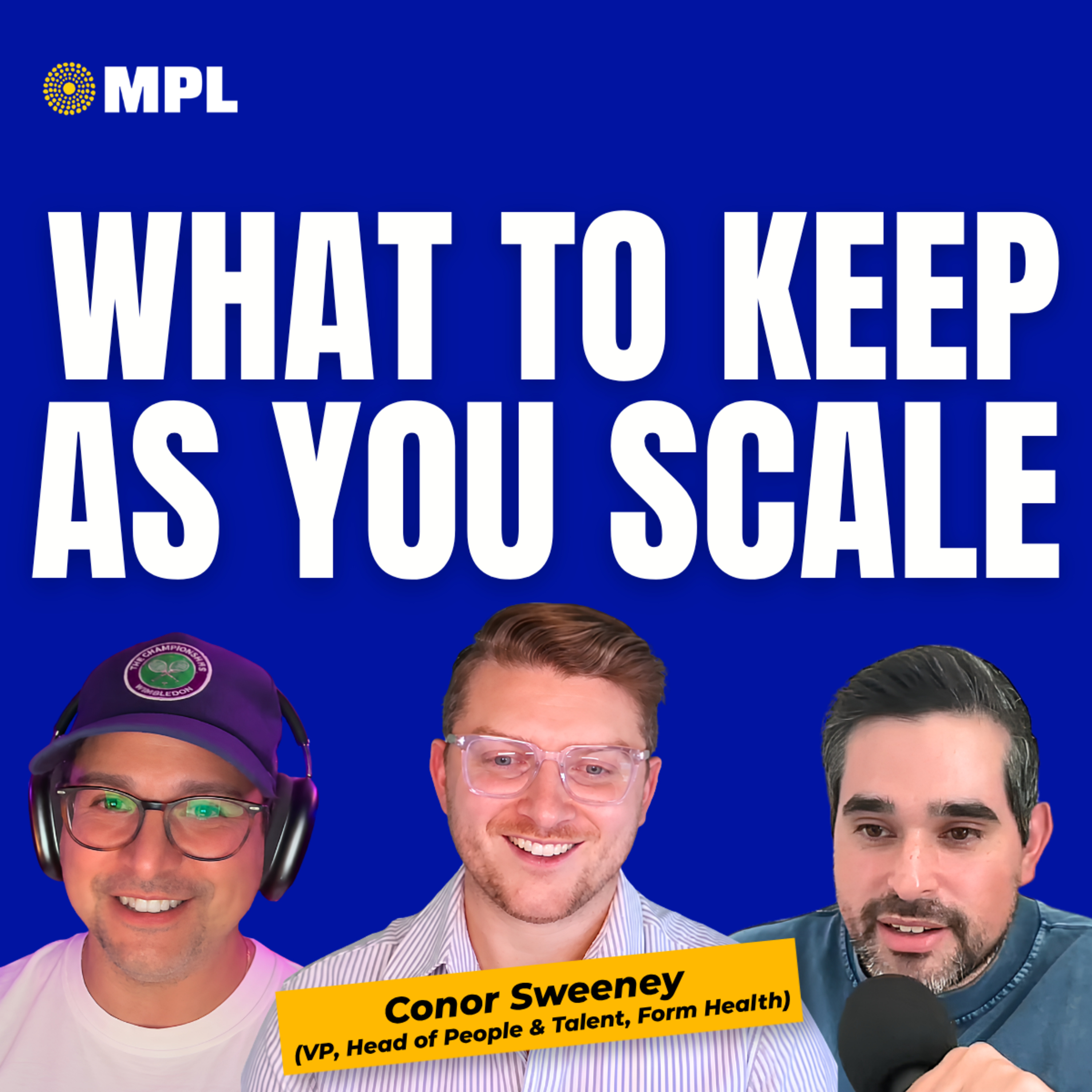
332 - Deciding what to keep & what to kill as your company scales: Conor Sweeney, VP, Head of People & Talent, Form Health
In short
How Form Health’s VP People & Talent, Conor Sweeney, decides what to retain vs. “kill” while scaling, focusing on culture, decision-making, trust, and people operations (job architecture/comp).
Guest background
Conor Sweeney is VP, Head of People & Talent at Form Health (~1.5 years). Career path: Hewlett Packard (ops/finance/strategy), Walmart e-commerce (M&A corporate communications), Box (2.5 years chief of staff for co-founder/CFO Dylan Smith; worked closely with HR leader Jessica Swank), then leadership roles at Weight Watchers (2.5 years; worked with Tiffany Stevenson), plus other startups. He says he shifted from finance to people/human capital strategy after Box.
Key claims
Scaling requires a fork: retain what makes the company unique (e.g., quality care model, partnership) and remove what’s no longer scalable (e.g., consensus-driven decisions on everything). Trust is the mechanism enabling “disagree and commit,” supported by feedback culture and hiring people who are both excellent and collaborative. People programs must be “build with,” not “build for.”
Notable examples
Walmart’s long-lived values/rituals; Volta Charging’s consensus/approval bottlenecks; Form Health’s refreshed values (patient-first unchanged); “Project Compass” job architecture/comp upgrade from “moped” to “Maybach,” built for future growth.
Written by AI. May contain mistakes.
Chapters
1:22
Sharing Good News
The hosts and guest share personal good news stories, including upcoming family events.
“You know, we've had an interesting like month podcast wise.”
3:20
Event Planning and Updates
Discussion about upcoming HR events and progress in planning.
“We've got a lot of family around us where we live in Southern California.”
6:40
Conor's Journey in HR
Conor shares his career path and experiences leading to his current role.
“Unfortunately, it doesn't look like I'll be at HR Tech this year.”
9:18
Learning from Mentors
Conor reflects on key takeaways from working with two influential mentors.
“And for what it's worth, those two humans are a big part of the journey into the people space.”
14:00
Lessons from Different Leadership Styles
Learn about the importance of patience and empathy in leadership through personal experiences.
“And I'm curious, like, what would you say were your takeaways from working with each of them?”
16:56
The Impact of Tiffany on Leadership
Discover how Tiffany's kindness and ability to read a room contributed to effective leadership.
“So we first met at last year's NPL Live San Francisco 2025.”
19:36
Introduction to Form Health
Understand the mission of Form Health and its approach to obesity and cardiometabolic care.
“There is, I think a skill to being able to see when there are things that maybe aren't going the way you think they're going to.”
22:01
Experiencing Rapid Growth at Form Health
Explore the challenges and excitement of scaling a company at an unprecedented rate.
“So when I hit my one-year anniversary back in May, truly, I remember scratching my head saying, there's just no way it's already been a year.”
24:25
Navigating Cultural Changes in Fast-Growing Companies
Learn about the dual challenges of retaining core values while eliminating non-scalable practices during growth.
“Let's just kind of get caught up with like baseline on culture first.”
28:00
Finding the Right Balance in Feedback Culture
Learn about the importance of balancing feedback culture as companies scale.
“Because I think what you don't want to lose and been a part of those companies that I think went too far in the other direction is you don't want to lose the ability to represent the importance of feedback culture.”
Show all 22 chapters
30:09
Building Trust in Organizational Culture
Explore how trust is a foundational element in scaling company culture.
“And trust, of course, is a huge pillar of culture.”
36:54
Identifying and Preserving Company Butterflies
Learn about essential elements of company culture that need to be preserved during growth.
“Like that thing that made Breck special, like we can't crush that.”
41:37
Evolving Company Culture with Growth
Understand the necessity of evolving company culture as a business scales.
“over across different phases as a company grows, like that typically doesn't end well.”
42:00
Evolving Company Culture and Decision-Making
Learn about the challenges and strategies of evolving company culture and decision-making as organizations grow.
“It like, you know, you need to feed it and you need to invest in it.”
46:30
Job Architecture and Compensation Evolution
Discover the importance of job architecture and compensation strategies for organizational growth.
“When I caught up with you a few weeks ago and asked you what's like the thing that you're most proud of, you immediately talked about going from a moped to a Honda Accord to a Maybach with job architecture and comp.”
50:02
HR Tech Trends and Future Considerations
Explore the rapid evolution of HR technology and its impact on job architecture and organizational design.
“We've got to the steady, reliable, something that we can continue to iterate on over time.”
52:48
The Changing Nature of Management
Examine how the role of management is evolving in response to changes in organizational practices and employee needs.
“I think at this point in my career and at this point in time as just a historical moment where technological evolution is just more rapid than we've ever seen.”
56:04
The Evolving Role of Management
Explore how the expectations of managers have changed in modern workplaces.
“And we were going through really detailed, like management architecture trainings and like, so fascinating.”
58:20
Rapid Fire Questions Introduction
The host introduces the rapid-fire question segment of the podcast.
“I mean, I'm a huge advocate for developing people and giving people opportunities to manage.”
59:19
Advice and Insights for HR Professionals
Conor shares valuable advice for new HR professionals and discusses effective practices.
“We end every episode with rapid fire questions.”
1:03:08
Spotlight on Yvonne Furneaux
Conor recommends Yvonne Furneaux as a future guest and discusses her impactful career.
“I feel that Yvonne Furneaux would be a phenomenal guest for all of you to have.”
1:04:25
Closing Thoughts and Reflections
The hosts share their final thoughts and reflections, emphasizing kindness and collaboration.
“And I think she has also seen the inner workings of a lot of really prominent companies as well, and has been able to take those experiences and become phenomenal at her craft.”

Ask about this episode
Get the gist, explore an idea or ask about something said.
 Claude
On The Modern People Leader: Forward-Thinking HR, what are the key points of this episode?
Searching your listeningTranscript
Automatic transcript. May contain errors.
0:00Conor Sweeney: Does anybody really have time to be a manager anymore? And I said, well, tell me more. And they said, well, I feel like 15 years ago when I was managing teams, my job was to manage. It was to have the one-on-ones. It was to remove the roadblocks. It was to host the off-sites. It was to give the performance feedback. Maybe 20 % of my job was to do some more tactical work. But so much of the expectation of me in that role was to just manage the team. I think you'd be hard-pressed to talk to any leader today, C-suite executive all the way to M5 manager to say, do you spend 80 % of your time just managing humans?
0:39Conor Sweeney: My guess is all of them would say absolutely not, right? There's this, we're in this player-coach model right now where you've got to have the skill set to remove the roadblocks, but you're in it. Like, you're doing the work. We talk about this a lot as a leadership team here at Form Health where, you know, we're all straddling those lines of how do we continue to coach and develop our teams? but we've also got a lot of work to do, right? There's this kind of luxury, I think, from the broader ecosystem that's been removed around your job is just to manage. You're listening to the Modern People Leader podcast, where we go behind the scenes with today's top HR leaders and work experts.
1:15We talk to them about how they've gotten to where they're at, what they do every day, and what they see coming next for the future of work. Hope you enjoy.
1:28Welcome, welcome, Connor. Glad to have you at the MPL.
1:34Conor Sweeney: It's great to be here. Thanks for having me, team. You know, we've had an interesting like month podcast wise. Interesting, good, interesting. We had one week where we had like five recordings. We had another week with like three or four. We've had like Monday episodes, which we don't normally record on Mondays. And today we have a two-in-one-day kind of week. We don't have any other pods this week except we have two today. So I'm super excited to be kicking off with you. You know, we like to start off with what we call good news stories. It's just a way to kick things off with a little positivity.
2:12It could be work. It could be a personal story. And we like our guests to go first.
2:18Conor Sweeney: Yeah, that sounds great. I do just want to say this is a very full-circle moment for me. So I've been listening to this program now for a while. And one of the things that's really exciting for me is you have had a couple of mentors of mine slash previous bosses of mine on this program, Tiffany Stevenson and Jessica Swank, both of which mean the absolute world to me, both of which I've worked for in a variety of capacities. And so true full circle moment that I get to join the coolest of the cool on this program. So really great to be here. Good news. Very good time for you to ask that question.
2:57Conor Sweeney: My wife and I are expecting our first child in December, which is incredibly exciting. And I would say over the last couple of weeks is when it has become very real for us as we're now talking through nursery design and leave planning and all of the things that are necessary to work our way to December. So that's the good news in our house. And it's resonating broad strokes. We've got a lot of family around us where we live in Southern California. So we feel the support, we feel the love and we're really excited. Boy or girl? It's going to be a girl. And that is a big part of the excitement. I have long wanted to be a girl dad.
3:40Conor Sweeney: And so that just makes this news that much more special. So Daniel, is this it? Is this the moment where we start a parenting podcast? Yeah, there's just a girl dad. Talk about parents. Yeah. Wow. Well, congratulations. Thank you. I am a two-time girl dad. I have a 16-year-old and 14-year-old. Daniel's a girl dad, first-time girl dad. They're 15, 16 months in. Lena is 16 months. And I also have a December baby. So Joaquin, he was born last December. will be turning one on December 22nd. And for all of the birthday holiday haters out there, it's actually super convenient for the parent, at least from a Pat Lee perspective, because I was out when most of the world was on some form of vacation, like the two to three weeks.
4:40And so, yeah, that's exciting for y 'all.
4:43Conor Sweeney: The double update thing is, I would agree, you're talking to someone who shares his birthday with his wedding anniversary and so a lot of folks are like what and I'm like well one I'll never forget the two occasions which are two very equally important occasions but then the the real story behind that is that was just it was the day that our photographer was available so we were committed to the photography so therefore I was committed to sharing the birthday and yeah makes life a lot easier though as far as future state. and you'll never forget your anniversary that's right that's right yeah that's that's that's that's that's the big one yep i can go next yeah i'm gonna go work related so we had like a i don't know like a four or five month stretch with low activity on the event side at least like on our planning and getting ready for these big events.
5:43In October, we're going to be at HR Tech and we're doing some really exciting things with BCom and Deloitte separately. Planning has kicked off for that. Then we have NPL Live coming up in November, so November 12th.
6:01Conor Sweeney: We're making progress. It feels good to be checking things off the list and feel like everything's coming together, especially this far out, it reduces my anxiety a little bit. And now with Steven having a full-time job, it forces me to be a little bit more organized and plan everything out a little bit better. So that's my good news. Love that. You know, just a casual event with Ford and Deloitte and Eightfold and Deloitte. You know, just, you know, these little things going on. So that's exciting, Daniel. So exciting. Unfortunately, it doesn't look like I'll be at HR Tech this year. And which means that I'll be really jonesing for Vegas come March if I can make it to transform.
6:51My good news, I don't even know where to start. I know that that big sigh kind of sounded like a bad news sigh, but definitely not bad news. We close on our house tomorrow. I'm ahead of revenue and I set a team goal for 50 touches a day. That's a lot of touches. And I hit that for the first time yesterday. I'm a sales team of one, by the way. So I got 15. I'm averaging like 42 touches on a rolling seven basis. Progress, you know, in layperson's terms, I'm making progress in my new job. And it's measurable now. So that's super, super exciting. and so enough about us like Connor like I'm even more intrigued now that I know that you have two connections into the NPL fam our alumni now you will see you're soon becoming part of that group also we'll talk about that a little later but tell us your journey I call this the Brene Brown question like what's your story what were the ups and downs you know shout out the other NPL alumni I that were part of your journey and yeah, share with us how you got to where you are today.
8:02People leaders want to hire the best talent, regardless of citizenship or where that person is from. But when you're hiring across the globe, finding the right person is only half the battle. It's everything that comes after that can get really complicated. Can we hire this person? Which visa path makes the most sense? How long is this going to take? And who's going to be chasing updates along the way. That's where Manifest Law comes in. Manifest is an AI native immigration law firm built for companies that want to hire the best people regardless of citizenship. Companies like Resolve.ai, Novo, and LatchBio use Manifest to get hires onboarded and stay on top of compliance as they grow.
8:41For HR and global mobility teams, that means real-time case tracking, same-day candidate evaluations, fast filings, and a five-hour average response time. And there's real legal depth behind it too, including top-tier attorneys and advisors like the current president of the American Immigration Lawyers Association and former USCIS leaders. So instead of immigration becoming another thing your team has to constantly follow up on, you get more visibility, faster answers, and fewer surprises. If you want to schedule a free consultation with Bannerfest, just click the link in the show notes.
9:17Conor Sweeney: Yeah, absolutely. And for what it's worth, those two humans are a big part of the journey into the people space. So it's a very important part of the journey. So I like to say, and I think what I love most about talking to a lot of other people leaders is my journey has been as nonlinear as it gets. And I think that that is true for a lot of folks that end up in the line of work that we're in. I started my career in big tech. I spent the first five years out of my undergraduate at Hewlett Packard at HP. And why that is such an important part of the journey is six months into my very first job out of undergraduate, it, the kind of Fortune 10 behemoth huge tech company that we all knew for many, many decades was splitting into two separate publicly traded companies, which today I think is still known as one of the largest corporate splits in history.
10:13Conor Sweeney: If not history, definitely Silicon Valley history. And so being so early in my career during a time where something so monumental was happening, It was almost this, you know, kind of launching point or like mini NBA into, oh my goodness, how does corporate America work? And wow, what is change transformation? And what does it mean to evolve and all the things? So very, very thankful for that. So I started my career in the ops, finance ops strategy space. I did not start in HR. And after five years in big tech at HP, I had the opportunity to spend some time at Walmart in their e-commerce business unit right around the time that Mark Laurie was leading the charge there and was doing everything in his power to take market share from Amazon.
11:04Conor Sweeney: I had this very unique opportunity to work on the corporate communications team, specifically on the M &A side of things. And so it seemed like every month we were acquiring a new brand of some sort. And so the exposure to, again, transformation work and integration work and spending a lot of time with senior executives that were really, really good at their craft was a big part of my time there. And then the real pivot point in my career was hopping over to Box. I had an opportunity to leave what was then big, huge tech retail and go to what I thought at the time was more of a startup. Then again, Box was a publicly traded company when I joined the company.
11:46Conor Sweeney: And that's where I was able to spend two and a half years in a chief of staff role working for Dylan Smith, who's their co-founder and CFO. And that's where I had a chance to spend a lot of time with Jess, who is still their chief HR officer today. Fun fact, I met Jess very early in my career at HP. We are both HP alums. We had kept in touch over the years. She was a huge part of why I joined Box in the first place. And that was the most transformational two years of my career because it was at that time that I realized that I was about as subpar as one could be at finance work and where I fell in love with people work and human capital strategy work.
12:28Conor Sweeney: And how do you connect the dots culturally for an organization? That's where I was spending a lot of my time in a chief of staff capacity. And so when I wrapped up my Torah duty, that's the direction I went. I knew that I would be the worst CFO possible and felt that I could make a better impact in people leadership roles. So Beyond Box had a chance to jump in and out of a few really great high impact startups, spent some time, two and a half years at Weight Watchers International. That's where I worked with and for Tiffany Stevenson. And I had talk about a transformation opportunity. I joined Weight Watchers three weeks after they had acquired Sequence and acquired their way into the clinical telehealth world after spending 60 years as really a retail giant, if you will, you know, kind of a wellness retail giant.
13:20Conor Sweeney: And it was just, again, talk about two and a half years of impact transformation, not only working for an amazing leader, but it's really where I got to cut my leadership chops. I have the opportunity to lead the TA team, the L &D team, the real estate team, and Weight Watchers was and is a super large global company. And so it was a phenomenal stint. And then I have now been with Form Health for about a year and a half leading the people in talent charge here. And so very thankful for my journey. It sounds wacky, but it was very intentional. And I don't think if I were to go back, I would do it any other way.
13:57Jessica Swank and Tiffany Stevenson, like what, what legends between the two of them? Also, also very different, I think. And I'm curious, like, what would you say were your takeaways from working with each of them? Like, is there something specific that you, is there something specific that you think of when you think of each of them and how, and how they were different?
14:18Conor Sweeney: You know, what's interesting is they are very different leaders, but I learned two of the same things from both of them in very different ways. And that is the power of patience and empathy. I am naturally someone who is pretty impatient, has sometimes an overbias for action, can get frustrated when things deviate for wacky, sometimes stupid reasons. And I think what both of them do so well, but very differently is they take a step back no matter how chaotic a situation is and really approach things from a how do you think this feels from the other person's point of view and sometimes things don't go your way and so you just have to accept that and be creative and flexible.
15:07Conor Sweeney: And so I learned that from both of them. In fact, I remember my second week at Box and both Jess and I were in a meeting with Aaron, the CEO, and a few other leaders. And I think I had been preparing a presentation for a couple of weeks and was really excited to get through it. And the meeting did not go the way I wanted it to. The conversation got a bit derailed. We ended up going in a few different directions. And my understanding from Jess is I was very visibly frustrated, right, by the fact that, I thought this was going to go this way and it went this way. What the heck? And in the most eloquent Jess way.
15:44Conor Sweeney: I remember her pulling me aside after the meeting and she said, you have got to learn to be more flexible when things don't go the way you want them to, or else you're frankly not going to make it as a leader. And that was a very impactful moment for me in my career. And with Tiffany, she's one of the kindest, most thoughtful humans I think I've ever worked with, worked for. Or, you know, I joke with her often. I'm like, how are you so nice? How are you so patient? How are you so well put together in your approach, right? And so I think we had a lot of fun riffing off of one another, right? Where I think sometimes where I was charging forward, she was always there to say, let's take a step back and maybe here's some things to think about.
16:30Conor Sweeney: And then I think there were other moments where the push pull came into play where I'd be like, hey, Tiffany, I think we're waiting too long to do this thing. Like, let's go do this thing. And so she was always very receptive to that push pull. So I would work with either one of them again in a heartbeat. And I still keep in touch with them to this day. To transform is actually our, I feel like our yearly meeting, we get the selfie, we catch up, we have drinks if we can. It's, yeah, I lean on them very heavily. Oh, my God. True story about Tiffany. So we first met at last year's NPL Live San Francisco 2025.
17:06Is that? Am I getting my ears right? Okay. So we had standard panel and it was, except we didn't have Daniel because Daniel was like either about to, I think he had just gone on paternity leave. Three weeks into being a new dad. Wow. And it's me and like our panels always have big personalities. And so it's nice having like, you know, another facilitator there because you like bounce. And if, you know, one of us can't get the question or get the answer we're looking for, usually the other one can get it. And each panel has its own dynamic. And so Tiffany's on the panel with two other practitioners.
17:43and the topic was around reimagining performance. And man, the two other panelists, I love them dearly. Like they're great. And they're also like, you know, part of the fam. They just did not want to answer the tough questions. And I can be kind of stubborn when I don't get what I want. So I just kept going, like asking harder. And Tiffany stepped up every single time. And like, you know, you could just tell they did not want to answer. And we had like big brands in the room that were like asking tough questions to the panel. And I just remember thinking, wow, if this is how she is, like just on the hot seat, I can just imagine the type of leader she is.
18:31And so it's cool. And she is so incredibly kind. kind. And so to hear that her, her external persona is the same, you know, is aligns with what you experience is so cool. And just to add on to that, and I promise I'll keep it going, but I, we then had Tiffany on for a full episode on the podcast by herself. And I did the intake call and we spent 30 minutes just catching up on life. I think she was either between roles or about to between roles. And I think I spent like 15, 20 minutes just like venting about life and remember her just like listening and asking questions. And I was like, wait, sorry, this is supposed to be an intake call.
19:15We need to get back on track. But yes, Tiffany is so kind and I hope she's listening to this.
19:21Conor Sweeney: I hope so too, because I'm laughing that she spent two and a half years listening to me them to her almost every single day. So it's, yeah, there's, yeah, sorry, but truly there's nobody better to be in your corner. And I think Steven, to your point, there's nobody that reads a room quite like her. There is, I think a skill to being able to see when there are things that maybe aren't going the way you think they're going to. And I don't know how she does it, but she has a way of stabilizing even the most unstable of situations. And so, yeah, truly honor to work for her and consider her a good friend to this day.
20:01Definitely a superpower of hers. And so, Connor, tell us a little bit about Form Health. How do you typically describe what you guys do?
20:09Conor Sweeney: Yeah, I first off, I always start with I love what I do and I love where I work. And I will kind of additional nod to the previous conversation of, you know, spending two and a half years at Weight Watchers, which was a pivot in my career that I didn't expect to take, really led me down a path of just absolutely loving working in the healthcare space. And so Form Health is the proud national leader in science-based obesity and cardiometabolic care. We are an incredible telehealth platform that provides our patients with very comprehensive clinical care through a clinical care model that delivers one-on-one support from physician-led care teams.
20:59Conor Sweeney: And all of those physician-led care teams include diplomats of the American Board of Obesity Medicine and have phenomenal registered dieticians and advanced practice providers and additional specialized support staff that all work together to help our patients achieve really phenomenal health outcomes. So it's a really fascinating space to be in right now because both from a B2B and a D2C perspective, there are a lot of players, but what for me was so attractive about this brand and what this team has built is just the gold standard of quality care in a healthcare environment where oftentimes people talk about quality of care as being kind of peaks and valleys, right?
21:46Conor Sweeney: Depending on who they're working with or what their experience is like to see such consistent approaches to gold standard care is just, it's something I'm really proud to be a part of. And so you guys, how long have you been with Form Health now? I have been here a year and a half. And as I meet with new hires on a twice monthly basis, I always start my spiel with, it's the first time in my career, truly, I'm not making this up, where I feel like time is flying by versus time going really slow, right? So when I hit my one-year anniversary back in May, truly, I remember scratching my head saying, there's just no way it's already been a year.
22:30Conor Sweeney: In a decade plus of doing what I've been doing, I've never felt that way. So it's been a really exciting year and a half. Amazing feeling. And if our dossier is right, you doubled in that year, but you also doubled in the two prior years to that. So three years of doubling in size like that. First of all, that's insane. That's like I can't imagine how fun that has been, but all like exhilarating, but also exhausting. And, you know, you mentioned earlier that you spent time on an M &A team. I was on an HR M &A team as well. I thought, although I wasn't pursuing CFO path, I thought I wanted to be a buy side banker, investment banker.
23:15and I got onto this team and I realized I freaking hate due diligence. Like I did, I was a one man due diligence team when I sold my own company. So those skills, they paid off. And I did that for like two and a half years. And, you know, one of the, like the biggest takeaways that I took from that stint was that culture is freaking hard. Like in times of extreme change, transformation, workplace disruption, it's hard to nail culture. It's just like such a nebulous thing. It can be a nebulous thing to people. It can be hard to measure. And so when you're scaling at that pace, like three consecutive years of doubling headcount or doubling in size, like that's a lot.
24:07And so let's just start there. Like, you know, you come in, you've already doubled in size. So you're on this great, you're the rocket ship, right? And it's mid-flight. And, you know, how would you describe the state at which, you know, the culture was then? Some of the key priorities you had, the team had when you joined and kind of where you are now. Let's just kind of get caught up with like baseline on culture first. Yeah. So you alluded to this.
24:37Conor Sweeney: Scaling culture is always difficult, no matter what. And scaling culture is no matter if your company is growing or stabilizing or in some cases shrinking. Right. I've been a part of organizations that were very intentionally going through a transformation or turnaround that meant kind of consolidating or shrinking the footprint to be able to then build it back up again. And no matter what, you're always scaling culture to optimize for any one of those scenarios. And there's this incredibly difficult fork in the road that appears, which challenges anybody in the hot seat who's thinking about this more than anyone to think about what is it that you want to retain that should always play a role in the growth and positive momentum of the company, as well as what do you want to get rid of that is no longer scalable?
25:28Conor Sweeney: And so when I think about the things you'd want to retain, I go back to my days at Walmart. I remember being so surprised that to this day, they start all of their company meetings with their, you know, kind of Walmart chant, right? Something that goes back to the Sam Walton days when he had very, very few stores. And I think about the foundational values that they've retained over 50, 60 plus years. And I think about some of their ways of working pieces that they've retained all these years later. And so to me, those are examples of the things where you have to make a very conscious decision as an organization is changing or growing to ideally retain the things that just make you unique and make it special to work there.
26:12Conor Sweeney: The second fork in the road, right, is what are the things that you want to get rid of that are no longer scalable? I think any of your listeners can probably relate to times where something worked at one point in the company journey and then several years or months or whatever the timeline is later, that thing just doesn't work anymore, right? Because you've either outgrown the process or you've outgrown the thought around it. So, you know, I think on that last note, the one that comes to mind that I think appears or has appeared for me in every high growth startup environment that I've worked in is shifting away from consensus driven decision making on every decision.
26:54Conor Sweeney: And again, I don't think this is unique to form health. I think this is something fairly universal as companies start and then grow is, you know, your first 20 employees in a room are likely going to be involved in every decision that's made, right? Because you're all sitting in the room together. You're in a co-working space, you're in someone's garage, you're sharing laptops, right? You're just all naturally involved in what's going on. The organization's small, it's flat. When you really start to grow and think scaling to hundreds, thousands of employees in different locations, different working environments.
27:31Conor Sweeney: You're starting to bring folks into the organization with very different backgrounds and skill sets and experiences. You're building more layered teams. Decision making becomes a very different beast, right? It's no longer something that can be broadly consensus driven. It's something that really has to be verticalized a lot of the times in ensuring that you are leaning on the leaders and the expertise that you have in your organizations to make the decisions that impact that part of the organization. So whether that be you know, people, programs related stuff for HR teams or sales related strategy things for commercial teams, right?
28:06Conor Sweeney: So it's a balance though, right? Because I think what you don't want to lose and been a part of those companies that I think went too far in the other direction is you don't want to lose the ability to represent the importance of feedback culture. And so if all of a sudden it's don't give me your feedback, I don't want to hear it. I've got this, I'm the expert. Well, And so I think it's a really, really difficult, difficult balance. And if you sway too far in one direction, the inefficiencies are just going to absolutely eat you alive. I remember when we had Helen Russell on the podcast years ago when she was at Rivian, she described a very similar problem that they were working through, how as the company kept doubling in size every year, decisions were slowing down.
28:56and her big body of work was coming up with a framework. Like, how are we going to make decisions going forward? I wish I had a good enough memory to tell you what that framework was. I remember it being very smart and we had like a bunch of social content that we built around it. But I'm just curious, like, what does this more verticalized decision making look like? For so long, HR teams have had two choices when it comes to leave. One, manage leave internally with spreadsheets, email, and disconnected systems. Or two, just completely outsource it. Tilt is now introducing a third option. Their new in-house leave management tech gives organizations the tools they need to run leave internally while simplifying admin for HR managers and employees.
29:41So you can do things like centralized leave administration in one platform. Configure workflows and policies to match your org. give employees and managers clear visibility throughout the leave journey, and replace manual coordination. And if you still need extra help, organizations can also add access to Tilt's leave experts for guidance and ongoing support. If this sounds like something your company needs, you can learn more at hellotilt.com. That's hellotilt.com.
30:12Conor Sweeney: I think a big part of it's trust. And trust, of course, is a huge pillar of culture. So if we think about culture being something that really equals at its most fundamental level behavior, trust is a really important part of any ecosystem. And again, I think there's a lot of us that can relate to having worked in environments where trust is pretty limited. So you're triple, quadruple checking each other on things. You're hesitant to make decisions because you don't want to deal with the consequences of all the pushback. And that can be really hard. And so in absence of maybe a framework, I think it's important to, as any organization is growing, to continue to reinforce the importance of trust, like people trusting one another.
31:02Conor Sweeney: And I think the terminology that we tend to hear often, no matter what company you're in, is this whole disagree and commit model. At the end of the day, whether you are one of the first employees at a startup that now has a thousand people or if you are employee 1001 of that same company, there are going to be moments in your journey no matter what, where a decision is made. And it is what it is. And so you've got to kind of get on board or maybe get off the bus altogether. other. So yeah, I think a big part of it is trust and ensuring that as leadership teams, CEOs, people teams, that you're doing everything you can to reinforce and build an environment where people feel like they can trust each other.
31:46And I think that entails a few things.
31:50Conor Sweeney: Hiring really smart, awesome people is a big part of that, right? And I think any one of us who have worked in large organizations, hopefully can say at some point in your career, I remember working at that company because everybody was so freaking awesome. I mean, I feel selfishly very much that way about, you know, form health. You know, we hire truly some of the smartest, brightest minds in healthcare that just also happen to be the coolest, most patient, awesome, collaborative people around, right? So when you are hiring people that naturally come in with an inclination to trust other people that are fundamental experts in the work that they do, it just makes life a lot easier to work through that disagree and commit model and, you know, kind of over time step away from that everything has to be consensus driven model.
32:36Conor Sweeney: I think without trust, you can't do any of that. Somewhere. So shout out to Lencioni, former NPL guest and alumni somewhere in the world. He's smiling, Tennessee. I forget where he's based, but he is probably got a big smile on his face. We talked at length. Anytime trust comes up, I think of Pat and I think his body of work or bodies of work. It's a lot of work. And my question, Connor, is operationally or tactically, trust, how do you scale trust? How do you reinforce and maintain gain trust as like a foundational requirement to have the culture that aligns with kind of your values and vision.
33:23And that being so important, particularly in the line of work that you do, and the talent that you're trying to attract, like, to the best that you can, because I know this can be a hard thing to describe. But like, you know, what does that look like day to day?
33:38Conor Sweeney: It's a great question. So much of it starts with doing everything you can to build and reinforce feedback culture, culture of feedback. If folks coming into your organization very early on have a sense that they are empowered to tell other folks in the organization how they feel and what they want to see and what their experiences have been like, that goes a long way. And it sounds so fundamental, but, you know, I go back to years ago, I had a boss at Walmart who was obsessive about the idea of nailing the fundamentals. And I remember at the time, it drove me absolutely insane where every time that we were approaching a project, it was like, you know, Connor, did you nail the fundamentals?
34:21Conor Sweeney: I'm like, yes, freaking nailed the fundamentals. But now I find myself, you know, so many years later going, gosh, in a world that is so complicated and so operationally heavy and that is now so technologically influenced by complexity. Yes, it's very easy to lose sight of the fundamentals, right? You can have the absolute best tech stack ever and have the most AI-enabled organization on the planet, but if you have not nailed the fundamentals around feedback culture and niceties in an organization and people feeling good about showing up to their job every day, well, then really none of that stuff matters at the end of the day.
35:02Conor Sweeney: So I think one step is doing everything you can as an organization to reinforce the importance of feedback culture. Secondly is, and talk about overly fundamental, which is really taking the time to invest in hiring awesome people. I think, you know, I've worked in startups in the past where there is this business need, right? And so you're on this velocity to just hire, hire, hire, hire, hire, right? So you are optimizing in that mode for skill set. They've got that degree. They've got that experience. Let's get them in. well, that degree and experience really doesn't matter if they absolutely suck to work with every single day, right?
35:40Conor Sweeney: And so while I'm not a huge proponent of over-indexing on culture fit as a thing that I think has been very controversial over the last few years, I do think it is really important to lay the groundwork as you think about your hiring strategy and what you're looking for is to really ensure that you are 50-50 indexing on the what and the how. You know, I've worked for a few leaders now, Tiffany being one of them that I think always did a really good job, you know, balancing the two is the what is can you do the job? Can you deliver on the things? Can you get the projects done on time? Can you get them done under budget?
36:16Conor Sweeney: But the how is just as important. If you're nailing the what, but you are a nightmare to work with and universally not liked in the organization, again, that's not scalable, right? So, you know, I think so much of building a culture of trust comes from nailing the fundamentals around it, which is, you know, good people and, you know, consistency around workflows and expectations and really ensuring that you are empowering people in your organization to share feedback and equally receive feedback because that's really the gift that keeps things moving. when we talked to heather dunn maybe like a month ago i think we just published the episode but it was about a month ago she was walking us through the culture integration work that they're now working through as brex fully integrates into capital one and she said that capital one ceo had, he only had like one thing to say about the acquisition and it was don't crush the butterfly.
37:23Like that thing that made Breck special, like we can't crush that. We have to retain that. And so when I hear you talking about this fork in the road where you need to figure out what you want to retain versus what you need to get rid of, I'm just curious, like what are the things either you're hearing at Form Health from longtime employees that they're like, this is the butterfly, like, please don't crush it. Yeah. Does anything come to mind for you? And yeah, we'll just start there. I have a follow up question once you answer that one.
37:56Conor Sweeney: Yeah, it's a good one. And I would say Form Health and hopefully for those that are listening from the company I represent as well, there's really two things, right? There's two butterflies. I would say clinical care quality model. What differentiates us is ultimately at the end of the day, our maniacal focus on quality of care. And so, you know, one of the things that we talk a lot about with clinicians and we hear from folks across the industry that also are working in telehealth is as healthcare organizations scale, there is oftentimes, whether it's intentional or not, sometimes like a sacrifice of quality that comes with what it means to get bigger and to increase your volume.
38:40Conor Sweeney: And what we hear every single day, and I couldn't agree more, it's why I'm here from our clinical leaders, Evan, our CEO, Florenzi, our chief medical officer, is no matter what, we cannot sacrifice our, what has been since day one approach to our clinical care quality model. Our first and most prominent value as an organization. We just went through about a year ago now, a refresh of our values. And funny enough, the refresh of the values was a pretty limited refresh. We retained a lot of what had ultimately gotten the company from day one to year four or five. But one thing that remained unchanged, and I don't see changing ever in the history of this organization, is putting patients first.
39:27Conor Sweeney: That is our first and foremost and very intentional top heavy value, And so that ties to every single team in the organization, how you create operational rigor in the ecosystem that ensures that checks and balances are in place when we're doing really important work with patients, how our tools and systems from a product and engineering perspective optimize for ease, but also enough rigor where our patients feel protected and can trust the system. And then, of course, the model itself, right, what we are known for, which is the highly comprehensive approach that we take to caring for our patients.
40:07Conor Sweeney: I'd say, you know, the second thing is its partnership. And again, it sounds so cliche, but and I am a huge advocate for partnership. It's one of those kind of superpowers that I try to embody as much as I can as I as I scale in my career. But I have never worked for a more partnership focused organization and being in meetings all day, every day where the meetings always end with the, okay, let's make sure that we are gut checking with person X. Let's make sure that we're running this by this team, right? Even as the company has continued to double in size year over year for a good amount of time, the butterfly, so to speak, of kind of really critical partnership frameworks, very critical to the culture.
40:54Conor Sweeney: And I think a lot of that, too, just indicative of it's health care. There's so much on the line. The product that we deliver and who we service, it's a very sensitive matter. Folks are coming to us for clinical care. And so, you know, there's a lot of checks and balances that you've got to put in place, both, you know, externally as far as how clinicians meet with patients, but then internally as far as how we build and scale our product. And then by proxy of that, how we build and scale our culture. So I want to kind of similar questions, but in a different context. So you, in my experience, can't, when a company keeps the same exact culture, or they try to like operate in a way, you know, that is a fixed mindset on culture over across different phases as a company grows, like that typically doesn't end well.
41:53And my view is that culture is like kind of like an organism of its own. It like, you know, you need to feed it and you need to invest in it. And, but it also ebbs and flows and changes over time. And so do you have any examples of like parts of old culture that are no longer serving or no longer were serving the company well? So you like, you had to evolve or just like in your experience, like what, how do you as a leadership team, you know, grapple with the fact that, hey, you know, we may be evolving here and changes, maybe we should embrace some change.
42:39Conor Sweeney: Yeah, I'll go back to a previous example. And I think it's applicable to some of the work that we're doing here at Form Health, but has also been really applicable to experiences I've had elsewhere, which is, I think there's two things here, Ron, is this notion of consensus-based decision-making. And I've seen that at very different stages. I can recall being at a company a few companies ago where there was still this very heavy emphasis on consensus-based decision-making, even at 400 to 500 employees. And it just was really slowing down the business. And I would joke that so much of why people want to leave large bureaucratic organizations is because they can go and work for a smaller, more nimble organization and get decisions across the line faster.
43:33Conor Sweeney: And what I found at this particular company, and this was Volta Charging, which has since been acquired by Shell and changed very rapidly, right, was there was still such a strong sense of every single thing had to be run by a certain subset of leaders and every single process and workflow that team A, B, or C wanted to implement had to be run by a subset of people. And yeah, it just wasn't working super well. And I think what's unique about this example is I didn't, at least wasn't around to see it through to see if that actually had evolved. I think around the time that it was clear that the company was going to go the acquisition route.
44:18Conor Sweeney: It was something that I wasn't particularly wanting to be a part of. I know a lot of great people who were part of that who are still there, but I think that was like a good example of it was so clear to so many people this thing wasn't working. And if that thing had evolved culturally, things would have felt a lot easier. And I think it is something that if I fast forward today at Forum Health, there's like a very healthy balance today of recognition of this being a thing that there is always going to be a time and place for consensus-driven decision-making. I think about the work that I do as a people leader.
44:52Conor Sweeney: I can't push people programs across the line unless I've got the buy-in and the build with versus build for mentality of the organization. Having been on the other side of that, having spent my career in other parts of the business where a people partner comes to me and says, go do this thing, you're like, this is not going to work for me. And here's why. Did you even consider the implications of what this would mean for me and my team and how we operate? Right. It is really, really important for me as a, as a people leader to continue to be a build with and not for leader. And there have been times in my career where I've been gut checked on that, by the way, or folks have been like, this felt a little bit of build for, and I was like, not the intention.
45:31Conor Sweeney: Thank you for the feedback. Let's make sure that doesn't happen again. Right. Right. So at any rate, I would say, you know, for us at Form Health, it is it's a really delicate balance. And I would say also just because we're a health care company, too. Right. Like people need to feel empowered to speak up if they feel something is not working because of the critical nature of what we deliver, that being human care on a daily basis. But then the balance of how we continue to scale culture. And I think what is working well is the recognition that, you know, there are things that require broader consensus and there are things that don't.
46:02Conor Sweeney: And I think we have really amazing leaders internally that have been continuing to beat the drum on that. And I think we continue to strike the right balance on that here at the company. But it's huge. And I think it's an issue even in larger companies, right? And I think part of the bureaucracy that people get really frustrated about in much larger companies is like, why is this still so consensus driven? Like we're a 10 ,000 person company. It's going to take us six months to get this thing done. I want to talk about some of the major upgrades that you've made in the last six to 12 months. When I caught up with you a few weeks ago and asked you what's like the thing that you're most proud of, you immediately talked about going from a moped to a Honda Accord to a Maybach with job architecture and comp.
46:51Tell us more about that. Like, why are you so proud of this work and And what does that work look like?
46:58Conor Sweeney: Yeah, well, and I'll caveat by saying too, much like culture, career pathing, job architecture, compensation work, it's an evolving organism. You never really finish it, right? Because just when you think that you've implemented something that works in that moment, you're already starting to think about, well, what is this gonna mean for our next phase of growth or our next phase of transformation? And so I use that analogy also sharing the sensitivity that people leaders know it's something that always changes. But I would say why I'm proud of it is it's a huge part of operational maturity for any organization.
47:36Conor Sweeney: It's that moment where you really start to take a step back and say, okay, we're not just a few folks in a room thinking about how to get our first thousand patients or 5 ,000 patients or whatever. It's, wow, we have close to 40 ,000 patients and hundreds of employees. And rightfully so, those employees want a career path that exists for them no matter what role they're in. And I also say we have a lot of work to do on this, right? I think when I first came into the organization, I made the moped reference, right? There was some basic fundamentals of, you know, there was a few job levels that tied to a few different roles.
48:14Conor Sweeney: we had some you know some compensation data that we were leaning on pretty heavily from from you know some of our investors and and folks in our network but it was clear and what we were hearing from employees at that time in our engagement survey and anecdotal conversations I was having on my listening tour when I first got there was we needed to step it up whether you worked on the product team or the physician team or the people team we needed to create some structure that apply to everybody. What is my job level and what does it mean? And what are the leadership competencies that I need to be bringing to life in that job level?
48:53Conor Sweeney: And what am I supposed to be paid? What is the market saying? Are we competitive? And so it was a really fun project to work on because one, it was something I had done a couple of times before in my past. And I feel as someone who came into this space from a more finance-y, programmatic type background, it's something that you can really, it's a build mode project, right? You are constructing, you are building, it's frameworks, it's data, it's connecting the dots, it's creating a narrative that applies to everybody in the company. And so what we did was, you know, we created what we called Project Compass was the nickname that we gave it.
49:33Conor Sweeney: And it was this, you know, kind of quarter and a half long effort in partnership with the senior leadership team and managers and employees across the, you know, the company to make sure that at the end of the day, folks could point to consistency. I'm this level. I want to be this level. What do I need to do to get there? I, you know, I'm paid this. I want to get paid this from a comp band infrastructure perspective. What does that mean for me? Right. So that's where I'd say we, we got to the Honda Accord, right? We've got to the steady, reliable, something that we can continue to iterate on over time.
50:08Conor Sweeney: And then, you know, I think the thing that any people leader who's done this work in the past is always thinking about is you're always thinking about how is this going to apply to the next bigger phase of growth, right? You're not building something like job architecture to optimize for the current moment. You're optimizing for the moment 18 months from when you build that out, right? Because you know that if you're building for just in the moment, you're going to have to go and recreate the process all over again. So for me and how my team thought about this is what's going to be scalable? You know, if we're only X amount of employees now, I want to build this for Y amount of employees that I think we're going to be two or three years from now.
50:45Conor Sweeney: And so that way we can grow into this. And sometimes these things feel a little burdensome or overwhelming. And it's why do we have all these levels? We have no need for these levels. It's like, yes, but we, you will have a need for this. Right. And it's there for you when we get to that stage of growth, where you're hiring in the IC4 versus the IC6 or the staff engineer versus the senior staff engineer, right? Like it's, it's all about future, future iterations. And I'm just curious, because I've done this kind of work. I also grew up in the more technical aspects or came into HR through more of a technical angle with compensation and the world back then.
51:26And even the world 10 years ago was a lot different, you know, specific to job architecture, leveling, laddering, like you name it in the kind of AI era, like all, it seems like this has been a in disruption and I think some pretty good ways. And I think there's some, some use cases. Did y 'all use any of that or do you just rely on the kind of tried and tested tools that you've used in the past? All right. So HR tech is coming up fast. If you're planning on being there, please come hang out with us. We're going to take MPL Live to the Deloitte stage for two sessions. So on the Wednesday at 1.15, we're going to sit down with the director of TA Ops at Ford, and we're going to dig into their talent acquisition transformation.
52:13So how the tech has evolved, where agentic AI fits, and what that could mean for the way that recruiting gets done. And then on Thursday at 1045, we're talking to the SVP of HR tech at AT &T. And with them, we're going to unpack AT &T's learning and skills rebuild that's happened over the last couple of years. So two very big sessions. And if you're going to be in Vegas, please come join us. And if you want to meet up with us individually, just shoot us a DM on LinkedIn. We would love to connect.
52:43Conor Sweeney: Yeah, I mean, I think you can't, to your point anymore, just rely on the tried and truly tested platform from the past, right? I think at this point in my career and at this point in time as just a historical moment where technological evolution is just more rapid than we've ever seen. These are the moments where I appreciate more than anything spending time with the folks like yourself, the other CHROs in my network, going to the transforms, taking the classes, right? Attending the webinars. Like there's so much more value, I think now than even there was a few years ago of balancing the, anybody can pay for benchmark data, right?
53:23Conor Sweeney: You know, anybody can tap into databases to understand the fundamentals of job architecture and titling taxonomy and all the things. But, you know, it's being able to sit down in a room with other thought leaders who are straddling the line that all of us straddle in different environments to really understand the how is this looking elsewhere versus how does this look on a spreadsheet given to you by PAVE or Carta or AMGA or what have you. So I think it's a balance. Look, benchmark data and benchmark infrastructure is still very, very core to how you should be thinking about the fundamentals of decision-making around compensation and job architecture framework.
54:03Conor Sweeney: But I mean, just in the last year or two, the time that I spend at some of these dinners here locally in the LA area with other CHROs and CTOs and just other leaders of other functions as they're kind of talking about their thought process of how they see roles evolving over time in their orgs. That's hugely instrumental to informing the way we think about these things for the future. Yeah, one concept we've talked a lot about is the concept of the high performing individual contributor and just like the disruption, like, you know, I don't know where I know where I personally, where this all lands for me.
54:43And that's, I don't think we're going to, we're going to see maybe some companies, not a lot. I don't think it's going to be the prevailing model where everyone is just like super ICs. I do think though, this is going to be a disruptive role and it's going to change the way that jobs are architected and the way that organizations are designed and how we fundamentally look at work. I think these are all things that are changing and it's just hard to not have curiosity around where this is all going. And I'm just curious, do you have any crystal ball kind of thoughts on that, on just like what the future could look like, what rework, reimagined and job architecture, these old traditional constructs, what they may look like in the future?
55:37Conor Sweeney: I have a crystal ball moment that is actively coming to life right now. And I think, and I was just talking about this recently with a friend of mine, and we were both reflecting on how we were taught to think about management when we started our careers. and for what it's worth, I'm 12 years into my career. So I've still got a long ways to go. But when I think about coming into, you know, it was a fortune 10 or fortune 14 company at the time, and we were going through Emily Post Foundation trainings on manners and intercontinental dining. And we were going through really detailed, like management architecture trainings and like, so fascinating.
56:23Conor Sweeney: But when I think about how applicable some of that stuff is to what it means to really just lead teams through times of change and transformation, it's fascinating. You know, someone said to me recently, and I think I somewhat agree with this because I think some of it has to do with ways of working, but someone said, does anybody really have time to be a manager anymore? And I said, well, tell me more. And I said, well, you know, I feel like 15 years ago when I was managing teams, my job was to manage. It was to have the one-on-ones. It was to remove the roadblocks. It was to host the off-sites.
56:57Conor Sweeney: It was to give the performance feedback. Maybe 20 % of my job was to do some more tactical work, but so much of the expectation of me in that role was to just manage the team. I think you'd be hard-pressed to talk to any leader today, a C-suite executive all the way to, you know, M5 manager to say, do you spend 80 % of your time just managing humans? My guess is all of them would say, absolutely not, right? There's this, where we're in this player coach model right now, where it's, you've got to have the skillset to remove the roadblocks, but you're in it. Like you're doing the work. We talk about this a lot as a leadership team here at Form Health, where we're, you know, we're all straddling those lines of how do we continue to coach and develop our teams, but we've also got a lot of work to do, right?
57:43Conor Sweeney: Like there's this kind of luxury, I think, from the broader ecosystem that's been removed around your job is just to manage. And so I had a theory a few years ago when we were kind of getting into future of work conversations, we're in the middle of the pandemic, organizations were going through a lot of restructuring, people were starting to think differently about the construct of teams. And I remember saying to, you know, my wife, my then girlfriend saying, I just feel like what's expected of managing humans is going to change really rapidly over the next few years. And here we are. Right. And for what it's worth, I love it.
58:20Conor Sweeney: Right. I mean, I'm a huge advocate for developing people and giving people opportunities to manage. But I think the way that you teach that now. I think there's a big discrepancy between, you know, I'm just coming off of about a year and a half ago, I went and got my MBA and I felt that the fundamentals of management and how it was taught through higher ed curriculum was really not caught up with the experience that I was having as an executive leader at the time at a, you know, 5 ,000 person global company. So I think that's the biggest crystal ball moment that I think is coming to life. But I think we have a lot more to see about how that evolves.
58:59Maybe we'll have you on in 12 months and we can do a little catch up and see how things have changed.
59:07Conor Sweeney: Exactly, exactly. Things change every week. For real. It seems like every other day. Yeah, exactly, exactly. Well, I would love to keep it going, but we are over time and I want to make sure we get you out of here soon. We end every episode with rapid fire questions. We ask the same four or five questions. And so let's see how rapidly we can get through them. Question one, what's one piece of advice that you'd give to somebody who's just starting their career in HR? Become an expert in lots of things. HR, much like finance or marketing or sales, like it's a discipline, don't get me wrong, of business.
59:46Conor Sweeney: But I think the biggest impact that a people partner or like a really good HR partner can have on the business is being able to come to the table with the HR lens, but also the kind of multi-discipline subject matter expertise lens, right? Some of the most prominent people leaders that I've worked with, worked for, respect most are people that started their careers in marketing or finance or legal or compliance, right? I'm not saying you have to go start your career in these things. By all means, please start in HR. We need more of you for what it's worth, but don't be afraid to become an expert in other things.
1:00:19Conor Sweeney: Really learn the business, right? Bare fundamentals, but learn other things, you know, get into the nitty gritty and intricacies of how to optimize AI for HR use cases. Learn the fundamentals of the P &L and how financial infrastructure works at a growth stage company. Like be an expert in more than one thing. If your team gave you a superpower nickname, what would it be?
1:00:45Conor Sweeney: Oh, that's a good one. it's rather ironic because in so many ways it's opposite to how I operate in my personal life but it'd be something to do with like change or like riding the wave of change I think I was very lucky early in my career to have leaders look at me and say you are not going to make it in any way shape or form in the broader business world if you do not adopt this mentality of like something can change tomorrow and you've just got to figure out how to make do with that. Right. In my personal life, I feel like I get really cranky when things tend to like veer off or change or don't go the way I want it to.
1:01:22Conor Sweeney: But I think, you know, I find myself more often than none right now, training and encouraging folks that work for me or work with me to say like, yeah, this may not be ideal, but let's figure it out. Like the outcome may be good. So I think it's, yeah, riding the wave of change. So the, yeah, the, the change maker, I don't know. I'm trying to think of some name, but it's hard. Yeah. I'm a change maker. It's like, like, you know, there's a lot of folks that I've worked with that are true change makers. I think for me, it's this adaptive adaptability to change, I think. Right. So yeah. What's a strategy or practice from another company that you'd love to steal?
1:02:01Conor Sweeney: Oh gosh, this is an easy one for me. I go back to my years at box. I still reference my years at boxes. Some of the most awesome in my career. And a lot of that was because I think that they've really nailed culture and they've nailed programming in a really awesome way. Box did a thing. I don't know if they still do it. When I was there called LearnFest, it was literally a week every year, just dedicated to learning and development. No matter where you worked in the company, no matter how high level you were on the executive team, you were expected to participate in a number of different trainings tied to the values, trainings tied to programs.
1:02:40Conor Sweeney: They also were oftentimes trainings that were facilitated by the business leaders. So not necessarily trained facilitators. I remember I volunteered to be a facilitator for a couple of different courses as an opportunity for me to grow my own public speaking skills. But LearnFest was this global thing. All countries, all employees, You were bare minimum. You were in it for that week in sessions, carving time out in your calendar to focus on learning and development. And I thought that was absolutely wonderful. That is wonderful. Last question. Who should we have on the show next? Like who is someone that you think we should be showcased similar to you, you know, how it was paid forward, you know, I think in the fact that we had Jess and Tiffany on the show, like how, how could you, you know, who could you, you give that, that gift to?
1:03:33Conor Sweeney: Yes. I, this is also an easy one for me. I feel that Yvonne Furneaux would be a phenomenal guest for all of you to have. Yvonne and I were peers at Weight Watchers. She was the vice president of Global People Experience. She has since gone on to start her own consulting practice prior to coming to WW, had a very non-linear career, kind of spent a lot of time in corporate communications, then ended up in a chief diversity officer role for a publicly traded real estate company, then over to Weight Watchers to be on the people leadership team there with Tiff and I. And I just, she does a lot of really cool public speaking stuff and she's doing a lot of really good work in her, in her practice right now.
1:04:18Conor Sweeney: And I, I really miss working with her. And I think her perspective is one that is very valuable. And I think she has also seen the inner workings of a lot of really prominent companies as well, and has been able to take those experiences and become phenomenal at her craft. So she would be a great guest. And you said Yvonne for no, is that right? For no. Yeah. Yeah. We'll have to reach out. All right. Final tradition, one word or phrase close. So we all respond with whatever is going through our brain as we wrap this up. Happy to start. Refreshed. I think this was a great conversation for refreshed.
1:05:01I'm going to go with foundation of trust. I know that is not profound, but. And I'm going to say build mode. I feel like all three of us are in build modes in different ways. And, uh, yeah, it's, it's fun to hear everybody's experience with that. It's, it's fun it's scary there's a lot of change and uh yeah go out there and build everybody i'm gonna add a bonus and just say be kind because i uh you know the our conversation about tiffany like i just want to go like text her dm right now because she's such a kind person i want to be more
1:05:41Conor Sweeney: like tiffany you heard it here i said it more times than is probably comfortable for her to here. So yes, I, I, we should all be more like Tiffany. Yes. Oh my goodness. Well, Connor, this has been great. Thank you so much for joining us. Absolutely. Yeah. It was great to be here, gentlemen. Okay. Thanks for tuning in to another episode of the modern people leader. We really, really appreciate it. And if you enjoyed the show, please leave us a five-star rating. It would mean the world to us and connect with us on LinkedIn. We want to know what you think about the show and you can find links to both of our profiles in the show notes.
1:06:19Thanks again for listening and see you on the next episode.
From the publisher
Conor Sweeney joined us on The Modern People Leader. We talked about what it's looked like to scale culture while doubling in size every year for three years straight.
----
Sponsor Links:
🔗 Schedule a consultation with Manifest
🔗 Learn more about Tilt at hellotilt.com/mpl
🔗 Explore the 2026 Deloitte Human Capital Trends Report
MPL Links:
----
(12:05) Lessons From Jessica Swank and Tiffany Stevenson
(12:40) Learning Patience, Empathy and Flexibility as a Leader
(18:25) What Form Health Does in Plain English
(21:30) Scaling Culture While Form Health Doubles in Size
(23:25) The Fork in the Road: What to Keep and What to Let Go
(25:05) Why Consensus-Driven Decision-Making Stops Scaling
(28:00) Trust as the Foundation for Faster Decision-Making
(31:15) How to Scale Trust Day to Day
(32:35) Why Nailing the Fundamentals Still Matters
(33:25) Hiring for Both the What and the How
(35:40) “Don’t Crush the Butterfly” and What Form Health Must Protect
(36:30) Form Health’s First Butterfly: Clinical Care Quality
(38:45) Form Health’s Second Butterfly: Partnership
(43:20) Build With, Not Build For, as a People Leader
(45:30) Project Compass and Form Health’s Job Architecture Upgrade
(48:00) Building Consistency Around Levels, Competencies and Compensation
(49:15) Building Job Architecture for the Next Phase of Growth
(51:10) Why People Leaders Can’t Only Rely on Old Benchmarking Tools
(53:00) The Rise of the High-Impact Individual Contributor
(56:00) The Player-Coach Model of Modern Management
----
📬 Subscribe to our weekly newsletter to get episode recaps
💡 Follow The Modern People Leader on LinkedIn
😊 Follow Daniel Huerta on LinkedIn
😊 Follow Stephen Huerta on LinkedIn
----
Past guests on MPL include Brené Brown, Annie Dean (VP of Team Anywhere, Atlassian), Josh Bersin, Katie Burke (Chief People Officer, Harvey), Liz Fosslien, Helen Russell (Chief People Officer, HubSpot), Dave Scott (Chief People Officer, ADT), Melanie Rossenwasser (Chief People Officer, Dropbox), Crystal Boysen (Chief People Officer, Sprout Social), and many more.
More from The Modern People Leader: Forward-Thinking HR
All episodes
We use cookies.They keep VO running smoothly and help us improve it. Privacy policy