
 Ask ChatGPT


- Podcasts
- The Modern People Leader: Forward-Thinking HR
- 334 - The Change Episode: Laura McGann (Chief People Officer, Prosci)
The Modern People Leader: Forward-Thinking HR29 Sep 2026 · 1h · 31 chapters
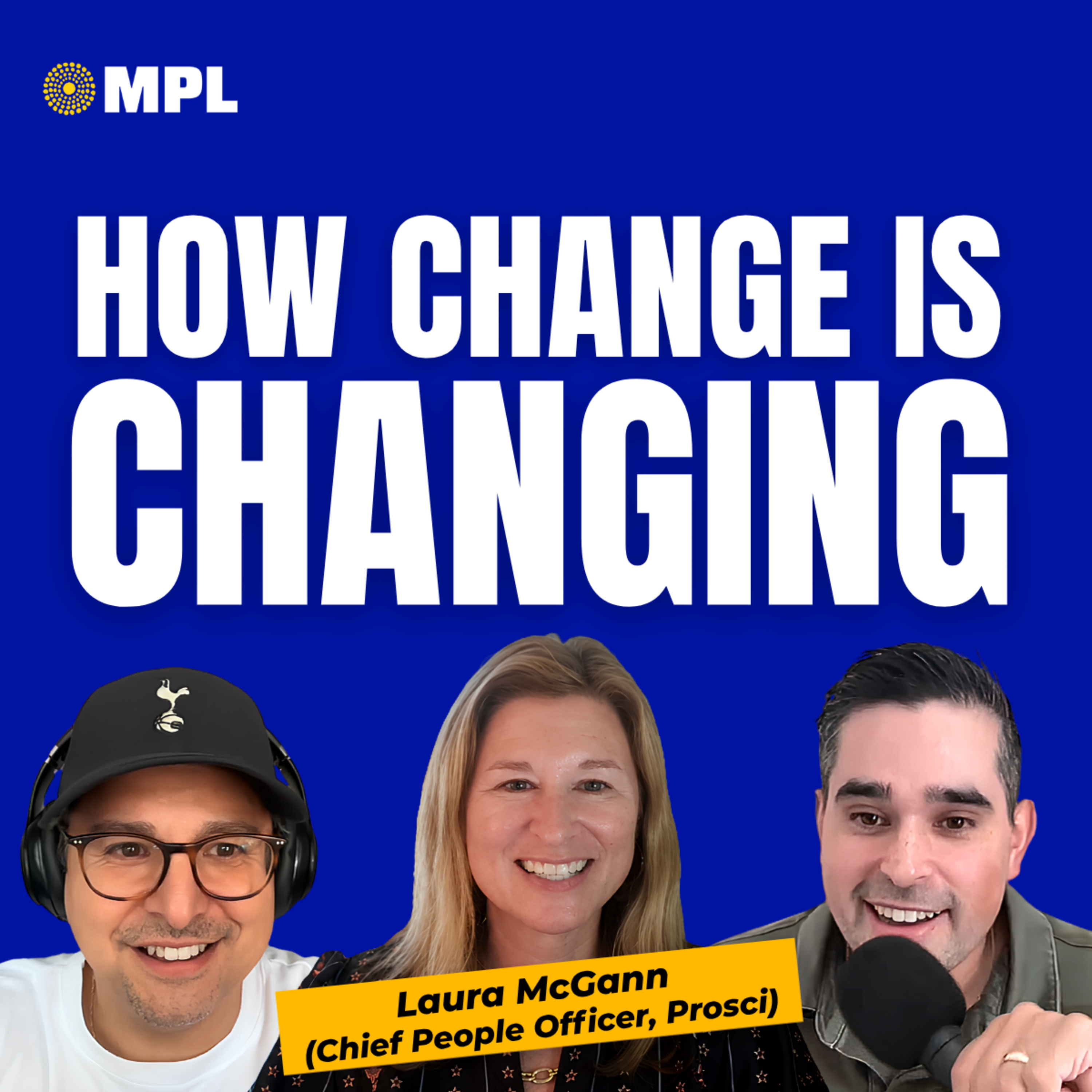
334 - The Change Episode: Laura McGann (Chief People Officer, Prosci)
In short
How leaders and employees can navigate relentless, AI-driven organizational change by defining “change success” on the people side and using a diagnostic framework (ADKAR: Awareness, Desire, Knowledge, Ability, Reinforcement) to reduce change fatigue. The episode also discusses why change is no longer linear (no end dates, constant tool updates, multiple change sources) and what “future leader skills” look like in the age of AI.
Guest
Laura McGann, Chief People Officer at Prosci. Background: change-management expert; previously led enterprise change globally in HR business partner and Center of Excellence roles at Bose and UKG; joined Prosci nearly six years ago after being a ProSci client; holds an undergraduate background in sign art/fine art and has worked across individual, team, and company change.
Key claims
People-side success is measured via proficiency, utilization, and adoption; leaders often skip Awareness/Desire and jump to training; AI integration makes change cycles perpetual and can push people backward (e.g., desire gaps).
Notable examples
integrating acquisitions while globalizing Prosci; ProSci rebranding; integrating AI into ProSci’s product suite; her own “knowledge barrier” experience with AI; using ADKAR to name barriers (e.g., awareness vs knowledge).
Written by AI. May contain mistakes.
Chapters
0:00
AGKAR Framework Overview
Learn about the AGKAR framework for managing change effectively.
“Do I have a desire to participate in the change or like have I made a decision to participate?”
1:27
Good News Stories
Hosts and guests share personal and professional good news stories.
“And we prefer for our guests to go first.”
2:18
Laura's Soccer Celebration
Laura shares the joy of her son's first varsity soccer game.
“I'll share a personal one because we had a big night in our house last night.”
2:56
Host's Home Improvements
Discussion about setting up a projector for backyard movie nights.
“So there's never, you know, actually he did get an assist the other night, but on a penalty kick.”
4:21
Parenting Moments
Hosts reflect on their parenting experiences and milestones.
“On the work front, and I haven't even shared this with Stephen because we haven't caught up recently, but making a ton of progress on MPL's first ever stab at community.”
6:50
Laura's Career Journey
Laura shares her career path and experiences leading to ProSci.
“What was your journey, the ups and downs?”
10:34
Challenges of Change Management
Discussion of the challenges faced in change management at ProSci.
“of ProSci and I'm using our tools, leading some of those large scale changes and crazy turn of events.”
12:44
Understanding ProSci's Mission
Laura explains ProSci's focus on the people side of change.
“And I am drinking our own champagne using our own tools, techniques, research every day, kind of in the work that I that I do.”
14:00
Understanding Change Management
Learn about the importance of the people side in change management for successful technology adoption.
“So we've been researching what works on the people side of change for over 30 years across tons of different types of change projects.”
14:38
Laura's First Change Management Experience
Laura shares her early experience with change management during an office move at her first job.
“We'll have to find a way that they find this.”
Show all 31 chapters
15:42
Lessons from Change Management Projects
Discussion on key factors for successful change initiatives based on past experiences.
“I was an executive assistant to the CEO.”
17:50
Defining Success in Change Management
Explore the importance of defining success metrics for people side of change management.
“Like what are share with us, like, you know, the key things that you think organizations, you know, to really excel at change management, like what do they need to do?”
20:12
The Evolving Landscape of Change
Discussion on how the challenges of change management have evolved in recent years.
“And so foundationally, it sounds like still today, like, you know, in terms of like, conceptually, the things that you should do to be successful, successful with change, like, that still holds true.”
22:44
Navigating Change Fatigue
Advice on addressing change fatigue and adapting to new realities in leadership.
“And frankly, that has a huge impact on how we navigate change.”
24:47
Understanding the ADCAR Framework
Introduction to the ADCAR framework and its role in personal change management.
“So probably two paths we could go down here.”
27:36
Identifying Barriers in Change
Insights into where individuals get stuck in the ADCAR process during change initiatives.
28:00
Understanding Change Management
Learn the importance of navigating change through awareness and desire.
“a row the last six months like I no longer have the desire like well yeah what do you what do you think it is?”
29:00
The Impact of AI on Change
Explore how AI complicates the change process and affects individual journeys.
“I know it sounds linear, but it's not, to your point.”
30:40
Upcoming Events and Networking
Discover details about live sessions at HR tech events and networking opportunities.
“We're going to take NPL Live to the Deloitte stage for two sessions.”
31:55
Rapid Changes in the AI Economy
Understand the fast-paced changes in product development within the AI sector.
“but the product is still not completely at the point at which we would consider like, okay, this is the real deal.”
34:20
Navigating Overwhelm in Leadership
Examine the challenges of feeling overwhelmed in a fast-paced business environment.
“there that I can like replenish myself and so I'm just curious like what are your thoughts on velocity like both of you.”
37:00
Future Skills for Leaders
Identify essential skills leaders need to adapt in the evolving landscape of AI and change.
“through what they said and what I should actually care about.”
40:30
Learning AI Through Experience
Discuss the importance of hands-on experience in learning AI rather than formal education.
“Hopefully I wasn't too meta on you, but something changes.”
42:00
Leadership in the Age of AI
Explore the evolving role of leaders in integrating AI into organizations.
“And I think that's leading probably bigger picture to some of these other kind of fears and, you know, recent press around maybe we need to slow things down.”
45:50
The Burden of Management
Discuss the increasing pressures on leaders and the endless workload they face.
“So lots of things in that, but I don't know if there's anything you want to pull on there.”
49:07
Recalibrating Leadership Roles
Discuss the need for leaders to recalibrate roles and responsibilities in light of AI.
“And I think it's even harder because I'm not sure managers even knew how big that suitcase was and what was being put in it.”
52:19
Embracing Change in HR
Delve into the importance of adapting to change in the HR landscape.
“Like I had all the great, the right intentions, but like, I just lost a week of my time that I'm not going to get back.”
55:19
Rapid Fire Questions
Engage with quick insights from the guest through rapid fire questions.
“I think this is the first full episode we've had fully dedicated to change or change management.”
56:01
Superpowers and Company Culture
Learn about the importance of strong convictions and company culture.
“If your team gave you a superpower nickname, what would it be?”
57:29
Spotlighting Innovative HR Leaders
Discover insights on notable HR leaders and their impacts on the field.
“You know, we've had a lot of great guests.”
58:39
Reflections and Future Conversations
Reflect on the conversation and what to expect next in HR discussions.

Ask about this episode
Get the gist, explore an idea or ask about something said.
 Claude
On The Modern People Leader: Forward-Thinking HR, what are the key points of this episode?
Searching your listeningTranscript
Automatic transcript. May contain errors.
0:00And AGKAR is an acronym for awareness. Do I know what the change is? Why we need to do it? Why now? What if we don't? Desire. Do I have a desire to participate in the change or like have I made a decision to participate? Knowledge. Do I know like how to do it? Do I know what's actually being asked of me or is that like fuzzy? Do I have the knowledge to actually engage in the change? Ability. Can I actually do it? Right. So do I have the knowledge and the can actually do it? And then reinforcement, which is, you know, does my leader, do I have the conditions around me to actually continue in that new ability?
0:40It was one of those frameworks that kind of blew my mind because it was so pragmatic and it helped me actually put like name a feeling I was having that I could not get my arms around. So on a given change, I was like, oh, right. I have a knowledge barrier. That's why I can't change right now. or I have an awareness barrier. I have no idea why you're asking me to do this and what the case is for me not doing it. You're listening to the Modern People Leader Podcast, where we go behind the scenes with today's top HR leaders and work experts. We talk to them about how they've gotten to where they're at, what they do every day, and what they see coming next for the future of work.
1:21Hope you enjoy.
1:27Laura McGann: Friday podcast, y 'all. How we doing? Well, it's Friday. We made it. So pretty good. It's my last meeting of the week. That's a good feeling. How about you, Laura? Things are good. I'm glad it's Friday. It's good to be with you all today. It's a perfect way to end a week. have a chat about you know a lot of you know trending things and we also get to hear the origin story of an amazing leader in you laura so we're super excited to get to that but before we do we have a few traditions the first tradition we have on the show is what we call good news stories and we all share a work or personal related story two if you've just got like a lot of good news going a lot of good in your life.
2:15Laura McGann: And we prefer for our guests to go first. So if you could kick us off. Sure. I'll share a personal one because we had a big night in our house last night. Actually, it wasn't in our house. It was out on the pitch. I'm on the soccer field. So I was able to watch my son start his first varsity soccer game. And I felt like it was a nice reflection of all of the time I have spent on the soccer sidelines since he was three years old. So it's a little meta moment of how old I'm getting maybe, but also a really nice celebration that he finally got a starting spot on the varsity team. So what were the highlights?
2:57Any assists? Any goals? Like what? He plays defense. Yeah, he plays defense. So there's never, you know, actually he did get an assist the other night, but on a penalty kick. But, which I don't know if that really qualifies as an assist. But yeah, he's on defense. So we look for, you know, goals avoided and penalties gained and throw-ins and, you know, things like that. It's a very different way to look at the game and see how well he did. But yeah, he crushed it. So pretty proud parent moment. Steven's way more into soccer than I am and can, like, speak to the nuances of the game. So I'm like, yeah, I don't know, like, half of what you're saying.
3:36but that's that's awesome news i can go next i'm gonna say my good news hmm so we recently moved into a new house a month ago and we have a pretty sweet backyard and we're trying to make more use of our backyard and so we ordered a projector setup which are way cheaper than i would have expected and so like we got like a little roku projector and a screen and a little stand. We're going to watch the big, well, I say big. We're going to watch the Texas football game this weekend here at the house in the backyard. And I'm already picturing movie nights in the backyard and getting a lot of use out of this projector setup.
4:19But that's my good news. That's my personal good news. On the work front, and I haven't even shared this with Stephen because we haven't caught up recently, but making a ton of progress on MPL's first ever stab at community. So over the last couple of months, I did 30 interviews with different CPOs to get feedback. And yesterday, I finally had some time and headspace to process all of that feedback, come up with the top insights and iterate on the website that we created. And so it just feels good to make some progress after like being stuck in the day-to-day stuff for the last month and not having the time.
5:03So lots of good news in my world.
5:06Laura McGann: That is a lot of good news. On my side, I will go with personal good news. So my son started crawling for the first time last week and now is already like pulling himself up and like standing and trying to walk. It's just insane and so much fun to watch, observe. And this is my third time going through it in two very different phases of my life. The first time I was much younger. I also have a varsity aspiring soccer player in my daughter, Astrid. She's 16. I have a 14-year-old. And Joaquin is eight months. And he, the other good news is like, loves his sisters like so much and they love him so much.
6:03Laura McGann: And like my favorite part of my week now is Thursday nights because I have them every Thursday and every other weekend. And seeing them like he, because I think he just object permanence or like, there's like this concept that kids don't have until they're around like eight or nine. Where they, at eight or nine months, they realize like, wow, daddy has left, but daddy still exists and daddy will come back later. Object permanence is what I think it's called. And so when he sees them now, it's like next level, like excitement and cuteness. And so I'm finding that like I'm coming into my Fridays.
6:46Laura McGann: I don't know, just like a different man these days. So that's all my good news. And so let's talk about you, Laura. I call this the Brene Brown question. Tell us your story. What's the deal? What was your journey, the ups and downs? We have a dossier, so I have had to run through your career background. So what's the scoop? How has your career led you to what you're doing today? I feel like these days, Cloud and ChatGPT can get you surprisingly far in HR work. And they're great. Until you need live people data, or you need data from performance, comps, surveys. Then suddenly you're exporting CSVs, you're explaining the company's entire history, and you're figuring out what's actually safe to share with who.
7:36And that's the gap that Shapes is closing. Shapes basically brings that AI experience directly into the HR platform. with your live people data, your org context, and your existing permissions built in. So instead of jumping between systems, people teams can build things like a flight risk dashboard, a reorg simulator, a calibration grid, or a completely custom workflow or visualization. You just describe what you need, and Shapes builds it from the people data that's already there. It's kind of like Claude and your HRAS had a baby. If you want to see what this actually looks like in practice, go book a demo of the shapes.
8:14You can find a link in the show notes. It's the most non-linear career path ever. So I always find it hard to kind of give that summary, but definitely one of those multi-passionate, you know, could have gone into a million different careers and definitely drove my parents crazy. So I carry that forward into my parenting today, for sure. The red thread though, in my career, which I hadn't figured out until I actually was doing my leadership coaching certification where they kind of walk you through your own, you know, who are you today type of thing. And I think it dawned on me as they literally made us draw out and peak moments in our career, in our life and train, like thread it all together about like who you are and who you're becoming.
9:01And what I realized when I did that is the red thread in everything I've done has actually been around helping people change and whatever hat it was that I was wearing. So I spent some time, my undergraduate degree is actually in sign art. I originally went to school for business, decided that was too boring, wanted to go into interior design to kind of create and reimagine spaces. So I love that you're both in new spaces and, creating environments was something I was really interested in. Then decided fine art actually wasn't really what I love to do and was dying to get back into business. Long story short, I love change.
9:46I love helping people change, whether it's on the individual level, team level, company level. And when I figured out that that was a career and that I could actually gain some expertise in and help people change. That once I figured out that I could actually kind of major in change as my profession, and it really didn't matter what hat I was wearing, that became my career path. So spent some time as a consultant. I'm in a consulting organization at Bose and UKG wearing HR business partner and center of excellence hats, leading large-scale enterprise change kind of globally. And then that led me to ProSci because I was actually a client of ProSci and I'm using our tools, leading some of those large scale changes and crazy turn of events.
10:43ProSci was looking for a new head of people to actually help us change, which is kind of, you know, interesting being a change manager and head of people in a change management company. And so, yes, I've been at ProSci for the last almost six years now. So Laura, for you, like when you think about change in the last, like, let's call it like years or so, what's like a big change that you've had to work through personally? If you're comfortable sharing, I know I'm putting you on the spot here, but that seems to be the common thread throughout your career. Yeah, and I'm pretty transparent about leading change within a change company.
11:20So it's great that I get to work with our clients and everything too. But my primary focus is helping our own team change and transform. So we've had three pretty big ones that we're in the middle of. One is actually we've done a lot of acquisitions of our partners over the years and we're becoming a global company. So integrating acquisitions has been incredibly challenging, even though they were colleagues of ours to some extent because they were our partners. It's very different moving from being a partner colleague into a fully integrated, you know, part of ProSci. And so working on those integrations has been really challenging and really rewarding, right?
12:04Because now we have global team members all over the world. We've also gone through a complete rebranding effort. So, you know, ProSci is a 30-year-old organization that has to change to stay relevant. And so, you know, whether it's updating our branding, updating our products, updating how we go about doing research, all of those things are things we've been doing. And then most recently, and I'm sure we'll end up talking about it at some point today, AI. We are full on integrating AI into how we do our work, into our product suite, into the types of things we help clients with. So you name it.
12:45And I am drinking our own champagne using our own tools, techniques, research every day, kind of in the work that I that I do. So it's really an interesting time to be doing change, change management. Like I can't even use that word anymore, management, because it doesn't it almost doesn't feel relevant as a word. Change has changed. It sure has. And for people that are listening to this that maybe aren't familiar with ProSci, what's the 30-second elevator pitch? How do you typically describe y 'all's work? yeah it's pretty simple every change has kind of two sides so usually there is a technical side to the change so what you're actually trying to change so it could be a merger and acquisition it could be adopting a new technology it could be moving into a new office space or even you know having a new leader of an organization so there's kind of a technical side but then there is an often forgotten side, which is the people side of the change.
13:50So pro-size expertise is really helping with the people side of the change. So building that thing, but actually getting people to use it is where our expertise is. So we've been researching what works on the people side of change for over 30 years across tons of different types of change projects. And we are focused on helping you realize success. So, you know, if it's a technology implementation, I think that's the easiest thing to kind of get your head around learning how to use a new technology. It's not about just the system. It's about how people actually use it and adopt it. That's what really, you know, gets the return on the investment or what is change success is what we say.
14:36So that's how I describe it. People side.
14:38Laura McGann: I want to kind of go back to your career journey before we get into the meat of the topic today and when would you say is like the first large change management initiative or project that you were involved in in my career like ever yeah yeah yeah like your first big wow okay so the biggest one i was ever involved in okay at in my first job out of undergrad So I'm rocking a fine art degree in a internet startup at, I hope somebody from Breakaway Solutions is listening to this podcast. We'll have to find a way that they find this. They're not in business anymore, but I've got colleagues from Breakaway.
15:32Yeah, so we were doing an office move and hugely successful where we're growing out of our tiny little internet startup space. and we were moving into our first real, you know, professional office building. And I was put in charge of the move. I was an executive assistant to the CEO. And yeah, I actually, now that you asked that question, I think that's where I first kind of cut my teeth on how to create successful change. And it was a very physical one, right? So moving office spaces, and this is, you know, pre-COVID. So office space was a thing and was really important to everyone, right? And it was We build out of designing, selecting the office, building it out, moving people in, and then kind of getting people to operate in our new environment.
16:21So, yeah, thanks for bringing that memory back.
16:24Laura McGann: Yeah, no, I mean, I was curious, the first big project or kind of transformation thing that I was involved in, I worked at Ernst & Young, fresh out of undergrad. and the firm was a matrix organization. They wanted to shift from one like org structure that was super confusing to another org structure that was equally confusing. And I just remember like none of us really understood it or got it. And I remember like different tiers, which had like a very finite beginning and in, you know, I remember there not being like a clear idea of like when, how do we know when this is going to be done? And for me, when I look back to kind of those days and being a part of like change that is bigger, like I, what kind of hits for me is like really understanding what we're trying to accomplish.
17:33Laura McGann: Like, what are the goals of this initiative? And like painting a picture of like what the outcome will be. And because that's what I didn't have. So I just remember like over the years being like, okay, you know, now I've seen a few of these that are working great. And as like someone who is an expert in this and like does this day in day out, Like what are share with us, like, you know, the key things that you think organizations, you know, to really excel at change management, like what do they need to do? I think you just named it, actually. So getting really clear on what success looks like is probably the most important part.
18:16And I think on the technical side, it's really easy to get your arms around that. Right. And so that's typically, you know, some sort of financial metric. or some sort of, you know, on time, on budget, here's what it looks like. I think people are very good at defining technical success tricks. What's really hard is defining the people side metrics. And so that's often where we start, which is, okay, what does it actually really mean for this change to be successful? And so on the people side, that usually shows up in words like proficiency, utilization, and adoption. Those are kind of three of our big buzzwords.
19:00So and they don't mean to be buzzwords because they're real things, right? So when you look at utilization, is somebody actually using the solution? So if it's a new org design or a new office space or a new technology, utilization is going to look different in each one of those changes, but it's a real thing you can actually measure. Adoption, same type of thing. That's that utilization and proficiency, right? So is somebody actually using it in the way that it's intended and they're good at using it? So we can kind of explore each one of those things, but defining success is honestly what most people don't do.
19:41So how do you know if you're successful? And so when you get through a change, you're like, did that change work? You know, you're looking around, did that stick? Why is everybody going back to, you know, the old org structure, or they actually haven't changed their behaviors, or the technology actually never got adopted? We can usually look back at those type of people side metrics and say, oh, it's because we had no idea, you know, what actual ability looked like. So start with the end in mind, right? I love that.
20:14Laura McGann: And so foundationally, it sounds like still today, like, you know, in terms of like, conceptually, the things that you should do to be successful, successful with change, like, that still holds true. But yet so much is different today, then, you know, going back to 2000, to that project that I that I'm talking about, that I was that I referenced earlier. And so from, you know, the impact that COVID had, I think, on the workplace, on our minds and our psychologically, you know, to like everything else that's happening today, polarization of topics, seemingly, you know, benign topics are now like, you know, just really hard.
20:58Laura McGann: And it feels like there are a lot of challenges that didn't used to exist that now currently exist. And so, like, if we let's start there, like what what to you do you feel is like the big challenge, you know, today? And, you know, looking at today's environment that we just didn't, you know, five, 10 years ago, wasn't even in the forefront of our minds. I think you definitely frame that up, right? I mean, 10 years ago, we could kind of get our arms around a change and maybe there was one or two going on at a time. I think now, current state, future state, go live, done, that doesn't exist, right?
21:40That trying to get your arms around a change and having one or two, that page doesn't exist and having one or two doesn't exist. So we've got things like there are no end dates to change. The tool people learned in March is not the tool in September, right? It updates underneath them. So if you're using any sort of tech tool, you're getting updates probably weekly and you're learning in real time. I think some of the other things, you know, there's not like a single owner of a change. Change is not top down anymore, right? Now it arrives from you. It arrives from a vendor. It can arrive from top down still too, but it could also arrive from a customer or a team that just figured out, you know, a better way to work.
22:23So change is coming at you from lots of different places. And I think you mentioned this, right? There's no recovery gap. So it's feeling relentless. It's probably feeling overwhelming, exhausting. We used to let people kind of absorb a change before starting the next. And that reality feels over. So change fatigue is very real. And frankly, that has a huge impact on how we navigate change. And so I don't even say change management anymore. I used to watch other people roll their eyes when I would say it. And now I can't even say it because that doesn't feel like the right term at all. So we're navigating ongoing.
23:04It's just like management now because things are changing constantly. Yeah. Yeah. And leader led change, right? That like true leader led change. You know what's impacting your team, how you lead through that. I mean, there's a very different reality hitting folks. Not just in organizations, but just as we walk through the world as humans right now. And how do we pay attention to what changes are most important in all of our lives right now? You mentioned there no longer being a recovery gap. And because of that, there's this change fatigue. And I can feel it. I feel it myself. What worked six months ago doesn't work today.
23:46And what works today probably won't work in six months. And it's not that it doesn't work. It's just that there's going to be a better and faster and more slick way of doing it. Like that's always been the case. But usually there's like a two or three year gap between those improvements. Now it's like every month or like every day. Like I swear, like I never even know which LLM has the best model. Like every week there's somebody new and it's like, I can't even keep up. And so when it comes to change fatigue, what advice would you give people leaders? Like, how can they, what do you do about it?
24:21Like, how do you help your people understand that change fatigue is even a thing? And then what can you do about it? Or is this just like our new reality that we have to adapt to? Probably two things. I do think it's our new reality. And I think there are some very specific things we can do. So that's the good news. You know, we don't have to go into feeling like just giving up. I think we can learn some new behaviors and we might actually have to unlearn how we used to go at things. So probably two paths we could go down here. I think personally, there are some things that every individual can do.
24:59And that is to have a way to name kind of what's going on for you. so I don't know if this may be an interesting time we can talk about framework I learned this framework from ProSci years before I worked at ProSci called Agcar and Agcar A-D-K-A-R is an acronym for awareness do I know what the change is why we need to do it why now what if we don't desire do I have a desire to participate in the change or like have I made a decision to participate? Knowledge. Do I know like how to do it? Like, do I know what's actually being asked of me? Or is that like fuzzy? Do I have the knowledge to actually engage in the change?
25:47Ability. Can I actually do it? Right. So do I have the knowledge and the can actually do it? And then reinforcement, which is, you know, does my leader, do I have the conditions around me to actually continue you in that new ability, which is really where success comes from. So the reason I bring up AgCard is because all of us individually have to go through an AgCard journey. And I remember when I learned this in the classroom, it was one of those frameworks that kind of blew my mind because it was so pragmatic and it helped me actually put something like name, a feeling I was having that I could not get my arms around.
26:27So on a given change, I was like, oh, right. I have a knowledge barrier. That's why I can't change right now. Or I have an awareness barrier. I have no idea why you're asking me to do this and what the, you know, what the case is for me not doing it. Right. So if you can name just even on a personal level, using a framework like ADCAR or whatever other framework you want to use to get really squishy things like change and overwhelm into a language that makes it really pragmatic and real. And actually, you know, I know how to close out an awareness gap. I'm going to go get some information. A desire gap is kind of hard, right?
27:08Like, wow, I just don't want to do this. But at least I can go have a conversation with someone and talk about, you know, what's the with them? What's in this for me? And along each, you know, of those areas in the AdCar model, you can name, you know, where you're stuck and what you need. So I think at least for me has been something that can kind of help anyone going through change. You know, name it to tame it. If you've heard that saying before, it can help anyone kind of get out of that place of overwhelm. And across your client base, do you find that it's like one piece of like the ad car like loop that people are getting stuck in or is it that they have to go through an ad car cycle like every couple of months and then by like cycle three people are stuck at desire and they're like screw this like I've just had to to reskill myself three times in a row the last six months like I no longer have the desire like well yeah what do you what do you think it is?
28:12Like where are people getting stuck right now? It's interesting. People get stuck at every single place. So it has a lot to do with like, who are they and what their impact of the changes on them. And so really is it more of like a diagnostic. I think what's interesting is in any given change, I think leaders sometimes because they know about the change, they kind of move through awareness and desire really quickly, especially if it's a top-down driven change. And so they think everybody, because they've spent more time with the change, right, can like awareness, desire. Yep, yep. Let's just get to knowledge.
28:47And so they make a decision and then they, you know, go train folks and kind of forgot that we need to bring people through awareness and desire and then and only then kind of move into training. so we definitely find a lot of organizations and you know now as I sit in the leadership seat I see it in a little bit of a different way too because I'm like oh yeah I'm already ready to like knowledge and ability let's go and that was always something that I saw as a recipient of change that like leaders like slow down to speed up right we need to slow down make sure everyone's through awareness and desire before we move into you know expecting results but I also think with AI so I think this is one of the interesting parts about AI.
29:32It's not linear. Agcar is not linear. I know it sounds linear, but it's not, to your point. Whatever new LLM update is coming up, right, we are learning. We're almost in a perpetual knowledge to ability cycle. And yeah, you can go back to desire, especially if you get exhausted or you're not getting what you want, especially out of AI integration. So just being able to have that language to diagnose and kind of figure out where am I and what do I need to be successful in this change? I think is honestly, it sounds super simple, but it truly is something that pragmatic and something that, yeah, all individuals need to just be aware of where they are in their journey to help us all move through the change together.
30:19Right. So for all individuals on our individual journey, and then you look at that like a team and organizational level, you can see why change is so hard. Right? Say something obvious there, but it is because we're all on individual journeys around every change. All right. So HR tech is coming up fast. If you're planning on being there, please come hang out with us. We're going to take NPL Live to the Deloitte stage for two sessions. So on the Wednesday at 1.15, we're going to sit down with the director of TA Ops at Ford, and we're going to dig into their talent acquisition transformation. So how the tech has evolved, where agentic AI fits, and what that could mean for the way that recruiting gets done.
31:01And then on Thursday at 1045, we're talking to the SVP of HR Tech at AT &T. And with them, we're going to unpack AT &T's learning and skills rebuild that's happened over the last couple of years. So two very big sessions. And if you're going to be in Vegas, please come join us. And if you want to meet up with us individually, just shoot us a DM on LinkedIn. We would love to connect.
31:25Laura McGann: And I think to complicate it, so I recently, I worked with Daniel in the podcast business, the modern people leader, like the business that, you know, has grown substantially over the years and have now moved over to being a head of revenue for a music software company. and that is in really like pre-product launch. We're in like, we have a public beta that's live. So like anyone can get to us, but the product is still not completely at the point at which we would consider like, okay, this is the real deal. And the pay, so we're, you know, we were founded in earlier this year, call it February, was when the first initial MVP launched.
32:18Laura McGann: So we are built for and in the AI economy. And the velocity at which this company can move is absolutely insane to me. And product-wise, we have a head of engineering that is a bot, And we have a, the engineering channel is just like constant. It's like new releases, new, like it's constantly alerts and like failures and read and like, but it is 24 seven. We launched our product, we opened the beta up to public on Labor Day. And like on Labor Day, we had users in the tens, in the dozens. And now we're in the thousands. And it is just crazy to me. Like that was literally a week and a half ago. What you do at 50 is very different to what you do at a thousand.
33:17Laura McGann: And, you know, once you get to a thousand in my head, I have line of sight to 10 ,000. And to think that like in just like a matter of weeks, like that we move so fast, like part of, you know, my brain rewiring is like, am I, I'm an old head as we jokingly call me Daniel and I. and I just remember the days at which like one of these little things would have been a quarter it would have been the roadmap for a quarter or like first half a year second half a year and now these things are just happening in weeks and so just I think the velocity for me I don't know how y 'all feel about this is like is is a big part of why the change feels so uncomfortable comfortable and so fatiguing as we were just mentioning and why I think at car like I am definitely going to go deep on it because the the more I understand it and the faster I can cycle through kind of like where I'm at like the better like I don't know and and whatever else is out there that I can like replenish myself and so I'm just curious like what are your thoughts on velocity like both of you.
34:33So interesting too, when you're putting things out there and you're getting that feedback much more immediate too. I think that is like, wow, okay, I need to do something with that feedback and all of those things, especially in like a customer adoption journey too. I think Edcar works really well with customer adoption because you're trying to figure out how to get your customers to ability. And so, yeah, they might have, especially in the tech space. You've got, you know, that technical knowledge, how much training do they need versus actually we're all getting pretty savvy, right, around some of this tech stuff.
35:05So we actually maybe don't need as much training and it's much more about, you know, ability and reinforcement. So it's an interesting kind of lens when you're looking at just, you know, tech adoption versus some of these other changes that aren't on the same pace and they might be more complex and they need more humans versus agents. So there's some some cool stuff we could dive into there. The transparency. Now I'm kind of curious from your seat. One of the other things that I've seen be really powerful, especially when you have so many things moving at the same time, is like, what does that portfolio look like?
35:43So the degree to which leaders running a business, whatever the size of your your portfolio is, how much transparency do you have around all of those changes in flight and then the feedback that you're getting on all of those changes. That feels like a very different dashboard that we need as leaders to understand, right? Because we're all going to start moving much faster. So how do we create that transparency? How are we able to spot, you know, where some of those portfolio problems are going to be on all of these types of changes, be it, you know, product tech changes, people changes, org changes, you know, could have that whole portfolio, every change is going to have a little bit of a different context to it.
36:30My reaction to what you said, Stephen, is more like on a daily basis, I feel like I at a certain point, I have like this feeling of overwhelm. And I think it's because, like you said, it's the velocity on multiple fronts. It's the way that in a month and a half, I was able to set up 30 interviews with 30 CPOs that have busy schedules and now have technology that can help me work through what they said and what I should actually care about. And then I also have other technology that allows me to go in and make those changes. Whereas before, if you wanted to build a product, you would go through a round of interviews.
37:16You would then maybe put together a deck and you'd probably need help creating that deck from some sort of like designer or agency. You'd go through a few rounds of feedback with them. And then you'd finally have something to put in front of these people that you're doing product development interviews with. And then you'd have to go back to them and say like, hey, here's all the feedback. Can you help us process it? Then you'd agree on which of those items are the most important. and then you would put together the iterated version and then you'd go through that again. And before you know it, you're six months down the road and you haven't really made that much progress where all of that can happen in a matter of weeks today.
37:54Plus, as a business, every few months, you're needing to try new technology. And so you just have way more bandwidth. But my reaction is like, I feel like it's taken not a mental toll. It's like, yeah, I don't know. Maybe it's that change fatigue that you're talking about, Laura. And I don't know what the answer is because like I enjoy this stuff and I like I want to do cool things as a business. But yeah, sometimes like there is like that overwhelm. Yeah. And I don't think we should be afraid to say the word overwhelm. I think that's one of the new challenges that's coming up in leadership is, you know, leadership, I think we used to be able to just show up like we had all the answers.
38:44We had the plan. We were in control. And I think especially now with the pace of AI and what we see is the possibility, we don't have all the answers. None of us have ever been in this dynamic before. And that can feel, I think, vulnerable for leaders too to say, I actually don't know. I am a little are overwhelmed. I'm not sure what, you know, this looks like in six months. And so there are some new leadership skills that I do. And they're not new leadership skills. I think they're more of the focus we need to have on some of the softer leadership skills, which is really understanding who we need to be collaborating with to figure out like, what is that next right step, right?
39:35Getting the right people in the room around the right conversation feels like a really important leadership skill right now. And then really being able to listen to each other and the different perspectives that we all have on all of the changes, but then also all of the opportunities in front of us, right? We've got new threats, new opportunities, and it is probably, you know, we're kidding ourselves if we all think we have all the answers in and of ourselves. And Now we have our new AI friends who probably know way more than we do. And so how do we invite them into the conversation and really make some of those human judgments that maybe used to be a little more siloed?
40:12I think we're entering a whole new age of leadership and leadership skill sets that can help us figure out, you know, how to not get fatigued, how to not give up, and really how to bring our human organizations, augmented now, but human organizations through to, you know, what's going to be possible. possible in the years to come.
40:32Laura McGann: Hopefully I wasn't too meta on you, but something changes. No, I actually want to dig into some of that. And so you mentioned there near the end that like the future leader skillset, like what is that? Like I over, I had a conversation with a friend who's, you know, pretty senior at their, at the company. And we're talking like large enterprise company, global enterprise company. All of the C-suite were sent to MIT. All the top leaders of this company were sent to MIT to learn AI. And I'm paraphrasing here for sensationalism, but not too much here. They legitimately sent their top leaders to learn how they should be using AI.
41:27Laura McGann: And Laura, I thought to myself, oh man, this company is cooked. Like that is just not how people that I am exposed to are learning AI. Like that's just not how it's working. There's no classroom to learn this stuff. Like the people that are like, in my opinion, the furthest ahead pushing this thing forward are the ones that are just doing it. They're just using it. They're not hesitating. They're not worried. They're probably fatigued, but like they know they're on to something. And it's just like, how far can I push? And I think that's leading probably bigger picture to some of these other kind of fears and, you know, recent press around maybe we need to slow things down.
42:14But I'm just curious.
42:17Laura McGann: And I when I interact with some of these people that are like pushing the envelope, like if I were to there a variety of different ages and a variety of different skill sets and technical expertise. And so I don't feel like it's as easy to even identify the leader. Like you used to just like, we're the gray hairs, right? Those are, they've got to be the leaders of this company. And I don't, I, I do not look at it that way anymore, just in the bubble that I'm working in. And so I'm just curious, like, what are the skill sets that you think are absolutely vital right now for leaders to focus on?
42:59There's like three different paths I want to go down here. So do it all. Let's do it all. Because it's really important, especially as we're looking at like what is going to move us forward. So one of the things you pointed out was the knowledge to ability cycle. Some folks who are more technically adept, and I will say I was not in that camp. I mean, I can make my way around an Excel file fine. But when it came to like AI, I knew I had a knowledge barrier. I needed to go to training. I needed to go and I needed somebody right or you know classes to kind of walk me through and I spent a lot of time in knowledge so that I could get hands-on keyboards to ability other folks who are much more technical they're like I don't need training why are you making me sit through training like I just want to get in there and play so a little bit of like okay you know figuring out and then there are folks who have absolutely no desire to even go to a training on AI and that's a totally different, you know, thing and place that those folks need to start because they actually, you know, think AI is not anything that they want in their sphere of, you know, daily use.
44:10So I'm not completely like, okay, training is not the answer because for some people it absolutely is the answer. That being said, what's interesting about what you said is what is that leadership role in AI integration? And I think that is a whole different lens on AI integration right now. So leaders to be in integrity of integrating AI right into their enterprise, they do need hands on keyboards, right? I think that is where a lot of organizations have the cheerleader leader saying AI and ROI from AI and let's, you know, cut costs or innovate, whatever that leadership mandate is, without actually having hands on keyboards and understanding, right, the capability or lack thereof in certain AI and how we're using it and how you actually have to integrate it into your organization.
45:04Like that is one of the biggest leadership gaps. So we know leaders are important to realizing, you know, ROI from from from AI. And that is incredibly important. But like how they come at it is, yeah, it's a little bit of hands on keyboards themselves figuring out how to make AI work for them as a leader. And I've been on my own journey here. I'm sure you both have as well. And sitting with other executives where it's like, it sounds good, but have they actually done it? Right. And that's a very different conversation. And honestly, it's really vulnerable because if they don't know how it works, they've never done it, they don't have their own agents running, then it's very hard to set expectations with your organization and to figure out what ROI even looks like.
45:51So lots of things in that, but I don't know if there's anything you want to pull on there. So I think this is, you know, leading through AI, leading in the age of AI, trying to figure out how to transform, you know, work environment. Like, yeah, we need training, but we also need ability. And then we're probably going to go back to figuring out if this is really what we thought it was and what's going to make sense for our strategy. I mean, AI is not the strategy. AI is an enabler of your business strategy, right? And so if that's the case, you need to get really clear on what your strategy is.
46:22And then we're going to kind of come back and figure out, OK, how does AI help us get there? I don't think it's ever been more difficult to be a leader, whether you're C-level or a manager. I feel like both of those roles are very difficult today. I think that the pressure that individual contributors feel every day, knowing that more is expected of them, is probably amplified by 10, 15, 100 for the manager or for the leader. and I was like trying to think of a good analogy for this it's like we've gone from like it's like if you think of like work like the body of work that you have to do in your role you can picture a suitcase like back in the day you know you would just pack your suitcase and you would fit what you could fit and then somebody was like you know what let's create packing cubes we'll get really creative with how we can fit as much stuff into the suitcase as we can and then somebody was like you know what let's add vacuum sealers into these suitcases that way we can put four times the amount of stuff into this this suitcase like i don't know what's next like putting like a black hole in a suitcase so that you can literally like stuff everything in your life that you need into the suitcase that's what it feels like the manager role is turning into like you just have more and more and more and more and more added to your plate every week like it's it's endless like There's literally never ending work to be done.
47:58What can we do for leaders and managers that are experiencing this? And I feel like the common thread throughout this conversation is just like the fatigue.
48:05Laura McGann: But what advice do you have for the people leaders out there listening? For so long, HR teams have had two choices when it comes to leave. One, manage leave internally with spreadsheets, email and disconnected systems. Or two, just completely outsource it. Tilt is now introducing a third option. Their new in-house leave management tech gives organizations the tools they need to run leave internally while simplifying admin for HR managers and employees. So you can do things like centralize leave administration in one platform, configure workflows and policies to match your org, give employees and managers clear visibility throughout the leave journey, and replace manual coordination.
48:48And if you still need extra help, organizations can also add access to Tilt's leave experts for guidance and ongoing support. If this sounds like something your company needs, you can learn more at hellotilt.com slash MPL. That's hellotilt.com slash MPL. By the way, that is the perfect metaphor and I am going to absolutely be using that for the rest of my life. Yeah. And I think it's even harder because I'm not sure managers even knew how big that suitcase was and what was being put in it. So I don't even know what's in the packing cubes because how you've worked and how you've already integrated AI.
49:29So I think we've got to do some discovery together to really identify, you know, what is, and I think even before AI, I think we were losing just because so much was changing in our organizations. I think we were, managers were already losing a sense of really what was on people's plates. And so AI is compounding that even more so. And so we're not even sure what's in the suitcase. And having those conversations, I think a lot of managers are like, I don't want to micromanage, but like, I have no clue what you're doing. Or I really don't know if you're at capacity or not. And for a manager, that's probably really hard to articulate that.
50:10And it's probably hard for a team member to say, yeah, actually, I have capacity or no, I'm completely overwhelmed because all of that conversations feels pretty vulnerable. So I think the biggest thing that we can do right now is admit that we are a moment where we actually need to recalibrate and reset. So we have all got to kind of open up the suitcase, unpack everything that we have completely compressed in those packing cubes, and really take a look at, okay, we've got this opportunity with AI, right? So what can AI do for us? What do we need to do with AI? And then what needs to be uniquely human?
50:48after you do that inventory, you're probably going to have another capacity discussion because ideally, right, we've taken a lot of those non-value add activities off our play. We've outsourced those to agents and AI. We've really figured out what that high value human activity is. And what if that doesn't, you know, add up to a full full-time headcount, you know, in the way that we talk about it in companies? Well, then we have a real big opportunity to say, okay, is there additional value creation, right, that we can do with that capacity, which, you know, is that suitcase? How many suitcases do we need?
51:23Did we have two? Now we need one. I think that's a real conversation and that's a scary conversation, but that's a conversation we need to have. So I think that that is my biggest piece of advice is to get really real, to get really pragmatic and to talk about what is actually happening to all of our jobs in the context of all the changes that we have happening. What I've seen, the organizations that do this actually figure out that there is so many opportunities to add additional value, human value, and that there is plenty of value creation opportunities that we all have to do. So this is not gonna all be about getting rid of suitcases.
51:59This is truly gonna be about how we can innovate differently, how we can collaborate, how we can actually, you know, bring a lot more joy back to the work that we do every day and maybe have much more connection, right, with each other doing really valuable work. So hopefully that was a good kind of takeaway, but I think it's really pragmatic and just kind of real that like we just need to get clear on what we've got in most cases. I think that a leader skill, like that's very kind of a human check or a human needed skill
52:36Laura McGann: is like what what to not do because they're in this proliferation of tech and ai and bots and agents that can like streamline literally anything like it's really hard to avoid traps of like going down these paths with good intentions like oh you know that like whatever compassion empathy like bot that I built to review all my personal content that is going to my org brain. Like I had all the great, the right intentions, but like, I just lost a week of my time that I'm not going to get back. And like, did that create any commercial value? Like, and so I think that for me, like the, especially in my role right now, it's like, yeah, there are a lot of cool things that could be done, but like I need a prospect.
53:32Laura McGann: I'm a salesperson and I know how to drive pipeline. And, you know, the best way of driving pipeline is human centered and it's like prospecting. So today I need to get my 50 touches done and then look at like, what else, like with the very little bit of extra time, I like, where can I use that to? And so, so again, like a long way of saying, you know, what I started with is like knowing what not to do. And I'm just curious, like, what are your thoughts on that? Cause this is probably the last, the last one before we're going to have to bring it, bring the conversation to a close. So yeah. What are your thoughts on like how, how we can all be better at not falling into that trap?
54:15Yeah. All of us need to be saying, yeah, what, what got us here won't get us there. Just common phrase. But I think that is where you're like, okay, what do we need to stop doing? Because we don't have to do it anymore. Right. I think using technology is like definitely frees us up. I love coming to work now because I don't have to do some of those things that I used to do. But then prioritization has a new, I guess, top place on my list is how do you really understand what your priorities are? and I think that's hard because what your priorities are might not always be you know where you find joy in some of your work so I resonate you need to get really clear on you know high value activities what you need to stop doing and really focus on okay how can you do those high value things in the best way especially now with AI so yeah a lot of self-reflection it sounds like all of us need to be doing right so getting clear on how we really impact the work and how we can leverage AI or others to figure out the right path.
55:17I think we're going to call this episode the change episode. I think this is the first full episode we've had fully dedicated to change or change management. I know we're not calling it change management anymore, but this has been great. And so unfortunately, we are out of time and we've got to move to rapid fire questions. We ask the same set of questions to every guest at the very end of the show. So question one, what's one piece of advice that you'd give to somebody in HR who's just starting their career? Learn the business before you try and change it. So there's a lot of things, you know, especially in HR, we see lots of things, but I think fastest way to lose credibility is bringing a solution to a problem you don't really understand.
55:58So learn the business.
55:59Laura McGann: Good one. Classic. If your team gave you a superpower nickname, what would it be? I really wanted to pull my team before I came on here because I know they're going to listen. So I think it would be something about conviction. So I always tell them, you know, I have really strong opinions, but very loosely held. And so my superpower is coming out with a really strong conviction and a really big idea. But I always encourage them to push back on me because it might be a really bad idea. Now we just need to think of a clever name for that. I don't know what the name is. Yeah, that's a good response.
56:39What's a strategy or practice from another company that you'd love to steal? Yeah, I have always admired the companies that have a real collegial aspect to them. So when I worked at UKG, it was like Kronos and Ultimate Software coming together. and Ultimate Software had this like incredible practice around gathering and they called each other ulti peeps and it was just like such this like tribe. ProSci, we've got our tribe too called the ProSciety but like there's, so I kind of like try to steal, I am actively stealing from companies that have really, really strong company internal cultures and trying to make them as ProSci as I can because I just admire them so much.
57:27Laura McGann: I love that. Last question, rapid fire. You know, we've had a lot of great guests. And one of the big reasons of this question, who should we have on the show next? Like if there's someone that you feel like deserves a spotlight, they're doing innovative things in HR, like who are they? Yeah, gosh, I like really struggle to just have one name from an HR leader. I've been shaped by so, so many. I think there's this really interesting thing going on around like what goes around comes around. And so I actually went back to one of my mentors at Bose, who was Rick Martino, and he's doing a lot of like advisory work now because he's, you know, a senior HR leader.
58:08But it's really interesting for all of us, I think, to be in the soup of all of the changes and like what's changing in HR with some really great perspective from HR leaders who have this like breadth and depth of experience who've like seen it all. And Rick was one of my mentors at Bose, and I've been thinking about him a lot recently so I thought he would be a great name to uh to bring up well we'll definitely have to reach out all right last tradition on the show is called one word or phrase close we all respond with a word or a few yeah whatever is coming to mind for you as we as we finish this episode we prefer for our guests to go first so I think it's something about right next step doesn't have to be perfect but just whatever that right next step is i'll say ad car
59:03Laura McGann: no it's changed uh since we did and we rarely stick to stick to a single topic daniel and i are great at like telling you we're going to talk about something and then like just going off and talking about something different and so i thought that was uh an awesome conversation laura it's a privilege to have you on the show and have you a part of NPL fam and hopefully you'll come back sometime and and chat with us again I'd love to be for fun y 'all great things I love that we went off the rails and uh excited to get into the suitcase metaphor for the next uh month at least that one's gonna last I love it all right bye guys thanks for tuning in to another episode of the modern people leader.
59:48We really, really appreciate it. And if you enjoyed the show, please leave us a five-star rating. It would mean the world to us. And connect with us on LinkedIn. We want to know what you think about the show. And you can find links to both of our profiles in the show notes. Thanks again for listening and see you on the next episode.
From the publisher
Laura McGann joined us on The Modern People Leader. We talked about why change management no longer feels like the right term, how the ADKAR framework helps people name where they are stuck, and what leaders need to do as AI, velocity, overwhelm, and constant change reshape work.
----
Sponsor Links:
🔗 Learn more about Tilt at hellotilt.com/mpl
🔗 Explore the 2026 Deloitte Human Capital Trends Report
MPL Links:
----
(12:25) Why “Change Management” No Longer Feels Like the Right Term
(17:35) Why Defining Success Is the Most Important Part of Change
(18:20) People-Side Metrics: Utilization, Adoption and Proficiency
(21:10) Why Change No Longer Has Clear End Dates
(22:20) No Recovery Gap and the Rise of Change Fatigue
(25:10) Naming What Is Happening Through ADKAR
(25:35) ADKAR: Awareness, Desire, Knowledge, Ability and Reinforcement
(26:40) Using ADKAR to Name Where You Are Stuck
(29:00) Why Leaders Often Skip Awareness and Desire
(29:45) AI and the Perpetual Knowledge-to-Ability Cycle
(33:30) Why the Pace of Change Feels So Uncomfortable
(35:10) Why Leaders Need a Portfolio View of Change
(38:10) Why Leaders Should Not Be Afraid to Say “Overwhelmed”
(41:00) What Future Leaders Need to Learn About AI
(45:45) Why Leaders Need Hands on Keyboards
(46:30) AI as an Enabler of Business Strategy, Not the Strategy
(47:15) Daniel’s Suitcase Metaphor for Manager Overload
(50:00) Deciding What AI Can Do and What Must Stay Human
(52:00) Stephen on Knowing What Not to Do
(56:00) Career Advice: Learn the Business Before You Try to Change It
----
📬 Subscribe to our weekly newsletter to get episode recaps
💡 Follow The Modern People Leader on LinkedIn
😊 Follow Daniel Huerta on LinkedIn
😊 Follow Stephen Huerta on LinkedIn
----
Past guests on MPL include Brené Brown, Annie Dean (VP of Team Anywhere, Atlassian), Josh Bersin, Katie Burke (Chief People Officer, Harvey), Liz Fosslien, Helen Russell (Chief People Officer, HubSpot), Dave Scott (Chief People Officer, ADT), Melanie Rossenwasser (Chief People Officer, Dropbox), Crystal Boysen (Chief People Officer, Sprout Social), and many more.
More from The Modern People Leader: Forward-Thinking HR
All episodes
We use cookies.They keep VO running smoothly and help us improve it. Privacy policy