
 Ask ChatGPT


- Podcasts
- The Modern People Leader: Forward-Thinking HR
- 335 - Why This CEO Says High Output Management No Longer Works in the AI Era
The Modern People Leader: Forward-Thinking HR2 Oct 2026 · 51m · 23 chapters
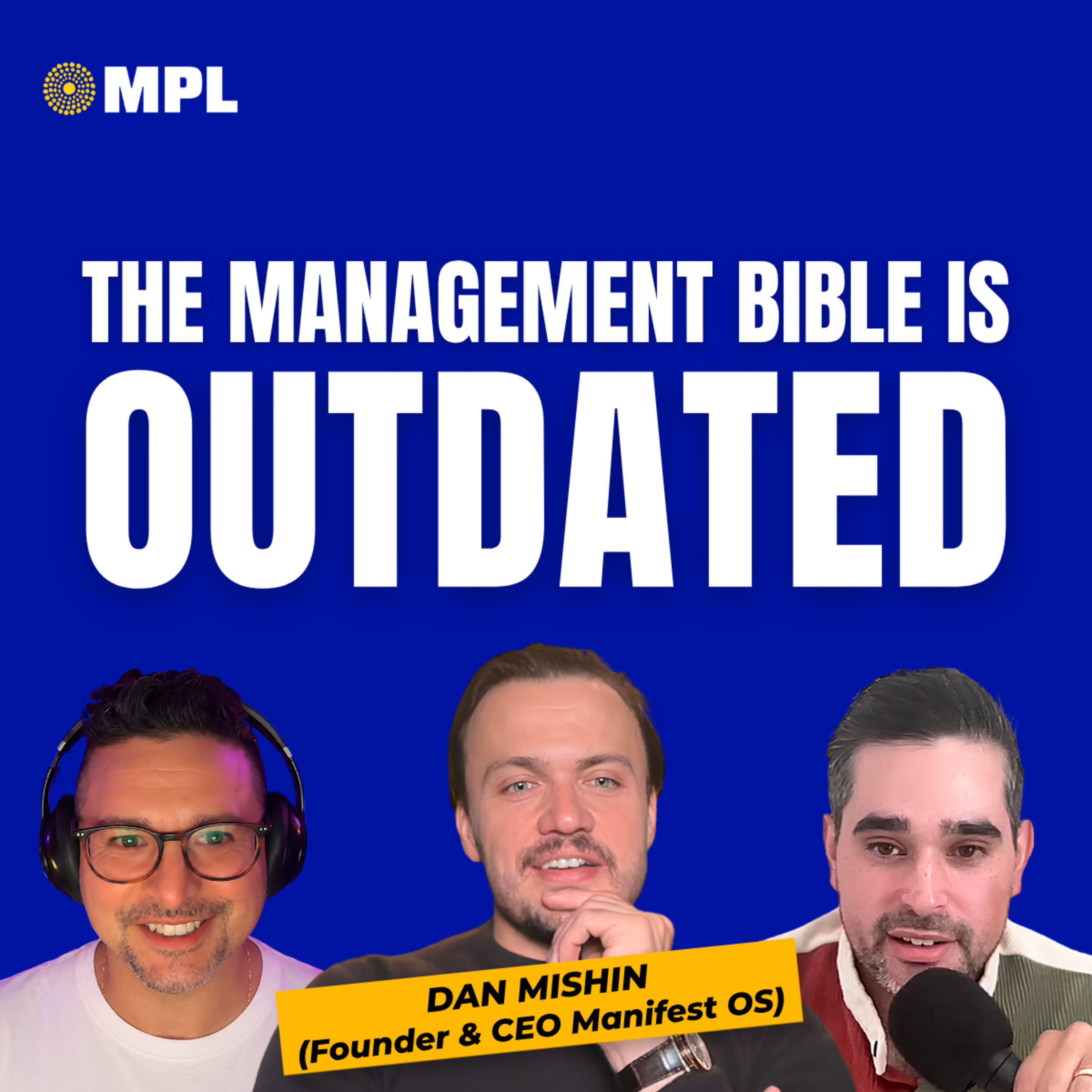
335 - Why This CEO Says High Output Management No Longer Works in the AI Era
In short
Episode topic: The CEO argues that classic management frameworks like Andy Grove’s High Output Management don’t fit the AI era. With faster velocity and more autonomy, teams shift from “pods” to one-to-one pairings (e.g., one AI engineer plus one lawyer) with AI agents coordinating to prevent duplicated work. He also claims AI enables more transparent, outcomes-based pricing in legal services (especially immigration), replacing billable-hour incentives.
Guest backgrounds
Dan (CEO of Manifest Law) is a serial founder. He built a hostel business in Ukraine into a large Eastern Europe operation, then founded a company for international renters in the US, and later created Manifest after experiencing broken immigration processes personally and while sponsoring employees. He also runs/learns engineering as a non-technical founder.
Key claims
AI changes management; lawyers remain human-in-the-loop for high-stakes decisions; AI should streamline repetitive legal work; immigration strategy becomes a talent acquisition/retention lever; companies must “blow it up” and restart when tech shifts.
Notable examples
one-to-one AI engineer/lawyer autonomy; AI backend to increase lawyer productivity; “one year severance guarantee” for roles automated; fixed-scope transparent pricing vs “nickel-and-diamond” add-ons; AI agent management via dedicated virtual computers (Muse).
Written by AI. May contain mistakes.
Chapters
0:00
The Relevance of High Output Management in AI
Discussion on the irrelevance of the High Output Management principles in the AI era.
“I just reread The High Output Management by Andy Grove, which to me is the bible of management.”
1:29
Good News Stories
Hosts share personal good news stories to set a positive tone.
“It's always good to have another Dan on the podcast.”
3:36
Transitioning to a New Role in Sales
Discussion on transitioning to a sales role from HR, sharing insights and challenges.
“And for our listeners, y 'all know that I spent 25 years in HR or an entrepreneur targeting HR.”
5:50
Dan's Entrepreneurial Journey
Exploration of Dan's background, his entrepreneurial ventures, and their impact.
“Like how did you go from doing that to starting a tech enabled legal company like that?”
8:08
Lessons from Building Companies
Insights on the learning curve and challenges faced while building multiple businesses.
“I started with a backpacker hostel in my grandma's apartment in a small town in the middle of nowhere in Ukraine.”
11:23
The Steep Learning Curve of Entrepreneurship
Discussion on the ongoing challenges entrepreneurs face despite experience.
“answer no no i love that so as somebody who is pretty pretty early in their entrepreneurial journey.”
12:10
Incentives and Outcomes in the AI Economy
Exploration of the relationship between incentives and outcomes in today's economy.
“The part that does not get easier is the learning curve because reality is like at any single moment in time, I feel like my work could be dramatically better.”
14:00
Avoiding Rookie Mistakes in Entrepreneurship
Exploring how experience helps avoid common entrepreneurial pitfalls.
“And so something that you shared in our prep call that really stuck out to me was a monger line that was something to the effect of show me the incentive and I'll show you the outcome.”
14:47
Incentives and Outcomes in the AI Economy
Discussing the relevance of incentives in today's AI-driven market.
“I think it's even more relevant for the incumbents that are getting disrupted by the economy.”
16:30
Innovation vs. Regulation in Legal Services
Examining how regulations hinder innovation in legal services.
“It should be fixed scope, predictable pricing, transparency, and outcomes-based pricing.”
Show all 23 chapters
18:12
Shifting from Hourly Billing to Fixed Pricing
The case for transparent, outcomes-based pricing in legal services.
“And that's the problem that we need to solve.”
20:45
The Role of Immigration in Talent Acquisition
How creative immigration strategies can attract and retain talent.
“And yeah, it's not making all the decisions and we're not just relying on what the AI says.”
22:44
Leveraging AI for Improved Legal Services
Using AI to enhance efficiency and client service in law firms.
“Let's say you acquired that exceptional AI engineer.”
24:12
Shifting Management Practices in AI-First Companies
How AI is transforming management structures and practices in companies.
“I feel like it's rare that I don't think we've had many episodes where we're talking to the CEO of an AI-first company that was like born AI-first.”
27:06
Challenges of New Management Structures
Exploring the difficulties faced with autonomous, AI-integrated teams.
28:00
Transitioning from High Output Management
Exploration of changing management styles in the AI era.
“It's interesting to hear you say that before we had these pods and if you were going to lead these pods, go read High Output Management and you're going to do a good job.”
30:18
Challenges in AI Integration
Discussion on the evolving nature of managing teams in the AI landscape.
“We're going to use the same credit card together.”
32:26
Hiring AI-Native Talent
The importance of hiring a new generation of AI-savvy employees.
“But there is this young, hungry people that are AI native from day one.”
34:33
Navigating Traditional Companies
Insights on how traditional companies can adapt to new AI standards.
“And like I just when you think about it, when you begin to think about the impact that this is going to have like on like jobs and workflows, like it's insane.”
37:34
The Future of Engineering Roles
The evolving demand for skilled engineers in an AI-driven world.
“Even the most innovative companies that were born 20 years ago, most of them today are not that innovative.”
42:01
The Evolving Importance of Talent in the AI Era
Explore how the demand for exceptional talent has transformed in the age of AI.
“Maybe there is not going to be any engineers left.”
44:22
Rapid Fire Questions with Insights
Hear valuable advice for new HR professionals and insights on leadership.
“Same set of questions we ask every guest.”
48:12
Reflection on Company Growth and Change
Reflect on the challenges and opportunities of leading in a changing environment.
“I've only interacted with her a couple of times in my career.”

Ask about this episode
Get the gist, explore an idea or ask about something said.
 Claude
On The Modern People Leader: Forward-Thinking HR, what are the key points of this episode?
Searching your listeningTranscript
Automatic transcript. May contain errors.
0:00Dan Mishin: I just reread The High Output Management by Andy Grove, which to me is the bible of management. That is ultimately that one book that I think everyone was supposed to read at any point of time if they're managing people, building an organization. So I reread it recently and my biggest takeaway was that it's completely irrelevant for this age. That book by the CEO of Intel about how to build organizations goes out the window at the age of AI. because reality is like you gotta you gotta accept the fact that your company is not fully in your control anymore the velocity has accelerated multiple multiple fold which means that you have to accept the fact that there is so much autonomy today that like you're not even operating in like five people teams anymore you're operating in like one individual to one individual teams today the way manifest engineering team is structured is not traditional pod system which is like, here's four engineers, here's one PM, here's one designer, here's their swim lane, they're going and solving that swim lane.
0:55Dan Mishin: No, today, the way we are structured is one AI engineer, one lawyer, full independence, full autonomy, run. And that is a crazy setup. There's no bureaucracy, there's no layers, there's no middle management. You're listening to the Modern People Leader podcast, where we go behind the scenes with today's top HR leaders and work experts. We what they do every day, and what they see coming next for the future of work. Hope you enjoy.
1:29Dan, welcome to the Modern People Leader. It's great to have you.
1:33Dan Mishin: Good to be here. How's it going, guys? It's always good to have another Dan on the podcast. That's like my alter ego. Although if you want to see Daniel get very frustrated with someone, call him Dan. repeatedly if you see me frustrated with anyone call me daniel so we're all even even steven well let's get let's let's get to it there's a lot we want to cover these hours go by really quickly we're going to have a little less than that today but we're going to fill it we're going to it's going to be jam-packed with a lot of goodness and so we start every show the same way dan we call it good news stories.
2:14And it's a way to just kick things off with a little positivity. We know you're a busy guy. So like, share with us a little, you know, good news nugget from your life.
2:24Dan Mishin: It's fall in New York City. It's super pretty outside. Yesterday, the air was crisp and beautiful and nice. And I walked out of the office super late, like whatever midnight, and I just walked out and I was so happy just to breathe some beautiful fresh air, whatever that means by New York City standards. I'm going to repeat my good news story that I used yesterday. And it's that I'll be in New York City this weekend. Tomorrow we leave around noon. I think we get there around like five or six. And we have a full itinerary. We have dinners planned. We've got like a hangout with like four or five of my friends that all live in the same little area.
3:00And this will be the first time where I actually know the second time that our daughter's flying and she's like more of a human than she was last time we traveled. So it'll be interesting. I'm trying to like manifest all the positive vibes, but I think it's going to go well. The airport and the plane and being in another city, but we'll see. You got this. You got this. That leaves me. I am going to build off of my last good news because I have like four good news stories, I feel like, in the last recording. I have taken on the role of, so I have a new job and my new job is head of sales for music software company.
3:47And for our listeners, y 'all know that I spent 25 years in HR or an entrepreneur targeting HR. Like music is completely different. We're also B2C and I'm kind of an enterprise expert, like a founder-led sales to the enterprise. So very different job. It's been very vulnerable experience for me. I feel like I've already learned a lot. But what I love about sales is if you follow the right tactics and you're flexible and you are insatiably curious, you can find the same results that you see like being methodical and applying same principles, same results, totally different industry, totally different buyer.
4:42and I am starting to see, I'm like a month in, I'm not, who knows, I lost track of time, but I'm already seeing results that Daniel, like we have talked through similar results and seen in the NPL business and in my other businesses that we work together. So all that to say, I just like, shout out to all the salespeople, our job, we get a bad rap, I think. And there's a lot of grinding that's happening every day and it feels like luck or I don't know, good fortune for a certain type of personality. But in my experience, it's like hard work, grit and determination that like sets you apart. So anyhow, I'll get off my good news story rant.
5:26And so Dan, we want to, this is today's all about you. Well, no, I was just going to say like, just to build off of that, I feel like Dan has a really interesting background and experience. I mean, you had three businesses that were like hostels. Is that right? Like you are three different businesses that you exited prior to starting Manifest. Totally different industry. So I have so many questions. Like how did you go from doing that to starting a tech enabled legal company like that? It just doesn't connect for me on paper, but so I want to hear all of the details. What's his? Yeah. The method to your madness.
6:07Damn. Definitely. People leaders want to hire the best talent, regardless of citizenship or where that person is from. But when you're hiring across the globe, finding the right person is only half the battle. It's everything that comes after that can get really complicated. Can we hire this person? Which visa path makes the most sense? How long is this going to take? And who's going to be chasing updates along the way. That's where Manifest Law comes in. Manifest is an AI native immigration law firm built for companies that want to hire the best people regardless of citizenship. Companies like Resolve.ai, Novo, and LatchBio use Manifest to get hires onboarded and stay on top of compliance as they grow.
6:48For HR and global mobility teams, that means real-time case tracking, same-day candidate evaluations, fast filings, and a five-hour average response time. And there's real legal depth behind it too, including top-tier attorneys and advisors like the current president of the American Immigration Lawyers Association and former USCIS leaders. So instead of immigration becoming another thing your team has to constantly follow up on, you get more visibility, faster answers, and fewer surprises. If you want to schedule a free consultation with Manifest, just click the link in the show notes.
7:49Dan Mishin: for you going from, you know, sort of the opposite direction than I went. But look, I mean, my background is I've been building companies. I'm historically unemployable. Never, never, never had any jobs. I don't think anyone should ever hire me universe in perpetuity because I'm very rebellious and too hard to work with as an employee. I started the first company at 11, completely by accident, and ended up building that company for basically 10 years. I started with a backpacker hostel in my grandma's apartment in a small town in the middle of nowhere in Ukraine. And I ended up building it into one of the largest hostel businesses in Eastern Europe with, you know, 3 ,000, 4 ,000 people staying in our hostels every night.
8:29Dan Mishin: Tons of thousands of tickets and complaints and operational issues, 13 time zones. It was like a brutal business. You know, you're essentially renting beds for$10 a night to college students who cause trouble. So I scaled that company. My heart was in travel. My heart was in connecting humans. And that was kind of one of the main reasons why I started that company. Because all of my friends growing up were my clients. There was never a very clear division between my clients and my friends. People would stay in my backpack of hostels that I owned. And I would become friends with these people. And we would go and explore the world together.
9:06Dan Mishin: And I would learn about their culture. Somebody, a student from Australia or a professor from Texas or a person who's traveling every country around the world and doing a worldwide trip. The stories were insane. Just growing up, hearing those stories formed my view of the world and broadened my horizons beyond any possible traditional education. So that was kind of the first company. Ups and downs, close to bankruptcy one day, then$100 million private equity investment the next day, literally one week apart. I was sleeping in the car without any money to pay my rent. and then a transaction a week later.
9:39Dan Mishin: So it was very volatile. The second business was solving my own pain point after moving to the US. I was an international renter without US credit score, without US social security number, without rental history. And anyone who's ever been in those shoes knows that it's impossible to rent. You get denied by brokers left and right. And I was like, hey, what if there are more people like me? And apparently there is an entire population of people that move internationally from overseas to the US who are essentially completely ignored by the current financial system, by the current apartment rental system.
10:15Dan Mishin: So what June Holmes was doing was we were solving this pain point for a subset of population and in a market that was sort of too small for the big guys to tackle, but large enough for a company like ours to tackle. And we built a business around helping international renters rent apartments in the US and scale that business. So I was kind of solving my own pain points. I understood the problem really well because I experienced it firsthand and solving it felt very organically. As I was building June Homes, I had to go through my own US immigration. And my immigration journey was visa after visa after visa until becoming a citizen.
10:49Dan Mishin: And just the experience was so broken. And the same thing happened with us sponsoring employees to work for June Homes. We had a lot of immigrants, 300 employees, 300 team members. Half of them were immigrants in Greece and other places. so we ended up spending a fortune on immigration lawyers and it was like just a really broken experience for us so hence why manifest so look i mean maybe it seems inconsistent if you look at like industry by industry but like it was always kind of following the passion and following the problem that i've personally understood and experienced and sorry that was a hell of a long answer no no i love that so as somebody who is pretty pretty early in their entrepreneurial journey.
11:33Like I'm four years in, I still feel, I feel like I've learned a lot in the last four years, but I still don't know shit. And you know, somebody like you who sold a few businesses, you know, started, you're on your like third or fourth business. Does it get easier? Or like, I'm just curious, like what it feels like, what it's felt like for you starting this last company versus the first or the second? Like, do you feel like it accelerates a lot faster? What stays hard and what gets easier?
12:03Dan Mishin: The risk tolerance, uncertainty tolerance, and pain tolerance increases dramatically as you get hit in the face a lot. That's for sure. The part that does not get easier is the learning curve because reality is like at any single moment in time, I feel like my work could be dramatically better. And as you sort of improve every single step, you see the next step of improvement, then the next step of improvement, then the next step of improvement. Hence, it's an endless journey. And what's really interesting is like, I feel like right now I have a lot of like, what's a beginner's mindset. I have a lot of beginner's mindset right now.
12:37Dan Mishin: So even though like I've done certain things in the past, right now I have beginner's mindset because I'm like, I'm sort of like deep in the product and engineering myself right now, running effectively manifest engineering and product teams. And I've never done that in my career. Like I'm not a technical person. My background is in businesses and that is an incredible learning curve. I'm learning so much. and we have a fairly small engineering team, like 22, 23 people. And I'm managing the engineering process myself and I love it. This is the most excited I've ever been. And as you hire a different caliber of people, managing those people, there is a lot of learning.
13:14Dan Mishin: Like if you compare the quality of team at my first business with the second business and with the third business, the bar just keeps getting higher and higher and higher. And the quality of people that we have today at Manifest, they're very different type of people who need to be managed fundamentally different, who need to be treated very different, who have very different values and very different approach to work than people in my previous business. So I guess the answer is, I think that if you're continuously pushing yourself to grow, then the learning curve does not accelerate or get any less steep.
13:49Dan Mishin: Does that make sense? It does. And that is consistent with my experience. Some things, it doesn't get any less steep. Some things, there are some pitfalls that I, some landmines that I know exist and are out there that my, given the experience of I've had, I can avoid, which may make it seem like I'm doing things faster, but it's more that I'm avoiding all the rookie mistakes that I have gone through in my time as an entrepreneur. And so something that you shared in our prep call that really stuck out to me was a monger line that was something to the effect of show me the incentive and I'll show you the outcome.
14:32And so I want to start there. Why do you think that is so relevant in what I'll call the AI economy in the current time and what's going on today?
14:48Dan Mishin: I think it's even more relevant for the incumbents that are getting disrupted by the economy. Like if you look at the incumbents, there are certain markets that just have never had the pressure, the external powers that would demand that market to evolve. Like look at the US healthcare, like everybody criticizes it, but it's true. Like our healthcare system is fundamentally broken because it's kind of like, it's so regulated that a lot of those regulations get in the way of innovation. Same applies to legal services. Like, I don't know much about healthcare, so I'm not going to go deeper there.
15:18Dan Mishin: But like, I do know legal services. I mean, look, we have an industry that is as old as the world, like as long as civilization. And that industry somehow, like initially for many, many centuries, that industry was you would pay your lawyer for the work. Work completed, here's your payment. That was like middle ages. Like how do people, how did people hire lawyers in the middle ages? They paid them money for like the outcome. And then somehow, end of 19th century, beginning of 20th century, one really smart lawyer who graduated Harvard came up with the idea of billing by the hour. And then Industrial Revolution, paired with this sort of like billable hourly model adoption, created a completely new economy that operates contrary to the economic principles that the rest of the economy operates in.
16:04Dan Mishin: Like, since when is it okay to pay for a unit that the supplier is directly incentivized to inflate? I'm not saying they do, but that's human behavior. The billable hourly rate is totally archaic, in my opinion. And at the age of AI, you can measure and sort of create scope for something that was probably hard to measure in the past. Therefore, I don't think lawyers should be billing by the hour. It should be fixed scope, predictable pricing, transparency, and outcomes-based pricing. Hence, this is what AI, I think, can do. Tell us more about this new pricing model. You said a lot of things right there, and I think I know what you mean, but how different does it look to have this scope-based pricing versus billable hourly rate?
16:52Dan Mishin: It depends on the type of law. Immigration, historically, is fixed pricing, but fixed pricing also doesn't mean that It's transparent. A lot of large law firms have nickel and diamond practices where they just, they say, hey, like, if you're a company sponsoring somebody for a visa, the price of the visa is$3 ,000. But then there is a long addendum that says, oh, we will also charge you per email. Or we will charge you for an evaluation. And we will charge you for a phone call. And we will charge you for this. And there is a surcharge for urgency. And there is a surcharge for complexity. And there's, like, all this, like, weird, like, just things that they came up with to, like, make margins on the upsells effectively.
17:30Dan Mishin: which again, this is contrary to the economic interest of the buyer. What buyer wants is like, tell me the price and make it all inclusive, make it transparent so I understand what I'm paying for and what the ultimate bill will be. And immigration is actually better than other types of law in that regard that there is at least some level of fixed pricing. If you look at contracts or you look at litigation, like you're hiring a lawyer, you're telling them what, like they tell you what the outcome needs to be, but you don't know how much you're going to spend until 45 days after the service has concluded and you get a bill.
18:02Dan Mishin: And you can do nothing about that. You have no visibility as you're going through the process of how much money you're going to spend. So to me, the incentives and the transparency is totally lacking in legal services. And that's the problem that we need to solve. And the beauty is today we have technology that allows you to sort of just streamline it, make it more efficient, so less hours to spend, but also just bring transparency to it. I was about to, you know, ask questions about technology. And, you know, one of the things that LLMs are great at is processing information that has been shared on the internet.
18:41And one thing that there is a lot of on the internet is like legal stuff, contracts and templates and laws. What the requirements are, the details around qualifying, and for all the one-off exceptions, the processing that you'll have to go through and the hoops that you'll have to jump through. I feel like, because I spent a period of my time in HR in the global mobility world, and so I got to know immigration fairly well. And I remember like I worked at bigger companies, so Ernst & Young and Goldman Sachs. And so, you know, they had big company budgets. But the reality is like why would we – we're never going to have an expert in the laws that sometimes it's like home country to host country.
19:40because some countries will do different things depending on where you're coming from. And so if you figured out all the combinations of legal details, there's no way we have that in-house. And so I'm going to pay Fragomen or insert – I'm picking on Fragomen. I like Fragomen. They were always good. They were always good to us, but they probably weren't cheap. So insert any other like immigration legal company. And that was it. Like that was the stamp. Like we know we're set on immigration. Now we're just going to like case manage or project manage the details. But even some of the vendors will do that.
20:26And so I've got to imagine that like a huge chunk of that rationale or the playbook has just changed. Like, why are we going to pay attorneys like, you know, for the technical piece? Like, I got to imagine AI will give me some pretty good information. And yeah, it's not making all the decisions and we're not just relying on what the AI says. But that has to be a big component. Like, how has that disrupted the immigration world? Just like what the capabilities are of AI?
20:59Dan Mishin: Yeah, I mean, look, just to be clear, manifest law is the law firm brand that provides legal services. So there is 80 plus attorneys that practice law under manifest law umbrella. They are part of a law firm. This is the sort of the facade of it. So clients hire lawyers and overlap with lawyers. The AI implementation happens on backend to streamline lawyer productivity. So I don't think that we're at the point where AGI or AI can do like substantive legal work that without human in the loop, because the risk of checking the wrong box on the forum is somebody's life. Like, I don't mean to be dramatic, but it's true.
21:32Dan Mishin: Like somebody might get deported. Like if you check the wrong box. So the role of lawyers is still really important. But the question is like, okay, so let's, if we look at it from the first principles, you're as a company, your objective is either to hire or retain talent. It's really one of those two main objectives, right? So if you want to hire the best engineers, the war for this talent is insanely competitive. Manifest today is competing against Antropic, OpenAI, Ramp, and all the best companies in the world. How does Manifest today as a company, Manifest OS, win all the best engineers that we just hired on the AI?
22:06Dan Mishin: You got to go above and beyond. And for an immigrant, the number one lever you can pull is a creative immigration strategy. It's more important often than stock options. It's more important often than the salary. It's more important often than the vacation days and other benefits that a table stakes. You got to go above and beyond. And if you're willing to be creative. And if your immigration becomes a lever of talent acquisition, where you have the best law firm, that law firm provides the fastest response time, the most creative solutions, the most white glove experience, the most transparency using technology, that's a lever in acquiring the best talent.
22:40Dan Mishin: So that's the why behind immigration. And then the retention is the second piece. Let's say you acquired that exceptional AI engineer. If this AI engineer is on LinkedIn and they log in every morning, they're probably getting a whole bunch of inbound requests from a whole bunch of recruiters. So how do you retain that talent? How do you avoid that attrition? Well, beyond a million other standard things that you're supposed to do as a company, make it exciting, you know, levels, compensation, all that. You can do that through immigration in many different ways. You can create immigration strategies that seriously improve your talent retention, especially among the most valuable talent pools.
23:14Dan Mishin: That's the why behind immigration. It's supposed to be invisible. It's supposed to be low touch. It's supposed to take as little of your time as possible. And you got to make sure that it's compliant, because if it is not, then you're due for millions of dollars of penalties to the government. And there is real risk in that. And you got to make sure that your employees are super, super happy about it. That's basically the core. So the way we use AI and the way we use technology is we just eliminate every single repetitive manual actions for attorneys so they can focus on exactly that. Let me help you as a company develop the best strategy.
23:46Dan Mishin: Let me help you write your global mobility policy and immigration policy. Let me help you identify the most creative visa solutions for the most difficult cases. Let me be on the phone with each one of your employees whenever they want to, because typically lawyers don't have the time to do this. And basically it ends up being an email communication and the black box. That's it. You take all the time that you freed up from manual labor and you give it back to the lawyer to go and provide customer service. I feel like it's rare that I don't think we've had many episodes where we're talking to the CEO of an AI-first company that was like born AI-first.
24:22I mean, a lot of these companies have popped up in the last few years and just like don't have like a big chief people out. They don't have the role yet that comes onto the podcast. And so I'm just curious, you know, as an AI-first law firm, is there anything that you guys are doing? I think about something that popped up in our intake process. You said that, you know, people will protect the most automatable part of their job. And so at Manifest, one way that you tried to change that is through this one year severance guarantee for anyone whose role is automated. Like, tell us more about that policy and just like the thinking behind that.
25:00Dan Mishin: Look, I mean, I think back to the very first question, which is like, what's different today versus two companies ago? I think AI has changed the management game altogether. And I'll address your question directly, but just like more big picture. I'm reading, I just reread The High Output Management by Andy Grove, which to me is the Bible of management. That is ultimately that one book that I think everyone was supposed to read at any point of time if they're managing people and building an organization. So I reread it recently. And my biggest takeaway was that it's completely irrelevant for this age.
25:34Dan Mishin: Interesting. I wrote this down. I was like, maybe I have to go read this, but... it became completely irrelevant. That book by the CEO of Intel about how to build organizations goes out the window at the age of AA. Because reality is like, you've got to accept the fact that your company is not fully in your control anymore. The velocity has accelerated multiple, multiple fold, which means that you have to accept the fact that there is so much autonomy today that you're not even operating in five people teams anymore. You're operating in one individual to one individual teams. Today, the way manifest engineering team is structured is not traditional pod system, which is like, here's four engineers, here's one PM, here's one designer, here's their swim lane, they're going and solving that swim lane.
26:16Dan Mishin: No, today, the way we are structured is one AI engineer, one lawyer, full independence, full autonomy, run. And that is a crazy setup. Like, there is no bureaucracy, there's no layers, there's no middle management. It's like one-to-one ratio. and they're kind of, the way we control it is before they begin working on a specific feature or a specific product, they post what they're working on. Like, hey, before I write a single line of code, I as an engineer write five bullet points about what I'm going to be building. And you kind of hope to a degree, and you have AI agents that make sure that other teams are not solving the same problem.
26:51Dan Mishin: And the AI acts as an orchestrator of all the different teams to make sure that there is no overlap and 10 people are not solving the same problem. That's basically the level of autonomy that Manifest operates in. And it's insane. I've never built companies like this. Extremely uncomfortable. And so that is like, I would agree with the comment that these management books that we historically have been like Bibles for people are no longer seem relevant. I don't have like I've only been at my company who's AI first like we we were founded in November of 2025 and so and our product you know just went publicly live you know our public beta went live on Labor Day and it is the speed at which things move is absolutely insane and there's no way to fit it into the neat you know packaging that was management that was possible for management in the past.
27:58There's just no way. It's interesting to hear you say that before we had these pods and if you were going to lead these pods, go read High Output Management and you're going to do a good job. Now you've transitioned to this completely different model where it's a lawyer paired with an AI engineer and they have full autonomy. And obviously there's a way for people to share what's going on and what they're working on. That way there's no duplication that's happening in the work. But like what, I'm just curious, like what have been, because there's no high output management, there's no equivalent to that.
28:38Like there's no book for that right now. Like what are you, what are some of the challenges that the team's running into managing the teams with this like new structure? How much compensation risk do you think is hiding in your spreadsheets right now? For a lot of people teams, comp has gotten way more complex than the system supporting it. You got merit cycles, bonuses, incentive plans, approvals, benchmarking, pay equity, transparency requirements. And somehow, a lot of it is still being managed through Excel, manual uploads, or HRIS modules that weren't really built for this level of complexity.
29:15And you know, that's all fine and dandy until there are three versions of the same comp file. or one person becomes the single source of truth or leadership asks why a pay decision was made and the answer is harder and harder to explain. That's where BCom comes in. BCom is a purpose-built compensation platform for organizations managing complex pay programs, especially those teams that I was just referring to that have outgrown what spreadsheets can comfortably handle. It helps people in total rewards leaders run complex comp cycles at the speed of business, connect compensation, performance, and pay equity in one place, create clear governance with clear audit trails, and use AI responsibly with humans still in control of the decisions.
30:02If your comp strategy is getting harder and harder to manage, BeCom is worth checking out. You can learn more at becom.com slash MPL. That's B-E-Q-O-M dot com slash MPL.
30:16Dan Mishin: it's a great question and you're right there is no books nobody knows what the hell we're doing like nobody this is evolving at every day in in the most incredible ways i was having a breakfast today with a candidate who we're trying to hire who's head of ai at basically like a very large ai company and he's like the way you got to treat your agent is the same way that you got to treat your new employee which is like imagine like if you have a new employee and then you're like we're going to use the same laptop, which means like you can just, you're going to go on my screen and you're going to follow me on my screen and you can, we're going to use the same laptop.
30:48Dan Mishin: We're going to use the same credit card together. Here's my credit card, go and use it. Here's my home address and go and use it. Like we treat agents today as an extension of us instead of treating agents as independent employees who have their own laptop, who have their own credit cards, who have their own autonomy, who have their own email, who have their own Slack accounts. and like when you start thinking about agents that way it becomes really exciting and really interesting now there's no book that basically talks about it like a week ago it was not possible before muse came out and sort of created the have you guys used muse already no what is that wait is that meta's new product yes okay i've seen it on my instagram but i haven't clicked into it so cool like game changer like virtual virtual dedicated virtual computers for every agent like It's game-changing.
31:39Dan Mishin: Now, a week ago, we didn't know this. Two weeks ago, we didn't know this. It just came out. It changes the game of how you manage your agents. So to me, this thing is evolving so fast, and the frontier is moving at such velocity that the science of management is changing really fast. What I found to work for me is at least one to two hours a day, I spend just educating myself on AI and tinkering with tools, which is, I've never had to do that as a CEO. As a CEO, I was like, I don't have time to self-educate myself because I have a business to run. Today, I force myself to educate myself because if I don't, the company becomes irrelevant too quickly.
32:15Dan Mishin: The second thing that I found is that you hire people that grew up in the age of AI. There's a completely new cohort of people that just like 21, 22, 25, whatever the age is. We don't discriminate based on age. But there is this young, hungry people that are AI native from day one. They entered their professional careers at the age when ChatGPT 3.5 came out. And it's a game changer because they adopt and they push you to adopt faster. Any one of the main questions that I ask during interviews is if a person wants to be a manager or an IC. If I hear that a person wants to be a professional manager in technical roles, I'm not interested.
32:52Dan Mishin: Like anybody who wants to manage people in technical roles is not close to the frontier. Best leaders today, C-level people want to be ICs. So there's a lot of things that are super fresh off the press for us that we're learning every day. Yeah, we were smaller and earlier stage. But the model that our co-founders have taken is they hired... We all... I'm an IC and I run sales. And I am a former founder. We're all former founders. so we have the ability to think like a CEO and think like the head of our business unit. We all are very sound technically. Like everyone, if you can't vibe code, you're not going to make it very long here.
33:39We don't use decks. We only use lovable. And the lovables are being, there's no like, oh, let me process your feedback and then send you something to read or look at later. Like literally, you know, like as we're meeting, it's like, oh, that's really good feedback and like lovable update my CRM dashboard. And so that's kind of how, you know, from the early stage trenches, the early, early stage pre-revenue trenches is what it's looking like here. And, you know, I learn I own the entire CRM that I have personally vibe coded. I know exactly what it does because I've built the API. Like I know what connects and how it data is being refreshed.
34:31There's like no one involved. And like I just when you think about it, when you begin to think about the impact that this is going to have like on like jobs and workflows, like it's insane. to think that like at some point the the what we're describing is people are going to begin to see that in like larger traditional companies you know I don't know if everyone's gonna make it honestly I don't they're like big companies out there I just don't see this is so different to what they have in place and so I'm curious like you know on your perspective you know having built all sorts of different kinds of companies.
35:14Do you have any predictions on how a traditional company begins to apply these? One advantage we have is that we don't have teams of people that were doing it the traditional way. That's right. I have literally an entire workforce that was not born in the AI era. Nona career, their entire careers were pre-AI era. And so like, it's unthinkable for me to just like fire my 10 ,000 employees because like they don't meet this new criteria. And I'm not saying that you were saying that that was a criteria, like it is for your business. And so I'm just curious, like, how is this all going to any thoughts on how this is all going to merge to like, you know, what we see it at the mass level with companies?
36:04Dan Mishin: So the use cases, I'm, I'm a chief people officer. I'm head of HR at a 10 ,000 people company. how do I basically make sure that the organization becomes more AI native? Yeah, yeah, yeah. Look, I mean, it's a hard one. It's way harder to do that than to do what you and I are doing, which is starting from scratch. And it's not easy at all. And actually, I don't even have truly experience in doing this. I mean, one possible way is you got to rethink your vendor strategy. You got to look for, you know, cutting edge, most progressive vendors that are just sort of pushing the frontier for you across every single area.
36:38Dan Mishin: like how are you doing your taxes? How are you doing your bookkeeping? Do you have an outside vendor that does your compliance? Do you have an outside vendor that does your immigration? Like look through like all your vendor lists and I bet you there is an AI native company that was just born. Pilot with them, try it out. See what a new bar looks like. I mean, that is much easier than the cultural shift you have to go through as a company where employees might have conflicting incentives, conflicting motivations, where they are used to doing things a certain way. that will push an organization to become more AI native from the outside.
37:11Dan Mishin: And I think that's actually easier to execute than it is to make a lot of the internal changes. On the internal changes, I don't think I'm well positioned to actually have an opinion on that because I haven't done that ever. And I think there are probably people who have found ways to do this, but reality is it's not going to be perfect and it's not going to be easy. And human inertia is one really hard thing to fight, no matter which organization. Even the most innovative companies that were born 20 years ago, most of them today are not that innovative. They're full of bureaucracy. They're full of layering.
37:43Dan Mishin: They're full of policies and procedures. And the best people get demotivated by that. And that's just the truth. That's the nature of the beast. That's my two cents. I mean, I know most CEOs of Fortune 500 companies wouldn't do what I'm about to just say or about to say. But for you, I know that you spent a handful of months as a paralegal just to see what the work actually looked like. I guarantee you if some of these executives just went and did the grunt work for a couple of months, they would find a lot of opportunity. I couldn't agree more. There was this quote that if you know your business truly well, there is no problem that you cannot solve.
38:26Dan Mishin: I think it actually might be anti-growth, if I'm not mistaken, the guy who wrote High Output Management. I don't remember who said that, but I think it was him. And that's true because the insights lay at the most granular level. So the question is, how do you go into the basement, dig for insights, and then walk out to the penthouse and basically make the strategic decisions? And how do you do it 64 times a day? Constantly shifting between zooming in and zooming out. That's where I find the best people in my company, people that have ability to do both, super high level and super low level. Like the person that runs our New York City engineering team.
38:57Dan Mishin: She's just like, she looks at the code base written by their engineer, plus she does an IC work, yet she sort of zooms out and talks about where's the frontier going? What are the technical bets that we need to place today to be relevant in six months? That probably is an uncomfortable thing to do, but probably the only true source of truth. Yeah, I don't think I would. I'm trying to imagine implementing sales the way that we are right now, not having done, like literally done everything I just described, like built everything from scratch. And I think that is such a powerful way for you to commit to learning the business and like truly understanding the problem that your, your end users and your clients are facing.
39:46You know, what were some of Were there any unexpected learnings that came out of that process? What were one or two things that were like, shit, if we had tried to approach this a different way, we may have had a blind spot here?
40:03Dan Mishin: I think being open to revisiting your prior decisions in real time is a very important factor right now. You build a code base, you run a product a certain way, and then you realize that if you keep going down this road, in six months you're irrelevant. and you have to restart from scratch. One of the hardest things for us to do as humans generally is to go back and start fresh. Going back is the hard part. Naval Ravikant, who you guys might know, the founder of AngelList, he said, if you're sort of like going up the mountain and halfway on the climb, you realize that this path is not going to get you to the top and you have to go back and then you have to restart from a different path, that's one of the hardest things to do, to reinvent yourself and to go back.
40:45Dan Mishin: And we have to make those decisions all the time and they're so freaking painful because like you're losing so much time and you feel like you have invested so much and you thought that it was right. But the technology is evolving so quickly that you have to do it. I'm seeing companies rewriting their architecture from the ground up every couple of months right now because the code base just gets irrelevant. I feel like I have some homework after this call. Like me and Steven have our own little internal chat and it's like, we should be looking at our bookkeeper. We should be looking at our tax person.
41:15Like, it hadn't even occurred to me that there's probably like an AI first tax person or AI first bookkeeper. That's probably a fraction of the cost. And I'm sure that could be applied to every aspect of our business. But, man, Dan, you've left us with so many good insights. We only have like nine minutes left. And so any parting thoughts, like anything that we didn't cover today that you want our listeners to hear?
41:41Dan Mishin: What's really interesting is our core product is we service HR departments and chief people officers and global mobility teams. And what we're seeing is like about a year ago when we were raising our last round, investors were like, hey, a company is going to continue to hire. Is there going to be like demand for engineers? Maybe all engineers will become irrelevant. Maybe there is not going to be any engineers left. I think that approach was fundamentally wrong. The demand for high quality, high caliber engineers has just increased over the course of the last year. Because reality is like engineering is just code.
42:15Dan Mishin: Writing a code is just structured thinking. And you cannot outsource structured thinking. You can eliminate a lot of the manual repetitive work. But the structured thinking piece does not go away. So what's really interesting is that today the value of a strong employee and A player, in my opinion, has 10x compared to a year ago. because the leverage of this 10Xer is infinitely greater than the leverage of A - player or B - player or B - player. So we're servicing some of the basically most innovative companies in the world today. And we see their talent strategies, right? And we're seeing that they identify this one insane engineer based out of Israel or based out of Poland or based out of Ukraine.
42:56Dan Mishin: And they're like, we're going to do whatever the hell it takes to win this person because we know that their leverage is infinite. and same applies to like an exceptional attorney like we're willing to pay so much more money for this like an outlier a plus player than for anyone who is like five percent like less impressive and less experienced than this person so to me like talents and everybody realizes we all like the same people it's not like we as a company like this exceptional engineer and then everyone else is like nah they're not that good like we're all competing for the same talent pool and this talent pool is getting bombarded with inbounds.
43:31Dan Mishin: We're bombarded with opportunities because they're outliers, exceptional people. So to me, the talent strategy is different at the age of AI than pre-AI. We should be fighting for those incredible people. We should be going above and beyond. We should be eliminating bureaucracy. We should be eliminating one-size-fits-all approaches. It is our duty to the company to win the best talent. And to win the best talent, we have to do whatever the hell it takes. For everyone listening to this episode, now is your chance go look up manifest what's your website dan just like roll with me law firm's website is manifestlaw.com manifestlaw.com and that's like gold because i know people leaders out there right now are losing the battle like they're not getting that 10x engineer they don't know why they're scratching their heads they're like shit you know we're doing everything we were doing before and we used to win or or be close or at least even in the conversation and now we're not even in the conversation and so reach out talk to Dan talk to his team like I believe 100 % that the talent strategy has changed everything is changing but with that we got to bring this conversation to a close we have a couple more traditions the next one's what we call rapid fire questions.
44:53Same set of questions we ask every guest. We tweak them a little. So for your instance, they're going to be a little different. You ready to do this? Awesome. First question, what's one piece of advice you'd give to someone in HR who's just starting their career?
45:09Dan Mishin: Think of your role as less than HR and more as like HR meets ops, HR meets product, because realistically the lines are going to get blurry between traditional people work and ops and product. And they're going to sort of, if you can become a Swiss army knife, there can be more than one. That is a major enhancement of your career. You're speaking our language. I love that. All right, next question. If your team gave you a superpower nickname, what would it be? They did have something for me, but I'm totally blanking on what it was because they kept calling me that in like private chats and somebody just showed me a screenshot.
45:47Dan Mishin: I forgot the name. But I think that it would probably have something to do with like breaking walls and sort of not taking no for an answer. I sort of tend not to hear when people say no, most of the time, it kind of like just sounds like a hard yes. In my head, like there's some AI conversion happening when the client is like, no, we're probably not ready right now. I'm like, yeah, no problem. Like means I'm going to close them in six months. So that's probably one of the things that they would mention in some shape or form. Love that. Next question. What's a strategy or practice from another company you'd love to steal?
46:21Dan Mishin: I want to manifest culture to keep this level of intensity, but pair it with a higher level of kindness and calmness. And as I'm interviewing people from Antropic specifically, I see that Antropic has this very interesting combination of insane caliber of people, obviously, super smart people, super intense people and driven people. But somehow, despite being one of the fastest growing companies in the history of the world, I'm seeing the common trait among those people of being calm and kind. And I think we as an organization can become both calmer and kinder. And I really want that. All right, last one.
47:02Who do we need to have on the show next? Are there any people leaders that are on your radar or other CEOs that you really admire? Like, yeah, who's the next guest that we need to have on?
47:13Dan Mishin: Well, selfishly, I think, so we just hired a chief people officer who we relocated from New Zealand. Super counterintuitive profile. Like I've interviewed chief people officers from every major tech, many major tech companies in New York. And then we found the person who was 10 ,000 miles away in New Zealand, of all places, who we relocated to New York with three kids to become our chief people officer. And I was like, what am I doing? And the uniqueness of him was the fact that he was an operator at Airbnb running a business development at Asia Pacific, who then joined as the third employee of a company that became huge in New Zealand and evolved from traditional ops into chief people officer because he realized that people strategy is the highest leverage thing you can be doing as a leader.
47:58Dan Mishin: And he had passion for this. I think Harry is very interesting and his thinking is very different than like traditional chief, like many chief people officers that I've interviewed. He's just fundamentally wired differently and he thinks about it as an operator. But that's like a very selfish response, of course. In terms of who I find to be very thoughtful, D 'Arvila, chief people officer at Verkata, is incredible. I've only interacted with her a couple of times in my career. But as I interacted with her, the way she framed people issues was really fresh and different and smart. and I think she's exceptional.
48:31Those are all great options and it could be fun to talk about the, go deeper on the people tangent on the conversation we've been having in terms of how you grow a company in the AI economy. So thank you. And that leaves one last tradition. We call one word or phrase close, a word or a few words just to, as we reflect on the great chat that we've had, how we want to kind of wrap it up. And we prefer to start with our guests.
49:02Dan Mishin: Okay, I was not prepared for that. Uncertainty can be enjoyable. I'm going to say blow it up. Blow it all up. Yeah, go back down the mountain and come back up. It'll be worth it. I know I said this a couple years ago in many rants. And so I'm going to say I stand behind it. Everything is changing. Everything is changing. The good news is that there are some things that are staying the same. And, you know, I think that it is always a fun conversation when people join us and they are open and vulnerable with sharing kind of the way that they're growing their company or the way the company is being grown.
49:51And so thank you for letting us peer into the inner workings at Manifest. Y 'all are up to some cool things and it's been a really fun chat.
50:01Dan Mishin: Likewise. This was a lot of fun. Thank you, guys. Thank you. Bye. Yeah. Thanks for tuning in to another episode of the Modern People Leader. We really, really appreciate it. And if you enjoyed the show, please leave us a five-star rating. It would mean the world to us. And connect with us on LinkedIn. We want to know what you think about the show. and you can find links to both of our profiles in the show notes. Thanks again for listening and see you on the next episode.
From the publisher
Dan Mishin, Founder & CEO of Manifest OS, joined us on The Modern People Leader.
We talked about how Manifest is rebuilding immigration law for the AI era, why talent strategy now requires faster, more creative support for global employees, and how AI-native companies are changing management, engineering teams, vendor strategy, and the war for 10X talent.
----
Sponsor Links:
🔗 Schedule a consultation with Manifest
🔗 Learn more about Beqom at beqom.com/mpl
MPL Links:
----
(13:00) Charlie Munger, Incentives and the AI Economy
(14:30) The Problem With Billable Hours
(15:20) Why Legal Pricing Should Be Fixed, Transparent and Outcome-Based
(20:45) Immigration as a Talent Acquisition and Retention Lever
(21:40) Why Tech Companies Need Creative Immigration Strategy
(23:25) How AI Frees Lawyers to Focus on Strategy and Service
(25:20) Why High Output Management No Longer Fits the AI Era
(26:20) How Manifest Structures AI-Native Teams
(26:45) One AI Engineer, One Lawyer and Full Autonomy
(27:20) Using AI Agents to Orchestrate Work and Avoid Duplication
(30:00) Treating AI Agents Like Independent Employees
(31:20) Why CEOs Need Daily AI Education Time
(31:45) Hiring People Who Grew Up AI-Native
(32:10) Why Dan Does Not Want Professional Managers in Technical Roles
(36:20) Rethinking Vendor Strategy Around AI-Native Partners
(38:00) Why Executives Should Do the Grunt Work
(40:25) Revisiting Decisions in Real Time
(41:00) Why Going Back Down the Mountain Is So Hard
(42:25) The New Talent Strategy in the AI Economy
(43:40) Why A-Players Have 10X More Leverage Now
(46:40) Career Advice: HR Needs to Become HR Plus Ops Plus Product
----
📬 Subscribe to our weekly newsletter to get episode recaps
💡 Follow The Modern People Leader on LinkedIn
😊 Follow Daniel Huerta on LinkedIn
😊 Follow Stephen Huerta on LinkedIn
----
Past guests on MPL include Brené Brown, Annie Dean (VP of Team Anywhere, Atlassian), Josh Bersin, Katie Burke (Chief People Officer, Harvey), Liz Fosslien, Helen Russell (Chief People Officer, HubSpot), Dave Scott (Chief People Officer, ADT), Melanie Rossenwasser (Chief People Officer, Dropbox), Crystal Boysen (Chief People Officer, Sprout Social), and many more.
More from The Modern People Leader: Forward-Thinking HR
All episodes
We use cookies.They keep VO running smoothly and help us improve it. Privacy policy