
 Ask ChatGPT


- Podcasts
- The Modern People Leader: Forward-Thinking HR
- 337 - Who benefits from AI gains? (Andy Doyle, Chief People & Agent Officer at Kantar)
The Modern People Leader: Forward-Thinking HR9 Oct 2026 · 56m · 20 chapters
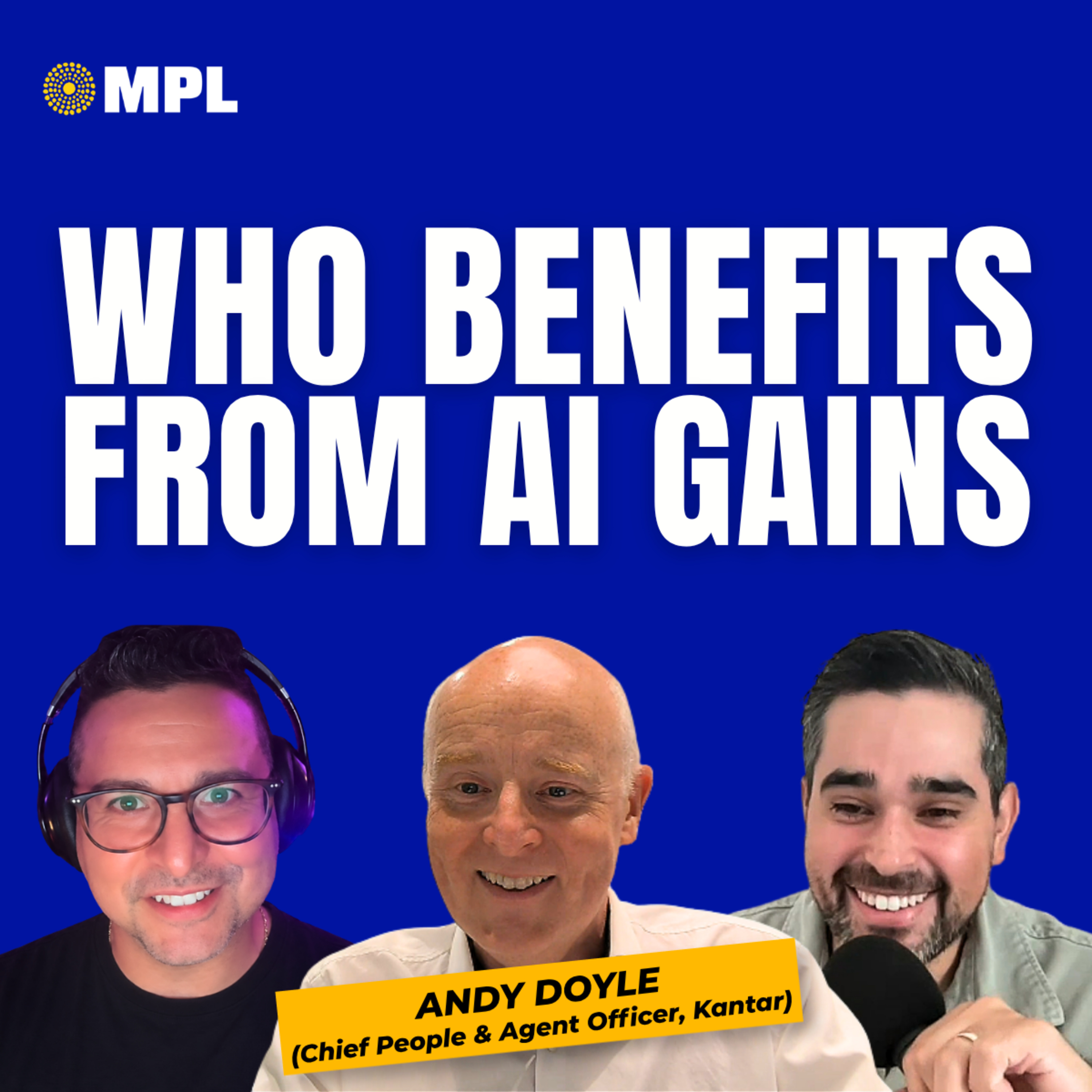
337 - Who benefits from AI gains? (Andy Doyle, Chief People & Agent Officer at Kantar)
In short
Kantar’s “future workforce” approach to agentic AI in HR—how benefits from AI gains should be shared across clients, shareholders, employees, and society, while maintaining ethics and quality.
Guest background
Andy Doyle is Chief People & Agent Officer at Kantar. He helped create a combined “future workforce” function (people + agents/tech) after leadership aligned on human capability plus agents/technology. Kantar is a Microsoft shop operating in 60 countries.
Key claims
HR service delivery and admin (joiners/leavers, payroll-type work) will be automated; Kantar targets 95% of HR tickets resolved without human touch. AI is the “front door” to HR, replacing parts of the classic Ulrich model. Agents should augment humans (aiming for ~80% answers), not replace judgment. Leadership must role-model agent building and enable iteration.
Notable examples
launching tier-one agents via an “Agent Factory”; cutting HR bonus-cycle moderation from 12 weeks to 8 days; rewriting 4,200 country policies into a machine-readable “locked box” after Copilot surfaced conflicting maternity policies; “Sparky” reward agent driving ~3,000 Spark Awards entries.
Written by AI. May contain mistakes.
Chapters
0:00
The Impact of AI on Client Benefits
Discussing how AI can enhance client deliverables while being ethical.
“I suppose we use that four quadrant approach about what benefit for our clients.”
2:19
Good News Stories Segment
Hosts share positive updates and personal stories to kick off the episode.
“We have a tradition we call Good News Stories.”
3:23
Andy Doyle's Journey in HR
Exploring Andy Doyle's career path and his current role at Kantar.
“My good news is that we are in the process of finding a couple, one or two new people to join the MPL team.”
6:09
The Future of Work: Human and AI Collaboration
Andy talks about the integration of human capability with AI and agents.
“And it came about about 18 months ago because probably about a year ago, really, I got a new chief exec and we started talking about the future of work.”
7:12
Transforming HR Through Automation
Discussion on the automation of HR tasks and its implications for the industry.
“How different is the role today than when you started your career?”
9:18
The Disruption of HR Functions
Andy discusses the inevitable disruption in HR and the need to adapt.
“We'll get there at some point next year.”
12:10
Challenges and Changes in HR Strategy
Insights into the strategic decisions made in HR and adapting to change.
“the big LLMs hit the market that's not going through an AI transformation.”
14:01
Transforming HR Through AI Integration
Learn how Kantar's HR team radically changed their operations by integrating AI and redefining roles.
“One of the questions they keep asking, I love the board, is when they say, what would you need to believe?”
21:21
Building a Modern Tech Stack for HR
Discover the components of a modern tech stack and how Kantar leverages AI in their operations.
“But thank you for walking us through that.”
24:29
The Disposable Nature of Tech in HR
Explore the concept of technology being disposable and easily replaceable in the modern workplace.
“One of my, on your comment that, you know, they're not all agentic, all the agents, you know, they're not like automating things.”
Show all 20 chapters
26:28
Lessons Learned in AI Implementation
Understand the key lessons from Kantar's journey in implementing AI solutions and the importance of data management.
“And so if you don't believe that, just another reminder to go spend a little more time like in whatever it is, whatever tools you're using.”
28:00
Transforming HR Policies with AI
Learn how AI tools can streamline HR policy creation and improve compliance.
“We're in about 60 odd countries around the world.”
30:00
The Changing Landscape of Trust in HR
Explore the importance of trust in organizations amidst AI transformation.
“And when you've got better policies, you can start getting better answers out your technology because you're going, the source that you've given it is a source of truth.”
33:05
Cultural Shifts in the Age of AI
Understand the cultural changes organizations face when adopting AI tools.
“And no one knows how, you know, when we started, no one knew what a prompt was, what an agent was, how to use the technology.”
36:40
Navigating the Role of Digital Workers
Examine the evolving role of digital workers and their impact on human roles.
“And then I think this leads us to a really important question on trust for organisations.”
41:05
Building Positive Energy in Teams
Learn how to foster positive energy and engagement in teams during transformations.
“we think that the agents will augment and add value to humans in that way around.”
42:00
Navigating Change in an AI-Driven World
Explore how organizations adapt to rapid changes brought by AI.
“And for me, the weird is like the re experiencing the job changing as you're working because, you know, for the teams that are really in the void, like they're past what is known and they're pushing forward.”
45:46
Understanding AI Beneficiaries
Learn about the four-quadrant approach to analyzing AI's benefits.
“Yeah, I mean, I suppose we use that four quadrant approach about what benefit for our clients.”
47:59
Balancing Work Constructs with Employee Wellbeing
Discuss the implications of AI on work structures and employee wellness.
“So we are seeing people take on bigger roles and get paid more.”
51:11
The Future of HR in an Evolving Landscape
Converse about the evolving role of HR amidst technological advancements.
“piece that our board and our management team are all going, we don't know which is the right thing to do here, but we do know that doing nothing is not the right thing.”

Ask about this episode
Get the gist, explore an idea or ask about something said.
 Claude
On The Modern People Leader: Forward-Thinking HR, what are the key points of this episode?
Searching your listeningTranscript
Automatic transcript. May contain errors.
0:00Andy Doyle: I suppose we use that four quadrant approach about what benefit for our clients. As we do, as we identify our workforce and like when you think about using more agents, how do we make sure that as we are ethical in the use of AI, it's enhancing the deliverables for our clients. So we try and focus on speed and try and how do we bring cycle times down? How do we kind of change our processes to help? How do we augment our processes and ways of working to make sure that the quality is always right and the quality is good? So lots of dimensions for our clients about how they benefit. We talk to our shareholders.
0:39Andy Doyle: One of the interesting things about agents is tokens are not a thing that we talked about a year ago. No one knew what token, well, it was an interesting kind of four or five letters. It wasn't a cost. So investors are simply saying to us, well, how can we get a return? We want you to be more efficient. how much of that do you give back to clients through more competitive pricing or better time to serve? How much do we get as investors and what do you give to employees? And employees, I think this is where it's a really interesting space and I don't know the answer to this. What we do know is the jobs that we will have will be more valuable to the company and therefore it's only right that you should pay more for them.
1:18Andy Doyle: So we are seeing people take on bigger roles and get paid more. People are working, the cognitive load on people is higher. And then I think that the bit we all have a responsibility for is how do we think about society and employment and where this goes and what happens to college leavers and school leavers and the generation that are coming out of college today. What does that mean for your employment, future employment and your apprentice pathways and how do you think about your role in society? it. And I think you don't have to have answers to all four of those things, but I think that's quite a helpful framing of how do you think about the dividend and the benefits from AI going forward.
1:59You're listening to the Modern People Leader podcast, where we go behind the scenes with today's top HR leaders and work experts. We talk to them about how they've gotten to where they're at, what they do every day, and what they see coming next for the future of work. Hope you enjoy.
2:18Welcome, Andy. How are you doing?
2:21Andy Doyle: I'm doing well. Thank you, Stephen. Super excited to have you on the show. We start all our shows the same way. We have a tradition we call Good News Stories. It is a way to kick things off with a little positivity. It can be a personal story or a work-related story, but just a way to kick things off in a good way. So I'll hand over to you to get us going. Well, my good news story of the day, and I'm super excited. I've just come out of our Agent Factory Steering Committee. Yesterday, we launched one of our tier one agents to the organisation, which has had a really great early adoption across the team, and it's saving our colleagues already lots of time.
2:59Andy Doyle: And beyond the kind of the technical piece of it all works, it's a great example for me of an agent that not just gives you the answer, but helps you work through how to bring the best of our work and the best of human knowledge to our clients in a really compelling way. And we launched that yesterday to the organisation, and we're super pleased with adoption so far. We want to start the episode right there. Let's dig into that, but we will. We will. Daniel, what do you have? My good news is that we are in the process of finding a couple, one or two new people to join the MPL team. And so we started interviews on Wednesday last week, and we have like three interviews today and a couple more the rest of this week.
3:43And so that's exciting. I forgot about everything that goes into the hiring process. And so it's been a fun week. And I'm looking forward to meeting the rest of the candidates. And so far, so good. There are a lot of talented people out there. So that's my good news. I am going to go like totally different than what I normally do. My good news is I got a fun new gadget. And it's this teeny tiny and sorry, this isn't an ad. we should be charging like i should have found this company is that and this is a for those watch for those not watching our youtube because that's most of you it is a little like old school crank camera that takes like a a like a wide lens digital video and like saves it to this tiny teeny tiny little device that you then like sync it with your laptop or your computer and you get this like insanely cool, like vintage wide angle videos.
4:46And so I don't do a lot of impulse purchasing, but my job is sales and I've been doing a lot of selling on Instagram, interestingly enough, and I got retargeted and I'm such a sucker, but really cool. If y 'all are interested, I'll share the name, but it's a fun little thing. And it's like a party conversation starter because everyone's like, what is that little thing? So super cool. I saw it at a, someone was using one at an artist. I work in music and it was at an event I went to. So that's my good news. In addition to that, you know, part of my job is interviewing recording studios. And I haven't, apart from being an HR podcaster, and I am going to be visiting my first recording studio in person.
5:32It's a recording studio called Spectra Studios here in Austin. and I'm super excited for that to happen. It might be Friday, it might be Monday, we're not sure yet, but that's my good news. But enough about us. I call this next question our Brene Brown question. Andy, tell us your story. We went the whole, we went the twists and turns, the ups and downs. You're in a super cool role now. You're the chief people and agent officer at Cantar. Like, I don't even know exactly what that means, but I think you're gonna, that's the point of our episode today. and super excited to hear your journey.
6:09Andy Doyle: Yeah, I mean, it's an unusual role. And it came about about 18 months ago because probably about a year ago, really, I got a new chief exec and we started talking about the future of work. And we both shared a belief that the future of work is a mixture of human capability and humans and agents and technology. And having those separate between technology sits in a tech function and HR looks after people in some way is the guardian of the organisational capability, just felt wrong. So we put the two things together and said the future workforce, and this was a year ago, the future workforce is going to be a mixture of people and agents and how they work and interact together and what that means for your skills, capabilities, development pathways, recruitment, what you need to build, what it looks like.
6:57Andy Doyle: How do you bring the total cost of employment and the total cost of agents together into a kind of a common framework that you want to think about and use that thinking to help us develop our strategy. So that's where it came from. And it's been a journey. And just take us down memory lane. How different is the role today than when you started your career? All right. So HR Tech is coming up fast. If you're planning on being there, please come hang out with us. We're going to take NPL Live to the Deloitte stage for two sessions. So on the Wednesday at 1.15, we're going to sit down with the director of TA Ops at Ford, and we're going to dig into their talent acquisition transformation.
7:41So how the tech has evolved, where agentic AI fits, and what that could mean for the way that recruiting gets done. And then on Thursday at 10.45, we're talking to the SVP of HR Tech at AT &T. And with them, we're going to unpack AT &T's learning and skills rebuild that's happened over the last couple of years. So two very big sessions. And if you're going to be in Vegas, please come join us. And if you want to meet up with us individually, just shoot us a DM on LinkedIn. We would love to connect. Yeah.
8:12Andy Doyle: I mean, you couldn't, I mean, I started my career in operations running hospitality bars and pizza huts. Okay. So I ran pizza hut delivery in London and that's a long time ago now. And when I moved into HR, even then it was a very, it was very different profession than it is today. And it's only accelerating. And if you say to me, even over the last five years of being a kind of a HR leader in private equity and public companies, the job is changing, you know, transformation, change, driving capability, engagement, culture, always been big parts of the roles I've played. But the pace and acceleration of change and the way we are changing and the way technology is moving the profession is profound.
8:58Andy Doyle: And we set ourselves an ambition about 18 months ago to reduce that 95 % of all our service delivery queries in HR would be resolved without human touch. That's what we're trying to achieve. All that will be done at some point next year. We thought we'd try and get there at the end of this year. It was a big target. We'll get there at some point next year. But for us as a profession, the thing that's often held the profession back is it gets stuck in the administrative processes of work, of managing payrolls, of joiners and leavers and contractors and people starting promotions. That work sucks up huge amounts of time.
9:37Andy Doyle: All of that will be automated in the future. Whether you work for Cantor or any other company, five years from now, HR will be unrecognizable in the value it can create inside organizations and what it does. And so let's just keep that thread going. So you're saying that a lot of the work that we're doing today in the HR world just won't exist in five years. Is that right? In nearly every organization five years from now, the HR service delivery type work, the joiners-delievers process, the administrative tasks that happen in HR will all be automated. I think there'll be some firms and we're trying to get there next year.
10:19Andy Doyle: So we're trying to get to that next year. So this is not some point in the future. I just think that it will take time for all HR functions to move in this space. But, you know, the way you run your payroll, the way you run your colleague experience will be much more consumer grade. It will be much more real time for the colleagues at the time they want. And it will all be driven by agents. and it would be driven anything that you can do with policy or you know that is kind of rules based will all be agentic in the future and we're seeing that right now we're seeing that how we run talent acquisition we're seeing that in the recruitment process we're seeing that in the onboarding process you know and lots of those there's lots of parts of that coming together but into the future it will be everything and what that does for the pros is two really fundamental problems for the HR function.
11:10Andy Doyle: One is, we have said as a function for years, what we really want to do is be strategic, get away from the detail, stop doing that sort of work. But actually, there's lots of people that actually got real value from doing that sort of work. And what does that transition mean? And as you make that transition, what do you do with the capacity that we create for the business? And how do you drive enterprise value for the business, where judgment and knowledge and curiosity really matter and HR people are really really good at those things so there's never been a better time to work in HR but we are going to be disrupted as a function and it will be comfortably uncomfortable I think in that that journey but I know that when we get to the fast you know we're already seeing the benefits of that in terms of how people are kind of creating new jobs new ways of working new thinking which will drive value for our colleagues for our people who work in our profession and indeed the organizations more generally.
12:08It's interesting. I don't think there's a single company that exists today that was founded before the big LLMs hit the market that's not going through an AI transformation. Whether or not they're actually transforming anything is a different question, but I think everyone knows they need to change. I think everyone has committees. They've done all the thing. They're making tools available to people. I've been waiting for this day, though, when we interview someone that is like, we're onboarding the agents. The agents are being rolled out and they're being introduced to the company. The company's being introduced to them.
12:48And so this feels a little different. And so I want to dig in a little bit. And I think you said about a year ago, 18 months ago, strategically as a company, the leadership team decides, all right, this is the direction we're going. We want 95 % of all of our tickets and admin or low value ops type of work automated. But you just don't jump immediately into that. And so I'm guessing that you probably had center of excellence model or some traditional HR model that was in existence. It's like, do you walk us through the thinking that you guys went through? Do you dismantle that carefully? Do you rip the Band-Aid off?
13:32Like how, you know, what was going through y 'all's minds and what were some of the initial fundamental decisions you made as a leadership team?
13:39Andy Doyle: Yeah, I mean, look, the provocation came from our board. You know, Kantar has gone through a lot of change and transformation over the last five, six years through COVID and then the change where private equity owned. I love working in private equity. I love the simplicity of having your investor in the room. And I couldn't be, we work with Bain Capital. I could not be happier to work with, they're a great partner. One of the questions they keep asking, I love the board, is when they say, what would you need to believe? They don't say do it. They give you the, what do you need to believe? And the challenge we had been asked is, we've reduced our cost base in HR.
14:17Andy Doyle: We've made a lot of strategic divestments and things like that. We've reduced the cost base in HR by about 50 percent over the previous three years. And I was feeling pretty good about life. You know, good job. And the question I got from the board and our investor was, what would you need to believe to do it again? What would you need to believe to take another 50 percent out? And I start my first reaction was, you're kidding me. You know, leave me alone. Finance have done nothing. You know, they've taken 10 percent of their cost base out. I've taken 50 percent of my cost base out. You don't mean I've got to do more.
14:49Andy Doyle: You surely mean I've got to help finance do more. And our lead investor said, no, what would you just need to believe? Go and think about it. And I spent about a day thinking that he'd gone mad. And then I went, well, what would we need to believe? And actually, I posed that question to my people leadership team. And we went, let's stop fighting it and think about what we're doing here. Two things happened at the same time. I'd just come back from a session with Microsoft, where we were at the very early frontiers of Copilot at work. You know, ChatGPT had come online. I'm going, there must be something here.
15:29Andy Doyle: I viewed Copilot as my answer to cost reduction. And then I realized that it was part of the answer, not the answer. So we did four really big things. First of all, we set ourselves a target of this 95%. And we said, we're going to use AI as the front door for HR. and we're going to use AI in everything we do. We are going to change the business partner model. We had a very classic Ulrich model of business partners, COEs, service delivery. So we're going to change that whole model. We have moved away from centres of expertise. We changed the business partner teams completely and split that team into three.
16:08Andy Doyle: And we put an AI front door in. So as a function, we've delivered a lot of change in the last 18 months. It's been hard. The people team at Kantar have been spectacularly open-minded and good and really lent into some really uncomfortable conversations and different ways of working. So a couple of examples. Our COEs became what we call business capability hubs. So they own the end-to-end process, not just the advice and the guidance. So if the reward COE do something that's kind of theoretically pure but practically difficult to implement the business partners normally made up the gap and tried to explain it to managers and all the reward coe never paid a price for that now the reward coe owns the policy and the execution and the end-to-end process huge change in the way we operate and i look at our bonus cycle you know our usual bonus cycle it probably It takes 12 weeks from year end through to kind of paying the bonuses and you do moderation and you do allocations and you do that.
17:16Andy Doyle: We did it in eight days this year, end to end. From start of the bonus cycle until I sat down with a CEO and we signed everything off. Eight days because we used AI. We did a different way of working. We were much more directive. So, you know, you've got to it's not easy. We took away business partners from the business. the reality is the I think I probably had the orthodoxy over the last few years that you've got we've got a big we've got workday you know whether you've got workday whether you've got SAP whatever system you've got of record these are great systems we've given self-serve to managers that do things the reality is that's a bit of a myth most managers don't do stuff in workday they use their business partner to do stuff in workday and instead of paying cheaper resource to manage the end-to-end process you're paying really quite expensive resource based close to managers who are super helpful and what we found when we did the analysis with our business partner team was they largely self-generate work they go and see managers they talk to managers they coach managers but they they kind of start every week with a blank book of work and go and fill that up because they're good people and they want to do a good job and they want to be helpful so we took that away from managers and said if you want help you go over here and get help and we split our business partner team originally into two now into three we said very senior business partners that run teams you know like the person running emil or the americas became essentially individual contributors so your job is no longer designed about the team size you're an individual contributor to help this business but you're also for me an organizational expert in change, transformation, organisational design.
19:05Andy Doyle: I want to use those skills not just in your geographic location, but at an enterprise level. The bulk of our business partners and that senior partnership group, I view almost like a consulting practice from a BCG or a McKinsey. That's what I'm striving for that group to be, that they're linked to the geography, but they're also really, really capable leaders. And they are, they've got great people there. Then we had a good chunk of about 50 or 60 business partners that a bit more junior but still very experienced very senior very good value in terms of what they provide in the business we took workday access off them so they couldn't see anything and therefore they couldn't do anything in workday well I tell you that was hard and I still of all the things I've done in change and transformation over the years that I'm so indebted to the business partner community for sticking with me on that journey because they found it really hard and I said look I'm taking workday access off you because I don't want you to help.
20:01Andy Doyle: I want you to push managers to go into our service delivery agent, our people agent to help that. And the longer you help them, I never get the benefit. And what we've learned is that pool becomes a really good pool that says that they've lost identity, yes, about I'm allocated to this team or this business area. But what we've seen is they've also got huge experience working in broader teams, working internationally, working in different ways. So those are some of the benefits that people have had in that team. And then about three months ago, we went, one of the things we've learned is you do need a specialist ER case management grievance sort of team, you know, and we're going to carve out a team that specialise in doing that piece of work.
20:46Andy Doyle: So built lots of agents, we've enabled lots of teams, changed the Ulrich model to something that's very different. Some of it works, some of it will continue to evolve but that's the journey and you know we'll have a smaller hr team at the end of this this journey but because we will have shed the kind of volume transactional processing will be much more agentic and therefore the value add that we can provide to the organization is very different wow congrats that's a lot of change in the last 12 months right i can't remember what you said but But thank you for walking us through that. So a question that I think both of us have is, what does a modern tech stack look like for a people team?
21:32Is this all homegrown tooling that you're building? Like when you say we're using AI, what does that mean? What's the tech stack?
21:41Andy Doyle: Yeah, I mean, look, lots of it's homegrown, but it's not unique. We work with partners as well. And there are places where we go, our risk tolerance on TA, Today, we operate in 60 countries around the world, and every country has a different set of standards about privacy, data control. There are places that you might want to work with a partner, and there are places that you might want to work inside your own environment. We are a Microsoft shop. We are a frontier company with Microsoft. Today, we've got 12 ,000 people and 17 ,500 agents across the organization. So I have more agents across the organization than I have people.
22:14Andy Doyle: Of those 17 ,500 agents, about 17 ,300 of them have been built by our colleagues individually. They're more assistant-like than agents and they're not agentic, but we've enabled our colleagues and encouraged our colleagues and built capability to say technology has been democratised and it's not subject matter expertise now matters much more. And, you know, if you take your subject matter expertise and the things that stop you doing your job, how do you build tools for yourself and take agency and own this change so that you can make your job a little bit easier. And we know that our colleagues got in the first deployment of Copilot, our colleague saves on average two hours a week.
22:56Andy Doyle: You know, we've got 90 % daily usage of Copilot, 60 % of our colleagues globally use Copilot at least 20 times a week. That is our kind of principal stack. And then we supplement that with co-work from Microsoft and Claude for development and GitHub for our developers and then we buy pieces of software around that the big front door to hr which is our people agent is in a microsoft copilot studio environment we are on our third version of that and this is one of the big things for me technology has become disposable and if i look back on my career you know when you got kind of a budget something like that for hr to upgrade its you know the kind of human capital system or whatever it was like the once in 10 year event because it It was going out of life, out of service, you know, or you've had to upgrade it.
23:43Andy Doyle: And everyone tries to keep it vanilla and do it out of the box and no one ever does. And so you get these big systems with big budgets. And sometimes that can run hundreds of millions of dollars. And you go, that's just madness. You no longer need that. So you can build this technology in-house with the capabilities you have in the HR function, because you can kind of vibe code it. You can make it work differently. All our agents in HR, none of them have been built by technology. They have all been built by people in the HR function where we train them up. We've used them. I've got as many kind of like if I look at the kind of coding capability and development skills we have in the HR team now, it's staggeringly different to what it was two years ago.
24:25One of my one of my favorite two comments and then and then I want to dig in a little more. One of my, on your comment that, you know, they're not all agentic, all the agents, you know, they're not like automating things. Some of them are just like assistants. One of my most effective agents is my, it has two names because I kind of use it two ways, is my chief strategy officer for me and all the work that I do slash cheapest staff. And this agent is in open AI. So I didn't even really talk about using my cheapest app, because everyone has been like all gung ho about Claude, Anthropic. And but for certain things, this one agent I have just does it so much better than all the others.
25:18And so I totally I believe that it that not all agents have to be automating out the wazoo. You can have something that is super effective for your people that is kind of core to what the AI superpowers initially brought us. My second comment on how disposable, I was shocked. So I work for an AI native company. We were built and we were a year old. And I was shocked. One day we came in to stand up and our CTO was like, blah, blah, blah, blah, blah, you know, codex, blah, blah, blah, blah, blah, open AI. And overnight they had moved iron tire engineering to from Claude and Anthropic to open AI.
26:03And I just was like, my mind was blown on how easy that way. And like our Ludwig is our SVP of engineering. It's a bot. It's an agent that just codes all day long. And I just, and there was like zero hiccups, like it didn't skip a beat. And I like, I think that is like one of the key takeaways from this episode is that the tech is absolutely disposable now. And the ease of recreating what you've already creating, like that is a real thing. And so if you don't believe that, just another reminder to go spend a little more time like in whatever it is, whatever tools you're using. And so Daniel, did you want something to say?
26:43Were you going to comment? Oh, no, no. I was just going to say that like we've even experience this at NPL. So Steven, from January through May, spent a good chunk of time in a specific tech stack, trying to streamline all of the different processes in our business. And we made a ton of progress. Fast forward to July, and we found a new way of doing it. And because we had all the documentation, it took like a week to rebuild everything. and it's just it just it blows my mind the question i had was you know what are some of the lessons learned you mentioned that some things you know you said some things have worked really well others not so much i'm just curious like what were some of yeah what were some of the
27:26Andy Doyle: lessons learned so far i mean look i think it sounds obvious when i say it but you've got to get the foundations right and if you don't get the foundations right you know it doesn't work and I'll give you an example our first iteration of our policy agent was hey look we've got an intranet inside the organization it's on a SharePoint site that's great you put Copilot on the top of that it will work and a it doesn't and then you go well why doesn't it work and you know we did some trials and some tests and and the reason why it didn't work was because your librarianship of your data set was weak and Copilot can see everything so you can't just see the stuff that you've you know all the stuff you've archived all the stuff you've hidden so you know our uk maternity policy we had lots of businesses in the uk actually copilot found 23 different maternity policies that were on our intranet over 10 years you know it left them all equally so there was about a one in you know a one you know there's about four percent chance you got the same answer not because copilot was making stuff up or hallucinating it just found a different policy so you know and if it couldn't find a policy for a country it went well I know you asked me about France I can't find France but I've got spade is that any good you know and it tried to be super helpful so you know in our very early stage we went we actually have to get our data right and we spent a little bit of time trying to work that out we decided we were not going to try and clean up the intranet because it was the work of like the age and we said we're just going to rewrite all our policies and put them into a locked box that the agent can look at.
29:05Andy Doyle: Now, that's quite a big task for us. We're in about 60 odd countries around the world. The average country has between 60 and 80 policies. We've got over 4 ,200 policies that are required to do that piece of work. That took a week to write those policies. So we used an agent to write them all for us. We took the policy that we had, we kind of converted it. Those policies have been written for humans, not machines to read. So, you know, lots of pretty pictures, lots of graphics. And again, 18 months ago, that was more difficult than it is now for some of the AI models to use. So we rewrote all our policies in a standard format, in our standard tone of voice.
29:41Andy Doyle: We compliance checked all those policies against the laws of the various countries in which we operate. We had humans check all the policies. But so end to end, we did that entire piece of work from the beginning to the end in under 12 weeks. but they're kind of churning out the policy within a week. So I think that's where we went, okay, we now have better policies. And when you've got better policies, you can start getting better answers out your technology because you're going, the source that you've given it is a source of truth. And for any HR team, I'd say getting that bit right is super important.
30:15You made a comment earlier that it's never been a better time to work in HR. And you literally took the words out of my mouth. if you are interested in disruption. Like if you are change loving or you're not change averse, right? And so I am, one of the thing as I listen to the experience y 'all are having at the company is that I know, I don't know any of your team members, but I believe strongly that they really have faith in you or the leadership team, because like trust is such a big issue with companies right now. You know, I have, there was before I kind of left the day-to-day operations of the podcast and went into sales, I tried to go in HR and I actually interviewed for, you know, a handful of HR transformation jobs.
31:10And in one of those interviews, I'll never forget, like the panel shared with me, like we did a survey of our employees. we got like below 50 % participation because we believe that our employees are fearful of sharing their kind of honest opinions about AI usage. But here you are, Andy, in that same time period, it sounds like you've already evolved how you're working and what you're doing multiple times. And how are you able to, what do you think the trick is for the listeners out there? They're like, wow, I need to make this kind of action and it's coming from my board. Like what was the secret there for you and the other leaders of the team?
31:49People leaders want to hire the best talent, regardless of citizenship or where that person is from. But when you're hiring across the globe, finding the right person is only half the battle. It's everything that comes after that can get really complicated. Can we hire this person? Which visa path makes the most sense? How long is this going to take? And who's going to be chasing updates along the way? That's where manifest law comes in manifest is an ai native immigration law firm built for companies that want to hire the best people regardless of citizenship companies like resolve.ai novo and latch bio use manifest to get hires onboarded and stay on top of compliance as they grow for hr and global mobility teams that means real-time case tracking same-day candidate evaluations, fast filings, and a five-hour average response time.
32:39And there's real legal depth behind it too, including top-tier attorneys and advisors like the current president of the American Immigration Lawyers Association and former USCIS leaders. So instead of immigration becoming another thing your team has to constantly follow up on, you get more visibility, faster answers, and fewer surprises. If you want to schedule a free consultation with Manifest, just click the link in the show notes.
33:05Andy Doyle: This is new technology for us all. And no one knows how, you know, when we started, no one knew what a prompt was, what an agent was, how to use the technology. I mean, look, the world has moved on enormously in the last couple of years. There's a great data point team. We're a research company. And what I really like about being a research company is that we've got lots of data. But the other piece that I also know is the two most important cultural tenants inside our organisation are order and caution. So we're not allowed to change junkies ready to embrace, you know, what we've been waiting for is transformation.
33:40Andy Doyle: Well, like many organisations, we've done a lot of transformation over the years. People are, you know, everyone, if you ask people, you know, most people say, I'm all done with transformation. The T word is an uncomfortable word. But what we know to be true is people are using this technology outside of work. There's a much higher adoption rate of ChatGBT, of Claude, of Gemini outside of the working environment than there is in the working environment. So how do you make it OK for people to use these tools in the working environment? How do you give people the skills and how do you give people the right to fail?
34:14Andy Doyle: And, you know, if you think about the technology, most the thing you get the most out of when you use this technology is if you continue to iterate. You know, you get your first answer of a prompt and it's not very good. You get your first build of an agent. Doesn't quite work. You know, it's like it requires you to go to have a curiosity and a willingness to go. No, that's not what I want. I want this. I want more of that. Do more of this thing. You know, I was doing a I was creating a dashboard earlier on today in Excel. And it's like, no, no, I don't like it. I change that. Do this. You don't add those two numbers together.
34:47Andy Doyle: They're separate numbers. You know, like you you've got to work the data. So I do think it starts with leadership. I think unless you're your executive leadership, your functional leaders, your chief exec, they cannot abdicate this change and transformation. They have got to be agent builders. They have got to be role modeling. They've got to be showing, look, I built this agent. I've done this. They've got to be listening. And like people in my team book time in with me. you know one of my colleagues who runs our data analytics practice of a data analytics team in HR you know put a meeting in like I want to show you a kick butt agent Andy that's what I built over the weekend this thing this reconciliation between finance data and HR data used to take a week every month for one analyst I've got it down to 10 minutes let me show you how I did it let me show you how it works I've given one of my team about 25 their capacity they can do more value ad work.
35:38Andy Doyle: That's not coming from me. That's coming from someone who had never built an agent, who said her husband is a CISO in another company. And she said, I was working the weekend coding this thing. And he was going, what are you doing? How are you doing this? And she's going, just using the tools I've been given to help me. So I think what we've tried to do across the organisation is to encourage. And if I look at our agent builders in HR, they are people that were running TA, that were running payroll, that were running analytics, that, you know, the person that's built nearly all our talent acquisition agents was a recruiter.
36:15Andy Doyle: And she was going, the things that bother me are these processes, I want to fix them. And we went, great. And, you know, our talent acquisition team is half the size it was a year ago. It's doubled its productivity in that time. And, and this is where I think it's really important, and is more engaged than it used to be because the people in that team are doing work that they really, really enjoy. So work is more fulfilling. And then I think this leads us to a really important question on trust for organisations. If the benefit of all the dividend, if you like, that we obtain from AI just isn't shared fairly between shareholders, clients, employees in your organisation and society at large, I think you get skewed outcomes.
37:05Andy Doyle: People don't want to try and drive more productivity, try and work differently. And the reward for doing all of that is, well, you get to keep your job. They want to do that. So they get stuff out of it. They get new skills. They get maybe reduction in hours of working. They get more free time to do pet projects at work. They get more interesting work. that clients get faster deliverables, that get more accurate deliverables, get better quality of work, that shareholders get a return in terms of the investment they're making in AI. And how do you think about society, about employment and what that means for kind of people coming out of college today?
37:40Andy Doyle: I think we haven't quite worked that out as a profession yet in the future of work and what that means. And that's why I like the way we're approaching it because we're creating the space and the time to kind of answer some of those questions over the years ahead. Have either of y 'all read the, I think her name's Elena Verna from Lovable. She's like their CMO. And a week or two ago, she wrote a Substack article on what it's like working for like a truly AI native company. And the way that it's structured, it's like the good, the weird, the challenging. I'm probably butchering this, but one of the challenges that was in the weird section was that because of how the company operates, there's so much overlap between work, and she's like, I'm still adapting to this.
38:37Being somebody that's been a CMO multiple times and been very senior, I'm used to having ownership over whatever it is that I'm working on, but now I can log in one day and see that somebody else picked up my work and finished it and did it better. And I have to kind of put my ego to the side and say, okay, well, that kind of hurts, but this is actually better than what I would have done. Are you starting to see some of this as the team has restructured? And you mentioned the HRBPs being split up into three and all of the other changes. And if it's not the same, Like what's, what are some of like the, uh, what are some similar, you know, dynamics that you see popping up?
39:23Andy Doyle: Because we're not an AI native company, we probably have less of that. I mean, and we're still learning that and, you know, we're, we're super proud of how many agents the team has built and how that's been adopted, but we are still experimenting with, and I think one of the things I'd say to anybody is you've got to, you don't want to stay in pilot forever, but you've got to continue experiment. experiment and one of the things I think we're toying with or trying to understand is you know when agents are very direct you know when you say this agent does this thing and it's not very agentic but if you need this agent is a quality control agent and it looks at the data set and it looks for anomalies that's what it does but people go thank you for the output I'm going to take that with a good degree of it's helpful but I'm going to check it and I'm going to make sure that I apply my judgment as a human and an experienced leader as well.
40:14Andy Doyle: I'm not just going to go, the agent told me to do it. Yet when we see digital workers in our environment, people are a bit more, oh, the digital worker told me it was true. It's a weird thing that we're trying to experiment with. Are we better off with digital workers? But actually, when you have digital workers, you tend to lose a little bit of the questioning of the worker. Whereas with agents, people still have a good degree of, is that right? Is it just because you told me, is it the right answer? And we are trying to get to increasingly an 80 % answer with an agent where the human can add the 20 % that we think is really value rather than 100 % answer of a smaller task with a digital worker.
40:55Andy Doyle: And I think that's going to be one of the things that we're seeing, I don't have an answer on it, but that will play out for us over the next year. So we don't think you'll have digital workers that replace swathes of humans. we think that the agents will augment and add value to humans in that way around. And I think that's probably if I was starting a startup and I had a digital workforce and it was different, I might have a different frame of that. But I manage a very 50-year-old legacy company that is working in a different way. So it's interesting. Yeah, that all makes sense. And I struggle to believe that anyone wakes up on a Monday morning and is like, oh, I can't wait to get to all those workday administrative updates that I have piled up in my inbox because the people that should be doing those aren't doing that.
41:51Like, I just struggle to see like how anyone and like, that's all 80 % type stuff. Like, you know, like boom, gone. Like we're going to find a smarter way of doing this. And for me, the weird is like the re experiencing the job changing as you're working because, you know, for the teams that are really in the void, like they're past what is known and they're pushing forward. And in many ways, some of the things you shared, Andy, are very much in that void. Like, you know, you're introducing the agents to the company and, you know, you're thinking it about really complex things. And so so that that all is super exciting.
42:30And I got to imagine now there is like an energy, unspoken energy in your team meetings as, you know, maybe not in the beginning. There's probably some weird looks and, you know, some like uncomfortable silence. But I got to imagine that there's a lot of positive energy building in the work that team's doing.
42:47Andy Doyle: Look, we had a HR town hall yesterday. On that town hall, we showcased just some of the changes that we've been doing over this year. It wasn't planned this way, but I was just struck by all the people that presented at the HR town hall. None of them worked for me. They were all people that were on the front line of our organization. They were people doing the real work inside the organization, but they were talking about how they're developing the people agent taking it to the next level, how they were you working with a partner on an AI agent and recruitment to really try and drive our talent acquisition team to the next level.
43:22Andy Doyle: Because what we've learned is these teams just don't stop. It's not like they've gone, oh, well, now that we fixed it, it's all good. Of course it's not. The things that we've learned, the technology has evolved, you know, the technology is moving at a frightening pace. And it's almost like everything I've learned about change is now wrong. And that's like, I was really quite scared about that. I mean, I kind of went, you know, as someone at the end of my career, you've got all this experience, it's great, you know, you're wise. And then you go, everything I know about change has just gone out the window.
43:54Andy Doyle: And how do I think about change in an agentic world? How do I think about throwing technology away? How do I think about the pivots that we need to make on a regular basis across the organization? Then I look at what my team is doing and people agents, reward agents, TA agents, Award ceremonies based on agents. We just run a big recognition program across the organization. Spark is our purpose. We use it and we call it, so we have the Spark Awards. The most used agent over the summer was Sparky, the reward agent that could help you enter the Spark Awards. So you kind of gave us some stuff and it prompted you and asked for questions and evidence.
44:36Andy Doyle: And it created the entry for you. and we had like nearly 3 ,000 entries to our Spark Awards, which is up considerably in last year because people go, oh yeah, I do want to, you know, here's my, here's what I'm proud of. Here's the team I'm proud of. So that sort of, and I've read lots of them and I've read all the ones from HR. But as you're reading them, you're going, people are passionate about this. And I was laughing on our team school yesterday, someone, we had a wifi outage on Monday morning for about two hours. and someone posted the thing that I missed most about the Wi-Fi outage is I couldn't use Copilot.
45:14Andy Doyle: So it's changed a lot. That's the worst. When I'm on a flight and the Wi-Fi won't connect, I'm like, shit, how am I going to keep my bots going while I'm in the air? But so that's all great. And those are all benefits like that. Those are the benefits that I have experienced personally, like, you know, obviously different. But like, you know, what you shared really, really resonated for me. But you mentioned, you know, even more kind of beneficiaries in our prep call. And so before we run out of time, like walk us through how you look at the AI beneficiaries and like, you know, the framework that you have at the company.
45:46Andy Doyle: Yeah, I mean, I suppose we use that four quadrant approach about what benefit for our clients. You know, as we do, as we identify our workforce and we think about using more agents, you know, how do our clients who value and trust the reputation of our organization, what we do and how we do it, how do we make sure that as we are ethical in the use of AI, it's enhancing the deliverables for our clients? So we try and focus on speed and trying to how do we bring cycle times down? How do we kind of change our processes to help? How do we augment our processes and ways of working to make sure that the quality is always right and the quality is good?
46:25Andy Doyle: How do we use quality? How do we think about the people we ask for information in the market, our panelists? How do we make sure they're real humans and the information they are giving us is really valuable to our clients? So lots of dimensions for our clients about how they benefit. We talk to our shareholders. You know, one of the interesting things about agents is, you know, tokens are not a thing that we talked about a year ago. No one knew what token were kind of. It was an interesting kind of four or five letters. It wasn't a cost. It wasn't a thing. You know, now how you run these agents, how you think about the investment you're making in agents.
47:02Andy Doyle: Are you spending the right money? Have you optimized the agent for the task you're asking it to do? It's going to be super important as to how we think about the future cost of technology. And I think one of the things you're seeing at the moment is technology budgets. Up until now, you've largely been able to contain the cost of agents in the technology budget by a bit of reprioritization. I think over the next year or two, that's going to burst out the technology budget and you're going to have new costs for agents and total cost of agent and agent cost management. It's going to be really important.
47:32Andy Doyle: So investors are simply saying to us, well, how do we get a return? You know, we want you to be more efficient. How much of that do you give back to clients through more competitive pricing or better time to serve? How much do we get as investors and what do you give to employees? And employees, I think this is where it's a really interesting space. And I don't know the answer to this. What we do know is the jobs that we will have will be more valuable to the company. And therefore, it's only right that you should pay more for them. So we are seeing people take on bigger roles and get paid more.
48:03Andy Doyle: I think as I get into next year I've got more questions about how we share the benefits with our people I think we are exploring you know why is there a five-day working week what's the construct of a five-day 40-hour working week it's not you know like we all take it for granted but is that the right construct anymore you know in most markets we offer five weeks of holiday is that the right construct should we offer seven should we offer eight should we do a four and a half day working week these are questions that I think colleagues inside the organization need to have answers to because otherwise that they're going I'm working actually a higher level of intensity of mental load I do need to kind of have balance for me and my family and we certainly see that with people that you know that there were parts of your week that were kind of you know I'll do a bit of filing or I'll do a bit of easy tasks that are kind of quite good at clearing the head you know that people are working the cognitive load on people is higher and then I think that the bit we all have a responsibility for is how do we think about society and employment and where this goes and what happens to college leavers and school leavers and the generation that are coming out of college today and you know there are some economies around the world where they're built on offshoring of labour or there's some economies around the world that are growing really well at the moment.
49:24Andy Doyle: Equally, there are some parts of the world where the macros are really tough. What does that mean for your employment and future employment and your apprentice pathways? And how do you think about your role in society? And I think you don't have to have answers to all four of those things, but I think that's quite helpful framing of how do you think about the dividend and the benefits from AI going forward? And I feel like I don't think anybody's doing this maliciously, but it feels like a lot of the focus is on clients and shareholders right now. And there aren't as many questions being asked about the construct of a five-day work week, or is five weeks the right number for vacation, or how can this benefit society?
50:10And so I think that's a really important reminder. Before we wrap up, for so long, HR teams have had two choices when it comes to leave. One, manage leave internally with spreadsheets, email, and disconnected systems. Or two, just completely outsource it. Tilt is now introducing a third option. Their new in-house leave management tech gives organizations the tools they need to run leave internally while simplifying admin for HR managers and employees. So you can do things like centralized leave administration in one platform, configure workflows and policies to match your org, give employees and managers clear visibility throughout the leave journey and replace manual coordination and if you still need extra help organizations can also add access to tilt's leave experts for guidance and ongoing support if this sounds like something your company needs you can learn more at hellotilt.com slash mpl that's hellotilt.com slash mpl
51:10Andy Doyle: that we're having right now with our board and who are very supportive i think this is the other piece that our board and our management team are all going, we don't know which is the right thing to do here, but we do know that doing nothing is not the right thing. So how do we approach this in a way that's sustainable and good for our people? And that's why I'm really proud of work for this company because we've got investors and executives that are thinking in a really kind of thoughtful way about the future. And I think I've maybe mentioned this in the podcast, maybe not, but over the last 12 months, depending on the month, I can either be really excited or really bummed out.
51:50And I usually when I'm really bummed out, it's because I feel like we're ignoring how this is going to impact employees, how this is going to impact society. Whereas four or five years ago when we started this podcast, it's like everything we were talking about was like, you know, new, like, how are we going to make remote work work? How are we going to give people more flexibility. It felt like we were like things were actually getting better for people. And sometimes lately, I feel like that's not the case just based off of what my friends are sharing with me who work for some pretty big companies.
52:24And so thank you so much. I needed some positivity on several fronts that one, like there's no better time to be in HR. Two, this could actually be better for employees and for society. And yeah, there's some exciting work ahead for all of us. We end every episode with rapid fire questions. And so let's get started. Question one, what's one piece of advice that you give to somebody who's just starting their career in HR? Learn the business, not just the profession. Love that. If your team gave you a super powered nickname, what would it be?
52:59Andy Doyle: I would like to, well, I'm going to go what I would like it to be. which is rather than what they might say. I think they might call me Claude as the nickname, but I think what I'd like it to be is the supporter. Do they call you Claude because you're like a walking LLM? It's not said in a good way. Okay. It's not endearing. That's hilarious. All right. What's a strategy or practice from another company that you'd love to steal? I think one of the things that we're seeing is, and I'd love to do, is I take the product mindset from tech organisations into HR. You know, design your proof of concept, get it into a minimal via product, get it into the hands of users, try it, use it, work it, improve it.
53:49Andy Doyle: Don't let perfection be the enemy of good. And I think that kind of product mindset that you see across tech organisations in particular is something we can really use in HR and we've been using extensively. where we always start with, this is not the finished product. This is the beginning, not the end. Our friend and partner, Jessica, is smiling somewhere. Next question, who should we have on the show next? You were recommended to us and referred. This has been an amazing conversation. How can we carry this party forward? Who's someone you think is just really pushing the envelope? You know, there's a woman I work with in the UK called Lucy Adams who runs another podcast called Disruptive HR.
54:27Andy Doyle: and she's a really experienced CPO who now spends a lot of time working with organizations to help them disrupt, not first of all in AI, but over the last 10 years on how do you build capability in HR. She's a great colleague, she's great, and she's a great leader. I feel like Lucy's been on our radar for a while. This is our sign to go reach out, Stephen. Okay, last tradition, one word or phrase close. So one word or a few just to wrap up the episode, whatever's going through your brain right now. There's never been a better time to work in HR if we go and seize the moment. I love that. I'm going to go with disrupt, disruption.
55:09And I'm going to say progress over perfection. Yeah. That's good. Wow. Well, Andy, that was amazing chat. Thank you so much for trusting us to come share all the great things that y 'all are working on at the company. and hopefully you're now part of our family. So hopefully you'd be willing to come back sometime in the future.
55:28Andy Doyle: I'd love to come and share what we learned next. Thank you very much. We would love to have you. Thank you. Bye. Thanks for tuning in to another episode of the Modern People Leader. We really, really appreciate it. And if you enjoyed the show, please leave us a five-star rating. It would mean the world to us. And connect with us on LinkedIn. We want to know what you think about the show and you can find links to both of our profiles in the show notes. Thanks again for listening and see you on the next episode.
From the publisher
Andy Doyle, Chief People & Agent Officer at Kantar, joined us on The Modern People Leader.
We talked about Kantar’s agentic HR transformation, why the future workforce will be a mix of humans and agents, and the four dimensions of AI we should be looking at when we think about who benefits from the AI gains.
----
Sponsor Links:
🔗 Explore the 2026 Deloitte Human Capital Trends Report
🔗 Schedule a consultation with Manifest
🔗 Learn more about Tilt at hellotilt.com/mpl
MPL Links:
----
(09:25) Why There Has Never Been a Better Time to Work in HR
(12:25) “What Would You Need to Believe to Take Another 50% Out?”
(14:00) Four Big HR Operating Model Changes at Kantar
(14:35) Moving From COEs to Business Capability Hubs
(15:35) Cutting the Bonus Cycle From 12 Weeks to 8 Days
(16:10) Why Kantar Took Business Partners Away From the Business
(18:00) Taking Workday Access Away From Business Partners
(20:40) Twelve Thousand People and Seventeen Thousand Agents
(22:30) Why Technology Has Become Disposable
(23:00) HR Building Agents Without the Technology Team
(26:45) Why HR Needs Clean Data and Better Foundations
(28:10) Rewriting 4,200 Policies for Agents to Read
(33:05) Why Leaders Must Build and Role Model Agents
(33:45) HR Analytics Agent That Reduced a Monthly Task From One Week to Ten Minutes
(35:10) Why Kantar’s TA Team Is Smaller, More Productive and More Engaged
(35:35) Sharing the AI Dividend Across Shareholders, Clients, Employees and Society
(39:00) Why Kantar Wants 80% From Agents and 20% From Human Judgment
(42:15) Why Everything Andy Knew About Change Has Gone Out the Window
(47:25) Rethinking the Five-Day Workweek and Vacation Time
(52:25) The Practice Andy Would Steal: Product Mindset in HR
----
📬 Subscribe to our weekly newsletter to get episode recaps
💡 Follow The Modern People Leader on LinkedIn
😊 Follow Daniel Huerta on LinkedIn
😊 Follow Stephen Huerta on LinkedIn
----
Past guests on MPL include Brené Brown, Annie Dean (VP of Team Anywhere, Atlassian), Josh Bersin, Katie Burke (Chief People Officer, Harvey), Liz Fosslien, Helen Russell (Chief People Officer, HubSpot), Dave Scott (Chief People Officer, ADT), Melanie Rossenwasser (Chief People Officer, Dropbox), Crystal Boysen (Chief People Officer, Sprout Social), and many more.
More from The Modern People Leader: Forward-Thinking HR
All episodes
We use cookies.They keep VO running smoothly and help us improve it. Privacy policy