
 Ask ChatGPT


- Podcasts
- The Modern People Leader: Forward-Thinking HR
- 338 - How Edward Jones Builds Inclusion into Everyday Business Decisions
The Modern People Leader: Forward-Thinking HR14 Oct 2026 · 49m · 22 chapters
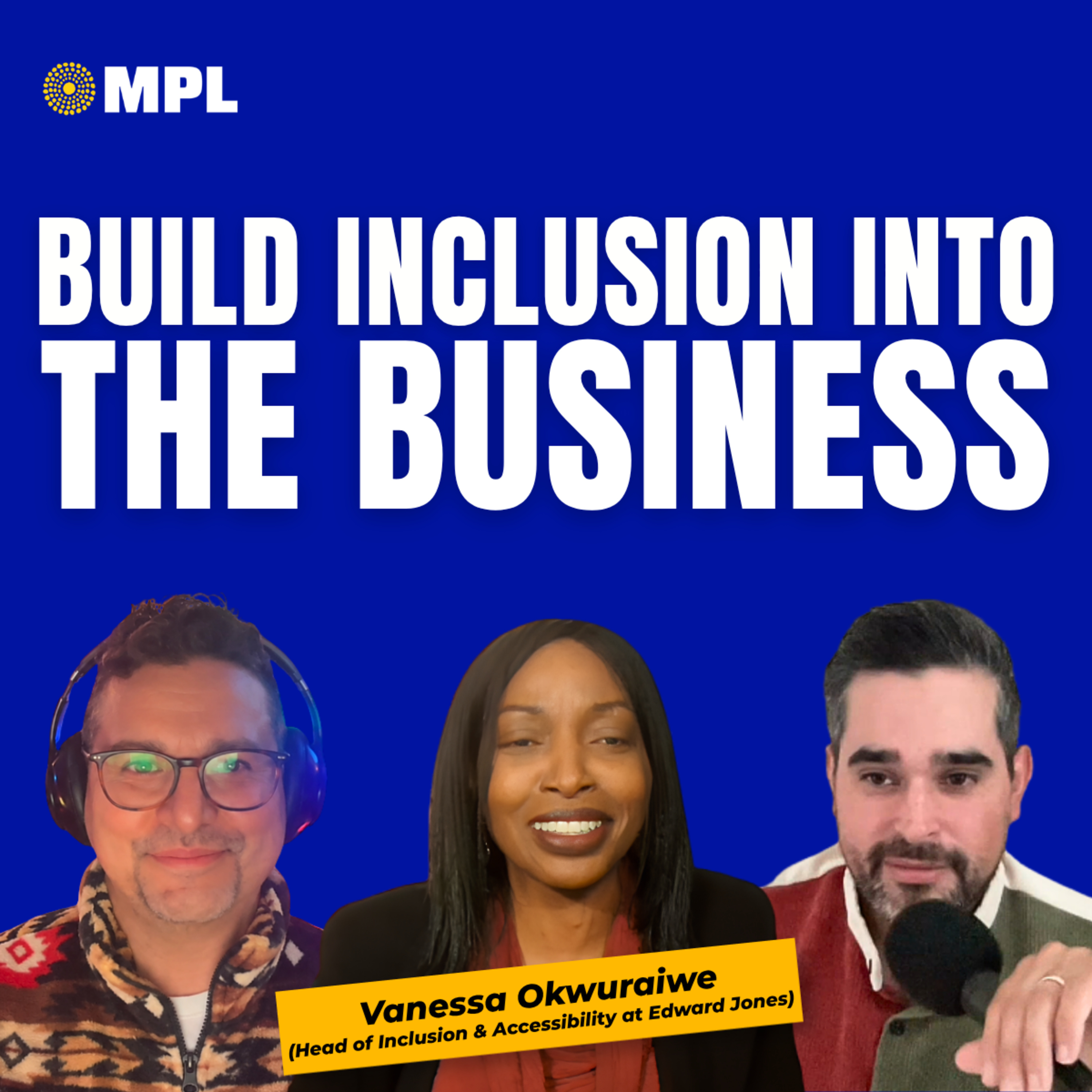
338 - How Edward Jones Builds Inclusion into Everyday Business Decisions
In short
Edward Jones’ approach to inclusion and accessibility as “everyday business decisions,” reframing D&I into an integrated inclusion/accessibility function that influences leadership behaviors, hiring, client experience, and AI use.
Key claims
Inclusion shouldn’t be “fashionable” or standalone; it must be embedded in business processes and leadership expectations. Edward Jones uses a behavior model (e.g., candid/respectful discussions, inviting different perspectives, valuing progress over perfection) to guide leaders and associates. Inclusion work also includes business resource groups as “business influencers” and focus groups for product/service improvements.
Notable examples
cultural acumen work with financial advisors; ensuring AI retains human judgment and doesn’t amplify bias; digital-first client engagement for younger generations (text-first, online account opening); serving multiple generations and building trust through human advisors.
Guests
Vanessa (Edward Jones inclusion and accessibility leader; 25+ years at Edward Jones across UK and US; background in economics, banking, global perspective from London/Nigeria) and Stephen (startup leader; described a hard, candid performance/feedback conversation with an interim CEO; coaching/courage theme).
Written by AI. May contain mistakes.
Chapters
0:00
Inclusion as a Guideline
Learn about the behaviors that support inclusion in business decisions.
“So we have a behavior model that is a guideline for all of us to use.”
1:26
Good News Stories
Hosts and guest share personal and work-related good news stories.
“It is finally raining here in Austin, Texas, and I'm enjoying this rainy day vibe.”
2:35
Reflections on Challenges
Discussion on overcoming challenges and having difficult conversations.
“You know, it was a lovely boutique hotel downtown.”
5:46
Updates from Modern People Leader
Insights into the activities and future plans of the Modern People Leader.
“And all day I've just felt enthused, so energized.”
7:24
Vanessa's Career Journey
Vanessa shares her career pivots leading to Edward Jones.
“And so Vanessa, would love to just hear a little bit more about you and the origin story.”
8:56
State of Inclusion Today
Discussion on the current state and importance of inclusion in workplaces.
“And as you could tell, one of the things I always try and make sure I do is add that fun element to my professional life.”
14:01
Reflecting on Inclusion's Changing Landscape
Explore how the conversation around inclusion has evolved over recent years.
“But to your point, Vanessa, I thought that was just something for people with a lot of money.”
14:56
Edward Jones' Integrated Approach to Inclusion
Learn how Edward Jones integrates inclusion principles into everyday business practices.
“But Daniel, spot on on the language, right?”
18:19
Real-World Examples of Inclusion in Action
Discover practical examples of how inclusion is operationalized at Edward Jones.
“And inclusion should never be fashionable.”
22:40
The Future of Inclusion for New Generations
Understand the demands younger generations place on companies regarding inclusion.
“And I feel like he he's almost a product of some of the curiosity and questioning and looking at your customers and trying to meet them where they're at.”
Show all 22 chapters
25:05
The Future of Inclusion for New Generations
Understand the demands younger generations place on companies regarding inclusion.
“We're already seeing that demand, how they receive information, how they want to give information out is very different from previous generations.”
26:53
Shifting Client Expectations in Financial Services
Examine how younger clients prefer digital-first interactions with financial services.
“want more of it, are you able to share any examples?”
28:00
Understanding Client Preferences Across Generations
Explore how client preferences are shifting towards digital interactions and the importance of adapting to these changes.
“And now people have moved to different parts of the country.”
33:00
The Role of Purpose at Edward Jones
Discuss the significance of purpose in Edward Jones' business model and its impact on client relationships.
“You know, usually in our experience at NPL, the many times highly purpose-driven organizations are those that have, you know, the most sophisticated inclusion programs.”
36:30
Leading with Purpose: Expectations for Leaders
Learn how Edward Jones fosters purpose-driven leadership and its influence on workplace culture.
“And you've also shared with us at the ground level, like the little p, the individual level purpose that your people have.”
39:40
Purpose in Action
Hear how Edward Jones helps individuals realize their purpose and impact on others.
“We're going to take NPL Live to the Deloitte stage for two sessions.”
40:00
Navigating AI's Role in Inclusion
Examine the potential of AI within Edward Jones and its implications for inclusion practices.
“And then on Thursday at 1045, we're talking to the SVP of HR tech at AT &T.”
42:00
The Role of AI in Inclusion
Discover how AI is integrated into business practices at Edward Jones and its implications for inclusion.
“No, no, no, I played volleyball, but my kids were interested in basketball.”
44:42
Rapid Fire Questions: Career Advice
Hear valuable advice for HR professionals starting their careers, emphasizing connection and learning.
“Well, Vanessa, we've officially reached that point where we have to go to rapid fire questions.”
45:29
Rapid Fire Questions: Superpower Nickname
Listen to a light-hearted discussion about superpower nicknames in the workplace.
“And the third one would be make sure you're genuinely connecting with people, authentically connecting with people and truly building a genuine network of individuals that can be helpful to you and vice versa.”
46:25
Rapid Fire Questions: Scaling Initiatives
Explore strategies for scaling initiatives within organizations effectively and with care.
“how do i scale and that's a good topic like hyper scaling initiatives like with little damage to human.”
47:20
Final Thoughts and Reminders
Reflect on the importance of investing in people and recognizing everyday impacts.
“Anything that's going through your head as we wrap this up?”

Ask about this episode
Get the gist, explore an idea or ask about something said.
 Claude
On The Modern People Leader: Forward-Thinking HR, what are the key points of this episode?
Searching your listeningTranscript
Automatic transcript. May contain errors.
0:00The Modern People Leader: So we have a behavior model that is a guideline for all of us to use. So if we want to grow boldly or deliver impact or serve deeply, what do the behaviors look like? One behavior would be to have candid and respectful discussions. Another behavior would be to invite different perspectives. Another one would be to value progress over perfection, as an example. So that's something that our inclusion team helps to influence. And I think that's a win because unfortunately in the past, when people have talked about inclusion, they've made it one thing and it almost became fashionable. And inclusion should never be fashionable.
0:43The Modern People Leader: Valuing and respecting differences should never be fashionable. That's something that we should build into our day to day. We should have different perspectives, ideas, backgrounds, identities at the table. And those different elements should be valued and respected. Why is that fashionable?
1:06Vanessa Okwuraiwe: You're listening to the Modern People Leader podcast, where we go behind the scenes with today's top HR leaders and work experts. We talk to them about how they've gotten to where they're at, what they do every day, and what they see coming next for the future of work. Hope you enjoy.
1:25Vanessa Okwuraiwe: All right, another podcast. It is finally raining here in Austin, Texas, and I'm enjoying this rainy day vibe. Yeah, it's so great to talk to you, Vanessa, and have you here. Thank you.
1:39The Modern People Leader: It's a pleasure to be with you.
1:41Vanessa Okwuraiwe: And so we start every episode the same way. And that's with something that we call good news stories. So we all go around and share something personal or work related, just like whatever's coming to mind for you, just like a fun way to kick off the episode. And we prefer for our guests to go first. So if you have something, please kick us off.
2:00The Modern People Leader: Yeah, sure, Daniel. I have just come back from visiting our financial advisors in four different cities. So I was in Austin, Phoenix, D.C. and where else was I? Detroit was my fourth city. And it was, you know, obviously after the business of sharing ideas and doing what we do in terms of building acumen. In the evening, we had some fun experiences. In Austin, it was country line dancing. And in Detroit, it was all about Motown. So that was a fun, it's been a fun trip.
2:33Vanessa Okwuraiwe: Where did y 'all do the line dancing?
2:34The Modern People Leader: Austin was in that in hotel van. Oh, gosh. I remember the van. Van Sant. There we go. You know, it was a lovely boutique hotel downtown. And so, yeah, we had it in one of the ballrooms there. It was, you know, it was hilarious.
2:50Vanessa Okwuraiwe: Steven, can you line dance? I cannot line dance, but I will give it my best shot. I was at a wedding this past weekend and I embarrassed my daughters for like three hours straight, just like out there dancing. just getting down they're so they're like oh my god dad can you stop so if i were to line dance that would be like epic embarrassment for them and for me honestly how did you how did you find it vanessa did you catch a you either catch it i think pretty quickly the line dancing or you're just kind of looking around like what the heck is going on which came from you know steven i don't
3:28The Modern People Leader: want to brag but you know i have kind of inbuilt rhythm so it doesn't matter if it's like you know Irish dancing or you know whatever dance I kind of just I'm very good at picking up the steps and then getting it feel that I don't want to brag I wish I could do that yeah Stephen you want to go
3:48Vanessa Okwuraiwe: next yeah sure I'm gonna go work we've had some I work at a startup it's very early stage and we've had like some kind of crisis management type of stuff going on. It's not my information to share, but it's, you know, I'll leave it at like it has impacted us at the top of the organization and it's rippled through. We're so fortunate to have an amazing team and our CTO has previously sold companies and he ran a VC for 10 years. And so if that's who's on your bench, you know, if you needed a backup for your CEO, like that's a really good person to have. And we, I had my first kind of hard truce conversation with him yesterday and that, you know, I was honest.
4:40Vanessa Okwuraiwe: I was like, I feel as though I could be delivering a lot more value than I am. And here, you know, I'm going to be vulnerable with you and, and possibly overshare here because I would rather just do this and just like have it out in the open and not just like have these thoughts and fears and doubts festering in my head. And this is a conversation I just would not have had. I would have self-destructed like in my earlier career. I just would have, it just would have like died on a vine and I would have moved on or something would have happened. And it's just such a great feeling to have, find the courage to do something like this for myself.
5:19Vanessa Okwuraiwe: It's like a form of self-care. And even better, the good news part of this is our interim CEO was like, thank you. Thank you for sharing. I need to hear all of this. And here are my thoughts. And here's how I think we can get you to a path where you're feeling like you're giving us the most you have. And so that's my good news. It's scary to have those conversations for me, but it went super well. And all day I've just felt enthused, so energized. Well, shout out to the PlayEd team, sending all the love and positive vibes. And yeah, those conversations are always tough to have. And it's almost, well, it is easier just to not have them.
6:03Vanessa Okwuraiwe: So kudos to you, Steven. Let's see, what's my good news? you know we've got a lot going on at the modern people leader we have the media side which is the podcast and the newsletter and at that point that's kind of just like running on autopilot and i say autopilot it's not autopilot but we have a really good process and we have great people and so it feels like autopilot we then have the event side of the business and we do like these big quarterly events and our next one's in San Francisco. And that feels like it's more manageable today than it was six months ago. And now we're officially launching a community at the NPL.
6:43Vanessa Okwuraiwe: And so I don't, it feels like a lot, but I think our team's doing a really good job of managing all of the different plates that we're spinning. And there's a plan to, to, to, to sustained the level of like, execution that we have going at the moment. And so I'm feeling very confident about the next 12 months. And you know, that's, that's not always the case. Whenever you're an entrepreneur, like, sometimes you go into panic mode. And right now I am not in panic mode. And that's a good place to be in. And so I feel like I'm in a good headspace. And so that is my good news story. And so Vanessa, would love to just hear a little bit more about you and the origin story.
7:32Vanessa Okwuraiwe: So if you're open to sharing, would love to hear about some of the pivots that you've had in your career and how all of that led you to Edward Jones. People leaders want to hire the best talent, regardless of citizenship or where that person is from. But when you're hiring across the globe, finding the right person is only half the battle. It's everything that comes after that can get really complicated. Can we hire this person? Which visa path makes the most sense? How long is this going to take? And who's going to be chasing updates along the way? That's where Manifest Law comes in. Manifest is an AI native immigration law firm built for companies that want to hire the best people regardless of citizenship.
8:11Vanessa Okwuraiwe: Companies like Resolve.ai, Novo, and LatchBio use Manifest to get hires onboarded and stay on top of compliance as they grow. For HR and global mobility teams, that means real-time case tracking, same-day candidate evaluations, fast filings, and a five-hour average response time. And there's real legal depth behind it too, including top-tier attorneys and advisors like the current president of the American Immigration Lawyers Association and former USCIS leaders. So instead of immigration becoming another thing your team has to constantly follow up on, you get more visibility, faster answers, and fewer surprises.
8:51Vanessa Okwuraiwe: If you want to schedule a free consultation with Manifest, just click the link in the show notes.
8:56The Modern People Leader: I'd love to share, Daniel. And as you could tell, one of the things I always try and make sure I do is add that fun element to my professional life. So I started out wanting to be an economist. That was something that was really passionate about. My first and second degrees actually in that space because I was just so driven to try and find a way to drive economic development. I was interested in problems. I was interested in theories, but I was also interested in practice. But somehow, I ultimately, my first professional job ended up being in financial services. So I worked in banking for a few years.
9:38The Modern People Leader: I liked it. I loved the interaction with the clients. And then after about five years, I thought, well, I really want to do something different. Maybe I should go back and try and work for the World Bank or do something, work for the UN. So I had all these global ambitions because my growing up, I was born in London and then ultimately we moved to Nigeria, which is what my parents wanted to do. And then I moved back to England. So I had this very global perspective of what it's like to grow up in a so called developed country versus a developing country and the gaps. So I think that that was the driver for me wanting to be an economist.
10:15The Modern People Leader: But as I started working, I thought I really enjoy financial services. I love the fact that, you know, anyone can figure out how to invest and ultimately change their lives if you invest for the long term. And so I found an opportunity at Edward Jones in the UK. And I thought, you know, this whole idea of wealth management, it's I felt like the way you had been positioned at least growing up sometimes it's like you had to have a lot of money to be able to invest and I think as I matured in my thinking and in my exposure I realized that well no you don't you know you can start with anything small if you meet with the right company the right financial advisor you know you can build your nest egg and retire with confidence or do whatever you want to do.
11:06The Modern People Leader: So that's how I ended up at Edward Jones. And I think over the last two and a half decades, being in one organization, again, I never thought I'd stay in one organization for that long. But when you're having opportunity after opportunity and you're growing and you're learning, you stay. You come for the opportunity, you stay for the opportunity, you stay for the people. So that's how I ended up at Edward Jones. And I've done different things over my career across two countries. And I feel very grateful to have found all of that in one company because I know it's rare. It doesn't happen like that anymore.
11:43The Modern People Leader: So that's a bit of a background.
11:44Vanessa Okwuraiwe: Yeah, no, I love that background. And if I seemed a little distracted coming off mute, asking your question, because I was texting my wife to ask the name of our Edward Jones rep because your story like literally like resonates with me and my family. And so we're kind of a moderate family. My, my wife and I got married last year and we co-parent two teenage daughters and we have an eight month old son. So we're like planning and figuring things out. I'm an entrepreneur though. And she's kind of, you know, mid career. So we, we don't have a lot of like moves that we can make, but one of the first moves that she made literally in grad school, still in grad school.
12:34Vanessa Okwuraiwe: And we were just like dating at the time. So this is like her own independent decision that continues to benefit me was she got an Edward Jones rep to help her manage, you know? Yeah. And it wasn't huge and it today it's much bigger. And, but we, you know, we do other things, but like that, that story is 1000 % true as it relates to us. And so I'm going to get his name and I will shout him out here before we end. But you know what, I think the, you, you've already done a good job describing, but in the one-off chance, someone listening to this doesn't know exactly what, you know, Edward Jones does.
13:10Vanessa Okwuraiwe: Like, how do you explain your core business to us?
13:12The Modern People Leader: Yeah, I will say we're, we're a wealth management firm. So we provide advice to enable people achieve financial fulfillment. And what does financial fulfillment mean? It means that you feel financially confident, is what my short description would be. And of course, beyond that, it's making sure your money has meaning. Because a lot of people have money. There are lots of people that have lots of money, but they don't feel that financial confidence. At Edward Jones, we help you build meaning around your money so you can achieve those things that you want to achieve. You can travel, you can retire with dignity, you know, whatever that ultimate financial goal is for you, we help you achieve that.
13:54Vanessa Okwuraiwe: Guys, I'm admittedly not as like financially literate as I should be. And for years, I've been thinking about getting an advisor. But to your point, Vanessa, I thought that was just something for people with a lot of money. And so now I'm like, I need to go check out Edward Jones after this podcast. But today we wanted to talk about inclusion, like a state of the union on inclusion. This is something that we talked about a lot in the early days of the podcast. So call it like 2020 through 2023. This was a topic that we couldn't get away from. I feel like since the focus has shifted more to AI and companies running more lean and having more of like a performance driven culture, this is just, you know, fallen off our radar.
14:50Vanessa Okwuraiwe: I don't know. There's probably a better way I could put that. But like, it's just not something that we're talking about all the time. But I think it should be. And so to start, I just want to start with the question of like, you know, when you look at the last few years, how has the inclusion work itself actually changed, not just the language that's around it?
15:06The Modern People Leader: But Daniel, spot on on the language, right? So the language, I would say, has evolved, but the work has changed in that it's been integrated more into the business. I think the idea of inclusion just being its own thing has diminished greatly across, I think, across North America, across the USA specifically. we can't have that stand alone approach. It's got to be integrated into the business. And so, yes, the language changed. You know, many firms looked at the different initiatives that they had and wanted to make sure that they were within the legal guidelines. And so that's what companies did.
15:50The Modern People Leader: Some companies pivoted their programs. But ultimately, I think a lot, at least a lot of the people that I speak to in other organizations, they haven't got rid of their inclusion initiatives, what they've done is kind of maybe built it more closely into policy, into processes and systems, and they're not leading with it. Because of course, like you said, AI is kind of the language of the now, you know, and I know the pendulum tends to shift depending on, you know, what's happening in the world. But I would say that's the biggest change that we've seen in the world of inclusion, more integration versus standalone.
16:28Vanessa Okwuraiwe: And so if you're able to talk about it, like what is the day to day look like today? So it would be good for me. Like I honestly, in preparation for this conversation, I thought to myself everything that Daniel thought like, wow, this is weird. talking about something that it seems like we talked about so long ago, but so we talked about it often and we haven't. And so what is like a modern D &I program look like, or at least how does, is Edward Jones approaching D &I today in terms of like the structure, how you engage with the business on a day-to-day basis?
17:07The Modern People Leader: So we reframed and we call ourselves, you know, the inclusion and accessibility area, which encompasses, you know, all the things that we do. And we've really worked on influencing the business. So I'll give you an example. We have, you know, worked closely with our other stakeholders or, you know, colleagues in leadership development, human capital area, to make sure that some of the principles of inclusion are built into our program. So if I I think about our behavior model. So we have a behavior model that is a guideline for all of us to use. So if we want to grow boldly or deliver impact or serve deeply, what do the behaviors look like?
17:51The Modern People Leader: One behavior would be to have candid and respectful discussions. Another behavior would be to invite different perspectives. Another one would be to value progress over perfection, as an example. So that's something that our inclusion team helped to influence. And I think that's a win because unfortunately, you know, in the past, when people have talked about inclusion, they've made it one thing and it almost became fashionable. And inclusion should never be fashionable. Valuing and respecting differences should never be fashionable. That's something that we should build into our day-to-day. We should have different perspectives, ideas, backgrounds, identities at the table.
18:36The Modern People Leader: And those different elements should be valued and respected. Why is that fashionable? Why is that? Why should, you know, why should we have a separate team necessarily to work on that? It needs to be, you know, integrated. So I would say we haven't, I don't think we've got to that point where we can say, oh, eliminate an inclusion and accessibility team. No, because it's still continuous work, not just in my company, but in other companies, we're influencing, we're building it in. We would also have initiatives like a business resource group. So in some firms, the employee resource group might come across to some as maybe more like a social group.
19:16The Modern People Leader: And I would say most firms, that's not the case. They're really acting as business influencers. They're acting as ready-made focus groups to say, well have we thought about this client segment and if we haven't why not because here's how a lot of people within that segment experiencing the financial services world so what can we build what can we help to build into our products our services our experiences to make sure we're addressing that group population background whatever the case is so it sounds like the
19:52Vanessa Okwuraiwe: scope of inclusion is much bigger than what we would have thought of before. It's integrated into every aspect of the business, you know, from like the behaviors that you want to see to the customer populations that you want to serve. And so like, just help me like paint a picture of what the day-to-day looks like for you. Like, because there's so much that you could tackle? How do you, what is like the prioritization process look like for where you're focusing your time and your team's time?
20:23The Modern People Leader: So Daniel, I'll give one example. So my day is, you know, different. So I said, you know, I've spent the last three weeks in different cities because with my work, you know, we're either out in DC, you know, working on advocacy efforts, you know, talking about financial caregiving. That's kind of part of the work that I do. We are in Austin or Detroit working with our financial advisors on how to build in cultural acumen and how do we ensure that AI continues to have this human perspective on what AI does. How do we make sure that we elevate human judgments even as we absorb these technologies into our system?
21:06The Modern People Leader: So my work changes from day to day. But an area that I've been focused on is really looking at the client opportunity. So when I think about, you've both said it, that with financial services or with wealth management, there's been a narrative that, well, if you don't have X amount of money, it's not possible for you to invest. So we think about these generations that we're serving now, some of them want this digital first approach. So part of my work would be to look across our segments and say, how are we making sure that we have these perspectives of the different generations embedded in our work?
21:43The Modern People Leader: What questions are we asking to make sure that we're representative of the clients that we want to serve? If we don't have that experience, how are we making sure that we truly diversify our hiring panels? Who's at the interviews? What's the talents? Have we got a broad enough talent pool to make sure that we can bring the right perspectives in the room? Do we have the right engagements? Are we seeing an engagement gap with people who might not traditionally have been in these roles? You know, are they feeling as engaged as we would like them to feel? So those are the points that, you know, myself and my team engage in.
22:24The Modern People Leader: You know, we're helping to close gaps and we're doing a lot of it through. Yes, there's some programs that we have in place. But more importantly, we are influencing the rest of the organization by asking questions, providing solutions where needed.
22:39Vanessa Okwuraiwe: And I finally got his name. And so shout out to Jim Nipple. And I feel like he he's almost a product of some of the curiosity and questioning and looking at your customers and trying to meet them where they're at. So, cool story about Jim. He worked in the theater industry. So, I don't know exactly. And we're connected through my brother-in-law, so my wife's sister's husband, who is a director. He writes and directs plays in San Jose. And Jim was like, he saw an opportunity and he left his world to go perk at Edward Jones so that he could help that theater community with all financial things. He saw that this market, there's some education and I guess some assets or benefits that we can give to this community.
23:38Vanessa Okwuraiwe: and he like took the plunge to directly serve it, which is such an awesome story. And so love what y 'all are doing. Love how the refocus and how that's been deployed. You know, if you were to have a crystal ball and look into the future, like what do you think the next illusion of this kind of inclusion work, like what does that look like? And like, what do you think is like an even higher level purpose that this work could serve? I feel like these days, Cloud and ChatGPT can get you surprisingly far in HR work. And they're great. Until you need live people data, or you need data from performance, comps, surveys.
24:17Vanessa Okwuraiwe: Then suddenly you're exporting CSVs, you're explaining the company's entire history, and you're figuring out what's actually safe to share with who. And that's the gap that Shapes is closing. Shapes basically brings that AI experience directly into the HR platform. With your live people data, your org context, and your existing permissions built in. So instead of jumping between systems, people teams can build things like a flight risk dashboard, a reorg simulator, a calibration grid, or a completely custom workflow or visualization. You just describe what you need and Shapes builds it from the people data that's already there.
24:55Vanessa Okwuraiwe: It's kind of like Claude and your HRAS had a baby. If you want to see what this actually looks like in practice, go book a demo with Shapes. You can find a link in the show notes.
25:04The Modern People Leader: So, Stephen, with the newer generations, with the younger generations, they expect firms, companies to be more inclusive of a wider range of perspectives and backgrounds. We're already seeing that demand, how they receive information, how they want to give information out is very different from previous generations. We all know this, right? The kind of digital acceleration that we've even seen in the last four years has been so dynamic. It's crazy. I mean, chat GPT, people started using it four years ago. And it's just crazy to see how quickly we've moved. and think the newer generations want difference and they want more of it.
25:51The Modern People Leader: So companies have got to be able to prepare and position themselves to have these wide ranges of perspectives and experiences and backgrounds built into their products and services. Because if they don't, they're going to lose a client base. So I would say it becomes imperative for companies to make sure that inclusion and all these different perspectives become part of what they do, not a standalone, but part of what we do. And we're going to see that, I would say, evolve significantly in a different way. It's going to show up in a different way from what it's been in the last 10 years. But the newer generations are demanding that.
26:42The Modern People Leader: And we've got to make sure we cater to that. Otherwise, the newer companies who see that opportunity are going to take advantage of it.
26:52Vanessa Okwuraiwe: And just curious, when you say the newer generations want different and they want more of it, are you able to share any examples? What are some examples that come to mind at Edward Jones.
27:05The Modern People Leader: So Daniel, a typical example would be, you know, how the, you know, and I've got a younger friend, I always like to have, you know, my 20 year olds.
27:12Vanessa Okwuraiwe: Oh, me too. Because they keep me young.
27:16The Modern People Leader: Yeah, they teach me. And so it's even the whole idea of how they want to receive information. It's texting. They're not picking up the calls. I mean, even for my generation, that's become calling someone up and having a conversation. It happens less and less. They want a text. They don't necessarily want to go into a bank or into a branch to open an account.
27:39Vanessa Okwuraiwe: You're describing me. There we go.
27:41The Modern People Leader: So, Daniel, how do we have a digital first approach is what we're thinking about. Because the way our firm was built, you know, we started in the Midwest and it was bringing Wall Street to Main Street. Right. A lot of our early clients were farmers in the rural Midwest. And now people have moved to different parts of the country. We're all over. We're in urban, we're suburban, we're in rural. And with the younger generations, they might not want to go into a branch or a bank to do anything first off. They ultimately will, but their first entrance into that relationship might be through a digital first approach.
28:24The Modern People Leader: We want to make sure that that's built into our system. So we're already starting that. But that's, I would say, a big shift from, say, even my parents' generation. I remember my dad even living in London when he would want to go into the bank. We lived in East London. He would want to go all over to West London, to Victoria, to get cash from his bank account. I was like, why would you travel across London? There are banks in our vicinity. But no, he opened his bank in Victoria. He wants to go to Victoria to cash in his check, which was ridiculous to me. I think now we're going to see something similar where I'm not going in physically.
29:02The Modern People Leader: Daniel, same as you, I'm not going in. I want to do it online. We have to cater to that.
29:07Vanessa Okwuraiwe: And that's a huge opportunity if you want these newer clients that are a little bit younger. And I just think about how the technology is evolving so quickly. And sorry if I get a little bit too nerdy, but there's this newish platform called Instinct AI. And it's been out for maybe a couple of months. And it was founded by this 23-year-old. It's grown so fast that he raised a billion dollars on a$10 billion valuation like a month ago. and it's a text-based virtual assistant. And I think the reason it's catching on is because this is how the younger generations want to interact with technology.
29:48Vanessa Okwuraiwe: So like I've been testing it out and I feel like such an old person, you know, trying to get used to it, but you can literally text it anything and have it help you. So when I imagine, you know, having a financial advisor, I would want a similar experience, like to be able to talk to the organization's AI And then like once it like gets elevated to a person, having that person like help me make the final decisions and having that all happen throughout my day to where I'm not having to go in. And so all of that really resonates.
30:17The Modern People Leader: So Daniel, I'll say, you know, so we always talk about serving five generations of clients, right? So we're serving a generation that wants to go into a branch. And we're also serving you, someone like you who doesn't want to go into a branch, at least initially, but they want ultimately to have that human connection. So I think that combination of information, because AI has made access to information and investment advice, it's like a commodity, right? So having that information, trust is really important. And that human judgment, that combination is what's going to help us bringing clients, regardless of what generation that they're representing.
31:01The Modern People Leader: So that's what we are really putting in a lot of work to do at Edward Jones.
31:07Vanessa Okwuraiwe: Well, and it's so interesting because Daniel, I forget when you shared this with me, it was like nine months ago. Let's call it nine to 18 months ago in the last year and a half. We were traveling and I think we were checking in or checking out of a hotel. And Daniel was like, you know, my parents prefer to just go to a hotel over an Airbnb or a niche place because they want to have the traditional hotel experience. and I noticed that like when we traveled with my in-laws so my wife's parents who are around the same age as Daniel's same thing that we would like recommend an Airbnb they're like no we're gonna stay at the Holiday Inn because like at least there's someone there we can talk to and like you know we want to they want that like traditional old school approach and for a business like Edward Jones, especially in the AI era where I'm sure like in financial services, like every other industry, AI is both an accelerator and an advantage creator, but it's also a major threat because now anyone can think that they're a personal financial advisor by asking chat GPT questions.
32:25Vanessa Okwuraiwe: And so all that being said, it's a complex world we live in. And I believe communities and sub-communities is how that's what's going to differentiate the winners and losers. Like it's, you know, focusing on having people within your company that are focusing on these very specific cohorts and segments that the business serves and untapping and unlocking, you know, revenue potential. And so, so cool. I can now remember why I loved talking about this so much, but I'm going to switch gears a little bit. And I want to talk about purpose. You know, usually in our experience at NPL, the many times highly purpose-driven organizations are those that have, you know, the most sophisticated inclusion programs.
33:21Vanessa Okwuraiwe: So it wasn't a surprise that I saw this on our outline. But I want to talk about what purpose means, Edward Jones, and why this is such a core part of your business.
33:32The Modern People Leader: So we've always said we're a purpose driven organization. And I think a few years ago, we put that into words that we partner to have a positive impact with our clients, our colleagues and our community. So it's about having that positive impact. And I think with purpose, at Edward Jones, at least, we don't need to go far to see our purpose in action, right? We see clients every day who are retiring with confidence because they had an Edward Jones financial advisor. We have clients who said, well, I wouldn't have been able to send my children to school or help my kids start a business if I didn't work with Edward Jones.
34:13The Modern People Leader: To me, that's purpose in action because you're able to do something that is bigger than yourself. So that's, we see it every day. So it's easy for it to, I think, show up in our people, you know, because it's purpose can be at the macro level with the big P, but then we see activated with the little P amongst our people, if that makes sense.
34:36Vanessa Okwuraiwe: Explain the little P.
34:37The Modern People Leader: Well, so, Daniel, I think sometimes people feel that they always have to have this big purpose statement as individuals. And we probably had a movement around that some years back. You know, everyone needs to have a written purpose and all of that. But I think with our firm, our purpose is so relatable and very achievable by so many people. You know, you want to have a positive impact with your clients, amongst colleagues and your communities. So that's the big purpose. But individuals can see, well, OK, I can just be a more helpful teammate. That could be my little P purpose. Another little P purpose could be, well, I'm helping the Alzheimer's Association by making sure I can organize a walk in my community.
35:27The Modern People Leader: Again, it's not huge in of itself, but it is huge, right? It's not the individual's purpose statements. They've kind of taken it from what the firm says that we believe in and what drives us, but they've made it their own, right? They're working with their colleagues every day. They're working with their communities every day. We have 14 ,000 organizations across that we support. So Edward Jones, of course, we're large. We've got 55 ,000 people. We're in every county in the U.S. We're in almost every province in Canada. So, you know, it's a big company with a large footprint. But if you think about the number of organizations that our people support, I think that that says a lot about how what a purpose driven company, what its impact is on the larger community.
36:17Vanessa Okwuraiwe: And so, I mean, that's a great walkthrough because you've explained to us like at the top level, like institutionally, you know, how purpose has been defined, how that relates to the work you do. And you've also shared with us at the ground level, like the little p, the individual level purpose that your people have. have let's talk about the leader like the in-between and a lot especially I would say first 10 years of my career which would have been like 2000 and 2010 it was all about being a purpose-driven leader like there was like you know I just remember like sitting in in classroom trainings about this and going through the mapping exercise of like what is my little p And so what does that actually mean at Edward Jones?
37:12Vanessa Okwuraiwe: And how do you see that manifesting in the leaders of the company, being a purpose-driven leader? I would say, Stephen, because we're a purpose-driven organization, there's the expectation that our leaders will reflect that, right?
37:26The Modern People Leader: So it's in our core values. We believe in putting the client first. We believe each individual's contribution is valued and respected. So it's kind of built into what we do. And as a result of all of that, we invest heavily in continuous development of our leaders and our associates. Right. So you will hear leaders. Actually, I was speaking to one of our leaders this morning and he said, like, I'm a better person. I'm a better dad for having worked at Edward Jones because at Edward Jones, we are providing coaching. we are helping people understand what does it mean to ensure that you are inviting all the different perspectives in the room, right?
38:09The Modern People Leader: And how do you debate or disagree in a respectful and candid manner? How do you make sure that all the colleagues, all the team members are engaged in the right way? All these things are expectations of the leaders, and you find that a lot of people carry that home. So we, I would say because of all the work that we do to make sure that people are purposeful, it's not just manifested in the work environment. We hear all these testimonials about how people feel that they were able to work with their child differently or their partners or spouses differently because of the, of what they've learned in the company.
38:51The Modern People Leader: And then you have a better a family life. You know, you're not taking the stress of work into the family and vice versa. So we provide our leaders and our associates with the right tools to actually know and feel and believe that your purpose is just beyond you. You know, it's not just about you. It's about having a bigger impact on the world that's not necessarily all you.
39:15Vanessa Okwuraiwe: I want to hear what, you know, for you as an employee of Edward Jones, what's your big P and what's your little P? What fires you up every day? What are some of the things that you're really excited about that you're working on and the impact that that's going to make? I know we've talked about it a lot. All right, so HR Tech is coming up fast. If you're planning on being there, please come hang out with us. We're going to take NPL Live to the Deloitte stage for two sessions. So on the Wednesday at 1.15, we're going to sit down with the director of TA Ops at Ford, and we're going to dig into their talent acquisition transformation.
39:55Vanessa Okwuraiwe: So how the tech has evolved, where agentic AI fits, and what that could mean for the way that recruiting gets done. And then on Thursday at 1045, we're talking to the SVP of HR tech at AT &T. And with them, we're going to unpack AT &T's learning and skills rebuild that's happened over the last couple of years. So two very big sessions. And if you're going to be in Vegas, please come join us. And if you want to meet up with us individually, just shoot us a DM on LinkedIn. We would love to connect.
40:25The Modern People Leader: Big P, Daniel, is really helping people become their best selves, right? So I've always been a coach. You know, I used to coach, you know, my kids basketball. I've been a leader for the last 20 something years. You know, it's in me to make sure that people can see, to bring out from people what they don't necessarily see in themselves. And because I was a recipient of that, Edward Jones, Edward Jones wasn't my first, my first professional gig, right? But it was my second. And there's a reason why I've stayed here for this long, because I feel like I've been provided with the right coaching to be able to be my best self.
41:06The Modern People Leader: And so my purpose is to make sure that other people can truly manifest their very best. I can help them do it, you know, in a very dignified way. And that comes from maybe providing feedback. You know, if I feel that, gosh, you know, you're not showing up the way I think you could. Here's some feedback. I'll do it in a kind way, which is something we also advocate for at Edward Jones. Give constructive feedback, but you don't have to be a jerk about it, right? You can be kind, you can be very human, but because of that feedback and the way it was given, you've left that person with their dignity intact.
41:44The Modern People Leader: They'll go ahead and do better and they'll treat someone else better as a result of that.
41:50Vanessa Okwuraiwe: Dang, so you're an amazing dancer and you hoop and you're a basketball player. Like, geez, what can you not do, Vanessa? And is it truly, did you play basketball? No, no, no, I played volleyball,
42:01The Modern People Leader: but my kids were interested in basketball. So, you know, I did all kinds of acts.
42:06Vanessa Okwuraiwe: Well, I was going to ask being born in London if it was netball because I know a little bit of handball. Nice. Nice. Well, we don't have a ton of time left. And there are a couple of things that I just wanted. I'm just so curious because we're at minute 42, almost 43. We haven't talked about AI at all. And I'm just curious if that at all, how AI, I'm guessing that Edward Jones, y 'all have AI in the stack available and accessible to your employees. And I'm just curious, like, does AI factor into the inclusion world? How has it factored in? We just like, literally, this is one category within the people space that we have.
42:54I don't think we've talked about, you know, at least with an AI element involved.
42:58Vanessa Okwuraiwe: So I'm just curious to hear if y 'all are using it in any unique, different ways. AI, that is.
43:05The Modern People Leader: So, Stephen, AI is baked into everything that we do, right? So Copilot, we use on a regular basis. I think any company that's worth its salt has AI baked in because the efficiencies that you can derive from AI, it's just amazing, right? It can help you manage your time more efficiently. You know, it's wonderful when used the right way. And so we've, I think we're still doing a really good job of making sure that we use AI to do work that is maybe repeatable, easily automated, but that we reserve ourselves for the human, for human judgment, human connection, building trust. that's where I think we as people are best used.
43:53The Modern People Leader: But, you know, the daily tasks that we have to get involved in, the administration, AI can do a really good job of that. And that's kind of what we're working on at Edward Jones. But in terms of what we do as people, you know, we save the connection with a client and with each other. That's a human need. And so that's where we want to really focus our time. And I think from an inclusive lens, Stephen, you want to make sure that AI is being used the right way. So we have to always challenge ourselves that AI is not amplifying bias. And how do we make sure that we can identify that it's not doing what it's not supposed to do and correct it?
44:39The Modern People Leader: So those are some of the things that we've talked about and we continue to work on.
44:43Vanessa Okwuraiwe: Well, Vanessa, we've officially reached that point where we have to go to rapid fire questions. This was so much fun. This is my reminder that we should be talking about inclusion way more to serve the big P of modern people leader. It just hasn't gotten the attention that it deserves the last few years. And this is my reminder that we should be talking about this stuff way more. So rapid fire questions. We ask the same set of questions to every guest that we have on and there's four of them. You ready? Let's do it. All right, question one. What's one piece of advice that you'd give to someone in HR who's just starting their career?
45:21The Modern People Leader: Be a student of your craft. Learn what you do really, really well and ask good questions. And the third one would be make sure you're genuinely connecting with people, authentically connecting with people and truly building a genuine network of individuals that can be helpful to you and vice versa.
45:42Vanessa Okwuraiwe: Networking, one of the most underrated things in 2026. I'm telling you, next question.
45:48The Modern People Leader: If your team gave you a superpower nickname, what would it be? Oh my goodness. I am not a superhero superpower person. Oh gosh. Oh gosh. I don't know. You can tell I don't watch Marvel. I don't.
46:05Vanessa Okwuraiwe: I was going to say like Captain Humility. okay okay all right next question what's a strategy or practice from another company
46:17The Modern People Leader: that you would love to steal maybe how to scale initiatives up really quickly yeah how do i scale and that's a good topic like hyper scaling initiatives like
46:31Vanessa Okwuraiwe: with little damage to human.
46:33The Modern People Leader: How about that?
46:36Vanessa Okwuraiwe: Okay. I love even the caveat. Last question. And it's one of the ways that we've been able to have so many amazing guests, literally a who's who of people leaders. Who should we have on the show next? Like if there's someone that you feel is really pushing the envelope within the people space and deserves a platform, like who might that be?
46:57The Modern People Leader: I just listened to Jennifer Wallace who talks a lot about mattering and how essential it is for people to know that they matter, especially in this world where there's so much isolation and anxiety. I would love to hear more from her. I think she'll be good.
47:15Vanessa Okwuraiwe: Jennifer Wallace. I'm writing that one down. All right. Last tradition on the show. One word or phrase close. Anything that's going through your head as we wrap this up? And it could be one word or it could be a few.
47:28The Modern People Leader: Let's continue to invest in people. I know that sounds boring, but let's never forget to invest in people.
47:34Vanessa Okwuraiwe: Stephen, what do you got? I'm going to go with buckets are full. This episode has just been awesome. And it's a topic that I am personally passionate about. And I've actually sat in the seat before a long time ago. And so it's just, it's refreshing to be having this conversation. So thank you for trusting us. I'm going to say don't forget to acknowledge the little P. I feel like sometimes, and I'll speak for myself, sometimes when it's taking a little bit longer to make the big P impact, you don't notice the everyday little P impact you're having. And so, yeah, don't ignore it.
48:26The Modern People Leader: That's fantastic. Love that.
48:28Vanessa Okwuraiwe: Well, guys, thank you. What a wonderful way to spend Thursday afternoon in rainy Austin, Texas. So thank you so much, y 'all. We'll talk soon. Thank you. Thank you, Vanessa. Thanks for tuning in to another episode of the Modern People Leader. We really, really appreciate it. And if you enjoyed the show, please leave us a five-star rating. It would mean the world to us. And connect with us on LinkedIn. in. We want to know what you think about the show and you can find links to both of our profiles in the show notes. Thanks again for listening and see you on the next episode.
From the publisher
Vanessa Okwuraiwe, Head of Inclusion & Accessibility, joined us on The Modern People Leader.
We talked about how inclusion work has moved deeper into the business, why purpose matters at Edward Jones, and how human judgment, client trust, accessibility, and AI are shaping the future of financial services.
----
Sponsor Links:
🔗 Schedule a consultation with Manifest
🔗 Explore the 2026 Deloitte Human Capital Trends Report
MPL Links:
----
(14:15) Why Inclusion Is More Integrated Into the Business Now
(15:10) Moving Inclusion From Standalone Programs Into Policy, Process and Systems
(16:25) Building Inclusion Into Leadership Development and Behavior Models
(17:35) Why Inclusion Should Never Be Fashionable
(18:15) Business Resource Groups as Business Influencers
(19:35) Vanessa’s Day-to-Day Work Across Advocacy, Cultural Acumen and AI
(20:15) Building Human Judgment Into AI and Client Experiences
(20:45) Looking at the Client Opportunity Across Generations
(24:00) Why Younger Generations Expect More Inclusive Companies
(26:35) Digital-First Expectations and the Future of Branch Experiences
(29:30) Serving Five Generations of Clients
(30:05) Why AI Makes Information a Commodity, But Trust Still Matters
(33:15) Big P Purpose: Positive Impact With Clients, Colleagues and Communities
(34:10) Little P Purpose: Everyday Ways People Activate Purpose
(37:35) How Edward Jones Develops Leaders Around Respectful Debate and Inclusion
(40:20) Vanessa’s Personal Purpose
(41:35) Giving Feedback With Kindness and Dignity
(43:30) Using AI for Efficiency While Preserving Human Judgment
(44:20) Why Human Connection and Trust Still Matter Most
----
📬 Subscribe to our weekly newsletter to get episode recaps
💡 Follow The Modern People Leader on LinkedIn
😊 Follow Daniel Huerta on LinkedIn
😊 Follow Stephen Huerta on LinkedIn
----
Past guests on MPL include Brené Brown, Annie Dean (VP of Team Anywhere, Atlassian), Josh Bersin, Katie Burke (Chief People Officer, Harvey), Liz Fosslien, Helen Russell (Chief People Officer, HubSpot), Dave Scott (Chief People Officer, ADT), Melanie Rossenwasser (Chief People Officer, Dropbox), Crystal Boysen (Chief People Officer, Sprout Social), and many more
More from The Modern People Leader: Forward-Thinking HR
All episodes
We use cookies.They keep VO running smoothly and help us improve it. Privacy policy