
 Ask ChatGPT


- Podcasts
- The Modern People Leader: Forward-Thinking HR
- 339 - When People Grow, the Company Grows: Katarina Berg (Chief People Officer, On)
The Modern People Leader: Forward-Thinking HR19 Oct 2026 · 58m · 24 chapters
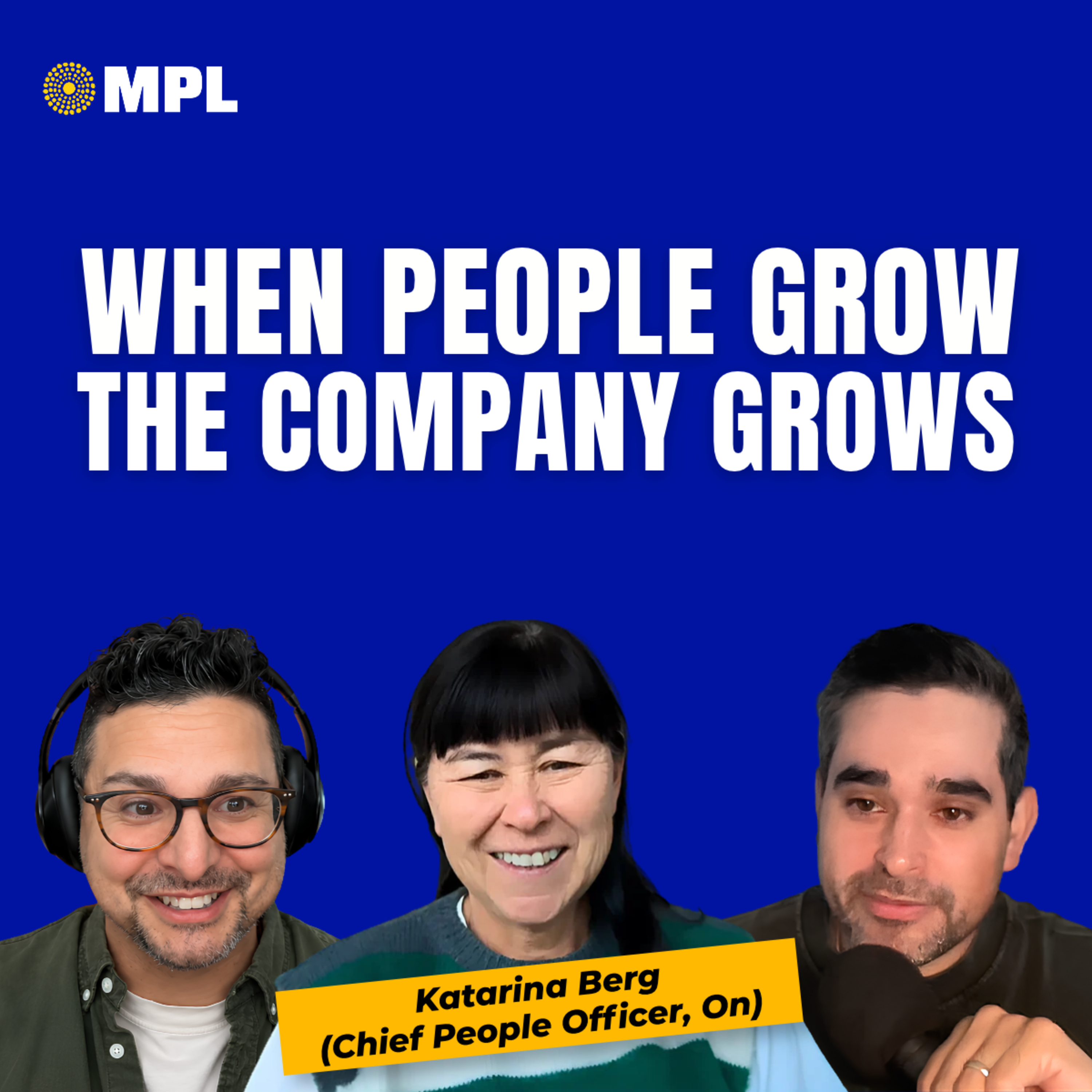
339 - When People Grow, the Company Grows: Katarina Berg (Chief People Officer, On)
In short
Performance development and growth mindset as the driver of company growth; how to set clear expectations, measure success, and manage change (including upskilling and off-skilling) without demotivating people. She contrasts “performance management” (metrics, grids, warnings) with “performance growth” (autonomy, competence development, belonging/purpose, benevolence/trust) and emphasizes leader clarity plus scalable engagement channels. She also discusses how AI and other new tech shouldn’t be bolted onto old work practices; work constructs will change gradually over 5–15 years.
Guest
Katarina Berg, Chief People Officer (On). Background: behavior scientist (master’s in HR management and behavior science), started at Volvo (HR), then oil, telco, banking/finance, retail; later Spotify (12 years) and then On (second European growth journey). She reports close founder/CEO coaching at Spotify and a culture-led, entrepreneurial environment at On.
Key claims
“When people grow, the company grows”; performance growth supports sustainable high-performing teams; clarity (“what,” “success,” “how together”) enables growth; leaders must be clear and recruit “missionaries,” not mercenaries.
Notable examples
Spotify’s “Chosen Truth” pressure-testing; On’s “spirits” culture and founder Olivier’s water-hose shoe story; On people team hackathon/AI agents for total rewards/recruitment; COVID work-from-home as an example of habit reversion and lag in rethinking work.
Written by AI. May contain mistakes.
Chapters
0:00
Setting Clear Expectations
Learn the importance of setting clear expectations in organizations.
“Actually, you can set more, clearer expectations.”
1:59
Sharing Good News Stories
The hosts and guest share positive personal and work-related stories.
“And we have a few traditions in the show.”
3:06
Katerina's Career Journey
Katerina shares her career path and experiences across various industries.
“So the last couple of months, I've felt the same feeling that I felt when we started the podcast.”
7:34
Insights from Spotify to On
Katerina discusses her transition from Spotify to On and personal growth.
“We have an expression in Swedish where we say, yeah, I kind of slipped in on a banana shield.”
11:02
Culture and Innovation at On
Exploring the culture and entrepreneurial spirit at On.
“I'm curious, for those 12 years of your life versus now at On, when it comes to the personal growth side, how are the goals different and what's the same?”
14:00
The Entrepreneurial Spirit at ON
Discover the unique culture and values driving innovation at ON.
“or was then, obviously, I don't know anything what's happening now.”
18:00
Growth Mindset in Companies
Learn how individual growth correlates with company success.
“something earlier that I want to come back to.”
22:20
Performance Development vs. Management
Explore the differences between performance management and development.
“You're just going to have metrics or a nine box or some sort of grid.”
26:00
Shifting Focus to Growth
Understand the need to prioritize individual growth over high performance.
“And don't you want to be relevant and competitive, not just now, but for the long run?”
27:00
Navigating Change in Organizations
Discuss strategies for embracing change and complexity in the workplace.
“And I think it's back to the five, if not more C's, right?”
Show all 24 chapters
28:00
Navigating Complexity and Change in Organizations
Learn about managing complexity and the importance of openness to change.
“How do you embrace almost like really embrace both polarities, dualities, because it's never either or, it's both and a lot.”
29:20
The Role of Human Qualities in Business Strategy
Explore the significance of human traits like intuition and imagination in business.
“It is about understanding that that propeller, that human growth is actually the things that you can't really replace, at least yet.”
30:50
The Importance of Leadership Clarity and Engagement
Understand how clarity in leadership shapes organizational growth and engagement.
“in my experience, there are two kind of major gotchas.”
33:45
Evolving Leadership Styles in Modern Organizations
Discuss how leadership styles are changing and what employees seek in leaders.
“Yeah, no, I think leaders are extremely important and I think they've always been.”
36:30
Building a Thriving People Team at ON
Learn about ON's approach to developing its people team through potential and homegrown talent.
“meant to push back and sometimes challenge so people can really find you know okay i'm good at this and I can do even better.”
38:10
Fostering Growth and Innovation in HR Practices
Explore strategies for fostering innovation and growth within HR teams.
“So I don't necessarily think that would be quite okay.”
42:00
Embracing Change and Learning in Work Culture
Explore how to foster a growth mindset in the workplace.
“And obviously we use Gemini or Copilot or Chattapid and whatever you're using in your company.”
44:35
The Evolution of Work Post-COVID
Discuss the lasting impacts of COVID on work structures and habits.
“heard that and it feels so true like you know I don't know if it is how fast everything is moving the speed at which it is moving it's like you know we used to talk about planning for the long short, medium, long term.”
46:39
The Future of Work and Technology Integration
Analyze the challenges of integrating new technology into traditional work methods.
“When we introduce new variables, like with technology, like we're seeing today, at the level we're seeing it, do things change?”
53:05
Rapid Fire Questions with Katerina Berg
Katarina shares insights and personal anecdotes in rapid-fire format.
“So I think there are two things to study too.”
53:33
Final Thoughts and Recommendations
Katerina recommends future guests and shares final insights.
“Question one is, what's one piece of advice that you give to somebody who's just starting HR today?”
56:00
Reflecting on Insights and Personal Growth
Katarina shares impactful insights that prompt self-reflection.
“He's not trying to make you laugh, but you just do because he says something, you think about it and you're like, that's funny.”
57:00
Priority Management Revelation
A key takeaway about prioritization in life and work is discussed.
“I'm going to go with something you said earlier, Katerina.”
57:20
Gratitude and Final Thoughts
The hosts express gratitude towards Katarina and summarize the episode.
“If everything is high, then nothing is high.”

Ask about this episode
Get the gist, explore an idea or ask about something said.
 Claude
On The Modern People Leader: Forward-Thinking HR, what are the key points of this episode?
Searching your listeningTranscript
Automatic transcript. May contain errors.
0:00Katarina Berg: Actually, you can set more, clearer expectations. And I think it's back to the five, if not more C's, right? It's about clarity. What do you want and what do you want people to achieve? So you're still very clear, right? You're consistent with what that is. That doesn't mean that you can't change because it's more consistent. What can people then expect from you? How do you see what is success? And how do we measure and how do we do that together? The third is that is compelling for a lot of people. I know I understand it's reachable it's doable but I still have to stretch which is exciting so I can't really just lean back or you know do whatever I did last week or last year then you have to be able to conceptualize so the organization okay why do we do this why do we want you to learn new things and it's not your upskilling and cross-skilling it's also off-skilling so you don't you take away the stress because when everything is widely important nothing is important You're listening to the Modern People Leader podcast, where we go behind the scenes with today's top HR leaders and work experts.
1:04We talk to them about how they've gotten to where they're at, what they do every day, and what they see coming next for the future of work. Hope you enjoy.
1:16Well, Daniel, the day has arrived. We have with us Katerina Berg, one of the GOATs and the all-time most referred person who we should talk to next over the last five years. So super excited to have you, Katerina. Welcome to the NPL.
1:35Katarina Berg: Thank you very much, Jen. Thank you for having me. And that put a lot of pressure, right? No pressure at all. And Stephen, he's not exaggerating. I think we've had at least like 10 people say that you need to be the next guest on. And so we're both very excited for today. Yeah, me too. And thank you. We have a lot to cover, though. And we have a few traditions in the show. The first is what we call good news stories. We all share a positive story. It could be work related. It could be personal. It could be both. It's a particularly good week. And we prefer for guests to go first, if you don't mind.
2:15Katarina Berg: I think my best story is when you can combine your work with something that I happen to love, but also with something that actually brings joy to other people. So I went down during the weekend to Greece to do a keynote on culture, which I love to talk about for a company that turned 90. And then they asked me how much, they actually asked me, how much can we pay you? And I said, I have a job, so you can't pay me. But if you would like to give some money to something called My Big Day, Min Surada in Swedish, that helps kids that are struggling with very, very, very tough diseases so they can actually go on and face more.
2:57Katarina Berg: And then they did. And then I saw the check and I was like, oh my God, that is so generous and so nice. And it made my weekend. Then I came into the office Monday with a smile and I'm still smiling. I thought that was amazing. That's a great one. Daniel, what do you have? So the last couple of months, I've felt the same feeling that I felt when we started the podcast. And it's because we're doing something new. We've been working on something new in the background at NPL. We've been building this community for CPOs. Nothing big, very, very, very small community. and there were 30 research interviews, there was building websites, there was creating different platforms.
3:47And so it felt like it was the first time in a while that I was in builder mode. And when we announced this, there's always the fear that it's gonna be crickets and nobody's gonna wanna be a part of it. And so far, so good. I think we are like 80, 85 % to our goal for this initial private launch. And yeah, it's really exciting. It's scary. And like I had to convince myself just to do it like four or five times. And yeah, I'm super excited about it. And also a little bit scared, which I think is a good thing. Amazing. Super excited. Proud of you. It's cool. It's cool to see what you've built. This one is a Daniel special.
4:36He's been, you know, I've supported, you know, more emotionally along the way. And so that's awesome. My good news, I'm going to stick with personal. I'm kicking off the second phase of what is an AI-assisted home improvement project. And in the U.S., we would hire a general contractor and they would be essentially do all the project management for all of the projects you have related to your home improvement. That's very expensive right now in Austin, Texas. And so I have decided, tried to take it on myself because we are new home purchasers. And so far, so good. The fence is built. It looks beautiful.
5:24And now we're moving on to paint and to testing some internal things with lighting and stuff. So super cool. And it's just like, you know, I am not a handy person, Katarina. I'm the type of, I would have either gotten lost in the research and just felt like, I don't know, just overwhelmed. or I would have gotten lost in the execution when I like run into like, oh, well, they didn't have this exact thing that I was looking for. And it's just amazing what can be done. I won't even go into it because we've talked about it at length. So that's been super fun getting to give my, getting involved in things in the household that I normally wouldn't have gotten involved in.
6:06So, well, Katerina, I call this next question the Brene Brown question who we've had on the show. And, you know, tell us your journey. You have such an impressive career. You've been at iconic brands. You've also been at very innovative brands and companies like Cutting Edge. And so how does one get to achieve such things? So, you know, share with us the ups and downs and the twists and turns. I feel like these days, Cloud and ChatGPT can get you surprisingly far in HR work. And they're great. until you need live people data or you need data from performance, comps, surveys. Then suddenly you're exporting CSVs, you're explaining the company's entire history, and you're figuring out what's actually safe to share with who.
6:53And that's the gap that Shapes is closing. Shapes basically brings that AI experience directly into the HR platform with your live people data, your org context, and your existing permissions built in. So instead of jumping between systems, people teams can build things like a flight risk dashboard, a reorg simulator, a calibration grid, or a completely custom workflow or visualization. You just describe what you need and Shapes builds it from the people data that's already there. It's kind of like Claude and your HRAS had a baby. If you want to see what this actually looks like in practice, go book a demo with Shapes.
7:31You can find a link in the show notes.
7:32Katarina Berg: Yeah, first of all, you're quite lucky. I think timing has a lot to do with it. We have an expression in Swedish where we say, yeah, I kind of slipped in on a banana shield. And I think that's been my career. I'm a behavior scientist. That is what I did. So I have my master's in that, in HR management and behavior scientists. And I'm coming from a very small village outside a quite small city in Sweden called Gothenburg. and the city is called Tuschlanda and it's actually more famous because Volvo is made there. So my first HR job back in the days were at Volvo. And then I realized the company was big and doing good and most likely I could stay there and retire there too.
8:15Katarina Berg: But I went from there to oil industry, from oil industry, see if I get this right, to telco, right? From telco to banking. Oh, I forgot. I was a discovery in between there. So it was media and then telco and then bank and finance. And then I went very short into retail. And then quite famous man today called Daniel Ek, very young at the time. He's still quite young. knocked on my door and we started to engage and I realized that that was most likely the best HR job in the world but the timing was off so I said no once and then he came back and said okay I hear you do you have names I gave him 10 names and then he came back and said thank you for your help interviewed them very interesting and do you know want to know who it is and I was like can you share and he said yes it's you and then I said okay thank you but still timing off and then we met and then I signed and I can't be happier for that and that was 12 quite exciting very much about personal growth and company growth it was fun it was exciting it was really going from startup to to a scale-up international to a scale-up globally to a mature company to today a great business and then I always said a couple of things one you cannot just sit and rest and vest and two I'm passionate, curious about things.
9:44Katarina Berg: I thought I at least had one more good growth journey in me. And I also think that successful plan is really important. And in my role, in the role as a CHRO or a CPO, can't really say things to their organization and not necessarily practice what you preach. So I had a couple of people that I found, I groomed, and hopefully I mentored and coached. And then I said to Daniel, when I leave, I think you can, depending on, I think they're all really good ice cream, but there's like vanilla, there's a pear and there is for sure a strawberry. And depending on what you think the next kind of leg or stint for the company is, you can pick and choose.
10:23Katarina Berg: I have one that I think is more ready. And then it was time to hand over. And this is when I knocked on my door. And it is something, I think, being European myself, that is quite nice and exciting about. But there's so many great companies that has been and become and are still kind of unicorn and iconic coming up from US and from China, but not that many from Europe. So now to be on my second journey here on a European company that is taking on some of the big, big, big players with great brands and great journeys and quite early, it's just too good to be true. So you mentioned that Spotify, there was obviously the company growth, but there was also the personal growth.
11:07I'm curious, for those 12 years of your life versus now at On, when it comes to the personal growth side, how are the goals different and what's the same?
11:19Katarina Berg: I think personal growth came very much in the relationship with the founder and the CEO, Danny Lick. I think he's brilliant in so many ways. He's ultra smart. He's a very good listener. I think he's bold, but also humble. As the Swede he is, he's also quite introverted, but more or less like five to six kind of freeways at the same time. And usually I could really kind of, I understand up to three, maybe four lateral thinking. And then at five, I sometimes think like, okay, wait, I can't bring back for that tomorrow. And then you have to say that again. Also in the space of what today is not new technology.
11:58Katarina Berg: Today, everybody's talking about AI and they implemented LLMs and it's authentic this and, you know, automizes in that. But Spotify was built on that and the company just turned 20. So it was a lot of new ways of thinking. and with a lot of visions like that, with somebody that is never kind of complacent and always leaning in, there's a lot of things that you could do yourself if you're interested to do that. You can really poke the bubble and you could also check if you're chosen truth because they're usually chosen, but you go like, no, you cannot do that or label or says this or let's hide by that.
12:36Katarina Berg: And it kind of gives you some sort of comfort. with a man like that as your closest manager. I think you have to be on your toes. You have to run. You also have to sometimes slow down and you have to find that pace. So all of the people in the organization also grow. And I think I've been saying for a long time that when people grow, the company grows. And when people are doing well, the company is doing well. At Spotify, I could actually really pressure test that and see if that was okay. and if that could be part of the business idea. So again, being, you know, very much product driven and platform first never became, you know, people lost.
13:18Katarina Berg: And I think I thought that was really, really cool, but it meant that I needed to mentally stretch myself. And as I said, pressure test a lot of things and then throw out Chosen Truth, which was very, very cool, very, very nice. And to do that with what I thought was a great team. And so fast forward to today, you're now at On. I've read like the shoe dogs and books like that. And so in my head, that's what I imagined it being like working at, you know, one of these 10 companies, maybe there's more, but it feels like there's like 10 big shoe companies. What is it actually like to work at On? I think what brought me there, so leaving a culture that is admired and rightfully so, or was then, obviously, I don't know anything what's happening now.
14:05But it was very important
14:07Katarina Berg: to kind of find something that you can't describe and you can't really touch, but you know when you step in. And it was so clear when I talked to a couple of very exciting and very successful companies that I didn't feel that. But when I met the three founders at ON and I met a couple of other people and some people from what became my team, I was like, OK, yeah, there's something here that is really kind of leaning in very much still entrepreneurial kind of spirit, very innovative. The Swiss engineering, too, like almost we will not do it if we can't disrupt the space. We will not go into a vertical we'll not just do another pretty good shoe we will do it our way I thought that was really nice and you don't kind of rest on your lures and you do it together very spirit-led we call it spirits like value-driven company and what keeps it real is I think first and foremost one of the founders Olivier who is an athlete himself and actually also very much the person that sparked the idea and tinkered with his shoes and the famous story of the water hose to try to get like a very kind of distinct soft landing and then a very fast push off to prolong his career, also do better, but also get that feeling of running and especially if you are in endurance sports.
15:40Katarina Berg: And I think everything that they said also was true when you come in there. So I think that is very much part of what it is. ambitious, hardworking, very nice people. It's very Swiss in many ways. I think it's very much good idea. It's a good idea. It's quite consensus driven, I would say. Growing up and also dare to stop doing things that we did before. I think everybody is also understanding what really got us here was many things, but not pure luck, but it will not necessarily be the things that will get us there. So trying new things, being open for new ideas and very welcoming for people like myself coming in.
16:23Katarina Berg: But also, you know, they know and they should be proud of what they've done in a very short while. I think a mix of that. And it is, yes, to your point, it is a busy space, but not necessarily if you do it your way. And there is also, I think there was a position that was waiting for us which is kind of the premium segment so a lot of fun things to do and i think the most important thing for me a lot of learning opportunities again so amazing yeah and you're you're obviously onto something market-wide like you know the the brand has done extremely well specific to our family i joked with daniel because we're sneaker heads and we're we would normally say that we're checks over stripes so we are Nike fans I also love Adidas but I've changed my my loyalty over time and I saw Daniel's younger brother who's three or four years younger than Daniel I'm a little older than all of them and I saw Daniel's younger brother and he was I remember him being a Nike guy and when I saw him it was all on it was like clothing shoes and I just remember thinking to myself ah when you see when you see something like this this is subtle a small change could be a small change for Mateo personally but it also kind of represents what I think is a big change just in the market and where things are going and so super cool we have we could spend all day talking about sneakers and going deep on on but we were here to talk about you and you said something earlier that I want to come back to.
18:05Hopefully I'm not butchering this, but you said when individuals feel good, the company does well. And when people are growing, the company will grow. And I love that. I've used different words to describe it, but very similar. But I very much believe that to be true. And Daniel and I, the last couple of weeks, we've kind of had like a Roback. We've talked about inclusion. That's something we literally haven't talked about in years. We used to talk about all the time. A couple of weeks ago, we talked about remote working. So these things that were once very, very, that were very much trending and no longer are, another thing was talent development.
18:45How am I growing? And what am I actually doing here at this company? How is this bettering me and where I'm going to go in my career? What I love about about what you said is it started with when people are growing, the company is growing. And I think that's the right sequencing. And so you also said in our prep that you have a very specific view on performance. And so I want to start there. You know, your focus, you believe that the companies that grow tremendously and accomplish the goals that want to accomplish have a performance development mindset and not just a performance and management kind of rhythm, for the lack of a better word.
19:29And so I want to start there. How do you differentiate and what is the difference between the two from your mind?
19:35Katarina Berg: I think it starts with the four Ps, right? It's usually people, it's product, it is planet if you are a global citizen and think about your company or enterprise like that. And then it's profitability. And I think a lot of companies, especially when the competition is fierce and also you may be talking quarters and because you have earnings, you know, conversations. And I think if you just zoom out a bit and you think about it, and not just because I'm head of HR or I actually think that people are making the difference in an organization, no matter how you interact with technology, you can't really do anything with the product or for the planet or with the profitability if you don't have great people.
20:21Katarina Berg: It's just very, very hard. And then if you then can make sure that you then have high-performing teams that are sustainable on a high level, obviously the correlation is if these teams can make, they will make the product better. When the product gets better, hopefully you also then are profitable. And if you then are a global citizen, you will also think about the planet. And that is kind of the three things comes as a result of you double down on people. Then I think a lot of companies, and I think more so in some parts of the world, but in general, been talking very much about people or performance management.
21:00Katarina Berg: And if you just look at it and not just think about it as a semantic exercise, if you're managing people, there are a couple of things that you usually kill and you kind of implicitly demotivate people by managing them. One, because universally, I think there's so many researchers that says it could be different change the word, but some sort of autonomy. Any modern person likes autonomy, right? To competence development, it is implicit in us that we want to grow. We want to learn. We want to, we have a growth mindset. I think very few people would believe in a fixed mindset today. So how do we get out of the way of the children that is growing and learning or the team members in your organization?
21:44Katarina Berg: And then most people also want to be part of something or leave something that is bigger or better or greater than when they joined. And then there is a bit of benevolence, right? Values or trust base is also very important and that you not just work for profit or money, that the company has a purpose and you're part of that. So if you believe in that and that is universal, it's not like, oh, that's what it looks like in Europe, but not in the US. Or that's what's actually motivating people in China, but not in Korea. It is quite universal that these four things are very, very important for the drive of human beings.
22:21Katarina Berg: If you just put that to paper and then you go people management, and then you think that you manage them to get more performance and higher or better deliverance and that people will go the extra mile, I think already there you hear that's not going to happen. You're just going to have metrics or a nine box or some sort of grid. And then you will try to push them up into the system by telling them or measuring them or sometimes give them a warning. I don't think that really works. And I think we have tried that in many, many companies. And it's not like it does not work. But if you then flip and go into performance development, we call it performance growth at ON, and you go, okay, if we truly believe that people have a growth mindset.
23:09Katarina Berg: and that if you also believe that proud people perform and you know that you don't want to kill that thing that is like you being passionate, curious about something and when you think it's fun, you usually get really good at it. If you then just have a system and you build that and have a kind of a bit of, you know, like a method to the madness, then all of a sudden you have individuals grow and they're not going to grow like separate plans. You make sure that they grow as a team. You make sure that some of the measurements and metrics you have is more on a team base. Then, of course, you will see the chain of people, product, planet and profit kind of flow.
23:53Katarina Berg: I don't think it's much harder than that. Then you will sometimes have the resistance. You will have a couple of people that are old school. You will go like, oh, so you mean that we're going to let people free? No, no, no. People are smart. Everybody wants to contribute, But the thing is, you have to be clear on what the North Star is or what the mission or vision is or what the annual goals are. Then you give them a mental paddock. And then obviously their role should be clear because when the why is clear, the how is easy. That's easy. And then you see them grow. Then you coach them, you nudge them a bit.
24:26Katarina Berg: But you don't do that necessarily because you want to manage them. You do that because you see their full potential and you want to see them thrive and go there as far as they can do. And then you want to be sustainable because the company is going to be there next week, next month and next year too. I think you find those levers and you play them. So this is where I go. The companies that don't necessarily understand that or that now when we have a bit of a shift that I don't believe is a tech shift, but it's very much change management. It's very much a mindset shift. And then it's very much again, And kind of the correlation between man, people, places, depending on what you work, and also technology.
25:11Katarina Berg: If you can get that triangle to work very good together, then obviously you will have people that will be relevant and make sure that they take care and drive their own development. So they are employable also in the new system. This means that you can also give it to them to be responsible. So if you have downsized your L &D or whatever department you like to call it, and then say that, ooh, now we're going to double down on technology, I don't think you have understood what we are going through and what you are doing. And you're for sure not helping your people. But I don't think you're helping the business either.
25:48Katarina Berg: Short term, you might be, okay, we saved a lot of money because we have fewer headcounts now. But is it the right headcount? And two, what type of behavior are you driving? And don't you want to be relevant and competitive, not just now, but for the long run? And here, I think it has to do with how do we attract? Same old, same old. How do we grow? And by growing, you retain. It's not by adding more money, right? I think it's very simple. And I think it's a very clear ecosystem here. Yeah, this is for our production team. That's a clip right there. That was amazing. Yeah, I mean, there's so much that I think we could dig in there.
26:33I feel like what I'm hearing is we are now in this world where every company is about high performance and being more profitable and, you know, better margins, being more efficient. and like that's great when the focus should be more about like instead of everybody needs to be a high performer it should be everybody should be growing like that slight reframe am i am i
27:03Katarina Berg: hearing that right totally i mean it's almost like there's some cadence of where you follow up what you do so i'm not talking about like a pampering system i'm not talking about like oh let's just feel what we want to do it's not about that it's actually you can set more clearer expectations. And I think it's back to the five, if not more C's, right? It's about clarity. What do you want and what do you want people to achieve? So you're still very clear, right? You're consistent with what that is. That doesn't mean that you can't change because it's more consistent. What can people then expect from you?
27:36Katarina Berg: How do you see what is success and how do we measure and how do we do that together? The third is that is compelling for a lot of people. I know, I understand it's reachable it's doable but I still have to stretch which is exciting so I can't really just lean back or you know do whatever I did last week or last year then you have to be able to conceptualize so the organization okay why do we do this why do we want you to learn new things and it's not your upskilling and cross-skilling it's also off-skilling so you don't you take the stress because when everything is widely important nothing is important so how do you teach people two things I think is very important today.
28:18Katarina Berg: How do you embrace almost like really embrace both polarities, dualities, because it's never either or, it's both and a lot. So how do you help people navigate that complexity? And the second thing is obviously, how do you also understand that change is a constant? Everybody says that, everybody understands that, and some people also lie and say, I love change. You only like change that you instigate yourself. And in an organization, it's usually somebody else, right? So how do you do that? It is by telling people that you need to be open-minded and we owe it to you to be open and transparent and explain why we're changing.
29:00Katarina Berg: But you owe it to us that you are eager to learn. And we're going to give you that smirkels board of things. And then we're not going to see that as a cost. We're going to see that as an investment. And you come and grow with us. And the other side of the deal is we take care of that growth. So you will have a job today and tomorrow because things are changing. So it's not nicer. It's not relaxing. It is about understanding that that propeller, that human growth is actually the things that you can't really replace, at least yet. And I see in a very close kind of overseeing type of time of the things that still that technology cannot replace.
29:42Katarina Berg: It's like the instinct, right? It's the intuition, it's the imagination, it's the identity, it's integrity. And it's not me talking about those eyes, it's actually Joelle Kasse that usually refers to that, what can't be replicated yet. I think a lot of other organizations loves to kind of echo human judgment. What the freaking frack is that? And common sense is not that common anymore. So I'm kind of not necessarily applying to that. But I think these eyes are telling the things that we all know is very human. And they are very important to infuse in so many parts. So I think that's really kind of a philosophy.
30:24Katarina Berg: I think it's a business idea. And I think for sure it's part of the business strategy. I would argue that maybe 15%, probably closer to 10%, only 10 to 15 % of the top organizations are getting this right or able to kind of capitalize on this business strategy. Because I agree, it is 1000 % a business strategy. in my experience, there are two kind of major gotchas. The first gotcha is at the top, because I think this has to start at the top. There's singularity here. The person who is leading the charge, the ultimate decision maker at the company has to have immense clarity here. And you said, you have to answer the what, what do we want people to do?
31:17And how do we want them to get there. And I have seen leaders, I have been part of the leadership teams that have just struggled. And again, we get bogged down, we get too caught up with the words that philosophically we can't align. And the second part where I've seen this is assuming the clarity is there and you know, the direction has been set, then the next gotcha is at scale. And like having the institutional channels, for the lack of a better word, to keep everyone engaged in this business strategy, you know, all the time. And it may not feel like it's all the time, because I may just be getting a nudge here and a nudge there.
32:05But there are things that contribute to this kind of growth mindset probably happening every day. And so any thoughts or comments on either two, the importance of leaders at the top and getting that clarity and alignment, and then kind of further downstream at what channels need to exist and what that looks like. You know, we hear all kinds of stories in the podcast, and I'll never forget the story that was told about a Mexico Beach FMLA backfire. One of their employees was out on approved medical leave and then somebody spots them on Instagram. Feet up on the beach looking a little too okay for someone supposedly recovering.
32:51So cue the call from the CEO wanting to pull their leave and all of the panic that followed. But here's the thing. There's actual legal precedent that says a photo isn't proof of anything. You can't just yank somebody's protected leave because of how a vacation pic looks. You need real evidence. And that's a trap a lot of HR teams fall into. Making a compliance call based on gut instinct instead of actually knowing the law. And that's exactly the gap 650 has built to close. 650 helps teams manage compliance across the full life cycle, from handbooks and policies to agreements, legal updates, and research.
33:27And their AI-powered Research Center gives you a way to ask employment law questions in plain English so you can better understand what applies and where. Because compliance calls shouldn't be made on gut instinct. They should be grounded in real legal clarity. For those of you that want to learn more about 650, go to the link in the show notes and let them know we see.
33:45Katarina Berg: Yeah, no, I think leaders are extremely important and I think they've always been. I don't necessarily always invested in them and I sometimes also think that we recruited the totally wrong ones, but I think they are crucial. I think they are key. And I think especially in the paradigm shifts, they are very, very important. And not necessarily the hierarchical leaders. I think the leaders that will actually bring people along and make them kind of, okay, let's try this. Let's really, like the leaders that has the followership. Don't get me wrong, though. That very old school, there's a leader, he or she is a he, points and tells and kind or micromanage or are not necessarily open or transparent, that works too because it's clear.
34:31Katarina Berg: But the thing that the people that work there, they're either there because you kind of overpay them or that they think that they will not get a job anywhere else. So are those the people that are you looking for now when competition is fierce no matter what business industry or where you are? The second thing is, I think you have to also talk to yourself. Are you looking for mercenaries or missionaries? And neither is wrong. So it works. Both systems work. I think when you get caught in the middle and you get wishy-washy, then it doesn't really work. So you will have, you know, the hierarchical old school.
35:10Katarina Berg: There's one leader. He tells everything. Then people kind of do. And it's kind of here. You have a piece of the cake. You eat that. You come back. I give you another one. That works totally well. I just see fewer and fewer, especially the new generations that actually think and act in a way that my generation didn't. And God bless them. I think they are only reacting the normal way where they're not necessarily just grateful to have a job, but they go, I don't want to be talked to that way. And two, why don't you enlighten me the whole vision and what we are doing here? And then maybe I can contribute.
35:46Katarina Berg: And I don't want to go the long way and wait like 20 years before I can have a say at anything. But does it work? Yes. And I think there are also institutions that needs to work like that. I don't think necessarily if you are in the military, everybody can sit down and have a kumbaya meeting or like, what do you think? Do we do this today or tomorrow? It is somebody needs to decide. But then you practice that. most companies that will want to thrive and be here for more than you know 10 15 20 years to become the real new icons that's been long and never really like lean back then i think it is very much about leadership how do we really make sure that we scout and attract how we grow meant to push back and sometimes challenge so people can really find you know okay i'm good at this and I can do even better.
36:41Katarina Berg: But how can I also pace myself? Because you can't really always walk the extra mile. You need to recover. And I think what we have learned, especially from top athletes, and most of us are not in an organization, but you can put all those training or practice hours in, but if you don't eat and you don't rest, you don't become better. And I think that's the same thing. You can't have like one person thinking for everybody and telling the rest how to do things. I think, I think just you're going to attract the wrong people. You will for sure keep the wrong people. And I'm not really sure if anybody believes that that's going to be a success for a long time anymore, because too much have changed.
37:26I'd like to maybe zoom in to the people team. And so we've talked about this idea of performance growth at ON and what that looks like and how that plays out across leadership and how it looks different than the leader who, as you were saying, is pointing and telling, not being transparent, and maybe looking for more of mercenaries and how at ON you're looking for missionaries. And so paint a picture for me. what does this look like on the people team? And if you have any good stories that you can share, then even better.
38:06Katarina Berg: So I can't really take cred for the great thing because I haven't only been there for a year. So I don't necessarily think that would be quite okay. But what I think what On has done, both for the people team, but for the teams, been recruiting very much on potential and done so really well. Believe in homegrown and recruit from within. But a certain stage, which was early this year, decision was made quite late last year, was to bring in a couple of strategic tentpole hires to really elevate people. So not to have somebody fly in and get like a pool position, more so actually an investment in the people that are there.
38:49Katarina Berg: And I think that goes for, if I then zoom in on the people team, I think it's the same thing for my team. Great people, very ambitious. hungry to learn and do very fast. And already when I got there, had, and it is a strange word, but institutional knowledge kind of understands what makes on tech and also what we need to do. But you need to level up, right? And you need to raise the bar all the time. And I think we've done that. So for me, I brought in a couple of people, but not in all of course positions. And what I see has happened with these teams are that a couple of people that they would still have peaked because they're great, but it would have taken them two, five, 10 years to peak.
39:34Katarina Berg: Some of them are already doing so much more in a smarter way, but also with a mix of, I see this with new greenfield eyes together with this experience of my, with my leader. And it's just, see, it's just cooking, boiling. And now I think they might have had HR acumen before, but what I expect from all my teams that they have as much business acumen, if they're going to support an organization, it's not like they need to spend time. It's not even they need to sit with. They need to understand exactly what that part that they are supporting from an HR standpoint, what they do and who is there and how we should be organized and how we shift the load from the left leg to the right.
40:21Katarina Berg: just before we do it in org design or ways of working or how do we adopt the new technology? And therefore you need to have both. I don't run teams that are only HR heavy and I can't have people that 100 % are, okay, now I identify with the business part that I support because we do have and we do play when we do our best job a bit of a different role, which means that if you're going to challenge things and sometimes you know and if you're part of a family if I use that now even if I don't believe in that metaphor but if I just use this for this example if you're part of family you don't hire and fire family right and you get maybe frustrated annoyed with family but you don't do that in a company it is more like that you know sports team it is a bit of transfer window sometimes it is a bit about okay there is somebody that is a bit better, but let's see if we can build the team.
41:22Katarina Berg: It is a bit of, you know, people come, people join. Sometimes they decide that themselves. Sometimes somebody decide that for them. How do we do that in a smart way? And how do we make sure that we really create that and foster that culture where we can grow and keep as many as possible? And I think this is where the people team is now evolving into. And it's just, I just had an HR summit and I got emotional when they presented on what they've been working and building. Also when we did the hackathon or agenton of building agents and applied AI rather than, oh, we try a bit here, we do this and we put our toe in.
42:04Katarina Berg: And obviously we use Gemini or Copilot or Chattapid and whatever you're using in your company. No, no. How can we build something quite complicated? And I already now know in my head what the end product would be for total rewards or for recruitment or whatever team they were. And then they start to prompt. And then the product they demoed, I guess, a couple of hours later. For some people that never, ever tried and thought that the threshold was a bit high. That is amazing to see. It's amazing because it does all the things that we've been talking about. it is how do you make sure that you tease that curiosity to how do you take away that i'm not an expert today but i could be that eagerness to learn and constant learning faster than the world is moving and changing and how do you make sure that you are relevant and who is closest to that yourself well the company has some sort of obligation but you have some more so how do you make sure that you do that in a very structured, but not overly structured, in a teasing way, but also that you challenge people of, why don't you do that?
43:12Katarina Berg: Try it. And then when things go wrong, most important, that you talk about not how stupid people were that made the decision, or how we wasted time or money. You talk about what is the learnings? What did we learn from this? right and one learning could be let's not do it again but most of the time it is okay that's really smart okay if we don't do that or at that time with all the data sets in the world with all the insights with our experience and intuition it was actually the right call but everything moves quite fast now we know it wasn't and then to just debate and discuss or point fingers doesn't really move anything if you focus on no matter if it's a quarterly earnings report or whatever it is that you have or quarterly business report or if it's just you know end of the year mental books like what are the learnings and i think that needs to be the thing you can't just say that you have a a growth mindset or you have like performance growth rather than a management everything like a red thread has to be thought through how do you build this so it's part of your culture I'm a huge soccer fan football fan and so I love the the transfer window analogy and I'd never heard that and it feels so true like you know I don't know if it is how fast everything is moving the speed at which it is moving it's like you know we used to talk about planning for the long short, medium, long term.
44:50And we would have cascading plans that would align with all of that. And now it's like, what do you, you know, short, medium, long term, it's like, what is what are the next three months going to look like? What are our needs? What are the gaps on our team? And it's like, okay, you know, what we thought we needed in the summer transfer window is actually, you know, we're a couple months later, and, you know, circumstances have changed that we, you know, for January transfer, we need something totally different, like it just feels super relevant. The interesting to me, if I knew that I was going to be a podcaster for five years and spent a career in HR, like solely talking about these sorts of topics, I would have chosen IO psychology or like a different major in college because behavior, you know, the science of behavior, like, and that fascinates me.
45:41And I've realized over the last five years, the conversations I enjoy the most are those with individuals that have this behavioral science background. And I think it's fascinating to have just heard you for the last almost hour talk us through kind of the levers that you have or levers that you have to make change, how you make change. There's no right or wrong. Like there are lots of things I'm going to take away from this conversation. Today, the only difference, though, today is we're introducing new variables into work, and the construct of work itself is changing. And we don't actually know what it's going to look like going forward.
46:27And so given everything you just shared with us, I felt like I needed to just kind of dig into this a little bit. I'm just curious, Katerina, like how much like as you, you know, plan for your team and for yourself and you spend time, you know, in space, you know, thinking about like your own tactics and how you want to approach certain things. What is changing and what do you feel is changing and what do you think still remains from kind of this historical way of working in which we're looking at behaviors and we're looking as it relates to work and there are certain factors that we have at our disposal to drive the outcomes we want.
47:11When we introduce new variables, like with technology, like we're seeing today, at the level we're seeing it, do things change? I guess I'll start there. Do you think things change or do you think the tactics remain the same?
47:24Katarina Berg: I think they do change, but I'm going to give you an example in quite close time and how much the resistance in the human being is. So we all experience in slightly different ways, but very much firsthand COVID, right? and we all then worked from somewhere that was not going into an office but for the longest time in like in history we all went to kind of a farm and then we went to a factory and then we went to an office and then there's obviously a slightly different but you you know where I'm going with this and then for a while there maybe for two years depending on what company and what job you had, you work from home.
48:11Katarina Berg: And then it opened up and it was safe again and we could go back. And there were so many companies like, oh, we have a hybrid. We introduced work from anywhere at Spotify. And then a couple of companies said, no, we need you to come in five days a week. And everybody had different arguments. Some were really old school, back to your question, and how much really changes fast. And some were made sense. Like no matter if it was three days, four days, five days, it made sense because maybe it was a company like ours, you work with fabrics, you put things together. Obviously, you can't do that from home.
48:48Katarina Berg: That's going to be very, very strange, right? And if core business is there because they need to be there and they touch things and see how it drapes and they cut things, then the people that support these people will also come in. But that is not controlling. That's not trusting issues, right? It's more of, okay, this is the type of business, this is the industry, it makes sense. But then there were other companies that said, you need to come in because we just think productivity has gone down and you never know and are people working from home and all that. And then you had the pure, like 100 % digital companies like, no, actually you can work from anywhere.
49:23Katarina Berg: So you have that mix. But boom, here we are just a few years later. And what did we learn during COVID? And even if it worked for every organization more or less for two years, most companies are coming back to the office. Is it only because of mental health or if it's trust issues or if it is, or is it creativity? Do we also prosper from getting together and see each other in the eyes and the energy? We don't really know. We haven't put that much research into it. I think we can see, and some of us have done that in our offices. But I would say it's very much habits. It's easier for leadership.
50:07Katarina Berg: And if senior leadership founder or CEO says, I think it's easier to foster culture and to manage people when they come in, then that most likely will be the rule. It's not necessarily the nature of work. Long-winded answer of, okay, so everything is changing. like everything, everything that you can build, everything. But we haven't really changed the way that we are working. We're trying to apply this new technology into old ways of working. And if I would sit on somewhere and not have a job or be retired, I would almost say it's quite cute because it's like, what are you doing? It's almost like, why would you do something old way with new technology in any other area, especially if you pick up the technology yourself.
51:00Katarina Berg: So here I think it's kind of a lag and not technology the way that we waited for, you know, the different zooms or meets to kind of be good and you can go into rooms and you can do whiteboarding. Not that type of technology. I think the lagging is we are not applying it in a new way. And some technology is also built or some AI features or apps are built because of the sake of technology rather than who's going to use that and what is the use case really, except for, oh, look, this is very cool. See what we can do. So do I think it's going to change everything? Yes. I think more or less everything's going to change.
51:39Katarina Berg: Will that take longer time? Yes. Yeah. It felt like with COVID, it forced us into this new way of working. Like we didn't have a choice. as you said people don't like change but the change was forced upon us and it feels like there hasn't been the same forcing function yet like there's nothing to force us into rethinking the construct of like a five-day work week or or whatever it is like the million different things that we just like assume to be true for what it means to work so thanks And as soon as pressure or that scare, like the fear of the disease by itself or the virus, when that was removed, most of us popped back to the habits.
52:27Katarina Berg: The only thing that didn't really go back was the freedom and flexibility that people got used to. So again, oh, I like the candy, but I don't want to go to the dentist, right? So it's very much that. And I think that's what we see now too. But I think I see a divide a bit. You go a bit more to Asia, even if Asia is like a clumsy, but you go to China, you go to all these countries and it's much more applied AI. And then you go more to US and it's very much technology for the sake of technology. See what we can build, see what cool things and see how fast. Yeah, but who's using it and what is it improving for life, for your being or for the end product?
53:07Katarina Berg: So I think there are two things to study too. But I think the short answer, it will change everything. But it's not happening tomorrow. It's going to be a slow, gradual change over the next 5, 10, 15 years. Well, Katerina, thank you so much. We only have a few minutes left. And I know you have a hard stop. So we're going to go into rapid fire questions. We ask the same set of three or four questions to every guest that comes on. Question one is, what's one piece of advice that you give to somebody who's just starting HR today? I usually don't give advice. I usually say, congratulations. This is the most fun job you can do.
53:47Katarina Berg: And it also makes a difference. You will have impact. Next question. If your team gave you a superpower nickname, what would it be?
53:56Katarina Berg: Oh, superpower nickname. This is not a nickname. So maybe Speedy. I think they sometimes think I go too fast. I like that. What's a strategy or practice from another company that you would love to steal? Right now, I think Atlassian and Avani, if you haven't talked to her, you should talk to her, CPO. I think she has a role that is similar to the one I had at Spotify, where you have IT, you have a couple of different things that is people constituents facing, which means that the mindset shift and also having new ways of working applied more than just gazing yourself blind on technology. I think that is where they are ahead.
54:40Katarina Berg: And I think she and what they do, not necessarily their products, that too, and she most likely would say it's the product. I think the way that they are open and applying and that they have the person of transformation coming out of HR and not from technology, I think it's like spot on. Well, that may have you may have given us a double answer to the next question, which we referred to earlier, because this is where you have been referenced so many times. The last question is, who should we have on the show next? Like if there's someone who, you know, deserves a platform that, you know, the people need to to hear, who would that be?
55:18In addition to Avani, because we have not had Avani on the show.
55:21Katarina Berg: So Avani, and then if you haven't talked to Sergio Zama at Netflix, I love him. He's so unapologetic. He's a good friend of mine. He's also a straight shooter. And he dares to say the thing that I always love, and it cracks me up when he's like, I'm a half glass empty person. I think everybody, when you use that metaphor, they always say I'm a half glass full type of person. I think he is a truth teller and he's a gentleman and I think he's refreshing to talk to. And it sounds like he'll make us laugh, which is always a plus. Yeah. But he's not that obvious. He's not trying to make you laugh, but you just do because he says something, you think about it and you're like, that's funny.
56:12My older brother has a personality that's similar to that. and he's like unintentionally funny, but like, I think he knows he's being funny. So yeah, we would love to have Sergio on the show. All right, final tradition is one word or phrase close. So a word or a few that are coming to mind for you as we wrap this up.
56:32Katarina Berg: A good idea should always be a good idea whoever comes up with it in any organization. I'm going to say mind blown. I feel like, yeah, there's some episodes that kind of like push my thinking a bit just because the way that something's being explained is just like a little bit different than everybody else. And I'm going to be processing for the next 24 hours. So it was a good one. Thank you. I'm going to go with something you said earlier, Katerina. If everything is a high priority, nothing is a high priority. I'm in a situation in life where I feel like everything is a high priority. Literally today, right now, I need to go do all these things.
57:17It's like, wait a second. Katerina just said it. If everything is high, then nothing is high. So maybe I should sit and think about that a little. But thank you so much. This has been amazing. It was well worth the wait. Sorry we bothered you over the years so many times to join us. But we knew it would be it would be amazing. And it absolutely has. So thank you, Katarina.
57:41Katarina Berg: It was my pleasure. And I now sit here and wonder why I made you wait. But it was because I was busy. I've always wanted to speak to you. And I'm now happy that we did. Thank you very much. Thank you. Bye. Thanks for tuning in to another episode of the Modern People Leader. We really, really appreciate it. And if you enjoyed the show, please leave us a five star rating. It would mean the world to us. And connect with us on LinkedIn. We want to know what you think about the show. And you can find links to both of our profiles in the show notes. Thanks again for listening and see you on the next episode.
From the publisher
Katarina Berg, Chief People Officer at On, joined us on The Modern People Leader.
We talked about her journey from Spotify to On, why performance growth is more powerful than performance management, and how people, leadership, curiosity, learning, and AI will shape the next era of work.
----
Sponsor Links:
MPL Links:
----
(08:15) Succession Planning and Practicing What You Preach
(10:15) Working With Daniel Ek and Stretching Her Thinking
(11:00) Pressure Testing HR Truths at Spotify
(11:45) When People Grow, the Company Grows
(13:05) Finding a Culture You Can Feel When You Step In
(13:35) On’s Entrepreneurial Spirit and Swiss Engineering Mindset
(18:30) Performance Development Versus Performance Management
(19:15) The Four Ps: People, Product, Planet and Profitability
(20:45) How Performance Management Can Demotivate People
(21:15) Autonomy, Competence, Purpose and Benevolence
(22:10) Why Performance Growth Works Better Than Performance Management
(23:00) Proud People Perform
(23:40) Giving People a Clear North Star and a Mental Paddock
(24:30) Why Growth Is a Business Strategy, Not an HR Program
(25:10) Why Downsizing L&D Misses the Point
(28:00) Upskilling, Cross-Skilling and Off-Skilling
(29:15) Why Learning Is an Investment, Not a Cost
(29:45) The Human Skills Technology Cannot Replace
(32:20) The Importance of Leadership in a Paradigm Shift
(34:00) Mercenaries, Missionaries and Why Both Systems Can Work
(39:15) Why HR Needs Business Acumen, Not Just HR Acumen
(41:15) The People Team Hackathon and Building Agents
(43:10) Focusing on Learnings Instead of Blame
(50:15) Applying New Technology to Old Ways of Working
(51:15) Why AI Will Change Everything, But Not Overnight
----
📬 Subscribe to our weekly newsletter to get episode recaps
💡 Follow The Modern People Leader on LinkedIn
😊 Follow Daniel Huerta on LinkedIn
😊 Follow Stephen Huerta on LinkedIn
----
Past guests on MPL include Brené Brown, Annie Dean (VP of Team Anywhere, Atlassian), Josh Bersin, Katie Burke (Chief People Officer, Harvey), Liz Fosslien, Helen Russell (Chief People Officer, HubSpot), Dave Scott (Chief People Officer, ADT), Melanie Rossenwasser (Chief People Officer, Dropbox), Crystal Boysen (Chief People Officer, Sprout Social), and many more.
More from The Modern People Leader: Forward-Thinking HR
All episodes
We use cookies.They keep VO running smoothly and help us improve it. Privacy policy