
 Ask ChatGPT

 The Ruck
15 Aug 2026 · 12m · 5 chapters
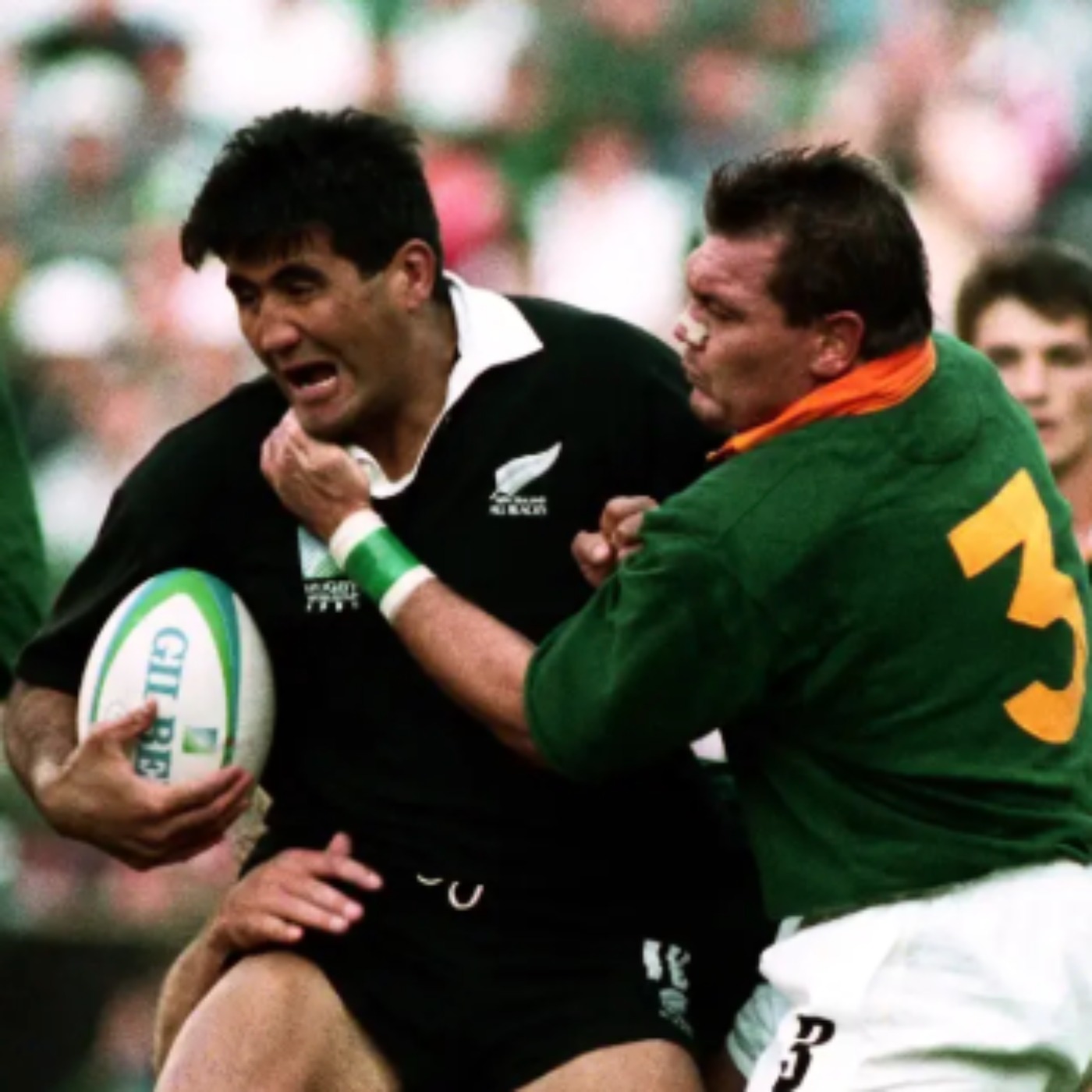
Rugby’s Greatest Rivals | Episode 1: Consider your country at war
In short
The South Africa–New Zealand rugby rivalry as a battleground shaped by racism, war, and politics, beginning with the first post-WWII test and tracing earlier racial controversies.
Guests/backgrounds
Jamie Wall, Auckland-based rugby journalist/writer/historian in Cape Town, provides historical context (e.g., early touring and discrimination).
Key claims
“Consider your country at war” was Boy Lowe’s rallying cry before the 1949 Newlands test; the rivalry’s “real tests” include nerve and skill but also apartheid-era protest and isolation. Early tours already reflected racial policy: New Zealand players could be barred if Maori; the “Blackett telegram” inflamed racism and helped cement exclusion.
Notable examples
1949 Newlands; 1919/1920s touring disputes; Ranji Wilson barred; 1902/Boer War origins of the New Zealand fern; 1921 series in NZ; Blackett telegram; 0-0 Wellington test after torrential rain.
Written by AI. May contain mistakes.
Chapters
0:00
Rugby’s Historical Context
Explore the historical significance of rugby rivalries, particularly between South Africa and New Zealand.
“You're probably multitasking right now, right?”
1:52
Rugby’s Historical Context
Explore the historical significance of rugby rivalries, particularly between South Africa and New Zealand.
“We were shielded and kept away from the truth.”
5:13
The Origins of the Rivalry
Delve into the early encounters between South Africa and New Zealand and their implications.
“The New Zealand fern was first worn on a black jersey in South Africa in 1902 when Kiwi troops who had fought in the Second Boer War set up rugby clubs as they waited for the ship home.”
8:07
Controversy and Racism in Rugby
Understand the controversies and racial tensions that impacted rugby matches between the two nations.
“They would not play each other until 1921, when South Africa were hugely popular visitors to New Zealand, at least at first.”
14:15
Marketing Insights on Data Influence
Discover how data can drive influence in marketing rather than just impressions.
“You're not buying impressions, you're buying influence.”

Ask about this episode
Get the gist, explore an idea or ask about something said.
 Claude
On The Ruck, what are the key points of this episode?
Searching your listeningTranscript
Automatic transcript. May contain errors.
0:00You're probably multitasking right now, right? Commuting, working out, crossing things off your list. Worth asking when check-in on yourself landed on it. Grow makes the booking part fast. The rest is between you and a therapist who actually gets it. Grow connects you with thousands of high-quality, licensed therapists across the U.S., offering both virtual and in-person sessions, nights and weekends. There are no subscriptions, no long-term commitments. You just pay per session. Grow helps you find therapy on your time. The therapist you want takes your insurance on Grow. Grow accepts over 125 insurance plans.
0:38Sessions average$21 with insurance and some pay as little as$0 depending on their plan. Visit growtherapy.com slash start now today to get started. That's growtherapy.com slash start now. Growtherapy.com slash start now. Availability and coverage vary by state and insurance plan. You've got social dialed in. Search is doing its thing. So why do your marketing results look the same as six months ago? That's because you're fishing in the same pond as everyone else. Podcast listeners are a different audience entirely, more engaged, harder to reach through traditional channels, and ready to act when someone they trust makes a recommendation.
1:19We're Acast, and we put them right in front of you. Browse thousands of the world's leading podcasts, book host reads or run your own ads, and track every conversion in real time. Same skills you already have, brand new results. Acast. Acast.com slash advertise.
1:51guys. We were shielded and kept away from the truth. Then I went to my toilet, locked myself in and read the whole stories, saw what they were being played and everything. They weren't interested in politics. They went to South Africa to play rugby and to win. Something had to change for the Springboks to ever be able to play rugby again. He was an arrogant, obnoxious and at times stupid rugby coach. He was the superstar. He was the first rugby superstar. Everyone wanted a bit of Jonah.
2:35It is July 16, 1949, at Newlands in Cape Town. South Africa are in their changing room, preparing to play their first test match since the Second World War. The All Blacks lie in wait. Boy Lowe has been invited to address the Springboks players. A formidable forward, Lowe had won 18 caps for his country, a record at the time. He had been part of the great Springboks team of 1937, the only South Africa side to have won a Test series in New Zealand and a future Springboks coach. Lowe signed up to fight in the war and he served as a bombardier in North Africa in Italy where South Africans and New Zealanders fought side by side and played rugby against each other.
3:14South Africa's 6th Armoured Division contained 22 Springboks. In that Newlands changing room, Lowe delivered a rallying cry. His words carried a powerful authority derived from his experiences on the rugby field and in the battlefield. When South African play New Zealand, consider your country at war. The revered South African rugby historian Paul Dobson published a terrific book in 1996 called Rugby's Greatest Rivalry, South Africa vs New Zealand 1921-1995. And on the first page he writes, There was between the countries that special bond which makes sparks fly higher and brighter when they meet.
3:54The truth is that matches between South Africa and New Zealand, Whatever anyone else may say or believe are the real tests of rugby nerve, sinew and skill. The Springboks and All Blacks share an epic rugby rivalry, built on long-distance touring and, more recently, the World Cup finals of 1995 and 2023. This year we'll see the return of the traditional tour for the first time in 30 years. The All Blacks will play four tests against the Springboks over the coming weeks as part of an eight-game schedule. the event has been branded rugby's greatest rivalry. But why is it so? The story is about more than rugby.
4:31It's the bitter history of racism and revolt, of politics and protest, as rugby became an international battleground against apartheid with this rivalry at the epicentre. But it is also about the long walk to freedom, isolation and reconciliation, Mandela, Khaleesi, and how rugby has been at the forefront of a new South Africa. So with insights from players and historians and cuttings from the Times and Sunday Times, we tell the full story in this exclusive series from The Rock. We're your hosts, Will Kelleher, Elgan Alderman and Alex Lowe. And this is Rugby's Greatest Rivals.
5:13The New Zealand fern was first worn on a black jersey in South Africa in 1902 when Kiwi troops who had fought in the Second Boer War set up rugby clubs as they waited for the ship home. New Zealand RFC were based in Durban and won the league three years in a row. In the decade after the war, South Africa and New Zealand each extended touring invitations, but a combination of logistics and funding issues prevented either from accepting. In the aftermath of the Great War, 30 years before Boy Lowe stood in that changing room at Newlands, teams from New Zealand and South Africa played against one another for the first time.
5:48It was 19-19 and they were competing in the King's Cup, an inter-services rugby tournament often described as the unofficial first World Cup. The New Zealand squad featured 20 players who either were All Blacks or would be capped in the future, including Ranji Wilson, who'd played 10 tests and Captain Wellington to the Ranfurley Shield in 1914. New Zealand defeated South Africa 14-5 and won the tournament with a victory in the final against the British Army, who played under the name of the mother country. The New Zealand squad then accepted an invitation to tour South Africa on their journey home.
6:23But it came with a condition. The South Africa Rugby Board had been discussing, quote, the question of procedure in view of the fact that the New Zealand team was believed to contain one or more Maoris. Following a vote, a cable was sent to the South African High Commissioner in London. Confidential. If visitors include Maoris, Tour would be wrecked, and immense harm politically and otherwise would follow. Please explain the position fully and try to arrange exclusion. Ranji Wilson was not a Maori, but his father was West Indian. He was sent home, the first New Zealand player to be barred from playing in South Africa.
7:03He was a soldier in the First World War, and on the way home, when they were bringing the troops home, their troop ship stopped off here in Cape Town and he wasn't allowed on to go ashore because of the racial laws at the time. This was before apartheid had been properly introduced in South Africa. I'm Jamie Wall. I'm a rugby journalist, writer and historian based in Auckland, New Zealand and I'm currently in Cape Town. So he went on to have a distinguished career back in New Zealand, especially for Wellington, was part of one of the most successful Wellington teams of all time. But this is what he's mostly known for, for being the first guy to suffer at the hands of racial discrimination laws.
7:51New Zealand and South Africa had each established a formidable reputation by touring Britain and Ireland before the war. The 1905 All Blacks, the Originals, lost only one game. The 1912 Springboks were the first to complete a Grand Slam by defeating all four home nations. They would not play each other until 1921, when South Africa were hugely popular visitors to New Zealand, at least at first. It had been seven years since the All Blacks had played a test. New Zealand had sent men to war and 9 ,000 people had died in the influenza pandemic. The Springboks were given a rapturous welcome across the country as they played nine warm-up games before the first test on a bitterly cold day in Dunedin.
8:33It was the start of a three-match series that had been dubbed the battle for world rugby supremacy in the New Zealand press. The All Blacks ran out at Carysbrook wearing letters on their jersey instead of numbers, a rather excessive ploy to ruin the day for those selling counterfeit match programmes. South Africa responded to the hacker with the Zulu war cry, and they scored the first try. But the All Blacks were stronger in the second half and won the inaugural test 13-5. The Springboks were at least winning the battle for hearts and minds. They received a letter from a girl in Auckland asking them to postpone the second test.
9:05She wrote that her father had promised her a 10th birthday party on the same day and she feared it would be cancelled if the game went ahead. When the Springboks arrived in Auckland, they bought the girl a wristwatch, attended a tea party and gave her a gift. The match went ahead at Eden Park and South Africa levelled the series with a 9-5 win, sealed by a drop goal worth four points. But by the time of the third test, the tour had become mired in controversy and South Africa's reputation smeared by racism. It was the notorious Blackett telegram. Charles Blackett, a pipe-smoking rugby correspondent, had been reporting on South Africa's 9-8 win against the Maori at McLean Park in Napier.
9:46He took a cable to the Telegraph office for transmission to The Advertiser, a newspaper in Durban. An edited version read... Most unfortunate match ever played. Bad enough having played team officially designated New Zealand natives. But spectacle thousands of Europeans frantically cheering on a band of coloured men to defeat members of their own race was too much for Springboks, who frankly disgusted. Māoris flung their weight around regardless of niceties of the game. The telegram was leaked to the local Daily Telegraph newspaper. The employee suspected of passing on the message was sacked. It's hard to know because the whole thing's kind of shrouded in a bit of mystery as to, firstly, how this telegram got leaked, what the motivations of the person who leaked it were, and then the fact that New Zealand has its own history of racial discrimination and that a lot of it, looking at it at the time, wasn't too far away from the way a lot of New Zealanders felt anyway.
10:52that it kind of muddies the waters a little bit and when you look at the language used in the telegram itself it was like clearly kind of inflamment designed to inflame and i'm not i'm not quite sure what it was meant to achieve other than you know make people angry and upset and given that the tour up until that point had been played in pretty good spirits between a very good Springbok side that was going through the country and was relatively popular with the public. What this guy was thinking is just absolutely beyond me. But then again, this was 105 years ago, so I don't know. Yeah, I mean, the Springboks sought to distance themselves from the content of it, but the racial sentiments within it were shared by the team manager, Harold Bennett.
11:41And in the build-up to the game, his counterpart with the Murray, Ned Parata, had raised the prospect of his team touring South Africa. and Napier's Daily Telegraph revealed that Bennett had told Parata that a Maori team would not find any accommodation in South Africa and therefore he would be recommending that no Maori should be included in a New Zealand visiting team to South Africa. The locals were not in a forgiving mood. Dr Peter Buck, an eminent Maori, said To everyone with Maori blood in their veins, no matter how small, the so-called grievance of the Springboks against playing a Maori team is an unmitigated insult.
12:17If a team of reputed sports will not make honourable amends and still persist in their curious attitude of drawing a colour line in sport in this country, then the New Zealand Rugby Union should, by not extending any future invitations to South Africa, protect their Maori supporters and their friends from further gratuitous insult. The third test in Wellington was played after days of torrential rain, and it was the first of only a handful of test matches in history to end 0-0. Toki Schultz, the Springboks hooker, wrote afterwards that the Tide Series meant that South Africa and New Zealand remained joint champions of the football world.
12:54But the tour finished on a sour and ominous note. Events in Napier, particularly Harold Bennett's conversation with Ned Perata, established a racist South African policy that would impact the next 60 years of Test Series between the two nations. It would lead to violence, protests, Olympic boycotts, South Africa's expulsion from international rugby itself and then the thorny issue of a Rebel Tour. All of that to come on Rugby's Greatest Rivals from the Times.
13:27This has been Rugby's Greatest Rivals from the Ruck, devised by Alex Lowe, Will Kelleher and Elgin Alderman. It was edited and produced by Alfie Reynolds with contributions from Jamie Wall, David Whisson, Hope Federico and Rob Wallace.
13:45Healthcare can feel complicated. That's why Optum uses technology to connect the people and processes that make healthcare easier, more affordable, and more effective. We're making it clearer for you to know exactly what your benefits cover. And to help you better manage your health, we're coordinating care between your doctors and your technology. We believe better, simpler healthcare is always possible. That's healthy optimism. That's Optum. Visit Optum.com to learn more.
14:42is, the right format. Then watch the data tell you it worked. You're not buying impressions, you're buying influence. Learn more by visiting acast.com slash advertise.
From the publisher
The Springboks and All Blacks share a rivalry like no other - and it’s about so much more than just the rugby itself. The real story goes back over a century of racism, rebel tours, politics and protest, fuelling fierce confrontations on the field.
With South Africa and New Zealand about to kick-off a four test series branded 'Rugby's Greatest Rivalry', Alex, Will and Elgan bring you a special podcast series charting the history of battles between rugby’s superpowers.
Our story starts over a century ago, in a world recovering from war, where tension over race is sparked by the infamous 'Blackett telegram'.
This podcast was produced and edited by Alfie Reynolds, with help from Hope Federico, Rob Wallace, Jamie Wall and David Whisson.
Read more: Rugby’s Greatest Rivals: Springboks v All Blacks
Photo: Getty Images
Hosted on Acast. See acast.com/privacy for more information.
More from The Ruck
All episodesWe use cookies.They keep VO running smoothly and help us improve it. Privacy policy