
 Ask ChatGPT

 The Ruck
16 Aug 2026 · 26m · 11 chapters
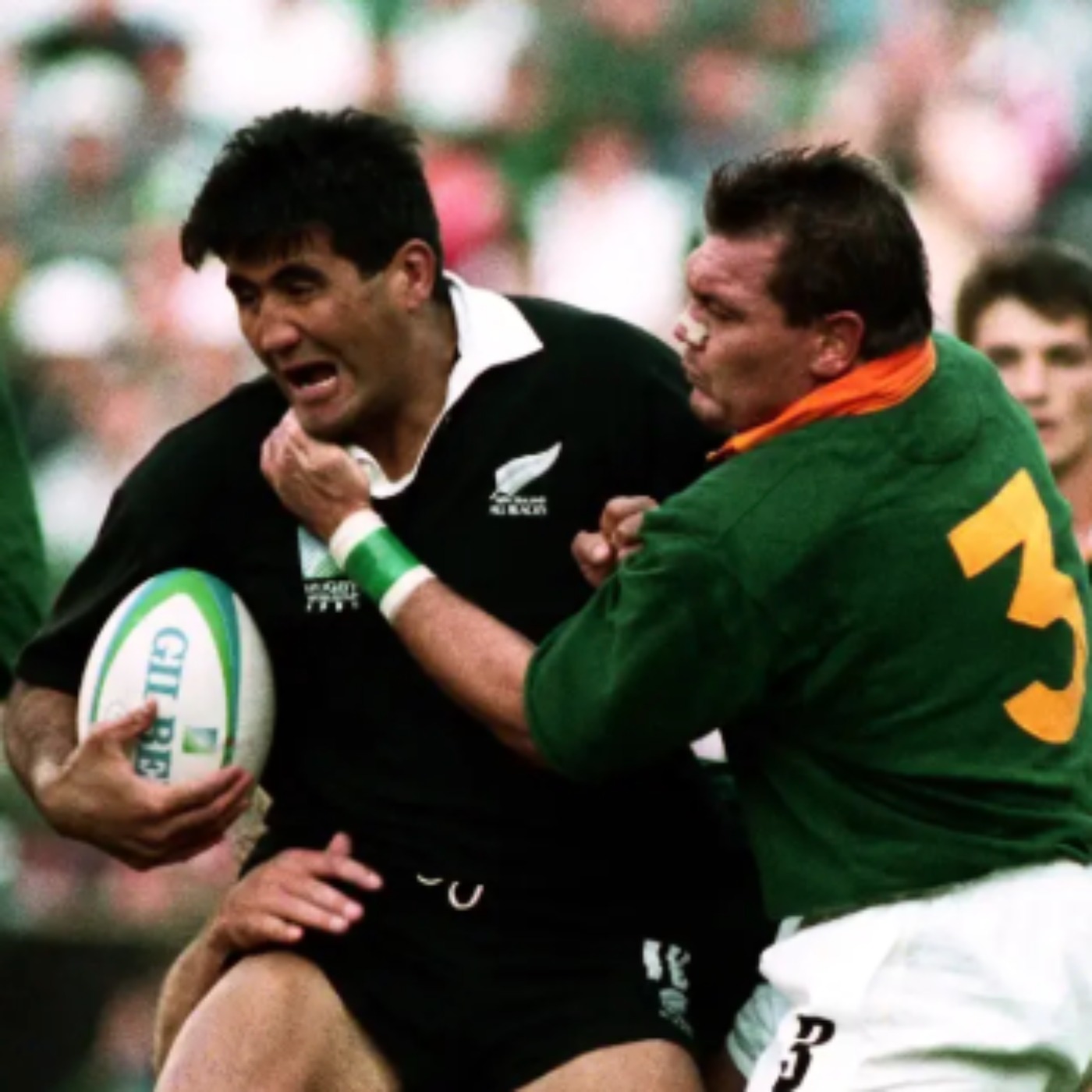
Rugby’s Greatest Rivals | with Episode 2: Racial lines drawn, and blurred
In short
The episode explains why the All Blacks–Springboks rivalry is branded “greatest,” arguing it’s inseparable from South Africa–New Zealand racial politics. It traces New Zealand’s early decisions to exclude Māori (1928 tour; “no Maori” policy), then compensating with a separate Māori tour (1926–27). It highlights Danny Craven’s paradox: racist statements and apartheid-era rugby leadership, yet founding Craven Week (non-racial schoolboy tournament) and later talks with the ANC to transform rugby. Key claims include that apartheid laws (Population Registration Act, Group Areas Act) reshaped support and that the 1949 All Blacks tour (and 1950s segregation) helped shift black/“coloured” support toward New Zealand.
Notable examples
1949 2-2 series; 1949 All Blacks losing to Wallabies and South Africa on Sept 3; 1960 Sharpeville; 1967 tour cancellation; “honorary whites” in 1969; 1976 Soweto riots and Olympic boycott.
Guests
Jamie Wall (rugby journalist/historian in Auckland and Cape Town).
Written by AI. May contain mistakes.
Chapters
0:10
The Early Struggles of Race in Rugby
Exploring the racial tensions surrounding New Zealand's rugby tours in the 1920s.
“The rest is between you and a therapist who actually gets it.”
2:41
The Early Struggles of Race in Rugby
Exploring the racial tensions surrounding New Zealand's rugby tours in the 1920s.
“In this unofficial race for global supremacy, New Zealand swept all before them on the 1924-25 tour of the UK, Ireland, France and Canada, returning home as the Invincibles.”
4:28
Craven's Complex Legacy
Discussion about Danny Craven and his controversial role in rugby history.
“under their somewhat dubious honorary whites laws.”
6:26
The Impact of World War II on New Zealand Rugby
How the war and Maori soldiers influenced rugby's racial dynamics.
“And in 1988, he held talks with the ANC against the orders of the South African government about transforming rugby into an integrated sport.”
8:18
The 1949 Tour and Cultural Shift
The significant changes and cultural tensions during the 1949 All Blacks tour.
“captain to go on the 51 tour to the British Isles.”
10:10
The Rise of Apartheid and Rugby's Response
Explores how apartheid laws affected rugby and the rivalry between teams.
“They lost to the Wallabies at Athletic Park in Wellington and to South Africa in Durban.”
12:20
Violence and Rivalry on the Rugby Field
Examining the violent nature of rugby matches during the era.
“Railways or hotels or public spaces no longer had to provide equal facilities for the segregated population.”
14:00
Rugby Rivalry and Violence
Explore the fierce rivalry and violent encounters between the All Blacks and Springboks during the 1956 tour.
“Welcoming the All Blacks on their 1956 tour, Dr Craven said, We know that you are out for our blood, but I think that we will give you all you are looking for.”
18:11
Race and Rugby in the 1960s
Discuss the impact of race on rugby, including the exclusion of Maori players during the 1960s.
“and recent research suggests 91 people were killed and 238 wounded.”
22:31
Politics and Rugby in 1976
Examine the intersection of politics and rugby during the 1976 series amid apartheid tensions.
“South Africa took that series and the next one again at home in 1976, 3-1.”
Show all 11 chapters
25:54
Legacy of Rugby's Divisive Era
Reflect on the long-lasting effects of rugby's contentious history in New Zealand during the 1970s.
“And we've effectively ruined the Olympics for everybody.”

Ask about this episode
Get the gist, explore an idea or ask about something said.
 Claude
On The Ruck, what are the key points of this episode?
Searching your listeningTranscript
Automatic transcript. May contain errors.
0:00You're probably multitasking right now, right? Commuting, working out, crossing things off your list. Worth asking when check-in on yourself landed on it. Grow makes the booking part fast. The rest is between you and a therapist who actually gets it. Grow connects you with thousands of high-quality, licensed therapists across the U.S., offering both virtual and in-person sessions, nights and weekends. There are no subscriptions, no long-term commitments. You just pay per session. Grow helps you find therapy on your time. The therapist you want takes your insurance on Grow. Grow accepts over 125 insurance plans.
0:38Sessions average$21 with insurance and some pay as little as$0 depending on their plan. Visit growtherapy.com slash start now today to get started. That's growtherapy.com slash start now. Growtherapy.com slash start now. Availability and coverage vary by state and insurance plan. In 2023, a source sent me a tip. It tied baseball's biggest star to a vast illegal sports betting operation. Shohei Otani! But then someone surprising confessed to me, his best friend. I'm Epey Mizuhara, and you do have permission to record me. From 30 for 30 podcasts, this is The Betrayal of Shohei Otani. Listen now, wherever you get your podcasts.
1:55The All Blacks will play four tests against the Springboks over the coming weeks as part of an eight-game schedule. The event has been branded rugby's greatest rivalry. But why is it so? The story is about more than rugby. It's the bitter history of racism and revolt, of politics and protest. But it is also about the long walk to freedom, isolation and reconciliation, Mandela, Khaleesi and how rugby has been at the forefront of a new South Africa. So with insights from players and historians and cuttings from the Times and Sunday Times, we tell the full story in this exclusive series from The Ruck.
2:29We're your hosts, Will Kelleher, Elgan Alderman and Alex Lowe. And this is Rugby's Greatest Rivals.
2:40You join us in the 1920s as South Africa's race issue starts to rear its ugly head. In this unofficial race for global supremacy, New Zealand swept all before them on the 1924-25 tour of the UK, Ireland, France and Canada, returning home as the Invincibles. The outstanding player of the tour was a 19-year-old fullback called George Nipia, who played in all 32 games. When he died in 1986, TVNZ repeated the episode of This Is Your Life with Nipia. It was watched by 1.6 million people, half the population of the country. but Nipia would not be selected for the tour to South Africa in 1928. The New Zealand Rugby Union, very aware of the South African position, courtesy of Harold Bennett's conversation, had already decided that it would not send any Maori on the tour.
3:28To compensate, a Maori tour was organised for 1926-27. It was a seven-month global odyssey showing the haka to a British audience following the example of the New Zealand natives who toured in 1888. It was the first example of the New Zealand Rugby Union prioritising sporting ties with South Africa over standing up for its people, and not the last.
3:50Morne du Plessis: The next team that went off to South Africa in 1928 was a segregated one. It didn't have any Maori players in it. And this, of course, was before Apartheid was officially introduced into South Africa. So this was New Zealand doing it just off their own bat to placate their South African hosts. I'm Jamie Wall. I'm a rugby journalist, writer and historian based in Auckland, New Zealand, and I'm currently in Cape Town. And then again, yep, you're right. It happened in 1949 and again in 1960. and it wasn't until 1970 that Maori players and Pacifica players were actually allowed to enter South Africa under their somewhat dubious honorary whites laws.
4:36Morne du Plessis: But up until that point, it was something that New Zealand was doing voluntarily. So they were kind of engaging in apartheid themselves. The 1928 series finished all square again, this time 2-2. The All Blacks' 7-6 victory in the second test at Ellis Park would be the last tri-less game between South Africa and New Zealand until the 1995 World Cup final, back at the same stadium. The 1937 Springboks were considered the greatest team to visit New Zealand. This was when Danny Craven burst onto the international scene. A pioneer of the dive pass, the scrum half used his new tactic to help South Africa win the Test Series 2-1.
5:15Craven would be a dominant figure within South African rugby for the rest of his life as a player, coach and administrator. He left behind a paradoxical legacy. On that 1937 tour, he was interviewed by the Evening Post in Rotorua about a social meeting between the Springboks and local Maori. In South Africa, the native problem is a very delicate one and this is why the New Zealand rugby union thought it fit not to let us play against the Maoris. It is in the South Africans' blood to be prejudiced against natives because natives we have are very primitive. It would be ridiculous to compare them with the Maoris.
5:53To be candid, we came here with some prejudice against the Maoris. I'm glad to say that that prejudice has been removed as a result of our visit to Rotorua, where we were able to see the Maori at home and appreciate their genuine hospitality and kindness. Craven was the chairman of the South African Rugby Board for 37 years. In 1967, he said there'd be a black Springbok over my dead body, although he later claimed not to have said that. Yet three years earlier, he had established Craven Week, a non-racial schoolboy rugby tournament. And in 1988, he held talks with the ANC against the orders of the South African government about transforming rugby into an integrated sport.
6:35That conversation paved the way for the Springbok's return to international competition following their isolation from Test Rugby. Craven was appointed joint president of the newly unified South African Rugby Football Union. Craven was the first Springboks coach in 1949, and it was he who invited Boy Lowe to speak to the players before that first test. Every South Africa player who sat in that Newlands changing room listening to Boy Lowe's rallying cry was about to make their test debut, including Felix Duplessis, the father of a future Springbok captain, Mornay, who led his country in the 1970s and 1980s.
7:11My dad was selected as captain. There was a first Springbok team after the Second World War. All 15, however many Springboks played in that first test match in 49, would have been their first test because the war years would have prevented anybody. You know, the Springboks won that Series 4-0. strangely and I say strangely because having captained the Springboks in the first three tests to victory my dad was dropped in the in the last test and it's something he never really spoke about he never queried it he never you know I I would have thought it would have had some sort of some sort of effect on him but he was a really quiet gentleman and just you know that's that's the way it was.
8:05Dr. Craven, who was mentored me many years later, when I very politely asked him maybe what the reason was, and he said, told me that they wanted a younger, to blood a younger captain to go on the 51 tour to the British Isles. I'm sure it must have affected him in You know, he never actually spoke much about that. He's rugby and he's tours, I suppose, very much like men who fought in the war. You know, they kept quite quiet about it. And I was very proud, obviously, to be the son of a Springbok captain. The Springboks had no experience, but they were a formidable scommaging outfit and full of innovation, like blitzing in defence with their flankers and throwing long lineouts into the middle of the field.
9:02Plus, they had a goal-kicking prop in Oki Geffen, who had practised his technique during his time as a prisoner of war. Ah, so Razzie Erasmus didn't start every piece of tactical genius then. The Bocs were too good for an all-blacks team once again missing their Maori players. The ignominy of the 1937 defeat on home soil was compounded by a 4-0 defeat against a Springbok team with no test experience. Opposition to the acquiescence of the New Zealand Rugby Union was beginning to grow back home. The Second World War had changed society in New Zealand. Maori soldiers had fought in disproportionate numbers.
9:38The 28th Maori Battalion was the most decorated New Zealand unit of the conflict. When he learnt that Maori players were being overlooked, Major General Howard Kippenberger scolded the New Zealand Rugby Union for exceeding to South African apartheid demands. Calls to boycott the tour were ignored. But the New Zealand Rugby Union did invite Australia to play a test series at the same time as the All Blacks were in South Africa. The matches were given test status in order to recognise the Maori players who were selected. Australia were strong. On September 3rd, 1949, the All Blacks achieved an infamous record.
10:11They lost to the Wallabies at Athletic Park in Wellington and to South Africa in Durban. Two test defeats on the same day in different continents. Just to demonstrate how splitting their own talent pool on racial grounds was self-defeating. Fred Allen, the All Blacks tour captain in 1949, was so disillusioned that he threw his boots over the side of the boat on the journey home, vowing never to play again. He kept his counsel at the time, but years later he unloaded on the New Zealand Rugby Union.
10:40Morne du Plessis: During the war we were all so proud of the 28th Maori Battalion. These tough, brave men fought in Greece, Crete, North Africa and Italy, where I was also fighting. Just to think of it makes me sick. We should have told the set of everything where they could shove their tour. The 1949 tour also marked a cultural turning point in South African sport. The previous year, South Africa had elected into power a new coalition government committed to entrenching racial laws. They were to be known by the Afrikaans' word for separation, apartheid. The Springboks were a symbol of white supremacy, and for the first time in 1949, the marginalised black and so-called coloured South Africans began to support the All Blacks, a concept which took a stronger hold following the introduction of apartheid laws that were implemented in the 1950s.
11:27Racial segregation had long existed, but the laws codified it. The Population Registration Act of 1950 officially classified every South African as white, native, which was all black South Africans, or mixed race, which they termed coloured. A fourth category of Asian was later added. A person's rights and social standing would be defined by their legal classification. The Group Areas Act of 1950 divided up the country on racial grounds, setting aside 80 % of South Africa for the white minority. This led to thousands of people being forced to move out of white areas and into segregated townships, one for each of the designated non-white groups.
12:08Non-whites over the age of 15 were required to carry a reference book which included racial classification, employment information, a photograph and fingerprints. Anyone caught in a restricted area without their documents would be arrested. Railways or hotels or public spaces no longer had to provide equal facilities for the segregated population. The Prime Minister, D.F. Malan, articulated his views in a letter sent in 1956 to a clergyman in the United States, who had written asking for an explanation of the severe laws. The difference in colour is merely the physical manifestation of the contrast between two irreconcilable ways of life, between barbarism and civilisation.
12:54Ellis Park is in the Johannesburg neighbourhood of Doornfontein. It had been a mixed residential suburb until 1950, when all non-white residents were removed to townships. When the British Lions played South Africa at Ellis Park in 1955, the game attracted a crowd of about 100 ,000 people. The majority of that crowd was white, although rumour has it a certain Nelson Mandela was in the non-European enclosure. On the same tour, the volume of support for the Lions from the segregated section of the stadium in Bloemfontein led to a 10-year ban on black and coloured spectators attending matches in the city.
13:29There is an incredible photograph from 1974 of black South Africans cheering in celebration after JJ Williams had scored a try for the Lions in the third test against the Springboks. All rugby in South Africa was strictly segregated, with separate governing bodies and competitions for the different racial groups until 1977. Yet the rugby rivalry between South Africa and New Zealand had now fully gripped both countries, so regular tours continued despite mounting pressure. The All Blacks were not the only outlier. England, France, Ireland and the British lines kept visiting apartheid South Africa until the 1980s, despite the country's ban from the Olympics between 1964 and 1988 and their suspension from playing international cricket between 1970 and 1991.
14:12Welcoming the All Blacks on their 1956 tour, Dr Craven said, We know that you are out for our blood, but I think that we will give you all you are looking for. The rivalry was of vital importance to both sides. A New Zealand Herald cartoon depicted the all-black selectors having an emergency meeting over the make-up of the forwards, with one player answering the phone to Sir Anthony Eden, the British Prime Minister, saying, Yes, I know, Suez Canal and all that, but we're right in the middle of a foreign affairs crisis of our own just now. The affairs on the field were violent and typical of the age, with players often chasing each other around the field to land punches.
14:47Here's the late Kevin Skinner, who was an all-black and a heavyweight boxer in the 1940s. I'd hate to have thought that my selection to an all-black test side was through the experience that I had as a youth in the boxing ring. I think I was selected because I had a bit more experience with springboard forward play, but that's a different thing to sorting them out. There was also an act called bollocking, which needs no explanation. During one incident in the 1956 tour, Tiny White was kicked up the backside by Yappy Becker. White recalled, I didn't realise how close I was to becoming a paraplegic.
15:25I walked off, my legs weren't numb, but the medics wouldn't let me go back on. Between the third and fourth test, the Springboks faced a listless New Zealand Maori and won 37-0. 54 years later, Muru Walters claimed that Ernest Corbett, the Minister of Maori Affairs, told the team to lose, quote, for the future of rugby. The series was alive for the final fourth test at Eden Park, with New Zealand 2-1 up, and it became a national event. They'd never beaten the Springboks in a series before. The All Blacks won 11-5, with Peter Jones scoring New Zealand's only try of the series.
16:14I'm absolutely buggered, Jones said afterwards, a quote that became part of Kiwi rugby legend. The race issue, particularly regarding the selection of Maori players, dominated the tours of the 1960s. All blacks to be all white was a headline in the Times on June 13th, 1959. It read, The moral of this incident is that South African customs in this matter of race are so widely divergent from those of practically the whole of the rest of the world that even in simple things such as a game of football, A continual atmosphere of embarrassment surrounds them.
16:47Morne du Plessis: It is also important to note that there was opposition to this as far back as the 1920s. And so the sentiment that existed around Māori not being able to tour with the All Blacks was a very real thing. And it only became like a sort of big public issue around the 1960s because of changing societal attitudes. And then, of course, events that happened in South Africa. and of course that was massively kicked off by the Sharpville Massacre which happened just before the All Blacks actually left to go on that 1960 tour but organized resistance to the tour which was made in the form of just people speaking out mainly in like academic circles and lobbying the government to try and stop that which is what the whole No Maoris No Toa movement was really geared at because it gave it a focus, like it gave it a purpose, which was if you're not going to let these people come, then no one's going to come at all.
17:47Morne du Plessis: And that was the goal of it. And it gave something for people to rally behind. Like I said, attitudes in New Zealand were changing quite rapidly. And so, yeah, that was pretty much the way once that ball started rolling on that issue, it was kind of pretty hard to stop it. As Jamie mentions, on March the 21st, 1960, the Sharpeville Massacre occurred. Police opened fire on protesters in Transvaal, and recent research suggests 91 people were killed and 238 wounded. At the end of May, the rugby series began. The all-black Don Clark's monster goal-kicking was so feared that he had his boots stolen, and South Africa won the series 2-1.
18:28New Zealand could have easily whitewashed the Springboks in 1965 on the next tour, but threw away a 16-5 lead in the third test in Christchurch to lose 19-16, eventually taking a 3-1 series triumph at home.
18:41Morne du Plessis: Pullback Don Clark, playing his first game for the All Blacks, takes the difficult kick 10 yards inside the halfway and on the touchline. And it's over! A beautiful kick, and it's right between the goals. On the same day as the Springboks won the third test in New Zealand, the South African Prime Minister, HF Favert, said that Maori would not be welcome on the 1967 tour. In accordance with our basic principles and attitude, we say that when we are guests in another country, we expect to behave according to their traditions. As we subject ourselves to their customs, we expect that when other countries visit us, they will respect ours and they will adapt themselves to ours.
19:24The tour was cancelled. By 1969, a protest group called Halt All Races Tours had been set up by New Zealanders. And the following year, the All Blacks toured South Africa with Maori and Samoan players involved. Players such as Sid Going, Brian Williams, Buff Milner and Blair Furlong were permitted to travel, but only after being designated as honorary whites. Ken Gray, the New Zealand prop, retired rather than go on the tour, though he kept his moral objection private. The 70s were very troubled times. We were shielded and kept away from the truth, if I can put it that way, what was actually happening.
20:02Not that that's any excuse or redeeming factor. Good day, Mournay Du Brussi here, coming in from Hermanus, near Cape Town, South Africa. 1970, I played the first time I played against the All Blacks. I was 20 years old, and that was the great Brian Le Corr team, Colin Meads. I've had one match for Western Province very early in the tour against them, and frankly, it was boys, me against men, them. There was no replays. There was one man's decision on the field. It was a rough and tumble. I think rugby is more brutal today, believe it or not. When I say brutal, it's the physicality of rugby today is far, far greater than it was in our day.
20:51But there was, you know, there were the odd punches thrown and the rakes, the raking and studs. And certainly one had to grow up. and I can't say that any of the test matches against the All Blacks in 1970 were violent. I can remember being dealt quite a good smack, but that's about all. I really think it was not as violent as perhaps the 1974 line tour some of the games were. I only happened to play two of those matches. The 1970 tour was another in which the rugby crossed from robust to rough. Colin Meads had his arm broken against Eastern Transvaal, and Sid Nomis lost two teeth from Fergie McCormick's elbow.
21:36The boxer underdogs, and the All Blacks have come to win. The only apparent problem is the absence of Colin Meads up with a broken arm against Eastern Transvaal. But offsetting this is the test debut of the exciting young winger, Brian Williams. But nothing showed the ferocity like the image of Frick Duprier tackling Chris Laidlaw with a clenched fist to the head. Graham Barrow, the esteemed New Zealand rugby journalist, wrote that the Springboks were literally fighting for their futures on the international stage.
22:04Morne du Plessis: They realised that rugby contact with traditional rivals hung in the balance because of the campaign against racialism in sport. If the Springboks won, they reasoned, other nations would still want to play them, to topple them from their position at the top. But if they lost to New Zealand just after the failure in Britain, rugby authorities elsewhere would not regard them as such an attractive proposition. The 1970 Springboks were therefore more prepared to do or die on the field than any Springbok team before them. Craig Patrick in a strap here with Mona van Heerden. And Bill Bush joining that one now.
22:39And it's all on. South Africa took that series and the next one again at home in 1976, 3-1. 1976 stands out in South African history for definitely not the rugby series. It stands out as the Soweto riots. Again, we were young men playing a game. We loved getting a chance to play against the All Blacks, getting on with this great opportunity and took it. And, you know, I'm happy that I was afforded that opportunity. Sad that other people weren't. But, you know, there's nothing much I can do about that now. And as you said, a horrible year really in South African history with the Soweto uprising that you've talked about.
23:26And there was also, because of the New Zealand tour to South Africa, an Olympic boycott. The 1976 Olympics were boycotted by a number of countries basically in protest against that tour happening. So as a young man, were you kind of aware of the political situation at the time or were you very much focused on sport and playing sport without politics involved? Yeah, absolutely. I mean, we were aware. You would have to be completely shut out of all communication, not to know that something was happening. But, you know, you are focused as a young man on the springbok, being a springbok. It unfortunately overrides the acknowledgement of what was going on on the outside.
24:12We were pretty much guarded from a lot of the real news, which, you know, obviously many years later, the real happenings in the country. And again, I say that's no excuse for not knowing, but that's what it was. Yet more global fury erupted after the Soweto uprising of June 1976. The South African police killed at least 176 protesters and injured more than 1 ,000 people. Later in the summer, more than 20 African nations withdrew from the Montreal Olympics because of New Zealand's continual contact with South Africa. So, Jamie, there's a great line from the Dominion, one of the Wellington newspapers, after the finale of the 1976 series, which South Africa won 3-1.
24:59I'll read it to you. Whatever the image of South Africa when the dust settles, it seems clear that the Ellis Park referee blew the whistle also on all black Springbok encounters, as they've been known for 50 years. the facts of international life particularly for a country sustained by international trade have been written so emphatically on the wall a surface stained with the blood of soweto and the tears of montreal that new zealand has had to embrace the pragmatism of the times and clarify without equivocation its attitude to african minority rule and in particular its antagonism so often questioned overseas to apartheid did that kind of sum up the feeling as of the time, do you think, Jamie?
25:41Morne du Plessis: Not really, no. I mean, what a great line, the blood of Soweto and the tears of Montreal. Because that year, 1976, there was an election held in New Zealand and the National Party ran on a campaign of let's keep politics out of sport. And they won. And it kind of says to me, just because of what happened in 1976, that a lot of liberal-minded people thought, well, we're never going to do this again because of the fallout of it and the international condemnation and the fact that so many countries boycotted the Olympics. And we've effectively ruined the Olympics for everybody. But that wasn't the case.
26:22Morne du Plessis: There was a lot of people that simply didn't care about that sort of thing and just wanted to watch the All Blacks play the Springboks. So it's a lovely sentiment in that editorial there, but it didn't actually sum up the feelings of a lot of New Zealanders. Yet if the events of 1976 seemed remarkable, what followed in 1981 was one of the most unsettled, divisive periods in New Zealand history. More soon on rugby's greatest rivals from the Times.
27:10This has been Rugby's Greatest Rivals from the Rug, devised by Alex Lowe, Will Kelleher and Elgin Alderman. It was edited and produced by Alfie Reynolds with contributions from Jamie Wall, David Whisson, Hope Federico and Rob Wallace. We have the tech to get food delivered in 15 minutes, but we all have horror stories about buying tickets. The GameTime app gives fans the advantage. Get amazing tickets in just a few taps. Fees are included, so what you see is what you pay. And the GameTime guarantee means authentic tickets at the best price every time. Take the guesswork out of buying tickets to concerts, sports, comedy, and more with GameTime.
27:51Download the GameTime app and create an account for$20 off your first purchase. Terms apply. You've got social dialed in. Search is doing its thing. So why do your marketing results look the same as six months ago? That's because you're fishing in the same pond as everyone else. Podcast listeners are a different audience entirely, more engaged, harder to reach through traditional channels, and ready to act when someone they trust makes a recommendation. We're Acast, and we put them right in front of you. Browse thousands of the world's leading podcasts, book host reads or run your own ads, and track every conversion in real time.
28:27Same skills you already have, brand new results. Acast. Acast.com slash advertise.
From the publisher
In episode 2 of our special series on the fierce rivalry between rugby’s superpowers, the former Springbok Morne du Plessis talks about the sheer, violent ferocity of test matches between South Africa and New Zealand.
For decades, these matches continue to be played among the shadows of race tensions in both countries. The introduction of apartheid adds pressure, boiling over in a boycott of the 1976 Montreal Olympics.
This podcast was produced and edited by Alfie Reynolds, with help from Hope Federico, Rob Wallace, Jamie Wall and David Whisson.
Read more: Rugby’s Greatest Rivals: Springboks v All Blacks
Photo: Getty Images
Hosted on Acast. See acast.com/privacy for more information.
More from The Ruck
All episodesWe use cookies.They keep VO running smoothly and help us improve it. Privacy policy