
 Ask ChatGPT


In short
The 1981 Springboks tour of New Zealand and the “Flour Bomb test” at Eden Park, framed as part of the wider South Africa–All Blacks rivalry and the era’s anti-apartheid politics, protest, and reconciliation.
Guest backgrounds
Jamie Wall is a rugby journalist, writer, and historian based in Auckland and currently in Cape Town. Rob Lowe is a former South African player (student in the 1970s/early 1980s; involved with the Springboks era) who toured and later played against the All Blacks.
Key claims
The tour should not have happened because of the Gleneagles Agreement; NZ politics and police helped enable it despite massive unrest. Flower bombs and plane-drops disrupted the All Blacks’ focus, with players reportedly watching the aircraft.
Notable examples
Eden Park flower bombs hit All Blacks prop Gary Knight; protesters flew a plane 62 times (Marks Jones, Grant Cole). Matches were disrupted/cancelled (e.g., before Wellington; Waikato/Waikato and South Canterbury). The All Blacks won the final test 25–22.
Written by AI. May contain mistakes.
Chapters
0:57
Setting the Stage for the 1981 Tour
Exploring the historical context and tensions surrounding the 1981 Springbok tour of New Zealand.
“We're your hosts Will Kelleher, Elgan Alderman and Alex Lowe and this is Rugby's Greatest Rivals.”
1:20
Civil Unrest During the Tour
Discussion on the civil unrest that accompanied the 1981 tour and its political implications.
“because there is a light plane circling the ground and dipping in low and dropping things into the crowd.”
2:54
Historical Perspectives from Jamie Wall
Rugby journalist Jamie Wall shares insights on New Zealand's societal challenges during the 1981 tour.
“Like I said, an election was campaigned on essentially bringing the Springboks back to New Zealand by the national government.”
3:38
Rob Lowe's Experience in 1981
Rob Lowe recounts his personal experiences and the conflicting emotions during the 1981 tour.
“It kind of captured the whole nation at once, didn't it, in a way that possibly had never happened before?”
5:26
The Significance of Errol Tobias
Discussion about the significance of Errol Tobias as the first non-white Springbok player.
“But it culminated in, yeah, a very, very organised tour movement, anti-tour movement, and a very, very organised and increasingly hard-line stance by the police to deal with them.”
7:54
Polarization in New Zealand Society
Exploring the division within New Zealand families and society regarding the Springbok tour.
“So, you know, at that stage, well, you know, we could see that there was change about our country.”
9:14
The Impact of Protests on the Tour
Effects of protests and civil disturbances on the Springboks' experience in New Zealand.
“really wanted to love that in the rugby was the positive part of it.”
11:21
Reflections on the Tour's Legacy
Reflecting on the lasting legacy of the 1981 tour and its impact on rugby and South Africa.
“The All Blacks won the final test 25-22, which still irks Springboks to this day.”
14:01
Reflections on a Divisive Tour
Explore the emotional and political impact of a controversial rugby tour.
“We're a very close team, funnily enough.”

Ask about this episode
Get the gist, explore an idea or ask about something said.
 Claude
On The Ruck, what are the key points of this episode?
Searching your listeningTranscript
Automatic transcript. May contain errors.
0:12Welcome back to Rugby's Greatest Rivals, a special series from The Ruck, the journalist's rugby podcast from The Times and Sunday Times. The Springboks and All Blacks share an epic rugby rivalry. The All Blacks will play four tests against the Springboks over the coming weeks as part of an eight-game schedule. the event has been branded rugby's greatest rivalry. But why is it so? The story is about more than rugby. It's a bitter history of racism and revolt, of politics and protest. But it is also about the long walk to freedom, isolation and reconciliation, Mandela, Khaleesi, and how rugby has been at the forefront of a new South Africa.
0:49So with insights from players and historians and cuttings from The Times and Sunday Times, we tell the full story in this exclusive series from The Rug. We're your hosts Will Kelleher, Elgan Alderman and Alex Lowe and this is Rugby's Greatest Rivals.
1:08We're tracking the history of the rivalry between South Africa and New Zealand and are now into the 1980s, an era defined by rebellion.
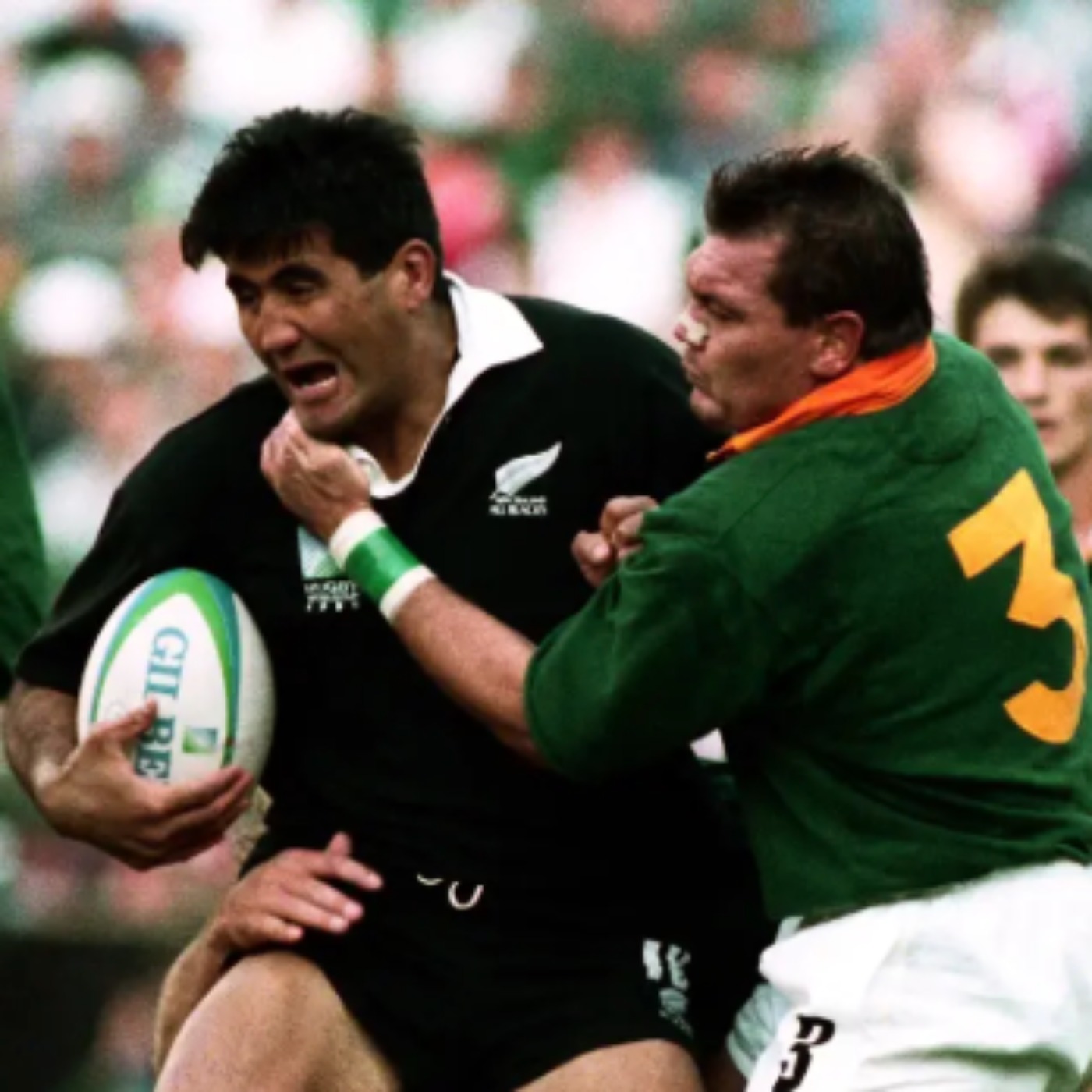
1:19It's changed now to quite an unusual feeling of tenseness because there is a light plane circling the ground and dipping in low and dropping things into the crowd. There were then some flower bombs dropping. Those are the gestures from the crowd as the plane comes over yet again. There's the plane coming in very low over Eden Park. It seems to me to be just above the grandstand height. The South African tour of New Zealand in 1981 was beset by the largest civil unrest in Kiwi history. It was about barbed wire, hard hat and shield, not rucks scrums and more. Flower bombs have landed on the field and they're going to be cleared away as the all-black team comes on.
2:04Firstly can you try and sum up for us how 81 was allowed to happen politically and then once it did happen what happened?
2:12Rob Louw: Yeah well it shouldn't have happened because the international community had signed an agreement called the Glen Eagles Agreement was signed in saying that race-based selection policies or exclusionary policies wouldn't be allowed. It was specifically done to exclude South Africa from participating in international sport. And you have to remember that this wasn't like a new thing. They'd already been stopped from competing in the Olympics. They'd already been stopped from playing international cricket. FIFA had banned them from the World Cup. So this felt like a pretty logical step. I'm Jamie Wall.
2:47Rob Louw: I'm a rugby journalist, writer and historian based in Auckland, New Zealand, and I'm currently in Cape Town. Of course, the New Zealand government didn't seem to care about it. Like I said, an election was campaigned on essentially bringing the Springboks back to New Zealand by the national government. The Labour government had already prohibited the Springboks from coming in the late 60s. It was put in place and they were invited over and the protest movement completely ramped up. you know, promises were made to disrupt the tour as much as they possibly could. A serious amount of organisation went into opposing it.
3:24Rob Louw: A serious amount of organisation went in from the police to make sure that that was circumvented. And it ended up with what you just said, which is the largest sort of civil unrest that happened in New Zealand in the later half of the 20th century. And Jamie, you start your historical look back at this rivalry, the Hundred Years' War, with a scene from the streets of New Zealand, don't you? with the protest marches in 81. It kind of captured the whole nation at once, didn't it, in a way that possibly had never happened before? No, I don't think so. I think that it's something that we look back on now through a lens of modern sensibilities, but it was very much just a case of people just standing up and saying, well, this is wrong and we're going to try and do something about it.
4:10Rob Louw: And there's something that's quite sort of simplistically admirable about all that. But the reality was it was actually a lot more complicated for a lot of New Zealanders who were involved in all of this, because, you know, New Zealand is, while it didn't institute apartheid or anything, it's not a perfect country at all. We have our own race relation problems that go back as sort of far back as colonialism itself. And so for a lot of people to be challenging the system, there was a lot of hypocrisy involved in all of this. Then at the same time, you had a lot of the population who simply didn't really feel that strongly either way about this.
4:57Rob Louw: They couldn't have cared less whether the springboks came or didn't go. and then you had a very very committed um section of the of the community who wanted to watch the all blacks play the spring box just simply because the other two best teams in the world and they wanted to watch watch rugby and why should anyone tell them what they can and can't do so there was it's a lot more yeah complicated than just simply a kind of pardon the pun black and white issue here in New Zealand. But it culminated in, yeah, a very, very organised tour movement, anti-tour movement, and a very, very organised and increasingly hard-line stance by the police to deal with them.
5:41The Springbok players who had grown up gorging on the rivalry were desperate to tour New Zealand, despite many of them opposing the politics of their country. As a student, I was a bit of a rebel. I mean, I stood up against the party big time. Probably cost me my spring-mock captaincy. This is Rob Lowe coming from Cape Town, South Africa. I matriculated in 73. So, yeah, I was, let's say, 16 years old. You know, it just raked me crazy watching the games. So my dad was a referee. And I used to sit at Newlands and watch every game, you know. And in those days, they allowed us to be right up front.
6:12So we used to sit basically within touching distance of the players. So it was just great to watch and just to be in that whole cauldron. Now, that atmosphere was just unreal. At 76, I was a student at that stage. I was in the South African 921 side. We played a game, Curtain Razor, between, I think, the All Blacks and the Strimbucks. And I remember them still punching John Williams. He was the second row forward of ours and knocking him out. I remember that. Wow. So, yeah. And we were downstairs. Someone had changed him and they carried him in. All bloodied and banished. A lot of people didn't know that in 1981, when South Africa went to a tour in New Zealand, Our opposition party was anti-apartheid.
6:54They didn't know that. So there was a large part of our country which was anti-apartheid. So many of the students and many of my teammates were anti-apartheid. The 1981 Springboks did bring one black player to New Zealand, Errol Tobias, a dashing back who became the first non-white player to represent South Africa in a Test match. He may have only won six caps between 1981 and 1984, but for that reason was a trailblazing figure. On the 1981 tour, he became great friends with the flanker Rob Lowe. In 1984, England came to South Africa with John Scott's side. And we had an incredible side at that stage, really, really strong box side.
7:30Donny Chabot was at his best. And Errol Tobias was a fly-off. And he was 34 years old at that stage. And I'll never get playing at Ellis Park in front of a crowd of 80-odd thousand in those days. I mean, it was a crazy crowd. And Errol Tobias scored on a try in the corner. And the whole crowd stood up. And you wouldn't think in Ellis Park and Janusburg, it would have been so anti-apartheid. The 84 ,000 people went crazy. So, you know, at that stage, well, you know, we could see that there was change about our country. And we were ready for the change, which was great, you know. And so, Dr. Craven, who was obviously doing North African rugby, and Dr.
8:10Craven used to take us as students. I'm talking about 1975, 76, take us with airplanes and fly us into outback places amongst the Zulus. And Doc Craven would say, I want 100 blacks, 100 white guys, and 100 colored guys on the field. And that was right in the middle of a party. But he was so powerful that he could change things. And the guys would say, oh, but it's not allowed. And he would say, I want it. And that's it. And so that was the early days of the change, which happened, which was fantastic to see. Lowe was aware that the Springboks would not be popular guests in New Zealand in 1981.
8:48I mean, obviously now in New Zealand, being rugby crazy, I knew there'd be a split. As rugby players, our dream was to play, to get on the field and play against the All Blacks. And they're the same, most of them. It wasn't easy. There was a lot of pressure on us. And I mean, you know, sleeping in the changing rooms before the test matches, Also, it wasn't easy. But then playing the games and then afterwards, being with the All Blacks and being with the people, really wanted to love that in the rugby was the positive part of it. It was the experience of a lifetime. Yet the tour divided Kiwi families.
9:23Before the Wellington tests, the wife of Stu Wilson, the All Blacks wing, was in the protest lines along with other members of his family. Matches in Waikato and South Canterbury were cancelled due to violent protests. and the Gleneagles agreement, which discouraged contact with South Africa, was debated hotly in Westminster. The Springboks won all six tour games before the first test in Christchurch. In the days before the match, fire destroyed a grandstand. And in the Times, David Elias described how the tourists were almost smuggled into Christchurch this afternoon for the first of the three test matches.
9:56The second match against Waikato in Yacht was Hamilton. I remember sitting in the stands, I was reserved and there was a plane flying over the whole time. And the guy came across us and said, listen, this guy wants to dive bomb, you guys. He wants to go into the stadium with his plane. We were all just warned, get out, because we had our tracksuits on. And so we had to evacuate. This guy was so motivated to fly. He wanted to fly into the stadium. Well, like a kamikaze bomb, basically. Yeah, like a kamikaze thing, yeah. You didn't even have a bed. You were sleeping on the ground or on stretches?
10:36No, we were on stretches. We were sleeping on stretches and mattresses. We actually slept at all the stadiums. So we slept at Christchurch, the same in Christchurch or so. No, hold on. We didn't. We slept in a squash court outside Christchurch. And then they brought us through early in the morning when we slept on stretches downstairs in the stadium. So looking back now, I'm sure New Zealanders could have flown us in with the helicopters, you know. They wanted to really look after us. But I think they also are competitive as they are. There's no way to prepare to play the All Blacks, is it, to sleep on the floor of a squash court?
11:13No, most certainly. We were sleeping on stretchers and mattresses. Before every match? Yeah. That's crazy. Yeah. The All Blacks won the final test 25-22, which still irks Springboks to this day. There was a final kick, which Alan Euston put over. And the ref, who was a Welsh guy, I actually moved the penalty forward by 10 metres and they kicked it over. And they beat us by their final kick in the last second. And that would have meant to us joining the series, which was unheard of in Oslo. It should be New Zealand there. I remember we came back and at the airport, Doc Craven said to us, many years ago we had a South African referee that cheated the All Blacks.
11:53And that's exactly what happened to you guys. That last kick came in my head. I'll never forget it. But one wouldn't blame anyone present for spending more time looking towards the skies rather than the action. Two protesters, Marks Jones and Grant Cole, flew a plane over the ground 62 times, and a flower bomb they threw hit Gary Knight, the All Blacks prop, on the head. Gary Knight was struck by a flower bomb and it knocked him over. He's just got to his feet again, and you can see Gary Knight was struck by a flower bomb, dropped from the plane. Now I guess that would be a tremendous thump. Yeah, as we ran out, we obviously had this guy come in, and he was coming in from the north.
12:32And it's amazing how it affected the whole game. The first half, we basically played looking at the plane. So playing with him, we could see him flying at us and coming very low and then dropping the flower bombs. And they went up, I think, about 20-odd, whatever it is, the first half. And the second half, we turned with our backs to them. And then we scored our three tries. And that's amazing how that airplane had a big effect on us. you know they're playing playing with him they're behind us we didn't even worry about it playing with him flying at us all the time and coming very low i mean he was coming in a hell of a low had a hell of effect on on the game the flower looking at me and and warning me saying to me rob watch out there's a flower bomb coming at you you know and i'm playing against him uh donaldson remember he sort of looked at me and he warned me slightly different to doing the toss and going would you like to play with the wind or against the wind you like would you like the plane dropping bombs from behind you or in front of you it's not quite exactly yeah it's amazing yeah i mean i mean she ran out with bob wire fences all around the ground and uh and one guy ran on before the kickoff i don't know how he got in there and he ran on and he kicked the ball and then ran off we couldn't believe it he was a demonstrator that got in there god knows how he got in because there was bob five as well like a bloody like a like a trench warfare type of situation how you got in there god only knows but even so he got in there you know there was a lot of hell of a good feeling between and our players i'll never forget uh stew wilson the great all-black wing we had on the final test match we had a lot of beers together and he said to me that his whole family was demonstrating against him but he said he wanted to play against africa and that was his dream so that that's what was all was about and i think looking back now there was a lot of south africans it was a good thing for our politicians to see how the outside world thought about what was happening in our country and also for the conservative players in our team to realize what was happening, which was very important for the change which happened in our country.
14:31We're a very close team, funnily enough. I mean, the guys, well, we haven't gone through basically a war in a way. It formed like a very close bond amongst the team members. And we still get together, I think, once every few years just to have a memory and the photographs amongst ourselves and recollect what happened. Summing up the tour's deep unrest in the times, Michael Brunson wrote, To describe New Zealanders in normal times as placid may be an understatement. Most Australians, for example, seem always to have preferred the word dull. This year has not been normal. New Zealand's sleepy image has been shattered by the violence of the argument over the Springboks tour.
15:11This was not the only 80s controversy in rugby's greatest rivalry More soon on rugby's greatest rivals from the Times
15:34This has been Rugby's Greatest Rivals from the Ruck devised by Alex Lowe, Will Kelleher and Elgin Alderman. It was edited and produced by Alfie Reynolds with contributions from Jamie Wall, David Whisson, Hope Federico and Rob Wallace.
From the publisher
In episode 3 of our special series on the fierce rivalry between rugby’s superpowers, we are into the 1980s - a decade defined by rebellion.
The 1981 Springbok tour to New Zealand goes ahead despite an international agreement to stop sporting contact with apartheid South Africa. Unrest culminates in flour bombs being thrown out of aircraft at the players. Former Springbok Rob Louw reflects on matters on and off the pitch.
This podcast was produced and edited by Alfie Reynolds, with help from Hope Federico, Rob Wallace, Jamie Wall and David Whisson.
Read more: Rugby’s Greatest Rivals: Springboks v All Blacks
Photo: Getty Images
Hosted on Acast. See acast.com/privacy for more information.
More from The Ruck
All episodesWe use cookies.They keep VO running smoothly and help us improve it. Privacy policy