
 Ask ChatGPT

 The Ruck
19 Aug 2026 · 25m · 14 chapters
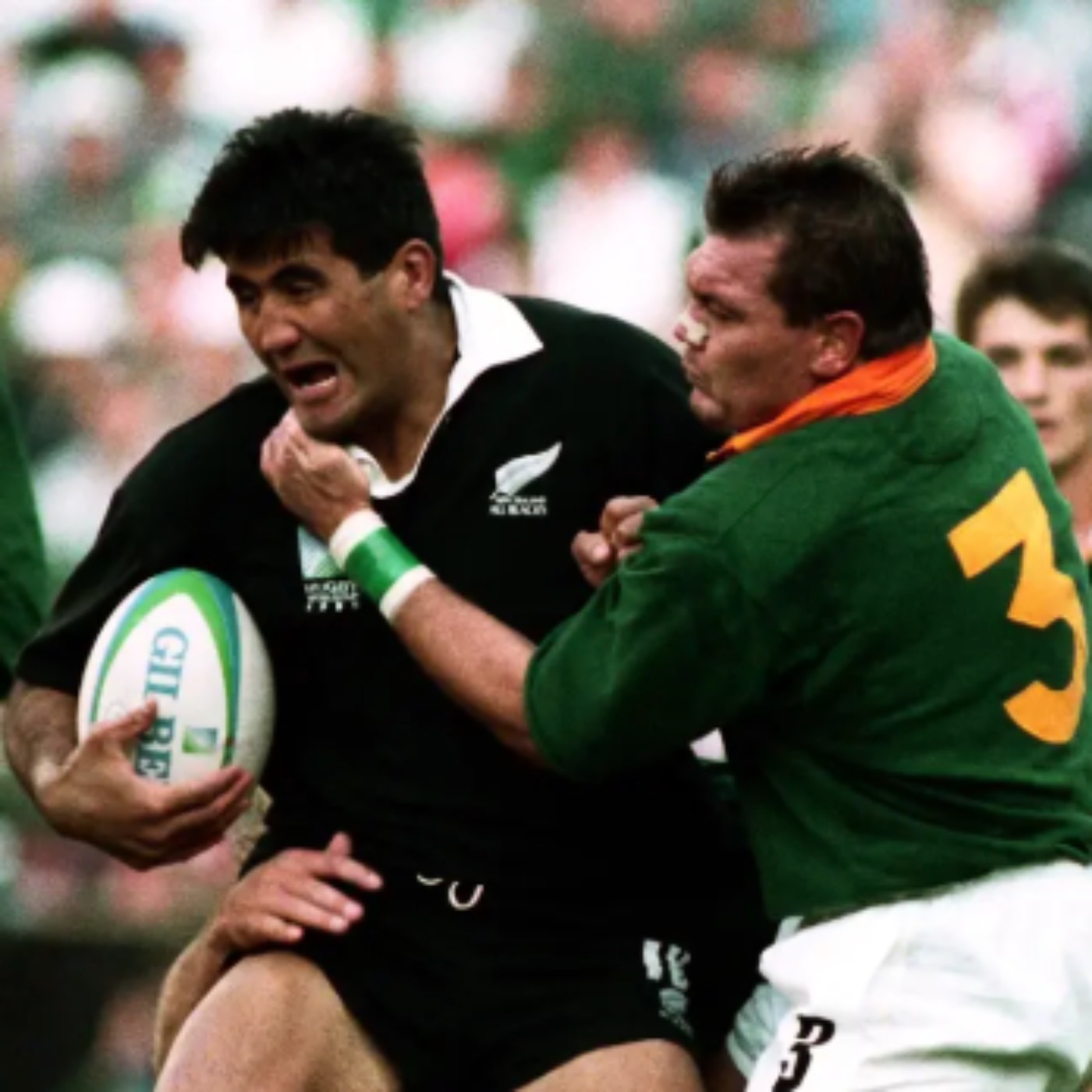
Rugby’s Greatest Rivals | Episode 5: Readmission for a Rainbow Nation
In short
How South Africa’s return to international rugby (1992) and the 1995 Rugby World Cup—especially the Springboks’ rivalry with the All Blacks—became a tool for reconciliation amid apartheid’s end, racism, and political protest.
Guests/backgrounds
Steve Schwete (ANC leader, former Robben Islander, advocated sport for reconciliation); Macken Casey Arnold Stoffele (jailed in 1985 for stopping the All Blacks Tour); Joel Stransky (Springbok player, 1995 final hero); Sean Fitzpatrick (All Blacks captain); Uli Smith (All Blacks hooker mentioned via Fitzpatrick); Jamie Wall (journalist/historian); Albert Grundling/Beyond the Try Line author; Pierre Berbizier (France coach, quoted); Laurie Maines (All Blacks coach, suspected sabotage).
Key claims + examples
Mandela backed Springboks’ readmission; Ellis Park’s crowd waved the old flag and broke a mandated silence (De Stem erupted); Mandela wore Springbok No. 6 in 1995; All Blacks’ food poisoning and alleged sabotage; Stransky’s drop goal vs New Zealand in the final.
Written by AI. May contain mistakes.
Chapters
1:11
The Power of Sport
Exploring how sport can change society and its role in South Africa's history.
“Sport has the power to change the world.”
2:15
The Return of Rugby
Details on how rugby was used as a reconciliation tool in post-apartheid South Africa.
“The Springboks were at the heart of his plan.”
3:56
Historic Match: Springboks vs All Blacks
Recalling the significant match between the Springboks and All Blacks in 1992.
“Their first game back was against New Zealand at Ellis Park in August 1992.”
6:46
Cultural Defiance at Ellis Park
Discussion on the crowd's reaction during the historic 1992 match.
“Albert Gunling, the author of Beyond the Try Line, Rugby and South African Society.”
7:52
Mandela's Vision for Rugby
Mandela's belief in rugby as a way to unite South Africa's diverse population.
“to give the scoreboard a more flattering look.”
8:11
The Path to the 1995 World Cup
How South Africa prepared for the 1995 Rugby World Cup amid national tensions.
“The ANC were furious about the Ellis Park Ferrago.”
9:32
Players' Mindset Before the World Cup
Insights into the Springboks' focus on rugby amidst political changes.
“that carried them to the World Cup final and another appointment with the All Blacks at Ellis Park.”
10:40
Mandela's Impact on the Team
Features stories of Mandela's personal engagement with the Springboks.
“But we might not have believed your statement wholeheartedly at the time.”
12:24
The Dramatic 1995 Final
Recounting the events and atmosphere of the 1995 Rugby World Cup final.
“It was an amazing change for us as South Africans.”
14:00
The Shadow of Sabotage
Exploring the suspicions of sabotage and the atmosphere leading up to the match.
“Laurie Maines, the All Blacks coach, has always suspected sabotage, convinced his team were poisoned.”
Show all 14 chapters
18:45
A Dramatic Final Showdown
The intense moments of the World Cup final and the tactical decisions made.
“The All Blacks edged ahead in extra time with a penalty from Andrew Mertens, but Joel Stransky was the hero for the spring box.”
20:04
The Aftermath of Victory
Reflections on winning the World Cup and the emotional journey that followed.
“So for me, it was never about, OK, we're going to win the World Cup.”
22:22
Iconic Moment in Rugby
Nelson Mandela's historic trophy handover to Francois Pienaar.
“I'm Jamie Wall, I'm a rugby journalist, writer and historian based in Auckland, New Zealand, and I'm currently in Cape Town.”
22:33
A Rugby World Cup with Purpose
The political significance of the World Cup victory for South Africa.
“if the Springboks hadn't been playing the All Blacks.”

Ask about this episode
Get the gist, explore an idea or ask about something said.
 Claude
On The Ruck, what are the key points of this episode?
Searching your listeningTranscript
Automatic transcript. May contain errors.
0:00Music
0:15Sean Fitzpatrick: You're listening to Rugby's Greatest Rivals, a special series detailing the history between the Springboks and the All Blacks. This is The Ruck, the journalist's rugby podcast from The Times and Sunday Times. The Springboks and All Blacks share an epic rugby rivalry. The All Blacks will play four tests against the Springboks over the coming weeks as part of an eight game schedule. The event has been branded rugby's greatest rivalry. But why is it so? The story is about more than rugby. It's the bitter history of racism and revolt, of politics and protest. But it is also about the long walk to freedom, isolation and reconciliation, Mandela, Khaleesi and how rugby has been at the forefront of a new South Africa.
0:58Sean Fitzpatrick: So with insights from players and historians and cuttings from the Times and Sunday Times, we tell the full story in this exclusive series from The Ruck. We're your hosts, Will Kelleher, Elgan Alderman and Alex Lowe. And this is Rugby's Greatest Rivals.
1:19Joel Stranski: Sport has the power to change the world. It has the power to inspire. It has the power to unite people in a way that little us does. It speaks to youth in a language they understand. Sport can create hope where once there was only despair. it is more powerful than governments in breaking down racial barriers.
1:56Sean Fitzpatrick: February 1990, Nelson Mandela walked to freedom. South Africa had taken a new course. In 1991, the last of the apartheid laws were repealed. And in March 92, a referendum of white South Africans approved the end of apartheid. But the country was awash with violence. As John Carlin wrote in Playing the Enemy, Mandela needed to appease white spheres and give them an incentive to accept the new order. The Springboks were at the heart of his plan. Steve Schwete, an ANC leader and former Robben Islander, had been arguing in favour of using sport as a tool for reconciliation since Mandela was released.
2:33Sean Fitzpatrick: The cricket team toured India in late 1991 and South Africa's Olympians competed at Barcelona in 92, albeit under a neutral flag. Schwete believed, quote, the restoration of rugby internationals would prompt Afrikaners to rethink their preconceptions about the ANC. Macken Casey Arnold Stoffele, who was jailed in 1985 for his part in stopping the All Blacks Tour, was involved in the discussions to bring back the Springboks in green and gold. This is no ordinary carrot we would be offering white South Africa. This is not politics. This is not ideology. This is something more powerful and primal and personal.
3:15Sean Fitzpatrick: Offering to restore the international rugby game is a way of saying to whites, if you play along with us, you will be able to go to Europe and the US and Australia to visit your friends and not be seen at the airport when your passport is being checked as a pariah. They will see it as good for business. Above all, it will mean being liked again. white South Africa will be able to feel like human beings again, like citizens of the world. The whites-only South African Rugby Board had merged with the non-racial South African Rugby Union to form a new governing body, and Mandela approved the Springboks' return to international rugby.
3:56Sean Fitzpatrick: Their first game back was against New Zealand at Ellis Park in August 1992.
4:05Joel Stranski: This is Joel Stransky in Boleto, South Africa. I think for me it was actually just a chance to go play rugby. I played provincial rugby. We played north, south, almost springbok trials every year. We got to play with and against our heroes. We got to challenge them. We got to try and prove we were better. And we watched a bit of international rugby on TV. We knew we couldn't play them, but we were hopeful that one day we would. And then in 1992 it sort of seemed like it was opening up.
4:36Sean Fitzpatrick: Sean Fitzpatrick was the All Blacks captain. to captain the All Blacks to South Africa. It was a great honour. I watched that 86 Cavaliers tour. Uli Smith was the hooker, and I was getting the opportunity to play against Uli. We arrived at the airport, and there was, I don't know, 3 ,500 people to welcome us back into the Republic. And there was a little kid who came running up to the bus when I was sitting in the front seat, and he threw the sign up at the window, and they said, Uli is going to kill you.
5:09Sean Fitzpatrick: which sort of is quite funny. And then we went to Kings Park in Durban to play Natal. Oh, my God. I was just like, this is why I play rugby. They have the best stadiums in the world, such loyal fans, and they obviously loved having the All Blacks back in town. So, you know, playing against my childhood hero, Nars Bortha, you know, Danny Herbert. My God, what an absolute legend. and we played at Alice Park, that sort of iconic stadium that we'd seen in 76. And we'd had Desmond Tutu travelling with us and we got to meet Mandela that time. So yeah, it was just a dream come true to go to South Africa.
5:53Sean Fitzpatrick: The game was approved by the ANC on the condition that there would be no symbols of the apartheid regime. There would be no South African anthem. Instead, a minute's silence would be held in support of peace. The journalist and historian Jamie Wall describes what happened next in his book, The Hundred Years' War, as the Afrikaner's last stand. In a demonstration of defiance, having been encouraged by elements of the Afrikaner press, fans waved the old South Africa flag. And the silence was broken when a rendition of De Stem, the old anthem, erupted in the stands.
6:35Sean Fitzpatrick: The Otago Daily Times reported that the scenes, quote, resembled a Hitler rally. The crowd was in a defiant mood. They had their rugby back. The celebrated green and gold jerseyed Springboks were about to tackle the mighty All Blacks. Albert Gunling, the author of Beyond the Try Line, Rugby and South African Society. It was an historic return to the international arena after years of isolation. an occasion brimful of nostalgia and tradition for predominantly Afrikaner male rugby fanatics who vividly recalled test matches which they had attended in the old South Africa. It was not an occasion where they were going to meekly comply with ANC demands an organisation which little more than two years previously they had regarded as a band of terrorists.
7:30Sean Fitzpatrick: Symbolically, the behaviour of the crowd can be seen as the last convulsions of a dying order. It was an act of nationalistic cultural defiance by people who knew that politically, the South Africa they had known and supported had all but vanished. New Zealand won the test 27-24. They were comfortably the better team, leading by 17 points before conceding a couple of late tries to give the scoreboard a more flattering look. Pierre Berbizier, the France coach, was at Ellis Park and he predicted the Springboks would, quote, quickly return to the highest level. That would only be possible with Mandela's continued commitment to rugby.
8:11Sean Fitzpatrick: The ANC were furious about the Ellis Park Ferrago. Mandela said that he understood the anger of the black people because he had asked them to embrace a sport which had always been viewed as an arm of apartheid. But he was also convinced that the Africana population would be won over if they had their rugby. He said, rugby, as far as the Afrikaners are concerned, is a religion. Five months later, in January 1993, Mandela delivered to South Africa's rugby-loving public the biggest gift of all, the Springboks, would host the 1995 World Cup. At this stage, South Africa were unlikely winners as they continued to adapt to the international game that had left them behind during years of isolation.
8:50Sean Fitzpatrick: In 1994, South Africa embarked on their first tour of New Zealand for 13 years. The All Blacks were not in a great place. They had lost a Test series at home to France and surrendered the Bledisloe Cup to Australia. But Springbok in discipline helped the All Blacks claim the first Test 22-14, and from there they won the Series. Johan Leroux was sent home by the Springboks after television footage from the second Test showed him biting Sean Fitzpatrick on the ear. The Box then drew the third Test, 18-0. It's over, and the Series belongs to New Zealand. From there, they defied turbulence in South African rugby and a country on the brink of civil war to embark on a remarkable run of 10 consecutive victories that carried them to the World Cup final and another appointment with the All Blacks at Ellis Park.
9:40Sean Fitzpatrick: The greatest, most complex rivalry to be played out for the first time on the biggest stage.
9:46Joel Stranski: When anyone mentions politics and sports, we all just want to vomit in our mouths. No, so I think you're right, though. It's the legacy and it's the history and it's the traditions and it's the arch rivalry and it's everything that's gone before. And that's what defines it in so many ways. It's as a South African, when you are playing rugby on the front lawn as a three or four year old, as a five or six year old, you're wearing a green shirt and you're playing against a black shirt. In 1995, when the Rugby World Cup came along, and again, I can say this all in retrospect, because as you get older and you look back, you understand things a little bit more.
10:22Joel Stranski: At the time, we were just rugby players. We just wanted to get in that World Cup squad. That was the first thing. Once you were in, you wanted to get in the starting lineup. And then you wanted to be part of a team that did pretty well. And I think at the beginning of the World Cup, before the World Cup, if you'd said to us, you're going to go and win it, we would have said, that'll be wonderful. But we might not have believed your statement wholeheartedly at the time. We all had one focus. And it had nothing to do with the politics. It had nothing to do with anything other than a rugby agenda.
10:51Joel Stranski: Get in that squad. Go to the World Cup. be the best you can possibly be and hopefully get a result that no one expects that would have been the, I would guess the mindset. The whole political sideshow and everything we were a part of, we understood a little bit we learned the new anthem, we coached in the townships, we had a motto, one team, one country we lived, slept, ate drank that motto because we wanted to but mainly because we were told to. For us it was about what happened between the four lines And that's the absolute basic essential truth. What was amazing was in the build-up to the actual World Cup, once the squad was announced, once we gathered a couple of weeks before the opening game, Madiba flew in on his helicopter and came and spoke to us.
11:37Joel Stranski: Wonderful. Absolutely incredible.
11:39Sean Fitzpatrick: On the morning of the final, as unbearable tension gripped the team, even a sense of fear at letting down a nation, Mandela decided to wear springbok colours. He specifically asked for the jersey to bear the number six of François Pinar, South Africa's captain.
11:53Joel Stranski: Little things that stand on, not just what he said or the fact that he, you know, came to see us, how he treated us, how he treated the tea lady and everyone special. Before the final, he came into the change room again. We saw in that period the groundswell of a nation supporting us, probably because of Madiba's willingness to wear the Springbok shirt and having spent so much time in jail, 27 years in jail, to all of a sudden support a predominantly white rugby team and use it to bring a country together. It was an amazing change for us as South Africans. And it was a great journey as a South African rugby player.
12:31Joel Stranski: I can tell you right now, I can't remember every word, but pre-World Cup, he said to us he will make sure that we have the support of the whole country. And we did. The morning before the World Cup final, every morning before game, we had a little early run and stretch. that morning already we could see the taxis had springbok flags and south african flags hanging out their windows the new south african flag the new south african flag the the street kids were running down the road with us shouting chester chester it was amazing on the way to the ground the ground swell was just incredible and then when he came into the change room before the game he didn't have like one team chat he just walked around shook our hands and had a little private word for each of us and to me we spoke he spoke to me about being the captain of general play and about making the right decisions and executing all it was like a wonderful little message man it was incredible and and and for us you know like i think any big game any match day you know it's hard to get to get to sleep the night before when you wake up it's like it's a
13:35Sean Fitzpatrick: day that drags in the new zealand camp the players were in the grip of something else food poisoning. On the Friday, 16 of the 21 players sort of were vomiting, couldn't get out of bed. And then on the match day, I think Jeff Wilson was the only one that was still vomiting. So yeah, it had an effect, obviously, but we weren't sort of trying not to focus on that. We were just trying to get on with it. Laurie Maines, the All Blacks coach, has always suspected sabotage, convinced his team were poisoned. Maines went as far as hiring a private detective who uncovered that Susie had joined the All Blacks hotel staff as a waitress two days before the game and was never seen thereafter.
14:18Sean Fitzpatrick: I've got to be honest, he told the Times, I'll never be able to discard it. And clearly the best team didn't win that World Cup. I say that without any doubts in my mind whatsoever. Weakened by food poisoning or not, New Zealand knew they were taking on a whole nation at Ellis Park. The afternoon began with the most outrageous flyover. The skies were designated a no-fly zone for a five-mile radius around the stadium, and a temporary air traffic control centre was built on the roof of the ground. The pilot, Laurie Kay, flew the South African Airlines jumbo just 200 feet above the stadium, an altitude that would have seen him arrested had the usual regulations not been suspended for the day.
14:56Sean Fitzpatrick: The plane flew at 140 knots, the slowest Kay could go without stalling, so that everyone inside Ellis Park could read, go bocca on the belly of the plane and then roared skywards to spin around for a second flyby. The noise had made Mandela jump. What happened next produced a rich smile. The president stepped onto the field and organically, the crowd began to chant his name.
15:20Joel Stranski: You play a waiting game and all of a sudden you're in the change room. And that's when, for me, when we got on the bus to go to the ground, my nerves started to calm and I got in the change room I was calm that was it it was like match face completely calm and and I remember we was I think I just finished strapping up and I was just putting my socks on and the the door burst open I always I always tell everyone I always tell everyone that it's um it's like Seinfeld when Kramer bursts into the room you know he slides slides in and this massive bodyguard came sliding into the change room he like he was so huge he hardly fit it through the door and And next thing, Madiba was there in his Springbok shirt.
16:00Joel Stranski: And I think Henny Leroux gave him a Springbok cap. And it was just a surreal moment, you know. And in years past that, I saw it as a player. I saw it as a commentator. I saw it as a pundit on the side of the field. He has this aura. And as a human being, I went to his house and spent time with him. And I've been at dinners with him. He has this aura of uplifting you. He has this aura of, we used to call it the Madiba magic. When he touched you, there was just, you like picked up to another level. and even the opposition at times like that, when they saw the touch, they knew it was time over. It wasn't happening that day.
16:34Joel Stranski: And he touched us with that magic. He inspired us. Special man, really special man. To hear 60 ,000 staunch Afrikaans rugby fans shout screaming Madiba, Madiba, Madiba. Two years before that, you would never have ever even dreamt that that could ever happen. If they were screaming Madiba, it was to hang him up for being a terrorist. It was just incredible.
16:59Sean Fitzpatrick: Francois Pienaar, the Springboks captain, was so moved by Mandela's visit to the changing room and of seeing the president in his South Africa No. 6 jersey that he dared not sing the anthem out on the field. The team had been taking lessons in South Africa's new anthem, but the captain feared his emotions would spill over if he began to sing. The All Blacks had seen nothing like it. Here's their captain, Sean Fitzpatrick. The atmosphere in that stadium was something I'd never experienced before. You know, greatest rival playing each other. You know, to see Mandela wearing the Springbok jersey was a testament to him.
17:34Sean Fitzpatrick: You know, one team, one country. The energy that filled the stadium with was just out of this world. But we knew what it was going to be. And, you know, to see Mandela wearing that jersey and the significance of that now, you know, to wear the jersey of the oppressor. But just, my God, what a statement he made. Despite the illness outbreak, New Zealand chose to stick with the same high-tempo tactics that had carried them so comprehensively into the final. The All Blacks scored 222 points in their three pool matches. They put 48 points past Scotland in the quarterfinal and 45 on England in the semifinal.
18:11Sean Fitzpatrick: Lomu had scored four against England and he'd been the tri-scoring star of the tournament, but he was shackled by the spring box. The one moment Lomu threatened to break for the corner, Yappie Mulder crashed him into touch.
18:32Sean Fitzpatrick: Defence prevailed. The final was an attritional game and it went to extra time, tied at 9-all. In the event of a draw after 110 minutes, the title would have gone to New Zealand because they had a cleaner disciplinary record. The All Blacks edged ahead in extra time with a penalty from Andrew Mertens, but Joel Stransky was the hero for the spring box. Pienaar called for a back row move from a scrum, but Stransky cancelled the call, overruling. He wanted the ball. The box pack managed to wheel the scrum in the right direction. Joost van de Westhuisen fired a deep pass to Stransky, and he sent the winning drop goal soaring through the posts.
19:07Joel Stranski: At that time, I think we were the fitter team, the stronger team. We were just starting to gain ascendancy. we had unbelievable belief in that whole period building up to the world cup we had done so much fitness and so much hard work Kitsch Christie's mantra had always been the the best team won't win the world cup the fitness team will win it and how right he proved to be so so into extra time at that point we knew we were fit and strong and we we had the legs to go and win it but when the drop went over we we knew they still had Lamu they were still an unbelievably dangerous team so even when the drop went over I waited for Francois on the forwards and running back we had a quick conversation about what to do next and it was about making sure we win the kickoff make they sit to them they get a kick short they've got to win the ball back make sure you've been hoist someone up there get it back send it back to me let them come forward I'm going to kick it down downfield as far as I as I can and make them and we'll make them play from deep we can chase them down they'll have to keep all in hand and you know we immediately had a little plan and So for me, it was never about, OK, we're going to win the World Cup.
20:12Joel Stranski: This is a joyous moment. It was about, holy moly, we've got to survive still. But that's it. South Africa have won the World Cup.
20:22Sean Fitzpatrick: Having been back in international rugby for less than three years and having not taken part in the first two competitions, at their first attempt, they have stolen the crown.
20:38Joel Stranski: I think the first time it really blossomed the idea or really came to fruition that we were going to win the World Cup was when that final whistle went. That was for me. That's certainly in my mind.
20:50Sean Fitzpatrick: And what happened then?
20:52Joel Stranski: Jost and I had a moment. The team was a very religious team. So Francois called everyone in and we had a little prayer. And then, you know, it's like funny. Time was quite quick. Like if I think about the whole like next 15 minutes, there's only one thing I can really remember. That was high-fiving a mate of mine who was sitting in the front row. I mean, other than that, like it's, it was all, it's all like a little bit of a blur. We got in the change room, had a few drinks, we went to the banquet. After the banquet, I made them stop the bus and some of us went to some nightclub, which was a terrible idea.
21:23Joel Stranski: We had to hitchhike back to the hotel later that night. It was crazy. But it was, and my brother got married the next day. So in the early morning, we got on a flight to come here to Durban to go to his wedding. So it was like all a little surreal. And I know that life is strange in this way because your purpose is gone. And I think maybe the World Cup final was like that. You know, your whole life you've dreamt about playing for the Springboks. You've dreamt about playing against the All Blacks. And then when World Cups came along, you dreamt about playing them in a World Cup final and beating them in a World Cup final.
21:55Joel Stranski: All of a sudden, that goal is, that dream is gone. You know, what's next? And I think you have to reassess life. and maybe in that little post-Rugby World Cup celebration, you know, there was so much fun, there was so much joy, there was so much happiness, but there was a moment where you have to reassess and understand where you're going next.
22:13Sean Fitzpatrick: 1995 presented us with probably rugby's, I mean, no, I'll say it, that is the most iconic moment in rugby history, was Nelson Mandela handing that trophy over to Francois Pina. I'm Jamie Wall, I'm a rugby journalist, writer and historian based in Auckland, New Zealand, and I'm currently in Cape Town. And that game wouldn't have been what it was if the Springboks hadn't been playing the All Blacks. That's just the bottom line on it. And an All Black team with John Alamo in it as well made that moment so much more special. And yes, obviously it was more about bringing South Africa, bringing itself together, but the fact that they'd beaten the oldest rivals in that game makes that game so much more important.
22:59Joel Stranski: It's a fairy tale, isn't it? But I think, and I'll say this again from my perspective, I don't think it was about justifying anything. I think politically we were in the cold because we had bizarre racial regulations and laws in this country which made no sense to some of us and we understood why we were out in the dark. And when we got back and we were in the process of changing that and writing that and becoming a fully democratic society where everyone's treated equally. To be part of a Rugby World Cup was special. To go out and win it in front of your home crowd was absolutely incredible. And then, as I said, looking back, to have played a little role in helping unite our country at a difficult time, we were blessed.
23:43Joel Stranski: We were lucky.
23:49Sean Fitzpatrick: How would things alter in the professional era? More on rugby's greatest rivals from the times coming soon.
24:08Sean Fitzpatrick: This has been Rugby's Greatest Rivals from the Ruck, devised by Alex Lowe, Will Kelleher and Elgin Alderman. It was edited and produced by Alfie Reynolds with contributions from Jamie Wall, David Whisson, Hope Federico and Rob Wallace. The 1995 World Cup audio is owned by World Rugby.
From the publisher
In episode 5 of our special series on the fierce rivalry between rugby’s superpowers, Nelson Mandela walks free, apartheid crumbles and South Africa becomes a new country.
The Springboks and the All Blacks face off once more, with Mandela seizing the opportunity to help heal a wounded nation. With the 1995 World Cup reaching its final, two of the players - former Springbok Joel Stranski and All Black captain Sean Fitzpatrick - describe being part of one of the greatest moments in sporting history.
This podcast was produced and edited by Alfie Reynolds, with help from Hope Federico, Rob Wallace, Jamie Wall and David Whisson.
Read more: Rugby’s Greatest Rivals: Springboks v All Blacks
Clips: World Rugby (1995 World Cup final)
Photo: Getty Images
Hosted on Acast. See acast.com/privacy for more information.
More from The Ruck
All episodesWe use cookies.They keep VO running smoothly and help us improve it. Privacy policy