Ask ChatGPT


 The State of It
26 Sep 2026 · 35m · 14 chapters
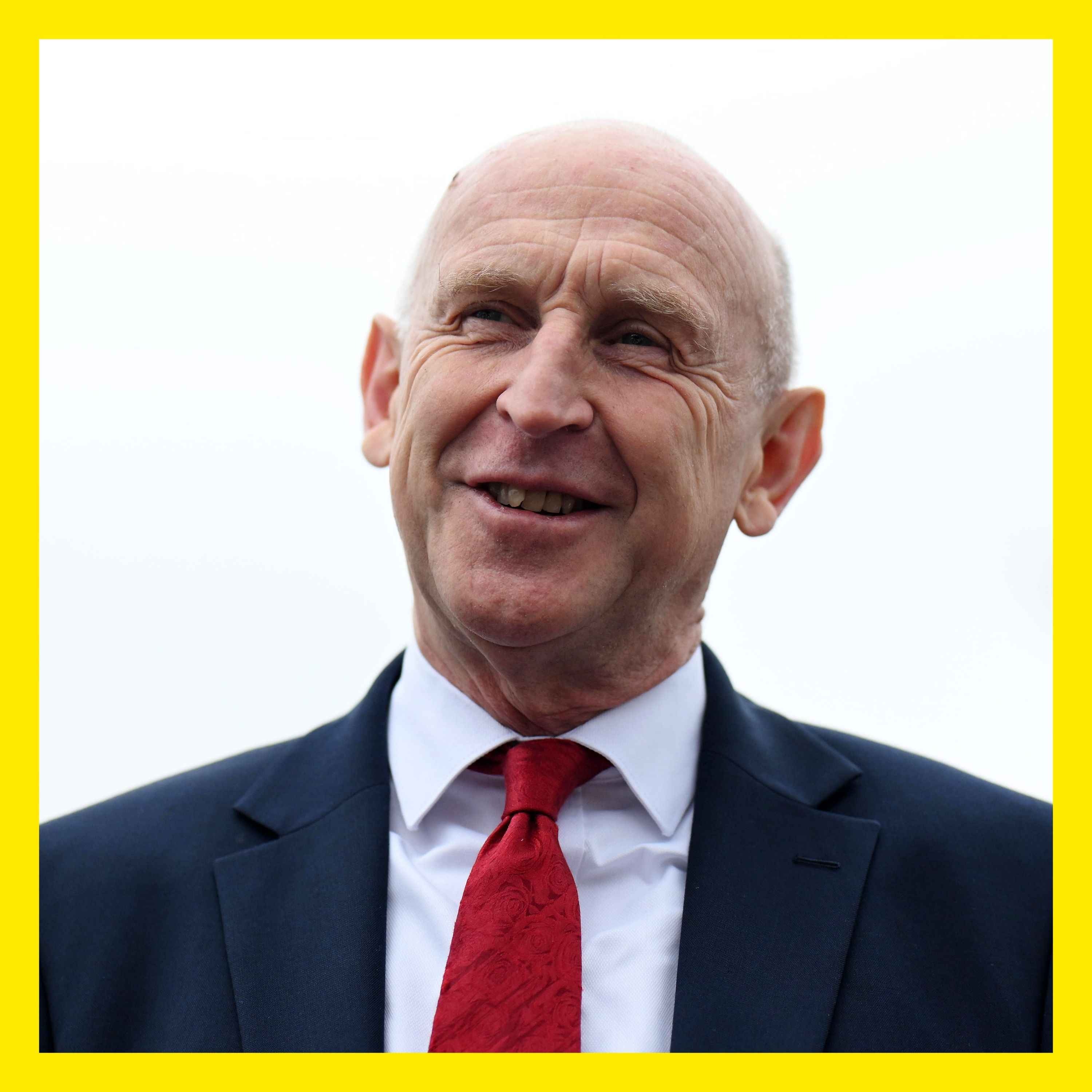
Interview with UK Chancellor John Healey ahead of the Oct 28 budget, focusing on cost of living and cost of business, welfare reform, fiscal rules/headroom, fuel prices, defense spending commitments, tax/spending tradeoffs, and EU relations.
John Healey (Chancellor of the Exchequer; previously Treasury Minister under Gordon Brown; disability rights campaigner; trade unionist; former Defence Secretary who resigned over defence spending plans, later says a clear path to 3% spending will be set). Interviewer: Katie Prescott (Times Tech Podcast).
Labour is “pro-business” and will use the budget to give “breathing space” while meeting fiscal rules with a buffer against uncertainty. Welfare costs should be controlled via getting young people into work/education/training. Fuel duty and welfare savings won’t be pre-signaled; diplomacy over the Middle East is the “real” solution to oil/gas pressures. Defence investment will be funded in full with a clear path to 3% (and 3.5% by 2035). Tax burden can’t be solved without growth.
business rate cuts for pubs/music venues/social clubs; caps on bus fares; VAT off electricity bills; youth unemployment “one in three” in South Yorkshire in the 1990s; references to fuel prices and global duty cuts; examples of EU/defence deals (Germany, France, Norway).
Written by AI. May contain mistakes.
Setting the scene for the interview with Chancellor John Healey.
John Healey discusses his experiences in the Treasury and influences.
“And are there lessons you're applying to your approach to the job now?”
Healey shares his past activism and beliefs about work and justice.
“I've had his block cap emails in the middle of the night.”
Discussion on Labour's stance on welfare cuts and financial reforms.
“Do you feel the parliamentary Labour Party is in a place that they might wave through a package of reforms that would decrease the welfare bill?”
Healey outlines the economic pressures faced by families and businesses.
“When you have deep-seated long-term problems like this, when you have deep-seated long-term problems like political power in this country centralised over many decades, you don't switch those or solve those overnight.”
Discussion on fuel duties and the government's approach to managing prices.
“I read a report that said 40 different countries have cut fuel duties since the Iran crisis kicked off.”
John Healey discusses plans for the upcoming budget and how it aims to reduce the cost of business.
“cost of business um and so um you know i will speak a bit more about this in my speech in Liverpool this week and I will look to do a budget that gives the country a bit of breathing space.”
Healey defends the Labour government's pro-business approach amidst criticism and discusses the pressures businesses face.
“And they will say, where is the proof that labour is genuinely pro-business?”
The conversation shifts to concerns about wealthy individuals leaving the UK and the impact on the economy.
“as well because it they create the jobs and they can create the wealth for us I mean on day one in this job.”
Healey outlines defense spending commitments and the need for a clear path to meet NATO obligations.
“You said you have been unable and the Treasury unwilling to commit the resources that the nation needs to defend the country this time of rising threats.”
Discussion on fiscal rules, headroom in the budget, and economic conditions affecting decisions.
“Coming to the budget, I appreciate what you said about not wanting to fuel.”
Discussion on tax burden, public spending, and economic growth challenges.
“Is that accurate that you're considering leaving a headroom of less than 24 billion?”
Exploring the need for economic ties with the EU and defense strategies.
“Well, let me finish by asking about one of those fundamentals and looking ahead at the next 10 years.”
Interpreting the Chancellor's comments on fuel duty, welfare, and fiscal rules.
“ability to stand together through NATO that gives us that combination of hard power, strong alliances and sure diplomacy that will meet this country safer and more successful in the years ahead.”

Get the gist, explore an idea or ask about something said.
 Claude
On The State of It, what are the key points of this episode?
Searching your listeningAutomatic transcript. May contain errors.
0:00At PwC, we optimize the systems that put your data to work so you can scale your AI from proof of concept to competitive edge and accelerate your tech evolution so you can redefine what's possible. From blueprint to breakthrough, we take you further with tech so you can outthink, outpace and outperform. PwC, so you can. PwC refers to the PwC network and or one or more of its member firms, each of which is a separate legal entity. Hi, I'm Katie Prescott from the Times Tech Podcast. AI is already changing business and medicine, but could it also change the way we look after our own health? In a special episode in paid partnership with Vitality, we look at how AI, wearables and everyday health data could help shift healthcare from treating illness to preventing it.
0:50Listen to the Times Tech Podcast wherever you get your podcasts.
0:59well we are standing outside the gates of downing street it is thursday morning the sun is poking past the clowns we've got tourists of course are getting out their iphones to snap the famous black gates we're about to go inside to number 11 to talk to john healy the chancellor i've been wanting to interview healy ever since he got the job two months ago So he is, other than Andy Burnham, the most significant figure in this government who determines things that directly impact Britain's lives. Anybody who's seeing their mortgage rates jump up, anybody who's paying more fuel when they go to the petrol station, if they're struggling to get a job or their children are struggling to get a job, these are things the Chancellor can impact with his budget on October the 28th.
1:45Now, traditionally, chancellors are very tight-lipped when it comes to fiscal events, but we're going to give it a go and see what he can tell us about his thinking ahead of that big moment well chancellor thank you so much for inviting us into your office and giving us time for a chat real pleasure to have you we certainly want to get into um uh all about your brief and how you want to navigate these tricky times so why don't we start a bit about your backstory you've only had this office for two months but you'll be familiar with it long before then because Obviously, you spent five years in the Treasury under Gordon Brown.
2:19What did you learn from those times? And are there lessons you're applying to your approach to the job now?
2:24John Healey: Yeah, so I was five years a Treasury Minister with Gordon. I last left the Treasury as a Minister 20 years ago. I was two years before that. His parliamentary aide, his PPS. I mean, he was and still is an inspiration, a mentor. he captured for me the best of a Labour Chancellor recognising that at the heart we have to grow the wealth in this country create the jobs knowing that it is the it's private business, private investment that creates the jobs but the best of that is the public sector government working alongside in partnership And secondly, making sure that with that growth comes fairness.
3:19John Healey: So back 30 years ago, we had a strong economy, social justice. And that's really a hallmark for the way Labour governments must approach the duty of government. That's certainly, if you like, part of the deep Labour values. It's what I draw on as the new Labour Chancellor. And if you have the chance to talk to him since entering office, he's never normally shy about coming forward with some tips. I've talked to him. I've had his block cap emails in the middle of the night. But the man is driven and an inspiration to those that he works with. I think possibly some listeners won't know about your backstory before politics.
4:05And there were two particular aspects to it. You spent time as a disability rights campaigner. I mean, I saw you spoke movingly in the past about working in a psychiatric ward on the edge of Cambridge and trying to help those people back into the community and the challenges with the support they needed. And also as a trade unionist, you spent time at the trades union congress. if people are trying to understand your approach to the Translator but their clues in your life experience there?
4:31John Healey: Perhaps, perhaps in two ways. First of all, I think the best politicians of all parties are restless campaigners. We see things that aren't right, things we want to change, ways that society or the economy can work better and we join together with others to try and make that case and get that change. The second is, I think, for me, much more personal. And that is a belief that good work is at the heart of a good life. And I first got elected nearly 30 years ago for part of Rotherham. And in the 1990s in South Yorkshire, the level of youth unemployment was one in three. And that for me is a moral duty that this government now must pick up again with nearly a million youngsters post-COVID, before the election, not in employment, not in education, not in training.
5:37John Healey: and I refuse to see a generation in jeopardy. I refuse to see a generation condemned to a life on benefits and that for me as it was then part of what drives me, jobs, jobs, jobs. Let's touch on that. Do you feel the parliamentary Labour Party is in a place that they might wave through a package of reforms that would decrease the welfare bill? Because obviously we know what happened under Keir Starmer, of that five billion cuts package that was thrown out, exacerbating his political problems. Do you think the PLP is willing to support financial cuts to the welfare budget? Well, they've heard Andy Burnham as prime minister.
6:17John Healey: They've heard me say that the cost of welfare must be controlled, must be brought down. The challenge is how do you do it? And Andy Burnham and I and Pat McFadden are making an argument for a Labour way of doing that. but it's quite clear we have to have people participating, we have to have them working and we all look forward to the report that Alan Milburn will publish shortly because he essentially has set out the scale of the challenge. For me this is a call to action, a call to action not just for government, a call to action for business, for trade unions, a call to action for communities because there are mums and dads that I speak to at home in Rotherham and in parts of Doncaster in the constituency.
7:17John Healey: You hear the fear in their voice for their kids' futures when some at the moment can't bring themselves to leave their bedroom, let alone leave the house. Well, I can see it matters to you personally. What the politicians on the right would throw back, I think, is they'd say, well, why don't you try and lock in some of the savings now at this budget? Because the Alan Milburn review, the PIP review, even if they're going to be published quite soon, those financial savings won't come. It's easy for them to say they never did it when they had the chance, when they had the power, when they had the responsibility in office.
7:53John Healey: and for me there's a big argument about a generation that in whose hands is the future of this country. They are our future, the young people and I'm confident that's an argument we can make with the public. I'm confident it's an argument we can win. And I suppose the argument is it would be too rushed to try and lock in the savings for your budget in just a few weeks' time. You need those reforms to be outlined. When you have deep-seated long-term problems like this, when you have deep-seated long-term problems like political power in this country centralised over many decades, you don't switch those or solve those overnight.
8:41John Healey: And it's part of why, as a new government two months in, we've looked to be a government that acts where we can. so in the first week you saw us act to give a bit of breathing space for those under the pressure with the cost of living and also the cost of business so um business rate cuts to pubs music venues social clubs cut vat off electricity bills cap on bus fares these aren't moves that will remove the cost of living pressures but they signal to people look we're a government that get the pressures. We're a government that will do what we can to give families or individuals a bit of breathing space.
9:28John Healey: And when I talk about the cost of living, when Andy talks about the cost of living, we also talk about the cost of business. And I recognize that businesses under pressure, these global economic shocks and uncertainties are putting pressure on prices. They're putting pressure on borrowing. They're putting pressure on growth. These are worldwide, but we feel it here. We feel it here as we fill up the car. We feel it here in the cost of the weekly family shop. We feel it in the cost of government borrowing. Yeah. Well, let me pick up a couple of points there. The cost of filling up your car, I think everybody across the country will be aware that petrol prices, diesel prices are on the rise.
10:09You're beginning to see action in other countries. In France, they're literally handing out checks, 100 euros to people who are driving to work. Donald Trump is now talking about possibly holding back some diesel exports to try and bring the price down. I read a report that said 40 different countries have cut fuel duties since the Iran crisis kicked off. Right now, the current plan, the plan you inherited, to be fair, is for fuel duty to jump in the new year because that temporary 5p cuts the duty ends and it's due to rise in line with inflation. Surely you're not going to let fuel duties rise when it comes to the budget?
10:44John Healey: Well, look, just to be clear, and from the outset here, I'm not going to give you any answers or signals about fueling that will fuel budget speculation. As all chances say, we should. Well, we've seen too much speculation in previous years, and it isn't just a matter of interest for the media. This has real world effects. It means people hold back investment, so it damages the economy. I mean, it's seen in recent years, people cashing in their pensions. So it hits the family finances. These have real world effects. If people react to baseless stories. So I'm the last person that's going to fuel that.
11:22John Healey: So just to be clear on that. And but I mean, so last time I went past our local filling station the other day, you know, diesel was 192, 195. Unleaded was 172, 175. So I'm conscious of these pressures. And this is part of a recognition that where government can, we'll do what we can to offer people a bit of breathing space for these pressures. But ultimately, I think people also see that these are driven by the Middle Eastern conflict, driven by trade tensions. And so the way of dealing with the problem rather than trying to help with the symptoms that we're all confronted with is we need a peace in the Middle East.
12:14John Healey: And, you know, I was speaking to the Treasury Secretary Scott Besson yesterday evening. We were discussing Iran. We were discussing the prospects and the moves to try and secure a settlement that will allow the conflict to settle, allow peace and reopening of the Strait of Mahmood. And, you know, there were discussions that I think are now well established around the margins of the United Nations meeting in New York this week. In the end, it's a diplomatic solution, not a fiscal solution that must be put in place. Look, and I'm proud of the way, you know, in the end, this is a matter for America and Iran.
12:57Yeah.
12:58John Healey: But I'm also proud of the way that Britain in recent months has stepped forward and has led that military mission, multinational military mission that we put together with more than 30 nations ready in the circumstances of a settlement to help safeguard and keep open the Strait of Hormuz because we all see how at the moment it is choking world trade. it's driving up prices and we can't have around holding the rest of the world to ransom in this way yes i mean they're clearly huge global factors driving it it's interesting it feels like you feel instinctively that fuel prices are too high and feel the financial pain drives the feeling when they go to fill up the car um nobody wants to see prices high for anything um because we know that it's it's putting pressure on people's uh ability to manage week to week um and sometimes putting pressure on their ability to manage the the the daily essentials um and look i'm a i'm the chancellor as well i'm also conscious of the cost of business um and so um you know i will speak a bit more about this in my speech in Liverpool this week and I will look to do a budget that gives the country a bit of breathing space.
14:21Yeah can you can you give me a bit more of a sense on the cost of business how are you looking to act to reduce the cost of business?
14:28John Healey: Well that'll be a matter for the 28th of October. Okay. But look if you want if you if you wanted a an indication it was part of that first week that Andy Burnham and I announced and we're in the hair in Harlow together to confirm You know, cutting business rates for pubs, the live venues, the social clubs that matter to those businesses. But those businesses matter to the community around it. Those are the sorts of things, the high street, the town centres that make the places we live, the places we love. I'm sure there are people on the right who will be listening to this who will be spitting out their conflicts because they'll look at what the government's done over the last two years.
15:09big hike to the national insurance that employees are paying, increase the youth minimum wage, may be an admirable thing to be trying to do, but does make it more expensive to hire young people, ripped up rules about curbing union action, more red trade with the flexible working package. And they will say, where is the proof that labour is genuinely pro-business? All that's happened over the last two years is piling more pressure and complications onto business. I mean, do you fear your predecessor had not been pro-business enough as a chancellor?
15:44John Healey: No, because this is a pro-business Labour government. I'm a pro-business Labour chancellor. You will see with the steps I take that I want to put backing for British innovation, British industry at the heart of bringing hope and growth to every postcode. and that will be a drive that is central to the budget, but it's also recognising that in recent years
16:12John Healey: the pressures on business have been rising and I want this to be a focused budget and the decisions that I take and announce on the 28th of October will be finding the right balance for that in the unprecedented global pressures that we face. Why don't we talk about those? At the very top of this, as the wealthiest in the country, you have seen a trend, or certainly individual examples, of very wealthy people choosing to leave the country. We had one recently, Chris Rockos, who reportedly is the third biggest taxpayer. I suppose he paid$330 million in tax last year. He's decided to move to Greece.
16:53The Betfred tycoon, Fred Dunn, he was reported number one taxpayer he's pulled sponsorship from rugby league which has a lot of support in your part of the country I mean do you find it concerning that these figures are deciding to take their money and their tax elsewhere?
17:10John Healey: Well first of all I mean you're offering individual examples I don't know the details of these people with their own decisions to take there seems to be a trend what I would say this is still a country that is open. This is a country that has a tax regime and a support for business and wealth creation that is as good as any. So, you know, we have the lowest capital gains tax of any European G7 nation. You know, we have a system here where you have 100 % relief if you come to live in this country for four years for any sort of foreign foreign profits and foreign gains so this is a country also with has just huge strengths and people want to be here want to invest here but there are these people who are leaving and and just look as Andy Burnham and I have both said we want we want people to be able to grow their business here we want the people to stay here as as well because it they create the jobs and they can create the wealth for us I mean on day one in this job.
18:20John Healey: I said out to the Treasury here, one of my five priorities was I want to see the decisions that this government makes, the policies that we take, raise the levels of business investment, business confidence, business profit in this country. and that will be a theme of what I look to do in the budget a budget that offers where we can breathing space on the cost of living and the cost of business and a a budget that looks to reinforce growth the dynamism of some of the most enterprising most innovative and fast-growing companies that we've got in this country. And just as a sort of touch of creativity, I've, you know, I've got my head down working on the budget, but I offered a chancellor's challenge to all treasury staff.
19:23John Healey: I heard about this. Nevermind the, you know, the senior, senior people that tend to come in and brief ministers, but wherever they worked, whatever their role, whatever their grade. So it was an open challenge. Give me budget representations and your good ideas. And we had a Helis Dragon's Den. It was a Dragon's Den. We had the Dragon's Den. We whittled 70 down to five yesterday. They came in and presented. One of the Treasury officials bought us a new suit for the occasion. It captured what the Treasury is great at. Bright people, great ideas and a real sense of how government at its best can potentially make a difference to the lives of people who may be struggling and under pressure businesses that may just need a bit of a bit of a lift and do you think some of those ideas might make it into the red book then we'll see on the 28th of October but I'm working on I'm working up some of them do you mind if we come back to what happened before you got to this room three months ago when you decided to resign as Keir Starmer's defence secretary big moment in the run-up to the uh makefield by election it's now familiar what you said in that letter you said essentially it was essential to get to three percent defence spending by 2030 and the package you've inherited was just going to go from 2.6 to 2.68 actually went back to dig dig up the letter you sent Keir Starmer because it was pretty striking.
20:49You said you have been unable and the Treasury unwilling to commit the resources that the nation needs to defend the country this time of rising threats. Now you've got your hands on the budget, you've decided not to try and hit that 3 % by 2030 figure in this budget. It might be something that might be dealt with next year. Why is that if it's such a pressing, important issue for the country?
21:12John Healey: Because we will make the investments that allow us to meet the commitments to allies in full. Andy Burnham said that outside Downing Street on the first day. And those commitments to allies are that 3.5 % in 2035. And on the path to that, we will set a target date for reaching 3%. It is setting out that clear path that this country has not done before to stand up the commitment that we've made to our NATO allies, that we've made to our public that we will do as a government, as every government must, and as every government's first duty, we will defend this country, we will back our forces. I think the record that you've seen over the last two years demonstrates that serious intent.
22:00John Healey: You know, I'm proud to have been part of a government that has increased defence spending more than at any time since the end of the Cold War. Do you know, this year alone, we're spending 14 billion pounds on defence more than in the last conservative year of government. But those were the plans you said were not enough in your resignation speech. I mean, I've talked to cabinet colleagues, if it was at the time, who said, well, hang on, is John Healy either unable or unwilling to spend the money now at the budget? Those are the words you threw at Keir Starmer at the time. We will invest what's necessary to meet our commitments.
22:33John Healey: We will invest what's necessary to defend this country. And for the first time in the spending review we will set out a clear path to how we will do that and in answering that we will also set that target date for three percent as part of the path to that and starting in this budget in just over a month we will we will fund in full the defense investment plan as a first step with still as you know work to do to make sure that that's the case we pick up that challenge both the prime minister and i have said we pick up that challenge and we'll take that further step in the budget at pwc we optimize the systems that put your data to work so you can scale your ai from proof of concept to competitive edge and accelerate your tech evolution so you can redefine what's possible from blueprint to breakthrough we take you further with Tech.
23:31So you can outthink, outpace and outperform. PwC. So you can. PwC refers to the PwC network and or one or more of its member firms, each of which is a separate legal entity. Hi, I'm Katie Prescott from the Times Tech Podcast. AI is already changing business and medicine, but could it also change the way we look after our own health? In a special episode in Paid Partnership with Vitality, we look at how AI, wearables and everyday health data could It helps shift healthcare from treating illness to preventing it. Listen to the Times Tech podcast wherever you get your podcasts. Who says Halloween only lasts one day?
24:11With Wayfair, one night of Halloween becomes a whole season at home. From larger-than-life yard decor and moody lighting to festive accents for every room in the house, Wayfair has what you need to make Halloween feel like magic all in one place. Because the best Halloween memories aren't made in just one night. They're made all season long. Shop Halloween decor now at Wayfair.com. That's W-A-Y-F-A-I-R dot com. Wayfair, every style, every home. Coming to the budget, I appreciate what you said about not wanting to fuel. Speculation, I'm sure you won't get into specifics about what's coming. But I just thought on a very big picture, there are some areas that I'd like to explore.
24:52One being borrowing. Andy Burnham in the summer said he felt there was more flexibility in the fiscal rules that could be adopted that was widely seen as it was possible to borrow a little bit more, maybe using these things called puffins, which allow you to invest kind of arm-length bodies, keeping it off the balance sheet. Do you feel there's flexibility in the fiscal rules that can be used?
25:13John Healey: No, we will meet the fiscal rules. We'll meet them with a buffer against uncertainty. And Andy Burnham as prime minister has said exactly the same thing. We're in lockstep about that fundamental determination. We will meet the fiscal rules. It's part of regaining credibility in the British fiscal system that was shot by the trust mini budget. It's part of trying looking to bring down the premium that Britain is still paying because of those catastrophic, reckless decisions that she and Kwasi Kwarteng made. And it is the it underwrites every promise that we can make as a government. Of course, the big question is how much you want to meet the fiscal rules by.
25:59I'm not wishing to confuse listeners with the jargon. There's this thing called headroom, the buffer zone that you keep money back for a rainy day. It's often described as Rachel Reeves left 10 billion, 10 billion, then in her last budget, 24 billion. Do you feel you have to rebuild that 24 billion with your budget?
26:17John Healey: Well, decisions like that, plans like that are absolutely for budget day and I'll set them out. But the headroom is a buffer against that uncertainty. It is, if you like, the country's contingency.
26:38John Healey: and we've seen the uncertainties, especially in the Middle Eastern conflict, intensifying in recent months. We've seen the oil prices rise since the spring. We've seen the gas prices rise since the spring. I mean, oil's up more than 45%, 14 % in the last month alone. gas is up 150 % and 25 % in the last month alone, which brings me back to, in the end, I will make the decisions that are required to balance the pressures in the budget. And in the end, we have to have a diplomatic solution. And the work that the government is also doing to support those that are looking to broker the discussions, looking to forge the peace settlement and standing ready to play our role to reinforce the peace and maintain the straight-up or moves.
27:43Yes. Well, I understand if you're unwilling to guide on the exact amount of headroom. I'll just try one more time only because the Financial Times has reported today that you are considering having a fiscal headroom of less than 24 billion. Obviously, chancellors have to watch their words very carefully before budgets, but I don't know if you can guide on that at all. Is that accurate that you're considering leaving a headroom of less than 24 billion?
28:06John Healey: I read the Financial Times. I'll make the decisions I need to make and announce them on the 28th of October. Understood. Tax. I can see you're rolling your eyes already. You're not actually John. No, I'm not. You're right. I can imagine you're braced for the conversation. You're not going to tell me your tax plans for the budget. But just as a top-level principle... I'm not. Fair enough. The big reveal. I'm not going to tell you. No, but as a principle separate from this individual budget, we have seen tax during the late Tory years and the first two years of Labour increase as a proportion of GDP, as has public spending.
28:46So we're approaching something more like Europe, a higher tax, higher spending economy. Do you think that's where our future lies? or fundamentally do you think the tax burden, which is at a historic high, has to come down, whether it can come down to this budget or not, just as a principle? Are we too taxed as a nation?
29:06John Healey: Well, as a principle, I don't think any chancellor wants to raise tax.
29:12John Healey: But in the end, the only way out of that tax spend challenge is growing the economy. And the truth is that for nearly two decades since the global financial crisis and crash, certainly through the 14 years of the last government. We've had flatlining growth. We've had rising debt. And it has put pressure on the public finances, which has seen the proportion of what we produce in this country, our GDP, rise over that period from 2010 from around 64 % to nearly 100 % now. And that is the legacy with Cameron's austerity, Johnson's Brexit and Truss's mini budget, adding to those pressures. Well, those on the right might argue a way to get growth going would be to reduce the tax burden.
30:08Let's say you're in office for three, four or five years, however long you want to pick. Is it your ambition to try and bring down that tax burden?
30:16John Healey: I like your hypothesis. three, four, five years. Yeah, that means re-election. But I'm not going to... You're tempted me to speculate now and comment on hypotheticals that in the end risk fueling exactly what has been so damaging in recent budget run-ups. Yeah, two more ones if I may. I'm not going to do that. The other side of the equation is spending. Do you want to reduce public spending? Do you think that's something you might be able to do with the budget? Well, the budget will contain the decisions fiscal and they'll contain the numbers that will cover public spending. So people will be able to see the picture.
31:03John Healey: They'll be able to see the pressures. And we will follow this budget with a 10-year plan for Britain and then the spending review likely next year. and so I mean people will start to see I think over the next few weeks with the conference speech that I make the conference speech that Annie Burnham makes the budget then the 10-year plan for Britain and then the spending review they'll start to see the way that we look to act now to just provide a bit of breathing space where we can cost of business and the cost of living where we act to support those parts of the economy, the innovation, the industry that can see jobs created across the UK, but also the deeper changes necessary over the next decade that are there to put in place the fundamentals that aren't there, that has been part of the reason that this country has not been fulfilling its potential now for too long.
32:08Well, let me finish by asking about one of those fundamentals and looking ahead at the next 10 years. It feels to me, I watched your growth speech and compared the rhetoric to your predecessor, Rachel Reeves. She talked much openly, much more openly about wishing to get closer, quicker to the European Union. You obviously represent the part of the country that backed Brexit. So does the prime minister. how aggressively do you want to pursue closer economic ties within the red lines of the manifesto over the next couple of years with with brussels well as a government we'll we'll
32:43John Healey: work to try and get in place the deal of and the negotiations that are underway at the moment um i think i've demonstrated in the last two years in my previous job that um alongside that recognition that we need to rebuild relations with the European Union. We can accelerate our relations with major countries for whom those relations were badly strained and in some cases almost broken willfully so during the Brexit process. So you've seen, for instance, when I was Defence Secretary, within 100 days, we struck the first ever deep defence agreement with Germany. we've rebooted the Lancaster House agreement with France we've got in place the biggest ever not just export deal but defence and security with Norway agreement with Norway and it's though that isn't just an economic drive that is a recognition in this increasingly dangerous world where threats are rising and demand we do more on defence and security that actually it's our ability to stand together through NATO that gives us that combination of hard power, strong alliances and sure diplomacy that will meet this country safer and more successful in the years ahead.
34:10John Healey: Chancellor, thank you very much. Thanks very much. Well, we are back outside the Downing Street gates after a 30-minute chat with the Chancellor, John Healy. Chancellor interviews, especially before a budget, a very particular beast because chancellors are obliged not to reveal any of the information for what's going to be announced in the budget, partly because that moves markets. It can change stock prices and influence the bond market. And John Healy especially is a very experienced politician. I was hearing from an aide, the Labour conference is going to be his 40th. He entered parliament back in 1997.
34:47So he's one of those politicians who very carefully watches what he says which means if you're trying to understand what's coming in the budget you need to decode what he's saying and search for significance and for me from that conversation even though the chance was playing a straight bat to a lot of the areas we were probing there was some careful chinks of light I think the first was on fuel duty it seems to me unlikely going off my political analysis that he is going to allow fuel duty to increase when there's so much pressure on fuel prices. Chancellor said he couldn't reveal what he was going to do on that but he did very clearly indicate concern about how high petrol prices were.
35:30He talked about how much petrol and diesel were at his local petrol station. So for me that was an indication that he understands there is financial pain there for drivers and perhaps that he might want to add. A second area was on welfare, this neat young people who aren't in employment or education or training. He actively bought up that issue and said it was one that drives him as a politician wanting to help out these young people. Now, we know he isn't going to lock in welfare cuts into this budget, but he did make clear that that's an area they want to reform and in theory to bring down the benefits bill.
36:11So it feels like that is quite high up his agenda, despite Labour MPs overwhelmingly rejecting the Cups package that Keir Starmer and Rachel Reeves put to them. And then the third area is this knotty question of the fiscal rules, those promises Labour made to try and control and reduce borrowing and debt. As I mentioned in the interview, Andy Burnham seems to have flirted with the possibility of doing more borrowing were he to become Prime Minister. He felt there was flexibility in the fiscal rules. That position has very much hardened. John Healy said, no, I'm going to stick to the fiscal rules.
36:43He's sending a clear message to the markets that he doesn't want to borrow more, even though that being an open question back in the summer when Andy Burnham was running to be prime minister. So all in all, although John Healy was counting his words carefully, I think you got a sense there about how on the big picture he's approaching the public finances.
37:08At PwC, we optimize the systems that put your data to work so you can scale your AI from proof of concept to competitive edge and accelerate your tech evolution so you can redefine what's possible. From blueprint to breakthrough, we take you further with tech so you can outthink, outpace and outperform. PwC, so you can. PwC refers to the PwC network and or one or more of its member firms, each of which is a separate legal entity. Hi, I'm Katie Prescott from the Times Tech Podcast. AI is already changing business and medicine, but could it also change the way we look after our own health? In a special episode in Paid Partnership with Vitality, we look at how AI, wearables and everyday health data could help shift healthcare from treating illness to preventing it.
37:58Listen to the Times Tech Podcast wherever you get your podcasts. Thank you.
John Healey, the chancellor, tells us his budget will offer people breathing space on both the cost of living and the cost of business. He said he was concerned about the rising price of fuel and that he wanted wealthy people to stay in Britain. In July, Andy Burnham, the prime minister, said that he would use "any flexibility" in the government's fiscal rules, but Healey was clear that there was no room for manoeuvre on the fiscal rules. Listen to the full interview to hear how he's getting notes in caps lock from Gordon Brown, his thoughts on bringing down the welfare bill and a Treasury Dragon's Den.
Ben Riley-Smith, political editor, The Sunday Times
Producer: Euan Dawtrey
Picture: Getty Images
This podcast was brought to you thanks to subscribers of The Times and The Sunday Times. To enjoy unlimited digital access to all our journalism subscribe here.
Hosted on Acast. See acast.com/privacy for more information.