Ask ChatGPT



Description: Real reporting from the coalface of British politics, featuring insights from The Times and The Sunday Times’ political heavyweights. No party loyalty or spin, presented by journalists who are deeply entrenched in the political scene.
In this episode, titled "The Stench of Decay Coming from Downing Street," the panel discusses the aftermath of a recent budget that has momentarily uplifted Labour MPs but has also incited unrest within the cabinet. The discussion touches upon Patrick Maguire’s experiences at Your Party’s conference, as well as the re-emergence of Brexit as a significant topic in political discourse.
Written by AI. May contain mistakes.

Get the gist, explore an idea or ask about something said.
 Claude
On The State of It, what are the key points of this episode?
Searching your listeningAutomatic transcript. May contain errors.
0:00We also need to nationalise the entire economy. I'm not sure what that means. I'm honestly not sure. I got told this morning that I would not be allowed into the conference hall. Comrade, can you please stick to the motion? I am speaking to the motion. It's not, you're just going around and... I am speaking to the motion. Give it up for the trans people everybody! My name is Joseph, I use she, they pronouns and I'm speaking for option A. We have the Socialist Workers' Party. We know what they did. We know what they did, comrades. They covered up a ring. They covered up a ring. Can you cut the mic, please?
0:40Can I ask you to cut the mic, please? This disruption, Stuart, could you please kindly remove the person from the front? Of the resistance and those who die for liberty. This is the point of the resistance. Welcome to The State of It, the politics podcast from The Times and The Sunday Times. Those glorious clips were from your party's inaugural conference at the weekend, which Patrick Maguire, the Chief Political Commentator at the Times, had the joy of attending. I'm Stephen Swinford, the Political Editor at the Times, and we've got a big welcome back this week to Caroline Wheeler, my colleague at the Sunday Times.
1:17Hi, everyone. Nice to be back. And Gabriel? I'm just, I've always been here. I'm Gabriel Pogrand. I'm the Whitehall Editor at the Sunday Times. Patrick, can you kick us off with that extraordinary conference that you went to at the weekend? Was it fun? Yeah, I'm recovering from my trip to Liverpool for your party conference. Was it fun? It was certainly very interesting, you know, watching two and a half thousand people start a new party of the left from scratch. Look, it was it was a surreal weekend. And it's very easy to say that listening to those clips, because, you know, these are people who have views that are outside of the Westminster consensus, put it this way.
1:55But it was surreal, first and foremost, because it was held in the same venue as Labour Party Conference, the ACC, the conference centre on the banks of the Mersey. And walking in on Saturday, I thought for a moment, have the campaign for nuclear disarmament. And all of the sort of anti-war activists around Jeremy Corbyn thought the best way to oppose nuclear war, to demonstrate we're against nuclear war, is to reenact the aftermath of one. because outside there was nobody there. When you're used to doing this sort of obstacle course of sort of sweaty lobbyists and cabinet ministers and fellow journalists, TV cameras at Labour conference, there was nobody there.
2:34And I thought, genuinely, have they cancelled it? And I just haven't realised. Has the civil war between Corbyn and Sultana resulted in its cancellation? But I walked in and who did I see outside flying against digital ID and a range of other causes, Covid vaccines chief among them Piers Corbyn and I thought well if Jeremy's brother is outside picketing this conference I've definitely got the right place but yeah it was remarkable not least because it felt like a Jeremy Corbyn Labour conference in that everybody hated each other Corbyn got up and gave a sort of hopey changey speech about good things and bad things saying let's not be mean to refugees because tomorrow favourite line of the conference this with very Corbynish specificity he said tomorrow they'll be your train drivers it was all peace and love from Jeremy Corbyn and then he left the room us journalists were ejected from the conference hall and within 10 seconds literally everybody was screaming each other and that set the tone for the weekend Zara Sultana boycotted the first day it was just one of the most vicious but entertaining and in some ways intellectually stimulating events I've ever been to and you know by the way when you're speaking to jeremy corbyn's allies friends advisors and they are the right-wing establishment of the party who are loathed by left-wing members in some cases you think this is the world turned upside down i hope they have another one but i'm not sure they will well it's not too dissimilar to what's been happening in westminster we're going to bring you uh this week two main topics we're going to obviously talk about the budget it's really chaotic aftermath and where that leaves rachel reeves and we're also going to be talking more broadly about Brexit, which is back.
4:13Listeners will be delighted to hear. And Keir Starmer is kind of trying to go on the front foot about Brexit. But let's start with this. We have now lost the head of the Office of Budget Responsibility. He has fallen on his sword for inadvertently leaking the entire budget on the day of the budget, which is unprecedented in its own right. And we're also in the middle of a kind of big civil war in Cabinet, where even Cabinet ministers feel that they were misled by the Chancellor when she kept claiming that there was a black hole in the public finances that she needed to fill with tax rises. In fact, as the Office of Budget Responsibility helpfully disclosed on Friday, that black hole did not exist.
4:52You've now got Rachel Reeves being called a liar by the Tories. You've got most economists arguing that she did actually, at the very least, mislead. You've got cabinet ministers who think that she's misleading. And if it wasn't possible for her to be more damaged, well, she is now. She's got lower trust levels than Liz Trust now. She's plummeted off the edge of the polls. And yet it looks like she's going to stick the course for now at least and stay in position. I keep thinking back to when we were kind of looking into the budget, what was happening. And I kept saying to Steve, and we were talking about this earlier, have they actually said what the black hole is yet?
5:27Because, you know, in normal circumstances, and I hope I'm not breaking too many journalistic confidences here. there is a moment ahead of the budget where the journalist of choice get a kind of tap on the shoulder and formally sort of briefed off the record about what the size of the black hole was going to be and it just didn't happen. We knew about the productivity at downgrade but we never knew what the size of the black hole was going to be and actually it was quite interesting because we were getting all sorts of voices to the contrary. I think Rishi Sunak wrote in the Sunday Times that he didn't actually think that the finances were as bad as Rachel Reeves was painting.
6:08He wrote that for us, I think, three weeks before the budget came out. There were whispers. And I remember talking to my editor at the Sunday Times a couple of weekends before the budget and said, you know, somebody suggested to me that actually there is only about a£5 billion black hole. As it turned out, there was in fact a surplus. A£4 billion surplus. And a lot of journalists are very angry right and it's not my job because it's all about us steve exactly politicians are angry journalists are angry and it's because they put out half the story the story that they put out they did leak one figure they said that there was a 20 billion pound downgrade in the public finances that was leaked to the financial times that is a traditional pre-budget leak the ft always gets something like that but they didn't leak the other bit they didn't leak the bit that said that actually higher inflation means tax receipts are much better and that black hole doesn't exist and And I think that that was clearly misleading and deliberate.
7:03And what she couldn't do is square the language of political choices she lent so heavily on in her budget speech with that reality. Because she talks, Rachel Reeves, as if she's doing things out of necessity. You know, we're all going to have to make a contribution, etc, etc. The reality of this is, OK, she wasn't in an amazing fiscal position. She still needed more headroom. But what she has chosen to do because of her weak political position among the Parliamentary Labour Party first and foremost, and yes, there's a bit of political morality mixed in there as well, is do something quite shifty on working people, i.e.
7:47freeze the thresholds, something she was going to overturn by the end of this Parliament because she said it was an injustice and short change working people, to increase welfare payments. which, by the way, unlike those tax thresholds, are linked to inflation. That's a very difficult political choice to defend, lifting the two-child cap while freezing everybody else's tax thresholds and clobbering more people with income tax and all the rest of it. To do that from a sort of position of fiscal strength is even more unpalatable. So no wonder she couldn't be entirely straight or give us the full story because then I think the political choices she's made, which is what they are, are even harder to defend.
8:25So she's in this weird position of saying, we chose to do this, and the Prime Minister said it as well. We chose to do this because we really want to do it, but also times are really tough and we have to take tough decisions. And they're caught between those two messages. And I think that goes some way to explaining why they couldn't be completely straight. The Parliamentary Labour Party wouldn't accept anything less than lifting a two-child cap, but the fiscal reality left them in a better position than it looked. I mean, politics has become more meta than ever before. and people knew as Reeves was rolling the pitch in a somewhat unorthodox way earlier in November what it was that she was trying to do you know we knew that she was bracing the public and her party for something that overtly departed from the manifesto but then when she didn't do it it sort of only exposed the expediency and political considerations at the heart of it and I think as well i mean it's kind of interesting this weekend number 10 we were saying that those quibbling with uh you know the perceived mismatch between her statements and the obr's reporting was what didn't understand maths that we were innumerate and illiterate and that this was all disingenuous and i also think that it probably taps into a wider theme which is the the sort of reduced value of words themselves when it comes to the treasury i think that you know we actually had lunch with somebody a couple of weeks ago who was saying to us that this project has such a slippery relationship with words and they almost seem to think that you know when it comes to political vocabulary you can kind of say some things and then kind of recount them later and the public doesn't notice and for instance you know their insistence that this doesn't breach the manifesto when in actual fact people know that they are paying more tax because of the freezing thresholds well i think i think that they think that there there is greater value attached to their own words than the public does.
10:20And this only, it's sort of deep in this existing sense that what the Chancellor says and then the letter of her own policy are not always the same two things. Yeah, the age where you can get away with pointing to some specific phrasing in a manifesto, if that age ever existed. After the budget, so many ministers, I'm thinking of James Murray, Chief Secretary of the Treasury, Bridget Phillipson, Education Secretary, both are on the media rounds. after the budget, in the days after the budget. I don't say this is single them out, just the interviews I remember. And they're asked the same question again and again.
10:55You said you weren't going to raise income tax, but for a lot of people, that is now true. They're going to be paying more income tax as a result of a decision the Chancellor has made. And both of them, this was clearly the line to take, said, well, hang on, no, no, no. If you read the manifesto, it said we're not going to increase the rates of income tax. So actually, we haven't broken the manifesto. Now, the problem is, a bit like Keir Starmer saying in 2020, hey guys, I'm Jeremy Corbyn in a suit. That's all right. Or Keir Starmer saying in 2024, this is a changed Labour Party. We're not going to behave as you think the Labour Party is going to behave.
11:28We've been reprogrammed by Morgan McSweeney and some other bright people. actually if you then proceed to do the opposite even if you can find a document somewhere that says no no no you know i think you'll find that we are in the letter if not the spirit of this voters are not going to say oh well since the chief secretary of the treasury has just said it on the world at one fair enough i don't feel angry about it anymore and that that is the political problem there so look we should ask the bigger question in relation to that and the question of truth which is where does this leave rachel reese and keir starmer and i wanted to give you a little insight into our craft our job so normally when you do something happens in journalism and you try to ring around ministers and cabinet ministers and it's actually really hard work you try and get people on the phone bump into them in places and get their reaction to an event in the wake of this budget and in the wake of friday when it was revealed that the black hole didn't exist it was actually one of the most straightforward weekends of journalism i've ever had because people voluntarily cabinet ministers senior ministers started just getting in touch to say we feel like we were misled we're really angry about this and we splashed that story on monday this kind of very unhappy cabinet that the cabinet itself felt misled by the chancellor and what i would say more broadly is when you get to that point when you get to the stage where ministers are making very clear that they are unhappy you're slightly in the kind of it feels to me in reporting terms like the end of days territory it was like when boris johnson folded and the briefings started flooding in.
13:02People are very unhappy. So look, we have a high tax, high welfare budget, as Patrick said, which is probably enough to win over Labour backbenchers and Labour MPs. But you have a very unhappy cabinet who are really concerned about what's happening. And that's why May, when we get these elections, is going to be really messy. And that pressure is going to start to tell more and more. But the interesting question, Steve, is, is it enough to win over Labour backbenchers? Because we know about these Labour backbenchers. they're not the backbench of a Chinese Labour Party they're fickle, they have a low pain threshold and what's been interesting is yes they all felt great about themselves on Wednesday because they lifted the two child cap etc etc I think unease is beginning to creep back in some of them have spent the weekend on the doorstep getting kicked in the face by their constituents over the taxes they're paying and realising actually this isn't possibly a winning proposition in the country.
14:00Rachel Reeves is doing her best to sort of curry favour with these people. Minutes before Richard Hughes was sat yesterday, she wrote in the WhatsApp group for Labour MPs and said, thanks, almost a veiled criticism of the cabinet ministers who've been briefing against us, sort of thanks so much to all the supportive colleagues who are, you know, out there at a time when some people don't want the government to succeed, but you, my supportive colleagues, You know, I'm really, really grateful. And that's a massive WhatsApp group. And I'm told it got a couple of dozen likes out of, you know, several hundred Labour MPs.
14:33So that is not a great indication of how popular the Chancellor is right now. It's a small straw in the wind. But you just know that Labour MPs will not need another excuse to give the government a kicking. You know, this general air of, you know, the stench of decay coming from Downing Street, I think, is getting in the nostrils of Labour MPs. And I'm not saying that it's reverted to the mean of Labour MPs being completely feral, as one ally of Keir Starmer put it to me the other week. But, you know, they are a hard crowd to keep on side. And it won't take much. It won't take much more political turbulence for, you know, things to kick off again.
15:14definitely we actually had some polling in the paper this weekend by more uncommon which said that it was the least well-off segment of the electorate which in the most resounding number said that they didn't think that the budget would address the cost of living crisis for them and i had a little anecdote in my piece on sunday about an encounter that reeves had a petrol station just leaving the west midlands shortly after her visit with starmer after the budget in which a driver came up to her introduced himself and sort of i think semi-sympathetically said well you can't please everybody love and um you know i think that she said you know you can't he said that's politics but the question is well can you can you please uh the plp and in order to do that you need to please the people whose grievances and complaints and anxieties they feel most acutely and that is uh you know in many instances the people who are supposed to be the beneficiaries of the budget and in particular the lifting of the two-child cap whether they feel they're benefiting when sort of wider ambience wider effect of the budget is pretty corrosive when it comes to growth that's another question and and it should be said you know however the totemic the two-child cap is if you're going back to your constituency week after week in a run up to Christmas and into the new year ahead of the locals and hearing all the same thing you know the mood changes rapidly.
16:33There's no commitment on the PLP's behalf that they'll now, you know, gingerly retreat backwards and won't come back to ease with more complaints or demands in the new year. Because of course, the thing that we all forget is that it's popular amongst Labour MPs, the two childcare cap being lifted. But as Rachel Reeves knew, and her aides has certainly been briefing for a long period of time beforehand, it isn't actually popular with the public. And again, as Patrick was saying, if you combine that with the fact that people are going to be paying more tax you know there is a risk there isn't there that people do kind of pick up on this line that kemi badenock sort of spouted about you know it's a return to benefit street and you know i think that whilst there is a rearguard action going on at the moment and people explaining very clearly that you know around 70 of those people that will benefit from this announcement are actually in work i think that that is something that is still going to irk some people that they are paying essentially to pay a bigger and bigger and larger and larger welfare bill.
17:33But I was really fascinated to see your story about the cabinet in particular, because it does feel a bit like what you were saying as well a few weeks ago, Gabriel, that it is just these constituents, these kind of three constituents of the electorate, the backbenchers and the cabinet, and you're kind of juggling those three balls all the time. And you can only make one of them happy all at once. And it seems whilst the backbenchers might be slightly happier this week, the cabinet aren't. And I do kind of wonder whether anything has fundamentally changed, because I do think that that situation that we had only a couple of weeks ago, I think when there was that incredible briefing against West Streeting and the sense I got from cabinet ministers that were calling me that weekend was that they were worried about who was going to be next.
18:20You know, they felt that that kind of camaraderie, that unity, that we're all in it together, however difficult it is out there, you know, we are a unit that can kind of face this down. There was a sense then that Number 10 could easily throw any one of them under a bus at any given moment, you know, if it was politically expedient to do so. And I do wonder if that will be the beginning of the kind of real fracture in Cabinet. Right. Let's head to the interval. and when we come back we're going to be talking about something that's back on the agenda once again thanks to Keir Starmer, Brexit. Brexit is back in kind of full force so we'll come back and talk about that shortly.
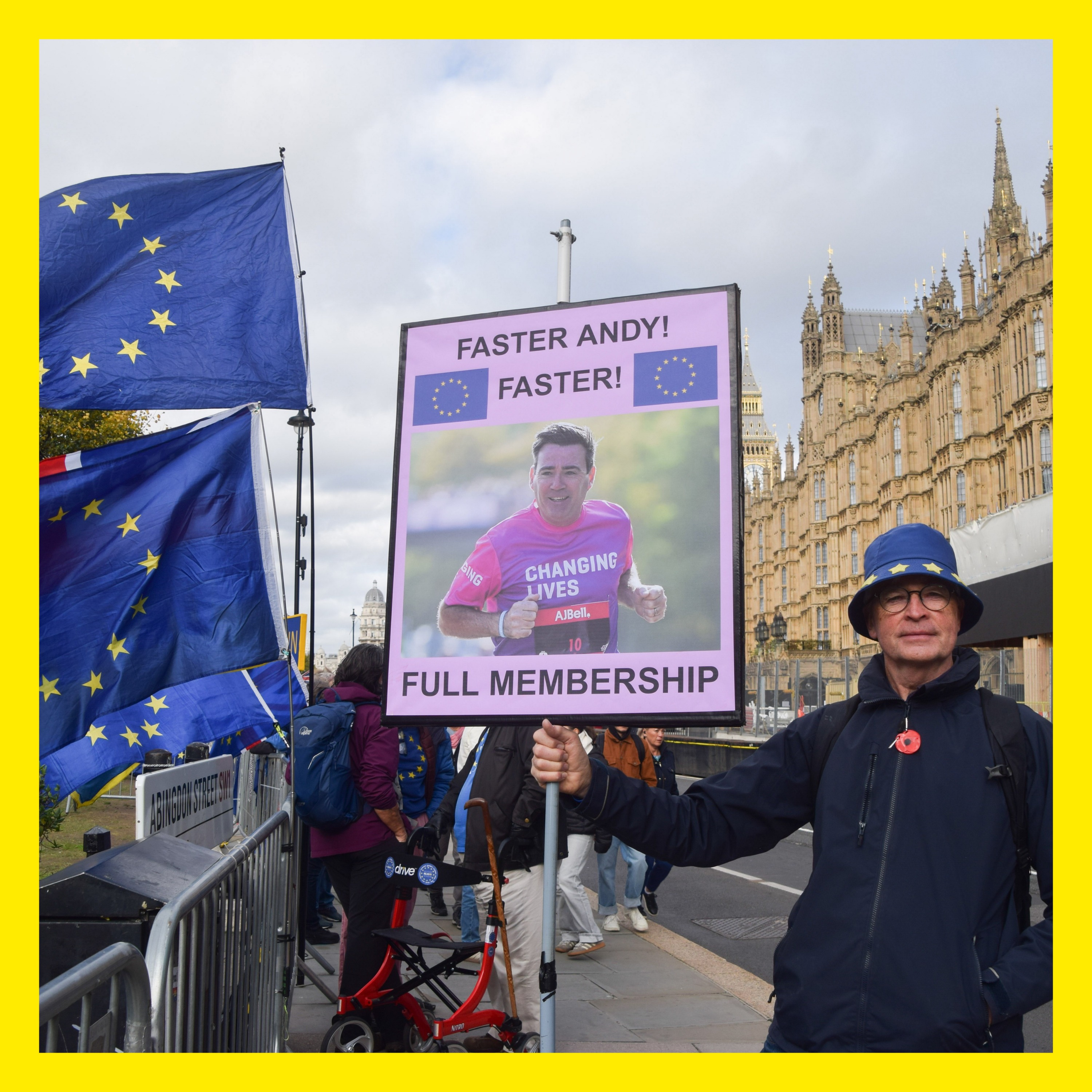
18:58Welcome back to The State of It, the politics podcast from the Times and the Sunday Times and for the second part we are going to talk about the return of Brexit to the forefront of British politics. So last night we had Keir Starmer standing in his kind of finest outfit and gave a speech in which he said that people made wild promises about Brexit, promises that were never fulfilled. Now, why are we talking about Brexit again? Why are we back here? The reason is because Keir Starmer and Labour think there is an opportunity here. If you look at some YouGov polling, it suggests that six in 10 people want a closer relationship with the with the European Union and so they sense a political opportunity that if you castigate those who delivered Brexit and specifically one guy who they say walked away, Nigel Farage, there are political points to be made here and this is against the backdrop of negotiations with Brussels have kicked off again.
19:56Those talks are happening at the moment about a youth mobility scheme which could see about 50 ,000 young people from Europe come to the UK every year. There are also further talks on kind of removing some of the frictions. But there's also huge risks to this. If you reopen the Brexit Pandora's box, it can get pretty vitriolic pretty quickly. I mean, it's fascinating to see that this has become a thing again. But I mean, look, I don't think this particular discussion is going to go away. My understanding is that the Liberal Democrats are going to kind of weaponise this as a subject. I can see that there is a 10-minute rule which is a rather arcane legislative procedure which is on the order paper for next Tuesday which has been put down by Sir Ed Davey the leader of the Liberal Democrats when they are going to try and push to a vote the idea of rejoining the customs union I think pretty much specifically with the aim in mind of flushing out Labour MPs to see who might come out and actually say that they support it.
20:56And I was sent a letter this morning that's gone to Labour MPs from the Liberal Democrats, urging them to back this particular legislative procedure, which, I mean, I must say, I can't remember a single time when it's ever become legislation when it started in the 10 minute rule, although I'm sure, Patrick, even with your history, is there one? I'm all out. I'm all out. It's usually sort of symbolic, but it is, but it is, it can be used as a tactic to create mischief but it could have legs this time because if you see large swathes of Labour MPs either coming into the chamber to talk about it or if they do manage to force it to a vote it could be quite interesting.
21:32And that is a delicate line they're trying to tread what they are trying to do is to say Labour backs Brexit the right kind of Brexit with fewer frictions but what we don't want to do is rejoin the customs union and the problem is as we learned at the weekend when you've got Starmer's most senior economic advisor, a woman called Manoush Shafiq, suggesting that privately behind doors as a way to boost growth, it got killed, nixed, that's not going to happen. But nonetheless, that is the very delicate line that they're treading here. Yeah, the government's a walking contradiction on this because you have the Prime Minister campaigning on a platform of make Brexit work.
22:08Just over a year in, he and his chancellor a sort of half saying i think it's important not to overstate their political courage here you know they sort of say it then they shrink back from it right so keir starmer said that the lord mayor lord mayor's banquet last night wow he's gone to the city of london said brexit was a mistake that's really really brave you know try doing it in you know grimsby or hull or wherever uh you know the chancellor says oh you know brexit has really hit our productivity figures she barely spoke about brexit by the time of the budget you know you're basically told the whole budget's going to be in a full frontal assault on Nigel Farage and his role in Brexit.
22:42That didn't happen. You've got the Prime Minister's chief economic advisor behind closed doors saying, why don't we rejoin the customs union? Then you've got the business department and Peter Mandelson, the late Peter Mandelson, when he was ambassador, spending a lot of time taking advantage of Britain's place outside the EU to negotiate an advantageous trade deal. You've got an AI policy that is built on Britain being out of the EU. You've got planning policy taking advantage of not being banned by EU regulations, right? And then you've also got one of Keir Starmer's closest allies, Nick Thomas-Simmons, the Paymaster General, in the Cabinet Office, spending most of his time negotiating a closer economic relationship with the EU.
23:25You've got the Youth Mobility Scheme that Rachel Reeves was desperate to get the OBR to score as a growth measure. and then you've got the Home Office under Yvette Cooper and Shabala Mood saying, whoa, whoa, whoa, whoa, whoa, why are you out there saying, please, can we have a potentially open-ended number of immigrants, right? So almost everything the government does on the EU and on Brexit, you can find a counterexample in policy terms that cuts across it. And there is no central sort of narrative on Brexit. That's the problem. And you can say that for lots of things, but at no point other than as a political expedient, I think, have they ever really engaged with the question of Brexit and what it means and what it could mean for Britain's economic model.
24:04Instead, as they bounce from political problem to political problem, they find a new stance on Brexit or Brexit and the EU are useful in different ways. So it's a bit of a mess, I think. I think that's right. I'd say the other thing is, in journalism, we are particularly attuned to contradictions and hypocrisy. Politicians can, endowed with the correct skills, reconcile contradictions or have them coexist but use rhetoric and vocabulary to weld them together and ask the public to go along with them boris johnson being the most famous example he was the london mayor who was a great spokesman for the cosmopolitanism of our great city and who believed in migration who spoke about his you know turkish ancestry and then he was you know the heineken politician who went to places that tories wouldn't go in order to persuade people to vote for Brexit.
24:56So you can have politicians that can transcend what appear to be intellectual contradictions as long as they actually appear to be able to own them. And Starmer's problem has been that because of his position when he was shadow Brexit secretary, you know, he was correctly deemed by most people to want to inch the Labour Party back towards a remain position. So there's always this notion that he sort of says one thing, but ultimately wants to give effect to another and when you couple that with his own ambivalence on how to take on reform we've spoken about this on the pod before sometimes he says they're racist other times it seems he says you know perhaps they're not morally objectionable but they're the politics of grievance and it wouldn't work yeah that's what this is by the way i mean that is essentially what he said yesterday it's not that you know brexit is intrinsically bad What was he saying at Guildhall, by the way, wearing white tie and almost looking like a laboratory grown version of the critique that, you know, Farage and others put forward about him?
26:02He was saying that it was the promises, the nature of the Brexit advanced by Farage, which wasn't acceptable, to which I think the obvious rejoinder from Farage is, well, yeah, I wasn't in government thereafter. I'm just not sure it's very persuasive. That's the point, because they wanted to pick Farage as the guy that delivered Brexit, then walked away and took no responsibility for it. But actually, I think for Farage, that is a potential strong point because he can say, well, I had nothing to do with the way it was delivered. The way it was delivered was hugely problematic. That is the Tories' fault.
26:30And then he can say, when I'm in number 10, I will sweep away all these problems. I will redefine our relationship with the EU, which is broadly the pitch he's making. And also Farage's view is Europe is turning towards the radical right or parties of the right with which Farage is aligned or familiar from his time in the European Parliament or otherwise sort of politically simpatico. So he would say, look, you know, if you want people to have a conversation in this change Europe, I'm your guy. And the second thing reform's leadership have spoken to me about a few times is, can you necessarily sell turning back to the EU at a time where on occasion it's not averse to taking a particularly aggressive trade stance against the UK?
27:15You know, put tariffs on UK steel the other day. That was manna from heaven politically for reform, who have made steel one of their big iron bars with which to beat Labour. so they think the politics of this are not as straightforward for the Labour Party as they look you know that the EU are not necessarily the good guys in the eyes of the electorate that we might think. One thing is for sure we are not in a 52-48 world anymore right the politics of Brexit has changed the big discussions around migration now are about actually non-EU migrants because that was the big change under the post-Brexit regime and there's been a significant shift in the way it is today i think that about brings us to an end this week if you want to email us if you want to get in touch please drop us a line at the state of it at the times.co.uk that's the state of it at the times.co.uk we'd love to hear from you we'll obviously be back next week in full force back with caroline again delighted to have you back on board um gabriel can you pay tribute to our excellent producers please absolutely uh yeah molly guinness you and daughtry thank you so much um and we'll see you in a week's time
The budget gave Labour MPs a lift but for how long? They're already getting uneasy, and some members of the cabinet are so cross that they're proactively ringing The Times. Also, Patrick reminisces about his weekend at the Your Party conference...and Brexit makes a comeback.
Steven Swinford, political editor, The Times
Caroline Wheeler, political editor, The Sunday Times
Patrick Maguire, chief political commentator, The Times
Gabriel Pogrund, Whitehall editor, The Sunday Times
Producer: Euan Dawtrey
Executive producer: Molly Guinness
Picture credit: Getty Images
Email us: [email protected]
This podcast was brought to you thanks to subscribers of The Times and The Sunday Times. To enjoy unlimited digital access to all our journalism subscribe here.
Hosted on Acast. See acast.com/privacy for more information.