 Ask ChatGPT


In this special episode of The State of It, host Caroline Wheeler visits Ukraine on the fourth anniversary of the Russian invasion. The episode captures a poignant moment in the ongoing conflict, detailing the experiences of ordinary Ukrainian citizens and the resilience they display amid adversity.
Written by AI. May contain mistakes.
The host discusses travel logistics and security measures for journalists entering Ukraine.
“to that, I've also been in on the overnight train as well with Sir Lindsay Hoyle, the Speaker of the House of Commons.”
The host reflects on the significance of the fourth anniversary of the invasion and the situation on the ground.
“We've seen the, well, we think it's the Polish president's plane arriving at the same airport as us.”
Discussion of current military statistics and the changing dynamics of the conflict.
“There's going to be a load of dignitaries here in Kiev to show solidarity with the Ukrainian people.”
Exploring the psychological and physical impacts on children affected by the war, including abductions.
“But I mean, one of the statistics that really struck me last night is that apparently during the past year, only 0.8 % of the territory in Ukraine has been taken by the Russians.”
The host describes the resilience of the Ukrainian community despite ongoing challenges and despair.
“in Kyiv this year, perhaps colder than any of the winters that they've had during this conflict.”
A look into the tight security measures in place for Ukrainian leaders and the threats they face.
Learn about the security measures and assassination threats facing the First Lady and President Zelensky.
“without going through various security checkpoints.”
Discover the story of Ukrainian children pursuing their dreams in dance amidst adversity.
“They've subsequently returned to Ukraine because they're professional ballroom dancers.”

Get the gist, explore an idea or ask about something said.
 Claude
On The State of It, what are the key points of this episode?
Searching your listeningAutomatic transcript. May contain errors.
0:02Caroline Wheeler: So, we have just arrived at the airport. We're going to be getting one of the royal planes, which the government charters. To do these kind of trips, we are going into Ukraine for the anniversary of the conflict, the fourth anniversary on the 24th of February. I was there for the first anniversary three years ago. I went there sort of on my own and wrote a big piece for the Sunday times about how the government of Ukraine was being run in the dark because of the threat of drones. They had to put sandbags up and all the rooms and all the corridors were pitch black and going in to meet who was then Zelensky's right-hand man, Andrei Yermak.
0:44Caroline Wheeler: And subsequently to that, I've also been in on the overnight train as well with Sir Lindsay Hoyle, the Speaker of the House of Commons. That was a trip and a half. That was in the VIP train overnight. I think it will be a similar train this evening once we get to the border. We usually fly either to Warsaw, but you can also fly a bit closer to the border to a place called Reservoirs. And then you tend to get the train on the border. I'm not breaking any security details here. These trains are used routinely. There's been lots written about them. They're quite a thing. And obviously, we won't be publishing this recording until after we've returned.
1:23Caroline Wheeler: So we're not jeopardising or endangering anybody on the journey. But I'll come back to you when I'm either on the plane or when we get to Poland and just let you know how we're doing. The jet's rumbling, about to go on the back steps of this plane. I can see Beth Wigby from Sky News is just doing a feature camera. She's the only other journalist coming on this trip, which is the pool camera for the broadcast round. And we're still waiting for the Cabinet Minister to join us, but we're boarding now. We've landed in Poland now and we are just making our way towards the train station to get an overnight train into Ukraine.
2:04Caroline Wheeler: You can drive, you can walk across one of the borders or drive across one of the borders. But by and large, when you are travelling with a politician, certainly when I've travelled in the past, I've gone in by train. the airspace closed when the invasion began so no one can fly in and out of ukraine and indeed even president zelensky when he travels abroad has to do the same routes they've got a number of these trains which go in and out of kiev apparently the trains are going a bit slower because there have been some drone strikes on the train tracks and it's safer to go at a slower rate There's a number of other dignitaries coming with us for this fourth anniversary.
2:48Caroline Wheeler: Show of solidarity for President Zelensky and, of course, the Ukrainian people. We're going to be in convoy with them in a number of trains. We've seen the, well, we think it's the Polish president's plane arriving at the same airport as us. I think we're in convoy with them as well. We're going to have to give our normal phones in. We have to take in burner phones where we can. But in this case, it's particularly acute because there are concerns that the Russians can track our SIM cards and can see movements of SIMs and data, which can indicate that there are people going in. Although, you know, one does wonder how much they know already, given that it's an anniversary and often there are these big shows of solidarity when there are commemorative events like this.
3:36Caroline Wheeler: So I will probably be speaking to you next time from the burner phone when I am on the train. So we've just arrived in Kiev. It was a fairly long night on the train. I think I slept for about 10 minutes off and on. Fairly noisy and rattly old train. It's known as the Bravery Express as it comes into Kiev. We got off about 6am and it is the 24th of February, so it's the fourth anniversary of the invasion. If you remember, everybody thought at the time that everything would be over and the Russians would have completed their invasion within a matter of days. And what came to pass was something very different.
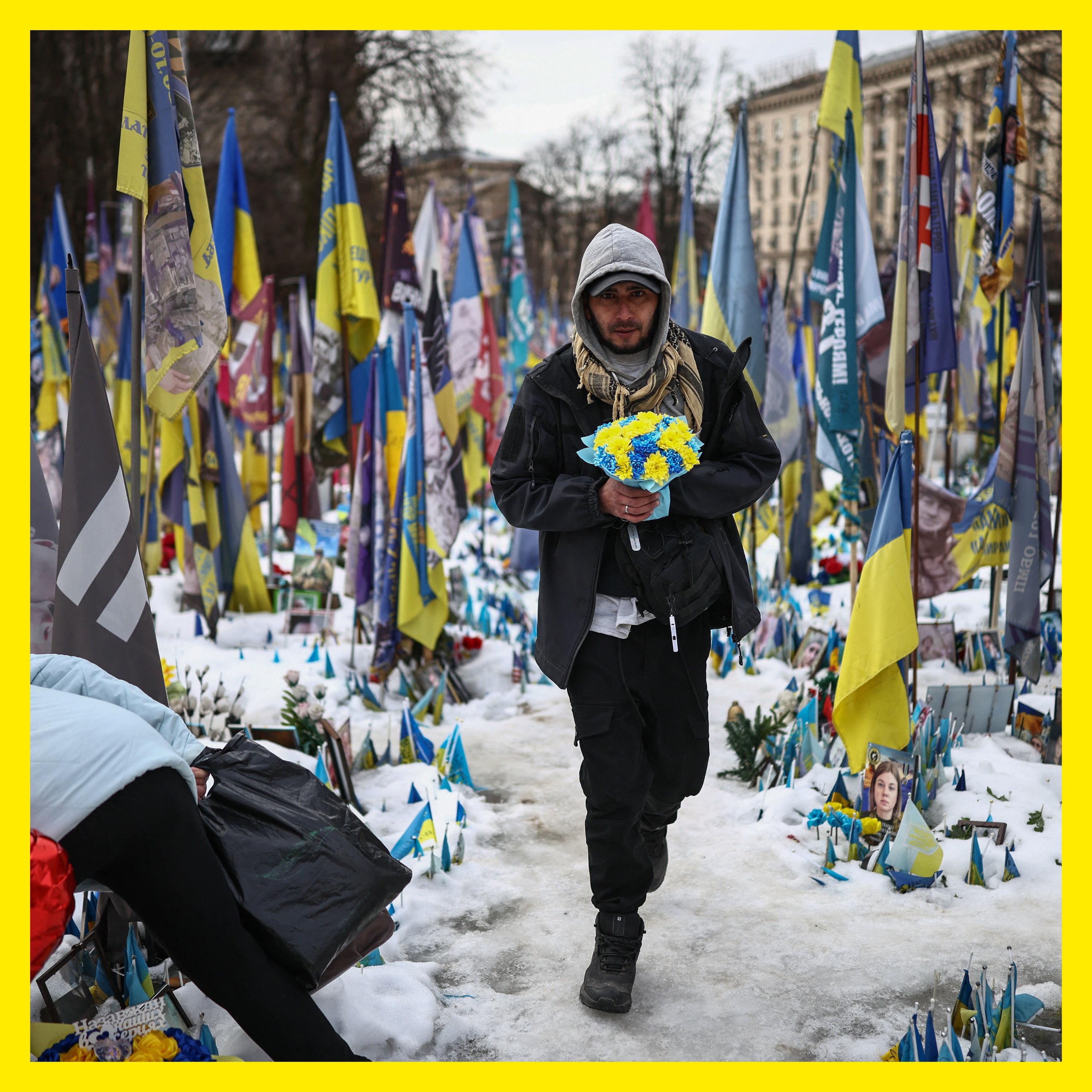
4:19Caroline Wheeler: They thought that President Zelensky would flee, that he would leave Kiev. There was an offer, of course, by the Americans to rescue him. There was that famous saying that he didn't need a ride. He needed arms to take up against the Russians. and they held out. And in fact, they're still holding out more than 1400 days later. And today we've arrived on the train. There's going to be a load of dignitaries here in Kiev to show solidarity with the Ukrainian people. Among them is Yvette Cooper, the Foreign Secretary, who we are with here in Kiev this morning. We're going to be going to an event at Maidan Square, which is the main square in Kiev for a lighting of the candles to obviously commemorate those who've died in the conflict.
5:07Caroline Wheeler: And we've just come to the residence, which is where the ambassador lives, just outside the centre. I've just sat down and I can see some familiar things here. There's a book by my colleague Gabriel Pogrund on the bookshelf here and also our former Earthwell colleague Tim Shipman. His book is on the shelves here and they obviously like board games. There's a game of diplomacy. it's worth just thinking about what this conflict has become. We were talking to a Western official last night on the train. He was saying that it's now estimated that around 1.3 million Russian soldiers are casualties of this war.
5:48Caroline Wheeler: And there is an ambition now because the Ukrainians are now killing more Russians than they can recruit. And President Zelensky, as I understand it, said quite recently that they think that they'll be killing around 50 ,000 Russians per week quite soon. And that far outstrips the number that can be recruited in Russia, which presents a real problem for President. But obviously there are casualties on this side as well. But I mean, one of the statistics that really struck me last night is that apparently during the past year, only 0.8 % of the territory in Ukraine has been taken by the Russians.
6:29Caroline Wheeler: at the cost of, what, half a million lives. And as it was described to us, it really is kind of First World War madness in terms of the numbers of lives being lost in this conflict. So it's going to be a really interesting day, and I will bring you updates from that ceremony in Maidan Square. I think we're also due to see the First Lady at some point today and also President Zelensky himself.
7:02Caroline Wheeler: Checking in on the afternoon in Kyiv, it's been a busy day, which started with that ceremony that I mentioned with many of the leaders of the EU nations coming together with President Zelensky in Modan Square, which is like the central square in the middle of Kyiv, to light some candles. And that was swiftly followed by a meeting, which was actually led by the Prime Minister, who isn't here, Sikir Starmer, at the Intercontinental Hotel in Kyiv, where they were having a Coalition of the Willing meeting. Keir Starmer came on the video call and started to talk to his counterparts about what he wanted to achieve in terms of the next steps to the Coalition of the Willing, which was a group of countries which have come together to help support Ukraine, particularly in the event of a ceasefire.
7:51Caroline Wheeler: Some of them offered to put boots on the ground to maintain the peace. And then we were quickly rushed away from that meeting to another meeting. The woman that I met was a woman called Elena. She lived quite close to the Zaropova nuclear power plant. And she described to me in vivid detail, really, how she was detained by the Russians back in 2022. in a detention camp before being taken to a forced labour camp, where she was made to do absolutely appalling things, including stripped naked. She was threatened with rape. She was beaten. She still bears the scars of that. She believes that what the Russians are doing is worse than what was occurring in World War II.
8:38Caroline Wheeler: She talks very, very movingly about the trauma that she suffered as a consequence of that. And I think what really strikes me about being here today is that to all intents and purposes, this is a normal city. It could be anywhere. It could be Paris. It could be Prague. You know, very beautiful, buzzy city. Beautiful architecture. There's heavy snow on the ground at the moment. But it's busy. It's thriving. There are cars in the streets. There are people on the pavements. People going about their everyday life. But the scars of this conflict are everywhere. From that meeting, we went to another meeting, this time with the First Lady, Elena Zelensky, who has been championing the plight of the missing children.
9:27Caroline Wheeler: This is the 20 ,000 children that have been taken to Russia and effectively indoctrinated in Russian ways, re-educated, forcibly removed from their parents, sometimes whole orphanages removed from Ukraine and taken to Russia. and just, you know, unbelievably moving story of a woman who talked about her own children being taken away from the two months that it took for her to get them back. And just the psychological warfare is at another level. I just, I find it absolutely unbearable to think of the idea of having your children removed by an aggressor. And the First Lady spoke very movingly about the need for the international community to wake up to what's happening, to remember the children, to keep the pressure on the international community to get them returned.
10:20Caroline Wheeler: I spoke a little bit about how at one stage the Russians were trying to make the children part of the prisoner of war transfer agreements and how they rejected that out of hands because these aren't soldiers, these are children. But just talking about the impact that this is happening on the future of those children, even the ones that come back they're traumatized they've got ptsd they often can't reintegrate you know they talk about the kind of stealing of ukraine's future and even amongst those children that are still here and haven't gone missing you know there's a problem in the west because there are schools there where the headcount has doubled because there have been so many children evacuated from the east and they're having difficulties there and then of course in the east there are children that haven't been to school for years who have been learning online and whose childhood has been severely impacted so really visceral scars of this conflict everywhere around us and then we've just now landed at another site just over the other side of the river and that's actually where most of the power shortages have been during the winter it's been a very very cold winter here in Kyiv this year, perhaps colder than any of the winters that they've had during this conflict.
11:37Caroline Wheeler: And in this community, which I'm standing in now, there's a group of tall tenement buildings, flats. I'm told some of them haven't had power since before Christmas and may not have very much power until spring. So we've come to a basically a tent where there is heating, where people can go and charge their mobile phones. But it literally is a very small sort of marquee and you know just to put that into context a couple of weeks ago it was around minus 20 here and lots of these houses have not had heating during this period of time and the one thing I was struck by when I come to Kiev is is the the resilience and they don't like that word anymore because they're not being resilient because they want to be they're being resilient because they have to be and a couple of people have told me how they don't like that word anymore But they are just buggering on, if you forgive the phrase.
12:29Caroline Wheeler: They are keeping calm and carrying on. But a number of the people that I've spoken to today, including in the First Lady's team, have just said really clearly that today, this fourth anniversary, has been an emotional day for many people. They said last year wasn't so bad because there was a bit of optimism in the air. There was hope that there could be a peaceful end to this conflict. That hasn't happened. And there's going to be talks going on again further this week. But a real kind of sense of despair that Putin is not serious about the peace negotiations, that he's kind of playing with them.
13:05Caroline Wheeler: So they're not actually going to get very far and just said that's really wearing and that they just feel there is not much light at the end of the tunnel. But at the same time, another member of the embassy staff was saying that this is a community that comes together often, sometimes when there's been an attack for example people come out and help each other the next day there's kind of coming together and it's a city that's just not giving up and a community and a country that's not giving up in the face of just huge adversity and you can really feel that that's sort of palpable but you know it's also a nervous city I think one of the other things that I've been struck by is that I've been to several events uh today one involving President Zelensky and one involving the First Lady.
13:53Caroline Wheeler: And security is incredibly tight. They don't let you into the areas where they are without your passport, without going through various security checkpoints. But I went into the meeting with the First Lady in a very nondescript building. There were people very clearly standing as lookout. You know, they are very clear that there have been a number of assassination attempts on their life. I think, as President Zelensky has said only recently, he is the number one target for the Russians and his family is the second. And so they have to be enormously, enormously careful. And as far as we understand it, the first family don't even live together and actually can only see each other fleetingly because of the risk of their lives.
14:35Caroline Wheeler: And let's not forget, there have been numerous assassination attempts on their lives. So this is our penultimate stop. We're going to go off to this, to a dance studio just outside Kyiv, which is actually where the two children that lived with Yvette Cooper when she took in a refugee family who went to live with her in her constituency home. They've subsequently returned to Ukraine because they're professional ballroom dancers. And we're going to go and see them dance. You know, this is about ensuring that there is still a dream, a future for people in Ukraine. There is hope still here, although on this greying February evening in the cold, with the power cuts, with the drone strikes, the last one was on Saturday, quite a bad one.
15:26Caroline Wheeler: There is still a sense that this is a country that's fighting back.
Join Caroline as she visits Ukraine on the fourth anniversary of Russia's invasion. Burner phones to make sure the Russians don't track them as they travel in on a train called the Bravery Express. A meeting with the first lady, and with a woman who was captured and held in a forced labour camp. Kyiv is a busy, modern city where some residents have to find tents to get heating and electricity.
Caroline Wheeler, political editor, The Sunday Times
Producer: Euan Dawtrey
Executive producer: Molly Guinness
Picture credit: Getty Images
Email us: [email protected]
This podcast was brought to you thanks to subscribers of The Times and The Sunday Times. To enjoy unlimited digital access to all our journalism subscribe here.
Hosted on Acast. See acast.com/privacy for more information.