
 Ask ChatGPT


 The State of It
17 Mar 2026 · 26m · 13 chapters
Description: A political podcast from The Times and The Sunday Times featuring insights and analysis from leading political commentators.
Steven Swinford, Patrick Maguire, Gabriel Pogrund, Caroline Wheeler
Written by AI. May contain mistakes.
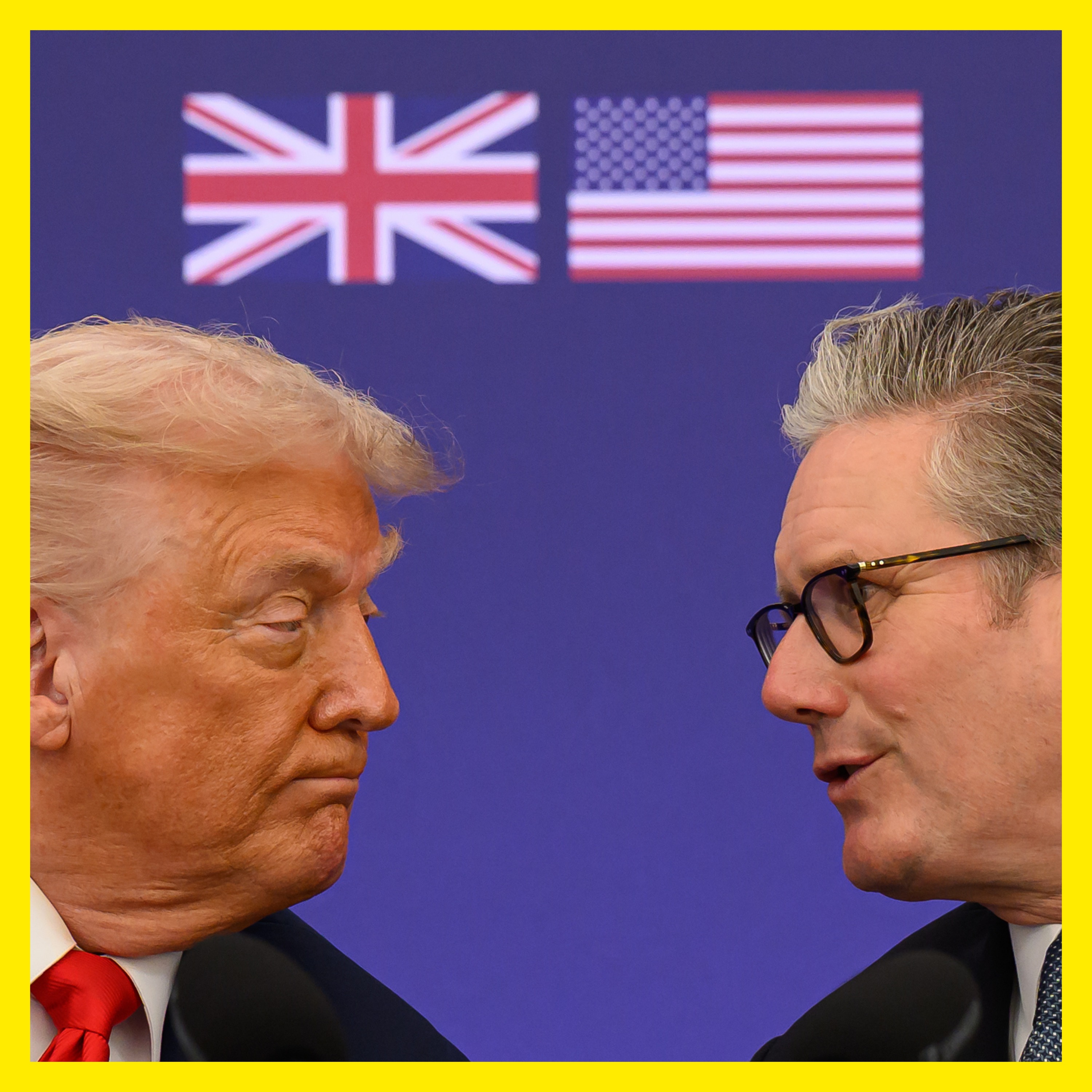
Discussion on the state of the UK-US relationship and Trump's tirade against Starmer.
“And joining us down the line is Patrick Maguire, chief political commentator of The Times.”
Analysis of Trump's claims regarding military requests and UK's factual response.
“We are going to talk about the British military intervention potentially in the Straits of Hormuz.”
Exploration of Starmer's political stance and public perception regarding Trump.
“And he claimed that Starmer had offered this aircraft carrier later today.”
Discussion on the broader implications of the UK’s political landscape in relation to US actions.
“But the Prime Minister has still managed to parlay that decision into something that looks like a conviction position, something that's on the right side of public opinion.”
Impact of the Strait of Hormuz situation on UK politics and oil supply.
“But the place Kyrgyzstan has ended up in now seems to be taking shape as a new consensus position across at least the mainstream of British politics.”
Examination of the UK government's legal stance regarding military deployment.
Analysis of energy costs and the political challenges faced by the government.
“As you say, Steve, all of these are, to one extent or another, mitigations rather than straightforward, really recognisable cuts.”
Debate on the effectiveness of targeted support for energy costs versus universal solutions.
“and all the stuff about the fuel cap, etc., and directing companies to do this or that.”
Discussion on Starmer's economic policies and their potential impact on his leadership.
“This is already quite a left-wing Labour government in the way it conceives of economics and fiscal policy.”
Analyzing how Starmer's situation differs from past interactions with Trump.
Discussing Angela Rayner's recent talks with BNP Paribas and implications for her leadership.
“So there is an extraordinary story in the FT today.”
Exploring Angela Rayner's evolving stance and approach to policy and political identity.
“traders have kept close on that's what the city's worried about and it sounds like from what patrick hearing, she is saying that she would absolutely preserve that essential kind of doctrine of Starmer's economic policy.”
Examining the controversies surrounding Angela Rayner and her political comeback prospects.
“And that KC actually concluded she should have paid the tax.”

Get the gist, explore an idea or ask about something said.
 Claude
On The State of It, what are the key points of this episode?
Searching your listeningAutomatic transcript. May contain errors.
0:00Patrick Maguire: We have to reopen the straight-off Hormuz to ensure stability in the Mock. That is not a simple task. There are different ways that we could contribute, including with mine hunting drones. We will not be drawn into the wider world. You're the Prime Minister, you can make your own. Why do you have to meet with your team to find out whether or not you're going to send some minesweepers to us?
0:35Gabriel Pogrund: Welcome to The State of It, the political podcast from The Times and The Sunday Times. I'm Stephen Swinford, the political editor of The Times. I'm Gabriel Pogrand, Whitehall editor at The Sunday Times. And joining us down the line is Patrick Maguire, chief political commentator of The Times. Here in our corporate headquarters, we have an enormous Patrick in front of us on a very large screen. Sort of like my dreams at night. Anyway. Right. This week, we are going to be talking about the special relationship. Has it hit a new low? It feels like it has after Donald Trump's latest extraordinary tirade against Keir Starmer.
1:13Gabriel Pogrund: We are going to talk about the British military intervention potentially in the Straits of Hormuz. Where are we with that? Could we do it? And we have a scoop on some legal advice the government has taken on it. And we are going to be talking about Angela Rayner. She's back. She's talking to the city and she's taking their money, which is really interesting, trying to kind of calm the horses about a potential Angela Rayner premiership. But let's kick off with Donald Trump, who last night did this extraordinary press conference, which shocked a lot of people in number 10 as much as it did the prime minister himself.
1:45Gabriel Pogrund: and what he basically did was he said that he had been treated terribly by Keir Starmer, that he had made a formal request for some warships, Starmer hadn't given them, and then he'd subsequently offered a warship but it was too late, they'd already won. It was kind of a prolonged attack on the UK and the special relationship more broadly. This was greeted in Number 10 with some surprise given that he got a lot of his facts wrong. He said, we asked for two aircraft carriers, in fact Britain only has one functioning aircraft carrier, There aren't two. And he claimed that Starmer had offered this aircraft carrier later today.
2:20Gabriel Pogrund: The government is categoric. At no point has it offered this aircraft carrier. But for Starmer, there is an argument that it is not unhelpful to him to have Donald Trump attacking him, given the unpopularity of this conflict.
2:33Patrick Maguire: I think the Prime Minister has shown unusual, if not entirely unsurprising, political dexterity, given that we know that initially he would have been in a pro-US, is probably the wrong position, but we know that it was the intervention of cabinet ministers at National Security Council, which gave the UK a sort of semi-detached relationship with the initial US assault to start with. But the Prime Minister has still managed to parlay that decision into something that looks like a conviction position, something that's on the right side of public opinion. And I think, and I wrote this in the Times last week, that that's because, you know, this is Keir Starmer's happy political place.
3:22Patrick Maguire: The word happy isn't too distasteful. You know, it's high diplomacy. It's international law. He has the intellectual vocabulary and this is how he conceives of politics. So that's one thing. The second, by the way, looking at how this is unfolding this week, is that it's striking that the place Keir Starmer has ended up in, it's not a full on war of words. And it was also striking that Donald Trump kept saying Keir Starmer was a nice guy in his Oval Office address. You know, we've had loser, et cetera. But there is clearly a productive enough relationship behind the scenes or a civil relationship, right?
4:03Patrick Maguire: It's not totally degraded yet. But the place Kyrgyzstan has ended up in now seems to be taking shape as a new consensus position across at least the mainstream of British politics. Kemi Badenock, I think only this morning, has come out and said Donald Trump is childish, right? Which is, considering where Kemi Badenock was only a matter of days ago, that's a really, really striking. I'm not saying Kemi Badenock is following Keir Starmer, but I think we might be approaching the territory where politicians across the piece, certainly in the middle of British politics are all sharing a moment of reflection on the nature of our relationship with the US and I think Kemi Badenock also going out on a limb and being critical of Donald Trump which I think is harder for a Tory leader to do any Tory leader to do to directly criticise the US president I think is really striking too.
5:00Gabriel Pogrund: The problem they've got is with the straight reformers right and this is arguably the genie is out of the bottle and it may be out of Donald Trump's control. But if that is not reopened, we're going to see very real consequences in the UK. We've already seen experts that are talking about fuel rationing. They're talking about potential issues like that. If this goes on for a month longer, how long will it stay closed? And it has an impact on oil supplies to the UK. And it obviously has a clear impact on the cost of living. So there are direct political consequences. And it is all very well to criticise trump's position and to say he doesn't have a viable or credible plan but a viable or credible plan is needed to reopen the straits of hormers which brings us to the question of what are we going to do about it and there is a discussion in government i'm told that they have been taking legal advice on whether we can deploy naval assets to the straits of hormers on the grounds of self defense of our gulf allies now that doesn't mean we're going to do it obviously there is a massive issue with the fact we don't seem to have any seaworthy naval vessels at this moment apart from one which is heading towards cyprus right now but we are still in a position where for the first time in half a century we have no naval assets in the middle east which is extraordinary and there will be repercussions for that in the long term but nonetheless it is all very well taking a position and for europe not to intervene but we could get to a position where if the only solution is de-escalation well what if that doesn't work what if there is a de-escalation and iran just keeps firing drones at the strait of homers it's got nothing to lose in this situation and that is the problem that some kind of action is likely to be needed to guarantee safe passage to those giant oil tankers and container ships that are going through that tiny body of water fascinating steve um what you just said a few moments ago about the uh acquisition of legal advice on what we can do in the straits for him is i mean there is a bit of a a split screen emerging in terms of the government's response to this crisis which is you know on one hand everything in the international theater is being reduced to questions of international law which you know as patrick outlined is well within starman's wheelhouse and comfort zone and it does seem so far as though he feels he has international law on his side in terms of you know his kind of restrained approach towards joining the initial adventure or misadventure as the case may be in iran coupled with what he deems to be kind of permissible defensive actions or multilateral actions to keep the straight of one who's open and then on the domestic front well that does come down to straight politics and there is no international law perspective on the question of whether starm would be well advised or not to introduce some sort of package to reduce cost of energy it seems as though you know we're not in uh you know previous universe in terms of it being a general multi-billion pound package but it seems from what one can tease out from the government to date that you know it would would be targeted but those the decisions that could make or break the government depending on the duration of this conflict and and in that regard i would imagine that ed miller band's position will be determinative you know ed miller band is not the prime minister but his decision making might end up being the difference between starmer living to fight another day after may and the opposite outcome but it does seem now like uh you know the international picture of this is a square which starmer has managed to circle so far but they're much more difficult questions lying down the track and patrick we should talk about this but they are obviously weighing up a pretty chunky package on the cost of living to shield people from soaring bills basically from oil prices etc my lesson that i i think we all learned from the Tory period politically.
8:42Gabriel Pogrund: So Liz Truss spent in excess with Rishi Sunak subsequently of£40 billion on energy support to stop people's bills from rising by as much as they would. But they still went up. And there were a series of other measures. And we saw the same in the pandemic. It is a thankless task. I'd suggest that straightly voters now expect the government to step in, and they don't thank them for it. There is not a political win. You can spend an extraordinary amount of money, the kind of bonanza that every party would love to take to an election, and they still don't thank you for it, because all you're doing is mitigating an increase in the cost of living rather than reducing it.
9:18Patrick Maguire: Yeah, exactly. And that is the fundamental problem. I mean, consider everything that Keir Starmer has been talking about since January, freezes in prescription charges, freezes in train fares, 150 quid off your energy bills, the energy price cap coming down. As you say, Steve, all of these are, to one extent or another, mitigations rather than straightforward, really recognisable cuts. People aren't necessarily grateful for that, are they? That's the political problem. And it was interesting listening to Paul Johnson, the guru of fiscal policy, yesterday talking about the government's heating oil announcement mitigating the rise in the cost of heating oil for the relatively small number of households that use it across the uk and not even not even all of them right the people on low income low income households problem with doing that is you know even though it's one thousandth of the cost of liz truss's bailout it has created a precedent and who knows when the autumn comes whether actually people are going to need help with their energy bills in a way this is a fortuitously timed, even allowing for the unpredictability of British weather, right?
10:34Patrick Maguire: It's fortunate for the government that this is happening. As we're moving into March, April, May, people might be turning the hating off. But they've set the precedent now and there will be a massive expectation for them to deal with it. And the question will be subsidy or cash transfers. And it was interesting in the five point plan Kirstama announced in a very Ed Miliband-ish way, and this was pointed out to me by a couple of cabinet sources that this was pure Miliband, there was a mixture of cash transfers, i.e. redistribution from the government to low-income households, but also what Ed Miliband used to call pre-distribution, which was the use of regulation to direct companies to make sure people didn't have to pay high prices or lose money in the first place, and all the stuff about the fuel cap, etc., and directing companies to do this or that.
11:23Patrick Maguire: so I suspect actually you know we might see a Milibandist solution where you get redistribution and pre-distribution but they'll be under a lot of pressure to do a lot of it.
11:33Gabriel Pogrund: So one of the issues which you've allotted on there is the Prime Minister in the Commons said that he would protect working families from rises in energy bills but from everything we are hearing and we did an interview with Rachel Reeves on Friday which appeared in Saturday's Times they are looking very much at a targeted solution which targets poorer households and how do you identify those households? Well those households are the households on benefits, they are the households on pension and credit, much like the warm home discount and that means you have to draw a line and we all know that can go very very badly wrong.
12:04Gabriel Pogrund: Look at winter fuel payments, when they took winter fuel payments away from people they did so based on a threshold of income and lots of people pointed out well you've drawn the line here, I'm just above it, so I am by virtue of being slightly marginally better off although I'm still really struggling, suddenly you know hundreds of pounds worse off and that is the problem that as soon as you get into targeted support there are clear winners and there are clear losers and look i'm not saying i'm not justifying millionaires getting energy bill handouts but i am saying there is a whole like area a tranche of people who are struggling that are going to be either side of those cliff edges and that's the dilemma they're going to grapple with which is why universal solutions tend to be politically more straightforward even if you're not rewarded for them it serves as well just briefly to remind
12:51Patrick Maguire: ourselves that this is a Labour government and when their backs have been against the wall, Rachel Reeves in particular, has always looked to protect people on low incomes. This is actually, despite appearances, quite a, it's already, you know, regardless of what happens when Ed Miliband, you know, raises the red flag over number 10 in the coming weeks or whatever, we're led to believe is happening inside cabinet by dismayed and terrified Blairites. This is already quite a left-wing Labour government in the way it conceives of economics and fiscal policy. I think the instincts of people like Rachel Reeves in particular are already really clear to see.
13:33Patrick Maguire: So I don't think they'll be weeping many salt tears in the Treasury or Desnaz if they end up being a very targeted thing, not least because it's good for the bottom line as well as the way they conceive of their political mission. I think that's right. I mean, it's one of those kind of great essay questions that every government is confronted with. Who are your people? Theresa May had the jams just about managing. Starmer had working people. And I think the budget and events since have, as you say, Patrick, crystallized the idea that it's going to be the less well-off who are prioritized above the median voter.
14:10one thing i just think might just bear remarking upon as well is i think if you ask people in number 10 what the kind of peroration of all of his early courtship of trump was it was that moment when he was able to exempt britain from the u.s tariffs and he had peter mandelson remember him in the oval office inking this deal with trump this is just just feels like a very different situation in that relief for Starmer does not lie in Trump's discretion or at least you know Trump will exercise his discretion in terms of this war for reasons that are wholly unrelated to the UK it's going to relate much more to the US stock market and also the isolationist tendency within the Republican movement than anything Starmer says now I don't know whether that engenders sympathy for Starmer among the populace but in terms of the bigger picture and whether Trump could produce a rabbit from Manhattan tomorrow massively mitigate the pain for this administration well well he can't and that is uh that is the reality that the picture Starmer's in for better or worse and it might be for the better in terms of public opinion in terms of how he's handling this but in terms of how people are feeling economically it is it's a very difficult position and it's not like there are levers he can instantaneously pull that are going to get him out of this
15:28Gabriel Pogrund: okay right we'll head to the interval and when we get back uh we need to talk about Angela Rayner We all need to talk about Angela Rayner. An extraordinary story today about how she's been talking to the city, what she's been saying to them. So we'll come back and talk about that shortly.
16:02No better feeling than when everything just clicks. Buy your car today on Carvana. Delivery fees may apply.
16:15Gabriel Pogrund: Welcome back to The State of It, the politics podcast from The Times and The Sunday Times. We need to talk about Angela Rayner. So there is an extraordinary story in the FT today. And there's also an extraordinary story about her in The Times today as well. The FT story is a fascinating story where she has been talking to the city. She has been paid by BNP Parabas, which is a French bank, about a five-figure sum, to talk to them about their concerns. And she's assured them over the fiscal rules. She's basically trying not to frighten the horses and reassure them that, look, should she ever enter power, she would have a kind of fiscal rules-orientated government, not pull the borrowing lever, all of that jazz.
16:54Gabriel Pogrund: But at the same time, she is being paid for this, a significant sum. and some people are saying to me that the next register of interest could be a lot of money in there there's several speeches she's done some are saying tens of thousands some are saying in excess of a hundred thousands and that matters for two reasons one she's got a potentially very big tax bill coming down the line for unpaid stamp duty but two these things are always potential conflicts of interest they are minefields for anyone in government or out of government as you know Gabriel you frequently write about so um look I'm open to views on what do we think about this Angela Rayner intervention well I think um yeah our large pay packets for after dinner speaking events and memoirs has a faint redolence of Boris Johnson's time uh before ascending to the premiership and I think there is possibly um another parallel to be drawn between our former Deputy Prime Minister and our former Prime Minister, which is that like Johnson, Rayner in her own way, despite her deep roots in the Labour and Trade Union movements, she does travel reasonably ideologically and lightly.
18:04And what was the objective of this event? It was to avoid speaking the horses and to convey to an audience that the cliche or the parody of Angela Rayner is not necessarily the reality of a Rayner premiership. I do think that if you just briefly trace Rayner's roots and the sort of first moment where the prospect of her leadership reared its head it was back in 2019 late 2019 2020 this is just for the Labour historians among us but a man by the name of Morgan McSweeney had once upon a time canvassed Rayner during the Corbyn years and considered whether she might be a viable leadership candidate but but when it came to Corbyn's defeat Rayner's position was twofold first it was that she didn't feel ready the second was that she felt that she could perpetuate the kind of internal coalition that had been the foundation of Corbyn's leadership namely that between the unions on one hand the left on the other she felt I remember being told this by her allies at the time that she had an understanding with John McDonnell that nobody on the left would run against her if she was to stand for deputy Richard Burgeon then threw his hat into the race and the rest is history but one thing that it did do is it drove a wedge between her and the left which people possibly thought i think actually probably wrongly assume is her natural constituency here she was saying well that's actually not true in terms of my factional identity it's not also true in terms of the substance of my political office she's saying you know an angela reina premiership would not be a return to corbynism i wouldn't necessarily be the left choice and she is quite delicately positioning herself a millimeter or two to the right of andy burnham who's still haunted by his prognostications and comments before labour conference about bond market she's saying well no actually um i was part of the keir starmer project easy though it is to forget and one pillar of that was these fiscal rules that's what guilt traders have kept close on that's what the city's worried about and it sounds like from what patrick hearing, she is saying that she would absolutely preserve that essential kind of doctrine of Starmer's economic policy.
20:16Patrick Maguire: Yeah, absolutely. There are two audiences for these talks. And it's interesting that this has clearly been briefed out. There's lots of speculation in Labour circles whether this has come from the city side or whether it's been briefed out by the Friends of Angela Rayner universe, which is very well populated with very chatty people to the despair of Angela Rayner's team. Well, obviously the first audience is the city. It's the people in the room. It's so Angela Rayner can go in and say, by the way, earning 10 grand, 5 grand, however much of speech, clearly helpful if you may have a tax bill to pay.
20:53Patrick Maguire: But that's by the by. It's about going in saying, I'm a credible person. Here I am. I believe in the fiscal rules. Remember all that planning reform we did? Yes, workers' rights was in the manifesto, but I'm pro-business, pro-worker. I'm a serious person. Why can't we all just get along? One thing that a key figure on the soft left was saying to me, there's a push on the soft left. Louise Haig, the key organiser of that faction, has also been trying to reclaim the mantle of fiscal responsibility for the soft left, particularly on welfare. As one person put it, can Angela Rayner go into the city and say, only Nixon could go to China, only I can reform welfare.
21:36Patrick Maguire: That's one thing. So that's the financial services audience. But reading about Angela Rainer going into the city and being well received by BNP Paribas sends a message to the Parliamentary Labour Party. It is that Angela is serious. she is organized she is dealing with her weaknesses she is trying to communicate clearly something distinct from rachel reeves and andy burnham she's a person of substance she's self aware all of these things and as much as we in the lobby say you know kissed on the fell under a bus tomorrow angela rayner would become prime minister without a contest or whatever it's not necessarily be true right these people still have doubts about angela rayner they still have the same conversations about angela rayner as people on the outside do so all of the things that angela is doing you know the the nature of her interventions in parliament this sort of thing um you know it's several audiences at once and the parliamentary labor party will be looking at this morning and thinking you know it's another sign that she's she is serious i think that's right and i'll just offer you one small vignette which i think illustrates the sort of subtle evolution of her approach to policy and politics which is um you might remember on this podcast a number of episodes ago i mentioned that um keir starmer was retreating from one of the promises that angela rayner managed to extract from him during one of their testy bilaterals in government which was a commitment to give effect to some sort of cladding remediation bill where the government could subject building owners and developers to criminal sanctions in the event that they failed to make good on their commitments to sort out the post-Grenfell cladding issues.
23:27And there was lots of concern that this particular bill and package hadn't really been subjected to proper scrutiny. And there was a sense that we ought to let the air out of this balloon and hope that Angela Rayner doesn't object too vigorously. Well, speaking to people around her over the last few weeks it's emerged actually she is herself pretty happy to let this one die and i think that you know in a previous era um you know patrick and i reported in our book that she genuinely believed or at least was alive to the possibility that she had been summarily assassinated by people in number 10 that they had proactively leaked information about her that was compromising you know if you spoke to people around her at one point in time and they also saw any attempt to step back an inch or two on policies which had been hers that would be responded to as a overt threat and starmer in his diffident and slightly awkward way trying to subtly kill things that she had represented well it seems in this instance that the angela rayner policy package as was a year ago is being rethought rethought and reshaped a question from uh that emerges from uh aubrey allegretti's story today on the front page of the times namely that labor uh underwrote her legal advice question that emerges is is it actually going to be possible for her to disentangle herself from the thicket of this hmrc issue and um you know can she rehabilitate herself in the eyes of skeptical audiences there are a lot of questions which are yet to be resolved
25:04Gabriel Pogrund: so aubrey's story this morning is that at the height of the scandal of whether she paid the right amount of stamp duty, she commissioned a KC at some cost, tens of thousands of pounds, we're told, to look at her tax fares. And that KC actually concluded she should have paid the tax. So it didn't go brilliantly. As I think, either way, that bill was paid for by the Labour Party. Now, why is that interesting? There is an argument she should have paid it herself. That's number one. There is a question about whether that's taxable benefit. That's number two. But more broadly than that is, and the story quotes people saying, there are some very aggressive criticisms for of people saying, I didn't do my kind of Labour subs to pay for Angela Rayner's legal fees.
25:44Gabriel Pogrund: And it is being used as a vehicle to criticise her. So there are knives out for Angela Rayner. Her critics are trying to get ahead of a potential comeback. And a story like that is really interesting politically. So we'll see. But it is fascinating to see her effectively on manoeuvres. I think that brings this week's episode to a close. So thank you for joining us once again. gabe would you like to do the honors this week for our excellent producers yes well uh we should give a special thanks to patrick um who uh is in ireland on saint patrick's day for joining us uh in this instance remotely and thank you so much to molly guinness new and daughtry for um for excellent production and be back next week
Steven Swinford, political editor, The Times
Patrick Maguire, chief political commentator, The Times
Gabriel Pogrund, Whitehall editor, The Sunday Times
Producer: Euan Dawtrey
Executive producer: Molly Guinness
Picture credit: Getty Images
Email us: [email protected]
This podcast was brought to you thanks to subscribers of The Times and The Sunday Times. To enjoy unlimited digital access to all our journalism subscribe here.
Hosted on Acast. See acast.com/privacy for more information.


