
In short
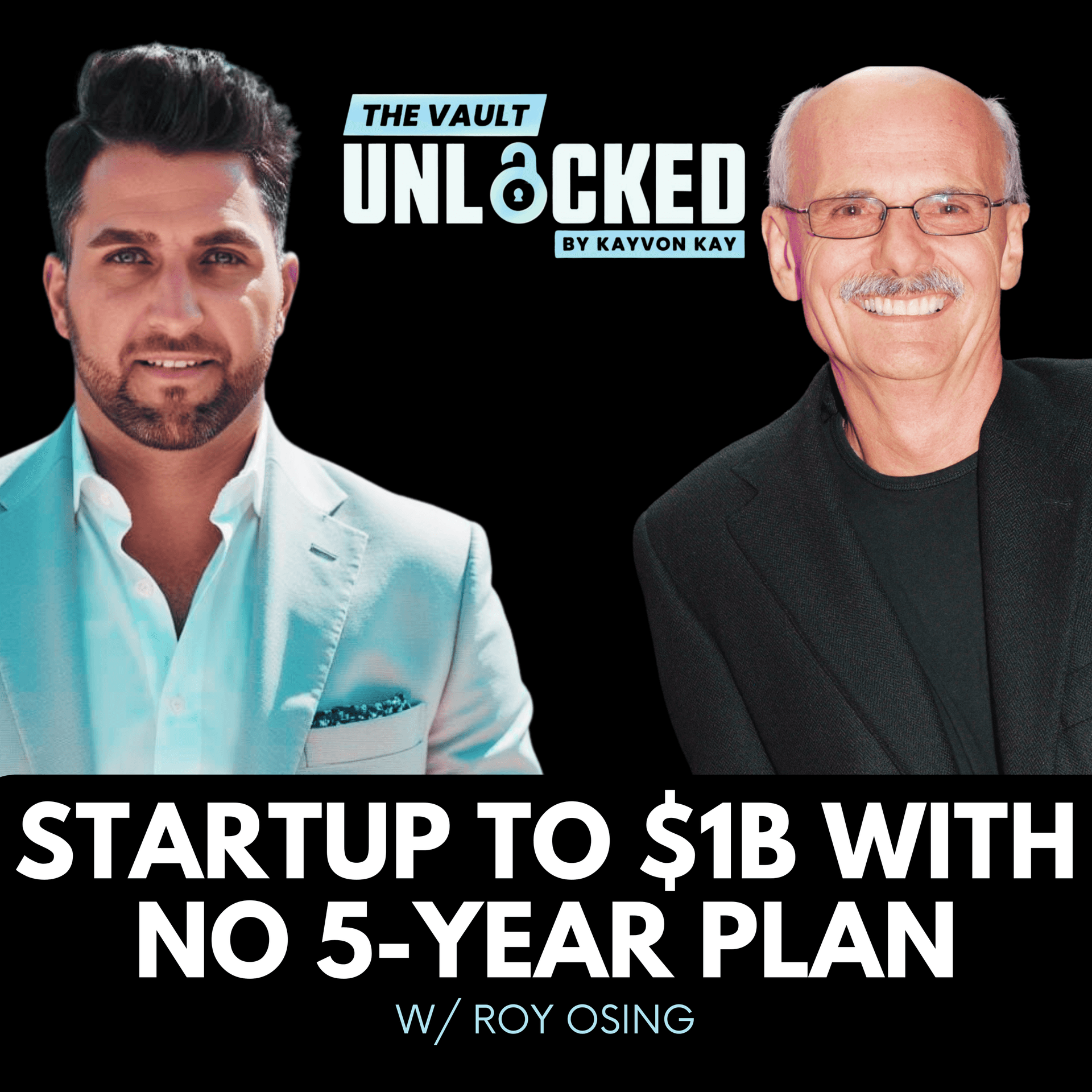
Podcast Summary: The Vault Unlocked - Episode: How to Scale From a Business Startup to $1B Without a 5-Year Plan
Episode Overview In this episode of The Vault Unlocked, host Kayvon Kay interviews Roy Osing, a visionary leader who played a pivotal role in scaling a data company from a startup to a billion-dollar enterprise without relying on traditional five-year plans. The episode focuses on the key strategies and frameworks that drove this remarkable growth, challenging conventional wisdom around business planning and differentiation.
---
Key Concepts and Themes
- Rethinking Strategic Planning
- Five-Year Plans: Traditional five-year plans are criticized for being ineffective. Roy argues that businesses should not predict the future but declare it and then execute.
- Execution Over Perfection: Businesses often get bogged down in theoretical planning instead of focusing on practical execution, leading to stagnation.
- The Three-Question Framework
Roy introduces a three-question framework that is central to his strategic approach:
- How big do you want to be?
- This question focuses on top-line revenue rather than profits, encouraging ambitious growth targets.
- Who do you intend to serve?
- Here, the emphasis is on understanding customer cravings rather than just needs. Cravings are emotional drivers that can differentiate a business in competitive markets.
- How are you going to compete and win?
- This question centers on differentiation and creating an "Only Statement" that defines what makes a business unique.
- Differentiation and Market Positioning
- Be Different or Be Dead: Osing's mantra emphasizes that businesses must differentiate themselves to survive. The common claim of being "the best" is often meaningless.
- Cravings vs. Needs: Understanding what customers truly desire leads to better pricing power and loyalty, while focusing on basic needs can trap a business in price wars.
- Culture of Execution
- Short-term Focus: Roy emphasizes the importance of measurable short-term goals, like 90-day execution cycles, to foster continuous growth.
- Team Alignment: Engaging the entire leadership team in the strategic planning process fosters buy-in and ensures collective accountability for execution.
---
Notable Anecdotes
- Service Recovery Example: Roy shares a story about how he salvaged a million-dollar account by creatively addressing a service failure with a personal touch, including a $50,000 check and an unexpected gift that resonated with the client.
- Cultural Changes in Sales Teams: He describes how he transformed sales team goals from simple sales metrics to focusing on understanding customer cravings, which shifted the culture towards a more service-oriented approach.
---
Key Takeaways
- Differentiation is Essential: Businesses must strive for unique positioning in the market to avoid being lost among competitors.
- Focus on Execution: Plans should prioritize execution and allow for flexibility and adaptation as situations change.
- Emotional Connections Matter: Understanding emotional motivations behind customer decisions can lead to stronger relationships and increased loyalty.
---
Conclusion This episode of The Vault Unlocked offers a refreshing perspective on business growth strategies, pushing listeners to reconsider traditional planning methods. Roy Osing’s insights challenge businesses to focus on execution, differentiation, and understanding customer desires, setting the stage for sustainable growth in a competitive landscape.
For further insights, listeners are encouraged to connect with Roy Osing through his various social media platforms and explore more of his work on differentiation and strategic planning.
Follow Roy Osing
- [Instagram](https://www.instagram.com/unheardofways/)
- [Facebook](https://www.facebook.com/roy.osing)
- [LinkedIn](https://www.linkedin.com/in/royosing/)
- [Website](https://www.bedifferentorbedead.com/)
Follow Kayvon Kay
- [Instagram](https://www.instagram.com/kayvonkay)
- [Facebook](https://www.facebook.com/kayvonkayy)
- [LinkedIn](https://www.linkedin.com/in/kayvonkay)
---
This summary encapsulates the rich discussion between Kayvon and Roy, providing listeners with an accessible guide to the episode's key points and actionable strategies.
Written by AI. May contain mistakes. Listen to the episode to check what was said.
Chapters
Tap a time to open that second in VORoy's Journey and Philosophy on Differentiation
0:59 to 4:02
Roy Osing shares his background and the importance of differentiation in business.
“For the listeners that don't know who Roy is, tell us a little bit about who you are, you know, where you came from and how did you get to this concept and this ideal methodology of be different or be dead?”
Creating a Unique Business Strategy
4:02 to 6:31
Discussion on developing a unique strategy and the importance of execution over traditional planning.
“And so you need to learn your way to maneuver through it.”
Three Essential Questions for Business Growth
6:31 to 9:20
Roy outlines three critical questions that drive effective business strategies.
“And you have a strategy coming out the other end.”
Understanding Customer Cravings
9:20 to 12:00
Exploration of customer needs and desires, emphasizing the importance of differentiation.
“In other words, it's you don't want to be the best of the best.”
Setting Ambitious Business Goals
12:00 to 14:00
Roy discusses the mindset needed to set ambitious growth targets for businesses.
“So let's just, I mean, let's break these questions down a little bit.”
Setting Aspirations for Growth
14:00 to 15:00
Learn how to identify ambitious growth targets for your business.
“And you say to me, Roy, I want to be 20.”
Identifying Your Target Audience
15:00 to 16:00
Discover the importance of narrowing down your customer segments.
“So the other part of that, just if I might, excuse me for interrupting.”
Understanding Customer Cravings
16:00 to 17:40
Explore the difference between needs and cravings in consumer behavior.
“So do you work with them to understand that?”
The Power of Surprise in Customer Satisfaction
17:40 to 22:20
Learn how surprising customers can build loyalty and improve relationships.
“Well, that's why the cravings thing, if you nail it, is so powerful.”
Clarifying Customer Desires vs. Needs
22:20 to 23:40
Understand how to differentiate between customer desires and needs for effective marketing.
Show all 27 chapters
Navigating Customer Relationships
23:40 to 27:00
Discuss the importance of knowing and engaging with high-value clients.
“you know in this call here is okay we go after their needs we go after their cravings whoa whoa whoa, whoa, whoa.”
Transforming Business Offerings Through Insights
27:00 to 28:00
Learn how to adapt your business model based on customer cravings.
“Okay, well, I'm not saying that's not important.”
Transforming Boat Sales into Business Solutions
28:00 to 29:20
Learn how rethinking sales approaches can help businesses position themselves effectively.
“That sounds like that's not really all about selling boats, although we could probably we could probably use it, use the boat as an anchor, so to speak.”
The Importance of Differentiation
29:20 to 31:50
Discover why standing out in a crowded market is essential for business survival.
“OK, so the third question is relative to the customer groups and their cravings that you've just discovered and defined.”
Crafting Unique Value Propositions
31:50 to 33:50
Understand how to create tailored solutions that reflect a business's unique value.
“OK, into what the solution that you want to be a unique provider of is.”
Revolutionizing Sales Practices
33:50 to 36:20
Explore new methods for engaging with customers beyond traditional sales tactics.
“And you provide it or deliver that value.”
The Role of Authentic Relationships in Sales
36:20 to 41:30
Learn about the significance of building authentic relationships in the sales process.
“Who give a shit, human being lovers, all that kind of stuff, as opposed to wham, bam, thank you, ma 'am.”
Creating Human-Centric Connections in Business
41:30 to 42:00
Discover strategies for establishing deeper connections with clients and prospects.
“I'm kind of like a content provider, dragging stuff out of people's heads that they already know.”
Creating Authentic Connections in Business
42:00 to 43:14
Learn how to develop genuine relationships with clients through human-centric selling.
“That's the other thing I want to say, Kayvon.”
Differentiating Yourself in the Market
43:14 to 44:56
Discover unique strategies to stand out in your consulting business and connect with clients.
“I mean, nobody else can take something, right, like an esoteric idea and dumb it down so that people actually can understand it.”
Understanding Business Owner Mindset
44:56 to 46:06
Explore why some business owners resist implementation of strategies despite recognizing their need.
“yeah run right we know what run rate is right and uh and let me ask you this then uh what type of businesses do you currently work with like what kind of size are they what industry are they in It doesn't matter.”
The Depth of Business Planning Questions
46:06 to 48:10
Unpack the significance and depth behind essential business questions for growth.
“And so like, they're not really serious about implementation.”
The Role of Process in Strategic Planning
48:10 to 50:18
Understand how to facilitate effective team decision-making in strategic planning sessions.
“What worked when we actually were growing the business, that was a huge learning experience because we were unionized.”
Building Relationships for Long-term Success
50:18 to 52:05
Learn the importance of relationship-building in sustaining business growth and customer loyalty.
“We didn't know it was going to be a billion, but all we knew is it was huge.”
The Importance of Short-term Goals for Long-term Success
52:05 to 56:00
Discover how focusing on short-term goals can effectively drive long-term business growth.
“So the process is what I do is get the, the leadership team in a room.”
The Flaws of Long-Term Planning
56:00 to 59:52
Discover why a five-year plan can hinder business growth and execution.
“What's been proven in the real world is people produce results that you build on and you build on and you build on.”
Embracing Differentiation in Business
59:52 to 1:01:12
Learn the importance of differentiation and adaptability in achieving success.
“And when you think about having competitive advantage, it's all about differentiation.”
Transcript
Automatic transcript. May contain errors.0:00Roy Osing:Welcome back to The Vault Unlocked. I'm Kayvon Kay, and today we're diving into something most businesses get completely wrong. Differentiation. Everyone says they're better. Everyone says they're the best. Everyone says they're number one. But if you sound like everyone else, you disappear with everyone else. My guest today is Roy Osing, the mind behind the movement Be Different or Be Dead. He took an early-stage data company and helped scale it to a billion dollars in revenue, a business that today is worth$18 billion. Not through hype, not through luck, but through ruthless differentiation and execution.
0:38Roy Osing:We're talking about why most strategic planning is broken, the three questions that actually drive real growth, why being the best is a losing game. If you're scaling, if you're stuck in a crowded market, If your message sounds sharp, but your revenue isn't moving, this conversation will challenge the way you think about growth. Let's unlock it.
1:08Roy, welcome to the show. Thank you very much. I'm delighted to be here. For the listeners that don't know who Roy is, tell us a little bit about who you are, you know, where you came from and how did you get to this concept and this ideal methodology of be different or be dead? Yeah, so I'm a Canadian. I'm from Vancouver and born and raised in BC and worked in the telecom space when, in fact, the business was changing very rapidly from monopoly to competition and technology was changing quickly. And I was asked to undertake the role as president of this company that already had a bit of a data business, but was asked to actually take advantage of the internet as it was coming on stream.
1:52So my challenge was level up, gear up, and let's try and take advantage of this. And so the be different or be dead thing was really kind of like a strategy that was driving what I did as a leader, because differentiation, quite frankly, is not done very well today by most businesses. Okay, all you got to do is look around. Everybody claims they're better, they're best, they're number one, they're leaders. And quite frankly, Kayvon, that's crap. It's not believable, right? And I have a solution for that, which we can talk about. So I was asked to come in. And the whole drive for me has always been differentiate, differentiate, differentiate.
2:29Entrepreneurs have a challenge for that. New startup CEOs, people looking to bump their career, presidents of companies, doesn't matter whether small, large for profit, not for profit. The challenge of separating oneself from our competition is critical. And yet you would think that people would do it well just by virtue of the marketplace we're in. And they don't. They don't. It's done mediocre at best. Hence my challenge now after leaving this company, which by the way, is no longer a billion dollars a year. It's 18 billion dollars a year. So my challenge now is to try and do what I'm doing with you.
3:07Spread the word, to have a conversation about why differentiation is so important and how to do it. Well, let's go a little bit back there because you said you took a billion dollar company and it's now worth$18 billion. Yeah. So we took an early stage data company and grew it to a billion in annual revenue. And that business today is now running up to$18 billion. You took a startup and brought it to a unicorns company. Yeah. Sort of this idea of being different. Well, the major back was on be different, but there's a whole lot of moving parts in that. It's like people keep asking me, well, what is the one secret to success?
3:49And I go, no, there's a whole bunch of things. What's the one thing that you did that you succeeded? And no, there was a bunch of stuff. What was the biggest failure? No, there was a bunch of stuff. I mean, so business and leadership is a highly complicated thing. It's an art form, right? And so you need to learn your way to maneuver through it. And the first thing you learn is there's no silver bullet. There's a whole bunch of little things, okay, that rely on people and their passion to actually get you to where you need to get to. And so as a leader, you need to have the energy and relentless tenacity to just keep driving, driving, driving, driving.
4:23And that's what we did. And we did different things, a whole bunch of different things. So looking back, and I love it because I love you. There's no silver bullet. There's no one thing. It's multiple things, multiple tries, multiple failures. But if you can look back on that, just that journey of going zero to unicorn status, you know, a billion dollars, what were a couple, I would say, what would be like the highlight things that stuck out for you that did make a little bit of more of a movement than all the little things stacking up? Yeah, and that's a fair question. And again, it's within this context of being different.
4:56Because that was that's always been my mantra since I was a kid through my whole young life. It's just figure out a way to be different than everybody else in a way that people care about in a way that matter. Right. I don't want you to think this is narcissism because it's not a narcissist do stuff for themselves. That's not what I'm talking about. Being different is about being special in a way other people care about. OK, so going back to this challenge, we had to look for literally in every nook and cranny of this business. We had to look for opportunities to be different. And it started with the planning process.
5:29I remember thinking, wow, I mean, this is a huge I'm going to either make this thing or it's going to break me one or the other. What am I going to do? I don't have a strategy. And so I looked around at traditional planning models and none of them were helpful. Okay, it took too long. They were too complicated and they were way too expensive. So I had to create my own. And the other thing that drove me behind the Be Different thing is the need to actually do something, not ponder it to death, but execute, execute, because that's where performance comes from. It doesn't come from the left brain.
6:04It comes from the right brain and actually keeping the feet moving and doing things. So I said, okay, my planning process has got to kind of be fueled by that. So I built this process called strategic game planning and I coined it. It's built to execute. It's like execute first, plan second. And it was a process that literally today with small businesses and clients, I do in literally 48 hours, Kayvon. It's remarkable. 48 hours. Wow. 48 hours. And you have a strategy coming out the other end. It's based on the notion of execution is prime. And so I talk about things like let's head west. Let's get the plan just about right.
6:43We live in an imperfect world. Why are you trying to perfect and formulaize something that's imperfect? That's nonsensical. And it's an idiot's way of trying to run a business. And so it's actually created by answering three simple questions. And you'll see when I tell you, you'll go, what? First question is how big do you want to be? That's a question about growth. And it's all top line revenue. It's not net income. It's not profits. OK, because I can give you whatever profits you want by manipulating an income and balance sheet. So it's how big do you want to be in 24 months in terms of top line revenue?
7:17I don't believe five year plans exist because the fourth year never shows up. And it just gives you a reason for putting stuff off, which, of course, is the antithesis of meaningful execution to drive performance. So my question is, if you're at a million today in 24 months, where do you want to be? Now, why do I start with that question? It's because the growth declaration drives the character of the strategy. You can't take an incremental strategy and apply it to an absolute step function growth. Right. So it makes sense. But nobody else does it that way. So that's the first question. Second question is, where are you going to get the money?
7:56So the question is, who do you intend to serve? So this is a question about customer groups. Others might call it market segments. The problem with that is it's too general. OK. And people love generalities in marketing because they're basically lazy. I want to see the whites of people's eyes. OK, that I'm going to target because the next question I'm going to ask is, what do they crave? who do you serve what do they crave not what they need needs are basically satisfied okay and typically if you want to compete in that space it's going to be price sensitive and there's going to be a lot of competition cravings on the other hand cave on or what you lust for what you desire right yeah what you covet those are all emotional triggers and guess what they're typically insensitive to price, relatively speaking.
8:47And there's nobody else playing in that space. So my view is always, I'm going to where people crave something. I'm going to figure out organizationally how to do that, which we can talk about. And then I'm just going to target, target and focus, focus. So those are the first two questions. Third question is the kicker. And this gets at the differentiation piece. And it's how are you going to compete and win in those who groups you've just defined with the cravings that you've discovered. And this is where you get into being different and the differentiation piece. And this is where I created this really cool strategy called building the only statement.
9:24In other words, it's you don't want to be the best of the best. You want to be the only one that does what you do. And so the quest here is to have a binary thing going on. You either are either the only one or you're not. And that's the beauty of this. It gets the kids off the street. There's no judgment involved in terms of are you better? Are you really? No, it says, are you the only one? And you trot out data to actually see whether, in fact, that individual or company is telling the truth. That particular model guided us to get going. OK, so we had pretty stiff growth goals. And even if we didn't make them because we didn't make them all, we still did a hell of a lot better than a scenario where we where we didn't have audacious growth goals.
10:10Right. Yeah. The who to serve really got us focused on high value customers. Right. And the craving angle actually allowed us to re-vector our customer service organizations and our sales organization where we actually coveted information around what people craved. Now, we didn't ask them, okay, Vaughn, what do you crave? But the conversation was skewed and tilted in a way that I was trying to discover something special about you. Right. And I kept a record of it. Right. And somebody gave me hell for violating privacy laws. And I said, oh, bullshit. Get out of my face. That's not that. This is a conversation.
10:48And eventually, and I can tell you a story of how we actually saved a$10 million a year account by using that information. It becomes part of the marketing process. The only statement is your pitch, right? It becomes your elevator pitch. We are the only ones who. And then you have a wonderful conversation about, well, why did you pick that? What is that all about? And can you help me understand what you're doing that would prove that you're doing a wonderful conversation? But it was all based around differentiation. So that's just one piece. I mean, there's a whole bunch of other stuff in here, like hiring for goosebumps, cutting the crap, killing down rules, all sort of line of sight leadership, all sorts of other small little things, all targeted, right, to change behavior and raise performance.
11:34And we just did a whole bunch of those and nobody else were doing them because they were following strategic planning one-on-one textbooks. Okay, Vaughn, that's the problem. And if everybody's reading the same textbook. The same textbook, you're right. You're going to get the same results. Oh, thank you. Thank you. Yeah, no, I agree on that. So I just want to make sure we're clear here because what I'm hearing is your framework is the first question is how big do we want to be? So let's just, I mean, let's break these questions down a little bit. Like when we ask that question, well, how big do we want to be?
12:06I would say most people are actually scared to go big. I know. That's right. Or they want to be big with no plan. So for me, like, you know, if you ask, like, so you ask me, and this is one of my demise, you know, probably my demise. You go, Kayvon, how big do you want to be? My question is more. Yeah. Yeah, that's not good enough. Okay. That could either be one or two or a billion. And the reason it makes a difference, OK, is the size of the challenge without knowing how to satisfy it drives innovation. So my belief, and this is part of the different thing, is you don't innovate by using a least squares regression model, using 10 years of data to project where you think you're going to be and accept that as the forecast of revenues.
12:53OK, because that's nonsensical. That assumes that tomorrow is going to be the same as yesterday. And we all know that that doesn't work. So this is literally as a leader. OK, and it is scary. Is your BHAG you're talking about how big you want to be or is this the realistic like, you know, when I set my goals, I have my three levels. Right. I have my target. I have my outrageous and I have my minimum.
13:15Roy Osing:Right. The idea is to not hit anything but the target and outrageous is great. Yeah. So if I were if I were coaching you. Yeah. I would say, OK, don't try and stratify your responses because all that's doing is you're trying to hedge your bet. What I want to know is, OK, when you wake up in the middle of the night, OK, what would your dream be of your 24 month revenue target? Just pure. And I'm not asking you to be realistic. In fact, I want it to be unrealistic because realism drives nothing. Unrealism drives innovation. And this whole planning process, you didn't get to a billion dollars by not being innovative.
13:53The whole planning process is meant to drive innovation. And so if you're sitting at five million a year, OK, you go cautiously and perspiration is coming down your face. And you say to me, Roy, I want to be 20. I go, good. I said, do you have any any idea how to get there? And if they say yes, the number isn't big enough. If they say no, I say, all right, let's take the 20 mil. Now let's go figure out which customer groups have the potential to get there. What do they crave? Blah, blah, blah. How are we going to compete and win? It all starts with that. So we get the, now, as I said, step one is get that number.
14:31And that number isn't from data. It's actually, what is like, it's what you want. What is it you want? And then once we have that, so if you're a$5 million company and you want to actually get to 20, heck, you want to get the 50, you work with them and go, okay, great. 50 is a great number. It makes you scared. Great. We're in the right, right. We're in the right department. Second question, which is the strategic question. OK, who are we going to serve that's going to give us 50 million and what do they crave? I just want to make sure I'm clear on that. OK, right. Yep. So the other part of that, just if I might, excuse me for interrupting.
15:04But as we go through this, I mean, the tendency is going to be to try and be too broad when you when you try to describe who you're going to serve. Right. So what I try and do is narrow you down because you don't have an infinite number of resources to do this. So I want as few customer groups as possible. So my question to you might be, Kayvon, can you give me one customer group that will get the 50 mil? And knowing full well that you're going to say, well, no. I say, OK, how about two? How about three? So we start that way as opposed to treating it mass market and then hacking it up. And you still are left with big segments that are really mass markets anyway.
15:40Well, it's niching down, right? I think people are afraid to niche down. We could talk about that. But I feel people are afraid to go niche. And there's different names for it, right? ICP, you know, ideal customer profile. But like the idea is going down to the one person that you know what they're craving. So that comes to that second question is just because I think I know what they're craving doesn't mean it's what they're actually craving. So do you work with them to understand that? Because you can think it and go out there and be brutally wrong. Yeah. And that's part of the risk. And so, you know, I mean, don't try and overcomplicate this thing.
16:19I mean, people talk an awful lot about the old kind of like customer research vehicles like focus groups. I mean, there's still magic. Okay. And why are they magic? Their magic is because you and I actually look at one another and we have a conversation. What the hell? That actually in and of itself is a strategic advantage for organizations who have the guts to do it and a will to do it. And so, you know, simplify it. And the other thing is every customer touch point that you have, use it as a strategic opportunity to gather insights on cravings. And I used to call them customer secrets. What are they what's their secret?
16:57What do they really desire? And then you have a repository and then you got the back end dudes working the best angle of this to make the data in usable form. the cravings data or insights so that you can actually use them in customer service, in service recovery, in marketing development. And I'm not saying product development ever, because this is a thing that is wrapped around products and services, because products and services, quite frankly, don't matter unless they're not working. I got it. No, I got it. People don't buy products. They don't buy services. They don't buy the next gadget.
17:32At the end of the day, people buy a better version of themselves. That's what I always tell everybody. So, And I really like that. I really like that. They buy an experience. They want to feel good. Yeah. And organizations, unfortunately. Yeah, exactly. Well, that's why the cravings thing, if you nail it, is so powerful. Absolutely. Because they go, oh, oh. And one simple little technique we always use was the element of surprise. I mean, nothing will blow a customer away more than surprising them with something they don't expect you to do. especially if you tend to be a larger company, right?
18:06They go, wow, where the hell did that come from? And they tell people about that. And that's actually one of the main strategies we used when we screw the customer over. What were some of the surprise elements that you use as examples that you could talk about? I know that you're under NDA because you've not mentioned the name of the company and stuff like that. So I get that. But can you talk about some of the, like, those things that you did to the surprise element? These are really operational in nature, and it really varied in terms of the kind of engagement that was going on. And so, yeah, there's nothing sort of confidential about this kind of stuff because nobody else would ever do it anyway.
18:48The biggest story I remember is we actually put the five sales restaurant downtown Vancouver out of business one morning. Their PBX, their switchboard just went out. So this is a huge, it were my client. And so what I'm out. Well, of course, uh, I knew the CEO, he was a wonderful chap and I was just waiting for this. Cause I already got a heads up. When I got a heads up 10 minutes later, he phones me and he is screaming at me. I mean, I mean, this is horrible, right? And that's fine. So I said, okay, Michael, I said, I'll tell you what I'm coming down. We're going to fix this. Okay. We're going to fix this in a half an hour.
19:25Don't worry about it. It'll be done. Hang up the phone. So here's what I did. These, And I told him about this later, but it formed the element of surprise. First of all, I got a check cut for$50 ,000. The lawyers went crazy because I admitted that we'd put this guy out of business. Cut a check for 50 grand. I was going to take that down. And then I called his EA, or I called my sales director. I said, look, what is he really like? I mean, what could we do to surprise this guy? Well, it turns out for years, he was trying to get, you remember these old candlestick telephones in the day that were kind of retro phones and people would put them on their desks and they would look really cool.
20:01Like, like, you know, one ringy dingy, those, that kind of thing, right? In modern colors and everything, they call them candlestick phones. Okay. He always wanted one and he was too cheap to go out and buy one. They're about 150 bucks at a phone mark in those, right? So I said, okay, let's take care of it. So here we go off in our car. This is literally two hours later down to his office we go into his i got the phone i got the check going to his office i got my sales director we go into the going to his office and of course of course here he comes right and he just wants to vent and the first thing i said michael look at man i'm so sorry we just screwed you over royally and you know what he said to me he goes oh well that's okay roy i mean mistakes mistakes happen but i said here's what we're gonna do okay here are the two surprises that saved the account one i gave him the money and i said i know it's not enough i know it's probably three four hundred grand but i said i couldn't get any more in such short notice here's a token man he goes what and he and i says and here's something else and i handed him i'm getting goosebumps just thinking i handed him the box man and he opens the box and that was what did it.
21:14He just, I thought he was going to cry. I thought he just go, I've always wanted one of these things. There's a CEO, right? Thank you, Roy. Thank you so much. I said, no. I said, look, I just wanted to give you something that you may not have expected. And I hope you get some joy out of this. And he just put it down and he couldn't stop talking about it. Make a long story short, the story he told of our company, right, was always that story. It wasn't how great our internet service was. It wasn't how great our earnings per share were. It was, wow, you wouldn't have believed what happened. These guys put us out and they recovered in this way.
21:56So that's my favorite story. He told that story. He was on the circuit, right? Big business guy down here in the Lower Mainland was on the speaking circuit. He told that story all the time. So what did it really cost us for an account that was millions of dollars a year? 50 grand plus 165. Yeah, to save it, right? And you're right, most businesses wouldn't do it. They would not do it. Well, first of all, by the time they got approval to do it, if they ever did, three weeks would have gone by. And if you don't recover this way in 24 hours, just came on it's gone you have no ability to recover that and build loyalty you know i bet you you can all say it but i guarantee you even if you showed up without the fifty thousand dollars but with that phone that probably would have been enough yeah who knows but i wanted it was it was this guy was a he had finance as a background too so i wanted so yeah so i want to i want to i want i want to make sure we're we're staying on track here because i want to really understand this like first things first because we're learning business 101 right really marketing 101 is how big do you want to be number two who is your i'm going to call it avatar but who is your customer and what is their biggest craving aka what are the needs what's the thing that keeps them up not needs not needs don't use the word needs it's desires what do they cover what are they definitely not what they need i i'm more than desires what are their cravings aspirations the little thing because if you say needs it drives you into thinking about products and services and that's not what you want to do okay see this is great let's talk about this here we go you just that's a huge opportunity there for people to understand the difference between the words we use and the power it has so when a business owner confuses what i just did the same you know in this you know in this call here is okay we go after their needs we go after their cravings whoa whoa whoa, whoa, whoa.
23:50Cravings and needs are two different things. Yes, they are. Like, clearly they are. But don't take that lightly. Because when we go after and make strategic business decisions based off cravings, we start seeing the world, I'm going to see the opportunity much different than if we start going after the business and think about their needs. What's the problem we can solve versus what's the thing that we can give them? Is that what I'm hearing? Yes, absolutely. And one step further, it can be it can be it can be couched around the word problem. But it's done so only because the need the need to fix it is such so emotional that it actually becomes a craving.
24:36So they crave that solution. OK, whereas they may start. It goes up the continuum of intensity to actually resolve it. So does it go back to like the old saying, which is the wrong saying, which is sell features and benefits. And it's like, no, you don't sell features and benefits. You actually sell outcomes. The result. Yeah, that's exactly. Well done. Well done. That's a great way to express it. And the outcome you're looking for is dilated pupils, perspiration, and just you can feel it. They want to hug you. OK, you can just feel it coming. And if you can get to that point, you know, you can check the box.
25:15OK, I think I've come close. And the other thing is record it. Make sure you don't forget it. Look for other opportunities with other people, because we are kind of the same in a lot of emotional ways to actually pull the trigger on that. And and, you know, over time, what happens is the culture of the organization starts to change. It's not overnight, but it starts to change because you tell stories. I mean, storytelling is huge around this stuff. Story selling. Yeah, exactly. So I just want to stick in this area because this area is the make or break of what you're going to offer the market.
25:51Like this really this area, the question two, I think is quite the foundational questions of what we're going to do as a business. So do you have strategies or what happens when you meet a business owner who may be stuck on that? Like they go, well, I can do this. We serve this. We serve this. We serve that. We have these three people. I can offer XXX. And then it's like they all have problems. They all have like, how do we get down to the one? So it starts out with saying it's not about what you think you can do. OK, it's not that. It's about what they crave. It's about them. And so that drives us to spend a lot of time really getting to understand who you've described as your who.
26:35OK, those five or six or 10 customer groups, you go through each and every one of them. OK, with people in the business. I mean, if you don't have people in your business that can answer this question, you've got the wrong people in your freaking business, dude. That's it. And I say to them, look, if you don't know, OK, who your high value clients are by name, and if you don't keep in touch with them, what the hell are you doing with your time? Oh, I know. You're trying to find a way to use AI. Okay, well, I'm not saying that's not important. It might be at some point. But you need to do the strategic work in order to legitimatize all those tactical opportunities.
Read the full transcript
27:11And I find what people do is exactly the opposite. They go chasing the shiny object. They chase what I call yummy because it feels so good to eat that AI solution. They go chase it without figuring out what the context is. So what I try and do with you is take you through the process. And I say, trust the process. We're going to get it done. OK. And it's not about your product and service. Trust me, we're going to drag it out of you. And so, you know, like literally out of out of a guy that did a landscaping lawn cutting, I drag a property development solution provider out of a guy that sold boats to boat dealers in Toronto.
27:50OK, I dragged business development advisor out of him because his clients craved comfort that they wouldn't go out of business. And I said, what the hell? That sounds like that's not really all about selling boats, although we could probably we could probably use it, use the boat as an anchor, so to speak. And they I let them right into you're now a problem solver. You're a business consultant. You're going to use boats in a different way and you're going to help them grow their business. And they're the only one that does it. And as a result, then they get to buy the boat. The boat will come.
28:28OK, but it's not it's not the leading indicator here. It's it's it's almost, you know, that's your core service. But that's not why people are going to buy. I mean, look, all people want is a boat that floats and the electronics work. Trust me, I own four of them. OK, it's not about anything else. And maybe there's some brand stuff if you really like, you know, Ocean Alexander's and high-end boats. But it's really not about that. And quite frankly, I wasn't the decision maker anyways. The guy that sold me the boat, he figured it out. It was my wife. Yeah, exactly. We were buying a home that floated, and he figured that out.
29:05And once I saw him doing it, I thought, oh, shit. This is good salesmanship. That's like salesmanship 101 right there. And then the third question, because we we we dived in and the third question is, how do I keep is all I got was what's the third question? OK, so the third question is relative to the customer groups and their cravings that you've just discovered and defined. How do you intend to compete in win in those segments, given given that there's going to be competitors running around? Right. So this is where the only statement. OK. And which is the ultimate manifestation of being different is the ability to claim that you are the only one who does what you do.
29:45So this is where the solution development stuff starts to come. Right. In a way that addresses those cravings and those those desires. And this is hard work. OK, because sometimes we have to reframe frame your business like like we had to do with the boat guys. They were no longer in the boat selling business. They were in the business development solution business, which blew them away. And the same with the landscaper moving into the property development solution business, albeit defined a specific way. so it's exceedingly important and people will all always say well i i just either i don't i'm not special at something which is is a normal thing because you haven't thought about it this way or they can't get out of the products and services and that's a really tough mindset to move out of okay so this brings us kind of back to the beginning here when you said the most you know the powerful truth is how do you differentiate yourself or you die?
30:50Right. Exactly. What was it again? Yeah. Be different or be dead. So how do you get people to be different? And, or you said in the marketing, everyone's saying, oh, we're the best, but that's not making you different. So what is different mean to you? How, how can a business stand out in today's economy, which everybody is fighting for attention and saying, and you're saying the same thing. My industry, for instance, everybody is saying the same thing. You don't pay. It's, it's, we're going to do X or you don't pay. It's like, I can't even, I couldn't even do an ad like that. It's just, it makes me want to puke.
31:26So let's, we're not going to think about the manifestation of the value proposition. We're not going to think about ads. We're not going to think about any of that stuff. We're going to do the work first. OK, because look at the answer is different for each and every business. OK, because when they do the work and they come up with how big do they want to be and and who do they intend to serve and what do those people crave and have some granularity around that, that gives them now insights. OK, into what the solution that you want to be a unique provider of is. Okay, so it doesn't, this is the problem.
32:02And this is the problem I have with consulting generally, is they take a boilerplate solution and they try and drive it down everybody's throats. Okay, and they will have a canned answer to what you just said. The unfortunate thing is they're being intellectually dishonest and they're lying through their freaking teeth. Because the reality is I need to sit down with you. You need to do the work to create your strategy with a trust that you will find the right solution. And I'll drag it out of you because I know how to do that. Yeah. But no, I'm not going to give you a simple form. I love what you just said.
32:39I love what you just said. Because it really calls out a problem that I see in the marketplace too, is a canned solution. And I believe every business is different. Every business has their unique things that make them different. Customer is different. and to do a one shop kind of style for everything. I just doesn't feel like it's, it's, like you said, it's not honest. And that's why I've always had our time with my, like my business and working with my clients is like, we build sales teams, but we build them for their business. I don't run a sales floor. I never believed in a sales floor. They're successful, but I just never believed in it.
33:17I believed in building a unique sales floor for your unique business. How do you scale that though? That's the problem. I don't believe that you do need a sales force. I believe that what we're talking about is engaging with people buying. I'm not selling at all. I mean, if you do a good enough job with everything we've just talked about and you have a relevant, compelling, unique solution, okay, that may have product components, but you don't sell it that way. You don't brand it that way. This is where clever branding comes. And you provide it or deliver that value. The customer ends up buying.
33:57So you don't need a sales, unfortunately. And I've written a ton of just check my my blogs. I mean, I beat the crap out of sales all the time because there's such a good target. Right. And I actually advocate that you don't need one now to replace it. OK, with a demand pulling capability is what we're talking about here. And so it's all about making the little not so subtle changes to an organization, its leadership and its culture to make it happen. And so one of the things that I did, because, yeah, we were flogging Salesforce and we never, ever did make the right angle turn that I wanted to see before I left.
34:35But one of the things I did was I started to incorporate little things like to your question earlier, what are those small little audacious things? So I put secret gathering in every performance plan of every salesperson in my organization. And I had about a 700 person sales force. So a secret gatherer. Yeah. Secret gathering is all about identifying your client's cravings. I just call them secrets. Right. And so I said to everybody, OK, it's going in your performance plans. It's going to have an impact on your bonus. And guess what? And they say, well, how are you going to measure it? How are you going to measure?
35:12I said, you're going to show me your secrets manual for every one of your clients. And if I don't see anything in it, guess what? You're done. If I see something in it, we're going to have a conversation about what you learned. So we started that way. Well, let me tell you, sales guys, they ran to their caves. They thought their life was over because they were all used to do another thing. But I just asked them to do one little thing differently. The other thing I did was I included the customer in rating the salespeople. OK, so we did a lot of customer perception research. Right. And so you can see what I'm doing.
35:48I'm moving away from how much did you sell in the last quarter towards. OK, I want to know how much you sold because that was yesterday's world. But I also want to talk about, you know, how many secrets have you got out of your top five clients? Right. And and let me see the customer report card that they filled out on you. And of course, we architected it around behaviors, non-sales, sales behaviors that were consistent with the culture we were trying to create, i.e. exactly what you and I have been talking about, caring people, right? Who give a shit, human being lovers, all that kind of stuff, as opposed to wham, bam, thank you, ma 'am.
36:29Secrets, I just want to make sure I understand this. The secrets you're talking about, aka the example of the guy that wanted the telephone. Is that what you mean? Exactly. I figured I just wanted to make sure. Yeah. Yeah. Okay. I just, I cloaked it differently. It's a hard one for me to hear this because as a professional salesperson, so I love it because we're going to battle this maybe because you, uh, my, you know, my, my, my last, I call professional, uh, what do you call it? Corporate job was I was like the number, I was the number one pharmaceutical sales rep for the largest company in the world.
37:05And I did not, and I tell people this, I did not know one, one molecule that I sold. Didn't know how to even say the names, but I was the number one. And why? Because of what you just, the secrets, business. And I learned this at a very, very, I was very fortunate to learn this at a young age. I was in an, I tell people this, I was in, it's a good story. I was in an interview, long story short, and I was young, cocky, you know, full of piss and vinegar, telling the guy, I'm going to be your number one sales person. You just put me in the spot and I'm going to kill it. The entire interview, he didn't say a word.
37:45He didn't say a word, not answer anything. Like didn't ask me anything. I just went off and off and he wrote, he wrote on a piece of paper and he slid it across the, uh, the desk. I picked the piece of paper up and I looked at it and all it said was people do business with people they like. And I looked at that. I looked at him. I shut up and he said, I'll see you on Monday. And, uh, I learned that lesson. It's not about how great you think you are. It's not about all these things, the products, the features, they don't, they're not buying that. Yeah. They're buying you and they're buying the idea of who they can become after they buy through you.
38:23So it's interesting. So you made your salespeople who probably had no idea how to actually have real conversations with people and even have the hard conversations for them, which is learn a little bit more about your customer. Yeah. Well, and, and, and be, be a human being. Yeah. This is a function of leadership of the organization. I mean, there's, it's not a sales, It's not the salesperson's fault. They're doing what the organization is asking them to do. They got six months or three months quotas, and they're all unit sales of products, et cetera, et cetera. Well, you and I know salespeople.
38:58You throw a bonus plan in front of them, they will make it. And the problem is, if the plan isn't right in terms of long-term goals, you're screwed. You are really screwed. And so what we try to do is start. It's not finished. You know, I check in now and then. It's not finished. It probably never will be. It's a journey to cultural change of getting humans doing business with humans. Technology doesn't make it easier because, unfortunately, you run into tactical people that want to use all that technology instead of saying, how can I use the technology to satisfy my overall human being goals?
39:37Yeah. Use the technology to create the cravings. Use the technology to create the connection. using the technology to be able to have the real conversations instead of use technology to make more sales. And it works. I believe it works for a short time, but it's not like, as you know, it's not a long-term plan. I think you're always going to be chasing with that type of, of, of, of mindset. So when, when working, when working with businesses and they're bringing you on, let's say, and you're going to start working them through this process, what do you find is either the biggest gap or the biggest resistance you get on average, you know, when working with the founder or the business as a whole?
40:19Actually, a good question. I don't, I don't find anything specific. What I do find is once we start the process, the very fact that they're asking me for help is reassuring to me that they're wanting to break away. They're wanting to break away from the shit that they're in the middle of. I had one guy say, Roy, you got to help me. I don't know what I'm doing. Okay. That cry for help. That's good. So I find that people come with that. And so they're kind of bought in and they trust the process enough. And it's because it's proven itself. It's not a theoretical process. I mean, when I say to them, look, I'm sorry, we just got a billion out of using this.
40:59What is it you want me to say? Right. When people say, well, how can that work? I say, well, some things it's like gravity, right? We know it exists, but we can't explain it really. It's kind of like the human being lover thing that we did. It works. Don't ask me how it works, but it works. And so I have people leaning the right way. They're willing to put the work in. And I find they're very willing to accept the results because they created the results. And so it's not, I mean, I'm not a facilitator. I'm kind of like a content provider, dragging stuff out of people's heads that they already know.
41:36I'm just giving it some, giving us some framework and language that because language is so powerful and it's never used right in planning everybody wants to make it so complicated right if you make it simple people understand it and they're willing to go forward so no i'm uh i mean yeah they they sort of trip over the how big do you want to be when i push them on top line revenue and and i get them to perspire a little bit but i i tell them i said look at if you're not sweating we're going to keep going. We're not stopping. And it is a fun experience. That's the other thing I want to say, Kayvon.
42:10It's a 48-hour fun experience with remarkable outcomes, I think. So be different, be dead to me, from what I'm hearing from you, is it sounds like it's more about creating the authentic, real relationship and connections with your, I'm going to call them your prospects or your clients, depending on the business model, uh, and, and being able to create a little bit more, uh, you know, human centric, I call it human centric selling in where I'm from, but like a human centric connection with, with, uh, with these people, how are you different though? When you are selling yourself, people don't know you, like, you know, if I were to come to your website or if I were to try to understand you a little bit more, what are you doing specifically to make yourself different so you don't die?
43:02Well, I'm the only one that talks about audacious ways to get to a billion dollars in sales, annual sales. Nobody else that does that. And I've got the credentials and the platform to prove it. Nobody else is as simple as I am. I mean, nobody else can take something, right, like an esoteric idea and dumb it down so that people actually can understand it. And the only reason I can do it is I've been doing this for 40 freaking years. I didn't come down from yesterday's rain cloud. So when somebody says, Roy, why should I choose you to help me in consulting? I say, first of all, I've been there and I've done it.
43:40So you can trust me. This stuff works. Oh, you don't believe me? Okay. What part of the billion don't you get? And we have that conversation. So it's nice to be able to point to a performance and an end result that is meaningful to business people and top line revenue and revenue growth really is. But there's many pieces to this. I mean, we've had we had service strategy, so I know how to build service strategy. I mean, basically, other than the CFO, I pretty well done using be different or be dead as my manager, everything in an organization, including internal audit, because I believe that service credit people can actually differentiate an organization because most of them are assholes.
44:22And all they want to do is collect money. And I wanted to build a relationship with people that owed me money. And I got all sorts of money from them. So it just seems to be that I'm the only one kind of in that space. And but I do use the platform of the billion as a way sometimes to get people to pay attention, because it's the only way they'll do it um but most of the time it's like having a conversation and giving them a book it's not even just a billion the billion is now 18 billion right as a result of the foundation hey you didn't get to the first bill you end up got to the 18 billion right yeah run right we know what run rate is right and uh and let me ask you this then uh what type of businesses do you currently work with like what kind of size are they what industry are they in It doesn't matter.
45:11It can be not-for-profit. I just completed some work for a not-for-profit called Dan's Legacy that are in the mental illness kind of space in Toilson. And we did a strategic game plan for them because they weren't happy that they were getting the results that they wanted. And I knew the executive director and she just reached out. like I'm not knocking on doors to do this right like I don't need to work here I feel like yeah like I was gonna say you're the type of guy uh you don't go looking for businesses businesses find you when they're ready yeah and if and that's a good thing for my because I don't need a filter then so if if somebody's talking to me about uh being interested in doing this and I know they're leaning in okay and that's that's good but I I will say though I have I have I have said no to businesses that have not convinced me that they're willing to do anything with the results that I helped them achieve.
46:15And so like, they're not really serious about implementation. They want to plan, but they don't want to put the work in to actually do the execution. And so I've said, you know, I'm not seeing that your skin is in the game here and maybe you can find someone else. yeah yeah i hear that uh because a lot of businesses that want the idea they like the idea that they're doing something different yes or the idea that they're working on the problem but they don't actually want to work on the problem why why do you actually think that is oh man i don't know that is so true though i think it just yeah it makes them feel good it actually it it sort of like strokes their ego and it makes them feel like a big boy or a big big woman or a big whatever, you know, if they're doing this stuff, because somebody has told them that it's important to do it.
47:04And so they're trying to do it, but they really don't want to do it. And what they don't realize, it's so easy to spot these people. I mean, they're so disingenuous. It's just unbelievable. And of course, then they use the buzzwords and not just right away. Does it for me? I mean, no, seriously. I mean, you open your mouth and you prove that you're stupid right yeah yeah totally get it i love it i love it yeah well it's i mean it's it's it's quite interesting because you did take something that is complex and you could tell you're just making it pretty easy with like three very specific kind of questions but uh i just sort of the audience there's a lot of depth in those questions they're not i think we can agree on that they're not just as simple as how big do you want to be who do you want to serve you know what are their cravings uh and uh what's that last one i can always keep forgetting that last one how do we are you going to compete and win yeah and how do you compete and win how do you compete and win because those are underneath those questions there's depth and there's things that people need to really understand well the other thing it points out if you don't mind is it's like like i'm always learning about my stuff okay like this is an evolution it's over time okay i mean working it and working it and thinking about it and trying it and tweaking it and what works with this kind of client, et cetera.
48:26What worked when we actually were growing the business, that was a huge learning experience because we were unionized. I mean, most of the workers in the business were members of a union. Okay. And so trying to craft this, right, in a way that was going to work in that environment and yet still yield maybe 85 % of what we wanted in year four or five. That was hard going, but we just had to do it. Again, I go back and say, if you're looking for silver bullets, there are none, guys. You've got to put in the work. I love that. I think we can end on that idea because I think a lot of business owners that I definitely work with and speak to, They're like they're stuck waiting or looking for that silver bullet because they see their competitor doing it or they've seen someone else in another industry try it.
49:19And I always say just because it worked for them does not mean it's going to work for you. You just can't do it. Why? You know, what would you say to business owners that are just they just got to be the one? There's one thing that's going to change everything for me. And you and I both know. No, there isn't. There really isn't. Well, I mean, what I would say honestly is, well, I mean, try it. You might get lucky. But do me a favor. When it fails, do your work. OK, because all you've done is proven the fact that buying single stocks, sometimes you get lucky. But most of the time, you don't. And I'm here to help you if you don't.
50:00OK, because the stuff that we're going to talk about in the process that we've created here is tried and proven. And it is it was loved by frontline people and every element of the business. So it has the human factor. It lit fires in people. And that's why we got to a billion. Not because it was a cool strategy. We didn't know it was going to be a billion, but all we knew is it was huge. We had a big base of customers. And so the strategy, OK, was to hold and grow, hold and grow. All right. And deflect using the kind of approaches that you and I just talked about, because they were there. It was people.
50:39The technology piece was easy. I mean, we were a telephone company, for God's sake. We knew about technology. What we didn't know is about cravings, is about demand creators, all of that sort of stuff, which kind of like defined a new world we were going into. And so, and the relationship building piece was never, ever a key element of our culture. And it had to be, in my view, we had to get there real quickly. And that was kind of. You're asking everyday people to continuously pay you month after month after month. There's no reason why you want to like talk about LTV. Exactly. If you do that right.
51:16Yeah. And you're, they, they will stay. Yeah. And we knew, we knew who they were. We had, We had the classic modeling stuff going on. And so we had the right information. It was what we had to do with that information to augment it the way you and I have just been talking about and then deploy it in a meaningful way in the organization and get advocates. I mean, part of my problem was at the executive level, getting advocates for what we were doing, because a lot of people thought we were crazy. I mean, how could you create a strategy in 48 hours? Why should I really believe that? I said, I'll tell you what.
51:52let's base your opinion on performance okay if we're not able to perform then you have a point okay but to throw something out because it's an idea that's different than yours is ridiculous we're going to make this work why do i know that because it appeals to people 48 hours you're hanging on that so 48 out businesses that are stuck i'm just going to say a business that's stuck at 10 5 1 million 100 million and they want they they know the business owners know, you know, that like something needs to change. Yeah. 48 hours, we can come up with a plan, asking the questions and you can come up with a strategic plan based off of a strategic, I'm going to call them a customer or, or, you know, relationship or the, again, who do we want to serve question.
52:38And in 48 hours we can start executing. Yeah. So the process is what I do is get the, the leadership team in a room. Okay. I can do it on zoom, but it's, it's, It's very powerful face-to-face, the leader and the team. And the process I have is basically every member on the team has equal decision-making responsibility. It's not just the boss. Okay, the boss is just another member of the team. And sometimes they feel uncomfortable with that. But look, I know how to play this. I know who the CEO is. So I can, you know, I can, the process works, right? It just works. And it's unanimous. Every decision gets voted on.
53:17and I go through this thing to understand and agree. So let's say we arrived at how big do you want to be and it looks like I can sense that 10 million is something that people are okay with. We all agree, yeah. What I will do is I'll go to Kayvon, okay, it's 10 million. Do you understand and do you agree? And if you don't say, I understand and agree, we stop. Because either you don't understand and we want to make sure we get you back at that or you don't agree and we want to know why because then it's your job to convince your colleagues around the table. And so when I get a UNA from everybody, everybody gets that language, right?
53:53Hey, I got UNA. But I make them say, understand, and agree because it's part of the program. And I love it because it goes the saying is he who battles the battle doesn't battle. He who plans the battle, sorry, doesn't battle the plan, right? Absolutely. Absolutely. And you make them feel like they're all part of it. They won't battle it. They'll actually help implement it. Well, it's an incredible team building exercise, by the way. But yes, in 48 hours, you have the strategic game plan statement, but you also have a set of objectives to get at the implementation piece. So I make sure we have enough time to drive down into the only statement, for example, and say, all right, we need to understand a little more about what those words mean, because this is a communications issue here.
54:35We're going to make sure. And then we drive out marketing objectives, which are customers. How are we going to get to 10 million in 24 months? OK, in 12 months, what's the revenue target? We're having that conversation right now and it's not linear. Anybody says it's linear is full of shit. You got to get it all. Get as much as you can right up front because you want a run rate going into the next 12 months. They're not used to having that conversation. I used to do this all the time. I want the fast run rate and that leads me to my other concept called fast and easy so when you're looking at the who to serve one of the one of the concepts that we talk about is fast and easy yeah I want to get fast and easy up front because I want the run rate going into into year two I want it up I don't want it down because then I'm chasing I don't want to chase right and so yeah we get through it it's fast and easy always the right way though is that always the right one fast and easy?
55:31Does that fix the short-term problem and not the long-term? Well, 24 months is short-term. But I would advocate that long-term growth is about meeting short-term goals. Don't ever try and tell me that it's in the 10-year plan because it's freaking not. The 10-year plan is an aspiration. It's based on analytical quantitative tools that are function into the past and algorithms and formulas that have never proven in the real world. What's been proven in the real world is people produce results that you build on and you build on and you build on. But if you have a five-year plan, it's not execution focused.
56:11And in my world, never did anything. Somebody says to me, while you're being short-sighted, I say, thank you. OK, and then we're going to be short-sighted again. And then we're going to be short-sighted again. And guess what? In 10 years, you will have five phases of being short-sighted. And thank you. I helped you achieve your 10 million. Boom. I can't argue with that. Well, it's hard to. It's so common sense. So this is not. I can't argue with that because how many times have we seen businesses play the 5, 10, and they never get there versus here's the two. So what happens when a business, okay, so what about this?
56:50Yeah. What happens when businesses do the short-term two-year plan and they don't get there? It doesn't work. It breaks. It goes sideways. You redo the plan. You just keep redoing it until you make it work. Part of the process is a three-month review as well. So you want to be execution-focused. You've got to be all over the numbers. Okay, so every 90 days, look at the numbers. Look at the numbers. Start making revisions and tweaking as you go. You don't wait until the end of the two years. But we do have an annual sort of formal review of the strategic game plan where we say things like, how do we feel about the how big?
57:25Okay? Yeah. All right? If we change it, and it's okay to change it, we change it as a team. And we have the argument, and I'm going to be Darth Vader here. I'm going to be your worst fucking nightmare when it comes to this. Okay? Because if we're changing it, it's changing it to make it bigger, not to make it smaller. Or something. We've learned something, right, that we didn't know when we started out. And isn't that, doesn't that make sense? We, you don't know everything when you start out. That's why it's a just about right plan. That's about it. That's why it's a head west plan, right? You execute, learn, and adjust, execute, learn, and adjust.
57:59So if there's a way and a good reason to change, of course it gets changed. Nothing is, is, is it's always a draft. Let me put it to you that way. And that, that's a concept some people really have difficulty with because quite frankly, we've been taught to get it done. It's over. It's complete. Now let's move on to something else. That's not the world we're in. The planning world, if you want to execute the plan, is not a world where the plan ever gets done. It's alive. It's amorphous. It's organic. It's like the strategic planning document has got blood on it from paper cuts, if you happen to have it in paper form, right?
58:43Because you use it. I mean, how many planning documents have you seen Sutton sitting on top of somebody's credenzins in an office? Or, you know, no, gotta be used. And I used to ask salespeople for a copy of their sales plan. And a lot of them would tout out, never been opened. Oh, Jesus. Anyway, so that happened just once with that guy and we moved on. But yeah, so you have to accept the fact that that things can be changed and once people understand that it almost they they feel oh okay yeah there's like a little bit of pressure it doesn't like because you got to be adapted we know you have to be adaptable you have to be okay with the plan changing but i really do like the idea of like you're gonna have a five-year plan or you can have a two-year plan execute the two year make another two year and then again two year and after five years where are you going to be Right.
59:37Probably where the five year plan was going to be anyway. So it'll be way more than what you want. Yeah, I agree. I agree. Any last thoughts for our listeners as we come to an end here? No, I would just say I need you to think about this whole notion of differentiation more. OK, because it's not being thought of. And when you think about having competitive advantage, it's all about differentiation. and come and visit me. Okay. On my website, there's lots of tools there. I've been writing about this stuff from since 09. I blog literally two to three times a week around this stuff. And I'm learning more about it and email me and ask me questions.
1:00:20I'm totally happy. It's roy.oseng at gmail.com. Start to ask yourself the question personally when confronted with a challenge. How am I going to do this differently? It's a simple little question. I used to do this all the time. I call it my different lens. Every time I got hit with something, I would always say, OK, take a deep breath. How am I going to do this differently? And that drove my thinking. And quite frankly, I think the quality of the solution, because it would be typically a solution that others wouldn't arrive at. And that in and of itself added value to it that nobody else had.
1:00:56And it's just the beginning. OK, so if you could do that for Uncle Roy, I would appreciate it. I love it. So for Uncle Roy, the next time we have a challenge or you're looking at the business, put on your Be Different lens. Roy, thank you so much for having me, for being here. Appreciate it. Very welcome. Thanks for having me.
From the publisher
If you're still writing 5-year plans hoping growth will show up… this episode is going to challenge you.
Because the companies that actually scale don't predict the future.
They declare it. Then they execute into it.
Roy Osing helped take an early-stage data company to $1B in annual revenue. That same business now runs at $18B. And he did it without a 5-year strategic plan, without textbook theory, and without hiding behind "best in class" language.
This conversation breaks down the exact operating model he used.
We go deep into his 3-question framework that drives real business growth, and Roy explains why most businesses fail at differentiation, why "best" is meaningless, and why chasing needs traps you in price wars, while cravings unlock pricing power, loyalty, and momentum.
He shares how a $50,000 check and a $165 retro phone saved a multi-million dollar account. Why sales teams are often incentivized wrong. And how execution-focused strategy beats perfection every time.
This is not theory. It's operator-level thinking from someone who's actually built scale.
This episode is for founders stuck between $1M and $100M who feel momentum stalling, operators tired of bloated strategy decks that never translate to revenue, and leaders who want predictable business growth without chasing tactics.
If you're looking for hacks, this isn't it.
If you want to understand how real revenue systems scale, it is.
We also unpack why 5-year plans kill execution, the difference between customer needs and customer cravings, why most differentiation strategies are lazy, the power of 90-day execution cycles, how to align leadership teams around growth targets, and why culture, not tactics, determines scale.
This conversation sits at the intersection of business strategy, sales psychology, leadership alignment, and revenue operating systems. If you care about influence, market positioning, pricing power, and long-term enterprise value, you'll feel the depth here.
Roy doesn't sell tactics.
He builds operators.
Topics Covered:
• The 3-question strategic framework
• Scaling from startup to $1B
• Cravings vs needs in business strategy
• Building competitive advantage
• Execution-first planning
• Differentiation in saturated markets
• Sales culture redesign
• Service recovery as a growth lever
Looking to dive deeper into these conversations and connect with our host and guest?
Follow Roy Osing:
Instagram
Facebook
LinkedIn
X
Website
Follow Kayvon:
Instagram
Facebook
LinkedIn
TikTok
Want to go deeper with Kayvon?
Subscribe to the newsletter
Book a discovery call
Get your Revenue Engine Scorecard™️