
In short
Podcast Episode Notes: The Vault Unlocked - "Why Buying an Existing Business Beats Starting One From Scratch"
Podcast Overview Title: The Vault Unlocked Description: A deep dive into actionable strategies that transformed the journeys of founders, creators, and marketers. Each episode reveals the pivotal moments that changed their game forever.
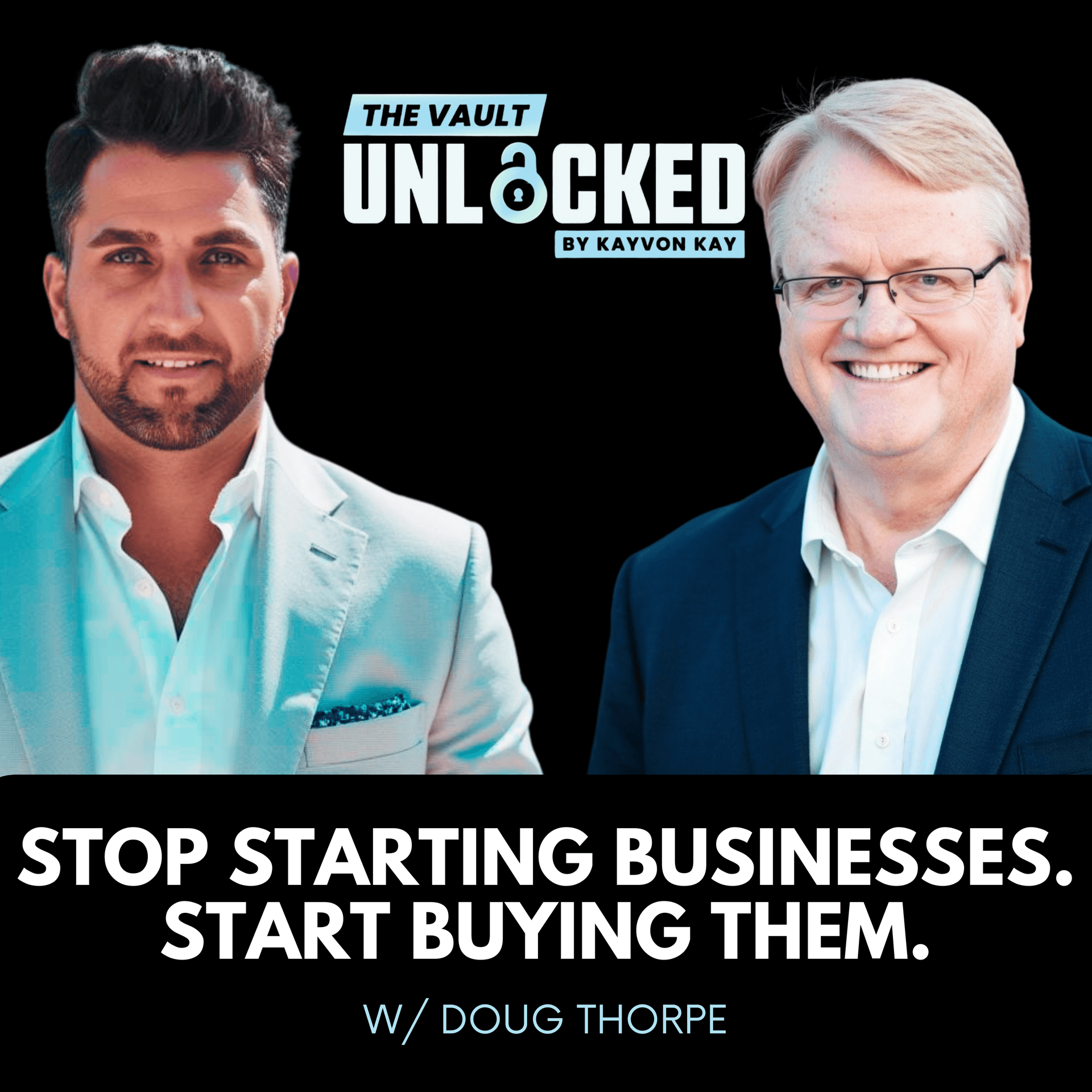
Episode Details Title: Why Buying an Existing Business Beats Starting One From Scratch Guest: Doug Thorpe - Former banker turned acquisition advisor, with involvement in 24 successful business acquisitions. Key Insight: Starting a business is often more costly and time-consuming compared to acquiring an existing, profitable business.
---
Episode Highlights
Key Arguments
- Perception vs. Reality: Starting a business is often viewed as the brave move, while acquiring an existing business is framed as a strategic decision that can be both cost-effective and less time-consuming.
- Market Dynamics: There is a significant wave of baby boomer business owners looking to exit their businesses, often without heirs willing to take over.
- Understanding Sellers: What sellers value goes beyond just price; emotional factors and loyalty to customers and employees play crucial roles in the sale process.
Discussion Points
- The Baby Boomer Exit:
- Trillions of dollars in value tied to businesses being exited by baby boomers.
- Many baby boomers lack a succession plan or interested heirs.
- Seller Concerns:
- Loyalty to their business, employees, and customers.
- Emotional attachment; selling is akin to giving up a child.
- Misconceptions about business value based on informal advice from peers.
- Buyer Dynamics:
- The importance of understanding both the seller's perspective and one’s own risk tolerance.
- Need for buyers to be prepared to actively manage the business initially, particularly if they have an investor mindset.
- Due Diligence:
- A structured due diligence process is essential, focusing on:
- People (staff and team dynamics)
- Systems and processes
- Financials (cash flow, revenue streams)
- Market positioning
- Common Acquisition Myths:
- The idea of "no money down in 30 days" is largely unrealistic.
- Understanding financing structures (e.g., seller financing or notes).
- Investment vs. Operation Mindset:
- Distinction between wanting to buy a business and needing to buy one—this mindset shift can determine success or failure.
- Strategies for Success:
- Seek opportunities for innovation and improvement within stagnant businesses.
- Engage with existing teams to gather insights and ideas for advancement.
---
Key Takeaways
- Opportunities Exist: There are countless opportunities in the marketplace for those willing to take the plunge into acquiring existing businesses, especially with baby boomers retiring.
- Prepare for Commitment: Successful acquisitions require a blend of risk tolerance, operational involvement, and a willingness to listen and lead.
- Leverage Existing Resources: Many businesses have untapped potential; buyers should look for ways to innovate and optimize.
---
Final Thoughts
- Advice for Buyers: Approach with respect for the business's legacy and work to establish trust with sellers.
- Advice for Sellers: Be open to discussing their concerns and ensure they understand the buyer's intent to preserve the business's integrity.
Contact Information
- Doug Thorpe's Links:
- [Website](https://dougthorpe.com)
- [Instagram](https://www.instagram.com/dougthorpe_com)
- [LinkedIn](https://www.linkedin.com/in/dougthorpe/)
- [YouTube](https://www.youtube.com/@dougthorpe)
- Kayvon's Links:
- [Website](https://www.kayvonkay.com)
- [Instagram](https://www.instagram.com/kayvonkay)
---
This episode serves as a call to action for potential buyers and sellers to explore the lucrative market of business acquisitions, framed as a practical solution rather than a daunting challenge.
Written by AI. May contain mistakes. Listen to the episode to check what was said.
Chapters
Tap a time to open that second in VODoug's Background and Experience
0:46 to 2:30
Doug shares his journey from banking to business acquisitions.
“Yeah, I'm, in a quick nutshell, a former Army officer turned banker, turned consultant and business advisor.”
The Rise of Business Acquisitions
2:31 to 4:53
Discussion on the trend of business acquisitions and why it's becoming popular.
“retail is individual, you know, checking accounts, savings accounts, car loans, boat loans, home loans, things like that.”
Understanding Seller Motivations
4:54 to 7:20
Exploration of why baby boomer business owners are selling their companies.
“It's like, well, I'll give you my very specific example.”
Challenges for Business Sellers
7:21 to 9:10
Discussing the emotional and practical hurdles faced by sellers.
“And then the second moving major part is, okay, who's the seller?”
Determining Business Value
9:11 to 12:32
Insight into how to assess the fair market value of a business.
“It is like giving up a baby for adoption.”
Finding Businesses for Sale
12:33 to 14:00
Advice on how to find businesses that are available for purchase.
“Because that, that, that I just think about the businesses that I know that are in these situations and some of these businesses are just, they just been riding it out.”
Unexpected Opportunities in Business Sales
14:00 to 15:00
Learn how spontaneous meetings can lead to business purchase opportunities.
“walked up and knocked on the door and said, Hi, Mr.”
Identifying Valuable Businesses for Purchase
15:00 to 18:30
Understand how to recognize red and green flags in potential business acquisitions.
“And those seller owners love to hear that as a starting point.”
The Importance of Revenue Types and Business Models
18:30 to 22:30
Discover the significance of recurring revenue versus one-time sales in business.
“So if you can find an HVAC company that's got a blend of one-time installs that's maybe 25 % to 30 % of the business, but the other 75 % is recurring revenue, like with quarterly maintenance calls.”
Mindset for New Business Owners
22:30 to 24:50
Explore the difference between investor and operator mindsets when buying a business.
“opportunity of these small businesses that are doing three, five, eight, even$10 million all over where you can actually step in and actually start taking over.”
Show all 19 chapters
Navigating Seller Relationships in Business Transactions
24:50 to 27:30
Learn the importance of mutual respect and communication in business sales.
“answer for, and again, it needs to be genuine and real, not fake, for how they will respond to that concern, the much greater is the probability of success on getting the deal to the closing table.”
Deal Structuring and Timelines in Business Acquisitions
27:30 to 28:00
Understand the typical timelines and deal structures involved in buying a business.
“I'll agree, you know, in long term to pay you that money.”
Understanding the Business Acquisition Timeline
28:00 to 29:20
Learn about the realistic timeline and requirements for buying a business.
“it, The first real conversation till it's actually structured deal, lawyers, all that.”
Exploring Deal Structures in Business Purchases
29:20 to 30:50
Discover various deal structures and financing options available in business purchases.
“We know it's going to take six to 12 months to actually make it happen.”
Traits of Successful Business Buyers
30:50 to 33:10
Identify the traits that differentiate successful business buyers from those who fail.
“And I will pay some interest for that privilege to do that.”
Understanding the Reality of Business Ownership
33:10 to 35:30
Explore the challenges of transitioning from corporate jobs to business ownership.
“And that's really the number one differentiator, I think, for most people who raise their hand and say, I think I want to do this.”
Finding Opportunities in Established Businesses
35:30 to 37:50
Learn how to identify and leverage opportunities in acquired businesses.
“And then every other year after that, I'm just profitable.”
A Real-World Example of Business Transformation
37:50 to 39:20
Hear a case study illustrating how innovation can boost business revenue.
“could go straight to the bottom line in no time.”
Final Advice for Buyers and Sellers
39:20 to 40:40
Gain insights on the importance of guidance in business transactions.
“So if someone's sitting here, I think both sides, right?”
Transcript
Automatic transcript. May contain errors.0:08And we're on another episode of the Vault Unlocked. And today we have our guest, Doug Thorpe, who is responsible for over$24 million in business acquisitions. Today we're going to unlock the number one thing that Doug looks at when acquiring a business. Doug, how are we doing today? I'm doing great, Kay. Good to see you, man, and happy to be here. Yeah, happy to have you as well. I mean, let's just first jump into, for those who are listening, who's Doug Thorpe? What is Doug and what does he represent? Yeah, I'm, in a quick nutshell, a former Army officer turned banker, turned consultant and business advisor.
0:55And, excuse me, I have, as you alluded to, over the last three years, I've helped. I've had a hand in 24 successful acquisitions, helping new entrepreneurs buy already cash flowing businesses and move in and take advantage of the great market that's out there for that very opportunity. This is awesome because this, uh, I started seeing this maybe four years ago. There's been, I won't mention the name, but there's been this big, uh, celebrity person who's going around telling everybody about, uh, business acquisitions and, and the fact that it's a new business model. Uh, and you can buy business.
1:38I'm not sure if you do this model or not. I'm just asking like the buy, you know, more, no money down. And all of a sudden you can have a business. Uh, I never really understood it. I didn't really go into it that much, but it sounds like as an expert here who is acquired over, you said, I think, how many businesses you said again? 24? About 20, 24. 24 different acquisitions. I'm sure we've learned a lot. So I think like before we get, just jump right in there, tell us a little bit how you found yourself here. Like, you know, how did you get to this point? Yeah, I think a lot of it has to do with my former banking career.
2:14You know, being a banker for 25 years, I had a hand in a lot of things. And the bank I started with was a more of a commercial bank than what is known as a retail bank. And for those who don't understand that, retail is individual, you know, checking accounts, savings accounts, car loans, boat loans, home loans, things like that. That's what we call retail. But commercial is business based. It's helping business owners with their financial needs. And in my banking days, I had a chance to work with companies of all sizes, everything from the private mom and pop all the way up to publicly traded companies that were needing working capital and special project financing and that sort of thing.
3:02But I've always had a bent for the entrepreneurial side of things. I grew up the child of an entrepreneur, and it was in my DNA to be part of that entrepreneurial community, and I really admire and respect people that are doing that. And what we're talking about here is this phenomenon. There's a once-in-a-generation move of the baby boomers who want to exit the businesses they've built, but they don't necessarily have second-generation players who want to step up and take over. Sadly, you know, I probably shouldn't even editorialize, but sometimes the kids of these entrepreneurs say, I've watched you run this business my whole life.
3:45I don't want anything to do with it. Well, I was going to ask that question. It's interesting because I have three, probably four really close friends of mine who have small, you know, I call them the mom and pop shops, three to$5 million. They do very well in their small little towns. They have kids and all the kids want nothing, absolutely nothing to do with it. And they're sitting there at the retirement level and wondering, you know, what do I do with this? So it's interesting you said that. And I would understand, why do you think the kids want nothing to do with it? I mean, being able to walk right into a proven business is to me is a gift.
4:26Yeah, I think the big pivot or the big tipping point is the fact that that mom or dad that started that business, it was likely their skill or passion that drove that business. And whatever that skill or passion was is not the kid's passion. It's not what they connect with. And so no judgment on either party one way or the other. It's just a personal choice. It's like, well, I'll give you my very specific example. I said I grew up in a house with an entrepreneur. It was my mom, and she was a single mom. And she had a great skill for interior design, and it was her passion. And a lot of that rubbed off on me, but I'll be the first guy to tell you, I don't have anywhere near the talent that she had in that space.
5:20I could not have taken over her business. Yeah. You know, it just wouldn't have worked, certainly not at the same level that she had it operating. And, you know, you get into those really nichey businesses, and that's usually the challenge. But if you look at some of the more, I call them core businesses, like home services, for instance, plumbing, electrical, HVAC, roofing, siding, painting, all of those things, those are high-demand businesses. And the companies that do them well usually have a community following, and you hire the talent to do that work. And there's a lot of opportunity for people who aren't really familiar with that business to step in.
6:13And the only real roadblock in some of those areas is that depending on the city, county, or state you live in, there might be some licensing requirements you can't get past. But other than that, there's a lot of those kind of businesses that are being handed off by the owner or founder who does want to retire and, you know, sail away or do whatever they're going to do. And to your point, you know, a three to five million annual recurring revenue generally spins off a pretty healthy lifestyle for the owner. Definitely depending on the city they live in, too. I mean, you're looking about, I'm going to do my math on that.
6:56If it's a good business with profits, you're looking at 800 to a million dollars a year. That's right. You know, 800 million dollars a year. I mean, that's more than you'll ever get paid as an employee. Yeah. It's a pretty good living. So I want to dive in because as you're speaking, my brain goes to, okay, there's two moving parts here, two major moving parts. Moving part number one is the business owner themselves. Where are they? how do we find them? How do you get to them? How do we know when they're ready? And then the second moving major part is, okay, who's the seller? So the buyer, who's coming in to actually buy these people?
7:34What types of people are these? I have so many answers and so many questions, but I want to deep dive into this because I find this fascinating because I know that this is a huge absolute absolute opportunity in the marketplace right now. Most people don't even know that this opportunity really exists, that there is this baby boomer. We would just call that a community of baby boomers, small business owners that are in this specific kind of situation. Like they want to retire. They want out. They have no one to give it to. they themselves have no idea that there are sellers that are willing to come in and buy and I'm sure there's becomes a lot of of I wouldn't call it red tape but barriers now because you're dealing with someone who's letting go of their baby and they probably think their baby's worth more than what it is they don't want to let go of their control I can only assume I've had my employees for 20 years I can't just give this to anybody I have to take all those things are coming up.
8:38So let's talk more on that side first is how do we deal with that? How do we find these baby boomers? What are the challenges that these boomers, baby boomers are having? How do you solve those challenges? Yeah. Well, first, let me say you're spot on. There's the seller side and the buyer side. And both situations have a lot of concerns and considerations to talk about, starting with the sellers. So the boomer founder that built this business up, you're exactly right. One of the first hurdles is just a very emotional one. It is like giving up a baby for adoption. It's like they've had their personal sweat equity in it, building it up to whatever it is.
9:23And usually you are very correct. There's a statement about loyalty to the employees they've got, you know, the sense of this is my second family. These guys have been with me. They've helped me through the tough times. And, you know, we've weathered these storms and we've built the business up. So there's a loyalty there. But there's also one that a lot of people don't talk about. It's the owner's sense of loyalty to his customers, the customers that have been faithful to them, to, you know, the repeat customers that have them on the speed dial when there's a need for some service or thing. And there's a very definite relational situation there.
10:07And I think about the guy I use for my home extermination needs. I mean, he's done my house for 25 years. And, you know, we've got a loyalty and a kind of a friendship. And I'm sure if he ever thought about selling, which he doesn't seem like he's ever going to do, but he's going to wrestle with that. And he's got a high affinity for that. So that's one of the hurdles there. The other thing on the seller side is just the positioning. Like you said, a lot of people, the story I always go to is the owner that's out there with his golf buddies, and they're out on a Saturday whacking the golf ball around.
10:47And he says to them, I think I'm going to sell my business. You guys got an idea of what it's worth? And they'll do a little chit-chat, maybe have a couple of beers in the 19th hole. And then they'll be sitting there going, oh, it's worth$10 million, man. That's what you ought to be asking for. Well, no, it's not. It's not worth$10 million. What's the golden rule that we know in business? What is it worth? What someone's willing to? Well, yeah, what someone's willing to pay for it. But there are more, I'll call them technical ways to get to a fair market value. And similar to selling houses, selling these businesses has a lot of similarities.
11:31You got certain, you know, when you sell a house, you got certain amenities. You know, you got four bedrooms, three baths, big patio, big modernized kitchen. You know, those are all high market value elements. Well, your businesses have that same sort of thing. There are pieces of the business that can be evaluated against the market to say, well, it's a high-end property or it's not. And just like in real estate, you can put a house up for sale, but it's going to need a lot of work. So it becomes somebody's fix and flip, maybe, something like that. And the same is true in some of these businesses.
12:11They might be earning good money, positive cash flowing, but the original owner has never really optimized or maximized the value that could be there with a few upgrades, a few enhancements in strengthening the team or buying a new piece of equipment or something like that that could enhance the value. So how does someone determine that? Because that, that, that I just think about the businesses that I know that are in these situations and some of these businesses are just, they just been riding it out. They haven't innovated. They haven't brought in new staff. Staff is getting old. They're almost near retirement.
12:50They're definitely not working hard anymore. They got this comfortable job. how do you determine, you know, when someone's looking at these businesses, I got so many questions because there's a, first of all, where are these businesses? How does anyone, everyday people find these types of, is there, is there a place they go? Is there, is it just what I've been told, pick up the phone and just start calling? You know what I mean? Like what is that? The true reality is you and I probably drive my, buy more of them in a one days drive across town than we ever think about or imagine. You know, pretty much every sign that's on the road that you might pass by, or a garage, a shop, you know, some facility, is somebody's business.
13:33And, you know, if it's something that appeals to you, I have one client I worked with, the way he found his, he literally was out driving around one day and ran by this place, saw the sign and was intrigued, and he got home. He did his lookup online, found the owner, and then looked that person up, found a home address, drove over to the guy's house and walked up and knocked on the door and said, Hi, Mr. So-and-so, I'm a private investor. I saw your business. I'm interested. Is there any chance you're considering selling it? and the guy said, holy crap. Yes, I am. I just started thinking about it.
14:20It's amazing you came by here. And the guy said, well, I know I'm unscheduled and unannounced, so maybe we can set a time. And the guy said, no, if you got time, come on in right now. You want a beer? You know, let's sit down and talk. Yeah, yeah, yeah, for sure. Because they're tired. Like, he's tired. If someone's doing that, they're just, they're done. You do 30, 40 years of building a business, you know, come on. And if you want to be the buyer and position yourself well, one of the first words a seller likes to hear is that idea, I'm a private investor. I don't have private equity money attached.
14:58I don't represent a firm. I'm me. I'm going to be the guy. And those seller owners love to hear that as a starting point. Because the first thing they're worried about, whatever, again, I go back to the golf buddies scenario, what they've heard from their golf buddies is, oh, don't let the private equity guys come in. They'll chop everything up. And there's all these horror stories. And by the way, that's not fair. It does happen, but it doesn't happen all the time. Again, I would say doing your due diligence as the seller as well as who you're selling to. If you care enough, if you care about your P.O.V., you're going to do that due diligence.
15:41But again, it doesn't matter how much due diligence you can do. I mean, once again, as soon as you hand the keys over, it's not your business anymore. It's not your problem anymore.
15:54So we're finding these businesses that you're saying they're every day. Like they're like, it's so easy almost in the sense of like, to think about where they are, because we're driving by them. They're everywhere. There's an abundance of them. I know there's like some number. I don't, I'm not going to say a number, but I know there's like some number in the United States alone of ex-baby boomers looking at it. It's massive. People don't realize that number is massive. The only consistent number I've heard is a dollar value on the wealth that's accumulated there. And some people are saying it's$7 trillion of wealth that's tied up in these businesses.
16:25$7 trillion tied up.
16:55number of opportunities. So when we're looking at these businesses, what are some, you know, red flags, green flags, things that are like, you know, I call them levers that you can look at and go, all right, if I pulled a little bit of those, pulled those, I can add an extra million to the bottom line. Cause I'm going to assume she never do. If you're buying this business, you're not buying it for status quo, you're buying it. Cause you can see potential in making more money. Absolutely. And that's probably step one in the due diligence is to determine if there is an upside that's untapped and not yet taken advantage of.
17:33And I have a in my own due diligence process that I provide to my clients. There is a checklist and there's categories of due diligence. You want to look at the people. You want to look at systems and process. You want to look at equipment they've got. You do want to look at the current client list. You want to differentiate between one-time revenue and recurring revenue. Because if the whole business is based on one-time revenue, like, for instance, in HVAC, one-time revenue is buying a new unit. Yeah. Now, you know, those are good tickets. I mean, most of those are 8 ,000 to 20 ,000 tickets, depending on the size of the property.
18:26You've got to keep acquiring customers and acquiring customers. But you have to really, really work that to make that be sustainable. So if you can find an HVAC company that's got a blend of one-time installs that's maybe 25 % to 30 % of the business, but the other 75 % is recurring revenue, like with quarterly maintenance calls. I've actually seen companies that have member programs they've done. Homeowners can pay for a membership, and your HVAC guy is going to show up once every quarter and run the system through a full checkup and do some preventative maintenance on it to keep it from breaking down when you really need it and that sort of thing.
19:15And if you can build a subscriber base in those membership plans, now you've got recurring revenue that you can rely on. Now, with the people that are buying these businesses that you've seen, just in your own experience, I'm not even caring about what the market's doing, but the type of people you deal with, are these people that are buying these businesses coming in and saying, okay, we're going to put a manager in place and they're going to run it you know, from the side of their desk? Or are these guys going and realizing that they're going to probably have to be there 24 seven again, all over again to get this thing going?
19:47Because I think that's the biggest misconception is you don't just get to buy business and not show up. Right. Now, what I tend to do with my clients, when people approach me and want to be buyers of these businesses, I prep them to say, you, number one, you need to decide in your mind, are you really going into this with the investor mindset or the operator mindset? And either one of them is okay, but it's important to probably try to lock in on that. And if you tell me you want to be the investor mind going in, I will tell you, you're still going to need to be boots on the ground probably the first 18 months minimum.
20:32Minimum, yeah. Minimum. You will be the operator those first 18 months. Now, you might be in parallel trying to identify a general manager that you want to bring in and have alongside for the long haul. But even that is a long play if the business doesn't already have one properly set up. And that's part of the due diligence. And truthfully, in my method, when we analyze these businesses, If you can determine that the business does already have a full-time general manager in addition to the owner-founder operating, then that's actually worth a premium. You know, it boosts the value of the business.
21:16Yeah, but my question is this, that operator that's working that business, why wouldn't they be the ones buying the business? Why would they not be the ones that inherited if they've been there? You know, I'm thinking. Well, and that's a great question. And a lot of times those guys will tell you, I don't want the headache. Yeah, they're just happy. They don't like what I'm doing. I'll stick with you forever. But I want to be able to clock out and go home for real, you know, at the end of the day. They don't even want that. They want to in and out. It's funny because there's so many ways we can talk about this.
21:51I just want to make sure we get clear. So we're not losing people here is. There is an I just going to say it again. there's an abundant amount of opportunity today, right now, for the right, I'm going to say the right person, I'm going to do a little talking here, because I know one or two things about business. When I say for the right person, meaning like you're willing to put in the hard work, you know, leadership, because you're going to have to have the highest level of leadership, you're coming into an established business, established employees, established clientele, and your leadership must be to the next level, or you're going to lose all of that in your first 30, 60, 90 days.
22:28But for that right person who understands that, there's an abundance of opportunity of these small businesses that are doing three, five, eight, even$10 million all over where you can actually step in and actually start taking over. Now, the great thing about this, most of these business, I'm going to use the word stale, not saying they are stale, but they've gone stale in the sense of they haven't really pushed marketing they really haven't pushed innovation they haven't looked at what are new avenues of revenue that i can bring in they've been happy with status quo and a lot of these businesses that are doing 8 10 3 4 are sitting on untapped potential to bring a 3 million dollar business to a 10 million dollar business bring a 10 million dollar business to maybe a 20 or 15 million dollar business um and their owners i want to make sure we're clear, are willing to sell because they have no one to sell to.
23:22Right. So then it just comes down to due diligence, making sure both sides are happy and making sure that you're not buying a lemon. But there's people like you that can help you with that. Correct. That's exactly right. So when it comes to the one, because it's all, I'm always like, what's the one, the key, the deciding factor. If we're looking at a business, let's just call it a three to 4 million. because I think that's probably the average size from what I'm gathering. And we're looking at a$3 million to$4 million business. What is the number one? I know there's multiple, but what's that key one that determines we're moving forward, we're not moving forward?
24:00The number one thing I would say on the buyer's side is the willingness to go into this with a respect and a genuine respect for the legacy the seller has built. And that needs to be communicated. And that's bigger and deeper than doing a great spreadsheet on the numbers, you know, doing all your financial analysis. There's a lot more to it than having those numbers in hand. It's about being able to sit down with that seller and give them a chance to express all of their concerns about giving it up. You know, what's going to happen if this, if that, yada, yada. that buyer needs to steer that conversation.
24:47Don't just leave it to chance. But the more proactively the buyer can give the seller that chance to express their concerns and have a good answer for, and again, it needs to be genuine and real, not fake, for how they will respond to that concern, the much greater is the probability of success on getting the deal to the closing table. Okay. So yeah, I hear that. As you were saying that, something came up to me and I was thinking, could this be true? I want to say it might be true, but I could be wrong. I think it would be true in Canada where I'm from, maybe not in the United States. The seller would rather sell their business as someone who is going to stay in integrity as the best they can with what the business they built and again making sure their people are good making sure that they're not changing it you know totally turning it upside down and would actually take less on the on the sell than getting more but selling to corporate who they know that's going to come in rip it apart and whatnot.
25:59I'm not sure what that answer is. I'm asking you. In general principles, yes, I think that's true. But part of, I think, of the journey is being able to establish what feels like a fair purchase offer for the business as it stands. Yeah. And again, part of the tools and checklists that I give buyers to work with does have a good methodology for actually being able to craft that story back to the seller and say, well, you might want$5 million for this business. I can't pay you that because, and you kind of list it out. And, you know, if the seller sees and understands that, you know, well, I've had situations where we have a similar discussion like that.
27:01And the buyer says, you're asking$4 million for your business. I just cannot rationalize that price. I can rationalize three, and here's my reasons. And I see these as opportunities to be adjusted, fixed, and I'm willing to take on that challenge. And it might then be worth four. So how about this? I'll agree, you know, in long term to pay you that money. But the million difference we're talking about, we're going to make that a seller note. You're going to have to carry that note. And it may or may not get paid if I don't have this success getting those things done. I was going to – we were going to get there.
27:50I was going to ask all the different types of deal structures because I think there's multiple. Before I did, I wanted to ask one thing, timelines, in sense of how long do you see these on average to acquire a$3,$4 million, say, a business from the moment of having that first conversation, let's call it, The first real conversation till it's actually structured deal, lawyers, all that. How long, you know, average timeline to get these? Realistically, it's six to 12 months. That's what I was going to say. Yeah. I mean, being very realistic, six is really pushing it, especially if you are going to try to need to go out and get some bank financing, which, by the way, is a really lucrative opportunity with the programs that the SBA has to offer here in the U.S.
28:42But it adds some time to the process to get the bank involved. But, you know, you opened up by alluding to some of these programs that are kicking around out there. And I always cringe when I hear some of them, you know, they'll say, no money down in 30 days, you can have this business and i'm like no way there is zero fortunate i just know how bullshit it is it's so unfortunate um it's just not true um you know maybe they did it once by luck you know and it was i'm sure it wasn't even that great of a deal but uh so here we are i want to just make sure we're on it truly someone's listening i want to make sure we're all on the same page and everybody can we can understand what's happening here right we got the sellers we got a huge opportunity of abundance of people needing to sell their businesses.
Read the full transcript
29:33We know it's going to take six to 12 months to actually make it happen. You can use your own money. You definitely, there's a huge, I'm sure, opportunity in the United States with the banks and all the different loans that you can do to use other people's money, OPM. But then we get into these deal structures. Some, there's multiple deal structures, but I can buy it cash. I can loan against it. I don't know what the correct term is, but I know two people are in these deal structures right now where you actually basically like I don't have all the cash out front to pay you, Mr. Business Owner. So your retirement isn't a lump sum.
30:13It's I'm going to pay you monthly for the next 20 years and you're going to be able to live off basically as an employee where you don't even step foot in the business anymore. Have you heard of those structures? Well, like a buyback or something. like that maybe? It's a buyout. Yeah. There are those, but the more conventional way to do it is that notion of what we call a seller note. Just like any bank loan would be, you set up terms and conditions. You say, I'm going to pay you that. What you had hoped would have been a lump sum, but I'm going to pay you that over time. And I will pay some interest for that privilege to do that.
30:54So you'll get a little bit of a bump there for carrying it. The one advantage to that for the seller is that often in those arrangements, if the business starts to rattle and crumble, the seller just takes it back and, you know, it's still theirs. So now you might have a, you know, a partially wrecked, you know, business at that point. But depending on what you work out in terms and conditions, you can monitor that health with a, in a healthy way and have the triggers for that be invoked sooner rather than later. So. What would you say the characteristic traits are of the, now this is for the buyers, the buyers who actually buy these businesses and, and run them to success.
31:46What are the characteristic traits between those and the ones who highlight the idea of buying the business, but don't understand what they're actually getting into and thus the business starts to fail? You've hit on one of my pet peeves, my hot topic. I have had people come to me who have been in corporate. They built a nest egg. They've done some savings for investment purposes and they've decided, you know, hey, I'm sitting on a half million bucks I can put in play. Let's go buy one of these businesses. And, you know, if it's cash flowing 500 to a million a year, I get my money back in the first year, you know.
32:25So, you know, I'm good with that. Let's go do it. Well, not so fast. My question to them is, all right, let's talk about your risk tolerance. You know, what do you, how do you perceive life's risks? You know, what are some of the ones you've thought about and dealt with in time? And I have had people that were very accomplished corporate leaders who, when they realize they're going to be standing on an island by themselves, there is no safety net. You're flying on the big trapeze with no net. And how do you feel about that? Or, you know, is that going to drive you crazy and make you stay up all night?
33:08If so, this is not your game. Yeah. And that's really the number one differentiator, I think, for most people who raise their hand and say, I think I want to do this. Is that the resilience, the hard work, the full understanding of what they're actually getting into and not thinking it's an investment play, it's more of work play, Like, you know, the entrepreneur mindset, I go, well, what does that really actually mean, right? Yeah, well, to me, it's a couple of things. Number one, it starts with risk tolerance because you're taking all the risk when you're the owner. You know, the risk that you're not going to make payroll because your last big check didn't land and, you know, you got to pay your team on Friday.
33:51How are you going to do that? You know, you have a cash reserve plan in there somewhere. It's those kind of things. But then you also need to, the way I like to differentiate, I'll have a discussion with people in the early stages. I'll say, so tell me this. Hey, Kate, do you really want to buy a business or do you need to buy a business? And sometimes people look at me and they go, that's the same thing. And I'm going, no, it's not. It's really not. And, you know, want to buy a business is, you know, it sounds good. You've been reading the Internet. You like you maybe even paid for some of the schools and you think you're big and bad enough to go out and do that.
34:39So you want to do it. But the game changes when you say you need to do it. And one of the best examples when I did have a guy show up one day and he was introducing himself and we were talking and I asked him that question. He says, oh, I need to buy the business. I said, why? He said, I've already quit my day job. Yeah. I'm all in. He's all in. I'm all in. I've got to do this. And I don't want to burn my nest egg for long. I have enough runway to make this do happen correctly, but I got to get it done. I need to be on it. And it is my full-time job to go through the buying process right now. it's so funny because as soon as so many people make it sound so easy it's the concept's easy but the hard work the day-to-day the risk is not uh and i think that's the the nuance because i was going to mention when you said hey they they and i totally get corporate c-suite guy who's been making you know half a million six hundred thousand for the last 10 years wants to retire done playing for the man i want to go buy a business oh this thing does a million dollars a year no problem i'll just take a half a million, pay general manager, and I'll just get my other half on the first year.
35:54And then every other year after that, I'm just profitable. And it's like, yeah, if only it was that easy. Right. Right. Right. Like how many people do you think come in thinking like that? Because I know for me, if I were to ever buy one of these businesses, it would be on that. I'm not going in that. I'm not going into retail nine and five. Hell no, I'm not doing that. So I would need to make sure I have my operator that I know, like, and trust that's willing to do that. Or I can, and then there is profits and that there is a spread there that I can weather the storm and whatnot, or what, or what are you doing?
36:28You're just, I honestly think you're just trading your job for another job. Right. Yeah. No, it, uh, you have to go in with that plan, that master plan of what you're doing. If, if, if, yeah, if you're going to buy this thing and just maintain a status quo of whatever the seller has established, you are just trading job for job. And I always advise people when they're doing their due diligence to look for those golden opportunities that might be there. And you alluded to it. A lot of times these original owner founders, they're just tired. They don't want to do anything new. You know, go wireless with my dispatch?
37:10No, I don't want to be that. You know, I don't know what that is. I don't want to learn anything new. I'm tired, you know, da-da-da. And that's okay. But again, that's kind of a golden nugget opportunity. And one of the things that I tell my buyer clients to consider, the very first thing I encourage them to do when they move in is to start having meetings with their teams and open up the discussion about what these individuals know about the business. And you might find some amazing ideas right in the early, early days, first week, you may get a whole slate of great ideas that could go straight to the bottom line in no time.
37:54Yeah. If you just allow them to happen and, you know, yeah, you got to do some analysis and decision making to see if that's consistent or if it requires extra investment or whatever. But I know one guy that bought a plumbing company, and he quickly learned about this process called jetting, which is cleaning out sewer lines. And the company did not have a jetter, the machine that did it. It's kind of like a super power washer. So he got busy, did his research. The unit cost$80 ,000. To get one, yeah. So that sounds high, but he called his Amex people. They financed it for him, put it on play, and he sent two guys to a two-day training class.
38:45They went to an apartment complex, did a jetting. They got$15 ,000 for a half day's work on that job. And the owners said, holy crap, this is great. I know a guy that owns a bigger property. Why don't you go talk to him? They went down the street, talked to this guy, and they signed up an annual contract that was going to have an annual value of$500 ,000. Yeah, there we go. Paid for on the spot, straight to the bottom line. And then the risk tolerance you said on that is they were willing to take their risk, the original owner not willing to take that risk. Yeah. Yeah. Right. Yeah, I love it. So if someone's sitting here, I think both sides, right?
39:28Seller, if someone's sitting here as a seller or someone sitting here as a potential buyer, what's one last piece of advice you would give them or a statement you'd leave them with? And then how can they find you? Yeah, I think the advice is this is a mountain climb. So just like you would never think about climbing the Mount Everest without a guide, find a guide to help you on the journey. And there are plenty of people that are out there that do good work in this space. And as for me, you can reach me at my website, which is DougThorpe.com, T-H-O-R-P-E on the end, dot com. Doug, I love it. I think what you're doing is you're helping everyday people get into a business.
40:15you're helping business owners who've I want to say slave but worked their butts off for 20 30 years retire with something uh there's there's two people you're helping change lives so I think it's it's amazing work you're doing and uh and I know that we're just getting into this baby boom rush like this this is like you said we're talking about trillions of dollars sitting out there when do you want to go after that so I'll just leave it at that again thanks so much for being and that's another episode of the vault unlocked
From the publisher
Most people think starting a business is the brave move.
It's not. It's the expensive one.
While founders burn years chasing traction, there's a quieter game happening in plain sight.
Profitable businesses. Cash flow. Real customers. Owners ready to exit.
Miss this conversation and you'll keep mistaking struggle for ambition.
In this episode of Vault Unlocked, Kayvon sits down with Doug Thorpe, a former banker turned acquisition advisor who's been directly involved in 24 successful business acquisitions.
This isn't theory. It's the real anatomy of how deals actually get done.
They break down why baby boomer business owners are exiting in massive numbers, why their kids don't want the businesses, and why most buyers misunderstand what they're walking into.
You'll hear what sellers actually care about beyond price, why "no money down in 30 days" is fantasy, how long real acquisitions take, and what separates buyers who win from those who get crushed under risk they didn't anticipate.
This is a ground-level look at buying businesses that already work, not building something fragile and hoping it survives.
This episode is for operators, founders, investors, and executives who think in systems, not hype.
If you're looking for shortcuts, passive income myths, or motivational noise, this isn't for you.
If you care about cash flow, leverage, leadership, and buying assets instead of jobs, you'll recognize yourself immediately.
The conversation explores business growth through acquisition, how real wealth is built through ownership, and why small businesses with strong fundamentals outperform most startups over time.
It touches power dynamics between buyers and sellers, leadership under pressure, risk tolerance, deal structures, and how disciplined systems turn stagnant businesses into scalable assets.
This episode sits at the intersection of money, control, sales, negotiation, and long-term strategy in a market most people don't even realize exists.
Topics covered:
-
Why buying an existing business beats starting from zero
-
The baby boomer exit wave and the trillions locked inside it
-
What sellers actually care about when choosing a buyer
-
How to evaluate cash flow, systems, and upside
-
Investor mindset vs operator mindset
-
Common acquisition myths that kill deals
-
Real timelines, financing, and deal structures
-
The risk tolerance most buyers underestimate
Looking to dive deeper into these conversations and connect with our host and guest?
Follow Doug Thorpe:
Instagram
LinkedIn
X
YouTube
Website
Follow Kayvon:
Instagram
Facebook
LinkedIn
TikTok
Want to go deeper with Kayvon?
Subscribe to the newsletter
Book a discovery call