
In short
The episode argues that founders fail by being “unwarrantedly risk-averse.” It claims Jeff Bezos’ shareholder letters reveal a repeatable system: experiment to invent for customers, accept failure as part of learning, obsess over customers by removing friction, and apply long-term thinking (“always day one”) to avoid “day two” stasis and decline.
Guest backgrounds
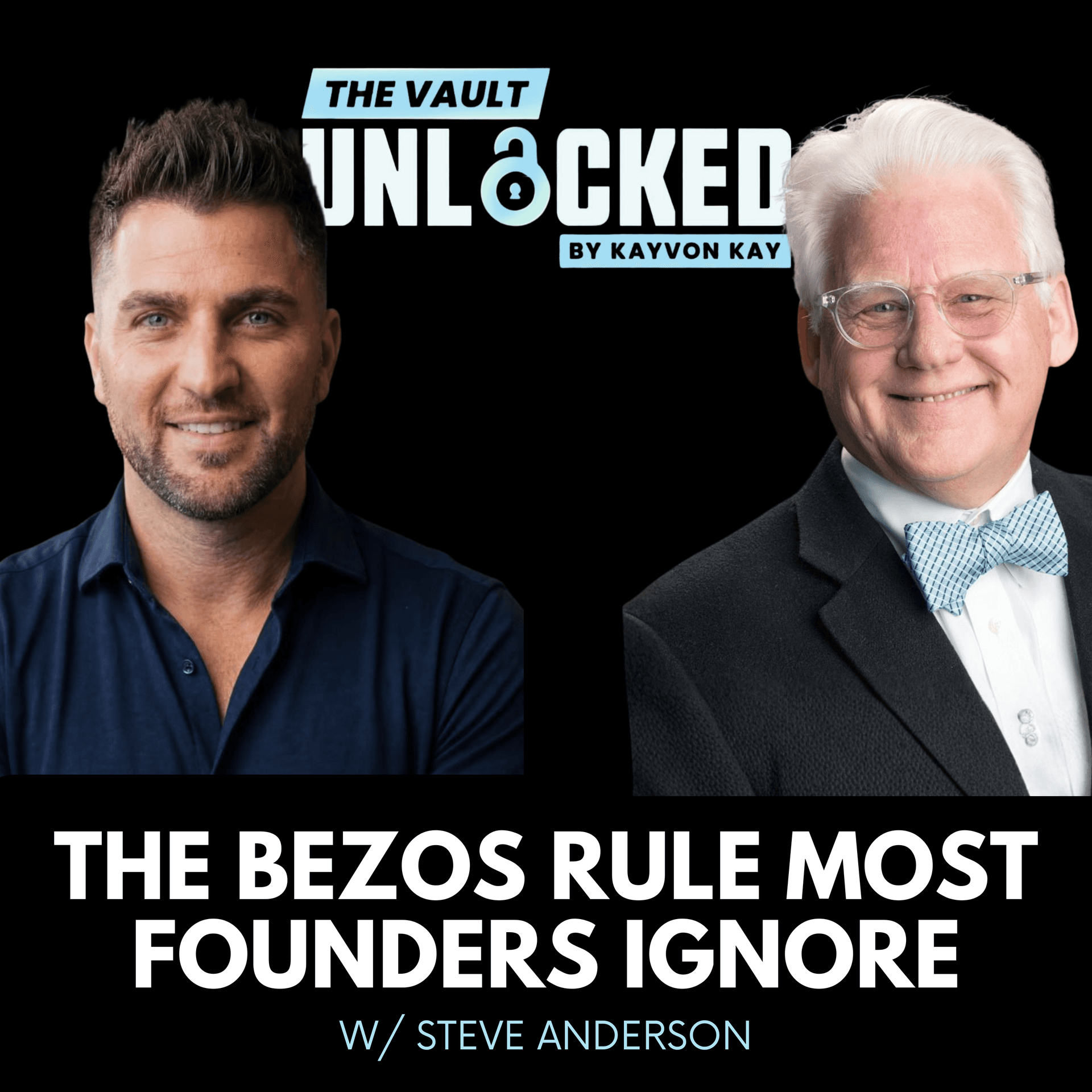
Steve Anderson, former insurance-industry professional who later consulted with agents on technology and social media; he researched Jeff Bezos’ shareholder letters and wrote the book The Bezos Letters.
Key claims
Amazon’s success wasn’t luck but a documented growth system; experimentation requires tolerating failure; long-term conviction sustains progress through setbacks; customer obsession drives speed and simplicity; complexity should be made simple.
Notable examples
1997 letter emphasizing experimentation/invention; “ouch” during the dot-com bust; bandwidth constraints; Blue Origin’s 2001 long-term vision; PillPack packaging as “make complexity simple”; Amazon returns and friction reduction; “NASA’s most successful failure” (Apollo 13) as “successful failure.”
Written by AI. May contain mistakes. Listen to the episode to check what was said.
Chapters
Tap a time to open that second in VOSteve Anderson's Journey into Amazon's Principles
0:51 to 3:17
Steve discusses his background and how he became interested in Jeff Bezos and Amazon's growth.
“I mean, I'm so excited to jump in and see what you're about.”
Exploring Risk Aversion in Business
3:17 to 6:53
Discussion on how unwarranted risk aversion can hinder business success, referencing Bezos's letters.
“So looked at companies that had once been very successful and were gone, out of business.”
The Principles of Successful Failure and Customer Obsession
6:53 to 12:51
Delving into Bezos's principles of encouraging failure and obsessing over customers.
“So anyway, you can wind me up and I can keep going.”
The Customer Experience and Amazon's Approach
12:51 to 14:01
Highlighting how Amazon's customer-centric strategies contribute to its success.
“It was, or like to support the customer.”
Customer Obsession and Amazon's Return Policy
14:01 to 16:46
Explore how Amazon's customer-centric approach minimizes friction in returns.
“But this whole idea of obsessing, and it can have negative connotations, right?”
Jeff Bezos's Visionary Leadership
16:46 to 19:18
Discuss the tone and content of Jeff Bezos's letters during challenging times for Amazon.
“So I think he was on, again, he's CEO of a growing large publicly traded company.”
Long-Term Thinking as a Principle
19:18 to 22:56
Learn about the importance of long-term thinking in business through Bezos's principles.
“But now Amazon, you know, is launching satellites and has created what is now called Amazon LEO, L-E-O, for low Earth orbit, satellite constellations for high-speed Internet communication.”
Embracing Failure and Learning
22:56 to 25:30
Understand how embracing failure can lead to growth and innovation in companies.
“As you were going through all these letters and you came up with the 14 principles, which were the one or two that really stood out for you?”
Simplifying Complexity in Business
25:30 to 27:42
Discuss how Amazon focuses on making complex processes simple for customers.
“And the other one that resonates with me and a little story behind it is in the Accelerate cycle, it's called Make Complexity Simple.”
Insights from Bezos's Letters to Investors
27:42 to 28:04
Examine what Jeff Bezos's letters reveal about his vision and challenges faced during Amazon's early years.
Show all 14 chapters
Exploring the Bezos Letters
28:04 to 36:21
Discussion on Jeff Bezos's letters to the board and their implications for Amazon's culture and employee treatment.
“I think we talked about this before the show.”
The Power of AI in Business
36:21 to 36:53
Insight on how AI can revolutionize business practices and the importance of adaptation.
Lessons from Jeff Bezos
36:53 to 42:01
Discussion on what Jeff Bezos would teach his son about business and the mindset of continual innovation.
“So if you want a life like that, follow the principles, get the book, where can they find the principles in the book?”
The Importance of Experimentation
42:01 to 42:25
Learn why embracing experimentation is crucial for founders' success.
“So again, looking ahead, not being afraid, having an understanding of experimentation and trying and moving forward.”
Transcript
Automatic transcript. May contain errors.0:00Steve Anderson:Most people think Amazon won because Jeff Bezos got lucky. He didn't. He followed a system and he wrote it down for over 20 years in every single letter he sent his shareholders. My guest today, Steve Anderson, read all of them. Then he pulled out 14 growth principles that explain how a company that lost money for a decade became one of the most valuable on earth. We get into the one most founders get wrong. Bezos called it unwarranted risk aversion, the idea that playing it safe is the most dangerous move you can make. We talk failure as a strategy, obsession over the customer, and why Bezos ended every letter the same way.
0:43Steve Anderson:It is always day one. If you are building something and you feel stuck, this one is for you. Let's unlock it.
1:00so steve uh welcome to the show i know you spent uh many years i mean i'm gonna say your whole life discovering but many years looking at uh jeff bezos and really what he did and how he's accomplished i mean so much i know you wrote this book called the basil letters i'm looking here on Amazon, thousands of reviews, you know, bestselling book. I mean, I'm so excited to jump in and see what you're about. Well, thank you. I am too. And thanks for having me on the show. So for everyone listening, just even just right now, tell us a little bit of like who you are and how did you even come to this idea or how'd you find this concept?
1:44So I will start off by saying I stumbled into it. My background is the insurance industry. I spent my career there early on selling insurance to individuals and to businesses. Kind of midway through that, I got intrigued with the technology piece. So agents using websites and all of that. And I to social media to, you know, et cetera, and now certainly AI. But along the way, I was consulting with insurance agents, and I think we all realize that technology continues to develop really rapidly, more so now than ever, I would say. But even 20 years ago, it seemed fast. And so I started this idea of thinking about this idea that the biggest risk businesses face is actually not taking enough risk.
2:48You know, sitting back, let me wait a few years. I don't know if this internet is going to be anything. You know, let me just, and at that time you could do that. You know, certainly today, much, much harder. So I started looking at companies in general, and something I did pretty effectively, I would say, is look outside the insurance industry for ideas and trends and where things are going. Because the insurance industry tends to be very conservative and slow to adopt. So looked at companies that had once been very successful and were gone, out of business. And companies that had been successful and continue to be successful and trying to understand what's the difference?
3:31Why one company did this and the other company wasn't able to. during that research came across Amazon had sort of heard and read maybe one or two of the letters to shareholders that Jeff Bezos wrote about Amazon but got started getting deeper and at one point read every letter that he had published to that point probably through that at this point it was probably 2017 and read them one after the other as a narrative and realized there were trends that he talked about in the letters. And really the trends that caught my attention were how he grew Amazon and how Amazon was able to be successful and continue to be successful.
4:19So that's kind of what the hook that got me. And then I had this brilliant idea to create a lead gen, right? Here's some great takeaways from Jeff Bezos. I don't even know if he was a billionaire at that point, probably, but obviously successful. Amazon continues to grow. Here's some things you can learn wherever you are in your business journey, from startup to 50 employees to 500 employees, et cetera. And so I created a one-page executive summary of all the letters to that point. Fortunately, my wife is in the book publishing business. And so I was pretty excited about this. I thought this is really interesting to me.
5:07And I showed it to her and she looked at it and said, this isn't a lead gen. This isn't a giveaway. This is a book. And so that moment was actually my oh shit moment, which was, oh, I don't know how to write a book. And she sort of said, well, I do, you know, you come up with the ideas, we'll, you know, work on this together. And so that was the start of a probably year and a half to two year process of actually figuring out what the principles would be, how they apply, you know, research and all of that kind of stuff that went into the manuscript. And I said I, you know, accidentally stepped into it.
5:49I had no conception of what it would become and has become. You mentioned bestseller, Wall Street Journal USA Today debuted on their bestseller list and has been translated into 21 languages. And as you said, you know, lots of reviews. and I still am sort of surprised, you know, why me? There are a lot of smart people in the world, but I had the right combination. And I think one of the hooks that's different about this book is that view of risk, right? So the insurance industry is all about reducing risk, mitigating risk, transferring risk. And I was saying, you need to take more risk. Very counterintuitive, certainly for me and the industry, but I think for people in general who often are very risk averse.
6:48And there's a phrase Bezos uses that I still like a lot, which is unwarranted risk aversion. Right. So anyway, you can wind me up and I can keep going. You're going to have to interrupt me. Yeah, I don't think it's anyway. I think it's very important. So unwanted risk aversion, I think is what you said. Well, I mean, let's start there. Like, what did that mean to Jeff Bezos? Where did that, like, how did you even find that in all these letters? So just to recap, because I just want everyone to understand you went and researched and found, I don't even know how you find this, but you found every letter Jeff Bezos wrote to the shareholders, to the board.
7:37And you then got, I'm going to say, you got deep into it and really analyzed and studied these letters and started seeing trends and started seeing what was actually going on as Jeff was writing these. And you can see probably the evolution of the company of what he was writing. So you kind of went deep into that and then built a book around it called the Bezos Letters. And from the Bezos Letters, there came, I believe, 14 business principles or 14. Well, I call them growth principles. Yeah. 14 growth principles on, you know, how Bezos grew Amazon to what it is today. And I think, again, I always try and emphasize, regardless of where you are in business, these are principles that are principles, which means they're long-term.
8:26They're not kind of flash in the pan marketing hacks and, you know, things like that. But they are principles. And the more I talk to business owners of all sizes, it resonates with people. Now, they're not all easy to implement. And that's, you know, part of the work that goes into it. But if you feel stuck as a business owner, if you're growing, but not enough for these are ideas that can help you get unstuck is the way I would say it. So back to my question of the first, I don't know if that was a principle or not, but you were talking about not having the fear and being able to be a little rich, like, you know, go in and be unwarranted risk adverse, I think is what you said.
9:19It was not a principle or is that something that you've kind of saw within the letters and saw within the letters? Well, so I would say first I saw it in the letters, and how it shows up is from the very beginning. So the first letter he wrote when Amazon went public was 1997, and he had kind of three main sections in that letter, and some of the principles grew out of that. But one of the common threads throughout the letters and started from the very beginning was this idea that he, Bezos, knew we needed to experiment in order to invent on behalf of the customer. And those words, experimentation and invention, and on behalf of the customer are really kind of key ideas.
10:16What he said was, is that if you're going to experiment, you're going to fail. Right? Because if you know the experiment's going to work, it's not an experiment. So you have to, as a business owner, be willing to suffer the failures to find the wins. So that idea became my first principle, which I call encourage successful failure. Okay.
11:15affects you during what phase of your business. And I believe those four phases, every business is going through all the time if they're a 5 ,000 employee business or a five employee business. They look different, but they're still the same. They're testing an idea. They're building on the successful results. They're accelerating the growth. And then they're scaling. Okay. And then starting over again. And it could be different departments, different regions. you know, et cetera. So, so yeah, so I got to answer your question. That whole idea of experimentation and failure is one of the principles.
11:56And that's what, that's how I put it together. I mean, it makes sense when you hear it, but it's sometimes I think as business owners, marketers, cause I mean, the amount of testing that you don't have to do as a marketer, but I've been just saying as a project builder, whatever it might be in the scope of business is yeah i get it's hard to test because there's a lot of failure that's going to come from it but bezos was basically saying we're going to fail before we succeed you're on this board get ready which i love because it's also setting him up as well as why is this not happening you know it's like hey and they get they got to buy in they got to trust and you know i'm sure they've had i know they've had trillions of dollars of failures before they've had their you know their successes.
12:39So that's interesting. So test, test. He said it in 1997, we are going to basically test. We're going to trial. We're going to keep figuring it out. What I love at the end, you said something was either for the customer or by the customer. It was, or like to support the customer. So customer was always kind of the forefront is in it. Yeah. And that's another principle, um, which when Bezos talked about it in the 97 letter, he said, we will obsess over customers. And so my principle growth is obsess over customers. And, you know, this was an interesting principle because most businesses go, well, I take care of my customers or I have good customer service or I've mapped out a good customer journey.
13:26But there's a different flavor or connotation when you talk about obsess over customers. And I don't see many businesses obsessing over customers. Now, if you're listening to this and you're buying from Amazon, there's a reason. And that reason is they obsess over customers, meaning they're always looking for lower prices. They're always trying faster delivery and they're always building more selection. And those are three customer pillars that Amazon has put in place and continues to grow. But this whole idea of obsessing, and it can have negative connotations, right? If someone's obsessive, they've gone too far.
14:10But can you go too far when you're taking care of the customer?
14:13Steve Anderson:I don't think you can, right? I don't think there is a line for that, truly. And it's interesting because you said they're always looking, they're always trying to build, but I think there's also, I could be wrong, but they're also retaining. And what I mean by that is you ever try to return something with Amazon? You ever had a hard time doing it? Not often. Never for me. I mean, I returned, I had a, I've returned one product that was bought like two years ago and then they sent it again and it broke a year later and they let me return that product. And then they finally said, you know what let's just give you the full refund back yeah i used the product for like three years and i was willing to buy a new product but just and it wasn't it was like 150 thing but i guess what the next day i bought more things off amazon i actually try to find products that you'd buy on a normal regular website on amazon because i know the refund policy and the the process to refund is going to be the easiest there is.
15:23And I think that's a point too. I mean, in my mind, that always goes to how much friction do you have currently as a business owner with your customers? What do you make them jump through? What hoops? That's all friction. Amazon is obsessive over removing friction. And that's just what you described. So I want to ask, I kind of want to go deeper here because we're going to learn more about the principles, but I kind of want to go deeper in the psychology. If you picked up any, like, what was he really saying? What was he really thinking? Were there moments when you were reading letters that seemed more panicky or more, let's say, less on the vision and more maybe about not, like, was there times that he'd deviate from what the mission was, maybe because it was lack of resources or lack of money or things were happening in the economy and he was just trying to, you know, save the company before it exploded?
16:17it or the letters always just the same tone? No, they weren't. And, and when you say that, and I'm thinking is the 2001 or 2002 letter when the, the internet bubble burst and Amazon stock went, and I can't, I can't quote the numbers. I'd have to look them up, but something like$81 a share to six. And he started his letter with, ouch. It's been a brutal year. So I think he was on, again, he's CEO of a growing large publicly traded company. There are parameters around that. And at the same time, I always felt like he was being real or being who he is. I think he was pretty optimistic. I think he had an interesting innate ability to look into the future.
17:18And really two examples of that. One is just seeing the internet. So the whole origin story with Amazon is he was a financial analyst in New York City. and kept hearing about internet and how fast its use was growing. And he started asking himself the question, could it be used to sell stuff? And he said, yes, it will be. And so another example is, I think it's probably 98 or 99 letters, again, an early letter, when he talks about how slow the internet is. and that bandwidth was a constraint on Amazon, right? Because it took time for the webpage to load. They had to be conscious of how many images, right?
18:07All the stuff that had to happen to speed up the time. But he also said, and today is the worst it's ever going to be. So again, there's acknowledging problems to overcome and being realistic about what they could do. But he was always, he literally was always thinking multiple years or decades ahead. The second example of that is his space company, Blue Origin. He started that in 2001. He had a long-term vision. In fact, he was valedictorian of his high school class in Miami. and his valedictorian speech was how manufacturing would be moved to space so people could come back to the earth as a national park and visit.
19:04You know, I mean, again, so long-term vision and the willingness to continue to step-by-step move toward that vision. Now look at Blue Origin, right? Again, reusable rockets and, you know, interesting competition there between Musk and Bezos and all of that. But now Amazon, you know, is launching satellites and has created what is now called Amazon LEO, L-E-O, for low Earth orbit, satellite constellations for high-speed Internet communication. They've been working on that for years. so that's that line so one of my principles um and i can't oh there it is it's in the build cycle it's called apply long-term thinking right as you're building you need to have the conviction of what you think is right or what's going to be happening and be willing to continue you know really to suffer not just losses but suffer um um what's the right word i want to use Well, I was going to say suffer through the pain of not just the external of the people saying it won't work, this and that, but the pain of the internal.
20:19Being able to set your vision and believe in a vision so big and so bright that other people can't see it and still stay on the lane to go through it. You know, at one point, I think it was Bloomberg had a cover, Amazon.bomb, right? That was during the, you know, dot-com era. But still, I mean, people, naysayers saying this will never work. You've got to have something to keep that going. And for him, it really was long-term thinking. I think there's a little bit of, you know, some people may call it psycho or sociopath. after that there's definitely something that these these guys have for sure that just they're relentless they know it's like they don't even if we don't know them right we don't know their personal journeys but uh it feels like doesn't even matter what the journey is they they will just find a way to pursue and and keep building no matter what happens and i mean yeah it's it's like anybody can sit here and go it's quite remarkable what jeff bezels have done and with amazon i mean it's it's it's it's amazing and i know they just i feel i feel like that company is just starting i was told i'm not sure if this is correct but i was told this was told this like many years ago that like one of the goals or the missions is can you buy something from amazon and have it delivered at your house faster than it would take you to get in your car drive to the store and come back and that was i don't know if that's still one of their goals or not but like i would not be surprised i mean people are talking about i would not be surprised in the next probably year, I would say year for sure too, drones are going to be dropping off my packages.
22:00Well, and yes, I totally agree with that. And that's another example of a long-term vision. I mean, they've been working on drones for a long, long time. You know, and people were, you know, a normal business would have given up a long time ago. Yeah, it's, you know, and so having that vision and that long-term goal, fast delivery and faster, I mean, keep pushing that edge and they keep pushing that. And again, that's, and this is an example where principals stand on their own and they interact with one another. So that's long-term thinking, that's obsess over customers, that's leveraging time with technology.
22:44I mean, it's a number of principles that are interacting there that create that environment that can be successful. So let me ask this question. As you were going through all these letters and you came up with the 14 principles, which were the one or two that really stood out for you? I knew this had to be in the book. This was one of the game changers. What was that principle and how did you come to it?
23:17there are a couple that come to mind i think first we've talked about the encouraged successful failure um quick story on where that came from it definitely was intertwined with experimentation and bezos was a big believer in experimenting and one of the things i could have a friend of mine who did an early read of the manuscript. And he came back with, on that principle, he came back with, you know, employees aren't afraid of failure, but they are afraid of the consequences of failure. And that holds companies back because they won't experiment. They won't try something new. They won't because they're afraid.
24:01They're afraid their, you know, career is going to get hit. They're going to get fired. They're going to, you know, et cetera, et cetera. So that was one. And And that phrase literally came from the Apollo, the, oh, I just forgot the director's name. Hang on a second. Apollo 13 movie at the very end. So I'm a space nut, have been forever. So I love space stuff. And watching at the very end of that movie, Ron Howard's movie, thank you, Apollo 13, really good movie. And at the very end, Tom Hanks, who's playing the commander, Jim Lovell, is stepping off the helicopter onto the deck of the Iwo Jima.
24:45And he's narrating in the background, our mission, Apollo 13, became known as NASA's most successful failure. We didn't make it to the moon, but we got all three astronauts back alive. And that, to me, encapsulates the definition of a successful failure. Okay. Right. So that's one. Yeah. So another way of saying that, just from my perspective, is there's learning to be like every failure, there's a lot to be learned. And actually in every failure is getting you closer to the win. Correct. You don't get closer to the win without the trial, without the error, without the consequences, and most importantly, without the failure.
25:27Right. Exactly. I think another – we talked obsess over customers, so I won't go into that one again. And the other one that resonates with me and a little story behind it is in the Accelerate cycle, it's called Make Complexity Simple. And so we talked some about that, right, just about returns. It can be most places it's complex for the customer, certainly. At Amazon, it's less so. So they make complexity simple. That came from a, I was listening to NPR radio interviewing when Amazon bought a company called PillPack, which was a pharmacy company that mail order pharmacy company that specialized in patients who had multiple medications per day.
26:19and they created a process to package in a little plastic, yep, you know, little plastic by date and by time, morning, noon, 12, I mean, whatever. And then just pop them up and eat them. And you just opened them and take them. You didn't have to use the pill boxes and all of that kind of stuff. So Amazon bought them. One of their first forays into that, you know, pharmacy, healthcare, et cetera. One of the CEOs of the established pharmacy company, I think it was Walgreens, but again, I have to look that up again. He was being interviewed and was asked about, you know, how does this affect you, you know, Amazon getting into the pharmacy business?
27:00And there's been, there had been a bit of a trend of kind of the Amazon effect, right? And the CEO said, yeah, I'm not really worried about Amazon because it's more complex than they realize. And I thought, I literally said, I remember this. I said out loud in my car, I was alone. But I said, that's what Amazon does. Is they make complexity simple. And so again, how do I say this? Experience, I mean, how I kind of put these ideas together ended up with the book and then the framework of the growth principles. From the letters. now we talked a lot about what was in those letters uh you know and there's four we don't want to give all the principles away that's the whole point you got to get the book to really get the principles but was there things that you saw in the letters even maybe going through the journey of building the book where we're not talking like that didn't maybe make the book that maybe should have made the book and or things that you saw with those letters that like what was he not saying i I think we talked about this before the show.
28:11I was like, I want to understand like, what was he not saying in these letters? Cause these letters, again, I'm assuming just for the audience, like you're writing letters to a board where at this point, you know, I'm going to assume Amazon's losing multiple, multiple millions. If you don't understand, like Amazon was losing multiple millions of dollars a month. Yeah. Especially, especially the first 10, 10, 15 years. Profit was negative, like negative. And how are you writing? And what are you writing to these people who are still dumping in money, the board, that they have the pressure from everyone else?
28:46And you have one guy that's still sitting on the vision. Like, what was he not saying in those letters indirectly? A couple things come to mind, and he ended up addressing them later. So let me – and what's coming to mind is employees. and really more specifically, fulfillment center employees, the warehouse workers. Lots of stories of, what's the right word? Tough working conditions, their drivers not being able to take breaks, you know, things like that.
29:31and early on even in that I think the 98 letter he talked about the importance of you know employees and hiring the right employees in order for Amazon to be successful but he also said this is a tough place to work we have a vision and and here's how he phrased it we are building something great, something we can tell our grandchildren about. Part of that translated into pushing for faster. And maybe not, certainly early on, maybe not taking as much time or effort or thought into how do we better treat our warehouse employees. Now, I think because of pushback, responding to some of that, they actually – so Amazon had 14 leadership principles that are different than my growth principles, but there's some overlap.
30:44But they added two more just before he steps aside as a CEO. And they, you know, one of them was will be the Amazon will be the best and safest place for an employee to work in the world. So that and again, for them, leadership principles are core to who the organization is. So that was a different focus. I think there's still legacy kind of thoughts. I mean, one of the pushbacks I get talking about the book is, yeah, but he treats his employees like crap. Well, that's what I was thinking. I didn't want to say it, but like, from my understanding, they're actually not the greatest working conditions.
31:25They're actually unsafe working conditions. And I know there are safety regulations that are different in North America to other countries as well. And you can only control so much in those safety. You know, as a business owner, you can only control so much at that level. But from my understanding, it wasn't actually the safest and most fruitful place to work. and I'm going to go back to customer obsession because that's one of the things you have to be aware of if you're obsessing over customers and speed is the measure of that obsession then you're going to push employees harder and harder and harder and
32:09warehouse employees get health care on day one they have what's called career choice so they amazon will pay now used to be 90 now it's 100 of tuition for um schooling i'll say that and and it doesn't have to yeah it doesn't have to be related to their job It could be they'll pay for a nursing degree. Interesting. So, yeah. And, again, that emphasis on safety. And, again, this is sort of the interesting because the other piece to this is their continued work on robotics. So they are replacing. okay the very first fulfillment center i i went i was did a tour of walked into when you clicked by a employee in a fulfillment center got a notice on a handheld device go to aisle 23 shelf 8 section 3b and pull this they had a cart with a yellow bin that they walked up and down miles and miles of these aisles in a fulfillment center of probably at least a million square feet and they were walking and doing that that has been replaced by robots so they no longer have that position.
Read the full transcript
33:49Now they're getting, well, you're putting people out of work, but people are also complaining, well, it's unsafe to, I mean, so it's an interesting counter, you know, working of, yes, we're trying to be safer and we want to be faster. Here's the thing with that, because I think we're getting to a little bit of a different topic, but the reality is, because I've gone all in on AI. Someone asked me the other day, What does that mean? All in. I mean, all in. Whatever I do, it's through AI. How I think is how can AI do this? Because whether you believe it or not, this thing isn't coming and going.
34:28This thing is here and it's here to take over. It is here to take over your job. It's here to take over your business. It's here to take over civilization. It really is. So for me, Eric Hoffer, I don't want to bush this, but Eric Hoffer had one of the best quotes and he said, in times of change, the learners will inherit the earth while the learned find themselves beautifully equipped to live in a world that no longer exists. and we are in that change right now. So I look at it and go, you can either fight it, argue it and think it's not coming. The same people who once said, you don't need a website.
35:10Well, guess what? No, you're right. You were right. You're right. You don't need a website today. Today, you don't need one, but guess what? And it's going to be the same with AI. So that's just the reality. But I hope that with AI, those jobs are going to be replaced and 10 more jobs might be created. And that's the opportunity. Well, and I, you know, again, having now decades of watching some of this stuff, yes, jobs are going away. And I absolutely am convinced new jobs that we can't even imagine right now are being created. And actually, mentioning AI, when we first started, we talked about analyzing the letters and all of that.
35:50And I almost popped up and said, and I didn't even have AI to do that. I had to do that myself. I mean, can you imagine though, like what your 2.0 book would be? Having all those letters. And I like to like, and here's the reality. I like to say you're the smartest guy in the room and you got the team full of smartest people.
36:08Steve Anderson:I'll tell you something. You know who's smarter than all those people combined? AI. And I guarantee you AI can look at all those letters and pull some crazy stuff out of there that we wouldn't even be able to think. And that's just the power of it. But here's the coolest part. are you the guy who's using the ai in that way to pull out that information or are you the person who's sitting around and saying oh ai is not going to work and i'm just going to write this on my own you know etc etc but yeah i can't imagine you the amount of work you guys would have done and detailed you would have been letters you would have to pull to read those and actually come up with all that that that goes without saying i mean what a what a what a great thing you did i would say what like i mean awesome like i mean this book's obviously doing as successful it is for a reason uh and i love it the bezos letters uh so as we come to the end here i know i'm looking on amazon but where else can people get this book i'm gonna say people need this book we talked about like one or two of the principles there's 14 principles here if you're in business you're in marketing i'm gonna say even probably in life there's 14 principles that jeff bezos has kind of lived by, I would say, directly or indirectly to create Amazon.
37:20So if you want a life like that, follow the principles, get the book, where can they find the principles in the book? So obviously the book itself, and it's all formats, you know, physical, digital, and audio available on Amazon. The book website is thebezosletters.com. And there's some additional information there on, you know, helping little workbooks and some things like that to help actually, I was really tried to be very intentional about not just having the ideas, but how can we actually do something with it, with it. And so, and interestingly, Bezos is, is building an AI company right now.
38:05Oh, I mean, they all are. And it's really, he's focusing on manufacturing and how AI can help manufacturers, you know, being streamlined, et cetera, et cetera. Well, I think it's already happening. I know that they're working on robots right now. They put them in, I believe, I forget what it was. It was like the BMW plant. And they put that same robot into like a food manufacturing plant. And the robot did the job of like 10 employees, more efficiently, more effective. And I mean, that's the scary thing, right? Like that's the jobs, you know, robots and AI is going to take over. I got one deep question for you.
38:47And only because I know you studied these letters and you must have gotten deep into the psychology of Jeff himself. So let me ask you this. Knowing what you learned from those letters and the principles and everything you saw, all the triumphs, the ups and downs. If Jeff was sitting there with his son and his son asked him, Daddy, what's one thing I need to know about business and life? What do you think Jeff would be saying to his son? There's so many things I think he would say. I think I would distill it down to don't be afraid to experiment. have a long-term vision, understand where you want to go, and believe it's always day one.
39:44So we didn't talk about that principle. That's the last one. But he ended every single letter he wrote with some version of it's still day one, it's always day one. And day one is a mindset of the excitement when you first opened the doors to your business, whatever that looked like for you, that excitement of helping customers, having something to do, you know, that. And Amazon's been described as the world's largest startup because that mindset of we still have a lot to learn. and I don't think we have time for the whole story, but I want to give you one piece. He, at an all-hands meeting in Seattle 10 years ago now, he had a question from an employee in the audience.
40:42He had talked about company update and opened it up for questions. The question was, Jeff, what is, because of that day one, that's very common, Jeff, what does day two look like? And he kind of chuckled and he said, I think I know the answer to this question. Day two is stasis, followed by irrelevance, followed by excruciating, painful decline, followed by death. Wow. And that's why it's always day one. So you think about those companies that once were very successful. and he later and they actually told that story in one in the 2016 letter and he said it could take 20 years for that process but once it starts it's really hard to reverse and he said and this is i want to tie into a little what you said earlier about ai he said there are four things that i think will help fend off day two i won't go through all of them but the one is eager adoption of external trends.
41:52And he identified in 10 years ago, machine learning and artificial intelligence as one of those trends. So again, looking ahead, not being afraid, having an understanding of experimentation and trying and moving forward. I think there'd be some version of that conversation to his son. I love it. Well, Steve, thanks so much for showing up and being here with us. And for those, those, for those of you that want to learn more, it's the Bezos letters. All you got to do is go to Amazon and put in the Bezos letters and you can't miss it. Thank you so much.
42:44Fair enough.
From the publisher
Most business owners think risk is the enemy. The man who decoded Jeff Bezos found the opposite.
The instinct to wait, to protect what you have, to move only when the path is certain feels responsible. It is the exact behavior that kills companies slowly enough that no one notices until it is too late.
This episode names the thing nobody wants to say out loud: caution is not safety. It is a slow-motion decline you mistake for stability.
Steve Anderson, author of The Bezos Letters, spent his career in one of the most risk-averse industries on earth: insurance. Then he read every shareholder letter Jeff Bezos ever wrote, start to finish, as a single narrative. What he found became a Wall Street Journal and USA Today bestseller translated into 21 languages, and a set of 14 growth principles that explain how Amazon went from burning millions to dominating the planet.
Kayvon pushes past the surface. They get into what Bezos was actually saying to a board watching the company lose money for over a decade, and what he was not saying. The conversation moves through the principle of unwarranted risk aversion, the discipline of obsessing over customers until friction disappears, and why Amazon wins by making complexity simple while competitors assume that complexity protects them.
Then it sharpens. Bezos ended every letter the same way: it is always Day One. When an employee asked him what Day Two looked like, his answer was stasis, then irrelevance, then painful decline, then death. That single idea reframes how a founder should think about success itself, because the companies most at risk are usually the ones that already won.
This is for founders, operators, and executives who are growing but feel stuck below their ceiling. For the people building something real who suspect their own caution is the thing holding it back. If you want motivation, this is the wrong room. If you want the operating logic behind one of the most valuable companies in history, stay.
The conversation also covers what most business owners get wrong about experimentation, why failure is the price of invention rather than the absence of it, how customer obsession can quietly turn into pressure that costs you elsewhere, and where AI fits into the same pattern Bezos identified years before it became obvious. Eager adoption of external trends was on his short list for surviving Day Two long before machine learning was a headline.
Topics Covered:
-
Why unwarranted risk aversion is the real threat to a growing business
-
How reading every Bezos letter revealed 14 repeatable growth principles
-
The test, build, accelerate, scale framework and where most founders stall
-
Customer obsession as a system for removing friction, not a slogan
-
The hidden cost of customer obsession on the people doing the work
-
Making complexity simple as a competitive weapon
-
The Day One mindset and why Day Two means decline
-
Where AI sits inside Bezos's logic of adopting external trends early
Looking to dive deeper into these conversations and connect with our host and guest?
Follow Steve Anderson:
Buy The Bezos Letters on Amazon
Follow Kayvon:
Want to go deeper with Kayvon?