
In short
The “bull case” that AI agents will increase the value of many SaaS categories, while some will lose value; plus why enterprise AI adoption is slower than Valley expectations and how agents change work, pricing, and market structure.
Guests
Reid Hoffman (entrepreneur/investor; early investor and mentor to companies including Facebook, OpenAI, Airbnb; co-founder of LinkedIn; chairman at Village Global events). Aaron Levie (CEO of Box; long-time Box entrepreneur; discusses “startup reinvention” and cultural reset for incumbents).
Key claims
Agents can multiply the value of SaaS business logic, security, workflows, and data when usage expands 100x–1000x, because risk and guardrails scale. Some categories will shrink where agents commoditize the platform value. Incumbents may win if agents fit their business model; disruption depends on innovator’s dilemma and pricing (e.g., seat-based vs agent-based pricing). Enterprise adoption is slower due to reliability/security/provisioning needs and “jagged edges” in agents; coding agents advance faster than other knowledge work because coding is verifiable and has more digitized context.
Notable examples
Contract management TAM could grow from “a couple billion dollars a year” to “tens of billions” with agents; CRM/go-to-market may gain value (e.g., agents that follow up, connect to LinkedIn, update contacts). Customer support shows seat-model disruption (agent-based pricing vs incumbent seat models). Coding agents work well in smaller, code-rich contexts; broader work (law/accounting) is harder because context is fragmented and outputs aren’t verifiable until later.
Written by AI. May contain mistakes. Listen to the episode to check what was said.
Chapters
Tap a time to open that second in VOThe Bull Case for SaaS in the Age of AI
0:00 to 0:45
Exploring the value proposition of SaaS amidst AI advancements.
“So how is it that, you know, SaaS and cloud was going to be incredibly disruptive to the incumbents, and yet those companies are all bigger today?”
Understanding Market Dynamics
0:46 to 2:09
Discussing market perceptions of SaaS value in the current landscape.
“I assume the startups in the room shouldn't presume stupidity on the part of Box.”
Evaluating Software Value
2:10 to 4:48
Analyzing how user population impacts software's business value.
“So the point when I put that out there was as more of maybe a philosophical architectural point as opposed to like all of SaaS should be worth more than it is now.”
The Future of CRM Systems
4:49 to 6:32
Delving into how agents can enhance the CRM technology landscape.
“I was like, yeah, that's a good summary of what I said.”
The Intricacies of SaaS Value
6:33 to 8:06
Examining the distribution of value between SaaS companies and AI models.
“That's up to the execution of the teams.”
Startup vs. Incumbent Strategies
8:07 to 13:22
Discussing how startups can navigate competition with incumbents.
“then that will be, like, depending on where you are in that continuum, will mean more or less value to, again, that SaaS layer.”
Lessons from Market History
13:23 to 14:03
Reflecting on historical market trends and their implications for SaaS.
“which is like it still requires the same seat to go do the work with the agent.”
The Unexpected Resilience of Incumbent Software Companies
14:03 to 15:26
Explore how traditional software companies have thrived despite expectations.
“And then now you look, you know, 20 years later at the market, the vast majority of on-prem software companies are bigger today than they were back then, of at scale.”
Opportunities for Startups in the Age of Agents
15:27 to 16:51
Discover the new market opportunities for startups leveraging AI agents.
“So, you know, these are gigantic companies, and they're bigger than any SaaS company that's ever been produced.”
Slow Rollout of AI in Enterprises
16:52 to 18:06
Analyze why enterprise adoption of AI has been slower than anticipated.
“Like you could go after all the services areas that now agents for the first time ever can go and automate.”
Show all 26 chapters
Challenges and Misconceptions in AI Development
18:07 to 21:10
Learn about the challenges faced by enterprises in adopting AI technologies.
“I mean, so revolutionary on the one hand, but still, so many companies haven't really adopted these tools at all.”
Comparing Coding AI to Other Knowledge Work
21:11 to 23:12
Understand the unique advantages of coding AI versus other fields.
“So I do think we will see the fastest revolution of work processes in human history.”
The Future of AI-Native Companies
23:13 to 28:01
Explore how AI-native companies will disrupt traditional industries.
“like at least what the sound bites represent.”
The Evolution of Incumbents in SaaS
28:01 to 28:57
Explore how established companies adapt to new market pressures from startups.
“This is actually why I think there's so much opportunity is because the opportunity is which companies can actually bridge these incredible breakthroughs that we see in Silicon Valley with real life work environments.”
The Role of Professional Services
28:58 to 30:19
Discuss the significance of professional services in implementing AI solutions.
“I think I can argue more same and less Yes, exactly.”
Sizing Market Opportunities in AI
30:20 to 31:35
Understand how market opportunity can shift with technology advancements.
“My question is about how do we size this market opportunity?”
Human Dynamics in AI Sales
31:36 to 33:50
Examine the importance of human interaction in enterprise sales alongside AI.
“I mean, you know, back to—reintroduced Jevon's paradox into this.”
Future of Sales Rep Roles
33:51 to 36:32
Speculate on how sales roles may evolve with AI integration in the future.
“But, Reed, sorry, before you transition, but, like, it's interesting.”
Competition in AI Models
36:33 to 37:52
Discuss the implications of multiple competing AI models for startups and society.
“Let's go, if you can make them quick, we'll also get Samit in, but let's do Shri here.”
Specialization and Coding Agents
37:53 to 41:49
Analyze the emergence of specialized coding agents for complex tasks.
“Because you're always going to have a counter pressure from China with open source.”
The Challenges of Automation for Founders
42:00 to 44:24
Explore the difficulties founders face in automating their workflows and the tendency to hire help instead.
“SEM, the growth hacking, the email marketing, like the whole stack of marketing.”
Learning and Unlearning as Entrepreneurs
44:24 to 47:20
Discuss how successful entrepreneurs need to adapt by learning new skills and unlearning old habits.
“Let's talk about how to improve as entrepreneurs.”
The Importance of Delegation in Business
47:20 to 50:20
Understand the significance of delegation and focusing on high-leverage tasks as a founder.
“It's the what got you here won't get you there idea.”
Founder Mode and Its Complexities
50:20 to 52:44
Examine the concept of 'founder mode' and the balance between deep involvement and delegation.
“And I think there's a lot of founders that – I think when you're three people, this advice doesn't work.”
Admiring Entrepreneurial Craftsmanship
52:44 to 56:00
Hear a mutual admiration between Reid and Aaron, reflecting on their entrepreneurial journeys and practices.
“And so we've always tried to just hire for and delegate the kind of things that require that.”
Exploring the Art of Entrepreneurship and Magic
56:00 to 57:36
Listeners will learn about the parallels between magic and entrepreneurship and the unique qualities of successful entrepreneurs.
“that's cool and you'd go to magic conferences and they had magicians, magicians.”
Transcript
Automatic transcript. May contain errors.0:00SAP is a$300 billion company today. So how is it that, you know, SaaS and cloud was going to be incredibly disruptive to the incumbents, and yet those companies are all bigger today? It's because it actually was ultimately a sustaining innovation for the incumbent. The incumbent was fine to move to the cloud once they were able to. I think there's other AI strategies that are not we have to build a foundation model. And so you have to nuance to that. And then the other AI strategies, how are you doing that smartest or less smart? And if you're like, oh, this won't really work. So, for example, a lot of startups, I think, go, oh, I'm going to be building better coding agents.
0:40And you're like, well, OK, there's a lot of work in building good coding agents. What's your particular differentiation that might be harder? I assume the startups in the room shouldn't presume stupidity on the part of Box. Yeah, yeah, yeah. For all other incumbents, that's great advice. Yes, exactly. You should assume we're going to do the absolute best thing. Yes.
1:06Well, good afternoon, everybody. I'm Ben Kesnoka from Village Global. Welcome to another Village Global Luminary event featuring our chairman, Reid Hoffman, Aaron Levy from Box. We're going to have an hour conversation. I'll ask a bunch of questions. I'll also call on you if you have questions, and some of you have submitted questions in advance. So we'll try to keep this interactive. Let's get right into it. Reid, you often advise founders to think about what's true and contrarian. The first question, though, is going to be for Aaron along those lines. Oh, we did too soon. Yes, exactly. You're like, this is my chance.
1:36Aaron, speaking of contrarian and maybe true, you have a thesis that agents will actually make SaaS more valuable, not less. Wall Street right now has a certain narrative. It's every day I'm being tested on that theory right now. I started that theory when the market was like 40 % higher than where it is right now. So I'm like, we'll see if this one's true. Give us the bull case on SaaS companies in the world and the era of AI and agents. Yeah. No, my confidence is being tested very aggressively. So the point when I put that out there was as more of maybe a philosophical architectural point as opposed to like all of SaaS should be worth more than it is now.
2:25And so I do think that the market does need to decipher which software reduces in value and which one grows in value. And so I think the market has decided not to do that. And it sort of lumped everything together. So forgetting what's happened in the past maybe three months in software, I think the general point I was making was there's a lot of software where if you had 100 times more users on the software than people previously were using it, or a thousand times, that the sort of value of the guardrails, the workflows, the business logic, the security of how that workflow worked and the data that was involved in it would go up because you actually have even more risk of something going wrong because now agents are roaming through these systems and pounding them at, again, 100x more than people ever did.
3:19And so in some areas, the value of that business logic now is actually multiplied because we've actually had a lot of categories of software that were artificially constrained by just the fact that the total number of users you sold into a company was constrained by the headcount of that company or that particular department for that use case. And so there's a lot of categories of software where like, you know, everybody knows Harvey at this point, but like the market size of the contract management market previously was like the total spend on all software ever in time in the contract space is a couple billion dollars a year.
3:55That's like how big the TAM is of contract software. Well, now in a world of agents where those agents are doing a substantial portion of the work in the software, the value of that category could be tens of billions of dollars. There's sort of not a particular limit that is out there because now you just deploy these agents 24-7 and they're operating within the system. So I think the challenge is that we haven't as an industry and Wall Street hasn't been able to figure out who looks like that, where the agents doing work within the system actually grows the value of the platform versus there's going to be definitely software where the agent is now doing so much more of the value proposition of what the software used to do that it compresses the value.
4:36And there will be cases where that happens. And those will be the areas where the platforms are less valuable. And I think right now, everybody's just trying to figure out which side they end up in. So which are the categories that are growing and which are the categories or use cases that are shrinking? Yeah. What are they for you? Oh, okay, okay. I was like, yeah, that's a good summary of what I said. I probably should have said it that fast, actually. I mean, have you seen these market maps of software categories? Like the logos become this small. There's like 9 ,000, you know, SaaS products in the world.
5:07Not even the world, probably per category. So I think it's hard to say. I think my general rule of thumb would be which categories of software, again, would have had much more demand for that software. If the population of users in the company could have just, you know, there was a larger population. Like which things structurally add a lot of value, but they get underutilized. Those things should go up over time and which things have already reached kind of saturation and they probably have overbuilt their functionality and the functionality kind of gets underutilized because it's just not that, you know, there's too many features.
5:42That stuff probably goes down in value. So take an example like so HR tech. Is that? I think you can't even do it at a category level like that. I think it's I think honestly it's like subcategories beneath that because, you know, like CRM as an example. there's going to there's lots of cases where I would spend more on our CRM system if it generated the leads if it followed up with the leads if it could could connect to LinkedIn and roam around and get all of the updated contact information like I we would spend more on CRM systems if it did that whether that was Salesforce or a startup so in that case I would make the argument that actually a CRM system in a go-to-market world you'll spend more money on because in a world of agents, they can be doing so much more work for you to go and actually grow your business.
6:27So that's actually an area where I'd say more dollars will go into the category over time. Again, does the incumbent get it? Does the starter get it? That's up to the execution of the teams. But I don't think that less value goes into the CRM or go-to-market technology stack because of agents. I think more value goes in there. I agree with everything Aaron said, but I think there is one additional question that is partially top of mind for people, which is how much of the additional agentic value goes to the SaaS company, startup or existing, and how much it goes to the AI model agent companies.
7:00Yep. So that's another part of the variable. And so part of, I think, I completely agree with you that some SaaS will actually become more valuable and some SaaS will become less valuable. But part of it also is how intrinsic is the value of that SaaS ecosystem, not as it is today, because the rebuild of the tech stack, all the features, you know, lots of too many features or too few features or whatever how that plays into essential value that is not just commodified by the agents yes and I think this is this is why this is like we could do a four hour you know and we need a whiteboard because you got three to four moving pieces in this and and reed brought up the probably the most important one which is which is does the does the value of what used to happen in the software go to some horizontal system of intelligence of which there's only three or four major players that could probably capture that, versus how much really is actually business logic, you know, kind of required, where the agent equally needs so much that's in that business logic layer, and either the agent is native to that platform, or, you know, the agent at the horizontal layer is paying some kind of tax to be used in that system, then that will be, like, depending on where you are in that continuum, will mean more or less value to, again, that SaaS layer.
8:14And how do you think about the startup versus incumbent framework in general? It's obviously top of mind for all the founders here. What's the general framework or specific to agents and AI, but where startups should focus that incumbents might be laggards? Well, the general thing, as you know, since I'm mostly an entrepreneur and investor, is, you know, presume incompetence and stupidity from the incumbents. So go for it, right? Because presuming intelligence is not as good as an idea. So for example, if you say, oh, what I'm going to do is I'm going to go after Google for desktop or mobile search.
8:51You're like, okay, well, what's your particular plan, right, in terms of how to do that? But generally speaking, incumbents will be slow at getting out of their own way. They have innovators dilemma problems. They have, you know, none of them are currently built in AI native ways. Question about how the marketplace is changing because of it. So generally speaking, the default is go for it. Now, that being said, you know, if what is not a particularly good thing, and this refers a little bit to one of the things that Aaron was referring to earlier, is if you said, well, I have to build a beyond the foundation model, multi-billion dollar hamster wheel, then you had better be like intelligently on that wheel.
9:40I think there's other AI strategies that are not we have to build a foundation model. And so you have to nuance to that. And then the other AI strategies, how are you doing that smart or less smart? And if you're like, oh, this won't really work. So, for example, a lot of startups, I think, go, oh, I'm going to be building better coding agents. And you're like, well, okay, there's a lot of work in building good coding agents. What's your particular differentiation? That might be harder. Aaron, I assume the startups in the room shouldn't presume stupidity on the part of Box. Yeah, yeah, yeah. For all other incumbents, that's great advice.
10:17Yes, exactly. You should assume we're going to do the absolute best thing. Yes. But where do you, because you recently said you're trying to, it's a startup reinvention moment for Box, or it's kind of a cultural reset for the company. In what ways do you think incumbents are vulnerable to startup disruption, either in general or in this moment of AI agents? Yeah, I think the only, because you gave me a but, and so I'll give you a but. So I actually, at least in the way we internally think, we actually force ourselves to think, imagine if the incumbents are actually really good, how would you win?
10:56Because if you can develop that strategy, then you'll win if they're bad also. but if they're really good, you're going to need to know what is your angle of attack. Now, the part where maybe it meets the middle is you don't want to get yourself into this loop and people do, which is you over-assume what the incumbent will do and then that kind of creates paralysis and then you just freeze and you don't go after the market. So I would still go after the market but you should actually assume the incumbents are eventually going to figure this out And again, if they don't, then you're going to be bigger than you thought.
11:32And if they are, then you'll at least have had a kind of an opening. And I think the only tricky thing is I think innovator's dilemma is very instructive for this whole situation, which is you have to identify where is there something that the incumbent doesn't want to have happened from a business model standpoint versus where are they actually totally fine for it to happen. and they actually, it's more attractive on the other end of that journey. And that's the classic innovator's dilemma. It tells us exactly what will play out in every given market because incumbents don't want to do things that will make them less money, but they are totally happy to do things that make them more money.
12:10And so you have to figure out which parts of AI are actually going to make the incumbent less money or change their business model so dramatically that it's going to be hard for them to execute that. Or AI has this in some areas, or it's so technically different that they just don't have the data structure, they don't have the ability to kind of bring agents into their workflows in a way that is actually going to work. And I would sort of study that for each market. I think the easiest example of all time that's already playing out in the market, and so we already have the perfect control for this, is what has happened in things like customer support software.
12:46You look at the incumbent models, you have to sell to the seats of the number of agents, the customer support agents. And then conversely, we have obviously startups, Sierra, Decagon, et cetera, that actually just say, okay, we're going to do agents. We don't have a seat model. We have a different way of pricing this. It's obviously very disruptive to the traditional seat model. That is an innovator's dilemma 101. The incumbent has a hard time getting their business model to transition effectively. The disruptor has a very kind of clear path to going and disrupting that. So that one's really easy.
13:18and we're going to see that in a number of categories. There are going to be spaces, though, that are a little bit tricky, which is like it still requires the same seat to go do the work with the agent. And the existing incumbent, the seat already contains like the data or the workflow that the agent already is going to need to kind of tap into. And so thus the incumbent actually has this sort of natural data advantage in some cases. And then it's really up to the incumbent to be able to execute sort of, you know, flawlessly from a technology standpoint, a business model standpoint, et cetera.
13:48The thing I go back to that, again, people need to be prepared for, and then I'll give really good news for startups probably, is if you, you know, like let's snap the line in 2003, let's say, right before the SaaS kind of was like fully like we figured out the template for SaaS. And then now you look, you know, 20 years later at the market, the vast majority of on-prem software companies are bigger today than they were back then, of at scale. You know, like Intuit didn't get disrupted. Autodesk didn't get disrupted. Synopsys didn't get disrupted. Siebel sort of got disrupted, but they got acquired by Oracle, so we don't really know how that would have played out.
14:27So, like, Oracle is 2x, 3x the size of Salesforce. Like, all of our predictions were wrong. SAP is a$300 billion company today. So how is it that, you know, SaaS and Cloud was going to be incredibly disruptive to the incumbents, and yet those companies are all bigger today is because it actually was ultimately a sustaining innovation for the incumbent. The incumbent was fine to move to the cloud once they were able to. They got the business model wired up for subscriptions. It actually was a better business model because you had recurring revenue from your customers as opposed to the perpetual license model was this kind of crazy treadmill you had to be on.
15:06So it was actually a better business model. So the question is which parts of the software stack actually have a better business model because of agents versus, again, which ones are going to be under pressure because of what agents are not going to do. That's kind of the question that you have to do category by category. There's no way to do it in any kind of broad brushstrokes. So that's our... Who knew SAP was a$300 billion company? That is a mind-blow. Yeah. 2026. And Oracle's$450. So, you know, these are gigantic companies, and they're bigger than any SaaS company that's ever been produced.
15:33And so the agents will have some aspects of that, with one big asterisk that there is a new kind of disruption because as you move away from the UI layer into the agent layer using APIs, that will change the value proposition. So anyway, so here's what I'd say for startups. The cool thing is there's actually so much white space for startups, but it's not gonna look like just do the old software product but with agents. It's gonna be go and do a completely different kind of software category that previously you couldn't have done in software. And that's what agents actually let you do, is like go after markets where there was no software incumbent because, and this is the lesson of all the great disruptions in the past two decades is like go build a company in an area that there wasn't software for.
16:20There was no Uber before Uber. There was no Airbnb before Airbnb. There was no incumbent that had those business models. Those are where the biggest startups will emerge. So in agents, you would go after, instead of going after like let's CRM plus agents or it's HR plus agents, you go after the parts of the market where there is no incumbent piece of software because you previously never had digitized that workflow. So this is where you're, I mean, we never had like that much software for doing like audits of companies. We didn't have that much software for being able to do, you know, for being able to do legal work.
16:56Like you could go after all the services areas that now agents for the first time ever can go and automate. So there's going to be gigantic companies that get built because there's so much new software opportunity but I don't think it'll be that you go head on with Workday and you're like, we're just, you know, agents plus Workday. Yeah, fantastic. And so we'll do a few more topics and questions on AI, then we'll want to shift to broader entrepreneurship themes. I've heard both of you say, Reid a few months ago and Aaron just a few minutes ago in the green room, about that we've been a bit surprised at how slow, in some sense, AI deployments have been in enterprises.
17:30Like if we rolled the clock back to the day ChatGPT was launched and then said how many companies two or three years later would have massive AI implementations, we would have thought the number is a lot higher than it is. It's an incredible number of companies you talk to today that do very, very little internally. So I'd like to hear from both of you about where we are in the rollout of AI, especially in the enterprise, and especially as it relates to predictions. Like, Aaron, you've said on multiple occasions you think there'll be 1 ,000x more Asians inside of a company than employees, human employees.
17:59Like, when? When does this actually happen? So maybe, Reid, we can start with you. How would you reflect? And you were helping the OpenAI team at the very beginning. Knew the launch was coming of ChatGPT. Warned nobody. Didn't tell anybody. That's not my business. Especially when you're a board member. Why has it been slower in some sense? I mean, so revolutionary on the one hand, but still, so many companies haven't really adopted these tools at all. What does that diffusion look like? And then, Aaron, I'd love to hear from you. So one of the things that I think is interesting is all startups are basically, well, like if a startup isn't this, they're just basically already dead, is essentially coding agent accelerated and is using it.
18:46When you go to the smart, competent, incumbent companies, it's very funny because you can look at like a map of what the token count is across the developers. And what you'll find is it's lumpy. There's a few people, usually a much smaller than 50 percent that's using it a lot. And there's a bunch of people who are using it very little. the using a lot is not always indicative of being much more productive. Because, for example, currently in all the use of the coding agents, because one of the challenges you have with incumbent companies is working on legacy code bases is not yet a superpower within these agents.
19:29So I've talked to multiple very smart teams, not just Microsoft, Google, but many others, and they're working on it still. So because it's the question of the cold start of I've got a new idea and I'm going to start writing something. I got some spectrum. Great. I have 300 million lines of code and I'm doing the maintenance and the upgrade of it much, much more uneven. Now, I don't think that's going to stay that way. I think everyone's working on that. But I think that's part of the reason why even when you look at the incumbent, you know, like tech companies with coding development agents, which are the current like leading edge of the competence of AI acceleration, that's still like and it's happening very fast.
20:21But that's still in process versus like started with, you know, kind of Opus 4.6 as kind of as a driver. And so part of it then gets to what are the things that enterprises care about? They care about reliability of work. They care about security. They care about provisioning. And, for example, there really isn't an LLM right now that isn't, if it's generally speaking, open to the world. Like just about anyone with a brain can figure out how to do a prompt injection attack. It's not perfectly defensive. So the enterprises kind of go, right, we kind of want to use them, but we want to make sure it doesn't open up attack surfaces, it's not bleeding information, et cetera, et cetera.
21:06So you have all of that as well. And then you add in group coordination, a bunch of things. So I do think we will see the fastest revolution of work processes in human history. But we in the Valley tend to go, it's going to happen next month. and it's like that's not how human organizations especially at scale work because of all this and one of the things that I strongly and this is this is a room I don't need to do that in but like when I'm talking a lot of people I'm like you should be using these coding agents yourself some to see what it is not just because of the magic part of it which is amazing but you start going oh right it's still got this jagged edges where sometimes the the the the coding agent goes, I'm just going to brute force my way through this problem.
21:56And it's like cycling and cycling and cycling. And it's on the wrong approach. It's like, no, no, no, you got to, not this one, this one. They appreciate the magic and also still the stunning shortcomings by actually using the product. Yes. So anyway, so I think we will see a major acceleration. I do think there will be a bunch of changes. I think most of the things that are like, for example, oh, hiring college interns and so forth. It's an AI problem. This is actually a problem of instability of a business environment and correction from COVID, right? So of course, companies, when they go, we don't know what the fuck we're doing in hiring, they don't hire interns, right?
22:37Because it's like, we don't know what to do. It needs a stable basis. And stable basis is not just a question around AI. There are some questions there. But it's like, oh, are we going to have a growing number of wars? What is that gonna mean? Right, like tariffs, what is that gonna mean? Right, and I wanna hear from you in a sec, but just we'll take some questions on AI and agents in a minute, so if you have a question, think about it, you can raise your hand. But Aaron, next three to five years, what are you seeing across all the companies you're working with, how fast do you see the development of these agents?
23:06Yeah, I would kinda just underscore what Reid said. I think this is gonna take a lot longer than we in the Valley have maybe, like at least what the sound bites represent. And if I can just layer in two to three other things. So I don't know if everybody saw the Dwarkesh Dario podcast recently. Dwarkesh actually kind of nailed one key point on this that relates to this, but I'm going to expand it a little bit. And he kind of hypothesized that coding agents are working really well because the code base has a lot of the context that the agent needs to be effective. maybe 300 million line code base a lot harder, but like let's just say, you know, starting with in a smaller and a smaller environment.
23:50But if you just think like so we we all like our measure of AI progress mostly in our industry is related to AI coding progress. And we do this thing where we try and extrapolate that to other areas of knowledge work. But let's just let's just do a ledger for a second. So in coding, first of all, these models have had a two to three year head start on being trained specifically for coding. So all the RL has been done for coding-related tasks. It's a type of work that essentially is just text in, text out. So, you know, the thing that it needs to produce is just text. It doesn't need to be particularly pretty text.
24:28It just needs to be text.
24:33The outcome is effectively verifiable. Like, did the feature work? Did the product run? so instantly you know within about 10 seconds, like did the thing actually do what it wanted, that we wanted. The user base prompting the agents are the most technical users on the planet and they have no problem changing their tool chain literally in a week if there's new alpha that has happened. So you take kind of four or five aspects of that work and then this other key point, there's so much greenfield stuff that you do where you can just prompt something for the first time and it generates something very useful if you wanted.
25:11So you have four or five kind of huge benefits in the world of engineering. Now go to the rest of the world. Let's just take like law or you're doing accounting or payrolls or something like that. Or you're an investment banker, you're a consultant. Your context, 70 % of it is probably completely undigitized. Like it's in meetings, it's in conversations, it's the lunch you just went to with the client. Your data is not in a singular code base. It's fragmented across three or five or 10 different places of where your existing context is. There's a lot of legacy infrastructure. I forgot that one in engineering.
Read the full transcript
25:48We've all standardized in GitHub over the past 10 years, like, I mean, 20 years. It's like 100 % of all work is done in GitHub or GitLab or whatever. But in the real world of work, there's 40 different places where the knowledge is that any kind of agent would ever need to be able to automate the workflow. The users are not technical. They actually they don't they don't like they don't want to do any of the things that we're all doing here They don't want to install open claw like they like they just they literally they were if they do they don't know to do it on a fresh Mac mini Yeah, I mean like I mean if they did then they've given up all of their information You know to the internet and then you have this other problem Which is the work isn't verifiable until it hits real life in most of these jobs So if you go and generate a contract your ability to verify whether that contract was good doesn't really happen until either like somebody else redlined it or like there's litigation.
26:40So you could have like weeks before you know that the thing that was output is actually a thing that is going to like work and be sturdy enough for you to put in production in whatever that type of work is. So just compare that ledger, and we've got every perfect condition for AI coding to take off and rapidly self-improve and us be able to adopt these systems and the best practices, to the rest of knowledge work. Imagine going to a knowledge worker and tell them about agents.md. You just wouldn't be able to explain that. This is the delta that we're going to have. So it's going to take years and years for this to play out.
27:18Now, there's one interesting X factor, which is you'll have AI-native companies in a bunch of these categories that get built. I'm actually pretty excited by that. Like the AI-native law firm will totally outrun the traditional law firm. They'll do 5x the amount of legal work. The AI-native, you know, ad agency will produce campaigns for, you know, five times the number of clients. So that'll be this really interesting pressure. And that's the entrepreneurial opportunity. Yeah, so either you're building the tools for them or you're building the agency themselves. That'll put some really compelling pressure in the market.
27:46But even just again a little bit of pouring some water on Reality here even when we've had that kind of disruption we had this in the digital non digital world in the kind of early 2010s Where again uber? Etc Even if you look at today, we've had Robin Hood We've had all these things JP Morgan is a 700 800 billion dollar company So like so even when you will have pressure coming from these new startups You know, the incumbents again eventually sort of, you know, kind of rewire their practices to support that. So I think it's going to take a while. This is actually why I think there's so much opportunity is because the opportunity is which companies can actually bridge these incredible breakthroughs that we see in Silicon Valley with real life work environments.
28:29One thing that is not going to be surprising is the headcount on professional services, whether you call it FDE or something else. Like this is a this is a multi tens of thousands of person problem as we enter the real world You have to rewire your workflows in an enterprise if you're really gonna get the full power of agents This is this is why Deloitte is still gonna exist. This is why Accenture still good They'll be still be smaller right in terms of head counter. I don't know I mean who knows like like that you think in five years to late will employ the same number of humans I I do I can I can argue both sides.
29:02I think I can argue more same and less Yes, exactly. Well, I think we can all argue for less. What's the argument for more? It's Shevin's paradox. It's actually, in fact, at a certain price point, given the work is so much more amplified, there's a huge amount more demand for it. Yeah. Almost all of the mistakes presume that there's fixed demand. Yeah. And there's many things. Just grow the pie. Yeah, there's not fixed demand. And if you're, imagine, you know, let's say you're, you know, every company in the economy, we agree, needs to, will eventually need agents running around doing all this work.
29:34So who's in a really good position to help companies do that? Is it each company one by one themselves learning how to do that? Or is it five or ten companies that have built best practices that can go and diffuse them across the economy? This is what systems integrators do. They get really good. They're doing their 10 ,000th Salesforce implementation. So when you are in line, you get the benefit of that of being 10 ,001. So when they go in and re-engineer your banking workflow with agents, you're going to want to hire the one that just did it across the street. As opposed to you have to go learn all the, you know, sort of mistakes from scratch by yourself.
30:11So there's going to be so much business for all the layers of professional services in this environment. Questions on AI or agents. Is Lavanya here, by the way? Okay, let's go down here then. My question is about how do we size this market opportunity? because you said something, Aaron, at the very beginning, which is it's about we can think about how much are companies spending on contractors for a given work. And I don't think that's right because imagine that I'm a farm owner back in the day and I'm spending a lot of money on farmers and now I get to buy a tractor. That spend is going to go way down and I'm not going to go look at that money and say, okay, how else do I spend it?
30:51It's more about, I think, the type of work that is going to become more or less valuable. And I agree with you that there's going to be new types of work that no one was spending money on at all because it was just too out there, too expensive, and now all of a sudden they're going to spend money on. And so my question is, could you shed light on how do we think about these different types of work? Because I also agree with you that it's not pervertical. It's not going to be sales, this is going to happen, marketing, that's going to happen. It's going to be different types of work, and I don't think we have a good thesis or philosophy yet on how do we categorize the different kinds of work that get commoditized, that open-air anthropic completely take it over, versus other kinds that don't, and companies actually spend a lot of money on.
31:32Yeah, I mean, this is the tens of trillions of dollar question, because it represents all of work. I mean, you know, back to—reintroduced Jevon's paradox into this. I think a lot of it will come down to which work—which work actually did we have an artificial demand constraint on, or supply constraint on, where there's actually way more demand. And I think it's why you look category by category. And you have to look at what parts of the economy either don't change or are gonna change in different ways. So as an example, we are hiring more sales reps than ever before, because there's nothing you can really automate other than we can automate the pitch that they generate, we can automate the out email scripts.
32:19But if I can, if we can be in more conversations with customers, then we will hire more sales reps because that's just even more deals we want to go close. So there's almost nothing we've been able to, we haven't automated away the job. We've just automated various tasks that make them more productive. So there's lots of parts of the economy that will actually have that aspect. And Aaron, do you think in enterprise sales, it will still be as human to human? A hundred percent. Okay. Yeah. So when agents, my agent's not going to talk to your agent to do a deal? It'll talk to them as much as it can to then eventually just get us back into a meeting to discuss the same set of things we were discussing before.
32:56Because at the end of the day, you still want to look at somebody and you want to say, you're going to be responsible for making this project successful. I can't hold an agent accountable to anything. Me turning off an agent and pulling the plug, it doesn't care. It has, so like I can't, that is not accountability in any real sense. I have to look at somebody and say, your job is on the line for this thing to be delivered. That's going to be humans. And Reid, do you buy that? It's certainly true for longer than most technologists think, right? Precisely because business is built on trust. It's built on a trust of you're actually going to deliver on the product.
33:35I'm going to look good for it. I have a person to call in order to make it happen. And that is years. It may eventually as, hey, we have this trust protocol that's actually really working for agents and that works. And that can build up. But that won't be like this year. Right. Right. And it will take some time. Now, the other thing I would add. But, Reed, sorry, before you transition, but, like, it's interesting. You think about people in high school today. And you think about the jobs market 20 years from now. Like, in 20 or 30 years, are we hiring human sales reps in the way we are today, Aaron, to do that face-to-face trust?
34:05I actually would guess we're not hiring the way that we are today, but I would also, I could, look, this is all looking through a glass darkly. We might be hiring sales reps. They'll look somewhat different. They'll be differently empowered. Like the agent's done 99 % of it. Two humans show up to shake hands and say, good deal. Well, but also maybe like, hey, this is the things that I want to make sure that in the agent dialogue, you're really backing up, et cetera. Okay, I got off a customer call two hours ago, and they can't decide if they should go with Anthropic or OpenAI for something. Okay?
34:38So what do you think they're going to do next? They're going to have a ton of meetings with both of those vendors. Because there's no, like, an agent could have made any recommendation on how to determine that. They're still going to then go and be like, well, shoot, like, I did hear this one thing from this one peer. and I think they deployed it this one way but this other direction, that all can only be adjudicated by people talking and working through that. So I think the human in the loop component will be much longer, maybe transformed than people think. Now, the other thing about market sizing as a general principle is it is exactly right, markets change.
35:19Like for example, part of a bunch of people were like silly about Uber because they were like, oh, it's just limos, right, and market changes. Similarly, when I invested in Airbnb, I probably could have spent the week calling everyone who was actually doing a stay that week, right, if I'd spent my whole week doing it because it was so few. But what you're trying to do is you try to go, okay, where do I think there will be natural, strong economic trends, and that there's something that you can build a useful asset in there. And that's actually part of the entrepreneurial bet. Now, sometimes it's a pure substitution effect.
35:59I have a much cheaper product that's much better, and I'm going to replace a lot of it. And as per Aaron's earlier examples, frequently what happens is, like, for example, people have been going, PCs, totally dead, it's all going to be mobile. The growth is in mobile, PCs continue. And I don't just mean Microsoft PCs, I mean, you know, desktops and so forth. So what it is, is you've got this big area where all the growth's going, but a bunch of things also still continue. So that's part of what you're doing when you're trying to figure out like what happens here. One more question on AI or agents from anyone.
36:34Let's go, if you can make them quick, we'll also get Samit in, but let's do Shri here. Shari, I'm a co-founder of MetaView. We built agents for recruiting. Is it unreasonable or a waste of time to think that there will come a point where the intelligence of models of GPT-10 or OPUS-9 is so high that it makes no sense for anthropic or open AI to make that publicly available? because they can capture all the value, theoretically or practically a loss of it, and not give it away to us. Is that unreasonable or like who cares? Well, you definitely care, as we should. I think part of the thing as I look at this is I think it's best for the startup ecosystem and society when there's multiple models that are competing because as long as there are at least call it two or three that are really competing, and they have a reason to compete with each other.
37:34And they say, well, you know, I have one that I'm not going to share with you, but Aaron does. Right? And so that creates the incentive. And so we want to make sure that it gets that way. And it isn't like one model to rule them all to be the Lord of the Rings. And I think that division is very important. It's also one of the reasons I helped them start OpenAI. I think you'd have to really do a big kind of jump in your mental model of the AI landscape to have that outcome. Because you're always going to have a counter pressure from China with open source. The way that markets always eventually play out is there will be an Android to the iPhone.
38:19So somebody with enough compute capacity will say, well, you know, our only way into this market now is to do the open model because all the closed models, you know, are the incumbents. You know, you have enough players like NVIDIA just said something about 25 billion or something in open models. Like you have nation states like enough players want to make sure that this doesn't get locked down. So, sure, there could be a six-month advantage from the kind of closed models. Closed, in this case, being like not even an API, I think was the kind of intent of the question. But I think unless there's some secret to some algorithm that gets invented somewhere, and as long as these ideas continue to be shared, as long as everybody can keep buying the same training data and the same, you know, have the same RL setups, it would be hard to imagine that these APIs won't be available.
39:16Let's do Samit. Thank you. Hi, I'm Samit, founder of a decent-driven firm called WorldBuild, which Village has backed since day zero. My question is regarding agents. For unbounded and complex tasks, do agents just become coding agents? Don't all the agents become coding agents for these complex tasks, or do you think there's room for specialty types of agents? I think there will be room for specialty agents. I do think that part of the reason why the coding thing is so important is because I think it will underlie a number of the different kinds of tasks that involve planning, logic, et cetera.
39:55And they're the natural kind of baseline for that. But I think that we haven't really, we're so early in this that I think there's actually different compute fabrics that we'll be deploying that aren't just kind of loops with LLMs. in terms of this. And I think there will be ways that that will play into interesting things. I think there are ways that diffusion models reason that aren't just purely graphical and so forth. And I think some of that, that's just one clearly present example, but I think there'll be others. Which ones there are is a very interesting bet from an entrepreneurship perspective.
40:37Because there will also be a whole bunch of compute fabrics that we tried that won't get adoption in the field. Aaron, any specialty agents that you're bullish on? Well, I would hope, maybe I would just kind of make it a hybrid thing. Right now, it seems like the winning paradigm is agents that can code, but are given a certain kind of domain-specific task and context. And because it's kind of like this amazing combination is like, what if you took a life sciences researcher, like level of knowledge, but they were also an expert engineer. So they could do unlimited amount of, they could write any amount of code to do their task, but they know that the task is within the domain of life sciences and research.
41:21And so now there's like not all areas of knowledge work are benefited from that, but I think there's actually a reasonable number, which is like, if I could do my job, but also have a staff of 10 engineers that could write any script to do anything I wanted at any time, what would I be able to automate? That is what will come for all knowledge work, which is like, what would a lawyer write code for? What would a marketer write code for if they had an expert engineer working on their behalf? There's this thing that went viral last week. It was Anthropics Growth Marketer. There was one employee of Anthropics Growth Marketing.
41:57I skimmed it, so I'm probably not even, you know, restating the facts, but it seemed like it was one person that like did the SEM, the growth hacking, the email marketing, like the whole stack of marketing. And it was because you have all of the expertise of a coding agent that can wire up your systems, that can write scripts when they don't exist. You can connect your data flows between things, but it would have only worked because you had a marketer telling it what to do for that workflow. So I think you package that up, you bring that to a lot of areas of knowledge work. And I think there's a lot of, a lot of interesting automation.
42:30And yet, constructing agents can still be a pain in the ass. Aaron, you were saying that you recently are, or you're close to throwing in the towel on a LinkedIn-related agent. Do you want to tell us about... I thought we weren't allowed to mention... No, you mentioned that part. I was giving some product feedback, but this is more like in a time machine. This is how founders are to... Improve this. Oh, no. This is back to even just Jevin's paradox, which is like, I have something, I have a particular thing that I want to automate for my own workflow, and I'm like, to me it's even stressful to think about the steps of going and automating it because I just know all the, once you know how automation works, I just know all the things I'm gonna have to go wire up, all the data systems something's gonna need access to.
43:12And so I'm probably gonna just hire somebody to do it. And yet, I could do it, but I will probably just hire somebody to go. You could build the automation, but it's simpler and easier and cheaper even to hire. No, but it's just like, I'm just tired. Like there's so many things going on. And so and this is but like I am a microcosm of the world like like Like a lot of people are just gonna be like yeah I could totally set up my open claw to do this thing But I just like there's too many things to type and click and connect and make sure are sustained And something's gonna break so I'm gonna hire somebody to go do that And that's actually this is where everyone gets it wrong with like the number of engineers that are gonna be in the world And and and they get it wrong of like oh you don't need to be an engineer anymore It's like, no, no, like, we're going to build the quick level prototype and be like, this thing is awesome.
43:59But then to move that thing into production and have it maintained and have it running ongoing, you're going to hire an engineer. And so think about how many companies now will do that in their workflows. This is why you're just going to have this incredible boom of anything where, again, like anything where you can lower the cost of executing that task. As long as there's more demand for that task in the economy, you will see people get hired to do that work. Let's talk about how to improve as entrepreneurs. So, Reid, you were the first or early investor and helped mentor Mark Zuckerberg, Brian Chesky, Sam Altman at Facebook, OpenAI, and Airbnb, respectively.
44:38And Aaron, you've been on a now 20-year journey with Box, which is incredibly impressive. I thought you were going to list my version of that. And Aaron Levy, number four. And you've been mentoring this guy, Aaron Levy. I've been working on it. It's so hard. He doesn't listen. Yes, he doesn't listen. I'd love to hear, and obviously read you through your own journey at LinkedIn. How old is LinkedIn now? 21 years old? No, 23. 23 years old. So if you reflected on... Graduated from college. Exactly. Looking at the job market. Yeah, exactly. If you think about the evolution and maturation of Sam and Brian and Mark and even yourself, how have they leveled up as entrepreneurs to go from pre-seed to seed to A to B to now global titan?
45:24And then, Aaron, I want to ask you to reflect on 20 years of being an entrepreneur. How have you leveled up to be all you can be today? So I think the primary thing is to be constantly learning. Part of that constantly learning is that the game changes. and you have to recognize which parts of the game change. And so part of the reason you and I wrote Startup View, part of the reason blitzscaling is because you're looking at, I played this game really well, got here, have won, the game changes. It might be what is the way the company is operating, what is the key way that kind of information flows and decisioning flows work within the company and how do executives and mid-level managers and information systems work.
46:08What is the strategy relative to competition? What are the different kinds of risks you take? So, for example, like one of the things from a very early Master of Scale podcast with Zuckerberg was, I basically said, so you changed move fast and break things to move fast with stable infrastructure. Yeah, it's the same thing, right? And the reason it's the same thing is, how do you be net moving faster? When you were small, moving fast, the best way was being willing to break things. When you get large, if you break the infrastructure, it takes a long time to fix. So you now have to say, okay, keep the infrastructure stable.
46:46That's still net velocity as a goal. But that's still a change of the game in terms of what you're doing. And this is a microcosm example through the entire thing. Like, who are your execs? What's the competition like? Sometimes even, what are you evolving in business model? And all of these folks are examples of extreme learners who are always learning the new game. Just to try this on for size, I hadn't thought about this until now, but it almost seems like the key meta skill is unlearning as much as it is learning, right? Remarkable learners over 20-year periods unlearn the habits and the frameworks that actually got them to that point but won't serve them for the next chapter.
47:28It's the what got you here won't get you there idea. Selective unlearning. Yeah, selective unlearning. But it's such a rare combination. Yes. Or it's such a rare trait to have been so successful at something with a set of habits and perspectives and market understandings. And then to systematically, like, remove those from your brain so as to insert a new framework. It's so hard to do. So few people can pull that off. I mean, Aaron, what have you learned and unlearned over your 20-year journey? Yeah, I think my version of how I kind of think about this and scaling and it's interesting. You've caught me at an interesting time in life where I probably operate more like we did when we were 10 people than at any other point.
48:11How many people now at Box? About 3 ,000. And so, but like I'm sort of behaving, for better or worse, more like, again, we're like back in the grind of the 10-person company. Simply, you've locked yourself in a closet with cloud code. Almost just as bad. Ramen noodle supply is piling up. I'm eating a lot of top ramen, actually. That, to some extent, is a moment in time we're in where, you know, the kind of Brian Chesky founder mode is actually very real because of how much change is happening in our industry. and it kind of requires both you understanding the company's history and so my context is pretty critical to make sure that we can make the right moves next.
48:54And it's all on my shoulders if we screw it up, and so that kind of forces a level of just intensity of kind of focus. But I think as we've scaled over the years, my best lessons are usually some form of delegate the heck out of everything you're bad at and that you don't want to be involved in and apply just incredible focus and intensity on the things that you're uniquely either good at or the things that are the highest leverage parts of the business. What's the thing you're uniquely good at? The thing that I'm uniquely at least like to be good at is, I mean, we have to nail every kind of product kind of juncture as a company.
49:32And so there's just fundamental architecture decisions that we have to land on. There's fundamental product kind of decisions that we have to land on. And so that tends to be where I lean in in my time. And then the things that I feel comfortable delegating is I have a fantastic team that one person runs all of our go-to-market. And I don't have to really meddle too much other than some marketing messaging strategy things or like rough funding allocation decisions of what markets we're going to enter. And so the more that you can get leverage by not being involved in everything, but being involved in the applied areas that are going to have the highest impact that are just these kind of the do or die things of the company, of which, again, there's a longer list today than there have been in the past many years.
50:16That tends to be how I think about being a founder. And I think there's a lot of founders that – I think when you're three people, this advice doesn't work. If you're 20, it starts to work, which is if you find yourself just grinding on something that you hate and and you're just not good at. And and then you probably have just not delegated effectively. Help me understand. How do you juxtapose founder mode, which is not a well-defined concept? It's a concept people like to invoke to justify whatever their pet theory of entrepreneurship is. That's how I use it. It's a very handy phrase. I was actually going to get away with it up until this.
50:55But at least as I think I understand Brian Chesky's original use of it, it was about CEOs and founders getting into the weeds. Yeah. It's one of Brian's favorite phrases. That's kind of the opposite of delegation. Yeah. If your point is, well, delegate unimportant stuff, but being the weeds on important stuff. It's not unimportant. It's not unimportant. It's just the stuff that you're not going to add the unique level of leverage onto. And I guess is the difficulty then that a lot of founders and their egos think that they're better at more things than they are? is one of the first starting points to get honest with yourself about what you actually are good at?
51:27No, yes, but also I think it's a time allocation thing. You should really understand what are the actual real things that are the deeply high leverage things that you have to do from everything else. Maybe you are the world's best salesperson, but if you are the constraint in your founder-led sales motion, then I can just guarantee your business will not be as big as it likely could be if you hired a really good head of sales and you freaking turbocharged that as a machine. And so I'll talk to the founders all the time where you talk to them and they have got an incredible product and you're like, how's your sales pipeline?
52:08And they tell you all the customers that they are personally handling in their pipeline. And it's like, why have you not hired a head of sales yet? Why are you the bottleneck in every single sales company? What's a common mistake that founders make when they hire their first head of sales? You're going to make that - Hire two senior? Do they get the fancy resume? I think, honestly, these days, we're still replaying this set of issues from 15 years ago. I think the number one mistake founders have right now is they don't hire the head of sales. They don't hire soon enough. They do not hire soon enough.
52:38I think that is more frequently happening than people are hiring the wrong head of sales. and it's just because back in 2011 somebody wrote a tweet that said you know here are the three types of heads of sales you're going to hire and it's going to be wrong and so you need to do it and like that tweet is wrong then like and like you are you are slowing down your company and so what like I just would more look at your business through that lens which is what things are you slowing down because you because it's a because you're just you know you don't have leverage in that particular function. And so we've always tried to just hire for and delegate the kind of things that require that.
53:14And then the founder mode is just what decisions get made in all of those areas of work that are the single most impactful decisions. So in our marketing strategy, it's gonna be like, what's the message that we're gonna go and deploy to all of our customers? You know, I'm in founder mode in that particular thing, but there's 40 other things that have to happen that you don't have to be in founder mode on, on that topic. You know, conversely, in product, it's probably more like, you know, 70 % of the decisions are a bit more kind of highly important and going to be long-term impactful. And so I'm in those set of conversations at the moment because, again, of how the impact downstream that those will have.
53:54Let me add in two things. One, you should be hiring, the bar you should have for hiring people are people you're learning from. People you're learning from. That you're learning from. It doesn't mean that they're perfectly better for you than you at all things. But if you're not learning from them, you're not hiring well enough. And are you evaluating that in the interview process, you mean? References, interview process, the whole thing. But that's the target. Yeah. Right? So because the theory that if anyone whose theory is founder mode is I am better skilled at this entire set of things, that's an idiot.
54:26But the second thing is, what I think is useful in terms of founder mode is some kinds of decisions have some high risk coefficient. They might be the sacrifice of like, oh, it's supposed to investing in the thing that's obviously going to increase revenue. This will be more strategic position over time or something that's relative to a foundational asset. It's unclear if we can accomplish that or not, et cetera. So is that a risk? And I think the utility of thinking about founder mode is only really owners who feel like I can take that big risk can do that. And that's the kind of thing to think about is doing founder mode.
55:10Not, I'm better at marketing than anyone I could possibly hire. You're like, that's silly. Just to enclose, I want to ask each of you to reflect on the other. Aaron, what do you admire about Reed? I'll pay you afterwards. Okay, okay, okay. Okay, okay. I mean, Reid is, you know, I don't know if we use this term that much in our industry, but he's an entrepreneur's entrepreneur. the academics of entrepreneurship I think are I think you know Reid will have been probably the biggest generator in my generation of entrepreneurs and get us to think about it as a practice and as an art form I think is really important and in high school I did magic and you'd go to these magic events that's cool and you'd go to magic conferences and they had magicians, magicians.
56:06And it's basically like their art form of card handling was regular people wouldn't understand it or care, but you could watch them and it was just like, like the deep intensity of their practice and their craft was in that. And I think, you know, you've been able to bring out that in entrepreneurship in a way that is, I think, unparalleled. And then read about Aaron. I don't know how your card handling skills are, but not very good. Okay, okay. No, terrible. But I, by the way, have, because this is one of the things that I will now track as a thread, I have on occasion gone and hired some of the most amazing magicians that I find to do things.
56:46Next time I'm doing that, I'm inviting you. Okay. Because I've seen some things that are like, how the fuck do you do that? Right? Look, I think, you know, one of the things about, there's relatively few entrepreneurs that are actually both systematic thinkers and generous. And I think Aaron embodies that because a lot of time when I hear entrepreneurs say things, it's like just selling their own book. It's not particularly useful to other entrepreneurs in navigating and not just here on stage, but also what you do in your Twitter presence and everything else I think has been an impressive leadership.
57:31Thank you. We will have some mingling and appetizers and drinks if you'd like to stay with us. Reid Hoffman, Aaron Levy. Thank you. Thank you very much. Appreciate it.
57:44Hey, this is Ben Kaznoka, co-founder of Village Global. Thanks so much for tuning in to the Village Global podcast where we go deep on all of the biggest topics in tech. If you enjoyed this conversation, please subscribe to our YouTube channel. You can check us out on Spotify, Apple, wherever you get your podcasts. We'd love to see you for the next one.
From the publisher
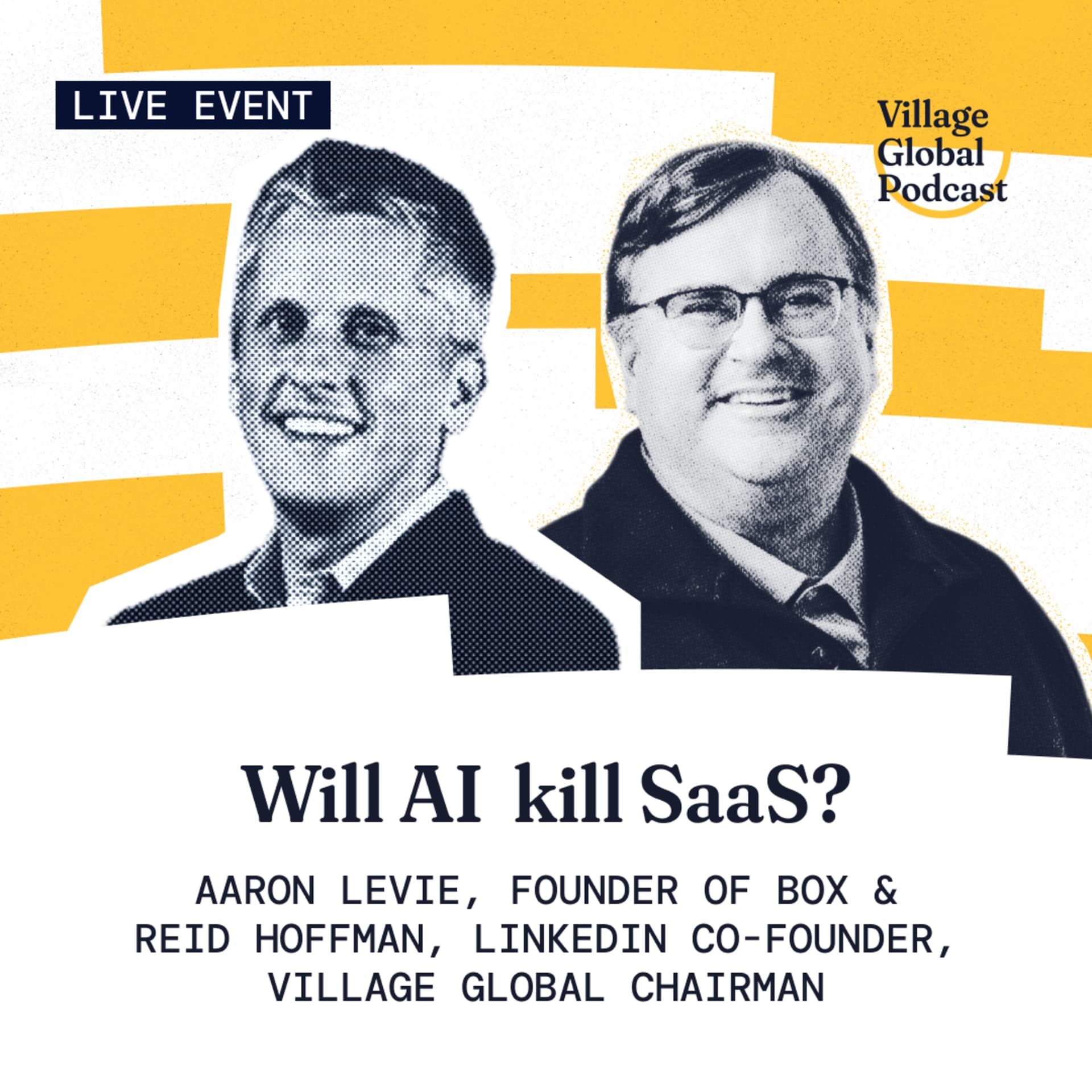
In this episode of the Village Global Podcast, Box CEO Aaron Levie joins Village Global Chairman Reid Hoffman and host Ben Casnocha live on stage at a Village Global event. They get into what agents actually do to SaaS, where startups should go on offense, and what twenty years of building Box has taught Aaron about leveling up as a founder.
Thanks for listening. If you like what you hear, please review us on your favorite podcast platform.
Check us out on the web at www.villageglobal.com or get in touch with us on X @villageglobal.
Want to get updates from us? Subscribe to get a peek inside the Village. We'll send you reading recommendations, exclusive event invites, and commentary on the latest happenings in Silicon Valley. www.villageglobal.com/signup