
In short
Village Global Podcast - Episode Summary
Podcast Title
Village Global Podcast
Podcast Description
The Village Global podcast explores the fields of venture capital and technology through interviews with entrepreneurs, investors, and tech industry leaders.
Episode Title
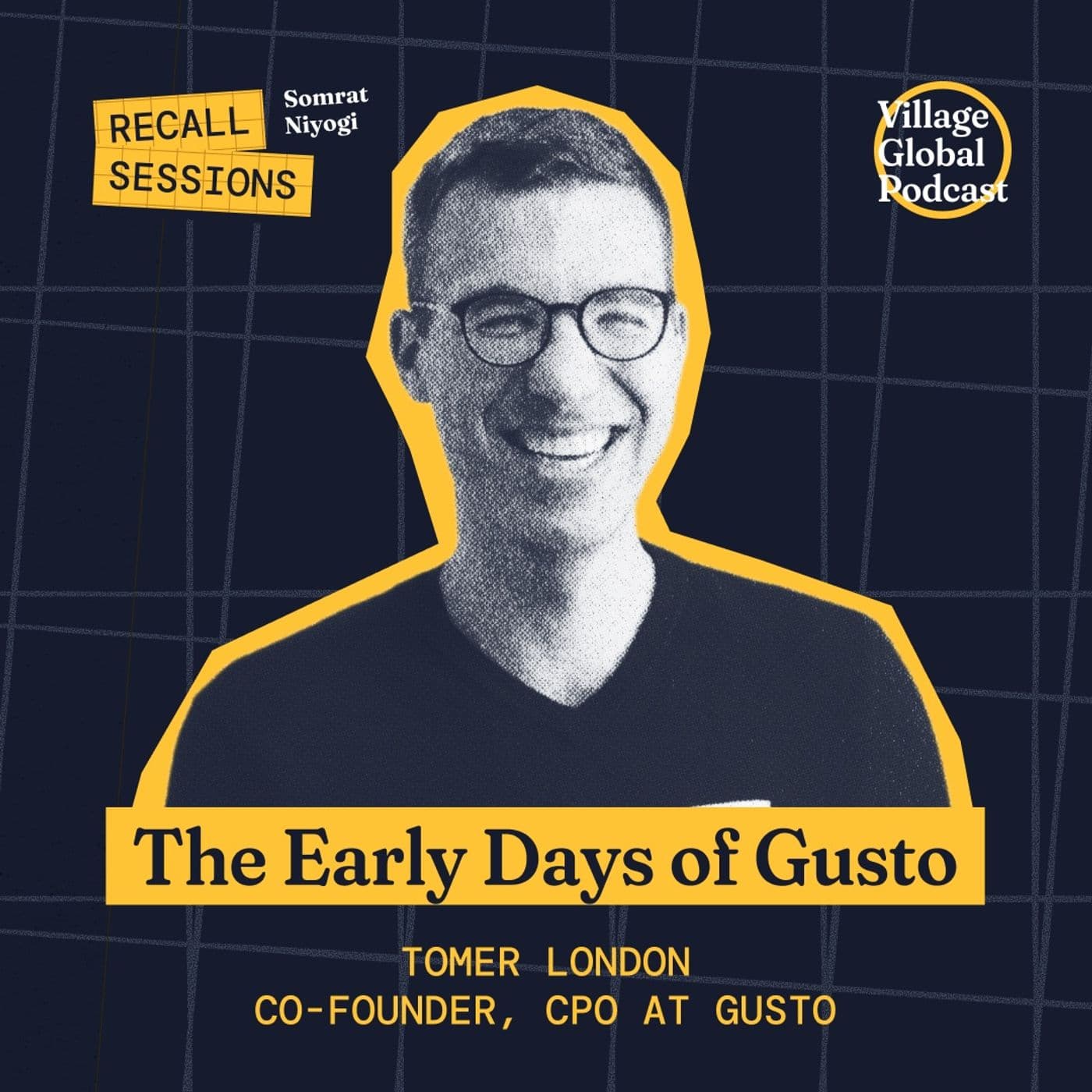
Recall Sessions: Tomer London on Building Gusto from ZenPayroll to 400,000 Customers
Episode Description
In this episode, host Somrat Niyogi talks with Tomer London, Co-Founder and Chief Product Officer of Gusto, a payroll and HR platform serving over 400,000 businesses. The conversation dives into the early days of Gusto, its evolution from ZenPayroll, and insights on acquiring customers.
---
Key Themes and Discussions
Early Beginnings of Gusto
- Founders' Backgrounds:
- Tomer London shared experiences growing up in Israel and his early exposure to entrepreneurship by working in his father's clothing store.
- He coded an inventory system at age 12, hinting at his long-standing passion for tech.
- Initial Concept:
- Gusto started as ZenPayroll, focusing on California small businesses with a product designed for very limited usage (salary-only for companies with fewer than five employees).
- The aim was to provide a simple, user-friendly payroll service that contrasted with a complex competitive landscape.
Customer Acquisition Strategies
- Grassroots Marketing:
- Tomer and his co-founders used a hands-on approach to identify their first customers, including cold-calling businesses found on Yelp and leveraging connections within the Y Combinator network.
- They would regularly engage potential customers in discussions to understand payroll needs and frustrations.
- Building Product Before Sales:
- They gathered insights from potential customers before writing code, validating ideas through meaningful conversations.
- A significant moment was a lunch with an accountant who expressed frustration with existing payroll solutions, motivating them to build a better product.
Business Model Insights
- Pricing Strategy:
- Initially, Gusto priced its service at $2 per employee per month, which Tomer later identified as an undervaluation of their product's worth.
- The founders learned that pricing conveys value, and customers often perceive low prices as indicative of lower quality.
- Iterative Learning:
- The founders emphasized the importance of listening to customer feedback and iterating on their product, leading to significant improvements and customer satisfaction.
Challenges in Serving Small Businesses
- Market Dynamics:
- Serving small businesses is described as "startup in hard mode." Many startups find it easier to scale by moving to larger enterprises instead.
- The founders' dedication to helping small businesses was driven by a belief in the importance of supporting this market.
- Growth Through Word of Mouth:
- Initial customers largely came through referrals and positive experiences with the service, highlighting the importance of customer satisfaction.
Hiring and Team Dynamics
- Hiring Philosophy:
- Gusto aimed to hire full-stack individuals who could contribute across various functions.
- Early hires were carefully considered based on the specific roles they would fill, ensuring alignment with the company's goals.
---
Gusto's Future and AI Integration
- Embracing AI:
- Tomer discussed the transformative potential of AI within Gusto, aiming to enhance productivity and customer service.
- Gusto is leveraging AI to streamline internal processes, improve customer interactions, and provide small businesses with innovative solutions like automated scheduling.
- Vision for the Future:
- The future focus will remain on supporting small businesses while continuously seeking ways to improve their experience and operational efficiency using technology.
---
Conclusion This episode of the Village Global podcast provides valuable insights into the journey of building Gusto from its inception to becoming a leading payroll solution for small businesses. Tomer London’s stories emphasize the importance of understanding customer pain points, iterative development, and the strategic use of technology, particularly AI, to enhance business operations.
Call to Action For more insights, visit Gusto’s website at [Gusto.com](https://www.gusto.com) and explore their payroll and HR solutions tailored for small businesses.
Thank you for listening! If you enjoyed the episode, please subscribe and leave a review on your preferred podcast platform.
Written by AI. May contain mistakes. Listen to the episode to check what was said.
Chapters
Tap a time to open that second in VOThe Courage to Start a Business
1:16 to 2:58
Discover the bravery required to start a business and the inspiring customers of Gusto.
“I've worked for you for several years, but I've never really had this conversation about today, which is something that I'm passionate about.”
Gusto's Super Bowl Ad Decision
2:58 to 4:39
Understand the strategic thinking behind Gusto's decision to advertise during the Super Bowl.
“That's why the way we call the company Gusto.”
Finding the First Customers
4:39 to 5:50
Learn how Gusto acquired its first customers through hustle and networking.
“Before we kind of, you know, I know a lot of times you've talked about how you, Eddie, and Josh kind of came together.”
Challenges in Gusto's Early Days
5:50 to 7:46
Explore the hurdles faced by Gusto founders in gaining trust and acquiring clients.
“But, yeah, so, you know, we were part of Y Combinator.”
Sales Before Building: The Gusto Approach
7:46 to 9:39
Hear insights on Gusto's strategy of validating ideas with potential customers before product development.
“Because I imagine it was not like everyone was like, yeah, sounds great.”
Pricing Lessons Learned at Gusto
9:39 to 12:23
Understand the impact of pricing decisions on customer perception and business value.
“Did you, just kind of thinking about that moment, a lot of founders are kind of like, hey, do I build and then I sell?”
Navigating Small Business Challenges
12:23 to 14:03
Gain insights on how to effectively reach and serve small business customers.
“Because a lot of founders are kind of struggling with this, like, hey, I'll give my first 10 design partners, I'll give it away for free.”
Challenges in Targeting Small Businesses
14:03 to 16:33
Explore the struggles of founders targeting small businesses and why many choose to move upmarket.
“It doesn't feel like, you know, it wasn't that hard to build it or something like that, right?”
Identifying Pain Points for Success
16:39 to 18:07
Learn how understanding customer pain points can lead to successful product development.
“Like, how painful is the problem you're solving?”
The Role of Accountants in Growth
18:13 to 20:12
Discover how accountants played a crucial role in Gusto's early growth and product development.
“One of the things that you brought up was, and you brought up in the early days, is you ended up engaging with an accountant.”
Show all 19 chapters
Focus and Prioritization in Early Stages
20:13 to 23:21
Understand the importance of focus and principles in early product development and hiring.
“Let's talk about this sort of notion of focus.”
Knowing When to Pivot or Kill a Product
23:21 to 25:38
Learn the indicators for when to pivot or discontinue a product that isn't working.
“We killed several products along the way.”
Hiring Strategies for Early Success
25:38 to 28:00
Examine the hiring strategies that helped Gusto build a strong foundational team.
“I think, you know, at our scale today, since we have so many customers, you can really get a good data.”
Company Culture and Employee Engagement
28:00 to 28:50
Learn how Gusto fosters a unique company culture that encourages authenticity.
“And then, you know, like there's a certain cultural element where, you know, you came to our office.”
AI's Transformative Role at Gusto
28:50 to 30:11
Explore how AI is reshaping Gusto's operations and expanding possibilities.
“Well, let's talk about today, we're going to talk about AI because, you know, we can't not have this conversation.”
AI as a Superpower in Business
30:11 to 31:15
Understand the potential of AI to enhance productivity and effectiveness.
“Every week or two, I re-underwrite, rethink, like, oh, my gosh, we can do even more.”
Engineering Productivity with AI
31:15 to 34:25
Discover how AI tools are improving engineering efficiency at Gusto.
“And you were working just with pen and paper, and all of a sudden they put a PC on your desk.”
AI Enhancing Customer Experience
34:25 to 36:24
Learn how Gusto is using AI to improve the small business customer experience.
“I mean, obviously, you know, there's been, you know, call the phone.”
Future Plans for Gusto
36:24 to 37:21
Get insights into Gusto's future strategies and AI initiatives.
“And the more it can do, the more, again, superpowers the small business has when they can call in whenever they want.”
Transcript
Automatic transcript. May contain errors.0:07Tomer London:I'm Sharma Niyogi, and I'm guest hosting a new series for the Village Global podcast called Recall Sessions. Everyone talks about product, but I want to talk about something that doesn't get enough attention, go to market. Specifically, how do the world's most successful companies get their first customers? I'll be sitting down with founders and operators of billion-dollar companies to hear the real story. Not the polished version where everything just clicked, the messy version, the cold emails, the first deals, the selling before the product was even ready. My guest today is Tomer London, co-founder and chief product officer of Gusto.
0:40Tomer London:Gusto is the payroll and HR platform for small businesses, payroll, benefits, hiring, the whole stack. Today, they serve over 400 ,000 businesses and are valued at$9.5 billion. Tomer grew up working in his dad's clothing store in Israel. At 12, he taught himself to code and built an inventory system for the shop. Before Gusto, he founded a startup that didn't work out. He and his co-founders went through YC in 2012, back when Gusto was still called Zen Payroll. They had been building Gusto for over 13 years. We're going back to the early days, before Gusto became Gusto. Let's get into it. Hey, Tomer.
1:17Tomer London:So it's funny. I've worked for you for several years, but I've never really had this conversation about today, which is something that I'm passionate about. I know you've been passionate about, which is just the early days of company building. I know you love spending time with founders. You're an active investor in the ecosystem. But when I listen to all these podcasts, there are some stories that have never been told. And I wanted to spend time with you today and hear about the early days of Gusto, or at that time was then payroll, and dig in and talk about what it took to go build the amazing company that it's today.
1:50Tomer London:And by the way, I saw the ad on the Super Bowl, so congrats on that.
1:56Somrat Niyogi:Yeah, yeah. Yeah, we're the U.S. luge team is using Gusto. They're in the Olympics and they're using Gusto, and it's like we just have the coolest customers. You know, everywhere I look, there's like these awesome, awesome customers. Are you a luge fan? Is that where? You know, as an Israeli, there's not a lot of luge or like ice sports, but, you know, After watching it for a few years, just kind of learning what it is, it takes an incredible amount of courage and bravery to go head first. I know. It's scary. So it was a good example for us or a good metaphor for the sort of bravery you need to start a business.
2:33Somrat Niyogi:People, whether you're early in your career or young and you don't know much about how the world works or the industry, but you just go and jump in and start trying to build something. or maybe later on in your career you have a family and you still need to go and you put your kind of salary, the thing that kind of keeps you going to the side, and go and take that leap and try to build something from scratch. It takes this incredible amount of courage and bravery. That's why the way we call the company Gusto. But anyway, we love sharing about our customers this way because we admire them. I admire them.
3:06Somrat Niyogi:Well, it's amazing.
3:07Tomer London:Courage. I do have one question we'll talk about just the early days of Gusto. So, like, Super Bowl, big, big decision, putting, like, you know, an ad, which is obviously, you know, my daughter was like, oh, my son was like, oh, hey, I know Gusto, which is pretty great. So, you know, we got four views there just among the family there. What was the thought process around, like, hey, this is the moment to kind of put something on doing Super Bowl, which is the biggest event in the U.S. of the year? I think Gusto... I know you guys are very deliberate when it comes to making these decisions, having worked there before.
3:41Somrat Niyogi:Yeah, yeah, absolutely. So we're 13, 14 years in at this point, serving over 400 ,000 businesses with payroll, benefits, with HR. We're a huge part of the small business economy. And I'll answer your question, but I'll tell you the why. So we're thinking about Gasto's role in the future is to help the small business economy, help grow the small business economy. we want to be the most loved brand by small businesses everywhere. So for us, what it means is to celebrate small businesses. And that's for me, like when we go out there and we do brand campaigns and we kind of tell our story, it's not about, you know, showing one of the founders in front of a laptop in a new feature, but rather it's about, like, again, the bravery, the courage of small businesses.
4:25Somrat Niyogi:And, you know, Super Bowl is a good moment to go and do it. We did it in a cost-effective way. Don't worry. We found ways of making those things cost-effective. But, like, we intend to do much more of this.
4:35Tomer London:Well, let's start with 400 ,000. Let's start with number one. So take us to that time. Before we kind of, you know, I know a lot of times you've talked about how you, Eddie, and Josh kind of came together. Tell me about how you got your first customer. Did you just like talk to a friend and said, hey, do you want to use us for payroll? Because it wasn't that easy?
4:59Somrat Niyogi:Well, every human around me was a potential target to use Zen Payroll in the early days. So in other words, we were in Y Combinator. We started the company called Zen Payroll. The first product we had is just focused on payroll. And it was specifically payroll for, it was a very, very focused product because we wanted to get something out that's great for a very focused audience and then go and expand from there. After that is very successful, after we have customers who love the product. So the first version of the product was really, really, really tiny and scoped to only brand new companies that never ran payroll before, only in California, under five employees, only salary, no benefits.
5:41Somrat Niyogi:It's a very tiny market, actually. There's not that many companies. So we were out there to look for these kind of initial set of customers. By the way, we were one of those initial customers, obviously. So we didn't pay ourselves until we had a working payroll system to pay ourselves with. But, yeah, so, you know, we were part of Y Combinator. And the first thing you do is after the YC dinner, that's every Wednesday. Back then when it was every Wednesday, you just go around all the different YC kind of batch companies and ask them, hey, did you run payroll already? Do you have a payroll? And provider, can we help you?
6:10Somrat Niyogi:So that's like one thing you do. The other thing you do is just anywhere you go in the world. So, for example, you know, Eddie was ordering flowers to, I think, for his mom. And then he was asking that small business, the flower shop, like, hey, do you have payroll? And luckily, she didn't. So that's actually another one of our first customers is Farm Girl Flowers. And now it's a huge brand. But it was just like a small business starting. And so similarly for me, like kind of every day, everywhere you go, you kind of start asking people and friends or, you know, potential investors, people you know.
6:43Somrat Niyogi:I went to every Apple store I could, and I just put our homepage, Zen Payroll, in all the screens there, hoping that somebody is going to look at it and find it. I don't know. I don't know. But this is the sort of stuff that you do. You basically 24-7. You know, as founders, I like that. 24-7, you always think, well, how can I move forward? How can I push forward? What is the bottleneck? How do I, you know, kind of solve the problem in whatever way is possible? So that's how we got our first set of customers.
7:13Tomer London:I can imagine, though, that like a lot of hustle. I imagine that a lot of founders were like, hey, man, how do I know you're going to do it right? Like, this is not something you just kind of mess up. How did you, were you just kind of lucky in the sense people just kind of, oh, you know, these guys seem like some smart guys. Like, they'll probably do it right. Because I feel like a lot of founders go to their friends or, you know, other CEOs. And there's like, oh, hey, like, you know, we're not going to use, you know, XYZ system because, like, you know, you guys are not there yet. You know, like, how did you deal with that?
7:47Tomer London:Because I imagine it was not like everyone was like, yeah, sounds great. Yeah.
7:50Somrat Niyogi:Yeah. Yeah. Okay. I think there's a few things that we're going for in our favor in that situation. So first, payroll, you're right, is not something you just like, you know, vibe code, to use today's language. Like you have tens of thousands, hundreds of thousands of tax codes. You know, you need to know how to calculate the payrolls. You need to know how to do the filings. You need to know how to do compliance correctly, labor laws. You need to make the payments. And each little tiny, you know, sometimes like school district has their own payroll rules. So there's a lot of kind of long tail compliance rules that you need to know.
8:22Somrat Niyogi:And then what happens if you get something wrong is kind of scary. You get like a notice from the IRS. No one wants an IRS agent knocking on their door when they're trying to build their business. So you're right. It's a very high stakes sort of product. On the other side, in our situation, I think we were lucky where when we started, the situation was that the competitive landscape just had like a terrible user experience. And people just hated these brands. They just hated different payroll companies. And I spent a lot of time actually asking people. Before we wrote a single line of code, I was cold calling people out of Yelp asking, who do you use your payroll and what do you think about them?
9:01Somrat Niyogi:And I got a lot of people telling me that, just telling me because they decided to do that. Hey, yeah, I use, let's call them ABC for a second. I use ABC for payroll and my password is fuck ABC. Oh, wow. So there's a lot of hate. And that meant that people were very open to trying new things.
9:20Tomer London:Even despite the fact that you're, oh, wow.
9:23Somrat Niyogi:And it doesn't mean that we didn't get rejection. Success for me, I think if 80 % of people say no when you're looking for new customers, it's an incredible success. That means 20 % say yes. So you just need to talk with 100 people to get 20 customers. That's pretty good.
9:39Tomer London:Did you, just kind of thinking about that moment, a lot of founders are kind of like, hey, do I build and then I sell? You kind of made this choice of I'm going to call people just to verify it. Did you get commitments before you started building? Or how did you go about that sort of sequencing of build, then sell, or sell, then build? Right. That's a great question.
10:03Somrat Niyogi:So I think we started by definitely just speaking with customers, with potential customers, and learning about the space, learning about what works, what doesn't, what people like, what people don't like, to get a sense of it. We have a lot of – Josh, I, and I have a lot of background from small businesses ourselves, from our families and friends and things like that. So we knew small businesses very intimately. But specifically, payroll is something that we're not from that industry. So there's a lot for us to learn. So I would say we spent – I want to say it was weeks, weeks of these conversations.
10:34Somrat Niyogi:And we were building things, too. We're all engineers, so we like to start building things. We started actually by building a payroll API before we had a payroll product. But we started building, but really spent a lot of time talking with people. And then there was some moment where we felt, I actually remember that, for me, that actual moment, where we spoke with this one accountant. We took her over to lunch, someone who, you know, I got to work with in my internship at Bump. And she was, again, we're sitting for lunch in this Thai restaurant in Monterey. And she was, like, raving. Or, you know, what's the opposite of raving?
11:07Somrat Niyogi:Like, complaining nonstop about how terrible the current software is. And it's just, God damn it, somebody must build something different. And we were looking at each other. It's like, okay, I think that's going to be us, right? So then you kind of, we were like, okay, we're going to go build. But we didn't stop talking with customers. We kept talking with customers. And the closer we got to a real working product, the more we try to get commitments, right? And it's not commitment. There's no contract. These are small business contracts. It's like, you know, we were charging almost nothing back then, like, you know, like$2 per employee per month, which is like almost nothing for the first, like, 100 customers.
11:40Somrat Niyogi:And so it was not about the revenue, but it was about kind of building that pipeline that for when the beta is open, when we're ready to accept customers, we're ready. And that's what happened. So in the first few months, we had like around 80 or 100 customers. And they were all by this sort of kind of word of mouth people that we knew personally.
11:59Tomer London:How did you – you mentioned pricing for a second. I mean, a lot of founders are like – they always struggle with like, do I have design partners? Do I give away my product for free? Right. how do I make sure I'm not underpricing the value of what I'm delivering? How did you go about making that? I mean, you did charge something. When you look at that time, do you feel like that was the right choice or would you have done something differently? Because a lot of founders are kind of struggling with this, like, hey, I'll give my first 10 design partners, I'll give it away for free. Or, oh, man, if I charge it too low, I'm not sure if I'm holding my value in what my product actually is creating.
12:34Tomer London:I mean, obviously, there are other alternative solutions, even at the time, that was priced way, way higher. So how do you think about that?
12:41Somrat Niyogi:Yeah, I think that's a lesson learned. I think we made a mistake with the way we priced things originally. I think it was way, way, way too cheap,$2 per play per month, where the competitor was like, I don't know,$20. And the reason why we did it is because we said we don't want the price to be a reason for people to not choose us. Really, our goal is to get customers to learn and then iterate, and then we'll have time to figure out pricing in the future. That was the thought process. But what we, I think, underestimated is that the price is a message. And when you price something very low, especially something like payroll that you want to depend on, what message are you saying?
13:18Somrat Niyogi:You're saying this is a low-value service. You're saying that this is, you know, people are going to ask, is this company going to be around because it's so cheap? So I think looking back, that's one thing that I definitely would have done differently. And also, it's a device I give. The most common advice I actually give for startup founders is to raise their prices. And it's, again, not necessarily in order to optimize revenue. It's more like it's messaging the market that your product is valuable. Now, I'm not going to say you should be the most expensive in every single case. Absolutely not.
13:50Somrat Niyogi:But founders more often than not sell themselves cheap because they just have discomfort charging a lot of money. And it's a lack of confidence. Because for the founder, it's kind of like, hey, I just built this thing in a few months. Right, right. How can I charge so much money for it? It doesn't feel like, you know, it wasn't that hard to build it or something like that, right? So anyway, I think that's what people sometimes enterprise.
14:17Tomer London:I know in the last, like, I mean, people have always been building software for small businesses for a long time. But in the last, like, five to ten years, specifically the rise of vertical software, and it's continuing to rise. There's always new sort of companies. Whenever I chat with founders that are considering starting a software targeting small businesses, they always kind of stress out and they're like, oh, my God, it's so hard to acquire. If you were chatting with founders that are kind of going through that journey because you've actually went through that journey, how do you help them punch through that?
14:49Tomer London:Because it's like, oh, the lifetime value of a small business customer, the ACVs are so low. It's so hard to get their attention. These small businesses are obviously very busy. The owners are busy doing other things. Like, walk me through that first, let's say, few hundred, because was it like all word of mouth? It was just like, or did you guys like do other things? You said you were doing Yelp calls. Because a lot of founders struggle with this that are serving small businesses.
15:18Somrat Niyogi:So the truth is that I do feel like in most cases doing SMB focus, like small, and I'm talking small business, like under 50 employees. If your software is focused on under 50 employees, it is startup in hard mode. I really do think it's harder. And that's just by looking at the fact that the dynamics of the market in the past 15 years is that 90 % of companies that start with small businesses just go upmarket the fastest they can. And since these are all like capitalistic companies who try to optimize for their success, it tells us something. It's a signal that it's easier to go up market often and kind of get larger contracts and have a repeatable sales process.
15:58Somrat Niyogi:I see this all the time. You're absolutely right. Yeah. And that was the common kind of knowledge when we started, too. I wish I could tell you, like, hey, you know, we kind of planned everything and we knew that in our market we can do it. Like, we didn't. We just, we love small businesses. We have a true, true passion for small businesses. We had multiple times over, you know, the past 14 years that, you know, there were conversations, you know, investor conversations like, OK, so this is all cute and nice. But like, when are you going up market? And our answer is like, it's been always like, that's not our plan.
16:28Somrat Niyogi:Like we love small businesses and it's a huge market that that somebody needs to go help them. And I think we are at the point where we can we kind of we can confidently say that we are on the path of doing that. I think the reason for us it was possible, and I would say maybe for founders who are listening to this and trying to figure out, like, is that a good route for me, is to think about the size of the pain. Like, how painful is the problem you're solving? If it is so painful that people are literally cursing and that they hate the current system so much or that they just can't wait to get rid of whatever they have in front of them in order to replace it, then maybe there's something there.
17:10Somrat Niyogi:And that also answers your other question because so how do you know? So talking with people. And the second thing is, like, if you feel this market pool. So with Gusto, you ask, like, you know, we didn't, to get from the first, call it, like, beta customers, 80, 100 beta customers to the first 1 ,000, it wasn't, like, a repeatable, you know, process, like, putting salespeople and, like, doing, like, calls or doing, like, we didn't have any ads or anything like that. It was actually word of mouth. And then you're like, well, how can somebody do this? And the answer is, I think for us, we found a problem that's so, so, so important to solve, and people really wanted to solve it, and we had the right product for it.
17:48Somrat Niyogi:So then it got to word of mouth going. And I think some situations you can do this, and some situations you can't. It just depends on how painful the problem is. And that's the biggest lesson, I think, for me, from the whole Gusto journey, is if you're starting a company, it's worth to spend the cycles to figure out, So find problems that are really, really, really painful for people and then put all your energy there. And don't spend time on things that are kind of like, oh, okay, it'll be nice, nice to have.
18:16Tomer London:One of the things that you brought up was, and you brought up in the early days, is you ended up engaging with an accountant. I know sometimes there's an appeal from founders to be like, oh, man, the grind of going direct is just so exhausting. But, man, if I could just get an accountant on board. How did you guys, did you, in the first year, did you already have an accountant product? Or did that come like a few years later?
Read the full transcript
18:43Somrat Niyogi:I actually don't know. Yeah, the accountant product is interesting. So we knew a lot about small businesses, but we didn't know much about accountants. And we started noticing that some accountants start using our product and they have multiple customers. They were using on behalf of their clients. Their clients brought them in and said, hey, can you like collaborate with me on the account? And then so you had this one user, like, you know, that had like 10 different accounts. And they were complaining all the time because it was very hard to log in and log out and log in. And they're like, I love you guys, but this is really annoying.
19:07Somrat Niyogi:And we had like a new engineer joining. I think it was Omar. And, you know, we did this thing where, you know, within your first week or two as an engineer, you have like a little project and you kind of start and then you kind of build from there. So that's kind of the entry project. So his entry project is the accountant dashboard, which ended up being Gusto Pro today, which has, you know, like incredible amount of traction. Tens of thousands of accountants use it to run, you know, their payroll business. But it was kind of like called like an intern project. And that's what it started. And then, again, if you listen to the story, it's less we went out to the market and try to get them and more like they showed up and we just found a solution for them.
19:49Somrat Niyogi:Now, over time, we did hire actually a couple of sales folks. Like this is like year three, I want to say. who went out there and were more like, again, inbound, like accepting the calls, trying to kind of get accountants to add more clients into their book of business as opposed to going out there to accountants. And that was helpful, and we still do that today. But it's less selling. It's less pushing their open. It's more pulling their open. In other words, like the market's already there pulling kind of the product from you. So my advice to these situations is like, look, if you can get like an accountants or any channel, the way you get, I think the best way of working with them is that if they, again, they want your product, it's not that you're pushing the product to them.
20:30Tomer London:Let's talk about this sort of notion of focus. Like, you know, I always, when I talk to founders, they're always thinking, okay, you know, in this case of the accountant, you're like, okay, should I work on an accountant product? Should I not work on it? You know, how do you think about these trade-offs around this is distracting in the near term? A lot of founders, they're all ambitious. They want to do things. And you're always like, hey, I kind of like it, but we need to get this first thing done really, really well. How did you guys approach that in the early journey? I know you did payroll for a few years before you added benefits, as an example.
21:06Tomer London:But in this accountant, it sounds like you kind of worked on the accountant thing. Tell us about focus in the early days.
21:12Somrat Niyogi:Yeah, that's a great question. I think that's the main job. And I want to talk to you about how AI changes this. Maybe that's the next question. Right, right. But as we built Gusto in the past 15 years, knowing what to focus on is just absolutely critical because you have incredible talent and you want to focus on the highest impact things and everyone's excited to build things. So there's always new ideas. So you need to have principles to guide what are you going to focus on. And I think that's what, again, great product people or product managers do. They start with, like, hey, here's a strategy.
21:43Somrat Niyogi:Here's the principles. So our principles in the early days were as simple as, like, the way Gusto is going to win, back then it was called then payroll. is by building a product that customers absolutely love, you know, as measured by NPS over 80, for example, and this measure, like, this kind of viral word-of-mouth growth. And then once we do that, we get the right to do more things. So it started with, like, make payroll in California really, really, really great. Get there, get to that scale. It's like, okay, cool. We got to a place where it's like, okay, you know, customers are really happy.
22:16Somrat Niyogi:This thing is going really, really well. we can afford to take two engineers and then ask them to focus on expanding to additional states because we feel pretty good about California. And then even then, we didn't go 50 states. It was like, okay, how about we add one state or two states and kind of see how that goes. We added Texas and Florida because it was easier states to add. And then that, again, started kind of working well. And then we decided to kind of add more bandwidth to this effort. Similarly, with health insurance as our kind of second large product and time tracking. And, you know, now we have over 20 products like, you know, R &D tax credits and, you know, time tracking, time scheduling, like 401k.
22:57Somrat Niyogi:We've got a lot going on right now in the product, like finance, bill pay, invoicing, a lot of other things. But we only expanded once we felt like the core of that principle was fulfilled, where we have a high NPS product people absolutely love and it grows on its own so we can go and do.
23:14Tomer London:Do you think that's a good rule of thumb around this NPS as like a bar on initial product? Did you ever throw anything away where you kind of you added something and then you're like, this is not working? Yeah, absolutely. Yeah, we threw it. We killed several products along the way. And I think if you don't. How do you. So tell me about that, because, you know, everybody thinks every product they've got to build is like, you know, amazing.
23:39Somrat Niyogi:Yeah. Yeah, so we launched several things. Several years ago, we had a different... It's called QSHRA. So this is basically... It's a type of health insurance plan. The goal was to help... One of our goals is to reduce the cost of health insurance for employers, and this was one kind of regulatory framework to do it. The belief was that people don't use it in the wild a lot, and it's because it's too complicated, but we're going to make it really, really simple. We shipped the product, and it didn't convert. Like, we had people start using it, and it was just too complicated for people to understand, unfortunately.
24:16So we were not able to solve that need that we were really focused on, which is make things simple.
24:22Somrat Niyogi:It wasn't simple.
24:22Tomer London:How do you know when to kill something? Like, because, you know, obviously for founders, they still believe. You know, even saying, you know, hey, you had to believe, you still believe. Like, when do you know to sort of look in the mirror and say, hey, this is something's not working?
24:39Somrat Niyogi:There's the numbers and then there's the sentiment from customers. I would say, you know, you need to get to a place where both of them tell you the same story. So don't believe in your thing unless you see both of them being very positive. And don't kill your thing until it's clear that both of them are really negative. And if they're not, then there's probably an opportunity. You found some things, for example, like the numbers go amazing, but people hate it. It's like, okay, well, probably we should improve the product, but there's a good hook here. If it's the opposite, we're like, customers who use it absolutely love it, but no one uses it.
25:08Somrat Niyogi:It's very, very, few people actually attach to it and use it. They're like, okay, probably we need to figure out onboarding, go to market, and, you know, how to simplify the product further. And unfortunately, in that product situation and others that we've had over the years, too, we got, like, you know, negative kind of signals from both of these. And, you know, I think there's a good question about, like, how long do you let it run? You let it run for a month or four or six months. I think we made mistakes there. There's some things that we took way too long to run. And that's probably the repeated mistake we're doing.
25:37Somrat Niyogi:We're kind of giving things a little bit more too much time before we kill them. I think, you know, at our scale today, since we have so many customers, you can really get a good data. Like, after a month, you know. And after three months, you definitely know. But we had time that we let something run for nine months.
25:53Tomer London:Let's talk about the first 10 hires. You probably know them from the top of your head, but without getting names, who were some of the first hires? Like roles? How did you know? You're always like, when do I hire? Because sometimes you meet founders that are just like, I'm ready to hire, hire, hire. Were you guys slow to hiring? Were you like, let's just hire 10 people right away? What was unique about your hiring process? I mean, I know a lot of people know about Gusto's experience. It's very, very special. I'd love to have the audience kind of hear a little bit about the early days of Gusto hiring or Zen payroll hiring.
26:30Somrat Niyogi:Yeah, yeah. So, you know, we kind of have an unfair advantage in that space because we are a people company, like helping companies with their HR, growing their team, building their team, paying their team, and all that. So we care a lot, a lot about the details around how do you build a great team, how do you manage a great team. And one of these things is hiring. So, you know, for us, you know, it's a very high stakes thing. So, you know, to bring someone on the team. I would say one of the things that we've done very much from the very early days to be very, very specific what exactly we want this person to do.
27:04Somrat Niyogi:So it's not just like I need an engineer, but rather like here's what this person is going to be working on. And therefore, here's the skill set and the talents that I'm going to optimize for. And therefore, here's where I'm going to source from. And here's the question I'm going to ask. And here's how I'm going to evaluate if this person is the right person. So kind of starting from the work and kind of going backwards as opposed to starting with like this imaginary profile. The second thing is like definitely for the first 50 hires, I would say, focusing on full stack people. So as much as possible, and I would say even more than 50, whatever full stack means in that world.
27:37Somrat Niyogi:So if you're talking about, you know, an engineer, you want someone who has good design taste. You want someone who cares about product management, like prioritization. You want someone who understands the business, like as much full stack as possible. And if you're talking about like a go-to-market person, same thing. It's like you want to sell it. We also can market. We also can do research and also can understand, you know, economics and product. So as much full stack as possible. And then, you know, like there's a certain cultural element where, you know, you came to our office. We were working with our shoes off until we were like 2 ,000 people to make it feel like home because in our home we took our shoes off.
28:12Somrat Niyogi:So it felt very natural. And you kind of saw the energy and you see the energy and the spirits like in people, how much they care and how much they're bringing kind of their full selves to work. And I think that was like a pretty good filter on both sides. So if the candidate came in and it was like, oh, this is too intense for me, this is too weird, they would opt out. And then on the other side, it's kind of us setting expectations. Hey, this is the sort of place where we want you to be yourself. We want you to bring everything, bring all your energy. We want you to build that empathy to small businesses and kind of that connection to the customer.
28:47Somrat Niyogi:Yeah, I think that's some of the things.
28:50Tomer London:Well, let's talk about today, we're going to talk about AI because, you know, we can't not have this conversation. We'd love to talk about how is AI transforming Gusto today. And whether it's, you know, we'll talk about how you're using AI in the company and so forth. But let's talk about just however you want to answer that question. A lot of talk about AI's kind of impact to small businesses, startups, the way engineers work, product people work, every single department's being affected. How is Gusto approaching AI today?
29:24Somrat Niyogi:Yeah, I think we're really lucky to live in the world in this time where there's this incredible platform shift and clever shift in technology and expectations of what's possible. Honestly, it's just amazing because the sort of stuff that I thought was possible three years ago and what I think through today just really changes how big I'm thinking about what Gusto can become. And that's just really, really exciting. I'm an engineer in terms of my undergrad degree and my graduate degree, and I felt pretty confident in my technical abilities to understand kind of where the world is going in terms of what's possible with software.
30:04Somrat Niyogi:It's just so crazy how that opinion changes. Every week or two, I re-underwrite, rethink, like, oh, my gosh, we can do even more. We can do even better. Even better user experience for our customers. Solving problems even faster for them. Solving more problems for them. Being available for them in more places. So it's just super cool.
30:28Tomer London:It's super cool. What is, at the size and scale that Gusto has, number of employees, Like, how do you even make tradeoffs? Like, you know, at least among the investor community, there's a lot of, you know, chatter about, oh, headcount. Why do you need more headcount? You know, you can do more in theory. And this is still early in terms of whether it's actually executing in practice or ROI. But there's a hypothesis that, hey, you don't need to have more headcount. You can do more with the team that you have. What is your point of view of how, at the size and scale of organization of gusto, around the messaging you're kind of telling the organization around AI's role in everybody's job?
31:12Somrat Niyogi:We look at this as like a superpower. So like, hey, imagine being in the workforce when they invented the PC, right? Or the computer, right? And you were working just with pen and paper, and all of a sudden they put a PC on your desk. Now we can decide, am I going to turn this thing on and learn how to use Word and Excel and whatever? Or am I just going to keep using pen and paper? And the answer is, of course, I'm going to use the computer because it gives you the superpower, right? So I think this is where we are. Now every single Gusty has this computer at their disposal. All of a sudden, this new superpower.
31:45Somrat Niyogi:And our expectation is that people are going to just jump right into it and try to become experts in it. And I believe that it depends on which kind of parts of the company. Every part is impacted a little bit differently. But I would say overall, I don't think I'm hyperbolic by saying engineers, for example, can be 10x more productive. I was going to ask. I don't think it's hyperbolic at this point. I was going to ask about that in engineering specifically.
32:09Tomer London:Yeah. In engineering particularly, are you all seeing in the organization sort of increased kind of throughput? There's a lot to build. There's a lot of problems to solve for small businesses. What are you seeing right now? Yeah. because you guys are in this moment right now.
32:27Somrat Niyogi:I'll tell you about myself. So, you know, I haven't coded. You remember me. Yeah, yeah. You remember for a long time ago. You've never seen me code. Yeah, I have not seen you code. Exactly. And so I know how to code. Right. But I didn't. And why? Because it's just, you know, the distance between, I was just explaining this to my dad on the phone on the way here in the morning. So you got like the PRD, right? Like the spec. And then there's a distance between the spec and a product. And that distance is the code, right? And it used to be that that code took you. And if you had an idea, that code would take a team of professionals for weeks and weeks and weeks in order to make it happen.
33:00Somrat Niyogi:And that just, like, I think work of two weeks cannot be done in a day. And this is, again, talking about my own personal experience of coding. While I am back to coding, I'm now coding. There's three different products that I'm working on. I ship something every weekend at this point. And sometimes it's small things. Sometimes it's large things. And I can tell, like, right now this thing that I'm working on, it's an internal product right now. So it's like a really, really cool dashboard I'm excited about. But it definitely, definitely would have taken me like weeks and weeks and weeks. And I did it like in basically 24 hours this weekend.
33:29Somrat Niyogi:And this is just like my personal example. And when I look at the engineers at Gosto who are, you know, called like AI pill, like people who are like, they get it. They're using cloud code. They're, you know, all day long have like multiple agents running at the same time. They're definitely 10X. Maybe they're 20Xing their bandwidth. Now that said, not every single thing you do can be 10Xed. So it depends on the sort of projects you're doing. So some projects, like if you brand new, like kind of products out of scratch, amazing. You can totally 10. You can 20x that thing. If you're looking at like a very, very complex code base, maybe it's not 10x.
34:01Somrat Niyogi:Maybe it's like 30 % faster. Maybe it's 50 % faster. But it's definitely faster. And I think ignoring it and pretending it's not real is just a mistake for people.
34:11Tomer London:And how are you approaching it from, you know, is it internal use cases? Is it like, hey, how are we, you know, I know you have launched Gus, was it last year? How are customers experiencing that? Because that's a change for small businesses, too. For sure. I mean, obviously, you know, there's been, you know, call the phone. They've had some, but, you know, sometimes that can be scary for small businesses. Oh, no. For sure. Like Gusto has always built this amazing brand of a relationship with someone. Yes. How are you all thinking about how AI is being used in that customer experience?
34:44Somrat Niyogi:So similarly, it's how I was talking about AI giving us superpowers inside Gusto to Gusties. The goal is to give that superpower to small businesses. And I think there's only a handful of companies out there that can really kind of put a stake in the ground to say, like, hey, we are giving that AI superpower to small businesses. And Gusto is one of them. So that's our goal. And Gusties is kind of our assistant product that helps customers run their business, really. And we have lots of other kind of places within the app, within the experience to help people. For example, like, you know, scheduling is like if you run a coffee shop, for example, and you have like a schedule with like, you know, with, you know, three shifts a day and, you know, 15 people and you're going to figure out how do I do this?
35:24Somrat Niyogi:It takes it can take like two hours every Friday to figure this out. Now, you know, with gusto scheduling, you just click a button and it automatically takes all the different kind of, you know, conditions and all the issues and all the everyone's restrictions. And puff gives you like a good schedule and you can kind of correct it and change it. But instead of taking two hours, it can take you like, you know, 10 minutes. That's like a small example. There's like many, many examples like that within our app. And we're just starting. So I'm very, very excited about it. You mentioned customer service.
35:50Somrat Niyogi:You know, here's the thing. Like Gusto has hours of operation, for example. So you call our customer support, and we have specific hours of operations. We're trying to be as accommodating as possible. But it will be hard to answer at 2 a.m. in the morning. Well, that's when you get actually a voice agent, and you talk with our voice agent. And, you know, people absolutely love it. People absolutely love it. Because, listen, if the bar is like I get nothing done and I was able to get something done, that's already better than what it is. And now our goal is to take it from like I'm able to, let's say, serve 80 % of the cases or 50 % of the cases and I'm bringing up to 80 and 90.
36:24Somrat Niyogi:And the more it can do, the more, again, superpowers the small business has when they can call in whenever they want. They can get things resolved.
36:31Tomer London:I know we're running out of time here. What's next? What's coming up for Gusto in 26, 27? Kevin, what can you share about what's sort of top of mind for you and the leadership team?
36:41Somrat Niyogi:Yeah. So, you know, our focus is small businesses. We're growing really, really quickly. We're very, very happy with how things are going. And again, I feel like AI is that new superpower that we're bringing to our customers. So there's a lot of work on that front. It's going to be a lot of news around being able to use AI to solve problems for a business, being able to use AI to access Gusto and use Gusto from everywhere you are. And then we're also solving more problems for our customers. So whether it's the world of HR, insurance, benefits, or whether it's things around your financials and kind of how you run your mind from a cash flow basis.
37:15Somrat Niyogi:There's a lot going on in Gusto right now. So stay tuned.
37:20Tomer London:Well, I appreciate you taking the time today. A lot of little tidbits for our founders. If they want to learn more about Gusto and they want to sign up, what's the best way for them to do that?
37:29Somrat Niyogi:Go to Gusto.com and check us out. And, you know, Gasto is the most popular, you know, payroll benefits, HR for startups, for technology companies in the U.S., YC companies, and so forth. So, you know, it's definitely the right way to go. Well, thanks, Tom. I appreciate your time today. Thank you.
37:49Somrat Niyogi:Hey, this is Ben Casnoka, co-founder of Village Global. Thanks so much for tuning in to the Village Global podcast, where we go deep on all of the biggest topics in tech. If you enjoyed this conversation, please subscribe to our YouTube channel. You can check us out on Spotify, Apple, wherever you get your podcasts. We'd love to see you for the next one.
From the publisher
In this episode, Somrat sits down with Tomer London, Co-Founder and Chief Product Officer at Gusto, to discuss how he and his co-founders built the leading payroll and HR platform for small businesses. Gusto serves over 400,000 businesses today and is valued at $9.5 billion - but it started as ZenPayroll, with a product scoped down to California-only, under five employees, salary only, and no benefits.
Tomer talks about growing up in his dad's clothing store in Israel and building an inventory system at age 12, cold-calling businesses off Yelp before writing a single line of code, the Thai restaurant lunch that confirmed they were onto something, why charging $2 per employee per month was a mistake, and how building for small businesses is startup in hard mode - but worth it if the pain is big enough.
Thanks for listening - if you like what you hear, please review us on your favorite podcast platform.
Check us out on the web at www.villageglobal.com or get in touch with us on X @villageglobal.
Want to get updates from us? Subscribe to get a peek inside the Village. We'll send you reading recommendations, exclusive event invites, and commentary on the latest happenings in Silicon Valley. www.villageglobal.com/signup