
 Ask ChatGPT


 What's The Trick?
13 Nov 2026 · 54m · 27 chapters
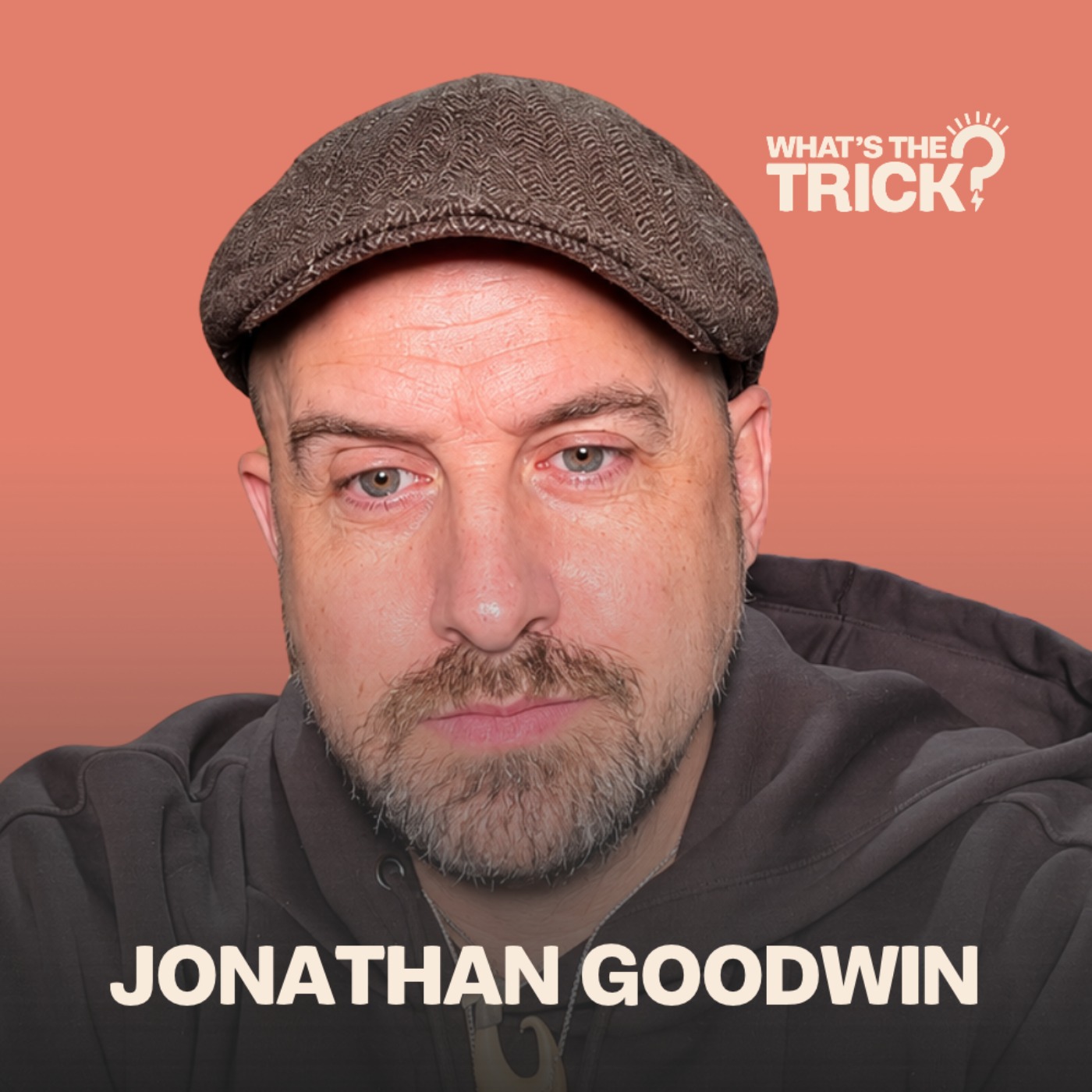
Jonathan Goodwin, an escape artist and daredevil, discusses his career philosophy and several signature stunts, including the 2021 rehearsal accident for America’s Got Talent Extreme that left him paralyzed from the waist down. He also explains how he designs “jeopardy” moments for live audiences and why many escape acts fail to create real suspense.
Jonathan Goodwin is a British escape artist who read about Houdini as a child, later built and modernized escapology for TV and stage, and performed internationally. After his accident in 2021, he reinvented himself as a hypnotherapy hypnotherapist, creative consultant, and novelist.
He says he’s not an adrenaline junkie; he trains bravery. He believes magic’s job is to make audiences care, not just fool them. He argues performers should change the dynamic so the “bad thing” happens during the act (e.g., scorpion in mouth) rather than before it.
Steve Baker’s car-crash escape; Discovery Channel “minimal movement” scorpion-in-mouth opener (he was stung on Paul O’Grady’s show); “hot iron through a sheet” escape concept; Britain’s Got Talent crossbow “chicken” stunt; his “iron jaw” neck/teeth lift; stage “buried alive” concept.
Written by AI. May contain mistakes.
Discussion on Jonathan's dangerous stunts and the accident that changed his life.
“And in 2021, whilst rehearsing for America's Got Talent Extreme, things went horribly wrong.”
Jonathan explains the details of the stunt that went horribly wrong.
“Because a few people listening to this may not have seen or heard what happened.”
Jonathan shares his mindset and philosophical approach after his accident.
“So I don't know how long I was unconscious on the ground.”
Exploration of Jonathan's perspective on facing adversity and loss.
“And so I really, the philosophy that I had before the accident, it was basically the same.”
Jonathan describes his unique scorpion escape trick and its origin.
“I've already described in the introduction some of the bonkers things you've done.”
Jonathan recounts the story of getting stung by a scorpion during a performance.
“on stage, I would give a lady in the front of her a box and then I'd bring another lady up on stage and I'd say that I'm going to escape from handcuffs, but it's quite boring.”
Jonathan shares a harrowing story of a scorpion stunt gone wrong on live TV.
“And I stepped off stage and the first person that I saw was Kevin James.”
Exploring Jonathan's career path and his unique approach to escapology.
“And he said, well, put your money where your mouth is.”
Discussion on how to instill genuine suspense in escape acts, moving beyond predictable outcomes.
“And in my mind, all they do is essentially meet my expectation at the bar that they've set.”
Jonathan recounts his daring crossbow stunt on Britain's Got Talent, merging magic and danger.
“So, I mean, I've talked about a few of the things you've done.”
Insights into how Jonathan trains for extreme stunts, including his iron jaw act.
“Obviously, that's how big they used to kill people.”
Learn how gravity impacts escape performances and the necessity of straight hanging.
“The difference is, though, that when you hang anything, it basically has to hang straight because of the laws of gravity.”
Discover the daring acts of historical performers like Jean Holtem, who caught cannonballs.
“And the first time he tried it, he lost, I think, three fingers.”
Explore the story of The Great Peters, a circus performer known for his risky act.
“You know, like you or I, if we even had the guts to go, yeah, all right, I will do it.”
Jonathan discusses his creative process and inspiration for stunts and performances.
“And he'd obviously toured with everybody as well.”
Learn about the idea of creative influence and how borrowing ideas shapes art.
“It doesn't, that part of it is, I know that's probably hard to believe, but I trained myself to be brave.”
Jonathan explains the concept behind his unique stunt involving the bed of nails.
Understanding common pitfalls in magic shows and how to engage the audience better.
Discover how to create engaging performances by holding back information.
“That's Grandpa Joe with a deck of cards, you know, doing a clever card trick.”
Jonathan shares insights on directing performers and improving their stage presence.
“You know, if you sort of, if you get into writing, there is a process where, you know, a sort of a naive sort of novelist will write and tell you sort of, you know, what the person is doing, but what they're thinking.”
Learn tips on how to effectively stand and present on stage during performances.
“are things that are not written in magic books.”
Learn how to control nervous energy and enhance stage performance.
Discover the importance of tension and release in magic and comedy.
“But also to have the focus to maintain it.”
Explore the creativity that stems from understanding tension and release.
“I try and do a thing and then I'm either going to succeed or fail.”
Engage with Jonathan's rapid-fire responses about his artistic inspirations.
“Jonathan, we're going to move on to the fast five.”
Understand the foundational elements that make magic truly magical.
“That's traditionally what they, you go back to sort of Howard Thurston was the guy that popularized that thing was, you know, the Thurston Five got nothing in my hands and I'm going to produce cards.”
Uncover the keys to being an engaging performer and attracting audiences.
“And I think the secret to that is to just have a good time.”

Get the gist, explore an idea or ask about something said.
 Claude
On What's The Trick?, what are the key points of this episode?
Searching your listeningAutomatic transcript. May contain errors.
0:00So the car swung and collided with me and exploded and then I dropped, but by that time I wasn't over the airbag anymore, so I fell 30 feet headfirst to the ground. A stunt that I performed on Britain's Got Talent, it was essentially chicken with crossbows where I'm dodging arrows that are coming directly at me.
0:18Ben Hanlin: What's it feel like when you get stung by a scorpion? welcome back to what's the trick i'm your host ben hannin and today's guest has been hanged buried alive attacked by sharks people don't like him bitten by rattlesnakes covered in 200 000 bees he is jonathan goodwin escape artist and daredevil so tell me if this is true jonathan at seven you read a book about houdini you then asked your dad quite naturally to tie you up. And then he did. And then the rest is history. You've had your own TV show. You've performed all over the world. And in 2021, whilst rehearsing for America's Got Talent Extreme, things went horribly wrong.
1:01Ben Hanlin: And there was an accident and it nearly killed Jonathan. And he's now paralyzed from the waist down. And he's reinvented himself since then as a hypnotherapy hypnotherapist a creative consultant a novelist jonathan goodwin you've had a busy crazy life welcome to what's the trick oh thank you that's a nice introduction i appreciate it how are you doing i'm very good we have to do that thing where we've been speaking off camera for about 15 minutes and now pretend like this is the first time we're chatting but um so we're going to cover you've got you've done some bonkers things and i'm going to try and get underneath the surface of where they come from, how you come up with your ideas, etc.
1:42Ben Hanlin: But I think if it's okay with you, can we start with the America's Got Talent experience? Because a few people listening to this may not have seen or heard what happened. Are you able to describe possibly as short as you like as what was happening, what the stunt was, and what went wrong? So essentially, I was hanging upside down 30 feet in the air from a crane over an airbag and hanging from the same place as me were two cars that were held back and needlessly laced with explosives. And so the idea of the stunt was that I had to escape from a straitjacket and pull a release at my ankles, which would drop me into the airbag before the car swung and collided and exploded where I was.
2:33And it didn't go to plan. So I did everything I was supposed to do, but when I pulled the release, I didn't drop. So the car swung and collided with me and exploded. And then I dropped. But by that time, I wasn't over the airbag anymore. So I fell 30 feet headfirst to the ground. So yeah, that's what happened
2:55Ben Hanlin: and that was in a rehearsal so obviously it wasn't live on TV or anything like that it wasn't live although it was sort of iPhone filmed there was it was linked to TMZ so it's it is on the internet you can you can see it if you're bloodthirsty so yeah how long until you I suppose woke up in hospital then I woke up on the ground actually and I you know the time of that then becomes a little blurry. So I don't know how long I was unconscious on the ground. And I sort of vaguely remember waiting for the helicopter to come and take me to the hospital. And then after that, it all sort of becomes a bit of a blur.
3:42Ben Hanlin: So that kind of stunt then, and because we see stunt people or stuntmen, stuntmen, doing these things, and we flip-flop as audience members to go, well, it's going to be fine because they've done this a million times. But then equally, we also then in the audience go, yeah, but this is live, something can happen. So talk us through that stunt in particular. Where did you come up with this idea? In the 70s, there was a really great escape artist, an American escape artist called Steve Baker. And Steve would do, one of his sort of signature escapes was that he was tied to the bonnet of a car. So he's standing, but physically sort of lashed to the bonnet of a car with, there were sort of electronic release handcuffs, essentially, that he's kind of lashed to the bonnet with.
4:37And then he had a stunt driver drive directly at the car and crash. and so he basically has to escape and jump out the way now you and i know that the escape part of that is not particularly difficult the challenge of it is getting the timing right because you know you either get it right or you go early in which case it's not particularly good escape or you go late in which case it's really not a good escape you know so it that always seemed to me to lack a little sort of control and finesse but i liked the idea of that sort of near miss it's sort of very filmic and and you know it's sort of what all escapes are are made of and i wanted to be able to control that near miss and i realized that the solution is to hang it if you could lift it up then then you can then you can create that timing
5:49Ben Hanlin: perfectly and then I think to bring a bit of light to this the first post you did in hospital you woke up this was obviously big news a big thing and you wrote I believe the comment na na na na boo boo to death is that correct? looking back over the last few years what has because I think everyone in life will face at some point some sort of unforeseen problem or massive challenge. Were there particular things that you look back on, the mantras, saying, thoughts, mindsets that have kept you going through these moments over the last few years? No, I'm sort of, I'm a stoic person. And so I really, the philosophy that I had before the accident, it was basically the same.
6:51It didn't shift. I didn't really have a massive sort of, you know, striving to find some sort of new philosophy to get me through the hardship. I was quite used to going through difficult challenges sort of what I did for a living and so consequently they said to me you've been in this accident you'll never walk again and my response to that in the moment was like okay I didn't have this sort of horrendous sort of sense of, of loss and, and, and whatnot. It doesn't mean that I haven't felt loss at any point, but, uh, uh, it, it happens in, in small moments, not, not a big sort of wave, if that makes sense.
7:50You know, I think that, um, uh, my, my philosophy about it, which would have been my philosophy anyway, is that, you know, you may never, and I'm talking about you now, you may never visit the Taj Mahal or walk along the Great Wall of China in your life as two examples, but you don't wake up sad about it every day. Why would you? You just get on and do the things that you're going to do. And I'm in exactly the same position, you know. The only difference is that I'm sort of, I'm put in a situation where some of those things are maybe a little more obvious, but, you know, I don't really dwell on it.
8:39I just think about all of the things that I'm going to do. You know, that's it, really.
8:44Ben Hanlin: If I'd have kind of saw you a few months after or a month after, do you think it would have been that kind of answer you'd have given? I mean, because obviously a lot of people would have anger or blame and annoyance and why me? and will it be really, I suppose, internalizing a lot of it about themselves? Did you get to that point? Or like you say, were you quite stoic from day one? No, stoic from day one. I just think that it's a bit of a waste of energy because you can't change it. And so I can't do anything about it. It is what it is. I've already described in the introduction some of the bonkers things you've done.
9:22Ben Hanlin: So what I want to do is I want to talk about some of your most bonkers things you've done and where they came from. So there's things I've got on my list here. So let's start with very simply, because again, let's assume people haven't seen this just so we can make it clear for them. Scorpion in the mouth, right? And now this isn't one of your most bonkers things, but let's just, where did that idea come from? And explain what that trick is, because I think this is a real good insight into you as a thinker. Well, it was my opener for a long time, actually. on stage, I would give a lady in the front of her a box and then I'd bring another lady up on stage and I'd say that I'm going to escape from handcuffs, but it's quite boring.
10:04We need a jeopardy to make it exciting. You're going to be the jeopardy. You're going to slap me in the face and every five seconds or every time you hear a bell and harder every time. And so then she would, we would practice, which is always quite good fun. And then, and then she would get taken away, at which point I turned to the audience to say, I lied to her, she's not the Jeopardy, where's my friend with the box? And then I'd go to the front row with the ladies holding this box and we'd open it up and inside is a live scorpion and I'd say that this is the Jeopardy and the escape and it's going here.
10:37So then I would put the scorpion in my mouth, duct tape my mouth shut, handcuff myself and then the other lady would be brought back. So now you have this lovely dramatic irony moment where the audience know but she doesn't know and so she's slapping me in the face while I'm trying to escape, completely oblivious to the fact that I've got this live scorpion in my mouth. And then at the end when I escape, I give her the box to hold and spit the scorpion back into it, at which point she freaks out because I just spat a scorpion sort of essentially almost at her. And it was a lot of fun. It's like playing a prank on somebody with the whole audience involved.
11:16Ben Hanlin: Do you remember where, so again, if you just listen to that, Imagine you've got this guy on stage with gaffer tape in his mouth and we all know that inside his mouth for two, three, four minutes is a live scorpion. And I've never seen, you know, again, when have you ever seen that before? So where does that idea come from? Do you remember? Yes, I made a series for Discovery Channel and we, you know, because it was Discovery, they wanted to kind of make it sort of scientific and we would apparently sort of explore different themes each week. And one of the themes that we explored was escaping using minimal movement.
11:58Because usually in an escape, you have to really thrash around in order to get out of whatever it is. But sometimes maybe that might be a bad thing. Like if you have a scorpion in your mouth, then you don't want to really thrash around. And so we did it. And it was sort of filmed. And in that TV show, one of my mates was kind of my on-camera foil. And out of the blue, while I was doing it, he just decided that he thought it would be funny to slap me in the face. And he didn't tell me he was going to do it either. so I you know I escaped and span it out and was actually quite angry uh with him um because you know you would be really uh you know certainly if you weren't expecting it and then afterwards the more I thought about it the more I'm like now that's a great bit that's that's brilliant And so then from that moment to managing to find exactly how it would work on stage, it took me about 10 years of like different versions of it and whatnot.
13:14And, you know, there was a version where I built a hat that slapped me in the face. So, you know, I didn't have the audience member and whatnot. There's a bunch of different versions. I actually did that version I did on Paul O 'Grady's show, if you remember Paul.
13:34And that's the only time I got stung. I was stunned like... So what's it feel like when you get stung by a scorpion?
13:41Ben Hanlin: Is that inside the mouth? Yeah, it stung me in my tongue. So what happened was they hired an animal handler to put the scorpion in my mouth because I was restrained and she didn't put it all the way in. and um and so consequently there was sort of a bit of light and whatnot and i'm trying to kind of close my lips around this this scorpion's tail and it started to go down my throat um and so i'm gagging on a scorpion on live television i i escaped a little bit quicker than i than i intended to uh for obvious reasons and then when i went to spit it out it it nailed my tongue and And it was, what was weird was that I stepped off stage, tears streaming down my eyes, incredibly painful locally.
14:32And I stepped off stage and the first person that I saw was Kevin James. Oh, right. I was in a studio in London and I had no idea. He was literally coming to do the show the following day and was just doing a recce backstage. age so i was like hi kevin i can't talk literally um and uh and and then it it was very odd so within five minutes the tips of my fingers were numb and then uh and then another 10 minutes later my toes started to go numb and within a half hour i couldn't walk no way yeah and then slowly that sort of wore off um and i couldn't eat or swallow for about three days and uh and then eventually um uh it's a necrotic venom so eventually like a peanut-sized piece of my tongue came out and i had a hole through my tongue um and then that healed up and that was
15:36Ben Hanlin: the whole experience and most but most people at that point would go yeah i'm not gonna do that or I thought, if I'm honest, being an audience member, I thought they've been de-venomed and they're just like a little... No. Okay. Yeah, no, all of that is legit. And I think about not doing it again, but it's a good bit, so I personally... Not if you're booked to do a week-long run and you get stung on night one. um what we haven't really talked about because is your journey into this as a career and from what i know from when you started you loved and breathed escapes escapology also all ways of making things that we'd seen people do with straight jackets and you modernizing them and making them fun and engaging um and the one that springs out and taught me through this how old were you where you came up with this idea was an iron through a sheet and you're on a bed go on sum that up for me because i think that's tells me a lot about you as well well so i i uh i was i was probably about 22 i think at that point um so maybe older than you know old enough to know better but the the the real the real sort of backstory of that is that um i i loved escapes and then i kind of fell out of love with it because because you know it a lot of it was magic tricks and and and it was always quite samey and and you know the the the escape artist always escapes and just at the last second and and and you you never really believed any of the the danger uh and they always use sort of big elaborate props these sort of big shiny boxes or whatever it might be that they're that they're gonna they're gonna escape from and um and so i emailed the the the owner of objective productions he just made one of these escape artist specials And I was, you know, cocky 22-year-old, told him that I thought the TV show that he made was no good.
17:56But I didn't just say that. I sort of listed my reasons why. And he said, well, put your money where your mouth is. Film something and show me. So what we did was that, the hot iron. So essentially what I did was I reversed all of the things that I didn't like about escarpology. So I did it for real. And the Jeopardy was not a big shiny thing. It was literally a hot iron because everybody knows. you know it's obviously it's it's based on the famous table of death magic trick escape with the the big spikes that are going to fall which so yeah let me let me visualize it for the audience
18:43Ben Hanlin: imagine this is what i remember tell me if i'm wrong you've got like a double uh double bed and you're essentially get chained to a double bed is it is it the four limbs in the four corners is that correct or am i misremembering that yeah that's right the bed head the bed head and the and the end of the, by my dad. And then above that, he's rigged a thin sheet. And on top of that thin sheet, just literally bearing down onto the sheet is an iron that then gets turned on. So if you imagine, if you leave it on top of a sheet for long enough, it's going to burn a hole straight through and it's going to fall on whatever part of Jonathan's body is underneath it.
19:20Ben Hanlin: That's the jeopardy. It's super clear to understand. And it feels, so that's how I remember. Yeah, so that's what you'd come up with. Go on. um and uh and and it didn't and it didn't work i i uh i it burned through and and and hit me in the chest um and uh and that was the tape that i sent to the producer as my sort of my my sort of proof of concept if you will because the moment that you understand oh this is real and it might and it might go wrong then all of a sudden the jeopardy's back in you know now now i don't know i don't know what's going to happen and so consequently now i care and that was the whole idea yeah so if you so you had a did am i right thinking you had like an iron-shaped scar on your chest or or yeah i did for a long time yeah yeah it said t foul t foul backwards on my on my torso yeah and can i be honest with you and be completely was that now did you being again trying to prove your point how to make this interesting how to make people in tv care did you deliberately go wrong and that was the point or not i mean you don't have to share it if you don't want if you want to leave it a mystery uh i did it twice actually yeah yeah the intention was but for for it to for it to go wrong because essentially what the the thing that i was was proving was that um that failure was theatrically valid that the that you could have it go wrong and and that people would still enjoy watching and then consequently the next time they watch they don't know what's going to happen and so that was that was the whole purpose of it yeah wow which is um really clever there and i think because you were saying there's some things you're not mad keen on with escapes and i was coming to this conversation and i was thinking this i really enjoy watching you as a performer but escapes in general that i think the reason i don't vibe with them as much is because what essentially you do is two things exactly that you're you're absolutely perf not you but the escape artist is perfect in every way so it's just like any superman there's not much drama there if you know you're going to get it right why are we even bothering right But the main thing is, it was this thing of the idea that an escape artist tells you they're going to do something and then they do it.
21:53Ben Hanlin: And in my mind, all they do is essentially meet my expectation at the bar that they've set. There's usually no twists, no turns, no other bits and bobs. That's always the thing I was thinking. Oh, what are your thoughts to that, I suppose? And how do you get around those moments? um well i i think i think that what you said is exactly right that that you know when you go to um when you go and see a an escape artist you let's say you're walking through a government garden and you see somebody you know put being laced into a straitjacket the one thing that you know for sure is that they're going to get out of it like there's no that we're not we're not concerned about about that at all and and there was a period of time where a straitjacket was supposed to be like the most impregnable restraint that you could be in and now it's sort of the opposite the only time we ever come into contact with it is is when you see somebody throwing one off like a jumper so it's sort of become the opposite of of of what it was supposed to be and i think that the the remedy for it uh you know i'm i'm not i ironically i'm not the biggest fan of straight straight jacket escapes for that reason but i think that you know if you're if you're going to try and solve that it's that you have to do something there are essentially there's two things you either put the jeopardy back in uh in a in a way that that you know you're maybe you're going to fail problem is that that works on television it doesn't work live you know people when you if you if you cock up live then people start to ask for their money back like it's not it's it's not it's not it's not a thing that that that works out of a sort of reality television entertainment format and so the the other solution is to change the the dynamic if you change the plot from uh i i have to escape before the bad thing happens to the bad thing is happening and i have to escape to stop it then all of a sudden you get your cake and eat it it's not that you're going to be inherently disappointed because they escaped just before the bad thing.
24:26We get the bad thing. It's happening. You know, I've got a scorpion in my mouth. I'm completely on fire or whatever that might be. And so consequently, you can combine those two things. And I think that is a good solution. So, I mean, I've talked about a few of the things you've done.
24:43Ben Hanlin: When you look back, What are the ones that stand out at you that you think are the most bonkers and ridiculous ideas that you've had and then you've done? I think some of the, I feel like I was sort of hitting my stride at the time that I retired. So probably the last couple of things that I did, I'm most proud of. I did a stunt that I performed on Britain's Got Talent, which was a crossbow stunt. It was essentially chicken, game chicken with crossbows, where I'm dodging arrows that are coming directly at me. And then I catch one with a picture that was in front of me. and that's uh that i'm proud of because it's a magic trick and yet it's also you know most people would not other other than the fact that people think oh well maybe the arrows aren't real and they're not really flying which they are all of the arrows are flying and yet it's a magic trick and it's also reasonably safe that um uh which which i find quite satisfying yes you used to do this is it iron jaw is that what you called it which was yeah that's right this ability so again the way i remember it and i'd imagine a lot of people who've seen you do this remember it like this is you literally something comes down from the the ceiling and you bite onto it almost like a reinforced gum shield type thing and then it pulls you up into the air by and all you're doing is grabbing on with your teeth so how do you practice that do you how do you learn to hold your entire body weight by your mouth um well uh you you you start by holding your whole body weight on your neck now i need to be very clear that that when when uh and i don't i'm not advocating anybody try this but essentially um when you when in with like an old school sort of judicial hanging by your neck.
27:00Obviously, that's how big they used to kill people. The rope comes here at the front, right? Well, in circus, you would see people, it's called doing a neck hang. The loop comes behind there. Right? So it's sort of in this space here. And so the beginning of learning to hang from your teeth is learning to hang like that. It's incredibly painful. And you're just not meant, you know, it feels like we're not supposed to do that. It's a bit balmy. But it's a circus. It's like training any muscle. You can kind of get used to it. Get your endurance up for being able to hang like that. And then eventually, once you've got a decent amount of strength to be able to do that, then you can shift to being picked here.
28:03The difference is, though, that when you hang anything, it basically has to hang straight because of the laws of gravity.
28:12Ben Hanlin: so go on then Jonathan what are your best not done by you but your favorite ever escape acts or daredevil acts that you think have ever been performed for anyone that's interested in this era oh my goodness in history go on then you can do history or in recent times whatever you want um uh I'm I would always go back in history because essentially if you go back a hundred years ago there were um uh there were there were there was no health and safety and like insurance wasn't a thing and so essentially if you had a an idea that was mad enough nobody was going to stop you doing it you know um and so there are some great stories about about people you know just doing barking things there was a a french i think he was actually a swiss strong man called uh jean holtem uh he played at the folie berger in paris and his act was that he would catch a cannonball that was fired directly at him uh in his bare hands and the the ball weighed 50 pounds and apparently it was going at 90 miles an hour when it hit him.
29:33And the first time he tried it, he lost, I think, three fingers.
29:41And he tried it again. You know, like you or I, if we even had the guts to go, yeah, all right, I will do it. He lost four fingers. I know what I did wrong. Let me have another go. Yeah, I'd probably chalk that up as a loss, really, and move on. Exactly. Let's move on. So he was great. And there's also a lovely story about a guy called the Great Peters. You will find a poster of this chap. He worked for Sells Floto, which was a touring circus company. in America. And his act was, he was called the man with the iron neck. And he would dive from a 75 foot high platform with a 65 foot long noose around his neck.
30:42And that was his thing. And he would not die or decapitate himself, which is, you know, amazing. And the poster, which I'm sure you'll find it is incredible. His mentor was a guy called George Carl. I don't know whether you know George Carl. If you don't, you should look him up. He was like the clown's clown. He was an amazing, brilliant chap. And he'd obviously toured with everybody as well. And Charlie saw the poster for the Great Peters and he said, oh, yeah, George worked with him. I'm like, hang on a minute, what? Because I couldn't find anything about this guy anywhere other than the fact that one day the rope snapped and he didn't bounce and that was the end of the Great Peters.
31:41But I didn't know anything from this event.
31:44Ben Hanlin: He died from hitting the floor. He died from hitting the ground, yeah. Yeah, yeah, yeah. So there's a sort of an obituary news article, but nothing else about him. And I couldn't find anything about it. I just thought it was such a great act. I had the poster on the wall. Charlie goes, oh, George worked with him. And so I was like, hang on a minute. What, you have to tell me everything? It's obviously George has passed away. So now Charlie is potentially the only sort of second-hand source of information about this channel. Like where does this obsession, what's driving you to want to do escapes, stunts, crossbow acts?
32:25The thing that I love is the idea, having an idea and manifesting it. I'm not an adrenaline junkie. It doesn't, that part of it is, I know that's probably hard to believe, but I trained myself to be brave. Like I'm not, I'm not particularly, I'm not particularly, uh, you know, it's not, not a thing that I do that I get out of bed in the morning, but I'm also now not, I'm not really afraid of anything. And I think that's because I just did so many different ridiculous, dangerous things over the years that I just got used to kind of, I eliminated that emotion from myself. um so really it's about wanting to create something as a performance piece that that nobody's seen before um that's really the thing but where does the inspiration come from
33:21Ben Hanlin: is it literally through sifting through old magazines old stunt performers and going oh this guy was doing something 100 years ago let's try this where where do the ideas come from lots of different places i mean i think that standing on the shoulders of the people that that came before me for sure you know i think that's all creativity we all get you know influenced by by other people there's a brilliant book which i'm a massive fan of which is called steal like an artist by a guy called austin cleon and uh and and i think that that's a really important thing to kind of get and understand is where it's okay to be influenced and what then becomes just taking something that belongs to somebody else.
34:07Ben Hanlin: And I think in that book, doesn't he say, or it might not have been him that originated it, but it was that steal from one person and you're a thief, but if you steal from 100 people, then you're an artist. Right. Yeah, I think that from that point of view, though that hundred people um you know those hundred little micro elements of of this person's that person like that's basically all creativity everybody whether you were beethoven or you know einstein were all taking what everybody before them had done and just taking the next step just just adding and and changing so like for example i did a stunt one of the things i used to do on stage a lot was an act where I would lie on a single nail, essentially the least number of nails on a bed of nails.
35:06And that idea came from the concept of, you know, how a bed of nails works, right the more nails there are the less it hurts uh but the opposite is also true what is what's the answer to that what's the least number of nails that you could lie on well let's talk about
35:31Ben Hanlin: what you're currently doing so you're doing a number of different projects you have done over the last few years from i guess creative consultancy to directing so and obviously some magic shows not just magic shows but all in kind of the live theater space in this sense so i suppose a slight two questions really what do you find that most magic shows or live shows get wrong when you're looking at them and working with them and you when you add your flavor or twists or spins what is it that you're changing to make it better for the audience a myriad of different things um um i you know i that's a really hard question to answer because it's because it's you know there's lots of different things it's not always the same thing but i think that if i was to sort of reduce it down to to an idea it's that magicians think their job is to fool the audience and And whilst they're not technically wrong, you know, that's baseline, right?
36:45That's Grandpa Joe with a deck of cards, you know, doing a clever card trick. The job of a magician, if it is your job, is to make them care. That's the job. is to essentially show the audience something arbitrary and make them care about it.
37:10Ben Hanlin: Obviously, you never want to give away the full ending anyway. You always want to kind of hold something back. You've also created a scenario. I'm just trying to think how we can all, and this works in anything other than just magic, is so there's a simple story we're following and we think we know what this story is so we can keep up and we don't disengage because we, okay, the guy's shooting targets. I get this. This is good. It's great. Fine. But you've held back a twist, which takes it up a level. But also not just that, when you come to reveal it, you've also then just given it a moment a bit like any, I'm really thinking about these murder thrillers that we watch these series, where we just see a little clip of a weapon or a thing.
37:51Ben Hanlin: And we go, that's the thing. That's him. And then we connect the dots. And then it gets revealed. So you're kind of doing all these things at the same time in a way. It's exactly that. You know, if you sort of, if you get into writing, there is a process where, you know, a sort of a naive sort of novelist will write and tell you sort of, you know, what the person is doing, but what they're thinking. And you kind of get into that world where you're apparently knowing everything about what this character is doing and thinking and whatnot. And ultimately, it gives no work for the reader to do. And if you hold it back and hint at it, you know, then we start to put the pieces together and potentially correctly or incorrectly.
38:49but all of a sudden I'm now invested in what's happening because I'm trying to understand and if you give me the whole puzzle completely done there's no work for me to do and so yeah it's a pretty puzzle but I'm not engaged.
39:08Ben Hanlin: Yeah so that's really interesting and then another thing I was thinking about how your career has changed now so you're working on shows like that but also So you're now gone from being the person on the stage to now working with performers. And I'd imagine part of your goal is to take their visions or their ideas and help turn them into the best version. But also working with acts. How do you have you found over the last couple of years you've learned how to get the best out of people on stage and get the best out of their act? It's a multifaceted thing. Like I worked with Harry DeCruz. He basically came on as the swing for Jamie Allen in New York in his off-Broadway show, Amaze, which I directed.
40:00And, you know, it's a lot of shows and it's a permanent show. So Jamie didn't want to do all of it and he wanted to be able to, you know, have a day off or, you know, go to Blackpool for a week or whatever that might be. And so we needed to find somebody and we chose Harry who both Jamie and I knew separately.
40:22And the work with Harry, because he's a great magician, like he's a talented close-up performer. but he didn't he didn't know how to stand on a stage he didn't know how to stand and be on a stage and that's that's and what's funny is you know he came to my house and we had literally a couple of sessions where we're literally just working on him being standing and delivering a script and he didn't realize that he didn't know how to stand on the stage and it was the thing that we had to kind of unpick some of those things so and and now you know he's been and done that he's done over 200 shows in in in new york and and he can do it you know he's he's learned that but it's uh it's it's all of the things the things that make uh that good you good as a stage performer are things that are not written in magic books.
41:31You know, they're written in acting books, actually, and performance books, but it's not a thing that you're going to find anywhere in any magic. I've got to ask the question because there'll be people listening to this going,
41:44Ben Hanlin: do I know how to stand on a stage? Do I know? So you've got me questioning it. Do you remember the kind of things that, it doesn't just have to be him, but obviously people would, a lot of people would probably have the same problems if they've never been on big stages so what are the kind of things that you tell people to do in those moments to adjust to because actually a lot of people might have a job here that has to stand up on a big stage in front of a big audience how do they how do you stand on a big stage essentially um your nerves in in that uh in that situation uh betray you um you people tend to uh that people tend to move in ways that are not motivated right yeah um you you you're you're using your hands in ways that that are not motivated um you you people tend to sort of maybe turn and pace and then go back again and turn and pace and and all of these things weaken you on a stage i mean obviously it depends on what the intent is you know what what the sort of performance is but if you're standing and talking then plant yourself and be comfortable there and don't move and it's two things isn't it it's like you say it's your it's the way your body's moving and the words that are coming out of your mouth and if the and those are all you've got all these little levers you can pull within those two frameworks and i think you know i see i do a lot of conferences and i watch these amazing intelligent ceos or leaders on stage and their bodies are doing these ticks that they don't even know they're doing especially if they stood at election i saw somebody the other day rocking back and forward because that's how the nervous energy was getting out of their body and like you say the moment you can get rid of those ticks and things and be still doing less gives you more power doesn't it more impact incredibly powerful and you know there's uh i remember when i i my degree was in drama and theater and we studied there was a um uh a german um physical theater production uh that lasted for about three days and the and the show and people it's one of those things where people sort of come in and leave and come back if they wanted to or you know whatever like living art yeah exactly and and the and and the the show was I think it was maybe one or possibly two performers walking from one side of the stage to the other and that's it for three days um For three days, which if you think about how physically hard that would be to move that slowly is unbelievably impressive.
44:45But also to have the focus to maintain it. And then what would happen is you'd sort of be sitting and watching this magnetic sort of thing of these people moving. And then at a certain moment, one of them would take two steps. the audience would gasp because of all of that tension built up and then released in that in that moment you know um and i think that's that is is um it's funny it's it's what we do in magic actually which which a lot of the magic performers wouldn't necessarily understand uh because we We don't tend to analyze magic at this kind of level, but it's tension and release. That's what magic is.
45:37And comedy. Yeah, but comedy is tension and release as well, right? It's set up and punchline. It's torn and restored. It's lost and recovered. That's the process and the story of most magic tricks. Yes. I try and do a thing and then I'm either going to succeed or fail. And most of the time I'm going to succeed.
46:06And once you understand that and get into that modality, I think it's really fun to play with audiences because you can just do things that... I think that's what I'm trying to say basically is that there's a real pocket of potential creativity to be mined with that idea.
46:31Ben Hanlin: Fantastic. Now, thank you very much. Jonathan, we're going to move on to the fast five. Sure. My last five questions. So we're going to kick off. Are you familiar with the film Highlander? Yes. My Highlander question, very, very simple. If you, in the film Highlander, when they kill another immortal, they can steal their skills and expertise. You can steal the skill and expertise of anyone living or dead, who would it be? Oh, gosh. I think that I would love to steal the skills and expertise of a fine artist. You know, one of these artists that has the patience and ability to do, you know, like photorealistic pencil drawings.
47:18Yeah. That to me is a magic trick, actually. the way that they can do that. And you can look at it and think, oh, that's a photo. Oh, no, it's not. You get up close and it's, or you can see all of the tiny little indentations. I think that skill I would love to have. Fine, you've got it.
47:36Ben Hanlin: We're moving on. Time capsule. Now, we've covered quite a few of the things you've done, but if you could only keep one thing you've done in a career, you could put it as a whole show. It could be a particular trick or a stunt. Whatever you want is going in a time capsule. The rest of your work, Jonathan, is going to be evaporated forever. What are you keeping?
47:58That's a tough one. I think probably I would keep Buried Alive. I did a version of Buried Alive on stage, and it sucks, actually. It's not a pleasant thing, but, you know, Houdini tried to do Buried Alive on stage and never managed to do it. He was on his docket the year he died, 100 years ago, and he never managed to do it. So that one, I think, is quite special, and I would keep that one for sure.
48:33Ben Hanlin: Is that where you get in a glass box, it gets filled up, and then essentially we watch you like almost like grains of sand in a sand timer, and then it gets released. Yeah, lovely, beautiful. Right, it's in. Culture Vulture. What is the one book, video, film, anything you've seen recently that you've loved that you want to share about with the rest of the world?
49:00So a TV show, I'm a big fan of the show Widow's Bay, if you haven't seen it. It's fantastic. It's like a drama-de-horror thing starring Matthew Rhys, and it's just beautifully done. It's really, really great and not a lot of people have seen it.
49:20Ben Hanlin: I keep sort of testing people asking and it's sort of one of those things that's gone by the wayside but it shouldn't have because it's absolutely brilliant. So Widow's Bay. What's that on? Do you have any idea? Do you know what? It's one of the streamers. It's either, I think it might be like an Apple TV or something like that. I think maybe it's where it is. Widow's Bay. There we go. Right. I'm going to give you Jonathan my magic wand now you might already own your own magic wand but with this magic wand you have the power to make anything in the world of theater and performance vanish what would it be uh I would say that it's it's a it's a it's a sort of it's a modality, it's a thought that I would like to remove, which is that there is a world where
50:17magicians specifically will latch onto something and take it to its logical conclusion, forgetting the fact that it's supposed to actually be a magic trick. um uh so like for example um there are a lot of card manipulation acts um that that the especially modern more modern card manipulation acts that uh that essentially have forgotten the the point that the trick is i've got nothing in my hands and now i've produced a card, right? That's traditionally what they, you go back to sort of Howard Thurston was the guy that popularized that thing was, you know, the Thurston Five got nothing in my hands and I'm going to produce cards.
51:07Now they've forgotten that I've got nothing in my hands part. So if you go and watch some of these acts, and I'm not going to name them, but go watch some of the more modern card manipulation acts, they're just dropping cards on the floor. That's essentially what they're doing it's oh yeah but there's no level of like i've got nothing in my hand i can you've clearly got loads of cards in your hand and you're just dropping them on the floor it's not magic it's just it's you know it's just being being uh you know it's littering essentially is what it is so i would i would remove that part show us your hands empty then do it that's that's
51:45Ben Hanlin: what i want do you know what it's so like when you think of uh storytelling it's just here is an empty hand and now here is a card it's the most simplest thing that you can do um right and then finally my final question jonathan what is the trick to i'm going to broaden it out for you i think what is the trick to having a great career as a live performer what is the secret gosh i don't know um i think that uh you know it it's a it's a very very difficult uh career path to be to be a performer um and there is i don't think there is one secret to success because you know there's an awful lot of skill that has to be there there's luck you know obviously huge amounts of luck hard work and whatnot but i was once told that the secret of of being an engaging performer whether that be on the television or on stage is uh to look like you're having a good time no matter what you're doing if you look like you're enjoying what you're doing then people will want to hang out with you essentially because they'll want to enjoy themselves too so so have have fun because if you think about it we are time is the most valuable thing that any of us have and we're choosing to spend it with whoever we're we're watching and so we need to like you you know or even like to hate you if that's the sort of thing but But ultimately, you need to be likable.
53:38And I think the secret to that is to just have a good time.
53:42Ben Hanlin: And that energy is infectious to the rest of the audience. Exactly. Yeah. Fantastic. Jonathan, absolutely love today. Thank you very, very much. Thank you. My pleasure.
Jonathan Goodwin has been hanged, buried alive, attacked by sharks and covered in 200,000 bees. In 2021, while rehearsing for America's Got Talent: Extreme, a stunt went horribly wrong and left him paralysed from the waist down. When he was told he'd never walk again, his answer was simply: "Okay." So why do we waste so much energy on the things we can't change?
Ben Hanlin sits down with the escape artist, daredevil and Britain's Got Talent star to get under the surface of his ideas: the cocky email that launched his TV career, why he wanted a hot iron to burn through him, the scorpion sting that left a hole in his tongue, and why most magicians misunderstand their real job. Plus practical advice for anyone who has to stand up in front of an audience.
CHAPTERS
00:00 Intro
00:23 Who is Jonathan Goodwin?
01:48 What went wrong on America's Got Talent: Extreme?
03:42 Where did the idea for the stunt come from?
05:50 How do you cope when your life changes overnight?
09:20 Why put a live scorpion in your mouth?
13:38 What does a scorpion sting feel like?
16:12 How did a cocky email start his TV career?
21:14 Why are escape acts so predictable?
24:40 What are his most bonkers stunts?
28:13 Who were history's greatest daredevils?
32:18 What drives someone to do this?
33:19 Where do great ideas come from?
35:30 What do most magic shows get wrong?
39:07 How do you get the best out of a performer?
41:41 How do you stand on a stage with confidence?
43:46 Why is magic all about tension and release?
46:31 The Fast Five
51:47 What's the secret to a great career as a performer?
About Ben Hanlin:
Ben is a magician, presenter, and keynote speaker who helps companies create engagement, connection, and memorable experiences. He hosts corporate events and interviews world-class creatives on this podcast.
About the podcast:
"What’s The Trick?" explores how creative people think, create, and turn ideas into reality.
Topics covered include creativity, communication, storytelling, content creation, performance, and building creative careers.
🎧 Listen / Watch:
YouTube: https://www.youtube.com/@BenHanlin
Apple Podcasts: https://linktr.ee/benhanlin
Spotify: https://linktr.ee/benhanlin
📩 Work with Ben:
https://www.benhanlin.com/
---
FOLLOW BEN:
YouTube: https://www.youtube.com/channel/UCM0oXTRP-zWlJ_IiNykTLag
Instagram: http://instagram.com/benhanlin
Facebook: https://www.facebook.com/benhanlin
TikTok: https://www.tiktok.com/@benhanlin
---
🎤 FOLLOW JONATHAN GOODWIN:
Instagram: https://www.instagram.com/jonathangoodwinofficial
TikTok: https://www.tiktok.com/@jonathangoodwinofficial
X: https://x.com/TheDaredevil
Website: https://thedaredevil.com
How do creative people turn ideas into reality?
Ben Hanlin breaks down the mindset, process, and decisions behind it.
Hosted on Acast. See acast.com/privacy for more information.