
 Ask ChatGPT

 What's The Trick?
30 Oct 2026 · 48m · 17 chapters
Thrill seeking psychology and how to engineer “thrilling” experiences (especially roller coasters), including arousal spikes, novelty/surprise, anticipation/“point of no return,” emotional contagion in groups, and pacing/tempo with relaxation between peaks.
Thrill is an emotional state driven by adrenaline/dopamine and concentrated attention; it’s not sustained continuously, so designs create multiple peaks and troughs. Novel stimuli strongly correlate with thrill, but perceived risk can outweigh reward. Social emotions are infectious: a few disinhibited riders/actors can seed group reactions. Anticipation and the moment of commitment (e.g., harness lock) can be more intense than the main drop.
Blue Peter/UK coaster survey; “Rage” at Southend-on-Sea outperforming bigger coasters due to high “concentration” of effects. Alton Towers’ Oblivion: spikes in arousal when the bar locks, with the drop only reaching ~80% of that moment’s intensity. Design/testing stories: verifying “13” drop thrill via reaction-time proxies and staged priming drops.
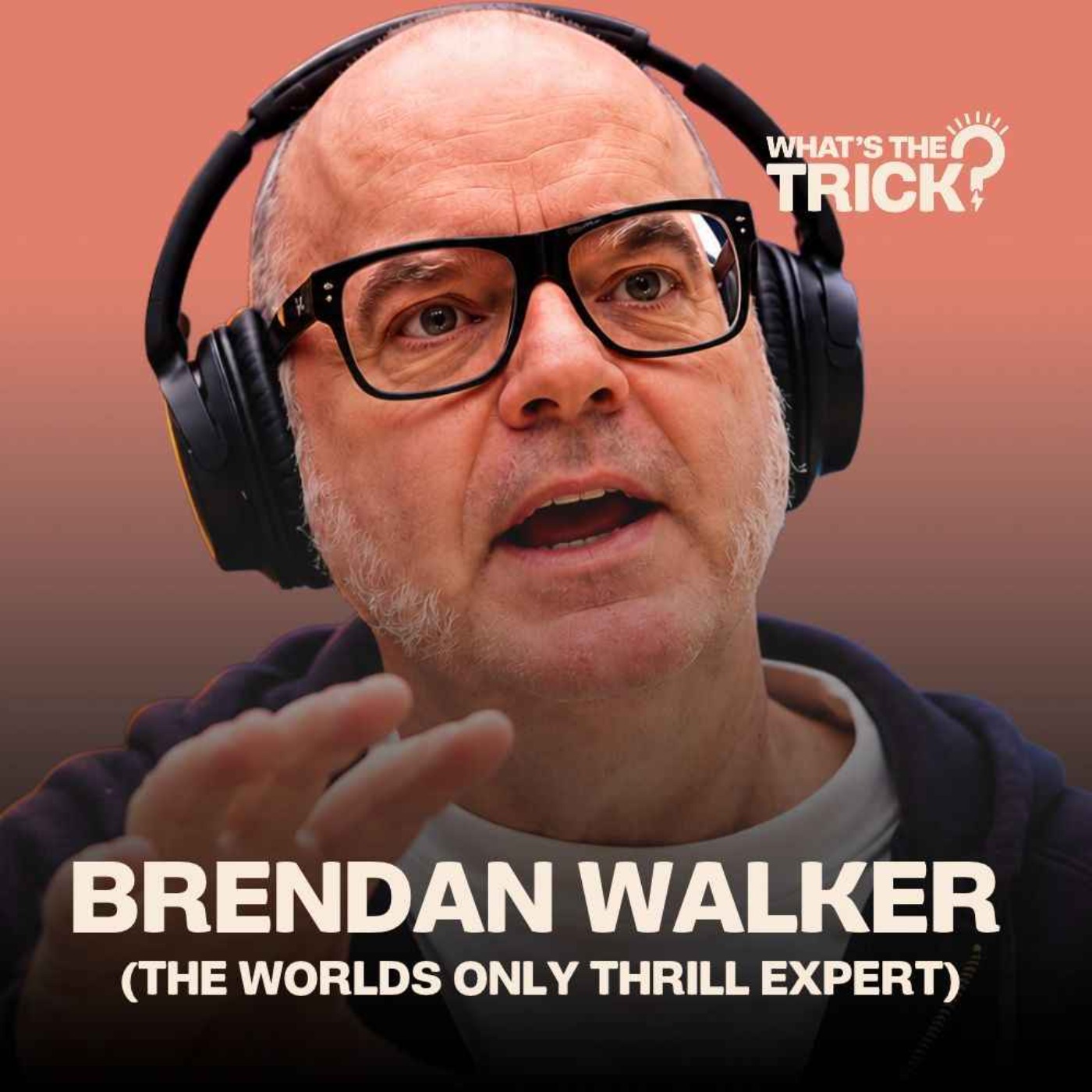
Brendan Walker, ex-aeronautical engineer (British Aerospace), experience/product designer, founder/“thrill engineer” paid by major theme parks (e.g., Merlin/Disney) to monitor and validate ride experiences; previously conducted 50 interviews and built monitoring-based “Walker thrill factor” research.
Written by AI. May contain mistakes.
Exploration of why people seek thrills and their physiological responses.
“The very precise moment people get locked into the harness, their spikes in arousal absolutely shot up.”
Discussion on the meaning of thrill, its evolutionary importance, and modern implications.
“This is Brendan Walker here on What's the Trick?”
How thrill can be designed and the role of novelty and relaxation in experiences.
“And this is what people pay you the big bucks for, Brendan.”
The influence of social dynamics and shared emotions on thrill experiences.
“So there is a strong correlation between novelty and thrill.”
Brendan discusses surprising research findings on roller coasters and thrill levels.
“And what has been your findings as a thrill expert?”
Learn about the emotional aftermath and shared experiences of thrill rides.
“So first off, yeah, that's going to be engaging.”
Explore how to incorporate thrilling elements into daily activities and presentations.
“By the way, if you're a new listener here, hello, you're very welcome.”
Hear Brendan's fascinating journey from aeronautical engineer to thrill engineer.
“Can you give me your origin story, please, Brendan?”
Understand the detailed process of designing and constructing roller coasters.
“So whether it's Merlin Magic Making or Disney Imagineering, they will then start looking from taking it from a theme point of view.”
Learn how psychological principles are applied to measure thrill in roller coasters.
“And I said, well, the only way I can reliably verify this is to build a test rig and do that.”
Discover the unique features of top roller coasters at Alton Towers.
Discuss the evolution of thrill rides with a focus on visual and auditory illusions.
“So we've talked about the past and the current.”
Engage with a rapid-fire Q&A that reveals Brendan's thoughts on various topics.
“We are going to wrap things up with my Fast Five.”
Learn about the changing dynamics of thrill-seeking and audience reactions.
Gain insights on pursuing a career in thrill design and storytelling.
“middle section university and other universities i've been at and i would always say they say well how do I get to where I want to be?”
Discover key takeaways from Brendan's thoughts on thrill and anticipation.
Understand how branding and presentation impact audience attraction.
“audiences or my clients working with me whoever it is better on the lead up to the thing so that They're enjoying the anticipation and what's about to happen more than what actually happens.”

Get the gist, explore an idea or ask about something said.
 Claude
On What's The Trick?, what are the key points of this episode?
Searching your listeningAutomatic transcript. May contain errors.
0:00The very precise moment people get locked into the harness, their spikes in arousal absolutely shot up. We feel less alive, so we have to fabricate different methods to be able to create that sensation of thrill.
0:15Ben Hanlin: And why do we want it? Why do we need thrill in our lives? Welcome back to What's The Trick? I'm your host Ben Hanlin and today's guest is Brendan Walker, the world's first and only thrill engineer. So he's an ex aeronautical engineer who's now paid by some of the biggest theme parks in the world to help design roller coasters. And his whole obsession is all about thrill. What actually is it? Why do we love it? This is a conversation unlike anything we've had on the show before. So if you've ever wondered how a roller coaster is actually designed, you'll love this one. But also, I wanted to understand how our brains actually worked?
0:54Ben Hanlin: Why do we seek thrill? And how can we use this information and what he does to make our own audiences that we interact with feel a bit more thrilled with dealing with us and chatting to us? There we go. This is Brendan Walker here on What's the Trick? Let's talk about thrill then. What is thrill? What do we define as the feeling of thrill? A thrill, if you're thinking about it just from a personal perspective, it's that really lovely feeling where your emotions and your viewpoint becomes really concentrated. Your heart starts quickening. You feel lightheaded. And that's all associated with adrenaline and dopamine coursing through your veins.
1:39So it's a really heady mixture of biochemicals, which just make you feel absolutely on top of this world. And why do we want it? Why do we need thrill in our lives? From an evolutionary perspective, thrill has evolved to help us with the perseverance of life. So sex, clearly quite thrilling, proliferation of life, avoiding danger, avoiding getting eaten, finding food, sating hunger. And also all those sensations with like swinging through trees and movement, which are associated with any one of those things. it rewards all those things and and so if we're going to feel truly alive we want to be thrilled or look at it the other way to be thrilled means to be truly alive right so why do we now
2:28Ben Hanlin: want to pay for it why do we go around spending our money on thrill okay in the modern world i think actually if you look at the industrialization the we very rarely face risks or challenges that are going to really sort of question that idea of truly being hungry, truly being in danger. And so we feel less alive. So we have to fabricate different methods to be able to create that sensation of thrill, just to feel that sort of joy, which we have the capacity for, but sometimes we very rarely fill that capacity. All right. So we like a bit of thrill. And I suppose my question is, how then? How?
3:13Ben Hanlin: And this is what people pay you the big bucks for, Brendan. How do we create thrill? people think that a thrilling experience is let's say a roller coaster was thrilling but that's just the start of it the roller coaster itself you think is actually it's like a composer composing some elaborate piece of music that there are peaks and troughs which are really critical so you might have a peak of thrill but then you need to relax off again because thrill is actually the movement of emotions. It's not an emotion itself. It is the activation of positive emotions. And you can't stay thrilled all the time.
3:50You need to relax a bit. So that's why rides like roller coasters have evolved to be really good at being able to create multiple thrilling peaks over a very short period of time. There's other things I've heard you mention before. Where does this go on the list, I suppose?
4:05Ben Hanlin: You've talked about novelty is thrilling. What does that mean? So again, I'll go back to a scientific definition of thrill is our emotional response to a novel stimuli. So this is what the scientists say, a novel stimuli. They don't tell you what the stimuli is, but novelty is key. And we can become habituated to things. So let's say we haven't been running for a long time and we go for a run. That can feel quite novel and it can feel quite exhilarating. But equally, in rollercoaster terms, if I've never done a full inverting loop-to-loop, then for me, the first time I do it, it's like a big, wow, a massive thrill.
4:49The more I do it, yes, it'll still be thrilling to some extent, but the novelty can wear off. So there is a strong correlation between novelty and thrill. It's not the only ingredient, but it's right up there. But with novelty comes another problem, which is the opposite side is if you haven't done something before, then you've got a much higher perceived risk. So like, I've not done a loop the loop. Maybe I'll fall out of my seat and die. So sometimes the risk can outweigh the thrill reward we're going to get from doing that novel thing. So it's always a balancing game when you're trying to design an experience.
5:33Ben Hanlin: and so we had the novelty of the changing state and we've got surprise obviously the surprise element got to be in there and talk to me about something i heard you say before when it comes to riding a roller coaster because i heard you say that the person you ride with affects your experience and you said that emotions are infectious and as somebody who performs to audiences i was like oh i need to know more about that what's that about then brent um so i'm now expressing an emotion. You are now reading that emotion. But because we are social animals, we've developed a real strong sense of empathy towards people.
6:14And let's say if there's a lot of people in the room, that can create a massive effect. So we mimic people's emotions. We feel empathy. And so it only takes one or two, in the instance USA, one or two key people in the room to start laughing, to start expressing an unusual emotion in response to something you've done, then again, the whole room can erupt. And so that's why, again, you're having somebody who's disinhibited. If you're riding with somebody who's disinhibited, who loves to scream and shout, and also they'll scream and shout even play acting as well. I could perform being thrilled.
6:53And even if you're not, other people on the ride will also then start to perform being thrilled. And very often that can actually lead you into feeling thrilled. So, yeah, performance of an audience is really key.
7:08Ben Hanlin: I've actually noticed that of, I've never done this, but if you were to put a few well-positioned hype people around the audience to laugh a bit louder, to be a bit. I could imagine how that would definitely change the entire audience just two or three people which is all you'd need right yeah yeah absolutely and and I produced um a pilot for reality horror tv show which is very much like a walk through scare attraction at a theme park and of the four paranormal investigators we put through this one hour scare attraction one of them was a ringer He was an actor who had an earpiece, and we were using him to control the emotions of the group as they went through.
7:50So he was basically seeding different emotions in different states. So it wasn't just the theming of the ride and the space. We were controlling a human as part of our, I suppose, our thrill machine, our thrill mechanics.
8:04Ben Hanlin: And what has been your findings as a thrill expert? But what have you found surprising in Uganda? It tends to be these are the most thrilling, these are the least thrilling. Yeah. So when we first applied this across a lot of roller coasters, it was actually for Blue Peter. The BBC said, look, we're going to do a series about which are the best roller coasters in the UK. And I said, look, well, I was just starting on this point. I said, I'll survey as many rides in the UK as we can, and we'll come back with with the results so we took one person so Andy who at the time was the Blue Peter presenter we said we need a a standard response so everybody responds slightly differently this roller coaster so we'll standardize the person so Andy became our guinea pig we kitted him up with our monitoring devices and then we took him around the UK uh monitoring the different rides i mean there were two surprising things that came out of that one was that well let's say i'm trying to think of the rides at alton towers light oblivion or nemesis they didn't win in fact the ride that won was a ride called rage at south end on sea and that ride when you look at it i mean it's very similar to saw at uh thought park it's called a gersh flower it was made by gersh and it's a typhoon style ride it's very particular but it looks really small you think well it's not the tallest it clearly can't then be the fastest but i i likened it to the concentrated orange juice of the thrill world now when we're thinking about thrill we've got these you know these peaks we need to create but if you remember i was saying it's not just a single peak that defines a whole ride it's the number of peaks so we're looking at the sort of concentration of these different effects and because rage and and sore at thought parker and such a small footprint we've got this really high concentration so not only have you not you know you've gone down the first uh over vertical drop then you're into the first loop the loop then you're into a bunny hop then you're into a cobra roll and so it's effect after effect after effect uh you still have a little bit of time to recover between both of them but you come off feeling well emotionally exhausted at the end of it um so that was the first thing it really did question the the the the public's perception of you know the best roller coasters are going to be the superlative talk to me about from your research now we're gonna get really geeky but i think this is really interesting how what the most thrilling bits are because it's not what we think is it when we think of a roller coaster no uh and this was a real surprise to us when we started studying in depth uh oblivion at alton towers where we were taking riders around the ride looking for in fact this was an experiment to do hold on before you before you dive into that anyone that doesn't know oblivion let me because i'm from the midlands i've been on oblivion many times it's it's a very it might i'll describe it and you tell me if i'm wrong it's a very short ride you go up you go over the edge and it's a vertical drop and and the the scariest bit is what for me is where they stop the the carriage just before you drop and you can see what what your fate lies ahead of you and then you free fall it feels like down the track underground you go underground and then you come back up and you pretty much that's the ride over but it's short sharp and really intense that's the is that it yeah cool yeah absolutely you bang on there they they sell the entire ride on that that not just the drop but the hanging bit there i think it was the world's first over vertical drop so rather than going straight down you're actually going slightly back on yourself at the same time so it's pretty terrifying looking down that hole which is pitch black so the ride's been sold on this so obviously you're getting on the ride you know that this is going to happen and so we were monitoring people going around the ride you know we got them kitted up their monitoring equipment put them in their harness send them around the ride and people were coming back really interested about what's happening at this moment and it turned out and we zoomed in zoomed in to the very precise moment that people get locked into the harness their spikes in arousal absolutely shot up and and i think the actual drop it's or rather that hanging point on the ride only got to something like 80 percent of the uh of the size of the moment that the the bar comes down and this you know i think we sort of looked at this through interviews post sort of ride that people reported saying yeah it was the the anxiety the apprehension the knowledge that this was going to happen and this was a point of no return so they even though the event was going to happen like maybe 60 seconds later because it was the point of no return that's when they felt most i suppose emotionally committed or emotionally uh charged by by that whole series of events do you know what i think that's so interesting because it's not just even in thrilling but in let's look at excitement in general i always think this when does an event actually start so as a performer it's not when i stand on stage it's actually way before they've even walked into the theater all of the build-up is part of the show and that you know the moment you sit in a theater and you go oh we're about to finally watch the thing that is probably one of the most exciting in bits that you're there you've made it it's a bit like if you go to an amazing restaurant and you sit at the table and you look at the menu and you haven't even eaten anything but the excitement of what's to come right that's all part of the the experience and afterwards there's that you know going for a drink afterwards and that decompression and reliving those memories which which we call in the ride world the afterglow that sort of like you know you can preserve that sense of thrill quite a long time after the actual moment itself so it's not just the the the apprehension the lead-up but it is the sort of decay afterwards which is also important well yeah because actually i'm thinking about it because we went to disney world this year and actually one of the most fun bits is the moment after the ride where me and my kids get off and we look at each other and we talk about oh gosh what was that what oh my gosh you were doing the the the shared the talking about the shared experience i suppose is part of the bonding experience i guess uh oh it's really really interesting so here's a question that i've got to ask how can we all be more thrilling in our everyday lives brendan how can we use this information maybe there's somebody here that's got to give a presentation maybe they work with customers whatever i'm a performer obviously but how can we use this to give people around us more thrill it is about pace and tempo so i think that's the first thing you know if we were thinking to the ride like uh rage at south end on sea it is that pace and tempo but you can't go too fast because you'll get frustrations you'll get uh anxiety that people are missing things you need moments to pause and reflect before hitting them again so i think again you know i'm not a natural performer but i think experimenting with that which is why i think i also love time-based media as well so we look at things like people who do projection shows used to do sort of like images or even like going back to the old magic lanterns and shows like that that were just very early powerpoints i think again telling stories cartoons animation i think all those kind of um uh all that kind of media really informs the way I would tell stories to be engaging, right?
15:52So first off, yeah, that's going to be engaging. But I suppose then it's the reveal. And I look, then I started, well, I actually had a couple of correspondences with David Mamet right back in the early days when I was starting out my theories of thrill and about how writers do that, you know, can do this. And I think if you go to this sort of the four or the five act structure in theatre where you have the the setup the build-up the denouement the sort of uh you know the release if you look at those kind of like theatrical structures i think again when we're creating three minute ride experiences particularly now we're using vr in our work as well i think those kind of dramatic structures you know it's the build-up then the payoff and then the sort of relaxation at the end of that sort of catharsis so i'd say uh look at theatre I mean that is it it is all it is all theatre
16:50Ben Hanlin: Hello it's Ben and this is a very short commercial break but for regular listeners you'll know it's not really a commercial break because I haven't really got any sponsors but I thought it was nice to have a quick stop for two seconds to say first of all this is Brendan what a lovely man very different career if you want to go and have a look at him he's the he's thrill engineer on Instagram and you can see some of his work there but what do I want to tell you about today I mentioned this a week or so ago, we have recently launched Substack. By the way, if you're a new listener here, hello, you're very welcome.
17:22Ben Hanlin: Please go and have a listen to some of the other episodes. But the Substack that we've just launched, if you don't know what Substack is, it's essentially a weekly newsletter from me. And it's a bit of a community that we're building for the home for the podcast. So here's what happens. If you subscribe to Substack, and this is totally free, by the way, I should mention this, you're going to get a weekly email that highlights this episode from the guest and the key takeaways. So if you don't listen to every episode, you've got that option there to have a look at the key takeaways. And I'm going to focus on other articles as well.
17:51Ben Hanlin: I'm going to talk about creativity. So if you're enjoying these conversations, you're going to get more of that. Communication and also a little bit about how to grow your business, because I know a lot of performers and creatives have been asking me questions about that as well. So it's a big home for the community on the Substack. And also, if you do want to pay£3 a month to the Substack, because everything I've mentioned so far is free, but the£3 a month gets you access into the community, which I'm trying to build. And that basically goes towards supporting this podcast because as you may know, I'm doing this totally independently.
18:21Ben Hanlin: I'm trying to grow this to being one of the biggest creativity podcasts in the world and I'm really loving it. But for£3 a month, the cost of a cup of coffee, you get to support it and you get to be part of the chat where we can discuss the recent episodes as well. And I can tell you about what's coming up on the show and tell you a bit more about what's going on. but if you don't want to do any of that totally understand i am on instagram whatsthetrickpod wttpod and you can just just drop a like there and drop me a message i've been loving your messages lately and i've had a few messages from performers asking for advice and tips more than happy to help where i can so feel free to message me or just say that you've found the pod and you're enjoying it that all sound i say i've said this from the beginning it's good for my ego you shouldn't need an ego to have but it's good to know that the work i'm putting out into the world that you're actually enjoying it and if you want to share this with anyone that you know and just say hey I think you might like this podcast if you're in a community of similar like-minded people the more people that can hear about this the better because my advertising budget is very low so any help there would be great so that's pretty much it for me it's been a busy old week I was in Ireland last week doing a keynote for Hiscox Insurance so it's been doing a lot of keynotes and then I'm doing another keynote this week and next week I'm in London for three days in a row actually hosting award evening do's because it's evening awards season so all of that information can be found at benhanlin.com but there we go look I hope you're enjoying this episode make sure you hit subscribe so you don't miss an episode and I'll see you over hopefully on Substack let's get back into it with Brendan Walker right let's talk about you for a little if we can.
20:05Ben Hanlin: How do we become a thrill expert? Can you give me your origin story, please, Brendan? How did you get from where you were to doing this? And explain to people what you now, over the last few years, what people pay you to do, what your job is, Brendan?
20:23Gosh, I started out as an aeronautical engineer, and I worked for military aircraft for five years at British Aerospace and I left went to art college I became really interested in product design so I worked as a product designer for a little while but started gravitating towards exhibits so I made some exhibits for the science museum interactive exhibits you know people pressing buttons interacting with things this is around the end of the 90s and I was also making very large mechanical sculptures for art galleries as well. And so there's something about the scale of the engineering I was doing, something about the interaction.
21:06And this was before this discipline, which we now call experience design, emerged. And I just became really fascinated by the, a little bit like the story of the knitting, with how emotionally charged just hitting a button could be, depending on what the effect it was going to have. and and i started thinking more about the emotions just of button pushing and the more i looked into it the more i thought actually there's there's quite a a lot of psychology built up in this and i entered this into it like with no preconceptions and this is where i conducted these 50 interviews with different people looked for commonalities between 50 different stories from 50 different people experiencing 50 different thrilling experiences and this is where that pattern of the massive and large increases in pleasure and arousal came from i noticed that this was a signature so two elements sprung off from that one was a scientific pursuit of the the walker thrill factor and using scientific techniques to be able to monitor people and to be able to validate rides and experiences but the other part was applying what i'd learnt to make my own rides better or make the rise of other people better so it was that really that was the thing that's always driven me as a primarily working as a creative it's applying that knowledge to make things better or make things that people have never even experienced before can you talk me through the
22:38Ben Hanlin: process how does a roller coaster get made does when you know what's the starting point is it just a sketch on a piece of paper is it a thick what let's go through it if we can yeah so you can start at i mean the true journey of a roller coaster will start with a manufacturer like uh intermin or gershlauer who um if you like toy train sets they're like the hornby of the toy toy train set so they they're not like the geeks who do all the massive fantastic toy train layouts they make the kit that you can make those bits from so you've got the ride manufacturers so then if you come to a company like Disney or Merlin Entertainment, two of the top players in the ride entertainment world, they will then start with their creative team.
23:28So whether it's Merlin Magic Making or Disney Imagineering, they will then start looking from taking it from a theme point of view. And that will often, that journey of the ride when it gets commissioned will often come from marketing so it'll either be what ip have we got out there so uh yeah it's thunderbirds exciting have we brought out a new aladdin film it's toy story 3 coming out so that kind of gives you the the story opportunity you know we talked about story here so that kind of gives you the hook and then you can start building from there well let's take one of your experiences if we can
24:06Ben Hanlin: so you worked on wicker man and 13 which is i believe was uh rise for alton tower so yeah i'll I've not been on either of them. So let's take this from the beginning. Explain what the end goal of it was. Maybe pick one of them and what the brief came to you was and then how that went from there. That'd be pretty cool. So the two rides, and they've both got very different stories. Rickman, which is at Alton Towers, started out as a proposition that they needed a really strong ride for a marketing uptick. That sounds very like it. So every three years, a theme park will usually get a major investment.
24:44It's the new ride, thinking about novelty, it's the new ride which will drive people to repeat visit. They might go two or three times before that ride starts to get a little bit tired. Then they need a new one. So in its marketing journey, Alton Towers needed a new ride. At that point, the question is, well, what ride do we build? so I was brought in as part of a task force to look at the new uh IP that that we might be working on I have to admit that we you know and a guy literally a lawyer comes into the room opens up a book and goes these are the IPs we can buy there's Thunderbirds here there's um there's Teletubbies here you know and so you're going through this going well what story is going to match you know the demographic of Alton Towers you know that Alton Towers and again theme parks move between either being targeted towards thrill seekers or families so in this particular year we were looking at thrill seekers so then the second key was well what makes this ride a unique first and so is it going to be the tallest the fastest what's the marketing hook when you see that image of a ride on the front cover of the daily mirror or in the travel section of the guardian you know you've got the image of the ride what is the key signature of this thing so wood fire wicker man uh that's where they coalesced into this story um and at that point that's where my job finished and that's where the job of others started once we had that that our team had come together with the strong narrative approach to creating a ride so that's one approach and then it went through as i suppose i'd say a normal ride cycle there is like any show in production there is a lot of work then to choose the right kit of parts and put it together etc um so just on that you've covered a
26:32Ben Hanlin: lot of so so it's interesting one thing is really interesting you said about like the first thing you do is imagine it in the paper essentially or on the side of a bus or whatever that image is and you know what we had a guy called simon painter a few episodes ago who makes west end shows magic shows actually and he says everything he's ever done in his career starts with a poster if he can't get a great name and a great poster then forget about and he said so much of their tickets were sold on posters alone that's it and it sounds like you're at theme parks you're doing the same thing absolutely and that was a real uh in fact we called it the uh well it merlin magic maker they called it the uh the nugget the golden nugget you know what's the image and the text was called the nugget what are the two sentences that sell this okay so so you've got the idea and then a thing that's always interesting how do you then go from you're about to spend millions on this thing and in any other business you test cheap versions of something you get some but do they just commit and go right we're going to spend x million and it's going to be built and then we'll figure out when people ride it if it's any good or not how do you actually test it well so there's two two elements i mean they can test the idea the marketing team can test the idea with the audience about is this looking attractive you know i mean that's just like normal sort of market testing but can you test the effect of a ride you know is this going to be thrilling for somebody and i think this is one of the questions that alton towers when they were making 13 alton towers became very nervous uh when the whole ride was based upon one drop feature of getting people i'm sorry if you've not been on 13 yet but you go it looks like an ordinary coaster you go into a very dark um station completely pitch back black and then rather than dropping going forwards the whole ride drops vertically and they wanted to know are we dropping them far enough is this going to be thrilling and they came to me and said can we can you verify this?
28:42And I said, well, the only way I can reliably verify this is to build a test rig and do that. And they said, we haven't got time. So I had to find different ways to do that. How do you do it? How do you test dropping people? Well, so this comes down to, I think, my fascination and I think a little bit of knowledge in psychology. So I was thinking, well, there is this idea that novelty or rather, let's say you're, I think this probably applies to illusion as well or or spectacle suddenly something happens that you aren't expecting and how long does it take for your brain to process that something's happened and then how long does it take for your body to form an appropriate response which for me is like screaming or grabbing hold of the person next to you and I and I proposed that after that it was diminishing returns so i said right okay for 95 percent of people it's going to be like 1.2 seconds and then you can just do some physics say 1.2 seconds you can free fall uh this distance and i think it actually turned out to be over seven meters uh i think it was around 7.1 meters but we shortened that because if you go and again another spoiler alert but it's good fun to go and try this ride you'll find other roller coasters like it that we pump prime people so in the tunnel once you stop we then drop you 30 centimeters first and that first initial sort of gut churning sort of sensation going oh i dropped no i didn't i'm safe then you drop them again the second time you drop them the response time shortens and what we managed to do was to convince the manufacturers that the distance to be dropped was I think around 5.2 metres.
30:34And so we were able to verify it through previous scientific studies that had been done. And I think in the Department of Transport, who studied how quick people's responses are to pressing a brake pedal when, let's say, a father with a pram steps out in front of the car, that's a really important reaction time and so we use sort of um proxies and analogies to uh to be able to come up with this kind of scientific formula for distances so question that that dipping
31:04Ben Hanlin: mechanism you didn't invent that or anything the what the the warehouse that builds them goes we've got a new toy who wants it type thing is that what happens exactly yes so that was part of the kit of parts that came from the ride manufacturer well let's talk about roller coasters then what are in your opinion the best roller coasters in the world and why it's not a coaster that most people would imagine it is spinball whizzer at olsen towers um people go huh what's that and well it's it's a magic mouse uh style ride or a crazy mouse um the riders sit in a coaster carriage and the coaster carriage itself can spin 360 degrees and so you're going up and down these undulations you never do a full loop the loop but if you're riding with somebody who laughs and believe me this this ride absolutely will make you laugh because it's crazy as you're talking about the unexpected from 13 dropping this you don't know what orientation you're going to be and as soon as you get the giggles it goes and when you're talking about a thrill relying on arousal and pleasure it delivers pleasure in absolute space so if you're a pleasure seeker magic mouse at alton towers is is the one uh that you really want to go on and and and your favorite come on yeah i'm going to sound very one-dimensional um because i'm going to go for another ride at alton towers but if you look at the roller coaster of great britain uh who are great aficionados of coasters um it's air um at halton towers and the reason it is so good is it's so smooth and you see i've not done air so can you explain to me what it is what it is yeah so air is a flying coaster you go in a uh try to think prone position that is face down isn't it prone and you're suspended from above you can see the ground below you and the right suspended underneath the steel circular tracks so you're basically like superman basically aren't you exactly and it is like the superman ride except um the countryside around alton towers is so fantastic and you can see for miles and that ride is so smooth and when you say it's called air you really do feel like you're one with nature because you can't see the ride structure for lots of the ride you can only see what's in front of you have that sensation of wind and they made an appalling error on that ride a few years ago where they introduced VR on it and they created a ride called Galactica exactly the same ride but you put a VR headset on feel like you're flying through space and they killed the one of the major defining feature of that ride with which was being able to see and having the sense of unity with the the the environment around you so they removed that you know after only spending about I think it was about two million pounds getting the headsets on They took them off the next year and it's popular once again.
34:13Ben Hanlin: So we've talked about the past and the current. Let's talk about the future. Because obviously your company, this is what you're doing, is you're trying to look into more technical ways of doing things. So what is the future, do you think, of these experiences, the VR stuff, the digital stuff? Yeah. I think if I was to give you my pitch version, it's we're reaching the uh the thresholds of what the human body can do you know we can no longer sustain more g-forces or extended levels of exposure to g-forces so we've got to start looking at other frontiers and this is where we're moving from the thrill and adventure seeking into experience seeking to to create our thrills and from that i mean storytelling visual illusion theming and so all of those things i think are definitely going to become stronger which is why gardens of the galaxy doesn't surprise me but the other area that that they don't i say they as in i don't think the parts are looking at enough is visual illusion auditory illusion and there's one particular ride which was made in 1897 which was the haunted swing effect which was you're on a playground swing you're swinging backwards and forwards but they mechanically move the room around you in the opposite direction so you you were in a room if you're in 1897 the room would have a pram a vase a bunch of flowers and so everything that you felt should have been grounded in the real world but they were all glued down and so as the room started moving around you and you felt that that sickening sense in your stomach that the swing was actually working but the room was going the opposite direction suddenly you feel like you're doing a full 360 loop the loop that ride even when there were loop the loop coasters around at the end of the 19th century that ride for a whole year was an absolute sensation all the way across north america and that was simply visual illusion now um but it was visual illusion plus a little bit of body movement and i think that for me is the key that get those components right you don't need to be throwing a body around in space over you know 500 million dollar rides you can actually do a little bit of movement but actually then transfer most of what you're trying to do into storytelling visual illusion and auditory illusion which is something we're currently looking into now how can you use spatial sound to make you feel that you're doing something which your body really isn't doing wow and and that so you think that's where where it's all going to go is more visual audio illusion like you say which is uh yeah and i think i mean and and visual and audio illusion is you know right now virtual reality is very good at delivering that because we're strapping a screen onto your eyes you can put on a pair of headphones so you can actually put you know this media straight into somebody's head but you could equally be in a room where there's projections you could be in a room where there are actors so um you know it depends but right now for us we're really interested in vr because it is the simplest way to be able to give images and sound into people's heads.
37:23We are going to wrap things up with my Fast Five.
37:27Ben Hanlin: Are you ready for Ben's Fast Five, Brennan? Go on, I am. Seat my pants. I'm sitting on the edge of my seat. Well, it's going to be thrilling. Well, I'm going to change the state. I'm going to surprise you. It's going to be novel and my emotion is going to be infectious. There we go. Right. Let's start. Highlander question. In the film Highlander, when they kill another immortal, They steal that person's skills or expertise. If you could steal the expertise of anyone, dead or alive, who would it be? Oh, oh, they could be dead. Well, I'm going for a live one here. Neil Hannon, Divine Comedy. And the reason is I would love to be a performer.
38:10and I just love the way he mixes comedy, comedy timing, his writing and musical ability. In fact, I'm learning currently, and I'm an awful pianist, but I'm learning on a tiny keyboard a track that he sings called The Dead Only Quickly, which was written by Steve Merritt. But I come from a very big Irish family and there's always a death in the family at some point. So it's going to be a little song I'm going to sort of entertain at the wake with. There we go.
38:43Ben Hanlin: Oh, well, that's lovely. That's a lovely sentiment. Can't wait until you experience another death there. Spread it. Moving on, time capsule. So we can only keep one thing you've ever created. It can be something small. It can be an entire project. Whatever you want stays in a time capsule. The rest of your work is evaporated forever. What do you keep? so there was uh there's a piece of work i created called black box and coming from an aviation background i've got a real fascination with aviation disasters uh i've done tv shows about it but these two artworks were very small boxes with small holes inside them so they're cubes and inside those cubes are dioramas of famous air disasters that have happened and i made those dioramas but the thing that fascinates me about them is that they were based on the story of a guy called jonathan scott who i interviewed who talked about as a child bending down closing one eye so using monocular vision to look at his trains as they came down the track and for him he was basically fooling his stereoscopic vision and he was imagining them being real worlds and they remind me always to look at the world uh from a child's perspective you know we don't learn i mean all those thrilling things that we learn and how to construct them we've already been doing them as kids so just be more like a child well fantastic that is in the time capsule we're going to move on to culture vulture you what has been the one thing you've seen recently you want to share with the world it could be a book a film anything i i love kurt voniger and i only read cat's cradle last month um i i'm not going to spoil it for everybody but i love apocalyptic movies but i absolutely hate post-apocalyptic movies they're so dreary but the apocalyptic moment is always really exciting that transformation and in this book i've never read a book before where i've actually audibly gone no no no and and it is the most bizarre occurrence and you realize the whole book's been working up to this moment uh it involves chemistry and the end of the world that's all i can say what's it called again it's called cat's cradle cat's cradle right there we go i'm going to give you my magic wand brenda with this magic wand you have the power to make anything vanish from the world let's keep it the world of thrills experience roller coaster whatever you want could be theme parks you can make anything vanish to make it a better place obviously what we won't say safety or anything like that i mean that's a given what you're going to go for i'm going ben this week i'm going for the manosphere and there's a reason i don't think how does that relate well yeah i've seen it i know i've seen it in teenage boys this uh going on rides that there is this real reluctance to perform your emotions going well i'm not scared by this i'm not enjoying this i'm not you know and having deadpan and it is the worst thing they're not enjoying it the people who are around them aren't enjoying it and i think this is now appears to me to be infecting the world more broadly this idea of going well i'm too brave to do this i'm not you know and i think where's the joy in that so uh be well i'd be be be be more of a man and scream like a girl that's what i'd say that that's really interesting that the cultures are changing because it's actually used to be something similar even with magic shows is the the alphas and this didn't have to be male it could be male or female the alphas don't like to show that they are being fooled so they sit there with a stern face and go yes well i clearly know how this is done and that energy is infectious and it ruins the experience for the other people around them which is really interesting i didn't know that that was essentially you can spot that happening with reactions on feet on rides absolutely yeah and i say when you go on spinball whizzer it's one of the only rides i've seen which can actually break because we're not getting them from the the arousal side which is the biggest the fastest we're doing stuff which is actually challenges them and is fun and I think that's the way in to break that it's look yeah provide more fun rather than more sort of adrenaline and I think we can sort of break break that more so I think entertainment and and fun and joke and light heartedness is is certainly the way to go what is the trick brendan to having this career where you've followed your passion and you're now a professional thrill seeker what advice would you give to anyone else who's starting out in their career i talk to a lot of students at middle section university and other universities i've been at and i would always say they say well how do I get to where I want to be?
43:42And, you know, and if they want to be a thrill engineer or, you know, experienced designer. And I say, there are so many different ways in. And I think early on in your career, follow your passion, because I've worked with people who studied astrophysics or history or sculpture, and we all ended up in the same studio at Merlin Magic Making. and I think it was anybody who had a real interest in storytelling and again the people who fascinate me like Kurt Vonnegut or David Mamert or uh I'm trying to think of some of the roller coaster designers I've met it's all about story and so I think stay interested in story and and
44:25Ben Hanlin: drama and I think the rest will follow so behind it all is an amazing story fantastic yes great brendan absolutely love this thank you very much thank you thanks ben so there we go that was the thrill expert brendan walker uh listening back to that i have made i suppose three notes of things that jump out at me in that conversation and a couple things we've never spoken about before which i think is interesting so this idea that thrill comes from changing your state so you were here you're now here that's that's where the thrill happens and i think about this as a performer is I often talk about gear changes that you, if you want to hold an audience's attention for a long period of time, every few minutes I'm trying to change my gears, whether it's, there's lots of things I can do in my performance to keep changing the state for the audience, whether I'm telling a story, telling a joke, being sincere, getting them to do something, whatever it is, all of these are gear changes.
45:25Ben Hanlin: And that's essentially what he's saying is you, you've got to be interesting by changing states i thought it was interesting and then he talked about surprise obviously people don't know what's coming that um obviously is threatening but the idea of novelty getting people to do things they don't normally do and i think that's quite interesting that's quite you think about actually what could i do that my audience or my customers or whatever don't normally do and within that is slightly thrilling so all of that i thought was interesting and then this idea of anticipation where we actually part of the thrill of the experience is the anticipation to the experience and I think that is such an underused asset for all of us how I mean I'm even thinking about now like how can I make the anticipation of my audiences or my clients working with me whoever it is better on the lead up to the thing so that They're enjoying the anticipation and what's about to happen more than what actually happens.
46:23Ben Hanlin: I think that's quite interesting. One thing I do actually as a performer, thinking about anticipation, is I really focus on how I get introduced on stage. And I suppose that is a little bit about building up the anticipation, is getting the introduction right before the ride, if you like. I've just called myself a rollercoaster ride. Okay, but you get the idea. All these ways of playing around with anticipation, I thought was interesting. And thirdly, branding again it goes back to something we've spoken about before branding and what is on the poster and the best person i've i've heard described this was simon painter a few episodes ago it was only a couple months ago wasn't a month or so ago who is a massive west end but producer and he says all of the biggest shows he's ever produced always start on the poster and if you can't get a great poster forget about it because that is the thing that's going to get people to stop get their attention and go let's go to that show and in this case what's going to go on that ride it's the poster and um so i'd go and have a listen to the simon painter episode if you haven't already that was great and then building on that henry lewis who's another theater producer who produces the play that goes wrong they very much put a lot of their success into the title of that show as well so it's kind of like titles posters branding all of that i think uh was really interesting as well so those are some of my thoughts you can go and have a look at listen to those episodes.
47:45Ben Hanlin: Again, if you're new here, you can always go and follow me on social media, Ben Hanlon or What's The Trick Pod. Drop me a message and I'll tell you other episodes to listen to. And the rest of you, I'm sure I'll see you over on Substack. Yeah, you're getting interested now, aren't you? There we go. All right. Anyway, have a great week and I'll see you next week. Bye-bye.
Why do humans crave fear, chase adrenaline and actively seek out experiences that terrify us? And what if the scariest part of a roller coaster isn't actually the drop?
In this episode of What's The Trick?, Ben Hanlin is joined by Brendan Walker, a thrill engineer and expert in the psychology of thrill seeking, to uncover the surprising science behind fear, excitement and human behaviour.
From designing experiences for Alton Towers to measuring people's emotional reactions on roller coasters, Brendan reveals how our brains respond to danger, why anticipation can be more powerful than the event itself, and how theme parks deliberately engineer unforgettable thrills.
We explore the psychology behind some of Britain's most famous roller coasters, including Oblivion, Wicker Man and Thirteen, and discover how adrenaline, dopamine, emotional contagion and the power of suggestion influence our experiences.
In this episode, discover:
Whether you're fascinated by human psychology, roller coasters, theme parks or the science of fear, this conversation will change the way you think about thrill seeking.
00:00 Introduction – The Psychology of Thrill Seeking
01:11 What Is Thrill and Why Do We Crave It?
03:06 How Do You Create Thrill?
04:02 Why Is Novelty So Thrilling?
05:33 Can Other People's Emotions Affect Our Fear?
08:04 What Makes a Roller Coaster Truly Thrilling?
10:37 What's the Scariest Part of a Roller Coaster?
14:34 How Can We Create Thrill in Everyday Life?
16:50 A Quick Break with Ben
19:59 How Do You Become a Thrill Engineer?
22:36 How Are Roller Coasters Designed?
27:19 How Do You Test a Roller Coaster?
31:20 What Are the Best Roller Coasters?
34:13 What's the Future of Roller Coasters?
37:23 Ben's Fast Five
43:18 What's the Trick to Following Your Passion?
44:37 Ben's Final Takeaways
About Ben Hanlin: Ben is a magician, presenter, and keynote speaker who helps companies create engagement, connection, and memorable experiences. He hosts corporate events and interviews world-class creatives on this podcast.
About the podcast: "What’s The Trick?" explores how creative people think, create, and turn ideas into reality.
Topics covered include creativity, communication, storytelling, content creation, performance, and building creative careers.
🎧 Listen / Watch:
YouTube: https://www.youtube.com/@BenHanlin
Apple Podcasts: https://linktr.ee/benhanlin
Spotify: https://linktr.ee/benhanlin
📩 Work with Ben:
https://www.benhanlin.com/
---
FOLLOW BEN:
YouTube: https://www.youtube.com/channel/UCM0oXTRP-zWlJ_IiNykTLag
Instagram: http://instagram.com/benhanlin
Facebook: https://www.facebook.com/benhanlin
TikTok: https://www.tiktok.com/@benhanlin
---
🎤 FOLLOW BRENDAN WALKER:
- Instagram: https://www.instagram.com/thrillengineer/
- LinkedIn: https://www.linkedin.com/in/profbwalker/
- Website: www.thrilllaboratory.com
How do creative people turn ideas into reality?
Ben Hanlin breaks down the mindset, process, and decisions behind it.
Hosted on Acast. See acast.com/privacy for more information.