Ask ChatGPT

 When Shift Happens Podcast
12 Nov 2026 · 1h 10m · 24 chapters
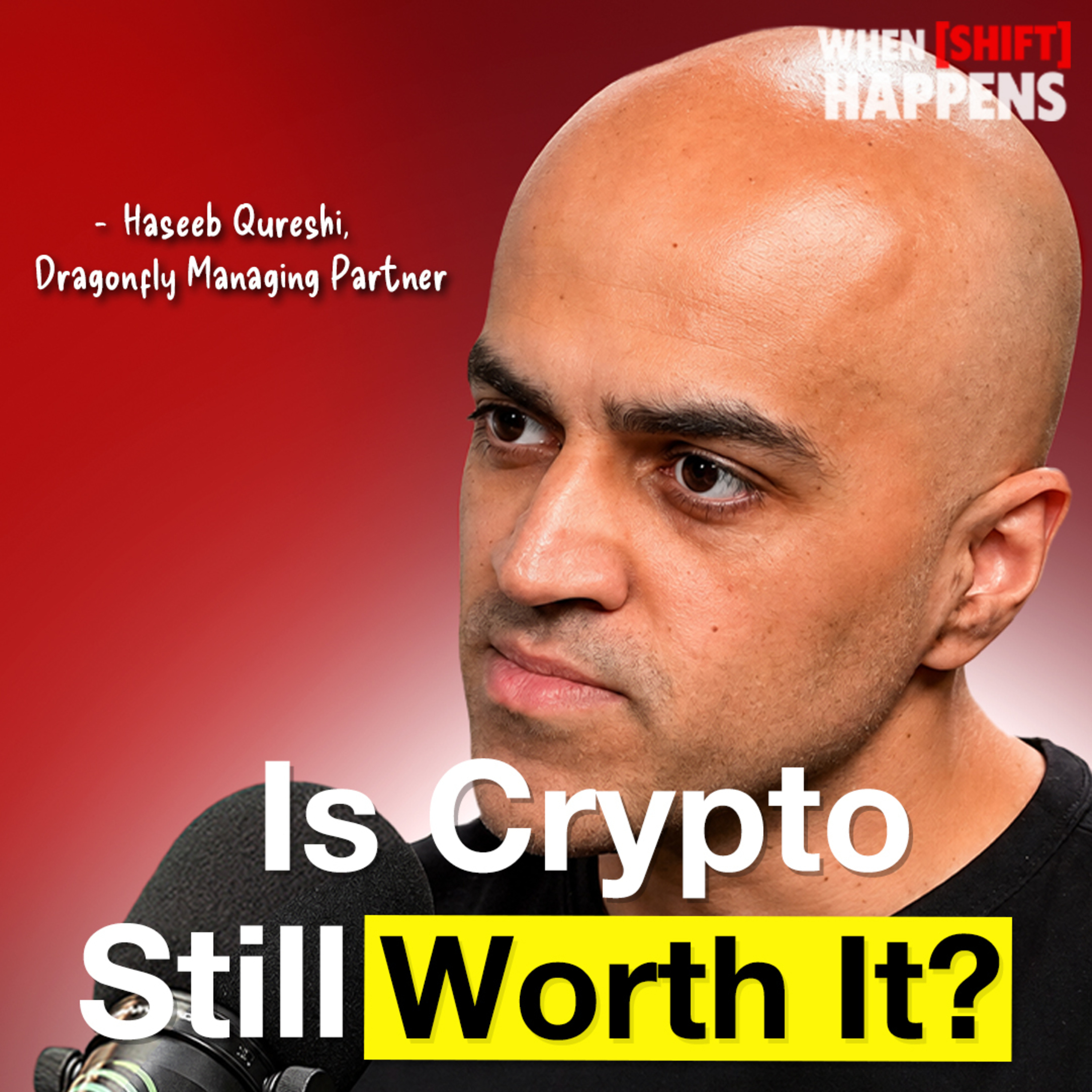
Dragonfly managing partner Hasib Qureshi discusses why AI is entering a “crypto-2020/2021”-style frenzy, what would make him bearish on crypto, and how VC success depends more on access and building a public brand than “betting on the right horse.” He also explains his current crypto conviction and how he invests across cycles, plus detailed case studies (Near, Athena, Variational, Hyperliquid/Hype).
Hasib Qureshi is managing partner at Dragonfly, a crypto VC that has backed 150+ companies. He previously worked as a poker pro and shares investment thinking publicly.
Written by AI. May contain mistakes.
Explore the intersection of AI and cryptocurrency, highlighting key developments and cultural shifts.
“Everybody realizes how important AI is going to be.”
Hosts discuss the importance of audience engagement and subscriptions for podcast growth.
“One of our absolute favorite things at When Shift Happens is to look at our data to improve what we're doing for you every single week.”
A conversation about the social aspects of crypto investing and its parallels with AI.
“Yeah, partying is not the best place to like talk about serious stuff.”
Discussion on how to approach investments during different market cycles.
“i mean like you just look at the scale of the data center build out like the amount of revenue that's going to be necessary to pay back all this debt is massive.”
Insights from the speaker's past investment decisions and lessons learned.
“And, you know, now it's funny because after 2021, 2022, you can sort of go back and do the archeology, like, you know, kind of dig your way through the wreckage.”
Understanding what determines success and failure in venture capital investing.
“Well, this was not during that period, but I actually, back when I first started as a VC, so this was 2017, 2018, I, for the first roughly year that I was a VC, I would write past memos.”
Exploring the critical importance of access to deals in venture capital.
“I remember being at school and at school you have, if you're competitive, you're thinking, oh, well, maybe I do this math problem And then if I'm lucky, the teacher or professor will like recognize that part is right.”
Learn about the essential skills for venture capitalists and how they evolve over time.
“So it's more an access thing than betting on the right horse.”
Discover why personal branding is crucial in venture capital and how it impacts deal-making.
“one of the largest on-chain trading platforms.”
Hear the story behind the investment in NIR and the thought process of the investors.
“However you want to invest in crypto, the experts at Bitwise have you covered.”
Explore how NIR has developed over the years and its potential for future growth.
“Like these guys have clearly never worked on a distributed system before.”
Learn why successful crypto projects must adapt to changing market conditions.
“And so their whole idea was that, look, we're just going to front run and build this thing before anybody else is able to build it.”
Discover the rationale behind investing in Athena when the market was skeptical.
“And most people did not really understand the mechanism.”
Understand the lessons learned from Lemma Finance and how market dynamics shifted.
“wasn't enough open interest on chain for them to build something of scale.”
Explore how Athena can capitalize on yield demand amidst new regulations.
“Well, look, I think the answer is clearly that it can get a lot bigger than it is today.”
Learn about Variational's innovative approach to market making and trading.
“What was so special about Lucas and what the guys at Variational were trying to do?”
Understand the massive total addressable market for derivatives in crypto.
“And now, you know, it's probably not going to be institutions that are trading on these venues, but it's, you know, retail trading.”
Explore the differences between CFD platforms and DeFi, including transparency and accessibility.
“So if you're trying to buy US equities out of Hong Kong or out of Eastern Europe, you're mostly trading these on CFD platforms because you don't have access to the underlying.”
Discuss the challenges of securing funding in crypto and the importance of founder conviction.
“How do you think about an asset like Hype that never had a seed round?”
Learn about the strategy behind selling crypto assets and managing investor returns.
“Um, so, and that's the number one thing that you want to look for in a founder.”
Delve into how Venice aims to provide privacy in AI and the implications for civil liberties.
“What's the asset, crypto asset that you have the most belief in right now?”
Learn about Zcash's unique position as a privacy-focused asset and its value compared to Bitcoin.
“That is also a bit weird because it's been liquid for a decade.”
Explore potential factors that could lead to a bearish outlook on the cryptocurrency market.
“Well, yeah, you were one of the guys who were like talking about ETH and SOL and all that stuff when people were depressed.”
Understand how the entrepreneurial spirit of Silicon Valley influences the crypto space.
“In Europe, we definitely don't have that.”

Get the gist, explore an idea or ask about something said.
 Claude
On When Shift Happens Podcast, what are the key points of this episode?
Searching your listeningAutomatic transcript. May contain errors.
0:00Everybody realizes how important AI is going to be. The civil liberties around AI are yet to be adjudicated. You are not allowed to say abusive language to cloud. What else is going to be added to this list of things? All of this should naturally well up the human instinct of, fuck you, and I will tell you what I will do with my AI. You will not tell me what I do with my AI. Two years ago, we went from failing on high school math to solving the Navier Stokes problem. The story now is that apparently OpenAI is pointing their lasers at cryptography. So AI now is about 2021 crypto for you? Uh, maybe 2020.
0:31Hasib Qureshi, the managing partner at Dragonfly. The crypto firm has backed 150 plus companies. A former poker pro. He shares his investment thinking publicly and clearly. It's more an access thing than betting on the right horse. Step one, access. Step two, betting on the right horse. There's a ladder of skills that every VC needs to learn over time. At the bottom is deal flow. Then there's analysis. Then there's picking. Past picking is winning. In VC, the brand has a role. How do you win if you're the underdog? The number one thing that is going to make you a success in VC is building a public brand.
1:02If you are at one of these big firms, you're basically renting the brand of the big firm. They're giving you a brand that you did not create. If you are not at one of those places, then you got to make the brand. What would have to happen for you to become genuinely bearish on crypto? The first is betrayal of our core values. The culture that we have in crypto, that no, no, no, you should try things. That culture is very important and sacred. And I think if you lose that, that would make you more bearish on crypto. What's the asset that you have the most belief in right now? The most belief in?
1:27You said before, the ones that we really believe in, the ones we just don't sell them. You have to pick one. It's right now because it's top of mind.
1:38Hey everyone. One of our absolute favorite things at When Shift Happens is to look at our data to improve what we're doing for you every single week. And one of the things that we notice every week when going through our data is how many of you regularly watch this podcast but still have not subscribed. And so if you want to help us get even better guests every week, take two seconds and click that subscribe button just below this video. Thank you for being with us today and for supporting us every week. And now let's get to today's show. Yeah, partying is not the best place to like talk about serious stuff.
2:14Exactly. But for some reason, crypto people love to party. It's not just crypto, man. You go to SF, like the AI parties, like what was happening in crypto three, four years ago, that's what AI investing is like right now. It's like super social, no DD thing, you know, checks flying out the door, like term sheets written on napkins. So it's, you know, I don't know what's like, there's no valuation metrics, you know, it's kind of like these neolabs that have just four guys and an idea raising money. mass evaluations and billions of dollars so what's old is new we went through what's going on to remind me when you look at that it's human nature it's just like this is what happens when people are really excited about something and they feel they have to get involved is the norms around investing are extremely adaptable to the environment and the energy and the mood in society so it's easy to tell ourselves they're like oh man crypto was so crazy and cryptos, we kind of make fun of ourselves a little bit that like, oh, we were just, you know, people reminisce about 21, 22.
3:28And, oh, we thought we could take over the world. And we thought bored apes were going to be everything. And people could just put their money into some random stupidity and three exit, five exit, 10 exit. And we all thought we were going to be rich forever for doing nothing. And, uh, you go to these kids in San Francisco and they just feel like, of course I'm going to be rich. Of course, like I don't even need to ship anything commercial. I just need to be in the right time at the right place. And people feel entitled to, of course I should be able to raise from top PCs and raise a bunch of money and, you know, sell secondaries.
3:59I mean, the, I remember in 2021 being flabbergasted that people started fighting back against vesting. That's now a thing in SF is people talking about like oh wait why do we have cliffs that just makes it harder to hire people because they have to stay a whole year and staying a whole year for your cliff there's so much opportunity cost who know AGI might be here in six months so like why would you have why would you ever agree to a cliff I mean OpenAI got rid of their cliffs they're the biggest they got rid of their cliffs and that was in response to all the startups that already got rid of their cliffs so and you know you hear these stories about somebody's a co-founder of a lab and they leave after three months and they go found another lab and leave that after a year that's i mean i remember all that stuff happening in crypto you said this is human nature and like with this when people want to get involved how much do you get involved how much do you want to get involved when you watch all this stuff but you've seen the movie a couple of times before yeah well i mean it's it's true that it's crazy it's also true that it's happening for a reason and that reason is that there is actually a technological revolution happening in the same way that in crypto in 2020 2021 there was a real revolution happening right i mean now some of that revolution was 2021 was the time of tara and ftx and board api club and openc there's a lot of stuff that didn't last 2020 and 2021 was also the birth of d5 there's also when stable coins started going vertical you know it was when bitcoin went past 20k like all this stuff was happening at the same time the same thing is gonna be true in ai there's a lot of stuff that's not going to work or go anywhere there's a lot of stuff that's going to change the world so ai now is about 2021 crypto for you uh maybe 2020 okay so it gets much crazier i think it gets crazy before getting sad for a while oh it'll definitely get sad at some point i mean like you just look at the scale of the data center build out like the amount of revenue that's going to be necessary to pay back all this debt is massive.
6:08And, you know, you look at the compute commitments that Anthropoc has, you know, something like 500 billion that they have to go and buy this compute. If there's a downturn and there's some dip in secular demand, it's going to be very hard for them to make the math work. So you think 2020, so like how do you think personally? you think I'm going to throw some more fuel to the fire personally, or I'll wait for people to get wrecked to then. First of all, when there's this first like big run up, you see like which ones are like the most interesting. And then you have a few ideas of like, this is interesting.
6:50And then when everything crashes, you see what survives. And that's usually when like the best deals are happening. How do you play this? Yeah. Yeah. Well, I think the answer is largely that all the while, they're almost always great investments to be made. And the same thing was true in 2020 and 2021 is that, um, there were a lot of bad assets and a lot of things you could, could have bought in that period that would not have done well. Um, if you look at, for example, Athena, seed round of Athena was in 2022 and, um, early before the, um, you know, things, things got, um, uh, you know, before FTX collapsed and all that stuff.
7:28same thing was true with monad same thing was true with uh actually variational i think we did their seed round and is it 21 or 20 that we did their seed round um so the answer is that there's always great investments to be made no matter what part of the cycle that you're in it's a question of how much money you're putting in at what stage and ultimately what assets are you buying so i think it's when you're investing out of fear of missing out that you're most likely to end up making a mistake or if you're investing in something you don't understand that's the most common thing that i see where people see that axi infinity is huge all the vcs are saying that you should invest in openc you know all the money is going into you the labs i don't really get it but they must know something i don't that concept you just it's so common when you when you have this kind of market frenzy.
8:18And, you know, now it's funny because after 2021, 2022, you can sort of go back and do the archeology, like, you know, kind of dig your way through the wreckage. And I've had the opportunity to read some of the memos that people wrote during that time, because at the time when they were doing those deals, I assumed there must've been so much work, so much due diligence, so much thinking, there must've been a good reason why they did these deals you read the memos that people wrote during that time and it is embarrassingly simple why they did those deals and it's obvious which is because other people were doing them is there any memo that you guys do that you would be kind of embarrassed about thinking about it in the same kind of formal moment yeah have you ever i mean right like i was like probably like yes you have an example.
9:11Something that worked out well and something that didn't work out well. That I'm embarrassed by the memo. Well, I do. Well, this was not during that period, but I actually, back when I first started as a VC, so this was 2017, 2018, I, for the first roughly year that I was a VC, I would write past memos. Normally I only write memos today as a firm, we only write memos when we invest in something, but I wrote memos in every deal I passed on. And it was kind of a way for me to learn and memorialize my thinking at the time when I was looking at these deals. And of course, 2018 was very early days of crypto.
9:49And so I have past memos on almost every deal of that vintage of crypto, including Solana. So I have my past memo on the seed run of Solana. And that was, I think, at four cents. It was four cents, the first one. Yeah. So it was a very bad pass. It was, I don't know what that is. it. What was the reason why I passed?
10:13So if you read my past memo at the time, it's interesting because my past memo is very technical. So I point out very specific claims that they made in their deck. I think they claimed that they were going to be something like 10 ,000 or no, I think it was 100 ,000 TPS. No, sorry. I remember now 600 ,000 TPS was in their deck. and they were claiming that they were going to use hardware acceleration to have a super fast blockchain and you know all these things that my memo was just picking apart a lot of individual claims that they were making in their deck um it was in a way very emblematic of a junior investor in that i was taking what they were saying extremely literally and also almost treating this investment question as a homework problem.
11:05And like, well, okay, if I show my work, I will get full marks on the homework problem, which is that, you know, here's what, they're wrong about this, they're wrong about this. And to put everything wrong separately to then have like a summary that's basically like wrong, right, negative. Exactly, exactly. Interesting. And so, you know, I've long had this joke that like, you know, the worst thing you can be as an investor is to have all of your, like your work right, and the final answer wrong. You know, in your math class, if you have all your work right and you have the final answer wrong, you get partial credit, right?
11:38But having your work right and getting the answer wrong and investing is zero credit for that. Doesn't fucking matter. If you're really smart and you look like a genius, if you get the wrong answer, you're wrong. That's the beauty of investing in entrepreneurship, I would say. I remember being at school and at school you have, if you're competitive, you're thinking, oh, well, maybe I do this math problem And then if I'm lucky, the teacher or professor will like recognize that part is right. And I'm going to get some things, even if the answer is wrong. But then maybe you are doing like a French or an English literature thing.
12:12And the person just doesn't like you. He's going to give you a bad grade. It's basically like, and it's just, it's just random. Right. And I was always thinking like, I wanted to have the best grade. I was like, how can I show that I'm better than the other people? well i need to become an entrepreneur and i need to invest yeah because ultimately whether your fucking business works or your investment works well there's only one possibility right you were right yeah and there's no like professor anymore can get to say i don't like this guy's uh glasses or or tone and then therefore i'm gonna give him like a shit grade yeah that's right that's right there's no ambiguity zero you know there's no politics there's no well you know you look like this, or you came from this family, or you have, you have these friends or this social group or whatever.
12:57It's just like, you're right or you're wrong. And the universe is going to tell you very quickly if you're a good investor or a bad one. So I, I very much agree at the same time, you know, venture is, is unique compared to something like hedge funds because hedge funds, everybody has access to every instrument, right? If you want to go invest in Tesla, you want to go invest in SK Hynix or Micron or whatever, everyone can invest in anything. It is truly a level playing field. VC is not like that. VC, you know, you can sit at home in the bleachers and say, oh, I knew that this company was going to succeed.
13:31Uh, that was, it should have been so easy to make all this money because like, oh, you know, Sequoia is doing, I bet I could, you know, they, they did FTX. I would have known not to do FTX. Um, but the reality is that most of the difficulty of VC is getting the right to do it in the first place. And it is in a way different from hedge funds. Um, you have to be this tall to even play the game in that if you don't have access to a deal, it doesn't matter if you know which. So it's more an access thing than betting on the right horse. It's was both step one, access step two, betting on the right horse.
14:13um so the way i map it out for people within dragonfly is that as an investor you know if you're coming in you're a junior investor you're like okay what am i going to be judged on as a vc if i'm making my way through the ranks and what i tell them is that there's a ladder of skills that every vc needs to learn over time and as you get up the ladder those skills become more and more valuable so you know at the bottom is deal flow so just can i find deals can i talk to people and figure out what's happening. Okay. Uh, then there's analysis. So can I do the due diligence? Can I write the memo? Can I break out?
14:47You know, what, what are the upsides and downsides of this business? Um, then there's picking. Okay. That's like, okay, this one, not this one, this one's going to win. That one's not going to win. This is only halfway up the ladder. This is not that high on the hierarchy of the most important skills in venture capital. There's a lot of people who can pick. Um, past picking is winning. What does that mean? It means winning the deal, winning the deal. So there's a lot of people who can recognize open AI is going to win. But yes, there are. Sequoia can recognize it too. A6 and Z can recognize it too.
15:24Benchmark can recognize it too. So just because you can recognize it doesn't mean you get a seat at the table. The seat at the table comes from winning. How do you win? That is always different for everyone. Except if you have a big big brand, right? You think about like consultancies, you have the guys, Mackinze, they win because of this mega brand and they're like charged like crazy. In VC, the brand popular plays a role. How do you win if you are, if you're not like the, if you're the underdog? Yeah. So that is always the je ne sais quoi adventure is that look, if you're assuming that you're not at a big platform, if you're not at A6 and Z, you're not at Sequoia.
16:00If you are at one of these big firms, you're basically renting the brand of the big firm, right? So if you're at A, 16Z, Mark Andreessen and Ben Horowitz and Chris Dixon and all these guys have created this brand and you're borrowing from their brand to go win this deal, right? They're giving you a brand that you did not create. If you are not at one of those places, then you got to make the brand. um there's there's always multiple ways into a deal and of course it depends on how big is your check what are you asking for what's the counterfactual to me taking your money if you are a massive fund then i have to beat a6 and z to to get into this deal but if you are a medium-sized fund or small fund then who you're replacing is maybe just a couple angel investors or maybe some strategic investor, in which case the value you have to bring to the table is lower in order to earn that seat at the table.
16:55But almost always you have to bring something that the founder finds to be uniquely valuable, uniquely compelling, or just that they have to like you and they have to want to go to bat for you and make a trade-off that would not otherwise be easy. Now, there's some people who their strategy is, look, I'm not a deal winner. And so my angle is going to be to go into things and find them early before they're competitive, before A6 and Z and Sequoia are at the table. And that works. It's harder to go through that strategy, but it works. Um, it's sort of like, uh, the, the, the different ways to think about it is that there's the, the heat seeking missiles that try to find the hot deals and try to find their way to get in.
17:35And then there's the truffle hunters and the truffle hunters are going and finding things out in the forest that nobody else is looking for. And that can work. It's hard to scale that, but it's a strategy that often can, especially for smaller funds, can be successful. But the number one thing that is going to make you successful in VC is building a public brand, right? Building the legend. Why do people want to work with this person? Why do people want to work with Marc Andreessen? Why do people want to work with Vinod Khosla? It's because of the legend, right? They've built up all these entrepreneurs who will say, yeah, Vinod is crazy, but like he's the guy.
18:14And they're also out there a lot. That's right. Which is why you are there a lot, I would guess. Yeah. Doing all these podcasts. I mean, personal brand, right? That's right. Matters everywhere. Yeah. Today. It's a people business more than anything else. And even if, look, a lot of times you might think that A, 6, and Z is a bigger brand than, you know, some Menlo Ventures or something. But very often when it comes to a real competitive deal, it comes down to not the brand but the person. Because at the end of the day, there's going to be somebody sitting on your board. There's going to be somebody who's calling you, trying to help you think through problems.
18:51And that person oftentimes can win over a brand that's bigger based on their personal connection or their ability to win trust with that founder. So there's all sorts of stuff that people do to try to win deals of, you know, throw these big dinners or fly people out in a private jet or do some, you know, these big kind of romantic gestures, I often like to call them, you know, like these kind of moments of trumpets blaring of like, oh, I'm the one, I've done this thing for you. It's so amazing. But I think for founders, especially people who are very serious about building their companies, oftentimes it's not how deals get won.
19:25Deals more often get won through understanding and trust and somebody really feeling like you're the guy I want to build this with. On most trading platforms, crypto lives in one app, stocks in another, and commodities such as gold and oil somewhere completely different. Variational puts perps on all of it. crypto, equities, commodities, FX, and even pre-IPO names in one single account with zero trading fees on every market at any size. Visit variational.io to see why Variational has quickly become one of the largest on-chain trading platforms. Big thanks to my friends at Bitwise Asset Management for backing today's conversation.
20:05Bitwise is a global crypto asset manager with$11 billion in client assets and more than 70 crypto solutions. That includes ETFs, index funds, SMAs, custom option strategies, staking, vaults, and more. However you want to invest in crypto, the experts at Bitwise have you covered. Yeah, the personal money is so important everywhere now. It is. All these, yeah, I'll invite you to this F1 Grand Prix or dinner or party or whatever. Like this is not cutting it anymore. It's the old way of doing business. Yeah, yeah, that's right. I mean, and you got to be adaptable to what that founder is looking for, what ends up impressing them.
20:47So like there are people who, you know, you buy them a fancy dinner and you take them to an F1, you know, bring them to the paddock. And they're like, wow, this guy's a big, I love this guy. That's so awesome. There's a lot of founders, especially you talk about technical founders, who that's not how you're going to win them over. so I think both in you see this a lot in crypto and you see it a lot in AI as well is that very often there's a different vector of competition than just throwing money around and flashing somebody the way that a banker might let's talk about a bunch of these people that you identified early on let's start with Nier, very early when did you invest in Nier and why?
21:32So I co-led the seed round of NIR a long time ago. This was 2018. And at the time, it was actually called NIR AI. So NIR was founded by Ilya, who was one of the co-authors of the Transformers paper. And at that time, the Transformers paper was just a paper. There was nobody who was talking about attention is all you need, Transformers, all this stuff. Did you know that the Transformers paper... was basically what would become a GPT or a, you didn't know, right? So you didn't invest based on that. No, of course not. None of that stuff existed at that time. This was like a, just an esoteric little architecture thing that was published inside of Google research.
22:17So, so no, that was not at all the reason why we invested. And it would have been anachronistic to claim that because it genuinely wasn't true. GPT-2 wasn't even existent at that time that, that we made the investment in your AI. so um so no i uh it's funny because actually i'm remembering the story i met ilia and his partner alex uh they were co-founders at the time sorry not partner and co-founder um they were building a new blockchain originally they were working on ai and they pivoted into blockchain and the reason why they pivoted into blockchain was because they saw what ethereum was doing and they were like this is so bad.
22:58This is so amateurish. Like these guys have clearly never worked on a distributed system before. Uh, so, uh, Alex, he worked, I believe at memdb, which was, uh, an early in memory store database. So these guys were very, very hardcore low-level engineers. And they were like this, this blockchain thing is a joke. The engineers here are terrible. Uh, we're going to build something way better. And so I remember me and my then partner, Yvonne, we sat down with him and we walked through his pitch and he sketched out for us, I think on a piece of paper, their protocol that they were going to call Near.
23:36And the idea, this was very popular at the time, the idea that they're going to do a blockchain that can be validated on mobile phones. Because everybody was freaking out about, oh, it's decentralization. You have these nodes and then you can't verify them on your phone. So nobody cares about this anymore. But at the time, this was like a big thing. So he showed us this protocol. And I remember me and Yvonne, we looked at it and we were like, okay, well, this is very cute, but this is broken. This doesn't work. This isn't going to work. There's no way this is going to scale. This part makes no sense.
24:09Nobody cares about this. I don't think this is a good protocol. And we basically passed in the initial meeting. And the next day, him and Alex email us and they were like, hey, thank you for your feedback. We have a new protocol for you. And they send us a new version of Near that addressed every single thing that we pointed out in one day. And to be clear, the new version of Near was not great, but I was like, these guys are good. These guys are clearly super high horsepower. And at the time, most of the people who are were building blockchains were scientists. So there was, there was this, you know, at the time that notion of professor coins, where there were all these academics that would come out and they would build protocols and chains.
24:56And these were the first guys that like, no, no, no. These are, these dudes are just cracked engineers. Like these Eastern European, just super, um, in the weeds motherfuckers. And what would happen if guys like this built a blockchain? That was the thesis. And that's why we ended up, uh, sitting here. What was the seed round price? You mentioned before, so I'm at four cents. Yeah. That you passed here. What was the seed round price? I don't even remember, to be honest. It was, it was certainly less than 50 million, but I don't remember. It was 15. 50, five, zero, less than five, zero, but I don't remember.
25:32I'm going from memory.
25:36What is near eight years later? What is near eight years later? Explain simply. Yeah. So near, Their primary product, because at this point, there's a constellation of things that Near does. But the main thing that Near does is Near is a cross-blockchain exchange. So it allows you to use every single blockchain from one account or one address and be able to trade assets or perform financial transactions anywhere privately.
26:08Obviously, when you invest as a VC, you have this vesting, right? But it's probably not a vesting over eight years, I would guess. Does Dragonfly still hold Near today? We do. Why? I think, well, I mean, if you look at the price chart of Near, you can see that Near has gone through a lot of ups and downs in the time that we've been investors in Near. But the answer why we hold our Near is because we believe in the team. We believe in the technology. And there's times when you have to really decide, do I believe in this team and what they're doing and what they're building? and for not every protocol is the answer yes for a lot of them we decide that like hey either you know one of two things either one we've lost confidence in this direction this team this plan or two we have confidence but like the vision is realized they said they were going to do x they did x great you know it's time to cash in our chips like we did it you know kudos to us for near it's both the case that we have total confidence in this team and the job's not done and so once that job is done is probably the time when it's time for us to get off the ride when is job done like how big can this thing get i think a lot bigger than it is today so uh yeah i mean so to be clear the near story has transitioned a lot over time right so back in the early days, NIR was one of this generation of Ethereum killers.
27:34It was using a bunch of advanced cryptography and sharding to compete with Ethereum 2.0. If you remember, ETH 2.0 took a very, very long time. They were saying that they were going to get ETH 2.0 live in 2017, 2018. It took until well after 2020 for them to get ETH 2.0 live. And NIR got there first. NIR implemented sharding and implemented a lot of the, you know, ETH 2.0, we still don't have sharding. You know, charting just never came. And so their whole idea was that, look, we're just going to front run and build this thing before anybody else is able to build it. And hopefully you build it, they will come.
28:13It turns out that was not the way in which they were going to succeed. And this is one of the things too, that I think you see from great teams is that they're adaptable to the way in which the market changes over time. Teams that are too myopic, they're ultimately going to say, okay, well, I came in this to build NFTs and NFTs aren't working. And so I guess I'd better go down with the ship. Instead of saying, hey, okay, I came in to build this, but like, look, the market's pulling that out of me and I'm going to follow the gradient and move in the direction of building something valuable. And actually most of the successful projects in crypto have pivoted.
28:50Which means very low ego. That's right. That's right. another one you identified early is athena yep 2022 you said i believe that's right
29:05or 2023 i believe it's right too because luna happened in 2022 yeah the whole thing i think happened before it happened right after right after right after why did you invest in athena right after luna and when everyone was having crazy anxiety and ptsd from this uh disgusting luna experience yeah i mean people thought at the time that obviously defy is not investable now but especially stable coins like you have some kind of on-chain stable coin like this thing are you serious you're gonna try to raise money for this um so he got a lot of knows in the seed round. And most people did not really understand the mechanism.
29:51They didn't really understand why this thing was interesting. So with Athena, part of the reason why we ended up getting to know Guy and part of the reason why he wanted us as an investor was that we actually invested in the predecessor to Athena. There was another protocol before it called Lemma Finance. And Lemma Finance was trying to do the Athena model of doing the cash and carry trade, but it was trying to do it in DeFi instead of doing it using centralized exchanges. And the problem was that in DeFi, perps were not big enough yet. Now today it might be a different story, right? At that time it was just DYDX and, you know, GMX and a few other things.
30:28But, um, you know, their bet was that, oh, well, obviously perps are going to get bigger on chain. And like, we believe the same thing. We've been investing in perps on chain for like seven years. You know, we've kind of all been waiting for the moment that just only recently arrived where perps are now ubiquitous on chain. But it was obvious that perps were going to grow on chain. It's just a question of when. So we invested in Lemma Finance. Lemma Finance didn't work. There just wasn't enough open interest on chain for them to build something of scale. And it was actually through Guy coming to us that he was like, look, I saw what Lemma Finance did.
31:03And here's what I think their mistake was, was that you cannot sit around and wait for open interest on chain to catch up to be able to expand stable coin supply. But you have to be able to find a way to go off chain. And going off chain means that you need to find some way to solve the counterparty risk problem. And the counterparty risk problem was getting solved because of the fact that once all of the exchanges started worrying about all these outflows that happened as a result of, you know, what happened with Terra, as well as Three Arrows, and then eventually with FTX, is that all of them started getting pressured to offer third-party custody.
31:41So like custodying things through fire blocks, custodying things through Anchorage. If you're a big institution now, you don't have to have your assets sitting on the exchange. If they don't sit on the exchange, you're not taking counterparty risk. That was only possible at that moment in time. A year earlier when Lemma Finance was doing this, that was not a thing. And so he realized something in the market structure has changed that allows me to do this now and solve the problem that Lemma Finance was facing. and that like sort of squared the circle for us. It's like, aha, you're absolutely right.
32:10The moment has changed. You've identified exactly this opening in the market and you're the founder to do it. You've got the pedigree, you've got the ability. Um, and I think most investors, they did not have that picture. They just didn't understand the prior art and they didn't understand why something fundamental about the market had changed. Cause that's why we ended up leading their seed round. You led the seed round. We did. Yeah. Again, that's four years ago. I don't think the vesting lasted four years. There was, so Athena was interesting because there was vesting, obviously a significant amount of it already had unlocked, but then they did a full unlock for all investors.
32:51I think this was a couple of months ago now. So all investors are now unlocked. Quick shout outs to our legendary long-term WhenShiftAppend partners, without whom none of this would be possible. Thank you to Cast, my go-to global money app to store, earn, move, and spend stable coins across 170 plus countries directly with Apple Pay or a physical card. On top of that, I can also get paid in USD and Euro with my Cast virtual account. Use my promo code SHIFT and my link below to get 10 % off your membership, earn up to 3 % instant USD cashback on every card spend, and get up to$250 in cash for referring your friends.
33:37No banks, no borders, just money that moves with you with stable cash rewards. Does Dragonfly still hold Athena? We do, yeah. Why? How much bigger can this thing get? Well, look, I think the answer is clearly that it can get a lot bigger than it is today. It's interesting because, you know, the Genius Act at the time that we did Athena, the Genius Act was not a thing. I think we weren't sure when there was going to be stablecoin regulation. Now the Genius Act is upon us and it says very clearly that stablecoins can't pay yield. And so, okay, in a world where normal, regulated stablecoins cannot pay yield, if they're regulated under Genius as a US stablecoin, people will still want yield.
34:25They're still going to need some way to get access to yield on dollars, especially when rates are as high as they are today. The opportunity cost of not getting any yield is so high. And at the end of the day, Athena is first and foremost a yield product. And so I think it's incredibly obvious that as demand for dollars increases around the world, part of what they're going to want is yield. And that's where Athena shines.
34:52There's another one that you didn't invest in the seed round. You invested in more recently. Variational. Well, we did invest in the seed round, but we did not lead their seed round. We put a smaller check in their seed round and then we led their... So another one you got right. Well, right for a very different reason. Very different reason. Why did you invest in Variational? What was so special about Lucas and what the guys at Variational were trying to do? So Lucas, brilliant founder. Lucas and Ed are the two guys who are building Variational. So I think he, I'm going to butcher this, but he graduated college as a teenager, very young.
35:32He went to college at 12, university at 12. That's right. Yeah, crazy story. Yes, yes. So clearly a brilliant guy. If you speak to him at any length, you can just realize, okay, these dudes are built different. And at the time that we did their seed round, they were building a market maker. And we don't usually invest in market makers. You know, they're not usually shaped like venture backable startups. But we were just like, look, this guy seems really special. And so we should put some money in, you know, maybe there'll be the best next winter mute. You never know. And the idea was that, you know, they were going to be very on chain, very DeFi native.
36:09and we didn't know what that was going to become. And so we said, okay, put some money in. You know, we're not market maker backers by our nature, but we thought we should be a part of this. And so we built a relationship with him. And of course, they were a market maker. They went through the collapse of FTX, which was tough on anybody who was running a market making business. And so they were kind of looking for their next business model because of course crypto trading became very depressed after the collapse of FTX. And the natural business model that they ended up moving into was seeing what was happening with hyperliquid and on-chain perps.
36:45And they thought, you know, this is cool how this is growing, but like, this is not really the optimal structure for this market, right? Like, why are we recreating all this liquidity and rebuilding all these order books that normally in traditional markets, that's not what you do. You don't have every single exchange recreating the same pairs and trying to get market makers to post new orders on this order book and on that order book and on that order book and on that order book. We do that in crypto. It's kind of weird, right? In traditional finance, usually there's one venue that is the venue to trade this asset.
37:21And everywhere else where you buy it, you buy it like through a broker that routes you to the place where the liquidity lives. And that's how Robinhood works. You go trade on Robinhood, you're not trading on Robinhood exchange. Robinhood is sitting in front of you, but then they're fulfilling your liquidity on some venue. Well, really they're routing you to some hedge fund or something. And that hedge fund is filling the liquidity on the primary venue. So they were like, well, that's known as the RFQ model, request for quote. So you make a request, you get a quote, right? And that quote is competitive because people are trying to compete for giving you the best pricing.
37:58That model is how almost every single brokerage works. It's how Schwab works, how Fidelity works, how Robinhood works. Why don't we have that in DeFi? If we had that in DeFi, especially for derivatives, because they're cash settled, you don't need the underlying, then you could just have super tight liquidity on everything. And on any pair that you don't have demand for, somebody could stand there being ready to quote and offer you as good prices as you see on Binance or on OK, or in the case of RWAs, on the CME. So that was the idea behind variational. And at the time that we ended up leading their previous round, they were still really small.
38:40They were probably like, I don't know, number 10, number nine. They weren't doing a ton of volume, but it was really clear to me that like this model, RFQ, this model is the right model for RWAs. Because the thing about RWAs is it's not like crypto, right? In crypto, almost all the volume, even on Hyperliquid is Bitcoin, ETH, Sol, right? Maybe XRP. And you have those and like, that's 80 % of the market, something like that. Everything else. Yeah, there's other stuff. People trade Doge, people trade, you know, whatever these other derivatives that pop up here and there. But the main thing is the majors, okay?
39:22In TradFi, that's not how trading looks. It's not like, oh yeah, most of the volume is in like the major. There's no majors. You know, of course there's the NASDAQ and there's, you know, WTI and there's gold and there's, you know, S &P. But there's a huge universe of assets. There's thousands of symbols that people want to trade in traditional finance. and how on earth are you going to rebuild on-chain order books for every single one of these assets? Like, there's just no way. And if you try, you're just going to get such bad liquidity that anything that somebody shows up on-chain is thinking, yo, I can trade anything here, great.
39:58I want to trade, you know, this Korean stock, or, you know, this, you know, I want to trade molybdenum, or I'm going to trade, you know, whatever. And, oh, you don't have liquidity for that? Well, screw you, I'm going to go back to my brokerage, right? The only way you can solve that problem is using RFQ. That's how the brokerage does it. The brokerage you're competing with is doing RFQ. So you should be doing RFQ if you want to compete with them. That idea to me was just like, boom, this is how RWAs are going to scale. And so given the founder, the market, and the angle of attack, like when those three things are singing together in perfect consilience, that's when I'm like, we have to do this deal.
40:37And so that's why we ended up leading Variational. and then yeah exactly then you then you invested again and you led the 50 million correct uh round yeah with the conviction that this would become much bigger yep how big can this thing get i feel like this is now a joke um the answer is really big how big do you think that this perps stuff because people are thinking up you know you look at the hype which i think you own too right dragonfly owns hype yep there's a ton of people now saying why would you still buy hype or own hype here it's so expensive it's run 33x or 35x or whatever depends the price yep how much bigger does this entire kind of derivative sector become yeah i I mean, it's pretty clear that now the TAM we're going after is all of trading.
41:38And now, you know, it's probably not going to be institutions that are trading on these venues, but it's, you know, retail trading. Just take the CFD market as being an analog for what's happening in crypto trading. It's pretty clear that we right now are tiny players in the global CFD market. What's the CFD market? CFD means contract for difference. It's basically the derivatives that people mostly use to try to trade most assets overseas. So if you're trying to buy US equities out of Hong Kong or out of Eastern Europe, you're mostly trading these on CFD platforms because you don't have access to the underlying.
42:17You're not supposed to have access to the underlying. So these CFD platforms, I mean, there's huge global business. I don't know exactly what the numbers are, so I don't want to make up a number on the spot, but we are single digit percentages of this market. This market is enormous. It is how most people end up trading a lot of these assets is through these CFD derivatives. And that tells you the TAM is really, really big. And that TAM, because we're using these permissionless platforms, is even bigger than it is for CFDs. Because this means that using on-chain venues, you can trade anything anywhere so long as you have a mobile phone and an internet connection.
43:00That is the big unlock that I think DeFi brings that traditional CFDs did not have. Couple that with the global liquidity that a lot of CFDs are not going to have. They're going to be quite regional. And the fact that they're trustless. A lot of CFD platforms, oftentimes they're maybe a little bit shady. they are loosely regulated and as a result there's been many cases where people lost their money or they were being b-booked against meaning that the cfd platform is trading against you um these kinds of things are very common in cfd platforms but in defi you know exactly what you're getting you can see everything is transparent everything is uh fully on chain and you know we live in a world now we're like look even if you don't know go ask your agent your agent will go read the code it will look up all the docs, it will research everything about it and it'll tell you, look, this thing is way more trustworthy than some overseas CFD platform in the Sheychelles or whatever that you're trading on otherwise.
44:02How do you think about an asset like Hype that never had a seed round? When you are a VC and your job is to go and find seed rounds, is it because there was no seed round that you're like, we need to look at this thing? What made you look at this thing as a VC when the thing was never, it was liquid directly, right? Yeah. Yeah. Well, to be clear, we tried. We were one of the many VCs who approached Jeff when he was building Hyperliquid and pitched him on raising money. And he said no to us. He said no to several people at prices higher than ours. What was the price? I think that we pitched him, if I'm not mistaken, at 600 million.
44:47This, of course, was pre-TGE. Like they blew up really after TGE, right? TGE was like this big moment where their volumes went crazy. So they were at the time, I think they might not have been number one, but they were obviously growing very fast such that they were on their path to becoming number one very quickly. At the time, DIDX was the largest perplex. So yeah, we pitched them, I think it was 600 million and they hemmed and hawed, you know, they were thinking about it, but they decided, you know what? we're not gonna do it we're we're gonna we're gonna keep self-funding and you know we really think it's the right thing for us to do to not take any external capital um and i know that they declined offers later at over a billion um for for vc money but at that point they were much closer to tge so you know i think it was a little bit easier for them to say no as they were very obviously going to have a really massive tge um which makes you want even more to invest i guess when someone you go, they say, you know, you say, motherfucker, I'm going to get you.
45:52Look, I mean, if you, if you believe it that much that you're like, no, no, no, I want to invest in myself with my own money. Then it's like, well, yeah, shit. I want, I want to as well. Um, so, and that's the number one thing that you want to look for in a founder. Absolutely. Betting on themselves, you know, somebody who's not like, you know what, why don't I give you all the risk? And like, you know, I, I just have a free ride. You know, sometimes someone doesn't have the capital and you know, you understand that. but you know oftentimes if a founder is like trying to sell secondary in a round it's not just i'm raising money i want to like cash out very negative signal because i'm like well you're not bullish on your company i'm bullish on your company if you're not bullish on your company that makes me you have more information than i do and you're telling me you want to sell more um now again if somebody doesn't have liquidity somebody has a family somebody's trying to buy a house okay that makes sense if somebody's just trying to take money off the table, then one must suspect that, Hey, maybe this is not as great of a deal as I thought I was getting.
46:45Um, so when the founders doing the opposite, when they're putting their own money, you know, like, I mean, Jeff is funding that thing to the tune of tens of millions of dollars. Um, most people don't have that scale of capital themselves. Um, I don't know if it's tens of millions, it's certainly millions that he was, uh, funding it himself. Um, so that, uh, kind of conviction is very rare, especially for people who are, you know, Jeff obviously had done well, but he was not, you know, a billionaire or something. Um, so that kind of confidence is, um, a really strong signal from a founder. I had Dan Tapiero from 50 trillion funder on the podcast a couple of times.
47:24And he said something, he said, the riches is made in the selling. You need to take profits sometimes. Yeah. How do you think about taking profits? on an asset like Hype, for example, when you're like, this thing should get much bigger. I mean, the entire sector, right? Probably going to get much bigger, but at some point you need to realize some of these gains. Yeah.
47:50So I think it depends a lot on the asset. The framework that I laid out earlier of, you know, selling when you lost confidence in position, selling when you have realized the thesis of your position is usually how we think about getting out of an asset when it comes to selling. That said, as a venture capitalist, we have a generally roughly 10-year fund cycle, which means that our LPs gave us the discretion to say, if we believe that this space is going to be a lot bigger in this timeframe, like you have the latitude to be able to decide when you want to actually liquidate and sell. So you can wait 10 years, basically.
48:32We can. Now that doesn't mean that we should, and it doesn't mean that it's the right decision for any given asset. But especially for things that we believe in, that we think are really strong investments that continue to have positive IRR, not just positive, but attractive IRRs, then it's our job to hold onto it. Now, that doesn't mean that we do everything right. It doesn't mean that we always make great sales. And to be clear, we have sold a lot of our assets over the years and returned a lot of capital to LPs. And that's a big part of the reason why, look, if you're a VC and you're not returning any capital to your LPs, you don't get to keep doing this.
49:04LPs do want to see you realizing assets and giving them back money. But what they also want to see is that at the end of the day, the job is to generate returns. And very often returns come from the winners. it's not always the case that your winners keep winning sometimes your winners win win win win win then lose it's been known to happen but most of the outcomes in venture especially in early stage are extremely power law distributed right so you know we did uh polymarket early and we did the round at 175 million and there were many opportunities to sell along the way and you know it's been reported that their new round is going to be happening at 21 billion.
49:49And, you know, if we had been selling off chunks, saying, oh, you know, we got a 10X, oh, this is awesome, we got a 20X, we got a 30X, that is how you end up not generating the returns, is by capping the actual potential for exponential returns in a single asset. Quick shout out to the legendary team at Jupiter, the DeFi super app. Anything you want to do on-chain, from trading to earning yield, you can just use Jupyter. Personally, I recommend getting the Jupyter wallet on either your phone or your laptop. 10 times faster and 10 times cheaper than the competition. You're going to love it. Thank you to the awesome team at Athena for backing today's conversation.
50:29Athena is one of the fastest growing projects in DeFi with over$7 billion in stablecoin supply and an average 11 % APY on SUSDE. And importantly, zero DPEGs since launch, which is exactly what you want from a stablecoin. Go check them out by following the link in the description down below. What's the asset, crypto asset that you have the most belief in right now? The most belief in? Yeah, you said before, like the ones that we really believe in or the ones we just don't sell them. Yeah. You have to pick one. You have to pick one.
51:09at least right now, because it's top of mind, it's probably Venice.
51:15Why are you so bullish on Venice? So for those who don't know, Venice is a privacy-preserving AI inference platform. So it allows you to do private, unrestricted AI models from anywhere in the world completely anonymously. Think of it like a private chat PT. They have a token, and they have a very straightforward business model of just charging those subscriptions as well as an inference API. This business has been growing like gangbusters. It's something like 10 % month over month. They're now well over 100 million revenue run rate. I think when we first spoke to them, this must've been like last December, they were on more like 15 million revenue run rate.
52:01So this thing has just been gapping up like crazy every single month. Now, this has been happening across the board in the inference space. You can see, you know, the neoclouds and the inference platforms. They're just all growing like crazy. But the thing that's unique about Venice is this privacy angle, is that, you know, AI is now becoming deeply ingrained into our lives. The vast majority of people are using AI every single day. And the intuitions that we have about AI is that our AIs are deeply personal. in a way that are almost an extension of our own minds. And yet the way that the law treats AI is completely different, right?
52:44Under the law, when you share something with an AI, you've now shared it with a company. And at least in the US, the US has this concept of the third-party doctrine. Third-party doctrine means you have shared something willingly with a third party. Therefore, you've lost your expectation of privacy. Therefore, it's now discoverable. You get sued. Somebody can pull out all your AI chat logs and say, oh, look, you were asking your AI for legal advice. How interesting. Hand it over to opposing counsel. It means that if law enforcement wants to take a look at your chat logs, they do not need a warrant.
53:16They can just go grab it with a subpoena. And that is because, again, you've given up your right to unreasonable search and seizure, your Fourth Amendment protections, because you willingly handed it over. This is obviously not how we feel about our AIs. intuitively this thing is like the deepest darkest corner of my mind and yet that's the law is not there and the law might never get there um i think we are about to enter into one of the most serious political battles over technology which is that everybody realizes how important ai is going to be but the civil liberties around ai are yet to be adjudicated if you go to china china is probably the country that has the most robust legal regime about AI.
54:05In the US, we basically have no laws at all about AI. We have some executive orders, which mostly have not actually been implemented, but no laws. There's been no law that describes what you can and cannot do with AI. China has laws. And the law in China is that if you want to release an AI application or model, there's a battery of tests that have been created by the CCP that your application must pass. If it doesn't pass, you're not allowed to release it, right? There are, of course, things that your AI model is not allowed to say, as everybody knows now. The Chinese models are very censored in what they say about certain facts about history or Chinese culture.
54:46And, you know, even in Thropic, you know, there's a story, I think it was just recently, that now you are not allowed to say abusive language to Claude. It will cut you off if you are abusive. now what does that mean uh it's not clear um and what else is going to be added to this list of things that you are not allowed to do um so all of this i think should naturally well up the human instinct of fuck you and i will tell you what i will do with my ai you will not tell me what i do with my ai and that promethean instinct it's deeply human and it's something that I think you are going to see happen all around the world in many different cultures.
55:33And what Venice is doing is trying to be that VPN for AI. It's something that, you know, like the Apple that hands the power back to you and says, no, no, no, no, no. This thing is yours. And somebody, a government, a company, no third party has the right to tell you what you should and should not do with your AI. And by giving that power back to individuals, I think it is positioned itself as being the most important company in the most important political battle that's about to come our way with respect to civil liberties. That's why I'm bullish on Venice. Clear. Very clear. Very clear. Last one.
56:12That is also a bit weird because it's been liquid for a decade. Zcash. Zcash. Yes. I've been hearing you talking about Zcash quite a bit, So I guess you guys own ZEC. We do. What's your thesis on Zcash and what's your framework? How do we evaluate this asset? That is a very weird asset. It is. It's interesting because lately there's been a lot of kerfuffle about mathematics. The OpenAI dropped, I think it was 700 plus manuscripts of new results that they had found using their unreleased AI model in foundational mathematics. And a lot of these mathematicians are saying this is the biggest day in the history of mathematics with respect to the total amount of progress that's happened in any single day in history.
57:08Open AI spent a total of four hours per problem to end up producing all these results, which is a crazy acceleration from where AI was two years ago when AI could not do high school level math problems. We went from high school math, failing on high school math, to solving the Navier Stokes problem, right? Okay. The story now is that apparently OpenAI is pointing their lasers at cryptography. And there was a lot of fear and loathing online about, oh my God, does this mean that cryptography is going to get destroyed? And apparently that wasn't necessarily true, but then OpenAI saw all the drama on Twitter and they were like, yo, these guys are freaking out.
57:49We should totally go do this. This would be hilarious. And so they are now almost in search of a trophy, going to go see if they can find vulnerabilities in foundational cryptography. Okay. So the thing about Zcash is that Zcash is, of course, a privacy preserving version of Bitcoin. Very simple protocol from a functionality perspective. You know, it's not smart contracts, it's not super stateful, it's not DeFi, it's not any of those things. Very simple, just Bitcoin, but private. And the way that Naval often describes it is that it's an insurance policy on your Bitcoin. And so look, if you believe in non-sovereign currency, which at this point, obviously many people do, then you should also believe that, well, part of the value of being non-sovereign currency is that it cannot be seized from you.
58:39And if Bitcoin can be seized or Bitcoin now is sort of being encompassed under a very different kind of regime, then Zcash is the antidote to that. Well, it's not just about the privacy. Increasingly, it's also about the mathematics, which is that if we get to a place where our foundational understanding of mathematics is about to change, our foundational understanding of cryptography is about to change. then Bitcoin might not get its shit together in time to survive such a transition. Zcash has already decided what they're going to do if there's a foundational break in public key cryptography.
59:21So I think increasingly the right way to think about Zcash is that it's an insurance policy against Bitcoin. So how much of your Bitcoin do you insure in Zcash? What's a good framework. And also, does that mean that you hold on to your Zcash as long as you hold on to your Bitcoin? And therefore, if you have a forever view on Bitcoin or 10 year view on Bitcoin, you just I'm going to keep my Zcash for 10 years. I think that's not a bad way to think about it. And I don't want to be too prescriptive about, you know, portfolio construction or something like this. But what I would say is that Zcash at the end of the day, the amount of Zcash you want to hold relative to Bitcoin is responsive to the level of risk you see in Bitcoin.
1:00:08If you think Bitcoin is basically guaranteed to be okay and that everything's going to be totally fine and Bitcoin's going to remain this totally wonderful, non-sovereign store of value, you're going to get effective privacy from Bitcoin and Bitcoin is going to survive any kind of mathocalypse, as it's been called, then maybe you don't need a hold Zcash. But if you worry that maybe there is some risk and you think that maybe Bitcoin is not going to fully weather the transition as it needs to, or that of course the post-quantum transition, or even the eventual end of block rewards, which will happen at least by the year 2140, if not far sooner before then, the Bitcoin security budget will programmatically decrease.
1:00:58If you worry about that, then the more you worry, the bigger your insurance policy ought to be.
1:01:06You're the guy who is always bullish, even in the bear markets. Am I? Well, yeah, you were one of the guys who were like talking about ETH and SOL and all that stuff when people were depressed. That's true. So you were the guy who is like extremely optimistic, I would say, instead of bullish, right? I did do that, didn't I? What would have to happen for you to become genuinely bearish on crypto? That's a good question. Or more pessimistic. Yeah, yeah, yeah. No, let's take bearish. Let's take bearish. A few things that would make me bearish. The first is betrayal of our core values. If I saw that basically crypto had given up trying to be what it is, in terms of being an escape and a respite from the existing systems, then I think that would make me more bearish on crypto.
1:02:06So the institutionalization for you is not that? Because there's quite a few people who say, it's too institutionalized, it's all the ETFs, all these kind of cypherpunk values are gone. You don't believe in that? I don't believe in that at all. I think that's an overly simplistic understanding of what makes Bitcoin a sanctuary technology. If BlackRock makes a Bitcoin ETF, or for that matter, we just got a Zcash ETF or these Zcash DATs as well. Let's take Zcash. Zcash is maybe an even more obvious example. If somebody decides to go create a Zcash ETF, does that impair your ability to use Zcash and to get privacy from it?
1:02:50Obviously not. They can be doing that. You can be doing this. There's no interaction. They don't bother you, right? It's like if two people are on different sides of the pool, and you're like, well, I can't swim in this pool anymore because what if he peed in it? It's like, okay, look, it's a big pool, right? Like, you'll be fine. Even if he does pee in it, it's not going to reach you. You're way over here. So that is more or less the right way to understand blockchains, is that no, they don't impair your ability to use it in any way. Now, it would be different if every single miner would only listen to things that BlackRock told them to do.
1:03:22then you would say, aha, okay, yes, this blockchain has fundamentally changed. It now no longer supports both cyberpunk use cases and institutional use cases. But the answer is not that, oh, the cyberpunks now have to run on the institutional rails. It's the other way around. The institutions are running on the cyberpunk rails. And you will know that when something bad happens to the institutions and there's no hard fork. now we'll see like we've not actually had a good test case of that yet but of course you know like when you have these institutions buying slashing insurance and like you know going and finding all these ways to inoculate themselves against the risk of something bad happening with the blockchain that should you take that as evidence that they don't think the blockchain is going to fork to protect them um so that more or less is uh the perspective i take on whether institutionalization makes cypherpunk values weakened.
1:04:17I don't think it does at all. So you said that would become bearish if these values were going away. Yes. What else? What else? I would say if the creativity of crypto goes away, crypto is an extremely generative place. i mean the beauty of it is that it's truly permissionless technology which means that you don't have to ask anybody to go build some crazy thing on the blockchain um that creativity can go away either one because the people here are not creative anymore that's possible but i think unlikely um the more likely way that creativity goes away is a change in the culture and that change in the culture comes from people saying you shouldn't be trying new things you're French you know that culture plays a huge role in the encouragement of entrepreneurship and if you come from a culture where you're basically like if you want to build something it had better work because if it doesn't work it's going to be a stain against your career it's going to be a pockmark on your decision making like your risk appetite is a sign that you are uncalibrated and you have no respect for the traditional way to get things done.
1:05:39If that's what it means to go build something, then nothing's going to get built. And so that attitude, that culture that we have in crypto, that no, no, no, no, you should try things. And yeah, they might not work. Yeah, a lot of things fail. Yeah, you know, okay, things get hacked. And it sucks when that happens. But we also understand that you should keep trying. That culture is a very important and sacred culture. And I think if you lose that, that would make you more bearish on crypto. That's a very American culture. It is very, very American culture. Silicon Valley culture. Yes. In Europe, we definitely don't have that.
1:06:12In Asia either. I think China has that. China, yeah. But like, for example, here we're in Singapore, right? That's true. And I'm not French, I'm Swiss. Oh, I'm sorry. In Switzerland, they talk about we're one of the most innovative country in the world. It's not fucking true. There's no risk taking. Zero. In Singapore, there's no fucking risk taking. That's why there is no big companies that came out of here or Switzerland. Like, there's nothing. Europe, barely anything. Right. And so, yeah, definitely. Yeah. I mean, it's a... Crypto is Silicon Valley in the cloud. Of course. That's what Balaji says.
1:06:46People always say that, like, how can we rebuild Silicon Valley in Singapore, in, you know, whatever, whatever country. Every country wants a Silicon Valley. And of course, when they hear the answer, which is that, like, you have to allow crazy people to try stupid things and blow up and waste money, That's the answer. And when they do it, you have to not judge them. And in fact, you have to somehow venerate them when they do it. They're like, that's not, there's no way that's what you're doing. It's like, no, no, that's what we're doing. And you see like the FTX stories four years ago, Singapore got pretty wrecked in that.
1:07:27They did, yeah. And they're still not that crypto, they're still not that crypto friendly. Or there's not much crypto stuff being pushed here because after that, well, they looked bad. And so it's the opposite of what you're saying, right? They definitely didn't say, oh, amazing. Let's go crazy on all this stuff again. I get it. It makes sense. Obviously, it makes sense. I get it. I get it. But, but, but like take Sequoia. Okay. Sequoia led FTX. They were the largest investor. Sequoia, probably one of the biggest pockmarks in Sequoia's entire history was their investment into FTX. here we are today.
1:08:07They're still investing in crypto. Most people in the FTX cap table never touch crypto ever again. Paradigm same. Well, Paradigm is a crypto fund. So obviously they're going to stay in crypto. But Sequoia is not. Sequoia is not. Sequoia didn't have to. Sequoia could just do AI deals and biotech and all this stuff. Never, ever breathe the word crypto ever again. But that's not what they're doing. They're still investing in crypto. To which I give them enormous credit. But that is also, in a very deep sense, it is the essence of Silicon Valley, which is that, look, you, you get punched in the face, you get up again, you do it the next day.
1:08:40And like, and that is a sign of the culture. That's how you win. Yeah. That's how you win. That's how you win. Thank you so much, Asib, for the Omega Alpha session, which is not just being optimistic and bullish, but actually going through a bunch of the points that you guys like nailed early. And that are, I think right now, like in the narrative, and probably going to do much better from here onwards. Well, thank you. And I apologize for calling you French. It's fine. It's fine. I'll punch you in the face outside. We'll do it. Thank you. Awesome. Awesome. As you probably know by now, I host some of the biggest names in Bitcoin and crypto on my podcast, but a lot of the best stuff never makes it on air.
1:09:28The Shift newsletter is where I share that raw behind the scene alpha, The insights, stories, and lessons straight from my guests that you won't hear anywhere else. If you want the real inside take on Bitcoin and crypto, join my newsletter, The Shift, in the description down below.
Haseeb Qureshi, Managing Partner at Dragonfly, has backed more than 150 crypto companies. He explains how top investors actually pick and win deals, and why the AI boom looks a lot like crypto in 2020.
He also explains why most of the difficulty in venture is getting a seat at the table, and how an underdog can win without a big brand. He also shares what drew him to early bets like Near, Ethena and Variational.
He ends with the bets he believes in most right now, what would make him bearish on crypto, and why the culture of trying new things matters so much.
THE SHIFT NEWSLETTER
💡Go beyond the mic - subscribe to The Shift, my new weekly newsletter where I share the uncut stories, raw takes, and behind-the-scenes notes from When Shift Happens: https://www.kevinfollonier.com/crypto-web3-newsletter
___________
PARTNERS
⚖️ Variational aggregates liquidity to offer industry-leading depth on crypto, equities, commodities, and more: https://www.variational.io/
🌐 NEAR is a high-speed, low-fee Layer 1 blockchain built for scalable apps and AI agents: https://near.org/
🚀 Jupiter is the most used Decentralized Exchange in Crypto and the largest DEX by volume on Solana: https://jup.ag/
💳 KAST lets you manage and spend stablecoins or crypto with a Visa Card or Apple Pay. Live in 100+ countries: https://go.kast.xyz/VqVO/SHIFT
🌱 Bitwise Asset Management manages $15B+ across 30+ crypto investment products — ETFs, index funds, alpha, staking, and more. https://bitwiseinvestments.com/
⚖️ Ethena is a synthetic dollar protocol on Ethereum, offering a crypto-native, non-bank-dependent stablecoin called USDe. It uses a delta-neutral hedging strategy with staked ETH to maintain a $1 peg. https://ethena.fi/
♾️ Coinsilium provides vital funding and expert advice to Web3 and AI-powered early-stage technology companies.
https://www.coinsilium.com
___________
FOLLOW HASEEB QURESHI 👇
• Twitter: https://x.com/hosseeb?s=21
• LinkedIn: https://www.linkedin.com/in/imhaseeb
FOLLOW WHEN SHIFT HAPPENS
Twitter (X): https://x.com/KevinWSHPod
Instagram: https://www.instagram.com/kevinfollonier_
TikTok: https://www.tiktok.com/@kevinfollonier_
Linkedin: https://www.linkedin.com/in/kevinfollonier/
Website: https://kevinfollonier.com/
DISCLAIMER
The info contained herein is for informational purposes only. Nothing herein shall be construed to be financial, legal, or tax advice. The content of this video is solely the opinions of the speakers who are not a licensed financial advisor or registered investment advisor. Trading cryptocurrencies poses considerable risk of loss. The speakers do not guarantee any particular outcome.
#Crypto, #AI, #NEAR, #NEARProtocol, #IlliaPolosukhin, #Web3, #Blockchain, #AIAndCrypto, #DecentralizedAI, #DataPrivacy, #Privacy, #Transformers, #ChatGPT, #Claude, #AIPrivacy, #Bitcoin, #Ethereum, #DeFi, #CryptoNews, #CryptoInvesting, #FutureOfAI, #BigTech, #DigitalPrivacy, #TheShiftNewsletter, #Innovation
0:00 Intro
2:18 Why AI Currently Feels Like Crypto Did
6:28 How Haseeb Looks At Investing During a Frenzy
8:54 The Solana Memo Haseeb Regrets
12:47 Why Getting Into VC Is Difficult
15:34 How an Underdog Wins Deals
17:50 Why Building A Personal Brand Helps In VC
19:34 Partnerships: @Variational @BitwiseInvest
20:27 Advice on Being Adaptable To Specific Founders
21:18 Why Haseeb Ended Up Investing in Near Protocol
28:55 Ethena’s Investment: The Bet Nobody Wanted
32:57 Partnership: @KASTxyz
33:44 Why Dragonfly Still Holds Ethena
34:52 What Made Variational Worth Investing In
40:40 How Big Can Variational Get
44:02 Why The Founder of HyperLiquid Said No to Investors
47:21 How Dragonfly Thinks About Taking Profits
50:06 Partnerships: @JupiterExchange @Ethena
50:49 The Crypto Haseeb Believes In Most
56:10 Haseeb’s Thesis on Zcash: Insurance for Bitcoin
1:01:06 What Would Make Him Bearish
1:06:06 Why The Silicon Valley Culture Is Important