Ask ChatGPT

 When Shift Happens Podcast
15 Oct 2026 · 1h 50m · 44 chapters
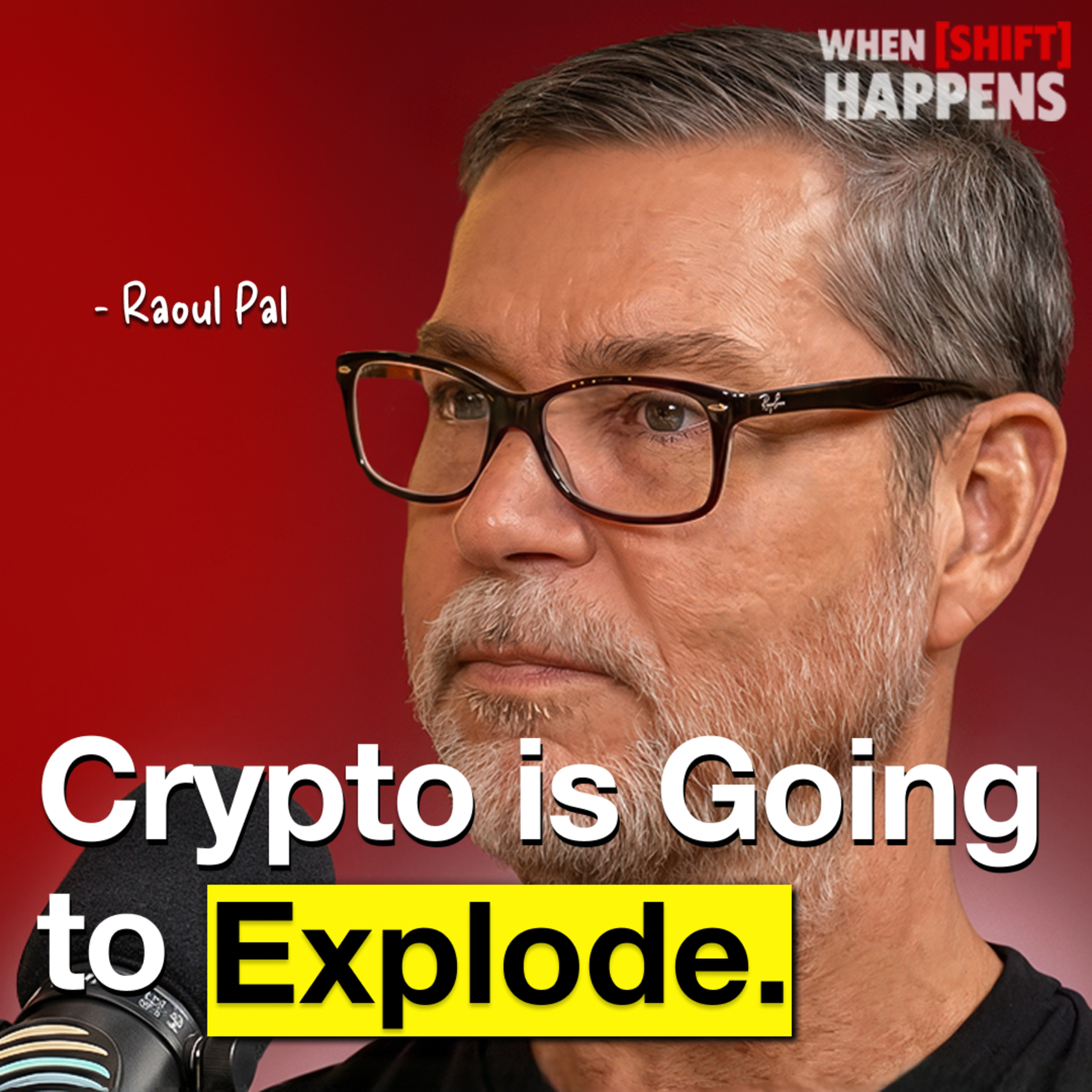
Raoul Pal argues crypto can outperform because the market is still in an early “super cycle” (he frames it like 1996–1997 tech-boom conditions) lasting until around 2030. He ties crypto’s timing to liquidity, argues AI will accelerate “agents” and create an “economic singularity,” and claims smart contracts (especially Ethereum-like networks) and stablecoins/real-world assets will benefit. He also emphasizes compounding via buying during oversold drawdowns rather than trying to trade tops/bottoms.
Raoul Pal is co-founder and CEO of Real Vision and founder of Global Macro Investor. He previously worked at Goldman Sachs and is known for macro investing focused on technology and digital assets.
Written by AI. May contain mistakes.
Discussion on the potential for a sustained increase in crypto prices leading up to 2030.
“When people say, you know, crypto, it's like boring.”
Introduction to Raoul Pal's expertise and experience in macro investing and crypto.
“The economic singularity is going to happen in 2030.”
Exploration of market cycles and Raoul's experiences with crypto investments over time.
“One of our absolute favorite things at When Shift Happens is to look at our data to improve what we're doing for you every single week.”
A humorous reflection on the podcast studio's evolution and past experiences.
“You were actually saying like, I really hope it happens otherwise I'm going to get grilled on the internet.”
Discussion on Raoul's investment strategies and the importance of timing in crypto markets.
“I've done nothing, nothing different except buy when it got two standard deviations oversold versus log trend.”
Insights on how compounding works in crypto investments and the impact of market performance.
“People make it look like, you know, Chris Bernisky can just come, time the market, buy it at the bottom, come back again.”
Raoul discusses changing beliefs about market dynamics and the future of crypto.
“You've been early on some of the biggest shifts in crypto and macro.”
Explore the relationship between crypto liquidity and market dynamics, including factors affecting Bitcoin's price.
“writes online, whether they're real people or not.”
Discover how the integration of AI with crypto is reshaping economic valuations and future opportunities.
“However you want to invest in crypto, the experts at Bitwise have you covered.”
Explore how AI's rise impacts crypto investment opportunities.
“Nature is a good side of that whole thing.”
Learn about the current market cycle and future predictions for crypto.
“38 % of the traders on Calci think that Bitcoin will cross 100k before Jan 2027.”
Understand the emotional and practical challenges of investing in volatile crypto markets.
“But don't forget, it did have 20, 30 % sell-offs.”
Discuss the importance of digital identity in securing transactions and society.
“Yeah, the history of financial markets is always feeling shit.”
Examine how Bitcoin's role has evolved in financial markets and its current status.
“And I realized because I have some other like, uh, alt account and I go on there and I see my own account tweeting about FOMO.”
Learn how to differentiate between promising and failing crypto networks.
“And, and, and, and then, and then the hackers, they start to post some, uh, some shit coin on Solana and everything.”
Discover the implications of AI's rapid growth on society and technology.
Explore the concept of The Everything Code and its implications for the economy.
“Because if you get those other three, there's a huge re-rating.”
Learn how AI's rapid evolution impacts the future of cryptocurrency.
“which is my kind of big master thesis over the whole thing.”
Explore what becomes scarce as AI makes intelligence abundant and its implications.
“Well, because you can't trade intelligence.”
Discover how blockchain technology creates digital scarcity and its value.
“I'm actually wondering how most people, how most normal people still afford traveling.”
Learn about investing in digital art as an appreciating asset.
“To buy just the scarcest assets and get the convexity out of it.”
Understand the factors that could drive excitement in the crypto market again.
“Do you think we're ever going to have something exciting again in crypto?”
Gain insight into the high-pressure environment of financial trading and its effects.
“Because what you're doing is you've set up an infrastructure layer that produces block space.”
Learn about the extreme stress and challenges faced during high-stakes trading.
“Because they didn't know what you've gone through.”
Discover how to creatively achieve life goals without the pressure of high-cost living.
“So most people will say, let's say, I want a house in the sun, and I want to have some land, and I want to have a nice car, and I want to be safe.”
Understand the psychological traps that keep investors holding onto losing positions.
“the whole structure of the market changed.”
Learn how to evaluate investment strategies and the importance of sticking to your thesis.
“And so you back hold the thing thinking it's going to go back, but most of the time it doesn't.”
Learn about Raoul Pal's investment approach and insights on various cryptocurrencies.
“what I want to own so I don't care about the other stuff zcash was obvious to me because the privacy thing just makes sense, particularly after seizing of assets and that kind of stuff.”
Discover Raoul's thoughts on the intersection of art and cryptocurrency as an investment.
“So it's all well and good to have$4 ,000 per user in economic density.”
Explore the potential of Zcash and how it fits into Raoul's broader investment thesis.
“And they'll buy art to remember their youth.”
Raoul discusses market sentiment and the complexities of holding cryptocurrencies over time.
“it's the moron thesis which is like, yeah, what does 10 % of global store of value, want to be private.”
Discussion on the promising networks like NIR and their potential growth.
“You said, ah, this data is really interesting.”
Discussion on the recent performance and analysis of Nier in the crypto market.
“with the price of Nier rising quite a lot.”
Exploring the fundamental reasons for wealth, security, and lifestyle.
“I still probably have a bit of XRP somewhere.”
Raoul Pal shares insights on securing one's financial future amidst market changes.
“and markets are not the same thing anymore.”
Discussing the applications of AI in providing financial insights and community support.
“It's trained on all of the free content I've ever put out plus everything I've put out behind the paywall on Real Vision and my X feed and a whole bunch of other stuff, background stuff.”
Insights on assessing risk tolerance, especially among different demographics.
“And they forget that conversation always when they're down 50%.”
Discussing the balance between lifestyle choices and stress management.
“What's something you used to think would make you happier once you had it that turned out not to matter nearly as much as you thought?”
Exploring the unpredictability of achieving financial aspirations and the journey involved.
“some take it to the very extreme like how much are you into this thing like i actually really need to take care of myself or do some procedures or some things to actually look good yeah no No procedures or anything.”
Analyzing the complexities and repercussions of giving financial advice to others.
Learn about the complexities of risk management and the responsibilities of influencers in crypto trading.
“And you know, that kind of copy trading without doing any work on it is so prevalent now.”
Explore the common market patterns and expected volatility in crypto investments.
“But I still take responsibility because I want everybody to win.”
Discuss the rapid advancements in technology and its implications for humanity's future.
“I mean, we're going through the biggest, fastest change in the history of humanity.”
Gain insights into Raoul Pal's views on the intersection of AI and the cryptocurrency landscape.
“Thank you so much, Raul, for doing that for the sixth time, the second time this year.”

Get the gist, explore an idea or ask about something said.
 Claude
On When Shift Happens Podcast, what are the key points of this episode?
Searching your listeningAutomatic transcript. May contain errors.
0:00Raoul Pal: When people say, you know, crypto, it's like boring. I'm like, everything we've ever asked for, from regulation to the US Treasury saying stable coins are one of the most important single things that we can do. And we don't think that the price is going to explode. So we still think that the price of crypto and Bitcoin is going to explode. I can't say well, then it doesn't. I actually think the whole thing is a super cycle. It doesn't stop. It doesn't stop. What does that mean? It just means it keeps going till 2030. We're kind of in 1997, 96. What happened in the technology boom last time? Raoul Pal, the co-founder and CEO of Real Vision and founder of Global Macro Investor.
0:31A former Goldman Sachs executive, he is a leading macro investor focused on technology and digital assets.
0:38Raoul Pal: The economic singularity is going to happen in 2030. The rise of agents went from zero to everywhere. By 2030, all the study of what we understand of economics, relationships between things, it's going to be so screwed up. We now have basically four years to unfuck our future. What did you learn in the last two years about how to allocate better? I've done nothing except buy when it got two standard deviations oversold versus a log trend and I added more and I bought some Zcash. That's all I've done. You've been early on some of the biggest shifts in crypto and macro, but being early and being wrong can look identical for a very long time.
1:06How have you learned to tell the difference? It's very difficult for you to be wrong.
1:10Raoul Pal: You have to set yourself up where the secular trend's in your favor and then the probability of getting it wrong is much less. And then you can take bets on things that are more emerging. We've done this six times. What's the question I should have asked you five interviews ago, but I never did? You've never asked me the secrets of my good looks.
1:28You've been pounding the table on Sui for a while now, and it hasn't been as clear of a winner yet. Have you actually made money on Sui if you look at the average buys? Or is this a thesis that you're waiting on another one or two years to play out?
1:40Raoul Pal: Yeah, I mean, I started...
1:45Hey, everyone. One of our absolute favorite things at When Shift Happens is to look at our data to improve what we're doing for you every single week. And one of the things that we notice every week when going through our data is how many of you regularly watch this podcast but still have not subscribed. And so if you want to help us get even better guests every week, take two seconds and click that subscribe button just below this video. Thank you for being with us today and for supporting us every week. And now let's get to today's show. Last time you were in Singapore, welcome back to Singapore.
2:20Last time we did that was our first time together.
2:23Raoul Pal: that's right this is our sixth time i know it's been singapore twice dubai twice miami once london once yeah and as you can see there is some progress right it's a lot nicer the first one was a dump i thought was going to be knifed in the corridor well we're bootstrapping a media company right that's right there was actually no other podcast studio in singapore and that wasn't really a podcast studio no it was a music studio it was a closet it was kind of like a music studio so it's for artists right don't pretend it wasn't cool in any way and then it was a shoe covered he was it was kind of shit hole like even even the place where you go to toilets was this chinese toilet where you had to like like sit down there was no normal toilet i was like fuck man like i don't know how long i can get these big people coming here but it worked out it did you've done all right yeah we had this beautiful toilet and we had the banana on the table the kiss of death And some wine.
3:18The kiss of death. You were actually saying like, I really hope it happens otherwise I'm going to get grilled on the internet.
3:23Raoul Pal: And I did. I got grilled on the internet. Grilled banana. That was two years ago already. A bit more actually. Two years and a half. June 2024. What do you believe today that the Raoul I interviewed first one and two years ago would completely disagree with? The banana zone? it didn't fucking happen fair enough um but no i've said the same thing it's not like i say anything new or interesting it's always been the same thing which is like you need to extend your time horizon you need to just hold on to this stuff be careful with how you ask to allocate and that's it do nothing and you know people just we talk about this all the time offline it's like people just lose their minds they can't do it they just cannot do it what did you learn in the last two years about like how to allocate better in crypto?
4:15Raoul Pal: I've done nothing, nothing different except buy when it got two standard deviations oversold versus log trend. And I added more and I bought some Zcash. That's all I've done. I mean, I've done two trades the entire year, which was to buy in whenever it was Jan, Feb, whenever it collapsed first and then buy again in july and that's all i've done i haven't done anything else don't do anything else so people kind of think that you know just because i look at the cycles and liquidity that i'm going to trade around it i don't do any of that because i just want to compound can you explain a bit more how this compounding works and if it really makes a difference to buy these like two standard deviation lower when do you start to see that it makes an actual difference um you notice when the obvious way is like 2022 i bought i started buying solana and eth in june 2022 i think that was the eth low and i started with solana and then i bought everything in december i my pnl was back to all-time highs well before the market.
5:35Raoul Pal: That's what compounding is, right? Because if you just don't do nothing, your P &L gets the all-time high when the market does. If you've got cash to add when it's super oversold, your entry level never gets tested again. So that makes you feel good. It might be tested for the first week or month or whatever, but after that, it doesn't get tested again. And because you've added more to the market at cheap prices, you're at all-time highs well before the market. And that's the superpower, because then suddenly you're really on the front foot and not the back foot. And the other thing people try to do versus the compounding is the idea of this myth on the internet.
6:11Raoul Pal: And I was talking to somebody last night at a Real Vision event last night, is you can sell out and get somewhere near the top, but you will never put the same amount back in again. You just can't do it. It's impossible psychologically to do it because you think there's always going to be the other leg lower. And what happens is, and you're seeing it today, is people are trapped. Yeah. And so I just don't do any of that. So if I want to take money out, I'll take money out because I want to take it out for lifestyle chips. If not, I won't because there's no point because it's too hard to do. People think it's easy.
6:47Raoul Pal: People make it look like, you know, Chris Bernisky can just come, time the market, buy it at the bottom, come back again. It's not easy. And it doesn't. Ben Cohen, Chris Bernisky, I mean, they were pretty good on the top, but then like they kind of miss the bottom. That's right. You don't know how much Chris has put in now. Is he up? Is he putting 20%, 10 %? And then before you know it, Bitcoin's at 100 ,000 and people still haven't got their money back in. So you end up actually underperforming by trying to do that strategy. While if you just say, I look forward to those two standard deviation sell-offs or one and a half standard deviation sell-offs, then you kind of got money ready for it.
7:23Raoul Pal: When it comes, you take it and you say, great, I don't have to do anything anymore. Well, it doesn't feel good. I applied your strategy this kind of... I mean, for me, that was a bear market. For you, that was not. But like, we can talk about that later. Well, it's a bear market, but it's not that, I didn't think it's the full kind of crypto. But I applied the Raoul Pal strategy. I mean, with this podcast, we're generating quite a bit of cash. I was like, I'm going to allocate. So I allocated a lot, actually, every month. I mean, we're kind of like lucky to pick a hype all along Zcash. But did you buy, did you dollar cost average or along the lows try to average?
7:56To be honest, I just DC it. I was like, because I was like, I don't know.
7:59Raoul Pal: Because I think that's suboptimal as well. It's easy to do mentally, but you end up buying all the way down. It's kind of, I find the oversold part much easier than... I don't look at charts much, but I was like, I just DC it every first of the month. And now where some people still think it's a bear market, we're kind of barely starting to get out of the bear market. My P &L is like two, three X previous all time high already. And now I realize, holy shit, I mean, you have to have the right picks, all that stuff. But like, I'm like, holy shit, it's actually works. It was so boring for a year and it didn't feel good for a year.
8:38But you're like, this is the right thing. This is the right thing to do. This is the right thing to do. And, and you, as you said, like you, you, you, you're ahead now and you're like, you, you start to like think, holy shit, if this thing, if this thing is just the beginning of the bull run, like, I don't know what's going to happen. Like, it's kind of scary because you're already at these numbers you never thought were possible. just because of the compounding from the bear market.
9:01Raoul Pal: Now, the question is whether, because a lot of yours are in like hype, Zcash, et cetera, whether they retain leadership throughout. That's the hard one. They might underperform. The unlikely is go the reverse direction of the market. But that's the big question then is having to figure that out. And it's not easy. No, nothing good is easy. No, it's not easy. You've been early on some of the biggest shifts in crypto and macro. but being early and being wrong can look identical for a very long time. How have you learned to tell the difference? Firstly, you try and set yourself up where it's very difficult for you to be wrong.
9:45Raoul Pal: So it's very easy if you're buying a smaller applications layer, a great project versus Ethereum. you know what's the probability that you'll lose money if crypto goes up and you own ethereum very little over time it may end up form for periods of time so you have to set yourself up where the secular trends in your favor it's measurable it's understandable and then the probability of getting it wrong is much less and then you can take bets on things that are more sort of emerging um but that's what i try to do to make it easier to get right um because again you know we go back to the conversation we had the whole don't fuck this up thesis and i said that that 10 of stuff that you you fomo and mess around with if i look at that every time i lost money do you still do it with 10 no and i think i'm not going to again why would anyone do this 10 except if it's their first time because you want to experiment with a meme and you see people making money, it just kills the FOMO side of you.
10:53Raoul Pal: But I've now become sort of super stoic about the whole thing. And so the question is, when do you know you're wrong? It's when, if you've got a thesis and you're not seeing evidence accruing, that your thesis is right. And it's hard in crypto because it takes a while. You have to think about what the technology is what's going to be built on it how it's going to work that kind of stuff so it's hard but i do question all that all the time and look at the metrics on it all but i don't make instant decisions it takes a while because there is still this kind of cycles and because it's crazy volatile so i think we talked about that last time but you have about bitcoin right oh
11:372017 20k 2022 15k five years of nothingness depending where you bought right oh i'm down after five years, uh, 2020, uh, yeah. Well, then there was 69 and then there was 126, but then you're like lower, uh, than six, you're at 60, right? So if you bought a 69 in 2020, whatever, I don't remember when, then like a few years later, you're like, oh shit. Like I'm still down. I'm at 60 now and I bought a 69, like a couple of years ago. And so it's, and he was massive in between. So like there is this extra like kind of mindfuck.
12:17Raoul Pal: I mean, ETH has been the best one for that. It's like 2021 peak. And then it's never broken that high again. But it's forming this massive wedge. It's like the most bullish chart in the history of charts. And all you have to do is nothing. And that's the hardest thing. Because everyone calls you a moron when it goes to the bottom of the range. ETH's dead. Nobody's ever going to use it. And then, you know, it's like, it's ridiculous. And you just have to say, you just have to have a thesis and hold on to that. Like the gold bugs had with gold for so long. Yeah. Much longer than ETH. And like they ended up making money at the end.
12:53But when everything else rips, it's kind of tough to not for more.
12:57Raoul Pal: It is. What's the belief you held five years ago that you've completely changed your mind on? I haven't completely changed my mind, but one of the beliefs was, well, there's probably a few things, But one of the beliefs was that the kind of social economy would come on chain before the finance system did. And it's going to be the reverse. Social tokens and all that stuff. Yeah. And I still think that's coming. I was thinking about it today, actually. I still think that's all coming. And I think people can't see it. And it's another whole layer of use cases. Now everyone's fixated with the finance system plus agents.
13:30But I think, I don't know if you saw the video that came out yesterday, two days ago, which is the new AI video.
13:37Raoul Pal: so like on a zoom call you're speaking to an ai and you cannot tell so it passed the kind of tests of the the touring test of is this real or is it not and over 50 of people think it's a real person so we are going to have to have digital id i know people don't understand it yet but there's no way we can operate a system where you can't tell somebody's voice somebody's image what somebody writes online, whether they're real people or not. And you're going to have to do that because if not, it's going to be crime central. So I think all of that is coming. There's so much that's going to happen on chain.
14:14Raoul Pal: I thought it was going to come first. And so I definitely got that wrong. I still think it's coming. The other thing is, what else have I got wrong? I thought the correlation of liquidity and crypto would be tighter than it has been. and it's been looser because of there's not been enough liquidity. So the liquidity that's flowed has gone into AI and we haven't had fast acceleration of liquidity yet, which tends to then benefit crypto more. So now, right now, we've got this rotation. So tech stops have stopped going up. So the money then rotates into crypto. But we haven't got the phase, that banana zone phase, where everything goes up.
14:56Raoul Pal: And that, I think, is still to come. so if you look at this uh bitcoin and m2 global m2 liquidity chart yeah like this like it's like kind of was pretty correlated and over the last year actually since october last year that's right and that was for a bunch of reasons one was um the government shut down so they withdrew liquidity for that and that happened twice and nobody foresaw that coming so that that's when it started breaking apart because the liquidity that was still available went to the nasdaq everything else lost it. And you've seen this K-shaped economy where the breadth of the stock market has done this, where the tech stocks are here and everything else is like all-time lows.
15:33Raoul Pal: And it's crazy what's going on. And crypto has been part of that whole process. So there's not been enough liquidity around then the Iran war. And so that took liquidity out of the system again, because rates went up, the dollar went up, and oil prices went up. So there's just not enough liquidity. What does that say about Bitcoin and crypto today, if you look at this chart? So when you look at the charts of, and I use different measures of liquidity, I use US liquidity, global liquidity, US narrow liquidity, US broad liquidity, which includes all the loans and leases in the banking system. That's almost perfect for NASDAQ right now.
16:07Raoul Pal: So you can see the marginal liquidity. Crypto is, Bitcoin is basically following US narrow liquidity, which is how many bonds the banking system buys, plus the treasury general account and the Fed balance sheet. so it's following those for the time being but it's still at a discount to every measure that it is and then you flip it around and say okay what does it look like versus nasdaq and gold because assets generally assets have a have a sort of fair value basis between each other and bitcoin got two standard deviations oversold versus both first it was gold and then gold corrected and bitcoin kind of held stable and then it got two standard deviations oversold versus nasdaq and that trend is a beautiful log trend where over time bitcoin is outperformed by 99.
16:55Raoul Pal: i mean i mean um nasdaq is underperformed by 99.97 over time and so that channel got to that and it's like you want to own crypto versus technology and i've owned both but um but it's at this point in the cycle it's like crypto looks the better bet so bitcoin and crypto should outperform yes everything else by quite a lot going forward my thesis has been that smart contracts will outperform significantly this time so that's why because the applications layer of what finance is building and what the agents are doing is all smart contracts so it's stable coins it's real world assets on chain it's tokenizing equities it's perps it's all of the things that are being built are all smart contracts.
17:45Raoul Pal: So what you're seeing is a massive demand for smart contracts. Now, there is demand for Bitcoin as a collateral asset. We know that. But the convexity of, you know, something like ETH, and I don't know what the size of ETH is now, what its market cap is, but it's wildly undervalued versus, you know, what is coming. Interesting. And how I look at some valuation, for example, is I think about always about networks, right? What's the value of a network? And people think it's about cash flow. It's nothing to do with cash flow. This is what everybody gets wrong all the time. The applications layer is about cash flow.
18:17Raoul Pal: Why hyperliquid is interesting? Because it generates cash flow. But that's really an applications layer. Yes, it's a layer one, but it's not true. Broad, multi-purpose layer one. With Ethereum, it's really simple. You have to ask yourself, if I turn the switch off to Ethereum tomorrow, if you theoretically could, how much value do you destroy today and into the future? It would remove 70 % or 76 % of all stable coins in existence. It would remove, what, 70-something percent of all DeFi. It would remove most of real-world assets. It removes all of the digital art market. And it removes all of the layer twos.
18:52Raoul Pal: There's a trillion dollars plus of value that would be turned off if you just discount it on a forward basis, maybe one and a half trillion of value. So it's kind of like it's wildly undervalued. On most trading platforms, crypto lives in one app, stocks in another, and commodities such as gold and oil somewhere completely different. Variational puts perps on all of it. Crypto, equities, commodities, FX, and even pre-IPO names in one single account with zero trading fees on every market at any size. Visit variational.io to see why Variational has quickly become one of the largest on-chain trading platforms.
19:32Big thanks to my friends at Bitwise Asset Management for backing today's conversation. Bitwise is a global crypto asset manager with$11 billion in client assets and more than 70 crypto solutions. That includes ETFs, index funds, SMAs, custom option strategies, staking, vaults, and more. However you want to invest in crypto, the experts at Bitwise have you covered. You're saying like if ETH is like 300 billion, it should be at least 5x higher based on like this kind of thing. Yeah, exactly. If I gave you a blank piece of paper and said, write down the single biggest thing the financial markets are mispricing today, what goes on that paper?
20:14Raoul Pal: I think it's this. I mean, it's boring to say, but right now, it's the integration of AI and crypto. We've gone to an infinite TAM, where before the TAM was the number of users, human users. It was like the internet where you can go from zero users to 4 billion users, 5 billion users, and that's the kind of tan. And now we've gone to infinite tan. And the market hasn't really woken up to that yet. We all talk about it in crypto. Now, we're always early to these things, for sure. And there'll be joy and pain on that ride as well. But I think that's still wildly undervalued. And I think it's wildly undervalued because, again, people are looking at fees about what the value is of having equities online where they're trading 24-7 on blockchain rails.
21:05Raoul Pal: So I think all of that is still stupidly undervalued. You know, I don't think this – I think the infrastructure layer to the digital age is blockchain. And nothing can exist without it. It's like they were all meant to be. It's like a really weird manifestation of technologies that were not really for us. They never were. What do you think needs to happen for people to catch up with this? It's going to be evidence. I mean, the difference in people's understanding of AI is staggering. You know, how much I'm using it, and I'm probably in the top 1 % of users. Then there's another group of 0.1 % users.
21:47Raoul Pal: And then there's your friends. And they're, you know, using it to find out a good restaurant or something. They have no comprehension of what this thing can do. So they don't know what an agent is. We talk about agents. It means nothing to them. But soon that penny drop will come where it becomes a straightforward thing. And then before you know it, they're making payments without realizing it. And then suddenly they're like, oh, I get it. What's something you believe that you wish you were wrong about? That the economic singularity is going to happen in 2030. And I had always 2030 to 2032. where it starts breaking apart.
22:25Raoul Pal: And I can already see the signs. We can see it everywhere. Bond yields going up, but not inflation expectations. It's to do with forward discounting growth within the bond market and the issuance of debt to finance the biggest build-out in history. The rise of agents went from zero at the beginning of the year, if you remember, to now everybody, everywhere. There's now more agents than there are humans on the internet. And that's only been 10 months. And so this is happening faster than I thought. So by 2030, all the study of what we understand of economics, relationships between things, how economies work, who gets the wages, how that works, it's going to be so screwed up that it's going to be really hard to understand.
23:13Raoul Pal: And that's coming faster than I thought. So we now have basically four years to unfuck our future because beyond that, I can't see it. what can people do if they believe this too? Can we even know what to do? Or do we need to be super flexible and kind of like see along the way? Because one of the things is, oh, AI makes everything abundant. Therefore, everything becomes cheap. Therefore, my question is, if everything is abundant and cheap, why do people even need to build wealth? Your argument is you need to build as much wealth as possible before all this stuff happens. Well, I don't think the abundance comes immediately.
23:53Raoul Pal: So the first wave of deflation is wages. And we're seeing that. Wages are not rising as much as productivity, for example. And that will continue. So we'll see wage growth lower than expected. So that's the first wave of deflation, because we can now create infinite intelligence. So knowledge workers, you can print them infinitely via AI now for no cost. So over time, we see that, and then it starts into the goods economy. But it can't get into the goods economy yet because AI needs to be pervasive through all the corporations and all of that stuff. Everyone starts making cost savings and figuring out how to mine stuff cheaper and create stuff cheaper and create more electricity.
24:33Raoul Pal: Like we've got this massive electricity roadblock right now. But what's really interesting to me is what is on the other side of this. You've got the largest race in the history of humanity, which is over superintelligence. and then it's between two nations and nothing must stop this because if you stop it one nation wins and you can't allow that because then you get a state that rules everything and whether it's the u.s or china doesn't matter you need this duality and so the biggest obstacle right now for the u.s side of the equation is energy so infinite money will be thrown at solving this in infinite speed So what happens after you've solved it?
25:15Raoul Pal: So give it five years, seven years of building out massive energy infrastructure. What is the cost of electricity? It's going to be close to zero. The marginal cost of electricity goes to zero. And you've seen that. You've seen Wright's law with electricity. I mean, the cost of electricity from solar has gone down 99.99 % in 30 years. And it just keeps going. I mean, what's a world with almost free electricity? I mean, you can make anything. It costs nothing for anything. So what's the problem there for people? You say because you wish you were wrong about this economic singularity. Because society is going to break apart.
26:01So what does that mean?
26:03Raoul Pal: Because firstly, you've got wages that don't go up, right? This is the ongoing everything code, the ongoing debasement, where they have to keep debasing the currency to fund this super build out whilst people still suffer from it. But it won't be mass unemployment, but it's just the grinding, I can't get ahead, which has been pervasive for so long now. That continues. But then you get the political backlash, which is, I don't want data centers, I don't want AI, I don't want this, I don't want that. That's terrifying because it's going to split people apart over this. And what they're actually doing is slowing their own progress down.
26:40Raoul Pal: Because you've got the other side, China, accelerating in the race too. So I think the political system is going to get really fraught over this. People are going to get angry. People are going to get concerned. People are going to have misinformation about it. And then it becomes also, whilst people aren't used to the new technology, how much scamming and how much stuff can go on when you've got video representation, vocal representations, you know, calling the bank and confirming it with your own voice is worthless now. You know, all of this stuff needs, the whole structure of society needs to change.
27:15And then building a business, what does it mean?
27:21Raoul Pal: What is, what education do you do? What are you trying to aim for? You know, do you want to be trained as an accountant or a lawyer? Probably not. So that's the problem of the whole thing. And then if agents and AI are accumulating wealth, how does it get redistributed? Or do these guys just get super ultra wealthy? It's probably a combination somehow. It needs to get redistributed. So your answer is get as rich as possible. I mean, it's one of the answers. You just want optionality, right? So the optionality is find a home, a stable place where if the political climate turns ugly that you feel relatively safe in.
28:02Raoul Pal: And I've talked about that. Nature is a good side of that whole thing. And the other is trying to make money. Try and make as much money as you can in this gift of an opportunity where more money than ever before is being forced into one particular opportunity set, which is this whole technology crypto nexus. So take it. And then after this whole event, well, if agents are running the world, if AI is running the world and it's taking a larger share of economic activity, well, this is where I've talked about is blockchain is so great because if that's the rails they operate on for the payment system and everything else, and sort of validation online and all of the things that need to come out of it, then you can own those rails.
28:50Raoul Pal: So everybody can own the infrastructure rails. So there's no excuse. And now they're tokenizing all the equities. You can own those too in any country in the world. So there is the chance for everybody to participate in it. But the crypto rails is the one part that's interesting because it doesn't get disrupted. like companies do, really, just ends up being infrastructure. You said before, I mean, we definitely had a bear market over the last year, but it's not like the real super painful bear market. Yeah, because we didn't have a withdrawal of liquidity. We had a marginal withdrawal of liquidity, which is why equities went up and crypto went down.
29:28Raoul Pal: So I wouldn't call that a full cycle. To me, it looks more like 2019-2020, where we had that big correction, we didn't go to the low. It feels more like that. And I've said for a long time, I think this is going to be a longer cycle. And that's how it feels to me. So the mid-cycle correction. But it matters not. Market went down 50%. It's pain either way, right? 38 % of the traders on Calci think that Bitcoin will cross 100k before Jan 2027. You're agreed that we didn't go through like a proper bear market based on liquidity withdrawal, but more like a big correction. If that's the case, how long does this bull run go?
30:07Raoul Pal: And where does it bring us? See, the issue is we can't tell because it depends what financial conditions are doing, what the dollar is doing, all of this stuff. And so we can't tell. Right now, the dollar's been going up, rates have been going up. That's not good for forward expectation of liquidity. But we've got the offset, which is the largest capital expenditure in the history of humanity underway that supports the economy. So we can't tell. The debt rollover is 5.8 years right now. And so that would give us probably until 20, sort of Q2, 2027. But I actually think the whole thing is a super cycle.
30:45Raoul Pal: Crypto, tech, the whole lot. And it doesn't stop. I think it's going to suck in all of the capital. It doesn't stop. What does that mean? It just means it keeps going until 2030. 30. Something like that. So this is like, we're kind of in 1997, 96, in what happened in the technology boom last time. And it barely started. It really accelerated after that. So you're more like 96, 97, rather than saying, oh, we had this big crash to 2022, which would be like 2001 in kind of NASDAQ. And then for, I mean, there was the great financial crisis. Okay, but like, if you look at tech for 20 years, just compounded.
31:28Yeah.
31:28Raoul Pal: But don't forget, it did have 20, 30 % sell-offs. It's only when you look back at the chart, it looks like nothing there. Well, that would be the 50 % sell-off that we have now in Bitcoin and that might just continue, but people might just think forever. Ah, we have to go lower. We have to go lower. Like now, we have to go lower in October, right? But we just don't. And therefore, if you just DCA or accumulate when it's two standard deviation lower, like you just, I mean in theory when you look back you're like ah that was so easy but actually it's still the way to get your head around it is put up the chart of the Nasdaq Microsoft, Amazon Meta and do the long term log regression channel on them and they've all done this all the way through and they just continue to follow the same guidelines and in the end you don't hear people complaining about the volatility in Microsoft even though there's been massive volatility It goes down 50 % often.
32:27Raoul Pal: Amazon does too. But in the end, people just know it's a compounder. People just haven't still got their heads around crypto yet. No, that's why not everyone is rich. Yeah. Because in theory, it's easy and practice is super hard. But it's not. Well, mentally it is. When AI stocks are going fucking crazy and you're like, I'm just going to DCA or whatever, wait for bitcoin or sui or zcash whatever to be like going to shit to buy well it's still it's still hard yeah because the moment to buy ai is not when everything pumps like crazy it's when no one gave a fuck or when there is a massive correction afterwards that's right like the same as it went up like crazy like the same as zcash went up like crazy and you're like oh i'm gonna look at this when it's down 70 i'm gonna buy right ai stock same but like you it's it means you're never cool because you're never doing the thing when it's cool no that's right you can never tell your friends no but you tell them they're gonna tell you you're a fucking loser you're buying z cash at minus 70 or ai stocks at minus 70 right but there again i've seen you on x boasting about the fact that you got it right this time by yeah but i've never i was never emotional i was never cool and i'm still not cool but now you're thinking no you think you're cool now because you've actually done it the right way no but i have no one to share it with i can share it with you but like i'm like it's kind of depressed it's very lonely all this it's a bit it's like being a founder right yeah super lonely because you always do the thing that nobody else wants to do at that moment yeah yeah and then you're gonna have to sell at some point when it's gonna be so cool to buy not to sell and you'll be like fuck man so you always feel like shit yeah or you always feel Oh yeah, yeah.
34:14Yeah, the history of financial markets is always feeling shit. And if you're not feeling shit, you're doing it wrong. Yeah. That's why not everyone is rich. That's right. That's why. We've gone from Bitcoin as digital gold to Ethereum as financial computer to stablecoin, tokenization, DeFi, and now AI. What's the next crypto primitive that you think is going to look obvious in hindsight? ID.
34:40Raoul Pal: it's like we cannot fucking we cannot go another year without it we simply can't this you've got to have a zero knowledge proof id to confirm who you are because the internet and society is going to break if we don't do it and i've been bleating on about this for years i mean i got amazon microsoft meta a whole bunch of them together back in 2020 and 2021 saying ai is coming you guys need to have digital ID and they're like yeah we do and then they couldn't agree a common standard but we're going to have to do this fast because we're going to break society really quickly because nobody you know in the digital world you can confirm there's no way of doing it and people I'm always like an optimist so I always think like people should have some kind of judgment and say like this is not this person talking Like I know this person, I got my ex account hacked sometime ago, a couple of weeks ago.
35:45And I realized because I have some other like, uh, alt account and I go on there and I see my own account tweeting about FOMO. Hey, I just joined FOMO. What am I buying? And I'm like, what the fuck? And I see in the comments of people saying, I didn't think you were like that. You fucking loser and everything. And I'm like, I mean, first of all, like he said, I didn't think you were like that, which is like positive. Right. But then I'm like, people should know that like, I think that all this stuff is shit, like based on everything I say all the time, but like, yeah, people, people don't have judgment and there's no attention span.
36:16Right. So it makes it worse because like everyone makes a decision like in a millisecond. I'm like, do I trust this? Yes. No. Boom. And, and, and, and then, and then the hackers, they start to post some, uh, some shit coin on Solana and everything. I was like, oh my God.
36:33Raoul Pal: We have to do this with news. We have to do this with everything. Everything has to have an on-chain record to prove its provenance. Because anybody can make a video of anything now. And, you know, we're going to go through an election in the US. And if we don't have ID, not the midterms, but the main election, we're so fucked.
36:56Do you still believe Bitcoin is primarily a monetary asset? Or has your mental model of Bitcoin changed? No, I think it's that.
37:03Raoul Pal: I think the whole digital gold idea works well. I think it's a collateral asset that is attractive over time. What we've seen is the seizure of Bitcoin now. Like the seizure of gold from Russia was a big signal. The seizure of dollar assets from Russia was a big signal that got people to buy more gold. Now we've seen the seizure of Bitcoin, the Iranian Bitcoin, which coincided with the Zcash's price rise. no you know so yes i i think it continues i know the sovereign wealth funds are all still interested i think everyone gets it over time um i think the privacy thing is also going to be important why does no one seem to care about bitcoin specifically now because it's boring what's there to talk about the fucking millions of podcasts talking about bitcoin it's like gold podcasts it's like it just is right there's nothing else you do it it just is and that's fine you just buy it and i mean do we do we have whole podcast based around bank accounts do you still own your one bitcoin yeah good we've watched hundreds of supposedly revolutionary crypto networks come and go maybe thousand what separates a network that becomes infrastructure from one that is just another psychos narrative it's you know it's tough to know it's tough it's tough to know because you know some of these are built by really quality teams some of them have amazing technology who the fuck knows um it's it's a complicated game you know and i've only got one of those bets which is sui as i know and i'm on the foundation but i've taken that bet because i think the team is exceptional i think what they built is exceptional and i think we'll see the proof arising of use case stuff like zero cost stable coins is like a no-brainer for the agentic economy there's there's so much there the speed of transactions all of that stuff the privacy elements all of that but we'll see i mean you don't know you just don't know it's you know it's never that easy to spot the early trend and say this technology is going to work and it's much easier to say well just buy solana it's fast it's cheap they do a great job it's great protocol what's a great example of a crypto network that you feel is at the inflection point from a narrative to an actual infrastructure and long-term usage um well only two have actually matured so that's e you know of the smart contract platforms of layer one it's only eth and um salama that's matured so the game is every network um business on earth has maybe five dominant players it's pretty standard across everything whether it's operating systems or whether it's cloud or whatever it is so there's probably room five here I don't see why it's any different.
40:05Raoul Pal: So who are they going to be? That's the game. Because if you get those other three, there's a huge re-rating. And that's an interesting game to play. You spent years talking about the exponential age before most people took it seriously. You just published a book about the exponential age, by the way. Now AI is accelerating incredibly quickly. Are we still underestimating the rate of change of AI? Yes. So a bit about the book's called The Everything Code, which is this whole thesis that I've had about the debasement of currency is being used to manage the debt, which grew because of the aging population.
40:48Raoul Pal: So demographics, debt, debasement. That's the story of The Everything Code. That's what's going on. That's the world we live in. That's why we own the only two assets that outperform debasement, crypto and technology. then we have moved into the duality of that world with the exponential age where everything has gone vertical and the end stages then go into the economic singularity when everything changes so we're right in the middle of every curve going vertical i did not imagine it this fast because we're kind of in crypto used to and in technology used to um metcalf's law so when a network takes off, we know we put it on a log chart, and it all looks normal, and we can deal with it.
41:33Raoul Pal: You get your head around log charts. But this is a log chart squared, Metcalfe's law squared. So you've seen Anthropics revenues were the fastest ever rise of revenues in the history of the world. From zero to a billion users of chat GPT is the fastest in the history of the world. Their rise to the 100 million users was fastest in the history of the world. The output of intelligence per unit of energy, which is what I measure as a big part of the universal code, which is my kind of big master thesis over the whole thing. We've had intelligence growth per unit of energy at Moore's law, which was like how much compute you got out of a transistor and out of a silicon chip and all of that.
42:16Raoul Pal: And the application of intelligence, it's gone vertical on a log chart right so that's called reed's law reed's law doesn't exist in nature in fact it's never been observed i cannot find another example of reed's law and we're fucking living with it everywhere all around us which is why we cannot go heads around what is happening in ai because we've now got self-recursive learning going on where ai is building ai and it's getting faster and faster and faster we're getting new models every month remember we used to get them twice a year or once a year. So the rate of intelligence from how I measure it is doubling every four and a half months, intelligence per unit of energy.
42:58Raoul Pal: And we're going to drop the electricity costs over time. Right now, electricity has actually risen in price because of this demand structure. If you produce solar, it's dropped. So that's why everybody's now, like Elon, everyone's producing solar plants, gas plants, and small nuclear is where they're going. And eventually the cost of electricity will fall and you get the double multiplier. So this is like la-la land and it's not going to stop. It's not going to stop. There's nothing to stop it. And it'll just suck in all of the world's capital as well. So what are we doing crypto? Well, if crypto is only exponential, but it's not exponential, exponential.
43:36Raoul Pal: Well, because you can't trade intelligence. Right. So does Anthropic, if you buy it on the IPO, is it a double exponential? No. I think none of this will be. So the use is the double exponential. The intelligence is the double exponential, but I'm not sure the profits are. So crypto has remained the best performing asset class in the world. Even with Bitcoin from its lows is about a 45 % annualized return. And if it's back to the two standard deviation highs, it'll be about 120 % return. I mean, that still kills all of these stocks. So it's just time horizon again. I don't think anything's changed.
44:17If AI makes intelligence and execution abundant, what becomes scarce?
44:23Raoul Pal: Okay, scarcity gets really interesting because, and you're already seeing pricing in markets, human experience. So human stuff that AI can't compete with, live concerts. Look at the price of Ticketmaster shares, just like this. the sports teams just like this and just don't stop going up. All of these live experiences don't stop. My guess is the size of the YouTube economy, the same, just none of this stuff stops because it's human experience. Yeah. YouTube economy, good. Good for us. Yeah, but don't forget - Actually, it's true. I mean, if you have your face on the thing, et cetera, right? As long as it's authentically you, and then you can have live experiences around it.
45:15Raoul Pal: Live experience is the other big thing. So these are really human things. Travel just keeps doing this, never stops. So those things seem to be the kind of offset around it. I'm actually wondering how most people, how most normal people still afford traveling. It's just insane. It's just insane. I don't know. When you go to Europe in summer, you're like, what the fuck? Yeah, but then where are all your friends with less money going to? Thailand. They find the place that's cheap where they can still have fun, like Spain used to be in Europe, but it probably is now again. It's pretty cheap again.
45:56Raoul Pal: So people start going to places that are cheaper, and that lifts other countries out of poverty. It kind of works. Not everybody can afford to go to a lot of places now because they're just priced out. where does crypto fit into that scarcity so the ultimate scarcity so scarcity of a money you can't debase okay we get that one bitcoin um in the scarcity what does blockchain actually do in a digital world you can make infinite amounts of anything infinite and you know in by next year we can have this conversation. It won't be us. It'll just be our AIs, right? So you can make infinite content. We're seeing that everywhere now.
46:39Raoul Pal: So what is scarcity? Well, blockchain creates digital scarcity. And this is, I keep bleating on and people don't fucking get it yet. But digital art is the greatest example of how this works. It is, it proves that you create digital scarcity out of something that had no scarcity beforehand in the digital world. And that's immensely valuable. So digital art is a representation of culture and it's a compression of all culture. There's your concert tickets you went to, the nights out you had, all of those things, none of them you can monetize. The music you listen to, they're all worthless because they're all infinite or fleeting.
47:20Raoul Pal: So it all compresses all the value of all culture of a period of time across the art. It's done it every single time. and we're going through the largest change humanity's ever gone through and we've got this breakthrough art so art went from canvas to the streets and it's now gone to the digital streets if and they're doing it with ai as well if this is not some of the most valuable stuff that ever gets produced it's beyond me it's it's so fucking obvious to me so i'm actually starting a digital art fund and all of this now called epoch one so i think that's this is probably a pre-announcement of a pre-announcement, but that's in, I think, November we'll launch it.
47:59Raoul Pal: To buy just the scarcest assets and get the convexity out of it. Because how you think of digital art is, it is, let's say you're mainland Chinese. You know, we're in Singapore today. You're mainland Chinese. What do you do? You buy dollars with your savings. And then if you've got a lot of money, you buy a dollar asset, which is why they bought all the real estate in Australia, Canada, the US, London, Paris, all of these places. why? It's because that's the way of parking your dollars in an appreciating asset. So you get the dollar convexity, let's say your currency goes down 50%, and then the property goes up 100%, okay, you've made huge sums of money.
48:38Raoul Pal: And that's what all emerging market investors do, which is why they drive the art market and the real estate market. And I'd forgotten all of this because it was only after I built my kind of AI GMI brain that I was able to inquire back to the history of all the stuff I've ever written. And it's like, oh, you've done this before. I'm like, what are you talking about? It's like, it's like, do you not remember in 2013, you switched all of your life savings into dollars from euros? I was living in Spain. I changed the billing of the whole business from dollars to euros when it was at 140. And I said, the dollar's going to rally from here.
49:14And then I built a house in the Cayman
49:17Raoul Pal: because it was a dollar peg currency and i didn't want to be to to sell my dollars and i'd be forced to if i didn't so i bought an illiquid asset in dollars in a place that would appreciate and it paid off and i'd forgotten i'd done that whole trade and it's like oh this is the same as the art trade all over again does that mean that our favorite jpegs are ever going to come back no no no you know that whole pfp thing i don't think that that is a big deal that punks obviously um some others will you know find some historical relevance but it's art art and that's a harder market to approach because it's not as fun and it's not as exciting and it's not as like you know i bought this and i bought one of these and i got the scarcer rarer one no it's like do you know the artists you know who are the other collectors it's a very different way of you know it's a much more serious thing so the jpegs are cooked yeah your bag of shame is fucked people won't like it yeah i mean i have so many bags of uh i mean you can see it happening people so want it because people loved it because yeah it was one of the best moment in crypto yeah it got everybody together it was a lot of fun and people made obscene amounts of money and you know punks was the one that went from what five bucks to some of them traded for millions i mean that returns were staggering.
50:41Raoul Pal: And so people have that in their heads. I don't think that happens again. You get bursts of it. We've seen it recently. There's been a few bursts of it. So you're going to have to live with your wallet of shame forever. It's fine. It's full of a lot of shit, other shit too, so. Quick shout outs to our legendary long-term When Shift Happens partners, without whom none of this would be possible. Thank you to Cast, my go-to global money app to store, earn, move, and spend stable coins across 170 plus countries directly with Apple Pay or a physical card. On top of that, I can also get paid in USD and Euro with my Cast Virtual Account.
51:22Use my promo code SHIFT, S-H-I-F-T, and my link below to get 10 % off your membership, earn up to 3 % instant USD cashback on every card spend, and get up to$250 in cash for referring your friends. No banks, no borders, just money that moves with you with stable cash rewards. Do you think we're ever going to have something exciting again in crypto? Yeah. Like that excites everyone, even outsiders? I think money excites most people.
51:56Raoul Pal: I think, look, basically everything we've ever asked was about to happen. I mean, when people say, you know, crypto, it's like boring. I'm like, everything we've ever asked for, from regulation to sovereign wealth funds buying Bitcoin, to the entire financial system now committing to build on this, to the US Treasury saying stablecoins are one of the most important single things that we can do, that we want to sell our bonds to stablecoin holders. And we don't think that the price is going to explode? And of course it fucking is. I mean, it's so obvious. And that's what gets people excited. It's not really the fact that they did it in JPEGs.
52:34Raoul Pal: It's because they made a lot of money. And, you know, yeah, memes will happen again and people make and lose fortunes and all of that. But generally just people making money is fun. Not making money is not fun. So we still think that the price of crypto and Bitcoin is going to explode. Yeah. I can't see a world that it doesn't. You just can't. Because what you're doing is you've set up an infrastructure layer that produces block space. and we haven't been using a lot of it. And now we're going to use a lot of it. So therefore it gets more valuable. You spend decades trying to understand the future.
53:11You always say I live in the future. Yeah. Those constantly think about what's coming, make it harder to live in the present.
53:19Raoul Pal: Yeah, a lot, really hard. Really hard. It's weird because I'm always, even in my personal life, living two, three, four, five years ahead. And it's hard to bring yourself back down to where you are. Does it mean that you live in anxiety constantly? No, it's motivation. Motivation. Yeah. So I use it to try and manifest destiny in personal life. It's like, you know, how do you motivate yourself to do something? So every morning when I was working at Goldman Sachs and I was on the tube at 5.30 a.m., I would focus on how do I want to get out of this? Which is I want to leave before everybody else does.
53:59Raoul Pal: I don't want to get into the whole partnership thing at Goldman. I want to leave before people and I want to cut to the lifestyle, living in the Mediterranean coast of Spain. And I just manifested it. This is an interesting one because I lived three years in London and the tube, oh my God, it was not 5.30. It was more like 9, 9.30. So peak traffic. You never really worked if you're 9.30. It's fucking lunchtime. People in finance actually work for a living. People don't realize that, think they get paid a lot. but oh my god it's hard i was trying to build my first company actually we moved to london when i was 22 you're not going to build a company going at 9 30 in the morning sorry my friend especially especially because at 9 or 9 30 actually it worked out pretty well but because at 9 or 9 30 you have to wait five fucking tubes before you can take it that's right because it's just full so tell me about the raul at 5 30 a.m in the tube like what was going on in your mind you know it's two things of like what's happening now markets all of that trying to figure out where everything's going but the other side is like why am i doing this you know it was so hard people can't understand like 1997 98 over the financial crisis i was so busy and we were understaffed and i was trying to hire people that i couldn't leave the desk to go for a piss um because i was getting paul Schilder-Jones, Stan Drucken-Miller, Julian Robertson, other people at Soros, Lewis Bacon at Moor Capital, all calling through with orders, shouting and only wanting to speak to me.
55:35Raoul Pal: So nobody else could pick up the phone to them because they would cut the whole firm off. It happened with Lewis Bacon or Soros. They would call up. If I wasn't there and somebody from the institutional thing who was slow moving and didn't know how to deal with these guys, they cut off the whole firm for a month like we're not dealing with these fucking morons it was like the hardest thing and that was like 14 hours a day at the desk but did you feel like oh this is so exciting i love my job i love my life or do you feel like i need to get the fuck out of this because i don't feel any meaning in oh it was the most exciting time but the most stressful time i had eczema and rash over my face i couldn't sleep on a friday i would go out for dinner with friends and I couldn't speak.
56:15Raoul Pal: Because they didn't know what you've gone through. They don't know the intensity of 42 telephone lines all ringing. You're on three phones at once, trying to shout to the guy over there to get an order, get somebody else to pick up a phone. Everyone's clicking their fingers, trying to get other people to pick up phones for you. And that's going on for 14 hours a day. So you mean, couldn't speak because of tiredness or because of like anxiety, like of sleep? You're shell-shocked. You've gone through so much. And you're trying to explain to people, it doesn't mean anything to them. But you answer the phone and you would, you know, why is that stressful?
56:48Raoul Pal: I'm like, you have no understanding when you're dealing with billions of dollars, tens of billions, hundreds of billions of dollars. And it's all instant urgency. Everything must be done immediately. It's like, it's hard. For someone who is taking the tube or the metro every day, going to their nine to five or four to six or, and feeling like, how do I get the fuck out of that? What's your advice with him? The advice is, what is it that you want? And can you get to the same thing easier? So most people will say, let's say, I want a house in the sun, and I want to have some land, and I want to have a nice car, and I want to be safe.
57:32Raoul Pal: And then they look at prices, and it's like, well, if I try and buy a house in Mallorca, that's$5 million. I can't do it. but then all you need to do is look for another place you can do it and you can do it for a fraction absolutely and then you realize oh i can have exactly the same quality of life but i'm just not in such a posh place or such a um fashionable place to be but i can get exactly the same what do you think keeps people in this most posh or fashionable places well that's just status they just want to be around other people it's also isolating if you're the wealthier person in a small town you're the big fish in a small pond it's not very nice because everyone looks at you and i've kind of done that before and that's not good in spain yeah um and that's not great look either um but people also don't want to believe they can do it they kind of sell themselves a story that they can't have it and i've seen plenty of people who can particularly now if you can work on the internet you can live anywhere in the world yeah you know and if you're if your dream's a beach i mean you can go to el salvador or nicaragua or somewhere in the central america it's nothing or in southeast asia there's plenty of places you can live for a fraction of the cost and have a nice house on the beach which you can own in a secure politically secure environment but people don't see it people want the abiza beach and house yeah because it feels less risky but also it's the same as building a business building a physique or building a career or anything like or or building wealth you could say ah you could see it like in steps or in stairs i'll go first to this cheaper place maybe the ultimate goal is to go to this more expensive but they want the best thing right now.
59:26And then it seems impossible. They want the shit con 100X right now.
59:29Raoul Pal: So they don't do it. Yeah. You kind of force yourself not to do it. And if you tell yourself, I'll never get there, you will never get there. But if you do it either in steps or as you say, you accept something different and then use that as a base to build on. And that's what I did. I did that. You've had enormous conviction in ideas that took years to play out. how much of your success is actually intelligence? And how much is simply having the psychological ability to see through being wrong for a long time? I don't think it's that. And intelligence, I don't know if it's that. But one thing I did do is I went back through my GMI brain and said, okay, what is my hit rate over 21 years?
1:00:14And it's 65%, which is stupid high.
1:00:18Raoul Pal: 65 % of everything I've ever, every position that's ever been recorded in the history of GMI has been profitable um and the average profit was like 50 per trade so where does that come from it's the living in the future and pattern recognition that's what i'm good at i'm just very good at holding a 3d jigsaw puzzle of everything happening in the world in the future in my head now is that intelligence or is just a weird trait i don't know but most macro people have that um and it's that but for the 65 of the trade to be profitable probably a bunch of these trades if not more than a bunch were not profitable for a while yes i've had many of those that they take a while to play out and you really question yourself and you're like i don't use stop losses but you have to have an idea stop and it's really hard when prices against you and you're not sure the facts have changed and you end up, you'll lose more in your losers than theoretically you should, but you should make it back in your winners if you get it right.
1:01:26Raoul Pal: And time horizon is the thing that's worked for me. But sometimes, you know, the whole structure of the market changed. I was very bullish bonds out of 2022. No, earlier, bonds have broken this big log down channel they've been in for 30 years. I called it the chart of truth because every time it touched it, it reversed and yields went lower. Then it broke out and I thought it reversed back into the range. Never did. So it takes you a while before you're like, okay, I'm done with bonds. I don't get it anymore. It's changed. So I lost money in that. When did I really lose money in that? That was 2022, I think, 21.
1:02:08Raoul Pal: And then I realized something had changed. So that's painful, but I made it up in other stuff. what do you do when the conviction disappears when it disappears it's a problem if you if you and i've learned this is if i had a big diversified book i end up forgetting about the positions i mean i've got one in um carbon allowances i made 200 returns in it the first time i did the trade then i came back and did it got the timing completely wrong and so it was down 40 at one point but i know how it works it's driven by the business cycle and the business cycle had been slow because it took forever for the rsm to build up and the carbon allowances the european carbon announces is based on that and now the trade is up small but i can't cut it yet but i just didn't look at it and that's bad because then you're not really managing your pnl um so i've tried to be more more concentrated so it'd rather be concentrated and in a specific field or two, it's much easier to have conviction, right?
1:03:11Raoul Pal: It's much easier to have conviction. It's much easier not to lose money. I mean, I don't play the game of, you know, cutting my downside all the time. You know, I'm not a trader. But even then, I know I've got basically two bets, crypto and technology. And then I'll have crypto bets that are working, some crypto bets that aren't. I'll cut some of them, or I'll just eventually just give up. What's an example of crypto bet that didn't work out and you cut? I had a position in, there's a UK listed company called KR1. And they're basically like a open-ended, a closed, sorry, a closed-ended VC fund that was a public company.
1:03:50Raoul Pal: So these guys were early in the Polkadot ecosystem when that was a big thing, early in Ethereum, early in a lot of stuff, really smart guys. But the structure was a bit fucked because they couldn't raise any more money from it because it had a fixed amount of capital in it. and when you looked at the the nav at the time back in 2021 it was trading a huge discount to nav now in the end most of what they held proved to be in protocols that weren't super valuable and who knew that polka dot wouldn't be because you know five years ago it was a serious ecosystem um and so i had that position for ages just thought well when alts rally i'll just be able to get out for less loss and eventually i just cut it down what at 80 or whatever it was a small position but it's like you know i've done that a few times you
1:04:39I just have to say something about this. When alt rally, I'll be able to like recoup my investment. This is a very classic psychology that even if you think about, maybe you say, it's okay, I'm in this top meme coin. It's a meme coin, but it's a top one. When alt rally, this thing should get back. You basically hold the bag at loss, right? Instead of saying, I can just put this money into something that I think it's already hot or proven a leader, and I'm going to probably make this money back much faster. But I can't fucking sell, right? And so you back hold the thing thinking it's going to go back, but most of the time it doesn't.
1:05:26Raoul Pal: And I suffer from that. I think the trick is, and I've not managed to do this, is just think of it as new money to add to your position in Hyperliquid or Solana or whatever it is, right? your choice of thing that looks strong and just say it's new money as opposed to and down. So if you put in, you know, 10 grand and it's worth a grand, you should stop thinking it's down 90 % and saying, well, I can put another grand into... Something I believe in or that's doing well. I haven't got that psychology right yet either. But that's the way, I think, to think of it. To distance yourself from the loss and just think of it as the capital.
1:06:03Raoul Pal: I think is the way. When do you accept that we're wrong and move on? Uh, it takes time with me. Um, it just takes time where if it's a big position, then it'll be more big technical levels. You know, how's it trade? What's going on? Is the adoption not working or whatever? If it's, if it's a stock, you know, is something not playing out here? Um, if it's a smaller position, I'll, I'll tend to, yeah, abandon it, which is a, which is a bad way of doing it. You've been pounding the table on SUI for a while now, and it hasn't been as clear of a winner yet as your BTC bet in 2020 and your sole bet in 2023.
1:06:48Have you actually made money on SUI if you look at the average buys, or is this a thesis that you're waiting on another one or two years to play out?
1:06:56Raoul Pal: Yeah, I mean, I started, obviously I got granted from the foundation, but ignoring those, is let's look at the ones that I bought. I think I bought as low, I mean, I bought in July at 70 cents. I bought previously at around the same kind of levels. I've also bought at two and a half. So I think my average entry is probably, excluding the ones I was given, my average entry is probably 170 150 something like that so that underwater underwater okay but you have this big thesis so you're basically saying i'm waiting for this to play out i'm a massive believer yes and you know my job is to question that right you build a thesis and then your job is like is this bullshit am i wrong where am i wrong what proof points do i need And so how I looked at SWEAT is I started thinking, okay, what is the, because people are looking at fees, I'm like, stupid.
1:07:58Raoul Pal: The job of technology is to reduce all friction. So everything has to go to zero in cost. That's how all technology works. So I'm like, okay, so what are we looking for here? What is the value of a network? Is this whole Metcalfe's Law idea? And what I got down to is economic density per user. So how much TVL is held per user? And if that is fleeting, so when the price moves, it moves a lot, it tells you that's not sticky. So SWE actually has more density per user, even though it's got a lot less users, but they're kind of economically valuable, that it produces like$4 ,000 per user. So if you add a new user to the network, it adds$4 ,000 of value of TVL, which in chain valuation term goes up a lot.
1:08:46Raoul Pal: So if SWE is like at 150 ,000 active users, daily or weekly, whatever you use, if it added another 100, it's probably a 3x multiplier in price. And after it fell 85 % this time around, its economic density stayed, while Avalanche and other decent protocols collapsed. Only three held economic density, Ethereum, Solana, and SWE. That was a signal to me. That was a really interesting thing to see. is that whatever's there is sticking around. And like staking, I mean, whatever it is, 75 % of the entire market's staked, and that doesn't move. It's like, okay, this is interesting. What do you feel in your guts when you're massively over 83?
1:09:31Which you actually said on this point, I'm massively over 83. But another asset like hype, or more recently Zcash, steal the show. So hype is not in my thesis.
1:09:41Raoul Pal: So it doesn't matter to me. not that I don't think it's a good thing or whatever it's just that's not the thesis that I'm playing the thesis to me is layer ones are the infrastructure layer for the digital age particularly where we're going the economic singularity and beyond and so therefore that's what I want to own so I don't care about the other stuff zcash was obvious to me because the privacy thing just makes sense, particularly after seizing of assets and that kind of stuff. And there's just a number of times you can hear fucking Barry Silbert call me up and say, you need to buy this, and me ignoring him, and then he gets it right.
1:10:25Raoul Pal: So I'd spoken to Barry a lot about it, and I saw other people I'd spoken to about it. And so, yeah, I bought it at$200 or something, and it's worked out quite well so far. at 400 maybe 400 but so yeah so i don't get i've trained myself not to have fomo it's like it's out of my thesis so pump.fun can go up 50x i don't care because it's not my thesis and therefore i'm just trading somebody else's thesis then you have conviction i have a thesis i've written a lot about i've done a huge amount of work on it and i know i'm right on layer ones am i right on where sweet fits into those don't know but i'm fucking sure i'm right on on ethereum and solana when do you think the sweet thesis will play out and you'll be able to tell people i fucking told you so well i hope i can because a lot of people have come along for the ride for that as well and people are hurting um look i think it's it's kind of all the conditions are there all the conditions are there and if if they don't get adoption from the agentic economy or they don't get adoption in finance and the you know hashi the goals um you know the sort of um gold on sui and other big projects don't get traction and the eve online gaming doesn't get traction then somebody's not executing properly because they there's no reason for them not to because the technology stack is so good and the people are highly experienced.
1:11:58How can you test or see whether the execution is good?
1:12:03Raoul Pal: Well, in the end, it has to be use case, right? It's how many active users and how much are those users worth. I mean, it's that whole equation. So it's all well and good to have$4 ,000 per user in economic density. But if you're not growing users, you're going to go nowhere. so that's the case here and if it works it'll outperform because if you think about Sui it's like there's still a whole bunch of unlocked stuff unlocked stuff that has not been issued yet or is out of the market then you've got 70 % plus of stuff that's staked so the free float of this is tiny so if you bring new users on or new investment in it massively outperforms So that's been my thesis for a while, and we see it every time.
1:12:56Raoul Pal: If you look at the chart of ETH versus Bitcoin, and then look at the chart of SWE versus Solana, they're all the same pattern. And it's the risk curve. So yeah, we're going to have to wait and see. But for me, it's like the next 12 months. It's going to have to go. And it will go at the same time Solana moves, and Ethereum moves, and everything else moves. you were a big eth bull a couple of years ago and then at some point you said i don't own eth anymore i own sol right that was to 2023 you bought some eth recently what's your thesis on ethereum that made you get back in look almost 90 percent of my eth is in art oh okay which i think is the most convex trade on earth it's as simple as that and and the best long-term store of wealth that moves into the economic singularity where you own something that's going to be valuable so most of my eth is in that i bought eth into the sell-off in the summer i had stink bids in eth solana suey all got filled but really i just convert my eth from from liquid asset into very illiquid art because like the house i bought in the cayman islands i could then own it for 10 years because i can't sell it and then before you look back and you've made 50x or nothing
1:14:24what's the likelihood you make nothing on this eath art um of losing money
1:14:33Raoul Pal: sure but eath would have to also go down because you get the convexity of eath and then the art price on top so will you have selected some of the wrong art of course right nobody can get everything right um but i wouldn't be launching a fund if i didn't think that the opportunity set was extraordinarily good over time underlying assumption it goes up a lot underlying assumption is the crypto economy grows crypto wealth gets put in as all wealth art is upstream of all wealth always has been always will be and so in the end because you know i think we've talked about this before you can be a multi-billionaire most of them don't have more than five houses why because it's a pain in the ass to manage but they have 10 times the value of the house in art because art is portable liquid-ish um that now is hypercharged by it being on chain so it's upstream of all wealth so if the crypto economy goes to a hundred trillion dollars is where I think it goes by like 2035, well, somebody's going to make$97 trillion of wealth.
1:15:41Raoul Pal: I mean, fuck me, that's a lot of money. And they'll buy art to remember their youth. That's the ETH thesis. You bought some soul recently. Well, it's not my ETH thesis. The ETH thesis is the entire financial system builds on ETH as well. So it's like the US economy. What you've got is it'll be the financial center and it'll be the place to own the scarce assets. So it's like buying New York real estate. You have Park Avenue real estate. So you get the dollar. You get the economic vibrancy of the US economy. It may not be the fastest economy. Maybe the Solana economy is faster. That could be the, you know, whatever, choose whichever fast economy you want to choose.
1:16:28Raoul Pal: But Ethereum is the safest, largest, most organized, deepest financial system with real estate that's the most valuable real estate in the history of block space so that people piece of art that sold for 69 million is the most valuable piece of block space on earth how about solana you bought some soul recently what's your thesis on solana that made you get back in um no i've always held some solana um i just i like solana i just think it's they've executed brilliantly it's got culture around it they're always trying to make it cheaper faster um so they're they're doing the right thing the value of an active user on solana is a lot less because it's used for a lot of speculation smaller users faster turnover um yes it generates fees but it's a different quality um of user um but the speculative economy continues to grow and solana will grow real world assets and everything else and the team are fabulous you know totally and stuff like that just you know i think they're brilliant you mentioned zcash before so we talk a bit about zcash people clipped our last podcast obviously and made fun of you when the zcash hack happened which sent zik from 650 to 250 in a day but ended up being a non-event how do you feel in 2026 when people hate you or make fun of you online you still feel something yeah of course you do of course it's horrible it's horrible and the way everything gets misconstrued and taken out of context and like you're responsible for for their money.
1:18:19Raoul Pal: And then, you know, yeah, it's horrible. And, you know, some of the level of abuse that I've got or threats is extraordinary. And it's not nice. And we've talked about this almost every single time. It doesn't get any easier. And, you know, you're so close to saying, why the fuck am I even bothering to try and help people? You know, but I've been doing this since 2013. And I must have brought tens of millions of people into this whole thing over time. And so why should I stop? Because in the end, if people are around long enough and they try and listen to the advice of don't fuck this up, they'll be okay.
1:18:57You said you bought around 200 or 300 bucks, right? We talked about Zcash in December last year when it was like high. And then you said, I'm going to wait and have a look when there was a correction. And there was a correction. And then you bought, then it went up to six something. There was this hack in between. We had our podcast together. we talked about zcash did you buy more when it flash crashed to 250 300 i did why um because
1:19:23Raoul Pal: i've seen that move before is like has the fundamental thesis changed no you listen to some of the smart people like mert and others who kind of know the space the technology and the probability was that there was no infinite supply of zcash that people didn't know about and that was it. Just made an instant decision that you get these gut checks and if it's a quality project and it's been around long enough, right? It's got Lindy effects. It's been around. It's been battle tested. And so in which case that was the last opportunity to buy and it's proven that way. What's your Zcash thesis? I think, you know, it's the moron thesis which is like, yeah, what does 10 % of global store of value, want to be private.
1:20:17Yeah.
1:20:18Raoul Pal: And what's its value versus Bitcoin? You know, it's like, it's the moron thesis. It's like, it's so simple that you don't need to explain to anybody. Is this a trade for you or not? Because you mentioned multiple times, you said, I was in Bitcoin 2013, then it went to like 2K, then I was up 10X, then I sold, but then it went to 20K. And I was like, fuck, I lost a lot of other 10X. And then you ended up buying back around 3 or 4K, but a few years later how do you see if people say this is kind of akin to btc but maybe 10 percent it could be like kind of like the next bitcoin in terms of press action which is going to be crazy was already kind of crazy right over the last year and a half could still be crazy and catch attention how do you but your entire thesis is just buy and hold and do nothing and add on huge crashes or dips.
1:21:09Raoul Pal: Yeah, I don't know where my level of conviction is to hold it. I'm not sure I want to go through this all again. Because, do you know what I mean? It's like, with this one, you're going to end up having to fight every government all over again. I've fucking done that. I've done that for 13 years in Bitcoin. And you're going to have to go through it all again. Every exchange will ban it. The Europeans will stop it. And all of this stuff. And it's like, it's not easy money. and it's going to take time to play out. So even if it has a blow-off cycle this cycle, it'll come down a lot again and then it's going to be really hard to hold on to it.
1:21:45Raoul Pal: So the answer is I don't know. I don't know.
1:21:51How big can Zcash get this cycle? You mentioned 10%. I mean, there's quite a few other very smart people. They're all saying 5%, 10%, some say 20%. what's your kind of i mean obviously we're not talking about price predictions but what's your what's your framework for bitcoin and therefore like i haven't really i haven't really got one
1:22:13Raoul Pal: i'm just like looking at the chart saying it'll go where it goes so i'm trying not to over engineer where i think it's going to go what it's going to do i don't have so much in it that if it goes up and down 50%, I even think about it. But I've got enough that if it goes up, you know, five or 10x, it's like, that's a really big win. So I just wait. So you think one day you're going to wake up and say, now is the moment to just, now is enough? Yeah, or do you just take off 50 %? If it's done really well and you still believe in the thesis, but you don't want to deal with having quite a lot of money and having to fight the European government and everything else, you just say, I'll take 50 % off and just run the rest.
1:22:57Quick shout out to the legendary team at Jupyter, the DeFi super app. Anything you want to do on chain, from trading to earning yield, you can just use Jupyter. Personally, I recommend getting the Jupyter wallet on either your phone or your laptop. 10 times faster and 10 times cheaper than the competition. You're going to love it. Thank you to the awesome team at Athena for backing today's conversation. Athena is one of the fastest growing projects in DeFi with over$7 billion in stable and an average 11 % APY on SUSDE. And importantly, zero DPEGs since launch, which is exactly what you want from a stable coin.
1:23:35Go check them out by following the link in the description down below. Last year, you said there were a few networks whose data was promising, right? You were mentioning SWE, NIR, and AVAX. You mentioned NIR. You said, ah, this data is really interesting. That was last year in December, I think, something like that. The market seemed to be confirming your thesis a year later with the price of Nier rising quite a lot. Have you looked at the Nier data in your models recently?
1:24:08Raoul Pal: No, but Jamie Coutts at Real Vision did a big analysis, big deep dive on Nier, interviewed them all, and came out super bullish on it as well. I have not. I just don't have bandwidth to, you know, I've kind of got my bets. I'm not going to change around. i'm not going to do anything else but you know if that thesis is playing out is near has you know a lot of use cases which seem to be growing it's doing well and you know that seems to be the thesis what's jammy's thesis on near i'm not really sure because again i tend not to read anybody else's research but you know he's written a lot about it and nailed it he got it really right and he his thesis was yeah the on-chain activity is growing the use cases are growing the team are executing all of that stuff.
1:24:52Raoul Pal: And that seems to be the case. But again, I don't really follow it closely. There's too much going on in the world, right? Just keeping up with AI is hard enough. Do you own any other crypto assets that we haven't mentioned? You mentioned 3E, Sol, Zcash, Bitcoin, NFTs. I think I still have some Doge left. A bit of that. I still probably have a bit of XRP somewhere. And that's about it. you spend your career helping people understand how to make money at this stage of your life. What do you think money is for?
1:25:31Money at first is for security, right?
1:25:35Raoul Pal: The stress of being a human and trying to exist. It's for that security. And then if you're lucky enough, it's for lifestyle. But security is primarily what it's all about. And that's why, you know, that's why I wrote the book. I'm going to plug the book again, The Everything Code, because I wanted to get it down to people exactly how this works and what it's all about. Why people need to own crypto and technology, why it's happening to them, why they feel like their future has been fucked or stolen from them, what is going on, and then what to do about it, and the phases we're about to go through.
1:26:10Raoul Pal: So I've laid that all out for people in the clearest possible way in the book to help as many people as possible navigate this journey. Because I think where we're going, as I said, we've only got about four years. And it doesn't mean that you can't make money after four years. I'm just meaning it gets weird after four years and you want to have security, that feeling of security. It doesn't mean you can't invest anymore, but you're going to be competing with agents and markets are not the same thing anymore. So all I want to do is say, listen, we're kind of setting up, this is it, this is the one.
1:26:43Raoul Pal: take it and then you can navigate this future much more comfortably. What are you optimizing for now that you're no longer optimizing purely for wealth? Lifestyle. It's lifestyle and security of your family and stuff around you. And then it's, what exact lifestyle do you want? How do you want to live your life? And how much stress do you want to take versus not you want to take some so that's really the main the main thing it's also look i'm in this journey with millions of people now there's nothing i can do about that um so you know i've i've done as much free content as possible i've gone out and explained everything to everybody for 13 years about all of this i've then done as many videos as i can on it I've then written a book on it, which is out November the 3rd.
1:27:37Raoul Pal: Please pre-order the book. And then I have also built an AI of me so people can then ask me questions. I've given, like, everything I possibly can. Pretty much all of it's free. Sure, you can get my research and GMI and Real Vision Pro, but I've kind of given everything to everybody and said, look, this is everything I can give you. um and you know luckily i get thanked more than than hated on you get hated on the internet and thanked in real life um which is nice because you can change people's lives over time but it's over time it doesn't depend on you it depends mostly on them and their decisions yeah but it's amazing with the AI, so it's in my voice or you can chat with it.
1:28:28Raoul Pal: It's trained on all of the free content I've ever put out plus everything I've put out behind the paywall on Real Vision and my X feed and a whole bunch of other stuff, background stuff. And you can ask it questions. So it's raoulpal.ai and it's free to use. What's interesting is the questions people ask. So many are concerns about the future. concerns of do i hold the right assets how do i manage risk what should i be holding what it's like it's all financial insecurity there's like okay maybe 60 is like what are your frameworks how do you think about liquidity what do you think the business cycle's doing you know etc there's a huge chunk of people that's like desperate for help and i've got to think about how to address that because you know legally compliantly it's not easy to do but needs to be way that we can address that i think ai will help so with we're planning some things at real vision there because we've got this amazing ai called the rv brain which is trained on not only the kind of on finance itself everything that's ever been on real vision but also all the behavior of all of the users on the real vision platform what's the most asked question to your palvatar are the most concerning or concern that people have about the future?
1:29:52And what's your AI answer and what's your personal answer?
1:29:56Raoul Pal: So a lot of it is the insecurity bleeding through of, am I going to make it? There's a pervasive sense of fear. And I think this is this four year, they can see what's moving around them. They can see that they're not moving and they're becoming impatient. it's like how the fuck do i get out of this because i can see that the future is going to be complicated where we're competing with ai and robots and and so you're getting this increasing sense of urgency even with crypto prices not going down and it's not just about crypto it's just like do i do i own ai or crypto what do i do it's like the whole i need to unfuck my future is like so strong uh and that's scary what's your answer and what's the ai answer the ai answer is built on my frameworks of understanding of like you know what assets beat debasement how you should think about it and broad generic terms because it can't give full advice so own crypto and and technology and think about you know what kind of weightings you want to own and What is your risk tolerance and that kind of stuff?
1:31:05Raoul Pal: And it tells people to go to the Real Vision platform. The Real Vision brain there has more information to give out. It has real-time pricing in it, all of that stuff. And then there's the community. Just go and ask the community. They're amazing. So people start posting quotes about, hey, I've got this waiting in this. What do you think? How do I manage this? So the community is the biggest support of all. And my answer to that is the same really as the AI is like, what is your risk tolerance? And people think they've got risk tolerance, but they haven't. They always say, yeah, yeah, I can deal with 80 % swings like, no, you can't.
1:31:39Raoul Pal: And they forget that conversation always when they're down 50%. Well, we can see that with this SWE bet, right? Where you say, I'm over 8 SWE, so people will follow that. But then they will, well, then there is, you say, don't fuck this up, own like Bitcoin or ETH or SOL majorly, right? And the other ones less because the smaller ones are more volatile. So for you to feel less pain, you should have almost all less. they just listen to i'll take the riskiest choice you're taking and i'll put it all into that actually people i found who to be the best in terms of risk tolerance or knowing their risk tolerance is woman so they will ask me like hey uh should i invest in this thing etc and the first thing i ask is like how much downside can you take that's going to define like your your portfolio allocation and they seem to be much more even with bitcoin like okay this is already too much like the down 40 or 50 percent of because it's already too much right so i found that or the other way i found is if if you explain to a woman about okay you're going to have to deal with 70 drawdowns but you're going to hold it for 10 years when the 70 drawdown happens they said well told me it was going to happen.
1:32:58Raoul Pal: There's less ego in it and more applied intelligence into it than the man is, oh my God, it's all going to worthless. I mean, it's very interesting to see. Very interesting to see. What's something you used to think would make you happier once you had it that turned out not to matter nearly as much as you thought?
1:33:22I don't know, my sanity. you don't need your sanity it's fine
1:33:31we've done this six times it's a sixth time today what's the question i should have asked you five interviews ago but i never did i don't know you've never asked me the secrets of my good
1:33:45Raoul Pal: looks which i find insulting um what should you have asked how did you go from being in london and you said like i had all like these problems etc when you were much younger i mean obviously you're a tan because you live somewhere where there is sun i would guess right yeah spain but is it just like a different lifestyle in happiness in meaning no it it wasn't it was a lot less stress because i was just running my own business i was writing once a month and it was a lot easier yeah I went through the European crisis, the financial crisis, all of that. And, you know, so it was extraordinary times, but it was also boring.
1:34:32Raoul Pal: We've talked about this. I was in a beach town in Spain. There's nothing to do apart from get up to no good. And in the end, I really missed being in something. So you have to be careful with that whole lifestyle trade. You have to be careful what you wish for. I thought I could be an olive farmer. I couldn't. so you go you it's boring but you you feel better and you look better then you go back in the trenches building businesses and all and taking flights all the time yeah but you still manage to look good there you go you do you do so what's this i mean there's this whole lux maxing trend right some take it to the very extreme like how much are you into this thing like i actually really need to take care of myself or do some procedures or some things to actually look good yeah no No procedures or anything.
1:35:18Raoul Pal: No, I've always eaten super healthy. I eat processed food. I cook my own food. It's, you know, all of that stuff. And I did the whole keto diet for like five or six years. I go to a longevity clinic called Fountain Life, take supplements which may or may not be any use for you, stuff like that. I think really the answer is just being an optimist. Being an optimist, I'm not doing enough exercise. I'm traveling too much. my lifestyle is catastrophic but just being an optimist and enjoying life is is the biggest life hack of all and because it's not like the world is crushing me you just look for oh it's a beautiful day you might have you might have had a shit day lost ton of money or whatever fallen out with your best friend but the sun's shining it's beautiful outside it's like life's okay in 2024 i think it was in i think it was in october or november we recorded a podcast in our second podcast together in london you said i bought a little bit of smoking chicken fish to pay my ex-wife for the shares of the business i still owe her after the divorce would be funny if this paid off the last chunk i owe her yeah it didn't she got the she won that one as well it went to zero
1:36:42Raoul Pal: I mean it was like it was like less than 1 % of my portfolio but if it had worked I was like that would have been the funniest outcome no the funniest outcome was me losing money and it going to zero again and she's still winning 2025 that's one thing by the way is even though you try and manifest your destiny it never fucking happens in the way you think never and you have to kind of learn that trick is not to get disappointed it didn't happen in the way you what you're trying to do is kind of move your gravitational force in that direction but what you find is you do this this this this and then you're like oh and then it's this it's not a smooth path and so you know in my head i was going to pay off my ex-wife with smoking chicken fish proceeds the reality is no i'm still paying her off still now out of my income yeah oh yeah in 2025 i think our third podcast or fourth i think third you said i'm massively over it to be more than 70 percent do you still believe this was wise to tell people to have the position i would say both to have the position is my choice right i know my risk i've been doing this a very long time i know my income i know how much risk i can take um so that's my choice i've now learned i can't even fucking tell people percentages i just can't tell people anything you cannot give them any detail because they want to copy you without having done the work and you said they don't have the same level of income all this stuff makes a massive difference risk tolerance do I work in the industry do I have the information and do I have the income so even if let's say it doesn't work out I'm still absolutely fine right that's right people will just copy they want to simplify everything I'll copy the trade and the time of entry and the percentage but it doesn't work it's not as simple as that No.
1:39:02Raoul Pal: And you know, that kind of copy trading without doing any work on it is so prevalent now. Copy trading, I think it's a great idea. In fact, it's something we're going to be building into Real Vision. But what we want is thoughtful discussion and understanding on thesis and why and what. How do you explain that to these millions of people who followed you in that trade? because they did like i have a lot of people after that podcast they said i bought a lot of sweet yeah like and four dollars and three yeah exactly like how do you explain that to these people were like i believe in raul and i believe you know and i just blindly follow look and they bought much later on yeah and i feel and look i do feel responsible and my view is and i've explain to them is you need to be adding into the weakness if you want to stay in the trade in the same way.
1:39:59Raoul Pal: Your entry level shouldn't matter over time. Now, my whole thesis can be wrong. Okay, fine. But it's yet to be proven. We need to go through an upcycle fully first before we can prove it one way or the other. And I've said to people, I know how horrible it feels because I've done it with Bitcoin. I've done it with everything where you've got a, your entry price is extremely high, you put in too much to start with, you either have to cut the trade because of your risk tolerance, or you have to add. And then before you know it, if you were adding at 70 cents, 75 cents, 80 cents, before you know it, your entry level is now two bucks.
1:40:41Raoul Pal: And so you have a much higher chance of making money over time. So it's hard because I don't get time to speak to people and explain how to think about these things. So people get, you know, people get scared, angry, and I get the blame. I get it, but I'm not telling them to buy it. But I do want to help people. I do understand what it feels like because it is not nice. Yeah. Since all this sales use and FTX shit happened, I also always tell people, I don't advise anyone to buy crypto anymore. I think you should not. But here is what I'm doing. Here's what I'm doing, but I don't think you should do it, right?
1:41:19Obviously, they still do it.
1:41:21Raoul Pal: But I gave people the whole don't fuck this up thesis, but they don't listen. I made it clear. I published it. I made fucking, I think, NFTs of it. We made T-shirts of it. Did everything, but they don't listen. And then it's like, you maybe buy Siri at the high. No, I said do this. But you didn't do that. And I explained why. But I still take responsibility because I want everybody to win. And I've gone through this. for 13 years i know how this game plays out yeah well one one thing is for new joiners or newcomers in crypto you will need to accept that the moment you buy is not the law most likely and you're probably going to be down at least 50 on your position at some point and this happens all the time every time we take a new position a new thing it's probably going to be down a lot at some point even if it's not now even if it goes up first or it could be now you don't know when it comes right If you just accept, you don't know when it comes.
1:42:17Raoul Pal: And part of that, don't fuck this up, was expect 35 % pullbacks in Bitcoin alone. Now, once you go down the risk curve, you're at 70%. Now, don't forget, Solana in 2020 was down 80 % in the middle of the bull run. And Ethereum did it in 2017. In the middle of the bull run, these things fell 50%, 60%, 70%, and still ended up like up 50x. so volatility you don't know when it comes if you if you just tell yourself i'm going to have a 50 drawdown easily and maybe more and i don't know it could be today or it could be in a year forget whether you like uh three was the position sizing around 70 percent uh no i'm still you know i'm still comfortable in the position i won't talk about the sizing of it really but I'm still comfortable in the position because I do believe there'll be three to five layer ones that are systemically important and that will capture 80 % of the entire market for block space.
1:43:28And I don't see another one outside of SWE that can get into the top three.
1:43:37Raoul Pal: I really don't. Now, Now, you know, Nier is a different thing. It's built for a different purpose. Hyperliquid is a different purpose. What are the other? Avalanche? Yeah. Okay. I can see a possibility there. But what other layer one has got any sort of form of adoption that has the technology stack to offer something different than Solana or Ethereum? It's actually a few. It's very few. That's very interesting when you realize it's very few because then you can actually build a basket of some of this stuff and assuming that a couple of them don't work out. Last year and this year you said, when shift happens, hold the right assets and do nothing.
1:44:18Yeah. Do you still believe this? That's all I've done.
1:44:22Raoul Pal: I mean, the proof is in the pudding. I told you I've traded twice, buying both times and just put in low bids when the market, you know, fell sharply, abort in beginning of the year and then in the summer. And that's all I've done. and then before that I've done nothing either I mean I've just bought I don't know how to sell but of the core holdings I don't know how to sell because I don't sell and like digital art I've never sold anything you spent your entire adult life trying to see around corners if you knew you had one major shift left to witness in your life one thing that would fundamentally change humanity what do you think this is Well, we're in the middle of it.
1:45:10Raoul Pal: I mean, when I wrote, and you alluded to this, when I wrote The Exponential Age, they're like, this is weird because macro people are supposed to be cynical and miserable and look for value stocks and do all of these things, look for collapses. And I said, they can't happen because of what's happening. And I said, all of this technology is going to go vertical and humanity is never going to go through a period like it. Everyone thought it was insane. And now we're in the middle of it and people are losing their minds. I mean, we're going through the biggest, fastest change in the history of humanity.
1:45:42Raoul Pal: This is the biggest economic race to ever occur. The most important technology ever to be discovered. And we're here for it. What fucking time to be alive. We've just birthed super intelligence. You know, I think Trump is right in renaming it from artificial intelligence to super intelligence because that's where it's going. And intelligence now goes to infinity in abundance. So we don't even know what this means. But in terms of longevity of life, over time abundance, solving disease, all of this stuff becomes all doable. So I remain hugely positive, even though I understand it's going to be a very difficult societal path.
1:46:35Raoul Pal: But this is the one thing, is what is on the other side. And we get to see it. We get to see what is on the other side of this when robots are walking around with AGI brains. So they're smarter, stronger, fitter, cheaper than us. And they may or may not end up becoming conscious. The fuck does that mean? We're going to see it. We're going to live through it all. When shift happens. Yeah, I mean, yeah, talk about shift, right? Right, but talk about shift, we've got the slow shift of the entire financial system now finally coming to see our way, which is we built this for this. And it's all coming to blockchain, the whole lot.
1:47:14Raoul Pal: And then we birth these creatures called agents. And everyone's figured out, oh, they can only transact in blockchain. It's the only thing that's fast enough, cheap enough, that will operate this system. and then we've been working on that and then along comes intelligence robots and the whole other thing and we're at the epicenter of it all which is why so many crypto people move to ai not because they're just profit chasing maximalists which is great but because they were open to technology technological disruption much earlier than others and you've seen it how fast the crypto crowd has adopted AI is staggering.
1:47:53Thank you so much, Raul, for doing that for the sixth time, the second time this year. The second time in Singapore also.
1:48:02Raoul Pal: It is. We've done Dubai twice, Singapore twice, London and Miami. We need to change it up. We need to find somewhere else. We will. I'm sure we will. Thank you for being so vulnerable and open and honest once again. I always am. It's always good fun doing this. That's awesome. Thank you. And then I look forward to the abuse I'm going to get afterwards. but before you abuse people need to go buy the book that's on amazon anywhere else pre-order out in november called the everything code and also listen i built that ai it's raoulpal.ai just go and talk to it it's in my voice people can just get advice think things through how do i think through a position how do i think where the market is what do i think about liquidity all It's all there.
1:48:45Raoul Pal: And it's free. So just go and use it. How good is that AI today? Versus how I want it to be. 70%, 65%. It's very useful for good conversations, but it's not the source of truth on everything for sure. Where it'll get to will be very different. Because I've built another version of GMI, which is much more powerful because it's built on 21 years of everything I've ever written, everything I've ever done. And then it's taking in market pricing and stuff. This one is different, but it'll collapse into some experience, probably within Real Vision soon. And that's all free there. So you can go to Real Vision and use it there for free.
1:49:22Raoul Pal: And the RV brain, which is amazing because like Grok, you can just tag it in the comment section and you can settle disputes and arguments and do all this stuff. It's really smart. Awesome. Thank you so much. We'll talk. See you next time. Somewhere in the world. As stunned as we are. As you probably know by now, I host some of the biggest names in Bitcoin and crypto on my podcast. But a lot of the best stuff never makes it on air. The Shift newsletter is where I share that raw behind the scene alpha, the insights, stories, and lessons straight from my guests that you won't hear anywhere else.
1:49:58If you want the real insight take on Bitcoin and crypto, join my newsletter, The Shift, in the description down below.
1:50:12We'll be right back.
Raoul Pal believes we have roughly four years to build wealth before AI fundamentally changes how the economy works.
THE SHIFT NEWSLETTER
💡Go beyond the mic - subscribe to The Shift, my new weekly newsletter where I share the uncut stories, raw takes, and behind-the-scenes notes from When Shift Happens: https://www.kevinfollonier.com/crypto-web3-newsletter
___________
PARTNERS
⚖️ Variational aggregates liquidity to offer industry-leading depth on crypto, equities, commodities, and more: https://www.variational.io/
🚀 Jupiter is the most used Decentralized Exchange in Crypto and the largest DEX by volume on Solana: https://jup.ag/
💳 KAST lets you manage and spend stablecoins or crypto with a Visa Card or Apple Pay. Live in 100+ countries - Get $20 Signup Bonus - https://go.kast.xyz/VqVO/SHIFT - promo code: SHIFT
🔓 Trezor offers the safest cold-storage wallets for crypto and true financial independence.
Buy with 10% off - promo code: WSH10 - https://affil.trezor.io/SH12h
🌱 Bitwise Asset Management manages $15B+ across 30+ crypto investment products — ETFs, index funds, alpha, staking, and more. https://bitwiseinvestments.com/
⚖️ Ethena is a synthetic dollar protocol on Ethereum, offering a crypto-native, non-bank-dependent stablecoin called USDe. It uses a delta-neutral hedging strategy with staked ETH to maintain a $1 peg. https://ethena.fi/
♾️ Coinsilium provides vital funding and expert advice to Web3 and AI-powered early-stage technology companies. https://www.coinsilium.com
🚀 Kalshi is a US regulated financial exchange that allows users to trade on the outcomes of real-world events : https://kalshi.com/category/crypto
___________
CONNECT WITH RAOUL👇
Twitter: https://x.com/RaoulGMI
Linkedin: https://www.linkedin.com/in/raoul-pal-real-vision/
Instagram: https://www.instagram.com/raoulgmi
YouTube: @RaoulPalTJM
GET RAOUL PAL’S FREE REPORT AND PREPARE FOR THE NEXT DECADE: https://rvtv.io/3YOZZUe
CONNECT WITH REAL VISION👇
Twitter: https://x.com/RealVision
Website: https://www.instagram.com/realvisiontv
YouTube: @RealVisionPresents
FOLLOW WHEN SHIFT HAPPENS
Twitter (X): https://x.com/KevinWSHPod
Instagram: https://www.instagram.com/kevinfollonier_
Linkedin: https://www.linkedin.com/in/kevinfollonier/
Website: https://kevinfollonier.com/
DISCLAIMER
The info contained herein is for informational purposes only. Nothing herein shall be construed to be financial, legal, or tax advice. The content of this video is solely the opinions of the speakers who are not a licensed financial advisor or registered investment advisor. Trading cryptocurrencies poses considerable risk of loss. The speakers do not guarantee any particular outcome.
0:00 - Intro
03:31 - The BANANA ZONE that never happened
04:07 - How To Allocate Better In Crypto
04:52 - How Compounding Actually Works
09:25 - Early vs Wrong: How To Tell
12:54 - The Belief Raoul Totally Reversed
19:01 - Sponsor: Variational, Bitwise
22:12 - The Belief Raoul Wishes Was Wrong
29:46 - How Long Does This Bull Run Last?
34:23 - The Next Obvious Crypto Narrative
36:50 - Is Bitcoin Still Primarily Money?
40:19 - Are We Underestimating AI’s Speed?
50:53 - Sponsor: Kast
51:41 - Will Crypto Ever Be Exciting Again?
59:49 - Is Success Being Smart Or Pain Tolerance?
1:03:27 - KR1: A Raoul Crypto Bet That didn't work
1:11:02 - When will The SUI Thesis Pay Off?
1:13:20 - What Brought Raoul Back To ETH
1:20:24 - Is Zcash A Trade Or A ZODL?
1:21:44 - How Big Can ZEC Get?
1:22:53 - Sponsor: Jupiter, Ethena
1:25:16 - What Is Money For?
1:26:45 - Optimizing For More Than Wealth
1:29:35 - The Most Asked Question To His Palvatar
1:33:31 - The Secret to Raoul's Great Looks
1:35:03 - Looksmaxxing: How Deep Is Raoul In?
1:37:46 - Was Telling Everyone About SUI a Wise Idea?
1:42:53 - Was the 70% SUI Position Sizing Wrong?
1:44:13 - Does Raoul Still Believe In Hold And Do Nothing?
1:44:48 - The One Major Shift Left To Witness
1:48:46 - How Good Is AI Today?