Ask ChatGPT

 When Shift Happens Podcast
8 Oct 2026 · 32m · 14 chapters
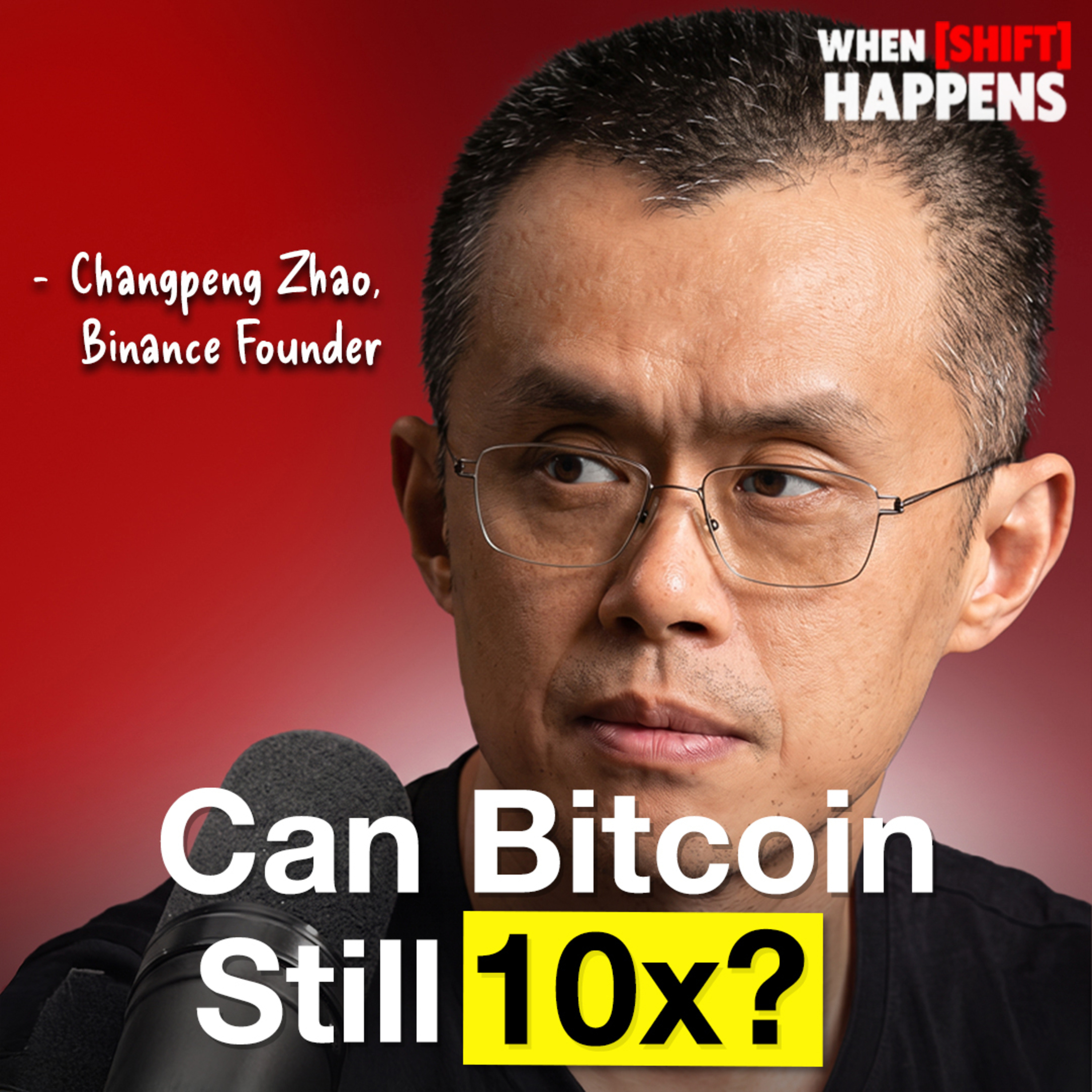
Changpeng “CZ” Zhao (Binance founder) argues Bitcoin’s “century” will be defined less by price and more by utility—mass adoption for payments, use as a retirement/pension reserve, and integration into tokenization and AI-agent commerce. He claims Bitcoin will likely overtake gold and reach $1M sooner than 25 years, while stablecoins and other crypto assets enable machine-to-machine transactions and AI agents that start with stablecoins then add Bitcoin.
CZ Changpeng Zhao is the founder of Binance and a leading figure in crypto exchange and tokenization infrastructure.
tokenized stocks can democratize access and indirectly drive Bitcoin demand; governments’ power depends on regulation choices, not Bitcoin itself; AI agents will use crypto for transactions; payments may start with stablecoins then shift to native crypto (including Bitcoin).
tokenized US stock access for Hong Kong/Asia; UAE ADGM granting Binance broad licenses; US focus on stablecoins and CFTC moving on derivatives; Binance B stock launched “a few months ago” and growing quickly.
Written by AI. May contain mistakes.
Explore what needs to happen for Bitcoin to become mainstream and its pricing potential.
“CZ, we're calling this session the Bitcoin century.”
Discussing the necessary infrastructure and shifts in finance for Bitcoin's success.
“For 25 years I think all of those things will happen.”
Understanding the interconnectivity between Bitcoin and other cryptocurrencies.
“There's so many opportunities right in front of us.”
Examining how Bitcoin affects government power and regulatory frameworks.
“Bitcoin started as a technology for individuals and it's now becoming a strategic asset for institutions and potentially nation-states.”
Examining how Bitcoin affects government power and regulatory frameworks.
“Quick shout outs to our legendary long-term WhenShift Happens partners, without whom none of this would be possible.”
Identifying key recommendations for governments concerning crypto regulations.
“How seriously are governments taking Bitcoin today?”
Learn about effective strategies for countries to adopt crypto regulations and frameworks.
“And the implementation and the licensing takes forever or impossible.”
Explore the common misconceptions many governments have regarding Bitcoin and its potential.
“Tell me about one major government that you think is currently getting Bitcoin completely wrong.”
Understand why Bitcoin may surpass gold as a strategic reserve asset for nations.
“large countries to change, it takes many years, right?”
Discover recommended strategies for countries to allocate their reserves towards Bitcoin.
“If you're allocating the reserves of a country today, what's the percentage that you recommend them to allocate to Bitcoin and why?”
Understand the importance of having multiple cryptocurrencies to support Bitcoin's growth.
“So for me I I'm very strong proponent of Bitcoin.”
Explore the challenges of predicting trends in the rapidly evolving crypto space.
“So I think like this industry is about decentralization.”
Discuss how AI could revolutionize cryptocurrency transactions and the role of stablecoins.
“If we're heading towards a world with billions of AI agents that can automatically buy, sell, negotiate and transact, what money are those agents going to use?”
Explore how AI will influence crypto payments and trading efficiency.
“And then to do that you don't want to you don't want the AI to do the analysis for you and you press a button to trade yourself.”

Get the gist, explore an idea or ask about something said.
 Claude
On When Shift Happens Podcast, what are the key points of this episode?
Searching your listeningAutomatic transcript. May contain errors.
0:00I think for Bitcoin to hit a million dollars would be a good thing. I actually don't think we need 25 years. I think it's going to happen much quicker. CZ Changpeng Zhao, the founder of Binance. At Bitcoin Asia in Hong Kong, discussing what could define the Bitcoin century in the decades ahead. I think we need Bitcoin payments to happen on a massive scale. I think we need Bitcoin to be a retirement pension fund reserve. All of those things will happen. If we're heading towards a world with billions of AI agents that can automatically buy, sell, negotiate and transact, what money are those agents going to use?
0:30They will probably start with a stable coin. Once you can accept a stable coin, it's very, very easy to add Bitcoin. It's also possible some of the large AI companies, they may want to issue their own tokens. I've had discussions with multiple very large, the top tier AI companies about how to issue tokens. Some of the AI companies I talked to, they want to do hundreds of gigawatts over the next couple of years. and that's going to cost trillions of dollars. If you're allocating the reserves of a country today, what's the percentage that you recommend them to allocate to Bitcoin? My recommendation is pretty simple and it's a little bit self-serving.
0:59I usually recommend them to take the top five cryptocurrencies and just allocate according to market cap percentage-wise. That's the easiest, simplest and most market-driven approach. So typically, it'd be like, no, 50-something percent in Bitcoin and then 20 % each and then BNB will get in there. So, yeah. As we can see here, the majority of the people have been believing for a long time that Bitcoin will be bigger than gold. How could we all be wrong? Well, I think there's a very...
1:49button just below this video. Thank you for being with us today and for supporting us every week. And now, let's get to today's show.
2:02I love you too.
2:12CZ, we're calling this session the Bitcoin century. What would have to happen over the next 25 years for you to look back and say that was really the Bitcoin century?
2:29I think for Bitcoin to hit a million dollars would be a good thing. It will happen. Do you think we need 25 years for that to happen? No, I actually don't think we need 25 years. I think it's gonna happen much quicker but more than price. I think we need a lot more utility. I think we need Bitcoin payments to happen on a massive scale. I think we need Bitcoin to be a retirement pension fund reserve. It will get there. All of those things will happen. A lot more will happen.
3:05For 25 years I think all of those things will happen. What's the biggest thing people today are underestimating about the transition that's needed to truly cement this century as the Bitcoin century? I mean this whole century. This whole century is a long long time. So I think what somebody said is very people tend to overestimate what they do in one year on but underestimate what they do in 10 years. A hundred years is a long time. So even in the next 10 years I would say a a lot of the infrastructure will get built. I think we're seeing the shift. In the last two years, we saw a huge shift in traditional finance's attitudes towards Bitcoin.
3:52So, and even only in the last year or so, in the last few months, we're seeing tokenized stocks going up tremendously. And this is just the beginning. We only, like what, I guess B stock, Binance B stock was only launched a couple months ago, Like maybe three to three months ago It's already growing very quickly. So if you think about ten years That's gonna be huge And and that's just one small sector, but not a small sector, but it's just one sector So with other sectors There's multiple other sectors payments AI agentic finance infrastructure Stable coins tokenization. There's a lot of things that will happen over the next 10 years.
4:43So I think, yeah, many things will happen. So I think, yeah, we're actually at the best point in time compared to any time in history. There's so many opportunities right in front of us. We just got to take advantage of it. You mentioned tokenization, you mentioned payments. how is that linked to Bitcoin and the success of Bitcoin? I think they all help each other. I think the Bitcoin blockchain doesn't really handle tokenization today so all the tokenization happens on other blockchains but in the crypto industry what's good for Bitcoin is good for everything else. What's good for another blockchain or another sector is actually good for Bitcoin as well.
5:26They help each other. People who learn about People who learn about Bitcoin eventually learn about other they will eventually to other blockchains other tokens etc And people who come in through a tokenization of today of stocks Eventually what look in Bitcoin right so today like say right now in Hong Kong People in Asia who wants to buy US stocks. It's very hard for them to get a broker brokerage account And of the very few people that get brokerage accounts in the US It's very hard. The timing is wrong, right? So you can't trade from like 11 p.m. to 4 a.m. every day so Once that's tokenized you will democratize access to the stock market But so the people who used to want to buy us dogs could that couldn't and now able to but through But through crypto through crypto platforms once they're on the crypto platforms They will probably know have some exposure to Bitcoin that they did not have before so over time that will compound So what's good for our tokenized stocks is actually good for traditional stock markets, but also good for Bitcoin.
6:35So I think all of those things help each other. It's truly an ecosystem. It's not one project versus another. Bitcoin started as a technology for individuals and it's now becoming a strategic asset for institutions and potentially nation-states. Does Bitcoin ultimately weaken governments or Or does it make the governments that adopt it early significantly more powerful? And why? Okay, I think on this point, Bitcoin itself doesn't weaken or strengthen governments. It's what governments do that strengthen or weaken them. Some governments like a lot of power. They want total control, etc. In human history, that may not always be the best for the economy, for the citizens.
7:23What we've seen that many countries with weaker governments actually do better with economy So if you look at the US government for example, the US government is actually a small girl It's a large country, so it's a large government, but relatively speaking is a less powerful government The people only empower for four years and then the government change and then you have two parties They debate all the time. It's inefficient There's just a lot of debates, but it's actually a weak government But the weak government may have contributed to one of the strongest economies in the world right so Having weaker government may or may not be a bad thing and you can see that the current SEC in the US They said that they give up a lot of their power.
8:10They say we don't we don't regulate this. This is not in our regular purview and actually the industry grown because of that right so when the powerful people, the regulators have less power, sometimes the industry grows better. Whereas compared to the US previous SEC administration, Gary Gensler wanted everything in his power and that actually stopped growth completely. But Bitcoin itself, it's just a technology. It doesn't give power to more people here, one side or another. The more the technology is decentralized so it does give a bit more power to the individual So you have more sovereign control of your currency, but at the same time I think big ones design the privacy aspect of it is Somewhat flawed so it's very it's actually very very easy to track transactions on the blockchain So that aspect actually weakens some of the privacy control aspects But both of these aspects doesn't a government can use it or not use it So if a government said in potentially, but I don't think this happened in any country yet If the government says holding Bitcoin is illegal in their country whether that law is makes sense or not It's fair or not But some governments may be able to push a lawsuit in many countries a government can totally push a lawsuit like that when the government does that then you know that Because this sector is not going to develop in that country or maybe a more practical example Some countries say look we're gonna we're gonna apply a 36 % tax on every transaction Right, that's gonna kill the industry the government will have a lot of control The government the government will be very powerful But they will not have any tax revenue because charging a 36 6 % of zero is still zero Whereas if you charge like no, I don't know 6 % of 100 of 1 trillion, that's a lot of money, right?
10:08So I think the technology doesn't dictate the government. The government decides how much power they want to have. And in countries where the citizens can vote, the voting determines that. Quick shout outs to our legendary long-term WhenShift Happens partners, without whom none of this would be possible. Thank you to Cast, my go-to global money app to store, earn, move, and spend stable coins across 170 plus countries directly with Apple Pay or a physical card. On top of that, I can also get paid in USD and Euro with my Cast Virtual Account. Use my promo code SHIFT and my link below to get 10 % off your membership, earn up to 3 % instant USD cashback on every card spend, and get up to$250 in cash for referring your friends.
11:01No banks, no borders, just money that moves with you with stable cash rewards. On most trading platforms, crypto lives in one app, stocks in another, and commodities such as gold and oil somewhere completely different. Variational puts perps on all of it. Crypto, equities, commodities, FX, and even pre-IPO names in one single account with zero trading fees on every market at any size. Visit variational.io to see why Variational has quickly become one of the largest on-chain trading platforms. Big thanks to my friends at Bitwise Asset Management for backing today's conversation. Bitwise is a global crypto asset manager with$11 billion in client assets and more than 70 crypto solutions.
11:46That includes ETFs, index funds, SMAs, custom option strategies, staking, vaults, and more. However you want to invest in crypto, the experts at Bitwise have you covered. How seriously are governments taking Bitcoin today? I think most governments are taking relatively seriously, but many But today many countries still don't have crypto regulations, right? So many countries don't have crypto regulatory frameworks It's actually only a handful countries that does so I Think many people in governments understand Bitcoin, but they are probably still a minority So and also especially many countries the government are slightly they ran by elder people So it's like a slightly older generation and that generation actually logically adopts new technologies slower And they also read more traditional news Which I was usually more negative on crypto and all these other things So they tend to have a slightly more negative mindset, but I but I certainly feel the shift.
12:59I meet many different country leaders Politicians in different parts of the world the shift is definitely happening. No one's denying that. You know, this is a new technology No, one's denying that you know They need to adopt it But sometimes they still have their skewed view that all big ones used by drug lords is that true or not? But more and more people are explaining to them now that no, that's not the case. When you meet these leaders, do you feel like they're meeting you and looking at this Bitcoin thing because they have to to look good or because they have to for the future of their country to be more successful?
13:38Actually, almost every country leader I meet are the second of the ladder. They want their country to be better. But to be frank, I think there's quite a lot of countries who are doing it just because they have to. But most of those countries, you can detect them pretty quickly. They adopt some kind of framework. It's usually overly restrictive. It's usually just a PR job. And the implementation and the licensing takes forever or impossible. And nothing really happens on the implementation level. So of the countries that usually invite me to go and They usually very progressive that they're sincerely wanting to adopt crypto So it's a pretty good benchmark.
14:22You see which countries I visit. Those are usually the crypto friendly countries When you're advising a major government today What do you tell them about Bitcoin that they're probably not doing yet? What there's many? There's many parts right so number one is putting a crypto regulatory framework that's Usually and also once you have a framework. How do you what what's good about it? What's bad about it? How do you revise it? How do we how do you improve it over time? most people Most of the crypto regulatory frameworks fall into a few parts right now many people are focused on either the centralized exchanges Which is usually the past few years this and last year many countries are focused on stable coins, which is good Because us genius clarity there's a lot of debates and there's a lot of attention on that Many countries are not doing a crypto reserve.
15:18So I usually advise them to do a crypto reserve That's usually much better. That's usually very important for the country long term Many countries are not issuing their own stable coins Or so we need we need to get their own currency onto the blockchain so that you know they capture liquidity in their own currency They also promote liquidity for their own currency on the blockchain Many countries are thinking about tokenized assets in addition to stocks traditional financial instruments, but like you know rare earth minerals real estate culture arts IP So there's a lot of discussion on those fronts Many countries are very interested in tokenization because they view that as a way to attract money into the country And or have assets that are available to be for people to buy outside of the country So quite a lot of those discussions are happening.
16:08What are the countries that you think are doing that the best? Different countries are pushing different parts of the envelope, which is good. I think UAE has probably the most progressive crypto regulation today. ADGM, Abu Dhabi Global Markets, gave Binance.com a global license to operate almost all of their products, which is fantastic. And then but you still have not issued major stable coins yet But I think I hear some discussions there so they're progressing I think us is moving pretty much more much more heavy on the stable coin side. They're very focused on the stable coins And the exchange regulations they just use the old sort of MSP money transmitter license etc And but right now I my impression is the CFTC is moving pretty fast on sort of a federal level Futures derivatives licenses etc.
17:05Which is which is fantastic for the industry. I think Japan is pretty pretty pretty forward right now Hong Kong is moving pretty quickly Singapore I think is a little bit more conservative today So but all of those countries are moving pretty quickly Pakistan. I think Bala was here earlier, I just had a meeting with them earlier. Pakistan's moving pretty quickly, but Pakistan, the regulations are moving quickly, but the implementation is not quite there yet. For example, Binance does not have a bank account there yet, like a client money bank account there yet, but I think that's underway. They haven't issued stablecoins yet, so all of those things need to happen.
17:47Kazakhstan's moving very quickly. Binance has very good banking support there Binance pay works with QR codes everywhere there Kyrgyzstan is very happening very soon. So I'm visiting those two countries next week. So there's quite a lot of countries moving pretty quickly. Yeah Tell me about one major government that you think is currently getting Bitcoin completely wrong. I think that's I don't want to name any specific countries to make them look bad But I think many countries view Bitcoin as this dangerous thing It's not it's Bitcoin is much more dangerous if you don't use it so You basically you're missing out if you think about AI Which country doesn't want to hold AI technology themselves, right?
18:31So not investing in AI technology is not promoting the AI industry in your country is dangerous for you Using AI well AI have some dangers, but using air properly will be fine So I think there's a there's quite a lot of misconceptions about Bitcoin crypto etc right in a few different countries. You mentioned strategic reserves and that you're advising governments to actually build a strategic reserve. If Bitcoin becomes a strategic reserve asset for nations, does it eventually become more important than gold? For sure. I think Bitcoin will for sure become more important than gold. Yeah. I think today, what we got to understand for large countries to change, it takes many years, right?
19:15So today they have mechanism to value gold to hold gold There's a pop there's a whole mechanism there for them to shift into Bitcoin will take some time Or into crypto will take some time, but it will happen so and Bitcoin is just a much better asset than gold. I Think Peter Schiff might not agree, but I've had that debate with him before But you know Bitcoin is much more important. Yeah Thank you well We can see here the majority of the people in this room Believe or have been believing for a long time that Bitcoin will be bigger than gold. How could we all be wrong? Well, I think there's a very okay, I think there's a very small chance Something better than Bitcoin takes over like another digital currency that's that grows faster than Bitcoin overtakes Bitcoin before Bitcoin takes over gold I think by everything that we're looking at today, the chance of that happening is quite small.
20:18I think Bitcoin will overtake gold pretty soon. There's only like a 10x difference right now. So who knows, in the next world run, it could happen.
20:30If you're allocating the reserves of a country today, what's the percentage that you recommend them to allocate to Bitcoin and why? My recommendation is pretty simple and it's a little bit self-serving. usually recommend them to take the top five cryptocurrencies Take our stable coins. I was about that they may already have a US dollar reserve Take the top five cryptocurrencies and just allocate according to market cap Percentage wise that's the easiest simplest and most market driven approach. So typically you'll be like no 50 something percent in Bitcoin And then I don't know 10 20 percent in ETH and then B &B will get in there
21:12Quick shout out to the legendary team at Jupyter, the DeFi super app. Anything you want to do on chain, from trading to earning yield, you can just use Jupyter. Personally, I recommend getting the Jupyter wallet on either your phone or your laptop. 10 times faster and 10 times cheaper than the competition. You're gonna love it. Thank you to the awesome team at Athena for backing today's conversation. Athena is one of the fastest growing projects in DeFi with over$7 billion in stablecoin supply and an average 11 % APY on SUSDE. And importantly, zero DPEGs since launch, which is exactly what you want from a stablecoin.
21:50Go check them out by following the link in the description down below. Well, I have to take the Bitcoin side. Why would that make sense? Why would I just not advise them to allocate only into Bitcoin? It's a Bitcoin conference. I guess there's a lot of Bitcoin maximalists here. And also, if people understand what Bitcoin is, They might just say like this is the only one that makes sense. Sure, I think As much as I think the organizer of this conference David Bailey is a Bitcoin max maxi. He's a good friend of mine too. Very good friend. I Think look if the industry only have Bitcoin is actually the industry will grow much slower Having the other block chance does not take away from Bitcoin having all this other block having aetherium having be a meetian having other blockchains actually helps to grow the Bitcoin as well.
22:39I think Bitcoin would be smaller if we didn't have other blockchains. Bitcoin would not be bigger, it would be smaller.
22:47What's good for Bitcoin is also good for the other blockchains. So we're in an industry that is not a zero-sum game. It's not like we're taking anything away from each other. Bitcoin service as a service has its own utility. It's the most it's the largest market cap is the most decentralized It's gonna be the group of reserve currency for a very long for a very long time to come But the other blockchains have more innovation, right? It's easier to try new things on the other blockchain and then if Bitcoin can reverse adopt it then great So I think most Bitcoin max is also realized that you know it's Realize this it's not it's not always the best to only promote Bitcoin.
23:30So for me I I'm very strong proponent of Bitcoin. This is a Bitcoin. It's called Bitcoin Mina or Bitcoin Asia Conference, but in the early days the the whole crypto industry is called the Bitcoin industry We only we only started calling crypto actually crypto is not not a very good name Like most people most normal people when they hear about crypto they think like no it's too scary It's too mathematics driven right most math non math majors. They feel distant from it Web 3 is it's not web 3 is an okay name So I think the term the terminology and label doesn't matter very much I strongly think that we should push the industry as a whole There should be multiple blockchains multiple exchanges multiple Dexas multiple prep taxes multiple of everything so that this competition there's more innovation there's more just more pushing.
24:22So I think like this industry is about decentralization. We should adopt the open approach that we accept multiple of everything and it's not one versus another. We spent the last decade proving that Bitcoin can exist. What actually is driving the next cycle? I'm not too sure to be very frank. I Well, I think right now if we look right now if we look this RWA is an AI both are very strong and the country the previous ones stable coin will continue to grow Centralized exchanges will continue to grow decentralized exchanges will continue to grow Mean coins will continue to grow and FTS will probably make a comeback of some kind So D5 MMS are continue to grow.
25:13So I think multiple things will continue to grow I don't know what the next hot thing is. That's very hard to predict You know in the beginning of 2017, I would not have predicted ICOs, but you know half a year later we were doing ICO When the NFT craze was happening six months before that I would not be able to predict it So it's very hard to predict predict the next thing I think it's up to the entrepreneurs like no in this audience and out there that you know That creates those next the next big hard things You mentioned AI. Let's talk about AI. If we're heading towards a world with billions of AI agents that can automatically buy, sell, negotiate and transact, what money are those agents going to use?
26:00For sure, it's going to be crypto money. But which one? Oh again, I would think that what they will probably start with a stable coin And then once you once you can accept a stable coin is is very very easy to add Bitcoin And then hopefully is equally easy to add B &B Ethereum Solana I know other blockchains as well and then And also it's also possible some of the large AI companies. They may want to issue their own tokens So they're probably jamming that in there. I've had discussions with multiple very large the top tier AI companies about how to issue tokens. There's many different there's many different schools of thoughts, right?
26:46So you are very early like no building data centers requires a lot of money like one gigabyte of one gigabyte of compute takes about somewhere between 30 to 50 billion dollars and Many of them are running out of money to As high valuations they have Many of them do not have enough money to do to build that kind of compute power Some of the AI companies I talked with they want to build hundreds of megawatt Over the next couple years and that's going to cost trillions of dollars, right? So they talked about how do you Potentially issue a data center token so that we get later on you can get rewards from that data for to use that data center If you're going to issue a token you want to increase the utility of that token as much as possible So naturally you want to allow that token to be paid for subscription services And then do you want to tie that with different language models different services, etc?
27:41So there's many different models to tie that so it's not inconceivable that a AI company will issue their own Utility token try to promote that. I think we've seen that you know some tokens being already issued by companies very closely associated with open AI right so the work coin Even though today I think does not have a huge amount of utility yet, but you know those guys are very close to to the AI companies, so I think Crypto work when when when when AI handles payments for us They will use crypto and also but today I think the AI payments may come after AI trading So like paying for hotels paying for bills etc using AI agents Based on my conversations with some of the top tier AI companies Today payments is not their priority They're trying to make the agents smarter to find you the best deals But they don't view that payments is a big problem to solve today by AI Most people can swipe their credit card to book hotels once the AI finds the best hotels for them Whereas in trading AI may have to AI is more appropriate because you have to gather a lot of information very quickly you have to react very quickly to news to other analyze the charts, however you work, however you do your trading, AI can probably facilitate that process by improving efficiency by 10x.
29:03And then to do that you don't want to you don't want the AI to do the analysis for you and you press a button to trade yourself. You want the AI to place the orders for you for efficiency reasons or for timing reasons. So AI will probably trade for you before they pay for you. So that means that whether we're in a human world or an AI world, Bitcoin mostly stays a technology for savings, Bitcoin for savings, and then we have stable coins or crypto for machine to machine commerce or for trading? I think so to a large extent, yeah. I think that's gonna be the next step. But I think as people use stable coins more and more for payments, many of the payments will shift towards native crypto like the Bitcoin payments.
29:46Many people are not used to the Bitcoin price fluctuation, but once the payments once the payment rails are fully open accepting crypto all the guys holding Bitcoin will no longer convert them to stable coins because the guys will hold Bitcoin long term they don't care about the fluctuations they don't want to convert to us to a fiat currency pegged value and let's hold that that's just another extra step like for me right I hope B &B and and some Bitcoin I mostly spend B &B when I spend I don't I don't I don't sell B &B into US dollars And hold it there and then spend sometimes I do that, but that's very inconvenient when I swipe the binance card Bnb gets deducted based on how much I spend.
30:26I don't care what the exchange rate is You can fluctuate. It's gonna fluctuate upwards. I just I spend on whatever Whatever the price is on that day on that on that minute. I just spend it so I think as long Initially people will do payments in stable coins, but as the payment rails become more widely available people are just gonna spend the cryptocurrency that they hold. This session is called the Bitcoin century. What do you hope CZ's contribution to that Bitcoin century will have been? I actually don't know. My mentality is always I try my best. So if my abilities are low, I'll just contribute a little bit.
31:09If my abilities are high, I'll contribute a bit more. So So far, I believe I've made decent contributions to the crypto industry to the extent that I could. I will continue to do my best to contribute to the extent I can. Thank you so much, CZ, for this. And thank you, everyone, for your attention. Thank you so much. As you probably know by now, I host some of the biggest names in Bitcoin and crypto on my podcast. But a lot of the best stuff never makes it on air. The Shift newsletter is where I share that raw behind the scenes alpha. The insights, stories, and lessons straight from my guests that you won't hear anywhere else.
31:47If you want the real insight take on Bitcoin and crypto, join my newsletter, The Shift, in the description down below.
Changpeng Zhao (CZ), founder of Binance, sits down with Kevin live on stage at Bitcoin Asia 2026 in Hong Kong and explains why right now is the best point in history to build wealth in crypto.
He breaks down why $1 million Bitcoin is coming faster than anyone expects, why Bitcoin will overtake gold in the next bull run, the exact crypto allocation he tells governments to hold, and what the biggest AI companies are telling him about launching their own tokens. Where the next decade of crypto is going, from the man who built the biggest exchange in the world.
THE SHIFT NEWSLETTER
💡Go beyond the mic - subscribe to The Shift, my new weekly newsletter where I share the uncut stories, raw takes, and behind-the-scenes notes from When Shift Happens: https://www.kevinfollonier.com/crypto-web3-newsletter
___________
PARTNERS
🚀 Jupiter is the most used Decentralized Exchange in Crypto and the largest DEX by volume on Solana: https://jup.ag/
💳 KAST lets you manage and spend stablecoins or crypto with a Visa Card or Apple Pay. Live in 100+ countries: https://go.kast.xyz/VqVO/SHIFT
🔓 Trezor offers the safest cold-storage wallets for crypto and true financial independence.
Buy with 10% off (promo code in video): https://trezor.io/?transaction_id=102...
🌱 Bitwise Asset Management manages $15B+ across 30+ crypto investment products — ETFs, index funds, alpha, staking, and more. https://bitwiseinvestments.com/
⚖️ Ethena is a synthetic dollar protocol on Ethereum, offering a crypto-native, non-bank-dependent stablecoin called USDe. It uses a delta-neutral hedging strategy with staked ETH to maintain a $1 peg. https://ethena.fi/
💧 Sui is a next-gen Layer 1 making digital asset ownership fast, private, and secure.
https://sui.io/
♾️ Coinsilium provides vital funding and expert advice to Web3 and AI-powered early-stage technology companies.
https://www.coinsilium.com
___________
FOLLOW CHANGPENG ZHAO (CZ)👇
Twitter: https://x.com/cz_binance
FOLLOW WHEN SHIFT HAPPENS
Twitter (X): https://x.com/KevinWSHPod
Instagram: https://www.instagram.com/kevinfollonier_
TikTok: https://www.tiktok.com/@kevinfollonier_
Linkedin: https://www.linkedin.com/in/kevinfollonier/
Website: https://kevinfollonier.com/
DISCLAIMER
The info contained herein is for informational purposes only. Nothing herein shall be construed to be financial, legal, or tax advice. The content of this video is solely the opinions of the speakers who are not a licensed financial advisor or registered investment advisor. Trading cryptocurrencies poses considerable risk of loss. The speakers do not guarantee any particular outcome.
#CryptoNews, #JupiterDEX, #SolanaEcosystem, #DeFiInsights, #DEXAggregator, #CryptoTrading, #Web4, #BlockchainFuture, #TokenEconomics, #CryptoCommunity, #DeFiGrowth, #CryptoAdoption, #FintechRevolution, #CryptoMistakes, #FoundersStory, #CryptoBuilders, #DeFiRevenue, #CryptoVolume, #CryptoCulture, #Web3ToWeb4, #CryptoInnovation, #SolanaDEX, #CryptoProduct, #BlockchainStrategy
0:00 Intro
0:37 Do We Need 25 Years For Bitcoin To Hit $1M
1:36 What’s Needed For This Century To Be Bitcoin Century
3:26 How Tokenization Links To Bitcoin’s Success
5:08 Will Bitcoin Weaken Or Strengthen Governments
8:47 Are Governments Serious About Bitcoin Today
11:14 What Most Governments Aren’t Doing With Bitcoin
12:56 Which Countries Are Doing The Best With Bitcoin
15:36 Will Bitcoin Become More Valuable Than Gold
16:33 Could We Be Wrong About Bitcoin Being Better Than Gold
17:17 How Much Should Countries Go In On Bitcoin
20:37 What’s Driving The Next Bitcoin Cycle
21:49 How AI Agents Will Trade Crypto
25:21 Stablecoins vs Bitcoin’s Future
26:54 What Will CZ Contribute To The Bitcoin Century