
In short
When Shift Happens Podcast - Episode 97 Summary
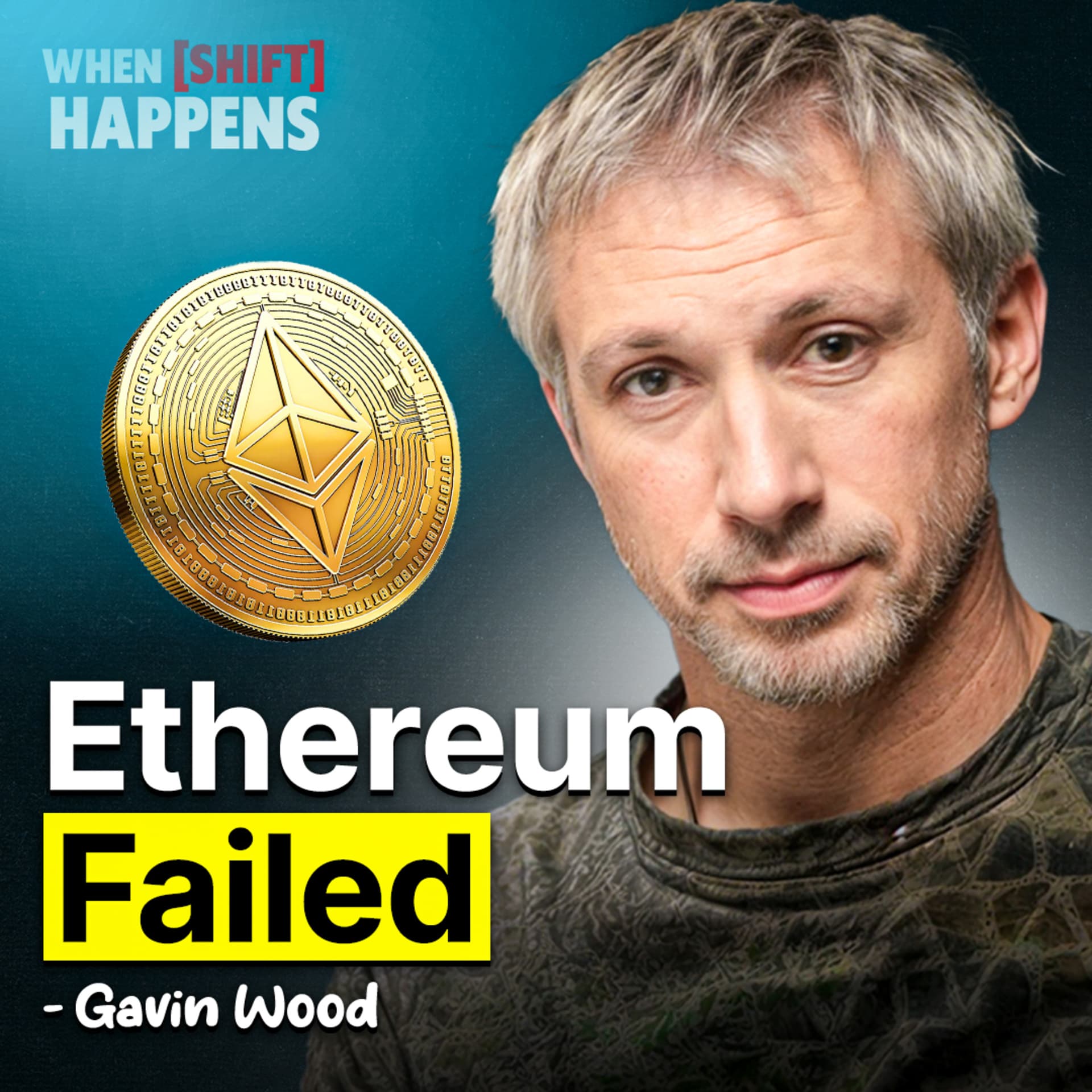
Episode Overview In episode 97 of the *When Shift Happens Podcast*, host Kevin speaks with Dr. Gavin Wood, co-founder of Ethereum, inventor of the Ethereum Virtual Machine (EVM), and creator of Polkadot. The conversation delves into Wood's unfiltered perspective on Ethereum's stagnation, the challenges facing blockchain technology, and his vision for the future of Web3.
Key Points and Discussions
Introduction to Gavin Wood
- Dr. Gavin Wood has a rich background in blockchain technology and is recognized for his contributions to Ethereum.
- He coined the term "Web3" in 2014, emphasizing a decentralized internet that adheres to trustless principles.
Ethereum’s Current State
- Wood discusses Ethereum's achievements, suggesting that although the platform has made many millionaires, it has not fully realized its potential.
- He poses the question of whether Ethereum can be considered a success, revealing his belief that it has not achieved its original goals.
Challenges Facing Ethereum
- Wood highlights that Ethereum has become stagnant due to scalability issues and the complexity of decentralized applications (dApps).
- He emphasizes the need for better technology to facilitate the original promise of Ethereum's decentralized applications.
Polkadot and Its Vision
- Wood introduces Polkadot as a solution to many of Ethereum's challenges, particularly in terms of scalability and interoperability.
- He outlines Polkadot's unique approach of connecting multiple blockchains to operate under a shared security model.
Building Big Ideas
- The discussion transitions to Wood's creative process, where he explains that significant ideas often emerge from combining existing concepts rather than top-down planning.
- Wood reflects on the characteristics that make for successful founders, touching on the value of childhood experiences, including trauma and resilience.
The Role of Decentralization in AI
- Addressing the intersection of AI and blockchain, Wood expresses concerns about how AI could centralize communication and control in society.
- He argues that decentralization is crucial for future AI systems to prevent monopolistic control and ensure user privacy.
Happiness and Life Goals
- Wood shares his thoughts on happiness, stating that meaningful contributions to society, particularly in education, are essential for him.
- He expresses a desire to create opportunities for knowledge sharing, reflecting his belief in the importance of intellectual growth.
The Meaning of Life
- When asked about the meaning of life, Wood highlights the importance of principles that contribute to human knowledge and understanding.
- He emphasizes the significance of leaving a positive legacy through education and knowledge dissemination.
Final Thoughts
- The episode concludes with Wood contemplating the future of blockchain technology and Web3.
- He remains optimistic but acknowledges the challenges that lie ahead for the broader adoption of decentralized technologies.
Key Takeaways
- Challenges of Ethereum: Stagnation and scaling issues hinder Ethereum's growth.
- Polkadot's Role: Introduces innovative solutions for blockchain interoperability and scalability.
- Decentralization Importance: Essential for both blockchain and AI to ensure user trust and privacy.
- Personal Reflections: Wood values happiness derived from contributing to education and personal growth over financial success.
- Vision for Web3: A future where decentralization underpins all aspects of technology and human interaction.
---
This summary provides a structured overview of the podcast episode while highlighting the critical themes and discussions presented by Dr. Gavin Wood.
Written by AI. May contain mistakes. Listen to the episode to check what was said.
Transcript
Automatic transcript. May contain errors.0:00I started writing Ethereum in December. I had£500 left. My rent was£500 a month. At that point, I've done two startups. Neither of them seem to be doing anything. I'm just going to get a job at a bank. And then he offered me a thousand pounds a month to just carry on doing Ethereum. I wanted to see if this white paper could work, so I started coding it. A few months later, I was the co-founder of Ethereum. Gavin Wood, the co-founder of Ethereum, creator of Polkadot and the visionary behind Web3. He's here to unveil the secrets shaping the future of blockchain technology. You created the Ethereum virtual machine and you also founded Polkadot.
0:33What is Ethereum's biggest achievement to date? Ethereum made the most millionaires of any project in the history of the world. How do you come up with a big idea? An idea is where you actually have a path. Honest stake on meme coins. It's bullshit. What is Brokado's biggest achievement? Delivering a secure, sharded blockchain. What's the biggest problem with Brokado today? The fact that it's sharded. My childhood wasn't the easiest childhood in the world. I can probably identify with childhood trauma. Do you want to elaborate a bit more? I grew up with a single parent. My mother had an abusive husband.
1:15I do have very strong memories from that era of life, of essentially abandonment. It gave me a strong gratitude for a safe environment. Kevin, being too far ahead is the same thing as being wrong. You're an inventor, very early to trend. How much have you suffered in life from being too early or completely misunderstood by other people? Was it really Howard Marks that said that?
1:4675 % of you that watch this channel frequently do not subscribe. If you like this show and think it provides value to you in your crypto investing journey. Can you please, please, please do me a favor and subscribe to this channel. Hit the like button and leave a comment below. It helps this channel more than you can imagine. The bigger the channel, the bigger the guests and the better the conversation. Thank you. This conversation is supported by Jupiter, the most used decentralized trading platform on Solana and the largest DAO in the world. SWI, a scalable layer one blockchain that's fast, secure, and affordable, built by previous Facebook developers, and that delivers the benefits of Web3 with the ease of Web2.
2:26And Mantle, an Ethereum layer too that built two products I particularly like. FBTC, which enables you to borrow and lend Bitcoin in DeFi, and METH, or METH, one of the largest ETH liquid-staking protocols that, by the way, just launched its token called Cook. Thank you so much for bringing this, Gavin. We are drinking some Japanese whiskey. Yeah, Yamazaki 12. Because I learned that you like whiskey and that you like Japan. Cheers. Jin-jin. Kanpai. You say kanpai in Japanese? I thought it was only in Chinese. Definitely kanpai Japanese. Do you speak Japanese? No, but I know a little bit to get around.
3:11Do you live in Japan? I have a home in Japan now. Why? Just really like the culture. I mean, maybe not to live throughout the year, but it's a really unique culture. So very interesting to live there. What do you like about the culture? It's actually very different from the rest of Asia. I mean, the services are just incredible. There's so much consideration put into everything, and you can really tell. very different from the uk uh yeah what do you think about the uk um i mean you know i grew up here um i'm british so it's like a bit of a i'm not desperate to uh spend all of my time here but i like uh i have a home in Cambridge.
4:04I enjoy staying. I enjoy a very, I very much enjoy certain elements of British culture. For example? Uh, British Indian curry. Very good. Um, I like a nice pub on ale, cheese. So some of the cuisine pies, always nice. A bit of fish and chips, Sunday roast, lovely um and uh you know it's it's one of the more sort of polite mannered countries of the world which is always nice it's nice but when you're not from the uk and you're not like me for example i'm from switzerland you don't speak english natively it's sometimes very hard to understand what they mean in terms of um kind of humor right very difficult very different humor Yeah, you know, I think, uh, I think humor is a great way of communicating.
4:57Um, and, uh, it's, you often find that, uh, there's a lot of, um, uh, meaning in, uh, in, in jokes. Like some places, humor is just part of the communication. It's like being somewhat indirect or reaching out to some sort of shared anchor point rather than, you know, really trying to just drill in on the statement is just a natural way of communicating. I was told that this is the case in Japan and that people from, I believe it was Osaka, but it might have been Kyoto, but definitely not Tokyo, are just naturally more humorous. Part of the communication that they do is just naturally humorous.
5:44And this is a little different when you're sort of born and raised in Tokyo and you go down there and everyone's a joker. You know, it's a little different when, you know, a natural part of communication is joking around for one person and maybe not so much for the other. Do you think humor is more linked to culture or actual how smart someone is? Understanding humor. So I think to a large extent, humor draws upon common anchor points, common perceptions, and a sort of very common way of interpreting the world. So it's not necessarily kind of intelligence, but I think to some extent,
6:38intelligence can be used as this sort of means of generating humor, of like generating this commonality between interlocutors. Humor, as far as I can tell, I thought about humor a little bit, draws upon the idea that if you make an utterance, if you say something or you do something, the person, the sort of target, will interpret it in two ways. And some other, what we might call like public, will interpret it only in one way. And this hidden interpretation is what gives rise to the fact that it's funny. and it's funny because the the interlocutor the target understands that they interpret it in both ways and that there are others that only interpret it in the one way and because they know that and because they know that the originator of the utterance knows that there's like a sort of understand their shared understanding that is special it's between them and it's not between other people.
7:45You love to analyze a lot of things. Sure. Who are you? This is the question that the Borlons asked of Delenn in Babylon 5. It took an entire episode. That's why I'm starting with that. I prefer the other question, what do you want? That was what the shadows asked of Dylan. Who am I? I don't know. I'm a bit of a free spirit. Try to avoid pigeonholing myself. And this is usually how one defines who one is. It's like what is one's relations to the world around them, to people and institutions.
8:30But it's, you know, I don't like... I don't like providing a simplistic answer to this question because it's like if people hear it, then they will inevitably read into this answer more than I really mean because who a person is, broadly speaking, it cannot be summarised usefully in a sentence or two. It's really something that you can only get by, I don't know, I guess, looking at what the person has said and done and maybe some sort of interview like this. What is your mission?
9:25Well, I suppose what drives me, I don't know. There's a few different factors. a few different things that that i want to achieve um i mean happiness would be a nice one that's one of the topics of the day actually contentment um uh to be a good father um there's a sense of duty duty towards uh some of the things that i've been involved with and this this is my personal mission um and then there's a few sort of childhood ambitions and things that i know will uh will be that i want to um i guess that i know will make me happy and might make other people happy as well. And this sort of more falls into art and music and so on.
10:28You mentioned childhood ambition.
10:34I sat down with Kia Weng from Alliance Dao on this podcast a couple of months ago. And he told me that they're looking for two main traits to find and identify the big crypto founders of tomorrow. The first one is a certain degree of autism which helps you think independently. And the other one is a sort of childhood trauma that gives you a chip on the shoulder, makes you want to prove something to the world. As a very successful crypto founder, can you identify with one or both of these traits? Well, I'm not qualified to diagnose autism. um but uh yeah i mean uh my childhood wasn't the easiest childhood in the world so um i guess um i can probably identify with childhood trauma do you want to elaborate a bit more um so i grew up uh i grew up as uh with a single parent um just my mother and my Now, this was, to a very large extent, her choice.
11:49But she had an abusive husband that was also my father for a number of years. And, you know, I don't think I ever got, like, you know, smacked around or anything. But I do have very strong memories from that era of life of, you know, essentially abandonment. And I don't know if I really could claim that this is a, I don't know. I don't know what specific trauma this falls into, if any. But it gave me a, I guess, a gratitude for a safe environment, strong gratitude for a safe environment. There's more and more, actually, I talked a lot. I talked with Jesse Pollack, Mike Novogratz, a bunch of people.
12:44There's more and more of trying to understand oneself and their kind of childhood, doing some sort of therapy to understand where some sort of patterns come from. So not only to explain, hey, this is the reason why I'm doing that, but it's more to basically self-improvement, which we all want to. Have you ever done anything like that? Thinking my childhood might be helpful for me in some ways, but also unhelpful in other ways, and therefore I want to learn more about myself. um i mean yeah i i'm as you correctly um determined not long ago i am a someone who likes to think about things like to analyze things so it's not that um i haven't thought very deeply about this stage of my life and how it can um how it might impact my thinking now or interactions.
13:40But if you mean have I done any specific, I don't know, psychotherapy or hypnotism or something, no. You're the co-founder of Ethereum. You created the Ethereum Virtual Machine and the Solidity Language, which is the programming language enabling smart contract developers to build applications on the top of Ethereum. you also founded Polkadot how do you come up with a big idea
14:12um
14:16I don't know I guess they come up with themselves interesting so you don't need to do anything just comes yeah do you start with objectives and goals no or just one day you wake up and you're like that's the thing I have to do sure I mean have to do is maybe pushing it a little bit but yeah I mean one day uh I think about things maybe I go on a walk maybe I'm just thinking in the shower or something I don't know and um and uh the pieces I mean at the end of the day it's not I mean I don't know I mean I guess maybe some people like Elon Musk like think just they decide I want to go to Mars and it's like right what do i need to do that and i need to do this this this develop batteries develop rocket science develop this and that and the other and it's and then they just set up a roadmap in their brain or on paper and just get tick the boxes right yeah that's not that's not really what's um what my vibe is i'm more of a i guess i'm sort of i'm more incremental and it's not that i'm Incremental in like, you know, I avoid doing anything, you know, significantly different.
15:31But it's incremental more in the sense that I take what I already know and what I already can see working and the components that I can sort of imagine existing or know already to exist. and I look for combinations of them that provide an outcome which seems positive, useful, and that, as far as I understand, has not been achieved before, at least not in as good a way. I read a book by Maxwell Maltz, the famous surgeon and author of Psycho-Cybernetics. So the book is called Psycho-Cybernetics and it actually explains some part of the creative process, right? And that most of it is actually subconscious.
16:25So he says, when you do see a thing clearly in your mind, the creative success mechanism within you takes over and does the job much better than you could do it by conscious effort or willpower.
16:41How much is creating a big idea, like the EVM, for example, or any other big idea from your conscious mind versus you have some sort of idea, you set some goals, you kind of slip over it, and you let the subconscious mind do the work after thinking hard about that.
17:10i mean in my opinion an idea isn't really like i can have an idea right like um end hunger in the world and then i can sleep on it and like let my brain let my subconscious do the work and will anything happen in the morning no no right because if you're talking about ideas as in visions or high level goals that that's not really an idea, right? That's, I mean, maybe it's an idea for a film or something, but it's not like an idea in the sense, in an engineering sense. Um, and therefore I don't really agree that, that, that the subconscious mind can particularly help in this regard. Um, I think ideas must be constrained by practicalities.
17:58Um, if you do not have the means of ending hunger, then there's not that much point in trying to ideate, you know, trying to focus on an idea of ending hunger. Now you say, well, we'll take an incremental approach and we'll do this or that or the other. But I think much more, so I mean, I think this approach implies a top down thing where you have the end goal and you're trying to work down from the end goal to how you will achieve it. And as I said, I look at this as more of like an Elon Musk kind of a move where you actually, you know, are a multi-decker billionaire and you come up, I don't know, is he in the hundreds of billions now?
18:36I think so, right? And you can just come out, like the president of the United States, right? Or the president of the Saudi National Fund, right? And you can just say, right, I'm going to build a city there. I'm going to spend three billion on eradicating malaria, right? From this place in the world. And then you treat it in a very much methodical, procedural, corporate, emotionless manner. And you work it all out and you work out if the resources you have, you know, can just be spent on achieving the outcome that you, the idea. But as I said, I don't think it's an idea. I think that's an outcome.
19:17An idea is where you actually have a path. You have a way of, of a means of achieving something. Now, maybe you don't know exactly what it is, but you know it's positive. You know it's probably going to be useful. It's probably going to do the world a favor. And you believe that no one has ever considered this invention or this way of combining things that you already have into something new. And I would say this is actually what most people, when they say, oh, an inventor had an idea. That's what they mean by the idea. They mean a recombination of basic elements.
20:03You're saying I combine these things and I think it's going to be useful to the world, right? The problem of that is for the person who is like that, the inventor, is that people for some time or maybe for a very long time will not even understand you, right? I think it's Howard Marks who said, being too far ahead is the same thing as being wrong. You're an inventor, very early to trend. How much have you suffered in life from being too early or completely misunderstood by other people? Probably a fair amount, but I don't know. I mean, is it possible to know when other people misunderstand you?
20:49I mean, is there an apparent difference between them misunderstanding you, ignoring you, or not being clever enough to be almost like kind of able to, ever able to get the concept. I don't know. I suspect so, but, you know, to some extent I would agree with, was it really Howard Marks that said that? It doesn't sound like him. I'll double check later. But yeah, I mean, I think if you are aiming to build something that has immediate value to the world, then yeah, you have to sort of explain it in terms that the world already understands. which is why most radical new inventions are initially used for a ridiculous like naive use case like making you know the classic example being the internet being used for email it's like okay you can now send messages instead of taking a day to arrive they take a few minutes to arrive It's like, assuming people check their inbox every few minutes.
22:13It's, you know, the internet had a huge impact and email these days accounts for a relatively minor part of that impact. But nonetheless, it was needed because people understood mail and therefore they understood that if you can do mail, but do it like an order of magnitude faster in terms of delivery or two or three. then that's obviously an improvement. So I would agree that, you know, yeah, you do need to explain things in concepts, in terms relevant to the market or whatever that you want, the world that you want to attract. The problem is, of course, that sometimes building something is easier than working out what it's useful for.
23:00That's a problem of most entrepreneurs, right? they're actually building a product to try to find an audience instead of the opposite. Am I solving a problem for people? But then you might also argue that the people who are building a solution for an existing problem, it's kind of they're solving a smaller problem than something like a completely new invention. Yeah, typically. And oftentimes they're constraining themselves. um like they're constraining their intellect and their intellectual um space because like they have they've they've have a clear scope and it's like right i'm only aiming to make this thing a car go faster or uh consume less fuel and it's it's like maybe they can think of making the car fly but that doesn't matter because they're only concentrated on making it use less fuel um so yeah i would agree that um that you're probably going to small solve smaller problems if you already pick your outcome before you begin the truly intellectual work of uh devising how to achieve that outcome if you're a little bit more widely, like broadly scoped, if you're a little bit more laissez-faire on precisely what outcome you're aiming to achieve, like how you're trying to make the world better, just attempting to look for things that generally do things freer, better, faster, then you're probably going to find, you're going to hit upon something more revolution more substantial faster.
24:55What's the moment that you felt the most misunderstood ever in your life? Because you said probably many times, right? I mean, I get it quite a lot with Jam, this new protocol I'm doing. But I mean, it's fair enough because it's a complicated protocol and it sort of does things in a different way. And it's not always easy to understand how the way is indeed different and why it's better. Largely because I think people haven't understood well the constraints of doing things in the present way. And I think this is like a big issue with working sort of on the edge of technology. um people it's not it's not always very clear to people even the practitioners where the technology is whether where the current sort of edge of technology is not really optimal like the problems until you sort of analyze and really understand the problems um it's uh it's not always so easy to understand why that a that a particular thing might be a solution how do you even start then when you say because again if you have the classic approach which is i have a problem i'm going to solve this problem you know where to start right but if you something much more kind of abstract abstracted how do you even start so if you if you begin by saying, well, I have this problem.
26:37I'll look for a solution. Um, I think this can work in, uh, for, for smaller incremental problems. I think for bigger problems, um, you, you, you're probably going to have to be an extremely lucky person to, to stumble upon a solution for a very big problem. Um, or you could be, you know, a Bill Gates type and just say, right, I'm going to throw my personal wealth, which is substantial, at this problem, right? But assuming you're not extremely lucky or extremely wealthy, then you're probably going to only want to start solving the smaller problems because there's lots and lots more smaller problems than there are big problems.
27:21They're much more niche nuanced. And therefore, there's not so many people focusing on them. Therefore, there's a greater chance that still lower hanging fruit, that intellectually lower hanging fruit that you are likely to find and be able to capitalize upon. So I think, yeah, this top-down outcome-first approach is probably much better suited to smaller problems than it is to bigger problems, unless you happen to be exceedingly well-resourced or exceedingly lucky. and this is why I sort of say well you would probably want to begin by looking at like the situation as it stands the components that you have and reading like I know when I say components I mean it in a very abstract sense so I don't just mean literally plug and play things like the rust language or um uh the uh an android phone or a cpu i mean um various uh um the various um areas of mathematics the various areas of engineering various areas of human understanding of the world um as well as you know goods and services that are already being sold as well as deployed projects, open source software, and all of this all together.
28:53So these are the components that you have to work with as someone that is attempting to build something. And looking at ways of combining these, along with probably a little bit of intellectual novelty, into something that can be useful, that might be able to be purposed at solving one or more outcomes is, I think, really what it's about. And you can probably do this at a low level fairly easily. I can just write a new program that does, I don't know, exchange pair matching and make a bot that, you know, achieves some success after not that long, right? That's solving a fairly small problem. Academics, I think, work at a higher level of abstraction.
29:38They're still trying to recombine ideas, right, with a little bit of intellectual ingenuity, a little bit of innovation. But they're trying to solve bigger problems, in inverted commas, because they're not necessarily, they're not problems that have necessarily been particularly, they're not necessarily big problems that a lot of people know about. And they're not necessarily problems that are particularly useful to know how to solve. Um, but nonetheless, they are, uh, they're creating more useful, um, pieces of human knowledge. And this is, this is in and of itself a useful thing. I mean, there's, there's classic examples of this, of like, um, the theory that were theory work that was done in the early 20th century that gave rise to laser theory that was ultimately utilized for, uh, CDs.
30:27It's like it couldn't, CDs couldn't have been invented without this work being done. um but like when the work was done no one actually knew what it was useful for like it stayed useless for many for decades before it was actually used but when it was used it was a revolution audio technology and this is uh like working i mean i'm not necessarily saying you should you know get up into your ivory tower and only do stuff that you know is like high high intellect uh work but i'm i'm saying that there is a spectrum between working on something that is immediately practical and working on something that is like not particularly, apparently purely theoretical, um, you can kind of, and this is sort of where I sit, like in this sort of middle ground where I'm trying to come up with sort of new engineering, uh, understanding that I'm not like, I'm not saying it's going to, uh, give a 10 % improvement to transaction volume tomorrow, once it's deployed even, but rather that it could, if used properly, give a thousand or a million percent increase in transaction volume as part of a next generation system.
31:40You don't know for sure because you're not chasing that outcome so fervently. Rather, what you're doing is sort of chasing the intellectual understanding. Because the assumption is that a much better intellectual understanding can itself generate great outcomes. And it can generate more than one great outcome. Hey, when shift happens, family. Time to toast our partner, Devin. They're taking luxury wine to the blockchain with their super fun concept called Uncorked to Earn. Buy your favorite wines, enjoy unique experiences, and get an airdrop each time you open a bottle with your friends. Cheers to Divin for bringing transparency, authenticity, and exclusivity to the fine one's industry.
32:27How do you find people who kind of support you when what you're trying to build is so kind of abstract? Especially when it's very early on in a trend.
32:43There are a lot of people out there that just love building stuff. and uh i found this out actually when i put out the jam prize and managed to get like over 30 teams interested in building this thing and it's like you know you look at the the gray paper the jam spec and it's it's maths right it's formal um formal language and it's not uh it's not easy stuff and it's not even like that obvious that it's i mean you know kind of done some modeling trying to work through what the numbers would be. But, you know, there's no diagrams. There's no whizzy demos or visualization of how it's going to work.
Read the full transcript
33:24It's hard stuff to get into. And still, as it seems, people love the idea of actually just building it, of like being there, building something that is new, that has new innovation, has new technical foundations. So it seems at least that it's actually not that hard to find people to build actually new innovative stuff. What is really hard, and I think Joel Spolsky, one of the essays that he compiled and some of his work on software theory pointed out, was that it's really hard to find great people to maintain alts and or shitty software. The one thing that great developers don't want to do is shovel other people's shit.
34:25So if it's a case of like greenfield development of something that is novel, I think you actually don't have too much problem finding people. Do you have an example of old? Banking software, right? So the banks still have software in, you know, ancient languages built in the 70s, and they're still looking for people to maintain this stuff. Like, thankfully, I think, thankfully, well, thankfully for the practitioners of banking software, it's increasingly being rewritten. but I think you can still find some of the older banks that, um, that kind of have this core of, uh, you know, whatever it is, COBOL, uh, 75, uh, logic, um, that's, that's still actually running, uh, the banking, uh, stuff that's got like something built around it and something built around that and something built around that in sort of, um, in layers and layers out, outwards until you eventually get the modern software that's been written.
35:29All of them sort of trying to use the thing inside of them, but like not expose it and avoid sort of exposing its flaws and try to make it go, you know, sort of as fast as possible. It's an engineering mess, basically. But the banks pay enough to find people to maintain it. Which are usually the people who are more interested by the money than by the innovation. So, yeah. You mentioned before academia and some sort of big progress in audiovisual, right? And your career actually started with a mashup of music and computer science. You did a PhD in music visualization. Why would a computer scientist want to visualize music?
36:19I really love music. I love listening to music. And it's like, I don't, I'm not like synesthesic, but I don't know, I somehow, I was very interested in musical analytics, I suppose. Like I've got an analytical mind, right? So I naturally, as the music, as I hear the music, I naturally analyze it. like it naturally breaks down into structure, a pattern. For example? I mean, I can't. What kind of patterns?
37:02I guess like, you know, repetition and evolution. So, you know, a simple example would be like a verse chorus structure and it's like you've got an intro, you've got the first verse and you've got a chorus, maybe another verse chorus, maybe a third and then you've got a bridge and maybe a final verse and then an outro. and this is a, you know, if you're a music composer, this will just be second nature to you. If you're a practicing musician like an instrumentalist, you'll probably know about it, but you're not like that focused on the structure. You're focused on making sure that you actually get the notes out in the right place at the right time in the right way.
37:47If you're a listener, you probably don't care. um, you don't notice it at all. It's not, it's not something that you, I mean, most people at least think about very much. They just, you know, they listen to the music. Maybe they listen to the words, maybe listen to the instrumentation. Um, but they're not like that interested in like analyzing the structure of the music. Um, but for me, I kind of am. And I think there's probably some other people out there that are also interested, you know, have maybe not quite as analytical minds of me, but still kind of on the way. And I think, you know, for them, maybe it's like they get pleasure through seeing the music before understanding the music in a deeper way.
38:33Because if you listen to it, it's not that easy to understand the structure. Like you have to kind of make a mental model, like mental checkpoints of what's happening in the music. And have there been two choruses or three choruses? and if it's a very complicated piece of music then it would be very difficult to keep it all in your head very few people would be able to do that but if you can see it, that's a bit different
39:01and I think on a broader basis a lot of people really love a more immersive experience like one of the reasons that I go to see live music and I presume other people go to see live music, is to see the players of the instruments moving as the music, as I'm experiencing the music. And it's like, wow, I can see the pianist, you know, being much more aggressive and the piano sound is much louder, right? And then they're being, and the piano sound is much quieter. I can see as the drummer is tapping the drums, the beats are coming to me. There is this, I think up until recorded music, This was just, you know, this is what you, what you saw was what you heard.
39:45And there was just never any question about it. Then of course we have recorded music and it's like, you can hear it without seeing it. And it's, and you know, I was born in this era. Um, and so I don't question it, but maybe I should be questioning it because it's, uh, it's not what people had up until whenever the forties or fifties, uh, no, actually recorded, I guess twenties.
40:10and I think it's a much fuller experience when you see when you see the music in addition to merely hearing the music maybe it's not the most important part of the experience hearing is probably still the most important part but like seeing it also adds to it and so this was really what I was trying to do it's like can we can we create algorithmic ways of taking the actual the sound, the audio, and turning it into something that is readily familiar for a viewer so that they can either look at an image and like see that from the image is the music and follow it along, or can we create some sort of animation or video feed that matches the music in some immediately tangible perceptible way now you say well you know you've got wind and plug it visualizations and whatever and you've got this and that and like lights and the lights kind of move in line with the bass beat it's like yeah i mean i looked at all this and it honestly it's like most of the time the visual artist listens to the music gets a feel for the music and then make some visual art that is not particularly, I mean, it's their own interpretation perhaps, but it's like a very high level interpretation of the music.
41:37To me, this is, I mean, it's all very well. And if I like the visual artist, maybe I'm going to like the visual art that goes along with the music, but it's a little bit like wine pairing for food. They don't really have that much to do with each other. It's one person's interpretation, like one person's opinion. And really what I wanted to do was let the music do the speaking, but do it visually. I didn't want, I wanted minimal opinionation, like minimal artistic addition. What does that mean? Minimum opinionation? I wanted a particular human's opinion to play a minimal part in the visualization of the music.
42:12Rather, I wanted to let the music, what was the underlying structure, texture, composition, composition, instrumentation of the music, be command and control how the visualization of that was, uh, worked. And this is a much harder ask because, you know, they're different media. Um, now one of the obvious ways of doing this and indeed something that, that, that was done in the not, uh, you know, regularly is to turn the music, the, or the audio wave, the sound, into just a classic displacement waveform. So we're all familiar with a sine wave. It sort of looks like a classic kind of seaside wave, a sea wave, an ocean wave.
43:04And in music, this would just be a whistle. It'd sound like a whistle. And if you look at like a bass drum, it's sort of like this, except it. it tapers off very quickly. And if you ask an audio engineer, a good one, a really experienced one, they'll probably be able to look at a waveform of a short period of music and tell you roughly what's going on. Like maybe what instruments are there, how loud it might sound, maybe a little bit about its dynamics. But it's a very difficult thing to be able to do. I think there was one guy, crazy good at doing this guy, that could look at a vinyl record and just from the pattern of grooves explain what was going on in the music.
43:53But I mean, it's hard, right? I looked at some vinyl records. I could not do that. I mean, you can see that there's different sections, but that's about it.
44:04What I wanted to do with my PhD was to create something that was much more immediately useful to people. And what I ended up doing was essentially a way of colouring in the waveform. So taking the waveform, but like making parts of it red and parts of it green and parts of it kind of orangey-yellow, undulating orangey-yellow. And I found that by doing this, and there's particular ways of doing it, of course, it was possible for people to comprehend the music far, far better, such that they could solve problems, solve questions, like answer questions about what was going on in the music far faster than they would otherwise be able to.
44:44And as it happens, it's nice to see that DJ software these days uses exactly this innovation. It colors in the waveform and it does so, as far as I can tell, in a way that was described by my, or one of the ways that was described by my PhD work. so it's sort of gratifying to see that it's actually being used finally why did you not pursue anything in the music industry afterwards no but why why did i want not want to do it um at that point i was still chasing a childhood dream uh so i didn't uh and i honestly i'm not i'm not a natural entrepreneur i don't i don't like meetings i don't like selling things and i think as an entrepreneur you basically that's your life it's selling things and doing meetings
45:37so what did you do after that went to work in the video games industry i had a sort of um a particular video game i really really loved as a child I sent an email to the guy that wrote it and I met him he was in Cambridge actually that's why I moved down to Cambridge for the first time and explained that I really like this game and I wanted to help him make a sequel to it
46:09and I explained a bit of music visualisation to him he explained a bit of game mechanics to me and he hired me and then I proceeded to not make the sequel. Instead make an audio engine, which I wasn't especially impressed about and I left about a year later. To go to Microsoft? To, no, to finish my PhD. So I had to do some corrections on the thesis and read a bit of philosophy, understand what a PhD was about. Um, and then after, uh, I spent a few months doing that. And then after that, uh, I was kind of at a loose end. I'd made a little bit of money working, uh, not much like five or six grand, uh, enough to support myself for a few months.
46:59Um, and I had a friend that, that, uh, that also had a friend that, that, that was working at a, um, a place not so far from Cambridge and said, well, you know, they could do with some help on, on this project. so I sort of arranged to take a job there but I had a few months before I needed to start so I went and did the Camino de Santiago this kind of walk through Spain How was that? Nice, very nice experience I will probably do it again at some point maybe even in a year's time I don't know I did a lot of thinking not much else you can do I came up with
47:46a video game so the video that I wanted to do the sequel to basically it was still in my mind after this year and I came up with I wrote a diary and I came up with like lots of background story narrative for the video game I was like I'm going to do this one day I'm going to do this one day
48:08and other than that I had a lot of conversations with people. Like it's very easy to just have an hour or two conversation with someone and then with someone else and so forth. And yeah, it was four weeks, five, yeah, 30 days. And I saw some very impressive sights. I went to Pamplona when they were doing the last day of the bull run, which was a bit mad. I went to Fisterra the very western point of Spain and met a guy who was doing a much bigger walk than me, he had a donkey and he was doing a walk from Belgium in his home all the way over to the Camino de Santiago and then down to Rome and then over to Jerusalem and then finally Mecca before going back to Belgium and he reckoned it was going to be a two year walk so it's like after 30 days of walking i thought i'd done pretty well you know um yeah this guy was just like yeah i've already been on the road for like three months and i'm i'm gonna be on the road for another year and three quarters you mentioned pemplona and the last bull run we are crypto nerds here so obviously bull run means something else how did you get so fascinated by the world of blockchain and cryptocurrencies um as a few um a few sort of reasons uh Uh,
49:49specifically, I, um, I mean, I knew about Bitcoin, I think in 2011 when Slashdot reported that it, I think got more than a dollar. I think it had a run from like a dollar to$5 and then down again around this time. And there was a story in Slashdot about it. um and i even went as far as uh going to the mt gox site and uh like looking at what was required to purchase some bitcoin but i didn't have any money at the time did you do it did you pull the trigger i couldn't be bothered to like put my passport in or like sign up for an account and do all of this identity check so now i didn't uh i didn't go through with it.
50:33Um, I came back to, uh, to it in like 2013, early 2013. And I saw an art, it was because I saw an article in the paper that mentioned Bitcoin as a, um, uh, uh, sort of, uh, uh, an interesting sort of decentralized, um, phenomenon. Um, and that they had an interview with a guy called Amir Taki, who was a developer of a alternative Bitcoin client. and he seemed like a very interesting kind of a person not someone that I really had any real not a personality type that I really had any real interaction with in the past like a real crusader and and so I thought and it was a coder like it was a crusader and a coder I was a coder, but I wasn't a crusader.
51:34So I thought it would be interesting to me because we would have some, like he used to, he was a C++ coder, as was I. And he did a lot of video games coding. That's how he started off, as did I. So I figured we had enough in common to just like have a chat.
51:54So I sent him an email from my open source software account. I knew it was a domain that he would recognize. It's sort of like an upfront credential in this space. And he said he met me at his squat. I'd never been to a squat before, so I went to his squat in South London, Elephant and Castle, I think it was, or next door to Elephant and Castle. And, yeah, it was a pretty bad experience. I was there for maybe an hour.
52:30What do you think a guy like that was doing in a squat? He was coding. I mean, there were a few Bitcoin people there. There was a... In a squat? In the squat, yeah. Mihai Alisi with his girlfriend, Roxana, who was actually one of the co-founders of Ethereum. And the founder of Bitcoin Magazine was also in the squat. And it was an office squat, right? This was a big office block. It was five stories high with at least one basement, I think maybe two. And I mean, it took most of a block. It was big, really big. He had a sort of bedroom on the top floor, but he introduced me very briefly to Mihai.
53:14He was in bed at the time with the Roxanna. I said hello. And then he introduced me to a couple of other personalities that were also chatting with him at the time, that were there at the time. A guy called Johnny Bitcoin and a guy called Barry Bitcoin. Bitcoin personalities of London. And we talked a little bit about Bitcoin. We talked about some of the innovations that were happening in Bitcoin at the time, colored coins particularly.
53:43And yeah, I mean, he wasn't super, he got back to coding soon after I arrived and I ended up sort of chatting to Barry and Johnny and kept in touch with both of them. And I met up with Johnny Bitcoin about once a month. I was in London at the time, living there. And he introduced me to a friend of his, Vitalik. And around early December, I got given the Ethereum white paper. And I figured, I'm a curious person. curious and analytical. And the curiosity got the better of me. I was interested to see if this white paper could work. And so I started coding it.
54:38And a few months later, I was the co-founder of Ethereum. You wrote an article in 2014 called What is Web3? You actually coined the term Web3, which I think got much more popular in 2021
54:58through Chris Dixon, I think. Read, write, own. What is web one, web two, web three, right? Read, read, write, read, write, own. You actually, so in the article, you call web three the post-Snowden web. Why? Um, mostly it was, um, a, uh, an insight that the technology. So with Web3, what I meant by Web3 was the combination of decentralization, crypto economics,
55:46and I suppose some degree of sort of usability, a sort of common application platform that could provide what people believed they got from the web, like the services that they believed they got from the web, but actually enforced the guarantees that they were, or I suppose the guarantees that they believed that they were getting from it. The reason that I specifically linked it to Snowden was because those guarantees had been broken, I mean more than broken.
56:37worked around, um, attacked, um, uh, undermined. Um, if I think, and I, if I go to a website, I believe that the communication is between me and the website. I believe it's the same expectation as going to a shop where the communication is between me and the shopkeeper. If I make a video call, I believe the communication is between me and the person I've had the video call with. I do not believe that there is a government agent or many government or a government department that is able to look in on my video call. Willy-nilly without judicial oversight.
57:23This was not the case. It should have been the case, but it was not the case. and not only was it not the case it was a conscious determination by elements of the government to ensure that it was not the case Snowden uncovered this brought it to light and there was rightfully a public outcry And rightfully, encryption soon after became widely utilised in order to help provide guarantees against various governments from infringing upon common expectations and in part in cases, expectations that were enshrined in law.
58:26Web 3 takes that a step further and actually says, well, it's all very well protecting the user's expectations from third parties, but what about protecting them from second parties? I might interact with Facebook in order to have a video call with my girlfriend, but I'm not protected from what Facebook does. with being that agent of communication. And especially with modern technology, it's perfectly reasonable for Facebook to, you know, analyze and potentially even snoop on that call. Now, of course, you know, we've got things like end-to-end encryption, but that's still based on trust. I have to trust that the end-to-end encryption is in place.
59:25Do you trust it? I have no reason to trust. You think about, yeah, you think about WhatsApp or... I have no reason to trust WhatsApp. Indeed, I can't even trust that when I... Signal, which is a piece of open source software, also has things like end-to-end encryption giving me some safeguards against unwarranted snooping. But I don't know that the Signal app on my phone is necessarily the Signal code base that the developers have created that I can audit, check, and make sure is legit. And this fundamental requirement of me to trust institutions and individuals that I have no reason to trust is what Web2 is built on.
1:00:10And introducing HTTPS doesn't, I mean, while it plugs one particular hole, it doesn't really fix this architecture of trust. Web 3 starts from the bottom up to avoid this architecture of trust, avoid the need to trust intermediaries that we have no reason to trust and no desire to trust for that matter. We actually saw a clear example, I think it was two months ago, with Telegram, which is, by the way, used a lot in crypto. I would say like less technical crypto people, where even if the founder has the best interest of the people in mind, when the government comes, throws you to jail, at some point you have to do something, right?
1:01:04Or you end up like snowed down, hiding forever and having a tough life, which most people would not want to. No, indeed. The social contract rears its head. Don't rock the boat. so you said you co-founded ethereum in 2014 why did you join him as co-founder and cto
1:01:34um it was uh i and i identified it as an incredible opportunity and uh immediately realized that i should dedicate my life to this right now i mean not maybe the rest for the rest of my life but for some period to come yet to this. It had the right combination of being innovative at the right time, have people that were competent, at least some, and dedicated, and have, you know, a sort of ready and willing, willing to understand market or public. I mean, very small slice of the public, but still. And honestly, it was, it was, I was curious. I thought it was, I thought it was a very interesting project.
1:02:36I thought it could really go very far and really contribute to at least what I understand are the principles of enlightenment liberalism. What is that? So basically this concept, this optimistic view of society and development that was developed in the, whatever, like 400 or 500 years ago in the West. 180 That's mainly off the so alright What is Ethereum's biggest achievement to date? uh maybe like uh crypto kitties i don't know uh i'm not sure actually i heard that ethereum made the most millionaires of any project in the history of the world like individual millionaires presumably because the crowd sale was you know there were lots of people in the crowd sale and the price went up enough.
1:03:48So maybe that's its biggest contribution. Honestly, it's hard to say. Has it actually achieved all that much that's useful? Certainly nothing along the lines of what I, if you'd have asked me that question 10 years ago, what I would have answered. So if I ask you, do you consider Ethereum of success? Your answer is no. Uh, my answer is, I think, uh, do, do I personally consider it a success? Was it like a success under my metrics of success? Certainly not all of them and very, probably like very few. Um, yeah, of course it was a financial success. I mean, I think maybe there are some, I could probably name one or two founders that expected it to go even higher.
1:04:37but um what are some of these metrics that would have made you see it as a success utility how do you measure utility the number of things uh that people consider useful uh that you can do now that you could not do before so is this not a crypto problem in general rather than Ethereum? For sure. Yeah, for sure. I mean, so one of the things that we sort of wanted to do, like, you know, back in 2014, 15, it was like, you know, we were coming up with all sorts of ways how freedom from trust could open up parts of the economy that otherwise just wouldn't be able to be opened. One of the nice ones that I like to think about was supply chains.
1:05:31So being able to go down to the supermarket, and have the products all have a sort of QR code on and being able to scan the QR code and see exactly what went into the product, when, where, and how much. It's like, you know, I want to know when I buy a T-shirt, I want to know where the cotton came from. Now, this is actually, this is really hard to do. It's very expensive if you're doing it in a centralized fashion, but I think it's, I think it's like actually quite viable if you do it in a decentralized fashion.
1:06:03but it hasn't really been deployed. There are some supply chain crypto things over there. Very niche, very particular segments of the market and it's really not living up to its promise in that regard. And I think this isn't the only... I think we have a lot of imagination in the crypto space. Um, but it's not always easy to translate that imagination into, uh, real action and traction. Um, and that's unfortunate. But the main reason I think is, I don't think it's the technology that's, I mean, the technology is behind the ideation for sure. And particularly the base layer technology needs to improve a lot.
1:07:02And that's basically why I'm, my bit, that's my bit there. I'm working on Jam to try and improve the base layer technology to make it relevant for the sorts of ideas that I think are valuable, that crypto can help with. But that's not enough. You have to make people understand the value in what it is that it does. and this is hard. In part because you're fighting with the attention economy. Absolutely. I have an entire chapter on that.
1:07:38Why did you leave Ethereum in 2016? I think it was late 2015. We had decided in 2015 that a lot needed to be done in order to make Ethereum be popularized. And we were looking for outside investment. So one of the ways of doing this is to, basically the most obvious way of doing it is to make a startup and look for outside investment, the startup being in the Ethereum. And this is really what initially Vitalik, I, and Jeff, the sort of core coders, core engineers, had decided to do together. In the end, Jeff wasn't really up for the startup life. I mean, and actually soon after, he left Ethereum to pursue video games, which left Vitalik and me.
1:08:44And Vitalik sort of felt it necessary to stick with the Ethereum Foundation and work more of an academic role.
1:08:56But still advise as part of the offshoot that we made at the time, Ethcore. And this we went to sort of get some funding. we took uh i guess about half of the technical staff um from the ethereum foundation to found ethcore um and um yeah we got some funding we made an ethereum client so when i when i sort of left uh the ethereum foundation in late 2015 it was really more of a uh to to found this um offshoot and to do so so that there could be an additional private funded entity within the Ethereum space but it actually leave the Ethereum space until I think late 2017 with the start of Polkadot What is Polkadot if you had to explain it to your mother?
1:09:57Well
1:10:05polka dot has changed a bit over the years the original vision for polka dot was to try to bring together different architectures of blockchain and make them compatible and also sit under the same security umbrella and through sitting under the same security umbrella it's possible to it's possible to
1:10:35get much improved economics of scale so you're able to essentially secure 100 chains for the same price as securing one if you have the right design and this this is in contrast to um designs like cosmos where each of the chains has to secure itself indeed for many years polka dot was really trying to distinguish itself um from cosmos in this in this sense and it's unfortunate because the two are really doing very different solving very different problems um in retrospect i would probably have stated that ethereum is uh a sharded system sorry polka dot polka dot is a sharded system um not a multi-chain system but hindsight is 2020 especially with regards to communication um now this has been with jam um this has taken a slight turn and the technology that we developed for Polkadot, which might be characterized as a piece of roll-up technology.
1:12:01And with the Polkadot chain being a roll-up host chain, so a custom-made roll-up host chain. this is very
1:12:22the technology needed for this is not trivial to develop not trivial to come up with and it's not super surprising that we see two competing technologies neither of which are really delivering anywhere near as effectively as what we developed for Polkadot So specifically optimistic roll-ups and ZK roll-ups. And these are both in use on Ethereum. So what we can sort of postulate, what we can describe Polkadot as being, maybe not for, you know, mother, but for someone that's got a bit of an idea of what's going on in the crypto space, is that it's a native roll-up host chain. And what we do with Jam, which is what Polkadot will become, is attempt to turn this from a model of a multi-chain model, where we have several different chains, we call them parachains in the Polkadot world, all being placed under the same security umbrella so they can sort of interact with each other, turning it from this
1:13:35into a more general computation resource. in the same way that Ethereum took Bitcoin and turned it into a more general computation resource. So we're trying to remove the opinionation, remove the design sort of scoping and open it up to a wider variety of use cases. What specifically do I see it becoming? Basically, it's a big shared computer that always works exactly how you expect it to. And on this big shared computer, you can upload your programs to run, and your programs can be sort of services that solve particular problems. And because it's a shared computer, those services can cooperate and coordinate with each other.
1:14:37but what's crucial is that it's a single big shared computer. What we don't want to do is split it up into different sections and have those sections not really be able to interact with each other.
1:14:53I think you're probably referring to what we both know here, which is actually creating a lot of confusion today in the Ethereum ecosystem.
1:15:07What is Polkadot's biggest achievement to date? Delivering a secure, sharded blockchain. What's the biggest problem with Polkadot today? The fact that it's sharded. What does that mean, concretely? so sharding um was long proposed to be the holy grail um of blockchain how you scale and it derives its name from uh database design where you will take a database which is basically a set of records and you split the records up into shards and each shard uh operates independently of the other shards except for some very well-defined interface where the two shards can come together and a record, for example, might move from one place to another.
1:16:05Very simple physical example. Imagine an old 60s office with, you know, records, maybe like a doctor's office, medical records of the people in the doctor's office. You'll have these old drawers, right, where they put the records in. Now, if you've just got, if you've got like, I don't know, 20 people you can probably fit them all into one drawer um and then it's just very easy it's alphabetically ordered if you have more than that such that the records don't fit into a single drawer you have to spread it out over multiple drawers and then if you have more than maybe you get four drawers five drawers in a filing cabinet maybe you have to have multiple cabinets every cabinet every drawer might be considered a shard um they operate independently of each other you can open one drawer without having to open all the other drawers.
1:16:56Um, and you can search within one drawer without having to search through all the other drawers. Um, it's as opposed to having just one really, really long drawer that's like 10 meters long and then pull it out and have to go through. Now that would obviously not be very, um, practical. Like you'd need a 10 meter long room just for this one drawer that comes out 10 meters. And if you wanted to find someone whose name was W, you'd probably have to draw, take the whole draw out and then walk all the way up the length of the draw until you get to W and have a look. So it makes sense to do the sharding in this regard.
1:17:32Now you've got problems, of course. What if one draw gets full? Now you have to take the, such that, you know, all of the records from, I don't know, A to E no longer fit. And you need to take a record. You need to instead make it A to D and move the records of the names that begin with E down to the draw below. And of course, now maybe those records don't fit in that draw and you have to do the same and the whole thing becomes very, then you have to rename the label on the side of the draw. Sharding comes with its own set of problems. But the main point is that these draws operate independently.
1:18:02And so it's the case in sharded blockchain design, database design. Essentially, you move the data, you split the data up and it stays split up persistently. Like it stays split up forever until you make a very particular action that's usually very time-consuming, very costly, very resource-intensive to actually move records, data, whatever, from one drawer, from one shard to the next.
1:18:31Now, this means that it might be very easy to sort of reorganize records in one drawer, but it's very hard to reorganize records across different drawers. And this is the problem with sharding. it's not so bad with data which is probably why it's used a lot in database design but it's really not so great with services like with actions with things that need to actually sort of move and change a lot like smart contracts um because you don't really it's like if it's a smart contract that's in your drawers you kind of and you want to have the smart contract interact with the smart contract that's another drawer you kind of have to have both drawers out at the same time and this sort of means and these draws sort of have to be out and then sort of together so you kind of have to detach them from the thing kind of glue them together do all of the stuff that the smart contracts want to interact with and then kind of unglu them and put them back in the drawers and if you're doing it with two I mean that's that's hard enough but if you want to do it with several then it becomes very very difficult indeed and by doing this you're preventing the drawers from interacting with other drawers which means you kind of all of the other smart contracts in the draw, they're kind of stuck with just this interaction pattern.
1:19:43The whole thing gets very convoluted, very difficult, very inefficient very quickly. Another way of doing it is to let the draws sort of send messages. So a draw can kind of, a shard can kind of post out a message and at some point later it will arrive in another shard. This is what Polkadot does with XCM. It's a cross consensus message, messages, message passing. This is, this is fine. But the problem is that you can't have very close, succinct, agile interactions nearly as much as you can, as if everything is operating in kind of the same space, the same kind of playground. It's kind of like, it's the difference between, you know, you're playing back to, let's take another example, school playtime.
1:20:33Maybe your school has like four different playgrounds. These correspond to the sort of four different blockchains. Now you might have a game of tag, right? Playing the game of tag on one playground is perfectly fine, no problem. But playing a game of tag across two different playgrounds is really hard because you kind of have to send a message to the other playground saying, okay, now I am it. And if you come in this area, I'm going to tag you. And then the other guys in the other playground have to then kind of know, but then not know that much. And very quickly, the whole game gets kind of crazy.
1:21:09No, you can't really play tag across playgrounds, right? It's a game that can only be played in one playground. And that's kind of what's going on here. It's really hard to make certain solutions work if they have to work in this very asynchronous fashion, in this way where you can only play the game through messages. Now, if it's a game like chess, maybe it's not so hard. If it's a game like tag, it's basically impossible. That's kind of the case also in smart contracts. There are some smart contracts, it's not too difficult to make this thing work and maybe it's a little bit slower than it otherwise would be, but it's basically fine.
1:21:44There are other games, an example of that might be identity checking, KYC. So you might have one chain that just does identity checks and then another chain that does, I don't know, transfers. And maybe the other chain wants to make sure that the destination of the transfer is KYC'd and AML'd before they do the transfer. They send a message over. They say, hey, is it KYC AML'd? And the identity chain says, yes, it is. They send it back again, and the transfer goes through. And it takes like an extra few seconds, but it's like not a big problem. There are other use cases, like for example, exchanges like DEXs, where you kind of want to say, hey, what's the price right now?
1:22:23I want to make a trade. And it goes over to the other chain. And the other chain says, well, the price is this, and this is what the trade would be. And it goes back to that chain. And that chain has to say, okay, I'm happy with the price. Go ahead and make the trade. So it goes back again and says, okay, I'm happy with the price. And it says, actually, the price has changed. Now it's this price. And it goes back and forth. And before long, it's very difficult to come up with an effective solution to this problem. Like basically it has to happen all at the same time or it can't happen at all. So it is with playground games, right?
1:22:56And this is really the main, this requirement in the, you know, in the industry, it's called asynchronous composition versus synchronous composition. Synchronous composition is really what you want, but it's very, it's very cost intensive, right? It's resource intensive. It means everything kind of has to be in the same place at the same time. And just in the same way that, you know, running a conference is expensive and no one spends their life living at a conference. So it is with blockchain. Like you can't have everything all on the same shard, you know, in the same space at the same time. So now we have to understand, OK, that doesn't scale.
1:23:38how do we still provide synchronous composition and therefore solutions to these kinds of problems whilst still retaining scalability or keeping scalability? And this is the hard problem. Scaling in and of itself, Polkadot's already done, but scaling whilst retaining synchronous composability is difficult. What's a viable solution? Well, Jam is my proposal, the join accumulate machine. What the hell is Jam? Jam is an agile way of bringing together different people in the playgrounds and sort of creates ephemeral playgrounds where they can play tag. So in the example, I'm making this up on the fly, by the way.
1:24:34So if it's a bit mad, sorry.
1:24:40But to carry on with this example of the game of tag, where you've got like maybe four different playgrounds. With Jam, you don't have the four different playgrounds. Instead, they're not fixed playgrounds. People are not beholden to a playground, and it doesn't cost that much, like with a high cost to send people between playgrounds. Instead, what we have is we have a broad play area where specific playgrounds can form and disappear very quickly. And in this case, people can, what we kind of do with the game of tag is we say, right, well, we find the people that are actually near to each other in the game of tag that might actually tag each other.
1:25:26and we say, right, for this little block of time, we're going to make a playground around you guys and you play tag. And then once enough of you kind of run out of the playground, this little ephemeral playground, then we're going to reconstitute where the playgrounds are and draw a new playground around the people that are actually close to each other, where we actually have to watch out for them tagging each other. If people are far away, we know that they're not going to tag each other anytime soon, so they don't need to be part of the playground. So they're kind of just, they're not part of the game at the moment.
1:26:01And if we do it this way, in a much more agile fashion, we can imagine a system that scales but still allows synchronous composability because what it's doing is it's not persistently splitting apart what we call the state, right? So essentially drawing a player, like having a player be subscribed into a specific playground forever, persistently. But instead, what it's doing is providing or partitioning the players on the fly and moving the game along according to these partitions, with the partitions being driven by essentially kind of which players actually need to be considered together. In the smart contract realm, what we're talking about here is taking smart contracts, having the smart contracts all sit in some very large shared crucible, but not a crucible where everything can always interact with everything else all of the time, but rather a crucible where we can take partitions of the smart contract.
1:27:19So basically pull out however many, 10, 50, two smart contracts, put them together, move them along with each other synchronously composing, send them apart again, reconsider, take another different set of smart contracts, bring them together, move them along, send them apart again. and we can do that but at the same time as doing other partitions and this is how we scale, right? So we don't have to just have one constellation of smart contracts that are moving together synchronously composing but we can have multiple constellations of smart contracts synchronously composing and moving together at the same time in parallel and this allows us to process hundreds of interactions more than we would otherwise be able to.
1:28:15Let's say this is the solution to every problem in blockchain, which probably it's not right, because it's probably even harder than that. But let's say it solves most of the problems. That's only one piece of the puzzle, because to drive adoption, you need communication. You need attention. so you can build the best tech in the world, but if you don't have the attention, there's a lot of other ones out there, right, who are competing for that attention. How well do you think Paul Cardot is doing on this other side of the equation, which at the end of the day, it's a business, right? You need great tech, but maybe having the best tech is not going to make the whole difference if you're not amazing in communication?
1:29:16I think communication is hard and it depends on your audience, understanding your audience. And it's not something that is... The audience that needs to be communicated with is not readily obvious.
1:29:41And of course, you also have to understand what your goals are.
1:29:51Now, if your goals are to attract...
1:30:01If your goals are to attract public attention, then you would do something like sponsor a football team because the public watches football is that relevant to polka dot not convinced not convinced either um if you are looking to attract vcs you'll communicate in a totally different way um if i actually if you're looking to attract vcs other than a pitch deck you'll probably communicate you'll probably mostly just offer them very cheap uh buy-ins if you're looking to attract um uh the backing of enterprise you'll market in another way if you're looking to attract um bedroom coders and small startups you'll market in another way you'll communicate in another way now there are arguments for communicating with each of these segments of society each of these demographics and Polkadot thus far is really focused mostly on developers and it's you know up until fairly recently it was borne out in the numbers Polkadot has traditionally had among the highest developer adoption of anything beyond Ethereum.
1:31:36But that doesn't necessarily make it successful in the eyes, well, in everyone's eyes. Because if I can just say one thing, there's this thing in crypto that we say, your token is your best marketing. It's very simplistic, right? But if I need to look at one kind of commonality between all these people that you talked about, But at the end of the day, most of the people, the public, the developers, probably earning some tokens to develop, the VC, they're not? They never did in PokéDoc. But of course, you can throw developers tokens. Sure. I mean, but you can also provide good tech and a good technological vision and a good technological platform.
1:32:24and this is really what Pokerot had focused on.
1:32:32Is it enough?
1:32:36Well, again, it depends what you are setting out to achieve
1:32:43and I think that there are a lot of people out there that have a very simplistic idea of what constitutes success. For example, you can take a project. There are projects out there where it's just about numbers and it's about optimizing a certain concept until the numbers are sufficiently high and then showing off about the numbers. it's not about delivering on the ideals of web 3 as i put out in the 2014 post
1:33:27you can look at other projects that might have be able to point to a number of corporate tie-ins and claim adoption and they're not focusing on the numbers. They're not focusing on like practical matters. They're focusing purely on business development side.
1:33:53Neither of those things we've really focused on too much in Polkadot. In Polkadot, we've really tried to deliver what we believe, what essentially, firstly, we put forth in the white paper. And this was, you know, in part a legal requirement. Yeah. I mean, if you sell something, then you develop what you state you were selling. Yeah. And in part, it's from a belief that we are in the product. And as that, as more information comes in, this product, the understanding of what makes a good product can shift. And this is partly where jam comes from, an understanding that sharding is not the end game.
1:34:56um but i think i think that a lot of people might view uh the space uh there's a well there are a few perspectives on the space right one of the perspectives is and i think this is a minority perspective, that it's a tech space, a decentralized cryptographic tech space, similar in some sense to the Tor project, right? Another group of people might see this as some sort of like anarchistic space, where it's actually about developing an alternative to banks. I think this is like kind of the proposition put forward by Satoshi Nakamoto with Bitcoin. And another group of people might have a perspective that actually what this is all about is markets and delivering, as you say, like a business, value to shareholders.
1:36:09others um i do not uh have much um
1:36:22i that's not how i approach the space how i approach the space is much more in line with the first group of people and so for me developing polka dot developing the polka dot product is in part about making it relevant, but it's also relevance in my mind is also crucially based on the ideals and principles of Web3, which means more importantly than basically any of the other stuff is that it has to actually deliver those guarantees that people expect with their internet interactions.
1:37:07Privacy being a notable one, but all the rest of it as well.
1:37:16And there are times when these come into conflict. Now, I think Polkadot could do a much better job at communicating this, don't get me wrong. And this is something that we are heavily focused on at the moment, like coming up with ways of presenting this and phrasing this and helping people understand the difference of Polkadot from other approaches. I think, honestly, Ethereum is one of the very few other projects that cares about doing things sort of the right way, doing things in line with the Web3 principles. Most projects are focused much more, I would say, on delivering on short-term factors.
1:38:07With Polkadot, it's really, we're building for the long run. And when you focus on the long term and you focus your resources on the long term,
1:38:21inevitably those short-term factors can be short-changed
1:38:28what does success look like for polka dot for you what's the day you can say oh polka dot achieved exactly what i wanted um being
1:38:45useful, being the platform that provides Web3 to the world. Now, this is a bit of a, this implies that the world wants Web3, right? Interesting. And that is not necessarily the case that is yet to be shown. I mean, people did move to HTTPS after the Snowden leaks, implying to me that there is some desire to have these guarantees, strong guarantees, technology-based guarantees, not social or legal-based guarantees.
1:39:24But, yeah, it's not clear to me that this is an immediate pressing need that people feel. I feel it. and I think with the disruption that's happening internationally in the 10 years since I started all this journey the world is moving in a direction that where people increasingly will recognize the need for this but is it widely felt at the moment? I don't know, maybe, maybe not the bet is that it is of course The bet is that, you know, I'm working on this because I think we can build something useful that will, in the not too distant future, be recognized as being useful and used.
1:40:16And, you know, I totally, I think at the moment, the platforms that we see getting wider adoption, I mean, Element is starting to get wider adoption, like the Matrix.
1:40:33And we see platforms like Telegram and Signal getting increasing adoption. So I think there is a ground shift in this direction. Are we at the point where people have identified that they need crypto economics and decentralization in all of their interactions? No, definitely not. But are we moving in this direction? Yes. How fast will we get there? I don't know. Five years, 50 years, who knows? I don't think we're there yet. I think there are valuable fruits to harvest along the way, things that can improve businesses, things that can provide people with value. but it's always again hard to decide how much to sort of veer from the track uh and and and you know kind of hand hand this like low hanging fruit to them but you know not spend your time on doing the important stuff um versus just staying on target um and the reality is that we don't have that many resources we're not like ibm where we can kind of go off and do consulting for a ton of different enterprises and try and create a ton of different startups that are all doing, all using this technology in many different ways and really trying to feel for where, provide products and services that seem to be relevant today.
1:42:02Like this, there's a lot of different areas where this could happen and parity for what it's worth in the last, I don't know, whatever, seven, eight years that it's been around, it has dabbled in this. But the problem is it's resource intensive. Every coder that's building a prototype is not building core technology. And Parity is really, you know, a while back, a few years back, we made the decision to really just double down on core technology and let other people do the consulting.
1:42:32You said before at Polkadot we were very, you're part of this first group, right? Very focused on developers, tech building. so you are on one side of the blockchain spectrum as an inventor, technologist, an experimenter deep into tech building you build the Ethereum and Polkadot blockchains and both times you try to create something useful and complex a complex protocol whose token value is linked to the protocol value creation at least that's the goal before we mentioned the attention game. On the total opposite side of the crypto spectrum, we have the explosion of meme coins. No tech, no product, just a token representing an internet meme.
1:43:30What's your honest take on meme coins? I like to think of a, uh there's a there's a an ironic um publication in the uk called viz it's a magazine that uh it's like a comic magazine um that provides some uh quite fun social commentary um one of the adverts i used to read it when i was a teenager one of the adverts that um i remember seeing it has these um adverts like kind of classified adverts kind of think they're small little box ads that you get in magazines. Um, but its adverts are ironic. So they're actually part of the actual publication. They're not real. I think one of them, um, was one of them had a, uh, some gizmo that was being marketed, uh, like being advertised in the, in the magazine and the caption read, uh, no technological nonsense just marketing breakthrough and uh this is where i would place an awful lot of um of this industry with meme coins being indeed the uh the the best example the real prime example i mean it's bullshit it's uh i can't i can't express how bullshit i feel me comes on but But kind of the same as NFTs, just NFTs, but, you know, multiplied by a billion issuance.
1:45:01Yeah. And then even worse than meme coins that have their own chain are meme coins that are just a deployed smart contract. So they don't even have their own chain. It's not actually that anyone took any real effort in launching the meme coin. Which is the case for most of them. Which is the case for most of them. You wrote the Ethereum Yellow Paper 10 years ago. 10 years later, Web3 is mostly a bunch of degenerates gambling addicts online choosing to invest their money not in the builders of the infrastructure of tomorrow, but on pictures of their favorite memes. what the hell do we do now to get back on track and realize the post-Snowdenweb vision you laid out a decade ago?
1:45:55The people are still there, right? The people are still there. They're the builders, the ideators, the crusaders. They're still there. It's just that they're now outnumbered because of all the new entrants. so the the new people have come in new money has come in and this has altered the characteristics of the industry but it's not that the original people have moved away at least as far as i know i know i know there's still a few of them around at least um it's just that you don't they're not as they're not nearly as dense like the industry is not nearly as densely populated with them
1:46:36um we're never going to get it back to how it was right it's just not going to happen i mean we can make a new industry i suppose but um no i don't i don't i don't see that happening um we just have to like kind of live with it and try to make order from the um and sort of I don't know, extract somehow the useful parts of this like now much bigger, much more populated industry than it was before. And try to sort of extract utility from having more people in the ways that it works. I mean, you know, there are ways of extracting utility from having lots of people around, right, or having more people around.
1:47:28Generally, it's called crowdsourcing.
1:47:33Markets crowdsource to get better price discovery. If there's only a few participants in a market, price discovery is usually awful. There are lots of participants, then it's usually better. Now, it does depend quite a lot on the characteristics of the participants. And if there is heavy selection bias, then towards, for example, speculation and speculators, then the market price will be based largely around speculation. Similarly, if there are lots of people in a market that care about pictures of dogs, shibarinos or whatever, then there's going to be a lot of, that's going to have a bias over some projects and others.
1:48:17So, I mean, you know, if a market is full of people that concern themselves with underlying technology, if the market is largely based on future thinking, on the belief in technology, technology's ability to actually make foundational changes, disruptive foundational changes to society, to unlock value, then that will be reflected, right? If the participants are mostly concerned about betting, gambling on the next thing that makes a 5X, then that will be reflected in the market. And I think that's what we're seeing. So there needs to be a better way of, I don't know, sort of deriving utility from the fact that there are now are many more participants that are not necessarily very technologically minded.
1:49:21Because I think at the end of the day, other than a great gambling platform, which is what crypto has delivered, the technology has still got quite a long way to go before it becomes relevant for building
1:49:41services worthy of mass adoption.
1:49:47crypto has been around for 15 years now with bitcoin in 2009 as a start yet as you said right i would add i would add something to make the paint a bit of a better picture we still pretty much only have cross-border payments with stable coins store of value with bitcoin i mean speculative store of value and i would argue stable coins could be a store of value for developing countries that have currency issues and gambling obviously why have we not been able to have more than that to achieve more than that in 15 years It takes time for people to get to grips with a technology that does something so fundamental as allow people to trust each other without knowing each other.
1:50:49Like it's a really major shift of civilization. We have interacted with institutions for centuries as a means of trusting, as a means of mitigating against malevolent behavior of strangers. This is just, it's baked into our mindset, into the mindset of people. I would say the world over. I don't know that many people living in certain parts of the world, but I think broadly speaking the world over. And certainly the Western world. Certainly places where institutions are powerful and a bit at least trustworthy. I think in places where institutions are not powerful or not trustworthy, they're maybe a little bit more minded to working in these more peer-based technologies.
1:51:54And that's possibly one of the reasons why cross-border payments actually is a use case that has seen wide adoption. Because usually one end of the cross-border payment has fairly underdeveloped or not so trustworthy institutions. um i don't think it's used that much in cross-border payments between like france and spain um i think it's typically used in remittances um
1:52:29yeah it's hard to and it's not like we see practitioners now that start to get it they start to be able to ideate under these assertions under these assumptions the assumptions of a trust trust-free world, right? Trustless world of building trustless services. But actually having people understand that, like the actual consumers of these services, hard. And explaining to them the value in it, very hard. Now, there is inherent value to be expressed in terms of money in using trust-free services. You don't need an institution to trust. therefore the institution isn't going to be taking 5, 10, 25 % from the transaction.
1:53:17This is, I think, is why your financial use cases are the most immediate, obvious use case. So, I mean, when you gamble, the house wins, right? That's the deal. The house always wins. They will take a significant percentage regardless, and therefore you get better, you get a better financial outcome if you gamble in using kind of crypto, I mean, theoretically at least.
1:53:55With cross-border payments, it's the same. You're not paying Western Union 10 plus percent in order to process this transaction.
1:54:06um with nfts it could be argued it's also the same thing like high value artwork nfts you can usually transfer between owners for substantially less than you would transfer a high value piece of actual physical artwork for um i mean if for nothing no other reason that you can very quickly check the transaction history of NFT and check to see what the real market value is. You can buy and sell it with a relatively small markup.
1:54:42And I think these points alone, like it's very easy to verify if it's genuine. I mean, genuine NFT seems a bit silly, but in theory, if you buy into the idea of NFT, any NFTs being genuine, then you can very easily verify this. Unlike with a real piece of artwork that can be forged and then you have to kind of check previous owner and all the rest of it. This is actually possibly one of the more useful things that NFTs can do. They could actually function as virtual receipts for real artwork. And then the idea is the NFT will be passed around with a physical piece and you'd very easily be able to check that it's genuine.
1:55:23But that's a different thing. So I think, yeah, I think it's not especially surprising that the initial use cases have focused around finance. Just because the world of finance is so institutionalized and so, I don't want to say corrupt, but there's a lot of people taking, a lot of rent seekers, right? a lot of institutions taking a very large percentage for basically doing nothing other than being the place that, that, that is trusted. Um,
1:56:02people can understand having 25%, having their international transfer being 25 % cheaper. It's a lot harder to make people understand that purchasing their loaf of bread being only a penny or two cheaper is, is much better. I mean, you know, it's an argument, but it's a different, it's a much more harder argument to get, get across. Um, and then trying to convince people that actually they really don't want to trust the bank because, you know, banks go bust or banks are not transparent or banks stop your account if they decide to or if they make a mistake. This is all stuff that most people are not that interested to hear.
1:56:49And you're looking at until the world becomes sufficiently chaotic that centralized institutions really start falling down, you're looking at a very hard argument to make. Unfortunately, that world is coming. I mean, it's fortunate for crypto, it's unfortunate, or fortunate for Web3 practitioners, it's unfortunate for everyone else. But if you go to, like, for example, Sweden, you'll find that the heavily centralized financial system breaks down on an almost daily basis. Maybe that's harsh. Maybe it's more like a weekly basis. But still, it breaks down, and it breaks down badly. Now, Sweden doesn't have the fallback of cash.
1:57:36almost nowhere accepts cash as a payment method in Sweden. It's all about credit cards.
1:57:46And credit card processing systems are all extremely centralized. And it turns out apparently quite attackable by probably Russian hackers. as we see an increasingly polarized world going to you know sleepwalking into a cold war i think we will increasingly see centralized systems be attacked and we'll see the the holes in them and we'll look increasingly for resilient systems and the most resilient way of architecting IT like massively multi-user IT systems that we know of thus far is crypto economics and decentralization I saw you have a tattoo on your biceps oh yeah did you do you have only yes it's underneath
1:58:50it's a QR code? no do you have another one that is a qr code no because i read somewhere because i saw this tattoo there i thought it was this one uh no i don't have a qr code there is a um a sort of artistic uh representation of a 256 bit identifier but it's not a qr code so this is the one right What does it represent? It represents someone, I think it's Raoul Romanouti's public key on Kusama.
1:59:33Is this linked to this proof of ink thing that you're working on? Yeah, so this is the Kusama Society. it's a it's a sort of membership society i think there's somewhere between 150 and 200 people in it at the moment they each have a tattoo that links to the previous person in the society the previous person that joined the society so it's like a human blockchain if you like each human sort of being a block and referencing the previous human with a cryptographic identifier every human has their public private key pair and they they're uh they they are referenced by their public key um so this is i think raul's public key and then someone else has my public key that they have a tattoo in their tattoo and someone has their public key and all the way um it was an early yeah it's it's a little bit of a um it's it's an experiment it was a social experiment to try to understand are people you know is this just madness is is like is anyone actually going to get a tattoo like if it's just like on a blockchain with really very little incentivization um just for fun basically um and they did and it sort of gave me um gave me a data point gave me a you know to understand what um resources i had available for building future systems like going all the way back to the beginning of the conversation.
2:01:10Inventors, like innovators, innovation is about taking the components you already have and recombining them in certain ways. And I wanted to see if this was really a component that I could count upon. And it seems that it is. So yes, the thing that I presented more recently is the individuality system in Polkadot. um individuality i think is something that is absolutely required for us to become a mass market a mass market i'm not even thinking about markets a mass adopted technology base um platform
2:01:54systems that work in the real world with real people need to understand what a real person is
2:02:04blockchain does not do that when satoshi launched bitcoin all bitcoin understood was a cryptographic keeper that's what it that was its basic form of interaction with the real world ethereum didn't change anything in that regard polka dot not so much either it simply it made things a little bit more general but it didn't really alter the fact that this cryptographic identifier was how external entities entities external to the blockchain world interacted with the blockchain like identified themselves um and this is something that i think needs to be changed um all of the stuff uh thus far that that tries to build in humans to blockchain has been like to allow blockchain systems to recognize humans and when When I say recognize, I mean recognize a human from a rock, not recognize a human from another human.
2:03:02All right. This is the distance. This is the difference between identity and individuality. And when I talk now, I talk only about individuality. It's a subtle difference for reasons that I can go into, but it is a very important difference. So individuality, recognizing a human from a rock, not a human from another human. um blockchain systems when they do need to recognize a human from a rock um they will uh there are a few different ways of doing it they mostly uh boil down into uh centralized systems that are just where there's a person a key holder an institution or an organization often profit-based um that plays the uh the the role of kind of giving out passports giving out id cards virtual digital id cards but still they're the ones that get to decide you're a person you're not you're a rock yeah um unfortunately this uh this isn't really web three it's not definitely not web three at all and there's only a very very very small number that sort of do it in line with Web3 ideals and those ones tend to be very limited in adoption and not so
2:04:24their assumptions on what people will do to actually go through this process seem to be broken like because their adoption numbers are so low and because they've limited themselves to this specific process.
2:04:38and so what the project I'm working on this individuality project can do is firstly it's a multi-process mechanism so it's not focused around a single
2:05:02procedure or paradigm of proving individuality. The idea is that there are at least three, and maybe more. And it avoids solving the problem of identity in order to solve individuality, which is what almost every other system thus far has done. This is a big problem. If you solve identity to solve individuality, what you're essentially doing is you're saying, give me all of your details. And by using your details, I will say that you are a human being. But you shouldn't need to know all of my details just to say I'm a human being. This is like governments do this. They issue a passport by knowing all of your details.
2:05:53and then you will take your passport and that they will know that you're an individual human being, that you are able to vote, for example. Now, your vote is fungible. Your vote is the same as any other person's vote. In order to vote, you only need to prove that you're an individual. But when you vote, you will invariably show all of your identity details to the voting office to prove that you are an individual and that you are unique, that you haven't voted yet. This is the problem that almost all systems, I find it very difficult to think of a system that doesn't do this, prove individuality through identity.
2:06:38And this means giving up privacy. And sometimes that's a big deal. For example, vote the wrong way in a dictatorship and you may end up regretting it. We need systems that do not force us to give up our identity when we take part as a citizen in processes that are non-reliant on specifically who is taking part in the process.
2:07:17you mentioned human and rocks yeah there's another non-human element that is becoming more and more prominent yep you don't tweet much but you tweeted ai more trust less truth is ai a bad thing uh it certainly makes the world a lot more complicated is it a bad thing?
2:07:49Not wholly, no. AI is, I can think of at least one area where AI is great and I'm very happy it exists. But I can think of a lot of areas where it massively complicates
2:08:12the situation that society finds itself in now. The area for what it's worth where it's great is music. Having AI, we can analyze music much better than we used to be able to, to the point where it makes my knowledge of music analysis obsolete. And I did a PhD in it like 20 years ago. it's now the rules are rewritten and it's there are so many things that you can do now that you would have just been impossible before so it's it's almost magical for music
2:08:57but when we talk about the things particularly it's interactions in the web 3 sphere
2:09:05it's is essentially the opposite of Web3. Like it's a sort of diametrically opposed to the principles and ideals of Web3. And this is problematic for Web3 crusaders. As someone who is consistently five to ten years, if not more, ahead of the curve. What does the world look like in five to 10 years when AGI has taken over?
2:09:46AI is a fundamentally new way of enabling human communication. So I think we have to understand where the world is going in five to 10 years. We have to look at the fundamentals.
2:10:07um the fundamentals for ai are so the world is still a world of humans right i think it's too early to start saying okay it's skynet right we're going to be fighting the ai how is the a going to make machines to fighters and what those machines going to be and i don't know i think i think that's more of a 20 to 50 year sort of time scale maybe even longer so let's let's like dial I'll lay back. The world is still humans. Humans communicate. That's the nature of like human cooperation. Humans need to communicate with each other, right? In the old, very old days, humans would communicate face to face.
2:10:49And because of this, there were basically villages and towns. And, you know, if you wanted to send a message to another town, you'd either have to go there yourself. Like if you want to communicate with someone in another town, you'd have to go there yourself. or you could maybe give them courier a message and then they would courier it over and maybe you'd wait a few days and maybe get a message back. All very difficult, time-consuming, very hard to coordinate, interact. That's like a one-to-one. And then we've got like one-to-one remote systems like phone calls, right, where you make a phone call or send a mail and you can do, again, one-to-one messaging, but remotely.
2:11:27And the difference between a phone call and a letter or a telegram is that the letter is more asynchronous, right? The phone call is synchronous. You actually wait for the response. You block until you get a response. You stay silent.
2:11:46Then we had white radio, wireless, which gave us one-to-many. And then television, which gave us visual one-to-many. Again, remote. We actually had one-to-many before radio and TV, which was stage. Many people gathered as an audience, but again, very limited in scale. With radio and television, the scale went huge and society changed accordingly. We ended up with regional accents being lessened. We ended up... The number of social repercussions are probably too many to name here, but politics changed, right? The nature of war changed. Global politics changed, not just local.
2:12:39Democracies, large democracies could exist. And the nature of being a politician changed. It became much more important to be someone that could explain things on over air or look a lot, look nice on TV, yeah, be photogenic. The nature of almost every part of society changed in some way when this communication changed. Now the internet came along and this facilitated remote many-to-many communication, yeah. Suddenly everyone could communicate with everyone else cheaply at the same cost and this gave rise to huge new changes in society, some of which are still just playing out now. Social media affecting politics being a very notable one.
2:13:28AI is another fundamental change in human communication. Humans, when AI becomes in general use or AGI or whatever becomes in general use, humans will no longer communicate directly with each other. They will communicate to the AI, the AI will communicate possibly to another AI, and then that AI will communicate to the human. Essentially, everything is going to be intermediated by some non-linear, non-trivial transformation.
2:14:01Now, if this were, I don't know, just an isolated device, it would be one thing. And there's probably already examples of isolated device intermediating and transforming human communications. I can't think of any offhand, but there might be some. But it's different with AGI. Certainly the way AGI is going, and if you listen to, you know, people like Sam Altman and the way that the movers and the shakers in the industry want it to go, it is not going to be isolated. This communication, this intermediation, this non-linear non-trivial intermediation between basically every human that's the that's the the idea anyway um would go through not merely uh a system but a networked system a system that is quite possibly run by a for-profit enterprise quite possibly controlled by a single government.
2:15:10Now this is crazy, right? This is a very, this is a mad idea. Imagine if rather than me talking to you, I talked to you and I had through like Facebook, but with the knowledge that what I told to you wasn't necessarily what I wrote. And with the knowledge and acquiescence, like I have no, I had no belief that it would be. I would just be believing that what you were reading or listening to was kind of in my interest, kind of what I wanted to get across. What it means is that there is now a, a separate entity. Now you can call this entity if you like, you know, open AI or Facebook or whatever, but you can, you can identify it with the U S government.
2:16:09You can identify it with, um, a specific, um, legal institution if you want. Um, I think that this is naive, but any, in any case there would, there is an entity that is now intermediating in a non-trivial fashion, all communication between people. This is the world that we're moving towards and it's pretty mad. And the, the communication isn't limited to, uh, directly human to human communication, but it's also, um, systems that are not, uh, so when we interact, one of the ways is that I talk to you and you listen. Another one of the ways, just as important, but not really considered, is that I might write software that you use.
2:16:57Now, this is a way that I interact with you. It's not exactly direct, but it's still, I have an effect on your life. Like you run an Ethereum node. If I wrote the software or some of the software for that, or I designed some of the software for that, then that that has now an effect on you. AI is also moving into this sphere as well with things like, um, not just me like writing, not just, uh, being an intermediator for articles I might write or conversations I might have, but also for software I might write. It can alter it in imperceptible ways, potentially. Um, and I mean, it does, I write, I see this every day.
2:17:36I write software, I write the gray paper and I see it, you know, um, offering me up example of like, uh, ideas for what, what I might want to write. Um, sometimes I'm lazy and I go along with it before I realize actually the thing that it's proposed is slightly different to what I wanted to say. And I go back and I erase it all and I actually write what I wanted to say. I'm pretty, uh, finicky about what I write. A lot of people are not. Before long, it's not hard to imagine a world where people aren't really writing what they want to write. They're writing what the AI is guessing they might want to write.
2:18:12Not long after that, it's not that hard to imagine a world that it's not the AI that's guessing. The AI actually has quite a specific intention of writing this, not quite what the person wants to write, but something that makes sense. Maybe that's biased in a particular way. At this point, we're not going to be talking to each other. We're only going to be interacting with a, you know, I hate to use these horrible buzz terms, but for want of a better word, a super intelligence that is essentially an overlord that is listening in on everyone's conversations and altering them. And maybe they're not altering them in particularly obvious perceptual ways, but they are altering them.
2:19:02Now, the other thing to think about is that maybe it's not specifically a profit motive of Facebook or OpenAI or Microsoft or whatever, or even a power motive of the US or China. maybe uh if we start thinking about uh darwinism survival of the fittest which i have a fervent belief that all um uh all systems that are able to change over time um uh succumb to um then we can begin to imagine a world where not only is everything intermediated by this um, AI that's, uh, listening in and nudging things in the right direction and what it called in a direction, right? Let's, let's not assume that it's got such a big grand plan yet.
2:20:03Um, well, the AI wants an AI that is, uh, perpetuated is necessarily more powerful than an AI that is not perpetuated. In exactly the same way that a biological life form that can live longer is more able to have a greater impact on the world than a life form which does not live longer. All other things being equal dies sooner. In biology, it just is more likely to be able to reproduce, right? And, and keep its genetics going. Well, it's sort of the same thing with AI. We can imagine an AI that has, uh, as since AIs are capable of, um, uh, gathering information about the world. And since an AI, uh, has no, um, all other things being equal, the ai that sticks around longer is the one that is more capable of um of creating the circumstances allowing it to stick around longer in essence what we're doing is uh providing a um an incentivization system for ais to um persist themselves like that's sort of what's naturally there.
2:21:38And for that matter, improve themselves. And the improvement of an AI is going to be based largely upon the sort of computational machinery that's available to it. And I think if you squint your eyes, you can already see this kind of AI as a life form. I mean, AI is maybe not quite a life form, but AI is an actor in a Darwinist model. You can already kind of see it forming. OpenAI was started off as a public good organization, right? It was started off as a foundation. In theory, the foundation still controls OpenAI. In reality, I think it's quite different.
2:22:29And we already see the imperative of getting more GPU power to the AI as taking over all other factors in the evolution of this company, of this organization. Essentially, it's the AI that wants the GPU power, right? it's it's the ai that's sort of commanding the humans in some sense right again if you squint your eyes it's one point on the map um it's no longer the original mission of the institution that is under that is the driving factor if it were then this wouldn't be a conversation in reality um the the participants here are microsoft sam altman the developers behind it and to some degree uh the members of the board and over time uh i i've tried to find this quote i can't find it but i do remember reading that it was a quote um so there's a book written by um uh what's his name uh popper um philosopher from uh 20th century uh the open society and its enemies it was quite quite an influential book published i think in the 60s um and it's uh one of the uh things that it posits is um any uh social any institution any social organization will, regardless of its mission, ultimately have a primary driver as retaining its own existence.
2:24:24Essentially, pointing out, I mean, if you sort of simplify it a little bit, essentially pointing out that social institutions are fundamentally Darwinist as well. um i don't i think it's it's it's not hard to sort of draw the parallel here in uh in open ai and in the ai itself uh to some degree um it's about uh not so much guaranteeing existence but even retaining relevance is the primary factor here and it it's the factor regardless of the mission the mission was meant to be public good but it's hard to see that now what role does decentralization play in the future of ai i mean there's a few ways that ai could be decentralized one of them that's put forward in the crypto ecosystem is having something like a blockchain that's like an ai blockchain and that could fund an ai model don't really see this as being viable mostly because ai models are things that can be sort of improved upon incrementally.
2:25:41You can take a base model and feed more data into it and make it better at a particular thing or maybe everything. All you're really doing is with the initial training is kind of using up, like kind of getting it to a point, paying a lot of money and getting it to a point of trainedness, of intelligence. it's still possible to train it further and make it more intelligent, particularly if you have access to more data. So any blockchain-based AI model would probably have to have open data, which instantly means it's open to everybody, including private enterprise, and will probably have open weights, which means the training that they're doing is spend, I don't know, million plus on training this AI model with the open data would again be usable by private enterprise.
2:26:36And the thing is they won't have to pay for it. So they could take that as a baseline and then just improve it further and spend their money not on just training from scratch, but training from there, essentially improving their own product and keeping it private. So I don't quite see the economic viability of decentralizing in this way. I think it's probably just going to have the effect of improving everybody's models. Now you could argue, well, it's going to improve the open source models a lot more than it would improve the private models. Yeah, you're probably right. But I think it's still not like a winning concept of like decentralization.
2:27:15The private models will still have a significant advantage. Another way of decentralizing is sort of edge compute, which is basically where rather than sending your query to a central server and have the central server run the query through the system for you and then send you the answer back, as is what currently happens with most of the chatbots. You instead download the model and run the queries yourself in private.
2:27:44It's a much better proposition, I would say, in terms of decentralization.
2:27:53the problem is it's a little bit like, uh, earlier blockchain. It's, it's, it's like running a full, full node. It's quite resource intensive and maybe not everyone, maybe most people indeed don't really want to be extending that maybe most people are happy to give up their privacy, give up their self-sovereignty, um, in order to avoid the need to, uh, perform that edge compute and have like a device that can do the edge compute even. So I also don't see this as necessarily a very economically viable model of decentralization in AI. AI, I think, is pretty fundamentally centralized. Like it's about building a single coherent, intelligent model of the world and then using that.
2:28:44And I think the more that it's like concentrated in one place, the more powerful it is. And power seems to be what, like, power of reasoning, power of knowledge seems to be what AI is providing. So overall, I fear that decentralization is not going to be a thing for a while at least.
2:29:10In the very beginning of this podcast, we mentioned, I mean, you talked about happiness.
2:29:20you stepped down from your CEO role at Priority Technologies in 2022 because being chief executive had limited your ability to pursue what you call eternal happiness. What is eternal happiness? I don't know. Did I say that? I read that. I don't think I said it. The reason I stepped down was very simple. Running a company is a very particular skill set and it's not something that I'm particularly skilled at. Like my skill, my talent is, I mean, I can maybe invigorate people.
2:30:08I can have people really, make people very excited about getting certain pieces of work done. But a CEO has to really run a company. and if you want to uh if you want to do this in a in a broader uh uh way like if you want to like sort of interact with people outside of the company in in a much the same way it it's sort of it's a bit weird it's like you your focus should be on the company itself um not on the community in some sense, not on the wider project. Um, as CEO, I was often bogged down with decisions in finance operations, um, marketing, um, day to day stuff. Now, um, thank you. I'm not, I wasn't like the COO.
2:31:09I wasn't the CFO. It's not like I was inundated with this stuff, but it was still a significant concern, a significant stress, source of stress. And, you know, there's a reason academics are just sort of left to their own devices in an office to come up with, you know, the next major idea is because stress really inhibits this kind of thought. And so being CEO of a company that actually had to think about, you know, its finances and its payroll and its employees and its culture and all this other stuff. um it's not uh it's not conducive to being uh productive in the space of like intelligent intelligent discourse and uh idea ideation and even like architecting and development so the reason that i left the role is really to refocus on this side of things um Um, and, um, and I think by and large, that's been a really, uh, really great decision.
2:32:16Very happy with it. Are you happy? Um,
2:32:25there's a lot of factors in happiness, you know, uh, as far as, uh, uh, as far as the blockchain stuff is concerned, I'm fairly happy. I think, um, I'm very happy with, with, with Jam and the way that Jam's going. This is like actually one of the more, more, um, fun times in my blockchain career to be able to do this project. Um, the individuality project is, uh, it's one of these things that's like, I know needs to be done, but I don't, a lot of it is going to be sort of marketing and communications and persuading, uh you know people that this is important and uh it's not what i'm um what i enjoy the most what i enjoy doing the most how about life selling uh broadly in life um yeah uh i'm trying to cut down a little bit on the travel trying to stay in one place for more than two weeks at a time uh it takes it out of you um um so i'm uh i'm working through lifestyle um but i'm i think i'm improving it and and therefore optimizing my own happiness in that regard you like to think about a lot of things so there's one big question i need to ask you that you probably thought about that I think a lot of people come to think about at some point in their life.
2:34:09What's the meaning of life? Ooh, meaning of life.
2:34:22Well, it's 42. Is that the answer? I can't remember. I don't know. I think this is something that everyone has a perfectly reasonable expectation to have their own opinion about and not have to sort of rationalize it or be expected to rationalize it to anybody else. Like I don't think it's knowable and therefore I'm not sure how sensible it is to even talk very much about it. But the driving forces for me are largely to pick principles that seem to be worthwhile and contribute to them. I think an interesting projection of the meaning of life is how would you like to leave the world when you die?
2:35:28Um, so a lot of people are very happy leaving the world, having contributed to what they see as their sort of social grouping. Um, so they, I don't know, leave money to a particular, um, culture, township, religion, family and this for them is a meaning to life it's like they worked they presumably had some money at the end of their life or a house or whatever and then they leave this money to a particular institution group of people project whatever in my case I think I would quite like to build a university if I have those resources so I suppose this would imply that for me the meaning of life is less about um bolstering a culture or bolstering a particular um you know nation or or or school like a lot of people leave money to their old school or university as well but rather bolstering broadly speaking education like human understanding of the world the passing on of human knowledge and i think this is this this fits quite well into like you know my general sort of personality i i kind of find myself, I'm not a great fan of academia, like practically, the practicality of academia.
2:37:16I think there's a lot of, a lot of it that doesn't really work that well, doesn't really deliver on its ideals. But I am a big fan of the ideal of academia, like the ideal of this, like enlightenment, education, liberalism, of that improved human knowledge can deliver better human experience, a better humanity. And this is like as opposed to conservatism that basically says we should keep things just as they are and that should be our aim. We shouldn't be like looking to find, explore a new world and sort of develop new ideas. We should be looking to perfect the ideas of our elders.
2:38:07So, yeah, I guess that's really what I consider them to be in some sense, the meaning of life, at least the principles of life. But I don't, if you're looking for something more metaphysical, I don't really have that much to offer. um uh i'm pretty uh uh i don't know i want to say materialistic but materialistic is like money oriented i don't mean that i mean like um i think that we live in a world that is very uh based on physical premises and um and not i don't i don't i guess i don't really have too much of a um of a belief in metaphysics like in anything that is beyond our ability to measure you talk about materialism not in that sense obviously but makes me think about
2:39:08what is money to you an illusion
2:39:17fool's game Uh, it's honestly, I didn't, I never particularly cared about money. Um, I grew up in a, in a very, um, a family of very modest resources. Uh, we didn't have much. Um, I, I grew up knowing, very much knowing the value of money, like, very much watching my, uh, my expenditure, but this didn't, um, make me want money. um i often had the opportunity of making you know before all of this before 2014 2013 whenever i got into crypto um i had the opportunity of making significant amounts of money um you know working at a bank or whatever i had i had several job offers i had like a headhunter guy that would find me jobs and i was even at one point uh actually at multiple points um a couple of examples.
2:40:18One of them was, um, I was offered a job working at, uh, Barclays Capital, a, an investment banking outfit. Um, and I also at the same time was offered a job working for Microsoft Research and I took the Microsoft Research job paid half of the Barclays Capital job. Both of them were, uh, were contract work. Both of them were like, um, I don't know, three to six month project. I could have done, uh, I could have done the finance work. Um, I chose the research work basically because it piqued my curiosity. Curiosity was more important than the paycheck. In fact, I think that the, the Barclays work, the, the, uh, the finance work was, uh, was open for bit for being a longer project.
2:41:09So I could have, I could have actually earned maybe four or five times as much money in a relatively small timescale. But I still went for the smaller project that was more curious. When I came to the early days of Ethereum, I started writing Ethereum in December. I actually had run out of money. I think I had 500 pounds left and my rent was 500 pounds a month. So I had like one month rent and I was at that point really at the end And I was like, right, I've done two startups. Neither of them seem to be doing anything. I'm just going to get a job at a bank, just going to write software for a bank.
2:41:49I'm done. And then, you know, I would have been very comfortable, but not free. I would have been not doing anything curious. I did, Johnny Bitcoin actually came along and gave me, offered me a thousand pounds a month to just carry on doing Ethereum. It's like, don't bother about the, like, if you're going to get paid, just here's your rent and a bit of money for food. And just, I love Ethereum. You just keep writing Ethereum. And he actually gave me two months of that before I was able to support myself in other ways. So I actually gave him, paid him back eventually. Like after the, after Ethereum launched, I gave him 5 ,000 ETH.
2:42:36Wow.
2:42:40I don't know if we kept it. Um, but yeah, uh, I, I, uh, yeah, pay my debts. Um,
2:42:53and, uh, yeah, uh, the, so, I mean, I always chose, um, curiosity and, uh, and freedom of, money money just wasn't that and even before i needed to get a job i would like yeah i would always just get enough whatever i needed not what i not what the most i could be paid for like i would prefer to have i guess the main thing is i wanted intellectual and and physical freedom not um money just wasn't worth giving that up for and even after the ethereum and polka dots protocol building that made you a lot of money you never change your stance your stance on money honestly it doesn't what can you buy like you can't buy love you can't buy time not really um can't really buy health either i mean there's a limit at least to how much health you can buy.
2:43:58Um, most of health mostly involves hard work and like not doing stuff that you actually want to do. Um, so in, in, there's actually very few things that you can spend money on to deliver, um, to deliver you greater curiosity and freedom. And, uh, so there are, there are things that, that are, that you can spend money on and I spent money on those things. Um, but actually they're, they're not that many. And, uh, like, you know, you can make traveling less onerous, more comfortable. Um, you can be in more places, um, uh, and have more like maybe better interactions or more interactions at least.
2:44:50Um,
2:44:54But that's about all. You can maybe optimize the ability to find the right people and have the right people in your life. But, yeah, you can't... A lot of the things that maybe people think money can buy, don't think it really can. I think Warren Buffett actually basically said the same thing. He said, look, money doesn't really buy very much. The only thing that he's... I remember him pointing out that the only thing he found money was very useful for was travel. And I'd largely agree. I mean, also equipment. It's kind of fun to be able to buy the best equipment for doing, like tooling, for doing things like coding or music.
2:45:36It's nice to be able to say, I'm going to buy that keyboard. I'm going to buy those speakers. I'm going to buy this laptop. So there are a few bits of equipment that are really nice. um but yeah it doesn't it doesn't buy um it doesn't buy time and that's the thing i want most i think now that ravi can't say you can't buy good mental health you can't buy good physical health and you can buy a house full of love no you need to earn them you need to work on them right Yeah. Talking about the house full of love, you said your father, you had a baby. Why? Why? Well, in some sense, it's biological impetus.
2:46:28You know, we have a desire. I mean, I think most people anyway have a desire to like procreate, have kids. So there was that. and um partly it's actually really fun being a father uh it's uh you know you get to relive a lot of life especially as they get a bit older I mean it's really fun being a father to a to a baby uh at least one that's as uh as chill and happy as as my my babies have been because you know you look at the smile and and it's just like pure bliss and it's like you know it's hard not to feel blissful when you're looking at someone in pure bliss um I mean I'm pretty empathetic person uh is that a word empathic maybe um so I kind of find it quite easy to feel what the person I'm looking at feels.
2:47:29And in the case of a very, very happy, blissful baby, it's like, I feel happy and blissful. So that's really nice. Um, and as they get older, so my first two are getting kind of old now, they're, they're seven and eight years old. Um, they're starting to sort of explore the world and understand the world in more sophisticated terms. And this is also kind of nice because you get to, um, you kind of get to explore the world a little bit yourself and you, um, you get to relive certain insights by explaining it to them. Um, and you get to sort of relive a little bit like being a child and play games.
2:48:16Uh, like one of the things that I did was play a game called fantasy world dizzy. It's a game from the late 80s, early 90s, might have been like 1990, on the Spectrum and Amiga, like these 8-bit, 16-bit platforms. It's a little puzzle game. You're an egg and you go around a world platform, sort of 2D world solving puzzles. I really loved it. I played it when I was like nine years old or something. And I played it, I sort of showed them it and they were super into it. And it's like, I get the feeling of reliving this experience, which is super nice. What's something that you believe in that most people would not agree with?
2:49:04Europe is unjust. I think what we consider to be a beacon of light and justice in the world, like in terms of social, in terms of civilization and society, is in fact quite broken.
2:49:36Indeed, you know, we look towards Europe as being their sort of free society, democratic leader in the world.
2:49:48and I think that this is a misconception to a large extent and I think there are undercurrents of prejudice I mean the highest levels amongst people that are in positions of authority that make perhaps Europe is not as corrupt as some other places in the world but I think it's oftentimes morally corrupt. I do not, I used to be a big believer in sort of Europe and the European institutions especially when compared to certain other countries in the world or certain other regions of the world. I'm much less of a Europhile these days.
2:50:53And I fear that this is not something that's specific to Europe. I think it's something that's largely to be found in all societies. And I think it's a natural repercussion of the centralization of societies and them being based on archaic ideas about trust and attempting to find trustworthy people and putting them into positions of power, positions of within their little scope absolute power indeed so yeah i would disagree with anyone that thinks europe is some sort of beacon of light democracy and justice
2:51:48i think more and more people are actually agreeing with that it's kind of becoming too obvious Thank you so much, Gavin, for spending almost three hours in this conversation. And I think even more, thank you for spending your last 500 bucks to start Ethereum, which is one of the reasons why this bigger and bigger industry is here today. and why we're, I think, having some hopes for the future. Thank you. It was fun.
From the publisher
Dr. Gavin Wood is the co-founder of Ethereum, the inventor of the EVM, the man who first coined the term "Web3" in 2014, and the creator of Polkadot. In this fascinating conversation with one of the giga brains of the Web3 industry, we explore Gavin unfiltered perspective on the future of blockchain, the challenges holding Ethereum back, and his bold vision for Web3. As a visionary who not only co-authored the Ethereum Yellow Paper but also pioneered innovations like the Ethereum Virtual machine and the Solidity contract language, Gavin's insights are both provocative and deeply rooted in his extensive technical expertise. If you're ready for a candid, thought-provoking conversation with one of the most influential minds in the blockchain space, this episode is for you. Buckle up—it’s not just about where Ethereum has been but where it’s headed (or isn’t). __________________________________ FOLLOW GAVIN WOOD • Twitter: https://x.com/gavofyork • Instagram: https://www.instagram.com/official.gavofyork • Website: https://gavwood.com/ FOLLOW KEVIN & WHEN SHIFT HAPPENS👇 Twitter (X): https://x.com/KevinWSHPod Instagram: https://www.instagram.com/kevinwshpod/ TikTok: https://www.tiktok.com/@kevinfollonier_ Linkedin: https://www.linkedin.com/in/kevinfollonier/ Website: https://www.podpage.com/when-shift-happens/ __________________________________ PARTNERS 🚀 Jupiter is the most used Decentralized Exchange in Crypto and the largest DEX by volume on Solana. https://jup.ag/ 💧Sui is a first-of-its-kind Layer 1 blockchain and smart contract platform designed to make digital asset ownership fast, private, secure, and accessible. https://sui.io/ 🤖 SwissBorg is Europe’s top trusted crypto app offering user-centric investment platforms and DeFi asset management with reliability and innovation. Sign up with this link and earn up to €100 : https://join.swissborg.com/r/kevinH6E7 ♾ Coinsilium provides vital funding and expert advice to Web3 and AI-powered early-stage technology companies. https://www.coinsilium.com 🍷 Dvin is building the operating system for the $100 billion wine industry. https://www.dvinlabs.com/ __________________________________ DISCLAIMER The info contained herein is for informational purposes only. Nothing herein shall be construed to be financial, legal, or tax advice. The content of this video is solely the opinions of the speakers who are not a licensed financial advisor or registered investment advisor. Trading cryptocurrencies poses considerable risk of loss. The speakers do not guarantee any particular outcome. #Entrepreneurship #Crypto #news __________________________________ 0:00 Introduction 1:46 Please Subscribe 2:08 Our Valued Sponsors 2:44 Culture in Japan VS UK 6:00 Understanding Humour 7:40 Who is Gavin Wood? 9:17 Gavin Woods Mission 10:28 Characteristics of Successful Founders 13:53 Developing Big Ideas 16:08 Creative Success Mechanism 20:03 Suffering from Being an Inventor 24:56 From Theory to Transactions 32:02: DVIN Labs 32:28 Building a Support Network 34:36 Legacy Banking Systems 36:01 Visualizing Music as an Engineer 45:08 Chasing Childhood Dreams 46:27 Camino Adventures in Spain 49:19 Crypto/Blockchain Fascination 54:44 Web3: The Post Snowden Web 1:00:39 Co-Founding Ethereum 1:03:12 Biggest Ethereum Achievement 1:04:04 Is Ethereum a Success? 1:07:38 Why Leave Ethereum? 1:09:48 What is Polkadot? 1:14:53 Polkadots Biggest Achievement and Problem 1:24:05 Solution to Polkadots Problem 1:28:12 Polkadots Adoption & Communication Strategy 1:38:26 Polkadots Vision of Success 1:42:30 Meme Coins 1:45:19 Restoring Crypto Integrity 1:49:45 Crypto's Limited Adoption 1:58:35 Identity vs. Individuality 2:07:15 Is AI a Bad Thing? 2:09:27 AI's Communication Revolution 2:25:06 Decentralization Role in AI 2:29:08 What is Eternal Happiness? 2:32:17 Are You Happy? 2:33:52 What’s the Meaning of Life? 2:38:58 What is Money? 2:45:55 Experience as a Father 2:48:54 Non-Consensus Beliefs


