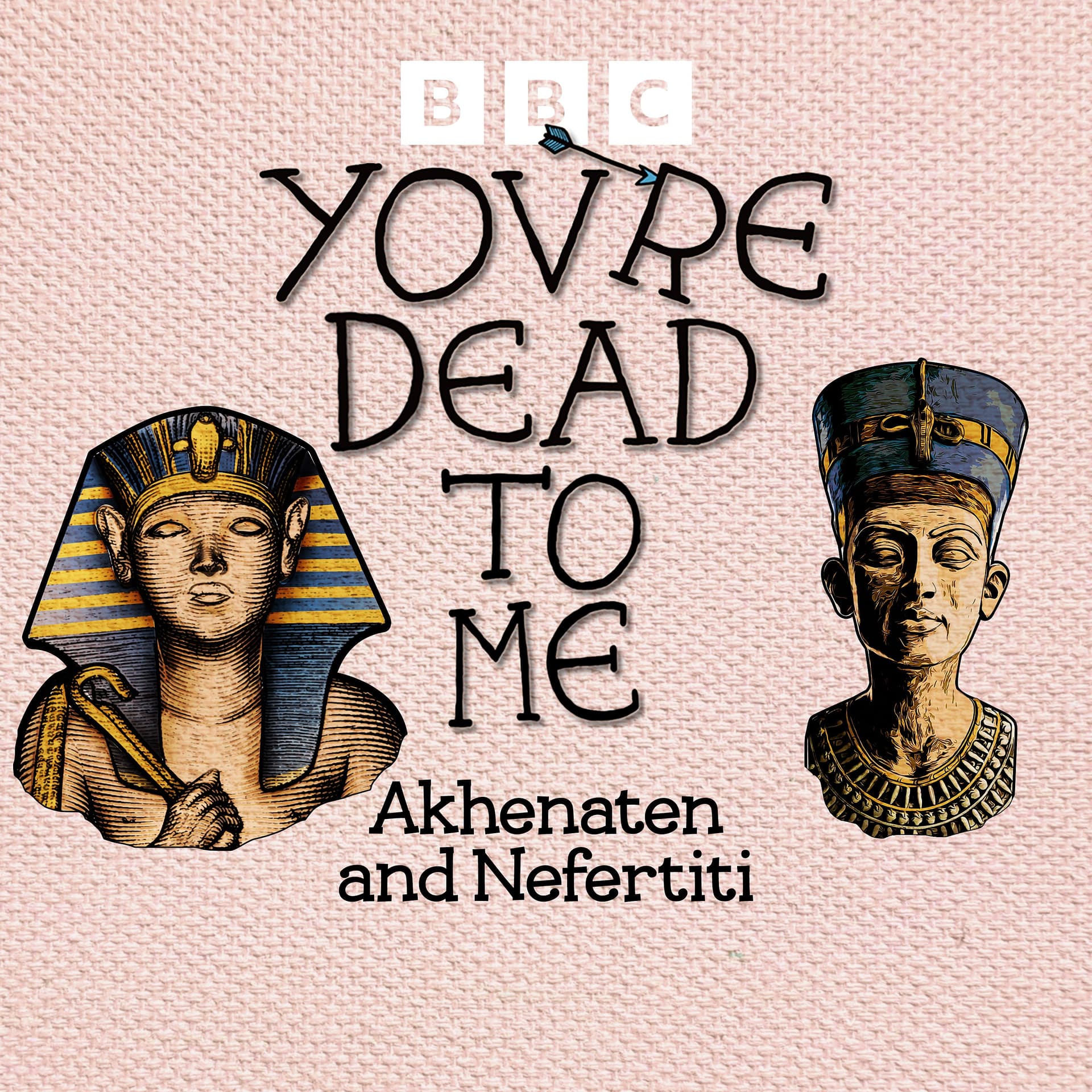
In short
Akhenaten and Nefertiti’s brief religious revolution in 14th-century BCE Egypt, centered on worship of the Aten (the sun disk), the creation of the new capital Akhetaten/Amarna, and the later reversal that erased them from official memory.
Guests
Dr. Campbell Price, curator of Egypt and Sudan at the Manchester Museum; fellow at the University of Liverpool; author of Ancient Egypt in 50 Discoveries and Totally Chaotic History. Sakisa, award-winning comedian/actor/producer and host of Wrestle Club UK.
Key claims
Akhenaten (originally Amenhotep IV) rebranded himself as “Beneficent One of the Aten” and promoted Aten worship as exclusive, with Aten depicted as a sun disk reaching only the royal family (hands ending in the ankh). He moved the royal residence to the desert and vandalized older cults, especially Amun, including attacking the “Amun” part of his father’s name. The Aten period lasted roughly 20 years; after Akhenaten’s death, a counter-revolution restored Amun worship, and later king lists omit Akhenaten (and possibly Nefertiti).
Notable examples
the Nefertiti bust found in 1912 by a German team (now in Berlin); Tutankhamun’s name change from Tutankaten to Tutankhamun; Amarna’s distinctive art (elongated bodies, and royal family affection); the sacred Apis bull oracle at Saqqara; and evidence that ordinary people continued using older gods’ amulets even after the city was abandoned.
Written by AI. May contain mistakes. Listen to the episode to check what was said.
Chapters
Tap a time to open that second in VOIntroduction of Guests and Topic
1:07 to 3:58
Hosts introduce the topic of Akhenaten and Nefertiti, along with guests.
“We are the BBC Radio 4 comedy podcast that takes history seriously.”
Guessing Game: What Do You Know?
3:58 to 6:40
The hosts engage with Sakisa about what she knows of Akhenaten and Nefertiti.
“This is where I have a go at guessing what you, our lovely listener or viewer, hello, might know about today's subject.”
Historical Context of Akhenaten
6:41 to 9:10
Discussion on the time period of Akhenaten and Egypt's golden age.
“which is basically him talking to foreign kings and all the kings are writing to the Egyptian pharaoh asking for gold.”
Akhenaten's Family Background
9:11 to 11:10
Exploration of Akhenaten's parents and their influence on his reign.
“Now we think of the ancient Egyptians, oh, they loved cats, they buried their cats, they mummified cats.”
Thutmose and Animal Cults
11:11 to 14:00
Discussion of Akhenaten's brother Thutmose and the significance of animal cults in ancient Egypt.
“But yes, so this prince is, he's a high priest.”
Succession and the Rise of Akhenaten
14:00 to 21:54
Learn about the transition of power to Amenhotep IV and his name change to Akhenaten.
“So that means that we now get the kind of the succession is established, right?”
Nefertiti's Background and Children
21:54 to 27:35
Explore Nefertiti's origins and her marriage to Amenhotep IV, including their children.
“So Sakisa, Beneficent One of the Aton is the official name of Akhenaten.”
Akhenaten's Religious Revolution
27:35 to 30:30
Discover Akhenaten's radical shift in religion and the establishment of the Aten as the sole deity.
“Pure threat sounds like an Egyptian pharaoh.”
Nefertiti's Role in the New Order
30:57 to 33:00
Discuss Nefertiti's potential feelings about the new city and her husband's plans.
“Is the West Bank reaching a tipping point?”
Amarna: The New Capital City
33:01 to 35:45
Explore the features and significance of Akhenaten's new city, Amarna.
“I've got quite a lot of friends who've got husbands who complain about how they want to do something and they've not thought about how it's going to process and how you get to that end point.”
Show all 18 chapters
Artistic Revolution in Amarna
35:46 to 41:49
Learn how the artistic style changed dramatically during the Amarna period.
“But it's interesting in the art depictions of what the city is like.”
The Downfall of Akhenaten
41:50 to 42:00
Understand the challenges Akhenaten faced and the aftermath of his reign.
The Drama of Akhenaten's Reign
42:00 to 46:05
Explore the tension and dynamics of Akhenaten's rule and the public's response.
“And actually, Akhenaten Asakisa, he doesn't live long.”
The Aftermath of Akhenaten's Death
46:05 to 49:38
Discussion on the implications of Akhenaten's death and Nefertiti's potential role.
“Maybe it's like a tourist-like area for them.”
Nefertiti: The Icon and Her Legacy
49:38 to 54:09
Examine Nefertiti's lasting impact and the mystery surrounding her disappearance.
“what a story Sakisa right yeah it's actually very interesting I did take some notes and it was glad to hear about her husband I will say that yeah okay because he's like Like, men don't get talked about enough.”
The Quiz Challenge
54:09 to 55:14
A fun quiz testing knowledge about Akhenaten and Nefertiti's history.
“In fairness, no one is spelling these names correctly, even with loads of...”
Final Thoughts on Akhenaten and Nefertiti
55:14 to 56:02
Reflecting on the significance of Akhenaten and Nefertiti in history.
“Akhenaten ruled during the 18th dynasty, during this sort of very famous era, when pharaohs were so rich, gold was said to be as common as what?”
Trivia on Akhenaten and Nefertiti
56:02 to 58:09
Explore intriguing trivia questions about Akhenaten and Nefertiti's reign and legacy.
“Yeah, fat, long necks, long heads, skulls.”
Transcript
Automatic transcript. May contain errors.0:00This BBC podcast is supported by ads outside the UK.
0:30at Whole Foods Market. Is President Trump snubbing South Korea to reignite his friendly relationship with Kim Jong-un? I'm Asma Khaled, and I host the Global Story podcast from the BBC. The U.S. and South Korea have been close allies since the 1950s, but this week, Trump announced that the U.S. will substantially reduce joint military exercises with South Korea. He cited his very good relationship with North Korea's Kim Jong-un. For more, check out the Global Story on BBC.com or wherever you get your podcasts.
1:07Hello and welcome to You're Dead to Me. We are the BBC Radio 4 comedy podcast that takes history seriously. My name's Greg Jenner. I'm a public historian, author and broadcaster. And today, well, we're bounding back to ancient Egypt and bowing down before the great sun disk in the sky as we learn all about the pharaoh Akhenaten and his queen Nefertiti. and to help us tell our Amuns from our Athens, we have two very special guests. In History Corner, he's the curator of Egypt and Sudan at the Manchester Museum. He's a fellow of the University of Liverpool. Maybe you've read one of his excellent books, including Ancient Egypt in 50 Discoveries and the children's book we wrote together, Totally Chaotic History, Ancient Egypt Gets Unruly.
1:45But you will definitely remember him from our episodes about Hatshepsut, the royal pharaoh queen, and Ramses the Great, the ego himself. It's Dr. Campbell Price. Welcome back, Campbell. Hello again. Nice to be back. Lovely to have you back in. And in Comedy Corner, she's an award-winning comedian, actor and producer. Maybe you've seen one of her hilarious tour shows, stand-up shows, or maybe you've watched her on the telly, on Live at the Apollo, Comedy Central Live, Jonathan Ross's Comedy Club. And for wrestling fans out there, maybe you've listened to her podcast, Wrestle Club UK, it's Sakisa.
2:16Welcome to the show, Sakisa. Oh my God, I'm so excited to be here. Can't wait to learn. You're going to learn so much stuff. Yeah. Quite weird stuff. Yep. Even for ancient Egypt. Even for ancient Egypt. So, Sakisa, we have to do sort of the basic chat. First time on the pod. Yes. Thank you so much for coming in. I have to ask, do you like history? I do like history, actually. I always wanted to do it at GCSE, but I decided to pick geography instead. Oh, come on. But yeah, like Henry VIII was like my, like if we did an episode on that, I'd be like, we don't need you. But I'll be the expert on that one.
2:50Oh, interesting. Okay, so you quite like the kind of Tudors, but what about ancient history? Do you know anything about ancient Egypt? That the women were great. Yes. Nefertiti was amazing. I actually do love the symbols. Obviously, the symbols come up quite a lot in tattoos and stuff like that. I've always wanted to get one, but I decided not to. Okay. I feel like it's a bit like the Chinese symbols. You know when people get Chinese symbols and you're like, does that actually mean what it means? I don't know. Well, you've got an Egyptologist here. Oh, actually, you can draw me one. Yeah, maybe after the show.
3:23Yeah. I've seen people in swimming pools where I'm like, your name is Steve. It's written in hieroglyphs. All right. Today, we're talking about Akhenaten and Nefertiti. I think you know Nefertiti's name, right? Yes. What about Akhenaten, her husband? No, I don't care about that person. Maybe by the end you will. Maybe you won't. I mean, he's a controversial guy from history. And his queen, I think, is perhaps more famous than he is. So, what do you know?
3:55Let's crack on with the first segment of the podcast. This is called the Sawaddeean No. This is where I have a go at guessing what you, our lovely listener or viewer, hello, might know about today's subject. And Akhenaten, I think is a tricky one. I think you've probably heard of Nefertiti though. I think that's the sort of the baseline. She's this famously beautiful queen whose one-eyed bust is, you know, one of the most incredible ancient sculptures, one of the most famous sculptures in ancient art. And you may even know about their possible son, a certain chap by the name of Tutankhamun. Oh, yes.
4:24So, you know, we'll get into that. Basically, as we think, Nefertiti was the big mummy to Little King Tut, or was she? I mean, we'll ask, we'll find out. Akhenaten, I don't know, if you're an opera fan, Philip Glass wrote an opera about him, but I don't know if that's well known. He's a baddie in Assassin's Creed Origins, and Doctor Who fans will remember Nefertiti herself from hunting dinosaurs on a spaceship, as you do. So, were the real historical Akhenaten and Nefertiti hunting dinosaurs on spaceships? Probably not. But how did they profoundly change ancient Egypt? And do we need to redraw Tutankhamun's family tree?
5:00Let's find out. So, Sakisa, historians, I'm coming to you first. You're coming to me first! Historians love dates, not romantic dates, mathematical dates. We like, you know, years in history. So we'll start with some basic ones. How long ago do you think our story is? Oh, don't do this to me. Oh. Can I? I feel so stupid. It's not stupid. It's a long time ago, so I'm not expecting you to know this. People think I'm smart because I'm a lawyer. And I'm like, no. You are smart. You are a lawyer. I'm actually quite dumb. But I'm going to say 1300. BCE? This reaction is everything for me. Campbell, I mean, that is bang on.
5:47He says bang on. Yay! BCE, yes. Yeah. So Akanat and Nefertiti are in the 14th century BCE, the 18th dynasty out of 30. So they're kind of midway in ancient Egypt. So we're talking about 3 ,340 years ago. Yeah, a long time ago. But this is really the ancient Egyptian golden age. So you sometimes hear Egyptologists talk about the new kingdom. So the pyramids are the old kingdom. The new kingdom, Greg, as we've said before, isn't particularly new. It was 3 ,000 years ago. but it's a time when Egypt has expanded in a way and kind of taken a lot of stuff from its neighbours. So the treasury is full.
6:30Is this what Britain got it from? We'll come back to this. But we've got letters from this time from the reign of Akhenaten, which is basically him talking to foreign kings and all the kings are writing to the Egyptian pharaoh asking for gold. they're like in my brother's kingdom gold is as plentiful as dust so it's so common as an idea that ancient egypt is rich yeah and we'll see evidence of that we're talking here about the kind of almost the high point of a 3 000 year civilization right yeah it's up and down and up and down in history it's never as that that simple as a real high point without any question but akhenaten's dad is a guy called amenhotep the third he rules for over 30 years and he is not doing much in the way of battles because the treasury is so full, all he wants to do is build stuff.
7:23So this is really an international time. It's quite cosmopolitan and Egypt has lots of gold. I've got a question. Yeah. So I will put up my hand because I feel like I am in school. I am taking notes. How do you know that was his actual name? Without going on a major tangent about the Rosetta Stone, we've got lots of texts that repeatedly give the king's name. So we have the basic components. So it may have sounded like Imenhetep or Amonhotep or something, but we know for sure that the dad is called Amonhotep. And in fact, the son is also called Amonhotep. This is a good name. And this is name checking the big God at the time, the kind of prime God, a guy called Amon-Ra, who, as we will see, goes out of fashion under our friend Akhenaten.
8:14Let's talk about Akhenaten's mum. So we've met Akhenaten's dad. Yes. Let's talk about his mummy. You will insist on doing that. I will. I will. You know, sorry. Who was the mother of Akhenaten? We know a lot about this lady. So Queen T is the daughter of people who seem like fairly normal folk. So she's not born into the royal family. In fact, we found the intact tomb of her parents in the Valley of the Kings. So that's really where you get buried if you're a king or a queen but queen t's mom and dad are thought of so highly uh by their son-in-law that they get buried in the valley of the kings queen t and this is important for understanding nefertiti just is right front and center with her husband she's doing things she's depicted commanding things she's very present in the monumental art and i think that sets the tone for the reign it's not just Amenhotep III is a god and he's telling people he's a god when he's alive he's also saying my wife is a living goddess they are worshipped full-on deities so it's Kate and William it's kind of like Kate and William on steroids yeah yeah yeah okay cool I can I can see the vision yeah I can see the vision and they have a few children how many um this is gonna be a repeated thing we don't know for sure because the record doesn't always record historians historians of course we're we're talking about an archaeological subject where we have got loads of stuff surviving but that stuff is a fraction of what must originally have been produced right so we know queen t and amenhotep the third have several children one of whom is a guy called tutmos
10:05what is it about tukmos that tickles you just tukmos that sounds so funny just tukmos what's your name tukmos see our episode on hat chips out for a joke about tukmos so we know a bit about this guy he is a big cat lover he is one of the only ancient Egyptians who for sure has a pet cat. Now we think of the ancient Egyptians, oh, they loved cats, they buried their cats, they mummified cats. Actually, most cats were sacrificed to the gods and were not pets. But Prince Thutmose, he definitely has a pet cat because he makes a sarcophagus for it. And he's also a bull fancier. He makes a massive tomb for some lucky bulls that can answer fortunes.
10:55What do you mean that the cats were sacrificed to gods? like what they were just like bunch of cats just what about the dogs? what about dogs as well? crocodiles? crocodiles? yeah anything you could kill you could give as an offering to the gods not spiders though no evidence of spiders you're right how about flies? flies hard to mummify a fly hard to mummify a fly tiny bandages they do they do scarab beetles obviously as we've seen from the mummy yes exactly yes renowned documentary yeah reliable information That's how we get all that information. But yes, so this prince is, he's a high priest.
11:35So he's got a job. That's important to give a job to these young princes. Of course, yes, as we know from history. Keep them occupied. But we know a little about him, but he does seem to be involved with animal cults because ancient Egyptian gods can usually take the form of animals. So he's in charge of this sort of famous temple called Saqqara, right? Where there's the fortune-telling, future-predicting sacred bull. The Apis bull. The Apis bull. Which you ask it questions and it tells you what's going to happen in the future. Wait, wait, wait, time out. So the bull is like telling the future?
12:10Yeah. Wait, is the bull... The bull can't speak. Yeah, that's what I was about to say. To be clear. The bull's dead, right? No, no, when it's alive. So imagine you go into the sacred paddock and you've got a question. Wait, wait. I've got a bull who's like being praised by everyone got a harem of cows yeah it's got special markings so the sacred bull when it is born they know it's sacred because the special markings right yes and then you ask it questions and it will it will eat food or it kick over a bucket or it sort of if it just gallops in a certain direction you say okay I've got a question did the woman down the road steal my chisel a bit to the left for yes a bit to the right for no so it's like interpreting movements of you know statues of the virgin Yeah.
12:52Yeah. And the bull is obviously in a room and has got like several other cows around it, just like, just worshipping him. Just being like, moo. Pretty much. Moo. All hail the bull, moo. Okay. Interesting. Okay. We see how the hip hop stars have got their allies from the bull. Yes, exactly. So that's Thutmose's job. Yes. So he's the main prince. He seems to be the heir apparent. So Arkhanathan, the guy we're talking about today, he's not the main prince. He's a backup prince. So what's his childhood like? We know next to nothing about royal children. Thanks for coming in, Campbell. Bye. Especially boys, because I think there is a taboo about boys being shown or given too much power, too much influence, because they might try and bump off their dad.
13:42Whereas princesses can feature in the art and the kind of public monumental discourse. So we know next to nothing about Prince Amenhotep as he is the younger son of Amenhotep III. He's not called Akhenaten yet. He's Amenhotep Jr. The fourth, yeah. Going to be Amenhotep Jr. Okay, but then Thutmose dies. He does. Perhaps run over by a sacred cow. Who knows? Who knows in the line of duty. Yeah, absolutely. So that means that we now get the kind of the succession is established, right? Yes. Our little prince, Amenhotep IV, is going to be Pharaoh one day. Yeah, second son, if he is indeed the second son, takes the throne eventually, which is not uncommon in other parts of history.
14:25And his pharaonic name, Sakisa, do you want to guess his pharaonic name? You won't guess this, and if you do, you are a witch. But like, do you want to guess his official pharaonic title?
14:39Amma, Amma Pharaoh? Pretty smart, pretty good guess. It's a bit more complex than that. I mean, do you want me to give you some pronunciation? I can't even read this. Nefer-Hebru-Re-Wa-En-Re-Amen-Hotep. That's his name. They are definitely emphasizing not just that he's connected to the god Amun, who, as I said, is the big main god of the time, but they mention the god Ra or Re, and he's the sun god. And so the power of the sun god is going to be very important in this story. This won't be his last rebrand, Sakisa. Spoiler alert, he's going to change the name again. Oh, it's Madonna. A little bit.
15:21But let's get on to Nefertiti because I think Sakisi, you knew a bit about her. So do you know what Nefertiti translates to? Do you know what her name meant? The queen? The boss queen? It means literally the beautiful lady has arrived. Okay, I think I'm now going to be renamed as Nefertiti. Yeah, it's a great name. The word Nefer means beautiful or perfect. She is unusually well known for an ancient Egyptian queen as we all find out because of the bust, this famous bust Greg mentioned that's now in Berlin. But she seems to not be royal. She's not married in the royal family. She's not born of royal stock.
16:00Some people think because of the meaning of the name that she might be a foreign princess who comes into the Egyptian court. We know the ancient Egyptians do that. The Egyptian king takes foreign wives. So she's an import bride. She might be a mail-order bride from the Tanni. Yeah, maybe. She's Megan. I can see how it's moving into Cotton Lord of the Force. You don't want to force too many historical comparisons. But like most ancient Egyptian brides, generally certainly royal brides, she seems to get married to Amenhotep IV, as he is, quite young. So she's anywhere between the ages of eight and 16.
16:40Oh, I'm going to have to honk my problematic marriage klaxon. That's so young. I mean, 16, by our standards on this show, is like tolerable. Eight is horrific. Did you really get married at eight? Well, yeah. Yeah. And that's not the worst thing probably because there's more to talk about. Oh, dude. So she may have been eight. Some scholars say nine, some say 12, some say 16. It's impossible to say for sure. Right, but like she's extremely young. It's very, very upsetting. But also she might have been, I mean, so Armin Hotep may have been related to her. We're not sure. We're not sure, but it wouldn't be uncommon for the king to marry a relative to keep the royal blood pure.
17:21So we've had in the past brusbands, brother husbands. We've had brusbands. In ancient Egypt, we call them brusbands. But we should now introduce a new term, cousin husband. So Amenhotep might be a cusband or a brusband. It could be. We could hope not, but... Hey, again, if we're talking about modern royal families, it's not uncommon. Come on now. If you're historians, you should know. Yes, no comment, but yes. Okay, but Sir Campbell, jumping forward in time, when do our marriage couple become parents themselves? When do they then have their own children? You know, Amenhotep and Nefertiti, when do they have their own princes and princesses?
18:00They have at least for sure, because we've got lots of depictions, six daughters. So it's quite uncommon actually to show daughters in that way. They may have some sons, maybe Tutankhamen. Yeah. But there is evidence that Akhenaten may marry one of his own daughters and have more daughters. That's a whole other problematic marriage klaxon. I don't even have that one. Yeah, it's a different realm. That sounds Austrian. We don't know for sure. And there can be symbolic ritual marriages that may not have involved children. What else can we say about these children they have, you know, the family dynamics?
18:43Well, I think the general context is high infant mortality. So children are dying a lot more in the pre-modern world. So you might want to have more children. Amongst those children, there is likely to have been a boy. Now, this is a big question. Is Nefertiti the mother of Tutankhamen? We don't know for sure. He maybe is the child of a lesser wife and Akhenaten. And he subsequently goes on to marry one of his half sisters. But it's complicated. But in all of this, you're trying to, if you're the pharaoh, you're trying to secure your right to the throne. And for a long time, it was assumed the real right to the throne passed through the female line.
19:29So it was really the female blood that was securing the right to be the pharaoh. So Tutankhamun, historically, traditionally, we'd say was Nefertiti's son. And now we are putting a question mark on it. Yes. Okay. Yes. Some people believe he was. Some people believe he wasn't. Interesting. Okay. Welcome to Egyptology, Sikisa. It's really hard. Sorry. Is there no DNA test that we could do? We're not sure that the bodies we have are definitely the people involved. That makes it complicated. So we do have mummified bodies, which is a historical resource. We've got Tutankhamun, right? Yeah, for sure.
20:03we've got Tutankhamun, but DNA and stuff degrades with time. So you can't just do a quick test and say, ah, I know whose son you are. All right. Let's talk about the backstory that's going to get quite confusing, Sikisa, because the reason we're here to talk about Akhenaten and Nefertiti is that they did something radical in ancient Egyptian history. Oh, exciting. And the way we can sort of see some of that is in Tutankhamun's name. Yes. So tell us about that. Give us the backstory on how his name is a sort of interesting indicator. So we've been talking about an Amenhotep IV, At some point, he changes his name to Akhenaten.
20:36So completely different name, mentioning the Aten. So the Aten is the sun disk. It's the disk in the sky, perceptible sunlight. Tutankhamen, the child, is not called Tutankhamen originally. He's called Tutankaten. So that means literally living image of the Aten of the sun disk. So he is very much a product of the belief, which becomes pretty serious at this period in just the Aten, the sun disk in the sky. Traditionally, the ancient Egyptians, you know, are worshiping lots of gods, magic bulls, cats, crocodiles. Denial, et cetera. Denial, the idea of magic, really broad pantheon. But Akenaten comes along and says, nope, we're not doing that.
21:26We're gonna switch things up. So the fact that Tutankhamun eventually changes his name to Tutankhamun tells you something, a bit of a spoiler, that things go back into reverse. So we go back to worshipping Amun and all the other gods, and the Aten episode is fairly short. Yeah, and we've got to talk about that episode because obviously that's the sort of extraordinary thing about them, this sort of tiny, brief flurry of monotheism. Yeah, essentially. But we'll get into it. So Sakisa, Beneficent One of the Aton is the official name of Akhenaten. I mean, I know you're into your wrestling. It's not a great wrestling name.
22:05No, it's too long. It's too long. It doesn't really have a nice ring to it. You kind of need... Say the name again. Beneficent One of the Aton. How would you wrestle that up? How would you pop that into spandex? Welcome into the ring. The Aton. Okay. That could work. Yeah, that's about it. Yeah, I mean... We don't need the beginning of it. Fair enough. All right, okay. But I'm thinking, you know, The Undertaker, The Aton. These things, they kind of, you've got to have the kind of branding. So, you know, it's an interesting problem, I suppose, of name changes and whatever. Akhenaten's already a brand new name for him.
22:38Yes. And also, I mean, you said sort of the pantheon of gods, they normally had animal heads. Yes. Quite common, not always, but they often, you know, falcon-headed and all that sort of. Sikisa, what do you think The Aton looked like? What do you think the official imagery was of this brand new god that Akhenaten said, that's the one god, that's it? Can I get a clue? Is it an animal? No. They're sexy. Cool. I think he is wearing like a sunray kind of helmet. And it looks like it's flared out with sunrays, but it's actually feathers. That's quite nice. That's a good image. Yeah. And some of the queens do actually wear that at the time.
23:27So how close is Sikisa with that really lovely guess? Not that close because for ancient Egypt, the Aten is really weird. So Et is shown, usually referred to with male pronouns, but kind of as a universal deity, as just a circle, as the sun desk. It's quite basic. Okay. But reaching out from the sun desk on the chalkboard behind Greg are lots of little hands reaching out, not just to humanity, not just to everybody, but only to the royal family. And at the end of the hand is a hieroglyphic symbol, you will know. It's the looped cross, the ankh symbol, the symbol of life. So it is, in a way, a totally aniconic, not human form of the god.
24:19but it's also exclusive because it's saying the sun only shines for Akhenaten, Nefertiti and their kids. Other people can't get close to the god. This is the new only god, right? Akhenaten said, this is our new god, the only god, and he only likes me. Yes, I am the only way you're going to get to talk to him. Right. I'm his gatekeeper. So Akhenaten is a diehard Atten bro. He's all about the Atten. Sorry, can't help it. so does he think that the sun literally shines out of his ass? Like, you know, is he literally? Not out of his ass necessarily, but out of his hands. Out of his hands, okay. Because there's one depiction which may be the only ancient Egyptian scene showing a rainbow.
25:05Like you never, think how universal symbolism of rainbows is now. Ancient Egyptians knew what rainbows were. There's one showing the aton with a rainbow around it. Really? But yeah, it's a very weird experiment and the experiment doesn't last because it lasts maybe 20 years for this period and then the ancient Egyptians forget about the Aten. What I heard from that is, is that how Egypt invented pride. That's what I've heard. I would love that to be the case. That's what I got from that. Yeah, it may not be. Let me just write that down in my notes. Arcanada and the rainbow flag. Yeah, absolutely.
25:40We'll come back to that idea, I think. Yeah, maybe. I mean, we should say, I suppose, this is not a brand new God, right? it had initially been one of the gods in the pantheon. And then it's sort of, it's been elevated. It's been sort of pushed forward. So the iconography had started as a sort of man with a falcon head. Yes, we've got early in Akhenaten's reign when he's not changed his name, he's still Amenhotep. There is a scene labeled the Aten and it's a regular guy or regular for the ancient Egyptians, God, man's body, falcon head, that's acceptable. But then things change. And as Greg says, that the Aten has existed in ancient Egyptian religious texts for hundreds of years.
26:19But then this is interesting. Akhenaten's dad, Amenhotep III, says that he is the dazzling Aten. So all of this might be a bit of a daddy complex. And Akhenaten might actually just be worshiping his fully divine dad, Amenhotep III. So as I said, Amenhotep and his wife, Queen T, are full on gods. Wait, how do you become a god? You just say you're one. Okay, so I'm a god? You could be a goddess right now. Well, we all know. I already am. Thank you. And sometimes if you die, if you were eaten by crocodiles, I think sometimes you could be made a god, right? You could pretty much overnight. Yes, that's right.
26:57The Nile was holy and crocodiles were holy. So if they ate you, that was actually like... You get full mummification. Even though your family might not be able to afford it, you get mummified. And everyone says, yeah, you're totally ascended, become... So you can choose. You can decide to just be a god or you can feed yourself to a crocodile. I think I'll just be a god, thanks. Okay. Yeah, cheers. Sakisa, how do you think Akhenaten went around publicly replacing these other gods, these ancient, important gods? What do you think he did to sort of, you know, bring in his brand new religion? I think he basically said to everyone, if you don't do what I say, you are all dying.
Read the full transcript
27:30Okay, so you just think pure threat, right? Pure threat. Threat. Pure threat. Pure threat sounds like an Egyptian pharaoh. It could be, actually. Just pure threat. Oh, I think he even bribed them and was like, hey, I'm going to give you some gold. Akhenaten says, right, we're going to move the capital city away from the traditional area of what is now modern Cairo, the city of Memphis. And we're going to move it into the middle of nowhere in the barren desert. and I'm going to call my new city the Horizon of the Aten, which is very on trend with the whole sun cult. So confusingly, the ancient Egyptian name of the city is Akhet Aten, meaning Horizon of the Aten, of the sun disk.
28:19And the king's name is Aken Aten, beneficent one for the Aten. So it gets confusing. This is the principal royal residence and Aken Aten says multiple times in big inscriptions, I am never going to leave this place. and I'm going to be buried here and the royal family are going to be buried here. And he just constructs this massive city in the space of maybe 15 years. In the middle of the desert? Pretty inhospitable. Nothing there. Next to the Nile. Okay, all right. So when you say move, like he literally like dug up the town and moved or displayed like, oh, you lot, we're going. He moves the people.
28:56He moves the people and I suspect because his dad is sitting in his throne and he's not going out to war. he's got so much time to build stuff. There are people who are ready to build. So he moves the builders. He doesn't move the actual stuff. He doesn't move the buildings. Later kings do that. But he starts fresh because he makes this thing of this is virgin land. It's not sacred to any god or any goddess. Let's just start from scratch because we're shaking it up. But he also trashes some of the existing temples, right? Oh, yeah. He doesn't just say new religion. He vandalizes the existing temples, the existing gods who have been, they've been revered for 1500 years by this point, 2000 years by this point.
29:40There's an interesting theory that maybe this kind of reaction against the old gods happens later on in Akhenaten's reign where things start going wrong. So his big revolution seems to have cracks in it. And he thinks, this is the bad luck from the old gods. I've got to go and attack them. So especially the god Amun gets totally removed from every standing monument. Akhenaten sends people with chisels out, some of them who can't read the text properly and who are carving out the wrong thing. But he even attacks his dad's name. So if you remember, his dad is called Amun-hotep. Yeah. He attacks the Amun part of his dad's own name.
30:19Wow. Okay, so he can't be worshipping his dad then if he's attacking his dad's name. Maybe he's worshipping the sun god form of his dad. Maybe not the moon part of his dad. Wow. Prep for a busy week with Whole Foods Market. Start your day with fully cooked breakfast sausages from Amy Liu, 365 brand frozen waffles with no bleached flours, and of course Whole Foods Market eggs, which are all cage-free or better. In the evening, bring home a build-your-own family meal that feeds four for just$35. Choose one entree and two sides. Shop smarter, not harder at Whole Foods Market. Is the West Bank reaching a tipping point?
31:00I'm Asma Khaled, and I host the Global Story podcast from the BBC. For more than a week, homes in the village of Qusrat have been under siege, including one of a Palestinian-American man from Ohio. It's just the latest to draw attention to the rise of settler violence in the West Bank, which the UN says is higher than at any point in the last 20 years. For more, listen to The Global Story on BBC.com or wherever you get your podcasts.
31:51speak, they were in trouble. This is the problem we have in modern politics. We did a referendum and now we're in. This is what happens. You gave the people the vote. So if you had limitless power, Sakisa, you'd be building a brand new city. Oh, if I had power, the world would be crazy. I would do so much. He's obviously trying to bring people around to his brand new religion, his brand new revolution, his brand new city. To me, it sounds like a sort a series of red flags, but I guess he's the pharaoh. He's a god. He can do what he wants. I mean, Takeda, how do you think Nefertiti took to this?
32:27Her husband has got this big, bold new religion. Do you think she's a supportive queen? No. I think she's an independent woman, and I don't think she was very much like, I don't want to move. Are you making us move? I don't want to move. And she'd be like, why are we moving? I think there was a lot of questions, and I don't think she was happy about it. Right. and was like, we're happy how we are. I think she was kind of like, you're being a typical man. You want to do this thing and you've not thought about it. So you think she's like Victoria Beckham having to move to Madrid and being like, I don't want to live in Madrid.
33:01I've got quite a lot of friends who've got husbands who complain about how they want to do something and they've not thought about how it's going to process and how you get to that end point. I think exactly this is what's happened. And, you know, the kids have to start a new school. I mean, it's time, right? You know, we've got to think about these things. How are we going to move? Like, have you thought about where we're going? Have you thought about the weather scheme? Yeah, I mean, you know, exactly that. Doctors, surgeries, dentists, you know, you've got to - All of those things. You know, important.
33:29I think you're right, Sakisa, that there's a lot of eye rolling. Yeah, of course I am. It's a woman. Oh God. He's doing this. I'm going to have to follow him. So Nefertiti is very prominent in all the arts. So she's with him. Yeah. Whether she's actively supportive, not sure. Some evidence against. She gets her own palace. So she's at a distance from him. I'm getting my own house, yeah. She is mentioned in an inscription where the king says, I'm going to make these decisions and the great royal wife, Queen Nefertiti, is not going to argue with me. So the idea is there that they're having a bit of a to-do.
34:08And her mother-in-law is on the scene. So Akhenaten's mum, Queen T, is still alive. And she probably lives at this site, the site of what we call Amarna today. And so if I was Nefertiti, I would want my own palace. Yeah, because if the mother-in-law is still there, that's the worst thing, isn't it? Why is she here? Go away. It's like that J-Lo movie, Monster-in-Law. Yeah, yeah. Okay, so we have a brand new city. We have perhaps squabbling royals, or maybe not, but perhaps there's some tension there. Tell us about the city itself. Tell us about Akinhatan. Akinhatan? Akinhatan. Akinhatan. Akinhatan.
34:48So we call it Amarna today. Yeah, I was going to say. So you'll hear people talk about the Amarna period. So this is this 20 years where the capital city moves to this area of Middle Egypt. So it's about seven kilometers along the Nile. So it's big. Yeah. It is mainly the king's palace or series of palaces, Nefertiti's got her own, and temples. Unlike traditional Egyptian temples, which have got roofs on the inner parts where you can worship God's statues. Because the God is the sun, nothing has a roof. So you go and the royal family, at least, worship in these temples. There is a major road connecting the palace and the temple.
35:29And because the ancient Egyptians were used to God's statues being taken in procession and everyone having a party, they're totally deprived of that. So Akhenaten and Nefertiti decide, do you know what? we're just going to be the gods and we're going to ride between the palace and the temple in a chariot and we're going to snog and that is your religion so you can invite so kisa your face right now is a picture i'm confused how have we diverted to this so so akhenaten and nefertiti bring the kind of the high officials along and they have to publicly at least buy into this crazy new scheme. But it's interesting in the art depictions of what the city is like.
36:12There are soldiers shown flanking this royal chariot. Never before seen soldiers. You do suspect there's a bit level of unpopularity about this. Some bodyguards to keep the king safe. To keep the kind of obstreperous masses at arm's length. I mean, yeah. And that's the interesting question, I suppose. How many people do we think maybe move to this city? Like, it's a big city geographically. Yeah, yes. But is it 10 ,000, 50 ,000 people? How many people live here? It could be anywhere between 10 ,000 and 50 ,000 people. Amazing. But so the elite people, the actual, like the rich people who are making any of the decisions, the royal family and the elite are maybe, I don't know, 100 people in total.
36:54And then everyone else is building or servants. So it sounds like it's a failure. It sounds like this move was kind of like not going very well. Doomed to failure. And actually you mentioned building there that they do something radical here in ancient Egyptian history. They revolutionize the kind of construction process by making the block smaller. Yeah. So the temples and the palaces and the houses are built of mud bricks mainly, but there's a lot of stone being used, local limestone. So unlike the pyramids, where if you've heard anything about pyramid building, you take a team of guys and they drag a big old stone on a sledge.
37:33They might have used ramps. They might use pulleys. They use big blocks and a whole team do the dragging. At Amarna, Akhenaten says, okay, I want this done double quick time. So I want the blocks to be smaller so you can throw up the buildings quicker and I want each block just to be enough for one man to carry. Which sounds great, but actually one person holding one block is much worse for your back. than a team of people dragging a bigger weight. Yeah. So it's not the health and safety. Not great. Not great. Okay. So we've got thousands of workers, sort of each carrying one block each. Yes. And building this sort of temple and city in 10, 15 years.
38:17Yeah, yeah, yeah. Incredibly busy. But also, you know, we've got the artistic tradition changes too. Have you ever seen any Egyptian, ancient Egyptian art? Have you ever seen any of the kind of famous murals or, you know, inside the tomb of Tutankhamun Yeah, it's only like the pictures and the hieroglyphics, hieroglyphics of like the sticks, stuff like that. But that's about it. Nothing like of like where they were, apart from like obviously the women. Yeah. The women pictures of them being in that thrones and being gorgeous and obviously like that. But they're often depicted side on, right? I mean, gods are pictured side on.
38:49People are, it's often a sort of two-dimensional. Yeah, it's always like this. Yeah, it's like, it's the chemist's. Profile. Yeah, it's this profile. They're like, this is my good side. Yeah, my good side. But we get a brand new revolution in art in this period. And the Amarna style of art is weird. Yes, even by ancient Egyptian standards, which in some ways doesn't come up to what we might expect of Renaissance art. It is weird. It's totally strange. It's worth saying also that Amarna, the city, now if you visit, is a desert. It's 50 shades of beige. But actually in ancient times, you would have...
39:23One of my favourite erotic novels. Oh, indeed. you would have the insides of these palaces would be eye-poppingly colorful. There's lots of gold, there are inlays. We've got all the fragments of these. And the scenes on the temple walls show, for a start, the weirdness of the gods. So the god is just the sun. There are only ever the royal family shown worshiping the sun. Any flunkies are way down the kind of pecking order. But actual people are shown very differently. They have long, elongated skulls. They have long, spindly legs, big bums, thighs, long, thin feet. So even to an ancient Egyptian...
40:05Quite rotund bellies. Yeah, quite a pronounced belly and quite androgynous. So men and women, which previously had been shown quite differently, are shown very similarly. So to an ancient Egyptian artist who was told, go away and help build this temple, they would have had to learn these new skills, these new techniques. They just look very weird, even to an ancient Egyptian. But the artistic style is radical and it's weird, but it also shows Nefertiti doing manly things, kingly things. Yes. So Nefertiti is a force to be reckoned with. She is present with her husband, as you'd expect the queen of Egypt to be.
40:43But she's also shown on her own a lot, worshipping the Aten on her own. and in one scene she's even shown beating up a foreign enemy. So that is usually just the pharaoh is shown with a mace smashing in the skull of a foreign captive. So she does a bit of that. So there's a different aspect. Independence, yeah. Independent woman. Be a queen, yeah. She's often shown with her husband interacting with the children. This is super weird also. Usually the king and queen in ancient Egypt are never shown with any level of affection or emotion. You never get family scenes. You never get the king touching anybody.
41:25But Amarna, as I said, there's this regular procession. Akhenaten and Nefertiti are shown kissing each other and their own children. They're depicted in a way that invites us to believe that it was a very kind of airy-fairy, floaty existence where everyone loved each other. The reality is likely to have been quite different, living in separate palaces yeah what I'm getting from that is that they're trying to like make it a bit like Real Housewives to be like this is a real relationship or actually it does not actually yeah Real Housewives of Amarna yeah yeah yeah yeah we're like give me the gossip that's what I like because you've got Queen T in the background and you've got Nefertiti yeah and then you've got the kids and then you've got the kind of the dad of the family who's like I'm the god now yeah it's all quite tense yeah I want to see that drama please make it The real Housewives of Manor would be amazing.
42:17And actually, Akhenaten Asakisa, he doesn't live long. Do you know how old he is when he goes? Oh, 26. He's not, actually, he's older than that. I mean, okay. 32. That might be about right. Maybe. So the reign lasts, it seems, about 17 years. Oh, that's not bad, actually. So if you imagine he came to the throne at 15, he's still only in his 30s, so young by modern standards. Yeah. And when he dies, does everyone go, right? Or is there a kind of continuity thing? Does Nefertiti step in? Well, this is really interesting. I think there are definitely sighs of relief in some quarters. Like, gosh, thank goodness that's over.
42:58Because, you know, while Akhenaten's doing all this and he's getting the elite people to worship the Aten, we know from archaeology from the city of Amarna, which was abandoned shortly after Akhenaten's reign, tells you something. It's a gift for archaeology because no one built on top of it. So it is like an ancient Egyptian Pompeii. You can literally go in, see what people were using in the houses. And so all the regular people were still using images and amulets of the old gods. So that rather implies his Atenism wasn't that popular with ordinary people. So yeah, when Akhenaten dies, there are a lot of questions about what happens next.
43:40Maybe he has a son who comes along and rules beside him for a period, a guy called Smenich Kare. Then there's a mistake, the names get really, really weird now. There's another person called Nefer-Neferu-Aten, who is meant to also be a king-like figure who might share the throne with Akhenaten and lives slightly after Akhenaten. And for some Egyptologists, this is Nefertiti by a different name. So the husband dies and she says, right, I've waited long enough. I am the Pharaoh now. So not just the Queen of Egypt, I am the Pharaoh. And she starts reversing the decisions of her husband and she brings back Amunism.
44:27And then eventually King Tutankhamen or Tutankhamen as he is, he fully sees through the counter-revolution and he fully brings back the worship of Amun. So Nefertiti might be undoing her husband's work. We're not sure. To be fair, I could understand that. Let's just slowly, but surely, let's go back to the way things should be. This went too far. It went too far. It was a joke. We'll go back. I just let my husband do his thing. I'll just make sure he's happy, you know, happy wife, happy life, sort of. But yeah. But as you say, it's fascinating. The Armana archaeological sites is an amazing window into ordinary lives too, isn't it?
45:06It's interesting. Because people ditched it, right? they just went, we're going back home. We're going back to Thebes. It is interesting the fact they didn't touch it. Yeah, almost like it was like scorched earth policy. They reused a lot of the stone, but laterally they tried to forget about that part of Egyptian history. And there is a dark side to this because although the palaces are very beautiful and they made a real focus on naturalism in art. So there's lots of plants, flowers. there are good bits of evidence that the people that did all the building lived very short very hard lives so there are cemeteries of people who literally had their backs broken young kids plagues seem to have swept through the city it was not a particularly pleasant place to live unless you're Akhenaten and Nefertiti so it's maybe no surprise that there was a counter revolution there was a reaction against this idealism, this utopianism of Akhenaten.
46:08Maybe it's like a tourist-like area for them. Maybe they were like, if you're feeling a little bit down, go to this place, it'll cheer you up. Because that's where you could be living. Yeah, exactly. That's what you could have won. I mean, I guess we've already introduced a couple of name changes because he was Amenhotep IV, then Akhenaten, then he died. Sakisa, he got a new name after death. New name after death. Yeah. Do you want to guess what it was? We rebranded. They did. This could be a good wrestling name. Nookie.
46:43I'm trying to like figure out like if it's a shorter version, just beginning with N, just Nookie. No, I mean, that's cute. That's a cute, lovely name. It wasn't quite as good as that. It was closer to like, you know, more like The Undertaker, more like a kind of a, more like a heel character because he's the baddie, right? Yeah, he's the rebel or that criminal. what was the Egyptian pronunciation I can't think off the top of my head Hefet might be the one yeah Hefet yeah I mean he's they're not even calling him by his name though they're just like that yeah that dude that guy who did the bad stuff which in ancient Egypt where there's such a focus on names and carving your name onto everything and everyone remembering the name if you are not referred to by name you're just that guy that rebel yeah I've got loads of people that that called that just that guy and the temples of Aten that had been built they were smashed to the ground you know there's no like it's not like they sort of just go well we'll just leave it behind and just go back home they trash it all that hard work yeah all those broken backs oh my god that's disrespectful I would be annoyed but that's also anger right that's people who are angry like they take it out on the religion the religion he forced upon them they're like no no so we get this sort of sense of vandalism of anger and of people writing you know returning to the old ways the old gods yeah so when later egyptians are listing the great kings of egypt they leave a conspicuous gap so akhenaten we're not going to talk about him so it goes from his dad to one of akhenaten's successors they completely miss out nefertiti if she was a king tutankhamen is also tarnished by association.
48:27Even though he changed his name back to Amun. Even though Tutankhamen actually did the counter-revolution and brought things back to the way they used to be, he gets written out. They just get written out of history. It does seem a bit like modern history. Yeah. This is what people do. It's reflecting. It's reflecting. This is what people do. You know what? I don't appreciate them cutting out Naftiti. No. What happened to her, actually? I mean, that's a good point. Does she get, you know, You say she gets written out of history, but does she die powerful and rich and glamorous or is there a kind of...
48:58We do not know whether she dies as the Queen of Egypt during the reign of Akhenaten, that's possible, or maybe she kind of transforms into being the Pharaoh. There was a theory for a while that she was actually buried in secret rooms in the tomb of Tutankhamen that haven't been found yet. But that radar results were kind of unsure. So that doesn't seem likely. she just disappears from the history books and only comes back as a kind of figure in history in the late 19th century and with the discovery of that bust that brings her up to modern times and has a great impact on popular culture yeah so there we go what a story Sakisa right yeah it's actually very interesting I did take some notes and it was glad to hear about her husband I will say that yeah okay because he's like Like, men don't get talked about enough.
49:51It's important to history, it's true. I feel like it's about time. Yeah, writing those wrongs. Yeah, it's about time. It's a new area. Equality, we need equality. I mean, I sort of feel bad for him because it's almost like people just hit undo. They just like, he spent 15 years building a brand new religion, a brand new city, and then they just went, nope. So yeah, so they just hit the control Z, undo, and that's it. He's wiped from history, and now we sort of know about him as a sort of villain of ancient Egyptian history. Yeah, like you said, it's so much work. So many people literally broke their backs building that place.
50:23All the statues, all the temples, all the palaces, gone, all gone, overnight. Used as fell for other buildings. It happens to us all, you know. Okay. The Nuance Window!
50:40It's time now for the Nuance Window. This is where Sikisa and I sit silently for two minutes drawing strangely proportioned portraits of each other while Dr. Campbell takes centre stage to tell us something. We need to know about Akhenaten and Nefertiti. I'm going to get my stopwatch up. Okay. You've got two minutes on the clock. Let's get that. There we go. Okay, two minutes on the clock. Take it away, Dr. Price. So of anything we've been talking about today, I think people will be most familiar with that picture of the Nefertiti painted plaster bust. Long neck, tall blue crown. It was found in 1912 by a German team and is now in Berlin, although its transport to Germany is a part of a division of archaeological finds has been contested.
51:26The Nefertiti bust is, though, perhaps the most weird sculpture of any we have from ancient Egypt. Strangely truncated, it's not part of a larger statue. Its function is unclear. But there was a matching Akhenaten. he's very bashed up so he's almost totally forgotten nefertiti survives in such perfection that she's been accused of being a fake which she's not nefertiti because of that bust is an icon she's an every woman she's both an african queen and in the words of adolf hitler an aryan she can be anything to anyone but i want to emphasize we'll never really know what the living woman looked like.
52:09Because as we've been saying, a lot of this art is highly stylized. She did not look like this. The metrical proportions of the face are totally unnatural, totally unhuman. But what I think accounts for her timelessness is that we can't see her hair. She's wearing this tall blue crown, which if her hair was showing that would make her more attributable to ancient Egypt without the hair, she can be the bride of Frankenstein. She can be an intergalactic space queen. She can be anything you want her to be. Like the most popular royals today, we can project any identity we want onto her. Amazing. One minute 54.
52:55Look at that. So punctual. And I drew a picture of you. Oh, thanks Akisa. You know, the idea of her as a kind of African queen, but also a beauty standard is interesting. People get plastic surgery to look like a face that never existed. Yeah, because obviously people get tattoos and stuff like that of her face. It's just her and Cleopatra, obviously iconic in like women's, in like Queen independence and stuff like that. So I can see why people were so fascinated with her. And obviously the picture that you showed me, it shows like a proper beauty. and obviously when people are like African queens.
53:37Great cheekbones. Yeah, people are like, Nefertiti, she's great. I mean, actually, she's not. Maybe she was great, but we're not really sure. I mean, as you said, they may find her bones one day. They've been looking, haven't they? They've been sort of hunting her down. Yeah, there are candidates out there, but we'll never really be sure because, yeah, DNA is not a magic wand that just tells us exactly who people were. But there we go. So that's the story of Akhenaten and Nefertiti. Maybe a power couple, maybe a kind of squabbling couple who didn't agree and, you know, maybe she undid everything he achieved or didn't achieve.
54:08Your mother-in-law's here and here. Why's she here? She doesn't even cook. No, she didn't cook but she ate. She's chowing down on a big steak. All she does is eat. She doesn't even look after the kids. What's our purpose here? So what do you know now?
54:30it's time now for our quiz this is so what do you know now this is our quickfire quiz for sakisa to see how much you have learned sakisa you are both a comedian and also an immigration lawyer you are extremely brainy and very accomplished you must be good at learning things because you know law degrees are hard so you've been taking notes do you feel confident no i discovered i was just next four years ago so oh so a lot of things may just go in and go And also, all these names have been spelt wrong. In fairness, no one is spelling these names correctly, even with loads of... They are hard, hard names, right?
55:07Okay, but we'll give it our best shot. I have been listening and I was very intrigued. Okay, 10 questions. Okay, question one. Akhenaten ruled during the 18th dynasty, during this sort of very famous era, when pharaohs were so rich, gold was said to be as common as what? Dust. Very good, we're up and running. Question two. What did Nefertiti's name literally translate to? Do you remember? The really pretty lady. Who has? Who has. Remember, import bride? No. The really pretty lady. That's what I got. The beautiful lady who has come. I'm going to let you have that because I think it is, you know, a really pretty lady.
55:42I think it's pretty good. Question three. How was Akhenaten's new favourite god, the Aten, portrayed in ancient Egyptian art? Oh, with that. yeah it's radiosy kids give us words oh sorry with the sun and the hands out touching them because they were only worshipping the royalty very good yes and originally a sort of falcon headed god but yeah later on a sun disc with weird little fingers question four how old was nefertiti when she married ark and natan we've got four possibilities between the ages of eight to sixteen very good excellent brilliant so there you go that's the law there was a debate about that yes 8 9 12 16 very good question five nefertiti and akhenaten definitely had six daughters but which of their possible sons has become very famous to history tutankhamen very good uh king little touch uh question six name one strange aspect of how humans are depicted in the famous amana style of ancient egyptian art produced during akhenaten's reign what is it about their kind of depiction that's weird oh that they're not facing sideways yeah and also in terms of their bodies, their sort of physiology?
56:53Fat. Yeah, fat, long necks, long heads, skulls. Yeah, I'll give you that. Question seven. Akhetaten, or Akhetaten, the city, was the brand new capital. What was different about the stone blocks used to construct? They were smaller. Yeah, so that individuals could carry them and then be hurt doing so. Question eight. What was unusual about what the royal couple were shown doing in their royal art? They were affectionate with each other. They were. They were kissing, they were snogging. They had their kids with them. Yeah, exactly. It's like sort of Queen Victoria and Prince Albert and that sort of famous Christmas card.
57:25Yeah, absolutely. This is question nine. You're doing so well so far. Name one way in which Akhenaten's religious revolution was undone after his death. They took down the pyramids and buildings. Yeah, the city, yeah, the temples. Yeah, yeah, absolutely. They also trashed his name and wrote him out of history. And this for a perfect tense, Akhisa, what is one possibility for what happened to Nefertiti after her husband died? That she became pharaoh and changed. I'll accept it. Yeah. Ten out of ten. Very good. Yay me. Very well taught, Dr. Price. Very impressive and very well learned, Sakisa. Well done.
57:58I did learn something today. You did. I mean, your notes obviously were effective. I didn't even look at them. Look at that. Amazing. Thank you so much, Sakisa. I hope you've enjoyed that. I mean, I enjoyed that. Yeah, it was fun. It was educational. It was. If you're not laughing, you are learning. Sometimes we did both. Listener, if you want more Ancient Egypt with Campbell, check out our episode on other impressive pharaohs. So we had Hatshepsut, the kind of pharaoh queen. And of course, Ramesses the Great. The great ego has landed. For more radical rulers from history, we've got episodes on Emperor Nero.
58:29We did that with Patton Oswalt. We did Frederick the Great with Stephen Fry. We did Catherine the Great with David Mitchell. We've done some greats. We've done a lot of sort of kings and queens through history. So check out the back catalogue. I'd just like to say a huge thank you to our amazing guests in History Corner, in Ancient History Corner. We had the stellar Dr. Campbell Price from Manchester Museum. Thank you, Campbell. Thank you. And in Comedy Corner, we had sensational Sakisa. Thank you, Sakisa. Thank you for teaching me something new. Absolutely. And to you, lovely listener, join me next time as we find more forgotten figures to elevate or relegate, depending on what they did.
59:03But for now, I'm off to go and build a new capital city dedicated to BBC broadcasting legend Akit Attenborough. Bye.
59:24This Cultural Life from BBC Radio 4. I will never go into anything so deep like that again. The world's leading artistic figures reveal their creative influences. Disobey, disagree, disavow. I'm John Wilson and my recent guests have included the sculptor Anish Kapoor, photographer Annie Leibovitz, the actor Kristen Scott Thomas. It has made me good at telling stories about people who have a secret suffering. and former Children's Laureate Frank Cotterall Boyce. If art's got one function, it's to point to what's wonderful and say, look, this is your world. It's insane. Listen to This Cultural Life on BBC Sounds.
1:00:05Is President Trump snubbing South Korea to reignite his friendly relationship with Kim Jong-un? I'm Asma Khaled, and I host the Global Story podcast from the BBC. The U.S. and South Korea have been close allies since the 1950s. But this week, Trump announced that the U.S. will substantially reduce joint military exercises with South Korea. He cited his very good relationship with North Korea's Kim Jong-un. For more, check out The Global Story on BBC.com or wherever you get your podcasts.
From the publisher
Greg Jenner is joined in ancient Egypt by historian and curator Dr Campbell Price and comedian Sikisa to learn all about Tutankhamun’s parents, Nefertiti and Akhenaten. As well as their famous son, this ancient Egyptian power couple are best known in the modern age for two reasons. Firstly, Nefertiti’s legendary beauty – her portrait bust is instantly recognisable around the world. Secondly, Akhenaten’s religious radicalism, which saw him reorient Egyptian belief towards the sun god Aten and build an entirely new capital away from the traditional seat of power at Thebes. This episode traces their lives as members of the 18th dynasty, often regarded as the ‘Golden Age’ of pharaonic Egypt. We look at Akhenaten’s murky childhood and Nefertiti’s even murkier origins, exploring their family life and the children they had, the religious revolution that Akhenaten drove, the unique architecture and art styles developed during their reign, and the fate of Aten worship after Akhenaten’s death. Along the way, we dig into the archaeological evidence and the many uncertainties surrounding their lives, and ask whether they really were Tutankhamun’s parents after all.
If you’re a fan of pharaohs and their follies, the history of religion, and unravelling the mysteries of ancient Egypt, you’ll love our episode on Nefertiti and Akhenaten. If you want more ancient Egyptian history with Dr Campbell Price, listen to our episodes on Hatshepsut or Ramesses the Great. And for more power-hungry monarchs, check out episodes on Emperor Nero or Frederick the Great. You’re Dead To Me is the comedy podcast that takes history seriously. Every episode, Greg Jenner brings together the best names in history and comedy to learn and laugh about the past. Hosted by: Greg Jenner Research by: Siobhan-Michelle Smith Written by: Dr Emmie Rose Price-Goodfellow, Dr Emma Nagouse, and Greg Jenner Produced by: Dr Emmie Rose Price-Goodfellow and Greg Jenner Audio Producer: Steve Hankey Production Coordinator: Gill Huggett Senior Producer: Dr Emma Nagouse Executive Editor: Philip Sellars